Together with the automobile, entertainment radio was the key transformative communications technology of the 1920s. Radio broadcasting had wide-reaching impacts: unifying an ethnically and culturally diverse nation, reducing the isolation of rural and small-town America, introducing regional music styles to a national audience, and bringing a new, intrusive, and inescapable form of advertising into people's homes. Radio contributed to reducing linguistic diversity, establishing “broadcast English” as the new national popular norm.Footnote 1 Even compared to earlier communications technologies—the telegraph, railroad, and telephone—radio's impact was dramatic, in terms of both the broad range of information and entertainment it instantly conveyed and its extremely rapid diffusion.Footnote 2
To meet the explosive demand for radio, manufacturers required effective downstream distribution systems. Existing high-ticket consumer goods offered a variety of models. Singer marketed its sewing machines principally through its own retail outlets.Footnote 3 Meanwhile, auto producers assumed considerable control over franchised dealership networks. Radio appeared to have stronger parallels with three novel labor-saving appliances being introduced to American homes via aggressive salesmanship: vacuum cleaners, washing machines, and refrigerators. These appliances were characterized by high prices, a consequent reliance on time-payment plans, and interfirm competition based on intensive promotion, branding, and quality rather than on price.
In contrast to these “white goods,” which faced very strong initial consumer resistance and inertia, necessitating “push selling” by door-to-door salesmen trained and supervised by the manufacturer, radio instantly found a ready market. Yet set makers faced greater business risks than did producers of white goods, owing to the lack of strong technical economies of scale in production, the consequent ease of entry to the sector, and rapid and unpredictable technical obsolescence. They thus sought to market their products cooperatively with independent distributors (wholesalers) and dealers (retailers), who were incentivized to conform to the manufacturer's marketing policy and promote the manufacturer's brand over the competing brands they stocked.
Dealers increasingly found that, from their perspective, the level, and mix, of marketing activities advocated by manufacturers was not optimal. Door-to-door canvassing presented a particular grievance. Many retailers found that this activity boosted sales but not profits, while incurring significant problems for managers in monitoring and motivating salesmen. Our analysis confirms the dealers' perception that, by the late 1920s, door-to-door sales were of much greater benefit to the manufacturer than to the dealer. However, this method of selling nevertheless provided dealers with some measure of protection from competition. During the Depression, manufacturers' control over distribution networks broke down and dealers—desperate to survive in a market overloaded with surplus stock at distress prices—embraced a new, radically cheaper, radio set format: the midget, produced by firms outside the mainstream industry. By doing so, they undermined the key advantages that had differentiated them from general retailers, precipitating the rapid decline of the specialist radio dealer.
Manufacturers' Promotional and Distribution Strategies
The launch of entertainment radio at the start of the 1920s was followed by a boom in equipment sales, at a level unprecedented for any high-ticket household durable. The proportion of American homes with radios rose from less than 1.0 percent in 1922 to 16.0 percent in 1926, 45.8 percent in 1930, and 67.3 percent in 1935—by which time a significant number of households owned more than one set.Footnote 4 Fears that the growth of broadcasting would not keep pace with radio set demand proved unfounded. During 1922 alone the number of licensed stations rose from 28 to 570.Footnote 5 These were established by a variety of organizations, including newspapers, educational institutions, retailers, and municipalities. Start-up costs were low, as stations generally broadcast over relatively short distances and used either amateur performers or professionals who could be persuaded to appear for free.Footnote 6
Radio equipment manufacturers and dealers played a key pioneering role in broadcasting, representing the largest single category of station owner by 1923.Footnote 7 Some also took the lead in developing regular national programming. In December 1923 the National Carbon Company launched what became the Eveready Hour to promote its Eveready radio batteries, integrating music, drama, and talk into a single program. This set a precedent for other major radio equipment manufacturers in sponsoring regularly scheduled programs.Footnote 8 In October 1925 the leading set manufacturer, Atwater Kent, launched the Atwater Kent Hour, which rapidly became the most popular U.S. radio program, featuring top musicians and costing the firm $7,000 per week by its 1926/1927 season.Footnote 9 In April 1928, Radio Corporation of America (RCA) launched the RCA Demonstration Hour, breaking the tradition of restricting prime programming to the evenings. Broadcast each Saturday at 2:30 p.m. EST, it enabled retailers to demonstrate radios using a quality music program.Footnote 10 RCA also played a leading role in the development of national networked broadcasting, culminating in the launch of its National Broadcasting Company (NBC) network in the fall of 1926.
Radios greatly outpaced the household diffusion of other appliances such as vacuum cleaners, refrigerators, and washing machines, reflecting radio's role as a “counter-status luxury,” with its utility varying inversely with income (as higher-income groups had access to more expensive substitutes for its entertainment services).Footnote 11 Rapid diffusion occurred despite radios being initially very expensive and often requiring costly external antennae, plus frequent servicing. Demand was initially dominated by classic “early adopters”—radio enthusiasts and home-constructors, who were interested more in the technical challenges of radio than in the content being broadcast. Homemade sets outnumbered factory-made receiver sales until 1925, while early listeners' first priority was often distance of reception.Footnote 12
However, by the mid-1920s mainstream users, who were chiefly interested in program content, began to dominate the market. The advent of national programming also contributed to a decline in the importance listeners placed on distance, relative to characteristics such as tone, selectivity between stations, simplicity of operation, and appearance.Footnote 13 Complete sets displaced kits, increasing the importance of branding and effective distribution systems. These required efficient sales organizations to promote this new product locally, provide after-sales service, and arrange installment credit for what was initially a very high-ticket durable.
Value chains are useful devices for analyzing the coordinating mechanisms governing the design, production, and marketing of consumer durables. They identify both the key players involved in organizing the sequence of activities that brings the good to the consumer in a particular format, quality, and price and the ways in which these players' actions impact the nature of competition and the distribution of profits at each stage of the production and distribution process. The value chain literature identifies two typical governance forms: producer-driven chains, coordinated by key manufacturers (typically those commanding strategic technologies); and buyer-driven chains, coordinated by firms responsible for final distribution. Buyer-driven chains tend to be more common in labor-intensive industries, while consumer durables involving new technologies are generally dominated by producer-driven chains.Footnote 14
In producer-driven chains, key manufacturers typically take responsibility for coordinating both suppliers and distributors.Footnote 15 In doing so, they dominate marketing and capture a disproportionate share of profits through their control over branding and design. However, each stage of the value chain is likely to benefit from participation (as opposed to uncoordinated market competition); as, by coordinating marketing and distribution, the lead firm can both add value to these stages and impose some barrier against new entrants.
Much research on producer-driven value chains for new consumer durables during this period has focused on the automobile sector, where, as Richard Tedlow noted, manufacturer-dealer relations were “marked by often bitter conflict.”Footnote 16 Leading auto producers used their considerable market power over dealers to impose franchise contracts, which could be canceled with little if any notice and without which continued activity in the sector was often not possible. This in turn assisted manufacturers in pressuring dealers both to accept close monitoring and coordination of their activities and to take on various costs that the manufacturer would otherwise have borne directly.Footnote 17 Examples of such cost-shifting include shipping unwanted stock—in excess of dealers' requirements, sent at the end of the production year for that model, or packed with accessories—and pressing dealers to use manufacturers' retail finance facilities.Footnote 18
While the automobile industry was a highly oligopolistic sector, dominated by three players, radio developed much greater competition within all price ranges. RCA initially looked set to dominate, having obtained what was believed to be a radio patent monopoly, under a U.S. Navy–sponsored initiative to unify American radio patents in a single domestically owned concern. RCA initially marketed radios produced by the two main firms that had pooled their patents for its formation: General Electric and Westinghouse. Yet due to a failure to successfully coordinate production, together with some loopholes in the exclusivity of key patents it controlled, RCA gained less than a quarter of the receiver market between 1922 and 1927. Meanwhile, antitrust threats and political pressure increasingly tempered the power of RCA's patents as an entry barrier.Footnote 19 However, its technical leadership and strong position in the tube and components markets enabled RCA to retain its status as the largest radio equipment producer and leading set manufacturer by value.
Radio manufacture became a relatively fragmented industry compared with automobiles or high-ticket labor-saving durables such as refrigerators, vacuum cleaners, and sewing machines; as late as 1940 the largest receiver manufacturer accounted for only 14.4 percent of sales, and the largest three together controlled just 37.4 percent of the market.Footnote 20 Vigorous competition between dozens of significant manufacturers, along with rapid technical obsolescence in this dynamic sector, gave rise to a near-universal strategy of annual model changes.Footnote 21 Moreover, demand for new models proved highly unpredictable, owing to the speed of innovation and the intensity of competition.Footnote 22 These conditions had important implications for distribution networks, on account of both the weaker market power of individual manufacturers and the impracticality of manufacturers looking to dealers to hold their inventory over the slack season.Footnote 23
Demand for radios, much as that for cars, was highly seasonal.Footnote 24 In the auto sector General Motors (GM) successfully pioneered a strategy of building up massive inventories in its winter slack season, underpinned by a distribution strategy whereby its dealers carried the stocks. Franchised dealers were required to hold GM inventory on their premises, the retailers' costs in turn being covered by (often manufacturer-owned or -associated) finance companies, who carried their inventory loans and purchased their retail installment sales contracts.Footnote 25 However, given the unpredictability of demand for radios, this strategy proved impractical for the radio industry. Meanwhile, radio's fragmented industrial structure prevented control via a GM-like system of franchise contracts subject to termination without notice, as dealers could easily turn to other brands.
Manufacturers responded to the high uncertainty of demand for new models and strong seasonal demand with labor-intensive production systems, which were flexible with regard to the scale of production but did not offer substantial scale economies. Meanwhile, economies of scope were obviated by the external sourcing of many components from specialist firms.Footnote 26
Coordinating Distribution
Major radio manufacturers typically organized distribution using independent wholesalers, who were given exclusive territories and, in turn, served independent dealers. However, manufacturers also sought to develop strong relationships with retailers, through cooperative and coordinated advertising, dealer educational activities, and a range of other assistance with marketing and credit provision. In return, dealers were expected to follow the manufacturers' marketing policy and prioritize their brand over the others they stocked for activities such as door-to-door canvassing, window displays, or customer recommendation. This strategy addressed a classic problem of distribution via independent dealers: If the retailer bore all the costs of its own promotional activities, it would spend less on promotion than the manufacturer—which shared in the benefits—found optimal.Footnote 27
David Sarnoff of RCA devoted considerable time during 1922 and 1923 to telling jobbers and retailers in the electrical goods and musical instrument trades how radio was to be marketed, by addressing their conventions or writing in their trade journals. His proposed distribution model proved remarkably prescient, foreshadowing most major developments of the 1920s. Sarnoff emphasized that the enthusiast home-constructor era was temporary and that radio would soon be sold as an entertainment durable and a piece of furniture—“a device which has a very important bearing on our home life, for its sphere is one of culture, education and entertainment . . . somewhat of the characteristics of the phonograph and other musical instruments . . . not a mere electrical utility.” To achieve this, Sarnoff advised, retailers should provide
an attractive store to fit in harmoniously with the accustomed methods of selling musical instruments . . . [and] the adoption of intensive selling practices, such as special demonstrations, demonstrations in the home, a reasonable amount of local advertising, and inauguration of all those special methods, which have been found valuable in other business in carrying on intensive selling campaigns.Footnote 28
Sarnoff also urged dealers to make their stores attractive to women—who, he said, accounted for 80 percent of phonograph sales—and employ staff who could sell on the basis of appearance, simplicity of operation, and value for money. This might involve window displays in which the radio takes pride of place in the living room; separate salesmen to deal with radio hams and mainstream customers; and crews of “outside” salesmen, who would arrange home trials through door-to-door canvassing, to break down sales resistance and inertia (including fears that radios would be too complicated to operate).Footnote 29 Further, he emphasized the need for time-payment schemes, to increase affordability.Footnote 30
By the mid-1920s, retailers were beginning to report this transition toward a new type of customer and, as Sarnoff had predicted, the need for retail practices that met the needs of (increasingly female) customers. Dealers characterized women as more demanding customers than men—that is, women expected a radio set to be reliable, easy to operate, and attractive in appearance. They were also said to purchase only after undertaking comparison shopping, “for a woman largely sells the merchandise she buys to herself.”Footnote 31 One dealer proposed employing some female indoor sales staff—building on the precedent of music retailing.Footnote 32 Yet subsequent trade press discussions generally assumed the national sales force to be uniformly male, a result corroborated by a 1930 U.S. Department of Commerce radio dealer survey.Footnote 33 The absence (or invisibility) of female sales staff may reflect popular assumptions that technical competence in radio was a masculine characteristic, or that salesmen were required, on occasion, to deliver bulky console sets to households. However, during the 1920s, men dominated most areas of direct sales (especially door-to-door), including sectors such as brushes, where women were the principal customers.Footnote 34
Most major manufacturers, including RCA, Crosley, Zenith, and Atwater Kent, adopted a distribution policy based on assigning territories to appointed wholesale distributors, which in turn supplied only authorized dealers (which nevertheless typically also sold other radio brands).Footnote 35 Some, including RCA, assigned sales quotas to each wholesaler.Footnote 36 A minority operated their own wholesale branches, while large retail customers such as mail-order houses, chain stores, and department stores often placed their orders directly with the manufacturer.Footnote 37 By limiting local competition for their brands, manufacturers' granting of authorized dealerships constituted a “carrot” to encourage dealer conformance with the manufacturer's retail model. For example, RCA—which used authorized dealerships from 1926—had the following requirements: a well-located store, with a well-appointed showroom, including sound booths; the use of window displays to promote its product; an “energetic” sales organization; adequate servicing facilities; and “[a]n advertising policy which is as liberal as the dealer's circumstances will permit.”Footnote 38
Authorized distributors were rewarded with discounts from list prices that grew significantly over the 1920s. In August 1922, RCA offered dealers 25 percent discounts on orders up to $499 and 33.3 percent on larger orders, while their wholesalers received a 46 percent discount (broadly in line with a December 1922 estimate for the sector as a whole).Footnote 39 Discounts subsequently rose; by February 1928, RCA dealers and wholesalers were receiving discounts of 40 and 52.5 percent, respectively.Footnote 40 They still had to be persuaded to hold significant stocks, given that market conditions often led to reductions in list prices, which devalued their inventory. RCA responded with a price protection policy. In the event of list-price reductions, distributors and dealers were refunded the difference between the old and new price on each unsold set.Footnote 41 Zenith achieved the same goal via a policy of no price reductions—underpinned by a conservative production strategy, relative to distributors' orders—to avoid dealers having to worry about suddenly finding their sets “worth fifty cents to the dollar.”Footnote 42
Maintaining capacity production was problematic in industries subject to strong seasonality and annual model changes—factors that had led GM to experiment with demand forecasting and, from the middle of 1924, to require statistical reports from dealers at ten-day intervals.Footnote 43 Zenith's spectacular success from the mid-1920s was attributed to their introduction of a production and inventory planning system, based on distributors' purchase commitments and updated quarterly. By facilitating price stability, the system was also said to have built loyalty among distributors and dealers.Footnote 44
RCA Victor (the radio division formed after RCA's merger with Victor Talking Machine Co.) introduced a production control plan in the fall of 1930. Distributors were required to secure sales reports from each of their dealers and collate them into weekly reports for RCA.Footnote 45 By summer 1931, distributors were also obliged to provide estimates of their requirements, to reduce the interval between RCA's materials purchase and use to 60 days (down from between 120 and 180 days in 1929).Footnote 46 However, problems of coordinating production and sales persisted throughout the 1930s.Footnote 47 In addition to production—or market volatility—problems, an RCA review identified cases where the company had oversold dealers on likely sales and where some smaller distributors had responded to RCA's “pressure selling” by accepting larger stocks than they could move.Footnote 48
An extensive volume of information also flowed downstream from manufacturers to distributors and dealers, via bulletins, national and regional sales conventions, and in-house journals. For example, by January 1924, Crosley was publishing the Crosley Radio Weekly, later replaced by the Crosley Broadcaster. In addition to informing distributors and dealers about Crosley's general activities, these journals included information on marketing assistance, letters from dealers (generally in support of Crosley's marketing policy), and articles extolling the merits of activities such as direct selling.Footnote 49
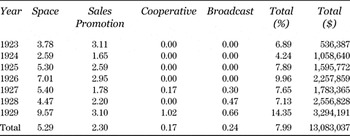
Support for dealers was seen by manufacturers as essential to developing strong relationships that would foster loyalty to the manufacturer's brand and retail policy. This support was achieved through extensive expenditures on cooperative and coordinated advertising and “sales helps,” or point-of-sale advertising material—a strategy also intensively exploited by refrigerator manufacturers.Footnote 50 Cooperative advertising appears to have become popular toward the end of the 1920s, as shown by advertising spend data for RCA (Table 1). RCA's cooperative advertising included a plan under which they paid half the costs of dealers' direct mailings featuring RCA products.Footnote 51 Crosley had initiated support for direct mailing by the start of the 1928/1929 season, offering dealers a set of three mailings for each potential customer, delivered to the dealer stamped and addressed for fifteen cents, for use in conjunction with a door-to-door sales campaign.Footnote 52
RCA's Advertising Expenditure as a Percentage of Sales, 1923–1929

Source: Data sheet on RCA advertising expenditure, n.d. [c. 1930], RCA, Victor Division, Records of the Office of the Company Historian Series II, 2069/2/2, Hagley Museum Archives, Wilmington, Del.
Notes: Total sales figure for 1923 excludes tubes. Total sales for 1925 excludes $913,139 of component parts supplied to Brunswick and Victor, as attribution between firms not known.
RCA's cooperative advertising appears to have grown considerably during the Depression. By the fall of 1931, RCA Victor was operating a system whereby it and the local distributor each paid 25 percent of a dealer's print advertising costs, providing certain conditions were met—including at least 50 percent of total advertising space being used to illustrate RCA merchandise and the RCA Victor name featuring at least as large as that of the store's.Footnote 53 For major accounts, such as chain stores, RCA offered to meet 50 percent of advertising costs, for expenditures up to 5 percent of the chain's purchases.Footnote 54
Manufacturers also engaged in extensive advertising-support activities for dealers, including “ready-made” newspaper ads into which stores could insert their own details. Other aids included billboard posters, window display material, store interior displays, electric signs, and advertising novelties.Footnote 55 Some manufacturers also provided sales training. By 1925, De Forest's sales department was running a radio salesmanship and service correspondence course—which around eight hundred dealers had completed—combining home study with discussion meetings among relevant staff in each store.Footnote 56
Manufacturers also sought to coordinate their own customer advertising with their dealers. As Table 1 shows, direct space advertising from 1923 to 1929 was equivalent to around 5.3 percent of RCA's sales revenue and accounted for two-thirds of its advertising expenditure. By 1927, RCA was supplementing its national magazine advertising with newspaper advertising in major cities, while urging its distributors to encourage dealers to arrange tie-in promotions, such as set demonstrations.Footnote 57
The Radio Dealer
In 1926, when the launch of NBC inaugurated national network broadcasting, an estimated thirty-one thousand radio retailers and one thousand wholesalers sold the output of some two thousand manufacturers to a national radio audience of around twenty million (who owned five million receivers).Footnote 58 Yet despite the rapid growth of equipment sales, the retail sector demonstrated significant dealer mortality. The National Electrical Manufacturers Association sponsored a Department of Commerce survey of dealers—defined as any retailer that carried an average stock of $500 or more in radio merchandise—that covered the three quarters beginning from October 1, 1927. Of over thirty-one thousand dealers identified in each quarter, more than one thousand had gone out of business by the next quarter—suggesting an annual failure rate of about 13 percent.Footnote 59 Dealers were required to carry significant stocks of expensive, and rapidly depreciating, equipment. A 1930 national survey found that retailers typically stocked around five different brands of radio and that stocking an excessive range contributed to failures, by accentuating obsolescence risks.Footnote 60 Given that in 1933 the largest nine radio set manufacturers were said to account for 74 percent of industry turnover, a typical store would thus stock around half the leading brands.Footnote 61
Problems of depreciating stocks were accentuated by highly seasonal demand. The 1930 survey found that 39 percent of business was conducted over the October-to-December quarter, compared to only 16 and 17 percent in the April-to-June and July-to-September quarters, respectively. A number of dealers turned to supplementary lines, principally electrical appliances, to reduce seasonal fluctuations.Footnote 62 Dealers also faced problems with trade-ins, estimated to feature in at least 40 percent of radio sales by the late 1920s. Trade-ins lowered margins and gave the retailer the dilemma of either selling used radios in competition with new stock or disposing of them at a total loss or at a price that contributed little to the trade-in allowance.Footnote 63 Yet they also enabled dealers to engage in price competition, without openly flouting manufacturers' list prices.
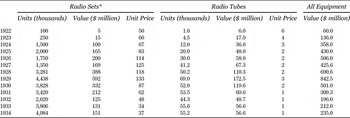
Business risks were further accentuated by credit sales. Radios were relatively expensive household durables in the 1920s. As Table 2 shows, the average 1924 unit price of a home radio was around $67, plus the cost of four or five tubes (sold separately, for around $3 each), batteries, and other accessories.Footnote 64 As radios became grander and more complex, prices rose further, peaking at $133 in 1929 (again, before tubes). Not surprisingly, credit facilities rapidly became integral to retail success.
Sales of Home Radio Apparatus in the United States (Units and Dollar Values), 1922–1934

Sources: Thomas Eoyang, “An Economic Study of the Radio Industry in the United States of America” (PhD diss., Columbia University, 1936), 73–85; corrected using original data from Radio Retailing, Mar. 1931, 20–21; Mar. 1932, 18–19; and Mar. 1933, 17–18.
Notes: Based on Radio Retailing data, shown at retail values. * Excludes cost of tubes.
In 1928, RCA estimated that approximately 70 percent of radios were sold on deferred payments; a 1930 estimate put the figure at 75 percent—on a par with other high-ticket consumer durables.Footnote 65 Of thirty-three dealers surveyed by the Department of Commerce in 1930, only one conducted business on a cash-only basis, while for the rest an average of 80 percent of radio sales were made on credit. Most financed deferred payments using their own funds or bank loans; only 21 percent relied exclusively on a finance company. The most common terms involved a 10 percent down payment with the balance payable monthly over ten to twelve months, typically at 6 percent annual interest.Footnote 66
Several manufacturers arranged credit plans for their dealers. By September 1928, RCA was advertising a Commercial Investment Trust plan, which provided dealers with an immediate advance of 90 percent of the unmatured face value of their paper, less a discount charge. The remaining 10 percent was then deducted from the final payment on the contract. Under this scheme the only cost to the dealer was the service charge, which could be passed on to the purchaser by adding 0.5 percent per month to the cash price.Footnote 67 Unlike the automobile sector, where dealers claimed to be coerced into using finance companies tied to manufacturers, even facilities promoted by the set makers typically involved independent finance companies.Footnote 68 This reflected both the weaker market power of individual manufacturers in radio and the impracticality of dealers holding large inventories, given highly unpredictable obsolescence. However, the absence of manufacturer-tied credit removed a potential source of cyclical demand stabilization. One justification for tied finance in automobiles was that it would be maintained during hard times, when independent finance companies might tighten credit provision.Footnote 69 Indeed, during the Depression the availability of radio commercial time-payment paper tapered off, becoming practically nonexistent by 1932, according to Radio Retailing. Dealers were thus forced to finance credit directly, which gave better-capitalized firms a competitive edge. It was not until the mid-1930s that finance companies again began to show interest in this sector.Footnote 70
Taking Radio to the Prospect's Home
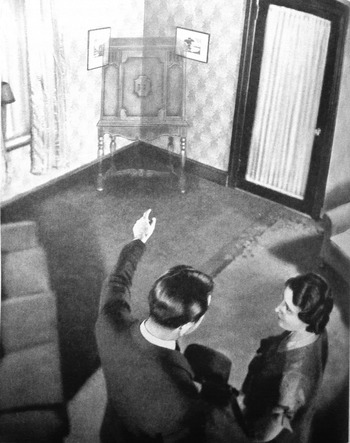
Canvassing, already a proven sales method for the phonograph, was quickly adopted in the radio trade.Footnote 71 By the mid-1920s it had become common for dealers to engage in door-to-door selling, typically offering to set up a radio in the home and leave it for several days on trial. This was a relatively novel innovation, though it had been employed by Eureka Vacuum Cleaner Co. from 1912 and was widely used by refrigerator manufacturers in the 1920s.Footnote 72 Home demonstrations had a number of important attractions for radio: allaying fears that operation might prove too complex, or reception too weak, and introducing the family to broadcast entertainment over several days.Footnote 73 Buyers often perceived home demonstrations as a good way of testing a set's performance, though from the dealer's perspective the strategy was seen primarily “as a lever to accelerate the normal process of the realization of the need . . . [and] to stimulate desire,” as shown in Figure 1.Footnote 74 It also avoided price comparison with cheaper models, boosting the sales of large console sets.
“Realizing the need” via home canvassing and demonstration, as visualized by Radio Retailing in 1930. (Source: H. U. Mann, “Selling in the Home Multiplies Desire,” Radio Retailing, May 1930, 22–24.)

A 1925 Radio Merchandising survey found that 38 percent of radio dealers in the United States and Canada used door-to-door canvassing.Footnote 75 J. J. Moore, manager of the radio department at New Orleans department store Maison Blanche, stated in 1925 that the most important factor in radio sales was home demonstration, followed by price and service.Footnote 76 In 1929, Radio Retailing estimated that most radio dealers employed at least two outside salesmen full-time, with more recruited for special campaigns. Paying a straight commission of 15 percent or less (with salesmen covering their own expenses) was considered most satisfactory.Footnote 77
Radio manufacturers vigorously promoted door-to-door selling. For example, in February 1929, Crosley Broadcaster informed dealers that “[d]uring 1928 the sale of Crosley sets was built up to record-breaking proportions by means of home demonstration.”Footnote 78 Yet radio trade journals were receiving more and more correspondence from dealers arguing that direct sales held limited, if any, attraction for them. Retailers found direct selling difficult to manage, expensive, and—given the rapidly growing proportion of replacement sales—a high-cost means of fighting for people already in the market, rather than a means of creating a new market. Moreover, the minimum efficient scale for direct selling—a team of four or five salesmen working collectively from a single vehicle—required a much larger territory for year-round employment than the catchment areas of most stores. The main exceptions were large traders such as department stores, though these were said to follow conservative selling policies, often eschewing outdoor canvassing.Footnote 79 Personnel problems represented another key obstacle; a 1930 survey noted that “many store managers have found it impossible to secure men who are intelligent and sufficiently aggressive. . . . More than two-thirds . . . definitely stated that the problem of securing the right type of men . . . was continually bothering them.”Footnote 80
By the late 1920s, Victor's Talking Machine Division was seeking to address these problems by establishing direct sales organizations in each wholesaler, to be at the disposal of successive dealers for short periods of intensive selling. Where circumstances warranted, the wholesaler might turn over one or two experienced salesmen to the dealer on a permanent basis. It was anticipated that this would boost sales both directly and by encouraging retailers to intensify their own direct sales efforts.Footnote 81 The “Victor Resale Plan” followed the broad outlines of established resale plans in other industries, such as vacuum cleaners, with the manufacturer running the direct sales effort and the dealer being responsible for itinerary, installment credit, and payment of a 10 percent commission on sales (which, together with a further 2.5 percent commission from the wholesaler, would fully finance the program). Based on experience in the South, crews of five salesmen were expected to close thirty sales per week (ten radiograms and twenty radios). They would be remunerated using a drawing account of $30 per week against 5 percent commission and all expenses.Footnote 82 Atwater Kent was recommending a broadly similar plan by 1929, based on deploying seven salesmen for intensive campaigns of three or four weeks, followed by the permanent retention of two or three men.Footnote 83 However, manufacturer-organized direct selling does not appear to have become firmly established before the Depression curtailed such activity.
A 1928 Radio Retailing national survey of 109 dealers found that around 40 percent of sales were made through canvassing, with those groups of firms undertaking the highest, and lowest, sales being most reliant on canvassers. The survey was pessimistic regarding the value of direct sales: “outside selling is more costly to the merchant and . . . its percentage cost is not reduced through increased volume to a figure comparable with the cost of inside selling.”Footnote 84 Skepticism intensified during the Depression. As an Albany dealer noted, “Too often . . . this makes money for everybody concerned except the dealer.”Footnote 85 Margins were said to be squeezed by opportunistic “joy riders,” who obtained a series of sets from various dealers on home demonstration with no intention of purchasing. One Atlanta dealer reportedly found that each unsuccessful demonstration cost $15 when factors such as damage to cabinets and tube replacements were included—while only one in three resulted in a sale. The resulting costs—including at least $5 for each successful sale—wiped out almost all dealer profit.Footnote 86 A March 1930 Radio Retailing survey of one thousand dealers broadly corroborated these figures. Each successful, and unsuccessful, home demonstration was found to cost $4.51 and $13.43, respectively.Footnote 87
A Radio Retailing survey of 109 radio retailers allows us to test whether dealers' perceptions regarding the poor cost-effectiveness of intensive canvassing were justified.Footnote 88 The sample was said to be well balanced geographically and to cover all types of outlets dealing in radio.Footnote 89 The survey year, 1928, was described as the most profitable to date, with average net profits having increased by 3.3 percent of sales compared to the previous (1926) survey. Yet the survey was surprisingly pessimistic, noting that rising net margins were driven by higher gross margins—boosted by lower stock obsolescence during a year of vigorous demand—while costs had actually increased between the two surveys, by 0.8 percent of net sales. The report singled out rising selling costs as the chief problem. They had risen from 9.4 to 12.0 percent of net sales, while publicity expenses had actually fallen, from 5.1 to 3.3 percent (partly owing to an increase in manufacturers' cooperative advertising). Rising selling costs were, in turn, attributed to increased door-to-door canvassing.Footnote 90
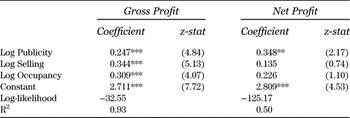
The survey included information on net retail sales, costs of merchandise sold, gross profits (i.e., sales minus cost of merchandise sold), and expenses—divided into occupancy, selling, publicity, administration, servicing, and other costs.Footnote 91 To test whether radio manufacturers pushed their retailers into unattractively high (from the retailer's perspective) levels of selling expenditure, we compare the relative impact of publicity and selling expense on retailers' gross and net profits. Our results, for a cross section of one hundred retailers, are shown in Table 3.Footnote 92 The estimates are derived from the use of generalized least squares (GLS) and transformed in log form to enable the coefficients to be interpreted as marginal effects. Given a view among some dealers that door-to-door sales reduced the need for a well-located store, we also include occupancy expenses as a control variable in both estimations.
Determinants of Gross and Net Profits (GLS Estimates: n = 100)

Source: S. J. Ryan, “109 Radio Merchants Answer the Question—What of Selling Costs?,” Radio Retailing, Sept. 1929, 52–54, 92.
Notes: ***p < 0.01; **p < 0.05. Coefficients are marginal effects. White corrected z-statistics in parentheses.
The table shows that the return on gross profit for selling expenditure was about 40 percent higher than that for publicity spending. Conversely, the return on net profit (after deducting expenses) on publicity expenditure was more than two and half times as high as that for selling—assuming that the coefficient of selling, which is insignificantly different from zero, is consistently estimated. In both cases the results are well determined, being significant at the 1 percent level. Occupancy expenditure similarly shows a markedly greater return on net profits than that for selling expense, despite having a lower return on gross profits.Footnote 93 The analysis thus indicates that direct selling was particularly successful in boosting gross profits, thus benefiting the manufacturer and wholesaler, but offered lower returns than advertising or better retail premises, once the retailer's costs are deducted.
However, while door-to-door selling may not have advantaged the retailer—compared to a situation in which all local dealers abstained from canvassing—it does appear to have acted as a significant barrier to entry. Canvassing was a specialist activity, with significant minimum costs for dedicated staff and their vehicles, which were most efficiently employed in teams operating on a full-time (though perhaps temporary) basis. By reducing the pool of customers who purchased radios through conventional shopping, direct sales thus restricted the potential customer base for vendors not prepared to take on these costs. Moreover, authorized dealers for major radio brands had a competitive advantage in canvassing, as heavy manufacturer advertising boosted brand recognition and was often coordinated with dealers' direct sales campaigns—increasing the likelihood that the salesman would receive a positive reception. Thus, by deterring market entry, canvassing may have benefited the specialist radio retailer more than was evident from its contribution to net margin.
The Depression, the “Midget,” and the Transformation of Radio Value Chains
During the Depression and its aftermath, specialist radio retailers faced a dramatic decline. Despite a rise in U.S. radio output—from 4.44 million sets in 1929 to 6.03 million in 1935—employment in the “household appliances, radio dealers” Census classification had fallen by 34.8 percent, to 71,971. Dollar sales by stores in this group had declined by 53.4 percent (compared with 32.2 percent for all store sales), while the number of dealers had fallen by 26.3 percent.Footnote 94 This was the result of technological changes that transformed radio from an expensive, bulky product requiring frequent servicing to a cheaper, portable appliance.
A new compact radio format, known popularly and in the trade as the “midget,” first appeared in California in 1929 and—as is often the case for new products that challenge incumbent formats—was initially produced by small start-ups that took advantage of the availability of cheap, externally sourced components.Footnote 95 Midget sets were essentially “market breakthroughs”—providing substantially higher customer value (for a segment of the market) using the industry's established core technology, rather than “radical innovations” based on a substantially different technology.Footnote 96 The first midgets were stripped-down versions of standard radios, housed in smaller cabinets. Miniaturized components were introduced in 1932, by Emerson, though these were functionally identical to conventional parts (in contrast to later instances of miniaturization, such as the transistor or microchip).
During the 1920s large manufacturers had generally avoided price competition, relying on brands whose strength was based on quality, innovation, and promotion. The midget's appeal was its price; performance did not initially meet accepted industry standards. However, as radio now provided all-day entertainment, increasingly featuring afternoon soap operas, sports, and other “talk” content, purity of sound reproduction was becoming less important, especially for supplementary sets. Over the 1930s, midgets improved dramatically in quality—challenging conventional radios for a progressively larger segment of the market.
These developments have strong parallels with the mobile phone industry, where economic recession at the beginning of this century depressed sales and triggered a shift in demand to low-price handsets. Marketing efforts thus shifted from quality and branding strategies to the aggressive pricing of entry-level phones, a submarket in which firms outside the established industry proved more successful than the market leaders.Footnote 97 Those firms that became market leaders in small radios had been active in the industry prior to 1929, but not as major receiver manufacturers. Crucially, they typically had established distribution systems. For example, Philco (which tied for receiver market leadership, by volume, with RCA by the end of the 1930s) was a long-established electrical goods producer, which had become a market leader in radio battery eliminators, but only entered receiver production in 1928 (capitalizing on its formidable distribution network). Similarly, Emerson—eventually the largest specialist producer of small radios—had been selling radios since 1924, but as a dealer in surplus equipment rather than a manufacturer.Footnote 98 Major retailers such as Montgomery Ward and Sears Roebuck also took advantage of the shift from brand- to price-based competition, contracting out the manufacture of sets sold under their own retail brands.Footnote 99
Despite lower prices (and profit margins), retailers welcomed the midget as something distinctive and novel in a Depression market burdened by distress sales.Footnote 100 Midgets offered the potential to draw in customers who could not afford a conventional set, had small apartments, or wanted an additional receiver.Footnote 101 The contribution of these small radios to total volume sales increased rapidly, reaching 60 percent of all radios sold between December 1, 1932 and May 1, 1933.Footnote 102 During the 1930s their weight and cost declined sharply—eventually retailing for less than $10 while their performance improved. An innovation initially viewed as a “Depression product” dominated unit sales by the end of the decade.Footnote 103 Midgets also took the lead in styling, appearing in distinctive modern cabinets, often featuring colored Bakelite. Meanwhile, the radio market was experiencing a general trend toward lower unit prices, as shown in Table 2.
Midget radios undermined the quality/branding competitive advantages of the industry's established leaders. Of the four leading set makers in 1929, three—Atwater Kent, Grigsby-Grunow, and Crosley—proved unable to weather this storm.Footnote 104 Only RCA remained as a major player in radio manufacture, though due largely to its strengths in patents, components production, and, increasingly, broadcasting. Moreover, its market position had been strongest in the highest price classes of sets, and it successfully held its lead in these segments during the 1930s.
As a 1930 article noted, the midget appeared to have answered the radio retailer's dream: “no deliveries, no financing, no collection grief, no service. ‘Just one long, sweet process of fittin’ em with tubes and passin’ em over the counter to eager buyers.”’Footnote 105 Yet by reducing the need for home demonstration, delivery, and servicing; credit; and showrooms worthy of a prestige piece of furniture, the midget eroded the key differentiating advantages of the specialist dealer. Moreover, as models had shelf lives of several years, rather than the annual model changes characteristic of conventional radios, the specialist retailer's skills of managing rapidly depreciating inventory commanded less of a premium. By removing the need for the most troublesome aspects of the dealer's activities, the midget had opened up radio to the general retailer, who sold on price and did not require close cooperation with the manufacturer.
Thus it was the weakness, rather than strength, of manufacturers' control over dealers that undermined their long-term survival. Established manufacturers proved powerless to block midget radios, in contrast to British set makers, who suppressed the format throughout the 1930s (using a blacklist of nonconforming retailers—which was perfectly legal in the absence of any effective British antitrust legislation).Footnote 106 In a Depression market, specialist dealers had embraced what they believed to be a novelty and a loss leader, apparently unaware of the fundamental threat it posed to their business model.
Conclusion
Like the refrigerator and washing machine, the radio of the early 1920s was an expensive mechanical novelty, requiring intensive advertising, considerable after-sales service, and costly door-to-door canvassing. By the late 1930s all three of these products had largely been transformed into “staple” merchandise, increasingly marketed via standard retail channels and methods. However, while refrigerators and washing machines experienced this transition as an evolutionary process, with new innovations tending to reinforce the first mover advantages of the leading firms and their established distribution networks, in radio it was marked by major disruptions to established industry structures and distribution channels.Footnote 107
Interwar radio had more in common with modern high-tech durables such as mobile phones. Rapid technological change characterized its development—punctured by frequent “technological discontinuities” that made earlier vintages of radios obsolete (for at least some market segments). Such patterns do not conform to classic product life cycle models, where markets typically become increasingly dominated by early entrants drawing on first mover advantages.Footnote 108 Michael Tushman and Philip Anderson distinguish between “competence-enhancing” technological discontinuities—those building on existing know-how within a product class—and “competence-destroying” technological discontinuities—new product subclasses that require different skills and competitive strengths. The latter are typically launched by firms outside the established industry, leading to rapid changes in industry structure and posing severe problems for established leaders.Footnote 109
Discontinuities in radio technology in the 1920s were generally of the competence-enhancing type, involving new circuits or features that could be most rapidly exploited by existing market leaders.Footnote 110 Conversely, the midget format constituted a competence-destroying discontinuity, competing on price rather than quality. Thus, market leaders with competencies based on quality, promotion, and branding faced a dilemma. As predicted in the literature on technological discontinuities, this innovation triggered both rapid firm entry and exit, with most leading manufacturers facing a rapid decline in market share, or liquidation.Footnote 111
As with more recent market breakthroughs, these changes had important implications for established relationships between manufacturers and their retailers.Footnote 112 Distribution networks based on cooperation failed to block the midget's introduction, owing to manufacturers' limited control over their dealers. Each retailer typically stocked several brands of radio and faced no contractual restrictions on stocking this new format. Nor could informal pressure achieve this end, in an environment of sharply declining sales and prices. Yet by embracing the midget radio, the specialist dealers popularized a format that required substantially less marketing, servicing, and installment credit, undermining their barriers to entry. Radio thus represents an important precursor of the modern pattern of disruptive technological change in high-tech-durables sectors, with even the strongest manufacturers and distributors having to be forever vigilant in watching for the next innovation that might threaten their competitive advantage.