

The timespan of a major cultural movement is difficult to specify with any precision. Aestheticism, the British literary and artistic movement associated with the French-derived notion of art for art's sake, emerges out of Pre-Raphaelitism during the 1860s. This is the decade that gives birth to the innovative, intricately patterned poetry of Dante Gabriel Rossetti and Algernon Swinburne; to Swinburne's influential new style of prose criticism, swiftly adopted by the Oxford don Walter Pater; to the more decorative type of painting espoused by Rossetti and his circle; and to the impressionistic non-narrative paintings of their London-based American friend, James McNeill Whistler.
It is more difficult to say where aestheticism ends. Visiting England in 1881 from Florence on one of her regular summer trips, the writer Vernon Lee thought that “æstheticism . . . has wellnigh died out in London.” Lee was not impressed by what she regarded as the grubby bohemian interiors of the aesthetic set. After a visit to see Jane Morris at Hammersmith, she commented drily: “The room was furnished rather like an extremely dingy sacristy with faded bits of old Italian furniture,” and a year later she wrote of William and Lucy Rossetti's home: “Oh what a grimy, dingy, filthy æsthetic house! I shuddered to sit down in my white frock” (77, 70, 87). But such impressions did not blind her to the attractions of aesthetic furnishings and décor: “I wish we had known, when we furnished, how cheap even pretty æsthetical effects are – japanese chintz curtains, mats & twopenny Morris wallpapers, Queen Anne wicker chairs, rugs & so forth” (77). In a letter of 5 July 1882, she records visiting both Liberty – “the wonderful æsthetic shop. . . . It is really a pleasure to be in it” – and Morris & Co – “The furniture is simple, but much better than elsewhere, & I think everything very cheap” – where she bought rose trellis wallpaper for a screen and red chintz for cushion covers (96).
Lee may have thought that literary aestheticism was dead, but clearly for her “æsthetical effects” were not passé, indeed were still highly desirable. Certainly the longer view of aestheticism includes all its wider and later decorative ramifications in the field of design – not only in terms of furniture and household objects or even dress and jewellery, but also on occasion the very architectural structure of the house itself. This inclusive perspective is understandably the one taken in the important new exhibition, The Cult of Beauty: The Aesthetic Movement 1860–1900, showing at London's Victoria and Albert Museum, then in Paris and San Francisco. Thus, in terms of its literary and artistic reach, aestheticism here also embraces the later phenomenon of “decadence” and the writers and artists of the 1890s, such as Arthur Symons, Ernest Dowson, Charles Ricketts, and Aubrey Beardsley.
This timely exhibition, the first international show on aestheticism, taps into a popular interest in Pre-Raphaelitism and things Victorian – an aesthetic that has been growing steadily since the 1960s. This interest has recently been fed by a thoughtful 2009 BBC documentary series on the Pre-Raphaelites partnered by the serialized drama, “Desperate Romantics,” a jaunty though lamentably inaccurate portrayal of the youthful DGR and friends. Pre-Raphaelite and other aesthetic painters featured prominently in the 2011 Paul Mellon Lectures on the “English Renaissance of Art” in Victorian painting, given to a large public audience at London's National Gallery by Elizabeth Prettejohn, author of the seminal Art for Art's Sake: Aestheticism in Victorian Painting (Reference Prettejohn2007) and curator of a sell-out 2009 Royal Academy exhibition on the painter J. W. Waterhouse. Overlapping with the current V&A exhibition is Birmingham Museum and Art Gallery's excellent The Poetry of Drawing: Pre-Raphaelite Designs, Studies and Watercolours, and Pre-Raphaelite Photography showing at the Musée D'Orsay, Paris. Two other current London exhibitions also feature relevant works: Tate Britain's massive trans-historical survey Watercolour and, more specifically, the Courtauld Institute's critically acclaimed Life, Legend, Landscape: Victorian Drawings and Watercolours. Aestheticism also permeates the programme of the international conference “Decadent Poetics,” Exeter University, 1–2 July 2011, reminding us that there is no clear divide between aesthetes and decadents, with many writers identified as both.
Stephen Calloway, principal curator for The Cult of Beauty at the V&A, is a noted authority on aestheticism who has published on Oscar Wilde and Aubrey Beardsley. A collector in his own right, he has lent a substantial number of items to the current exhibition, including fine examples of decorative book covers and books such as Christina Rossetti's Goblin Market (1865) illustrated by her brother, Malory's Le Morte Darthur (1893) with its cover by Aubrey Beardsley, and Wilde's The Happy Prince and Other Tales (1888) with designs by Charles Ricketts. An exhibition of this kind necessarily privileges visual artefacts rather than texts, but the curators are mindful of aestheticism's literary heritage and identity and have tried to bring this into view at certain moments.
In addition to the displays of books and illustrations, the curators have included contemporary recordings of a number of poems that play continuously at certain locations with the texts displayed nearby. Poems selected are D. G. Rossetti's “Nuptial Sleep,” Christina Rossetti's “In an Artist's Studio,” Swinburne's “Before the Mirror,” Ernest Dowson's “Vitae summa brevis spem nos vetat incohare longam,” Arthur Symons's “Morbidezza,” and W. B. Yeats's “He Wishes for the Cloths of Heaven.” This is an interesting venture, although not a wholly successful one. The Swinburne poem, fittingly teamed with the Whistler painting it celebrates (Symphony in White No. 2: The Little White Girl), was almost inaudible to this reviewer, while the repeated Dowson-Symons-Yeats trio was rather too audible, proving intrusive when one was looking at other exhibits. But it is a useful experiment and will, it may be hoped, encourage some visitors to explore the poems further, which can only be a good thing.
Consonant with its claim that aestheticism – in conception the preserve of an elite – permeated into the middle-class consciousness and the middle-class home, the exhibition draws on a wealth of materials that includes choice examples of blue and white china, wallpaper designs by William Morris, the famous peacock feather furnishing fabric designed by Arthur Silver for Liberty, and elegant furniture by Philip Webb, Christopher Dresser, and E. W. Godwin, as well as items of fashionable dress such as a brown velvet men's “Aesthetic suit” (c. 1880–85) of the kind worn by Oscar Wilde in the famous photograph by Napoleon Sarony. Yet “High Art” is also well represented by a selection of stunning pictures by leading artists such as Rossetti, Whistler, G. F. Watts, Edward Burne-Jones, Frederic Leighton, Frederick Sandys, and Albert Moore, borrowed from galleries throughout the UK. While aficionados of Victorian art may be familiar with many of these paintings, it is thought-provoking to see them again in this particular context and in fresh and interesting juxtapositions that accent shared themes or allow viewers to appreciate similarities and differences in composition. These works have evidently been hung by someone with a good eye for both color and contrast. Thus early on in a section on the Grosvenor Gallery, an influential venue which showed a great deal of avant-garde work, we find two monumental Burne-Jones paintings – The Beguiling of Merlin hung beside Laus Veneris – the subtle cool blues and greens of the first contrasting beautifully with the jewel-like palette of the second. In the final room, “Late Flowering Beauty,” from right to left we have Leighton's coolly sculptural The Bath of Psyche next to the expansive, sensuous warmth of his Hesperides. Next to that is the large imposing vertical of Burne-Jones's The Golden Stairs, all chaste dulcet tones, set alongside the flaming colors of Albert Moore's Midsummer.
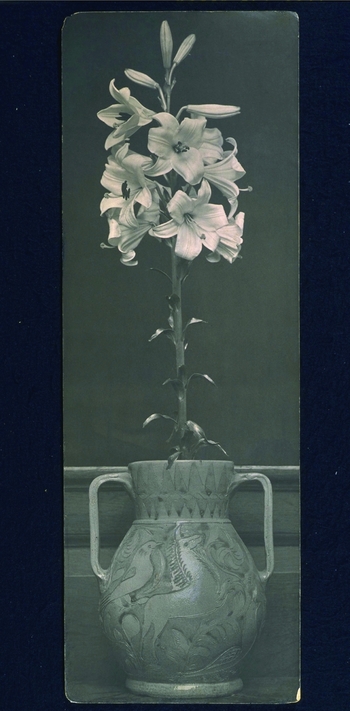
On first entering the exhibition space visitors are presented with a number of aesthetic icons with which to help orient themselves: a plaster cast of Frederic Leighton's wonderful languorous male nude The Sluggard, which will be cunningly echoed in a smaller bronze replica in the final room, a pair of andirons in the shape of sunflowers, A Peacock in oil and gesso by Burne-Jones, an exquisite platinum photographic print of lilies by Frederick Hollyer (Figure 38), a Royal Worcester glazed Parian vase portraying a peacock, and an earthenware charger by the noted ceramicist William de Morgan.
Frederick Hollyer, Flower Study, Lilies. Platinum print. c. 1890. Courtesy of the V&A.
The sunflowers, lilies, and peacocks are, of course, such staple elements in aesthetic literature and design that they become the props of the parodists – Linley Sambourne's Punch cartoon of Oscar Wilde as a sunflower or Beerbohm's retrospective cartoon of a knickerbockered Wilde lecturing lily in hand. They are essential accessories of the aesthetic characters mocked in comedies such as James Albery's Where's the Cat? (1880), Francis Burnand's The Colonel (1881) (for which the cartoonist George du Maurier designed a drawing room set featuring Morris wallpaper, blue china, peacock feathers, and lilies), and W. S. Gilbert's Patience, which famously enjoins the aspiring aesthete to “walk down Piccadilly with a poppy or a lily in your medieval hand.” Satire and parody are evident signs of a cultural phenomenon entering public consciousness, and they are well represented later in this exhibition by various du Maurier cartoons, such as Intellectual Epicures, Ye Aesthetic Young Geniuses, and Ye Gorgeous Young Swells; by “Budge” and James Hadley's camp teapot (Figure 39), whose handle is formed by an aesthetic youth hand on hip; and by Albert Ludovici's greetings cards, which feature aesthetic young people contemplating lilies, sunflowers, and teapots and bear sentiments such as “With Yearnings For Your Intense Joy” (Figure 40) and “May You Have A Quite Too Happy Time.”
“Budge” and James Hadley, teapot. Glazed parian. The Worcester Royal Porcelain Co., Ltd. 1881. Fine Arts Museum of San Francisco. Image courtesy of the V&A.

Albert Ludovici Jr., “With Yearnings For Your Intense Joy.” One of a set of four greetings cards. Color lithograph on paper. Printed and published by Hildesheimer and Faulkner, London. 1882. Courtesy of the V&A.

Once past the opening space, the exhibition is broadly organized into four themed parts, each with smaller interior displays. The early rooms, which come under the banner “The Search for a New Beauty, 1860s,” are devoted to the beginnings of Aestheticism in the Pre-Raphaelites and their contemporaries. New perceptions and styles of human beauty can be seen in a striking succession of paintings of fair women by Rossetti, Leighton, Watts, and Frederick Sandys, and in photographs by Julia Cameron and David Wilkie Wynfield. Here the demure, maidenly, or “angelic” ideal of Victorian beauty gives way to abundantly-tressed “stunners” whose rapt or penetrating gaze draws us into meditative reverie or entices us with voluptuous allure. The marked sensuality of some of the Rossettis provides us with a connection to a nearby display marking “The Fleshly School,” which is represented by the young Swinburne of William Bell Scott's exuberant oil portrait; Venus, an etching by Whistler; Simeon Solomon's wistful homoerotic pen and ink drawing The Bride, Bridegroom and Sad Love (Figure 41); and books of poetry by Christina and D. G. Rossetti.
Simeon Solomon, The Bride, Bridegroom and Sad Love. Pen and ink on paper. 1865. Courtesy of the V&A.

We are reminded that the artisanal side of the movement dates from the same time with arts and crafts items including a pair of copper candlesticks by Philip Webb, a stained glass panel by Burne-Jones, a Morris trellis design for wallpaper, a Webb and Morris chair, and a Burne-Jones and Morris hand-painted tile. Visitors who saw Burne-Jones's charming “Ladies and Animals” sketches in the Birmingham Pre-Raphaelite Designs exhibition can see here the beautifully painted pine sideboard for which they served as preparation. A cabinet display commemorates Rossetti's craze for blue and white china, a decorative taste also reflected in various Whistler paintings and emulated by many would-be aesthetes.
Two evocative paintings of Tudor House, Cheyne Walk by Rossetti's assistant Henry Treffry Dunn allow us to study authentic PRB interiors. The first, often reproduced in black and white, shows DGR with Theodore Watts-Dunton in a sombre yet richly colored sitting room surrounded by an eclectic mixture of antiques, mirrors, and paintings, including his own. The second, which has a faintly eerie gothic gloom, depicting Rossetti's bedroom with its high four-poster, blazing fire, and shelves stacked with blue and white china, the curators have used as a reference as they try to recreate select glimpses of this room. Visitors peer through peepholes to see small portions of a “room” containing carefully arranged objects either belonging to Rossetti – such as his Chinese chair and his sofa – or objects resembling those owned by him – such as a dresser crammed with china. This attempt to recreate an aesthetic interior is matched by another later in the exhibition concerning the Peacock Room (1876), which Whistler designed for his wealthy patron Frederick Leyland. As this room is now in the Freer Gallery, Washington, visitors enter a space in which digital images are projected onto the walls, giving an impression of what it feels like to be surrounded by Whistler's elaborate decorative scheme. Of course it is just a rough impression – some of the images are on the fuzzy side – but it does have the merit of allowing the spectator to experience the space as a three-dimensional one.
The second part of the exhibition, “Art for Art's Sake,” starts with a display dedicated to the Grosvenor Gallery, featuring the two Burne-Jones paintings mentioned earlier (The Beguiling of Merlin and Laus Veneris), as well as other oils by Watts and Millais, and climaxing in Whistler's magisterial portrait of Thomas Carlyle. We then enter a section dominated by Whistler and Godwin, including the former's remarkable Symphonies in White (Nos. 1–3), all featuring white-clad girls, and two of his loveliest Nocturnes – Old Battersea Bridge and Chelsea. This section also displays items of furniture by Godwin, some of it, such as an ebonized mahogany sideboard (1865–75) looking remarkably modern in its minimalism, as well as architectural designs for two Tite Street Houses, one of which belonged to Whistler himself. Subsequent sections examine the influence of Japan and Ancient Greece on the art and design of the period. “Imagined Japan” includes superior examples of the kinds of things collected by Victorians who enjoyed japonaiserie: stencils, tea services, tiles, fabric, and jewellery. “Grecian Ideals” also contains jewellery and furniture but rather more artworks, with sculptures by Watts and Hamo Thornycroft and paintings by Leighton, Sandys, Albert Moore, and Alma-Tadema featuring elegantly draped (or occasionally undraped) figures in Hellenistic settings. There are also examples of graceful Tanagra figurines of the kind loved by Victorian artists – Wilde's Basil Hallward has one in his studio in The Picture of Dorian Gray (1890, 1891). The Grecian influence can also be seen in other highly decorative Albert Moore paintings, such as Reading Aloud and Azaleas, in the section “Pictures Without Subjects,” which illustrates the aesthetic trend to concentrate on form, tone, and color rather than narrative, and also features Solomon's mystical Sleepers and the One that Waketh and Leighton's Mother and Child. Whistler, known for his refusal of narrative, is particularly well represented throughout the exhibition; his exquisite etchings of Venice and London, the subject of his own early shows and published collections, deservedly get a whole section to themselves.
The next part of the exhibition centres on “Beautiful People and Aesthetic Houses in the 1870s-1880s.” It opens with a succession of portraits of wealthy clients, worthies, and patrons by Leighton, John Everett Millais, James Tissot, and others, after which we view items of aesthetic dress and jewellery, such as silk Liberty dresses, a silk cloak, a satin and lace tea gown, the Wildean “Aesthetic suit,” and, among the jewellery, brooches and cufflinks designed by Burne-Jones and a brooch by Charles Ricketts. Designs for decorative room schemes by Albert Moore, George Aitchison, and Thomas Jeckyll are partnered by books such as Charles Eastlake's Hints on Household Taste (1872), Mrs. Haweis's Beautiful Houses (1882), and Clarence Cook's The House Beautiful (1881), all offering discriminating homeowners ways of beautifying their surroundings in the approved aesthetic manner. These are followed by small collections of items by lead designers – Morris & Co., Walter Crane, William de Morgan, Christopher Dresser, Thomas Jeckyll, Lewis F. Day, and Liberty & Co. – as well as some more eclectic gatherings under the headings “Furniture,” “Embroidery,” “Textiles and Wallpaper,” and “Ceramics.” These collections draw extensively on the V&A's own rich holdings and give a sense of the kinds of ornaments, furnishings, and homeware available to Victorian shoppers. While the more exclusive designer items were available only to the wealthy, it is clear that the mass-produced pieces of furniture, ceramics, textiles, and wallpapers were cheap enough to be within the reach of middle-class purchasers, thus popularizing aestheticism and aiding its absorption into mainstream British culture. This widespread awareness of aestheticism is carried through into a small display titled “Satire and Popularity,” which showcases the parodic cartoons and items mentioned earlier.
The fourth and final section, “Late-Flowering Beauty, 1880s-1890s,” contains a range of works on paper, many of them inspired by literary subjects, by artists often associated with decadence. This is a fine selection that includes Charles Ricketts's Oedipus and the Sphinx, Burne-Jones's Fantasy – a chalk drawing of a woman's leaf-wreathed head, Solomon's Love at the Waters of Oblivion, Maxwell Armfield's Swinburnian Faustine, and a range of beautiful, sinuous drawings by Beardsley from the intricate delicacy of Siegfried to the bravura flamboyance of The Abbé, which illustrates his own story “Under the Hill” in The Savoy. These works are complemented by an excellent selection of illustrated books and book covers, such as a Beardsley design for a Yellow Book cover, Morris and Burne-Jones's Kelmscott Press Works of Geoffrey Chaucer, and Ricketts's cover design for Wilde's The Sphinx. Illustrated children's books are fittingly represented by Kate Greenaway's illustrations for A Birthday Book for Children and Walter Crane's designs for The Baby's Bouquet. Next comes a small group of remarkable photographs, most of which have a markedly poetic or atmospheric intensity: Frederick Evans's arresting portrait of Aubrey Beardsley and his wonderful architectural study titled The Sea of Steps; James Craig Annan's Venice from the Lido, clearly inspired by Whistler; and Wilhelm Baron von Gloeden's sensuous study Head of a Sicilian Boy. Sensuous beauty is a keynote of many of the works in the final room, and constitutes an impressive finale to the exhibition. I have already mentioned the striking arrangement of the four beautifully colored canvasses by Leighton, Burne-Jones, and Moore that dominate the far wall of this space, but the sculptures here are also fascinating, with the space centred by a large aluminium cast of Alfred Gilbert's Eros. Gilbert's bronze Icarus; Charles Ricketts's Silence, a figure intended for the tomb of Oscar Wilde; along with two works by Harry Bates – Psyche Borne Aloft by Zephyr and Mors Janua Vitae – alert us to the high quality of much late Victorian sculpture, something that is just beginning to attract the attention it deserves.
This well-organized, nicely designed exhibition pleases both those who are knowledgeable about aestheticism and those who are new to the subject. For Victorianists who know the movement well, there is the pleasure of finding familiar friends and objects of interest in different permutations and contexts – Rossetti as a collector of blue and white china or Burne-Jones and Charles Ricketts as jewellery designers – as well as the opportunity for some new discoveries and insights, such as the remarkable photographic works by Hollyer, Evans, and Annan, the noteworthiness of late Victorian sculpture, and an increased sense of the formative and enduring influence of aesthetic design on British middle-class taste. For newcomers, this is an excellent opportunity to get a sense of the importance of the principal figures and their affiliations as well as a more general perception of the larger cultural impact of the movement.
The exhibition is a good size too, large enough to allow for a leisurely, meditative two to two-and-a-half hours’ survey, but not so overwhelmingly compendious as to induce fatigue. For those of us who teach aestheticism and are lucky enough to have the opportunity, this is a great show to share with one's students; for teachers and students disbarred by geography, there is always the resource of the lavishly illustrated catalogue, edited by the curators, and featuring a range of short essays on topics such as “The ‘Aesthetic’ Woman,” “Late Paintings,” “Punch and Satire,” “The New Sculpture,” and “Religion and Sexuality” by well-known scholars such as Margaret D. Stetz, Elizabeth Prettejohn, Leonée Ormond, Robert Upstone, and Colin Cruise. Most though not all of the works exhibited are depicted, but those featured are supplemented by other relevant images, helping make this a very useful, informative visual guide to the period.
Andersen's English, Sebastian Barry's play about Charles Dickens's domestic crisis in the late 1850s as viewed through the eyes of his house-guest Hans Christian Andersen, opened in London on April 7, 2010 at Hampstead Theatre after a two-month tour of England and Wales. The play shows us the Dickens family as it is irrevocably altered by Charles's separation from Catherine Dickens and the entrance into his life of Ellen Ternan.
Barry's play is part of an intensification of public scrutiny of Dickens's private life, given BBC Films’ announcement in May 2010 that it was to dramatise Dickens's relationship with Ellen Ternan and the publication of Lillian Nayder's biography of Catherine Dickens in October 2010. Yet the representation of Dickens's private behaviour in drama is beset with particular problems. On the one hand, as the literary critic William Skidelsky has recently pointed out, our culture has over the last decade or so been subject to “changing ideas about privacy and truth,” with privacy becoming radically redefined, and “important truths about the world” felt to reside in “personal relationships and feelings” (25). So we now expect that in order to understand Dickens properly we should know and feel what went on behind closed doors or inside his head. On the other hand, in England at least, he is still our national novelist, his books and reforming zeal credited with shaping the nation's social conscience.
Our own age is notably intolerant of perceived hypocrisy; the news media ruthlessly seek out evidence in our public figures of any mismatch between their pronouncements and their private behaviour. At the same time, popular understandings of the Victorians are based on assumptions of repression and hypocrisy whilst we become progressively more distanced from the historical circumstances which may have made some kinds of secret or double life more understandable. Media coverage of Dickens's life means it is no longer possible to evade reference to the Ternan affair, as Yorkshire Television's thirteen-episode dramatisation Dickens of London (1976) artfully did. So, from the point of view of dramatizing Dickens, the major issue is: how do writers show his private life without making him look like the worst kind of humbug? Put more broadly, should he now be cast as hero still, as anti-hero, or as villain?
One popular solution in theatre has been to concentrate on the “performing” Dickens, the Dickens of the reading tours, about whom much is known given his celebrity and the tours’ enormous popularity. Many of these live performances over the years have been solo shows and featured recreations of Dickens reading to a theatre audience cast in the role of his public. Some, from Emlyn Williams's highly successful show, billed Emlyn Williams as Charles Dickens, to Patrick Stewart's readings of A Christmas Carol (Albery Theatre, London, 2005), have made it plain that it is Dickens's work that matters and have sought to recreate his connection between reader and audience. Others deliberately contrast the public and private selves of Dickens and hope to negotiate an accommodation between the two by presenting extracts from the readings interspersed with biographical reflections, as in Simon Callow's long-running The Mystery of Charles Dickens (Comedy Theatre, London, 2000) scripted by Dickens's biographer Peter Ackroyd and related mostly in the third person, or the Edinburgh festival fringe show Pip Utton is Charles Dickens (New Town Theatre, 2010) where Dickens's memories and regrets are delivered in the first person.
In the meantime, British theatre and television have lost confidence in adapting Dickens's novels; it is as if we no longer quite know how to continue believing in his stories. In theatre, for instance, a quarter-century after David Edgar's RSC adaptation of The Life and Adventures of Nicholas Nickleby, the play was successfully revived, directed by Jonathan Church, at Chichester Festival theatre (2006) and later in London's West End. Nevertheless, no other attempt at Dickensian epic theatre and company narration has caught the public imagination in the same way since, and attempts to take a psychological, stripped-down approach to the later novels – which were an arts-theatre and touring staple ten years ago – are now seen much less often. On television, as Heilmann and Llewellyn point out, the relative failure of the BBC's adaptation of Little Dorrit (2008) was followed by the BBC's announcing a move away from adapting nineteenth-century novels altogether (238). The recent focus on Dickens as a performer may, therefore, be a side effect of this loss of faith in the power of literary adaptation. These self-consciously performative, confessional Dickenses have captured the spirit of the age, in Skidelsky's sense of artists’ private lives being perceived as a greater source of truthfulness and insight than their work.
The emphasis on Dickens as performer also provides a way to avoid a complete loss of faith in the man himself, since some biographical and theatrical narratives have fashioned an alternative final-act triumph for Dickens as a reader, a performer, an example of how a man might use and transform his own celebrity. He is represented in these last years as a restless, deeply flawed, more modern kind of artist, rather than a cosy Victorian patriarch. His reading performances of “Sikes and Nancy” thus become the crucible where the new Dickens is forged, “tearing himself to pieces,” as Dickens wrote of these readings, and as Ackroyd has Callow say in his one-man show. These “acts of self-morcellation,” as Malcolm Andrews's fine book on the public readings calls them (260), can be interpreted as the behaviour of one who is both murdering and being murdered, showing us his soul, atoning for and transforming his private “crimes.” As Ackroyd writes, Dickens was “a genius who held on to his ideal against all the odds and who, it might be said, was eventually destroyed by it” (918).
In contrast to this heroic vision of the author dedicated to an ideal rather than terrified of public scandal, Simon Gray's Dickens play, Little Nell (Bath Theatre Royal, 2007) presents him as increasingly weak and ailing, unable to manage Ternan's forceful personality which has been unleashed by their affair. It uses a memory-play form, jumping back and forth between Nelly's developing relationship with “Dick” and the scenes in which her son, Geoffrey Wharton Robinson, comes to see Henry Dickens in 1922 to attempt to find out the truth about his mother's secret life. By imagining the meeting between Dickens's most successful son and the blighted, resentful son of Nelly, Gray's play focuses on the destructive power of secrets. At the end, there is a strong suggestion that Nelly's festering resentment about Dickens's refusal to publicly acknowledge their relationship provoked a final argument in Peckham which led to Dickens's final, fatal stroke. Just as Dickens insisted upon killing his fictional Little Nell, so his real-life “creation” eventually kills him.
Television has responded to the fascination with Dickens's domestic life by using the drama-documentary format. Uncovering the Real Dickens (2002), a three-part BBC series, is presented by Peter Ackroyd. Whilst its dramatised sequences suggest access to a private world, the documentary style gives an impression of balance and comprehensiveness as memories of Dickens's life by himself and others are edited into a single account with the emotive passages contextualised by voice-over narration. Uncovering the Real Dickens begins with the Staplehurst rail disaster of 1865 in which Dickens, Ellen Ternan, and her mother were injured and then recounts the years leading up to that fateful journey. The series also attempts to recreate the theatrical conditions of the readings, with Anton Lesser playing Dickens as performer. The texts of letters and memoirs are performed by actors (many of them well-known, not least from the BBC's own costume dramas), as talking-head style interviews, with tics, pauses, and tearful moments, as if the material were being delivered for the first time to a time-travelling Victorian camera operator.
A much more brief 2008 documentary, Dickens’ Secret Lover, was screened on Channel 4 and presented by the actor Charles Dance as if he were a detective hunting out clues to the relationship. Scenes of Ternan and Dickens acting together in The Frozen Deep and Uncle John are re-created with David Haig as Dickens and intercut with comments from academics. Dance concludes that “we don't judge him, as he might have feared we would,” and approving comments are made about how the darker tone of his later novels was a beneficiary of Dickens's troubled private life. As a coming to terms with Dickens's infidelities, this conclusion sits somewhere between Ackroyd's account of the heroic artist and Gray's portrait of his fear and weakness.
Andersen's English uses something of each of these techniques in its representation of the domestic Dickens. Like Little Nell, it is a memory play beginning and ending with Hans Christian Andersen receiving the news of Dickens's death. It is also a play as much about Dickens's effect on people as about the man himself. As in the BBC documentary, there is the emphasis on family testimony and a variety of perspectives and, as will be explored later, there is more than a hint of the RSC's Nicholas Nickleby about the ensemble production. However, Andersen's English stakes out new territory by dealing with Dickens's life only up to the beginnings of the reading tours and the banishment of Catherine, and in using the visit of Hans Christian Andersen to Gad's Hill Place in 1857 to frame the main part of its narrative. In a series of incidents and conversations spread over the course of Andersen's stay, Barry shows us the Dickens family, unhappy in its own way through not only the often uncomprehending eyes of Andersen, but also through the invented character of an Irish maid, Aggie, who appears to have been made pregnant by Dickens's sixteen-year-old son Walter. Catherine Dickens's strange isolation in this busy house is also explored and a bond of sympathy is forged between Andersen and Catherine. Also, uniquely amongst biographical plays about Dickens, the action remains at Gad's Hill, introducing Nelly Ternan there, giving us a sense of what is to come, but ending before the most well-known episodes. This debut production of Andersen's English was by the theatre company Out of Joint, which was founded by the renowned director Max Stafford-Clark, former artistic director of London's Royal Court Theatre and of Joint Stock Theatre Company. Under Stafford-Clark's direction, Nelly in Andersen's English was played by Lorna Stuart who also plays Kate, making visible the strange fascination for daughter-figures to which Dickens's biographers have consistently returned. So what we have is a “prequel” to the more well-known incidents of Dickens's life in the 1860s: the Ternan affair, the Staplehurst accident, the reading tours, and his supposedly life-shortening performances of “Sikes and Nancy.”
The play's action draws to a close with the callow Walter leaving for India, Dickens laying down to the stunned Catherine the terms of their separation, and Aggie's defiant response to her employer's well-meant but stern paternalism: “I will not go to the place you mention, sir [Urania Cottage, Dickens's reform home for prostitutes] . . . I am not a fallen woman” (80). The last words of the play are Andersen's, describing Dickens standing, waving him off at his departure from Gravesend for far longer than Andersen had thought he would, one implication being that Dickens was bidding goodbye to his old family life, and to the innocent who had witnessed its disintegration.
The idea for Andersen's English, Sebastian Barry has said, first came to him in 1999, and long-time collaborator Max Stafford-Clark had been involved with the project since 2004 (Out of Joint 20). Barry has spoken of having to “strip down” scenes as with an old engine or prune back scenes and let them grow again every year, as if the sheer profusion of material on Dickens's life, the wealth of possible perspectives, made the subject overgrown, unwieldy, or unmanageable (Out of Joint 20). The solution that Barry found is to address Dickens from the periphery, presenting a vision that is more synchronic than diachronic. In this ensemble piece, punctuated by the characters singing the songs of Thomas Moore, we see the intricate patterns of relationships at Gad's Hill: the sympathetically rendered misery of Catherine, the frostiness towards her sister Georgina, the anxiety of, and about, the children.
The domestic space at Gad's Hill is represented in this production by a good deal of Victorian furniture demarcating the different rooms, yet without walls to divide them. This functions on two levels. First, it contrasts Dickens's need for domestic stability with his equally powerful urge to escape, to push forward, to propel himself into the open air. In this play, Dickens is already restless before meeting Ternan, thrown into disarray by his friend Douglas Jerrold's death. The indoors is re-imagined as outdoors in Act 2, when the furniture, still on stage, becomes the scenery of Telegraph Hill, which the family climb snatching secret conversations as they picnic. Secondly, the absence of walls renders visible the physical proximity of those who are gossiped about and mocked. It allows us to see people eavesdropping, or trying to find a moment alone, or about to enter a room but deciding against it. There is often a silent activity to complement or contrast the main focus of our attention in the theatre, very much as Shared Experience's critically admired adaptation of Jane Eyre (1997) kept Bertha Mason visible in the attic of Thornfield throughout. It takes one of the most well-known details from Dickens's relationship with Catherine – the boarding-up of the doorway connecting their bedrooms – and renders it invisible, in the process making a claim that Catherine is the real “invisible woman.”
The production works as a commentary on Dickens's modern biographers and impersonators, but perhaps assumes considerable knowledge in its audiences in order to discern this discursive quality. As Dickens, David Rintoul shows an author performing at all times without acting any role other than himself; spaces clear around him; he wants always to be the sun in this solar system. He is the compulsive public reader of his own works in waiting. Nevertheless, as paterfamilias to a large brood, he treats each child differently, as he does his wife, lover, guest, and servant, bringing home to us the highly social nature of the domestic privacy that middle-class Victorians were in thrall to. Crucially, Dickens does not speak directly to us at the end, as he does in those monodramas which recreate his reading tour farewell speech of 1870. Callow and Utton both perform this speech, in the character of Dickens, during their shows. In Barry's play Dickens always slips beyond our grasp.
The use of puppets operated by the older children to represent the younger children of the Dickens household, is in keeping with the play's slightly dreamlike naturalism, and can also be read as a metaphor for Dickens's (mostly disastrous) attempts to control and influence his children. However, whilst this sense of acting social ritual is amusing, it is perhaps the stylized appearance of the puppets, with their teardrop-shaped heads and rounded noses (see Figure 42) that created some uncertain laughter in the audience on the night I attended; it was hard to read the conventions operating for this scene, in a way that it never seems to be for audiences of, say, Avenue Q. By contrast, the turning of furniture into a landscape creates associations with the imaginative games of childhood, expanding the theatrical palette and allowing the company to act through the production design rather than to it.
Andersen's English by Sebastian Barry. An Out of Joint/Hampstead Theatre co-production. Courtesy of Out of Joint. Photograph by Robert Workman. Left to right: Catherine Dickens (Niamh Cusack), Kate Dickens (Lorna Stuart), Georgie Hogarth (Kathryn O'Reilly), Hans Christian Andersen (Danny Sapani), Walter Dickens (Alastair Mavor), Charles Dickens (David Rintoul), Aggie (Lisa Kerr).

Aggie (played by Lisa Kerr), a very popular character whose curtain call was greeted with cheers and thunderous applause, is an Irish orphan whose perspective as a woman, a colonial subject, and the kind of “fallen” woman that Dickens used Angela Burdett-Coutts's money to try and help contrasts with the dominant view in the house. The character's experience is woven into Barry's pattern of references to the Irish, capturing that Victorian mixed attitude of romanticisation and fear towards their neighbours. This outlook is worked into a larger imperial context with references to the Crimean War and Walter's enforced soldiering career in India.
At the end of the play, the synchronic framework is dismantled. Interwoven with Andersen's memories of his departure are statements from Catherine Dickens, her sister Georgina Hogarth, the Dickenses’ daughter Kate, Aggie, and Ellen Ternan, who all speak directly to the audience, relating their histories after that summer of 1857 (Figure 43). It is rather as if the epilogue of a Dickens biography has come to life. In contrast to the candid gaze of the witnesses in the television drama-documentaries, here the speakers’ ability to explain their subsequent lives, and their deaths, gives them a ghostly quality. Aggie's monologue relating her eventual emigration to Canada and the United States is placed amongst these final statements.
Andersen's English by Sebastian Barry. An Out of Joint/Hampstead Theatre co-production. Courtesy of Out of Joint. Photograph by Robert Workman. Left to right: Georgie Hogarth (Kathryn O'Reilly), Catherine Dickens (Niamh Cusack), Aggie (Lisa Kerr), Ellen Ternan (Lorna Stuart), Charles Dickens (David Rintoul), Stefan (Alastair Mavor), Hans Christian Andersen (Danny Sapani).

Out of Joint's production does to Dickens's own family story what adapter David Edgar and the RSC did to Nicholas Nickleby in 1980, opening out the narrative with conscious theatricality, flexible staging and moments of company narration. However, instead of Nickleby's picaresque vitality, Dickens's late 1850s are rendered as a melancholy and awkward time, and too unformed to be comparable to any narrative of Dickens's own. Some background knowledge is helpful when watching Andersen's English, not only to discern the difference between what is factual, what is imagined, and how the two have been intertwined, but also to follow the relationships and hierarchy within the large family. The scenes also acquire interest from our extra-textual knowledge of what will come next, which is not signalled with the causality that audiences would expect from a purely fictional work. Perhaps, politics aside, this pressure of biographical detail is an important reason for Aggie's presence in the play: without her lean narrative arc, the “baggy monster” of the Dickens family saga would have little dramatic momentum; the writing, or the directing (or the audience) would become swallowed up in the minutiae. Despite his repeated stripping down of the play, Barry needed to write Aggie's story, a second play which takes place under Dickens's roof, as scaffolding to support the collapsing domestic idyll at Gad's Hill Place.
From its opening salvo greeting visitors with John Everett Millais's painting The Huguenot (1851–52), The Pre-Raphaelite Lens: British Photography and Painting, 1848–1875, a recent exhibition at the National Gallery of Art in Washington, DC, offered a stimulating challenge to the visitor to reassess the conventional (one might even say fatigued) understanding of the relationship between nineteenth-century British photography and painting.
The Huguenot is a deceptively complex painting. At first glance it appears as a sentimentalized scene of young lovers in historical costume enacting a theatrical narrative. However, the exactingly detailed garden wall behind them slowly begins to overpower the pair as the vivid clarity of the paint colour and exacting facture renders the image hyper-realistic, with every plant and brick appearing individually rendered from life. It is an aesthetic mode that is undeniably informed by the indexical clarity of photography and its unique technological vision of the world. What appeared to be a simple Victorian genre scene becomes something much more through the infusion of this novel visual mode, the emotional exchange of the pair magnified by the insistent truth of each ivy leaf that seemingly asserts this image as a record of an exact spatial and temporal moment. The Huguenot thus attests to the undeniable impact of photography on Pre-Raphaelitism.
Deftly organized by Diane Waggoner, Associate Curator in the Department of Photographs at the National Gallery, and on view from October 31, 2010 through January 30, 2011, The Pre-Raphaelite Lens enacted an intermedial dialogue between paintings and photographs associated with the Pre-Raphaelite circle across five thematically arranged rooms. The exhibition began with two sections devoted to landscape and views of nature, titled “Minute Details” and “Natural Effects.” These were followed by two more rooms titled “Romance and Modern Life” and “Poetic Subjects” which presented genre scenes and narrative imagery. Finally, the exhibition concluded with a room of portraiture, appropriately titled “Portraits and Studies.” Throughout the wall texts and in her contributions to the accompanying publication, Waggoner established that she did not wish to argue for a simple causal interaction of one medium or artist with another, but rather to locate the “rich correspondence,” the “close formal and iconographical connections,” and the “shared assumptions and goals” of the collaborative Pre-Raphaelite visual network (Waggoner, “Uncompromising Truth” 3). The exhibition challenged stubbornly lingering intermedial divisions by elucidating the nuanced tensions between key issues shared across photography and painting, such as truth and vision, detail and realism, art and science, allegory and adaptation, obsession and celebrity. Within each room, sumptuous groupings of photographs were effectively punctuated by carefully chosen paintings and watercolors, many of which had rarely been exhibited outside Great Britain. Indeed, the tendency of the vibrant and jewel-like paintings to lure the eye away from the monochromatic, if sharply detailed and richly tonal photographs was effectively combated by the curatorial decision to weight the balance at approximately five photographs for every painting. As one work informed the next, the folly of scholarly and curatorial boundaries that keep each medium and artist conceptually as well as physically remote from each other within the museum and the academy was dramatically highlighted. The Pre-Raphaelite Lens thereby succeeded in prompting a reconsideration not only of the influence Pre-Raphaelite painters had on the nascent photographic artistic medium, but also of the profound impact photography had on the developing perceptual acumen of Pre-Raphaelite artists as they sought out new ways to depict the modern age.
The capaciousness of this reciprocal relationship and its power to challenge established aesthetic conventions was most effectively illustrated in the first two sections of the exhibition, devoted to landscape and depictions of the natural world. In his superb contribution to the catalogue, an essay titled “An Antidote to Mechanical Poison: John Ruskin, Photography, and Early Pre-Raphaelite Painting,” Tim Barringer establishes the significant influence of John Ruskin in the formation of this new Pre-Raphaelite model of vision. Barringer traces Ruskin's shifting attitude toward photography in context with his developing theories of truth, vision, and temporality. Central to this discussion is Ruskin's “clarion call” for young artists to:
. . . go to Nature in all singleness of heart . . . and walk with her laboriously and trustingly, having no other thoughts but how best to penetrate her meaning, and remember her instruction: rejecting nothing, selecting nothing, and scorning nothing: believing all things to be right and good, and rejoicing always in the truth. (Ruskin qtd. in Barringer 21)
Although Ruskin dismissed the possibility of the mechanized medium of photography as a legitimate form of artistic expression, he nonetheless acknowledged its invaluable potential for capturing and recording both the endangered natural world and the degrading force of time and neglect on architectural fabric (Barringer 18).
This function of photography as a tool for memorial preservation was captivatingly demonstrated within the exhibition through the inclusion of several very rare examples of daguerreotypes commissioned by Ruskin in the 1850s. A comparison between a daguerreotype such as Fribourg, Switzerland, Rue de la Palme and Pont de Berne (c. 1854 or 1856), attributed to both Ruskin and Frederick Crawley, and Ruskin's own watercolor of the same subject, Fribourg (1859), provokes the question of whether Ruskin followed his own advice to work directly from the motif. Was the watercolour a copy after the daguerreotype, or a record of the same village made over a series of years to capture the passage of time? Or could it even be a hybrid blend of indexical trace and meditative evocation? There is admittedly an inherent paradox in Ruskin's position, employing a tool of modernity to combat modernity's onward march of destruction towards what he perceived as an impending apocalypse. However, as Barringer compellingly argues, this paradox is what rendered Ruskin's philosophy and the Pre-Raphaelite visual mode it inspired so radical. Ruskin helped to foster Pre-Raphaelitism as a movement that did not ignore modernity, but rather sought to counteract its devastating capacity by looking both to the past and the future, embracing historical pictorial approaches while learning from the bold new model of exactingly detailed observation found in photography, forging a unique pictorial approach that was at once “medieval and modern, revivalist and realist” (Barringer 19).
At the study day hosted by the National Gallery in conjunction with The Pre-Raphaelite Lens, a certain hesitancy, one might even say scepticism, pervaded the conversation in relation to the “modernity” of Pre-Raphaelitism across both media. This reluctance is not unfounded, for, in running against the grain of the industrial age, the Pre-Raphaelites did effectively eschew modernism as we have come to define it. And yet, as Barringer argues in his essay and as Waggoner proved throughout the exhibition, their work was very much engaged with the pressing social and artistic issues of the day, as well as embracing the lessons of modernity's newest visual mode, the photograph. Perhaps the hurdle lies, then, in the terminology itself. The paradoxical Pre-Raphaelite approach, one that embraced a novel temporality perpetually oscillating between the past and the future, from the pious eye of early Renaissance devotional paintings to the sharply mechanical eye of the camera lens, could more productively be termed not anti-modern, but “counter-modern.” For while it is accurate to acknowledge that the Pre-Raphaelites stood outside the high modernist trajectory, their artistic project was still productive and resonant, speaking powerfully to their era and containing ongoing relevance for our own moment. By conceptualizing the movement along these terms, it may be possible to offer a constructive way forward for scholars, critics, and the public alike to see with fresh eyes the innovative qualities of the Pre-Raphaelite visual model and its potential significance in the aftermath of the post-modern. Most importantly, the Pre-Raphaelite compulsion to seek out the meaning of visual and emotional truth in the face of the new photographic technology seems to bear a particular relevance for the digital age.
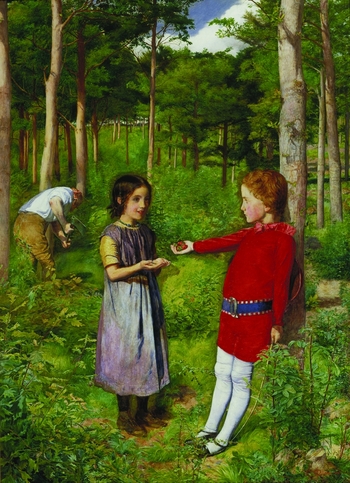
As The Pre-Raphaelite Lens transitioned from depictions of nature to the use of narrative in its third room, this subtle dialogue with digital photography and especially photocollage techniques seemed to emerge through the juxtaposition of two uncanny and strikingly bizarre works, John Everett Millais's oil on canvas painting The Woodman's Daughter (1850–51; Figure 44) and Henry Peach Robinson's albumen print photograph Fading Away (1858; Figure 45). With a shift towards genre and the figural, the visitor might have expected to encounter stereotypical Victorian melodrama; however, the unsettling qualities of Millais's painting and Robinson's photograph quickly overturned such preconceptions. The Woodman's Daughter, painted at the height of Millais's early Pre-Raphaelite style, echoes The Huguenot in its shocking brightness and overwhelming photographic detail, with the forest landscape once again nearly superseding the enigmatic foreground scene of two young children. Indeed, the alluring power of the hyperbolic realism and psychological intensity of Millais's work from this period was perhaps one of the greatest revelations of the exhibition. The title of this painting, The Woodman's Daughter, alludes to Coventry Patmore's poem of the same title of 1844 that relates the story of a rural peasant girl who is impregnated by a squire's son and ultimately drowns herself and her child. This scene from their youth foreshadows the tragedy to come through subtle clues that produce a slowly rising sense of horror in the viewer: the sweetness of the proffered berries, the sting of the switch ready to be raised from the boy's side, the axe blade hovering at the girl's shoulder. The dark halo that currently surrounds the head of the titular woodman's daughter only increases the off-putting effect of the work. It is the result of a pentimento, a later attempt on the part of Millais to respond to the work's poor reception by sweetening the original features of the ill-fated girl.
John Everett Millais, The Woodman's Daughter. Oil on canvas. 1850–51. Guildhall Art Gallery, City of London.
Henry Peach Robinson, Fading Away. Albumen print. 1858. The Royal Photographic Society Collection at the National Media Museum, Purchased with the assistance of The Art Fund.

In an illuminating lecture on this work delivered as part of the symposium, Truth to Nature: British Photography and Pre-Raphaelitism hosted by the National Gallery, Malcolm Warner, Deputy Director of the Kimbell Art Museum, argued for the modernity of Millais's painting as a work that engaged with excessive truthfulness on a visual and emotional level. Warner explicated that, in its original state The Woodman's Daughter was a work that aggressively eschewed the ideal through an exacting process of working from life, as Millais constructed the image bit by bit from a specific section of woodland on an Oxfordshire manorial property through a series of exhausting plein air sessions over the course of eight months. Moreover, Millais carried his dedication to visual truth through to the visage of the young girl, which Warner sought to recreate by undoing Millais's later over-painting. With the aid of Photoshop, Warner substituted alternate heads for the daughter by digitally copying and pasting from early reproductions of the painting and other depictions of the model taken from works such as Millais's The Return of the Dove to the Ark (1851) in an effort to approximate her original appearance. Warner's transgression of the tacit boundaries of digital image reproduction drew an audible gasp from the audience, but it proved a potent means of recapturing the lost impact of the work before its alteration. Interestingly, rather than make the painting more amenable in reversing Millais's obvious retouching, the work became even more unsettling as the unapologetic features, not of a tender innocent, but of a young girl studied from life in all her unforgiving awkwardness helped to increase the realism of the scene and her impending doom.
Admittedly, The Woodman's Daughter is a work that I have always found enigmatically unnerving. Within the context of the exhibition and through Warner's digital reversal of Millais later loss of faith in his original composition, however, the logic of the painting became suddenly apparent and newly persuasive. Millais had sought to apply the photographically exacting truth-to-nature approach not just to landscape, but to the figures as well in an effort to achieve the ultimate in realism and emotional impact. In resisting the idealizing of his young model's features, Millais hoped to produce a painting that forced the viewer to confront the perils of this doomed cross-class romance through indexical testimony to its inherent truth. And yet, although each piece of the compositional puzzle was studied from life, its collage-like approach created by Millais inch by inch over an extended temporal period exposes its own artifice. Although Millais did not employ photographs in preparing this work, he seems to have internalized both the strengths and weaknesses of the photographic medium. While there is much that remains mysterious about The Woodman's Daughter, its inclusion in this exhibition has offered fresh avenues from which to approach this long neglected painting through the lens of photography.
Employing a very different process and approach, Robinson's Fading Away similarly subverts stereotypical Victorian sentimentality through the disconcerting juxtaposition of indexical veracity with dark subject matter. An iconic work of early photocollage that pushes the boundaries of realism and truth, Fading Away borrows theatrical compositional techniques established by genre painting, but constructs the scene through figures cut from separately generated negatives. Fading Away features a prostrate and pale young woman surrounded by three figures in various states of emotional distress prompted (one is led to believe in the title) by her impending death. Much like The Woodman's Daughter, this photograph was poorly received by Victorian viewers who criticized Robinson at first for the shock of photographing such a private and painful moment and later denounced him for the deceptiveness of his photocollage technique. Visitors to The Pre-Raphaelite Lens, all too familiar with the cut-and-paste manipulation of digital photography, were perhaps better prepared to encounter the oppressive effect of cropped and reassembled negatives, but the work still had the power to unnerve, its theatricality overpowered by the airless and claustrophobic quality of the image, as well as the disquieting nature of the morbid scene. For although the young girl immortalized in this photograph may have been alive and well when the work debuted, the scene a complete fiction comprised of living models, she and the figures around her have long since passed away. Fading Away thus emerges as a self-reflexive meditation on the potential of photographic truth to serve as a memento mori that retains its haunting frisson. There appears to be a lesson in both works for the uncanny possibilities of photocollage and digital image manipulation to exploit the tension between falsity and truth in order to access heightened emotional response in the viewer.
Such unexpected revelations couched under the rubric of Pre-Raphaelitism attest to the significance of The Pre-Raphaelite Lens in bringing a fresh approach and heightened profile to the photographs and paintings featured within the exhibition, as well as to the broader understanding of the movement and its unique visual mode. Indeed, in the weeks following my visit to the exhibition, the intimate interrelationship of painting and photography amongst the Pre-Raphaelite circle remained very much in my mind and prompted unexpected realizations and connections. In her recent series of Paul Mellon Lectures delivered at the National Gallery in London and the Yale Center for British Art over the past winter, Elizabeth Prettejohn compellingly argued for the particular importance of the convex mirror as a frequently repeated motif across Pre-Raphaelite art. According to Prettejohn, these recurrent convex mirrors functioned as an allusion to Jan Van Eyck's The Arnolfini Portrait (oil on oak, 1434), acquired by the National Gallery in 1842. The motif came to symbolize not merely an awareness of this major work, but more importantly an invocation of Van Eyck's revelatory visual mode that prompted meditative absorption on the part of the viewer through minutely realized pictorial space.
Prettejohn did not extend her lectures to encompass photography, but her fascinating proposal brought to mind another work featured in The Pre-Raphaelite Lens, Oscar Gustave Rejlander's Infant Photography Giving the Painter an Additional Brush (c.1856; Figure 46). This small, unimposing photograph was one of the first to be featured in the exhibition, just to the left of the entry. A major work for parsing the complexities of the early relationship between art and photography, it was an apt choice to launch the intermedial dialogue of the exhibition. However, it is not an image that one would readily identify with Pre-Raphaelitism and its inclusion, while ideologically significant, seemed a bit out of place. It was only after hearing Prettejohn's lectures and returning to this photograph that I was struck by the prominent appearance of a convex mirror in the background. Rejlander's Infant Photography could thus be interpreted as participating in the Pre-Raphaelite practice of signalling a visual affinity to the devotional visuality of Van Eyck, while simultaneously overtly alluding to the convex lens that comprises the most basic component of the camera found beneath the infant's right arm. Could the prevalence of the convex mirror within Pre-Raphaelite painting, by extension, reference not only Van Eyck, but also the exacting vision of the convex camera lens? The convex mirror could thereby act as yet another example of the counter-modern duality of the movement, bridging the primitive aesthetic of the early Renaissance and the modern technological mode of photography, the past and the future. At the very least, this line of inquiry reveals the major contribution of this exhibition in suggesting new ways of delving deeper into the complexities of the collaborative artistic partnership between Pre-Raphaelite painting and photography.
Oscar Gustave Rejlander, Infant Photography Giving the Painter an Additional Brush. Albumen print. c.1856. The J. Paul Getty Museum, Los Angeles.

I would like to conclude, however, with what I perceived as one of the disappointments of the exhibition, namely, the over-representation in the final sections of the exhibition of the work of Julia Margaret Cameron and the type of dreamy non-narrative female figures that have become synonymous with Pre-Raphaelitism. Photographs by Cameron, such as The Passion Flower at the Gate (1866), Pomona (1872), and The Parting of Lancelot and Guinevere (1874), comprised nearly one-fifth of the total works on view. This disproportionate favouring of Cameron was an effort, in part, to free her work from its usurpation by the pictorialist movement and reclaim her as a participant in the Pre-Raphaelite circle, as well as an acknowledgement of the undeniable strength of her photographic oeuvre. However, the shadow of her sensual portraits hung heavily over the close of the exhibition by offering the viewer an untroubled version of pop culture Pre-Raphaelitism. A paradigmatic example of this type of portrait is Cameron's iconic photograph of 1864, Sadness (Figure 47), found within the last room of the exhibition. Infused with a sepia glow and cropped to mimic the delicate, talismanic form of a cameo, Sadness depicts a beautiful young woman on the cusp of sexual maturity. Her head gently rests against a floral-papered wall as her downcast eyes suggest an expression that is part contemplative, part melancholic. A ray of light grazes the side of her face, highlighting the soft curve of her jawline, the twisting waves of her hair, and the rounded beads of the necklace she absentmindedly clasps between her fingers. Dressed in a simple shift, such a figure could perhaps be mistaken for the infamous fallen woman of the Victorian era were it not for the wedding ring so prominently displayed on her left hand. The identity of this young woman renders the photograph even more evocative; she is Ellen Terry, the recently wed sixteen-year-old bride of painter George Frederic Watts, who would later go on to become a legendary Victorian actress in her own right. Cameron's sensual and suggestive portrait of Terry thus exemplifies the fantastical female daydreamer that has become equated with Pre-Raphaelitism. That the bottom of the photograph is marred by a curious dark form, the result of a damaged negative, only enhances the image's nostalgic appeal, its uneven edges suggesting bits of curled wallpaper peeled back to unveil a window into the past.
Julia Margaret Cameron, Sadness. Albumen print. 1864. The J. Paul Getty Museum, Los Angeles.

The presence of Sadness in the final room of The Pre-Raphaelite Lens was therefore a very fitting, if perhaps anodyne, inclusion. Cameron's work was set amidst photographic and painted portraits of other nineteenth-century British luminaries. Most notable were a set of photographs of the strikingly surreal Pre-Raphaelite muse Jane Morris taken by John Robert Parsons and posed under the direction of Dante Gabriel Rossetti, alongside Rossetti's own painted vision of Morris, Jane Morris (The Blue Silk Dress; 1868). Rossetti, for his part, was depicted in a photograph of 1863 by Charles Lutwidge Dodgson with heavy-lidded eyes suggestive of reverie. Rossetti's Pre-Raphaelite Brother John Everett Millais appeared in a photograph of 1862 by David Wilkie Wynfield dressed in a hood and laurel wreath and in another of 1865 by Dodgson, where Millais is surrounded by his family. Fellow member of the PRB William Holman Hunt could also be found in dual photographic portraits, one by Cameron of 1864 depicting the painter in Oriental costume and a second by Wynfield where he donned a velvet cap and damask coat. Poet Laureate Alfred Tennyson was portrayed in strikingly similar painted and photographic portraits by Watts and Cameron, respectively. Several more images of Terry surrounded Sadness, including Watts's own painting of his child bride, Choosing (1864), another photograph by Cameron with the poetic title The South West Wind (1864), and two photographs by Dodgson. Finally, Watts, the “Signor” himself, rounded out the circle in two meditative photographic portraits from the 1860s by Cameron and Wynfield.
In this room, the Victorian social network materialized before the visitor's eyes in a virtual pantheon of the “famous men and fair women” of the age, to borrow the title of the 1926 monograph on Cameron by Virginia Woolf and Roger Fry. This concluding section of The Pre-Raphaelite Lens thus brought the personal and professional intimacy of this close-knit circle vividly to life, as subjects, compositions, and even lovers were visibly passed from one artist and one medium to another. The fluidity of conceptual exchange between these painted and photographic portraits did much to substantiate the fundamental claims of the exhibition.
And yet, somewhat frustratingly, with works such as Sadness and in a more general sense within this final, portraiture-centric room of The Pre-Raphaelite Lens, the visitor encountered a largely untroubled model of popular Pre-Raphaelitism that has remained stubbornly entrenched since Fry mocked the Victorian “cult of beauty” he found represented in Cameron's photographs. The provocative arrangement of obsessively repetitive images found in this portion of the exhibition, particularly those of Terry and Morris, suggested the burgeoning cult of iconic celebrity worship; however, the subversive possibilities of agency and self-fashioning on the part of these media savvy women and the implications for our own image-saturated moment were only subtly insinuated. The Pre-Raphaelite Lens and its accompanying publication represent a significant contribution to the recent critical mass of work, from exhibitions to academic texts, that has sought to overturn through the mining of ever deeper veins of critical inquiry the lingering aura of archaism and escapism that still clings to the Pre-Raphaelite name. However, as appealing as such fantastically sensual images of bearded men and beautiful women may be, they seem inevitably to overshadow the revolutionary character of Pre-Raphaelitism for the twenty-first-century eye.
Wandering out of the cloistered, immersive realm of The Pre-Raphaelite Lens, the visitor quickly encountered an expansive permanent collection display, From Impressionism to Modernism: The Chester Dale Collection on view concurrently at the National Gallery. Face to face with the jarring juxtaposition of Renoirs, Courbets, and Cezannes, our divided understanding of artistic modernity was made manifest. One could not help but wonder, will the deep-rooted perception of Pre-Raphaelite “anti-modernity” as the artistic other of the nineteenth century ever be conquered and superceded? By exposing the intimate dialogue that arose between photography, the most modern of artistic media, and Pre-Raphaelite painting, The Pre-Raphaelite Lens did much to help foster future avenues of research and visibility for the movement. However, in order for such arguments to break free from their circumscribed constraints as a fascinating, but ultimately irrelevant Victorian digression, the terms of the argument need to be shifted to account for an equally compelling, productive, and radical visuality of the counter-modern avant-garde.
The new film ofJane Eyre, directed by Cary Fukunaga, stars Mia Wasikowska as Jane (The Kids Are All Right, Alice in Wonderland, In Treatment). She's the best Jane Eyre yet on film. She's “plain” in the best senses of that word – unassuming, unpretentious, unadorned, but appealing. Her looks are styled on the Charlotte Brontë portrait by George Richmond in the National Portrait Gallery (as many filmed Jane Eyres have been before), and she plays Jane's direct gaze, her bold honesty, and her steady but quiet self-assertion to perfection. As Rochester, Michael Fassbender (Inglourious Basterds, Band of Brothers) gruffly broods, smolders convincingly, and is particularly good at conveying his desperation after the abortive wedding.
A formidable assemblage of actresses and actors support the two principals. Judi Dench as Mrs. Fairfax made me vividly aware of how important that character is as a foil for Jane, with her garrulous, homey, and conventional ways. Sally Hawkins plays the mean Mrs. Reed, which is amusing on the face of things after her recent role as the preternaturally cheerful Poppy in Mike Leigh's Happy-Go-Lucky. Jamie Bell's St. John Rivers seemed wrong at first, because he doesn't have the imposing stature and the “Greek” profile I expected, yet he gets a good purchase on the character, especially on St. John's coldness and his psychological violence when Jane refuses him. As Adèle Varens, Romy Settbon Moore deftly helps to emphasize Jane's bilingual skill. Adèle's shocking French ways are made to be amusing; and the possibility that she is Rochester's illegitimate daughter as well as his ward is clearly suggested. In this film, we can see how much Jane strengthens herself by mothering, protecting, and learning to love Adèle.
The 2011 film features a rough, rather than an ethereal Helen Burns (Freya Parks), with strawberry blond hair and a prominent Yorkshire accent. The triumvirate of Helen Burns, Adèle Varens, and the young Jane Eyre (Amelia Clarkson) shows three aspects of deprived childhood (and, in particular, girlhood). The fact that Jane is an orphan, that quintessential figure in the history of both melodrama and the novel, who must make her own way and define her own place in the world, is compounded by a kind of figurative child-killing, for Mrs. Reed not only refuses to assume surrogate motherhood and pushes Jane out of the family, but also tells Jane's Uncle John that she is dead.
Everything about this film looks splendid. A choice to use costumes of the 1840s (instead of the 1820s), though anachronistic, happily steers us clear of the empire waist. All the costumes are fabulous, especially the ladies’ bonnets. The settings, too, are beautiful. For the exterior of Thornfield Hall, we have Haddon Hall in Derbyshire, which dates back to the twelfth century (and was also used in the 1996 Jane Eyre). For Thornfield after the fire, we have Wingfield Manor, also in Derbyshire, built in the fifteenth century and ruined during the English Civil War. Inside, the house seems to absorb light and sound, generating a sense of eerie foreboding and “the aspect of a home of the past: a shrine of memory” (Brontë 90). Gothic suspense, mystery, and horror draw on these interior effects of darkness and muffled acoustics. The film's lighting design is masterful – albeit in a way that has become quite conventional in films of Jane Eyre by now – with candlelight and firelight carving out interiors within the interior. The frequent sight of Jane's face, illuminated by the candle she carries, with the darkness looming around her, is perhaps the film's most memorable visual image.
During the Moor House episodes, which figure more prominently in this film than in any other filmed version of Jane Eyre, many scenes are shot from above so as to show the vast expanse of desolation on the moor. After Jane becomes the schoolmistress, her cottage in the snow, exceedingly harsh and solitary, is the scene of St. John's revelation that he knows her real name. The call from Rochester takes place outside, on the moors. While under duress from St. John's proposal, her name, “Jane,” booms out several times very slowly, with acoustics altered so that the voice seems to be expressed by the world of Nature, the entire ambient universe. Jane wheels around and around, seen from above, and looks for the source of the voice (“Where are you?”), before setting out to find it (“I am coming!”). From the beginning of the film until this moment, the moors are used as the objective correlative of Jane's lonely wandering.
In this film the mis en scène often seems to refer to Pre-Raphaelite and other Victorian painting. For example, the death scene of Helen Burns closely follows Golden Head by Golden Head, the 1862 wood engraving D. G. Rossetti, made to illustrate the end of “Goblin Market.” In bed, Helen dead, the two girls’ faces turn toward one another, in profile, with hair flowing symmetrically outward on either side. Another example occurs during the Thornfield episodes. Jane leans within a stone door, framed by its opening (and by lush vegetation) in the attitude of April Love by Arthur Hughes (1855–56). When Rochester portentously introduces “Bertha Antionetta Mason, my wife,” she is seen from the back, looking out the window, and then she turns to face us in white dress and with disheveled hair, looking very much like Whistler's White Girl (1862). At one point, I thought I saw one of the Waterhouse Ophelias flash by; at another, I was sure that Millais's A Huguenot, on St. Bartholomew's Day was being cited; and at another, I felt sure that Rochester had been posed in homage to the Millais portrait of Ruskin. I know that the readers of VLC will pick up on other visual allusions – or, at the very least, will agree with me that the film carefully tries to establish the look of the period, not only through the settings and costumes, but also through allusions to mid-nineteenth-century artistic styles.
All films of Jane Eyre face two narrative quandaries: how to provide a sense of Jane's first-person perspective and how to deal with the introduction, three-quarters of the way through the story, of a whole new set of characters at Moor House. I'll take these up one by one, in order to show that this film offers one and the same solution to both problems.
To lose Jane's narrative voice is a lot to lose from a story in which “voice” is not only the vehicle, but is also overtly thematized (in the extra-sensory call-and-response between Rochester and Jane, for example). In a film, obviously, we miss following Jane's direct account of her thoughts and feelings, as she parses her surroundings with that incessant comparative analysis so characteristic of her narrative voice. (On the other hand, we also lose her sometimes prim circumlocutions, not an entirely bad thing.) A distinctive autobiographical voice is conventionally taken as a mark of character, a sign of presence – when really it is an imitation of a present time of writing, as in the exciting deictic flourish at the beginning of the novel, which plunges us suddenly into Jane's here and now: “There was no possibility of taking a walk that day.” The first few chapters vividly fix our attention within the perspective of the child Jane on “that day,” guiding us toward the immediacy of her primal scene in the red room.
Our absorption in the present time of action can be conjured even more forcibly in film, and that is one of the medium's strengths. Yet none of the Jane Eyre films (that I know of) has created an excellent red room sequence – certainly not this one, where it goes by so fast that one might even miss Mrs. Reed's order to “take her to the red room.” We never learn that Mr. Reed died in that chamber. We do not see the mirror scene, which does so much in the novel to visualize autobiographical introspection and self-reflection. Instead, Jane's terror is trivialized, when Bessie says that if Jane does not quiet herself, “something might come down the chimney.” And of course it does. A puff of wind suddenly blows a cloud of ash outward from the fireplace, after which, terrified, Jane throws herself at the locked door so violently that she knocks herself out and slumps to the floor.
A slightly different aspect of the narrative voice is its retrospective stance, which operates the play of distances between present and past. Brontë has been credited with inventing a certain mixed voice, in which past and present are overlaid and convey at once the chaos of childhood passion and the later, calm adult understanding of it. Thus we feel a standpoint beyond the present action, from which the story is recounted, and which shows through from time to time. Flashbacks can provide a cinematic sense of this retrospective stance (about which more in a moment). In the novel, however, the retrospective standpoint often withdraws behind the scenes, as it were, in favor of present action and passion, sometimes even using the present tense to intensify the effect. But at any moment, that retrospective temporality can intrude on the action, and then the distance between present and past is suddenly both strongly felt and collapsed. For example, in the midst of the red room episode, older-and-wiser Jane interrupts the action to dilate on the way children feel but cannot express their feelings and to forgive Mrs. Reed (using the words of Christ on the cross, “for you knew not what you did”). Or, for example, after Helen's death has been narrated, we are suddenly transported from the past (“Helen was –- dead”) to the present (“Her grave is in Brocklebridge church-yard”). It's a “zoom” effect, but in temporal, rather than spatial terms.
For these autobiographical effects, voice-over narration provides the closest cinematic equivalent. The 2011 film uses voice-over only very sparingly, but many previous films have used it lavishly, and to good effect. In the 1944 film, voice-over provides transitions, signals changing perspectives, treats us to ruminations, and offers intermittent summary analyses. The 1983 BBC version uses voice-over the most, some of which is quoted directly from the novel – not only the opening sentence, but also the wonderful passages of feminist protest from chapter 12. In both these films, the ultimate pay-off comes at the end, when the voice-over can deliver a comprehensive conclusion, such as that of the 1983 film: “We have now been married ten years . . . We are flesh of each other's flesh.” But voice-over can create its own problems, too, interfering with audience absorption in the present time of action.
Then, too (as yet another aspect of narrative voice), there is our experience of reading, largely lost in film, which the novel's Jane so frequently revives through her addresses to the reader. Old-fashioned as it now may seem, the shot of Jane Eyre (the book) that opens the 1944 film does put us in mind of the story's early history as a novel. The book opens in that wonderful old way, with the pages turning on their own, displaying first the film's credits and then an ersatz first page of the novel (“My name is Jane Eyre – I was born in 1820.”). I don't know why the temptation is so strong to substitute other words for the actual words of the novel. The 1996 Zeffirelli Jane Eyre begins “My parents died when I was very young.” Flat and factual, these revisions sacrifice almost all the distinctiveness of voice. Only the 1983 film starring Zelah Clarke and Timothy Dalton begins, satisfyingly, with the novel's actual opening sentence. As a last reminder, the final shot of that film has Jane and Rochester sitting on a bench outside, reading a book.
Now for the other narrative quandary: how to deal with the Moor House episodes. Some films have taken desperate measures. The 1944 film, starring Orson Welles and Joan Fontaine, solves the problem by omitting the Moor House sequence altogether. As a substitute, that film invents a character called “Dr. Rivers” who, at Lowood and again later at Gateshead pressures Jane with a sense of her Christian duty. Likewise, the 1996 film starring Charlotte Gainsbourg and William Hurt returns Jane to Gateshead, “haunted by old memories,” instead of taking her to Moor House. St. John Rivers turns out to be the rector of Gateshead, living with his sister Mary (with no Diana anywhere to be seen). This invented Gateshead sequence is itself radically compressed. When Jane wakes after her faint, she has already been there for one month, and St. John immediately tells her of her inheritance; a few minutes of film time later, she has been there six months, and St. John proposes. She stands there, gravely thinking it over, and suddenly she is heading back to Thornfield with all due speed. This is dramatic condensation with a vengeance! Suffice it to say that the elimination of the Moor House episodes is no solution, but these ludicrous revisions do show the difficulty of the problem.
In the new film, Fukunaga and screenwriter Moira Buffini have attempted to solve this problem, together with the problem of autobiographical narration, by beginning the film in medias res, at the moment when Jane runs away from Thornfield Hall. This is the 2011 film's most distinctive innovation. Water-logged from the rain, sleeping outside on the rocky heath, dropping with fatigue, and desperately hungry, Jane suffers intensely in her flight. If in the novel suspense is generated around the question of how Jane will get back to Rochester in the end, suspense at the outset of this film is more elemental: what is going on? what is she running away from? and why? I wondered what a spectator who had not read the novel might think. For one familiar with the novel, this seemed an intriguing experiment.
After Jane recovers her senses, taken in by St. John Rivers and his sisters at Moor House, the 2011 film begins cross-cutting back and forth between the Moor House episodes in the present and Jane's history before that time, at Gateshead, Lowood School, and Thornfield Hall. Thus the sense of retrospection is well supplied through flashbacks. Some short, sharp flashes seem to come unbidden, as traumatic memories – the sudden, brief sight on the screen of a girl being beaten, for example. More leisurely flashbacks give the feel of reflection, or purposive retrospection – when the film dilates on Jane's relation to Helen Burns, for example. The flashbacks end when, in the course of retrospection, Jane gets to the central Thornfield Hall episodes. Of course that whole sequence is one long flashback itself, but the signs of retrospection have been withdrawn, so that we feel absorbed in a represented present. Eventually, the film catches up to its opening sequence. Jane runs away from Thornfield Hall again, and we see the very same scenes of her flight. The tale has come full circle, and thus we are to understand that from now on out, the action moves forward not retrospectively, but in the present tense of narrative time. (Elizabeth Barrett Browning uses a similar technique in the narrative structure of Aurora Leigh.)
In the novel, the function of the Moor House sequence is to interrupt the narrative momentum, to mark time while Jane is separated from Rochester. The narrative must delay so that we can feel the pressure of that separation. Jane's passion has been suppressed, but she is finally unable to turn her life in another direction. While the pause button is on, though, these Moor House episodes also provide Jane with a family and an inheritance. And they create a foil for Rochester in the ambitious, devout, and repressed St. John Rivers, who “lives only to aspire” and believes that Jane is “made for labor not for love.” So it will not do to omit these episodes, and this film is to be commended for highlighting them.
Moor House is not the end of the story, however. Still to come are Rochester's call, Jane's return to Thornfield Hall, the story of the fire and its consequences, and the reunion of the lovers. All of this is terribly rushed and truncated in the 2011 film, which has thus solved one set of problems only to create another. It manages to suggest autobiographical retrospection through flashbacks from the position of Jane at Moor House, and it solves the problem of introducing a whole new set of characters three-quarters of the way through – since they have already been introduced at the beginning. But as a result, it rushes the several phases of this novel's carefully calibrated closure.
To say that the film should have been longer would be to say that while the choices made in the 2011 film are often good, some important things do go missing. There is no gypsy fortune-telling scene. (The 1983 and 2006 versions do include this scene. They were both written for television, however, which allows for a more leisurely narrative than the usual feature film can afford.) Despite the 2011 film's strategic focus on the Moor House episodes, there is no Rosamund Oliver! And there is no scene of family Bible reading from Revelation, when, using the words of his namesake, St. John tries to force Jane to marry him. Above all, there is not enough consideration of Bertha Mason. In this film Adèle prefigures her appearance, when she tells Jane that her nurse has spoken of a woman walking the halls at night, like a vampire. (Jane dismisses this as nonsense, but we know better.) Grace Poole figures in the film, but her significance is not elaborated; likewise, Bertha sets fires, and finally is seen, but her significance is not developed. Certainly no relation between Jane and Bertha is adumbrated, a relation of the sort that Sandra Gilbert and Susan Gubar taught us to see, in which the “madwoman in the attic” acts out Jane's own displaced rage (Gilbert and Gubar 356–62). I especially missed the pre-wedding scene in which Bertha enters Jane's chamber and tears the wedding veil in half. In that scene of the novel, Jane looks into her mirror and sees not herself but the horrific vision of an unknown other – a clear indication of their mysterious identification.
The film does not do justice to the novel's feminism – in fact, it doesn't really try. The great passage in chapter 12, when Jane paces on the ramparts of Thornfield Hall and chafes against the limitations of her lot, is often rendered – as it is in this new film – at a window and made to seem wistful rather than angry. Jane speaks to Mrs. Fairfax: “I wish a woman had action in her life as a man does. I've never seen a city – never spoken with a man.” Thus the insistence that “women feel as men feel” and “anyone may blame me who likes” is translated into the dreamy romantic yearning of “I've . . . never spoken with a man.” While Jane's aspiration itself is represented – in this scene she wishes she could “overpass” the horizon, and similarly, when Rochester admires her pictures, she ruefully admits that they fall short of her imagination – the feminist element of that aspiration is not. (By contrast, the 1983 film quotes directly from chapter 12 with its stirring voice-over.) In this chapter, Bertha's rage is tacitly associated with Jane's, for the narrative moves directly from Jane's angry protest to this: “When thus alone, I not unfrequently heard Grace Poole's laugh.” As Mary Poovey has pointed out, this narrative association may be read for its psychoanalytic significance (Poovey 146).
Issues of class and the governess's status incongruence (which Poovey also guided us to see) get a better treatment. Rochester first offends Jane by facetiously lumping her together with a sociological group. “What is your tale of woe?” he asks, assuming that “all governesses have a tale of woe.” This offense is compounded when Rochester commands Jane to be present in the drawing room, where she overhears Blanche and Lady Ingram cattily disparaging governesses in general, treating Jane as if she were not there, nobody, not to be taken into account.
But the real center of the film's dilation on class relations comes in the tense, debate-like conversations between Jane and Rochester. During these encounters, they work tenaciously toward some sort of equality. He would like to treat her as an equal, but she points out that she is a salaried worker who must do as he says. When leaving for her visit to Gateshead, she banters with him about her salary, and he archly uses it to make sure she intends to come back. By the time of his proposal of marriage, the terms of their equality have shifted into a spiritual and psychological register. He baits her with the idea that he might marry Blanche – a kind of cruel torment that every film version indulges to the hilt. Driven to distraction, she comes out with her most passionate protest: “My spirit addresses your spirit as if we had passed through the grave and stood before God equal – as we are!” In this film, Rochester forms his proposal around this premise: “You are my equal and my likeness.” (But his growing awareness that Jane is his “other self” is spoiled when, in this film, St. John says the very same thing. Thus it seems rather more a male projection of desire for the female complement than what it is in the novel, a powerful feeling of sympathy and kinship between the two principals.) Yet the spiritual and the material must be reconciled somehow, and Jane does not return to Rochester in the end until she has inherited money and family connections of her own.
This film relies on a version of the tension between the spiritual and the material for its conclusion. The lovers, moved to the point of being overwhelmed by their reunion, wonder whether their joy can be real. Or is it a dream? The film ends with the definitive words “awaken then!” followed suddenly by a blank black screen, and then the credits. How different from – and how much worse than – both the novel's ending and the endings of various film versions that feature the blind Rochester in a sort of “mad scene” as he slowly recognizes Jane (“these fingers – these small, soft fingers!”). With the inevitable loss of Jane's address to her readers in any film version, we also lose the novel's last chapter, beginning with the satisfying “Reader, I married him.” Many of the films of Jane Eyre nevertheless find a way to tell us that Jane has a child (who has inherited his father's eyes); that Rochester's sight partially returns; and what happens to the other main characters. But no film version (that I know of) has attempted to turn us to the letter from St. John Rivers that ends the novel (and which I've analyzed elsewhere). Admittedly, this is a very readerly ending: as we are reading the end of Jane's story, she is reading about the ending of his. What would a good non-readerly ending be? Again, old-fashioned though it may seem, I think the 1944 film provides a good one. After their fierce kiss, as Jane and Rochester are seen, with their backs turned to us, silhouetted against the sky, the voice-over quietly ends: “and then one day . . . he could see that the boy had inherited his eyes as they once were – large, brilliant, and black.”


