




No CrossRef data available.
Article contents
WMS–III performance in epilepsy patients following temporal lobectomy
Published online by Cambridge University Press: 01 March 2004
Abstract
We examined performances on the Wechsler Memory Scale–3rd Edition (WMS–III) among patients who underwent temporal lobectomy for the control of medically intractable epilepsy. There were 51 right (RTL) and 56 left (LTL) temporal lobectomy patients. All patients were left hemisphere speech-dominant. The LTL and RTL patients were comparable in terms of general demographic, epilepsy, and intellectual/attention factors. Multivariate analyses revealed a significant crossover interaction (p < .001), with the RTL group scoring significantly lower on the visual than auditory indexes while the LTL group scored significantly lower on the auditory than visual memory indexes. Within-group pairwise analyses revealed statistically significant auditory versus visual index score comparisons (all p < .001) for both surgical groups. Discriminant analysis (p < .001) identified Verbal Paired Associates I, Faces I, and Family Pictures II to significantly discriminate RTL and LTL patients, with an overall correct classification rate of 81.3%. Our findings suggest that the WMS–III is sensitive to modality-specific memory performance associated with unilateral temporal lobectomy. (JINS, 2004, 10, 173–179.)
Information
- Type
- Research Article
- Information
- Journal of the International Neuropsychological Society , Volume 10 , Issue 2 , March 2004 , pp. 173 - 179
- Copyright
- © 2004 The International Neuropsychological Society
INTRODUCTION
Neuropsychological study of patients who have undergone temporal lobectomy (TL) for surgical control of intractable epilepsy has provided considerable information regarding the cerebral organization of cognitive functions and validity of tests designed to measure these functions. Early clinical research on this population reported an association between unilateral temporal lobe resections and changes in material-specific memory (Blakemore & Falconer, 1967, Kimura, 1963; Milner, 1975; Penfield & Milner, 1958). Verbal memory deficits have been reliably associated with TL involving the language dominant hemisphere (Lee et al., 1989; Naugle et al., 1993; Ojemann & Dodrill, 1985; Sass et al., 1994). Nondominant hemisphere TL has been associated with memory compromise for visually mediated information (Jones-Gotman, 1986; Kimura, 1963; Smith & Milner, 1981), although this relationship has been more difficult to demonstrate (Lee et al., 1989; Naugle et al., 1993; Walton et al., 1999). A number of explanations have been offered for the failure to identify a consistent relationship between nondominant TL and visual memory deficits including ease of verbal encoding of visual memory test stimuli, limited knowledge about the nature of memory stimuli for which the right temporal lobe may be specialized, and by extension, use of tests that reflect a limited theoretical base for the constructs being measured (Barr, 1997; Jones-Gotman, 1986; Novelly et al., 1984).
Valid characterization of a patient's memory functioning both before and after epilepsy surgery has important implications with respect to localization of seizure onset and forecasting post-surgical outcome (Chelune, 1991; Trenerry, 1995). Surgical decisions are made in part following a risk-to-benefits analysis that assesses a patient's chances for seizure control versus acquiring a deficit in functional ability. Such assessments rely on estimating the functional adequacy of cerebral structures in question partly through the application of cognitive tests. Therefore, the search continues for psychometrically sound and clinically useful measures that are sensitive to material specific deficits, particularly visual memory processing.
The Wechsler Memory Scale (WMS) is the most extensively used battery for memory assessment of adults (Larrabee, 1999), and furthermore, is utilized by the vast majority of epilepsy surgery centers as a component of presurgical neuropsychological evaluations (Jones-Gotman et al., 1993). The third edition of the WMS (WMS–III; Wechsler, 1997a) represents a substantial revision of the Wechsler Memory Scale–Revised (WMS–R; Wechsler, 1987). The WMS–III is a vastly improved instrument by virtue of increased size and representation of the normative sample, improved ease of administration, and linkage to the Wechsler Adult Intelligence Scale–Third Edition (WAIS–III; Wechsler, 1997b). Moreover, substantial changes were made to test content that reflect updated conceptualizations of learning and memory, and to address other validity concerns of the WMS–R (Leonberger et al., 1992; Loring, 1989; Naugle et al., 1993). In particular, empirical studies have provided conflicting evidence on the latent structure of the WMS/WMS–R and its ability to discriminate between patients with unilateral left or right lesions (Barr et al., 1997; Chelune & Bornstein, 1988; Moore & Baker, 1997; Naugle et al., 1993). A number of investigators examined the underlying constructs of the WMS–R using either the standardization or mixed clinical samples and found that a two-factor or three-factor solution, neither of which reflected material-specific domains, best characterized the test (Burton et al., 1993; Roth et al., 1990; Wechsler, 1987). However, Moore and Baker (1997) did find a three-factor structure (visual memory, verbal memory, and attention/concentration) that was material-specific for the WMS–R in a sample of intractable epilepsy patients being evaluated for surgical intervention. Naugle et al. (1993) examined the utility of the WMS–R to detect material-specific memory changes following TL in left hemisphere language dominant patients. Their findings showed that left TL was associated with a marked change in short-term and delayed recall, primarily as a result of a post-operative decrement in verbal memory scores. However, right TL was not associated with a decline in visual memory scores. In another study, Barr et al. (1997) investigated the performance of 757 epilepsy surgery candidates on the WMS/WMS–R Visual Reproduction subtest and found no significant differences between those with right or left temporal lobe focal abnormality. These authors concluded that the failure to consistently find a decline in visual memory measures associated with nondominant TL dysfunction or resection is secondary to the use of faulty conceptual models in the development of the WMS/WMS–R nonverbal memory subtests.
In order to address apparent shortcomings of the WMS–R, the WMS–III test developers replaced Figural Memory, Visual Paired Associates, and Visual Reproduction with two new tests of visual memory: Faces & Family Pictures (FamPix). This effort represented an attempt to include material that is difficult to encode verbally, as well as increase the ecological validity of the instrument (Psychological Corporation, 1997). Moreover, there was an effort to move away from designing subtests to measure hypothetical verbal or visual memory systems by instead emphasizing the modality of presentation, which is reflected in the revised index names. Other major changes to the WMS–III primary subtests include substantial revisions of the Logical Memory and Verbal Paired Associates subtests to better reflect acquisition and retention aspects of memory processing. Factor analytic studies were performed across three broadly divided age bands and indicated that a three-factor solution (working memory, auditory memory, and visual memory) provided the best fit for the 16–29 age group and a five-factor solution (working memory, auditory immediate memory, visual immediate memory, auditory delayed memory, and visual delayed memory) best characterized the remaining older age groups (Psychological Corporation, 1997). Millis et al. (1999) further evaluated the latent structure of the WMS–III by performing confirmatory factor analysis on the standardization sample as a whole and found that a three-factor model (working memory, auditory memory, and visual memory) provided the best fit although the Faces subtest had insufficient commonality with the visual memory construct. These data indicate that the underlying structure of the WMS–III supports modality-specific domains of memory performance and that the test may very well be sensitive to unilateral left or right cerebral dysfunction. Therefore, a next step in evaluating the clinical utility of the WMS–III is to determine whether this test detects memory dysfunction in a population known for such neurologic compromise.
The WAIS–III/WMS–III Technical Manual (Psychological Corporation, 1997) reports descriptive data for a sample of temporal lobe epilepsy patients who had undergone unilateral hippocampectomy for treatment of intractable seizure disorder. Results revealed a marginal double dissociation with the left TL cases (n = 15) obtaining higher scores on visual indexes relative to auditory indexes and right TL group (n = 12) showing an opposite pattern of performance. It should be noted that both the right and left TL groups performed comparably low on the visual indexes, suggesting that this index could reflect bilateral/diffuse or nondominant hemisphere dysfunction (Hawkins, 1998), or nonspecific factors such as problems with attention or perceptual organization. However, the sample sizes from this study were small and the data obtained were from a number of epilepsy surgery centers where demographic, seizure, and surgical variables were not matched. Bachtler and Dodrill (2001) investigated the relationship between lateralized brain pathology and WMS–III summary scores for nonverbal and verbal memory. The results showed that Auditory Delayed Index memory scores were significantly lower (p = .03) for the left versus right hemisphere groups. No significant group differences were found for the Visual Immediate or Delayed or Auditory Immediate Indexes. Since the publication of the WMS–III, there have been relatively few studies evaluating the performance of epilepsy patients on this test. Doss et al. (2000) examined the utility of standardized measures of learning and memory including the WMS–III in identifying modality-specific memory deficits in epilepsy patients with and without mesial temporal sclerosis (MTS). They found that FamPix and LM best discriminated patients with right and left MTS, respectively. Wilde et al. (2001) evaluated the ability of the WMS–III to detect lateralized impairment in a large sample of temporal lobe epilepsy patients using group means, ROC curves, and discrepancy scores. These investigators found the Auditory–Visual Delayed Index difference score to be the most sensitive to side of temporal dysfunction although patient classification rates were too low to be clinically useful. Nevertheless, the authors suggest that the WMS–III may still be a promising instrument to document baseline performance and identify patients at-risk for memory compromise following surgery.
The present study was designed to examine performances on the WMS–III among a sample of epilepsy patients who underwent surgical resection of the temporal lobe for relief of medically intractable seizures. We chose a post-surgical sample because material-specific memory impairments are more commonly observed in post-surgical than pre-surgical epilepsy patients with unilateral seizure foci (Lee et al., 1989; Milner, 1975). Therefore, such a population may be well suited to studying the validity of instruments purporting to measure modality-specific memory abilities, such as the WMS–III. Specifically, we compared WMS–III primary index and subtest scores generated from patients following either right or left temporal lobectomy.
METHODS
Research Participants
Research participants consisted of 107 patients, 101 evaluated at the Cleveland Clinic Foundation1
Data from the Cleveland Clinic Foundation were obtained from a neuropsychology patient registry that is anonymous and has undergone review and approval by the Cleveland Clinic Foundation's Institutional Review Board.
The demographic characteristics for the RTL and LTL patient groups are summarized in Table 1. One-way analyses of variance (ANOVAs) yielded no significant group differences for age, education, seizure duration, postoperative interval, prorated WAIS–III Full-Scale IQ, or WMS–III Working Memory Index. Non-parametric chi-square analyses also revealed no significant group differences for sex, handedness, or postsurgical seizure control. There were no significant correlations between postoperative interval and neuropsychological test scores for the entire surgical sample (r = .02–.13). Likewise, there were no significant association between degree of postoperative seizure control and the two surgical groups.
Demographic characteristics by group

RESULTS
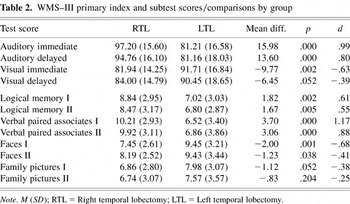
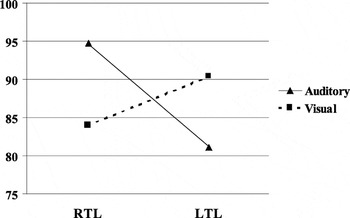
Table 2 presents the group means, standard deviations, and between group univariate comparisons along with effect sizes for WMS–III primary index and subtest scores. In order to determine whether the two surgical groups differed on the WMS–III at the index level, Auditory and Visual Immediate and Delayed Indexes were analyzed using a 2 (group) × 2 (mode) × 2 (time) repeated measures multivariate ANOVA. There were no significant main effects, but there was a significant Group × Mode crossover interaction [F(1,105) = 75.84, p < .001], which is graphically represented in Figures 1 and 2.
WMS–III primary index and subtest scores/comparisons by group


WMS–III Immediate Memory Index Scores. Note. RTL = Right temporal lobectomy; LTL = Left temporal lobectomy.

WMS–III Delayed Memory Index Scores. Note. RTL = Right temporal lobectomy; LTL = Left temporal lobectomy.
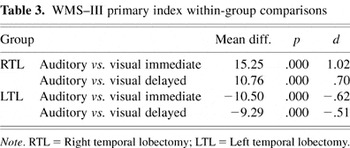
The RTL group scored significantly lower on the visual than auditory indexes for both the immediate (M ± SD = 81.94 ± 14.25, vs. 97.20 ± 15.60) and delayed conditions (M ± SD = 84.00 ± 14.79, vs. 94.76 ± 16.10). The LTL group demonstrated the exact opposite pattern, scoring significantly lower on the auditory than visual indexes for both the immediate (M ± SD = 81.21 ± 16.58, vs. 91.71 ± 16.84) and delayed memory conditions (M ± SD = 81.16 ± 18.03, vs. 90.45 ± 18.65). However, there was a significant Group × Mode × Condition three-way interaction [F(1,105) = 7.46, p < .01], indicating that the interaction between Group × Mode varied by condition. That is, the index score differences both among and between the two groups were significantly more pronounced in the immediate versus delayed condition, which again can be visualized in Figures 1 and 2. Qualitative inspection of the data suggests that a greater discrepancy between the auditory and visual indexes for the immediate condition for the RTL group was primarily responsible for the three-way interaction. There were no other statistically significant interactions. Between-group independent t tests revealed that the RTL and LTL groups significantly differed on all but the Visual Delayed Index, which approached statistical significance (p = .052). Effect sizes (Cohen, 1988) were medium to large for those comparisons found to significantly differ. Pairwise t-tests showed that within group differences on the auditory and visual indexes were statistically significant for all comparisons (p < .001) with medium to large effect sizes (see Table 3).
WMS–III primary index within-group comparisons

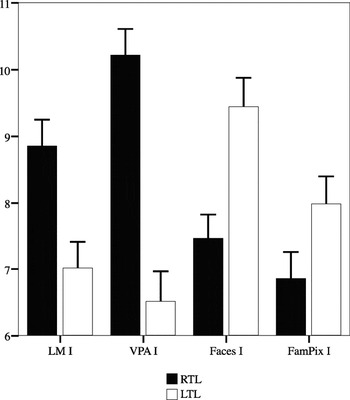
We next sought to determine which primary subtests best discriminated between the two surgical groups. Descriptive statistics as well as group comparisons and effect sizes for both the immediate and delayed subtests are shown in Table 2 and graphically represented in Figures 3 and 4. Significant group differences were found for all subtests except for FamPix I and II.

WMS–III Immediate Primary Subtest Scaled Scores. Note. Error bars indicate the standard error of the mean; RTL = Right temporal lobectomy; LTL = Left temporal lobectomy; LM = Logical Memory; VPA = Verbal Paired Associates; FamPix = Family Pictures.

WMS–III Delayed Primary Subtest Scaled Scores. Note. Error bars indicate the standard error of the mean; RTL = Right temporal lobectomy; LTL = Left temporal lobectomy; LM = Logical Memory; VPA = Verbal Paired Associates; FamPix = Family Pictures.
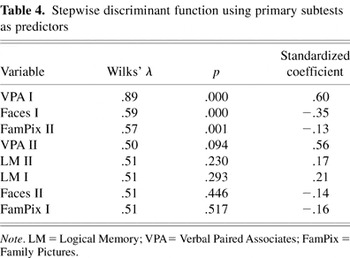
A stepwise discriminant function analysis was conducted to identify which of the eight primary subtests (immediate or delayed) best distinguished surgical group membership. Results revealed the overall discriminant function to be significant [Wilks's Lambda = .51, χ2(3, N = 107) = 69.20, p < .001]. More specifically, Table 4 reveals that VPA I, Faces I, and FamPix II all significantly discriminated RTL and LTL patients, with VPA I providing the greatest relative discrimination. Evaluation of the Wilks's Lambda statistics reveals that 49% of the variance between the two groups is explained by these three subtests with VPA I, Faces I, and FamPix II contributing 25%, 18%, and 6%, respectively. The sensitivity, specificity, and overall correct classification rate based on these three subtests was 79.3%, 83.3%, and 81.3%, respectively. Using the original derivation sample and leave-one-out methodology (Lachenbruch, 1967), the correct classification rate from this discriminant function was cross-validated at 80.4%.
Stepwise discriminant function using primary subtests as predictors

DISCUSSION
The current study indicates that right and left temporal lobectomy patients perform differentially on the WMS–III. Those patients who received LTL demonstrated worse performance on the WMS–III verbal memory tasks relative to both their own visual memory scores and the RTL group's verbal memory scores. The RTL group showed an opposite pattern of scores with worse performance on the visual memory tasks relative to their own verbal memory scores and the LTL group's visual memory scores. Analysis of the individual WMS–III subtests indicated that VPA I, Faces I, and to a lesser extent, FamPix II best discriminated the LTL and RTL groups with nearly 50% of the variance accounted for. It should be noted that the magnitude of the observed differences between the RTL and LTL groups is clearly greater for the auditory versus visual memory scores, which is consistent with previous research.
These findings suggest that the content changes from the WMS–R to WMS–III are more sensitive to the cognitive effects of unilateral surgical resection of the temporal lobe. Notably, it has been difficult to consistently demonstrate visual memory deficits associated with RTL and the double dissociation of performance seen with the current WMS–III data has not been previously shown for the WMS–R. The WMS–III visual memory subtests seem to better reflect cognitive processes subserved by the right temporal lobe. Our analyses indicate that the two surgical groups performed quite differently on Faces I with the RTL group obtaining significantly lower scores than the LTL group. These results are not unexpected given the empirical and clinical data strongly suggesting right hemisphere superiority in the processing of facial information (Barr, 1997; Dade & Jones-Gotman, 2001), particularly for right temporal–occipital lobe regions (Kanwisher et al., 1997).
It may be that adequate processing of the Faces subtest relies on intact functioning of the fusiform face area (Kanwisher et al., 1997), which is likely compromised to some degree following resection of mesial and lateral right temporal lobe tissue. Both surgical groups obtained relatively low scores on the FamPix subtest albeit for possibly different reasons. Holley et al. (2000) examined the three scoring components (character, location, and action) of the FamPix subtest among RTL and LTL patients and found that location was the most sensitive to RTL once verbal mediation strategies were controlled for. Therefore, spatial processing deficits may underlay the RTL group's rather poor FamPix performance. Impairment in spatial memory following RTL has been documented by other investigators (Owen et al., 1995; Smith & Milner, 1981) although negative findings have been reported as well (Barr, 1997; Malec et al., 1992). On the other hand, we believe the LTL group's low performance on FamPix is most likely related to this group's general weakness in verbal cognitive ability. There is a great deal of content within FamPix that can be verbally encoded including the names of family member (e.g., “mother”), scenes (e.g., “picnic”), and activities (e.g., “shopping”). Therefore, it could be expected that LTL patients would score lower on this test given this group's propensity to demonstrate weakened verbal function beyond learning/memory (Seidenberg et al., 1998; Straus et al., 2000). The ease with which FamPix can be verbally encoded confounds the application of this subtest as a visual memory task. Within the RTL group, performance of FamPix is clearly discrepant from LM and VPA scores and serves as the most discriminating modality-specific memory measure for this surgical group. The performance of the two surgical groups on the auditory memory measures was as expected and consistent with previous research findings and clinical experience.
It was determined that the immediate verbal and visual memory measures discriminated the two surgical groups somewhat better than the delayed memory measures. The relevance of this finding is equivocal in light of recent WMS–III factor analytic studies using both standardization and clinical samples (Millis et al., 1999; Wilde et al. 2003) that showed little support for distinguishing these memory tasks along a temporal dimension due to high correlations between the immediate and delayed conditions. The neurological compromise for this particular clinical sample seems to be best captured by the immediate rather than delayed memory measures of the WMS–III. This could be due to the nature of human memory dysfunction associated with temporal lobectomy and/or an artifact of test construction. Additional WMS–III validation studies using patients with other neurological disorders may help to clarify this question.
This study has evaluated learning and memory function in post-surgical temporal lobe patients, a population that has traditionally shown clearer group differences in performance than nonsurgical patients. The WMS–III appears to be reasonably sensitive to the effects of TL. Nevertheless, recent research suggests that using the WMS–III to classify preoperative epilepsy patients with lateralized abnormality is more problematic (Wilde et al., 2001). Although a number of factors (see Dade & Jones-Gotman, 2001) make the study of preoperative epilepsy patients more difficult, there remains a clear need to examine whether the WMS–III is clinically useful in predicting those patients at risk for post-surgical deficits or decline. Future studies will need to address the predictive power of the WMS–III as it relates to other known and frequently used learning/memory measures. Finally, it is hoped that results from these studies will lead to further improvements in this popular battery of learning and memory tests so that the next iteration of the WMS may be able to discriminate left and right temporal lobe pathologies more accurately.
References
REFERENCES
Bachtler, S. &
Dodrill, C.B.
(2001).
Wechsler Memory Scale III (WMS–III) auditory and visual memory
scores and lesion laterality.
Epilepsia,
42
(Suppl. 7),
234.Google Scholar
Barr, W.B.
(1997).
Examining the right temporal lobe's role in nonverbal memory.
Brain and Cognition,
35,
26–41.Google Scholar
Barr, W.B.,
Chelune, G.J.,
Hermann, B.P.,
Loring, D.W.,
Perrine, K.,
Strauss, E.,
Trenerry, M.R., &
Westerveld, M.
(1997).
The use of figural reproduction tests as measures of nonverbal
memory in epilepsy surgery candidates.
Journal of the International Neuropsychological Society,
3,
435–443.Google Scholar
Blakemore, C.B. &
Falconer, M.A.
(1967).
The long term effects of anterior temporal lobectomy on certain
cognitive functions.
Journal of Neurology, Neurosurgery, and Psychiatry,
30,
364–367.Google Scholar
Burton, D.B.,
Mittenberg, W., &
Burton, C.A.
(1993).
Confirmatory factor analysis of the Wechsler Memory
Scale–Revised standardization sample.
Archives of Clinical Neuropsychology,
8,
467–475.CrossRefGoogle Scholar
Chelune, G.J.
(1991).
Using neuropsychological data to forecast postsurgical cognitive
outcome. In
H. Luders (Ed.),
Epilepsy surgery (pp.
477–485).
New York:
Raven Press.
Chelune, G.J. &
Bornstein, R.A.
(1988).
WMS–R patterns among patients with unilateral brain lesions.
Clinical Neuropsychologist,
2,
121–132.Google Scholar
Cohen, J.
(1988).
Statistical power analysis for the behavioral sciences.
Hillsdale, NJ:
Erlbaum.
Dade, L.A. &
Jones-Gotman, M.
(2001).
Face learning and memory: The Twins Test.
Neuropsychology,
15,
525–534.Google Scholar
Doss, R.C.,
Risse, G.L., &
Gates, J.R.
(2000).
Predicting mesial temporal sclerosis in epilepsy patients using the
WMS–III and traditional measures of learning and memory.
Epilepsia,
41
(Suppl. 7),
158.Google Scholar
Hawkins, K.A.
(1998).
Indicators of brain dysfunction derived from graphic
representations of the WAIS–III/WMS–III Technical
Manual clinical samples data: A preliminary approach to clinical
utility.
Clinical Neuropsychologist,
12,
535–551.Google Scholar
Holley, F.K.,
Lineweaver, T.T., &
Chelune, G.J.
(2000).
Performance differences on three components of the family pictures
subtest among right and left temporal lobectomy patients.
Archives of Clinical Neuropsychology,
15,
679.Google Scholar
Jones-Gotman, M.
(1986).
Right hippocampal excision impairs learning and recall of a list of
abstract designs.
Neuropsychologia,
24,
192–203.Google Scholar
Jones-Gotman, M.,
Smith, M., &
Zatorre, R.J.
(1993).
Neuropsychological testing for localizing and lateralizing the
epileptogenic region. In
J. Engel (Ed.),
Surgical treatment of the epilepsies
(2nd ed., pp.
245–261).
New York:
Raven Press.
Kanwisher, N.,
McDermott, J., &
Chun, M.M.
(1997).
The fusiform face area: A module in human extrastriate cortex
specialized for face perception.
Journal of Neuroscience,
17,
4302–4311.Google Scholar
Kimura, D.
(1963).
Right temporal lobe damage: Perception of unfamiliar stimuli after
damage.
Archives of Neurology,
8,
264–271.Google Scholar
Lachenbruch, P.A.
(1967).
An almost unbiased method of obtaining confidence intervals for the
probability of misclassification in discriminant analysis.
Biometrics,
23,
639–645.Google Scholar
Larrabee, G.J.
(1999).
Wechsler Memory Scale III.
Archives of Clinical Neuropsychology,
14,
473–477.Google Scholar
Lee, G.P.,
Loring, D.W., &
Thompson, J.L.
(1989).
Construct validity of material-specific memory measures following
unilateral temporal lobectomy.
Psychological Assessment,
1,
192–197.Google Scholar
Leonberger, F.T.,
Nicks, S.D.,
Larrabee, G.J., &
Goldfader, P.
(1992).
Factor structure of the Wechsler Memory Scale–Revised within
a comprehensive neuropsychological battery.
Neuropsychology,
6,
239–249.CrossRefGoogle Scholar
Loring, D.W.
(1989).
The Wechsler Memory Scale–Revised, or the Wechsler Memory
Scale–revisited.
Clinical Neuropsychologist,
3,
59–69.Google Scholar
Malec, J.F.,
Ivnik, R.J.,
Smith, G.E.,
Tangalos, E.G.,
Peterson, R.C.,
Kokmen, E., &
Kurland, L.T..
(1992).
Visual Spatial Learning Test: Normative data and further validation.
Psychological Assessment,
4,
433–441.Google Scholar
Millis, S.R.,
Malina, A.C.,
Bowers, D.A., &
Ricker, J.H.
(1999).
Confirmatory factor analysis of the Wechsler Memory Scale–III.
Journal of Clinical and Experimental Neuropsychology,
21,
87–93.Google Scholar
Milner, B.
(1975).
Psychological aspects of focal epilepsy and its neurosurgical
management.
Advances in Neurology,
8,
299–321.Google Scholar
Moore, P.M. &
Baker, G.A.
(1997).
Psychometric properties and factor structure of the Wechsler Memory
Scale–Revised in a sample of persons with intractable
epilepsy.
Journal of Clinical and Experimental Neuropsychology,
19,
897–905.Google Scholar
Naugle, R.I.,
Chelune, G.J.,
Cheek, R.,
Lüders, H., &
Awad, I.A.
(1993).
Detection of changes in material-specific memory following temporal
lobectomy using the Wechsler Memory Scale–Revised.
Archives of Clinical Neuropsychology,
8,
381–395.Google Scholar
Novelly, R.A.,
Augustine, E.A.,
Mattson, R.H.,
Glaser, G.H.,
Williamson, P.D.,
Spencer, D.D., &
Spencer, S.S.
(1984).
Selective memory improvement and impairment in temporal lobectomy
for epilepsy,
Annals of Neurology,
15,
64–67.Google Scholar
Ojemann, G. &
Dodrill, C.
(1985).
Verbal memory deficits after left temporal lobectomy for epilepsy.
Journal of Neurosurgery,
62,
101–107.Google Scholar
Owen, A.M.,
Sahakian, B.J.,
Semple, J.,
Polkey, C.E., &
Robbins, T.W.
(1995).
Visuo-spatial short-term recognition memory and learning after
temporal lobe excisions, frontal lobe excisions or
amygdalo-hippocampectomy in man.
Neuropsychologia,
33,
1–24.Google Scholar
Penfield, W. &
Milner, B.
(1958).
Memory deficit produced by bilateral lesions in the hippocampal
zone.
Archives of Neurology and Psychiatry,
79,
475–497.CrossRefGoogle Scholar
Psychological Corporation
(1997).
WAIS–III–WMS–III technical manual.
San Antonio, TX:
Author.
Roth, D.L.,
Conboy, T.J.,
Reeder, K.P., &
Boll, T.J.
(1990).
Confirmatory factor analysis of the Wechsler Memory
Scale–Revised in a sample of head injured patients.
Journal of Clinical and Experimental Neuropsychology,
12,
834–842.Google Scholar
Sass, K.J.,
Westerveld, M.,
Buchanan, C.P.,
Spencer, S.S.,
Kim, J.H., &
Spencer, D.D.
(1994).
Degree of hippocampal neuron loss determines severity of verbal
memory decrease after left anteromesiotemporal lobectomy.
Epilepsia,
35,
1179–1186.Google Scholar
Seidenberg, M.,
Hermann, B.,
Wyler, A.R.,
Davies, K.,
Dohan, F.C., &
Leveroni, C.
(1998).
Neuropsychological outcome following anterior temporal lobectomy in
patients with and without the syndrome of mesial temporal lobe
epilepsy.
Neuropsychology,
12,
303–316.Google Scholar
Smith, M. &
Milner, B.
(1981).
The role of the right hippocampus in the recall of spatial location.
Neuropsychologia,
19,
781–793.Google Scholar
Straus, E.,
Semenza, C.,
Hunter, M.,
Hermann, B.,
Barr, W.,
Chelune, G.,
Lavdovsky, S.,
Loring, D.,
Perrine, K.,
Trenerry, M., &
Westerveld, M.
(2000).
Left anterior lobectomy and category-specific naming.
Brain and Cognition,
43,
403–406.Google Scholar
Trenerry, M.R.
(1995).
Clinical neuropsychology in epilepsy surgery. In
A. Hopkins,
S. Shorvon, &
G. Cascino (Eds.),
Epilepsy
(2nd ed., pp.
269–281).
New York:
Chapman and Hall.
Walton, N.H.,
Goodsman, C.,
McCarter, R.,
Sandeman, D.R., &
Bird, J.M.
(1999).
An analysis of neuropsychological change scores following selective
temporal resection of the non-dominant temporal lobe.
Seizure,
8,
241–245.Google Scholar
Wechsler, D.
(1997a).
Wechsler memory scale
(3rd ed.).
San Antonio, TX:
The Psychological Corporation.
Wechsler, D.
(1997b).
Wechsler adult intelligence scale
(3rd ed.).
San Antonio, TX:
The Psychological Corporation.
Wechsler, D.
(1987).
Wechsler memory scale
(Rev. ed.).
San Antonio, TX:
The Psychological Corporation.
Wilde, N.,
Strauss, E.,
Chelune, G.J.,
Loring, D.W.,
Martin, R.C.,
Hermann, B.P.,
Sherman, E., &
Hunter, M.
(2001).
WMS–III performance in patients with temporal lobe epilepsy:
Group differences and individual classification.
Journal of the International Neuropsychological Society,
7,
881–891.Google Scholar
Wilde, N.,
Strauss, E.,
Hermann, B.P.,
Loring, D.W.,
Chelune, G.J.,
Hunter, M.,
Martin, R.C., &
Sherman, E.
(2003).
Confirmatory factor analysis of the WMS–III in patients with
temporal lobe epilepsy.
Psychological Assessment,
15,
56–63.Google Scholar

Demographic characteristics by group
WMS–III primary index and subtest scores/comparisons by group

WMS–III Immediate Memory Index Scores. Note. RTL = Right temporal lobectomy; LTL = Left temporal lobectomy.
WMS–III Delayed Memory Index Scores. Note. RTL = Right temporal lobectomy; LTL = Left temporal lobectomy.
WMS–III primary index within-group comparisons
WMS–III Immediate Primary Subtest Scaled Scores. Note. Error bars indicate the standard error of the mean; RTL = Right temporal lobectomy; LTL = Left temporal lobectomy; LM = Logical Memory; VPA = Verbal Paired Associates; FamPix = Family Pictures.

WMS–III Delayed Primary Subtest Scaled Scores. Note. Error bars indicate the standard error of the mean; RTL = Right temporal lobectomy; LTL = Left temporal lobectomy; LM = Logical Memory; VPA = Verbal Paired Associates; FamPix = Family Pictures.
Stepwise discriminant function using primary subtests as predictors
 You have
Access
- 24
- Cited by