1. Introduction
In the field of comparative judicial politics, the Philippines present a particularly relevant case. Given the contemporary history of the Philippines, the Supreme Court has many similarities to the US Supreme Court since the general design was transplanted in the early twentieth century.Footnote 1 However, there are some important practical differences. They largely result from not only the variety of institutional arrangements, but also the local economic and social context.
There have been significant advances in the empirical study of Asian courts, including the Philippines, in recent decades.Footnote 2 In this paper, however, we address judicial behaviour in the Filipino Supreme Court with a different empirical methodology. We estimate individual ideal points for each Justice during the period 1986–2010. The American empirical literature on the behaviour of the Supreme Court Justices developed a sophisticated method for estimating individual judges’ ideal points based on how judges manifest their views in dissenting and concurring opinions.Footnote 3 Technically, the empirical method of estimation revealed those points in some n-dimensional space of politically relevant choices, which judges prefer over all other points in that space. Utilizing this particular approach allows us to estimate judicial ideal points by ranking them in one dimension. Essentially, we treat each presidential term as a single large court for which, based upon how the Justices have voted, we estimate their individual ideal points.
In the context of the US Supreme Court, it has been shown that the ideal points of individual Justices can be consistently estimated in a one-dimensional space that reflects the traditional conservative-liberal dichotomy. Although results suggest that US Supreme Court Justices do not have temporally constant ideal points, they seem to correlate quite significantly with the general perception of which Justices are conservative or liberal. Therefore, ideal point estimations are still viewed as a rightful measurement to predict judicial behaviour.
Our paper develops a similar exercise for the Supreme Court of the Philippines. Considering the peculiarities of the Philippine case, the relevant policy space is along a government-opposition divide (since the traditional conservative-liberal dichotomy is not persuasive in the Filipino context).Footnote 4 The unique dataset was collected by the authors and includes 125 decisions from 1986 to 2010. Historically, we consider four presidential terms following the EDSA revolution (or the “people power revolution”) that led to the downfall of Ferdinand Marcos and the return to democracy in 1986, namely Corazón Aquino (1986−92), Fidel Ramos (1992−98), Joseph Estrada (1998−2001), and Gloria Arroyo (2001−10). All Presidents have faced serious political challenges after the restoration of democracy. Among them were issues that stemmed from a politicized military and moves to amend the Constitution to abolish term limits.
The Supreme Court has played a significant political role since its foundation and has been involved in critical constitutional review with considerable policy consequences. Apparently, the Court enjoyed a reputation for independence before the Marcos dictatorship (1972−86).Footnote 5 Due to the fact that the Court was largely perceived as subservient to President Marcos and unpopular, the Court was purged in 1986 and repopulated by the new democratic regime. President Aquino accepted the resignation of all Justices and appointed the entire Court according to her preferences and political needs (in fact, reappointing those Justices perceived to be less likely to oppose her). Sixty-six Justices have served between 1986 and 2010. The 1987 Constitution contained provisions aimed at preventing the return of authoritarian rule in the country. With respect to the Supreme Court, this includes the expansion of the scope of judicial review,Footnote 6 its rule-making powers, and the creation of a Judicial and Bar Council to guarantee its independence.
The general perception is that the Court is too deferential to the President in office, occasionally corrupt, and highly politicized.Footnote 7 Several famous cases have raised concerns about the independence of the Philippine Supreme Court.Footnote 8 There is a general sense that the members of the Court defer regularly to the appointer and are unable to disregard the immediate interests of the President. As a consequence, the Supreme Court faces serious criticism regularly.Footnote 9
In a previous paper, some of the authors have studied the correlation between votes in the Supreme Court and presidential appointees.Footnote 10 Our results show an important alignment between individual Justices and the interests of the presidential appointers, although it varies across presidential terms. We argued that, although our dataset reflects the most politically salient cases, there is a significant proportion of anti-administration votes, which is surprising given the usual account by local experts.
In a second paper, the same authors have applied the strategic defection model to the Philippine context.Footnote 11 This model, based on the assumption that judges are politically dependent, argues for a concentration of anti-administration votes at the end of each presidential term, in particular, if they reflect a significant change of political majorities. The empirical results do not offer strong support to the model. However, there could be contextual particularities with the changes in administration in 1992, 1998, 2001, and 2010 that might explain the problems with the strategic defection model in the Philippines.
In this paper, we turn our attention to judicial ideal points. In tune with research on the US Supreme Court, our results show that judicial ideal points follow closely coalitions polarized by presidential appointments. Therefore, our results generally support our previous findings. The Supreme Court is largely polarized along presidential influence. It does not seem significantly different from the US Supreme Court, although for possibly different reasons.
Our paper makes three important contributions to the growing comparative empirical studies. First, it estimates judicial ideal points outside the US court system. Second, it compares the Filipino and the American Supreme Courts. Third, it provides an empirically oriented framework for future research on judicial politics in the Philippines and other countries with similar histories of authoritarian rule and restored democracies.
In Section 2, we address the case of the Philippines. In Section 3, we develop a theoretical framework to explain judicial ideal points. In Section 4, we present our empirical results. And finally, in Section 5, we conclude this paper.
2. The Case of the PhilippinesFootnote 12
The Supreme Court of the Philippines is composed of 15 Justices appointed by the President. The Chief Justice is also picked by the President, although there is an informal rule that the longest-serving Justice should be picked. Presidents have broken this rule periodically.Footnote 13 Justices are appointed for life, subject to mandatory retirement at age 70. They can be removed from office through impeachment or resignation. Table 1 summarizes the composition of the Supreme Court between 1986 and 2010.
Judicial appointments, 1986−2010

*The five justices appointed by Marcos were reappointed and served under C. Aquino.
There were 66 Justices appointed to the Supreme Court during the period considered. The average length of tenure is six and a half years. Most served their full term. Four justices resigned before reaching the age of retirement.Footnote 14 In 2012, Chief Justice Renato Corona was the first Justice to be impeached and convicted in the country’s history. The lowest percentage of Justices appointed with no judicial experience happened under the Aquino government, which is consistent with her establishment of a revolutionary government (we ignore for the purpose of comparative description the Justices appointed so far by President Benigno Aquino III). On the other hand, the highest percentage of appointments with judicial experience occurred under Estrada.Footnote 15
According to the Philippine 1987 Constitution, the Supreme Court is supposed to settle controversies and to determine if there is abuse of power by the government. The Court currently operates by three divisions of five Justices each, although other possibilities are contemplated in the Constitution. Separate opinions are allowed but a concurrence of the majority is needed to settle a case. The most important and relevant cases are decided en banc.Footnote 16
In order to understand the dynamics of court behaviour and judicial review in the Philippines, we briefly provide an overview of the key events that happened and situate the role of the judiciary in this development. More than two decades after the end of the Marcos dictatorship, the Philippines experienced another people’s uprising that led to the ousting of President Estrada,Footnote 17 an impeachment trial of the President,Footnote 18 eight coup attempts,Footnote 19 and moves to change the 1987 Constitution that would extend presidential term limits and change the form of government to a parliamentary system.Footnote 20
These events point out that the Philippines is not yet a stable democracy. Rather, it could be more appropriately characterized as undergoing the process of institutional experimentation towards a mature and working democracy. Thus, in the Philippine case, the Supreme Court, aside from performing its usual functions, has also played crucial roles in shaping the democratic and institutional set-up that eventually emerged. These are displayed in several circumstances.Footnote 21
The crucial role that the Supreme Court has assumed over the past two decades, has paved the proper incentives for the incumbent administration to exercise influence and control over it. One way is through the appointment stage. It is in the interest of the President to appoint a judge who shares his policy preferences.
Changes at the end of political cycles have not been easy in the Philippines. The 1987 Constitution established one term of six years with no possibility of re-election. President “Cory Aquino” came to power through the “people power revolution.” It resulted from a series of events, namely massive electoral fraud and a coup attempt by a faction of the military that culminated in the people pouring on to the streets and her being sworn into office by a Justice of the Supreme Court, Claudio Teehankee, who later became the Chief Justice. She left office in 1992, at the end of her term, although her administration was rocked by coup attempts.Footnote 22
President Ramos started his term in 1992, a term characterized by a period of relative stability. Ramos, one of the key generals who withdrew his support for Marcos and who remained loyal to Aquino, ruled by consensus and introduced the so-called “Rainbow coalition,” an alliance of parties from different political spectrums in the legislature. The most controversial ruling in his term involved the Supreme Court’s rejection of the introduction of constitutional amendments to extend presidential term limits (PIRMA) that would have benefited Ramos directly.
Estrada won by an overwhelming majority against the candidate supported by Ramos. Unlike Ramos, who only won by a plurality of votes and needed consensus, Estrada implemented his legislative agenda without proper consideration of other political parties, in particular, the coalition that had supported Aquino and Ramos. Later, he was accused of grand corruption involving his participation in an illegal lottery game. An impeachment trial started in the Senate and when the majority of Senators allied with Estrada voted to suppress a key piece of evidence in the Court, the people flocked on to the streets. It was followed by the withdrawal of support by the military.Footnote 23 The Supreme Court Chief Justice swore into office Vice-President Macapagal Arroyo (from the coalition supported by Ramos) at the height of the demonstrations.Footnote 24 The Supreme Court played a distinct role in the transfer of power in 2001.
In contrast to Estrada, President Arroyo promised a more transparent and clean government. Her popularity began to dip when corruption scandals started erupting involving the first family. After her first term ended in 2004, she reversed an earlier proclamation that she would not seek a second term. She won by a slim margin. Evidence of massive electoral fraud led to events that resembled the making of another people power and a military coup. However, this was pre-empted by a timely declaration of emergency rule. Her second term ended in 2010 and her candidate lost to Benigno Aquino III.
Arroyo appointed three Chief Justices and ignored the tradition of appointing the most senior twice. She bypassed Reynato Puno for Artemio Panganiban in 2005 and bypassed Antonio Carpio for Renato Corona in 2010. The constitutionality of Corona’s appointment was questioned before the Supreme Court in the light of a 60-day constitutional ban on presidential appointments before elections. It ruled that the Supreme Court was not included in the ban.Footnote 25 Corona was later impeached in the second year of the B. Aquino administration. Although he was convicted for failing to declare his true assets and net worth, another ground for impeachment was his “partiality and subservience in cases involving the Arroyo administration.”Footnote 26 B. Aquino appointed Maria Lourdes Sereno as the new Chief Justice, who was also his first appointee to the Court.Footnote 27
3. The Relevant Policy Space in the Philippines
3.1 Strategic Voting
The process of ideal point estimation generally seeks to map the policy preferences of Justices along a particular scale (Martin & Quinn, Reference Martin and Quinn2002). An important question that needs to be addressed in estimating the ideal points of Justices in the Philippines is identifying the relevant and salient policy space to map the Justices’ preferences. In the US, this usually takes the liberal-conservative continuum, which to a large extent reflects the ideological differences between the two relevant political parties and its particular institutional characteristics. In the case of the UK, where strategic behaviour is more frequently observed in the Parliament, Spirling and Mclean (Reference Spirling and Mclean2007) contend that a metric that shows a government-opposition divide is more appropriate than one based on ideology.Footnote 28
In countries where democratic institutions are weak and the executive enjoys a relative monopoly over the distribution of the political resource, the scope for strategic behaviour on the part of legislators and Justices may be wider. Under such conditions, the government-opposition divide becomes more appropriate (Zucco, Reference Zucco2009; Zucco & Lauderdale, Reference Zucco and Lauderdale2011). In Brazil, Zucco (Reference Zucco2009) found that the concentration of political power on the incumbent President undermined the logic of party voting and encouraged patronage relationships. In order to distinguish the effect of presidential inducements from ideological voting, Zucco and Lauderdale (Reference Zucco and Lauderdale2011) used a hierarchical model and found the government-opposition dimension to be relevant.
The Philippines has a presidential system patterned after the US that, due to weak institutions, actually provides more powers to the President and is often described as a case of hyper-presidentialism (Rose-Ackerman et al., Reference Rose-Ackerman, Desierto and Volosin2011). It has a multiparty system where discipline is weak and where classification based on ideology or any programmatic platform, such as state intervention or a laissez-faire policy, is a very challenging exercise.Footnote 29 Members can easily shift from one party to the other and coalitions among them are formed based on political convenience or exigencies. Political parties usually serve as vehicles for campaigning during elections where the personality of the candidates is emphasized more than their policy platform. Personality, personal characteristics, and patronage and clientelistic relationships assume a larger role in explaining policy outcomes than party affiliation.
Similarly, studies on the Philippine Supreme Court have likewise shown that Justices act based on a variety of motivations other than ideology.Footnote 30 There are other factors that enter into the utility of the Justices, such as their career aspirations and interests within and outside the judiciary. Once appointed as Associate Justices, they may aspire to the position of Chief Justice, or seek higher offices outside the Court before or after they reach the mandatory age of retirement. Achieving these career aspirations may depend on their behaviour in the Court and their relationship with the incumbent. Former Chief Justice Marcelo Fernan, for instance, did not serve his complete term so that he could run for Vice-President in the 1992 elections.Footnote 31 Other Justices were also appointed to various government positions after they retired. Two former Chief Justices were subsequently appointed as Ambassadors to the United Nations.Footnote 32 Associate Justices Jose Melo and Conchita Carpio-Morales were appointed as Chair of the Commission on Elections, and Ombudsman, respectively.
3.2 President-Judge Ideal Points at the Appointment Stage
Since the Justices are appointed by the incumbent President, what appears more salient is the relationship between the appointer and the appointee and the distance in their ideal policy preferences.
The choice of the distance in the ideal point for the Philippines is also grounded in the separation of powers theory. As the three branches of government are constitutionally endowed with sufficient powers to check excesses, and hence constrain each other, there are incentives for both the President and the Judges to behave strategically, in consideration and in anticipation of the moves of other branches of government. Moraski and Shipan (Reference Moraski and Shipan1999) showed how this is played out at the nomination and appointment stage in the US Supreme Court. Due to the crucial role of the Court in policy-making, it is in the interests of the President to appoint Justices whose ideal points are closest to him in order to bring the Court closer to his policy preferences. However, the nomination and selection process that requires Senate confirmation constrain him from doing so. In this case, the objective of the President is to minimize the distance between his and the Justice’s ideal point subject to the constraint that the Senate find his nominee acceptable and avoid rejection. Moraski and Shipan (Reference Moraski and Shipan1999) identified the conditions under which these institutional constraints would be present depending on the composition of the Senate and of the Court. Shipan and Shannon (Reference Shipan and Shannon2003) showed that the same set of constraints also explains the length of Senate confirmation of United States Supreme Court Justices.
The process of judicial selection and appointment in the Philippines begins with the Judicial and Bar Council, a body created by the 1987 Constitution to guarantee the Court’s independence. Its main function is to screen candidates to the Supreme Court and the lower courts in order to ensure that only those who are competent, have integrity, and are independent are selected to the Court. Article 8, Section 9, states that “The Members of the Supreme Court and judges of lower courts shall be appointed by the President from a list of at least three nominees preferred by the Judicial and Bar Council for every vacancy. Such appointments need no confirmation.” The Council is composed of the Chief Justice, the Secretary of Justice, and a representative of Congress as ex-officio members, and representatives of the Integrated Bar, a professor of law, a retired member of the Supreme Court, and a representative of the private sector as regular members.Footnote 33 The regular members are appointed by the President. Given that there is no confirmation process and five of the Council members are presidential appointees, the President is relatively less constrained in appointing a judge that is close to his ideal point and who moves the Court towards his preference. Prior to the Council, the 1935 Constitution required Congressional confirmation of the presidential nominee. While there was a lack of transparency in this process, the 1973 Constitution provided the President with the sole authority to appoint justices, and that only encouraged the perpetuation of patronage politics in the Supreme Court.
Apart from the formal rules, there are also existing informal rules that serve as constraints to the President. In the appointment of the Chief Justice, for instance, there is a traditional rule that the President should pick the most senior Justice provided by the Council, and refrain from exercising his discretion. This rule had been broken in the past by Arroyo, and recently by B. Aquino. While breaking the informal rule permits the President to appoint someone closest to his preferences, its implicit cost is the possible reaction from Court members when the President appoints a Chief Justice who lacks the support of the other Court members. Further, it also has an impact on the Court’s reputation and legitimizing function in society.
Likewise, the power to adjust the Presidentʼs ideal point with the Justices can also be exercised at the exit stage. Chief Justice Renato Corona, an Arroyo appointee, was impeached and removed from office under the term of B. Aquino. An impeachment complaint was also filed against Chief Justice Hilario Davide, a C. Aquino appointee during the term of Arroyo, but it did not progress.Footnote 34 Resignation is also another alternative, such as when C. Aquino asked all members of the Marcos Court to resign in 1986.Footnote 35
To conclude, given the particular institutional characteristics of the Philippines that relate to (i) strategic voting among judges, and (ii) the constraints of the President in appointing Justices closest to his ideal point, the relevant and salient policy space to map Justices’ ideal points is along a government-opposition dimension.
4. The Data and Results
We have analyzed and coded 125 decisions issued by Supreme Court of the Philippines from 1986 to 2010, of these, 122 are decided within the four administrations concerned.Footnote 36 All cases were decided en banc. As discussed earlier, we included all cases that are political in nature.Footnote 37 These decisions have obvious political content and therefore do not require second-guessing concerning the political interests involved (a larger dataset would be inevitably contaminated by less politicized cases that would require a more subjective assessment if a decision is favourable to the government).Footnote 38
We followed the methodological approach of previous scholarship, which is based on item response theory (IRT).Footnote 39 We let x ij be the vote of each Justice j (j=1, …, J) for decision i (i=1, …, N). Further, we assigned a vote in favour of the incumbent administration of a particular law, ordinance, or government behaviour a value of one (x ij=1), while the votes against the incumbent received a value of zero (x ij=0). In order to classify the votes as in favour or against the incumbent administration, we were first concerned about the President being plaintiff or defendant. Then, we considered whether the Court was reviewing presidential and executive orders or was considering the constitutionality of laws passed by Congress, and other issues that concern the interests of the President. In the latter case, we further accounted for whether the President’s party had or had not a majority in Congress.Footnote 40
In our study, we have considered the four presidential terms between 1986 and 2010. In particular, breaking the sample according to the administration allows us to check whether the strength of possible support provided to the President by the judges s/he has appointed changes across administrations. Table 2 summarizes the information used to implement the statistical method, in particular, the parameters J and N for each of the four specifications.
Estimating judicial ideal points, 1986−2010

The vote of each Justice responds to the personal attributes of the Judge as well as the characteristics of the decision.Footnote 41 In particular, we focused on the Judge’s ideal point (θ j), which is a latent variable that can be measured indirectly by observing the Judge’s manifest opinions on several decisions of the Supreme Court. We also considered a possible case characteristic that adjusts the particular preference of an individual Judge to the relevant dimension when faced with a particular decision (β i). In other words, β i, which is parallel to the discrimination parameter in IRT models, provides information on how effectively a decision on a given issue can discriminate between Judges on the recovered dimension. We also accounted for a particular location of the decision in the relevant space (α i). Again, α i is parallel to the difficulty parameter in Two-Parameter IRT models.
Suppose that the excess utility to a given Justice j voting for or against the incumbent President in a particular decision i is the following:
 $$Z_{{ij}} \,=\,\alpha _{i} \,{\plus}\,\beta _{i} \theta _{j} \,{\plus}\,e_{{ij}} $$
Where the error term e ij is distributed according to a standard normal distribution. Since z ij is a latent variable, we assumed that x ij=1 if z ij> 0 and x ij=0 if z ij≤ 0.
Moreover, the model is not identified unless additional restrictions are imposed. In the event that additional restrictions are imposed, it is possible to either normalize the ideal points or constrain the position of two of the Justices in the one-dimensional latent space, in such a way that all of the other Justices’ ideal points are estimated in relation to the two fixed positions.Footnote 42 We chose to employ the latter empirical strategy and we also assumed standard normal priors for the item parameters.
The estimated judicial ideal points are presented in one relevant dimension. These estimations typically follow the left-right or liberal-conservative dimension. But, in the context of the Philippines, the obvious approach may be favourable-unfavourable to the incumbent President, given the political context and the transition period included in our dataset. Since our analysis is presented by presidential terms, it seems intuitive to consider pro-administration and anti-administration as the representative dimension for analysis.
Through a careful analysis of the dissent opinions, we began utilizing this method by setting two Justices to −2 (opinions less favourable to the administration) and +2 (opinions more favourable to the administration) respectively per each fitted model. If the relevant dimension is correctly identified, we expect these Justices to be at the extremes, while the values corresponding to the other Justices should fall between −2 and +2. If, however, we incorrectly identified the relevant dimension, the estimated model should experience problems of convergence or Justices situated in less likely positions.Footnote 43 In order to address these shortcomings, we have estimated ideal points with multiple combinations of Justices in −2 and +2, according to our priors. As a result, we therefore produced several estimations of ideal points so as to guarantee robustness, and then averaged each Justice’s records obtained within each term. We summarize in Table 2 the information concerning all Justices we have combined in the positions −2 and +2. In particular, one may notice that only two Justices have been put in the extreme positions during Aquino’s term, i.e. Sarmiento and Fernan, respectively set at −2 and +2. More than two Justices alternate at the extreme positions during other presidential terms.Footnote 44
We used the MCMC pack for R to estimate the model.Footnote 45 The well-known advantage of this approach is that it uses Bayesian Markov Chain Monte Carlo to provide for robust intervals for the estimated parameters. Each model was run for 1,200,000 iterations, discarding the first 2,000 as burn-in. The thinning interval that we used in the simulations is 10. Gibbs sampling was adopted.
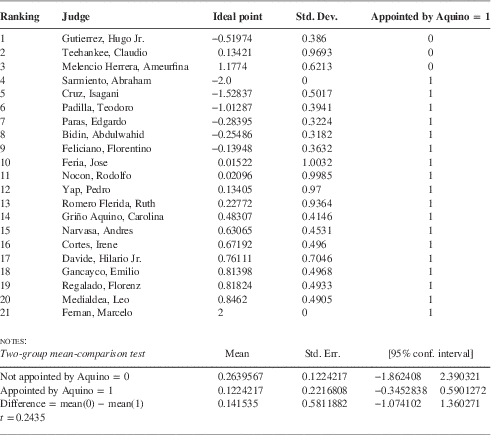
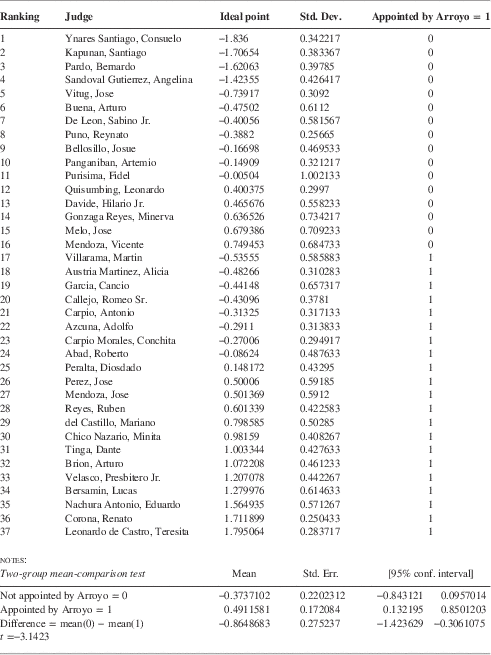
The results of our estimations are presented in Figures 1 to 4 in terms of average estimated ideal points conditional on presidential appointments. Let us start with the results for Aquino (1986−92), presented in Figure 1. As one can observe at the bottom of the table there is no correlation between the estimated ideal points and presidential appointments. That is hardly surprising, since all Justices were effectively appointed by her (with only three being previous choices of Marcos).
Average ideal points, Aquino term, 1986−92 (including priors).
notes: Justices 1 to 3 have not been appointed by Aquino; Justices 4 to 21 have been appointed by Aquino. Correlation between estimated ideal points and dummy for appointment (=1 if appointed by Aquino): −0.0558 (not significant). Correlation weighted for the standard deviation of idpoints: −0.0225 (not significant). Median justice: Teehankee Claudio [idpoint: 0.13421; 95% confidence interval: −1.765618; 2.034038].

The results for Ramos (1992−98), presented in Figure 2, are more interesting. There is a strong correlation between estimated ideal points and presidential choices, namely those Justices appointed by President Ramos are more likely to be clustered in a position favourable to the administration (the correlation is 0.53).Footnote 46 Although, to a large extent, Ramos’s coalition was perceived as a political majority continuing from Aquino, the results show a significant difference between those Justices appointed after 1992 (mostly favourable to the administration) and those appointed before 1992 (mostly unfavourable to the administration).
Average ideal points, Ramos term, 1992−98 (including priors).
notes: Justices 1 to 13 have not been appointed by Ramos; Justices 14 to 25 have been appointed by Ramos. Correlation between estimated ideal points and dummy for appointment (=1 if appointed by Ramos): 0.5348 (significant at 1% level). Correlation weighted for the standard deviation of idpoints: 0.5861 (significant at 1% level). Median justice: Medialdea Leo [idpoint: 0.132028; 95% confidence interval: −1.70253190 1.96658810].
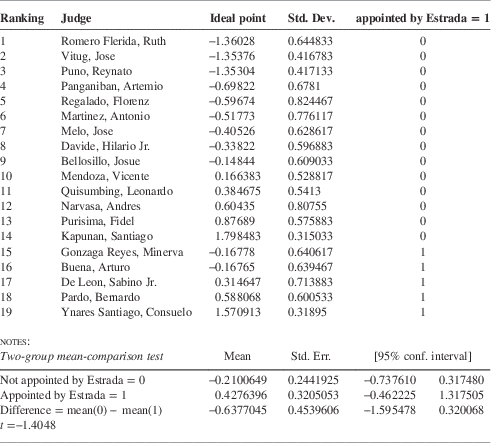
The results for Estrada (1998−2001) confirm the pattern, as we can see from Figure 3. There is some degree of correlation between estimated ideal points and presidential choices, where those Justices appointed by President Estrada are more likely to be clustered in a position favourable to the administration (the correlation is 0.32). However, given the political context of this term and the few choices to the Court, it is notable that the positive correlation is not statistically significant.
Average ideal points, Estrada term, 1998−2001 (including priors).
notes: Justices 1 to 14 have not been appointed by Estrada; Justices 15 to 19 have been appointed by Estrada. Correlation between estimated ideal points and dummy for appointment (=1 if appointed by Estrada): 0.3225 (not significant). Correlation weighted for the standard deviation of idpoints: 0.3390 (not significant). Median justice: Buena Arturo [idpoint: −0.16765; 95% confidence interval: −1.4210030 1.08570633].
Finally, the results for Arroyo (2001−10) are also in line, as observed in Figure 4. The correlation in her case is 0.47 (strongly significant), confirming that Justices appointed by Arroyo form a pro-administration cluster, where Justices appointed by previous Presidents seem to be less pro-administration.Footnote 47
Average ideal points, Arroyo terms, 2001−10 (including priors).
notes: Justices 1 to 16 have not been appointed by Arroyo; Justices 17 to 37 have been appointed by Arroyo. Correlation between estimated ideal points and dummy for appointment (=1 if appointed by Arroyo): 0.4691 (significant at 1% level). Correlation weighted the standard deviation of idpoints: 0.5151 (significant at 1% level). Median justice: Purisima Fidel [idpoint: −0.00504; 95% confidence interval: −1.9692238 1.9591388].
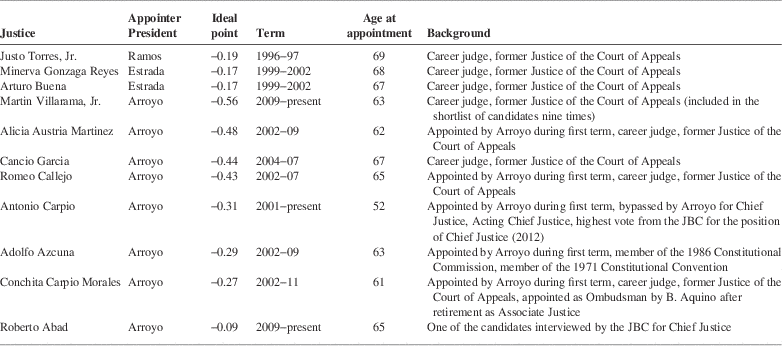
It is also interesting to note the difference between the estimated ideal points of Justices appointed by Arroyo during her two terms as President. Five out of eight Justices appointed during her first term, from 2001 to 2004, have negative ideal points: Alicia Austria Martinez, Romeo Callejo, Adolfo Azcuna, Conchita Carpio Morales, and Antonio Carpio. Except for a couple of Justices, all Justices appointed during her second term have positive ideal points. This may be a reflection of the shift in the nature of the Arroyo presidency. During her first term, she was sworn in as President by Chief Justice Hilario Davide in the midst of a peaceful people’s uprising following an aborted impeachment trial of Estrada on the grounds of corruption, the resignation of key Cabinet officials, and the withdrawal of support by the police and the military. Her first term was a response to the public clamour to end corruption and to strengthen the institutions of democratic governance which were impaired by the rise of cronyism under Estrada. Thus, the Justices appointed during this period were likely to share the preferences not only of Arroyo, but also the loose group that put her in power. A number of them were career Justices, former officials of the previous President, or played a role in the impeachment of Estrada.
Her presidency took a different turn during her second term. She lost support from her progressive allies and supporters when she ran as President and won by a slim margin in a contested election. Her popularity dropped as corruption scandals erupted involving members of the first family. There were calls from civil society for her to resign. There was also discontent from the military. A number of cases that were brought to the Supreme Court involved challenging the constitutionality of presidential moves promulgated in response to the crisis she faced as President. The most salient involved the curtailment of civil rights and liberties.Footnote 48 In this context, the incentives for Arroyo to appoint Justices whose preferences were closer to hers became more imperative.
In Table 3, we summarize the information about outlier Justices, that is, those Justices that are unexpectedly unfavourable to the administration that appointed them (we excluded the Aquino administration for which there is no correlation between ideal points and presidential appointment).Footnote 49 It includes one Justice from Ramos’s term, two Justices from Estrada’s term, and eight Justices from Arroyo’s terms (which is unsurprising given her long term in office). As we can observe, there is some pattern explaining why these Justices are less inclined to behave as predicted. Most of them are career judges who served as Justices on the Court of Appeals before moving up to the Supreme Court. They may share a judicial philosophy acquired and developed from their judicial practice.Footnote 50 Thus, it appears that the ideal points of career judges, especially those who served in the Court of Appeals prior to becoming Supreme Court Justices, are relatively farther from the appointing President. It may be the case that the institutional constraints are harder for the appointing President to ignore when faced with candidates who are career judges and who rose up the ranks of the judiciary.
Outlier Justices, 1986−2010
It is interesting to compare the degree of correlation between the Justices’ estimated ideal points and the President who appointed them with respect to the relationship with the legislature during periods of crisis or threats to the presidency. For instance, it is interesting to note that the lowest correlation is observed during the period of Estrada. All Justices appointed by Estrada have judicial experience, half of whom are women. His landslide victory at the polls coupled with his coalition party’s win in the Senate, may have provided him with less incentive to control the Court. On the other hand, it may also be due to the fact that the period corresponds to the early periods of his presidency. Its consequences, however, prove to be crucial in the incumbent’s ability to govern during periods of political crisis, in which the High Court’s intervention was often sought to have the final say in their settlement. This becomes apparent for Estrada when the deliberations over his guilty behaviour continued in the streets after an aborted impeachment proceedings in the Senate, and was finally settled by the Court when Arroyo was sworn into office.
This lesson of substituting judicial control over the lack of legislative and popular support did not escape Arroyo, who won by a slim margin in her second term. Her government’s responses to accusations of electoral fraud, corruption, and other criticism from the members of the opposition and civil society groups, along with measures to deal with coup attempts, were likewise questioned before the Supreme Court. At that point in time, the High Court was composed of her second-term appointees, who have closer ideal points with her. This politicization in the judiciary under her second term culminated in the midnight appointment of Corona as Chief Justice.
The ideal point estimation also aids in identifying the median Justice in the Philippine Supreme Court for each administration. The role of the median Judge is important in determining judicial outcomes and an aid in characterizing the position of the Court.Footnote 51
All median Justices for each administration were not original appointees by the incumbent administration. Claudio Teehankee, the median Judge for the Aquino administration, was appointed by Marcos. Leo Medialdea, the median Judge for the Ramos administration, was an Aquino appointee. Arturo Buena and Fidel Purisima, the median Judges for the Estrada and Arroyo administrations respectively, were Ramos appointees.
The median Justices also tend to predict the outcome of the cases in our set of observations most of the time, confirming their position as the swing voters. For instance, Teehankee, Medialdea, and Buena’s vote coincided with the final outcome of the cases in our study except for one case. It should also be underscored that a number of the cases were decided unanimously, but in those cases where the Court was divided, the votes of the median Judge coincided with the majority most of the time.
For all administrations, most Justices appointed by the incumbent administration also tend to lie to the right of the median Judge, implying that their policy preferences are more pro-incumbent. In the case of Arroyo appointees, we can again observe the difference between the Justices appointed during her first and her second terms. Most Justices appointed by Arroyo during her first term of office lie to the left of the median Judge, except for Renato Corona, who was appointed Chief Justice, Dante Tinga, and Minita Chico Nazario. Except for a couple of Justices, those who were appointed during her second term all lie to the right of the median.
The position of the median Justice between the Aquino and Ramos period did not move. This reflects relative stability in the Court’s share of Justices supporting the administration. On the other hand, the median Justice position shifted and became negative during the Estrada administration, reflecting a move towards a less favourable position with regard to the President. The median Justice moved more towards the President (although preserving a negative ideal point) during the Arroyo administration.
The estimation of the ideal points also provides us with a way to characterize the location of the Chief Justices for each administration. For instance, Claudio Teehankee, the first Chief Justice of the post-Marcos Supreme Court, is the median Judge during the Aquino administration. Pedro Yap, another Aquino Chief Justice appointee, lies next to Teehankee. Ramos did not appoint any Chief Justice during his term, as Andres Narvasa, an Aquino appointee, served as Chief Justice until after the end of Ramos’s term. Ramos, however, appointed two Justices who later served as Chief Justices during the period of Arroyo: Artemio Panganiban and Reynato Puno. As Chief Justices under Arroyo, both lie to the left of the median. Hilario Davide was appointed Chief Justice under the Estrada government, and his ideal point for this period lies to the left of the median. Thus, it appears that the informal rule of appointing the most senior Associate Justice as Chief Justice has served as a constraint on the part of the President to appoint someone who is closest to his or her ideal point. Given the informal rule of seniority, the most senior candidate for the position of Chief Justice is most likely to be an appointee of previous administrations.
While it is beyond the scope of this study to provide a detailed analysis of the estimated ideal points of Justices with their post Supreme Court careers, a comparison within the Arroyo administration is consistent with our theory. Some of the Justices with estimated negative ideal points became law professors and columnists in leading newspapers. Former Associate Justices Angelina Sandoval Gutierrez and Josue Bellosillo are the current Deans of the College of Law at the Pamantasan ng Lungsod ng Maynila and Centro Escolar University, respectively. Former Associate Justices Adololfo Azcuna and Jose Vitug are members of the Academic Council of the Philippine Judicial Academy, the former also being the Chancellor. Former Chief Justice Artemio Panganiban writes a column for a leading and newspaper, and Associate Justice Isagani Cruz was also a columnist. Former Associate Justices Alicia Austria Martinez and Romeo Callejo are part of the newly created SC Committee that is tasked with probing corruption in the judiciary. Former Associate Justice Conchita Carpio Morales, who has an estimated negative ideal point during Arroyo, was later appointed Ombudsman by B. Aquino III. On the other hand, Former Associate Justice Minita Chico Nazario, who has an estimated positive ideal point, was appointed by Arroyo as Chairperson of the state-owned Philippine National Oil Company-Exploration Corporation, also during the period when there was an electoral ban on appointments. Former Associate Justice Dante Tinga, who also has a positive ideal point, ran for public office.
Thus, the estimation of the ideal points through the MCMC method provides us with a more objective characterization and analysis of the Supreme Court as well as of the individual Justices. The positive analysis allows us to provide answers to normative questions such as: what institutional features are effective in the case of the Philippines and other restored democracies that share the same features? Such methods are needed, considering the series of events that put the Supreme Court in the spotlight, and to avoid a biased or partisan analysis.
5. Conclusion
This paper presents an application of ideal point estimation to the Supreme Court of the Philippines. We did find a strong indication of a relationship between judicial ideal points and presidential appointments. Our results indicate some possible political allegiance by Filipino Justices and the President (very significant in the Ramos and Arroyo terms). Our estimated model is consistent with interpretations offered in previous work.Footnote 52
Our results show that our estimation of the ideal points of the Justices in the Philippines along a government-opposition dimension does a relatively good job at characterizing Justice’s preferences. Due to the specific institutional characteristics of the Philippines, the usual dimension based on ideology poses a problematic exercise. The salient and relevant dimension is government-opposition. We find a strong correlation between the estimated ideal points of the Justices and the incumbency of the President who appointed them.
There are two suggested reasons behind this. One lends support to the theory that the President minimizes the distance between his ideal point and the Justices. Depending on the presence or absence of institutional constraints on the part of the President in appointing Justices closest to his ideal point, then the shorter or the longer is this distance. The other lies in the incentives of judges to engage in strategic behaviour. In a context, where the President exercises monopoly power over the political resources and in a situation where judges have career aspirations outside the Court, their votes reflect both their strategic behaviour and their respective policy preferences.
The study also provides a more specific way to describe the Court and the Justices. For instance, it aids in identifying and characterizing the median Judge. Quite notably, we find that s/he is never an appointee of the incumbent President. The positive analysis has implications for judicial reforms, especially with respect to the selection and appointment process and the appropriate institutional design that would guarantee the Court’s independence.Footnote 53
Our study also contributes to a greater understanding of the configuration of the Court in relation to the President and the executive in democracies that were previously under authoritarian rule. The function of the Supreme Court under the Marcos dictatorship was explored by Tate and Haynie (Reference Tate and Haynie1993, Reference Tate and Haynie1994). The extent of institutional and constitutional innovations and democratic features have been able to ensure the independence of the Court in performing its proper role in society is much less obvious.
Although the Supreme Court structure is the same in the Philippines as in the US, due to a significant transplant effect, the political and social context varies. Yet our results concerning judicial ideal points are actually not very different from previous studies about the Supreme Court of the US. To a large extent, such a conclusion is surprising given the standard accounts of judicial behaviour in weak democracies. Clearly, the underlying reasons differ significantly as we have explained, but it is important to recognize that the perceived differences between the Supreme Courts of the US and of the Philippines are less striking.
Appendix A
Some of the landmark cases that are illustrative of the relationship between the President and the Court are:
Javellana (1973): a six-four majority of the Supreme Court packed by appointees of President Marcos declared the 1973 Constitution not properly ratified, although recognized that the new charter was already applicable. Because of a requirement of two-thirds voting to declare a law unconstitutional, the Court decision effectively allowed the 1973 Constitution to be applied. Although the Justices rebuked the President for the process used to adopt a new Constitution, the decision legitimized the new political regime (with four Justices showing approval for all decisions of President Marcos under martial law). This case considerably undermined the prestige of the Supreme Court in the eyes of the public.
Philippine Long Distance Telephone (PLDT) (1992): the Court reversed a governmental decision to allow more competition on the provision of international telecommunications services. Later it was revealed that the Justice who drafted the opinion of the Court had used PLDT counselling in the writing. Justice Gutierrez took early retirement and the Chief Justice opened an investigation on corruption within the Court. Other similar cases followed later.
People’s Initiative for Reforms, Modernization and Action (PIRMA, 1997): the Court started by deciding that the PIRMA endorsed by President Ramos (that is, a constitutional amendment through a people’s initiative) was void, and more legislation was required. Essentially, if it were approved, it would have allowed the re-election of President Ramos (there was little time before the new election).
Lambino (2006): an eight-seven majority dismissed a petition for a constitutional referendum ratifying a proposal of President Arroyo. Because the two-thirds voting requirement was no longer applicable, the decision of the Court effectively undermined the constitutional project of the incumbent President. This decision included 11 separate opinions (six concurring opinions and five dissents). Most of Arroyo’s appointees dissented and considered the petition appropriate. The reaction to Lambino included a recusal of Justices who dismissed the petition (including the Chief Justice and the Justice who drafted the majority opinion), the filling of a vacancy on the Court by the Solicitor General, and the legislative preparation of impeachment of Justices who voted against the petition. The retirement of the Chief Justice at the end of 2006 allowed President Arroyo to command a solid majority in the Court. However, by a unanimous vote, the Court rejected a motion to reconsider the petition.
De Castro (2010): a nine-one majority allowed President Arroyo to make so-called midnight appointments to the Supreme Court, in particular replacing the Chief Justice a few days after the presidential election and a month before her own term expired. The majority defended that constitutional provisions against midnight appointments do not apply to the Supreme Court (with five Justices extending the exception to the entire judiciary). Only one Justice entered a dissent concerning lifting the two-month ban (the remaining dissenting Justices opposed the decision on procedural matters).
Biraogo (2010): the importance of the Supreme Court has been reflected in early decisions by the new President Benigno Aquino III. By the time Arroyo’s term in office ended in 2010, 14 of the 15 Supreme Court Justices were her appointees and tainted by the De Castro decision. President Benigno Aquino’s first two executive promulgations were challenged directly in the Court. Executive Order No. 1 on the establishment of a Truth Commission was declared unconstitutional by the Supreme Court with a vote of ten to five. The Truth Commission was tasked with investigating the cases of corruption under Arroyo. The Supreme Court ruled that it “violates the equal protection clause of the Constitution.” Executive Order No. 2 asked for the withdrawal, recall, and revocation of midnight appointments by Arroyo (presidential appointments made within the 60-day constitutional ban prior to election day). Although the Supreme Court granted a “Status Quo Ante Order” only for the case of Bai Omera Dianalan-Lucman, it cast a shadow on the legitimacy of Benigno Aquino’s act of appointing and the replacement of the Arroyo appointees with his own.
Appendix B
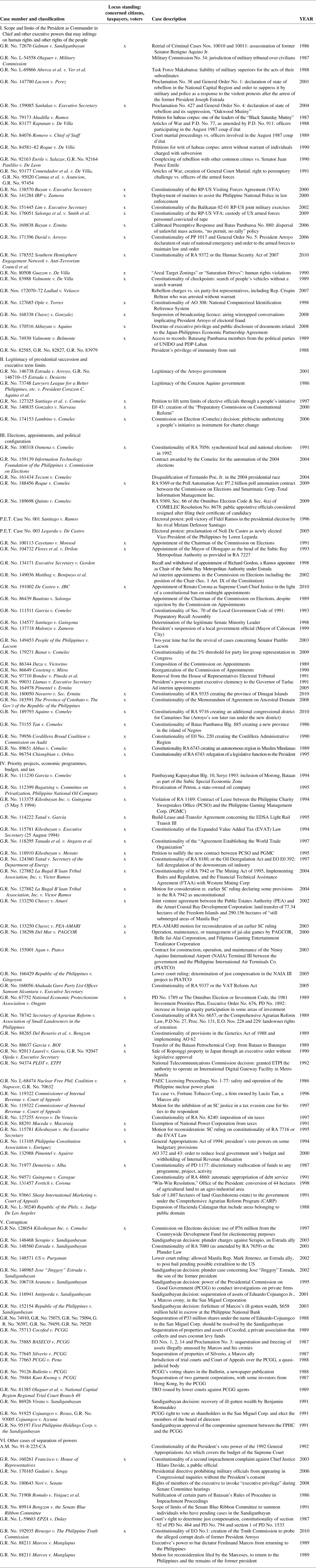
The Supreme Court has a huge case-load, owing to the expansion of the scope of its powers by the 1987 Constitution. From 2006 to 2010, it received an annual average of 16,329 cases and disposed of 9,211 cases. For judicial cases that are decided en banc, the average annual figure is also high, with 730 incoming cases and 327 resolved for the same period. While almost all important cases that involve constitutionality and disputes that involve separation of powers are decided en banc, there are other cases that reach the court that have no distinguishable interest for the incumbent administration. Thus, putting together a database of cases with which to study judicial behaviour was a challenging task, an issue that is not unique to the Philippines, however, as illustrated by the plurality of selection criteria that exists in the literature. What is often adopted reflects the differences in judicial institutional setting, especially with respect to new or emerging democracies.Footnote 54
Choosing cases based on thematic considerations also posed problems in the Philippine context, given the weaknesses associated with characterizing political interests along a clear conservative-liberal policy divide.Footnote 55 Apart from the legal merits of the case, and ideological considerations, what proves to be another decisive factor in explaining judicial outcomes is the existence of informal institutions that allow for the sanctioning of agents outside the formal institutional channels of the court that may include personal network, clientelism or patronage politics.Footnote 56 Thus, a purely legalistic approach in the selection would also tend to omit cases where such mechanisms would be manifest and requires that the selection criteria should be sensitive to both formal and informal institutional mechanisms at play.Footnote 57
The behaviour of justices with respect to the interests of the incumbent would be most apparent in cases where the political stakes for the sitting incumbent are higher. A database was assembled consisting of 125 cases that were decided en banc from 1986 to 2010 and that are representative of politically significant cases.Footnote 58 One hundred and twenty-two of these cases were decided within the four administrations we are concerned with. They cover a variety of issues related to the President. The important common denominators are that they are key to his or her political survival or to the stability of the incumbent administration. Thus, the cases show heightened conflict between the executive and the legislative branches, between the executive and the judiciary, and between the government and the general public interest. The dataset comprise 1,592 individual observations that were coded as either pro- or anti-incumbent.Footnote 59
The cases were selected based on media salience,Footnote 60 Supreme Court documents and publications, including original cases, Supreme Court Reports Annotated (SCRA), and interviews with law professors, including a dean of a college of law, a former justice of the Court of Appeals (who now sits on the Supreme Court). The media sources include newspaper articles, columns, and articles of different Justices, blogs of different lawyers, and archives of broadcast networks and other multimedia news agencies.
Supreme Court, en banc case selection and locus standing
The Supreme Court hears both original and appealed cases and engages in both abstract and concrete review. The cases that should be decided en banc are specified in the Constitution and the Internal Rules of Court of the Supreme Court.
According to Article 8 Section 4(2) of the 1987 Constitution, all cases involving the constitutionality of a treaty, international or executive agreement, or law, including the application or operation of presidential decrees, proclamations, orders, instructions, ordinances, and other regulations, shall be decided en banc. Apart from issues of constitutionality, the Constitution also requires an en banc resolution to cases concerning electoral disputes involving the position of the President and the Vice-President (Article 7 Section 4), the disciplining of judges in the lower courts (Article 8 Section 11), the breaking of an impasse when the decision at the division did not reach the required majority (Article 8 Section 4(3), and other cases specified in the Rules of Court.
Other cases in which the Supreme Court should decide en banc as specified in The Internal Rules of the Supreme Court Footnote 61 are:
(a) appealed criminal cases in which the decision imposes the death penalty or reclusion perpetua;
(b) cases raising novel questions of law;
(c) cases affecting ambassadors, other public ministers, and consuls;
(d) cases involving decisions, resolutions, and orders of the Civil Service Commission, the Commission on Elections, and the Commission on Audit;
(e) cases where the penalty recommended or imposed is the dismissal of a judge, the disbarment of a lawyer, the suspension of any of them for a period of more than one year, or a fine exceeding forty thousand pesos;
(f) cases involving the reinstatement in the judiciary of a dismissed judge, the reinstatement of a lawyer in the roll of attorneys, or the lifting of a judge’s suspension or a lawyer’s suspension from the practice of law;
(g) cases involving the discipline of a Member of the Court, or a Presiding Justice, or any Associate Justice of the collegial appellate court;
(h) cases where a doctrine or principle laid down by the Court en banc or by a Division may be modified or reversed;
(i) cases involving conflicting decisions of two or more divisions;
(j) Division cases where the subject matter has a huge financial impact on businesses or affects the welfare of a community;
(k) other Division cases that, in the opinion of at least three Members of the Division who are voting and present, are appropriate for transfer to the Court en banc;
(l) cases that the Court en banc deems of sufficient importance to merit its attention; and
(m) all matters involving policy decisions in the administrative supervision of all courts and their personnel.
The rules of court also provide for a majority decision and identify that a quorum is reached with eight members. In this case, the majority required to reach a decision is five.
Locus standing
A citizen can initiate a constitutional inquiry in the High Court if they can prove that they have suffered a direct injury arising from the statute being questioned. However, the Court has been known to relax this particular requirement and entertain petitions if the case is deemed to be of “transcendental importance” and must be settled early.Footnote 62
Based on Supreme Court rulings, taxpayers, voters, and legislators may also be accorded standing if the cases involve constitutional issues and, in the case of taxpayers, there is a claim that the tax measure is unconstitutional or there are irregularities in the disbursement of public funds. In the case of voters, it must be shown that they have a clear interest in the election law that is being challenged, and for legislators to show that it encroaches on their legislative powers. A number of cases in our dataset reflect these kinds of case.Footnote 63
Classification of cases
The cases involve both abstract and concrete review. The cases are filed by parties who are directly affected by the statute, or concerned citizens whose standing derives from the fact that the issue being deliberated is of transcendental importance or affects them as taxpayers and voters.
The issues can be classified into six groups:Footnote 64
(1) Cases that concern the scope and limits of the president as commander in chief and other executive powers that may infringe on human rights and other rights of the people comprise 21%. While the post-dictatorship administration initiated moves to curtail the powers of the military, the president also relied on it in response to coup d’état and civilian opposition.
a. Martial law cases: These cases refer to promulgations, laws, or institutions enacted, implemented, or established under martial law, as well as the review or reopening of famous cases during the Marcos dictatorship.
b. Rebellion cases: The government’s responses to military adventurism and alleged attempts from the left to topple the government were questioned before the Court. In particular, whether the measures were constitutional or whether there was an exercise of abuse of discretion on the part of the President.
c. Security cases: These involve issues concerning national security. After the Senate rejected a treaty that would allow for the continued stay of US military bases in the Philippines in 1991, the justification for the continued presence and deployment of US troops in the country has remained a contentious issue.
d. Human rights cases: The incumbent’s measures in dealing with members of the opposition, people’s organizations, and other members of civil society have also been questioned before the Court for encroaching on human rights.
e. Freedom of information, rights to privacy, and other cases: Other rights such as the freedom to access information about matters crucial to the public interest is protected by the Constitution, and the Court has been the venue for the extent of interpretation of such rights.
(2) Cases that involve moves to extend executive term limits through constitutional amendments and cases questioning the legitimacy of presidential succession arising from the two people’s uprising comprise 4%.
a. The turnover of power to new leaders following the country’s two cases of People Power in 1986 and 2001 has been the subject of landmark legal disputes. The Court has ruled that Corazon Aquino’s government was the de facto and de jure government while Arroyo’s ascension as President in 2001 was constitutional.
b. Except for C. Aquino, all Presidents who had served under the 1987 Constitution have tried to amend or revise the Charter, mostly in their alleged aim to change the term limits of the President and other public officials to extend their stay in power.
(3) Cases involving elections, presidential appointments, and other events that led to changes in the political configuration of the legislature consist of 24%.
a. Election cases: This set of cases relates to questions concerning electoral outcomes and procedures involved in the holding of elections. The Court has settled electoral disputes involving the President in 1992 and the Vice-President in 2004. The Court has also suspended or paved the way for the holding of elections and reviewed contracts concerning poll automation.
b. Appointment cases: The president’s appointments have been challenged through the Commission on Appointments, especially when his or her appointee did not fit the requirements stated in the Constitution.
c. Political configuration cases: These cases refer to changes in the composition of the Senate, Congress, and local governments that would affect the power of the President to effectively govern, especially in a context where individual membership to a political party and coalitions are very fluid and shifting.
d. Laws that pave the way for the creation of new political areas have an effect on the presidency. This includes the creation of the Autonomous Region of Muslim Mindanao and the Cordillera Administrative Region that is part of the government’s peace programme. The creation of some districts, however, as seen under the Arroyo administration, is seen to accommodate her interests and her allies.
(4) Each incumbent has their respective priority projects and economic programmes, as well as priority in budgetary allocation and measures to generate revenue. Disputes questioning their legality or procedural irregularity comprise 28% of cases.
a. Priority projects: Some of the projects pursued by each administration were questioned for their constitutionality or illegality. The Court has stopped some of them.
b. Tax cases: These cases involve questions of the constitutionality of some of the new tax measures as well as cases of tax evasions or tax favours granted to firms owned by or affiliated with the opposition.
c. Budget cases: The Court has settled questions concerning the parameters of the legislative’s and executive’s powers, and the national and the local government’s power over the appropriation and disbursement of the budget. This also includes the President’s exercise of his or her veto powers as well the automatic appropriation for debt service in the national budget.
d. Land cases: Agrarian reform is a centrepiece programme that started in the Aquino administration to address rural poverty and unrest. However, the political and economic power of the country’s elite is tied to land ownership. Disputes have reached the High Tribunal.
(5) Cases of corruption involving the President, their family, and their political supporters and allies comprise 15%.
a. While some of the government’s priority projects were questioned in the High Court because of irregularities allegedly arising from a corrupt transaction, these cases of corruption allegations involve the President, their families, and allies.
b. This also includes cases questioning the scope of powers of a quasi-judicial body to recover ill-gotten wealth and properties, especially those from the Marcoses and their cronies. Created under the Aquino administration, the cases involving the PCGG have remained important since some of the Marcos allies and members of the Marcos family came back to support candidates and even run for political positions.
(6) The remaining 8% of cases involve other issues of the separation of powers between the executive, legislative, and judicial branches.
Appendix D: Estimated ideal points
Average scores, Aquino term, 1986−92 (including priors)
Average scores, Ramos term, 1992−98 (including priors)

Average scores, Estrada term, 1998−2001 (including priors)
Average scores, Arroyo terms 2001−10 (including priors)