From the vantage point of the present, the cultural significance of Mel Brooks's directorial debut, The Producers (1967), seems clear enough: it signaled the triumph of a rebellious strain of Jewish comedy in which the Holocaust could be treated as a subject for laughter. Today this victory is so complete that it hardly seems necessary to defend Brooks's outrageousness. If anything, viewers are prone to regard his humor as excessively old-fashioned, gentle, or corny, and the initial thrill of seeing the film may seem hard to recover amid the bad puns and borscht belt humor. Instead of relitigating the ethics of goose-stepping chorus girls, then, this essay approaches Brooks's film by analyzing a famous piece of trivia: The Producers curiously features a character named Leo Bloom, an anxiety-ridden accountant played by Gene Wilder. As Brooks told Kenneth Tynan, “I stole the name from Ulysses. I don't know what it meant to James Joyce, but to me Leo Bloom always meant a vulnerable Jew with curly hair” (Tynan 108). Even more curiously, the film features not one but two Leopold Blooms. Wilder's Leo plays the sidekick to Zero Mostel's corrupt and histrionic Max Bialystock, and although in 1967 Mostel was most famous for playing Tevye in Fiddler on the Roof on Broadway three years before, some moviegoers would have remembered that a decade earlier he had played a different Leopold Bloom. Mostel's performance as Bloom in Ulysses in Nighttown, a 1958 off-off-Broadway adaptation of Joyce's novel that Brooks probably attended (McGilligan 249), had won Mostel an Obie award and revived his career after he had been blacklisted during the McCarthy years. What the audience of The Producers saw on-screen, in other words, was one Leopold Bloom playing opposite another.
In asking why Brooks named one lead after the hero of Ulysses and chose as another an actor made famous portraying the same hero, this essay takes the trivial as symptomatic, wagering that the telltale repetition of the name might teach us something about the role that Joyce's high modernist masterpiece played in popular culture—specifically, in postwar Jewish American comedy. If, as Jonathan Goldman claims, the name James Joyce, as it circulates in cultural corners far removed from academia, “is a text” (80), then so too is the name Leo(pold) Bloom. Following that text across time, genre, and medium (page, stage, screen), I posit, can illuminate the process by which Ulysses not only acquired outsize significance for American Jews but actually became itself a Jewish text. This process—neither literary influence in the sense propounded by Harold Bloom nor cultural appropriation in the sense much bemoaned today—entails the interaction of writers, texts, performers, reviewers, and audiences over the course of a half century. As Jewishness hitches its wagon to Joycean modernism in a bid for respectability, it finds in the source of that respectability something hardly respectable at all—what we might call an original pleasurable perversity. That is to say, the Jewishness of Ulysses, at the level of both form and content, celebrates ethnic, racial, sexual, and class difference in defiance of Christian norms of taste, decency, and health; and it is in the popular citation of the literary, revealed as far more than a superficial display of learning, that this defiance becomes visible.
[I]
Brooks's allusion to Joyce is no great discovery—it is as obvious a joke as naming the attorney general in Blazing Saddles Hedley Lamarr or the stage manager in To Be or Not to Be Sondheim. At least one critical essay has explored the connections between Joyce's novel and Brooks's film. Jesse Meyers likens the relationship of the older Bloom and the younger Stephen in Ulysses to that of the older Bialystock and the younger Bloom in The Producers, noting further similarities between Bloom's hypersexualized Spanish wife Molly and her not-quite-namesake, Bialystock's hypersexualized Swedish secretary Ulla (177). Meyers focuses on the 2005 film (made from the 2001 musical), but many observations hold for the original. He finds in The Producers “a plethora of additional Ulyssean correspondences” that include “Shakespearean citations, ethnic satires, verbal puns, a cat, an ashplant counterpart, a postcard and even a cracked looking glass” (180). The blogger Michael Sherman adds the credible suggestion that the name of The Producers’ Roger de Bris—the flamboyant director of the musical within the film, Springtime for Hitler—alludes to Paul de Kock, the popular author enjoyed by the Blooms. As Molly says, “Nice name he has” (Joyce, Ulysses 4.358).Footnote 1
If nothing else, such connections remind us that the distance between Ulysses, the notoriously difficult landmark of modernism, and The Producers, the crowd-pleasing camp-and-shtick-ridden comedy, was never all that great. Ulysses established itself early on as an icon of high modernism, celebrated and joked about for its difficulty and for bestowing a measure of intellectual prestige on its readers, but it remains a work of raunchy comedy, rooted in popular performance. Joyceans have recognized this at least since Cheryl Herr's 1986 Joyce's Anatomy of Culture, which argues that “Joyce's insistent use of popular forms and performers suggests his desire to create the avant-garde out of the demotic” (15).Footnote 2 Herr reconstructs the “social conventions and economic realities handled routinely on the stages of London and Dublin, especially in pantomime, music hall, burlesque, and melodrama,” to which Ulysses freely alludes (97). The pantomime was Dublin's most acceptable venue for public cross-dressing and gender-bending, and the theater was a lively public space shared by the bourgeoisie and the working class, one that afforded opportunities for sexual voyeurism (Herr 137). The novel registers such charged interactions when it depicts Bloom looking down the dress of Mrs. Yelverton Barry or Molly laughing at Ben Dollard in his too-tight trousers “[w]ith all his belongings on show” (Joyce, Ulysses 11.557).
Although Herr focusses on chapter 15, “Circe,” which is written in dramatic form and thus invites comparison to stage productions, the motif of performance pervades the novel. Simply consider the many professional singers and actors it mentions: the “charming soubrette” Marie Kendall (10.380–81), the pantomime actor Edwin Royce (1.257), Mrs. Bandmann Palmer in Hamlet (5.194–95), the “actress and professional beauty” Maud Branscombe (13.857 and 17.1779–80), the minstrel performers Eugene Stratton (6.184) and Tom and Sam Bohee (15.412), the soprano Jenny Lind (11.699), the baritone William Ludwig (16.859), Kate Bateman in John Augustin Daly's Leah the Forsaken (5.197), the “high comedian” Charles Wyndham (17.793), the “exponent of Shakespeare” Osmond Tearle (17.794), and Herbert Beerbohm Tree in Trilby (18.1042). As Stephen Watt concludes, “Joyce implies that turn-of-the-century Dubliners’ broad acquaintance with the theater was almost inevitable” (Joyce 37). And the novel's main characters are not merely theatergoers but performers themselves. In “Circe” Buck Mulligan appears “in particoloured jester's dress of puce and yellow and clown's cap with curling bell” (15.4166–67). In “Sirens” Simon Dedalus sings Flotow's aria “M'appari.” Stephen's literary efforts in chapters 7 and 9 are presented as performances—recited, not written, to impress his listeners, to “[m]ake them accomplices” (9.158). Molly, of course, is a professional singer.
Bloom too is a performer, one who displays mannerisms of comedians of the vaudeville stage and silent cinema. (As a comedian, he demonstrates more of the jitteriness of Wilder's Leo than the bluster of Mostel's Max.) Both Austin Briggs and Jesse H. McKnight have published comparisons of Bloom and Charlie Chaplin's tramp character—a similarity first noted by Marshall McLuhan, who calls Bloom “a deliberate takeover from Chaplin” (qtd. in Briggs 181). Briggs notes that both characters are essentially petit bourgeois in their aspirations; both “are epic survivors in a bruising sea of humiliation” (184). McKnight lists several Chaplinesque gestures Poldy makes, from his polite bow to Stephen and Mulligan at the end of “Scylla and Charybdis” to blunders like burning the kidney he cooks for breakfast to the frustration of his efforts to ogle a woman's exposed stocking. He finds an existential heroism in the comic presentation of both characters: “In the petty cogs of the causal, they appear foolish; in the grand swirl of the universe, they are wise, outmaneuvering their assailants and winning the race or the girl against all odds” (496). Even Molly seems to cast her husband as the star of a silent comedy, as she recalls a scene that might come straight out of Mack Sennett:
but Id never again in this life get into a boat with him after him at Bray telling the boatman he knew how to row if anyone asked could he ride the steeplechase for the gold cup hed say yes then it came on to get rough the old thing crookeding about and the weight all down my side telling me pull the right reins now pull the left and the tide all swamping in floods in through the bottom and his oar slipping out of the stirrup its a mercy we werent all drowned[.] (Joyce, Ulysses 18.954–60)
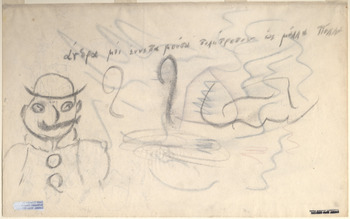
Bloom's bowler offers yet another connection to the world of comic performance (see fig. 1).Footnote 3 Joyce punningly refers to it as “Plasto's high grade ha”; the hat's “sweated legend,” like a figure out of silent film, speaks “mutely” (4.69–70). Bowlered Bloom partakes in a long comic tradition of tramps, clowns, schlemiels, and naïfs.
Joyce's sketch of Leopold Bloom. Courtesy Charles Deering McCormick Library of Special Collections, Northwestern University Libraries.

Finally, Joyce's Bloom anticipates Brooks's in his profession. While critics routinely describe Poldy as an advertising canvasser, he is also, like his latter-day namesake, a producer—a theatrical producer selling shares in a performance, what he describes to M'Coy as “a swagger affair in the Ulster Hall, Belfast, on the twentyfifth” (5.151–52). Joyce's Bloom may not be deliberately overselling shares and counting on a flop, but the venture is wholly entrepreneurial: “It's a kind of a tour, don't you see. . . . There's a committee formed. Part shares and part profits” (5.162–63). And although Bloom may not take octogenarian ladies to bed to wheedle money from them, he does cozy up to “that old faggot” Mrs. Riordan in the hopes of inheriting “her suppositious wealth” (18.4, 17.504–05).
By co-opting the name Leopold Bloom from Ulysses, then, Brooks, regardless of how carefully he had perused its seven hundred pages, intuits the affiliations with the popular that were there all along, some decades before academia would embrace similar critical insights. Surely Brooks's immersion in musical theater, silent film, and early television would have been sufficient education for him to tap into the popular wellsprings of Joyce's comedy. What is more significant is that even as his smiling reference to Joyce pretends to an easy mastery of high culture, Brooks voices a profound ambivalence toward that culture. He describes to Tynan the moment when he first saw himself credited as a writer on Your Show of Shows:
I got scared . . . and I figured I'd better find out what these bastards do. I went to the library and read all the books I could carry—Conrad, Fielding, Dostoevski, Gogol, Tolstoy. I decided that Tolstoy was the most gifted writer who ever lived. . . . And I said to myself, “My God, I'm not a writer, I'm a talker.” I wished they'd change my billing on the show so that it said “Funny talking by Mel Brooks.” (Tynan 108)
This hard distinction between books and comic performance might prompt us to recall Bloom's own funny talk, the garbled Hebrew and Yiddish of “Circe”: “Aleph Beth Ghimel Daleth Hagadah Tephilim Kosher Yom Kippur Hanukah Roschaschana Beni Brith Bar Mitzvah Mazzoth Askenazim Meshuggah Talith” (Joyce, Ulysses 15.1623–25). Sander Gilman has argued that the Jew's funny talk is an old anti-Semitic trope, signaling the Jew's “inherent difference,” the inability to “have command of any ‘Western’ . . . language” (20). Leo Bersani would seem to agree when he claims, referring to the windy Bloomian style of “Eumaeus,” that “Bloom will always prefer talking to writing” (157). In appropriating the text “Leo(pold) Bloom,” then, Brooks signals not only that he is “an intellectual” but that Joyce is a funny talker (Tynan 107). Brooks's conscription of Joyce into his own tribe is a means of managing, if not fully resolving, his exclusion from the canon of great literature.
In other words, Brooks chooses the name Leo Bloom not primarily because it names a small-time theatrical producer or a bowler-tipping comedian, but because it belongs to a Jew. Leslie Fiedler describes Bloom as literature's “first archetypal modern Jew: not ghettoized Israelite or Hebrew, but emancipated, secularized yid, his knowledge of his own ancestry approaching degree zero without diminishing his Jewish identity” (48). In Fiedler's account, modern Jewish culture needed a gentile to distill an image of itself that was at once authentic, sympathetic, and legitimate in the eyes of the establishment. For this reason, “no Jew has ever read Ulysses without recognizing Bloom as a fellow Jew, and rejoicing that this portrait of ‘one of Us’ by ‘one of Them’ . . . is so sympathetic” (50). Unlike the anti-Semitic modernists Ezra Pound, T. S. Eliot, and Wyndham Lewis, Joyce was deeply philo-Semitic, and generations of Jews inside and outside the academy have reciprocated his affection.
Should further evidence be necessary of the importance of Bloom's Jewishness to postwar readers, consider the testimony of a different Bloom, Harold, who does not merely enlist Joyce in the ranks of philo-Semites but actually identifies him—Joyce, that is, not just Poldy—as a Jewish comedian:
Having once been enchanted by watching Zero Mostel perform in Ulysses in Nighttown, half-dancing nimbly through the role in a very strong misreading of it, I have to fight against the image of Mostel as I reread the book. Joyce is not Mel Brooks, yet sometimes he did invest Poldy with what looks like a touch of Jewish humor. (Western Canon 419)
The elisions and disavowals here deserve a moment of attention. Harold Bloom, in bestowing on the actor Mostel the power to enchant (the precise power of Circe, whose chapter forms the basis of the 1958 play), collapses Mostel's performance in Ulysses in Nighttown into his later performance in The Producers, a film Bloom does not name. Mostel's performance becomes not merely a creative interpretation or “misreading” of Joyce's text but something like what Bloom calls, in The Anxiety of Influence, apophrades, a process in which the later “poet” achieves a “relative triumph in his involuntary match with the dead” and paradoxically appears to influence his predecessor (143). Turning Joyce into a practitioner of “Jewish humor,” the Jewish critic finds that his reading of the Irish novelist has been shaped by Joyce's epigone Mel Brooks, whose name irrupts into The Western Canon as a substitution for that of Mostel, Brooks's own comic-Jewish precursor. In short, Bloom posits that Brooks has influenced Joyce (retroactively through Mostel), thus becoming—to borrow the phrase with which Stephen Dedalus describes Shakespeare—“the father of his own grandfather” (Joyce, Ulysses 9.869). Bloom, Fiedler, and Brooks are alike, then, in claiming Joyce for a Jewish tradition. To this list one can add Frank O'Connor, whose 1967 Short History of Irish Literature claims that “Jewish literature is the literature of townsmen, and the greatest Jew of all was James Joyce” (qtd. in Levitt 145). Or as Morton P. Levitt notes more modestly, “in fashioning Bloom and his alien world, Joyce himself was functioning as a Jewish novelist” (145).
Brooks's winking allusion to Joyce is thus part of a larger trend of trying to “prove that he was a [J]ew” (Joyce, Ulysses 9.763) on the basis of his comic style, his urban sensibility, and his philo-Semitism—not to mention (as we will see) his rejection of fascistic nationalism and his identification with Jewish statelessness. But while prominent critics such as Declan Kiberd and Stephen Watt have recently offered versions of this claim, it is hardly uncontroversial.Footnote 4 Some readers, indeed, do not even consider Leopold Bloom a Jew. Joseph Brooker devotes a chapter of Joyce's Critics to the subtle rivalry between two of Joyce's most influential readers, Richard Ellmann and Hugh Kenner. According to Brooker, Ellmann's “humanist” reading is characterized by a “genial vision of Joyce” in his compassion for the failings and limitations of ordinary human beings (113), while Kenner's “counter-humanism” takes a harsher view of Joyce's characters and the human species in general (115). Brooker sees these visions as polar opposites: “[M]uch of what Ellmann reads as sincere or affirmative is inverted in Kenner's work, interpreted as black comedy or ironic mockery on Joyce's part” (115). Brooker also notes Kenner's religious emphasis, calling him “a maverick Catholic” (123) and allying him with Jesuit critics who attempt “to reconvert Joyce” to the faith he forswore (120).
What Brooker implies but does not state is that the Kenner-Ellmann debate is a contest between what Lenny Bruce would call Jewish and goyish readings of Joyce. It would be unjust to reduce Kenner's remarkable body of criticism to the views of fellow mid-century Catholic conservatives, and inaccurate to say that Ellmann openly advocated for a Jewish reading of Ulysses. Yet there remains an implicit politics at work in the assessment of Bloom's Jewishness. Kenner's Dublin's Joyce “openly declares its presiding spirits to be Pound and Lewis,” two anti-Semites, and Kenner even denies that Bloom is a Jew (Brooker 116). Kenner cites the facts that Bloom is not circumcised, that his father converted, that he converted, and that his mother was not Jewish (Fiedler 55). Now it is true that Erwin Steinberg makes many of these same points, but such legalisms are generally the kind of arguments that only a goy would make (or perhaps an Orthodox rabbi). In any case, the matter was largely settled at the International Joyce Conference in Zurich in 1979, when, in response to a quarrel between Steinberg and Morris Beja, Gershom Scholem unexpectedly appeared and rendered a Solomonic judgment. (I envision the scene resembling the sudden appearance of McLuhan in a movie theater lobby in Annie Hall.) As Marilyn Reizbaum recalls, “After all, [Scholem] offered, as David Ben-Gurion had said to him in a discussion they once had on the topic of Bloom's Jewishness, if Bloom thought he was Jewish, he was” (12).Footnote 5 Everyday readers evidently took the question of Bloom's Jewishness quite seriously.
Scholem made his remarks to the Joyceans in the late 1970s, about the time when Tynan celebrated Brooks as “a short Hebrew man” in the pages of The New Yorker. It was two decades earlier, however, that the debate had first been joined. That was when Kenner published Dublin's Joyce (1956) and Ellmann published James Joyce (1959), marking a coming-of-age of the Joyce industry. Thus, while the process of interpreting Ulysses for a wider public began as soon as the novel was first serialized, the 1950s saw a new public availability of Joyce.Footnote 6 Not coincidentally, the decade also witnessed the first Bloomsday celebration. That celebration, held in 1954, was not a decorous public reading of the kind staged for decades at New York City's Symphony Space, but something closer to street theater turned pub crawl. It was a full-dress production in which Brian O'Nolan, Anthony Cronin, and others played the novel's main characters. Just two years before Dublin's Joyce, and four years before Ulysses in Nighttown, O'Nolan and friends adapted Joyce's novel into a public performance.Footnote 7 At the same time that academic Joyce criticism was coming of age, the text was assuming new, accessible forms. These were related, not divergent, trends, as public performance and public pedagogy worked together in popularizing the text. This was also, finally, the moment that saw overt Jewish representation in American popular culture reemerge after a period of “de-Semitization” during the 1930s and 1940s (Popkin 46; Cohen 7). As a result, Jewishness could and would play a large role in Joyce's popularization.
[II]
It was in this climate, as the text of “James Joyce” was circulating in new forms and Jewish comedy was stepping out of the closet, that Ulysses in Nighttown was produced. The adaptation consists mostly of passages from “Circe” but incorporates passages and even single lines from “Telemachus,” “Hades,” “Penelope,” and other chapters. It was written by Marjorie Barkentin, a theatrical press agent and restorer of oil paintings. Padraic Colum, then teaching at Columbia, wrote an introductory essay for the playbill and is credited with supervising her work. (Male reviewers frequently credited Colum, at Barkentin's expense, as the actual playwright.)Footnote 8 But it was the casting more than the authorship that installed the former altar boy Joyce as the godfather of Jewish comedy. Although an early press release promised that “[o]utstanding players of world-wide fame who began their careers in the Irish theatre will be sought for the leading roles, and the ensemble will be recruited from the present-day Dublin stage to insure fidelity to Joyce's characters and atmosphere” (Press Releases), the Dublin stars were apparently unavailable, so Barkentin insured authentic Irishness by offering the lead to the Ohioan Burgess Meredith. Meredith, however, preferred to direct the play, and he brought in Mostel, a Jew from Brooklyn and fellow blacklistee. Other cast members included Carroll O'Connor as Buck Mulligan, Anne Meara as Mrs. Breen, and Bea Arthur as Bella Cohen. (John Astin was the assistant director, which means that, for fans of the TV show Batman, the production was in the hands of the Penguin and the Riddler.)Footnote 9 The presence of so many actors who later became television stars suggests, if nothing else, how an off-off-Broadway play could function as a switch point between high and popular culture. As the play made Joyce's literary text available to a theatergoing public, it also created opportunities for talented actors to reach the even broader audiences of Broadway, television, and commercial cinema.
The play was produced on a minuscule budget at the Rooftop Theater on Houston Street on the Lower East Side. This was, to everyone who entered, a Jewish space. While the theater was, as its name indicates, literally on the building's roof, the ground floor housed the National Theatre, a Yiddish theater until 1941, recently converted into a cinema. Right above it was—no joke—the headquarters of Bagel Bakers Local 338, the bagel workers’ union. The actor Robert Brown, who played Stephen, recalled, “From bagels to James Joyce. It was exactly the place Leopold Bloom would hang out, if he came to New York. Lower Second Avenue. A perfect setting” (qtd. in Meredith 186). The cast would run to a nearby Jewish deli for lunch. Not only Bloom but the whole production was taking on a Jewish character.
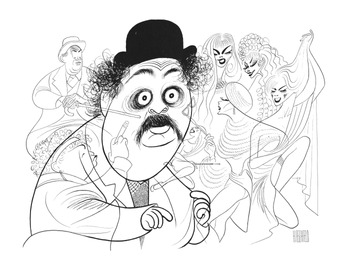
The play was a surprise success, opening in June (naturally), running for six months, and going on to London. A late-summer press release raved, “Despite a late spring opening, the off-Broadway entry has rolled through the steamy summer to healthy boxoffice grosses” (Press Releases). The key was Mostel. The public delighted in the sight of the Jewish clown fiddling around on the roof. Mostel had barely worked since earning the disfavor of the House Un-American Activities Committee (HUAC), before which he had testified in 1955, unfriendlily, but reviewers hailed him as an uncanny incarnation of Joyce's complex literary creation. Mostel, who had read a “bootleg copy” of Ulysses at City College in the 1930s (Sainer 195), himself promulgated this judgment, boasting, “I was made to play Bloom. When Joyce wrote this character, he wrote it for me. It's typecasting putting me in it” (qtd. in Zolotow 2). Gilbert Seldes echoed the assessment: “This is Bloom—and Heaven help whoever plays it in the second company. . . . The utterly complete embodiment of Bloom into Mostel is a totally different thing from Mostel throwing himself into the part of Bloom.” Meredith's account even invokes Jewish myth. After convincing Mostel to take the role over lunch, Meredith told the restaurateur Vincent Sardi, “I've found Moses in your bulrushes” (Meredith 191). This urge—not simply to commend Mostel but to identify him with Bloom—performs the same critical move that Harold Bloom does in finding a retroactive Brooksian influence on Ulysses. The portly Mostel realizes—in the sense of making something potential actual—a comic Jewish reading of Joyce's novel, as though the casting were an act of fate; he is the unique figure who, in embodying Bloom, can give the Joycean text an appropriate physical form. He makes Ulysses accessible to the public by incarnating it in what Gilman has called “the Jew's body” (see fig. 2).
Al Hirschfeld, “Ulysses in Nighttown, 1958.” © The Al Hirschfeld Foundation, www.AlHirschfeldFoundation.org.

What exactly marked Mostel's performing body as Jewish? First, it was very visibly a body. This was a man whose obituary's first line would describe him as “elephantine” (McFadden A1). A Herald Tribune review called him “fat” and “grotesque” (Brown 141), while Brooks Atkinson more tactfully observed that he gave the play “a solid center of gravity.” This physical bigness itself violated the classical body's norms (a comic presence quite different from the almost dainty precision of Chaplin), yet Mostel carried his mass with an astonishing grace. The Tribune praised the way that he “capers, struts, grimaces and cowers” (Brown 141). Mostel's face was equally nimble, as John Wain attested in his review of the London production: “Mr. Mostel has everything—the sad, rubbery eyes, the perfect timing, the ability to mimic, to assimilate, and then suddenly to be unmistakably and shatteringly himself.” As Mostel himself quipped, “I am an actor of a thousand faces, all of them blacklisted” (qtd. in Navasky 178).
Along with his face and body, Mostel's voice was similarly lauded for its versatility and range. As Gilman has noted, Jewish speech is central to the Jewish body, and Mostel used Yiddishisms, sound effects, and his Brooklyn accent to punctuate a formal declamatory style. To quote the Times obituary again, “He could gulp, chirp, bleep, shout like thunder and whimper—all in a single line” (McFadden A1). Accent and gesture, of course, are ethnic traits, or in the words of Joseph Litvak, Mostel's most significant academic critic, “the classic signs of an always excessive Jewish identity” (“Adorno Now” 37).Footnote 10 Mostel's gesticulating, accented performance, like Bloom's original funny talk, thus complicates Stephen Dedalus's hypothesis that “gesture, not music not odour, would be a universal language” (Joyce, Ulysses 15.105–06), pointing to an ethnic specificity in what looks to be a supralinguistic universality.
The staginess, primitivism, and ethnicity of this acting style break with realism to attain comic self-awareness and expressive power. This style originates in what the film historian Henry Jenkins has called “anarchistic comedy.” Against the norms of classical Hollywood cinema, Jenkins argues, anarchistic comedy celebrates “the affective force . . . of the individual performer” (73). Deriving from the heterogeneity of the vaudeville stage—itself created to gratify a heterogeneous, immigrant, working-class audience—it emphasizes gags over story, “component parts” over a unified whole, individual virtuosity over narrative continuity (78). It rejects middle-class Protestant conventions of “the legitimate stage” in favor of “a fragmented structure, a heterogeneous array of materials, and a reliance upon crude shock to produce emotionally intense responses” (63).
Mostel, then, brought his Jewish, working-class bodily habits to the highbrow role of Bloom. Yet he did so with the effect of creating a product that was middlebrow. Pierre Bourdieu understands the very project of making high art accessible to a broad audience as a signature trait of the middlebrow:
This middle-brow culture (culture moyenne) owes some of its charm, in the eyes of the middle classes who are its main consumers, to the references to legitimate culture it contains and which encourage and justify confusion of the two—accessible versions of avant-garde experiments or accessible works which pass for avant-garde experiments, film “adaptations” of classic drama and literature, “popular arrangements” of classical music . . . in short, everything that goes to make up “quality” weeklies and “quality” shows. . . . (323)
If today the dominant form of middlebrow aspiration is the digestible product branded as “peak TV” or “prestige TV,” then in 1958 Ulysses in Nighttown was “prestige theater”—an accessible version of an avant-garde experiment. In his account of the Jewish American embrace of high culture in the twentieth century, Jonathan Freedman notes that Bourdieu's view of the middlebrow has the merit of being untainted by snobbery. Bourdieu even finds a tragicomic heroism in the striving of the middlebrow consumer toward the attainment of culture (Freedman 95). And if this upward striving recalls a young Mel Brooks borrowing Conrad and Dostoevsky from the public library so he can become a proper writer, that may be because Bourdieu himself finds in the “doubly excluded” Jewish petit bourgeois the emblem of this cultural category (Bourdieu 323). Indeed, the figure Bourdieu uses to exemplify the middlebrow consumer is the theatergoing Leopold Bloom—memorably cultured, but in a rough-around-the-edges, self-educated way, able to spin an oddball theory about Ophelia's suicide and compose a creditable acrostic love poem, yet well out of his league when conversing with the jejune Jesuit Stephen (321).
Middlebrow culture, in short, entails accessibility, but an accessibility that bestows access to a higher culture beyond itself. Therefore, while Ulysses in Nighttown was Jewish in its location, lead, and comic style, it was also modernist, and American reviewers assimilated the production to a wave of avant-garde theater coming over from Europe. Atkinson describes Joyce and other modernists as “the literary godfathers of Beckett, Ionesco, and Duerrenmatt, whose plays have startled the theatre this year.” A letter to The New York Times from the film scholar Herman G. Weinberg situates the play in this same international context: “After Ulysses in Nighttown, nevermore let it be said that the American theatre has anything to learn from even the most successfully experimental examples of the European theater.” The American adaptation of an iconic text of European modernism signals a national arrival in which the aspirational (middlebrow?) superpower can finally match the cultural capital of the Old World.
The highbrow credentials of the play were further ratified by its affiliation with psychoanalysis. Atkinson appreciated the play as much for its use of the Jewish science as for its use of Jewish comedy. It is easy to assume that the “Circe” chapter of Joyce's novel forms the core of Ulysses in Nighttown because it was written in the form of a drama, but Barkentin may have been more interested in its taboo-breaking treatment of sadomasochistic desire. As Andrew Gibson writes, in the forties and fifties, critics reflexively used psychoanalysis to “naturalize” the long and difficult chapter, to distinguish internal events from external, latent content from manifest: “From the start, ‘Circe’ had been linked to Freud, and read in Freudian terms” (5). Atkinson is thus in tune with his cultural moment when he offers a reading in which a viewer-analyst becomes privy to Bloom's inner life, writing that Mostel's “vulgar bourgeois of Dublin[—]sensual, outwardly respectable, inwardly epicene, secretive, cunning, cheap in self-esteem as well as infamy, haunted by a million vicious specters—is the core of the performance.” Alan Brien put the matter more simply: “Ulysses in Nighttown is highbrow, psycho-analytical farce . . . [a] romp through the labyrinths of the Unconscious.”
The play thus staked a claim to highbrow status even as critics recognized its “low preoccupation with . . . urinal-wall humour” (Huvven). Reviewers had no problem in understanding Ulysses in Nighttown as simultaneously high and low, and indeed it seems to have appealed to theatergoers of 1958 not merely because it mixed accessible Jewish comedy with transgressive modernism but because it rendered these two things indistinguishable. A final part of this process was the change in medium, the adaptation from page to stage. Even an unsympathetic critic such as Frank O'Connor could praise the play for jettisoning “the whole pedantic paraphernalia of allusion and correspondence” of the novel and, “by a process of simplification inherent in all good folk art,” distilling something authentic, even wholesome. O'Connor continues, “Even the sexual queerness, as interpreted by Mr. Mostel, took on an Aristophanic delight.” In adapting the nigh-unadaptable, he asserts, Barkentin, Meredith, and Mostel “have taken the most private of arts and translated it into the most public one.”
Mostel's success gains further significance from the public's memory of his recent blacklisting. Mostel's 1955 testimony before HUAC was irreverent and proudly Jewish. During one exchange, Mostel “pointed at the Committee chairman and, in a loud stage whisper, said, ‘That man is a schmuck’” (Mostel and Gilford 108). Litvak interprets such clowning, whether onstage in the theater or in the equally staged setting of the HUAC hearings, as the display of an otherness that normative definitions of Americanness could not accommodate—what he calls, in a Joycean coinage, “comicosmopolitanism.” This comic cosmopolitanism, he writes, manifests an “intolerable enjoyment” that constituted the true target of the HUAC purges, which were ultimately about cultural identity far more than national security (Un-Americans 3).Footnote 11 Here again Mostel, with his Jewish style and what O'Connor calls his “sexual queerness,” seems to channel his fictional precursor Leopold Bloom. For these same questions—about Jewishness, citizenship, nation, belonging, sexuality—lie at the heart of Ulysses. In the “Cyclops” chapter, the character of the Citizen represents a version of HUAC, against whose accusations of un-Irish activity Bloom must defend himself. Like Mostel, Bloom affirms his Jewishness through a kind of comic nonsense in which he redefines Renan's concept of a nation as “the same people living in the same place” yet “also living in different places” (Joyce, Ulysses 12.1422–23, 12.1428). Barkentin in fact cuts and pastes this scene of Jewish persecution from “Cyclops” into “Circe,” as if to underscore its relevance to McCarthy-era America (Joyce, Ulysses in Nighttown 40–42). Whether we imagine the Citizen as a drunken Irish nationalist or an anticommunist heartland congressman, he is threatened by what Litvak, borrowing from Adorno and Horkheimer, calls mimeticism, a chameleonic ability to assimilate that which Christian society disavows in itself “and circumscribes instead in the figure of the comic Jew” (Un-Americans 108). Blacklisting is the process of circumscribing the Jew, “the attempt both to punish and to conceal . . . the offense of enjoying a permanent holiday from citizenship” (215). To take such a holiday—a Bloomsday—through an ever-changing series of costumes or languages is the project of both the stylistic mongrel Ulysses and the shape-shifting comedian Mostel. Indeed, the trial sequences of “Circe,” restaged in Ulysses in Nighttown, suggest that Joyce diagnoses in advance, just as well as Kafka, the kangaroo-court absurdity of the HUAC hearings, made explicit in the court clerk's utterly Brooksian instruction to Bloom, “The accused will now make a bogus statement” (Joyce, Ulysses 15.896–97). Joyce's scene here again looks forward to The Producers, at the end of which a jury pronounces Bloom and Bialystock “incredibly guilty” (01:23:45).
However one judges Bloom's sexual guilt, Mostel in 1958 won acquittal from the jury of public opinion, putting his blacklisted status securely behind him. According to the biographer Jared Brown, “Critics and audiences alike were stunned by Mostel's performance. Still remembering him . . . as a stand-up comedian, few suspected that he was capable of such range, combining comedy with tragedy, speaking with an exquisite sense of poetry, expressing the seemingly inexpressible with his body, face, and hands” (139). Mostel had made a transformation—blooming, we might say—from “an inventive buffoon” to “a great actor” (143). Offers came in to star in pieces by Beckett, Pinter, Ionesco, and Brecht, figures at the pinnacle of the new avant-garde (145–47). But if Mostel dallied with modernism, he hit it big with the middlebrow. He was able to return to TV in a 1959 production called The World of Sholem Aleichem, and he attained the status of “a Jewish icon” on Broadway with Fiddler on the Roof in 1964 (Hoberman 24). With Ulysses in Nighttown, Mostel had made Joyce Jewish, and Joyce had made Mostel American again.
[III]
Only by recognizing the cultural and political context of the adaptation of Ulysses into Ulysses in Nighttown can the meanings of the signifier “Leopold Bloom”—as a metonym for high modernism, for the urban wanderer's comedic response to modernity, for a cosmopolitanism that destabilizes citizenship—be fully appreciated. But Ulysses in Nighttown is ultimately only a way station in the greater travels of “Leopold Bloom” from Joyce's novel to Mel Brooks's film, a stop during which this name secures its identity as a comic Jewish text. In so doing, it becomes available to Brooks not merely as a signifier of his own cultural attainments but also as a means of recovering the forgotten vulgarity of Joyce's music-hall modernism as a force to undermine genteel taste. Moreover, as the text “Leopold Bloom” travels forward in time, it descends another rung in a cultural hierarchy. Having moved from avant-garde novel to bohemian-middlebrow play, it now moves from play to popular movie—although notably a movie whose popularity derives from a cult status linked to a special kind of sophisticated taste. The movie itself, after all, is about the making of a stage musical, signaling both kinship with and transcendence of the older mode of performance. It reproduces the popular pleasures of a Broadway musical or vaudeville revue, but in a framework that makes them something other than merely popular.
Mostel's presence in both Ulysses in Nighttown and The Producers adds a flesh-and-blood connection between the two “Leopold Bloom” works. His success in the first, however, led to his casting in the second only circuitously. Brooks and Mostel had been friends since the mid-fifties, and Brooks had written an unsuccessful pilot for “The Zero Mostel Show” in 1962, as well as other “little writing jobs for the actor” (McGilligan 197; see 256–57). But not until 1966 or 1967 did a sustained collaboration begin, when Brooks approached Mostel with the screenplay of The Producers. The script had originated as a mere joke, or less than a joke, an offhand quip. In 1962, during a press conference for a musical he had written, Brooks had been asked what was next. “Springtime for Hitler!” he blurted out, riffing on the title of the now-forgotten 1931 play Springtime for Henry (Kashner). The idea became a screenplay, for whose leading role Mostel was his only choice. Yet Mostel was reluctant. He had not made a Hollywood film since his blacklisting and had recently been passed over for the role of Bloom in Joseph Strick's film version of Ulysses in favor of Milo O'Shea. In fact, he initially turned Brooks down, affronted not by the dancing SS officers but by the apparently even more taboo treatment of untrammeled geriatric female sexuality. Mostel's wife Kate did convince him to take the part (Tynan 112), but the star himself at first found Brooks's script to be in bad taste.
Bad taste, of course, is the subject of the film. Max Bialystock and Leo Bloom plan to produce Springtime for Hitler, a musical so offensive it will outrage its audience, close immediately, and allow them to profit by claiming a total loss. Yet they are undone, as Alex Symons notes in a careful Bourdieusian reading, because “previously resolute taste distinctions” prove to be more unstable than anticipated (27). The producers assume that bad taste is universal, that the audience will reject the obvious vulgarity of “a gay romp with Adolf and Eva at Berchtesgaden” (Producers 00:28:01–04). But the production is so bad that the audience begins to enjoy the comedy, unintentional as it may be. Their laughter in turn horrifies the producers, who see their plan backfiring before their eyes. At the same time, the author, the Nazi Franz Liebkind, is also horrified by the laughter because it mocks his beloved Third Reich. The producers are upset that their vulgarity is misread as camp, the author that his homage is misread as ridicule. Nazi and Jew then unite in sabotaging their unplanned success.
The instability of taste that is the movie's central joke also shaped its reception. As Symons points out, when the movie premiered, such champions of avant-garde cinema as Andrew Sarris, Renata Adler, and Pauline Kael panned it for its crudeness. Kael's New Yorker review maintains that Brooks “could have toned down what is gross and brought out the wit” and suggests that John Barrymore would have been a better choice than Mostel for Bialystock. Kael complains that the film “revels in the kind of show-business Jewish humor that used to be considered too specialized for movies.” The whole thing, she writes, is “acted and directed as if each bit of horseplay were earthshaking.” Kael, it is worth noting, does not oppose the concept of Holocaust humor in itself.Footnote 12 The Hitler audition sequence could have been funny, she concedes, if executed with proper “timing,” but is undone by directorial incompetence. In the end, both the film's excess and its amateurishness attest to insiderism. The film's bad taste results from the “insularity” of a closed community that refuses to assimilate (140).
In reviews like Kael's, Symons argues, “America's most prestigious critics [were] practicing a working-class reading that is normally employed by those low in educational-referential capital when unable to legitimately engage with avant-garde works” (29). Leading reviewers, offended by the vulgarity, ceded the position of the avant-gardist and rejected the film for what amounted to moral indecency. Although, contra Symons, this position is less working-class than middlebrow—working-class sensibility can tolerate bad taste, whereas “[m]iddle-brow culture is resolutely against vulgarity” (Bourdieu 326)—the larger point holds: the critic reverts to a moral stance in response to stylistic excess. But any analysis of taste and reception must go beyond discussions of cultural capital and recognize the cultural politics of Jewishness and anti-Semitism. For in policing Jewish style, Kael was, in Litvak's terms, taking up the role of HUAC. Or more accurately, she was taking the role not of the goyish congressman but of the Jewish stool pigeon who secures her own citizenship by naming names. If the defendants on trial were the “incredibly guilty” Brooks, Wilder, and Mostel, the name being named was Leopold Bloom.
Yet The Producers overcame this interrogation, earning an Oscar for best screenplay and acquiring a cult status in which knowing how and when to laugh at Hitler distinguished the viewer not as vulgar but as culturally adept. Indeed, by the time The Producers was adapted into a hit musical in 2001, the Hitler humor had gone mainstream. The material had become less transgressive, even middlebrow, thanks to a shift in public taste brought about by the continued assimilation of American Jews (Fermaglich 60)—as well as by three decades of familiarity with Brooks's movies. The film's politics could now be explicated quite ably by a critic such as J. Hoberman, who argued that The Producers does not trivialize the Third Reich but rather ridicules it, revealing Hitler's own reliance on stagecraft, “reducing that totalitarian project to travesty.” The black humor is a Jewish expression of “cultural confidence,” “far less redolent of self-hatred than of self-love” (24).
In 1967, however, this interpretation was less available than it would be in 2001. The Producers was harder to interpret than the wartime propaganda of a film like Chaplin's The Great Dictator (Fermaglich 62), and the uncertain meaning of the comedy led to a split verdict on the film, which in turn reflected different readings of the musical nested within it. The hostile critics collapsed the distinction between The Producers and Springtime for Hitler, while the appreciative public had little trouble judging them separately, seeing the film as a critical commentary on the musical. The nesting of one performance and audience within another therefore allowed the 1967–68 viewer to put the whole production in quotation marks, reading it through irony, camp, or satire, suspending an aversive reaction to Springtime for Hitler by training attention on the production and reception of the show—on the producers. The film discovered a sophisticated audience that, by knowing how to read Jewish vulgarity, exposed the avant-garde critics as middlebrow. As Albert Goldman puts it, Brooks “zaps the movie schmendriks,” taking revenge on better educated, stool-pigeon Jews (243).
Yet the critics were not wrong in their recognition of the film's crudeness, or even of the dubious pleasure it takes in celebrating Adolf and Eva. They simply evaluated those qualities without reference to film history. Kael's objections to “what is gross” in Brooks's “horseplay” repeat almost verbatim the objections to the vaudeville aesthetic voiced a half century earlier by the filmmaker Sidney Drew, who, as Jenkins relates, favored “thoughtful laughter” and scorned the “gross horseplay” of “knockabout” comedy (qtd. in Jenkins 55). Brooks's collaborator Alfa-Betty Olsen points out that in 1967, “films were very filmic,” and The Producers, which looks back to the popular forms of Brooks's childhood, had little interest in the technical artistry, derived from European highbrow cinema, then in vogue (qtd. in Making 00:27:08–12).
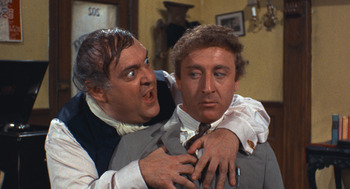
Every bit as much as his performance in Ulysses in Nighttown, Mostel's screen presence in The Producers exemplifies the vaudeville aesthetic—excessive, energetic, ethnic. His fingers drum, his hands gesticulate, his head bobs and wobbles, his voice roars in rage or self-pity and dips into Brooklynese on words like “Thoisday.” Gesture, accent, eyes, paunch, jowls, and physical motion revive the feral comic style that, Litvak argues, had been tamed in Mostel's performance in Fiddler on the Roof.Footnote 13 To recall Jenkins's phrase, Mostel's on-screen presence emphasizes “the affective force . . . of the individual performer” rather than the subordination of the actor to scene or sequence (73). Indeed, Mostel as Max is so intent on dominating each scene that at one point he yells at Wilder's Leo, “Shut up, I'm having a rhetorical conversation!” (Producers 00:11:09; see fig. 3). And Kael is correct that he is unashamed in his display of Jewish insiderism. When he finally discovers the flop-guaranteeing script of Springtime for Hitler, he kisses the corner of it like a rabbi kissing a prayer book (00:27:37)—a gestural in-joke if ever there was one, and in fact the very gesture performed by the phantasmic Rudy Bloom at the end of “Circe” (Joyce, Ulysses 15.4959-60).
Zero Mostel and Gene Wilder, from Mel Brooks's The Producers, courtesy of STUDIOCANAL.

Of course, the film is about a comic duo, and Wilder—the actual Leo Bloom—balances Mostel's presence with meekness, anxiety, and neurosis. As Brooks described him, “The kid is delicate, transparent, he changes color like a pigeon's breast” (qtd. in A. Goldman 246). Lacking the loud self-confidence of Max, Leo reminds us of the vulnerability and outsider status of the original Bloom. He possesses that “element of innocence” that Hannah Arendt sees as a common trait of Chaplin's tramp and Heinrich Heine's schlemiel and that, linked to the statelessness of the Jewish refugee, lends the character an ethical authority through his vulnerability to the cruelty of the law (112).Footnote 14 Together, the two form a homosocial couple, with Bloom occupying the traditionally feminine role in what Maurice Yacowar identifies as a parodic queering “of the traditional Hollywood romance” (77). “I'm hysterical and I'm wet!” Leo cries in the scene where Bialystock tries to take his beloved blue blanket (Producers 00:20:41). Supine and shrinking from Mostel's physical bulk, he compares Bialystock to Nero and himself to Nero's murdered wife Poppaea. Like Joyce's Bloom, Wilder's is not only “a vulnerable Jew” (Tynan 108) but also “a finished example of the new womanly man” (Joyce, Ulysses 15.1798–99).
To the film's list of transgressions we must therefore add an are-they-or-aren't-they queerness that asks us to question how gay the “gay romp with Adolf and Eva” really gets. Bialystock possesses a polymorphous sexuality that he displays first in the sexual role-playing he enacts with his senescent investors and again in his easy adoption of gay manners when interacting with de Bris and his valet. During what Yacowar calls his “day-long date” with Leo (77), Max unleashes the repressed libido of the buttoned-up accountant, and when he finally seduces the younger man to his scheme, Leo shouts, “I want everything I've ever seen in the movies!” (Producers 00:25:29). The torrential gushing of the Lincoln Center fountain that ensues is no more subtle than the fireworks that accompany the ejaculation of the original Bloom in “Nausicaa.”
When, in the Lincoln Center scene, Leo admits to this omnivorous desire born from a history of the cinema, he also implies that Brooks's reckless directorial style represents an homage to the popular entertainments that shaped him. In all his best films, Brooks gravitates toward the heterogeneity of anarchistic comedy, introducing gags and shtick, music and dance, at the expense of formal unities. To be sure, the plot of The Producers is built on a single classical irony, in which every action results in the exact opposite of its intention, but that story structure creates space for the vast variety of “everything . . . ever seen in the movies,” a variety that includes the improvisatory mischief that Brooks's “craziness” on the set licensed (McGilligan 268). In a 2002 interview, the choreographer Alan Johnson describes “a Mel Brooks theory of filmmaking” in which “three quarters of the way through the film you need to give the audience a zetz” (qtd. in Making 00:02:35–42). That zetz (a smack in the head) is a song-and-dance number, a showstopper that pushes aside the demands of narrative. While the revolving human swastika of Springtime for Hitler is the biggest zetz of them all, The Producers also includes numbers such as Ulla's gratuitous go-go dancing and the impromptu duet of Max and Leo singing “By the Light of the Silvery Moon” as they anticipate their terrible reviews. Brooks's heterogeneous style can indeed assimilate anything. When the outraged Liebkind tries to halt the production of Springtime, the audience laughs off his effort as another gag in the gay romp.
It is not enough, then, to understand The Producers as merely a disruptive move in a game of taste. The offensiveness of celebrating “the Hitler you loved, the Hitler you knew, the Hitler with a song in his heart” (Producers 00:33:22–27)—not to mention the whole grand clash of content (Holocaust) and form (Busby Berkeley)—points to deeper transgressions of sexual, class, ethnic, political, and, not least, artistic norms. For this reason, the culminating trial is only superficially a trial for fraud, just as Mostel's HUAC hearing was only superficially about communist sympathies.Footnote 15 The real crime in The Producers is the perversity of which Bialystock, Bloom, and Brooks are at once incredibly guilty and wholly innocent. They are guilty because, even after Leo's appeal to the judge, no one for a minute believes Mostel's vow of penitence, “May I humbly add, Your Honor, that we've learned our lesson and we'll never do it again” (01:26:31–37). (Now insatiable, they do it again as soon as they are behind bars.) But they are innocent in that we have all just reveled in their perversity with them and in the process admitted its appeal.
Leo Bloom may end up in prison, but he is freer there than at his accounting firm because he has transformed, having learned to enjoy his symptom. “You miserable cowardly wretched little caterpillar,” Max asks him early on, “Don't you ever want to become a butterfly? Don't you want to spread your wings and flap your way to glory?” (00:19:44–55). As Brooks said to Tynan:
In the course of any narrative, the major characters have to metamorphose. . . . Leo was going to change, he was going to bloom. He would start out as a little man who salutes whatever society teaches him to salute. Hats are worn. Yes sir, I will wear a hat. Ties are worn. Definitely, sir. No dirty language is spoken. Absolutement, Monsieur. But in Leopold Bloom's heart there was a much more complicated and protean creature. (Tynan 108)
Bloom's blooming entails an acceptance of “complicated,” “protean” desire and a rejection of goyish norms of moral health. It tells us that it is OK to do a Hitler musical not, as Hoberman has it, because you are secretly mocking Hitler, but rather because you are not supposed to do a Hitler musical.Footnote 16 Leo becomes, if not exactly a funny talker, a dirty talker. We enjoy the grotesque spectacle because of, not in spite of, its perversity.
As Brooks's word “salute” suggests, Christian culture mandates obedience to particular authorities and symbols. For this reason, perhaps the most transgressive moment of The Producers occurs when Bialystock and Bloom surprise Liebkind with a visit, and the war criminal blurts out a rehearsed denial of his past: “I was never a member of the Nazi party. I'm not responsible; I only followed orders. Who are you? Why do you persecute me? My papers are in order. I love my adopted country” (Producers 00:30:06–16). He then begins to sing “America the Beautiful.” Echoing both Adolf Eichmann and those Americans tyrannized under McCarthyism (including the actor sharing the screen with him), the Nazi here is subject to the same persecution as the Jew. Dangerously aligning HUAC and Hitler, the scene undoes the demands of loyalty oaths and expresses, in the words of Brooks's friend and fellow Jewish war veteran Joseph Heller, “a general feeling that the platitudes of Americanism [are] horseshit” (475).
Adding political mischief to its list of crimes, The Producers realizes a potential latent in Ulysses that Ulysses in Nighttown probably did not, burdened as it was by the pedagogical aim of ennobling the audience through exposure to Joyce's difficult masterpiece. The Producers, as a Ulysses-adjacent text, offers no such ennoblement, instead embodying a modernist, Jewish, and sometimes queer comedy that frustrates the demands of the nation for an obedient salute. Crossing boundaries of high, middle, and low to the point of voiding them, the modernism of Mel Brooks affirms Joyce's comment to his brother Stanislaus that “the music hall, not poetry, is a criticism of life” (qtd. in Ellmann 77).
The example of The Producers thus also revises and complicates two important recent accounts of American Jewish culture in the mid-twentieth century, Freedman's and Litvak's. In The Temple of Culture, Freedman tells how Jews, the excluded other of a Christianized high culture, came to see themselves as the custodians of that very culture. In The Un-Americans, Litvak demonstrates how the dissident comic energies of Jewish popular entertainment were disciplined into something safer and more middle-American. Thus, while there are obvious parallels between Freedman's reading of the way that Lionel Trilling “converted” Henry James “into a cosmopolitan Jew” and my reading of Brooks's use of Joyce, the two repurposings of the literary past are not the same (158). Choosing James and Trilling as exemplary figures, Freedman finds in the literary tradition a detached, critical stance embraced by Jewish academics who became high priests in the temple of culture. Choosing Joyce and Brooks, I counter that postwar Jews just as often served as unprofessional, nigh-blasphemous substitute teachers in the temple's adjoining Hebrew school. Similarly, Litvak's claim that McCarthyism could cease to police Jewish comedy because Jewish comedy learned to police itself is not entirely wrong, and the anti-Semitic cultural police work Litvak describes continues today to determine who or what is recognized as American or un-American.Footnote 17 Yet Litvak's argument is also shaped by the texts he chooses, and by placing Fiddler on the Roof rather than The Producers at the summit of his argument, he slights the radical potential of Jewish popular comedy, which is also a recovery of the popular roots of modernism.
In sum, the movement of the name Leopold Bloom from Ulysses to Ulysses in Nighttown to The Producers enacts the process that Frank O'Connor perhaps wishfully discerned in the 1958 drama, “a process of simplification inherent in all good folk art.” This process occurs through a combination of changes: adaptation for the stage, reinvention for the screen, social climbing, schmendrik zapping, public trials, movement through time, space, and context—all Zeroing in on the anarchistic comedy of Joyce's original. Through this process of simplification, or, better, of transformation, Ulysses itself enjoys a springtime, a rebirth, a new bloom, as Brooks's film distills from the big unwieldy book of modernism a pleasurable perversity—a perversity of which the repeated Jewish name Leopold Bloom is the symptom.