Textiles were of great importance in ancient Mesoamerica. For the Aztec, Maya, and other peoples of Mesoamerica, finished textiles were widely traded and commonly used for the payment of tribute. Textiles were also used to signify the status of different members of Mesoamerican society. And, worn textiles may have been utilized as ethnic markers, much as they are today in highland Guatemala (Hendrickson Reference Hendrickson1995; Morris and Foxx Reference Morris and Foxx1987; Schevill Reference Schevill1997). While textiles and textile patterns have received a significant amount of modern study (Asturias de Barrios Reference Asturias de Barrios1985; Mayen de Castellanos Reference Mayen de Castellanos1986; Mejia de Rodas and Miralbes de Polanco Reference Mejía de Rodas and de Polanco1989; Rowe Reference Rowe1981; Schevill Reference Schevill1985), a corresponding focus on the technologies related to ancient textile and cordage manufacture in the Maya area has been slower in appearing (Beaudry-Corbett and McCafferty Reference Beaudry-Corbett, McCafferty and Ardren2002; Hendon Reference Hendon, Claassen and Joyce1997, Reference Hendon, de Arathoon, Gonzalez and Willemsen Devlin1999; King Reference King, Rowe, Benson and Schaffer1979). In an attempt to partially remedy this situation, this paper focuses on the identification of ancient Maya textile production in the archaeological record at Caracol, Belize, and on the implications that these data have for our understanding of Classic period gender, power, and status. These data reinforce the significance of cloth and spinning to the ancient Maya and suggest that fine cotton-textile production with nonperishable tools was predominantly a high-status female gendered prerogative. The Caracol archaeological data reflect the importance of royal female gendered tombs and suggest that the role of women in ancient Maya society has been significantly understated. This analysis underscores how little we truly know about ancient Maya social and political organization, but it also suggests the role that textiles likely played in reinforcing a distinct Caracol identity.
THE IDENTIFICATION OF TEXTILE PRODUCTION IN THE SOUTHERN MAYA LOWLANDS
As is the case elsewhere (Good Reference Good2001), the identification of textile production in the Maya archaeological record is exceedingly difficult. While it is evident that textiles were produced, it is hard to delineate the producers, the details of production, or even the specific materials that were used in antiquity. Two kinds of cotton are noted as having been cultivated in both the lowland Maya area (Tozzer Reference Tozzer1941:200) and in Mexico (Stark et al. Reference Stark, Heller and Ohnersorgen1998:10). Clearly, cotton was processed by the Maya; finished textiles from the Maya area were available in the markets of highland Mexico (McCafferty and McCafferty Reference McCafferty and McCafferty2000:41) and were used extensively for tribute payments (Quezada Reference Quezada2001). Besides cotton, the Maya of the southern lowlands made use of various non-cotton fibers. Henequen (also referred to as “hemp”) was grown, spun, and used for making cordage and sandals (Tozzer Reference Tozzer1941:89); other varieties of agave (or maguey) can produce very fine fibers for other types of textiles (G. McCafferty, personal communication 2003). Other long-length “hard” and bast fibers (Bird Reference Bird, Rowe, Benson and Schaffer1979) probably included ceiba, yucca, and palm, as well as nettle and cactus. Even feathers and the hair of rabbit and humans may have been spun, along with other materials.
ARCHAEOLOGY
Because the remains of actual textiles are only infrequently encountered in the tropical lowland archaeological record (e.g., Morehart et al. Reference Morehart, Awe, Mirro, Owen and Helmke2004), archaeological materials most often utilized to identify Maya textile production include spindle whorls, perforated sherds, and bone artifacts. Carved bone needles and “awls” are generally associated with textile production, and bone “hairpins” may also have been used both as secondary picks and as clasps to hold together woven cloth mantles. Although sometimes made of other materials (e.g., clay, shell, bone, wood, or palm endocarp; Beaudry-Corbett and McCafferty Reference Beaudry-Corbett, McCafferty and Ardren2002:60; Coggins and Shane Reference Coggins and Shane1984:146; Taschek Reference Taschek1994:116, 130), stone spindle whorls form the mainstay for the archaeological inference of textile production in the Maya area during the Classic era (although a suggestion has also been made that the stone whorls may have served as flywheels for pump drills to work jadeite; Digby Reference Digby1964). This differs from central Mexico, where spindle whorls were “generally baked-clay disks” (McCafferty and McCafferty Reference McCafferty and McCafferty2000:42). Based on Ceren data, ceramic spindle whorls also appear to have been used early in the Classic period in El Salvador (Beaudry-Corbett and McCafferty Reference Beaudry-Corbett, McCafferty and Ardren2002:60). Only during the Terminal Classic era (after a.d. 800) did ceramic spindle whorls make a widespread appearance in the Maya area. These later whorls also tended to have a larger overall diameter than those made of stone, potentially suggesting changes in textile production.
Although perforated sherds are often assumed to have served as spindle whorls (e.g., Hendon Reference Hendon, Claassen and Joyce1997; Kidder Reference Kidder1947; Willey Reference Willey1978), there is contradictory archaeological evidence. The holes in these perforated sherds are sometimes not fully centered, and the disks are often only roughly circular. At least at Caracol, these artifacts generally do not co-occur with other artifacts associated with textile production (see later). When perforated sherds have been recovered in other than fill contexts at Caracol, they appear to have functioned as backings for earrings. An intact jadeite earring was, in fact, recovered still attached by stucco to a perfectly perforated and rounded sherd within an early cache in Caracol Structure A6 (A. Chase and D. Chase Reference Chase, Chase and Grube1995:96) and another set of composite obsidian earflares with ceramic backings was recovered in a tomb from the South Acropolis at Caracol. Partially based on these contexts and on the analogous (and widespread) use of perforated circular shell backings for earrings that are found in many of Caracol's burials (and that replicate the form of the circular perforated sherds often found in fill contexts), we feel that perforated sherds were more likely used as backings for jewelry than in their traditionally assigned association with spinning in Maya archaeology. Thus, this class of artifact is not included in the present analysis.
Worked bone needles, an artifactual class of relatively undisputed function, are taken as solid evidence of textile production. Smaller needles would have been used for sewing while the larger needles could either have been used for sewing, for embroidery in more elaborate textiles, or for other functions in the weaving process (such as shuttle substitutes). Other carved-bone artifacts, such as some “awls” and “hairpins” (Teeter Reference Teeter2001), may have been used for weaving and beating cotton (although beating of cotton was often done with sticks), to clasp the finished textiles, or as brocading tools—but again, this is difficult to establish firmly based on the archaeological record alone. Importantly, spindle whorls do co-occur with bone needles, bone pins, and bone awls in the same contextual deposits at Caracol, Belize. It has further proved possible to identify a specialized type of limestone bar that appears to have been used in the production of textile belts and/or cordage at Caracol, possibly having functioned as netting gauges.
In general, archaeological evidence for textile production is not common at Maya sites and good contextual associations are rare (but see Inomata and Stiver Reference Inomata and Stiver1998:439 for Aguateca, Guatemala), most spindle whorls having been found largely in either fill or surface contexts. Nowhere in the Maya Lowlands does extremely plentiful evidence for ancient textile production exist, even in well-excavated sites. The evidence that we do have is also likely skewed. While stone, ceramic, and bone artifacts may have a fair likelihood of surviving in the tropics, wood artifacts do not. Many of the tools used in Classic Maya textile production were probably made from perishable materials. Thus, what we are actually seeing in the archaeological record are tools made from more permanent materials that were probably used by higher-status individuals. This interpretation is to some extent borne out by the archaeological data. The most detailed consideration of archaeological textile production has been undertaken for Copan, Honduras, by Julia Hendon (Reference Hendon, Claassen and Joyce1997:38–39); she has extensively examined the evidence for textile production (recovered in intensive areal investigations) by looking at the distribution of 25 spindle whorls, 41 needles, 4 pins, and 186 picks/awls (and 66 ceramic disks) among contiguous Copan households, concluding that this activity was presumably engaged in by elite women. Support for the association of weaving with elite women at Copan was recovered in an Early Classic tomb of a high-status woman associated with three concentrations of bone needles, tabbed jadeite and shell rings interpreted as loom weights, and a bone spatula that may have served as a weaving pick (Bell Reference Bell and Ardren2002:97). For Tikal, Hattula Moholy-Nagy (Reference Moholy-Nagy2007) reports that only a total of 51 spindle whorls (26 ground stone and 25 modeled ceramic) were recovered in 14 years of research by the University of Pennsylvania Tikal Project; seven stone spindle whorls came from four burials (at least two of these burials were of women), and one other interment had a single ceramic spindle whorl; the recovered spindle whorls were almost evenly distributed between residential groups and palaces, but none came from the “civic-ceremonial core” of the site. These Copan and Tikal data on textile production are in line with those reported here for Caracol and, even though modest by central Mexican standards (see later), these data are more plentiful than those recovered from sites elsewhere in the Maya Lowlands.
Looking at manufactured spindle whorls and bone needles (both easily identifiable artifact classes) published in the artifact volumes of Uaxactun (Guatemala), Barton Ramie (Belize), Altar de Sacrificios (Guatemala), and Seibal (Guatemala), four sites that witnessed long-term excavation in the southern lowlands, the relative paucity of recovered data related to the production of textiles is striking. The site of Uaxactun, Guatemala, was the focus of intense excavation from 1926 through 1937 (Smith Reference Smith1973); these investigations resulted in the recovery of a total of eight bone needles, five stone spindle whorls, and 12 ceramic spindle whorls (Kidder Reference Kidder1947:39, 56, 67); only one of these whorls, a ceramic one, came from a burial (female). Three seasons of excavation were undertaken at the site of Barton Ramie, Belize, from 1954 through 1956 (Willey et al. Reference Willey, Bullard, Glass and Gifford1965); this work resulted in the recovery of six bone needles, four stone spindle whorls, and one ceramic spindle whorl (Willey et al. Reference Willey, Bullard, Glass and Gifford1965:402, 487, 500). At Barton Ramie, however, three of the stone spindles came from two Late Classic burials (sex indeterminate), and three of the bone needles came from two different Late Classic burials (one identified as male and the other as indeterminate; Welsh Reference Welsh1988; Willey et al. Reference Willey, Bullard, Glass and Gifford1965). Altar de Sacrificios, Guatemala, was excavated for five seasons from 1959 through 1963 (Willey Reference Willey1973); a single bone needle was recovered, three stone spindles were found, and 45 ceramic spindles were recorded, although the possibility that 13 of these were beads is also raised (Willey Reference Willey1972:84–85, 133, 231); none came from burials. For the site of Seibal, Guatemala, excavated for five seasons from 1964 through 1968 (Willey Reference Willey1990), no bone needles and only two stone spindle whorls and nine ceramic spindle whorls were recovered (Willey Reference Willey1978:46, 90), again none from burials.
Within the immediate Caracol region, J. Eric Thompson (Reference Thompson1931:317) recorded a single spindle whorl in a burial at Tzimin Kax (Welsh Reference Welsh1988:253 records two spindle whorls for this burial of indeterminate sex). Spindle whorls also appear in two burials (one male; one of indeterminate sex) at Baking Pot in the Belize Valley (Ricketson Reference Ricketson1929:14; Welsh Reference Welsh1988), in one burial (indeterminate sex) from San Jose north of the Belize Valley (Thompson Reference Thompson1939:Figure 91 m), and in two burials from Holmul (Merwin and Vaillant Reference Merwin and Vaillant1932; Welsh Reference Welsh1988 records only one burial of indeterminate sex as having a spindle whorl). More recently, a summary of burials recovered as a result of extensive archaeological work in the southeastern Peten of Guatmala has recorded a total of eight burials that included spindle whorls (Vásquez and Laporte Reference Vásquez, Laporte, Laporte and Mejía2005); these burials come from seven different sites (Sacul, Ixcol, Ixcoxol, Ixkun, Ix Ek, Sukche, and Ixtonton[2]); three of these interments are identified as male, two as female, and the other three could not be identified as to sex. The presence of spindle whorls with males is significant, especially given this artifact's assumed female gender association, and may indicate that not all textile production was in the female domain in this part of the Maya world; these data may have further implications for the gendering of human remains. W. B. M. Welsh's (1988) survey of excavated burials in the Maya area notes only seven other instances of spindle whorls occurring in interments: in one burial each at Altun Ha (infant) and Copan (sex indeterminate); in two burials at Palenque (sex indeterminate); and in three burials at Dzibilchaltun (sex association indeterminate).
The paucity of archaeological data from the Maya area that may be directly related to textile production differs dramatically from the bountiful data gathered from both highland and lowland Mexico, where ceramic spindle whorls are relatively common. Part, but not all, of this difference is likely temporal. For the most part, the ceramic spindle whorls recovered in central Mexico are of Postclassic date, whereas the majority of the spindle whorls from the Maya area date to the Late Classic and are of stone. The central Mexican spindle whorls are also concentrated in centers of production, specifically Cholula (McCafferty and McCafferty Reference McCafferty and McCafferty2000) and Otumba (Nichols et al. Reference Nichols, McLaughlin and Benton2000), but even surveys of outlying areas have produced sizeable numbers of ceramic spindle whorls in contrast to the Maya situation. Sharisse McCafferty and Geoffrey McCafferty (2000:42) note that 245 whorls were recovered in the Texcoco Valley survey; 228 whorls were collected from the Teotihucan Valley (Parsons Reference Parsons, Spence, Parsons and Parsons1972:45); 85 whorls came from a survey of western Morelos (Smith and Hirth Reference Smith and Hirth1988); 64 whorls were recovered from Chalcatzingo (Norr Reference Norr and Grove1987); and 131 whorls were recovered from three different sites in the eastern, northern, and southeastern Valley of Mexico (Brumfiel Reference Brumfiel, Gero and Conkey1991:233). An additional 41 spindle whorls derived from excavations at Xaltocan, Mexico (Brumfiel and Hodge Reference Brumfiel, Hodge, Mastache, Parson, Santley and Puche1996:429). Outside central Mexico in central Veracruz, Barbara Stark and her colleagues (1998) recovered 361 spindle whorls that were interpreted as providing evidence for the dispersed production of textiles among many households. An even greater number of ceramic spindle whorls, some 1,670, were recovered from Otumba in highland Mexico (Nichols et al. Reference Nichols, McLaughlin and Benton2000); at this regional capital, this data class can be used to delineate the general household production of cotton in conjunction with the barrio production of maguey. More than 800 spindle whorls have also been recovered from Cholula, 237 of them from three specific contexts, suggesting that “Cholula was intensively involved in fiber processing” (McCafferty and McCafferty Reference McCafferty and McCafferty2000:42–43).
All of these Mexican totals far surpass anything recorded for the Maya area, but all are also relevant mainly to the Postclassic era (after a.d. 900). While these totals are nowhere replicated in the Maya area, Terminal Classic spindles whorls were fairly well represented both at Chichen Itza, where 106 specimens were recovered (Kidder Reference Kidder1943:98–99; only 59 were described and illustrated [Bolles Reference Bolles1977:237–242]), and at Balankanche Cave, where 26 ceramic spindle whorls were found (Andrews IV Reference Andrews1970:45–52). However, it must be noted that among well-excavated Late Postclassic Maya sites, spindle whorls are relatively rare; three bone and seven ceramic spindle whorls were recovered from Mayapan (Proskouriakoff Reference Proskouriakoff, Pollock, Roys, Smith and Proskouriakoff1962), and fewer are known from Santa Rita Corozal (D. Chase and A. Chase Reference Chase and Chase1988). Thus, not all of the difference between the Mexican and Maya data is temporal. And, as indicated earlier, the ancient Maya may have used perishable whorls in addition to those made from pottery or stone.
In considerations of the Mexican data, there is a general assumption that spindle whorl weight and diameter can be used to infer what was spun and processed (Parsons Reference Parsons, Spence, Parsons and Parsons1972, Reference Parsons1975; Smith and Hirth Reference Smith and Hirth1988:350). Following Mary Parsons (Reference Parsons, Spence, Parsons and Parsons1972)—and in accord with E. J. W. Barber (Reference Barber1991)—small spindles weighing 10 grams or less with diameters under 3.5 cm (Type III) were generally associated with spinning cotton, while larger spindles usually weighing far more than 10 grams and having diameters of more than 3.5 cm (Type I) were usually thought to have been used to spin maguey. McCafferty and McCafferty (Reference McCafferty and McCafferty2000:45–46), however, have demonstrated that the Cholula whorls “do not conform well with the established big/little ‘rule of thumb’”; they argue that Mesoamerican spinners not only spun many different things, but also used drop, thigh, and support spinning techniques, and that “a wide range of shapes and sizes for whorls” could be “used to spin the same material (i.e., cotton) with the changing variable being the intended quality of the finished product” (i.e., single versus double ply). As will be seen later, the big/little “rule of thumb” also does not adequately reflect the Maya archaeological data recovered from Caracol, Belize.
ETHNOHISTORY
Ethnohistoric sources suggest that the ancient Maya were great weavers and spinners. Landa (Tozzer Reference Tozzer1941:93, 159; see also Farriss Reference Farriss1984) specifically correlated spindle whorls with women and noted that cotton mantles resulting from their efforts were significant components of tribute payment (see also Quezada Reference Quezada2001). Weaving was associated with the Maya female goddesses Ix Chebel Yax, the “wife of the creator,” and Ix Chel, the “Moon Goddess” (Thompson Reference Thompson1970:206–207, 246–247). Ixchel “is always known in association with the backstrap loom, sometimes holding a weaving needle or aguja in her hand” (Schevill Reference Schevill1985:3, Figure 3; but see Miller and Taube Reference Miller and Taube1993:101). A symbolic relationship also existed for the Maya among weaving, sex, and the birthing process (Ciaramella Reference Ciaramella1999; Joyce Reference Joyce2000:159,163–164; McCafferty and McCafferty Reference McCafferty, McCafferty, Schevill, Berlo and Dwyer1991; Sullivan Reference Sullivan and Boone1982). Every Maya woman is assumed to have been proficient in spinning and weaving cloth.
Although detailed written records pertaining to textiles do not exist for the Classic-period Maya, the significance that cloth held in ancient Mesoamerican society may be seen by reference to both lowland Yucatecan and highland Mexican ethnohistoric documents. Cotton mantles were a key form of tribute in colonial Yucatan (Quezada Reference Quezada2001); cloth also is portrayed as an offering in the Maya codices (Tozzer Reference Tozzer1941:n. 593). The spinning of cotton constituted a tribute service for some towns in the Valley of Mexico (Zorita Reference Zorita and Keen1963 [1565]:187); in Aztec highland Mexico cotton was restricted to high-status use with maguey being used for clothing by most commoners (Durán Reference Durán, Hayden and Horcasitas1964:131). This status differentiation in clothing materials may have derived from the fact that cotton could not be grown in the highlands of central Mexico; thus, most of it was imported into the region from areas of lower elevation (Berdan Reference Berdan and Boone1987). While there were clear differences in what was being spun in highland Mexico both within and between communities and regions (McCafferty and McCafferty Reference McCafferty and McCafferty2000:44; Nichols et al. Reference Nichols, McLaughlin and Benton2000), a long-distance trade in finished fabrics is also in evidence. In fact, it is clear that some of the cotton and textiles in central Mexico derived from the Maya area. For instance, finished cotton cloth from “Campeche” was recorded as having been for sale in the Cholula market (McCafferty and McCafferty Reference McCafferty and McCafferty2000:41).
Historic documents and codices indicate that textiles were used extensively for tribute in central Mexico (Anawalt Reference Anawalt, Drooker and Webster2000:217) and that the majority of these were produced for the Aztec tribute economy by women (McCafferty and McCafferty Reference McCafferty, McCafferty, Schevill, Berlo and Dwyer1991). Within central Mexico, the archaeological expression of textile production, as seen primarily through the recovered spindle whorls, is often associated with tribute rather than with high status. Parsons (Reference Parsons1975:208), in particular, equated the spinning of cotton with “tribute service.” Unfortunately, many of these data derived from surface collections and not contextual excavation; thus, functional associations are sometimes limited. The assumption that evidence for spinning correlated with tribute production led to other interpretations about the use of spinning and weaving in gendered resistance to tribute production that are interesting but difficult to prove with the extant archaeological data (e.g. Brumfiel Reference Brumfiel, Gero and Conkey1991, Reference Brumfiel1996:454–455, but see 2001). Elizabeth Brumfiel's (1996) data indicate that both elite and commoner Aztec women spun; she argues that spinning by commoner women intensified under Aztec rule, presumably to produce tribute cloth. Rather than suggesting that all Aztec women were oppressed and engaged in tribute production, however, Susan Toby Evans (Reference Evans, Inomata and Houston2001:262) has interpreted her research in Aztec palaces as demonstrating that the production of cotton was practiced in most noble households as a “conspicuous display of wealth production.” McCafferty and McCafferty (Reference McCafferty and McCafferty2000:44–45) also have examined differences in spinning between the Valley of Mexico and Cholula, drawing into question long-standing reconstructions by suggesting that the size and weight of spindle whorls may imply more about how the spinning was done than what was being spun.
While Maya textiles likely were produced for tribute, we believe that fine cotton-textile production with nonperishable tools was predominately a high-status female gendered prerogative that reinforced status distinctions and ritual associations as well as community or polity identity.
ICONOGRAPHY AND EPIGRAPHY
Iconographic details on carved stone monuments make it clear that the Maya produced fine textiles and used cloth and clothing to distinguish status (e.g., Marcus Reference Marcus1974:90), as was the practice elsewhere in Mesoamerica (Anawalt Reference Anawalt, Drooker and Webster2000:207). Perhaps the best-known depictions of Maya cloth occur on the monuments of Yaxchilan, where textiles of exquisite detail are carved on stone (Schele and Miller Reference Schele and Miller1986:198–199). The iconography, however, does not permit much insight into actual textile production. These depictions do, however, suggest the use of elaborate textiles by ancient high-status Maya women. Classic era Maya economic records are largely lacking, although recent epigraphic interpretations indicate that tribute did exist (Stuart Reference Stuart and Houston1998:384) and that such tribute occasionally was shown artistically through the iconographic use of cloth bundles. In fact, Rosemary Joyce (Reference Joyce1993) has argued that Classic-period Maya ceramic figurines directly commemorated women's labor in textile production, mirroring the importance of this effort to the Classic Maya economic and sociopolitical landscape—something only indirectly referred to through the presentation of cloth bundles. Therefore, both textile tribute and status distinctions in cloth and clothing can be inferred for the Classic-period Maya.
TEXTILE PRODUCTION IN THE CARACOL ARCHAEOLOGICAL DATA
The site of Caracol, Belize, has been the focus of long-term research by our University of Central Florida archaeological project. During the past 23 years, approximately 23 km2 of the site have been mapped; this area comprises about 12.5% of Caracol's total extent (estimated at 177 km2; A. Chase and D. Chase Reference Chase, Chase, Chase and Chase1994:5, Reference Chase and Chase2001b). We have collected archaeological data from some 111 residential groups (ranging from simple looters' clean-up to limited testing to more intensive areal clearing and trenching) and eight causeway termini. We have also undertaken very intensive excavation in many of the monumental buildings and complexes that make up the site's epicenter. This has included substantial areal excavation of palaces (A. Chase and D. Chase Reference Chase, Chase, Inomata and Houston2001a) that has seen the almost complete clearing of Barrio (26 rooms) and Caana (72 rooms), as well as the partial clearing of the C Group, South Acropolis, and Central Acropolis (D. Chase and A. Chase Reference Chase and Chase1996).
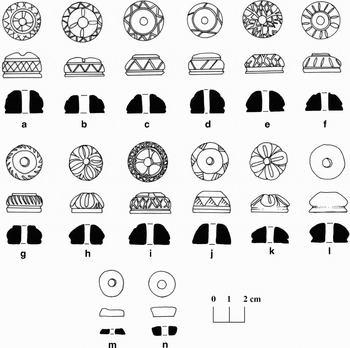
As a result of this work at Caracol, a series of materials have been recovered that can be associated with textile production or elaboration. While actual cloth has been recovered inside an early cache (A. Chase and D. Chase Reference Chase, Chase and Grube1995), most of the data related to textile production consist of other items—particularly, 57 specially manufactured spindle whorls, 22 bone needles, 43 pins and hairpins, 45 awls, and potentially 37 limestone bars. Most of these materials come from primary archaeological contexts. Of particular interest is the association between these items and formal burials. Thirty-eight of the 57 spindles come from 20 different interments. Thirteen additional spindle whorls can be associated with Terminal Classic de facto debris. Only six spindle whorls were recovered form fill or surface contexts (two were found on the surface, and four came from structural fill). Only three spindle whorls are not whole; an additional two are slightly chipped. Two circular items with central perforations were contextually located as part of a spinning kit (consisting of spindle whorls, a bone needle, and a perishable bowl in an epicentral tomb [see later]) and, based on their shape and weights, may be potentially identified as “spindle weights” (Figure 2m–n). Twenty-two “eyed” needles have been identified in the Caracol materials; potential shafts and tips were not counted because they could represent other artifacts. Thirteen bone needles are associated with 12 interments; in two of these interments, spindle whorls co-occur with the bone needles. Of the 37 limestone bars, eight were located in five different interments; in one interment, limestone bars and spindle whorls co-occur.
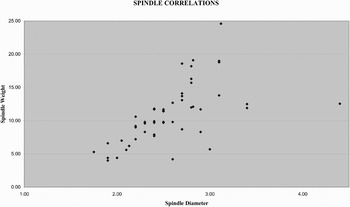
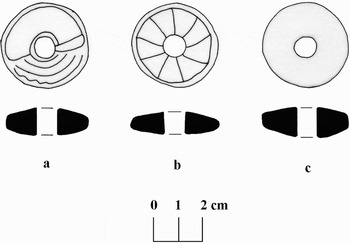
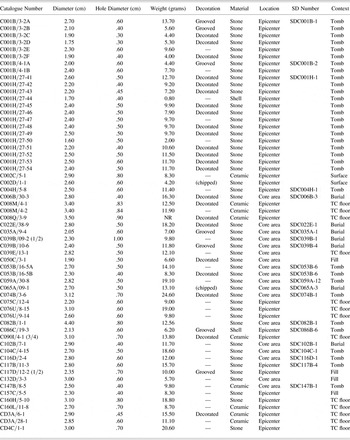
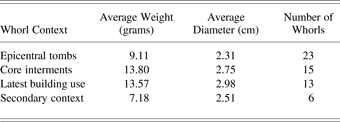
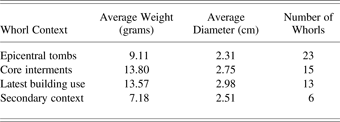
The dimensions of the Caracol spindle whorls (see Table 1 [includes 2 spindle weights]) do not mirror the Mexican dichotomy of very large versus very small spindle whorls outlined by Parsons (Reference Parsons1975) for the Valley of Mexico. Of the 57 spindle whorls recovered, the overall diameter ranges from 1.75 cm to 4.4 cm, and their weights vary from 4.0 grams to 24.6 grams (Figure 1). None of these whorls may be posited to fall within the larger class, ostensibly used for spinning maguey in central Mexico. However, within the Caracol sample four contextual groups of spindle whorls may be tentatively defined (Table 2). Within six epicentral tombs dating to the Late Classic, 23 stone spindle whorls were recovered; they average 9.11 grams in weight and 2.31 cm in diameter; 18 of them had some form of decoration (Figure 2). Based on size and weight, these spindle whorls may correlate with the production of cotton. Whorls found in non-epicentral residential areas and on the floors of Terminal Classic palaces are larger in size, bore, and weight and suggest the possibility that other non-cotton fibers were spun, as well, by high-status individuals. Within 14 Late Classic interments (seven tombs) from the outlying residential area, 15 spindle whorls were recovered; they average 13.80 grams in weight and 2.75 cm in diameter; six of the whorls had some decoration. From Terminal Classic on-floor deposits, 13 spindle whorls (more than half ceramic) were recovered; they average 13.57 grams in weight and 2.98 cm in diameter; four show decoration (Figure 3). Of the six spindle whorls from either surface or fill, two are decorated; they average 7.18 grams in weight and 2.51 cm in diameter. Besides potentially indicating that smaller spindle whorls might more likely be lost and included in structure fill, these combined data suggest that a range of fibers may have been spun and, likely, doubled or plied to various degrees of fineness and spinning twist for multiple uses related to weaving, brocading, or other textile surface decoration.
Caracol spindle-whorl weights plotted against spindle-whorl overall diameters.

Spindle whorls and weights from a tomb within Caracol Structure B20, all stone except for “m.” (a) C1H/27-54; (b) C1H/27-53; (c) C1H/27-52; (d) C1H/27-51; (e) C1H/27-49; (f) C1H/27-48; (g) C1H/27-41; (h) C1H/27-42; (i) C1H/27-43; (j) C1H/27-45; (k) C1H/27-46; (l) C1H/27-47; (m) C1H/27-44; (n) C1H/27-50.

Ceramic spindle whorls from the floors of Caracol Structure A6. (a) C8M/4-1; (b) C8Q/3-9; (c) C8M/4-2.

Excavated spindle whorls from Caracol, Belize: diameters, weight, substance, and provenience

Note: TC floor = Terminal Classic palace floor.
Groupings of Caracol spindle whorls based on excavated contexts
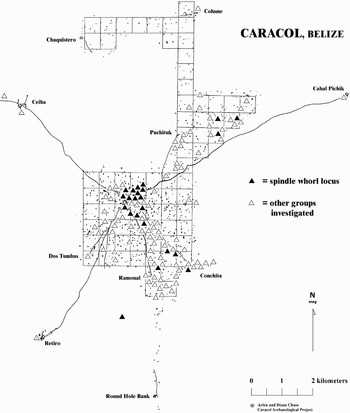
The spatial location of spindle whorls is particularly telling. More than 111 residential groups, representing a full range of status levels, have been excavated and tested. While there is a widespread distribution of spindle whorls at the site (Figure 4), the majority came from high-status contexts in the site epicenter. Twenty-one of 45 stone spindle whorls were found in four tombs on the summit of Caana; two other stone spindle whorls also derive from epicentral tombs. Thus, more than 50% of the stone spindle whorls were recovered from epicenter tombs that represent the highest stratum of Caracol's society. Because of mixed-sex multiple burials, few unequivocal associations exist between a single adult female and one or more spindle whorls (as described later, two single individual interments associated with spindle whorls are female gendered); however, female-sexed skeletal remains were present in all multiple individual interments containing spindle whorls. Sixteen other spindle whorls derive from the epicenter, all but four being directly associated with the latest Terminal Classic use of the epicenter's palaces. Other de facto debris suggests that the inhabitants of the Terminal Classic palace were members of Caracol's elite. Seven of the eight ceramic spindle whorls also derive from this epicentral Terminal Classic palace floor debris; the other ceramic whorl came from a tomb located just outside the site's epicenter. Thus, overall there is a positive correlation both of stone spindle whorls with higher-status Late Classic tombs at Caracol and of ceramic spindle whorls with Terminal Classic palace-derived trash. While upper-crust Caracoleños apparently used durable spindle whorls, it is probable that perishable spindle whorls were used by other social levels within Caracol.
Distribution of recovered spindle whorls from Caracol plotted by their location relative to associated group; also shown are other architectural groups at Caracol for which archaeological information exists but that did not produce any spindle whorls.

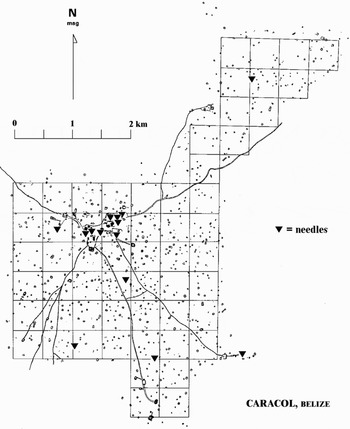
The distribution of the bone artifacts potentially associated with textile production is similarly telling, but is not as closely linked to status as stone or ceramic spindle whorls. Within the 22 securely identified bone needles from Caracol (Figure 5), two different size classes have been noted by Wendy Giddens Teeter (Reference Teeter2001). Even though many of the bone needles are not complete, enough of them were present to see standardization in their sizes. Eight large needles average approximately 8.3 cm in length; the other 14 needles averaged 6.0 cm or less in length. The larger needles may have been used as weaving shuttles; the smaller ones likely helped to decorate textiles. Sixteen of the needles derive from tombs or burials; six of these interments are from the site's epicenter.
Distribution of archaeologically recovered bone needles from Caracol, Belize.

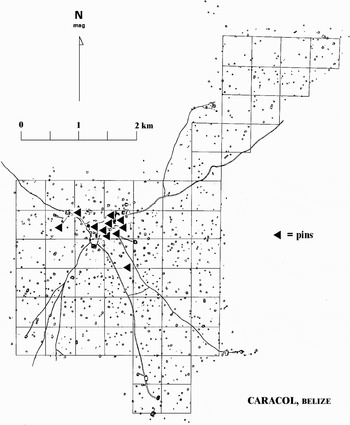
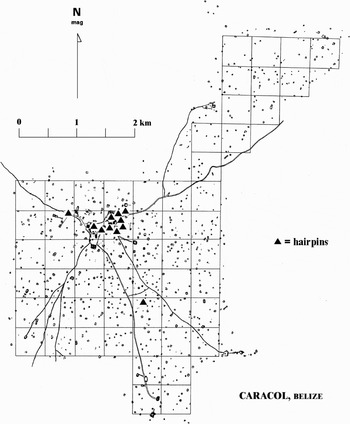
Bone pins (Figure 6), some of which could represent broken needle parts, and hairpins (Figure 7) cluster in and around the immediate epicenter. Pins refer to non-perforated objects with rounded ends and a usually circular cross-section that look very much like needles; they are often partial and could potentially represent reworked needles. Hairpins are also non-perforated with a circular cross-section, but they are usually longer than pins and may be decorated on their shaft (usually with hieroglyphs) or on one end (spatulate examples actually have incised scenes). Out of a sample of 47 examples, only 10 “hairpins” and 11 “pins” were found in burials at Caracol; none came from epicenteral tombs. There is one secure burial association between a pin and an adult female. Fifteen “hairpins” and “pins” were recovered on the floors of Caracol's epicentral buildings. Based on contextual considerations, it would appear that these artifacts tended to be used (worn) by secondary elites and not by those individuals of highest status.
Distribution of archaeologically recovered bone pins from Caracol, Belize.

Distribution of archaeologically recovered bone hairpins from Caracol, Belize.

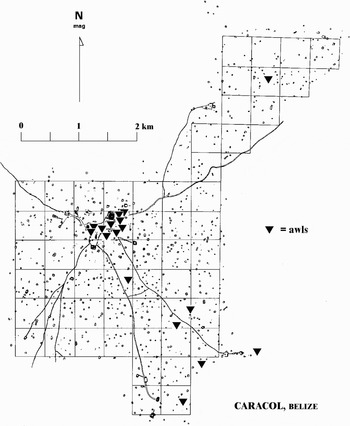
Awls are more heavily shaped bone implements, in which one end was pointed for potential use as a perforator. They were likely used for a variety of functions, which included basketry manufacture and the sewing of hides and leather; however, they could also be used as weaving picks (Hamann Reference Hamann, Claassen and Joyce1997:157). Of the 45 bone awls known from Caracol, only two came from epicentral tombs (Figure 8). However, 20 were recovered in Terminal Classic refuse associated with epicentral palace floors. The remainder generally came from burial contexts in the outlying part of the site or from general fill inclusion. In the settlement area, one burial had a bone awl clearly associated with an adult male.
Distribution of archaeologically recovered bone awls from Caracol, Belize.

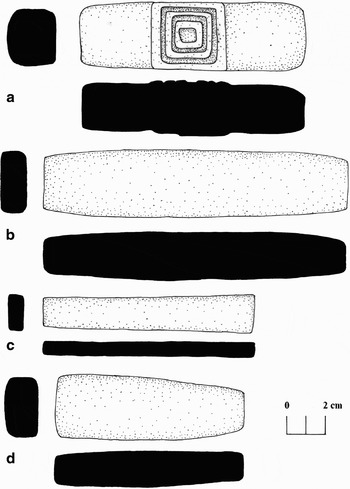
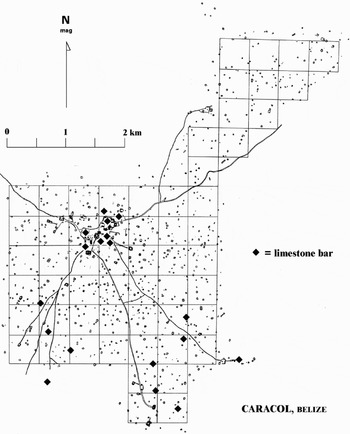
The 37 rectangular limestone bars (Figure 9) are a more unusual data class at Caracol. One has a central raised and decorated panel. Seventeen are whole. The whole bars' lengths range from 6.7 cm to 16.0 cm; their widths range from 1.6 cm to 3.9 cm; their depths range from .8 cm to 3.0 cm; and their weights range from 21.1 grams to 194.6 grams. The distribution of the bars includes both the site's epicenter and the southern part of the site (Figure 10). Eleven of these bars occurred in burials and tombs; however, only one fragment of a bar came from within an epicentral tomb. In the outlying settlement, one limestone bar occurred in the burial of an adult female. Archaeological data from the 2007 field season at Caracol suggest that two kinds of limestone bars may have been used at the site. The twenty-third field season recovered a series of caches in Structures D2 and I5 that were associated with eight limestone bars. However, these bars were finely made, tapered at one end, and had striations on their surfaces; several were coated with red pigment on their ends. Previously, limestone bars had not been recovered in association with cache deposits. The form of the 2007 bars is most similar to the example illustrated in Figure 9c and potentially indicates that limestone bars had multiple uses by the ancient inhabitants of Caracol. The closest items in form to these bars that can be found ethnographically are stone items of similar shape that are used by fishermen to make fishing nets (Moseley Reference Moseley1992:48 for Peru); the bars are used to determine the size of the net spacing. The distribution, contexts, and sizes of these limestone bars make it likely that they were similarly used to determine the size of the spacing in the production of netting or cordage; alternatively, they could conceivably have been used as an anchor in the production of textile belts.
Limestone bars from Caracol. (a) C26A/1-1 g; (b) C140F/2-10; (c) C54A/4-7b; (d) C75H/3-1.

Distribution of archaeologically recovered limestone bars from Caracol, Belize.

GENDERING THE CARACOL ARCHAEOLOGICAL DATA
The gendering of Maya artifacts, artifactual associations, and contexts is exceedingly difficult, but there is substantial interest in this topic (Ardren Reference Ardren2002; Claassen and Joyce Reference Claassen and Joyce1997; Gustafson and Trevelyan Reference Gustafson and Trevelyan2002; Joyce Reference Joyce2000, Reference Joyce and Klein2001). Margaret Conkey and Janet Spector (Reference Conkey, Spector and Schiffer1984) examined gendered task differentiation in the archaeological record. A strong gender association exists between ancient Maya women and textile production that can be found in various iconographic representations, as well as in burial data (Hendon Reference Hendon1996, Reference Hendon, Claassen and Joyce1997, Reference Hendon, de Arathoon, Gonzalez and Willemsen Devlin1999; Joyce Reference Joyce and Claassen1992, Reference Joyce1993, Reference Joyce2000). Apart from iconography related to gender, burial data often provide the most direct gender association between sex and specific artifactual materials (Joyce and Claessen Reference Joyce, Claassen, Claassen and Joyce1997:7). However, even burial data can be problematic (for a case in point, see McCafferty and McCafferty Reference McCafferty and McCafferty1994). Differential skeletal preservation and the presence of multiple bodies of both sexes in a single burial also make it difficult to associate specific artifacts with any one sex. The strong associative cases may be made only between artifacts and single individual adult interments of identified sex. However, even where interments of single adult individuals of known sex occur, the correspondences are often muddied with regard to most artifact classes. And, even the gendering of skeletons is viewed as problematic (Geller Reference Geller2005; Stockett Reference Stockett2005; Voss Reference Voss2000).
All of the bone implements that can be associated with textile production and sewing, either directly or indirectly, are found in archaeological contexts with both individual adult males and individual adult females. This is true at Caracol (D. Chase Reference Chase, Chase and Houston1998; Teeter Reference Teeter2001) and elsewhere (Vásquez and Laporte Reference Vásquez, Laporte, Laporte and Mejía2005; Welsh Reference Welsh1988). Bone needles occur in two instances of adult male interments and in one adult female burial at Caracol. Also at Caracol, individual adult male burials are found with awls and hairpins, while individual adult female burials are associated with pins and spindle whorls. Spindle whorls cannot be directly associated with any single individual male burial at Caracol; they do, however, occur in multiple individual interments containing males and females and are associated with two interments that can be gendered as adult females. One Late Classic non-tomb interment (C6B/30) in a residential group contained an elderly female who was buried with a stone spindle whorl and a bone shuttle. The other potential instance was in one of the two most important tombs at Caracol (discussed later)—out of a total investigated sample of 107 tombs.
Looking at other sites for comparative data yields some supporting evidence for gendering archaeological materials associated with textile production (data from Welsh Reference Welsh1988), but the picture is still far from clear. Needles seem to be non–gender-specific, but spindle whorls tend to be associated with women, except in the southeast Peten, immediately west of and presumably under the sway of Caracol during the Late Classic period (A. Chase Reference Chase and Garber2004). At Altun Ha and Altar de Sacrificios, single male interments occur with bone pins. At Altun Ha, both adult males and adult females are buried with needles. However, spindle whorls of clay and stone are only associated with adult females at Uaxactun (Burial A30) and at Tikal (Burials 184 and 192), all in high-status contexts. Yet another residential burial at Tikal in Structure 4E-31 also yielded an adult female in association with a stone spindle whorl. At Baking Pot, there is a tentative association of an adult male with a spindle whorl (Burial R11), but a review of contextual associations (Ricketson Reference Ricketson1929:14–15) reveal that this association is not clearly supported by the archaeology. However, the one-to-one correspondence between females and spindle whorls in burials is called into question by data gathered in the southeastern Peten, directly west of Caracol. Here eight burials of single individuals contained spindle whorls; three burials could not be sexed; two burials were identified as female; the other three were identified as being male (Vásquez and Laporte Reference Vásquez, Laporte, Laporte and Mejía2005). These data are anomalous with other patterns elsewhere in the Maya area, suggesting a potential association between males and weaving. However, the association between spindle whorls and females is generally supported in the Maya archaeological record through data gathered over a broad geographic area in more than a century of excavation.
The generally accepted association between spindle whorls and females in the Mesoamerican area is highlighted in the archaeology of Caracol, where there appears to be an association between spindle whorls and the elite. All multiple individual interments with spindle whorls included skeletal remains sexed as female. No single male skeletal remains were associated with spindle whorls, and two single individual female sexed and/or gendered interments incorporated these artifacts. Perhaps most interesting in this association is an interment that was clearly female-gendered but whose skeletal remains were poorly preserved. Deep within the core of Structure B20 on the summit of Caracol's tallest and most massive architectural complex, a painted tomb, dating to a.d. 537 and containing the remains of a single adult, was excavated. Although the bone preservation was exceedingly poor, two spondylus shells were positioned over the individual's groin and legs, a stingray spine was in the area of the mouth, and an elaborate shell bracelet was on the left wrist (D. Chase Reference Chase, Chase and Chase1994:Figure 10.3). In Maya iconography, females are portrayed with spondylus shells in the area of their groin (Miller Reference Miller and Robertson1974:154; Schele and Miller Reference Schele and Miller1986:71), perhaps related to the ethnohistorically recorded practice of unmarried girls' wearing shells in the same general area (Tozzer Reference Tozzer1941:106). Males let blood through their penises; women let blood through their tongues (D. Chase Reference Chase, Robertson and Fields1991; Schele and Miller Reference Schele and Miller1986:177–180). Elaborate shell bracelets, anklets, and mantles have been found with other women of high status at both Santa Rita Corozal (D. Chase and A. Chase Reference Chase and Chase2006) and Caracol (A. Chase and D. Chase Reference Chase and Chase2005). Thus, the positioning of the shells, bracelet, and stingray spine suggests a woman. The tomb also yielded 12 stone spindle whorls and two spindle weights (Figure 2), a bone needle, and a stuccoed gourd or wooden bowl (all in the northwestern part of the chamber). This spinning kit would also conform with the archaeological, ethnohistorical, and ethnographic associations between spinning and female gender. But the identification of this individual as female has major ramifications for our understanding of Caracol's Late Classic society.
Structure B20 was the primary ancestral shrine for the Late Classic ruling elite of Caracol and has yielded a total of four tombs. Besides the a.d. 537 tomb, two other tombs within a later version of Structure B20, each associated with a single individual, also yielded multiple stone spindle whorls. The interpretation may be made, therefore, that this important Caracol temple was primarily associated with female ancestors; alternatively, the temple could be dedicated to a series of third-gender or gender-crossing individuals (Bassie-Sweet Reference Bassie-Sweet, Gustafson and Trevelyan2002; Hollimon Reference Hollimon, Claassen and Joyce1997; Joyce Reference Joyce1994; Looper Reference Looper and Ardren2002:200). The most important Caracol tomb (dating to a.d. 634) recovered deep in the adjoining northern temple, Structure B19, clearly contained the remains of a female (albeit without any textile items [A. Chase and D. Chase Reference Chase and Chase1987:26–27]). During the 2001 field season, two other Late Classic tombs were recovered in this same northern temple. One of these chambers (C4H) also yielded a spindle whorl and bone needle with the remains of poorly preserved multiple bodies. These data would minimally indicate that certain Caracol elite women or third-gender individuals held extremely high status and were placed in the site's most important temples.
The archaeological data from Caracol imply that an imbalance exists between the actual archaeological data and our preconceptions about the Classic Maya as a “male-focused” society. Part of our viewpoint about the composition of Maya society derives from important excavations undertaken in the 1950s and 1960s, during which time a number of elaborate tombs containing male individuals were recovered (at Palenque [Ruz Reference Ruz Lhuillier1973] and at Tikal [Haviland Reference Haviland1967, Reference Haviland1992, Reference Haviland1997]). Based on these data, it was assumed that most of the individuals placed in tombs were, in fact, male (e.g., Coe Reference Coe1990). It proved difficult to change this assumption. However, besides Caracol, women are now well documented from tombs at a large number of Maya sites, including Santa Rita Corozal (D. Chase and A. Chase Reference Chase and Chase1985, Reference Chase and Chase2005) and Copan (Bell Reference Bell and Ardren2002) in the Early Classic and Palenque (the “Red Queen” tomb) in the Late Classic. To some extent, epigraphic interpretation has fostered assumptions of a male-centered ancient Maya society based on hieroglyphic and dynastic reconstruction of patrilineal succession (Hopkins Reference Hopkins1988) that proceeds largely without reference to the archaeological record and primarily emphasizes women as mothers, wives, or interim regents (e.g., Martin and Grube Reference Martin and Grube2000). In point of fact, at Caracol there is no fit between the dates relevant to individuals who are portrayed on that site's stone monuments and the dates painted in the excavated tombs at the site (A. Chase and D. Chase Reference Chase, Chase, Robertson, Macri and McHargue1996a). Perhaps this can be explained through a male focus on the monuments and a female or third-gender focus in the tombs. But if this is in fact the case, then we do not understand Maya sociopolitical organization at all—at least, for Caracol, and probably, by extension, for other parts of the Maya area.
Because of Caracol's numerous multiple burials (containing both males and females) and poor bone preservation (D. Chase Reference Chase, Chase and Chase1994; D. Chase and A. Chase Reference Chase and Chase1996), we intentionally did not focus on interments where there could be confusion about artifactual associations. Thus, the actual correlation between females and spinning may actually be more widespread in Caracol's burial data. Nevertheless, the linkages that can be made from the archaeological data suggest within a traditional interpretive framework (i.e., not considering a third gender): (1) that the ethnohistorically noted relationship between Maya women and spinning existed at Caracol; (2) that both men and women may have participated in certain aspects of cloth production; and (3) that, while textile production may have been widespread in Caracol society, spinning was especially practiced by high-status women. The correlation between spindle whorls and royal tombs with hieroglyphic texts and the presence of skeletally identified women or gendered females within these contexts demonstrates a conflict between the multiple-gender high-status interments and single-gender (male) portrayals and historic descriptions on stone monuments. These associations not only provide insight into ancient Maya social and political organization but also suggest the need to study gendered relationships further to interpret the Maya past.
CONCLUSION
Evidence of textile production at Caracol consists of spindle whorls, a series of bone artifacts, and, potentially, stone bars. The majority of the recovered Caracol data derive from primary contexts—burials or de facto refuse. When juxtaposed with data from other Lowland Maya sites, the Caracol data indicate what appears to be a positive correlation of women with stone spindle whorls—especially high-status women. Spindle whorls suggest a prominent gender correlation; bone needles, pins, and awls appear to have a mixed gender association. Perhaps the most interesting component of the Caracol data relating to textiles, however, lies in the contextual associations of the site's spindle whorls.
The presence of stone spindle whorls in the most important tombs of Caracol and in many of the site's burials clearly denote that textiles and textile production were important to the functioning of Classic-period Caracol society. While spindle whorls are not necessarily directly associated with high status as a class per se, the smallest spindle whorls (those most likely used in spinning cotton) are associated with extremely high-status interments. Other non-epicentral interments and later on-floor deposits in palaces contain slightly heavier and larger spindle whorls that may have been used to spin a wider variety of vegetable fibers. Spindle whorls, however, are not found in all, or even the majority, of Caracol's interments. Thus, textile production, like other manufacturing at Caracol, may not have been undertaken in every household at the site. Alternatively, the majority of spindle whorls may have been made from perishable materials, such as wood (see three examples from Chichen Itza and one from Dzibilichaltun [Coggins and Shane Reference Coggins and Shane1984:146; Lothrop Reference Lothrop and Coggins1992:38–39; Taschek Reference Taschek1994:130). In this case, the presence of a nonperishable spindle whorl of stone or clay would have represented a prized, and presumably rare, possession. Regardless, the inclusion of such spindle whorls in the tombs and burials of Caracol can be seen as reflecting the possessions of higher-status women. The use of spinning items to signify the highest status among women is found in pre-Columbian cultures throughout the New World—from portraits in the codices of central Mexico (Hamann Reference Hamann, Claassen and Joyce1997) to Andean ethnohistoric representations of Inca female “princesses” and “ladies (ñustas),” who iconographically are portrayed spinning (Guamán Poma de Alaya Reference Guamán Poma de Ayala1980 [1615], see also Zorn Reference Zorn2004).
Although the appearance of spindle whorls in burials is not restricted to Caracol, the site, with 20 spindle-whorl interments, does show almost half the occurrences of this association within the Maya Lowlands. Not only are there relatively large numbers of spindle whorls in the interments of Caracol, but at no other site except Caracol are spindle whorls correlated with some of the most important epicentral interments. This focus on spindle whorls also highlights the imbalance between the mixed female- and male-gendered royal interments and presumed male-gendered monuments at Caracol. Ritual and social practices, such as the placement of face caches and finger caches in eastern shrines and the higher than usual frequencies of inlaid dentition, previously have been interpreted as reflecting a Caracol identity (A. Chase and D. Chase Reference Chase and Chase1996b; D. Chase and A. Chase Reference Chase, Chase and Houston1998, Reference Chase and Chase2004). It is suggested here that spindle whorls placed in the site's burials represent the same phenomenon. The textile production seen in the archaeological record likely reflects the Caracoleños' attempts to emphasize their distinct identity from other parts of the southern Maya Lowlands region.
Resumen
Los textiles formaron una gran parte de cualquiera de las economías antiguas de Mesoamérica. Basándonos en la etnohistoria e iconografía, los mayas fueron grandes productores de vestimentas, tanto para uso interno como externo. Sin embargo, la identificación arqueológica de la producción de textiles se dificulta en cualquier área tropical debido a problemas de conservación. Este artículo examina la evidencia de la producción y distribución de vestimenta que se encuentra en el área Maya precolombina para luego enfocarse en el dato arqueológico relativo a los textiles de la antigua ciudad Maya de Caracol, Belice. La investigación arqueológica en Caracol ha sido llevada a cabo cada año desde 1985 hasta el presente y ha resultado en la colección de datos que permite mostrar la producción económica y distribución social de vestimenta en el sitio. Esto se logra a través de examinar los contextos y distribución de malacates, agujas de hueso, prendedores de hueso para la ropa y el pelo, barras de caliza. Todos estos artefactos se relacionan con el hilado, el tejido o vestimenta de alguna manera. Cabe destacar que discos perforados de cerámica no se incluyen en el conjunto de artefactos relacionados con el tejido debido a que la información contextual del registro arqueológico sugiere que debieron de haber formado parte del conjunto de orejeras. Los malacates son los artefactos más claramente asociados con la producción de textiles y 57 de estos han sido hallados en Caracol, 38 de ellos en 20 entierros diferentes. Varios de estos entierros contienen mujeres de alto estatus y fueron colocados en las construcciones más importantes del sitio. La ubicación contextual de estos entierros enfatiza no solamente el nexo entre mujeres y el hilado, sino también el alto estatus asociado con esa actividad, señalando con esto la importancia de la vestimenta y el hilado en la antigua sociedad maya. La predominancia de entierros femeninos en los edificios de mayores rituales en Caracol también refleja la importancia de mujeres en la estructura social maya durante el período clásico (250–900 d.C.), indicando las dificultades en las interpretaciones basadas en jeroglíficos de la antigua organización social y sugiriendo que el enfoque tradicional en hombres en la organización sociopolítica Maya del período clásico es incorrecta.
Acknowledgments
The paper should have appeared in this journal some time ago, but occasionally events occur that lead to unexpected delays. The work was submitted to Ancient Mesoamerica in the summer of 2002 and accepted for publication in 2003, but the manuscript and its reviews were sent to an old home address (meaning that they were never received by the authors), and any follow-up on the status of the manuscript was rudely interrupted by our twentieth field season and then by hurricanes Charley, Francis, and Ivan over the course of the summer and fall of 2004. All of the storms passed directly over Orlando, Florida, and caused great damage to houses and property. Full recovery took almost two years, during which life and field seasons continued amid much disarray. It was not until fall 2005 that the reviews of the manuscript were actually in the hands of the authors. By then, other commitments meant that the final revised version of the accepted paper was not forwarded to the journal for publication until January 2007. Despite these delays, the authors sincerely thank Traci Ardren, Rosemary Joyce, Geoffrey McCafferty, and three other reviewers for their very useful comments; we have attempted to incorporate these comments and other current literature into the final paper. Mary Elizabeth King also provided comments to the authors. An earlier version of this paper was presented at the 66th Society for American Archaeology Meetings in New Orleans. Over the course of 23 years, the research at Caracol, Belize, has been sponsored by a wide variety of individuals and institutions, among them the National Science Foundation; the U.S. Agency for International Development; the government of Belize (and, particularly, the Department of Archaeology); the Ahau Foundation; the Day Foundation; the Foundation for the Advancement of Mesoamerican Studies, Inc.; the Harry Frank Guggenheim Foundation; the Stans Foundation; and (last, but not least) the University of Central Florida. Three of the spindle whorls included in this study were recovered by the Caracol Tourism Development Project, directed by Dr. Jaime Awe. The authors also thank Dr. Rafael Cobos for his comments and for translating the abstract into Spanish.