I. Implausible Results
Despite its sober title, Ernst Mach's and Peter Salcher's article “Photographische Fixirung der durch Projectile in der Luft eingeleiteten Vorgänge” very soon attracted the attention of a wider public. After its publication in the spring of 1887, reprints and summaries appeared in scientific and military journals all over Europe, in popular magazines, and even in the daily press (see Hoffmann and Berz Reference Hoffmann and Berz2001, 144–45). Obviously the subject of the study had spectacular potential; photographing a rifle bullet flying with a velocity faster than the speed of sound was astonishing enough in a time that had just beheld the first pictures of moving horses. And yet the photographs also depicted the disturbances initiated by the projectile in the surrounding air: the head wave, which covers the tip of the projectile, the various wave fronts starting from the body of the projectile and the turbulences behind the projectile in its flight path. Physicists were not the only interested parties: in these experiments military circles found information on ballistic problems, physicians could integrate the results into their understanding of bullet wounds, photographers praised the importance of their trade for the advance of scientific knowledge, and even the nascent field of electrical engineering could claim a portion of the merit because electric sparks served as light source. All in all, for a scientific paper dealing with processes already fairly alien to Mach's and Salcher's colleagues, the reaction was remarkable.
Not very surprisingly such a startling piece of research was also subject to critique. In March 1888 a short article in the French popular weekly La Nature raised some doubt about Mach's and Salcher's effort. The anonymous author first included a summary of the experiments and then came directly to the point: given that a projectile travels with a speed of 500 m/s and the electric spark lasts at least 1/100000 s, it is easy to calculate that the projectile would travel a minimum of 5 mm in the time of exposure (cf. Anon. 1888a, 210). As a consequence it is suggested that the photographs Mach and Salcher had produced in the course of their experiments could not have been very distinct and clear. The suspicion was fuelled further by the fact that the examples added to the paper were apparently not simple reproductions of the original photographs, but lithographs based on sketches done by hand (cf. ibid.). The author concluded: “We do not deny that Mr. Mach and Mr. Salcher have produced photographs of projectiles in motion, but we think that they have reproduced in their drawings what they have crudely observed in the more or less blurred photographs they had obtained” (ibid.). This assumption was apt to disqualify Mach's and Salcher's research, but the argument took a slightly different route. Instead of rejecting the findings the author stated that the reported phenomena “are all in all in accordance with the ones that for some time had been established by direct observation at the École normale de tir [i.e. the Artillery School of the French Army]” (ibid.).
We will later see what the author meant by the term “direct observation.” For the time being it is worth re-examining his considerations. In a first step it is suggested that Mach and Salcher could scarcely have produced photographs of such a quality to allow them to discern details of the phenomena under inquiry. That they apparently add to their paper reproductions of the photographs based on hand drawings served, in this respect, as further evidence for the idea that the originals may have been little more than blurred impressions. This leads, then, to the assertion that the figures mainly show what Mach and Salcher may have concluded from the original photographs. To spell out what is implied: the figures, which they added to their paper, in no way represent unambiguous visible phenomena, but are instead extrapolations from barely discernible traces on the photographic plates. This prepares the way for the final claim. Touching on the issue of priority, the author reduces the importance of Mach's and Salcher's work to a confirmation of phenomena long known to French officers, and a kind of second-rate confirmation at that because – after the reader had drawn his conclusions from all he had learned up to this point – it must be obvious that the photographs, compared to the direct observations made at the Ecole normale de tir, amounted to nothing but vague speculations.
It is part of the elegance of the author's argument that the more offending consequences of his considerations, though unspoken, may be inferred by any reader without much effort. This is particularly true for the man whose reputation may have been challenged by the article, the Austrian physicist Ernst Mach: then director of the Physics Institute at Prague University for twenty years, member of the Imperial Academy of Science in Vienna, already well known as a historian and philosopher of physics engaged in popular scientific and educational issues – in short a public person who could not ignore the mixture of assumptions and conclusions enumerated in La Nature. Mach reacted very rapidly. Looking for further information, he wrote to Jules Joubert, secretary of the Société Française de Physique (of which Mach was a member), who in turn notified Gaston Tissandier, the editor of La Nature. In his answer to Mach, Tissandier emphasized that everything was ultimately a “misunderstanding” and proposed that Mach himself write an account of the experiments, which would then be published together with figures and diagrams (Gaston Tissandier to Ernst Mach, Paris, April 28, 1888; DMM, NL 174/3065). Exactly this happened. Three weeks later Mach's report appeared in La Nature, framed by some remarks by Gaston Tissandier on the background of the article that were full of praise for Mach's and Salcher's “marvelous results, which to some had appeared almost unlikely” (Anon. 1888b, 388).
At this point the controversy came to an end. The “suspicion of fraud,” as Mach's co-author Salcher had put it (Peter Salcher to Ernst Mach, Fiume, April 26, 1888; DMM, NL 174/2821), was lifted, and later that year the remaining claim to priority was – at least in Mach's eyes – successfully refuted as well (cf. Mach Reference Mach1888a, 1045 and 1049). Ultimately it had been little more than a brief quarrel that aroused the minds, produced additional papers, and then was consigned to oblivion like hundreds and thousands before and since (on scientific controversies in general, see Machamer, Pera, Baltas Reference Machamer, Pera and Baltas2000). When scientific “controversies are to be looked at as an endemic and vital motor in the production of scientific knowledge” (Nowotny Reference Nowotny1975, 37), it is quite difficult to identify in this case what benefit might have come from the affair. Of course, the competing ideas of his French opponents compelled Mach to publish new aspects from his understanding of the phenomena under debate (Mach Reference Mach1888a, 1052). But beyond that, no particular gain came of it. No new research technologies evolved, no new problems were solved, no important addition was made to the basic theoretical framework.
In one respect alone does it seem justified to return to this episode in the archives of science. Not only may controversies be seen as a productive mechanism, they also allow glimpses into the epistemological prerequisites of the actors insofar as they “arise from different modes of production of knowledge and their use” (Nowotny Reference Nowotny1975, 37). One key word in this respect has already been mentioned: “direct observation.” Presumably, the author of the article in La Nature had in mind a certain idea of what does and does not count as direct observation. Related to this, his disputing the nature of the reproductions in Mach's and Salcher's paper seemingly questioned the usefulness of photography as a scientific instrument in this particular context of inquiry. In epistemological terms, he challenged the adequacy of the methods used in relation to the research object. Given the emphasis put on the reproductions, one may assume, then, that challenging their reliability was, for the author, akin to challenging the significance (if not the reliability) of the paper as a whole. This in turn raises the question of how the reproductions were crucial for Mach's and Salcher's argument and, furthermore, how the photographs were involved in the research on which the argument is based. Briefly: this quarrel instructively merges both practical and more philosophical issues.
Comparable to the analysis of what Michael Lynch in Science Studies has called the “critical inquiry” inside the lab (cf. Lynch Reference Lynch1982), our case offers an opportunity to analyze the rationales, in a certain context at a certain time, for producing scientific knowledge. An otherwise trivial quarrel may thus become interesting because things usually taken for granted without debate now become tangible in the way the argument is developed. Inferences are of course limited to Mach's and Salcher's work and the kind of objections expressed by the critic in La Nature. However, with scientific photography as a pivotal point of the affair, an essential aspect of scientific research at the end of the nineteenth century takes center stage. According to Lorraine Daston's and Peter Galison's well-known argument, the means of photographic reproduction represented the “essence and emblem of mechanical objectivity” (Daston and Galison Reference Daston and Galison1992, 123). From this point of view, using photography fulfilled the dominant requirement for obtaining valuable scientific insights in those days. The beliefs and practices of the actors in our case can be related to this framework although, as we will see, they tend to complicate Daston's and Galison's account.
Before going into detail, I would like to emphasize that with my reading I neglect some aspects of the quarrel. Epistemological prerequisites do not exist as free-floating universal attitudes; they are bound to epistemic cultures and local communities. In this way, it might have made a difference whether you belong to the milieu of military engineering (as was likely the case for the anonymous author of the article in La Nature) or whether you do laboratory science like Mach and Salcher (the latter was a trained physicist and professor of physics at the Austro-Hungarian Naval Academy; see Krehl Reference Krehl2009, 1158f). And one also cannot rule out the possibility that national rivalries may have shaped the affair insofar as “French science” was played out against “German-speaking science” and vice versa.Footnote 1 Both aspects plausibly had some influence on the events; nevertheless in the following discussion I focus exclusively on the epistemological implications of the quarrel.
II. Direct Observation and Enhanced Perception
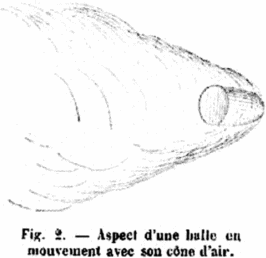
The research object at the center of the affair was a delicate one. On the level of theory, one must bear in mind that shock waves, to use today's terminology, confronted acoustics with a new set of problems that demanded novel approaches and only gradually led to a deeper understanding of the processes under inquiry (Krehl Reference Krehl2009, chap. 2.4). But before theory could become a challenge, observation had to be mastered. In the words of Ernst Mach: “Our task is that of observing a bullet or other projectile which is rushing through space at a velocity of many hundred yards a second, together with the disturbances which the bullet causes in the surrounding atmosphere” (Mach Reference Mach and McCormack1898, 310f). Counterintuitively, such a research object is not invisible to the human eye. When the observer places himself directly behind the gun and follows the projectile's path by looking through a telescope with strong magnification, both the projectile and a conical envelope that develops around the projectile can be seen. According to the anonymous author of the article in La Nature, it was this arrangement by which “thousands of projectiles” had been “observed” at the École normale de tir (Anon. 1888a, 210), and hence this arrangement gave rise to his claim of “direct observation.”
We can now analyze what the notion “direct observation” implies in this context. As the usage of the telescope underlines, observing something directly was, first of all, not synonymous with observing something without any additional help. The confrontation was not that between the naked eye and observation by instruments, and consequently we cannot say that the human organ of sight was favored over technological artefacts. A positive definition of “direct observation” is more difficult. If we conventionally oppose “direct” to “indirect,” we must introduce parameters of mediation. But why should a view through a telescope be more direct, i.e. less mediated, than viewing a set of photographs? Both, the images produced by a telescope and by a photographic apparatus, result from processes of comparable complexity. The last point, however, gives us a clue as to how “direct observation” can be defined most appropriately; direct here seems to be equivalent to simple. Presumably, an observation was more direct the more it relied on the least complex procedure of observation, i.e. a procedure that comprised the minimum number of steps to obtain an impression of the investigated phenomena. In this respect, for the author of the article in La Nature the combination of eye and telescope clearly had an advantage over Mach's and Salcher's procedure. Why take photographs, which, because of their poor quality (as the author assumed), do not show much without additional measures, when the processes in the air are easily visible through the telescope?
The anonymous critic of Mach's and Salcher's work did not prefer human perception to the use of technical means, nor did he favor instruments of registration, like photography, over the capacities of the eye. In terms of Daston and Galison, he was not fully in accordance with the epistemic virtues of the regime of “mechanical objectivity.” Rather, he took a third position. The demarcation line did not run between observation with or without human interference, but between observation based on more or less complex procedures. In saying this I am well aware that the issue of observation and the issue of objectivity do not coincide completely, yet in some respects they are coupled. Daston and Galison emphasize that they do not recount the history of an abstract notion. On the contrary, “scientific objectivity resolves into the gestures, techniques, habits, and temperament ingrained by training and daily repetition” (Daston and Galison [2007] Reference Daston and Galison2010, 52). The ways of making observations, then, are not solely technical matters, but can be considered as one channel through which dominant patterns of objectivity develop normative power in scientific practice. In fact, the whole argument of the anonymous article in La Nature implies that the observations at the École normale de tir, because they are “direct observations,” are simultaneously better observations. The argument would otherwise be meaningless in the author's attempt to downplay the significance of Mach's and Salcher's work. This does not mean that for him “direct observations” were those imbued with objectivity. That notion was not even mentioned. But doubtless a less direct, i.e. more complicated, observation was qualified as an observation that should not be given too much weight.
What was, in turn, Ernst Mach's approach toward observation? And more specifically related to the agenda of the article in La Nature: How did Mach understand the role of the eye, of instruments, and of registration apparatuses in the observational process? One way to answer these questions would be to consult his pertinent works in the philosophy of science, foremost Knowledge and Error (1905). This seems, perhaps, the most natural way, but it leads into a kind of discourse in which the things to be done in the lab already appear in the version of an abstract, generalizable argument. I therefore rely on a text that is closer in subject and publication date to the debated experiments. The short article Bemerkungen über wissenschaftliche Anwendungen der Photographie [Remarks on the Scientific Application of Photography] was published in 1888 in the Jahrbuch für Photographie und Reproductionstechnik, whose readership consisted of professional and amateur photographers. Despite the title, the text considers not only the application of photography, but also more generally the whole breadth of representational tools available in those days. Taking for granted “that all scientific knowledge proceeds from sense perception,” Mach discussed inscription devices and any sort of “graphic arts” as aids in the visualization of phenomena (Mach [1888b] Reference Mach2016, 441). His main point was that by their usage the “power of sense perception . . . can be even more enhanced and its scope significantly expanded” (ibid). Photography was thus characterized as a means either for “temporal expansion” or for “temporal diminution,” the former by fixing “the individual phases of a movement that proceeds too rapidly for our immediate perception with instantaneous photography,” the latter by fixing stages of a slow process like “the growth stages of a plant” and “exhibiting them in a quick series of successive ‘magic lantern pictures’” (ibid., 441 and 442). The microscope, for example, was similarly qualified as a tool for “spatial expansion” and the map as a tool for “spatial diminution” (ibid., 441).
Three epistemological premises determine Mach's account. First, human vision and representations that rely on graphical treatment (like the map) or instruments (like photography) formed a continuum. There was no sharp demarcation between things visible and invisible to the naked eye. Rather, as Mach emphasized, “graphic arts” and technical means enhanced and expanded sensual perception. They could be understood as “an artificial extension of the senses,” as Mach later remarked in Knowledge and Error with regard to Herbert Spencer and Ernst Kapp (Mach [1905/5th ed. 1926] Reference Mach and McCormack1976, 106). Second, everything subject to observation was finally seen; Mach did not differentiate between phenomena depending on their mode of representation. Regardless of whether phenomena were observed by the naked eye, given shape by graphical operations, or recorded by instruments, in every case experience and subsequent insights are bound to the gaze of the researcher. For example, “instantaneous photographs of flying projectiles along with their induced air movements,” on which Mach's and Salcher's study of shock waves was based, ultimately gained relevance through the fact that they “exhibit” the interesting processes “to our perception in as slow a sequence as we like” (Mach [1888b] Reference Mach2016, 441). Third, the power of photography was defined in relation to the power of the various further aids to visualization. Their relation to one another was not that of a hierarchy, with photography and registration apparatuses on the top and the eye at the bottom (or whatever hierarchy one might suggest), but that of functional particularity. One tool is good for this type of problem, the next for another type of problem, etc.
Once again we see how Daston's and Galison's account of photography as central means and agent of “mechanical objectivity” does not match very well with the actors’ ideas. The primary concept in Mach's reflections is “sense perception.” The way in which perception is achieved is not considered in terms of “bad” intervention or “good” non-intervention, but with respect to the particular challenges of the examined phenomena. According to his article's argument, it seems implausible that for Mach a photograph of a plant was to be preferred, a priori, to a drawing, for example. Only when a researcher is intrigued by the plant's growth cycle does the rapid projection of a series of photographs become a more powerful, which is to say functionally more appropriate, tool than a number of sketches displayed one beneath the next. One reason why Mach's approach does not comply with Daston's and Galison's account could be that their argument focuses on the atlas image as its main example. Scientific atlases are educational tools that train “the eye to pick out certain kinds of objects as exemplary . . . and to regard them in a certain way” (Daston and Galison [2007] Reference Daston and Galison2010, 22). Hence atlas images in general preserve and display established phenomena, whereas Mach considered the role of visualizations in much more unstable situations in which the researcher must first apprehend often very fleeting and vaguely defined phenomena. As a consequence, quite different aspects may become critical in evaluating the various means of visualization.
How do Mach's reflections relate to those in the article in La Nature? What do they have in common, and how did Mach react to the qualification of the observations at the École normale de tir as direct (and thus superior to his photographs)? To address the first question: it is likely that neither Mach nor the author of the article in La Nature had a general preference for one particular observational procedure over another. With regard to the nature of the observational means, they share an epistemologically neutral position. What is crucial is rather the relation between the task and the procedure of observation. The concept of “directness,” central for the author of the article in La Nature, has no immediate equivalent in Mach's framework of functional specificity. But to some extent Mach might have been sympathetic to the premise that, in observations, those procedures that make the investigated phenomena perceivable by the most simple arrangement should be privileged. Although it is not directly stated, behind this assumption lurks an idea of economy that resonates with Mach's general concept of the “economic nature of physical inquiry” (Mach [1882] Reference Mach and McCormack1898). Yet, by and large, he was not convinced by the observational procedure elaborated in La Nature.
Mach addressed the issue in a paper published in the Sitzungsberichte of the Imperial Academy of Science towards the end of 1888. In the aftermath of the quarrel with La Nature, he had learned about three articles published earlier that year that had summarized the results of the research at the École normale de tir (Sebert Reference Sebert1888; Journée Reference Journée1888; Labouret Reference Labouret1888). The studies at the French army's artillery school at Camp de Chàlons were now associated with a name; it was Capitaine Journée who had conducted the experiments to which the article in La Nature alluded. Mach's discussion mainly focused on the interpretation of the phenomena and the issue of priority (as already indicated in the introductory section). Only in a footnote did he go into detail about the procedure by which Journée had observed the processes in the air around the projectile. The summary is unambiguous. Without a doubt, the phenomena are perceivable through a telescope, but the resulting impressions cannot match Mach's and Salcher's photographs:
In sharpness and clarity the images Mr Journée observed must of course play second fiddle to ours, since the former are not instantaneous images but rather consist of a superimposition of images belonging to different moments in time, not to mention the fact that they offer an unfavourable perspective. (Mach Reference Mach1888a, 1048)
Mach turned the tables. Not his photographs were “without much sharpness,” as the anonymous author of the article in La Nature had suggested (Anon. 1888a, 210), but rather the images the French officers at Camp de Chàlons had seen. Once again the crucial point was not that Journée et al. ultimately had to rely on visual impressions whereas Mach and Salcher used a recording device. For Mach a light-sensitive plate mounted behind the telescope would not automatically have diminished the disadvantage of Journée's arrangement: a “good observation” was for Mach equivalent to one that shows discrete moments of the investigated phenomena, and a “good” (functionally appropriate) observational procedure was, accordingly, the one that possessed the power to dissect the overall impression into bits and pieces. “Sharpness and clarity,” which Mach attributed to his photographs, thus denote more than the qualities of the pictures. They are instead essential requirements for the process of analysis because any understanding of nature must be built upon discrete, i.e. “sharp,” “clear” elements in space and time. Mach preferred his photographs to Journée's observations by telescope not because visual experience was disadvantageous per se. What was relevant was rather that – apart from the more favorable side view the photographs offered – the duration of exposure by the electric spark according to his own measurements did not exceed 1/500000 s (Mach and Mach Reference Mach and Mach1889, 1313). In contrast, for the human eye the minimal threshold for discriminating two visual stimuli in perception is, as Mach very well knew, about 1/10 s. For this reason Journée's observations, from Mach's point of view, could at best acquire the status of secondary, indistinct representations, never able to serve as the basis for a serious inquiry, because compared to the photographs they subsume so many more moments of the processes into one impression.
III. Varying Functions: Figures in the Paper and Photographs in the Laboratory
Starting in the 1980s Science Studies has focused very much on the role of visualizations in scientific discourse (see Fyfe and Law Reference Fyfe and Law1988; Lynch and Woolgar Reference Lynch and Woolgar1990; in the following decades, of course, much more literature has contributed to and expanded this issue). Since then we are used to seeing a strong rhetorical resource in the figures of a paper. Visualizations in scientific publications can serve, for example, as expansions of and sometimes substitutes for textual statements as well, they can be used as confirmations for textual statements, and photographs in particular can represent within the paper the ‘real,’ the ‘raw’ or the ‘original’ (for the last point Lynch Reference Lynch1991, 217). Each of these functions relies on a written instruction: ‘see fig. xy’ or ‘compare fig. xy,’ or ‘as fig. xy shows’ or simply, almost non-verbal, by putting the number of the figure behind a certain statement or even a single word. Ernst Mach's and Peter Salcher's paper is no exception here. We find the same typical phrases by which numerous figures are integrated into an argument in the same way it happens in more recent publications. However, one thing seems remarkable; all references to figures point to drawings included in the body of the text, whereas the reproduced photographs, which follow in a separate table, are addressed in this way only once in all sixteen pages of the paper. What, then, was the function of these reproductions for the paper and to what extent, if at all, did they contribute to the argument?
To start with the drawings, there are two sorts: those serving as expansions of textual statements like the sketch of the experimental set-up (Mach and Salcher Reference Mach and Salcher1887, 765, fig. 1) and those – the more interesting of the two – used to substantiate theoretical claims. This is true in particular for the three geometrical constructions that form part of the basic interpretation of the processes in the air (ibid., 768–769, figs. 2–4). To say that they confirm textual statements would not be strong enough. On the contrary: the argument is based entirely on the figures. They substitute the observed phenomena with an abstract form of representation more familiar to readers (as long as they are trained in physics), and simultaneously make the processes comprehensible. To quote the first sentence of the corresponding paragraph: “To arrive at an understanding of the phenomena, let us first imagine an infinitely thin bar a b, fig. 2, of considerable length moving in the air in the direction of b a at a velocity exceeding the speed of sound.” (ibid., 768) Drawings like these are analytical tools that explore phenomena before the reader's eyes, allow their “mathematization” (Lynch Reference Lynch, Lynch and Woolgar1990, 170) and end up with “a conceptualized version of the original” (Lynch Reference Lynch1991, 221). But where in Mach's and Salcher's paper are the originals that here and in the remaining ten pages of text are transformed into more easily comprehensible and ultimately not so alien scientific objects?
It would be tempting to see in the reproductions in the table appended to the paper (fig. 1) the originals to which the drawings relate and through which they acquire the status of deduced, formalized representations of the registered phenomena. But as mentioned before, the reproductions are almost absent in the text. It is true that Mach and Salcher more than once reminded the reader of the photographs they had taken in the course of their experiments (Mach and Salcher Reference Mach and Salcher1887, 765, 767, 772) and that they even mobilized the photographs to serve as a reference and as proof of their claims: The photographs “confirm this opinion,” they “show the expected behaviour,” “the mere view of the images teaches,” “the images exhibit, when attentively examined, the inverse behaviour” (ibid., 771, 772, 773, 774). But despite the frequency with which Mach and Salcher addressed the photographs, not once did they add a reference to the table at the end of their paper. This is a peculiar situation. The photographs are repeatedly mentioned, the reader learns that the photographs show, exhibit, or confirm this or that, but s/he is never directly invited to reproduce the gaze and confirm Mach's and Salcher's claims with his or her own eyes. The reader might have done this nevertheless, yet it remains true that the authors abstain from actively integrating the reproductions available at the end of the paper into their argument.Footnote 2 But then the function of the table in the article becomes an even more pressing question.
Table with six reproductions of original negatives, photolithography, at the bottom left the signature of the draughtsman “Reisek del.[ineavit]” (Mach and Salcher Reference Mach and Salcher1887, table).

One reason for neglecting the table could have been that the reproductions did not reveal what Mach and Salcher were able to discover in them. As a reminder, this was more or less the objection lodged by the anonymous author of the article in La Nature. But upon closer consideration, this objection concerned the original photographs, not the reproductions added to the paper. The author's point was that the reproductions already result from a process of clarification and represent solely what Mach and Salcher “have crudely observed in the more or less blurred photographs they had obtained.” One may expect, accordingly, that the reproductions would have been arranged in a way that the readers could easily follow the statements and claims in the paper. But in the eyes of Mach and Salcher, the reproduced photographs could not speak for themselves. To the left of the table they added a figure containing a kind of ‘reading scheme’ for the various details visible in the reproductions (fig. 2). In this manner the audience learned to distinguish important phenomena, like the wave in front of the projectile, from technical details like the traces of the spark in the centre of the photograph. Yet, if the reproductions were unintelligible without instruction, as Mach and Salcher apparently assumed, they would have only very limited use as confirmations of their argument because any independent check of a claim by reference to the reproductions was impossible. The readers had to be signalled what parts of the things visible in the table were relevant, what they represented, etc.
“Explanation of the Figures”; Mach and Salcher's ‘reading scheme,’ added to the left of the table with the reproductions (Mach and Salcher Reference Mach and Salcher1887, 780).

As Ludwik Fleck put it: “In order to see one has to know what is essential and what is inessential: one must be able to distinguish the background from the image; one must know to what category does the object belong. Otherwise we look but do not see, we look intently at too many details without grasping the observed form as a defined entity” (Fleck [1947] Reference Fleck, Cohen and Schnelle1986, 130). Given this, Mach's and Salcher's problem was that the number of those thinking about (or more aptly, viewing) the investigated phenomena in the very moment of publishing the paper amounted to but two persons: the authors themselves (French officers were not yet on their minds). Mach and Salcher could not count on a readership that had at least some rough knowledge on the phenomena presented, let alone an audience used to seeing and interpreting photographs like the ones reproduced in the table. They had to deal with a situation similar to that of Fleck's early bacteriologists at the end of the nineteenth century (ibid., 140; see also Schlich 1996). Confronted with a brand new set of phenomena, they first had to stabilize the pictures themselves – I will come back to this point later – and then had to teach the audience how to look at them. And this was precisely one function of the table added to the paper: to enhance the capability of perceiving the phenomena the paper treated.
Even more important and more critical was the second function of the table, because this time the reproductions indeed became part of the argument. It is in the second section of the paper, equivalent to the ‘methods and materials’ section of a scientific article today, that Mach and Salcher for the first and last time directly point to the reproductions in the table. The whole passage reads as follows: “Commercially available dry plates (silver bromide gelatine) were used to make the photographs. The images had to be taken in a small format for the available light to prove sufficient. Some of the negatives obtained are reproduced in the table in approximately threefold magnification. The boundary of air compression appears either dark or light if the blinds of the Schlieren apparatus are vertical, and partially dark and partially light if the blind edges are positioned horizontally, a fact that needs no special explanation. On the negative, the projectile appears light against a dark background, and its contours stand out clearly on account of the light diffraction. In all, about 80 pictures were taken, most of which might be considered quite successful” (Mach and Salcher Reference Mach and Salcher1887, 767). Most of the passage serves once again to instruct the reader about what s/he sees. Simultaneously, however, the authors tried to create facts, literally, through words, through a gesture toward the table, very similar to and yet slightly different from the written instructions mentioned above.
The crucial statement of the paragraph is contained within the sentence: “Some of the negatives obtained are reproduced in the table in approximately threefold magnification.” One might easily read over the message, but essentially the audience is told: some of the negatives we obtained in the course of our experiments are reproduced in the table, just have a look, there they are. With the gesture toward the table, they claim nothing more or less than the possibility of producing photographs that can serve the study of the phenomena sufficiently well. From this point of view, the reproductions did not function as the ultimate reference point for the interpretation of the phenomena; they did not figure as the ‘originals’ or the ‘raw,’ which assure the drawings as more abstract, more formalized, more meaningful versions of them (in this context, there is no reference to the reproductions at all). The reproductions figure far more fundamentally as the reference point for the feasibility of the experimental procedure. This is the fact simultaneously produced and underscored when Mach and Salcher directed the attention of readers to the table only once in the whole paper. And thus the table indeed forms part of the argument, and a very critical part at that, because every conclusion in the paper is ultimately based on the production and analysis of the photographs in the lab.
Daston's and Galison's observation that at the end of the nineteenth century objectivity was almost automatically attributed to photographs because they result from a mechanical process of production (see Daston and Galison [2007] Reference Daston and Galison2010, 187) must be refined. In the majority of cases, the apparent absence of human agency might have been sufficient to qualify a photograph as objective. But in some cases approaching technical limits, the use of photography inspired mistrust precisely with regard to the process of production. Mach's and Salcher's experiments are one example. Another one, slightly different because it was not so much the practicability but the necessary precision being challenged, concerns photographically registering observations of the transit of Venus in 1874 and 1882 (Ratcliff Reference Ratcliff2008, chap. 6; Canales Reference Canales2009, 121–28). Both examples show that photographs were not at all beyond doubt, not (solely) because the mechanical process of reproduction sometimes required human intervention (for astronomy see Pang Reference Pang1997), but because the products sometimes did not seem to be helpful with regard to their intended task.
My argument that the table added to Mach's and Salcher's paper fundamentally functioned as a proof of the feasibility of the experiments may seem overstretched. The authors merely mentioned that some of the negatives are reproduced in the table; beyond that there is no further comment that might explain what they intended with the hint. Nevertheless, the way I have read the sentence becomes more plausible when we take into account how Mach reacted to the allusions in La Nature. Besides writing letters, he immediately forwarded examples of the photographs first to Joubert (who in turn passed them to Tissandier) and later to Tissandier (see Gaston Tissandier to Ernst Mach, Paris, April 28 and May 7, 1888, DMM, NL 174/3065 and NL 174/3066). Instead of solely relying on verbal explanations, he mobilized (in best Latourian manner; see Latour Reference Latour, Lynch and Woolgar1990) the immutable material product of the experiments. The gesture is very comparable to the gesture in the paper: here are the photographs, persuade yourself. The strategy worked perfectly. In his introduction to Mach's report in La Nature, Tissandier did not fail to emphasize that, while describing the photographs for his readers, he had one of the originals “before his eyes” (Anon. 1888b, 387).Footnote 3
The final point remains: what was the function of the photographs in Mach's and Salcher's research? The anonymous critic in La Nature did not deny that the two researchers had obtained photographs. He suggested that because of the necessary exposure time (he had no information about the actual exposure time) the apparatus could not have registered more than some confused traces of the processes in the air. The table added to the paper reinforced his reserve because apparently the reproductions were not directly based on the photographs. And he was partially right. The signature “Reisekdel.[ineavit; i.e. Reisek has drawn it]” and the imprint “K k Hoflithographie by A. Haase, Prague” below the reproductions (see fig. 1) left no doubt; the table was indeed produced by photolithography, for which the negatives were retraced by hand. Moreover, if the anonymous critic had seen the early series of photographs that led to the announcement of the first successful trials in June 1886, he probably would have felt entirely confirmed in his speculations. Mach's suggestion that the experiments led to “the expected result with full clarity” (Mach Reference Mach1886, 136) is somehow ironically contrasted to the two paper prints he attached to the galley proof of the announcement. Instead of clear, distinct pictures, a comparatively blurred mix of traces is visible (DMM, NL 174/0166 155). The correspondence in these months (Mach stayed in Prague, Salcher conducted the experiments in Fiume, today Rijeka) confirms that the experimenters in fact had to spend most of their time discerning what they saw in the photographs, what belonged to the set-up, and what, perhaps, might be identified as the phenomena under consideration (see Hoffmann Reference Hoffmann2009).
Nevertheless, the anonymous critic was only partially right. In a loop between producing photographs, checking them against each other, learning to discern the various traces, getting a clearer image of the phenomena, readjusting the set-up, producing more photographs and adding some provisional theoretical assumptions, the resulting pictures grew increasingly stable and more significant over the year 1886 (ibid.). They were far from technical perfection, but as “working images” (see Nasim Reference Nasim2013, 10) they fulfilled their purpose. I would even go one step further and claim that the photographs were working materials rather than working images because it was precisely the ‘image’ that first had to take shape in the course of the experiments. Mach's and Salcher's photographs did not display the phenomena right from the start; they did not simply underscore what was already well outlined, but made it possible to isolate and study aspects of the phenomena by comparing pictures and separating traces. As Mach had emphasized in his essay Bemerkungen über wissenschaftliche Anwendungen der Photographie [Remarks on the Scientific Application of Photography], the use of instantaneous photography “exhibits” to our perception rapid processes in time “in as slow a sequence as we like.” In other words, photography above all allows scientists to control the object of inquiry in a way far different from observations with the eye. The resulting pictures did not necessarily show more (and certainly not at the outset) than the “direct observations” at Camp de Chàlons, and they most assuredly did not provide immediate insights. Instead they kept the phenomena at hand, so to speak, and thereby prepared the way for a number of operations that partly enabled the researchers to isolate and analyse the phenomena in detail.
The anonymous critic in La Nature put a great deal of emphasis on the apparently missing “sharpness” of Mach's and Salcher's photographs. Although his guesses were not wrong, the implicit equivalence between the distinctness of the pictures and the possibility of conducting relevant research seems misleading. Mach's and Salcher's experiments led from comparatively incomprehensible pictures early on to the comparatively well-defined pictures added to their paper (as already mentioned, this does not imply that they were immediately intelligible to other researchers). What happened in between, the clarification of the pictures, was not merely a technical process, but clarifying the pictures went along with clarifying the phenomena. The one and the other were inseparably entangled. In this respect “sharpness” was rather the result of the research process, notwithstanding that the pictures still exhibited several technical flaws. I may overstress the argument of the anonymous critic in La Nature, but it appears that from an epistemological point of view he took an empiricist position. For him processes in nature, as soon as they become observable, disclose themselves. Mach's positivism, in turn, did not rule out that in practice phenomena had to be discerned from the immediately visible through laborious procedures. It is true that in his view “sense perception” formed the basis of scientific knowledge. The introductory section of Mach's essay on the scientific applications of photography left no doubt in this respect. The more interesting question is, however, what perception actually implied. In the case of the experiments with Salcher, perception did not simply mean seeing but required numerous additional operations first by which the perception of the processes in the air gradually evolved.
IV. Epilogue: Raising Doubt from Mechanical Reproduction
In October 1888 Ernst Mach sent a letter to the office of the Imperial Academy of Science. In near future, Mach explained, he would like to present a paper to the academy, for which, at the expense of the academy, a “collotype table” should be produced (Ernst Mach to the Imperial Academy of Science, Prague, October 29, 1888, AÖAW, Allgemeine Akten, No. 861/1888, at No. 850/1889). The anticipated price for 800 copies, 80 fl or Austrian Gulden, although not exorbitant, represented a considerable sum (about the monthly wage of a clerk in those days). But Mach had good reason to ask for the required subvention. Justifying the additional expenditure he emphasized: “Because this is a matter of continuing the ballistic experiments that some scholars still confront with disbelief, I would like to avoid a hand drawing and for that very reason attach especial importance to collotype printing” (ibid.). Half a year after the quarrel with La Nature, Mach had drawn his conclusions. Foreclosing any future criticism, he insisted on a printing process by which the original negatives could be reproduced directly, without intermediary retracing by hand.Footnote 4
One year after Mach's request the announced paper was published in the Academy's Sitzungsberichte. Instead of one, two tables were added, each of them bearing on the bottom of the page the imprints “Negative by Dr. J. M. Eder” and “Collotype Printing by J. Löwy in Vienna” (Mach and Mach Reference Mach and Mach1889, table 1 and 2). That so much time had elapsed between the initial request and the final publication was in fact mostly due to the tremendous difficulties the printing process involved (see AÖAW, Allgemeine Akten, No. 850/1889). Ultimately the director of the K. K. Graphische Lehr- und Versuchsanstalt in Vienna, Joseph Maria Eder, had to supervise the production of the master personally. Thus, in the end, it seems that Mach was very much in accordance with the epistemic virtues of “mechanical objectivity.” Hand drawings, i.e. human agency, invited potential doubt and mistrust while collotype print, i.e. non-interventionist reproduction, would silence sceptical colleagues. There is, however, a kind of ironic twist in Mach's request. As we already know, the disbelief focused not so much on the fact that the reproductions added to Mach's and Salcher's 1887 paper relied on hand drawings. The anonymous critic in La Nature did not reject drawings in principle, as demonstrated by a little sketch (fig. 3) that was to illustrate for the readers of his article how the processes in the air were observed at Camp de Chàlons (Anonymous 1888a, 210). Rather, the necessary retracing by hand indicated to him that the original photographs did not depict much more than some indistinct blurred traces of the described phenomena. With this in mind, Mach's request for the collotype printing was not primarily meant to establish the trustworthiness of the phenomena visible in the reproductions. But one type of mechanical reproduction should secure a second type of mechanical reproduction; collotype printing was ultimately used to show that the original photographs were of exactly the same quality as the reproductions before the reader's eyes.
Sketch of the processes in the air around a projectile, view from behind (Anon. 1888a, 210).

Acknowledgments
Part of the research presented in the article was supported by the Max Planck Institute for the History of Science in Berlin. I am also grateful to Dr Stefan Sienell, head of the Archive of the Austrian Academy of Sciences, for his advice in retrieving the archival material related to the article. Julia Encke, Peter Geimer, Alexandre Métraux and two anonymous referees provided helpful comments and suggestions. Daniel Bowles edited for language use. Translations from French and German sources are made by Daniel Bowles, Alexandre Métraux and the author.
Archival Material
DMM; Ernst Mach Papers, Archive of the Deutsches Museum, Munich.
AÖAW; Archive of the Austrian Academy of Sciences, Vienna.