1. Introduction
The North Atlantic Igneous Province was emplaced over several million years, during the peak of activity of the precursor of the Icelandic plume. The initial stages preceded the opening of North Atlantic Ocean 55 Ma ago and were accompanied by the eruption of flood basalts on both sides of the ocean basin (McHone & Butler, Reference McHone and Butler1984; White, Reference White, Tankard and Balkwill1989; Coffin & Eldholm, Reference Coffin and Eldholm1994; White & McKenzie, Reference White, McKenzie and 1995; Courtillot et al. Reference Courtillot, Jaupart, Manighetti, Tapponnier and Besse1999; Scarrow, Curran & Kerr, Reference Scarrow, Curran and Kerr2000; Pirajno, Reference Pirajno2004; Sigmundsson, Reference Sigmundsson2006; Coulon, Reference Coulon2003; Landes, Ritter & Readman, Reference Landes, Ritter and Readman2007). The segment of flood basalts preserved in Northern Ireland, known as the Antrim Lava Group, has been recently dated using the 40Ar–39Ar method at 61.4 ± 0.4 Ma for the lower units and 59 ± 0.4 Ma for the upper unit (McKenna, Reference McKenna2009; Ganerød et al. Reference Ganerød, Mckenna, Smethurst, Prestvik, Rousse, Torsvik and Hendriks2008). The eruption of these basalts is close to the Paleocene–Eocene boundary, a period of pronounced warming and a marked change in carbon isotopic composition (Kennett & Scott, Reference Kennett and Scott1991; Thomas & Shackelton, Reference Thomas, Shackelton, Knox, Corfield and Dunay1996; Norris & Röhl, Reference Norris and Röhl1999; Rhöl et al. Reference Rhöl, Bralower, Norris and Wefer2000; Farley & Eltgroth, Reference Farley and Eltgroth2003; Schmitz et al. Reference Schmitz, Peucker-Ehrenbrink, Heilmann-Clausen, Aberg, Asaro and Lee2004; Tripati & Elderfield, Reference Tripati and Elderfield2005; Zachos et al. Reference Zachos, Röhl, Schellenberg, Sluijs, Hodell, Kelly, Thomas, Nicolo, Raffi, Lourens, McCarren and Kroon2005; Storey, Duncan & Swisher, Reference Storey, Duncan and Swisher2007). Svensen et al. (Reference Svensen, Planke, Malthe-Sorenssen, Jamtveit, Myklebust, Rasmussen Eidem and Rey2004, Reference Svensen, Planke, Chevallier, Malthe-Sorenssen, Corfu and Jamtveit2007) attributed such changes to the expulsion of toxic or greenhouse gases from the contact aureoles surrounding intrusions of the igneous province.
The Antrim Lava Group and underlying sediment pile are cut by numerous shallow mafic intrusions, one of which is the Portrush Sill. This intrusion became famous in the 18th century because of a debate surrounding the interpretation of ammonite-bearing hornfels at its upper contact. Richardson (Reference Richardson1803), a follower of Werner, the Neptunist, maintained that these hard, fine-grained rocks were basalts and used the presence of the fossils within them to argue for a sedimentary origin. Playfair (Reference Playfair1802), who subscribed to the ideas of Hutton the Plutonist, recognized that they formed part of the contact aureole that surrounded the sill and used the evidence of intense heating of the sedimentary rocks to argue for a high-temperature origin as a magmatic rock.
In this study, we sampled in detail the contact aureole in order to determine how the Portrush Sill interacted with its sedimentary host rocks. Our field and petrographic studies revealed the complex structure of this intrusion and the presence of two new magmatic units. We thus provide an example of co-magmatic intrusions emplaced in a very short time, with the consequence that very high temperatures were produced in the sedimentary rocks between the two main units.
2. Geological background
In Late Cretaceous to Early Paleocene time, the North Atlantic region saw the arrival of a mantle plume at the base of the continental lithosphere. Partial melting in the plume resulted in the production of large volumes of magma that formed the North Atlantic Igneous Province, which extended to the west of Greenland, offshore Norway, NW Scotland and Northern Ireland (Coffin & Eldholm, Reference Coffin and Eldholm1994; White & McKenzie, Reference White, McKenzie and 1995; Scarrow, Curran & Kerr, Reference Scarrow, Curran and Kerr2000; Pirajno, Reference Pirajno2004; Landes, Ritter & Readman, Reference Landes, Ritter and Readman2007). Around 65 Ma, the whole region underwent rifting that resulted in the divergence of the North American and Eurasian plates and the opening of the North Atlantic at 55 Ma (Hallam, Reference Hallam1971; McHone & Butler, Reference McHone and Butler1984; White, Reference White, Tankard and Balkwill1989; Courtillot et al. Reference Courtillot, Jaupart, Manighetti, Tapponnier and Besse1999; Coulon, Reference Coulon2003; Sigmundsson, Reference Sigmundsson2006). During these events, the Icelandic plume exhibited an irregular activity with one pulse at 62 Ma and two others at 59 and 55 Ma. Forming the Antrim Plateau in Northern Ireland, the Antrim Lava Group erupted during these peaks, together with contemporaneous intrusive complexes, dykes and sills (Patterson, Reference Patterson1955; Old, Reference Old1975; McHone & Butler, Reference McHone and Butler1984; Thompson, Reference Thompson1985; Lyle, Reference Lyle2003; Mitchell, Reference Mitchell2004).
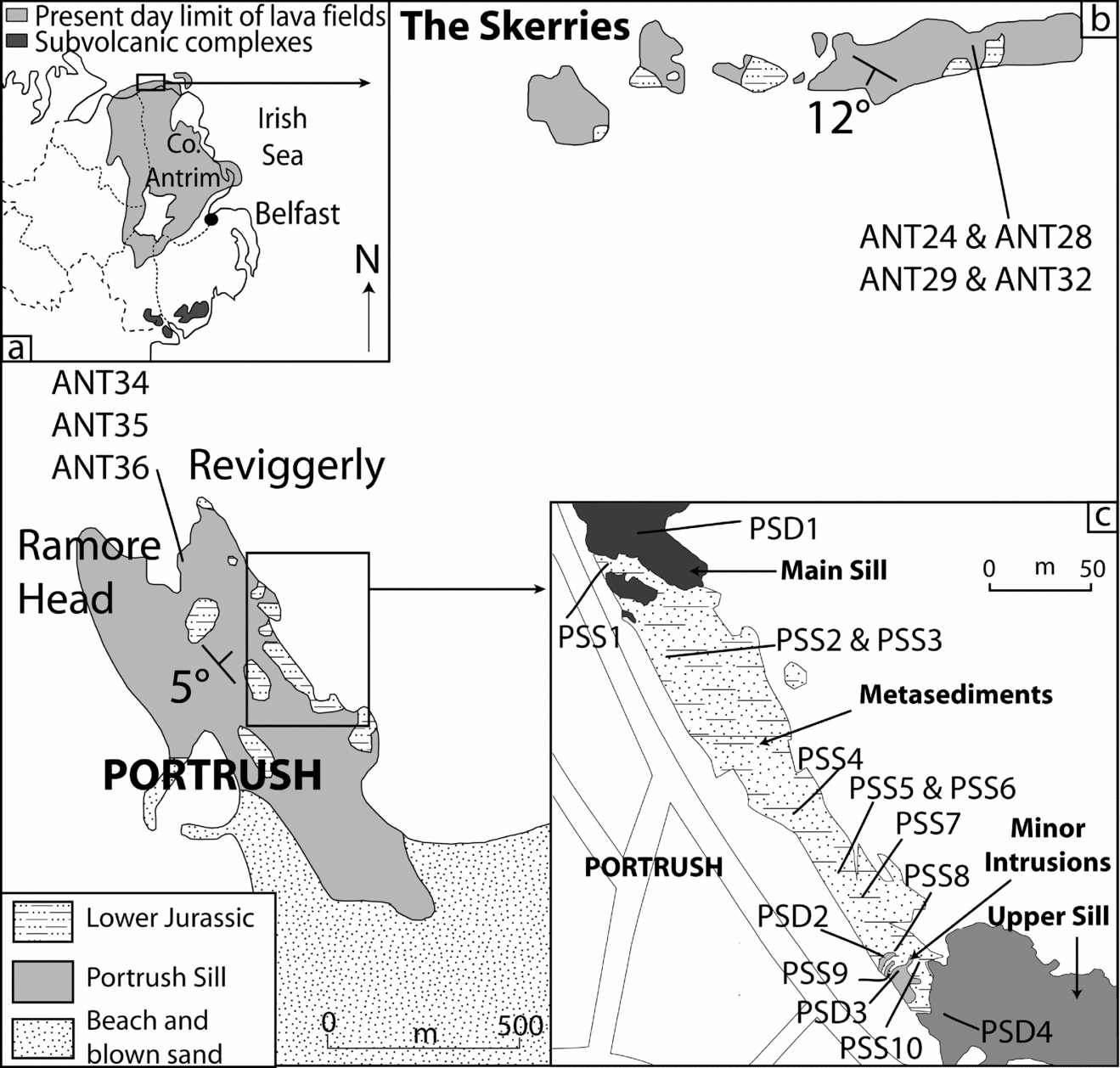
The Portrush Sill is located on the north coast of County Antrim (Fig. 1a) and forms the Ramore Head Peninsula in the town of Portrush. It extends to the north for 2 km offshore to form the E–W alignment of islands known as the Skerries (Fig. 1b). The sill is apparently lopolithic (Hawkes & Wilson, Reference Hawkes and Wilson1975) and its thickness remains unknown: the base of the intrusion is not exposed but its thickness is estimated at between 45 m (Mitchell, Reference Mitchell2004) and > 60 m (Hawkes & Wilson, Reference Hawkes and Wilson1975). McKenna (Reference McKenna2009) dated the intrusion using the 40Ar–39Ar method and obtained an age of 54.9 ± 0.6 Ma, making the intrusion slightly younger than most of the volcanic rocks.
(a) Simplified map of Northern Ireland, modified from Mitchell (Reference Mitchell2004), showing the study area. (b) Geological map of the Portrush Sill area, modified from Hawkes & Wilson (Reference Hawkes and Wilson1975). (c) Detail of the Portrush waterfront: geological map showing Main Sill, Upper Sill, Minor Intrusions and metasediments. Sample sites are shown in (b) and (c).

Hawkes & Wilson (Reference Hawkes and Wilson1975) described the petrology and mineralogy of the lithological units within the sill and the hornfelsed Jurassic sedimentary rocks at its upper contact. In the sill they recognized three main divisions of dolerite or gabbro that can be distinguished by their structure and mineralogy with a mean composition of 0 to 12% olivine, 50 to 60% plagioclase, 20 to 30% pyroxene and 2 to 6% oxides. From their field observations, they reported that the Jurassic sediments are baked to nearly 8 m beyond the contact with the sill, but they did not describe the overlying magmatic units we will present in this paper.
3. Sampling and analytical methods
To analyse both the igneous rocks of the Portrush Sill and the hornfelsed sedimentary rocks of the contact aureole, we sampled along a profile crossing these units (Fig. 1b, c; see Fig. 4 for GPS locations). Before undertaking this sampling, a detailed study was made in the field of the units overlying the Main Sill. Igneous samples were collected across the Main Sill (ANT34 to 36), from smaller dolerite units that intruded the overlying metasediments (PSD1 to 3), and from another magmatic unit that overlies the whole sequence (PSD4) (Fig. 1b, c). A total of ten sedimentary samples were collected from the 10 m of baked Lower Jurassic rocks above the Main Sill (PSS1 to 10). Finally, a small dolerite intrusion on the Large Skerries was sampled along a profile cutting through the intrusion (ANT24 & ANT28) and the surrounding hornfelsed host rocks (ANT29 & ANT32), with the aim of comparing the results with the Portrush profile.
All the samples were studied in thin-section and by X-ray diffraction spectrometry, augmented by microprobe analyses, to determine the major mineral phases in the fine-grained hornfels. All analyses were performed in the geochemistry department (ISTerre) of the University of Grenoble, France. Measurements of remnant magnetization were conducted at the Parc Saint-Maur Observatory in Paris and used to investigate the nature of magnetic minerals in the metasedimentary rocks.
Major and trace elements were analysed at ISTerre. Sample preparation and measurements of loss-on-ignition (LOI) were performed in a clean room and the assays were performed by inductively coupled plasma atomic emission spectrometry (ICP-AES) and inductively coupled plasma mass spectrometry (ICP-MS) using techniques described by Chauvel, Bureau & Poggi (Reference Chauvel, Bureau and Poggi2011). The uncertainty on the major element data is estimated at 5% and given as a percentage of standard weight of oxide. Errors on trace-element data are estimated at 5 %. Note that some concentrations, such as phosphorus (P) and cadmium (Cd), were below the detection limit of the machine, and could not be analysed.
4. Field relationships
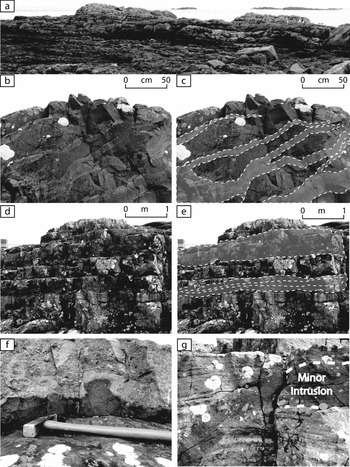
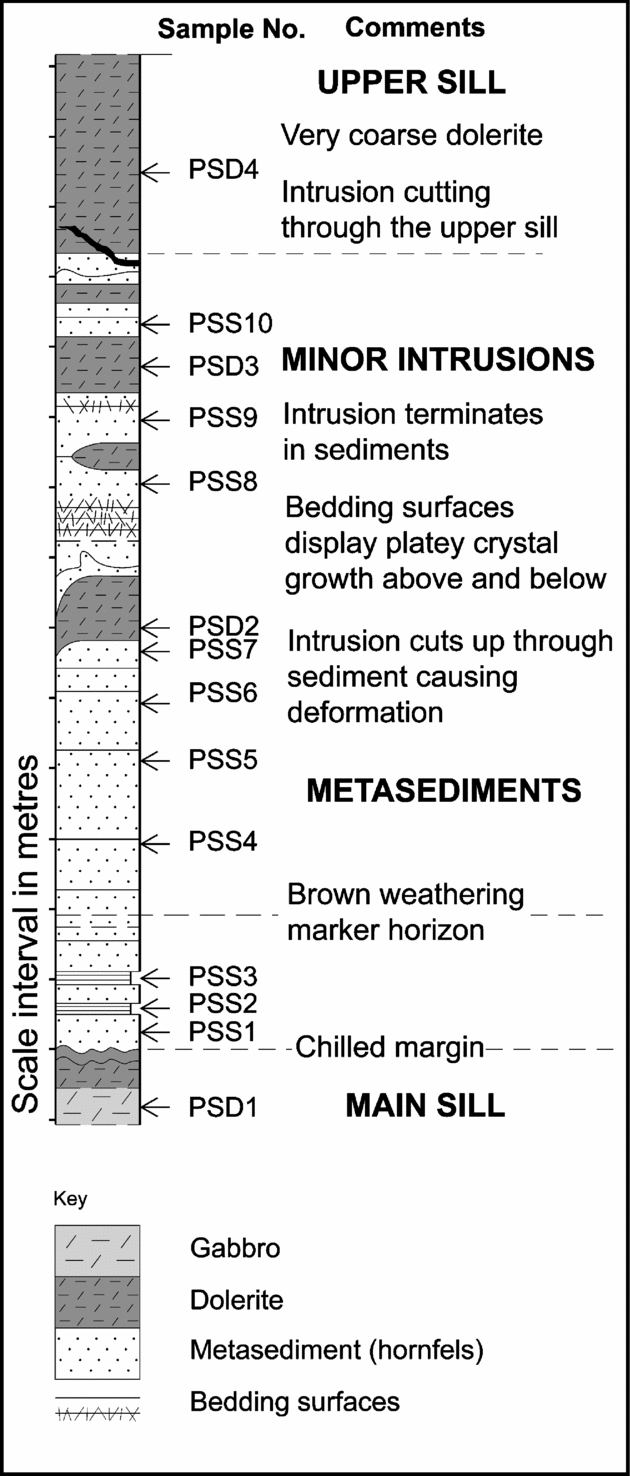
In outcrops on Ramore Head, Reviggerly and the waterfront of Portrush (Fig. 1b), several gabbroic to doleritic units intrude the metasedimentary rocks that immediately overlie the Main Sill, as shown in Figures 1, 2 and 3. The uppermost and thickest of these minor intrusions, an olivine dolerite that we will call the Upper Sill, intruded about 10 m above the Main Sill (Fig. 3). The upper part of this unit has been removed by erosion and its full thickness is unknown; however, the rock is medium grained throughout and it was probably not much thicker than the 15 m that remains. Other smaller doleritic intrusions, which we refer to as the Minor Intrusions, form a complex of irregular units intruding the metasediments between the Upper Sill and the Main Sill. They first appear about 6 m above the upper contact of the Main Sill (Fig. 2d, e) and persist upward to intrude the Upper Sill (Fig. 2b, c). Their thickness varies from tens of centimetres to a metre. They are broadly conformable with bedding in the sedimentary rocks, but at outcrop scale, these smaller intrusions were observed to terminate abruptly in the metasedimentary rocks, and to be associated with ductile deformation in the country rocks. Some intrude the Upper Sill (Fig. 2b, c) while others are cut by this sill, indicating that there were several generations of minor intrusions.
(a) General view of gabbros of the Portrush Sill with the N-dipping main outcrop in the foreground and the S-dipping outcrops of the Skerries in the background. The change in dip reveals the saucer- or lopolithic shape of the intrusion. (b) Dolerite of the Upper Sill cut by Minor Intrusions. (c) Same picture as (b) with Minor Intrusions outlined. (d) Minor Intrusions cutting through metasediments immediately below the Upper Sill. Those are concordant with the sediment layering. (e) Same picture as (d) with Minor Intrusions outlined. (f) The irregular fine-grained upper chilled margin of the Main Sill. (g) One of the Minor Intrusions cutting discordantly through metasediment: note the absence of a chilled margin at the edge of the intrusion.

Log of metasediments between the Main Sill and Upper Sill showing sample sites. This diagram outlines the various relationships between the sedimentary and magmatic units.

On the Skerries, the Upper Sill was not found, but a 3 m thick dolerite sill was located and sampled no more than 4 m above the Main Sill (ANT24 & ANT28, Fig. 1b). Metasediments are present on this side of the sill, but their thickness is less than 5 m.
5. Mineralogy
5.a. Igneous rocks
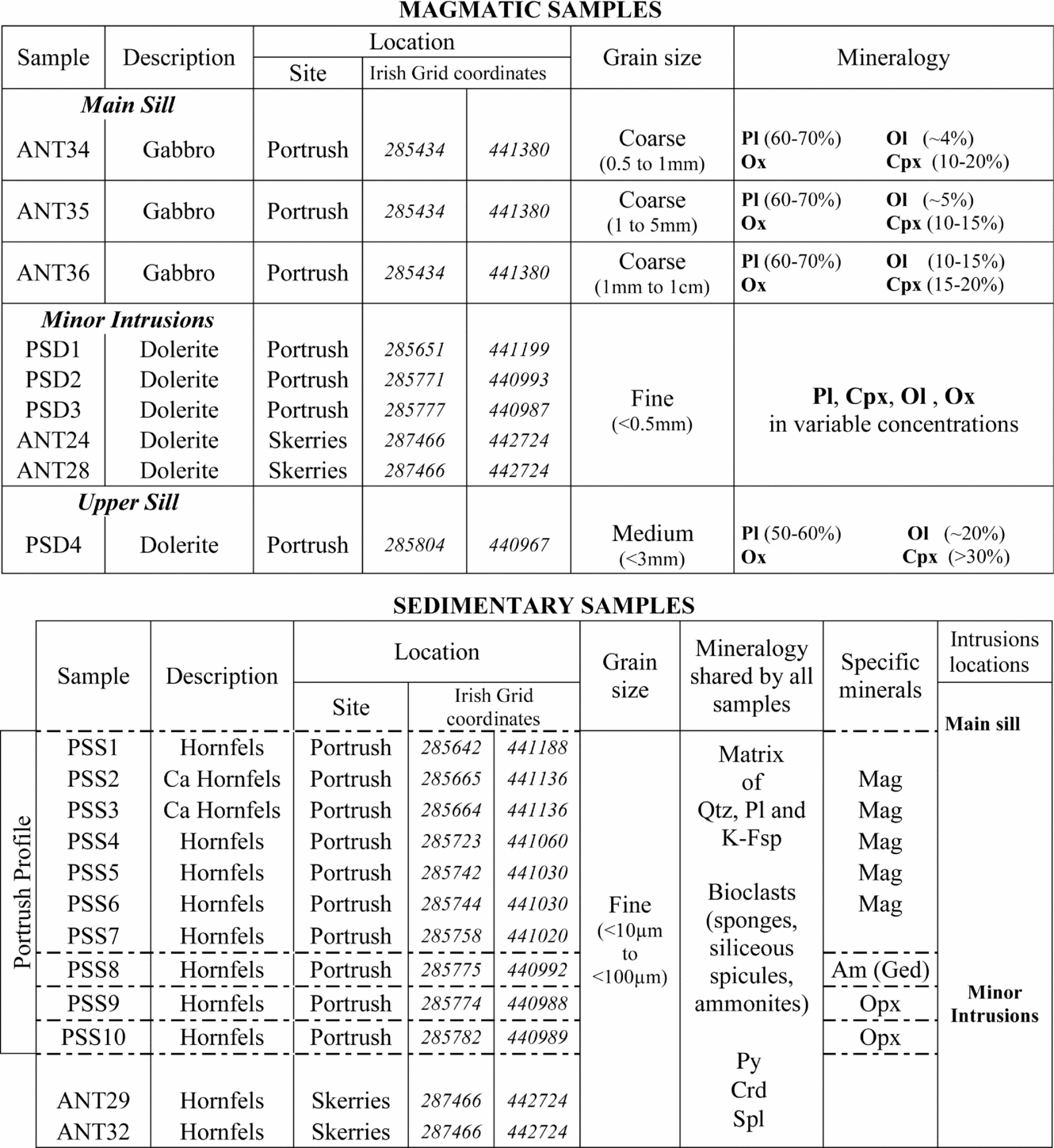
All of the igneous rocks sampled for this study are either dolerites or gabbros (Fig. 4). The Main Sill is divided into the three divisions described by Hawkes & Wilson (Reference Hawkes and Wilson1975). The upper division is a surprisingly thin chill zone in contact with the metasedimentary rocks (Fig. 2f). It has an aphanitic texture only in the uppermost few centimetres, then grades rapidly down into fine- to relatively coarse-grained dolerite. At a distance of only 20 cm from the contact, the average grain size is about 0.5 to 1 mm and the olivine content is only about 4%. The middle division is equigranular gabbro with a grain size ranging from about 1 to 5 mm. It is composed of plagioclase, clinopyroxene, about 5% olivine altered to iddingsite and accessory oxides. The lower division has a coarser texture (grain size can reach centimetre scale) and higher olivine content at 10 to 15%.
Sample descriptions with their localization (GPS coordinates from Irish grid reference), the rock type and their mineralogy. Minerals are named as follows: Pl – plagioclase; Ol – olivine; Cpx – clinopyroxene; Opx – orthopyroxene; Ox – oxides; Qtz – quartz; Fsp – feldspar; Am – amphibole; Ged – gedrite; Mag – magnetite: Crd – cordierite; Spl – spinel. The sedimentary part of the table includes horizontal dotted lines showing localization of magmatic intrusions along the Portrush profile.

The Upper Sill is a medium-grained dolerite (grain size < 3 mm) that contains a higher proportion of olivine (~ 20%) and clinopyroxene (> 30%) than the Main Sill. The Minor Intrusions have similar parageneses, but are more heterogeneous and are even finer grained (< 0.5 mm). They have distinct but narrow chilled margins and often show fine banding parallel to their borders (Fig. 2g).
The 3 m thick intrusion overlying the Main Sill on the Skerries shows a pronounced variation in grain size, from an aphanitic chill zone at the upper contact through to medium-grained dolerite at a distance of 1.5 m from the contact. The olivine content is similar to that observed on the mainland at about 5%. The contact chill zone is marked by pronounced alteration of the magmatic texture of the rock and by complete transformation of olivine to iddingsite.
5.b. Sedimentary rocks
The sedimentary rocks that host the Portrush Sill, at the Portrush waterfront and on the Skerries, consist entirely of mud- and siltstones that have been metamorphosed to hard, beige to grey hornfels (Fig. 2d, g). These hornfels have a quartzo-feldspathic matrix within which bioclasts can be recognized, including sponges with siliceous spicules, as well as Richardson's famous ammonites. No analyses were conducted on the protolith, which has been removed by erosion in the study area.
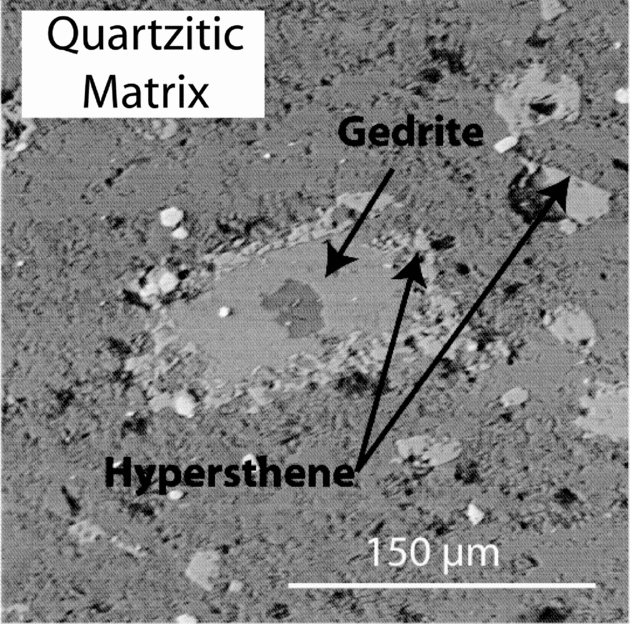
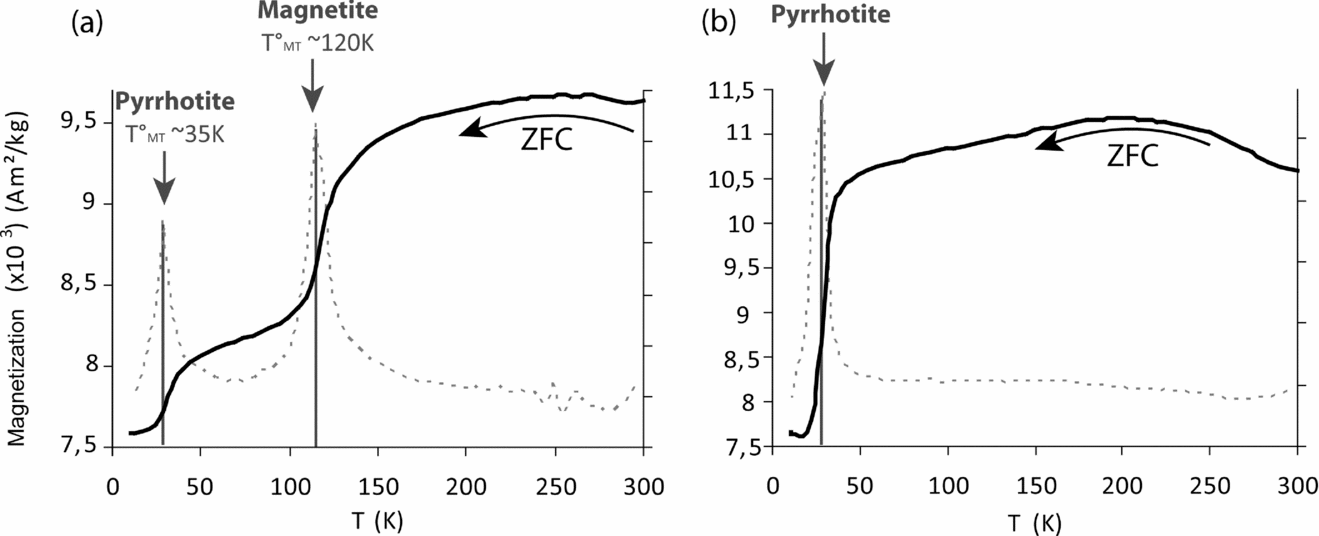
The hornfels are persistently fine grained (< 10 μm to < 100 μm), which precludes positive identification of most mineral phases under the petrographic microscope. However, a combination of X-ray diffraction and microprobe analyses reveals that clay minerals are absent, having been replaced by an assemblage that includes potassium feldspar and plagioclase, Mg-Al spinel and cordierite (Fig. 4). In samples taken next to the Minor Intrusions (PSS8 to PSS10, see Fig. 1c), orthopyroxene occurs as small equant grains scattered throughout the rock. In one sample (PSS8), a reaction rim of orthopyroxene surrounds a grain identified by microprobe analysis as the amphibole gedrite (Fig. 5). Finally, analyses of remnant magnetization by zero field cooling show the presence of two facies along the profile. The first is located in its central part (PSS2 to PSS6), far from all intrusion units, and contains both pyrrhotite and magnetite (Fig. 6a). The second comprises samples taken closer to the Minor Intrusions and is characterized by an absence of magnetite (PSS7 to PSS10) (Fig. 6b).
Back-scattered electron image of hornfels sample PSS8 showing metamorphic reaction rim of hypersthene on gedrite, identified by microprobe analyses.

Zero field cooling curves for representative hornfels samples showing two mineral assemblages: (a) Type 1, from the centre of the sedimentary profile: magnetite and pyrrhotite; (b) Type 2, adjacent to a Minor Intrusion: pyrrhotite only. Temperatures are of magnetic transition and reveal the presence of either magnetite at 120K or pyrrhotite at 35K.

6. Metamorphic conditions
The metamorphic assemblages identified in the hornfels are consistent with metamorphism at low pressures and high temperatures, as we would expect in an aureole surrounding a shallow-level mafic intrusion. The presence of cordierite and spinel in all samples implies temperatures greater than 500°C across the entire profile. In the same way, pyrrhotite is ubiquitous; its appearance corresponds to the destabilization of pyrite, a reaction that occurs at temperatures above 523°C (Scott, Reference Scott1974). In sample PSS8, orthopyroxene forms at the expense of gedrite (Fig. 5):
gedrite + cordierite + quartz → orthopyroxene + cordierite
To destabilize and transform the amphibole to pyroxene, the temperature must exceed 660°C (Winkler, Reference Winkler1965; Akella & Winkler, Reference Akella and Winkler1966). These observations show that the whole profile has been subjected to thermal metamorphism at temperatures greater than 523°C, and that the upper part was hotter with temperatures in excess of 660°C. The metamorphism is thus near constant across the 10 m of the aureole, with a slight maximum near the Minor Intrusions and far from the contact with the Main Sill.
7. Geochemistry
7.a. Igneous rocks
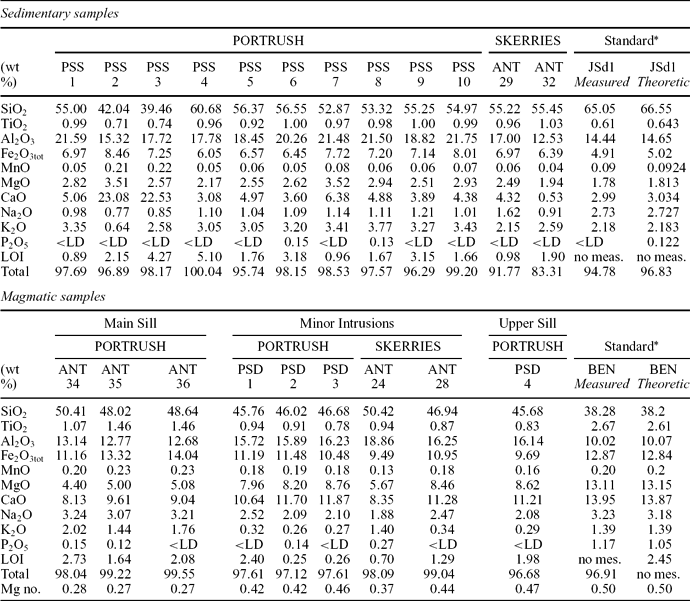
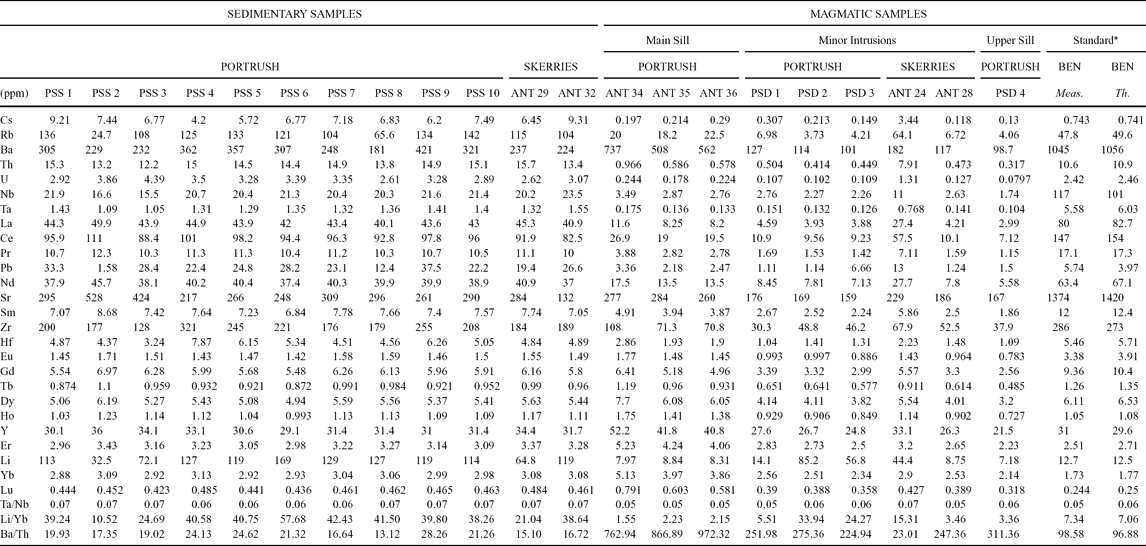
Major- and trace-element analyses of the magmatic rocks were conducted for the three units: the Main Sill, the Minor Intrusions and the Upper Sill. The compositions are similar to those of tholeiitic continental flood basalts: silica concentrations vary between 47 and 53 wt%, and CaO remains higher than the sum of Na2O and K2O. All the compositions are relatively evolved, with MgO contents and Mg no. around 5 wt% and 0.27, respectively, for the Main Sill, and around 8 wt% and 0.37 to 0.48 for the Minor Intrusions and the Upper Sill. Only the sample ANT24, taken at the contact with metasediments on the Skerries, is different from other Minor Intrusions with a MgO content of 5.67 wt% (Table 1).
Major element abundances for sedimentary and magmatic samples from Portrush and Skerries

Abbreviations: LD – limit of detection; LOI – loss on ignition
* BEN values from Govindaraju (Reference Govindaraju1980); JSd1 values from Terashima et al. (Reference Terashima, Ando, Okai, Kanai, Taniguchi, Takizawa and Itoh1990).
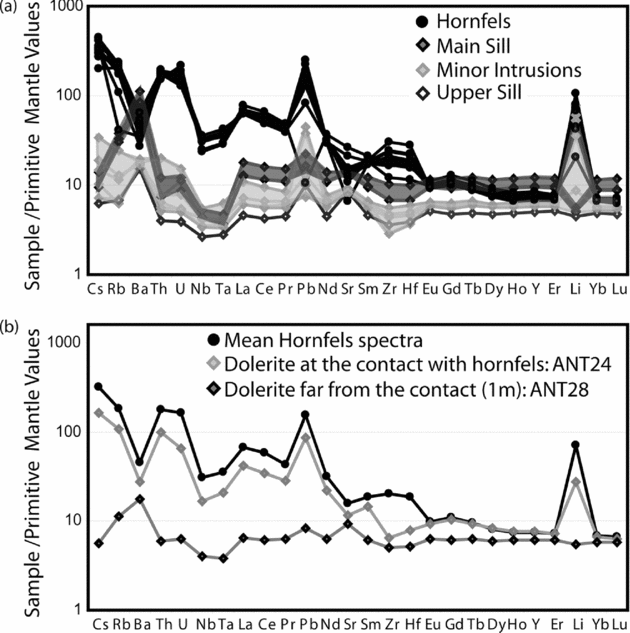
The trace-element analyses, when plotted in multi-element diagrams (Fig. 7a), reveal strong enrichment of the more incompatible elements coupled with pronounced negative niobium (Nb) and tantalum (Ta) anomalies. These features are typical of basalts in continental large igneous provinces. All three lithological divisions of the Main Sill, as recognized by Hawkes & Wilson (Reference Hawkes and Wilson1975), have similar compositions and, unlike the Minor Intrusions and the Upper Sill, have positive barium (Ba) anomalies. In contrast, the Minor Intrusions and the Upper Sill are very similar and show large positive lithium (Li) and lead (Pb) anomalies, the amplitude of which varies from sample to sample. Finally, overall concentrations of trace elements in the Main Sill are distinctly higher than in the Minor Intrusions and in the Upper Sill (Table 2), despite its lower olivine content and its lower Mg no.
(a) Multi-element spectra of samples from the three dolerite or gabbro units of Portrush and associated hornfels normalized to the primitive mantle values of Hofmann (Reference Hofmann1988). The Nb and Ta anomalies and the enrichment of all samples provide evidence of contamination by granitic crust. The Li, Ba and Pb anomalies give proof of shallower contamination. (b) Multi-element spectra showing the similarity between the mean hornfels composition and the composition of an adjacent Minor Intrusion (shallow dolerite, ANT 24), compared with a dolerite sampled far from the contact (deep dolerite, ANT 28). This correlation provides evidence of localized fluid circulation contamination.

Trace element abundances for sedimentary and magmatic samples from Portrush and Skerries

* BEN values from Govindaraju (Reference Govindaraju1980). Meas. = measured; Th. = Theoretic.
Two igneous samples from the Minor Intrusion located just above the Main Sill on the Skerries have unusual compositions (Table 2). The first was collected less than 2 cm from the contact with sediment (ANT24), and the second at a depth of about 3 m within the sill (ANT28). The multi-element spectrum of the first sample has a sedimentary signal very like that of Portrush hornfels, whereas the second sample has a composition similar to those of the Minor Intrusions (Fig. 7b).
7.b. Metasedimentary rocks
Samples from the contact aureole have very uniform compositions (Table 1) with 52.87 to 60.68% SiO2, 17.78 to 21.75% Al2O3, 2.17 to 3.52 wt% MgO and 3.05 to 3.77 wt% K2O, with the exception of two samples from fine-grained beds located about 20 cm above the contact (PSS2 & PSS3, see Figs 1c & 3): they have much higher CaO contents (~ 23 wt%, compared with the 3.08 to 6.38 wt% in the other samples), probably indicating that they originally contained a high carbonate content. The two samples taken on the Skerries (ANT29 & ANT32) are similar to those from Portrush: this confirms that the same Lower Jurassic metasediments are present on both side of the Main Sill. As suggested by the petrography (Fig. 4), the chemical analyses show that the composition of the sedimentary rocks is nearly constant through the contact aureole.
The trace-element analyses are typical of post-Archaean argillaceous sediments, being characterized by enrichment of the more incompatible elements and pronounced negative europium (Eu) anomalies (Table 2; Fig. 7a). The multi-element spectra show variable zircon (Zr) and hafnium (Hf) anomalies that can be attributed to variable contents of detrital zircon and other heavy minerals (Fig. 7a).
When compared with the igneous rocks, we note that (1) negative anomalies of Nb and Ta are present in all the sedimentary rocks, (2) Ba forms very large negative anomalies in contrast with the positive anomalies displayed by most of the igneous rocks, and (3) positive Pb and Li anomalies are present in all metasediments and some igneous rocks.
8. Discussion
8.a. Portrush igneous rocks and magma contamination processes
We found that the structure of the Portrush Sill is somewhat more complex than described by Hawkes & Wilson (Reference Hawkes and Wilson1975). Of particular importance, in the context of this study, is the recognition of the Minor Intrusions and the Upper Sill in the sedimentary rocks overlying the Main Sill because, as discussed later, they perturbed the thermal profile developed in the aureole. In addition, they provide evidence for a complex history of interaction between mafic magma and crustal rocks.
The trace-element spectra, and especially the relative abundances of Nb, Ta, Pb, Ba and Li (Fig. 7), provide evidence of two stages of contamination. The first is manifested in the overall enrichment in all samples of incompatible elements, accompanied by the development of negative Nb–Ta anomalies. The isotope data of Barrat & Nesbitt (Reference Barrat and Nesbitt1996) shows that igneous rocks of the Antrim Lava Group have variable 87Sr/86Sr and 143Nd/144Nd ratios, with ε Sr (t) = −22 to +107 and ε Nd (t) = −11 to +8.5. Such geochemical characteristics are typical of continental flood basalts worldwide. Like Barrat & Nesbitt (Reference Barrat and Nesbitt1996), we accept a contamination model involving interaction between magma and granitic rocks in a deep to mid-crustal magma chamber as an explanation for the overall geochemical features of the Antrim rocks.
The samples from the Minor Intrusions on the Skerries indicate that a second stage of magma contamination occurred at shallower depths. As shown in Figure 7b, positive anomalies in Li and Pb and a negative Ba anomaly relative to Cs, Rb and Th, which match those in the sedimentary rocks, are present in the sample from the margin of the intrusion (ANT24), but are poorly developed or absent in the sample from deeper in the intrusion (ANT28). This reveals localized contamination of the magma by sediments. As mentioned above, the magmatic minerals in the sample closest to the contact are replaced by secondary phases such as the iddingsite that replaces olivine, probably as a result of interaction with circulating aqueous fluids. The uptake of Li, Pb and other alkali elements can therefore be attributed to the transfer of these soluble elements from sediment into the intrusion in the same type of fluid. In the same way, because the alkalis and alkaline earths are easily mobilized during fluid circulation, the sample at the contact became enriched in K2O and depleted in FeO. The absence of Li, Pb and Ba anomalies in rocks from deeper in the intrusion tells us that the assimilation of material from sedimentary host rocks is a relatively limited process, one that takes place at a post-magmatic stage and is restricted to the margins of Minor Intrusions.
8.b. Portrush Sill: a special case of contact metamorphism
The metamorphic aureole of the Portrush Sill is almost 10 m wide and extends from the upper contact of the Main Sill through to the base of the Upper Sill (Fig. 3). Rocks higher in the section have been removed by erosion. The mineralogical data show that high temperatures were reached in all parts of the aureole: the presence of cordierite and pyrrhotite throughout the aureole implies a minimum temperature of 500–520°C (Schreyer & Yoder, Reference Schreyer and Yoder1964; Schreyer, Reference Schreyer1965; Winkler, Reference Winkler1965), and in areas with multiple Minor Intrusions, i.e. in the upper part of the profile, the gedrite–hypersthene assemblage indicates temperatures over 660°C. The entire sedimentary unit between the Main Sill and the Upper Sill has thus undergone intense thermal metamorphism. The temperature profile is quite different from what would be expected for one surrounding a single intrusion, in which the temperature should decline exponentially away from the intrusive contact. Another peculiarity is seen in the upper border zone of the Main Sill, which is unusually thin: the aphanitic chilled margin is only a few centimetres thick (Fig. 2f) and, at a depth only a metre into the sill, the rock is medium to coarse grained. Huppert & Sparks (Reference Huppert and Sparks1989) and Holness & Humphreys (Reference Holness and Humphreys2003) described how a chilled margin might form initially at the border of a sill, only to be resorbed by remelting or erosion caused by continued flowage of magma through the sill. We believe this process did not act during emplacement of the Portrush Sill for the following reasons. (1) The metamorphic profile inferred from mineral assemblages in the contact aureole records no decline in temperature away from the upper contact of the Main Sill. In the case of continuous magma flow associated with an eroded chilled margin, we would expect the higher temperatures at the edge of the intrusion; instead the highest temperatures are recorded between the small intrusions, some 8 m above the contact of the Main Sill. (2) In the metasediments of the aureole, textures and structures indicative of partial melting are absent while they are common features when sustained magma flows persist. (3) A chilled margin, although thin, is indeed present at the upper contact of the sill (Fig. 3c). (4) Neither textures nor structures in the upper border zone of the sill have been found to sustain the hypothesis of continued flow and melt-back of the initial chilled margin: the texture changes progressively, from fine to coarse, away from the margin, and flow structures and textures indicative of remelting are absent. On the basis of these arguments, we propose that the Main Sill was emplaced essentially as a single pulse and that the thermal environment was anomalous – unusually hot – at the time of its intrusion.
To explain the high temperatures, we propose that the Upper Sill and the Minor Intrusions were emplaced into the sedimentary sequence shortly before the Main Sill. Given the similar chemical compositions of the smaller intrusions, it is probable that they had a common source and were emplaced in a brief interval of time; this is supported by the several generations of Minor Intrusions that cut through or are cut by the Upper Sill. The two sets of intrusions generated a thermal aureole that extended several metres down to the sedimentary sequence. The Main Sill then intruded into a pre-heated series of rocks, and the excess of temperature provided by the earlier intrusions prevented the formation of a thick chill zone.
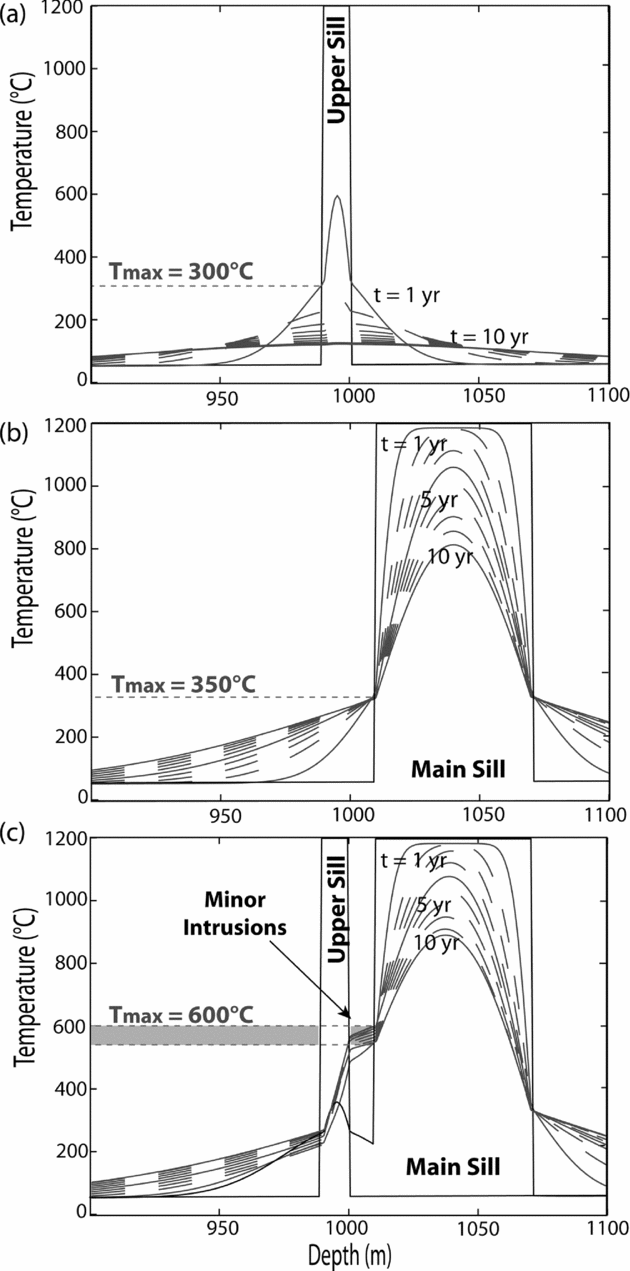
We modelled the thermal evolution of the intrusions and the country rocks using a simple heat-flow equation (Fourier, Reference Fourier1822). To apply this equation requires knowledge of several critical parameters, many of which are poorly constrained. One crucial parameter is the thicknesses of both large sills, which we cannot determine because the upper contact of the Upper Sill and the lower contact of the Main Sill are not exposed. For the modelling we have assumed that the Upper Sill was 10 m thick and the Main Sill was 60 m thick. Other unknown parameters are the duration of magma flow through the sills, which, for the reasons given above, we believe was short, and the amount of time that elapsed between the emplacements of the two sills.
As shown in the Figure 8a and b, neither the Upper Sill alone nor the Main Sill alone can explain the high temperatures observed in the aureole: the highest temperatures they could produce are 300°C and 350°C, respectively, far less than the 550°C recorded in the metamorphic aureole. Coupling of the thermal effects of those two intrusions with transfer of heat from the Main Sill enhanced the temperature of rocks throughout the sedimentary interval, and the process was efficient enough to produce the temperatures of 500 to 600°C.
The Minor Intrusions are not shown in this model, but they played a crucial role in the upper part of the temperature profile: as they were emplaced together with the Upper Sill, they are able to boost the temperature up to 660°C (compared to the 600°C shown in the model) leading to the appearance of orthopyroxene in samples taken in this particular zone (PSS8, PSS9, PSS10).
Several other models were tested but not shown here, especially concerning variations in the lag time between both intrusions. What emerges from those models is that if the Main Sill intruded within a few years of the first intrusions (< 5 years), the temperatures are coherent with the mineralogy, but if the lag time is longer, temperatures are too low and inconsistent with the metamorphic assemblages.
The geochemical data, on the other hand, show differences in the levels of incompatible elements of the Main Sill and the overlying units (Table 2; Fig. 8a) and provide evidence that they are not related by simple fractional crystallization. The combination of low REE contents but high Mg no. of the Upper Sill and Minor Intrusions suggests they derive from a different parental magma than the Main Sill. The Main Sill is then not directly co-magmatic with those two units, and their close proximity – in space and in time – provides evidence of the complexity of this magmatic plumbing system.
Numerical models of thermal diffusion following Fourier's heat equation. The whole system had a geothermal gradient of 30°C/km. The initial heat of the magma is fixed at 1200°C, the thermal diffusivity of the magma is 10−6 m2/s, and the thermal diffusivity of the sediments is 10−5 m2/s. Each sill was assumed to intrude at 950 m depth to prevent side effects. (a) The Upper Sill was modelled at a depth of 990 m with a thickness of 10 m: the highest temperature reached in the surrounding sediment is about 300°C. (b) The Main Sill modelled at a depth of 1010 m with a thickness of 60 m: the highest temperature reached in the sediment is about 350°C. (c) Both sills modelled at the same depths and the same thicknesses as before, but the Main Sill was emplaced one year after the Upper Sill. The thermal combination allows the sediments to reach a high temperature of almost 600°C. This model works for a lag time between intrusions of a few months to about five years.

Finally, the particular configuration of the various intrusions hides any record of gas release and prevented us from investigating their environmental impact. However, the geochemistry offers insight into magma emplacement and contamination processes, and the petrologic analyses and the numerical model of thermal diffusion explain how high-temperature contact metamorphism is reached by sedimentary rocks sandwiched between closely related sills.
Acknowledgements
This project would not have been possible without the financing and the collaboration of the Geological Survey of Northern Ireland, and especially without the support of Garth Earls during the fieldwork and discussions. We thank Francis Coeur, Bruno Lanson and Sarah Bureau at the ISTerre for their valuable technical assistance; Catherine Chauvel, Stéphane Guillot and Jean-Emmanuel Martellat for their instructive comments; and Frances Lagroix, IPGP, at the Parc Saint-Maur for the magnetization analyses. Finally, we thank N. Schofield and A. Saunders who accepted to review our manuscript and gave us relevant and helpful comments.