INTRODUCTION
Maize–legume cropping systems of southern Africa are characterized by low soil and crop productivity, limited use of inorganic fertilizers and livestock manure, and unfavourable input–output market conditions (Cobo et al., Reference Cobo, Gerd and Cadisch2010; Morris, Reference Morris2007; van der Velde et al., Reference van der Velde, Folberth, Balkovic, Ciais, Fritz, Janssens, Obersteiner, See, Skalsky, Xiong and Penuelsa2014). Productivity of cropping systems is low due to inherently low soil fertility in many parts of southern Africa (Cobo et al., Reference Cobo, Gerd and Cadisch2010; Zingore et al., Reference Zingore, Murwira, Delve and Giller2007) and unfavorable rainfall patterns (Tadross et al., Reference Tadross, Hewitson and Usman2005; Unganai et al., Reference Unganai, Troni, Manatsa and Mukarakate2013). Fertilizer use in smallholder farming systems of southern Africa is the lowest compared to the rest of the World (Smaling et al., Reference Smaling, Nandwa, Janssen, Buresh, Sanchez and Calhoun1997; Place et al., Reference Place, Barrett, Freeman, Ramisch and Vanlauwe2003). The prices of most agricultural inputs, including inorganic fertilizer, have been escalating and resource constrained smallholder farmers can hardly afford to purchase inorganic fertilizer. Consequently, maize and legume yields from the smallholder systems are either decreasing or have remained stagnant over the years. These production challenges for cereal and legume crops have been worsened by low grain producer prices in most southern Africa countries (Jayne et al., Reference Jayne, Govereh, Wanzala and Demeke2003; Reference Jayne, Mather and Mghenyi2010) forcing farmers to grow crops without appropriate soil nutrient management practices.
The commonly recommended soil fertility amendment is inorganic fertilizer and its effects on crop production in different agro-ecologies of southern Africa are well documented (Sanchez et al., Reference Sanchez, Shepherd, Soule, Place, Buresh, Izac, Mokwunye, Kwesiga, Ndiritu and Woomer1997; Smaling et al., Reference Smaling, Nandwa, Janssen, Buresh, Sanchez and Calhoun1997; Sommer et al., Reference Sommer, Bossio, Desta, Dimes, Kihara, Koala, Mango, Rodriguez, Thierfelder and Winowiecki2013). When inorganic fertilizer is available, smallholder farmers often apply it to cereal crops as basal dressing at seeding and as nitrogen-rich topdressing in later crop growth stages, and legumes are grown using residual soil fertility whenever full crop rotations are practiced (Giller et al., Reference Giller, Cadisch, Ehaliotis, Adams, Sakala, Mafongoya, Buresh, Sanchez and Calhoun1997; Twomlow et al., Reference Twomlow, Steyn, du Preez, Petersen, Unger and Payne2006). Similarly, when cereal and legumes are grown as intercrops, fertilizer is usually applied to the cereal crop and the legume is expected to compete with the cereal for added nutrients. In smallholder systems, both legume and cereal biomass yields are often low because of low soil fertility, limited use of inorganic fertilizer and manure, among other challenges. Where soil phosphorus is limiting, not all grain or green manure legumes fix N (Vanlauwe and Giller, Reference Vanlauwe and Giller2006) thus reducing the beneficial effects of legumes in the rotation. In such instances, residual soil nitrogen (N) and organic matter contributions of legumes are limited because of low biomass production and N fixed by the legumes. Smallholder farmers therefore have to make a decision on where to invest their limited inorganic fertilizer, either apply it to the legume to increase biomass production and make use of the residual effect on the maize in the following season or invest on the cereal to maximize grain yield in the current season.
Maize-grain legume associations have traditionally dominated smallholder farming systems in southern Africa (Giller, Reference Giller2001; Snapp et al., Reference Snapp, Rohrbach, Simtowe and Freeman2002; Twomlow et al., Reference Twomlow, Steyn, du Preez, Petersen, Unger and Payne2006), despite efforts to introduce green manure legumes for soil fertility improvement (Gilbert, Reference Kumwenda, Gilbert, Waddington, Murwira, Kumwenda, Hikwa and Tagwira1998; Hikwa et al., Reference Hikwa, Murata, Tagwira, Chiduza, Murwira, Muza, Waddington, Waddington, Murwira, Kumwenda, Hikwa and Tagwira1998; Waddington et al., Reference Hikwa, Murata, Tagwira, Chiduza, Murwira, Muza, Waddington, Waddington, Murwira, Kumwenda, Hikwa and Tagwira1998). The dominant grain legumes grown for household food, income generation and soil fertility improvement include cowpea (Vigna unguiculata (L.) Walp.), groundnuts (Arachis hypogaea L.), soybean (Glycine max (L.) Merr.) and bambaranuts (Vigna subterranea (L) Verdc) (Giller, Reference Giller2001; Jeranyama et al., Reference Jeranyama, Waddington, Hesterman and Harwood2007). These legumes are often grown in rotation or intercropped with maize (Zea mays L.) and sorghum (Sorghum bicolor (L.) Moench). Groundnuts, bambaranuts and cowpea are sometimes grown in patches on fields of low soil fertility further away from the homestead (Snap et al., Reference Snapp, Rohrbach, Simtowe and Freeman2002; Twomlow, Reference Twomlow and Serraj2004; Ncube et al., Reference Ncube, Twomlow, Dimes, van Wijk and Giller2009). Cereal yield gains following these grain legumes in smallholder systems of southern Africa is well documented (Jeranyama et al., Reference Jeranyama, Waddington, Hesterman and Harwood2007; Ncube et al., Reference Ncube, Twomlow, van Wijk, Dimes and Giller2007).
Green manure legume crops can be an integral part of conservation agriculture (CA) systems that are being promoted in southern Africa. The mixed crop/livestock smallholder systems where CA is being promoted face various challenges that include low soil fertility, lack of adequate crop residues for dry season livestock feeding and soil cover in CA fields, and weed control in CA cropping system (Giller et al., Reference Giller, Witter, Corbeels and Tittonell2009; Grabowski and Kerr, Reference Grabowski and Kerr2014; Komwihangilo et al., Reference Komwihangilo, Lekule, Kajembe, Mgheni and Petersen2007). Green manure legume crops such as velvet bean (Mucuna pruriens L.) improve soil fertility (Robertson et al., Reference Robertson, Sakala, Benson and Shamudzarira2005; Sanginga et al., Reference Sanginga, Ibewiro, Houngnandan, Vanlauwe, Okogum, Akobundu and Versteeg1996). For example, pure stands of velvet bean produce as much as 7–12 t ha−1 biomass (Lukuyu et al., Reference Lukuyu, Gachuiri, Lukuyu, Lusweti and Mwendia2012) and this can contribute up to 200 kg N ha−1 under non-nutrient limiting conditions (Sanginga et al., Reference Sanginga, Ibewiro, Houngnandan, Vanlauwe, Okogum, Akobundu and Versteeg1996). Legumes such as cowpea (Vigna unguiculata (L.) Walp.) and velvet bean (Mucuna pruriens L.) provide high quality livestock feed, and can therefore reduce the demand on crop residues for dry season livestock feeding (Gwiriri et al., Reference Gwiriri, Gora and Hamadziripi2015; Lukuyu et al., Reference Lukuyu, Gachuiri, Lukuyu, Lusweti and Mwendia2012). Mhlanga et al. (Reference Mhlanga, Cheesman, Maasdorp, Muoni, Mabasa, Mangosho and Thierfelder2015) showed that green manure legumes can be incorporated into CA systems and significantly suppress weeds during the cropping season. Mixed cereal–legume systems have the potential of reducing pests and diseases (Sileshi et al., Reference Sileshi, Maghembe, Rao, Ogol and Sithanantham2000) and parasitic weeds such as Striga (striga ssp.) (Ndufa et al., Reference Ndufa, Gathumbi, Kamiri, Giller and Cadisch2009). Crop associations involving legumes and cereals can reduce the risk of adverse climatic conditions such as dry spells and drought, late start and early cessation of rainy seasons in southern Africa (Kamanga et al., Reference Kamanga, Waddington, Robertson and Giller2010; Twomlow et al., Reference Twomlow, Steyn, du Preez, Petersen, Unger and Payne2006).
Traditionally green manure legumes such as velvet bean and sunnhemp were grown in order to improve soil fertility in the maize-based conventional systems of southern Africa (Gilbert, 1998; Hikwa et al., 1998; Kamanga et al., Reference Kamanga, Waddington, Robertson and Giller2010; Waddington et al., 1998). These legumes have not widely been adopted by smallholder farmers in southern Africa due to a number of reasons previously highlighted by Giller (Reference Giller2001). They take up space, need additional effort in planting, the seed is often not available and knowledge on how to grow these crops is often limited (Pircher et al., Reference Pircher, Almekinders and Kamanga2013). Nevertheless, there have been pockets of success of growing green manure and grain legumes in farming systems of southern Africa. Rusinamhodzi et al. (Reference Rusinamhodzi, Corbeels, Nyamangara and Giller2012) highlighted great potential of growing maize intercropped with pigeon pea and cowpeas, and concluded that these crops reduce the risk of crop failure, improve the productivity and income of maize-based systems, and provide a feasible entry point for ecological intensification. Likewise, positive responses have been reported from maize–lablab rotations in Tanzania (Owenya et al., Reference Owenya, Mariki, Kienzle, Friedrich and Kassam2011). Identifying the niche where green manure legumes could fit and become more attractive to smallholder farmer needs is very important.
Green manure legumes can contribute more to mixed crop/livestock systems given the continued high costs of mineral fertilizers, low crop productivity, decreasing grazing areas and the resultant inadequate livestock feeds, competition for crop residues where CA is being practiced and poor weed management (Cobo et al., Reference Cobo, Gerd and Cadisch2010; Mukwereza et al., Reference Mukwereza, Manyawu, Ndhlovu and Zisengwe2010; Valbuena et al., Reference Valbuena, Erenstein, Homann-Kee Tui, Abdoulaye, Claessens, Duncan, Gérard, Rufino, Teufel, van Rooyen and van Wijk2012). Green manure legumes biomass production, as with other crop species, is still constrained by low soil fertility and the legumes also require starter N and phosphorus when grown on degraded soils (Kumwenda and Gilbert, Reference Kumwenda, Gilbert, Waddington, Murwira, Kumwenda, Hikwa and Tagwira1998). There is need to explore further green manure legume production in both conventional and CA systems in order to fully utilize the potential of these crops for their different uses on the mixed smallholder farms (Snapp et al., Reference Snapp, Blackie, Gilbert, Bezner-Kerr and Kanyama-Phiri2010).
The main research question in this study was to find out where the smallholder farmer derives more benefits from the use of inorganic fertilizer – applying the half or full rates of fertilizer to the legume or to the maize (Zea mays L.) crop following the green manure legumes in a full rotation or half the fertilizer amount to both crop types under CA? The objectives of the study were to determine: (i) the effect of zero, half and full rate of recommended basal fertilizer on maize and green manure legumes biomass yields in one season, (ii) the residual effects of fertilized green manure legumes on maize grown after the legumes in a consecutive season and (iii) residual effect of fertilized green manure legumes combined with basal and topdressing fertilizer on maize yield.
METHODOLOGY
Description of experimental sites
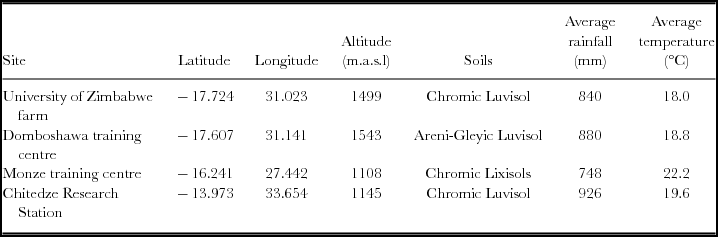
A 3-year experiment was set up at University of Zimbabwe (UZ farm), Domboshawa Training Centre (DTC) in Zimbabwe, Monze Farmer Training Centre (MFTC) in Zambia and Chitedze Research Station in Malawi. Geographical location, climatic conditions and soil types of experimental sites are summarized in Table 1. The sandy soil at DTC has a pH (CaCl2) of 4.5, 0.73 g kg−1 organic carbon and 200 g kg−1 clay content (Mapfumo et al., Reference Mapfumo, Mtambanengwe and Vanlauwe2007). At UZ site, soil has a pH (CaCl2) of 5.1, 1.68 g kg−1 organic carbon and 400 g kg−1 clay (Nyamapfene, Reference Nyamapfene1991). At Monze, the soil is characterized by pH (CaCl2) of 4.8, 0.6% organic carbon and 12% clay (Thierfelder and Wall, Reference Thierfelder and Wall2010). The sandy loam to sandy clay soil at Chitedze is characterized by pH (CaCl2) of 5.3 and 4.5% organic matter (Kumwenda et al., Reference Kumwenda, Saka, Snap, Ganunga, Benson, Waddington, Murwira, Kumwenda, Hikwa and Tagwira1998). The experiment was run in 2007/08, 2008/09 and 2009/10 cropping seasons at each site and involved rotation of maize and green manure legumes. Previous to inception of the experiment, the experimental fields were used for commercial maize production. The soils of the sites are representative for the major agro-ecologies in the different countries, although, unlike on the other sites, the UZ fields are more representative to the soils of commercial farms than smallholder farms. The main crops in southern Africa are cereals, mostly maize and sorghum (Sorghum bicolor (L.) Moench), while groundnuts (Arachis hypogaea L.), cowpeas (Vigna unguiculata (L.) Walp.), common beans (Phaseolus vulgaris L.) and in some areas soybeans (Glycine max (L.) Merr.) are the preferred rotational grain legumes (Thierfelder et al., Reference Thierfelder, Cheesman and Rusinamhodzi2012). Cereals are also planted in rotation with cotton (Gossypium hirsutum L.), tobacco (Nicotiana tabacum L.) and to a lesser extent with sunflower (Helianthus annuus L.).
Geographic location, soil type and rainfall regimes of the trial sites in southern Africa.

Experimental layout and description of treatments
DTC, Monze and UZ sites
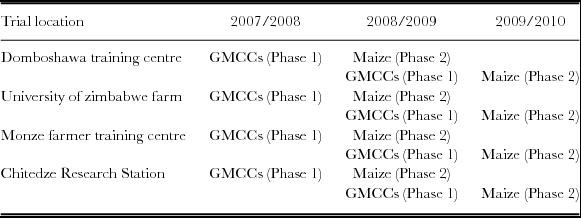
Animal traction furrow opener (also called Magoye ripper) attached to a conventional plough beam was used for opening furrows where seed and basal fertilizer were placed. The experiment comprised two phases: a green manure legumes phase in one season followed by a maize phase in a consecutive season of the trial. The two phases were replicated twice (Table 2). The experiment was set up in a randomized block design in the green manure cover crop (GMCC) phase with basal fertilizer levels as the treatments at each site. In the maize phase, the split plot design was used at Domboshawa, UZ and Monze sites, with previous legume crop being the main treatment and basal fertilizer levels as the sub treatment. The experiment was replicated four times at each experimental site. Crops grown in the green manure legumes phase were:
-
(i) Maize seeded in 90 cm riplines with mulch cover (control treatment).
-
(ii) Sunnhemp seeded in 45 cm riplines with mulch cover.
-
(iii) Velvet bean (Mucuna) seeded in 45 cm riplines with mulch cover.
-
(iv) Cowpea seeded in 45 cm riplines with mulch cover.
Crop phases and the season in which each phase was implemented at each experimental site from 2007/08 to 2009/10 growing season.

The basal fertilizer treatments in the green manure legumes phase consisted of three application rates at planting;
-
(i) 0 kg ha−1 of basal fertilizer.
-
(ii) 75 kg ha−1 of basal fertilizer.
-
(iii) 150 kg ha−1 of basal fertilizer.
In the maize phase that followed GMCCs, crop rotation was implemented and maize was grown across all treatments. However, at planting basal fertilizer treatments were reversed:
-
(i) 0 kg ha−1 of basal fertilizer in the green manure legumes phase now received 150 kg ha−1 in the maize phase.
-
(ii) 75 kg ha−1 of basal fertilizer in the green manure legumes phase received again 75 kg ha−1 in the maize phase.
-
(iii) 150 kg ha−1 of basal fertilizer in the green manure legumes phase now received 0 kg ha−1 in the maize phase.
The reason for reversal of basal fertilizer was to balance and keep the application of P and K constant over the two seasons. Nutrient content of basal fertilizer varied across countries based on available recommended fertilizer blends. The fertilizer used in Zimbabwe was Compound D (7N:6.1P:5.8K) while in Zambia, the fertilizer compound had a different nutrient content (10N:8.7P:4.4K). For Zimbabwe sites, ammonium nitrate (34.5% N) was applied at 150 kg ha−1 when maize had reached 5 weeks while in Monze 100 kg ha−1 Urea (46% N) was used in the maize phase. Each experimental plot measured 6 m × 5.4 m and all treatments received mulch at 2.5−3 t ha−1 each year. Green manure cover crops were seeded at their recommended seeding rates: sunnhemp was dribbled in 45 cm rows at 5 cm inter-row spacing (444 444 plants ha−1), velvet bean and cowpea were seeded in 45 cm rows with 25 cm inter-row spacing (88 888 plants ha−1). Maize was seeded at 90 cm row spacing and 25 cm in-row spacing. Two seeds of maize were seeded and later thinned to one plant per station after crop emergence. In Monze, the commercial hybrid MRI 624 was used in the maize phase while at UZ farm and DTC in Zimbabwe, the commercial hybrid SC635 and the QPM hybrid ZS261 were planted in each year, respectively. Urea was applied at 46 kg ha−1 N as a blanket topdressing fertilizer to the maize phase and to the control treatment 1 at 4 weeks after planting. We used different maize varieties in the different experimental locations based on their agro-ecological potential and varietal recommendation and release at the different sites. However, all varieties were medium maturing and are therefore comparable. Planting of maize and legumes took place between the end of November and mid-December at the beginning of each season depending on when the effective planting rains were received. Experimental plots were kept weed free in all cropping seasons. Initial weed control in green manure legumes and maize phases was through application of glyphosate at 2.5l ha−1 (1.025l ha−1 a.i) at seeding. Further weed control was through manual weeding whenever weeds reached 10 cm height and 10 cm in circumference. Weeding in the green manure legumes was done by hand hoe, 10–14 days after emergence before the green manure legumes developed a full canopy. After that, more weeding was done whenever required. In both maize and legume phases, crop residues were left on the surface after harvest.
Chitedze research station, Malawi
A dibble stick was used for seeding at Chitedze Research Station. At Chitedze site, the randomized complete block design was used in the green manure legume phase and the split–split plot was used in the maize phase with previous legume crop as main treatment, basal fertilizer levels as sub treatments and the four levels of N were introduced as sub–sub treatments. The treatments were replicated four times at each site and consisted of two phases, the initial year with green manure legume treatments (Phase 1) and the consecutive year with maize seeded across all treatments (Phase 2). The main treatments were:
-
(i) Maize seeded with a pointed stick (dibble stick) at 75 cm x 25 cm (control treatment).
-
(ii) Sunnhemp seeded in lines created by a planting stick at 37.5 cm between rows and dribbled into the furrow.
-
(iii) Velvet bean seeded with a pointed stick at 37.5 cm between rows and 25 cm in-row spacing.
-
(iv) Cowpea seeded with a pointed stick at 37.5 cm between rows and 25 cm in-row spacing.
The sub treatments were:
-
(i) No basal fertilizer in green manure legumes phase, 100 kg ha−1 basal fertilizer in maize phase.
-
(ii) 50 kg ha−1 basal fertilizer in green manure legumes phase, 50 kg ha−1 basal fertilizer in maize phase.
-
(iii) 100 kg ha−1 basal fertilizer in green manure legumes phase, no basal fertilizer in maize phase.
The sub–sub treatments, applied as topdressing in the maize phase were:
-
(1) 0 kg N ha−1;
-
(2) 23 kg N ha−1;
-
(3) 46 kg N ha−1;
-
(4) 69 kg N ha−1.
In Malawi, the basal fertilizer consisted of 23 N:9.2 P:0 K:4 S. At Chitedze Research Station, N rates were part of the treatments and topdressing fertilizer was applied at 4–5 weeks after crop emergence in the maize phase. Main plots measured 18 m × 11 m, sub plots were 6 m × 11 m and sub–sub plots of 3 m × 5 m. Each treatment received mulch cover consisting of maize residues at 2.5–3 t ha−1 every year. As in Zimbabwe and Zambia, green manure legumes were seeded in year 1 at a high seeding rate (sunnhemp 533 333 plants ha−1, velvet beans 106 666 plants ha−1, cowpea 106 666 plants ha−1) followed by the maize phase in year 2. Maize was seeded at two plants per station and later thinned to one plant per station after emergence (53 333 plants ha−1). The maize variety SC627 was used and urea was applied according to the sub–sub treatments as topdressing fertilizer at 4 weeks after planting. All plots were kept weed free during the period of experimentation at all sites. Initial weed control was through application of glyphosate at 2.5l ha−1 (1.025l ha−1 a.i) at seeding followed by manual hoe weeding whenever weeds reached 10 cm height or 10 cm in circumference. Green manure cover crops were weeded by hand 10–14 days after emergence before they developed full canopy. As in Zambia and Zimbabwe, maize and legume residues were left on the surface after harvest.
Harvesting procedure and data collection
At harvest, maize grain and biomass yields were measured from a net plot consisting of four rows that were 5 m long. Field weights of maize grain and biomass yields were recorded before taking 10 maize cobs for moisture correction and to determine the shelling percentage of maize. Grain moisture content was recorded after shelling using a grain moisture meter. All green manure legume plant material harvested from the net plot were weighed to determine biomass yield of each legume crop. Both maize and green manure legume final grain (12.5% moisture content) and biomass yields were calculated to a hectare basis. Daily rainfall was recorded manually using a standard rain gauge installed at each experimental site.
Statistical analysis
All data were assessed for normality using the Shapiro–Wilk test before being subjected to analysis of variance (ANOVA) using Statistix 9.0 (Statistix, 2008). The green manure legumes biomass and maize grain yield data were normally distributed. In the green manure legumes phase, the focus was to determine the effect of basal fertilizer on biomass production of the selected crop species. For all locations, total biomass yield from each crop species tested were analysed using the randomized complete block design in ANOVA with basal fertilizer rates as treatment factors. In the maize phase, maize yield from DTC, Monze and UZ sites were analysed using split plot ANOVA with previous green manure legumes crop species as main treatment factor and basal fertilizer rates as sub plot factor. For Chitedze site, maize grain yield data were analysed using the split–split plot with previous green manure legumes crop species as main treatment, basal fertilizer as sub plot and N topdressing as sub–sub plots. When F-test indicated significant treatment mean differences, separation of means within each treatment was done by LSD at 5% significance level.
RESULTS
Seasonal rainfall
Seasonal rainfall varied across the three countries used in the study with Malawi recording the highest amount of 1090 mm in 2007/08 season (Figure 1). The lowest rainfall was recorded at Chitedze in 2008/09 season and effective rain was received in mid-November and tailed off in March each season at all experimental sites. The longest dry spell stretching for 19 days was recorded at the UZ site in 2008/09 season and it coincided with the peak growth stages of maize and legume crops grown in the experiments. Rainfall was well distributed in most seasons with rainfall events of >20 mm per rainstorm varying from 9–15 at Chitedze, 11–17 at Monze and 13 at the DTC and UZ sites across the two seasons. Generally, the quality of the three cropping seasons was similar to what is currently being experienced in southern Africa (Cairns et al., Reference Cairns, Sonder, Zaidi, Verhulst, Mahuku, Babu, Nair, Das, Govaerts, Vinayan, Rashid, Noor, Devi, San Vicente, Prasanna and Sparks2012; Mupangwa et al., Reference Mupangwa, Walker and Twomlow2011; Rowhani et al., Reference Rowhani, Lobell, Linderman and Ramankuttya2011).
Seasonal rainfall patterns at Chitedze Research Station, Domboshawa, Monze and UZ sites during 2007/08, 2008/09 and 2009/10 cropping seasons.

Biomass yield in the green manure legumes phases
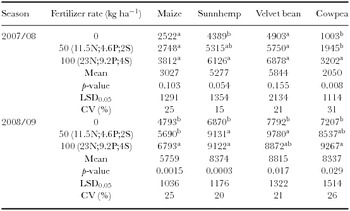
The green manure legumes and maize biomass yields were not significantly influenced by basal fertilizer at DTC, UZ and Monze experimental sites. Despite the lack of significant yield differences, velvet bean produced more biomass than the other species at DTC and UZ sites. Sunnhemp had more biomass than the other species at Monze site. At Chitedze, half and full rates of basal fertilizer had a similar effect on maize, sunnhemp and velvet bean biomass yield in 2007/08 season (Table 3). Velvet bean produced 93, 11 and 185% more biomass than maize, sunnhemp and cowpea in 2007/08 season, respectively. In 2008/09 season, half and full rates of basal fertilizer had similar effect on sunnhemp, velvet bean and cowpea. Velvet bean out yielded maize by 53%, sunnhemp by 5% and cowpea by 6% in 2008/09 season.
Total biomass yield (kg ha−1) of green manure legumes and maize grown at Chitedze Research Station in 2007/08 and 2008/09 seasons.

In each season treatment means followed by the same letter (a, b) in each column are not significantly different using LSD at 5%.
Maize grain yield in the maize phases
At the DTC site, green manure legumes had higher (p = 0.019) maize yield than the maize-after-maize treatment in 2008/09 season (Figure 2). In 2009/10 season, residual effect of green manure legumes influenced (p = 0.0616) maize grain production and yield was 27–36% higher after sunnhemp, 35–45% more after velvet bean and 31–44% higher after cowpea compared with maize monoculture. In both seasons, basal fertilizer applied at seeding in the maize phase had no significant effect on maize yield. At the UZ site, residual effect of green manure legumes significantly (p = 0.007) influenced maize grain yield in 2008/09 season with maize-after-maize treatment giving the lowest yield. In 2009/10 season, maize yields were higher (p < 0.001) in the treatments that had maize rotated with green manure legumes compared with maize monoculture (Figure 2). Maize yield was 28–69, 37–60 and 40–56% more after sunnhemp, velvet bean and cowpea compared with the maize-after-maize treatment. As observed at DTC site, basal fertilizer applied at maize seeding had no significant effect on maize yield in 2008/09 and 2009/10 seasons. At Monze, the residual effect of green manure legumes significantly (p = 0.047) increased maize grain yield with maize-after-maize having the lowest yield in both seasons (Figure 2). Maize yield increased by 50–71% after sunnhemp, 30–61% after velvet bean and 35–42% after cowpea compared with maize-after-maize treatment.
Residual effect of GMCCs on maize grain yield (kg ha−1) at DTC, UZ and Monze sites in 2008/09 and 2009/10 seasons. Means with same letter for each experimental site in 2008/09 and 2009/10 seasons are not significantly different using LSD (p < 0.05). Vertical bars under each experimental site represent standard error of means.

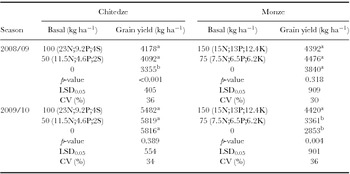
In Malawi, N applied as topdressing increased maize yield in all cropping sequences in 2008/09 season (Figure 3). As observed at the other locations, maize monoculture gave the lowest grain yield. Velvet bean, sunnhemp and cowpea had similar effect on maize grain yield at each N topdressing rate applied. When 0 kg N ha−1 was used, maize-after-sunnhemp treatment had 90%, maize-after-velvet bean 140% and maize-after-cowpea 90% higher grain yield compared with maize monoculture in 2008/09 season. In 2009/10 season, maize monoculture had the lowest grain yield compared with the other treatments. Maize-after-sunnhemp, maize-after-velvet bean and maize-after-cowpea had 31, 49 and 46% higher yield than maize monoculture. Contrary to responses observed at sites in Zimbabwe, basal fertilizer applied at seeding in the maize phase increased maize grain yield at Monze and Chitedze (Table 4).
Effect of previous crop and nitrogen fertilizer on maize grain yield at Chitedze Research Station in 2008/09 (left) and 2009/10 (right) seasons. Means with same letter under each previous crop treatment are not significantly different using LSD (p < 0.05). Vertical bars represent standard error of means.

Maize grain yield (kg ha−1) responses to basal fertilizer in the maize phase at Chitedze and Monze sites in 2008/09 and 2009/10 seasons.

In each season treatment means followed by the same letter (a, b) in each column are not significantly different using LSD at 5%.
Across seasons comparison confirmed that maize monoculture was the worst practice at each experimental site (Figure 4). Velvet bean, sunhemp and cowpea had a similar effect on maize yield across the 2008/09 and 2009/10 cropping seasons at all sites. Basal fertilizer applied in the maize phase had a significant (p = 0.0022) effect on yield at Monze only. Full and half basal rates applied in the maize phase had a similar effect. Similarly, half and 0 kg ha−1 basal rates also had a similar effect on grain yield across the two seasons. The full basal rate had grain yield of 4406 kg ha−1, 3924 kg ha−1 for half rate and 3345 kg ha−1 for the unfertilized treatment. At Chitedze, N topdressing significantly (p < 0.001) influenced grain yield in the maize phase. The 0, 23 and 46 kg N ha−1 had a similar effect on grain yield (4277, 4634 and 4756 kg ha−1) with 69 kg N ha−1 having significantly higher grain yield (5467 kg ha−1) than the other treatments.
Residual effect of green manure legume crops on maize grain yield (kg ha−1) across 2009 and 2010 cropping seasons at DTC, UZ, Monze and Chitedze experimental sites. Means with same letter at each experimental site are not significantly different using LSD (p < 0.05). Vertical bars at each experimental site represent standard error of means.

DISCUSSION
Total biomass yield in the green manure legume phase
Biomass yield responses to basal fertilizer varied from site to site and season to season during the period of experimentation. Biomass production of all species tested in Zambia and Zimbabwe was not influenced by half and full rates of basal fertilizer applied at seeding. In Zimbabwe, half and full basal fertilizer rates supplied 5.3–10.5 kg N ha−1, 4.6–9.2 kg P ha−1 and 4.4–8.8 kg K ha−1. These nutrient quantities had no significant influence on green manure legumes biomass production on the sandy soil at DTC and the clay soil at UZ. In Zambia, 7.5–15 kg N ha−1, 6.6–13.2 kg P ha−1 and 6.2–12.4 kg K ha−1 were supplied through half to full basal fertilizer rates. The lack of green manure legumes yield responses to basal fertilizer suggests that soil was not deficient in NPK nutrients to meet crop requirements despite the inherently low fertility of Luvisols and Lixisols at the experimental locations. Soil pH, an indicator of soil fertility status, ranges 4.5–5.1 (CaCl2 scale) at the DTC and UZ sites in Zimbabwe (Nyamapfene, Reference Nyamapfene1991) and these pH levels could have been within suitable range for the legume species tested. Lack of positive responses to inorganic fertilizer by some green manure legumes species such as cowpea have also been reported in another study conducted in southern Africa under conventional agriculture (Jeranyama et al., Reference Jeranyama, Hesterman, Waddington and Harwood2000). Soils with moderate to high initial NPK levels often give poor crop yield responses to inorganic fertilizer (Kadyampakeni, Reference Kadyampakeni2014) and lack of responses to fertilizer at DTC, UZ and Monze are possible as the soils at these sites are not highly degraded. Even maize grown in the green manure legumes phase at the three sites did not respond to basal fertilization at half and full rates, further highlighting the fact that soil supply of NPK was adequate for growth of the species tested in our study.
At Chitedze maize, sunnhemp, velvet bean and cowpea biomass yields increased with basal fertilization. Seasonal rainfall was well distributed and the adequate soil moisture supply could have ensured effective utilization of 11.5–23 kg N ha−1, 4.6–9.2 kg P ha−1 and 2–4 kg S ha−1 supplied from basal fertilizer by the green manure legumes species grown in that season. The increase in green manure legumes yield following basal fertilization suggest that soil supply of NPS was improved by the mineral fertilizer. Nitrogen and P are major limiting nutrients in Malawi (Kadyampakeni, Reference Kadyampakeni2014) as in other southern African countries (Kanonge et al., 2015) and previous studies have shown that P improves growth and N2 fixation of legumes (Cassman et al., Reference Cassman, Singleton and Linquist1993; Whitbread et al., Reference Whitbread, Jiri and Maasdorp2004). Soils in Malawi, as in other parts of southern Africa (Grant and Rowell, Reference Grant and Rowell1976), are low in S (Sakala and Mhango, Reference Sakala, Mhango and Waddington2003; Weil and Mughogho, Reference Weil and Mughogho2000) and green manure legume yields could have increased in response to improved soil S supply. Vlek (Reference Vlek1990) reports that applying S in combination with N and P increases crop yields in cropping systems of sub Saharan Africa where N and P are the common nutrients applied by farmers. Applying half and full rates of basal fertilizer to some green manure legume species gave similar biomass yield gains implying farmers in Malawi can target half of the recommended rate of basal fertilizer for green manure legumes in their CA systems. Generally, velvet bean produced more biomass than the other species tested, a result consistent with previous studies in sub Saharan Africa (Chivenge et al., Reference Chivenge, Mwale, Murwira and Waddington2003; Muza Reference Muza2003; Njarui and Mureithi, Reference Njarui and Mureithi2010).
With land being a significant limiting factor for smallholder farmers in some parts of southern Africa, particularly in Malawi, cropping systems that can accommodate grain and GMCC legume species together with the main cereal or cash crops are critical for the region (Kamanga et al., Reference Kamanga, Waddington, Robertson and Giller2010). Recent studies from southern Africa showed that GMCC species such as velvet bean, jack bean (Canavalia ensiformis (L.) DC.) and lablab (Lablab purpureus (L.) Sweet) can be relay intercropped with maize in CA systems without yield penalty on the cereal crop (Mhlanga et al., Reference Mhlanga, Cheesman, Chauhan and Thierfelder2016; Mupangwa and Thierfelder, Reference Mupangwa and Thierfelder2013). Maize–legume intercropping systems are generally more productivity than sole crops in the smallholder farming systems of southern Africa (Dube et al., Reference Dube, Madanzi, Kapenzi and Masvaya2014; Rusinamhodzi et al., Reference Rusinamhodzi, Corbeels, Nyamangara and Giller2012). Multi-purpose species such as pigeon pea (Cajanus cajan (L.) Millsp.) could therefore be ideal for maize–legume intercropping systems because of the slow early growth and ratooning ability, and can also provide both grain and fuelwood for the smallholder farming family.
Maize grain yield after green manure legumes and mineral fertilizer application
The green manure legumes improved grain yield of maize grown in the second season regardless of basal fertilizer quantity applied in the maize phase. The maize crop benefitted from the residual soil fertility contributed by the legumes but were not affected by greater green manure legumes biomass production as a result of different basal rates. Soils at the trial sites were inherently low in fertility and green manure legumes improved the soil conditions through N additions and organic matter as plant materials decomposed. The legume green manure legumes plant material has a low C/N ratio and decomposes fast (Giller et al., Reference Giller, Cadisch, Ehaliotis, Adams, Sakala, Mafongoya, Buresh, Sanchez and Calhoun1997), thereby improving soil fertility which benefits the maize grown in rotation with the legumes. Previous studies in southern Africa have shown that grain yield increases substantially when maize is grown in rotation with green manure legumes under conventional and CA systems (Kamanga et al., Reference Kamanga, Waddington, Robertson and Giller2010; Mupangwa and Thierfelder, Reference Mupangwa and Thierfelder2013; Robertson et al., Reference Robertson, Sakala, Benson and Shamudzarira2005). Velvet bean can contain up to 2% N in its plant tissue (Njarui and Mureithi, Reference Njarui and Mureithi2010) and this could have added 168 to 195 kg residual N ha−1 to the soil based on the biomass yields achieved at DTC and UZ in the green manure legumes phase. Sunnhemp could have added 40 to 259 kg N ha−1 from the total biomass achieved in Zimbabwe because it is reported to contain 1–3% N in its plant tissue between flowering and maturity (Maasdorp and Titterton, Reference Maasdorp and Titterton1997). In Zambia, 96 to 132 kg N ha−1 could have been added to the soil from velvet bean, 76 to 519 kg N ha−1 from sunnhemp and 96 to 170 kg N ha−1 from cowpea assuming a 2% N content in plant tissue of all the legumes tested. In Malawi, 117 to 176 kg N ha−1 was achievable from velvet bean, 53 to 251 kg N ha−1 from sunnhemp and 41 to 167 kg N ha−1 from cowpea based on green manure legumes biomass yields obtained in the two seasons.
Applying basal fertilizer at seeding and N topdressing in the maize phase increased maize grain yield in Malawi and Zambia in some seasons, and this emphasizes the need for inorganic fertilizer application in maize–legume CA systems that are being promoted in southern Africa. Nitrogen topdressing increased maize yields at Chitedze regardless of the previous green manure legumes crop and this suggests that smallholder farmers still need to apply N fertilizer after green manure legumes in Malawi. Maize yield responses to N fertilizer is consistent with other studies conducted in southern Africa under CA and conventional agriculture systems (Ncube et al., Reference Ncube, Twomlow, van Wijk, Dimes and Giller2007; Twomlow et al., 2010).
Besides weed control, N management is one of the major challenges in the adoption of CA practices by smallholder farmers in southern Africa (Gowing and Palmer, Reference Gowing and Palmer2008). Based on the GMCC biomass produced by each species in our study, substantial savings in mineral N fertilizer could be made by smallholders if these legumes are integrated into the CA systems that are being promoted in southern Africa (Kaizzi et al., Reference Kaizzi, Ssali and Vlek2006). Mineral fertilizer use by smallholders worldwide remains the lowest in southern Africa (Place Reference Place, Barrett, Freeman, Ramisch and Vanlauwe2003; Smaling et al., Reference Smaling, Nandwa, Janssen, Buresh, Sanchez and Calhoun1997) and limited quantities of manure are available due to decreasing livestock numbers (Mukwereza et al., Reference Mukwereza, Manyawu, Ndhlovu and Zisengwe2010; Nyamushamba et al., Reference Nyamushamba, Mapiye, Tada, Halimani and Muchenje2016). Smallholder farmers can therefore improve soil fertility in CA systems by incorporating both single and multi-purpose GMCC species that are adapted to southern Africa. In addition, GMCCs contribute towards weed control in CA systems when grown as sole or intercrops with the main cereal crop (Mhlanga et al., Reference Mhlanga, Cheesman, Maasdorp, Muoni, Mabasa, Mangosho and Thierfelder2015; Reference Mhlanga, Cheesman, Chauhan and Thierfelder2016). Weed suppression through GMCCs could compliment the current manual and chemical weed control practices used by smallholder CA farmers (Mandumbu et al., Reference Mandumbu, Jowah, Karavina and Tibugari2011; Muoni et al., Reference Muoni, Rusinamhodzi and Thierfelder2013).
CONCLUSION AND RECOMMENDATIONS
Green manure legume responses to basal fertilizer were variable and depended on location, season and species, and this highlights the fact that blanket recommendations for green manure legumes fertilization are not feasible for CA systems in southern Africa. In Zambia and Zimbabwe, green manure legumes did not respond to basal fertilization and they can therefore be grown on residual soil fertility which allows farmers to invest in basal fertilizer for the maize crop in CA systems. In Malawi cowpea, velvet bean and sunnhemp required basal fertilizer and half of the recommended rate (i.e. 50 kg ha−1) produced as much biomass as the full rate (i.e. 100 kg ha−1) under the soil and agro-ecological conditions used in the study.
Growing maize after fertilized or unfertilized green manure legumes in CA systems improved maize yields substantially and farmers can therefore exploit cowpea, sunnhemp and velvet bean for soil fertility improvement and maintenance. However, there are significant limitations to the adoption of these green manure legumes in the farming systems of southern Africa and these include unavailability of seed, labour shortages and to some extent lack of knowledge by smallholders in southern Africa. There is need to develop green manure legumes seed supply systems to enable smallholder farmers to use these legume species in CA-based cropping systems. In addition to improved seed supply, more training of smallholder farmers on the different uses of the green manure legume species is required particularly where livestock are part of the mixed farming system and dry season feed shortage is chronic.
Results from Malawi indicate that both basal and topdressing fertilizer are important for CA systems even where green manure legumes are part of the cropping system. Our results suggest that inorganic fertilizer should be applied to the maize crop and grow green manure legumes crops on residual soil fertility when full rotation is practiced. Despite growing green manure legumes for soil improvement, N topdressing of the maize grown after the legumes is still important under the soil and climatic conditions of our study. Future studies could focus on determining the quantities N fertilizer that green manure legume species such as cowpea, velvet bean and sunnhemp can replace in maize-based CA systems under smallholder farmer conditions in southern Africa.
The likelihood of adoption of green manure legumes in mixed smallholder systems needs to be further explored given the prevailing socioeconomic and climatic conditions in southern Africa. The different uses of green manure legumes species at farm scale should be considered and useful entry points for different resourced households and farming objectives should be unraveled. Multi-purpose legume species could be a good entry point for the different agro-ecological and socioeconomic conditions of southern Africa. Legume species that can provide fuelwood and can be used for construction especially in densely populated communities that no longer have forestry resources, can be ideal for smallholders. Legume species such as pigeon pea that ratoons are ideal for farming communities with limited access to seed. Current research on mixed crop/livestock smallholder farms indicate that livestock feed could be a good entry point for smallholder farms where goat production and dairy or beef cattle fattening are a source of household income in areas where grazing land is a constraint. On such farms improved soil productivity, weed suppression and soil erosion control become secondary benefits for the smallholder farmer. With CA being promoted in southern Africa, growing of legume species that are unpalatable to livestock such as Tephrosia vogelii provides an alternative to crop residues for soil cover in CA systems.
Acknowledgements
The authors wish to acknowledge the financial support from the International Fund for Agriculture Development (IFAD) for funding research activities. We are also grateful to the technicians at CIMMYT-Zimbabwe, Chitedze Research Station and Monze Farmer Training Centre for establishment and management of the experiments, and data collection from the experiments reported in this paper. The study was embedded in the Strategic Initiative (SI) 2 of the MAIZE CRP.