Introduction
The increasing number of people with dementia will require a dramatic increase in provision of care staff (Pitfield et al., Reference Pitfield, Shahriyarmolki and Livingston2011). To enable the delivery of high quality care for people with dementia, a competent workforce therefore needs to be recruited and maintained (Edvardsson et al., Reference Edvardsson, Fetherstonhaugh, McAuliffe, Nay and Chenco2011).
Staff training is an effective way of improving care for people with dementia (Teri et al., Reference Teri, Huda, Gibbons, Young and van Leynseele2005; Goyder et al., Reference Goyder, Orrell, Wenborn and Spector2012), also improving worker satisfaction (Coogle et al., Reference Coogle, Head and Parham2006), staff competence (Broughton et al., Reference Broughton2011), management of challenging behavior, self-efficacy (Davison et al., Reference Davison, McCabe, Visser, Hudgson, Buchanan and George2007), and formulation skills (Kendjelic et al., Reference Kendjelic and Eells2007).
Psychological formulations provide a framework from which complex factors that influence a person's well-being can be identified, making sense of the development and maintenance of a person's difficulties and helping to inform interventions (Ingham et al., Reference Ingham, Clarke and James2008). There is a growing trend for the use of formulation in multi-disciplinary teamwork, guiding clinicians in identifying treatment options, particularly for people with complex needs (Rainforth and Laurenson, Reference Rainforxsth and Laurenson2014). Training staff in the integration of individualized cognitive-behavioral formulations has been reported to help staff understand the pattern and timeline of a client's difficulties in dementia (Dexter-Smith, Reference Dexter-Smith2010) and it can be a powerful way of influencing a shift in culture towards a more psychosocial perspective (Onyett, Reference Onyett2007).
Spector and Orrell (Reference Spector and Orrell2010) responded to a need for an approach that allows the application of theory to practice by developing a coherent model for dementia care. The BPS model of dementia (Spector and Orrell, Reference Spector and Orrell2010, Figure 1) proposes that the identification of individualized biological and psychosocial factors that may be amenable to change is crucial in maximizing an individual's potential and minimizing their level of excess disability (Brody et al., Reference Brody, Kleban, Lawton and Silverman1971). It suggests that in both biological and psychosocial domains there are fixed (factors not amenable to change, such as previous life events and age) and tractable factors (those that may be amenable to change, such as mood and environment). The model also aims to increase understanding of the dynamic inter-relationship of these factors, helping to develop interventions, reduce stigma, and instill a sense of hope that change is possible (Spector and Orrell, Reference Spector and Orrell2010).
The biopsychosocial model of dementia (Spector and Orrell, Reference Spector and Orrell2010).

Whilst research on the impact of team formulation in other settings has shown benefits including better staff-patient relationships, staff satisfaction, improved team working, and a greater sense of competence, few studies have assessed the degree to which staff can develop formulations in dementia.
Training programmes in individualized formulation such as that by Dexter-Smith (Reference Dexter-Smith2010) and Ingham et al. (Reference Ingham, Clarke and James2008) primarily draw on existing CBT-based psychological formulations. The BPS model of dementia aims to incorporate psychological elements alongside those that may be more familiar to staff from a range of backgrounds, increasing its accessibility.
The aim of the study was therefore to build on work such as that by Dexter-Smith (Reference Dexter-Smith2010), to evaluate the feasibility of training staff from a variety of settings on the BPS model of dementia, examining its impact on attitudes, competence, and formulation skills.
Method
Design
An experimental within-subjects design was used to investigate the feasibility of the BPS training intervention with staff working in dementia.
BPS training intervention: development
In the first instance, a handbook summarizing the model was designed and piloted with staff from a broad range of backgrounds. Following this, the main elements of the handbook were developed into a BPS training intervention PowerPoint package, incorporating small group exercises, and points for discussion. Following field-testing in a care home, minor modifications were made based on the feedback, including whole group practice in using the model with clinical cases brought for discussion by the team.
A review of the literature suggested that due to demands on staff time, a low intensity staff intervention which kept didactic elements to a minimum would be optimal. The BPS training intervention needed to be accessible to staff with a range of backgrounds so it included some basic background on dementia with a greater focus on key elements of the BPS model.
Setting
Suitable care homes across London were identified through convenience sampling and searches of the Care Quality Commission database (2013). A total of 91 homes were contacted and invited to take part in the research using an initial invitation letter. All were owned by private care organizations, cared for people with dementia and a range of physical and mental health needs and were found to meet essential standards of quality and safety as defined by the Care Quality Commission (2013). A total of seven responded. A visit was conducted to five of the care homes and telephone liaison was initiated with a further two. It was not possible to carry out the study in three of the homes due to lack of staff resources in two and one already taking part in other staff training. The teams who took part included care staff, nursing staff, and managers.
One community mental health team (CMHT), comprising staff from a range of backgrounds, and one inpatient staff team were identified through personal contacts of the researcher. The lead team psychologists were contacted directly and further liaison took place with team and wards managers.
Recruitment of participants
Managers of each team were asked to identify ten staff that met the inclusion criteria and were able to attend all training dates. Due to logistical difficulties, in inpatient settings two staff were identified to participate from each ward. Information sheets were disseminated to staff to make informed decisions about participation. All staff were given a gift voucher and a certificate by way of thanks for their participation, following study completion.
Ethical approval
Ethical approval was granted by UCL Research Ethics Committee. Written informed consent was obtained from each staff member participating in the research. All data obtained was anonymised and identifying information stored separately.
Inclusion criteria
Staff working at least three days a week in a clinical setting with people with a diagnosis of dementia, who also intended to be working in the same clinical setting throughout the study. It was not possible for staff who did not have a good grasp of both spoken and written English to be included.
Measures
Approaches to dementia questionnaire (ADQ – Lintern et al ., Reference Lintern, Woods and Phair2000)
Respondents rate the extent to which they agree with 19 statements about dementia on a 5-point scale ranging from “strongly agree” to “strongly disagree.” There is a total attitudes score and two sub-scales: “hope” and “person-centeredness.” The ADQ has been shown to have good internal consistency and test re-test reliability.
Sense of competence in dementia care staff scale (SCIDS – Schepers et al ., Reference Schepers, Orrell, Shanahan and Spector2012)
Respondents rate 17 statements around perceived competence on a 4-point scale. It has shown good internal consistency and inter-rater reliability and good predictive and convergent validity.
Vignette-based outcome measure – “Problem-Solving exercise”
This measure was developed alongside the study. It is composed of two short case vignettes detailing persons with dementia, “Mary” and “John,” who have multiple needs. For each, the completer is asked to list (a) the key factors in working with that person and (b) suitable interventions based on these factors. The marking scheme is based on the main factors included in the BPS model. Respondents are awarded one or two marks for each factor identified, depending on the depth of their answers. The maximum score achievable is 113. Initial assessments of the measure (n = 131) using intra-class correlation, ICC(2, k) = 0.84, p < 0.01, suggest that it has considerable inter-rater reliability. A high correlation between vignette scores (ρ (129) = 0.683, p < 0.01) also indicates good internal consistency.
BPS model of dementia staff feedback questionnaire (BPS-SFQ)
The BPS-SFQ was developed for the study. It included five short questions about the utility and impact of training, rated on a Likert scale of one (not at all) to five (definitely). The questionnaire also included three open questions providing an opportunity to give qualitative feedback.
Procedure
Group training on the BPS model of dementia was delivered over two sessions: a training session (4 hours) and a workshop (2.5 hours) provided at each setting by the researcher. All staff were required to complete the ADQ and the SCIDS at baseline, post-training, and follow-up time points. In addition they were required to complete the “problem-solving exercise” at baseline and follow-up and the BPS-SFQ following training completion. Demographic information was obtained at baseline assessment.
Training intervention
The first training session involved a mixture of didactic teaching about the main principles of the BPS model, in particular emphasizing novel elements of the model including the distinction between fixed and tractable factors, and the differing ways such factors may be understood and managed. The training also included detailed case discussion and smaller group exercises in which staff were given printed copies of the BPS model to use as a practical tool to draw together and write-down ideas, stimulating discussion about potential interventions for the client. The training was applied flexibly in order for staff to participate actively in discussion, learning from each other's experiences, and sharing ideas. It focused on the application of the model to clinical practice using case examples to illustrate the principles.
During the training session, staff were provided with a handbook of guidelines, summarizing the training, and a group discussion was held in order to generate ideas about ways in which staff might apply the model, using printed copies of the BPS model as a practical tool in their daily practice. Staff were encouraged to practice using it with other staff members prior to the workshop.
Four weeks later, staff attended a workshop facilitated by the researcher. This built on the first training session, providing opportunity for staff to feedback about their experiences of applying the model between sessions and to practice applying the BPS model to clinical cases, understanding the factors involved and developing potential interventions.
Analysis
After testing for normality of distribution, the vignette-based outcome measure was analyzed using paired-sample t-tests. Magnitude of change was categorized according to Cohen (Reference Cohen1992).
A series of repeated-measures ANOVAs were then used (with outcome measures and time at baseline, post-training, and follow-up, as within subjects factors) to evaluate changes in scores on the ADQ and the SCIDS. Answers on the BPS-SFQ were analyzed using elements of thematic analysis (Braun and Clarke, Reference Braun and Clarke2006) in which the main themes were extracted before calculating the number of participants expressing each theme.
To control for the increased risk in Type 1 error caused by multiple analyses, a more stringent alpha level of p = 0.01 was selected. Missing data from teams who completed the intervention was managed using a last observation carried forward approach.
Results
Baseline characteristics
The BPS training intervention was delivered to 37 staff working across three settings (11 CMHT staff, 8 inpatient staff and 18 care home staff) from a variety of professional backgrounds. The majority were female (78%), aged 45–54 (43%), from non-White British backgrounds (70%) and had mean of nine years working in dementia care (SD 6.1). See Table 1 for further demographic information.
Demographic characteristics of participants

BPS training intervention outcomes
Means and standard deviations for outcome measures at each time point are presented in Table 2.
Total means and standard deviations for all outcome measures

Note: * = Significant at p = 0.01.
Impact of the BPS training intervention
Formulation skills and ability to develop appropriate interventions
Total scores for the problem–solving exercise were found to increase significantly following the BPS training intervention, t(36) = −3.51, p = 0.001. A medium effect size (d = 0.59) was observed (correcting for dependence between means). Early tests of the psychometric properties indicated a significant difference in scores obtained for vignette 1 and vignette 2 and therefore they were also assessed individually. A significant increase was found for vignette 1, t(36) = −3.97, p = 0.000, but not for vignette 2 at this level, t(36) = −2.5, p = 0.02.
Staff attitudes towards people with dementia
Overall, staff were found to hold a positive approach towards people with dementia on the ADQ, with scores clustered around the middle to higher end of the rating scale (Mean = 78.2, SD = 6.0). No significant difference was found in overall approach to dementia between baseline, post-training, and follow-up time points, and there was no significant difference found on subscales of hope, or person-centeredness. Positive trends were noted for total and subscale scores between baseline and post-training time points, however, this was not consistently maintained at follow-up (see Table 2).
Sense of competence
Overall, staff were found to report a relatively high sense of competence at baseline with a mean SCIDS score of 54.2 (SD = 7.9). There was no significant difference found between scores at baseline, post-training, and follow-up time points on the total score, or any of the subscales: professionalism, building relationships, care challenges, or sustaining personhood. Small mean increases were noted for the total score and all subscales between baseline and post-training time points. The mean increase was further increased at follow-up on total score and care challenges subscale, maintained on the professionalism subscale, but not maintained for building relationships or sustaining personhood subscales (see Table 2).
Differences between staff settings
Due to its pilot nature, it was beyond the scope of this study to statistically analyze the differences between staff settings. However, mean changes are summarized as follows. All groups showed an improvement in positive attitude towards dementia post-training, with inpatient staff showing the greatest change (+2.1). Whilst some improvement from baseline was maintained at follow-up for CMHT (+0.9) and care home staff (+1.0), this was not found to be the case for inpatient staff (−1.4). In addition, care home staff showed the greatest improvement on the “hope” subscale at follow-up (+1.4) and CMHT staff, the greatest improvement on the “person-centered” subscale at follow-up (+0.6).
Inpatient staff showed the greatest total change (+4.3) in sense of competence which continued to improve at follow-up (+4.9). The greatest mean change for each subscale was also noted for inpatient staff. Overall, CMHT staff showed a small increase between baseline and follow-up (+1.0). Care home staff showed a small decrease (−0.7) in sense of competence following training.
Overall, all staff groups showed an improvement on the “problem-solving exercise” following training. CMHT staff showed the greatest mean change (+8.0), followed by inpatient staff (+5.5). The smallest mean change was noted for care home staff (+3.0). At baseline, CMHT staff scored lower than inpatient staff.
BPS model of dementia staff feedback questionnaire (BPS-SFQ)
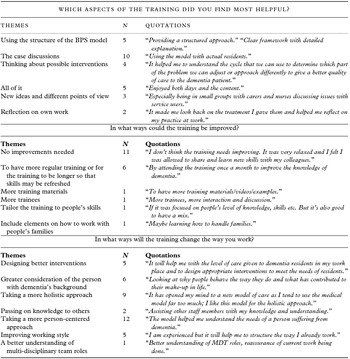
Anonymous feedback forms were received from 28 staff who completed the BPS training intervention. Overall, all staff reported the training helped improve their understanding of the different factors involved in dementia (see Tables 3 and 4). The majority rated that training had “definitely” or “very much” improved their knowledge, also increasing their consideration of different biological, psychological, and social factors. They also indicated that the training would “very much” or “definitely” help them to think differently about their work and had “definitely” made them feel more confident.
Quantitative feedback from staff in each setting

Qualitative feedback from staff

The BPS training intervention was rated most highly by staff from inpatient settings, with the majority feeling more confident as a result and that they would make use of it in their work. A summary of the qualitative responses is provided in Table 4.
Discussion
Key findings
The ability of staff to understand, formulate and develop interventions for people with dementia increased significantly following the BPS training intervention, suggesting that the BPS model of dementia may contribute to improvement in one's ability to incorporate information from biological, psychological, and social domains, in the development of treatment plans. Although small improvements were found in staff approach to dementia and sense of competence, the degree of improvement was not significant. Training feedback suggested staff felt their understanding of dementia had improved, with the majority also reporting greater confidence and a more holistic approach. Preliminary data from a variety of sources supports the potential feasibility of the BPS training intervention as a tool for improving clinical practice, however due to the small, uncontrolled nature of the study, further replication with a larger sample is required.
Findings in the context of literature
Whilst many studies have assessed the impact of training on staff, the majority have focused on well-being and organizational factors such as staff burnout.
The current study aimed to build on previous findings (Dexter-Smith, Reference Dexter-Smith2010) to examine not only the impact of training on the ability of staff to use formulations but also on their ability to develop interventions from them.
A recent literature review on case formulation (Rainforth and Laurenson, Reference Rainforxsth and Laurenson2014), highlights its potential importance for staff working with people with complex needs. This study supports findings from other clinical settings that training staff in case formulation can increase the identification of BPS factors (Ingham et al., Reference Ingham, Clarke and James2008). Evidence suggests that formulation affords a greater flexibility to treatment with an increased focus on individual needs (Rainforth and Laurenson, Reference Rainforxsth and Laurenson2014), also leading to enhanced therapeutic alliance and inhibiting unhelpful perceptions of challenging behavior (Restifo, Reference Restifo2010). The subsequent relationship of formulation to intervention is under-researched however (Ivey, Reference Ivey2006), and the current findings go some way to addressing this gap; providing preliminary evidence for the effectiveness of training in the development of treatment plans.
Due to the pilot nature of this study, it was not possible to conduct a detailed analysis of BPS training utility across staff settings. However, the data suggests that inpatient staff gained the greatest benefit in both approach to dementia (post-training) and sense of competence, also rating the training as the most helpful in every category. Previous research suggests a lack of training in inpatient teams (Chapman and Law, Reference Chapman and Law2009), and therefore the BPS training intervention could be of particular value in this setting.
Feasibility
There were few difficulties in identifying care homes, however thorough assessment of existing organizational factors would assist engagement. Of the total sample, 86% of staff attended all training sessions and 84% completed all measures at follow-up. Six staff members (16%) dropped out either due to staffing difficulties or long-term sick leave, suggesting that overall the intervention was acceptable to staff.
A number of challenges were also encountered in the completion of the “problem-solving exercise” measure. Findings from early tests of measure validity showed significantly higher scores on vignette 1, suggesting that staff may have become fatigued or that vignette 2 was more difficult. A counter-balanced experimental design could help assess this further. Difficulties obtaining completed follow-up measures also impacted on the time frame in which they could be collected. However, as the measure was considered to assess how skills were applied to real-life clinical information rather than testing knowledge, it still mirrored the BPS model's intended use following training.
Limitations
This was a feasibility study, and therefore there were a number of design limitations. One of the main outcome measures (“problem-solving exercise”) is still undergoing development. Early tests of its psychometric properties show good internal consistency and inter-rater reliability, indicating that it can measure staff's ability to conceptualize BPS information about dementia. However, further assessment of its test–retest reliability would be required in order to fully establish its validity as a measure to capture change.
Similarly, the overall sample was small and uncontrolled, and may have been underpowered to detect effects. In addition, all measures were self-report and relied on staff perception of their own skills. The use of blinded assessors in future effectiveness studies would ensure that scoring bias was minimized. At baseline, scores on the ADQ (Lintern et al., Reference Lintern, Woods and Phair2000) and SCIDS (Schepers et al., Reference Schepers, Orrell, Shanahan and Spector2012) were found to be clustered around the middle to upper end of the scale, and it is therefore possible that ceiling effects contributed to the non-significant change. Such effects have also been observed on the SCIDS in previous research (Goyder et al., Reference Goyder, Orrell, Wenborn and Spector2012).
Implications for future research
It would be pertinent for future research to examine the variables associated with the success of training, namely staff motivation, self-efficacy, and management support (Elliott et al., Reference Elliott, Scott, Stirling, Martin and Robinson2012). A recent review on the effectiveness of staff training interventions (Spector et al., Reference Spector, Orrell and Goyder2013) highlights the importance of regular supervision (Ford and Weissbein, Reference Ford and Weissbein2008). Further research could assess whether supplementary supervision sessions could improve the overall effectiveness of the BPS training intervention. It could also explore its continued use in clinical practice following training, perhaps comparing it to usual practice as part of a randomized controlled trial. Following demonstration of the effectiveness as a training programme for staff, it would be important to assess the impact of training on people with dementia.
Implications for clinical practice
The results suggest that the BPS training intervention could be valuable in improving staff formulation skills, particularly in inpatient settings. Qualitative feedback also indicated that staff would like continued input and it may benefit from being delivered over a longer time frame in the future, with skills training workshops for managers to facilitate use of the model following training. It would also be important to work closely with staff to develop a strategy for incorporating the use of the model into clinical practice. Whilst the training programme is relatively short, one of the strengths of the BPS framework is its relative simplicity and the ease with which it allows complex case information to be assimilated.
Conclusion
The present study has demonstrated some encouraging results, providing preliminary support for the utility of the BPS model of dementia as a training intervention for staff working in dementia. It has shown that even with a brief intervention, the ability of staff to understand, draw together ideas and develop interventions for people with dementia may be improved, which may have wide ranging implications for improving dementia care in the future. Whilst replication is required and the results should be interpreted with caution due to the uncontrolled, pilot nature of the study, they provide a range of both quantitative and qualitative evidence in support of the BPS training intervention which may be built on in subsequent research.
Conflict of interest
None.
Description of authors’ roles
C Revolta provided the intervention, collected the data, analyzed the data and wrote the first draft of the paper.
A Spector conceived the research idea, developed the BPS model, developed the training intervention and commented on/edited drafts of the paper.
M Orrell developed the BPS model and commented on/edited drafts of the paper.
Acknowledgments
We would like to thank Molly Hebditch, Luke Gibbor, and Stella Spanos for their support in developing the vignette and formatting the paper.