Introduction
Maintenance and enhancement of QoL is the main objective of dementia care (Moyle et al., Reference Moyle, Mcallister, Venturato and Adams2007). Because dementia is not curable, non-pharmacological interventions, particularly psychosocial interventions, are widely recognized for achieving a satisfactory QoL for PwD. However, despite recommendations for the use of psychosocial interventions as an initial treatment (Bartholomeyczik et al., Reference Bartholomeyczik2007; Vernooij-Dassen et al., Reference Vernooij-Dassen, Vasse, Zuidema, Cohen-Mansfield and Moyle2010), little is known about their effectiveness in terms of the QoL of PwD. One promising approach is person-centered care (PCC), the goals of which are to achieve the best possible QoL for PwD and to reduce challenging behavior (Chenoweth et al., Reference Chenoweth2009). The theoretical basis of PCC is Kitwood's social–psychological theory of personhood (Kitwood, Reference Kitwood1997). This theory assumes that dementia-unfriendly environments – including negative staff attitudes, communication, and care practices – strongly influence how PwD experience discomfort. PCC encompasses valuing PwD and their caregivers, providing individualized treatment looking at the world from the perspective of PwD and creating a positive social environment. These concepts are bundled into the VIPS framework (V = valuing PwD, I = individualized care, P = understanding the world from the patient's perspective, and S = providing a social environment that supports the needs of the patients) (Brooker, Reference Brooker2004). Existing evidence regarding different interventions for the operationalization of PCC, e.g. staff teaching programs, organizational change programs based on the VIPS Framework, or the observational method DCM, has suggested improvement in resident and staff outcomes (Brooker, Reference Brooker2004; Cohen-Mansfield et al., Reference Cohen-Mansfield, Thein, Marx, Dakheel-Ali and Freedman2012). Moreover, PCC has become an important component of dementia guidelines (NICE, 2006; Aged Care Branch, 2011).
The DCM method is a structured, multicomponent intervention that aims to operationalize and advance PCC in institutional and day-care settings. From 2001 to 2005, DCM was updated to the current eighth version (Brooker and Surr, Reference Brooker and Surr2006). The results of three international trials regarding the effectiveness of DCM are currently available. A first cluster randomized controlled trial (cRCT) conducted in Australia compared a standardized PCC training session, one DCM cycle, and task-oriented care (Chenoweth et al., Reference Chenoweth2009). This trial identified a significant reduction in the primary outcome, “agitation,” in NH units that provided PCC or DCM compared with units that provided task-oriented care (usual care) after eight months. No effects for the secondary outcomes of “challenging behavior (overall)” and “QoL” were observed.
In contrast, two recent European studies identified no effect of DCM on their primary outcomes. In a Dutch cRCT (van de Ven et al., (Reference van de Ven2013), DCM was compared with usual care in dementia special care units over a period of eight months. This study identified no effects on the primary outcome, “agitation,” or the secondary outcome “QoL” of PwD but indicated a negative effect on the secondary outcome “challenging behavior (overall).”
A cRCT in Norwegian NHs yielded similar results (Rokstad et al., Reference Rokstad, Rosvik, Kirkevold, Selbaek, Saltyte Benth and Engedal2013). In this study, the DCM method was compared with a PCC intervention based on the VIPS framework and with usual care supported by a DVD-based education program over 11 months (Rosvik et al., Reference Rosvik, Kirkevold, Engedal, Brooker and Kirkevold2011). No effect on the primary outcome, “agitation,” was found. However, the authors observed that DCM had a positive effect on the secondary outcomes “challenging behavior (overall)” and “QoL” for PwD.
The reasons for these heterogeneous results are unclear. Unfortunately, no further information regarding the implementation adherence or factors that facilitated or hindered the implementations of the interventions in these three studies is available. Moreover, there is a lack of knowledge regarding the long-term effects of DCM usage over periods of longer than 11 months. Furthermore, the heterogeneous results highlight the importance of cultural adaptation and intervention testing in different cultures and healthcare systems. In Germany, the DCM method has been well known for several years. However, there have been no studies of the effectiveness of DCM for residents with dementia in NHs in Germany.
Therefore, the purpose of our pragmatic trial, Leben-QD II, was to study the effectiveness of the DCM method for residents with dementia and their care staff in German NHs, to determine possible long-term effects of DCM and to gather knowledge regarding facilitating factors and barriers for implementing DCM in a real-life setting (Halek et al., Reference Halek, Dichter, Quasdorf, Riesner and Bartholomeyczik2013). We defined the QoL of residents as the primary outcome because nurses who deliver PCC attend to resident's holistic needs as they experience, e.g. transitions in health or environmental conditions (Meleis et al., Reference Meleis, Sawyer, Im, Hilfinger Messias and Schumacher2000). Based on this holistic scope, QoL is the major outcome of nursing, especially PCC (O’Rourke et al., Reference O’Rourke, Fraser and Duggleby2015). In addition, PCC supports understanding of need-driven challenging behavior. The secondary outcome “challenging behavior” enables comparison with the results of previous trials. In this paper, we report our results regarding the following research question: does the DCM method positively affect the QoL of PwD and reduce their challenging behavior?
Methods
Research design
This pragmatic quasi-experimental trial was based on a convenience sample of nine NHs (each with one nursing unit) and three measurement points T0, baseline; T1, after six months; and T2, after 18 months (Halek et al., Reference Halek, Dichter, Quasdorf, Riesner and Bartholomeyczik2013). The care home provider was responsible for assignment of a nursing unit to one of three different groups. The interest and prior experience of each nursing unit in the respective group intervention were crucial for the group assignment. Group A consisted of three units experienced in the use of DCM since 2009. In group B, the DCM method was implemented for the first time. In group C, a regular standardized QoL rating was integrated into the usual care provided. The group assignment occurred prior to the baseline measurement.
The Ethics Committee of the German Society of Nursing Science approved the study design and protocol in August 2010. For further information about the research design, see Halek et al. (Reference Halek, Dichter, Quasdorf, Riesner and Bartholomeyczik2013).
Sample and inclusion criteria
The participating NH units had heterogeneous living arrangements and care concepts. Thus, depending on the NH structure, dementia special care units with up to 15 residents or integrative traditional units with up to 36 resident places were included. All of the NHs were managed by one care home provider. The target population was all residents with dementia from the participating units.
Inclusion criteria for residents with dementia were written informed consent provided by the legal representatives, a Functional Assessment Staging Test (FAST) (Reisberg, Reference Reisberg2007) score ≥ 2 and being present over the last two weeks in the NH unit.
Evidence (van de Ven et al., Reference van de Ven2013) and our experience led us to predict a relatively high attrition rate for this type of population. To enable an intention-to-treat analysis after the long intervention period (18 months), we included PwD in an ongoing procedure. Thus, new residents of the participating units were included at T1 and T2 if they met the inclusion criteria.
Intervention
The implementation of the DCM method in groups A and B was coordinated and managed by one social worker qualified as DCM trainer who had been employed by the NH provider for several years. For group C, a nursing manager from one of the included NHs coordinated the implementation of the control intervention. In addition, one staff member from each participating NH was deployed for the management and coordination of the intervention. The starting point for all interventions, as described below, was directly after the baseline measurement.
Intervention group A
The three units that had prior experience with DCM, received two DCM cycles per year until 2009. The observations, data analysis, report writing, and feedback of the results were performed by external registered nurses or social workers who were qualified as DCM mappers with evaluator status. For the intervention period in this study, two interested members of each care team were trained as DCM basic users by the in-house DCM trainer during a three-day course (part of component 1). During the DCM basic user course, the participants were trained in, e.g. PCC and DCM coding principles and practice and providing feedback. The training was based on the official DCM manual developed at the University of Bradford translated into German language by DCM Germany. After the training, the DCM basic users enhanced their skills during 1.5 days of observation sessions supervised by the in-house DCM trainer. Our hypothesis was that a higher level of PCC would be observed in these three nursing units than in groups B or C because the care staff in group A was experienced in DCM. This group might provide additional information about possible long-term effects.
The six DCM components (Brooker and Surr, Reference Brooker and Surr2007; BSI - British Standards Institution and University of Bradford, 2010) were implemented as follows (see also Halek et al. Reference Halek, Dichter, Quasdorf, Riesner and Bartholomeyczik2013):
-
(1) Briefing and preparation of care staff and leadership based on a formal initial meeting for each care staff team at the beginning of the intervention, a newsletter with information about the progress of the project created by the in-house DCM trainer and written materials (e.g. folders and posters) that described the objective and content of the project and DCM.
-
(2) DCM observations: 5–8 hours of DCM observations performed simultaneously by two trained DCM basic users. The observations were based on a standardized coding of the well-being and behavior of PwD. Moreover, the interactions between staff and people with dementia were assessed.
-
(3) DCM data analysis and report writing by the DCM basic user: presentation of a written feedback report regarding the results of the observations within the first week after the DCM observations.
-
(4) Feedback of results to care staff and leadership during a formal care staff meeting. The feedback was based on the written report and performed by the DCM basic user. The in-house DCM trainer participated on the first two of the three feedback meetings for each nursing unit.
-
(5) Based on the DCM results and reflection of the care staff during the feedback session, a written action plan was created by the care staff of the nursing unit within eight weeks after the DCM observations.
-
(6) Realization of the action plan by the care staff of the nursing unit.
Intervention group B
Before our trial, the three units in group B were inexperienced in providing PCC based on the DCM method, but they expressed great interest in DCM. For the intervention period of this study, two members of each care team were trained as DCM basic users. The procedure of the DCM intervention was equivalent to the procedures used in group A.
Control group C
Because of the quality assurance criteria of the German medical advisory service of the statutory health insurance regarding the mandatory assessment of QoL in PwD during the care process (MDS, 2009) and the interest in PCC by all of the participating units, it was not possible to establish a usual care group as a control group. Therefore, group C received an intervention based on a regular and standardized QoL rating that was integrated into the usual care. The proxy measurement QUALIDEM (Ettema et al., Reference Ettema, Droes, de Lange, Mellenbergh and Ribbe2007; Dichter et al., Reference Dichter, Bartholomeyczik, Nordheim, Achterberg and Halek2011) was used for the QoL rating. This intervention consisted of the following components:
-
(1) Briefing and preparation of care staff and leadership.
-
(2) A 1.5-hours training program for the care staff on the three units that included general information about QoL rating for PwD and about the use of QUALIDEM in particular.
-
(3) An initial QoL rating for all residents with dementia within three months after the training (October–December 2011). The QoL ratings were always based on the proxy rating agreement between two staff members.
-
(4) Subsequent QoL ratings were conducted if notable changes in the residents’ needs were perceived. At least every six months, a new QoL rating was conducted. If necessary, the staff initiated case conferences based on the results of the QoL ratings.
Instruments
The data collection and DCM cycles were combined. Following the baseline measurement (T0) and the first DCM cycle, measurement T1 occurred after an intervention phase of six months. After T1, second and third DCM cycles were performed, with a subsequent follow-up measurement (T2) after a total intervention period of 18 months. All of the instruments were assessed at each of the three time points. The instruments were chosen based on their appropriateness for the target setting and population, their psychometric properties, and their feasibility. All of the instruments were completed by caregivers (registered nurses and nursing aids) who were members of the living unit's care staff. In addition, to facilitate collection of up-to-date information about the resident, the caregivers had to have been at work on most days within the two weeks prior to data collection to ensure a close relationship with the resident being assessed. The process was guided by external, trained study assistants to ensure standardized data collection. The study assistants received 5 hours of prior training regarding data collection provided by the research team. A comprehensive instruction manual regarding data collection and a telephone hotline were provided.
QoL was measured as the primary outcome using the proxy version of the QoL-AD scale. This scale consists of 13 items and results in a score that ranges from 13 to 52, with higher scores indicating a higher QoL (Logsdon et al., Reference Logsdon, Gibbons, McCurry and Teri1999; Graske et al., Reference Graske, Verbeek, Gellert, Fischer, Kuhlmey and Wolf-Ostermann2014b). As recommended by Logsdon et al. (Reference Logsdon, Gibbons, McCurry and Teri2002), up to two missing values were replaced with the mean score of the remaining items. More than two missing values resulted in exclusion of the scale data at the respective measurement point. This procedure was used for all instruments.
The secondary outcomes were QoL and challenging behavior exhibited by residents with dementia. The residents’ challenging behavior was assessed with the NPI-NH, which includes 12 domains (Wood et al., Reference Wood2000). For each of the 12 domains, the frequency, severity, and distress for the caregivers were assessed. Scores were calculated for each domain as frequency * severity (range 0–12), and a total score was generated by adding the individual domain scores (range 0–144). Higher scores indicated the presence of more challenging behavior.
QoL as a secondary outcome was assessed with QUALIDEM (Ettema et al., Reference Ettema, Droes, de Lange, Mellenbergh and Ribbe2007; Dichter et al., Reference Dichter2013a; Reference Dichter, Schwab, Meyer, Bartholomeyczik, Dortmann and Halek2014), which allows measurement of up to nine dementia-specific QoL domains. QUALIDEM consists of one 37-item version for people with mild-to-severe dementia and a consecutive 18-item version for people with very severe dementia. The response options for all items are “never,” “rarely,” “sometimes,” and “frequently,” thereby resulting in an item score between 0 and 3. The instrument focuses on the psychosocial domains of QoL and is feasible for assessing QoL in NHs. The subscale sum scores were transformed to values between 0 and 100. In addition, a QUALIDEM total sum score was calculated and transformed to values between 0 and 100 (QUALIDEM(%) = QUALIDEM(sum score) * 100 / (3 * n(number of items of each subscale))). Higher scores indicate a higher QoL. According to the individual FAST score, the QUALIDEM version for people with mild-to-severe (37 items) or very severe dementia (18 items) was used. When the dementia severity deteriorated from mild-to-severe to very severe during the study, the QUALIDEM score was calculated based on the 18-item version.
Functional ability was assessed with the Physical Self-Maintenance Scale (PSMS), which results in a score between 0 and 30, with higher scores indicating a lower functional ability (Lawton and Brody, Reference Lawton and Brody1969). The FAST was used for assessment of dementia severity. This staging instrument yields scores that range from 1 to 7 (1: free of cognitive impairment; 2–6: very mild dementia to severe dementia; and 7: very severe dementia) (Reisberg, Reference Reisberg2007). Data regarding regularly prescribed psychotropic drugs and pain medications were collected from the residents’ medication sheets using a self-developed electronic assessment tool (Witten Longitudinal Medication Collecting Tool, WILMER), which exhibited satisfactory feasibility during a pre-test conducted before the data collection. With WILMER, it is possible to collect data regarding prescribed drugs and aggregate these data based on the anatomical therapeutic chemical (ATC) classification provided by the World Health Organization (WHO, 2003) for each prescribed substance. Age, gender, dementia diagnosis, and care dependency level, as defined by the German long-term care insurance (0–3), were taken from the residents’ care documentation.
Influences on the institutional level were assessed in relation to the organizational characteristics, e.g. staff/resident ratio and funding per resident, with the self-developed Dementia Institution Questionnaire (DIQ). The DIQ is divided into two parts. The first part consists of four items that evaluate the entire institutional structure and financial revenue. The second part targets the nursing unit and is divided into resident-specific factors (three items), structure (one item, “How many residents rooms are there in the nursing unit?”), and staffing, including employee turnover (five items, e.g. “What is the sum of advanced training days (8 hours) for all employees of the nursing unit?”). The response for all items is open ended. The questionnaire was completed by the coordinating staff member of the corresponding NH. The instrument allows a descriptive analysis to be performed separately for each item, and combinations of item data can be used to determine relationships, e.g. between the number of advanced training days and staff full-time equivalents. The dementia-friendliness of the milieu of the nursing unit was assessed with the self-developed Dementia Milieu Assessment (DMA). This is a standardized observation instrument that consists of 29 items. The items are divided into an environmental subscale (21 items, e.g. “Are there many different noises, such as constant background music, TV noise, and loud conversations?”) and a psychosocial subscale (eight items, e.g. “Care staff interact (behavior and conversation) respectfully with each person with dementia”). Each item is measured using dichotomous response options (yes/no). The scores range from 0 to 21 (environmental domain) and from 0 to 8 (psychosocial domain). Higher scores indicate a more dementia-friendly environment. The DMA observations were conducted by an experienced registered nurse and dementia researcher over a 2-hours period of observation from 3 pm to 5 pm in the public space of each participating nursing unit. The single items of the DIQ and DMA were judged as feasible in a cross-sectional study called Leben-QD I (Dichter et al., Reference Dichter2013a).
Data analysis
The characteristics of residents and homes were stratified by time and intervention group and were described by frequency tables and means ± standard deviations, depending on their distribution. Overall, the three treatment groups were compared using Fisher's exact test or analysis of variance (ANOVA) tests. These analyses were not adjusted for cluster correlations. For the primary and secondary outcomes, normal distributions were assumed. This assumption was checked graphically (not shown). To calculate the NPI-NH total score, a sensitivity analysis was performed after square root transformation (results not shown). The expected values of the outcomes, including separate 95% confidence intervals for the three observation times and the three treatment groups, were estimated and adjusted for cluster correlation and repeated measurements (per resident) by fitting linear-mixed models (Brown and Prescott, Reference Brown and Prescott2006). The outcomes were used as dependent variables. Random effects were clusters (= homes) and interactions between clusters and time (large variance component of interaction). Any repeated measurement was adjusted by covariance patterns (Brown and Prescott, Reference Brown and Prescott2006) with compound symmetry (CS) structure and degrees of freedom calculated using Satterthwaite's method. The fixed effects (independent variables) were time, treatment group, and interaction time* treatment group. Furthermore, an adjustment for time-dependent covariates was performed in additional models by including the PSMS score (continuous), FAST score (binary: 2–6 vs. 7), pain medication (yes vs. no), and NPI-NH total score (continuous) as independent variables in the model. The choice of these variables as covariates was based on the significant group difference for pain medication use at baseline and the results of a systematic review of the factors associated with the QoL of PwD (Beerens et al., Reference Beerens, Zwakhalen, Verbeek, Ruwaard and Hamers2013). Overall, type-three tests were performed for the primary fixed effects time, treatment, and interaction time * treatment. The expected values of the outcomes at time-treatment strata were estimated using model-based least square means. For covariate adjustment, the overall means of the PSMS score, “FAST > 6” (prevalence), pain medication (prevalence), and NPI-NH total score were assumed for all strata. The model-based estimated time courses of the three main outcomes are presented graphically with 95% confidence intervals (adjusted for cluster correlation and repeated measurements). All residents with at least one observation with complete values for fixed effects and outcome were included in each model.
To test for selection bias that could potentially be cause by the ongoing inclusion of new residents, two sensitivity analyses for the primary outcome QoL-AD proxy were performed. The first sensitivity analysis was based on a sample of all residents included at baseline without ongoing inclusion of new residents at T1 and T2. In the second sensitivity analysis, only residents that completed questionnaires at all three time points were included. In further secondary analyses, the same models were fitted using the subscores as the dependent variables. Adjustment for multiple testing was not performed, and these results are interpreted with this limitation taken into account.
The level of significance was 5%. All tests and confidence intervals were two-sided. The statistical analysis was performed using the statistical software packages SAS 9.4 and R version 3.0.1 (R Core Team, 2014).
Results
Participants
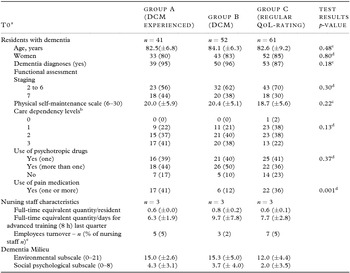
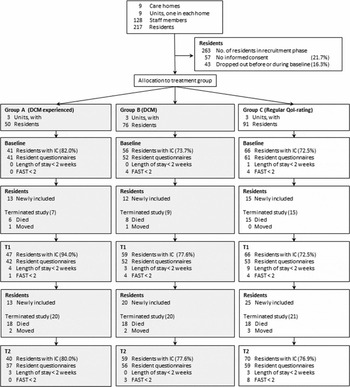
All nine NHs completed the study. From these units, 217 residents were eligible at baseline, and 234 residents (Table 1) were incorporated into the analysis set, thereby resulting in a total of 453 completed resident questionnaires for all of the time points (Figure 1). Ninety-two residents with dementia did not complete the study, and an additional 98 new residents were included during the study.
Baseline characteristics of residents with dementia, nursing staff, and dementia milieu based on the intention to treat

Data are reported as the mean (±SD) or number (%).
aOverall n = 234 residents (all measurement points).
bAs determined by expert raters of the medical service of the statutory long-term care. One missing in Group C.
cANOVA.
dFisher's exact test.
eNursing staff include registered nurses, social workers and nursing assistants (nursing assistants and nursing students). Interns and volunteers are excluded.
Flowchart with detailed numbers of residents with dementia.

Table 1 presents the baseline characteristics of the residents and the units (staff characteristics and dementia milieu). The baseline characteristics of the residents were generally comparable among the groups, with the exception of pain medication use (p = 0.001). Differences between staff characteristics and the dementia-friendliness of the unit milieu were only descriptively computed because of the small number of units.
Intervention effects
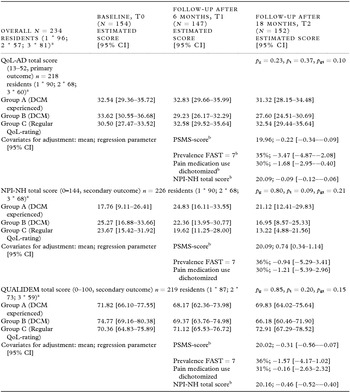
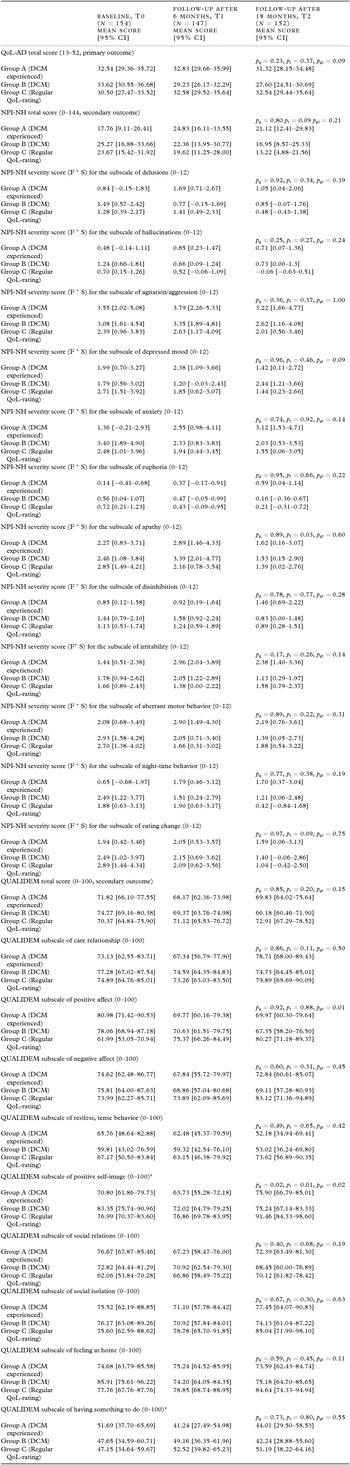
The overall effects on the primary outcome, QoL of PwD, measured with the QoL-AD proxy for treatment (two interventions and one control), time (T0, T1, and T2) and interaction between treatment and time were not significant (covariate adjusted model in Table 2: p g = 0.23, p t = 0.37, p gt = 0.10).
Intervention effects on residents based on an intention-to-treat analysis (adjusted for the following covariates: PSMS, FAST, pain medication use, and NPI-NH total score)

aNo. of times per resident.
bSignificant; p < 0.05 for covariate.
CI 95% = Confidence interval 95%.
Estimated score = estimated least square means.
p g = main effect of the intervention.
p t = main effect of time (at three time points).
p gt = main effect of interaction between group and time.
QoL-AD = Quality of life Alzheimer's disease scale.
NPI-NH = Neuropsychiatric Inventory – Nursing Home version.
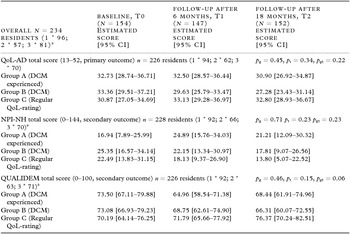
The results were similar to the model without covariate adjustment (Table 3) and those of sensitivity analyses based on both a sample of all residents included at baseline without ongoing inclusion and a sample of residents with questionnaires at all three time points (see Table S1, available as supplementary material attached to the electronic version of this paper at www.journals.cambridge.org/jid_IPG).
Intervention effects on residents based on an intention-to-treat analysis (not adjusted for covariates)

aNo. of times per resident.
CI 95% = Confidence interval 95%.
Estimated score = estimated least square means.
p g = main effect of the intervention.
p t = main effect of time (at three time points).
p gt = main effect of interaction between group and time.
QoL-AD = Quality of life Alzheimer's disease scale.
NPI-NH = Neuropsychiatric Inventory – Nursing Home version.
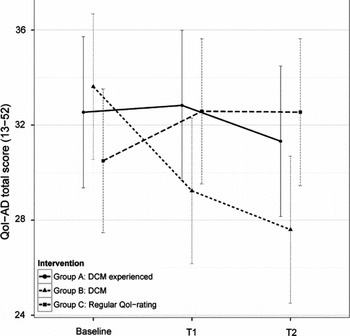
The estimated least square means of the QoL-AD proxy decreased between baseline (T0) and the 18-month follow-up (T2) from 32.54 (confidence interval, hereafter CI: 29.36–35.72) to 31.32 (CI: 28.15–34.48) in group A and from 33.62 (CI: 30.55–36.68) to 27.60 (CI: 24.51–30.69) in group B. For group C, the QoL-AD proxy scores increased from 30.50 (CI: 27.47–33.52) at baseline to 32.54 (CI: 29.44–35.64) after 18 months (Figure 2).
Estimated least square means [CI = 95%] for QoL (QoL-AD-proxy) of residents, adjusted for covariates.

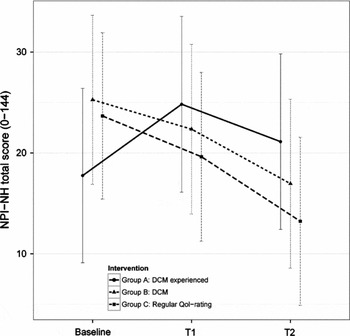
Overall, there were no significant effects of time, treatment, or time * treatment on challenging behavior (covariate adjusted model in Table 2: p g = 0.80, p t = 0.09, p gt = 0.21). The estimates increased over time for group A (17.76 (CI: 9.11–26.41) to 21.12 (CI: 12.41–29.83)), and they decreased for group B (25.27 (CI: 16.88–33.66) to 16.95 (CI: 8.57–25.33)) and group C (23.67 (CI: 15.42–31.92) to 13.22 (CI: 4.88–21.56); Figure 3). A significant decrease in apathetic behavior between T0 and T2 (p t = 0.03) in all groups was identified (Table 4). The results of the sensitivity analysis after square root transformation of NPI-NH were similar in terms of the time course and statistical tests (data not shown).
Estimated least square means [CI = 95%] for challenging behavior (NPI-NH) of residents, adjusted for covariates.

Intervention effects on residents based on an intention-to-treat analysis (adjusted for the following covariates: PSMS, FAST, and pain medication use)

CI 95% = Confidence interval 95%.
p g = main effect of the intervention.
p t = main effect of time (at three time points).
p gt = main effect of interaction between group and time.
QoL-AD = Quality of life Alzheimer's disease scale.
NPI-NH = Neuropsychiatric Inventory – Nursing Home version.
aOnly the PSMS and pain medication use covariates are included in the model.
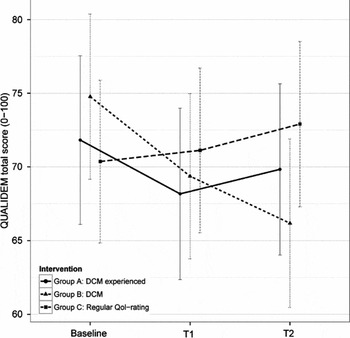
The QoL of residents with dementia measured with QUALIDEM also exhibited no significant effects for treatment, time, and their interaction (Table 2). With decreases in QoL for group A (71.82 (CI: 66.10–77.55) to 69.83 (CI: 64.02–75.64)) and group B (74.77 (CI: 69.16–80.38) to 66.18 (CI: 60.46–71.90)) and an increase for group C (70.36 (CI: 64.83–75.89) to 72.91 (CI: 67.29–78.52)), the development of the measured QoL corresponds to the results of the QoL-AD proxy (Figure 4). Significant effects were identified for the QUALIDEM subscales “positive effect” (p gt = 0.01) and “positive self-image” (p gt = 0.02). Between baseline and T2, the QoL domain “positive effect” decreased in the DCM groups A and B and increased in group C. The positive self-image of the residents increased in groups A and C and decreased in group B (Table 4).
Estimated least square means [CI = 95%] for QoL (QUALIDEM) of residents, adjusted for covariates.

Discussion
The results of our pragmatic quasi-experimental trial regarding the change in QoL (QoL-AD proxy) indicated no significant differences either between the two DCM intervention groups and the control group or between the two DCM intervention groups. The primary outcome, QoL, exhibited a non-expected and non-significant negative trend for both DCM groups. For the secondary outcomes, challenging behavior (NPI-NH) and QoL (QUALIDEM), non-significant differences between groups were observed. The results based on the QUALIDEM data confirmed the results for the primary outcome, whereas the challenging behavior data exhibited non-significant reductions in groups B and C and a slight increase in group A. For the subscales of these secondary outcome measures, a significant decrease in apathetic behavior (NPI-NH) overall and an increase in positive self-image (QUALIDEM) except for group B were observed. In contrast, the QoL dimension of “positive effect” (QUALIDEM) exhibited a decrease over time for both DCM groups. Based on both the heterogeneous results for the outcome measures and their subscales and the methodological difficulties associated with multiple testing, these results should be interpreted cautiously.
The three previous trials regarding the effectiveness of the DCM method yielded heterogeneous results. Our results can be best compared with the design and results of van de Ven et al. (Reference van de Ven2013). In this pragmatic trial, no positive effects were observed for the DCM method compared with usual care in terms of challenging behavior and QoL. For the primary outcome and the secondary outcome “challenging behavior,” a negative non-significant trend for the DCM group compared with the control group was observed. Both studies were based on pragmatic approaches in terms of the lack of inclusion criteria for the participating nursing units. Moreover, the DCM method was performed by trained members of the care staff rather than members of the research teams. No significant effect after eight months of DCM was observed in the study by van de Ven (Reference van de Ven2013), and we observed no effect after 18 months of intervention. The two other aforementioned studies regarding the effectiveness of DCM, Rokstad et al. (Reference Rokstad, Rosvik, Kirkevold, Selbaek, Saltyte Benth and Engedal2013) and Chenoweth et al. (Reference Chenoweth2009), used a more explanatory approach. In the Norwegian trial, DCM was performed by either researchers or trained care staff, depending on the DCM component, and no inclusion criteria for NHs were defined. In this study, no effect was observed for the primary outcome “agitation,” but positive effects were observed for the secondary outcomes “challenging behavior (overall)” and “QoL” (Rokstad et al., Reference Rokstad, Rosvik, Kirkevold, Selbaek, Saltyte Benth and Engedal2013). In Chenoweth et al. (Reference Chenoweth2009), the first effectiveness study, the DCM method was performed by two researchers in collaboration with the care staff, and the participating nursing units and the residents with dementia were selected specifically. Thus, the effectiveness of the DCM method was tested under near-ideal conditions (van de Ven et al., Reference van de Ven2013). In this trial, a positive effect with regard to the primary outcome “agitation” was observed. No effects for the secondary outcomes “challenging behavior (overall)” and “QoL” were observed (Chenoweth et al., Reference Chenoweth2009).
Summarizing these results, the effect of DCM seems to depend on the level of support provided by members of the research team during the implementation, which results in no variation of the implementation among the nursing units. The usage of selection criteria for participating NHs may be another explanation for the differences in the results. In the study of Chenoweth et al. (Reference Chenoweth2009), only units with task-focused systems, rather than PCC systems, were included. Moreover, the included residents exhibited persistent challenging behavior. In contrast, our study and the study by van de Ven et al. (Reference van de Ven2013) did not employ such selection criteria. In our trial, this decision resulted in a heterogeneous sample in terms of the living arrangements and care concepts of the nursing units. It can be assumed that a heterogeneous NH sample requires varying support for the intervention implementation, which suggests a need for external support, as noted above.
However, it is unsatisfactory that over a period of 18 months, it was not possible to demonstrate a difference between the intervention and control groups – i.e. the experienced and inexperienced DCM groups, respectively – for such a resource-consuming intervention. Neither our study nor two other studies (Rokstad et al., Reference Rokstad, Rosvik, Kirkevold, Selbaek, Saltyte Benth and Engedal2013; van de Ven et al., Reference van de Ven2013) used the persistence of challenging behavior as an inclusion criterion for PwD. It is possible that use of such an inclusion criterion increases the likelihood of identifying a positive effect for DCM because the study population is consequently more homogeneous. However, the aim of DCM is PCC, not only reduction of challenging behavior. Thus, because PCC targets the whole person, it should be possible to identify positive effects for prevention of challenging behavior in addition to maintenance and enhancement of the QoL of PwD.
We used QoL as a primary outcome in our trial, whereas the three previous studies used agitation and QoL as primary and secondary outcome measures, respectively. We chose QoL as the primary outcome because the aim of PCC, as defined by DCM, is the enhancement of well-being, which can be observed either as a major dimension of QoL or as a synonym for QoL. We think that the objective of a comprehensive care approach such as PCC must be maintenance and promotion of the QoL of PwD. However, a recent systematic review of the effectiveness of non-pharmacological interventions concluded that only group cognitive stimulation therapy is an effective intervention for improving the QoL of PwD in NHs (Cooper et al., Reference Cooper2012). No effects or only negative effects were observed for other psychosocial and complex interventions, such as DCM (Cooper et al., Reference Cooper2012). This finding may be due to the challenge of measuring QoL in PwD (Scholzel-Dorenbos et al., Reference Scholzel-Dorenbos, van der Steen, Engels and Olde Rikkert2007; Dichter et al., Reference Dichter, Halek, Dortman, Meyer and Bartholomeyczik2013) and the possibility that an improvement in QoL requires more time for manifestation (Cooper et al., Reference Cooper2012). We used the two QoL instruments that are recommended as outcome measures for psychosocial intervention research in dementia care, QoL-AD proxy, and QUALIDEM (Moniz-Cook et al., Reference Moniz-Cook2008). Despite the long intervention period of 18 months, it was not possible to demonstrate a significant intervention effect regarding dementia-specific QoL. Nevertheless, there are further unanswered methodological questions regarding the reliability (Dichter et al., Reference Dichter, Schwab, Meyer, Bartholomeyczik, Dortmann and Halek2014), responsiveness (Perales et al., Reference Perales, Cosco, Stephan, Haro and Brayne2013), and the perspective of proxy measures to assess dementia-specific QoL. In particular, the effect of different proxy perspectives on QoL measures such as the QoL-AD proxy has to be investigated in further research. We used the QoL-AD based on a proxy–proxy perspective, which means that the care staff rated the QoL of the resident from the proxy perspective. This perspective differs more from a QoL self-rating performed by a resident than it does from a patient–proxy perspective. In the latter perspective, a proxy assesses the QoL of a resident as the proxy thinks that the resident would rate him or herself (Pickard and Knight, Reference Pickard and Knight2005). To date, the patient–proxy perspective has not been regularly used. However, it is possible to use this proxy, and it would potentially yield a QoL rating that is more consistent with the resident's perspective. The advantage of a patient–proxy perspective for evaluation of psychosocial interventions, such DCM is stronger consideration of the individual resident's perspective.
These methodological questions also apply to the assessment of challenging behavior. Beyond the aforementioned difficulties, the effect of the intervention on the external assessment is unclear. Thus, it is possible that based on the interventions, the care staff members developed more sensitive observation skills over time, which attenuated any effect between intervention and control. This phenomenon is also possible for the outcome QoL. It is conceivable that the focus of the observations of care staff members correlated with the targets of the intervention and the content of the assessed proxy instruments, which necessitates the need for resident self-ratings as long as possible combined with patient–proxy-based or observation-based measurements as outcomes for the evaluation of psychosocial interventions in dementia care.
Based on the theoretical assumptions and intervention components, negative effects of DCM on resident seem to be unlikely. However, negative effects are possible because of, e.g. invalid DCM observations or incorrect interpretation of the results of DCM observations. Regarding staff outcomes, DCM may have negative effects in terms of, e.g. job satisfaction or burnout, especially under poor institutional conditions at the NH level (e.g. staff shortages or poor leadership). In addition, negative staff outcomes could also affect proxy-based resident outcomes. The results of the process evaluation of the Leben-QD II trial (Halek et al., Reference Halek, Dichter, Quasdorf, Riesner and Bartholomeyczik2013) will help identify possible negative effects of DCM based on interviews with the participating care staff. In addition, the results of the process evaluation will provide information about specific facilitators and barriers for DCM. This information will help to design future DCM effectiveness trials.
Study limitations
Because of the small number of nursing units in each intervention group (n = 3) and thus low power, type II error is possible. A power estimate determined via a two-sided cluster-adjusted t-test (Donner and Klar, Reference Donner and Klar2000) for the primary outcome QoL-AD-proxy (comparing two groups) can serve as a (possibly conservative) estimate for the power. Assuming a mean cluster size of 17 at the last time point (T2), a common standard deviation of 6, and an intra-cluster correlation coefficient (ICCC) of 0.2, a QoL-AD difference of ± 4 could be detected with a power of 90% if five clusters could be recruited per group (Cronbach's α = 5%) (Donner and Klar, Reference Donner and Klar2000). The above assumptions regarding the parameters correspond to the estimates in this trial except that the ICCC estimates were heterogeneous in the small groups with three clusters per group. A difference of ± 3 is considered clinically relevant (Logsdon et al., Reference Logsdon, Gibbons, McCurry and Teri2002). The power estimate suggests that more than five NH units per group would be necessary to detect a clinical relevant difference in the positive or the negative direction (two-sided test) between two groups at the last follow up. Furthermore, the 95% confidence intervals of the QoL estimates are large because of the low power. A more sophisticated power estimate that considers the complete study design with three groups and three time points would require specific assumptions regarding the alternative (which was not defined in the study plan), would be difficult to achieve based on simulations, and would add only a small amount of very specific information.
Furthermore, we were not able to randomly allocate the clusters to the intervention groups. Blinding of the proxy-rating care staff members was not possible because they were included in the intervention while they were functioning as regular staff members on the participating nursing units. The proxy-rating nurses were also directly included in the intervention as trained DCM basic users or team members who were involved in the DCM feedback meetings or action planning. Their direct involvement in the intervention might have led to an overestimation of the QoL of PwD. Conversely, the proxy-rated QoL ratings of the care staff could have been negatively influenced by the challenging behavior of PwD, nurses’ burnout and their life satisfaction (Graske et al., Reference Graske, Meyer and Wolf-Ostermann2014a). Because of the ongoing inclusion of residents, selection bias (e.g. based on different lengths of the exposure to the DCM intervention) may have occurred. However, sensitivity analyses that both included and excluded the residents included during the study yielded the same results.
Regarding the motivation of the NH providers to participate in this study, the included nursing units do not appear to be representative of German NH units in general. The cases that were lost to follow-up might have resulted in some bias. The analyses based on mixed models used all of the available information about the participants, even if their data were not documented at all three time points. Nevertheless, we stress that our results are in agreement with those of a large pragmatic cRCT that studied the effectiveness of DCM (van de Ven et al., Reference van de Ven2013). The main strength of our study is the long evaluation period, which extended over 18 months in a real-life setting. Thus, our study contributes to the body of knowledge regarding the effectiveness of DCM. Another strength is the small number of missing values for the participating residents at each time point, which is the result of a standardized data collection procedure that used trained student assistants.
Conclusions
Despite our study's limitations, the results of our study demonstrate that the DCM method had no statistically significant effect on the QoL or challenging behavior in PwD in the real-life setting of the participating German NHs. Compared with the previous trials (Chenoweth et al., Reference Chenoweth2009; Rokstad et al., Reference Rokstad, Rosvik, Kirkevold, Selbaek, Saltyte Benth and Engedal2013), it could be hypothesized that the likelihood of the identification of a DCM effect increases if the application of the DCM components is supported by members of the research team as external experts. This support must be embedded in an implementation strategy that targets the heterogeneity of nursing units, based on an analysis of the settings, stakeholders, and facilitators and the barriers to the implementation of PCC. Furthermore, our results indicate no effect of DCM after an extended evaluation period of 18 months, regardless of whether the units had prior DCM experience. For further research, use of patient–proxy perspective or an observational-based outcome is recommended for the evaluation of psychosocial interventions. Moreover, possible negative effects of DCM on resident outcomes must be considered during the design of future DCM trials.
Conflict of interest
The study is partially funded by the Public Welfare Foundation, North Rhine-Westphalia (Stiftung Wohlfahrtspflege Nordrhein-Westfalen), and the Knights of St John of Jerusalem Nursing Home Section West (Johanniter Seniorenhäuser GmbH, Regionalzentrum West). The Knights of St John of Jerusalem Nursing Home Section West is also the provider that operates the institutions included in the study. The Knights of St John of Jerusalem Nursing Home Section West is a well-established welfare organization with a charitable status. The Public Welfare Foundation North Rhine-Westphalia is a public foundation that supports projects in the field of social welfare with public funding. Neither organization has competing interests. Most of the authors are employees of DZNE and declare that they have no competing interests. CR is Strategic Lead for DCM in Germany. In this role, neither she nor the German Strategic Partner of the Bradford Dementia Group had any influence on planning or conducting the study. BH is self-employed with mediStatistica and received a fee for statistical consulting and analyses. He has no competing interests.
Description of authors’ roles

Acknowledgments
We would like to thank Stefan Ortner for his contribution as an in-house DCM trainer during the trial. We also thank the participating people with dementia, nurses, and managers of the nursing home teams and study assistants for their contributions.