INTRODUCTION
Schistosomiasis is one of the world's great neglected diseases, caused by blood flukes of the genus Schistosoma. Of the 3 major schistosome species infecting humans, Schistosoma japonicum presents one of the greatest challenges to control due, at least in part, to its zoonotic nature. Although great progress has been made in China over the past 5 decades where, for example, the estimated number of infected people was reduced from 11·6 million in 1950s to 0·7 million in 2000, the disease remains endemic in 110 counties, most belonging to the lake/marshland areas, within seven provinces in China (Zhou et al. Reference Zhou, Wang, Chen, Wu, Jiang, Chen, Zheng and Utzinger2005), with an estimate of up to 56% infection in some villages (Wang et al. Reference Wang, Wu and Zhou2006a). Moreover, particularly since the mid-1990s, S. japonicum has re-emerged in previously controlled areas and further snail-infested areas have been found in formerly non-endemic provinces such as Shanghai, Zhejiang and Fujian (Zhou et al. Reference Zhou, Wang, Wang, Guo, Yu, Xu, Wang, Chen and Jia2004). Such worrying trends in the re-emergence and/or the continued presence of high infection levels in certain areas may suggest some ongoing factors in the disease transmission which have been long neglected.
Based upon previous estimates of their relative transmission index (an index of the role each species may play in S. japonicum transmission based on the size of each species population, their infection prevalence, excreted faeces per day, and eggs per gram of faeces), bovines are generally considered as the most important species in terms of chemotherapy-based policy (Ross et al. Reference Ross, Sleigh, Li, Davis, Williams, Jiang, Feng and McManus2001; Wang et al. Reference Wang, Vang Johansen, Zhang, Wang, Wu, Zhang, Pan, Ju and Ornbjerg2005; Gray et al. Reference Gray, Williams, Li, Chen, Li, Forsyth, Barnett, Guo, Feng and McManus2007). Thus, most effort has been invested in either the development of a potential vaccine against S. japonicum in bovines (McManus and Bartley, Reference McManus and Bartley2004; Wu et al. Reference Wu, Lu and Yu2005), the chemotherapeutic treatment of bovines (Gray et al. Reference Gray, Williams, Li, Chen, Li, Forsyth, Barnett, Guo, Feng and McManus2007), and/or the elimination and replacement of bovines (and goats) with machines (Chen et al. Reference Chen, Wang, Han, Ou and He2004; Wang et al. Reference Wang, Chen, Guo, Zeng, Hong, Xiong, Wu, Wang, Wang, Xia, Hao, Chin and Zhou2009), together with the fencing of pigs. Prevention or control measures for other agriculturally ‘less important’ domestic animals, such as dogs or cats, are not mentioned within the newly passed ‘The Regulation of Schistosomiasis Control (2006)’, nor indeed were even included during the 3 previous nation-wide surveys conducted in 1989, 1995 and 2004, respectively (Li et al. Reference Li, Zhao, Ellis and McManus2005; Balen et al. Reference Balen, Zhao, Williams, McManus, Raso, Utzinger, Zhou and Li2007) or annual monitoring surveillance across the whole endemic areas (Zhao et al. Reference Zhao, Zhao, Jiang, Chen, Wang and Yuan2005). Likewise, the potential importance of wild animals, in particular that of small rodents, in the transmission or re-emergence of S. japonicum has also long been neglected (Yao et al. Reference Yao, Zheng and Qian1989; Zheng, Reference Zheng2006). Although previous studies have occasionally reported high infection prevalence levels in rodents of up to, for example, 64% in one area of Yunnan in China (Cheng and Gong, Reference Cheng and Gong1989), 59·8% in 2 islets along the Yangtze river in China (Xu et al. Reference Xu, Tian, Cheng, Yang, Qiu, Hu, Xie, Zhou and Ying1999), and up to 95·5% in Leyte, the Philippines (Fedorko, Reference Fedorko1999), their subsequent role in the transmission of schistosomiasis has generally been dismissed. Reasons for this may relate to the relatively low amount of excreted faeces from rodents, between 1 and 2 g of faeces for a host per day (Ebihara et al. Reference Ebihara, Shiraishi and Okuma1998), a potentially low egg viability as reported by some studies (Ho, Reference Ho1963; Mitchell et al. Reference Mitchell, Garcia, Wood, Diasanta, Almonte, Calica, Davern and Tiu1990), and/or a potential ‘natural resistance’ in Microtus fortis, one common species of lake rodents in Hunan province of China, against this parasite (He et al. Reference He, Luo, Zhang, Yu, Lin, Li, Li and Liu1999a, Reference He, Li, Liu, Luo, Yu, Lin, Zhang, Yu and McManusb). However, given contrasting reports that, for example, many viable eggs are excreted in the faeces from Rattus norvegicus infected with S. japonicum (Wu, Reference Wu1957) and miracidia per gram of faeces from infected rodents can be 14·5 times higher than that obtained from the equivalent human samples (Mao, Reference Mao1990), such a general omission and/or dismissal of the potential role of rodents in the transmission of S. japonicum may be surprising. Furthermore, recent molecular research in Anhui Province of China, using polymorphic S. japonicum microsatellite markers (Shrivastava et al. Reference Shrivastava, Barker, Johansen, Zhou and Aligui2003; Wang et al. Reference Wang, Shrivastava, Johansen, Zhang, Wang and Webster2006b), revealed that a large proportion of alleles observed from cercariae samples from snails were not observed in any miracidia from the human or domestic animals sampled in the same areas, thereby indicating that additional potential definitive host reservoir species may play a role in the ongoing transmission of this important disease.
Such obvious contrasting views and gaps in our current understanding of this multi-host pathogen leads us to question what may be the actual infection profile of S. japonicum in dogs, cats and rodents within mainland China and, moreover, whether such species could maintain transmission of the disease even if infections within bovines, goats and/or pigs can be successfully controlled or eliminated through current targeted treatment programmes. Therefore, throughout 2006–2007, parasitological surveys of the infected snail distribution prior to transmission seasons and of the prevalence and infection intensity in all species of definite hosts present after transmission were performed across 2 contrasting geographical regions within Anhui province of China: in the marshland where the disease persists, and in the hilly region where the disease was previously controlled, in order to evaluate the potential role of less agriculturally important domestic animals (dogs or cats) and wildlife (small rodents) in the transmission of the disease.
MATERIALS AND METHODS
Site locations
Research sites were set in Tongling County and in Shitai County, Anhui Province of China. Tongling County is located on the south bank of the Yangtze River, classified as marshland region with schistosomiasis persistence. According to the local historical recording (provided by Tongling Schistosomiasis Control Station), at the end of 2004, a total of 126 villages within 9 townships were endemic for the disease, with around 204 900 residents at risk of infection; the infected snail area was 7 144 300 m2, found on 34 habitats within 6 townships of 21 villages; the snail density on average was 0·37 per 0·11 m2 (frame), and infected snail density was 0·001 per 0·11m2; the mean prevalence in humans was 3·3%, with the highest up to 7·1% in some villages; the infection prevalence level among cattle and water buffalo was 8·5% on average across the county, with the highest 30·8% in some villages; acute cases have annually occurred over recent years.
Shitai County, a hilly region in which the disease has re-emerged since 1995, lies in the southern Anhui. According to local historical recordings (provided by Shitai County Centre for Disease Control), in 1985 disease control reached ‘transmission control’ level at the scale of county, with the prevalence in humans and in cattle both less than 1%, and no new infections in children under 12 years old nor any acute cases recorded. However, since 1995 the infected snail habitats have increased every year. During 2001–2005, the prevalence at the county-level in bovines fluctuated between 0 and 1·7% and in humans between 0·2 and 1·0% (provided by Shitai County Centre for Disease Control), and in 2003, an outbreak of acute schistosomiasis occurred in one village (Cao and Wu, Reference Cao and Wu2004).
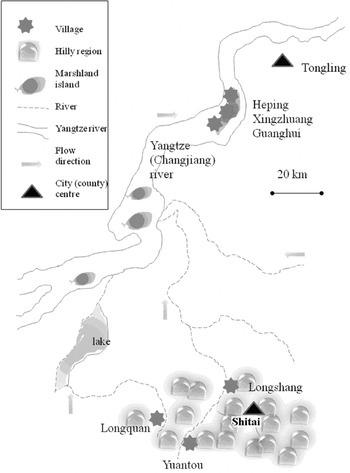
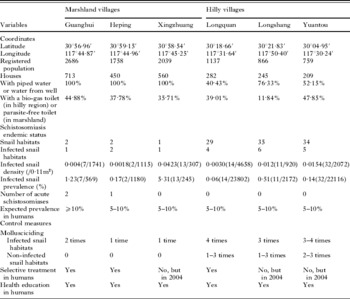
Based on the river systems, the distance from the county centre, and the availability of accurate survey data recordings (annual reports to the Provincial Disease Control Station) from the previous 3 years, 3 villages in Tongling county, namely Guanghui, Heping, and Xingzhuang from Laozhou Township located on an island in the middle of the Yangtze River, were chosen for the current investigation. Meanwhile, in Shitai county 3 villages: Longquan from Dingxiang Township, Longshang from Chili Township and Yuantou from Ketian Township, were chosen. Table 1 shows general information on demography, schistosomiasis endemic status, and control measures in the 6 villages in 2005 and Fig. 1 displays their geographical locations.
Map showing the 3 marshland and 3 hilly villages in Anhui, China.

General information in the sampled villages in 2005

Snail surveys
Systematic surveys of snails were carried out in all suspected snail habitats across the 6 villages during March to April of 2006 and of 2007. According to the standard procedure (Anonymous, 1990), frames, each 0·11 m2, were set at regularly-spaced locations within snail habitats, and all O. hupensis snails found within each frame were collected in order to measure the density of snails and of infected snails. In the hilly region, where snail habitats are known to be concentrated within irrigation ditches, frames were placed at regular distances (5 m or 10 m) along these ditches. In the marshland region, where snails are more widely dispersed across marshy areas of land, frames were set in an equally-spaced lattice formation (20 m×20 m). The captured snails from the field were checked in the laboratory the following day for death and then for infection by using a crushing method (Anonymous, 1990). The numbers of snails or infected snails were recorded by frames and habitats.
Schistosomiasis prevalence and intensity epidemiological survey
All the humans and domestic animals from each village were regarded as subjects of this survey, and 1 faecal sample per host was collected each time during September–October 2006 and of 2007. Stool examinations were conducted using the miracidia hatching test (Anonymous, 1990; Yu et al. Reference Yu, de Vlas, Jiang and Gryseels2007) to diagnose S. japonicum infection for all species of definitive hosts. For humans, only those antibody-positive during an annual indirect haemagglutination assay (Gui et al. Reference Gui, Idris, Shi, Muhling and Ruppel1991) were asked to provide faecal material, which, if positive in egg hatching, was subjected to a further Kato-Katz test with 3 slides thick-smeared per sample to quantify the intensity of infection with the index of eggs per gram faeces (Feldmeier and Poggensee, Reference Feldmeier and Poggensee1993).
A veterinarian was hired to obtain faeces from cattle, water buffalo, goats and dogs by direct rectal sampling wherever possible. Faecal samples from cats were obtained through scrutinizing the neighbouring ground of the house to which a cat belonged. Only a subsample of pigs were given stool examinations, as pigs tend to be always fenced due to their value in meat and/or behaviour in terms of destroying crops when free-roaming, and therefore have few opportunities for water contact. Small rodents were captured by setting live traps in the late afternoon and checking at dawn for 3 consecutive days and captured rodents were kept inside overnight for obtaining their faecal samples. For domestic animals and small rodents, infection intensity data were calculated as miracidia plus eggs (from sediments after hatched) per gram (EPG) (Anonymous, 1990).
The number of discharged eggs per host per day for each species was calculated by the arithmetic mean EPG (of infected individuals) times the amount of faeces excreted per day per host for that species. This was then used in calculation of the contamination index (the total number of discharged eggs per day) for each species, with the exception of rodents due to the inherent difficulties in accurately estimating the population sizes of wild rodents (Calhoun, Reference Calhoun1962; Meehan, Reference Meehan1984), using the formula: contamination index=the number of discharged eggs per host per day×the number of the total host individuals×infection prevalence (Wang et al. Reference Wang, Vang Johansen, Zhang, Wang, Wu, Zhang, Pan, Ju and Ornbjerg2005; Gray et al. Reference Gray, Williams, Li, Chen, Li, Forsyth, Barnett, Guo, Feng and McManus2007).
Throughout the 2 years of investigation in the sampled villages, control measures were implemented as usual by local health staff. These involved selective chemotherapy of humans, with praziquantel at a dose of 40 mg/kg body weight (Chen, Reference Chen2005) based on the indirect hemagglutination assay (Zhu, Reference Zhu2005), health education and mollusciciding with niclosamide, a current chemical widely used in China (Yuan et al. Reference Yuan, Xu, Dong, Jiang and Zhu2005). Due to the increasing concern, from both officials and health workers, over the high prevalence of schistosomiasis in bovines and goats in the marshland revealed in 2006, with special funding from the local government, all bovines and goats raised in the marshy villages have been eliminated since January 2007.
Statistical methods
Snail density and infected snail density were measured as the number of snails per 0·11 m2 at levels of villages (Anonymous, 1990). A significant difference in infection prevalence in snails between years was tested with Chi-square test. Due to low examination rates and small sample sizes of definitive hosts in each village (See Table 2 and Table 4), infection prevalence in definitive hosts was measured at the level of region and the significant difference among species was shown by their 95% confidence intervals. Infection intensity in animals was calculated as the arithmetic mean or the geometric mean of miracidia plus eggs per gram of faeces of infected individuals. The significant difference in infection intensity among species was tested with the non-parametric Kruskal-Wallis test using SPSS 11.0 software (SPSS Base 11.0 for Windows. SPSS Inc. Chicago, Illinois, 2002).
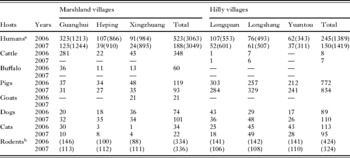
Censored population sizes of each species of definitive hosts in the two regions in 2006 and in 2007

a Numbers in parentheses refer to people who underwent IHA for detection of S. japonicum and numbers without parentheses refer to people positive with the IHA test.
b Numbers in parentheses refer to traps used for small rodents.
Ethical considerations
Ethical clearance for the study was obtained from the Scientific Committee, Anhui Institute of Parasitic Diseases. A blood test for antibodies to S. japonicum in all residents at home, conducted by local health workers, is an annual routine task required from the local health department, for selecting targeted individuals for treatment. Oral informed consent was obtained from all adults and from parents or guardians of minors who were involved in the project, and from owners whose domestic animals were sampled. Owners and local village leaders were informed of the infected dogs or cats and control advice was given. Captured rodents were humanely euthanized with ether in black bags if positive for S. japonicum in stool examination; otherwise, they were released at their original point of capture the following day.
RESULTS
Infection prevalence in intermediate host snails
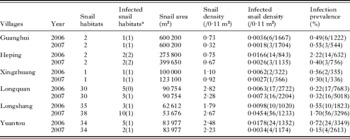
Infected snails were identified in all the sampled villages across both years (Table 3). In the marshland, both the infected snail density and the proportion of infected snails was lower in 2007 relative to the numbers in 2006, with a significant difference in prevalence seen in Heping (X2=7·97, d.f.=1, P<0·01). In contrast, in the hilly villages, with the exception of Yuantou, both indices were higher by 2007, with a noteworthy difference in prevalence found in Longshang (X2=11·32, d.f.=1, P<0·01). This apparent increase in prevalence in Longshang was accompanied by an increase in the number of infected snail habitats, with 10 out of 38 snail habitats found with infected snails in 2007, whereas only 3 infected snail habitats were observed in 2006 and 6 in 2005 (Table 1 and Table 3).
Snail distribution in the sampled villages in 2006 and 2007

a Numbers in parentheses indicate the same infected habitats also found in the previous year.
Infection prevalence and intensity in definitive hosts
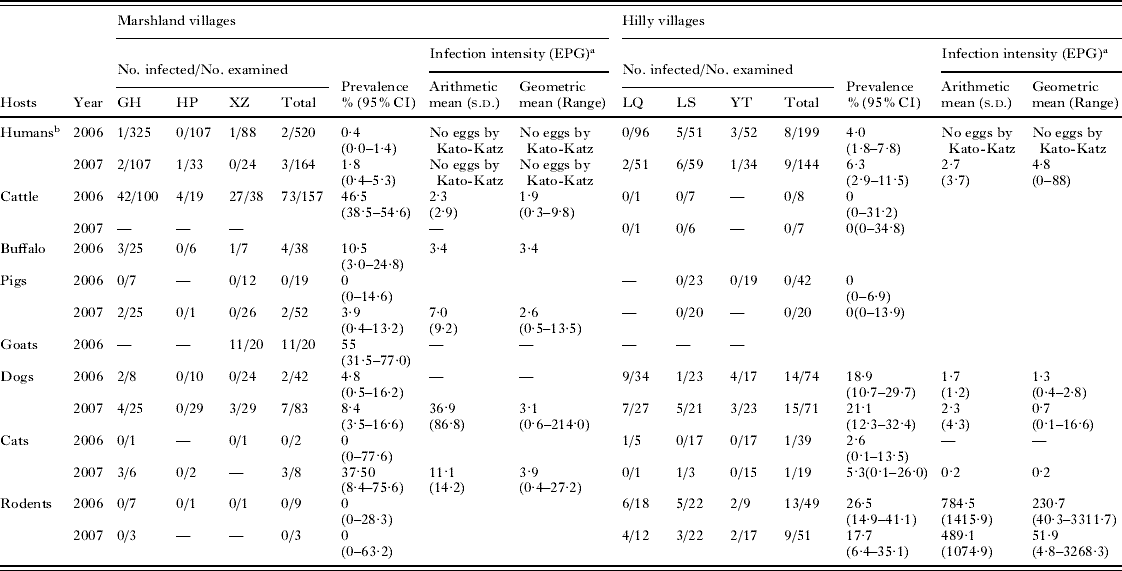
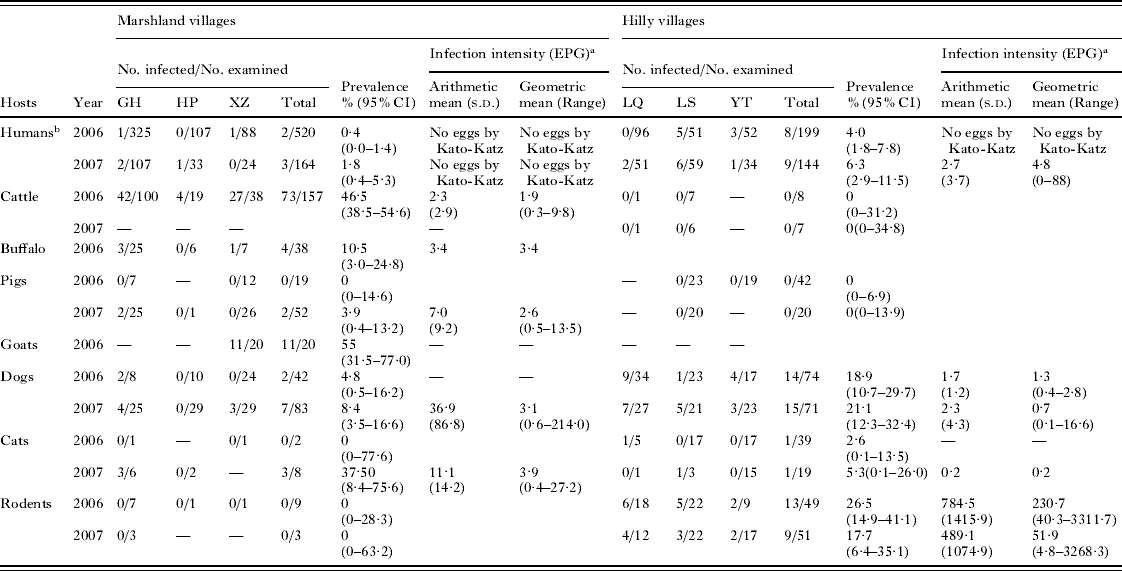
The infected species, not including humans, in the marshland, in order of infection prevalence, were goats, cattle, water buffalo and dogs, whereas in the hilly region were rodents, dogs and cats in 2006 (Table 4). In 2007 after bovines and goats had been removed from the marshland, the prevalence profile in definitive hosts changed with cats and dogs on the top of the list, while in the hilly region the dogs became the species with the highest infection prevalence among all species, with rodents second (Table 4). However, the prevalence in dogs and cats was not significantly higher in 2007, compared to in 2006, in either region (in marshland, X2=0·03, d.f.=1, P=0·86; in hilly region, d.f.=1, X2=0·0001, P=1·0).
Prevalence and infection intensity in populations of different definitive hosts in 2006 and 2007
a Infection intensity (EPG) is based on infected host individuals only.
b Only the individuals positive with IHA test received stool examination, therefore prevalence in humans is estimated among seropositive individuals.
GH, HP and XZ refer to Guanghui, Heping and Xingzhuang respectively; LQ, LS and YT refer to Longquan, Longshang and Yuantou, respectively.
Infected rodents were found in each hilly village in both years, often at high prevalence levels of between 11·8% and 30·0% by village, but no infected rodents were found in the marshland. In contrast, within the marshland villages, very high infection prevalence levels were observed within cattle in 2006, ranging from 21·05% to 71·05% by village, but no infected cattle were identified within the hilly region. It was also noted that infected dogs were identified in each hilly village across both years. Infections in human populations, that were positive in the previous IHA test here, were identified in all 6 villages during 2006–2007, with a non-significant increase between the two years in the marshland (X2=1·87, d.f.=1, P=0·17) and in the hilly region (X2=0·47, d.f.=1, P=0·49) (see Table 4).
Using the Kato-Katz test, no eggs were found among the majority of the infected humans previously identified through egg hatching, with the exception in the hilly region in 2007, and, as a result, the intensity in humans should be very low (Zheng et al. Reference Zheng, Wu and Li1995). Highest infection intensities in the hilly region were observed in rodents, across both years, while in the marshland there appeared to be no distinct difference in such indices among infected host species (cattle, water buffalo, dogs, cats and pigs; X2=0·79, d.f.=4, P=0·94) (see Table 4).
Contamination index for host species
Given the mean daily discharged faeces per host for each species (Wang et al. Reference Wang, Vang Johansen, Zhang, Wang, Wu, Zhang, Pan, Ju and Ornbjerg2005) and an estimate of 1·5 g of faeces produced by a rodent per day (Ebihara et al. Reference Ebihara, Shiraishi and Okuma1998), the number of daily discharged eggs per infected host in the marshland was, 13 724·1 for cattle and 49 867·8 for water buffalo in 2006, and 10 612 for pigs, 3 653·1 for dogs and 222 for cats in 2007. The index in the hilly region was 168·3 for dogs and 1176·8 for rodents in 2006, and 432 for humans, 227·7 for dogs, 733·7 for rodents and 4 for cats in 2007. Therefore, the contamination index (the total number of discharged eggs per day) in the marshland was, in descending order, 2 220 681·8 eggs from cattle and 314 954·5 from water buffalo in 2006, and 37 958·3 from pigs, 31 117·4 from dogs and 1 831·5 from cats in 2007; whereas such index in the hilly region was, with the exception of rodents, 2 833·8 from dogs in 2006, and 5 291·6 from dogs, 4 050·0 from humans, and 20 from cats in 2007.
DISCUSSION
The present study demonstrated that, based on the infection prevalence and intensity in each species, combined with the estimated total number of daily discharged eggs (or per infected host), small rodents, with an ability of rapid reproduction, and potentially more opportunities to come into contact with water sources and then defecate on snail inhabited ditches, may play an important role in the transmission of S. japonicum in the hilly regions. In contrast, within the marshland regions, bovines (and to some extent, goats based on infection prevalence only) appear primarily responsible for ongoing transmission. Furthermore, a relatively high infection prevalence was discovered in dogs (and cats) in both geographical regions, together with a relatively high transmission index (eggs per day) estimate, raising potentially important implications for current control criteria of S. japonicum in China (Liang et al. Reference Liang, Yang, Zhong and Qiu2006), which is essentially based on infection in humans and bovines, rather than any current concern over other less agriculturally important domestic animals.
Small rodents have long been considered of little or no importance in S. japonicum transmission in China (Minggang and Zheng, Reference Minggang and Zheng1999) due mainly to the much lower amount of discharges from rodents compared to that from humans or bovines. Another important reason is that recent research has either generally documented a very low prevalence (0·3–3·0%) of S. japonicum in small rodents (Yang et al. Reference Yang, Wu, Xiong, Fan, Wu and Tao2000; Zheng, Reference Zheng2006), or involved no attempts to collect faecal samples from such animals (Li et al. Reference Li, Zhao, Ellis and McManus2005; Wang et al. Reference Wang, Vang Johansen, Zhang, Wang, Wu, Zhang, Pan, Ju and Ornbjerg2005; Zhao et al. Reference Zhao, Zhao, Jiang, Chen, Wang and Yuan2005; Balen et al. Reference Balen, Zhao, Williams, McManus, Raso, Utzinger, Zhou and Li2007), which is potentially due to the logistical difficulty inherent in the sampling of wild rodents (Webster and Macdonald, Reference Webster and Macdonald1995). It may not be surprising that no quantitative estimation of the role of such species in the transmission of S. japonicum in China has (to the authors' knowledge) been made, as the necessary parasitological survey data have generally not been available.
In contrast, bovines (water buffalo and domestic cattle) have been considered one of the most important contributors to S. japonicum transmission within the lake/marshland areas of China due to their large herds, free-roaming behaviour, life span and potentially high number of eggs passed with their faeces (Ross et al. Reference Ross, Sleigh, Li, Davis, Williams, Jiang, Feng and McManus2001; Guo et al. Reference Guo, Li, Gray, Ning, Hu, Chen, Davis, Sleigh, Feng, McManus and Williams2006; Gray et al. Reference Gray, Williams, Li, Chen, Li, Forsyth, Barnett, Guo, Feng and McManus2007). Schistosomiasis control in bovines has therefore long been regarded as a major part of the Chinese national schistosomiasis control programme (Anonymous, 1990). Indeed, in this study, we also found that the highest infection (and the highest eggs per day contamination index) was in bovines in 2006, and also goats, which is consistent with previous reports from within one marshy village within Anhui (Wang et al. Reference Wang, Vang Johansen, Zhang, Wang, Wu, Zhang, Pan, Ju and Ornbjerg2005; Zhao et al. Reference Zhao, Zhao, Jiang, Chen, Wang and Yuan2005). However, within the hilly region no infected bovines were found. This difference may be explicable by 2 factors: one is that very few bovines were raised in local hilly villages and the other may be attributed to a specific pattern of rearing bovines there. In the hilly region, bovines graze on the slopes of the hills, and therefore have little or no contact with snail habitats (which are largely concentrated in irrigation ditches), unlike bovines in the marshland region which graze on snail-inhabited pastures. Generally bovines are suspected to be less important within hilly regions relative to that of the marshland or lowland areas, as has been discussed by Shrivastava and colleagues (Shrivastava et al. Reference Shrivastava, Qian, McVean and Webster2005) and Seto and colleagues (Seto et al. Reference Seto, Xu and Liang2002), although the latter supposed that transmission may still be maintained in these areas indirectly through agricultural fertilization practices which involve usage of untreated human and animal excrement. However, this was not the case in the hilly region of the current study, as bio-gas toilets, using faeces from humas or agriculturally important domestic animals as material to produce bio-gas, during which most pathogens are killed under anaerobic conditions inside the digester (Jha, Reference Jha2003), are relative common. The coverage of the toilets, for example, is 39% in Longquan village and 48% in Yuantou village, thus reducing the opportunities for faecal contamination of the water sources.
The role of infected humans in the maintenance or re-emergence of S. japonicum transmission, through migration into new regions, application of fresh faeces as fertilizer or occasionally through ‘night soil’ due to personal behaviours, has been demonstrated (Zheng et al. Reference Zheng, Bie, Gao, Yang, Pu and Zhou1991; Cheng et al. Reference Cheng, Yong, Huang and Liu1994). However, in both Shitai County and Tongling County, the role of humans appears to be of less importance in transmission. The infection prevalence in humans, despite being overestimated here (since it was estimated among sero-positive individuals rather than among the total population), at 0·4–1·8% in the marshland and 4·0–6·3% in the hilly villages, was still very low compared to that in bovines or rodents, and the infection intensity was nearly negligible. Furthermore, great improvement in sanitation was noted to have occurred in the sampled villages as mentioned above, which, along with annual control measures such as health education and selective treatment, would further reduce the chances of humans contaminating snail habitats (Guo et al. Reference Guo, Cao, Hu, Lin, Li, Zhu and Xu2005).
Infection in dogs (and cats) has infrequently or rarely been reported in China for over 10 years due primarily to logistical difficulties in sampling faeces from these species, as indeed was encountered in the current study. Dogs (and cats) are free roaming and, dogs in particular, usually follow their owners when they engage in agricultural production, for example, herding bovines, cutting grass and/or planting crops in areas near snail habitats. Moreover, if such animals drink from small ponds or ditches during these periods, this could not only enhance their water contact with snail habitats but also possibly lead to their frequent defaecation at such locations. In this study, the high infection prevalence and intensity levels observed among dogs, coupled with their high mobility and consequent defecation activities, might indicate a significant role of these animals in the transmission and/or dispersal of S. japonicum in the endemic communities within two regions. Indeed, there is increasing evidence to suggest that dogs may play an important role in S. japonicum transmission in the Philippines (McGarvey et al. Reference McGarvey, Carabin, Balolong, Belisle, Fernandez, Joseph, Tallo, Gonzales, Tarafder, Alday, Willingham and Olveda2006; Rudge et al. Reference Rudge, Carabin, Balolong, Tallo, Shrivastava, Lu, Basanez, Olveda, McGarvey and Webster2008). However, from parasitological data alone here it is unclear whether transmission could be maintained within dogs in the absence of bovines in the marshland or of rodents in the hilly regions, or whether they are mainly just ‘spill-over’ hosts. This is one question we are currently exploring using mathematical models fitted to these data. Pigs are also potentially important hosts (Johansen et al. Reference Johansen, Bogh, Nansen and Christensen2000), although they are relatively short-lived and often restricted to pens to fatten faster and/or provide faeces for biogas production, both in the marshland and in the hilly region. After examination of 133 pigs, however, we found 2 infected pigs in 1 marshland village which were not fenced, despite the fact that the local government has forbidden bovines, goats or sheep, rather than pigs, to live in the marshland since January of 2007. This may thereby highlight the need for continued vigilance across all potential definitive host species for successful disease control.
The different trend in changes of infection prevalence in snails and infected snail density between the two regions could partly reflect the effects of contrasting reservoirs or different control measures (and/or frequencies or coverage) between regions. Indeed, although intensive mollusciciding had been conducted annually in the hilly region, 2 hilly villages showed an increase in snail indices, indicating the possible existence of other important reservoirs apart from humans. The decrease in snail measures in April 2007 in the marshland may not be easily accredited to the replacement of bovines (and goats) implemented in January of 2007, as most contamination of snail habitats by these animals would likely have already occurred during the previous year (Liang et al. Reference Liang, Spear, Seto, Hubbard and Qiu2005). Since snail measures are variable across seasons (Davis et al. Reference Davis, Wu, Williams, Liu, Lu, Chen, Zheng, McManus and Guo2006), more caution should be given when interpreting the implication of such snail indices.
It should, however, be mentioned that there are several inherent limitations within the current study. First, the dilemma in the detection of infection in humans and animals still remains. The Kato–Katz test, one standard method for the detection and quantification of egg burdens in humans (Katz et al. Reference Katz, Chaves and Pellegrino1972), has poor sensitivity, especially when infection intensity is very low (Yu et al. Reference Yu, de Vlas, Jiang and Gryseels2007), and also cannot be conducted on faeces from animals with a high content of fibrous material (Guo et al. Reference Guo, Ross, Lin, Williams, Chen, Li, Davis, Feng, McManus and Sleigh2001). Here we could not detect any eggs in some infected humans, who here were identified through the previous hatching test. The hatching test indeed improves test sensitivity, but the required time, natural water, temperature and the disposal of large amount of waste limit its application in field surveys. Therefore, prevalence surveys using the hatching test were limited to the examination of samples from a single time point without considering day-to-day variation of egg excretion in stool (Carabin et al. Reference Carabin, Balolong, Joseph, McGarvey, Johansen, Fernandez, Willingham and Olveda2005) and, also due to time limitations of field work, infection intensity was not measured for each infected animal. Second, differences in the amount of faeces examined or in the sampling procedures, for example from cats, among species might be slightly problematic when directly comparing infection prevalence and intensity between species. Due to the logistic difficulty in the sampling of dogs, cats and small rodents, we were not able to get the required amount of faeces each time, as proposed by Wang et al. (Reference Wang, Vang Johansen, Zhang, Wang, Wu, Zhang, Pan, Ju and Ornbjerg2005), and thus each sample as a whole, after being weighed, was examined with the miracidia hatching and eggs from the miracidia-positive sediments after hatching were count.
Schistosomiasis is of great importance in terms of public health in China with the majority (80%) of cases occurring around the lake (Dongting and Poyang) and marshland regions of 5 provinces in southern China – Hunan, Jiangxi, Anhui, Hubei and Jiangsu (Zhou et al. Reference Zhou, Wang, Chen, Wu, Jiang, Chen, Zheng and Utzinger2005), and a recent village-based intervention trial (human and bovine praziquantel treatment versus human praziquantel treatment only) has confirmed that bovines are the major reservoir host of human schistosomiasis in the lake and marshland regions (Gray et al. Reference Gray, Williams, Li, Chen, Forsyth, Li, Barnett, Guo, Ross, Feng and McManus2009). However, the contribution of different species of hosts to the transmission of S. japonicum may vary with regions in China, particularly between mountainous/hilly regions (Zheng et al. Reference Zheng, Zheng, Wang and Hua1997) and marshland/lake regions (Gray et al. Reference Gray, Williams, Li, Chen, Li, Forsyth, Barnett, Guo, Feng and McManus2007, Reference Gray, Williams, Li, Chen, Forsyth, Li, Barnett, Guo, Ross, Feng and McManus2009). Indeed, the present study here demonstrates contrasting infection profiles of S. japonicum in mammals between the two piloted regions, and suggests that in the previously controlled hilly areas, rodents may be the most important reservoir for S. japonicum, whereas in the marshland, bovines may have been playing a major part in the transmission of the disease. The role of dogs (and cats) should not be ignored in both regions, and human infection seems inevitable in such areas. More evidence may be needed to further elucidate the role of rodents as the main reservoirs in the hilly regions. Nevertheless, the practical and primary implications from the current results are that, in the hilly areas, human- or bovine-based control strategies alone may not be sufficient for controlling transmission and therefore more efforts should perhaps focus on intermediate host snail control and environmental management, in order to minimize the snail density and infected snail habitats. Moreover, chemotherapy of dogs (and cats) might also help reduce the degree to which the disease is transmitted if dogs (and cats) play a role in the transmission.
ACKNOWLEDGEMENTS
We are very grateful to Mr Ai-Yan Shen and his team from Shitai County Centre for Disease Control, and Mr Xing-Ping Pan and his team from Tongling Schistosomiasis Control Station for help with the infection prevalence survey in mammals and snails in field. Many thanks go to Wei-Duo Wu, Feng-Feng Wang, Lei Zhu, Luo-Sheng Zhuang, Zhi-Guo Cao, and Da-Ling Chen from Anhui Institute of Parasitic Diseases for their help and support in field surveys and Dr Manoj Gambhir for his careful reading and critical comments of the manusript.
FUNDING
This work was funded by The Royal Society (Grant no. P07445 to J. P. W.), The Kwok Foundation (to D. B. L., C. A. D. and J. P. W.), and the Medical Research Council (to J. W. R.).
CONFLICTS OF INTEREST
The authors have declared that no competing interests exist.
AUTHOR CONTRIBUTIONS
J. P. W., D. B. L. and T. P. W. conceived and designed the study. D. B. L. collected baseline data. T. P. W. provided logistical support for all the fieldwork. D. B. L. and G. R. F. took part in snail surveys in field. D. B. L., G. R. F. and J. W. R. took part in prevalence survey of S. japonicum in definitive hosts. D. B. L., J. P. W., C. A. D., and J. W. R. wrote the paper.