


Introduction
How has business failure affected family relations in the past? What has it meant for understandings of kinship and the obligations of family members to each other? This article investigates the impact of business failure on family relationships, specifically examining how such events shaped understandings of kinship and familial obligations. Through an analysis of personal correspondence, it moves beyond the simplistic view of family as a purely positive asset. Instead, it explores the complex emotional and social tensions that could arise when navigating business failure within the family. The case study demonstrates how business decisions were inextricably linked to the maintenance of social standing and reputation; it elucidates the emotional dynamics of negotiating failure, and it reveals the significant intergenerational and kinship-based conflicts that emerged in defining family members’ respective obligations.
Family connections have generally been regarded as a positive resource: the ‘implicit contract’ of family provided businesses with access to capital, skills, connections and a form of insurance against failure.Footnote 1 Andrea Colli refers to the ‘emotional stock’ of family businesses, as if it were an item in the balance sheet.Footnote 2 Viewed in a negative sense, however, family connections might be an unwelcome source of liabilities, as when people were called upon to meet obligations to kin. As Sheryllynne Haggerty shows in her analysis of the ‘implicit contract’, people could also be drawn into poor investments by their family connections and exposed to the risk of failure.Footnote 3 Furthermore, although family members might feel obliged to provide support at times of need, the ways in which they were prepared to help, and the conditions they set, were a matter of negotiation.Footnote 4
Microhistorical focus on individual families provides a means of examining the process of negotiation in detail. Robert Nantes’ study of 24 English bankrupts, taken from across the long eighteenth century, shows that they could potentially find crucial support from their families, while also emphasizing that ‘family neither offered a simple solution to finance, or a straightforward safety net when things went wrong’.Footnote 5 Douglas Hamilton shows, for example, how members of James Baillie’s family disagreed over whether his business should be saved or allowed to go bankrupt, and blamed each other for their subsequent economic difficulties.Footnote 6 As the kinds of sacrifice that were required became clear, failure tested the resilience of family connections, and highlighted fault lines: for example, immediate family and relatives by marriage could be expected to respond in different ways.Footnote 7 As Mark Häberlein puts it, ‘business failures reveal the extent as well as the limits of kinship obligations’.Footnote 8
Such negotiations were made more complex by the fact that family members were often themselves creditors of their relative’s estate. Thomas Safley’s comparison of bankruptcy cases from early modern Augsburg (south Germany) show that, for some, helping to settle a relative’s debts could be essential to defending the collective reputation of the family and therefore their own credit. Yet, for others, asserting their own claims on a bankrupt estate could be a way of protecting family assets from other creditors.Footnote 9 Edward Balleisen describes a ‘culture of preference’ for family members who were creditors of bankrupt estates in the early nineteenth-century United States, which might result in other creditors feeling cheated.Footnote 10 Similarly, as Aidan Collins shows for the Halliday family of eighteenth-century Somerset, family members who were appointed as assignees could potentially exploit their position to shield a bankrupt relative or obtain preferential treatment for themselves.Footnote 11 Family members might therefore play an ambiguous role as both creditors of a relative’s estate and defenders of the family interest.
Business history has traditionally focused on the survival or failure of firms from the point of view of business, but for family firms it is essential to consider the points of view of family members, their strategies and needs.Footnote 12 This reorientation corrects a tendency to separate the operation of the capitalist economy from that of the family and its emotional life. As Sylvia Junko Yanagisako puts it in her study of family firms in late twentieth-century Como (north Italy), the marginalization of the family in business scholarship is part of the ‘hegemonic process through which capitalism is made to appear as an economic system that is autonomous from family and kinship processes’.Footnote 13 Similarly, in seeking to examine ‘the emotional structures behind business decisions and relationships’, Mandy Cooper and Andrew Popp argue that business strategy should be understood as the product of negotiations by human actors with emotional attachments to established relationships and ways of doing things.Footnote 14 In the case of failure, the emotional stakes could be particularly high: members sought to distribute liability, apportion blame and offer support, often with conditions attached. Recent legal scholarship on the experience of bankruptcy shows that failure provides a critical test of family relationships, either strengthening or damaging them, and that the emotional processing of failure depends on the kind of support received.Footnote 15
For historians, the personal correspondence of family members offers an opportunity to observe how delicate questions of liabilities, obligations and priorities could be negotiated within the idiom of the family. As Sarah Pearsall argues in relation to the eighteenth-century Atlantic world, letters are not a direct guide to the emotional state of individuals but reflect relationship dynamics and historical conventions.Footnote 16 With the increased volume of correspondence in the nineteenth century, related to improvements in the postal system, Clare Monagle et al. have identified a shift towards a more intimate mode of writing, particularly associated with women, in which letters were intended for individual recipients, rather than family readings. In such private correspondence, it became conventional to discuss feelings more openly.Footnote 17
Understanding how conventions shaped letters allows us to analyse both the dominant emotional norms of the period and individual expressions of personal experience. Although much of this scholarship has focused on women’s letters, as, for example, in Sophie Jones and Siobhan Talbott’s study of emotions in eighteenth-century mercantile firms, this can also be seen in men’s correspondence.Footnote 18 Robin Holt and Andrew Popp show this in their microhistory of the emotional aspects of a single letter of 1793 from Josiah Wedgwood to his son regarding the succession of the firm. Rather than being driven solely by economic rationality, business decisions were influenced by the emotional language of family love and obligation, which reflected the life choices of family members.Footnote 19 To accurately interpret the emotions expressed in such letters, we must recall that they are representations created within a specific historical and social context, shaped by the emotional regimes considered appropriate for different ages and genders.Footnote 20
This article focuses on Read & Co. as a case study of the effects of failure on family relations in one nineteenth-century business, a Sheffield firm involved in the smelting of precious metals, which occupied a specialist niche in the national and local economy. Established in the mid-eighteenth century, the firm found it difficult to adapt to changing conditions in precious metal markets owing to having considerable sums tied up in fixed capital (specialist machinery and premises), which added to the tensions it experienced over its future.Footnote 21 The value of studying this firm in particular lies in the extensive archive of personal papers of family members, much of it consisting of private correspondence. While these letters offer various insights, this article specifically analyses how the failure of the business was negotiated, and how the resulting tensions were expressed emotionally. Family members wrote to each other frequently about the difficult choices they faced, with correspondence spanning multiple generations, both men and women, and extended family through marriage.
Scholars have made use of the letters in various ways. More than 60 years ago, Ronald Wilson produced a traditional narrative history of the smelting business. Focusing on business continuity, it is characterized by a predominantly positive interpretation of the author’s ancestor.Footnote 22 Alison Twells used the letters to explore the involvement of the women of the family in anti-slavery, temperance and missionary campaigning, especially by Mary-Anne Rawson and her mother Eliza Read.Footnote 23 More recently, Autumn Mayle used these sources to analyse the philanthropic activities of the women of the family, which includes a gender analysis of their roles in relation to the difficulties of the business.Footnote 24 In this article, letters are used to focus more closely on the process of negotiating business failure within the family, showing that the emotional responses of family members were a key part of that process, and considering this in relation to a prevailing culture of middle-class anxiety about loss of status.
Contexts: bankruptcy law and fear of failure
The expansion of Britain’s commercial economy in the eighteenth century, linked to the growing interconnection of the national and global economy and the development of financial markets, brought economic opportunity but also a greater risk of failure. As Julian Hoppit has shown, rapid economic growth in the eighteenth century was accompanied by a growing rate of bankruptcy.Footnote 25 Crises became more common in the late eighteenth century and also tended to affect larger groups of people as firms became more interconnected with the financial system. For example, the failure of the Ayr bank in 1772 in turn pushed a series of other firms into insolvency.Footnote 26 It was an increasingly volatile market, in which trading conditions could change dramatically, with major contractions of commerce and credit linked to shifts in government spending and taxation.
Although this volatility was experienced most strongly in London, Hoppit shows that it was increasingly also a feature of provincial economies.Footnote 27 Building on its traditional strengths in metalware manufacture using local water power, iron, coal and charcoal resources, the Sheffield regional economy entered a dynamic phase of export-led growth from the mid-eighteenth century, which linked local circuits of production to global markets. To participate in the export trade required extending significant credit to overseas customers, and it could be difficult to obtain repayment if conditions worsened. For example, the Sheffield entrepreneur Joseph Wilson was bankrupted in 1775, partly as a result of saws, sickles, knives and other goods that he had exported to Boston, and which remained unpaid owing to a dispute with his American partner.Footnote 28
Growing recognition that credit was a necessary aspect of participating in trade can be seen in the changes to the bankruptcy laws introduced at the start of the eighteenth century. From 1571, bankruptcy had been a specific process restricted to a vaguely defined group of ‘traders’ who were involved in large-scale commerce.Footnote 29 Originally framed in punitive terms and designed to address the problem of fugitive debtors, the bankruptcy laws became significantly more debtor-friendly with the statutes of 1705, 1706 and 1711. These laws promoted collective solutions that were reached through negotiation between bankrupts and the commission of creditors.Footnote 30 By cooperating with the process, bankrupts could obtain a certificate that discharged them of all existing debts, so limiting their liability, and also allowing them to avoid imprisonment for debt.Footnote 31 Bankruptcy generally produced better outcomes for debtors than the alternative legal processes: debtors who did not qualify as traders might be imprisoned for debt or have their property seized, and were often obliged to negotiate with each of their creditors on an individual basis.Footnote 32
Nevertheless, for the commercial middle class who could benefit from these protections, bankruptcy remained a shameful process that could permanently damage their reputation and prospects, with the details published in the London Gazette and reprinted in provincial newspapers. Bankrupts might find themselves shunned by their former connections, even many years later, owing to the persistence of network memory, as David Hancock shows for the Quaker merchant Richard Hill.Footnote 33 The cases studied by Robert Nantes indicate that, although bankrupts were often able to recover to some extent and go back into business, the social, economic and emotional damage was usually reflected in a change of trades and significant reduction in the scale of their activities.Footnote 34 This can be seen in the case of the aforementioned Joseph Wilson, who was able to continue in business thanks to a loan raised by his relatives, but only on a much reduced scale that focused exclusively on snuff manufacture.Footnote 35
Although bankruptcy did not necessarily mean the end of one’s business activity, the loss of status and reputation involved nevertheless made it a persistent fear of the middle classes. Tawny Paul underlines that anxiety about failure was increasingly a condition of middle-class life in the eighteenth century.Footnote 36 As Barbara Weiss shows in her study of ‘the hell of the English’, the prospect of being unable to meet one’s debts was a particular obsession for the English middle class into the nineteenth century and remained a prominent theme in moralizing literature of that period.Footnote 37 These anxieties fed into investment behaviour: as Robert Morris shows, middle-class families tended to shift towards more conservative investment across generations. He describes a ‘property cycle’ in which families became more risk-averse over time, seeking to maintain social status rather than maximize profit.Footnote 38
Although anxiety about losing position was a prevailing theme of nineteenth-century literature, painting and drama, there was also a growing sense that people might experience failure through no fault of their own. Rather than moral condemnation, people who failed could be deserving of understanding, in line with Christian ethics of forgiveness.Footnote 39 A common device appearing in literature of the period was that economic failure provided a test of character, from which people could benefit morally, learning to focus on eternal truths rather than fleeting material things.Footnote 40 Such views were also reflected in autobiographical writings: Margot Finn gives the example of Robert Haydon, released from debt prison in 1823, who described his experience as the work of divine providence and a test of moral character.Footnote 41 Women often played a key role in literary narratives of redemption, providing moral, emotional and spiritual support to men who had failed, potentially saving them from suicide. This can also be seen in US ‘panic fiction’ of the 1830s and 1840s, which explored the impacts of the economic crisis on family life and emphasized the role of women in supporting men through the experience of failure.Footnote 42 Thomas LeCarner argues that this literature played a key role in building pressure for reform of the US bankruptcy process in this period.Footnote 43
The developing sense that debts should be forgiven rather than criminalized can also be seen in the way that the English bankruptcy process became more accessible in this period. In the eighteenth century, bankruptcy proceedings could only be initiated by a creditor, and only after establishing that the debtor had tried to evade payment by committing a specific ‘act of bankruptcy’ of some sort (for example, going into flight or hiding, being imprisoned for debt) – all things which implied criminal behaviour and associated bankruptcy with shame.Footnote 44 That changed in 1825 when it became possible for debtors to declare their own bankruptcy by having the information published in the London Gazette.Footnote 45 This reflected a changing attitude towards the bankruptcy process, which became less associated with criminality. This can also be seen in the way that in 1825 and 1842 the bankruptcy process was extended to broader categories of traders, eventually becoming available to all kinds of debtors in 1861.Footnote 46 Over the same period, it also became easier to access the process owing to the creation of dedicated bankruptcy courts – a new central court was set up in London in 1831, and district courts followed after 1842, including Sheffield.Footnote 47
Despite the greater accessibility of the process, bankruptcy remained an expensive and very public way of resolving disputes. By keeping things private, debtors could preserve their reputation and make it easier to start up in trade again. As Finn shows, credit continued to be bound up with personal reputation and ‘character’ throughout the nineteenth century.Footnote 48 It might be possible to achieve moral redemption or even start again in business after bankruptcy, but it was better to avoid the loss of social and economic standing by finding private solutions. An important consideration emerging from this is the need to distinguish between the relatively restricted group of ‘bankrupts’ who were involved in the formal legal process and the much broader group of insolvents who were unable to meet their debts. As Weiss shows, although the literary discourse tended to conflate the two,Footnote 49 for contemporaries there was a key distinction between being ‘bankrupt’ in formal terms and being insolvent. By keeping arrangements private, it was possible to avoid the time, expense and publicity associated with the legal process. This was the case with the Read family, which managed to avoid formal bankruptcy by reaching a private agreement with creditors.Footnote 50
The main difficulty in such arrangements was the problem of obtaining the consent of all of the creditors, leaving open the possibility of future litigation. Things became easier after 1825, when it became possible for a private ‘deed of composition’ or ‘deed of arrangement’ to be binding on all creditors with the agreement of nine-tenths of their number.Footnote 51 One witness testified in 1854 that such private arrangements amounted to ten times the number of official bankruptcies.Footnote 52 Although Ian Duffy argues that such agreements were probably of little impact until the requirement for registration was introduced in 1849, there is good evidence to show that the practice was well-established before this date.Footnote 53 Such solutions became more accessible over time owing to the growth of local firms of solicitors who could facilitate these arrangements. A later example from Sheffield was the certificate awarded in 1863 to Raynor Harrison, leather seller, following conveyance of all of his estate and effects to the trustees ‘for the benefit of the creditors of the debtor as in bankruptcy’ [emphasis added].Footnote 54 The phrasing of the document underlines that this was regarded as a private alternative to the official bankruptcy process.
A growing preference for private solutions helps explain why bankruptcy rates declined in the early nineteenth century, even while the process was being made more accessible to a broader range of traders. After the dramatic increase in bankruptcy cases in the late eighteenth century, Weiss shows that the number of bankruptcies registered each year reached a peak in the 1810s and then stabilized.Footnote 55 Considered against the backdrop of rapid population growth and continued expansion of the credit economy, this indicates a fall in the underlying bankruptcy rate. These findings are supported by Peter Solar and John Lyons’ study of the English cotton-spinning industry. Their data confirm a decline in the use of bankruptcy process after 1812, which they suggest was linked to the expense and inefficiency of the system.Footnote 56
At the local level, an overview of the figures for Sheffield can be obtained using The bankrupt directory (1843), which contains data compiled by George Elwick from the London Gazette.Footnote 57 Extracting all entries for Sheffield and the wider region gives an average of just over 13 bankruptcies per annum in the period 1821–1843.Footnote 58 The volatility of the local economy can be seen in the way bankruptcies varied significantly from year to year. Peaks of bankruptcy for the Sheffield area occurred in 1821, 1824, 1828–1829, 1834 and especially 1836–1840, with the highest peak taking place in 1838, when 28 bankruptcies were recorded. This reflected the difficult trading conditions faced by Sheffield firms because of the international financial crisis of 1837, in which they faced high interest rates along with a collapse in US demand for exports.Footnote 59 Behind these significant annual variations, the average number of bankruptcies per year increased only slightly over the period 1821–1843. Considered in relation to the expanding population of the region (from 42,000 in 1821 to 83,000 by 1851), Sheffield shared in the broader national picture of a decline in the bankruptcy rate.Footnote 60 This was probably related to the growing preference for private solutions that avoided the social stigma and loss of reputation that continued to be associated with bankruptcy, even as the process was normalized and made more accessible.
Read & Company
The case study regards a smelting business established in the late eighteenth century by John Read (1744–1803), which became the main supplier of silver to Sheffield manufacturers by the 1770s, linked to the growing export market for silverware and ‘Sheffield plate’ goods.Footnote 61 Having connections to jewellery and precious metal trades, located principally in Birmingham and London (including the Mint), was essential for obtaining raw materials or ‘sweeps’ (the waste by-products of precious metal processing).Footnote 62 John Read’s father, Thomas, had married into the Lucas family of Birmingham, and these connections were consolidated in 1787 when John joined in partnership with his cousin Samuel Lucas (1764–1834) to form Read & Co. This partnership brought capital, expertise and connections to the firm, and in 1790 the company moved from its premises near the centre of town to a more expansive site at Royd’s Mill farther down the Don valley, purchasing a 99-year leasehold that provided a secure basis for investment in the site.Footnote 63
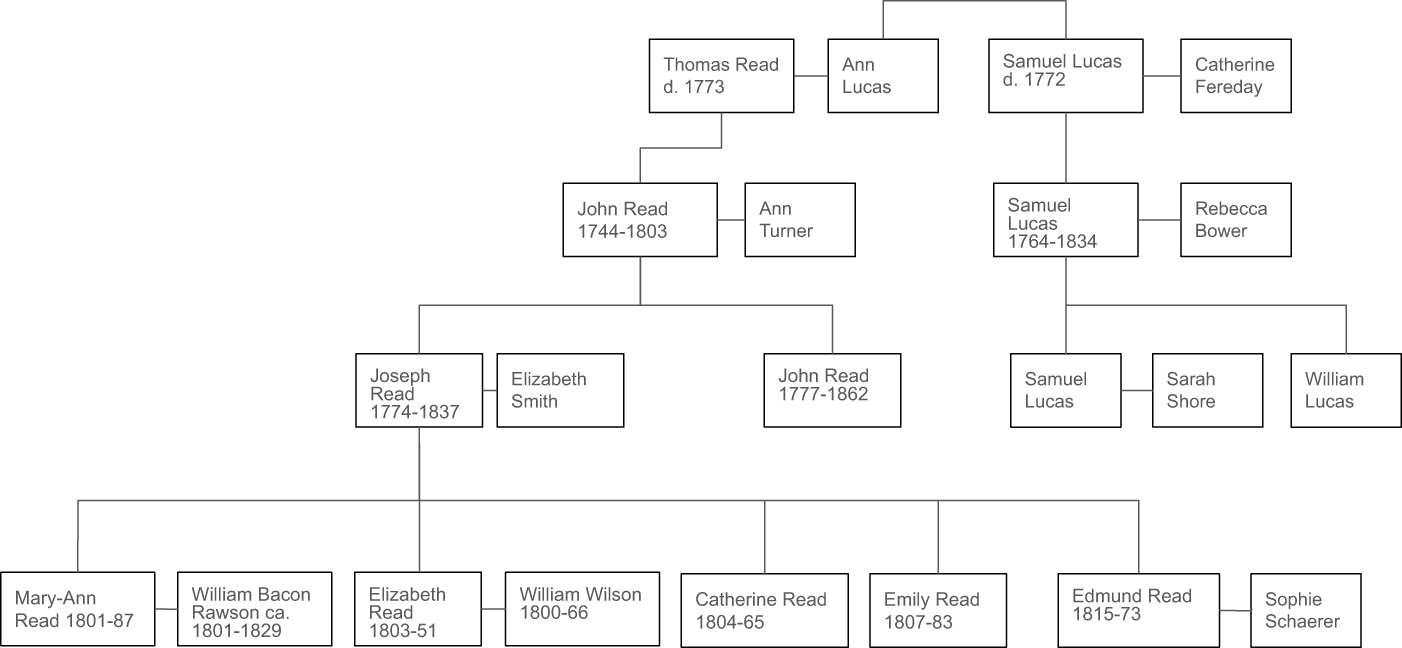
Following John Read’s death in 1803, the firm passed to his sons, Joseph Read (1774–1837) and John Read Junior (1777–1862), both of whom were already partners in the firm and who now inherited their father’s stake (Figure 1). John Junior, the younger of the brothers, did not marry, while Joseph’s marriage to Elizabeth Smith provided important connections to other businesses and established a broad group of family members that might be called on for support, but who also depended upon the success of the firm in various ways. Joseph and Elizabeth’s first daughter, Mary-Ann Read (1801–1887), married William Bacon Rawson (c. 1801–1829), a banker involved in various businesses, including a foundry at Nottingham.Footnote 64 Their second daughter, Elizabeth Read (1803–1851), married William Wilson (1800–1866), owner of a cotton-spinning firm in Nottingham, and who would play an important role in the future of Read & Co.Footnote 65 Joseph’s other daughters (who did not marry) included Catherine (1804–1865) and Emily (1807–1883) – Catherine would play an active role in mediating between family members during the period of financial crisis. Finally, Joseph’s youngest child, Edmund (1815–1873), became involved in the management of Read & Co. in the 1830s, a period in which the family’s response to financial crisis was characterized by intergenerational tensions over the management of the firm but also by the desire to provide for Edmund’s future in some way. As Alison Twells shows, the family were prominent in Sheffield’s evangelical community, and were involved in a variety of charitable, educational and religious activities.Footnote 66
Read family tree, select characters only. Characters have been selected for relevance.

Connections by marriage offered opportunities for investment, but also potentially exposed investors to risks that could conflict with obligations to their immediate family. This can be seen in Joseph Read’s involvement as a partner in the Chesterfield Iron Works, a major munitions manufacturer owned by the family of his wife Eliza. The business performed badly owing to the fall in demand for munitions following the end of the Napoleonic wars in 1815.Footnote 67 The decline of the Chesterfield business was clear by the 1830s and led to tensions between the two Read brothers. John expressed concern that these liabilities would weigh entirely upon his elder brother, as the only investor with any other capital available – as John put it, ‘the other partners have nothing but what is in the concern’. He recommended that Joseph do everything possible to get out of the investment, urging him to think of his own children rather than his in-laws: ‘I know the Smiths would suffer, but your children should be dearer to you than the Smiths’.Footnote 68 The letter illustrates how, at times of crisis, family members might need to choose between the competing claims of kin, and whether to prioritize immediate blood relations over marital connections. In this case, Joseph chose to side with his wife’s family, reducing the dividend he received from the firm rather than withdrawing his investment in a time of difficulty.
By contrast, John Read chose to detach himself from the family firm in 1831, leaving his brother as sole partner.Footnote 69 His behaviour conformed to the ‘property cycle’ described by Morris, whereby middle-class elites withdrew from active business management to focus on safer investments in later life, ‘the capital of old age’.Footnote 70 It also reflected the prospects for succession to the family business: being unmarried, John probably felt less stake in a firm that would most likely be continued by his nephew Edmund. He did not withdraw his money but transformed his equity share into a loan, describing the plan to his brother as being to ‘leave all my money in it upon a common bond from yourself’.Footnote 71 This guaranteed him an income of £1,000 per year, whether the company made a profit or not.Footnote 72 As John explained to his brother, this made sense on the grounds that he no longer played an active role in the firm: ‘I have long thought, that as I do not attend to business, I ought to go out of it’, and also because ‘at my time of life, I had rather have a certain income, (though it would be much smaller) than remain any longer in business, & I should think it would be much pleasanter to you to have the concern to yourself’.Footnote 73
John’s exit from the partnership was a delicate matter, revealing of the way individuals could rationalize their choices by framing them as the management of risk through the separation of family assets. John’s initial proposal was that ‘[a]s my income would be so much reduced, & yours so much enlarged’, in addition to the interest on the bond, Joseph should pay him ‘an annuity of a few Hundreds a year, for a few years, as a compensation for the sacrifice I make, & which I understand is no uncommon thing when a person retires from business & leaves his money in the concern’.Footnote 74 In doing so, John also tried to justify his proposal as being in the family’s interest: ‘for what earthly reason can I have but the good of yourself & family, indeed I have for so many years identified myself with them, as to look upon them as my children’. Having no children of his own, John argued that this arrangement also benefitted his nieces and nephew, since it would enable him to provide financial security for them in case of need: ‘if anything unpleasant happened at Chesterfield, I should have something left to offer a home to you & your children’.Footnote 75 By separating his assets from Read & Co., John would be in a position to help the family in the event of the liabilities resulting from the failure of the Chesterfield ironworks. Rational arguments about risk management and the possible impacts of failure were here deployed to smooth over the emotional tensions of separating himself from the family firm. At the same time, John confirmed obligations to family that would subsequently condition his behaviour, making good on the guarantees offered in this letter to look upon Joseph’s children as his own.
John’s departure also enabled the company to access new sources of capital via his new role in provincial finance. In 1831, he became one of the directors of the Sheffield Banking Company, one of Sheffield’s first joint stock banks.Footnote 76 In what would now be perceived as a conflict of interest, his position facilitated the investment of bank capital into his brother’s company (from which he continued to receive a personal income via the bond). By the end of 1833, the bank had extended over £10,000 in credit to Read & Co., for which Joseph mortgaged the properties of Wincobank Hall (the family home) and Royd’s Mill.Footnote 77 As Lucy Newton has shown, Sheffield banks often invested in businesses in which they were directly or indirectly involved, and this could generate serious financial problems for the banks over the long term.Footnote 78 For example, Sheffield’s oldest private bank, Parker Shore & Co., incurred heavy losses owing to investing in a company to which one of its directors was related by marriage, which was bankrupted in 1831.Footnote 79 Parker Shore & Co. eventually collapsed in 1843 owing to the combination of a downturn in Sheffield’s export trade and a series of bad investments of this sort. Although it avoided collapse, the Sheffield Banking Company shows a similar pattern of investing in companies by means of personal and family connections. Although John Read’s position in the local bank gave his brother’s firm easier access to credit, this may have helped to mask the underlying problems in the business of Read & Co.
The letters exchanged by the family during the crisis years of 1836–1837 provide a window into the tensions and emotions involved in negotiating the future of the company. The position of Read & Co. worsened significantly during the 1830s, partly as a result of the bankruptcy of the Chesterfield ironworks in 1834, which brought loss of income and liabilities for Joseph, but also because of the rise in interest rates from 1836 and the collapse in exports to the United States associated with the financial crisis of 1837.Footnote 80 As Edmund Read wrote to his uncle William that year, ‘Money matters are getting to a very awkward pass in Sheff[iel]d … there is talk of int[erest] being raised to 6 & 7 per c[en]t’.Footnote 81 By February 1837, the bank was no longer prepared to honour the company’s cheques. These financial difficulties were compounded by Joseph’s worsening health leading up to his death in July 1837, as it became apparent that somebody else would soon need to step in as company director.
Precisely who would take on these obligations was a matter of delicate negotiation, given the financial difficulties of the company, the need to resolve the succession, and questions over the relative roles of different grades of kin. Joseph’s son Edmund, now in his early twenties, saw his father’s decline as giving him opportunities to take on a bigger role. Describing his father as ‘almost entirely confined to the house’, he confessed to his uncle William in 1836 that ‘I cannot help feeling rather glad that he [Joseph] does not see about things as much as formerly’.Footnote 82 Nevertheless, other family members recognized that Edmund was not ready to lead the company himself – as when his sister Catherine wrote to William, describing ‘how many difficulties he [Edmund] would find in managing a business alone’.Footnote 83 Edmund was not yet regarded as a man whose ‘character’ was formed; he was considered to be someone who needed guidance.
A second candidate was Joseph’s son-in-law William Wilson, an experienced businessman now in his thirties. Joseph trusted William enough to name him executor of his will, and William had been actively involved in mentoring Edmund as Joseph’s health declined. For example, Edmund wrote to William in 1835 asking for advice on accounting methods, ‘if you wish me to keep the books in this new way’.Footnote 84 William’s reputation as an experienced and successful businessman meant that his involvement in the company served to reassure creditors about the company’s prospects at this difficult time. In March 1837, Edmund asked William to provide assurances to the bank directors, relaying the advice of the bank manager that ‘if you could write the Directors just stating that you would be over soon to make arrangements, he thought this plan would satisfy them’.Footnote 85 This again underlines how provincial banking in this period relied heavily on informal personal guarantees. Despite these expectations, William was wary of becoming more directly involved with the company. In a letter of 1837, he described his concerns about the ‘extra labour, anxiety and risk’ that would be involved, and concluded that owing to ‘the increased mercantile storm [a reference to the difficult conditions of the 1837 financial crisis], I should not be warranted in spreading more sail at present’.Footnote 86
Rather than state his objections openly, William initially presented himself as deferring to the greater obligations of Joseph’s brother John to his immediate family. In May 1836, he wrote to John: ‘I feel that you are the person who must lead the way in such matters …. The family are already under great obligations to you for past kindness & I am sure you cannot confer a greater kindness now than in not letting matters rest till placed on the most satisfactory basis they are capable of’.Footnote 87 Understandably, however, John was unenthusiastic about returning to the company that he had retired from just a few years earlier, and which was now in a far more difficult financial position. With neither man willing to step in, these delicate matters of respective responsibilities, expectations and personal feelings were discussed more broadly among the family.
The issues are revealed in a series of letters discussing William’s suggestion in February 1837 that he and John could perhaps take on the business as joint partners. This was a solution favoured by many family members: Edmund wrote to William expressing his delight – ‘too good news to be true’ – and he was sure this was the opinion ‘of the whole “family” & I think dear Mamma’.Footnote 88 Despite this enthusiasm, family correspondence reveals a series of tensions over the valuation of the firm, how it would be managed and broader concerns about the family’s reputation. There were disagreements, for example, over whether the management of the firm should be entrusted to Edmund or (as John preferred) to the more experienced William Lucas, son of a former partner. Catherine Read also noted that Joseph and John valued the business a lot higher than William Wilson did, indicating that the latter was more sceptical about the firm’s prospects.Footnote 89
In March 1837, William wrote to Catherine, referring to their close friendship, to set out the choice before them: ‘Uncle, or I, or someone else must take to the business’. If John could be ‘induced to take it’, then the profits would stay in the family, and there would also be less emotional and reputational cost: ‘feeling would be less wounded on all hands & less remark excited’ [emphasis in original].Footnote 90 With regard to the possibility of going into partnership with John, William pointed out the drawbacks: it was not clear whether John was really committed to the business and would play an active part in running it, or whether bringing in Lucas as manager would be of any benefit to Edmund’s development, from a material but also from a ‘moral & religious point of view’ (this was a reference to Lucas’ reputation for loose living).Footnote 91 Although ostensibly William was seeking his sister’s advice when he asked the question ‘would such a partnership peril my comfort or safety?’, by pointing out these objections he was probably aiming to get Catherine and other family members to use their mediating influence to put pressure on John.Footnote 92 By April 1837, the proposal for a joint partnership had fallen through, and the prospect of being managed by Lucas was causing Edmund to reconsider his own future: ‘I shall perhaps have nothing to do with it’.Footnote 93
The failure to reach an agreement about a partnership and the growing weight of family expectation eventually forced John Read to assume these responsibilities. In May 1837, he made a final attempt to get William to take on the business. Stating that ‘I do not wish to have anything to do with it, if I can avoid it’, he invited William to make an offer, possibly in partnership with Edmund, recalling how William had a desire ‘to serve the family’.Footnote 94 Otherwise, as John acknowledged, he would be obliged to take it on himself, referring to his own stake in the firm as a creditor: ‘I may find it necessary in self-defence to take the concern’. He reflected on the fact that, if he refused to take on the business, it would further damage confidence in the firm and lower its value: ‘if I was to declare that I would not take to it in any way, it would depreciate the value of the premises’.Footnote 95 He was hopeful that his brother’s estate would be sufficient to satisfy all the creditors and leave something ‘for the use of the family’, but also acknowledged that ‘if that is not the case & there is any deficiency, that will fall I suppose upon me’.Footnote 96 Following Joseph’s death, John resigned from the Sheffield Banking Company and again dedicated himself to the family business. He probably did so partly to safeguard his own stake in the firm, but also out of a sense of familial obligation and the need to protect the reputation of the family name from bankruptcy.Footnote 97 It imposed a heavy cost that eventually required him to sell personal assets – his country mansion of Derwent Hall was on sale from at least 1841 and was eventually auctioned in 1846.Footnote 98 It was a difficult decision, but he could feel that he was doing the right thing for his family, along with protecting his own interests.
A common gendered element in contemporary stories of financial failure is the portrayal of women offering moral and spiritual comfort to men facing hardship. As noted, the women of the family, especially Catherine, played an important role in mediating familial expectations. They encouraged John to feel that his sacrifices would be met with the gratitude of the family. As Mary-Ann Rawson wrote to her uncle, ‘we do feel so very uncomfortable to think that for our sake you should be involving yourself in any risk, and burdened with a constant load of care and anxiety’.Footnote 99 She also offered him the consolation that ‘all these sorrows are but necessary discipline, inflicted by a wise & kind Heavenly Father’.Footnote 100 During the subsequent crisis of 1845–1846, she similarly wrote to John, describing herself as ‘thinking of you night & day’ and ‘so distressed at the situation your kindness has brought you into’.Footnote 101 Echoing the theme found in contemporary literature that redemption might be found through failure, she reflected that ‘The real necessaries and comforts of life are but few … a quiet life, even in a humble way, will be a relief’.Footnote 102 For this middle-class evangelical family, the sense of religious purpose offered a way of managing the emotions associated with doing one’s moral and familial duty.
For William, convincing John to assume this responsibility was a way of extricating himself from the implicit guarantees he had made to creditors through his involvement with the company. These expectations were compounded by the fact that William was named as executor in Joseph’s will, leading to further tensions with John about the repayment of the company’s debts. William argued that it was now in the best interests of the family and of creditors for him to renounce the executorship and leave John in charge of everything. In this way, as William put it, ‘I should therefore be in reality and spirit, if not in the letter’, discharging ‘the trust the late Mr Joseph Read had confided to me, which I had virtually accepted at his hands, and from which I could not otherwise have felt myself justified in extricating myself’. In a letter to John’s solicitors, William praised John for having ‘so handsomely undertook to make good the deficiency, if any, in his brother’s estate and to pay in full and without delay all his unsecured debts’, along with making ‘so liberal and kind a provision’ for the family. This praise was mixed with an expressed concern that insufficient provision was being made to cover the firm’s obligations. William described how this threatened his own reputation, since
I have reason to know some of Mr Read’s creditors have felt confidence in the management of his affairs, from knowing he advised with me during his life, & from expecting I should act as an Executor after his death …. I am bound principally to take care that the creditors should have no reason to complain of my conduct in any respect.Footnote 103
The letter underlines the extent to which confidence in a company was a matter of personal reputation and character – having offered assurances to the firm’s creditors that he would be playing a role in the firm’s future after Joseph’s death, his own reputation and credit were now at stake.
These exchanges show the considerable tensions between John and William, communicating by means of solicitors and paying close attention to the distinction between moral obligations and legal liabilities. John had his solicitors respond to William, rejecting the idea that he had ever promised to pay all of his brother’s unsecured debts ‘which his assets may be insufficient to satisfy’, or to support the family, and that any such provision would be ‘perfectly voluntary on his part’ [emphasis added].Footnote 104 William subsequently apologized, responding that his references to John’s ‘kind & liberal conduct towards the family should have been misunderstood … the terms used did not imply that I considered you under any obligation to bind yourself to the generous proposal’.Footnote 105 This misunderstanding shows the sensitivity of the issue: William was concerned to protect his reputation in having provided informal guarantees to the creditors, but in reality was happy to pass the responsibilities on to John. For his part, John was concerned that an informal desire to satisfy the creditors and support the family should not be construed as a legal liability.
Through his return to the company in 1837, John was able to satisfy the creditors and avoid a public bankruptcy. Similar concerns to avoid reputational damage can be seen in the desire to handle matters privately in 1845, when the company was again insolvent despite John’s efforts to revive its fortunes. On this occasion, the Sheffield Banking Company appointed administrators to raise as much as possible by selling off company assets with the agreement of the other creditors (these included the local private bank of Rimmington & Younge and Todd Naylor & Co., metal merchants of Liverpool).Footnote 106 This sort of approach could obtain the same results as the bankruptcy process, but without the additional legal fees and publicity. It was an approach that was particularly valued by the family, and their acute sensitivity regarding this issue is expressed in a letter from Mary-Anne Rawson to her uncle John. She urged him to make a private arrangement with the creditors rather than be ‘rushing into a bankruptcy’ – ‘the thought of your having your name in the [London] Gazette, and of having every little thing belonging to you being sold’ was like a ‘dreadful dream’. She also questioned the motives of John’s lawyers, Brookfield & Gould, describing them as ‘very greedy of gain’ and seeking to benefit from the legal fees associated with the bankruptcy process.Footnote 107 The shame and expense of bankruptcy pushed families to seek private solutions as far as possible.
As Safley’s evidence indicates for Augsburg, family members might play an ambiguous role in cases of failure.Footnote 108 For some, it meant showing solidarity by shouldering the losses, but for others, failure could be an opportunity to salvage family assets and preserve them under new ownership. This comes out clearly in the behaviour of William Wilson, who had declined to take over the business in 1837 but now saw an opportunity to purchase the firm for himself. His close personal friendship with Edward Smith, director of the Sheffield Banking Company, played a key role in allowing this to happen. Although Edward cautioned William in a personal letter that ‘good money [should] not be thrown after bad’, he agreed that the business might survive with appropriate investment – developing a rail link and bringing in skilled workers. He also advised William that the bank would be likely to cooperate with him on favourable terms: ‘I should think that the Bank would be willing to resell the premises at cost price as their object is merely to cover their debt’, though he was careful to state that this was only his ‘private opinion’, that is, he was not formally speaking on behalf of the bank.Footnote 109 After purchasing the leasehold of Royd’s Mill from the bank, William made an offer of £1,200 for the company in June 1846, on the condition of being indemnified against any further claims from creditors.Footnote 110
Negotiations turned on the valuation of the existing stock and plant, and John Read’s solicitors suggested that this be put to an arbitrator, ‘by a reference to competent parties or their umpire in the usual way’.Footnote 111 William rejected this, describing his offer in a letter to John’s lawyers as being ‘as liberal & as explicit as was in my power’, and pointing out that ‘if you sell by auction or to other parties you will not realise this amount by a considerable sum’. Rather than valuing the stock item by item, he argued that it was a matter of determining what a buyer was willing to pay.Footnote 112 The firm tried to find alternative buyers in an effort to recover more money, allowing the creditor Todd Naylor to inspect the plant. It is possible that these moves were intended to pressure William to increase his offer, but another bid never materialized, and William’s offer had to be accepted as the best available.
Family correspondence shows that John Read was unhappy that the firm had been sold off to his niece’s husband by the administrators without his being consulted. Although the firm remained within the family, it was now transferred to a more distant relative, a younger man with different ideas about doing business. Perhaps there was resentment, too, at the different conditions of taking on the business: in 1837, John had taken on the firm with all its debts out of a sense of family duty, while William Wilson was now acquiring the firm at a low valuation with all outstanding claims settled. The creditors were also unhappy: as John wrote, ‘they say it looks like collusion – that connexion of the family should get the lease at a cheap rate’.Footnote 113 The case shows how family members might exploit their position and connections to acquire family assets, while creditors might be obliged to write off their losses as the least bad option.
The transfer of the company to William also caused long-running disputes over its management to re-emerge, the sorts of intergenerational tensions over the running of businesses that have also been identified by Gillian Cookson and Hannah Barker.Footnote 114 Edmund, who would manage the company for William going forwards, expressed frank views about the poor management of the company under his uncle and the state of the accounts. These criticisms understandably upset John, who wrote to Mary-Anne: ‘family quarrels are at all times foolish things but when a man feels himself to be falling from the station he has long filled he does not like the last kick to come from those of his own family’.Footnote 115 Wilson himself felt aggrieved that by stepping in to aid his brother-in-law Edmund and assure him a future in the family firm, he had generated such ill-feeling. The case reveals the complex emotional tensions that could exist within families over the distribution of loss and the management of assets. Younger members of the family might blame the firm’s problems on poor management, seeing themselves as being held back by their elders, while the latter might feel that their sacrifices had gone unrecognized.
Conclusions
Family was not simply a positive resource that members could treat as an ‘implicit contract’ and draw on for networking or financial assistance. Through a micro focus on family ties under strain, this article reveals the fault lines that could emerge between generations and grades of kin at times of crisis. Family members felt a general sense of obligation to assist, but they also had their own interests to protect and might disagree about strategy. The prolonged negotiations between John Read and William Wilson show how both men expressed a sense of responsibility to the family, even if neither was willing to take the firm on. The matter was eventually determined by the different sense of expectation that each felt in relation to family members, to creditors and to the business community. For William, it was a tricky matter to extricate himself from his commitments: he had been involved in advising Edmund about management, he had given personal assurances to creditors about the future of the firm and he had been appointed executor of Joseph’s estate. Ultimately, however, the impasse was resolved by John’s greater sense of obligation to family, especially the children he had earlier acknowledged as being virtually his own. Just as he had advised his brother Joseph regarding investment and risk, immediate family came before marital kin – arguments that could also be applied to William. For John Read, the bonds of immediate family meant his having to return to ownership of the firm that he had left six years earlier, and taking on its liabilities.
The family correspondence gives us valuable insights into the role played by emotions in such processes of negotiation. The dense exchange of letters among different members of the family show that they paid close attention to each other’s feelings. Communications might be open to different interpretations – as when William’s praise of John’s liberality was construed as an attempt to attribute liability. Given the delicacy and legal implications of negotiation, views might also be advanced with other family members, testing out positions, and here the women of the family played a particularly important role. Through an idiom of family love and gratitude, women reminded men of family expectations, validated them in their choices and consoled them in their losses. Religious feeling was particularly important in reminding people of their obligations to put aside self-interest in favour of the collective. Whether John Read shared in Mary-Ann Rawson’s strong religious views or not, such ideas formed part of the moral pressure that encouraged him to give up his own property for the sake of the family. A religious language of suffering as a source of redemption also helped people to accept the sacrifices involved in doing their duty. As scholars such as Yanagisako, Cooper and Popp have argued, economic action needs to be understood in terms of emotional and cultural motivations alongside rational calculation.Footnote 116 As the case of Read & Co. shows, such familial dynamics played an especially prominent role in the negotiation of failure.
One of the prevailing emotions that comes across in family correspondence is anxiety about failure and the effects that this could have on reputation. Weiss, Paul and Morris have emphasized that failure was one of the great fears of the middle classes in this period, but the social consequences of this might be reduced by avoiding the formal bankruptcy process. The data for Sheffield indicate that it shared in the general picture of a fall in bankruptcy rates after 1820, which was probably owing to the growing preference for negotiating private solutions. The concerns that Mary-Ann Rawson expressed about being published in the London Gazette illustrate how strongly family members could feel about the need to protect their social position. The negotiation of private solutions in the event of failure was facilitated by the way that credit relations were so strongly embedded in personal networks. In the case of Read & Co., the personal connections of family members to the bank helped the firm not only to obtain credit but also to negotiate a private arrangement when the business failed.
Another reason that failure was a particularly acute matter of concern for the whole family was that it was necessarily bound up with intergenerational tensions over the past, present and future management of the firm. In the case of Read & Co., the family firm was important in providing not just a living for Edmund but also opportunities for the formation of his ‘character’ as a man of business. At the same time, there were serious tensions between John and his nephew over the management of the firm. Edmund’s criticisms further added to John’s sense of a lack of gratitude, expressed in his bitter view of being ‘kicked’ by his own family. Having done his duty at great personal cost, he expressed frustration at seeing the firm sold to William at a discount price and his methods criticized.
Although families could indeed stick together and provide direct financial assistance, the separation of assets offered an alternative way of proceeding that held potential strategic benefits. This can be seen in John’s justifications for leaving the company in 1831 on grounds that this would help to manage risk for the family in the long term. Separation of assets could establish a secure position from which assistance might subsequently be provided. Operating from a position of independence also offered family members the opportunity to intervene and buy up assets at a time of failure. This is apparent in William’s actions in 1846 – by purchasing the company and its premises at a cheap rate, he was able to secure a future for Edmund from the financial ruin of the company.
Different approaches to failure were therefore available, either assuming liability to safeguard assets directly or assuming a position of separation from which business might start again. The Read correspondence reveals the strong emotions that might be involved in negotiating these contrasting positions at the level of individuals. Members of the immediate family might be obliged to shoulder the losses, while more distant relatives might be able to benefit from the opportunities offered by separation. Although the succession of the firm to another generation might be assured in this way, there were winners, losers and feelings to consider in this process. Considering these alternative approaches helps us to understand the familial dynamics of negotiating failure and the different ways in which these impacted on family members.