INTRODUCTION
Throughout U.S. history, police have disproportionately targeted African Americans for enforcement activity while simultaneously providing them with less protection under the law (Kennedy Reference Kennedy1997). When these phenomena intersect, they sometimes result in the gravest consequence: Blacks dying at the hands of police. In 2015, U.S. police officers fatally shot 990 civilians; these deaths were disproportionately borne by Blacks, who account for about 13% of the U.S. population, but comprised 26% of those killed (The Washington Post 2015). In some instances, when innocent people are in mortal danger, using lethal force is clearly justified. In others, when the decedent is unarmed, there is more ambiguity about its appropriateness. In 2015, approximately 10% of fatal U.S. police shootings involved an unarmed decedent; the decedent was Black in 40% of such encounters (The Washington Post 2015).
In the second decade of the twenty-first century, several cases of police killing unarmed Blacks received high-profile national news coverage. Since 1936, the Associated Press has asked news editors to identify the top ten stories of the year; “Black deaths at the hands of police” was the top story of 2014 and has remained in the top ten ever since (Crary Reference Crary2014, Reference Crary2015, Reference Crary2016). In August 2014, when a representative sample of U.S. adults were asked “How much have you heard or read about the police shooting of Michael Brown and the subsequent unrest in Ferguson, Missouri,” 54% indicated “a lot” (CBS News/New York Times 2014). Attention grew over time: in December 2014, 62% of U.S. adults had heard or read “a lot” about the grand jury’s decision not to indict Brown’s shooter (CBS News 2014). These polls highlight the variety of topics associated with Brown’s case, such as the nature of race relations (e.g., interracial comfort and racial discrimination), police tactics (e.g., militarization and body cameras), and court functioning (e.g., special prosecutors and grand juries). Given the prominence of such cases, and the importance of the public issues they raise, this narrow class of events can teach us a good deal about life in the contemporary United States.
The names associated with the high-profile cases easily roll off the tongue: Eric Garner, Freddie Gray, and Tamir Rice. Other names, such as Jermaine Darden, Dontay Ivy, and Tommy Yancy, are not part of the national conversation; their names only ring out in the voices of their loved ones. How do particular cases within a broad class of events become part of the public consciousness? Communications scholars have long recognized the power of the news to set issues and events on the public agenda (Iyengar and Kinder, Reference Iyengar and Kinder1987). However, the public agenda is a finite space, meaning that only some stories become fodder for public conversation, while others, and the particular sets of issues they raise, are relegated to the sidelines.
This study investigates the characteristics of cases of police killing unarmed Blacks that receive national news coverage; in doing so, it offers two primary contributions to the literature. First, there is a paucity of official statistics about police use of force (Kindy et al., Reference Kindy, Fisher, Tate and Jenkins2015). This project compiled a sample of over 100 cases where police have killed unarmed Blacks and mapped their parameters. Although these data are not a census of all such events, they are robust; therefore, this study contributes to our limited knowledge about the nature of police violence. Second, this project enhances the literature concerning the newsworthiness of criminal justice events, which has devoted greater attention to the activities of criminals (Gruenwald et al., 2013; Lundman Reference Lundman2003; Pritchard and Hughes, Reference Pritchard and Hughes1997; Sorenson et al., Reference Sorenson, Peterson Manz and Berk1998) than to police use of force (Lawrence Reference Lawrence2000). Beyond addressing this understudied area, this project introduces the concepts of flywheels (Bennett et al., Reference Bennett, Lawrence and Livingston2007) and injustice frames (Gamson Reference Gamson1992) to this body of literature.
This study also has substantive significance. Individuals’ attitudes and beliefs are grounded in their socially constructed reality, which is comprised of their first-hand experiences and the vicarious information that they collect from others (Adoni and Mane, Reference Adoni and Mane1984). The public has little first-hand experience with police use of force. The Bureau of Justice Statistics’ Police-Public Contact Survey (PPCS) shows that in 2008, 16% of U.S. residents aged sixteen or older had face-to-face contact with police; 2% of these individuals reported experiencing force or the threat of force during an encounter (Eith and Durose, 2011).Footnote 1 The public also tends to have little first-hand experience with racial out-groups; for instance, it is well established that neighborhoods, schools, and workplaces continue to be characterized by race and class segregation (Lewis et al., Reference Lewis, Krysan, Collins, Edwards, Ward, Krysan and Lewis2004; Massey and Denton, Reference Massey and Denton1998).
Therefore, vicarious sources of information likely play a substantial role in shaping public opinion about race and criminal justice. Undoubtedly, the news is an important source of vicarious information about society; more than 80% of the public consumes the news on any given day, spending an average of sixty-seven minutes engaged (Pew Research Center 2012). News coverage provides the grist allowing the public to learn about and debate societal issues, and to scrutinize social institutions (Curran Reference Curran, Overholser and Jamieson2005). High-profile instances of police use of force have been demonstrated to shape public opinion (Lasley Reference Lasley1994; Sigelman and Tuch, Reference Sigelman and Tuch1997), which is an ingredient of public policy (Burstein Reference Burstein1998; Sharp Reference Sharp1999). Ultimately, this study identifies the types of cases that are most prominent in national news coverage of police killing unarmed Blacks; these patterns have implications for the types of discussions that society is able to have, and thus the ultimate directions that it takes.
BACKGROUND
When reporting the news, the press cannot act as a perfect mirror, reflecting all possible stories. Instead, the news is socially constructed by journalists who act as gatekeepers (Lewin Reference Lewin1947), winnowing the universe of potential stories down to a select few that are deemed newsworthy. As such, the press emphasizes some topics and deemphasizes others; through this selection process, the press shapes the agenda of the national conversation (Iyengar and Kinder, 1989).
Events are classified as more or less newsworthy based on their alignment with criteria that are widely agreed upon within the news profession, transcending the predilections of individual journalists (Shoemaker et al., Reference Shoemaker, Eichholz, Kim and Wrigley2001). Herbert Gans (2004 [1979]) argues that newsworthiness judgments are a decision-making process that must be quickly executed; thus, criteria need to be easily applicable, flexible enough to apply to a wide variety of cases, easily rationalized, and above all, efficient. “Story selection is essentially composed of two processes: one determines the availability of news and relates journalists to sources; the other determines the suitability of news, which ties journalists to audiences” (Gans 2004[1979], p. 81).
Story Availability
Story availability hinges on the availability and suitability of sources (Gans Reference Gans and Abrahamson2004 [1979]). Source availability is influenced by a source’s power, incentive to participate in the news-making process, ability to supply suitable information, and geographic and social proximity to journalists. Source suitability is determined by a source’s productivity in supplying information, reliability, trustworthiness, authoritativeness, and articulateness; past suitability is also a factor.
Two broad groups of sources might make cases of police killing unarmed Blacks available to journalists. Officials, such as the police and district attorneys, are highly available and suitable sources. Steven Chermak (Reference Chermak1995) describes the mutually beneficial relationship between officials and journalists: journalists rely on the police to supply a steady stream of newsworthy events, and the police rely on journalists to help deter crime, invigorate stalled investigations, and provide positive coverage of their activities. Journalists are typically reluctant to criticize the police, for fear of losing access to a steady news stream. However, in cases of potential police misconduct, the dynamic can become adversarial, with journalists embracing their watchdog function, and the police becoming uncooperative, in order to protect their public image. Scrutinizing the police is a challenging endeavor because they are a powerful source, whose decisions about the type of information to disclose and when to disclose it have substantial implications for story availability. Indeed, the fact that the police are actively motivated to keep incidents of excessive force out of public view constrains the story availability of these events (Lawrence Reference Lawrence2000).
Critical non-officials, such as the family and friends of decedents, activists, community leaders, and academics, can also make cases of police killing unarmed Blacks available to journalists (Lawrence Reference Lawrence2000). Compared to official sources, they are typically less available and suitable, often lacking institutionally recognized power, as well as social proximity and routinized connections to journalists. The availability of critical non-official sources might be influenced by the characteristics of the context where a case occurred. For instance, the size of the population where a case occurred might have a positive relationship with story availability. Compared to less populous areas, more populous locations likely have a higher density of activists and academics to draw on, and these locations enjoy closer geographic proximity to news bureaus. In addition, the demographic composition of the location where a case occurred might also affect story availability. Given that journalists are predominantly college-educated Whites (Weaver et al., Reference Weaver, Beam, Browniee, Voakes and Cleveland Wilhoit2006), locations with larger concentrations of people outside this demographic profile might be perceived as more socially distant.
Story Suitability
The second ingredient of newsworthiness, story suitability, hinges on substantive and product considerations (Gans 2004[1979]).Footnote 2 Substantive considerations address whether a story is important or interesting, and thus newsworthy. Cases of police killing unarmed Blacks might be classified as important stories: those which news agencies are obliged to tell. Story importance is determined by its rank in government and other hierarchies, the number of people affected by it, and its significance for the past and future. Importance judgments might be influenced by the characteristics of the context where a case occurred. For instance, population size might have a positive relationship with importance, due to longstanding journalistic norms prioritizing large cities over more pastoral locations (Gans 2004[1979]).
Importance evaluations might also hinge on the degree to which a case fits within an injustice frame. William Gamson (Reference Gamson1992) proposes that some issues and events can be characterized as injustices, meaning that they generate righteous anger toward particular human actors who are deemed to be responsible for inflicting harm and suffering. Although society grants police the power to use force when carrying out their official duties, it expects that police use of force is justified and proportionate to the degree of threat (Klockars Reference Klockars, Geller and Toch1996). Cases exist along a continuum where some are perceived to be justified uses of force and others are perceived to be unjust. Instances of latter are important stories to tell, because they may signal dysfunction in a key social institution, thus potentially affecting large numbers of people.
Four general aspects of a case might shape its alignment with an injustice frame. First, the precipitating event’s characteristics might be consequential. For instance, cases where the decedent resisted arrest might be seen as more just than those where the decedent was compliant. Second, the decedent’s traits might affect evaluations. Decedents exist along a continuum where some are considered to be sympathetic and others are unsympathetic. Cases involving decedents who appear to be at fault for their circumstances might be regarded as more just than cases where decedents appear to be relatively blameless for their deaths. For instance, the death of twelve-year-old Tamir Rice, who was shot while playing with a toy gun in a public park, might be perceived as a greater injustice than the deaths of Malissa Williams and Timothy Russell, whose car was shot 137 times after the conclusion of a 62–car police chase, initiated because the couple refused to pull over for a traffic stop. Indeed, previous research indicates that homicide victims who are considered to be innocent by their status characteristics (Gruenewald et al., Reference Gruenewald, Pizarro and Chermak2009; Pritchard and Hughes, Reference Pritchard and Hughes1997) or by nature of their activities before death (Gruenewald et al., Reference Gruenewald, Pizarro and Chermak2009), are more newsworthy than victims who are considered blameworthy. Third, the officers’ traits might impact justness determinations. For example, cases involving officers with previous complaints against them might be seen as more unjust than those involving officers with previous awards in their favor. Fourth, the appearance of subsequent events might influence judgments. For instance, protests and court proceedings arise in direct response to circumstances that are perceived to be unjust.
Story suitability decisions further hinge on product considerations, which highlight the fact that the news is a commodity for economic exchange. Product considerations are multifaceted, broadly focusing on the fit of a story within the overall news offering (Gans Reference Gans and Abrahamson2004 [1979]). Medium considerations orient us to technology, foregrounding the importance of visuals to television news. Novelty considerations privilege stories that are new or unusual. Story quality considerations call for “good stories”, meaning that they have action, evoke excitement, are adequately paced, and can be told with clarity and parsimony.
Medium considerations might impact judgments about a case’s suitability. Specifically, television news sectors demand compelling visuals in a way that print news sectors do not; therefore, the presence of video evidence might be particularly important for television sectors. For example, the cell-phone video of Walter Scott being shot in the back while fleeing police after a traffic stop had inherently high news value because it objectively contradicted police accounts of the encounter. However, it provided an additional boon to television news sources, because of its gut-wrenching visual impact.
Novelty considerations might also shape decisions about a case’s suitability. Cases exist along a continuum, where some are deemed typical and others are atypical; the latter are more novel, and thus more newsworthy. Five general dimensions of a case might affect novelty evaluations. First, the characteristics of the context where the case occurred might be consequential. For example, a location’s degree of social disorganization is positively associated with police use of force (Terrill and Reisig, Reference Terrill and Reisig2003);Footnote 3 thus, aspects such as household income, residential mobility, and racial/ethnic composition provide insight into the typicality of force within a community. Previous research supports this reasoning; for example, homicides occurring in low income neighborhoods are less newsworthy than those occurring in wealthier locations (Sorenson et al., Reference Sorenson, Peterson Manz and Berk1998). Second, the precipitating event’s characteristics might influence novelty judgements. For example, some injuries, such as gunshot wounds, are relatively common, while other injuries, such as police canine bites, are less so. Third, the decedent’s traits might affect assessments. Decedents exist along a continuum where some are typical targets of police use of force and others are atypical. Research drawing on the normal crimes perspective (Sudnow Reference Sudnow1965) suggests several relevant decedent traits. Participant age consistently exhibits a curvilinear relationship with newsworthiness, such that the youngest and oldest participants are the most newsworthy (Pritchard and Hughes, Reference Pritchard and Hughes1997; Sorenson et al., Reference Sorenson, Peterson Manz and Berk1998). Findings about the relationship between participants’ sex and newsworthiness are mixed; some find that female participants increase newsworthiness (Gruenewald et al., Reference Gruenewald, Chermak and Pizarro2013; Sorenson et al., Reference Sorenson, Peterson Manz and Berk1998), while others find that they decrease it (Pritchard and Hughes, Reference Pritchard and Hughes1997). Richard Lundman (Reference Lundman2003) argues that cultural race and gender typifications about crime participants are more powerful predictors of newsworthiness than participants’ statistical rarity. He finds that that some uncommon victim/offender configurations, such as those involving White female assailants and White male decedents, are less newsworthy than more common victim/offender configurations, such as those involving Black male assailants and White female decedents. Fourth, and in the same vein, officers’ traits, such as race and gender, might influence novelty judgments. Fifth, the appearance of subsequent events might shape novelty determinations. For instance, violent protests or the indictment of officers are relatively rare.
Quality considerations might further influence assessments about a case’s suitability. Quality stories entail action and excitement; given that all cases of police killing unarmed Blacks involve familiar scripts about good and evil, and the presence of lethal violence, they are all relatively high quality. However, two broad aspects of a case might further affect quality determinations. First, the characteristics of the precipitating event might matter. Quality stories must be reported with clarity and parsimony, and cases exist along a continuum where some are simple and others are complex. For example, explaining fatal gunshot wounds is a relatively straightforward matter, whereas, fatal electroshock injuries are more complicated. Justin Jouvenal (Reference Jouvenal2015) reports that some coroners are reluctant to classify electroshock injuries as a cause of death; instead using excited delirium, a condition marked by extraordinary strength, immunity to pain, and wild or violent behavior. Excited delirium is a contested medical condition that is recognized by some groups, such as the American College of Emergency Physicians, but disavowed by others, such as the American Medical Association. Critics argue that since excited delirium leaves no definitive biologic signatures, and that it is primarily used to explain death resulting from police use of force, it is little more than a way to excuse the police and electroshock weapon manufacturers from wrongdoing. Second, events occurring after the fatal encounter might also shape story quality judgments. For instance, the appearance of protests and court proceedings provide a case with additional action.
In summary, I take the perspective that the news is a socially constructed product, and that the newsworthiness of a case of police killing unarmed Blacks depends on its story availability, which connects sources to journalists, and its story suitability, which connects journalists to audiences. The most newsworthy cases will be highly available, meaning that there will be a variety of available and suitable sources for journalists to draw on. The most newsworthy cases will also be highly suitable—they will be deemed important, fit within the confines of the relevant medium, have novel features, and exhibit the characteristics of quality stories.
METHODS
Data
Data collection began by establishing a list of cases of police killing unarmed Blacks. There are no reliable official statistics tracking police use of deadly force in the United States (Kindy et al., Reference Kindy, Fisher, Tate and Jenkins2015); therefore, the data were compiled by triangulating four unofficial sources: 1) Killedbypolice.net monitors corporate news reports to track people killed by U.S. law enforcement between May 1, 2013 and the present day; 2) Mappingpoliceviolence.org uses original reporting and crowdsourcing to track police killings during 2014–2015; 3) “The Counted,” a project by The Guardian, uses traditional reporting and crowdsourcing to track individuals killed by police since January 1, 2015 (Guardian 2016); and 4) Gawker Media, in conjunction with the NAACP Legal Defense fund, published a list of unarmed people of color killed by police from 1999–2014 (Juzwiak and Chan, Reference Juzwiak and Chan2014). Given that this paper uses sources relying on news reports to assemble its list of cases, it cannot describe the characteristics of all cases within the universe of police killing unarmed Blacks, nor can it test causal arguments about why some cases receive news coverage and others do not. Instead, it maps the characteristics of its robust sample of cases, and investigates the types of cases that rise to the top of the national news agenda.
To be included in the dataset, a case needed to meet two scope conditions. First, the decedent(s) must have been unarmed and Black. Coders determined decedents’ race by triangulating information across the four sources. They also extensively searched local and national news stories for explicit mentions of race and photographs of the decedent.Footnote 4 Second, the case must have involved sworn law enforcement officials acting in their professional capacity. This condition excludes cases where decedents were killed by private security guards, during domestic disputes with officers, or during traffic accidents involving police vehicles. The final dataset includes 111 cases of police killing unarmed Blacks, occurring between May 5, 2013 and May 31, 2015.
While it is impossible to gauge the completeness of these data without access to reliable official statistics, there are reasons to believe these data are valid. In 2015, The Washington Post began using interviews, police reports, news accounts, and other sources to track fatal police shootings. Their data indicate that approximately forty-one unarmed Blacks were shot and killed by police in 2015 (Somashekhar et al., 2015). This project’s data indicate that thirty-five unarmed Blacks were shot and killed by police in 2014, and another seventeen were shot and killed between January 1 and May 31, 2015. This high degree of correspondence with the Post’s data bolsters confidence in the validity of the current study’s data.
Dependent Variables
This study operationalizes national news coverage as stories appearing in three print newspapers (The New York Times, USA Today, and The Washington Post) and three network television newscasts (ABC World News Tonight, CBS Evening News, and NBC Nightly News). I focus on these two sectors because they reach large portions of the public; daily print newspapers are regularly read by 33% of U.S. adults, and network newscasts are regularly watched by 27% (Pew Research Center 2012). Moreover, these sectors have an outsized role in shaping the agenda of other news sectors. For example, websites operated by legacy news outlets tend to replicate their parent organization’s content, and Internet-only news outlets often link to legacy content (Tewksbury and Rittenberg, Reference Tewksbury and Rittenberg2012).Footnote 5 Therefore, the 39% of U.S. adults regularly engaging with online news (Pew Research Center 2012) likely encounter content deriving from these sectors. The specific outlets within each sector were chosen because they have large national audiences; with the exception of The Washington Post, each outlet is among the top ten news websites receiving the most unique visitors (Pew Research Center 2015).Footnote 6
Notably, this study omits cable television news. This sector is undoubtedly an important part of the American news landscape; it is regularly watched by 34% of the public (Pew Research Center 2012), and Fox News and CNN are among the top ten news websites receiving the most unique visitors (Pew Research Center 2015). I omit cable newscasts because, compared to print newspapers and network television, cable news formats are quite diverse, including breaking news coverage throughout the day, personality driven shows, and roundtable debates. This heterogeneity introduces a host of sampling challenges. Moreover, cable news outlets have pronounced ideological divides, most notably between Fox News and MSNBC; these partisan differences might lead to variable newsworthiness judgments across providers within this sector. Given the unique features distinguishing cable news from print newspapers and network television, it seems more appropriate to devote a stand-alone study to investigating newsworthiness within this sector.
To collect all network newscast and print newspaper stories mentioning a case, we conducted LexisNexis searches using the decedent’s name as the keyword, the date of the police/decedent encounter as the start date, and May 31, 2016 as the end date.Footnote 7 The data focus on stories appearing in the flagship news product, excluding those solely appearing online. The data were cleaned to remove irrelevant stories (i.e., those featuring a different actor with the same name as the decedent), resulting in 2,538 stories.
The majority of cases never attained national news coverage; as a result, the distribution of newsworthiness is characterized by a positive skew with a substantial number of zeros. To appropriately analyze these data, I use the two-phase approach advocated by David Fletcher and colleagues (2005). The first phase explores whether a case is deemed newsworthy by examining 0–1 indicators of receiving any national print newspaper or network television coverage. The second phase focuses on the subset of cases receiving coverage, exploring the abundance of coverage generated. In its raw form, the total number of stories generated about a case is positively skewed and has a long tail marked by outlier cases with extremely high amounts of coverage.Footnote 8 To adjust this distribution, I use a categorical measure of the total number of stories, representing low coverage (1 story), moderate coverage (2–26 stories), and high coverage (≥ 27 stories); these cut-points were selected in order to achieve a normal distribution.
Independent Variables
Each case involves a unique constellation of elements. To systematically organize these data, this paper adopts and expands the framework developed by Eileen Bjornstrom and colleagues (2010) for their study of racial/ethnic portrayals in local television crime news. Their approach conceptualizes cases as being composed of a series of situational components (i.e., the facts of the case) existing within a social structural context (i.e., the environment where the case occurs). The specific variables populating the framework for the current study were inspired by previous literature on the newsworthiness of criminal events and by the ingredients of newsworthiness outlined by Gans (2004[1979]).
The first set of variables describe the social structural context where the precipitating event occurred, operationalized at the city-level (e.g., Michael Brown’s contextual data describe Ferguson, Missouri). Fifteen contextual variables were collected. FBI data were used to determine a location’s violent and property crime rates per 100,000 residents (Federal Bureau of Investigation 2014).Footnote 9 United States Census Bureau data were used to measure a location’s population size, percent non-Hispanic White alone, Black alone, and Hispanic of any race, percent in same dwelling one or more years, percent foreign born, percent with a high school degree, percent with a bachelor’s degree, homeownership rate, median value of owner-occupied units, median household income, and percent in poverty (United States Census Bureau).Footnote 10 In addition, I created a 0–1 indicator of a case occurring in a southern state.
The remaining four sets of variables are situational components describing the facts of each case. Since this study cannot rely on official statistics, these data were collected by extensively analyzing local and national news reports about each case. Given that journalists strive for completeness in their coverage (Gans Reference Gans and Abrahamson2004 [1979]), this project assumes that news stories will provide a comprehensive account of events and thus takes an affirmative approach, such that variables were tallied as present if coders encountered explicit mentions of them within a news report. If coders did not find an explicit mention of a variable, it was coded as absent (e.g., if there was no mention of a decedent having mental illness, this variable was coded 0). If there were discrepancies across news reports, coders adopted the majority position. This approach is prone to generating false negatives; for example, a decedent might have a history of mental illness, but journalists might not uncover and report this information. As such, the results of this study should be taken as a conservative estimate of the relationship between situational components and newsworthiness.
Event characteristics orient us to the details of the precipitating police/decedent encounter. Seventeen event characteristics were assessed. These include a categorical variable tracking the reason for the encounter, and 0–1 indicators of the police perceiving the decedent as having a weapon, and of decedents resisting arrest, engaging in a physical altercation with police, injured by soft-empty control (i.e., grabs, holds, and joint locks), hard-empty control (i.e., punches and kicks), blunt impact (i.e., batons and projectiles), chemical sprays (i.e., projectiles embedded with chemicals), electroshock weapons, gunshots, police vehicles, or by police canines. Further 0–1 indicators tracked whether decedents died at the scene, the encounter was video recorded, or witnesses were present at the encounter.Footnote 11 In addition, a continuous variable tracking days since the previous case was included.Footnote 12
Cases also contain casts of characters whose traits might have implications for newsworthiness. Seven decedent traits were measured. These include 0–1 indicators of sex, U.S. citizenship, history of mental illness, impairment at time of the police/decedent encounter, exhibiting erratic behavior during the encounter, having a previous criminal record, and a three-category measure of age, with the cut points based on standard deviations from the mean.
Five officer traits were measured. These include 0–1 indicators of officer names being released, non-traditional officers involved (i.e., female or minority officers),Footnote 13 the involvement of officers with previous awards, officers with previous complaints, and a continuous measure of the number of officers involved. Since police departments are often unwilling to divulge information about their officers, these variables might be less reliable than others. For example, officers were not publicly identified in one-quarter of cases; in these instances, data about officers’ traits are necessarily incomplete. In addition, there are uncertainties about where these variables fit in the causal chain. While it is clear that variables such as population size or gunshot injuries precede newsworthiness judgments, it is unclear whether the police release officers’ names, thus making a case more newsworthy, or if the newsworthiness of a case prompts the police to release information, in order to alleviate pressure from journalists. Due to these factors, the officer trait variables are treated with particular caution.
Finally, events occurring after the precipitating event might shape newsworthiness judgments. Therefore, I expand on Bjornstrom and colleagues (2010) framework by introducing flywheels, which focus on the aftermath of the event. In communications parlance, a flywheel is an institutional process that provides the press with routinized entry points into the workings of government (Bennett et al., Reference Bennett, Lawrence and Livingston2007). Nine flywheels were assessed. These include 0–1 indicators of a peaceful demonstration, violent demonstration, arrest of demonstrators, grand jury hearing, criminal indictment, civil rights investigation, civil suit filing, and civil suit settlement. In addition, there is a continuous measure of damages awarded in settled civil suits. As with the officer traits, there is ambiguity about where the flywheels belong in the causal chain. In some instances, the appearance of flywheels might prompt greater news coverage. For example, the violent protests following the death of Freddie Gray, who suffered severe spinal injuries while shackled inside a police van, undoubtedly contributed to the newsworthiness of his case. In other instances, a case’s newsworthiness might induce the appearance of flywheels. For example, perhaps high-profile news coverage pressures officials to take action.
RESULTS
The analysis unfolds in two phases. The first considers each set of variables in turn. It begins by detailing the univariate statistics; given the lack of systematic information about police use of lethal force, it is worthwhile to closely survey the details of this paper’s sample of events. Then, it explores bivariate relationships between the independent variables and national newsworthiness. Phase two turns to multivariate models, providing an integrated account of how a case’s social structural context, event characteristics, decedent traits, and flywheels are associated with its newsworthiness. Given the small size of the dataset, I highlight marginally significant findings (p ≤ 0.10).
Univariate and Bivariate Analyses
Of the 111 cases, thirty-two (29%) received national print newspaper coverage, and fifteen (14%) received national network television news coverage.Footnote 14 Receiving newspaper coverage was a necessary, but not sufficient, condition for receiving television coverage, with about half of cases receiving the former also receiving the latter. Among cases receiving coverage, the total number of stories ranged from 1–1,464; 22% of cases received low coverage (one story), 56% received medium coverage (2–26 stories), and 29% received high coverage (≥ 27 stories).
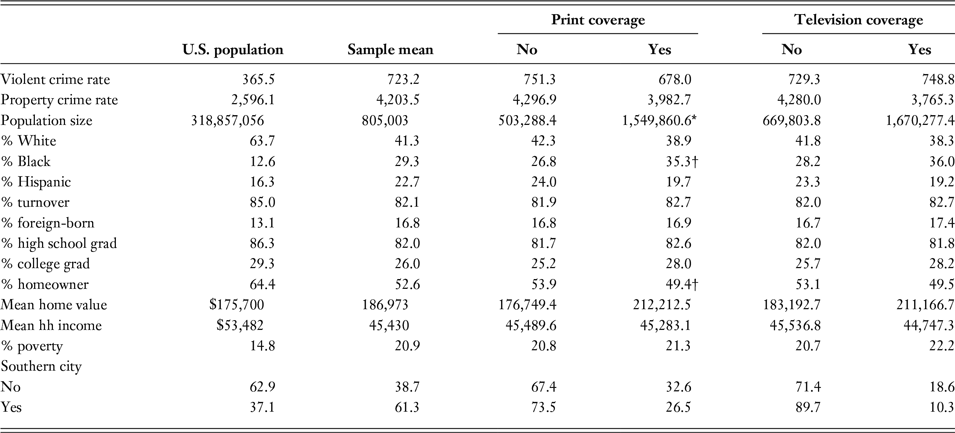
The first two columns of Table 1 present univariate statistics describing the average social structural context where police killing unarmed Blacks occurs; the U.S. average is presented for comparison. Against the national benchmark, the case locations experience more crime, have populations that over-represent Blacks and Hispanics, and have lower socioeconomic status. This concurs with previous research describing the contexts where police use of force typically occurs (Terrill and Reisig, Reference Terrill and Reisig2003), and further bolsters confidence in the validity of this study’s data.
Social Structural Context Univariates and Bivariates

Note: U.S. population data is from the Census Bureau (2015). Significant differences between continuous independent variables are determined by t-tests; significant differences between categorical independent variables are determined by chi-square tests.
***p ≤ 0.001, **p ≤ 0.01, *p ≤ 0.05, †p ≤ 0.10.
The remaining columns examine the bivariate relationships between the contextual variables and 0–1 indicators of receiving national print newspaper and network television coverage. The third and fourth columns show that cases receiving newspaper coverage occurred in locations with a significantly larger overall population, had a larger percentage of residents who are Black (marginally significant), and had a smaller percentage of residents living in owner-occupied housing units (marginally significant). The fifth and sixth columns show that none of the contextual variables are significantly associated with receiving television coverage.
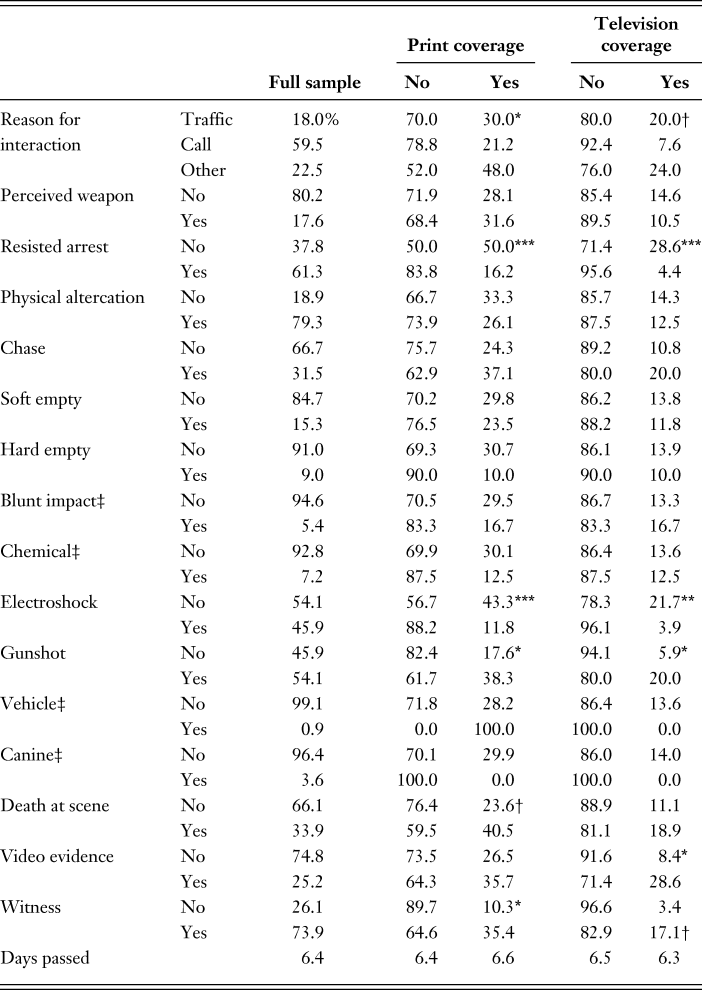
Table 2 presents the univariate statistics describing the event characteristics. More than half of cases were initiated by a call to the police, and they frequently involved resisting arrest and physical altercations. Decedents led police on a chase in about one-third of cases. Almost half of decedents were injured by electroshock weapons, and more than half suffered gunshot wounds; approximately one-third died at the scene of the encounter. One-quarter of cases involved video evidence, and three-quarters involved eyewitnesses. Soberingly, an unarmed Black person was killed by police once every six days, on average.
Event Characteristics Univariates and Bivariates

Note: Significant differences between continuous independent variables are determined by t-tests; significant differences between categorical independent variables are determined by chi-square tests. ‡ indicates variables with an events per variable count ≤ 10.
*** p ≤ 0.001, **p ≤ 0.01, *p ≤ 0.05, †p ≤ 0.10.
The second and third columns show that cases receiving national print newspaper coverage were significantly more likely to involve gunshot injuries, to have eyewitnesses present, or to involve death at the scene (marginally significant). Cases receiving newspaper coverage were significantly less likely to be initiated by traffic stops or calls to the police, to involve resisting arrest, or to involve electroshock injuries. The fourth and fifth columns show that cases receiving national network television coverage were significantly more likely to include gunshot injuries, video evidence, or to have eyewitnesses present (marginally significant). Cases receiving television coverage were significantly less likely to be initiated by calls to the police (marginally significant), to involve resisting arrest, or to include electroshock injuries.
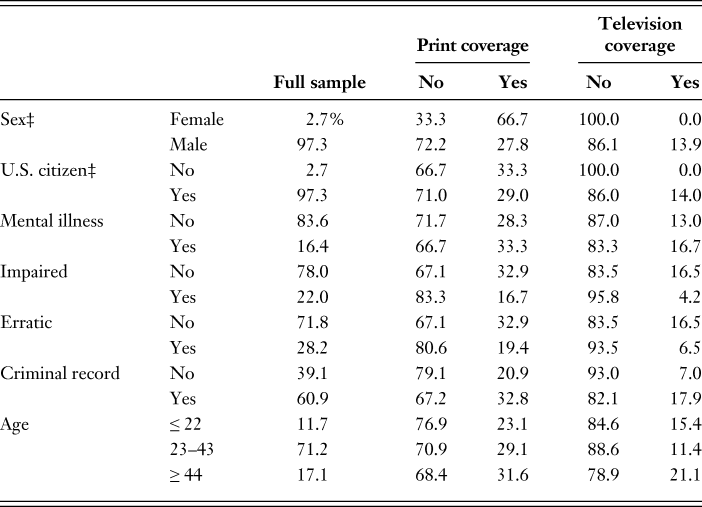
Table 3 shows the univariate statistics for the decedent traits. Cases involving female or non-citizen decedents were rare. Less than 20% of decedents suffered from mental illness. About one-fifth were impaired by drugs or alcohol during their encounter with police, more than one-quarter acted erratically during the encounter, and more than half had a previous criminal record. Almost three-quarters of decedents were between 23–43 years of age. Turning to the bivariate relationships, columns 2–5 show that none of the decedent traits are significantly associated with receiving national print newspaper or network television coverage.
Decedent Traits Univariates and Bivariates

Note: Significant differences between continuous independent variables are determined by t-tests; significant differences between categorical independent variables are determined by chi-square tests. ‡ indicates variables with an events per variable count ≤ 10.
***p ≤ 0.001, **p ≤ 0.01, *p ≤ 0.05, †p ≤ 0.10.
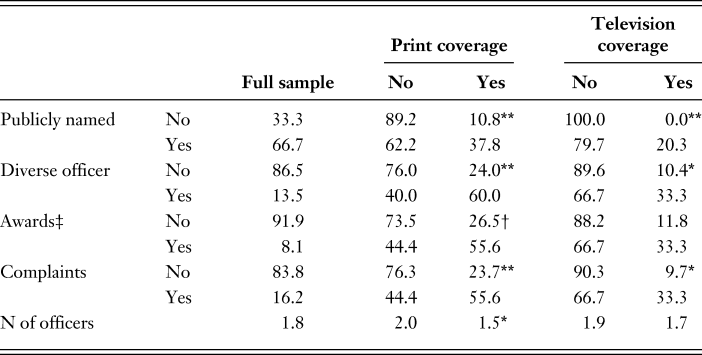
Table 4 displays the univariate statistics for the officer traits. Officers’ names were publicly released in two-thirds of cases. Approximately 14% involved a non-White or female officer, less than 10% involved an officer with previous awards, and approximately 16% involved an officer with previous complaints. On average, cases involved two officers.
Officer Traits Univariates and Bivariates

Note: Significant differences between continuous independent variables are determined by t-tests; significant differences between categorical independent variables are determined by chi-square tests. ‡ indicates variables with an events per variable count ≤ 10.
***p ≤ 0.001, **p ≤ 0.01, *p ≤ 0.05, †p ≤ 0.10.
The second and third columns show that cases receiving national print newspaper coverage were significantly more likely to involve officers who were publicly named, who were non-White or female, or who have previous complaints or awards (marginally significant).Footnote 15 The fourth and fifth columns show that cases receiving television coverage were significantly more likely to involve officers who are non-White or female, or to include officers who have previously received complaints. Moreover, public disclosure of officers’ names is a necessary condition for receiving television coverage.
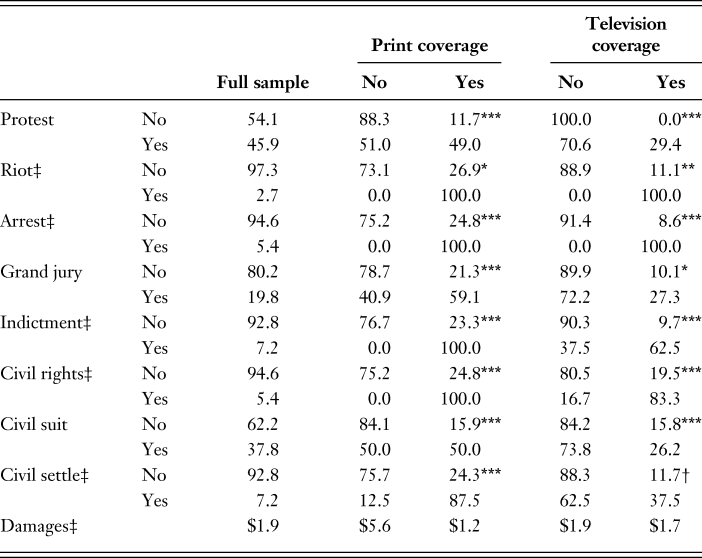
Table 5 displays the univariate statistics for the flywheels. Almost half of the cases generated peaceful demonstrations, while violent demonstrations and the arrest of protesters were rare. Grand juries were convened in one-fifth of cases, but criminal indictments were rare. Civil rights investigations were seldom initiated. Civil suits were initiated in over one-third of cases; damages were awarded in a small number of cases (7), amounting to $1.9 million, on average.
Flywheel Characteristics Univariates and Bivaraiates

Note: Significant differences between continuous independent variables are determined by t-tests; significant differences between categorical independent variables are determined by chi-square tests. ‡ indicates variables with an events per variable count ≤ 10. Damages are in millions of dollars.
*** p ≤ 0.001, **p ≤ 0.01, *p ≤ 0.05, †p ≤ 0.10.
The second and third columns show that cases receiving national print newspaper coverage were significantly more likely to generate peaceful demonstrations, grand jury hearings, civil lawsuits, or civil settlements. Moreover, generating violent demonstrations, the arrest of protesters, criminal indictments, or civil rights investigations are sufficient conditions for receiving newspaper coverage. The fourth and fifth columns show that cases receiving national network television coverage were significantly more likely to generate grand jury hearings, criminal indictments, civil rights investigations, civil lawsuits, or civil settlements (marginally significant). Generating violent demonstrations or the arrest of protesters are sufficient conditions for receiving television coverage; moreover, peaceful demonstrations are a necessary condition for television newsworthiness.
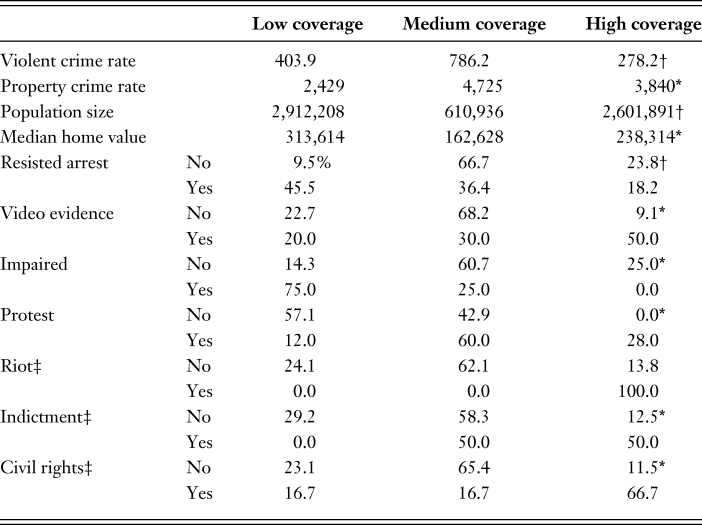
Thus far, we have explored whether or not a case received any national print newspaper or network television coverage; the next step is to explore how much coverage cases receive. Recall that the continuous amount of news coverage variable was recoded into three categories to achieve a normal distribution: 1) low coverage (1 story), 2) moderate coverage (2–26 stories), and 3) high coverage (≥ 27 stories).
Table 6 presents selected findings from the bivariate analyses. Four contextual characteristics are significantly associated with the amount of news coverage a case receives. Mounded distributions characterize the relationships between the amount of coverage and a context’s property crime rate and violent crime rate (marginally significant), and u-shaped distributions characterize the relationships between the amount of coverage and a context’s median home value and population size (marginally significant). Two event characteristics are significantly related with a case’s amount of coverage. There is a significant positive relationship between the presence of video evidence and the amount of coverage received; whereas 9% of cases without video evidence received high coverage, 50% of cases with video evidence achieved the same level. There is a marginally significant negative relationship between resisting arrest and amount of coverage; whereas 24% of those not resisting arrest received high coverage, only 18% of resisters received the same. Turning to the decedent traits, there is a significant negative relationship between a case’s amount of coverage and the involvement of an impaired decedent; whereas no impaired decedents received high coverage, one-quarter of sober decedents did. No officer traits are significantly associated with a case’s amount of news coverage. Finally, four flywheels are significantly associated with amount of news coverage. A mounded distribution characterizes the relationship between the presence of protests and the amount of coverage received. Importantly, Table 6 shows that peaceful demonstrations are a necessary condition for receiving high amounts of coverage. Generating violent demonstrations is a sufficient condition for receiving high amounts of coverage. Prompting a criminal indictment is a sufficient condition for receiving moderate or high amounts of coverage. Cases sparking civil rights investigations typically generate high amounts of coverage.
Selected Amount of Coverage Univariates and Bivariates

Note: Low coverage = 1 story, Medium coverage = 2–26 stories, High coverage = 27–1,465 stories. Significant differences between continuous independent variables are determined by t-tests; significant differences between categorical independent variables are determined by chi-square tests. ‡ indicates variables with an events per variable count ≤ 10.
***p ≤ 0.001, **p ≤ 0.01, *p ≤ 0.05, †p ≤ 0.10.
Multivariate Analyses
In analyses not shown here, I conducted a group-by-group analysis where each variable with a significant bivariate association with newsworthiness was entered into a multivariate model with other variables from its group. This revealed which variables were significantly associated with newsworthiness when controlling for related factors.Footnote 16 The process identified four sets of variables: 1) percent Black represents the social structural context, 2) encounters initiated by calls to police, or involving resisting arrest, electroshock injuries, or video evidence represent the event characteristics, 3) being impaired by drugs or alcohol represents the decedent traits, and 4) the occurrence of peaceful protests or filing civil lawsuits represent the flywheels.
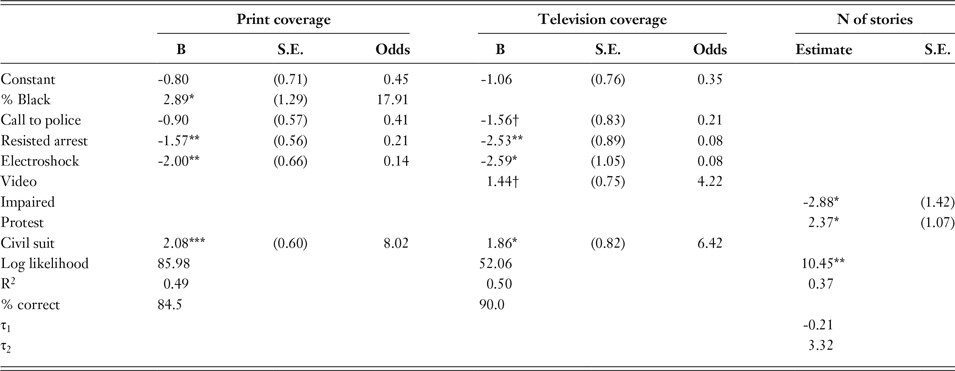
The first model in Table 7 predicts whether a case received any national print newspaper coverage. The model performs quite well, with an R2 of 0.49 and 85% correct classification score. Considering the social structural context, percent Black has a significant positive relationship with receiving newspaper coverage; for each one-unit increase in the share of the Black population, the odds of a case receiving newspaper coverage increase eighteen times. Turning to the event characteristics, there is a significant negative relationship between resisting arrest and national newsworthiness; such cases were five times less likely to receive newspaper coverage. There is also a significant negative relationship between electroshock injuries and newsworthiness; these cases were seven times less likely to receive newspaper coverage. Finally, considering the flywheel variables, the presence of civil suits has a significant positive relationship with national newsworthiness; these cases were eight times more likely to receive newspaper coverage.
Integrated Model Regressions

Note: The print and television coverage models are binomial logistic regressions with Nagelkerke R2, while the stories rank model is an ordinal logistic regression with Nagelkerke R2. ***p ≤ 0.001, **p ≤ 0.01, *p ≤ 0.05, †p ≤ 0.10.
The next model predicts whether a case received any national network television news coverage. The model performs quite well, with an R2 of 0.50 and 90% correct classification score. Considering the event characteristics, there is a marginally significant negative relationship between encounters that were initiated by a call to police and national newsworthiness; such cases were five times less likely to receive television coverage. As in the newspaper models, there are significant negative relationships between resisting arrest or electroshock injuries and newsworthiness; such cases were thirteen times less likely to receive television coverage. The presence of video evidence has a marginally significant positive relationship with national newsworthiness; these cases were four times more likely to receive television coverage. Turning to the flywheels, the presence of a civil suit has a significant positive relationship with national newsworthiness; these were six times more likely to receive television coverage.
The final model predicts the amount of national print newspaper and network television coverage that a case received. The model performed well, with an R2 of 0.37. Considering the decedent traits, there is a significant negative relationship between the involvement of a decedent impaired by drugs or alcohol and the amount of national news coverage received. Regarding the flywheels, the presence of peaceful protests has a significant positive relationship with a case’s amount of news coverage.
DISCUSSION
This study investigated the characteristics of cases of police killing unarmed Blacks that receive national news coverage. To do so, it used an original quantitative dataset mapping the social structural context, event characteristics, decedent traits, officer traits, and flywheels associated with 111 cases occurring between 2013–2015, and the amount of coverage these cases received in three national print newspapers and three network television newscasts.
Considering the sociodemographic context where cases occur, there is a significant positive relationship between share of the Black population and receiving national print newspaper coverage. Blacks generally express a high degree of linked fate, meaning that they perceive the struggles and victories of other Blacks as shaping their own lives (Dawson Reference Dawson1995). Therefore, as the size of the Black population increases, so does the number of people potentially affected by a case; this has implications for substantive considerations about a case’s importance. Beyond this direct effect, the size of the Black population might also have an indirect effect on newsworthiness. Given high levels of shared fate, locations with a larger Black population might be more likely to generate flywheels. Indeed, I find that cases generating protests occurred in contexts where Blacks constitute about one-third of the population; in contrast, cases without protests occurred in contexts where Blacks constitute about one-quarter of the population. This marginally significant difference (p ≤ 0.55) suggests that there is a positive relationship between the size of the Black population and collective action, which itself has an independent positive relationship with newsworthiness.
Four event characteristics are associated with national newsworthiness. First, there is a marginally significant negative relationship between a case being initiated by a call to police and receiving television coverage; such cases were five times less likely to receive coverage. Second, there is a significant negative relationship between a decedent resisting arrest and receiving newspaper or television coverage; these cases were seven and thirteen times less likely to gain coverage, respectively. These findings might be grounded in substantive considerations about a case’s importance, specifically, the degree to which a case aligns with an injustice frame. Given that society grants police the power to use lethal force when necessary, cases where police presence is requested might fall outside of an injustice frame. Similarly, decedents who resist arrest might be viewed as culpable in their deaths, and thus incompatible with an injustice frame. Furthermore, resisting arrest is common, occurring in 62% of cases; thus, these cases might be seen as ordinary, violating product considerations about novelty. Third, there is a significant negative relationship between the presence of electroshock injuries and receiving newspaper or television coverage; such cases were seven and thirteen times less likely to gain coverage, respectively. Electroshock injuries are common, occurring in 46% of cases; thus, these cases might be seen as typical, violating product considerations about novelty. Moreover, given some coroners’ reluctance to classify electroshock injuries as a cause of death, such injuries are particularly difficult to report with clarity and parsimony, violating product considerations about story quality. Fourth, there is a marginally significant positive relationship between the presence of video evidence and receiving television coverage; these cases were four times more likely to attain coverage. Given television’s product considerations as a visual medium, it is unsurprising that that the presence of video evidence enhances newsworthiness within this sector.
Turning to the decedent traits, there is a significant negative relationship between being impaired by drugs or alcohol and the amount of national news stories generated. Impaired decedents might be viewed as culpable in their own deaths and thus incompatible with an injustice frame, rendering these cases substantively unimportant.
Given the ambiguity about the validity and temporal ordering of the officer trait variables, they were not included in the multivariate models. At the bivariate level, four officer traits are associated with national newsworthiness. First, cases where officers are publicly identified are significantly more likely to receive newspaper coverage, and officer identification is a necessary condition for receiving television coverage. These findings might be grounded in source availability considerations. Specifically, releasing an officer’s name might be a proxy for the amount of information that the police make available to journalists; as information from the police increases, so does story availability. Second, cases involving non-White or female officers are significantly more likely to receive newspaper coverage. Given that diverse officers are relatively rare, occurring in 13% of cases, this finding is likely grounded in product considerations about novelty. Third, officers who previously received awards were more likely to receive newspaper coverage (marginally significant). Such officers were rare, perhaps shaping novelty concerns. Finally, officers who were the target of previous complaints were significantly more likely to receive newspaper and television coverage. The existence of previous complaints might signal the appropriateness of an injustice frame, thus enhancing a case’s substantive importance. Again, these results should be treated with particular caution, because data about the officers involved in a case is incomplete, and it is unclear whether the availability of this information is a cause or a consequence of a case’s newsworthiness.
In the multivariate models, two flywheels are associated with national newsworthiness. First, the presence of protests is a necessary, but not sufficient, condition for television coverage, and there is a significant positive relationship between the presence of protests and the amount of coverage received. Second, there are significant positive relationships between presence of a civil suit and receiving newspaper or television coverage; such cases were eight and six times more likely to receive coverage, respectively. These flywheels might affect source availability considerations, because each of these events introduces a new cast of characters who can supply journalists with information. They might also affect substantive considerations about a case’s importance. Protests and civil suits arise due to perceived injustice; therefore, these events facilitate a case’s fit within an injustice frame. These events might also affect product considerations about story quality by providing action and excitement. However, these results should be treated with caution, because it is unclear when flywheels promote newsworthiness and when newsworthiness promotes flywheels.
Other flywheels, such as criminal indictments and civil rights investigations, were not included in the multivariate analyses due to their statistical rarity. Cases involving these events are likely to be newsworthy due to the factors outlined above. Furthermore, these events are rare, influencing product considerations about novelty. Note, however, that flywheels are no guarantee of receiving news coverage. For example, Kaldrick Donald’s mother called police to her home to help administer medication for Donald’s mental illness; a scuffle ensued, resulting in Donald suffering electroshock and gunshot wounds. Despite protests, a grand jury hearing, and a civil lawsuit, his death did not receive national news coverage.
CONCLUSION
By mapping the characteristics of cases of police killing unarmed Blacks, this paper contributes to our limited knowledge about police use of force. Although this study’s data do not constitute a census of these events, they are robust, providing valuable insight into this aspect of police use of force. The data show that U.S. police kill an unarmed Black person about every six days. These cases occur in locations that experience more crime, have a larger non-White population, and have a lower socioeconomic status than the national average. The majority of cases begin with a call to police, proceed to physical altercations, and end with gunfire. The majority of decedents are men aged 23–43 who have a previous criminal record; at least 16% of decedents suffered from mental illness. Almost half of cases generate protests, but only one-fifth lead to grand jury hearings; about 7% result in officers being charged with a crime.
This paper further charts the characteristics of cases of police killing unarmed Blacks that receive national news coverage. Taken together, the most newsworthy cases are those that occur in locations where Blacks occupy a relatively large share of the population, where the precipitating event is documented by video evidence, and where subsequent events include protests and civil suits. In contrast, the least newsworthy cases are those where the precipitating event was initiated by a call to police, involved resisting arrest or electroshock injuries, and where the decedent was impaired by drugs or alcohol. Given that the previous literature on the newsworthiness of criminal justice events has devoted far more attention to the activities of criminals than police, this paper provides an important contribution.
Moreover, by highlighting the types of stories on the national news agenda, this paper has sketched the parameters of our national conversation about these cases. It is clear that our conversation foregrounds cases fitting within an injustice frame, while neglecting those that do not. This raises a philosophical question: is it possible that each and every instance of police killing an unarmed person is an injustice? There is no litmus test to distinguish between appropriate and excessive uses of force. Carl Klockars (Reference Klockars, Geller and Toch1996) defines excessive force as “the use of more force than a highly skilled police officer would find necessary to use in that particular situation” (p. 8). Jerome Skolnick and James Fyfe (1993) further distinguish between unnecessary force, which arises from ineptitude and may be a good-faith mistake, and brutality, which is a conscious and corrupt act. We might debate whether a highly-skilled officer would ever need to kill an unarmed person. But we do not, because we focus on the cases that are obviously sympathetic, while ignoring those that have unsavory elements. By limiting our discussion to a select few cases, we repeatedly miss out on opportunities to discuss important issues surrounding race relations, police tactics, and court functioning.
This paper also highlights several promising avenues for future research. This study is limited in that it focuses on a narrow, but substantively important aspect of police use of force: killings of unarmed Blacks. Future research should turn its attention to the newsworthiness of non-lethal uses of police force, as well as lethal uses of force against targets beyond unarmed Blacks. In addition, this study neglects potential mediators of national newsworthiness, such as the factors that compel police departments to release or withhold information (Chermak Reference Chermak1995; Lawrence Reference Lawrence2000), editorial conferences among journalists (Clayman and Reisner, Reference Clayman and Reisner1998), the local newsworthiness of cases, social media activity surrounding a case, and the presence of competing events on the national agenda. Future scholars should probe these areas as they relate to criminal justice newsworthiness. The current study is also limited in that it focuses on a narrow time frame, 2013–2015, a period coinciding with the tenure of the nation’s first Black president and widespread use of social media platforms. Future studies should broaden the time-span examined in order to determine the generalizability of this paper’s findings.
Finally, this paper calls attention to several practices that U.S. society might undertake. First, the lack of publicly available, conclusive data creates an informational constraint on problematizing police use of excessive force (Lawrence Reference Lawrence2000). Indeed, without an accurate census of these events, this paper is unable to definitively map the characteristics of all cases, nor is it able to test causal arguments about why some rise to the top of the national agenda. We are in dire need of a nationally institutionalized method for systematically tracking police use of force; such data must include standardized and detailed information about the event and the actors involved. Recall that the situational components described in this paper were collected by rigorously analyzing local and national news reports, thus the data are prone to false negatives, and must be treated as a conservative estimate.
Second, some may find it troubling that cases involving the use of electroshock weapons are missing from the national conversation; this is perhaps one of the most important findings of this paper. In addressing police shootings, a common refrain is “the officers should have used non-lethal force,” often mixed with a specific call for electroshock weapons. This paper sheds light on an underappreciated social problem: deaths by electroshock injuries. Although these cases are difficult to report with clarity and parsimony, they are highly important, given the ubiquity of electroshock weapons among police officers and concerns that an ostensibly non-lethal weapon may not be as safe as its advocates claim.
Third, in the interest of public information and police accountability, this research indicates that police use of body and dashboard cameras should be increased. Video evidence is available in approximately one-quarter of cases, and its presence makes a case four times more likely to receive television news coverage. Society might hope that the 77% of Americans who own a smartphone (Pew Research Center 2017) will turn on their cameras when they witness police use of force, as onlookers did while Staten Island police choked Eric Garner to death. We might further hope that these citizen journalists will take the initiative to use social media to publicize the cases that journalists dismiss. Undoubtedly, social media efforts, such as #BlackLivesMatter, have both publicized cases that have been ignored and forced journalists to reevaluate their newsworthiness judgments in a way that is particular to the current historical moment. But, resting the burden of documenting and publicizing these events on citizens seems misplaced, and potentially dangerous, making them vulnerable to police retaliation. Given the outsized influence that police have as a journalistic source, their resistance to body cameras, demonstrated in cities such as Boston and Miami, is particularly worrisome for observers who believe that police use of force is a newsworthy class of events.
ACKNOWLEDGMENT
The author thanks Alexis Beamon, Cody Hawkins, Kellyann Hayes, and Jared Henderson for their research assistance, and the anonymous reviewers for their helpful feedback.