Introduction
Low birth weight (LBW), a term referring to births weighing less than 2500 g, has been a major concern for public health policy since there is an extensive body of research showing strong links with perinatal, neonatal and post-neonatal mortality in addition to morbidity in infancy, childhood and adulthood (Wilcox & Russel, Reference Wilcox and Russell1983; McCormick, Reference McCormick1985; Kramer, Reference Kramer1987, Reference Kramer1990; Barker, Reference Barker1998; Huxley et al., Reference Huxley, Shiell and Law2000; WHO, 2004). According to the World Health Organization (WHO, 2004), LBW prevalence has been estimated at around 15.5% worldwide, but it is substantially higher in developing countries. Nevertheless, it is an important issue in developed countries too, since a high proportion of infant deaths are related to LBW, and sustaining such infants in life and keeping them healthy in the long-term poses a substantial financial burden on the health sector (Frisbie et al., Reference Frisbie, Forbes and Pullum1996; Speer & Gahr, Reference Speer and Gahr2001; Reime et al., Reference Reime, Ratner, Tomaselli-Reime, Kelly, Schuecking and Wenzlaff2006).
Though there are numerous studies dealing with factors associated with LBW in general, it has been recognized since the 1970s that a significant correlate is gestational age; births occurring before the 37th week of gestation, termed preterm, have a higher chance of being LBW than births occurring later (at full term). Low birth weight preterm babies in particular represent the most compromised pregnancy outcome facing the highest mortality risks, especially if birth weight is very low (VLBW, i.e. below 1500 g) or extremely low (below 1000 g). Low birth weight babies born later than the 36th week, on the other hand, are termed ‘intrauterine growth retarded’ or ‘restricted’ (IUGR), a condition attributable to a slower rate of fetal growth. There is ample evidence indicating different risks of mortality and morbidity for these two groups of LBW babies, in addition to different aetiology; hence, a vast amount of research has been carried out considering these adverse pregnancy outcomes separately (Kramer, Reference Kramer1987, Reference Kramer1990, Reference Kramer2003; Kramer et al., Reference Kramer, Séguin, Lydon and Goulet2000; Meggiolaro, Reference Meggiolaro2009; Tsimbos & Verropoulou, Reference Tsimbos and Verropoulou2011). Moreover, studies dealing with the birth weight distribution itself suggest that apart from the predominant distribution, which corresponds mainly to full-term babies, there is a residual one that includes preterm births of low birth weight; these two components of the birth weight distribution are independent of each other and levels of infant mortality are dependent mainly on the second component (Wilcox & Russell, Reference Wilcox and Russell1983; Umbach & Wilcox, Reference Umbach and Wilcox1996; Wilcox, Reference Wilcox2001).
There are several characteristics of the baby and of the mother that constitute ‘risk’ factors of a LBW or preterm birth. A number of studies indicate that female babies are lighter than male infants and the same holds for first births compared with births of higher order; multiple births also tend to be LBW (Mohsin et al., Reference Mohsin, Wong, Bauman and Bai2003; Meggiolaro, Reference Meggiolaro2009). Regarding maternal characteristics, teenage mothers and those aged 35 or more have higher chances of giving birth to a LBW baby (Astolfi & Zonta, Reference Astolfi and Zonta1999; Machado, Reference Machado2006). Certain genetic conditions of the mother seem to contribute to a higher incidence of IUGR while prior preterm deliveries and infections during pregnancy seem to predispose to preterm births (Kramer, Reference Kramer1987, Reference Kramer2003; Adams et al., Reference Adams, Elam-Evans, Wilson and Gilbertz2000). Maternal lifestyle during pregnancy is an important factor; unhealthy habits such as excessive alcohol consumption, smoking, drug abuse and poor nutritional intake have been linked to adverse pregnancy outcomes (Rodriguez et al., Reference Rodriguez, Regidor and Gutierrez-Fisac1995; Windham et al., Reference Windham, Hopkins, Fenster and Swan2000; Kesmodel et al., Reference Kesmodel, Wisborg, Olsen, Henriksen and Secher2002). Socioeconomic status of the mother also plays a part, acting as mediator; material deprivation, lone motherhood, unemployment, low educational attainment and psychosocial stress seem to affect birth weight unfavourably (Parker et al., Reference Parker, Schoendorf and Kiely1994; Rodriguez et al., Reference Rodriguez, Regidor and Gutierrez-Fisac1995; Pattenden et al., Reference Pattenden, Dolk and Vrijheid1999; Cheung & Yip, Reference Cheung and Yip2001; Mulder et al., Reference Mulder, Robles de Medina, Huizink, Van de Bergh, Buitelaar and Visser2002; Reime et al., Reference Reime, Ratner, Tomaselli-Reime, Kelly, Schuecking and Wenzlaff2006; Meggiolaro, Reference Meggiolaro2009). Finally, environmental pollution seems to have a negative association (Bobak, Reference Bobak2000; Lee et al., Reference Lee, Ha, Park, Kim, Hong, Kim and Lee2003; Štrám et al., Reference Štrám, Binková, Dejmek and Bobak2005).
Research attempting to quantify the effects of these factors on the birth weight distribution is usually based on two approaches: either ordinary least squares (OLS) regression models are employed or adverse outcomes are considered in comparison to normal-weight births occurring at term in logistic or multinomial logistic regression context (Abrevaya, Reference Abrevaya2001). The first approach, OLS regression, has the disadvantage that effects are estimated on the mean of the birth weight distribution while, in the second case, the outcome variable is categorical and information related to the rest of the distribution is lost. Some recent analysis, however, has been based on a different approach that allows for the effects of the various factors to differentiate across the quantiles of the birth weight distribution (Abrevaya, Reference Abrevaya2001; Koenker & Hallock, Reference Koenker and Hallock2001). Nevertheless, such analysis is scarce and does not make any distinction for gestational age. It is in that aspect of the birth weight analysis that this paper attempts to fill in a gap, quantifying effects of factors associated with adverse pregnancy outcomes by applying for the first time quantile regression techniques to preterm and term deliveries separately as they exhibit distinct birth weight distributions and are related to different risk factors.
Methods
Data
This study makes use of information collected by the vital registration system of Greece. The analysis is based on nationwide micro-data on the live births recorded in 2006. The material used has been kindly provided upon request to the authors by the Hellenic Statistical Authority (ELSTAT). For each birth there is information on the parental characteristics and the birth outcome. With respect to the mother, the data refer to age at birth, place of usual residence, marital status, educational attainment and citizenship. Concerning the newborn, the data refer to the date of birth, sex of the baby and birth weight (in grams). There is also information on single and multiple deliveries, numbers of reported prior stillbirths and deceased children, gestational period (in weeks) and parity (birth order).
In 2006 a total of 112,042 live births were recorded. Births occurring to non-residents of the country (0.4% of the total) are not considered as they are extraneous to the scope of the study. Multiple births (4.5% of the total) have also been excluded since birth weight of these infants is considerably lower than that of singletons (Joseph et al., Reference Joseph, Kramer, Marcoux, Ohlsson, Wen and Allen1998; Moshin et al., Reference Mohsin, Wong, Bauman and Bai2003). Finally, as maternal socioeconomic status, represented here by education, constitutes an important element of the study, births to women under the age of 20 (3% of the total) have been disregarded; this cut-off point has been used in other similar research (National Center for Health Statistics, 2005; Acevedo-Garcia et al., Reference Acevedo-Garcia, Soobader and Berkman2007). Thus, the analysis focuses on 103,266 records of single live births to women aged 20 or higher living in Greece. Birth registration in Greece is complete and since effectively all births (99.9%) occur in maternity wards and hospitals the information collected is considered reliable.
Measures
In the analysis the response variable is birth weight measured in grams; all the predictors are indicators introduced in binary form. Female births (=1) are compared with male births (=0), parity distinguishes between first births (=1) and birth order 2 or higher (=0) while illegitimate (extramarital) births (=1) are contrasted with legitimate births (=0). Regarding maternal age, women are categorized into two broad age groups; women aged 35 or higher (=1) are compared with those under age 35 (=0). A dichotomous variable is introduced as a proxy for past adverse maternity and birth history, denoting whether a woman reported that she has had at least one prior stillbirth or deceased child (=1) or if she has had no such past experience (=0). Maternal socioeconomic status is represented by education; the dichotomous variable used denotes whether the mother has obtained tertiary educational qualifications (=1) or not (=0). A dummy is also used indicating whether a woman lives in big metropolitan areas, Athens, the capital, or Salonica (=1), or if she lives in other less-urbanized areas (=0). Finally, an indicator of whether the mother is a Greek citizen (=1) or an immigrant (=0) is included in the models.
Models
To estimate the impact of maternal socio-demographic characteristics on birth weight distribution quantile regression has been used; estimates are compared with standard OLS regression coefficients. The conventional linear regression model has the form:
 $$y_i = x'_i \beta + u_i , (i = 1, 2, \ldots, n)$$
where yi is the response variable (birth weight of infants in grams), xi is the vector of all independent variables, β is the vector of parameters to be estimated and ui is the error term, which is assumed to be independently, identically and normally distributed with zero mean and constant variance. The regression coefficients estimated by the OLS model are constant across the distribution of birth weight (yi); this implies that the effects of the independent variables on the conditional mean of the dependent variable are the same for the entire distribution, which may range from extremely low (let us say about 500 g) to very high (over 5000 g) levels. However, there are reasons to believe that the factors' effects differ in magnitude and nature across the quantiles (or percentiles) of birth weight. In other words, it is likely that the OLS estimates do not portray adequately the impact of the regressors throughout the distribution of the response variable, particularly at the tails of it.
In an effort to further investigate the inter-relationships between birth weight and risk factors at different class levels of the response variable, the quantile regression technique is employed as it is more appropriate for dealing with such situations. Quantile regression was introduced by Koenker & Bassett (Reference Koenker and Bassett1978) and is considered an extension of the OLS technique, which estimates more general models for conditional quantile functions. Unlike the OLS, which is sensitive to the presence of outliers and inefficient when the dependent variable has a non-normal distribution, the quantile regression provides more robust estimates and captures unobserved heterogeneity (Dimelis & Louri, Reference Dimelis and Louri2002). The quantile regression model takes the form:
 $$\eqalign{y_i = x'_i \beta (q) + u_{qi} \cr = Q_q (y_i / x_i) + u_{qi} \ 0 < q < 1 (i = 1, 2, \ldots , n)}$$
where yi and xi are as previously defined, β(q) is the vector of parameters to be estimated for a given value of the birth weight distribution in quantile q(0,1), Qq(yi/xi) is the qth quantile conditional distribution of yi given the known values of the regressors and uqi is the error term with conditional mean equal to zero. The above model implies that the effects of covariates, represented by the coefficients β(q), may differ over quantiles so that the results can express more realistically the entire distribution of the dependent variable.
Estimation of the models
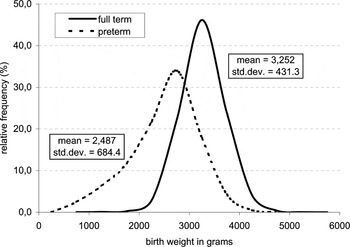
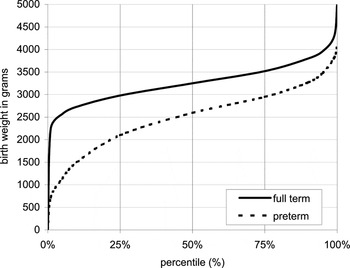
Quantile regression models were estimated separately for two subsets of the sample (preterm and term infants) on the basis that they constitute distinct birth weight distributions, independent of one another (Wilcox & Russell, Reference Wilcox and Russell1983; Umbach & Wilcox, Reference Umbach and Wilcox1996; Wilcox, Reference Wilcox2001). Preliminary analysis reveals that the distributions of these subsets differentiate significantly, as is denoted by the application of the two-sample Kolmogorov–Smirnov test (Z-statistic=38.47, p<0.001). The mean weight of term births (3251.8 g) is higher than that of preterm births (2486.8 g) by 765 g (Fig. 1) and the difference is statistically significant (t-statistic assuming unequal variances=82.9, p<0.001). The percentiles of the response variable also differ considerably between the two subgroups; this is apparent in Fig. 2, which depicts two inverted s-curves skewed at the tails (more intense at the low tail of the distributions) with the preterm curve being well below the corresponding full-term curve. Application of the Chow test (Chow, Reference Chow1960) further justifies separate analysis of these birth weight distributions. More specifically, the results of the test (Chow F-statistic=1775, F (0.01,9,103248)=2.41) imply that the impact of the assumed predictors on birth weight differentiate significantly in these subsets.
Empirical relative birth distribution: full-term and preterm births.

Percentiles of birth weight: full-term and preterm births.

Quantile regressions have been estimated at five different percentiles of the predominant distribution (0.10, 0.25, 0.50, 0.75 and 0.90). Further, hypothesis testing of equality of the regression coefficients between successive conditional quantiles and across quantiles has been conducted (Wald test). It is well known that departure from the homoskedasticity assumption causes problems in obtaining consistent standard errors of the parameters; hence, the variance–covariance matrix of the estimators has been obtained employing bootstrap methods (Buchinsky, Reference Buchinsky1995). Estimation has been implemented using Stata 10.1.
Results
Descriptive statistics
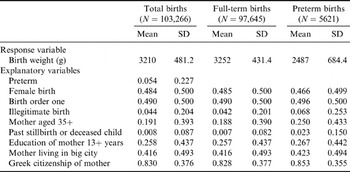
Descriptive statistics for the variables included in the analysis are presented in Table 1. Preterm births correspond to 5621 cases or 5.4% of the total, while full-term births correspond to the remaining 97,645 cases or 94.6%. As most births in the sample occurred at term the characteristics of these infants are virtually identical to those observed for the whole sample. Preterm births, on the other hand, tend to exhibit unfavourable traits more often. For the whole sample male newborns slightly exceed females while first births represent nearly half of the sample. The proportion of births occurring outside marriage in Greece is very low though it is slightly higher among preterm births. A higher proportion of mothers of preterm babies are aged 35 or higher, have past adverse maternity history and live in big metropolitan areas compared with mothers of term babies. Additionally, they are somewhat better educated, and include a higher percentage of Greek citizens.
Descriptive statistics of variables used in the analysis

Figure 2 shows the percentiles of the birth weight distribution for preterm and full-term births. The differences are quite substantial; for babies born at term, the lower 5% of the distribution corresponds to LBW births, the first quartile includes newborns weighing up to 2980 g while the median includes those weighing up to 3250 g. For preterm births, on the other hand, the first decile (10%) includes VLBW babies; the first quartile includes births up to 2100 g while the median corresponds to babies who are just above the LBW limit.
Quantile regression results
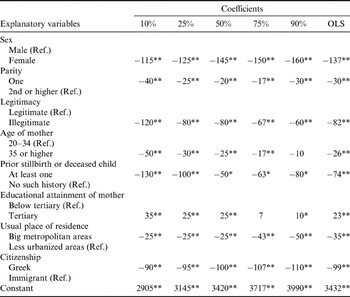
Table 2 shows the results of the quantile regression models for infants born at term. The last column of the table shows coefficients estimated using OLS regression. Apart from mother's citizenship, which seems to have a constant effect across the birth weight distribution, for all other predictors effects differentiate. For most variables, associations are more pronounced at the lower tail of the distribution; the only exceptions are sex of the baby and usual place of residence of the mother, for which the effect is greater at the upper tail. Associations for most predictors are significant at the 1% level. Females are born lighter than males; the difference is about 115 g at the 0.10 quantile, while it reaches 160 g at the 0.90 quantile. First-born children are lighter by about 40 g at the 0.10 quantile; the difference decreases to 17 g at the 0.75 quantile. Births occurring to mothers outside marriage are significantly lighter than those occurring within marriage; the difference ranges from 120 to 60 g. Age of mother over 35 has a negative, though rather small, association and the same holds for women living in big metropolitan areas. Prior history of stillbirths and infant deaths has a more substantial negative impact. Tertiary education, on the other hand, seems to have a protective effect, especially at the lower tail of the distribution. Greek mothers have on average lighter babies compared with immigrants by about 100 g.
Coefficients based on quantile regression (births occurring at the 37th week of gestation or later)

**p<0.01; *p<0.05.
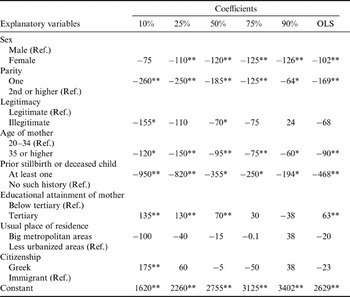
Table 3 shows results of the quantile regression models for preterm babies. Usual place of residence, extramarital status of a birth and citizenship of the mother are not significant predictors of birth weight in this instance. All other variables show significant associations that differentiate across the birth weight distribution; again, effects are greater in magnitude at the lower tail, the only exception being sex. Primiparity, female sex, age of mother over 35 and prior history of stillbirths and deceased children have negative associations with birth weight; the coefficients indicate, for all variables except sex, a greater impact among preterm than among term babies. Prior history of adverse pregnancy outcomes seems the most significant predictor and has a particularly pronounced effect at the lower tail of the distribution. For instance, at the 0.10 quantile, which corresponds to VLBW babies, newborns to mothers having past adverse maternity history weigh 950 g less than those born to mothers with no adverse history; the difference at the 0.25 quantile is 820 g and at the 0.50 quantile is still substantial, i.e. 355 g. Tertiary education has strong protective effects, increasing birth weight by 135 g at the 0.10 quantile and by 130 g at the 0.25 quantile. Nevertheless, it is non-significant for preterm babies above the median weight.
Coefficients based on quantile regression (preterm births occurring before the 37th week of gestation)

**p<0.01; *p<0.05.
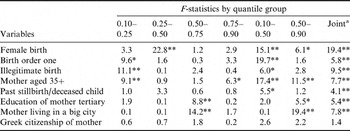
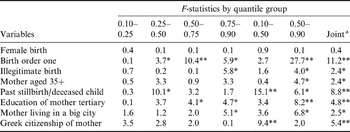
The results of the F-test examining coefficient equality for term and preterm births are presented in Tables 4 and 5, respectively. Although there are some statistically significant differences in the estimates between successive quantiles, the most important ones are observed, as expected, when considering the 0.10 to 0.50 and the 0.50 to 0.90 groups. The joint F-statistic, which tests equality across all five quantiles, indicates that coefficient differences are significant for nearly all variables, with the exception of citizenship of mother among term births and of sex among preterm births. The test also implies that differences are more pronounced below the median weight for term births and above the median weight for preterm births. Overall, these findings highlight the differential impact of most of the predictors across the birth weight distribution for both subsets.
Test of coefficient equality between quantiles: term births

a Tests equality of coefficients across the five quantiles.
**p<0.01; *p<0.05.
Test of coefficient equality between quantiles: preterm births

a Tests equality of coefficients across the five quantiles.
**p<0.01; *p<0.05.
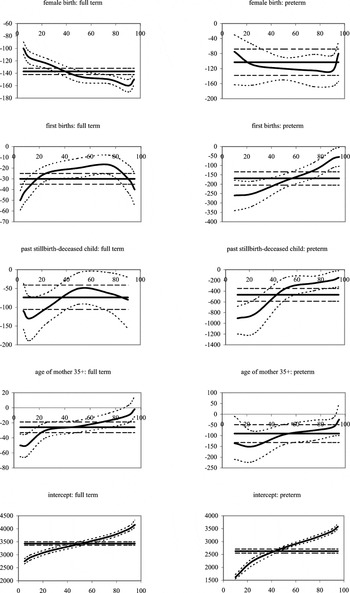
Comparing the coefficients obtained using quantile regression with those based on OLS, it seems likely that the latter approach does not adequately describe effects of the various factors on the birth weight distribution since, with only few exceptions, true effects vary. Ordinary least squares, in particular, tends to underestimate the effects at the lower tail, which, in this instance, represents VLBW and LBW babies. This is further explored in Fig. 3, which depicts the estimates of the intercept and of selected variables included in the models, i.e. sex of the child, birth order, past adverse maternity history and age of mother over 35, for preterm and term births separately. The bold curve in each graph represents the point estimates of the coefficients of the quantile regression for the different percentiles of the response variable, while the dotted lines around the curve denote the 95% confidence intervals of these estimates; the straight line represents the OLS coefficient while the dotted straight lines indicate the 95% confidence intervals around it. The graph of the intercept displays the estimated conditional quantile function of the birth weight distribution of a legitimate male baby of birth order 2 or higher, born to an immigrant woman aged below 35 who has at most completed upper secondary education, does not have any prior stillbirth or deceased child and does not live in a big metropolitan area. In most instances, quantile regression coefficients differentiate across the distribution and differ at most percentiles compared with the respective OLS estimate. Additionally, in nearly all the panels of the figure, the quantile estimates lie at some point outside the OLS confidence intervals indicating that the effects of these covariates may not be constant across the conditional distribution of birth weight (Koenker & Hallock, Reference Koenker and Hallock2001). This, however, does not hold for sex of the baby among preterm births; in this case the OLS coefficient may adequately portray the impact of the covariate on the dependent variable.
Quantile regression and OLS coefficients and confidence intervals for selected variables in the models.

Discussion
The present paper makes use of vital registration micro-data for the whole of Greece in 2006 and attempts to model effects of specific risk factors on the birth weight distribution of single live births, using quantile regression techniques. Analyses using this approach, which allows for the effects of covariates to vary across the conditional distribution of the response variable, are scarce. The very limited number of studies employing that method examine effects of covariates on the whole of the distribution, ignoring that it forms two distinct curves, one corresponding to term and one to preterm births, a fact confirmed in exploratory analysis of the Greek dataset, too. The present analysis contributes to these aspects, using a large nationwide dataset that includes information on both birth weight and gestational age. This is the first time that quantile regression techniques have been applied to Greek birth weight data.
Factors associated with birth weight: a comparison with other studies
The findings indicate that female sex of the baby, primiparity, illegitimacy status, age of the mother over 35, past history of stillbirths and deceased children, living in big metropolitan areas and being a Greek citizen are all factors that tend to reduce the birth weight of term babies, while education has a protective effect. Among preterm births, on the other hand, usual place of residence of the mother, citizenship and legitimacy are virtually not significant, while effects of parity, prior stillbirths and deceased children and education are more pronounced than among term infants. These findings are more or less in accordance with past research; the negative association of birth weight with female sex, primiparity and older age of mother is well established, while unfavourable socioeconomic conditions and stress are also known to play a part (Kramer, Reference Kramer1987; Kramer et al., Reference Kramer, Séguin, Lydon and Goulet2000; Reime et al., Reference Reime, Ratner, Tomaselli-Reime, Kelly, Schuecking and Wenzlaff2006; Meggiolaro, Reference Meggiolaro2009; Chiavarini et al., Reference Chiavarini, Bartolucci, Gili, Pieroni and Minelli2012). Living in a polluted environment also seems to have negative associations (Maisonet et al., Reference Maisonet, Correa, Misra and Jaakkola2004). Higher birth weight among infants of immigrant mothers has been observed before and may be linked to selectivity (healthy migrant theory) since most of these women arrived in Greece only recently (Kramer et al. Reference Kramer, Séguin, Lydon and Goulet2000; Wingate & Alexander, Reference Wingate and Alexander2006; Acevedo-Garcia et al., Reference Acevedo-Garcia, Soobader and Berkman2007).
The results are also quite consistent with past analyses carried out on the same dataset based on multinomial regression models, though as that method had a different focus compared with quantile regression a few minor dissimilarities were also observed (Tsimbos & Verropoulou, Reference Tsimbos and Verropoulou2011). For instance, illegitimacy status has been found in the past to be important for all categories of LBW births, while here it was not significant among preterm births. Nevertheless, associations in most instances persisted while the very pronounced effect of past adverse maternity history, especially among preterm births, was reconfirmed; this finding is also in accordance with other relevant research (Kramer, Reference Kramer1987; Reime et al., Reference Reime, Ratner, Tomaselli-Reime, Kelly, Schuecking and Wenzlaff2006). Finally, the results of the present study support the importance of the distinction according to gestational age, since term and preterm births form different distributions while being related to different risk factors.
Advantages of quantile regression over OLS
The analysis shows that the effects of most factors differentiate across the birth weight distribution, for both term and preterm births; this is also supported by the appropriate statistical test of coefficient equality across quantiles. Citizenship of the mother is the only factor among term births that has a fairly constant association and could be represented by an OLS coefficient; this holds also for sex among preterm infants for which the quantile regression point estimates lie within the OLS confidence interval. Nevertheless, these are the exceptions to the rule. In most instances the impact is greater at the lower tail of the distribution, which includes the most compromised birth outcomes; hence, OLS tends to underestimate effects among LBW and VLBW infants and to overestimate effects among heavier babies.
Other research carried out using quantile regression techniques, though not distinguishing births according to gestational age, is in accordance with the results of the present study, which indicate that educational attainment and legitimacy have a more pronounced protective effect among LBW babies, which decreases at the upper tail of the distribution; the opposite holds for sex, whose importance increases among heavier babies (Abrevaya, Reference Abrevaya2001). Hence, the OLS coefficients represent poorly effects of covariates on the birth weight distribution; modelling these effects requires the use of quantile regression.
Limitations of the study
Some limitations of the study should be mentioned. There are important factors omitted from the models due to the limited information available in the vital statistics. Such factors are those related to maternal lifestyle prior to and during pregnancy; for instance, there is no information on maternal BMI, nutritional intake and other health-related behaviour such as drug abuse, alcohol consumption or cigarette smoking. Additionally, there is no information on medical conditions that might have occurred before or during pregnancy and could have affected fetal development, or on antenatal care. Moreover, there is no direct information on past preterm births or on the psychological and material well-being of the mother during gestation; hence, proxies were used in the analysis.
Another point that should be mentioned concerns the differentiation of preterm births according to birth weight. Even though the present analysis distinguishes between term and preterm births, the latter category also includes normal-weight babies which, though preterm, seem to form a distinct group (Frisbie et al., Reference Frisbie, Forbes and Pullum1996; Tsimbos & Verropoulou, Reference Tsimbos and Verropoulou2011). More specifically, these babies face lower infant mortality risks than LBW preterm births but higher risks compared with normal-weight term babies; additionally, factors related to that condition differentiate. Distinction, however, was not possible in the present analysis due to the small numbers, which would not allow the application of quantile regression.
There is also the possibility of misclassification of a few births in the preterm/term categories due to incorrect assessment of gestational age. This information is derived from records of the pregnancy kept by the gynaecologist of each woman and is based on the date of her last menstrual period which, however, is not always reported correctly. Hence, there may be a few cases, around the cut-off point of 37 weeks, that have been misclassified. This is unlikely to have a large effect on the results, however, as it occurs randomly and not in a systematic way.
Finally, due to the cross-sectional nature of the data, careful interpretation of the results is needed whenever the issue of causality arises. For instance, information on the usual place of residence of the mother at the time of the birth does not necessarily mean that the woman lived for the duration of the pregnancy at that specific place.
Strengths and implications of the study
The present study is based on a large nationwide dataset, which allows the statistical analysis of small size subgroups and the application of multivariate techniques such as quantile regression. The statistical approach used supports the thesis that the effects of most socio-demographic factors differentiate across the birth weight distribution and OLS coefficients are a poor representation of these variations. The findings also provide a guide regarding specific factors that vary across the outcome distribution and indicate whether their impact is more pronounced at the lower or the upper tail.
The analysis identifies specific groups of women who face higher risks of an adverse pregnancy outcome and are in need of policy intervention and close monitoring. These are women who have had in the past a stillbirth or a deceased child, those aged 35 or higher, single women and those with few educational qualifications. For these women and, in particular, for the first two categories, provision of frequent antenatal care visits and close monitoring would improve the chances of a normal-weight term birth. Regarding single motherhood, it is rather infrequent in Greece and represents a not widely acceptable practice. It is a quite stressful event, usually combined with material deprivation and low socioeconomic status as state policies for single mothers are inadequate and social provision minimal. Hence, for single mothers additional psychosocial and material support may be needed to improve their chances of a successful pregnancy outcome. This is particularly important since single motherhood is on the increase.
Finally, in future research it would be of interest to combine births occurring over an extended period, thus increasing numbers, to be able to distinguish preterm babies into two sub-categories (LBW and normal weight) and to examine the most compromised birth outcome separately.