

Introduction
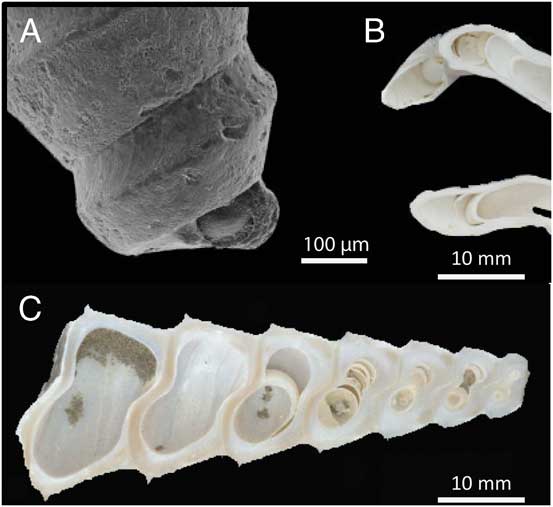
Although septa are frequently considered absent or rare in the shells of gastropods (Majewske Reference Majewske1974; Ray Reference Ray2008; Cook et al. Reference Cook, Jell, Webb, Johnson and Baarli2015), septation has long been noted in some groups, especially the family Turritellidae (Lyell Reference Lyell1838; Stimpson Reference Stimpson1851; Andrews Reference Andrews1971; Allmon Reference Allmon2011) and some Paleozoic forms (e.g., Euomphaloidea, Murchisonioidea, and Loxonematoidea) (Yochelson Reference Yochelson1971; Cook Reference Cook1993; Gubanov et al. Reference Gubanov, Peel and Pianovskaya1995; Wagner, Reference Wagner1999; Rohr and Blodgett Reference Rohr and Blodgett2016). Phylogenetic analysis by Wagner (Reference Wagner1999) even concluded septation to be primitive for gastropods. Yet the overall occurrence of septa in caenogastropods has never been systematically analyzed, even as molecular phylogenies of gastropod higher taxa have become available (Ponder et al. Reference Ponder, Colgan, Healy, Nutzel, Simone and Strong2008; Strong et al. Reference Strong, Colgan, Healy, Lydeard, Ponder and Glaubrecht2011). In this study, we consider a septum to be a continuous, nonpathological wall of shell material that completely closes off the adapical portion of the shell and leaves a void space sealed off from the body cavity (Fig. 1); this is in contrast to cephalopod septa, which are penetrated by a siphuncle (Yochelson Reference Yochelson1971; Gubanov et al. Reference Gubanov, Peel and Pianovskaya1995; Dauphin Reference Dauphin2006). We demonstrate that the phylogenetic distribution of septation in gastropods is quite broad, in both Recent and fossil taxa. Our analysis suggests that septa are either primitive for Caenogastropoda (which include 60% of living gastropod species; Ponder et al. Reference Ponder, Colgan, Healy, Nutzel, Simone and Strong2008) or evolved independently in many groups, with either possibility indicating that septa are not rare in gastropods.
Examples of septation in turritellids. A, A dome-shaped septum visible in the apex of Turritella altilira (Miocene). B, Multiple septa visible in a section of Vermicularia recta (Plio-Pleistocene). C, Extensive septation in T. abrupta (Miocene).

If one’s goal is to explain the origin of a particular feature of an organism, then adaptive, historical, and structural aspects all need to be considered (Seilacher Reference Seilacher1970; Gould Reference Gould2002). A variety of functional hypotheses for gastropod septa have been proposed, including: (1) response to excess calcium (Yochelson Reference Yochelson1971; Cook et al. Reference Cook, Jell, Webb, Johnson and Baarli2015); (2) prophylaxis against apical loss (and possible parasitic infestation; Andrews Reference Andrews1974; Dattilo et al. Reference Dattilo, Freeman, Peters, Heimbrock, Deline, Martin, Kallmeyer, Reeder and Argast2016); (3) protection from apex-damaging predation (Gubanov et al. Reference Gubanov, Peel and Pianovskaya1995); (4) repair after damage (proposed and rejected in Andrews [Reference Andrews1974]); or (5) strengthening of the shell (Yochelson Reference Yochelson1971; Gubanov et al. Reference Gubanov, Peel and Pianovskaya1995). Septation has also been noted to be associated with secondary shell thickening in Paleocene turritellids (Andrews Reference Andrews1971, Reference Andrews1974; Allmon Reference Allmon2005; Cook et al. Reference Cook, Jell, Webb, Johnson and Baarli2015). We expand on this observation to propose that these dome-like structures are not themselves adaptive, but rather are associated with adaptive shell thickening in turritellids, and are therefore constructional artifacts—“spandrels” (sensu Gould and Lewontin Reference Gould and Lewontin1979).
On the Definition of “Spandrels”
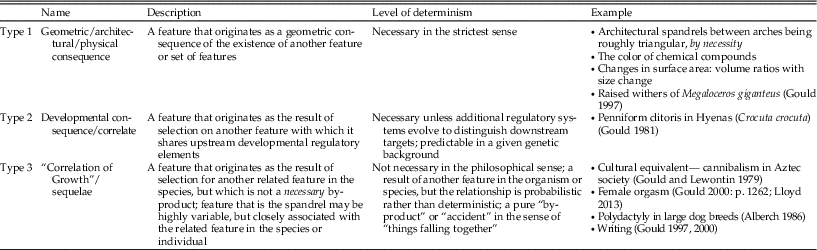
Use of the term “spandrel” in biology has been controversial (Houston Reference Houston1997; Pigliucci and Kaplan Reference Pigliucci and Kaplan2000); it has, however, achieved widespread use (Gould Reference Gould1997; Houston Reference Houston1997, Reference Houston2009; Lloyd Reference Lloyd2013) for “sequelae of adaptive decisions” (Gould Reference Gould2002: p. 1250), and we here refer to nonadaptive sequelae of adaptive features as spandrels, following Gould’s use (e.g., “Non-adaptive side consequences (‘spandrels’ in my terminology)” [2002: p. 513]). Spandrels (by-products) are epiphenomena of whatever is being selected for, and may themselves be adaptive, neutral, or maladaptive, but will persist as long as overall fitness is increased. If neutral (nonadaptive) features are effectively invisible to selection, they may persist for long periods (Gould Reference Gould2002: p. 1247). We choose this terminology in agreement with Gould (Reference Gould1997), who considered the term “spandrel” to be “the most obvious, the most useful, and the most historically sanctioned term available” for predictable forms that arise as consequences of other features, rather than as direct adaptations. The term is used herein in the broad sense to encompass three types of spandrels (delineated herein): (1) purely geometric consequences (Gould and Lewontin Reference Gould and Lewontin1979), sometimes considered spandrels sensu stricto (Houston Reference Houston2009); (2) coupled developmental consequences (Gould and Lewontin Reference Gould and Lewontin1979) (in which selection for one downstream target results in additional consequences that may be either selectively neutral or detrimental, so long as the primary target generates net positive fitness (e.g., Gould Reference Gould1981); and (3) any other by-products of features under selection, determinant or indeterminate (Gould and Lewontin Reference Gould and Lewontin1979; Gould Reference Gould1997; Table 1).
Classification of types of spandrels.

Type 1 spandrels are sometimes called “Gould-Lewontin spandrels” or “true spandrels” (Houston Reference Houston2009), but this is an incorrect attribution that results from taking the metaphor more literally than did the authors themselves. Gould and Lewontin (Reference Gould and Lewontin1979) explain that in architecture spandrels are tapering triangular spaces formed by the intersection of two rounded arches at right angles, and are necessary architectural by-products. The necessary aspects are the number (one between each arch, four when mounting a dome on four arches) and the shape (roughly triangular) (Gould Reference Gould2002: p. 1250). The analogy in Gould and Lewontin (Reference Gould and Lewontin1979) is that spandrels are by-products of selection for something else and that the form of this by-product is not itself selected—not that spandrels only refer to sequelae that are “necessary” in the ontological sense (contra Houston Reference Houston2009). Architectural spandrels are often exapted (Gould and Vrba Reference Gould and Vrba1982) for decoration. In their 1979 paper outlining the concept, Gould and Lewontin also draw an allusion to cannibalism in Aztec society—“a system developed for other reasons resulted in an increasing number of fresh bodies; use might as well be made of them” (emphasis added). Cannibalism, Gould and Lewontin argued, originated as a by-product (albeit a functional one), rather than a necessary and unavoidable consequence of hierarchical or militaristic society.
In a biological sense, when outlining nonadaptationist evolutionary research programs, Gould and Lewontin (Reference Gould and Lewontin1979) make explicit reference to the fact that the essential aspects of a biological spandrel are (1) there is no selection for the part directly, and (2) the “form of the part is a correlated consequence of selection directed elsewhere … Darwin ranked his ‘mysterious’ laws of the ‘correlation of growth’… Today pleiotropy, allometry, ‘material compensation’ (Rensch Reference Rensch1959)” (p. 591). Houston (Reference Houston2009) argues that by removing architectural necessity from the definition of a spandrel, it becomes redundant with the term “by-product.” Spandrels, however, are only used to refer to by-products of selection for some other feature, excluding features that originate as by-products of genetic drift, environmental limitations, and so on. Additionally, the term “spandrel” is reserved for forms that are in some sense predictable consequences (Gould Reference Gould1997). In any case, the term is meant primarily to clarify the importance of distinguishing historical origin from present utility, as well as providing a nonbiological metaphor for nonadaptive by-products of adaptive features (Gould Reference Gould1997).
It has sometimes been argued that such features are themselves adaptive, or are not strictly the only option, given a constraint (implying strict necessity is essential to the definition) (e.g., Houston Reference Houston1997, Reference Houston2009). Referring to the architectural example, Houston (Reference Houston1997, Reference Houston2009) argues that the pendentives (the specific architectural term for the roughly triangular spaces between a dome and its base, as opposed to spandrels, which can refer to any roughly triangular connective region, but most typically to that between adjacent arches; Mark Reference Mark1996; Gould Reference Gould1997; Houston Reference Houston1997, Reference Houston2009) employed in San Marco are adaptive, because a design based on squinches (arches or corbelings that transition between a square planned space and a dome; Mark Reference Mark1996; Houston Reference Houston2009) would likely collapse. This misses the point—if no medieval architect would employ squinches due to the likelihood that the dome would collapse, this does not make pendentives adaptive in metaphor—they were chosen because they were presumed to be necessary sequelae of constructing a dome of that size. Gould and Lewontin (Reference Gould and Lewontin1979) did not argue that pendentives did nothing useful (Gould Reference Gould1997). In the metaphor, the adaptationist error was presuming the spandrels were there to house images, even if these were not part of the original design (Gould Reference Gould1997). The aspects that make them spandrels, in the Gould and Lewontin sense, are that they have properties, such as number, size, and approximate shape, that are consequences of the primary reason for building a structure (Gould Reference Gould1997). If other possible constructions would cause collapse of the dome, that does not mean they are also selected independently of the decision to construct the dome. Such logic would lead one to conclude, for example, that selection for greater limb length also means specific selection for having more skin, as exposed internal organs are maladaptive, but it would be uninformative to treat the two as equally important in understanding the selection pressures present in the history of the organism. Similarly, pendentives are superior to spaces left open if they do nothing other than keep out the rain (Gould Reference Gould1997). Gould considered the reading that San Marco’s pendentives are adaptations “seriously false and based on a misreading of [their] clearly stated intent” (Gould Reference Gould1997). The pendentives of San Marco are spandrels in the sense that the basic physical features are “secondary consequences, not primary intents” (Gould Reference Gould1997).
Gould was especially explicit in other writings that “spandrel” certainly encompassed type 2 and 3 spandrels as well and treated “by-product,” “non-adaptive sequelae,” and “spandrels” as synonyms (Gould Reference Gould1997, Reference Gould2000, Reference Gould2002: pp. 43, 1250). Gould (Reference Gould2002: p. 87) states that “the spandrels of the human brain must greatly outnumber the immediately adaptive reasons for increase in size,” and it is nonsensical to interpret his meaning to be that the music of Brahams, Bach, and Beethoven was a physically necessary by-propduct of large brains, in the strict geometric sense to which others have sought to circumscribe the meaning of spandrels.
It has been argued that spandrels are a hypothesis of last resort, result from lack of imagination, or that such hypotheses are simply unfalsifiable. Pampush and Daegling (Reference Pampush and Daegling2016), for example, treat multiple spandrel hypotheses for the origin of the human chin as being “resistant to tests,” despite themselves providing in the same paper either strong arguments against several spandrel hypotheses (not all of which would here be classified as spandrels, but which are nonadaptive) or showing that these hypotheses have not been well demonstrated with affirmative evidence in their favor. We agree with Lloyd (Reference Lloyd2013) that nonadaptive explanations, including spandrel hypotheses, should be tested alongside adaptive hypotheses on equal footing. Spandrel hypotheses should not be considered the null hypothesis, but neither should adaptive explanations be favored “over non-adaptive accounts without good evidence for doing so, or, indeed, against the evidence” (Lloyd Reference Lloyd2013: p. 29). Spandrel hypotheses are not the default position when adaptive explanations fail; they are positive alternative causal hypotheses that can be tested (Lloyd Reference Lloyd2013). In the following section we outline a methodology for testing whether a feature is a spandrel.
Testing Hypotheses for the Origin of an Observed Feature
The hypothesis that a feature is a spandrel is not a null hypothesis. To demonstrate that a feature is a spandrel it must be shown that:
1. The proposed spandrel is correlated to another feature.
2. There is at least plausible selection for the correlated feature.
Additional supporting evidence that might favor diagnosis of a spandrel varies by the type of spandrel:
Type 1 spandrels:
As these spandrels are necessary in the strict sense, evidence needs to be gathered with respect to which feature is under selection, unless the necessary aspect is demonstrably unidirectional (e.g., dramatic enlargement of antlers require raised withers to support the head of Megaloceros giganteus, but enlarged withers would not necessitate drastically enlarged antlers for the organism to function; Gould Reference Gould1997)
Type 2 spandrels:
1. Shared regulatory genetic elements between the hypothesized spandrel and the correlated selected feature could be identified.
2. Demonstrating that the spandrel is maladaptive in isolation from the correlated feature that has been selected provides strong evidence that the feature is a spandrel. The hypothesized spandrel may be selectively neutral, but if it is maladaptive, the evidence is stronger that it does not have an unknown, beneficial function. As Gould and Lewontin (Reference Gould and Lewontin1979) predicted, because adaptationists do not consider nonadaptive explanations affirmative answers and are always capable of proffering additional adaptive explanations, these hypotheses are often favored even without evidence. As Lloyd (Reference Lloyd2013) describes, “There is no stopping rule to the question ‘what is the function of this trait?’ as opposed to the question ‘why is this trait present in an organism?’”
Type 3 spandrels:
1. There must be sufficient variation in the hypothesized spandrel to demonstrate the feature is not itself under strong selection (Van Valen Reference Van Valen2009), for example, high phenotypic variation in female orgasm (Lloyd Reference Lloyd2013).
2. There must be evidence of strong correlation with the proposed adaptive feature, which may take the form of:
a. high statistical correlation to another feature
b. evidence of the generation of the proposed spandrel through homologous features/processes
c. a demonstration of direct developmental or constructional relationship (e.g., male nipples; Gould Reference Gould1987)
3. A demonstration that the feature does not affect fitness itself supports the origin of the feature as a spandrel.
4. Demonstration that the proposed spandrel is correlated with the proposed adaptive feature in taxa/lineages that are phylogenetically implied to have developed the feature independently (e.g., polydactyly in large dog breeds; Alberch, Reference Alberch1986) also indicates that the features may be developmentally related.
If no known adaptive or phylogenetic reason explains a feature, it is not necessarily a spandrel. In order for a feature to be a by-product, there must be a correlation to a feature under selection. Additionally, an adaptive explanation for the origin of a feature (as distinct from its current function, which may be adaptive or exaptive; sensu Gould and Vrba Reference Gould and Vrba1982) would disprove the hypothesis that the feature arose as a spandrel that was not itself selected for. The absence of evidence for adaptive origin is not, on its own, evidence that a feature is a spandrel (Lloyd Reference Lloyd2013). Both adaptive and nonadaptive hypotheses should be considered, and if there is more positive evidence that a feature is a spandrel of another feature, then a spandrel hypothesis should be favored.
When positive evidence supports a feature’s classification as a spandrel, it should not be dismissed because the relative frequency of spandrels is presumed to be rare. Such reasoning is circular and amounts to favoring adaptive explanations over nonadaptive explanations, not in the absence of evidence, but in direct contravention of evidence. One is more likely to see horses in the street in Philadelphia than zebras, but if news organizations publish video of zebras that have escaped from a circus (reported by the Associated Press, 16 November 2015) and one were to claim that these were horses painted to look like zebras, the burden of proof is not suddenly transferred to those asserting the animals to be zebras. Constructing an assessment that spandrels are rare relative to adaptations with respect to the nature of features of organisms generally would be extremely problematic, as it would involve arbitrarily atomizing organisms best understood as wholes (Gould and Lewontin Reference Gould and Lewontin1979) and somehow knowing how many traits they possess. Further, if we include as spandrels such things as every thought that any human person could potentially produce not related to whatever the original purpose of increased encephalization was (e.g., Gould Reference Gould2000) and features that are adaptively neutral at present, such as the color of various biochemicals that are not visible externally, these side consequences would necessarily overtake the adaptive features that generated them. Such contests appear arbitrary and are not relevant to the questions with which biologists typically concern themselves, for example, what led to the presence of a particular feature?
Not every nonadaptive feature of an organism is itself automatically a spandrel (Gould Reference Gould2000). Gould refers to the triangular “constructional morphology” model for aptive structures (2002: p. 1052, following Seilacher Reference Seilacher1970), with functional, historical, and structural vertices. He divides the structural vertex into two components: “direct action of physical laws upon plastic material,” and “architectural sequelae (spandrels) that arise as non-adaptive consequences of other features” (emphasis added). Nonfunctional features that result from genetic drift are not spandrels (in contrast to the use in Pampush and Daegling Reference Pampush and Daegling2016). Trade-offs are a form of constraint, but not necessarily spandrels (Aiello and Wheeler Reference Aiello and Wheeler1995; Pampush and Daegling Reference Pampush and Daegling2016). To be diagnosed as a spandrel, a feature must originate as a direct sequel, consequence, or by-product of selection for another feature. Nor is suboptimality in one feature due to competing demands of selection on other features of the organism sufficient to designate a feature a spandrel. Constraint in total metabolic activity should not be considered sufficient to designate reduction of one feature a spandrel of expansion of another, if the two are not demonstrably inversely correlated and developmentally associated in some way. The argument that an organism has a limited supply of total energy is weak and does not imply that the reduced feature was the only option for offsetting the additional cost of the enlarged feature, and this reduction could itself be viewed as “adaptive” for saving energy, if that is a new selective pressure.
Materials and Methods
To assess the phylogenetic distribution of septa in extant caenogastropods, 10 phylogenetically diverse families were examined (taxa indicated in Supplementary Table S1). These families were chosen to represent high- to medium-spired gastropods from a broad phylogenetic distribution, following Ponder et al. (Reference Ponder, Colgan, Healy, Nutzel, Simone and Strong2008). The Recent mollusk collection at the Paleontological Research Institution was surveyed, and exemplar specimens were chosen based on apical completeness. During this survey, septa were frequently observed in broken specimens; however, the possibility that these were constructed in response to damage during the life of the organism could not be excluded by examining these specimens. As apical completeness was rare (Johnson et al. Reference Johnson, Anderson and Allmon2017), most non-turritellids examined in this brief survey were single examplars. The limited nature of this survey (single species, typically single specimens) would therefore bias our examination against detecting septa if they are only occasionally present in some families. These were supplemented with information from the literature. Micro–computed tomography (CT) scans were performed with a GE CT-120, and nano-CT scans were performed with a Zeiss-Xradia Versa 520 to determine the presence/absence, morphology, and insertion of septa.
Eight Recent turritellid species (Turritella communis Risso, Reference Risso1826; T. duplicata Linnaeus, Reference Linnaeus1758; T. leucostoma Valenciennes, Reference Valenciennes1832; T. terebra Linnaeus, Reference Linnaeus1758; Turritella variegata Linnaeus, Reference Linnaeus1758; Maoricolpus roseus (Quoy & Gaimard, Reference Quoy and Gaimard1834); Stiracolpus pagoda Reeve (Reference Reeve1849); Zeacolpus vittatus (Hutton, Reference Hutton1873) and two fossil species (T. abrupta Spieker, Reference Grzybowski1922=T. robusta Grzybowsk, Reference Spieker1899; T. subannulata Heilprin, Reference Heilprin1887), were laterally sectioned using a wafering saw. Seven Turritella leucostoma, all of adult size, were sectioned to evaluate intraspecific variation in septal insertion and examine the possible association with secondary thickening of the shell. Six Terebra dislocata Say, Reference Say1822 (Conoidea: Terebridae) were also sectioned for comparison. Whorls were measured with a digital caliper at the midpoint of each whorl to determine whorl thickness and across the exterior of each whorl between midpoints to determine whorl width. The percent filled of a whorl was calculated as twice the thickness divided by whorl width times 100.
Turritellid septa were confirmed to be aragonitic using Raman spectroscopy, a nondestructive technique that can distinguish among aragonite, calcite, and vaterite (Frech et al. Reference Frech, Wang and Bates1980; Urmos et al. Reference Urmos, Sharma and Mackenzie1991; Wehrmeister et al. Reference Wehrmeister, Soldati, Jacob, Hager and Hofmeister2010; Olcott Marshall and Marshall Reference Olcott Marshall and Marshall2015; Supplementary Fig. S1). Spectra were acquired with a Renishaw InVia microRaman system housed at the Cornell Center for Materials Research using the 785 nm laser, with 10 s acquisition times, and between 5 and 10 accumulations to obtain good signal-to-noise ratio.
Scanning electron microscopy (SEM) was conducted using a JEOL JCM-5000 Neoscope. SEM images were obtained without any conductive coating. Where noted, specimens were etched using 10% glacial acetic acid for 20 s. All sectioned turritellids, Cerithium eburneum Bruguière, Reference Bruguière1792 (Cerithioidea: Cerithiidae), and Terebra variegata Gray, Reference Gray1834 (Conoidea: Terebridae) were examined to assess microstructure and the morphology of the contact between septa and the inner shell wall.
Results
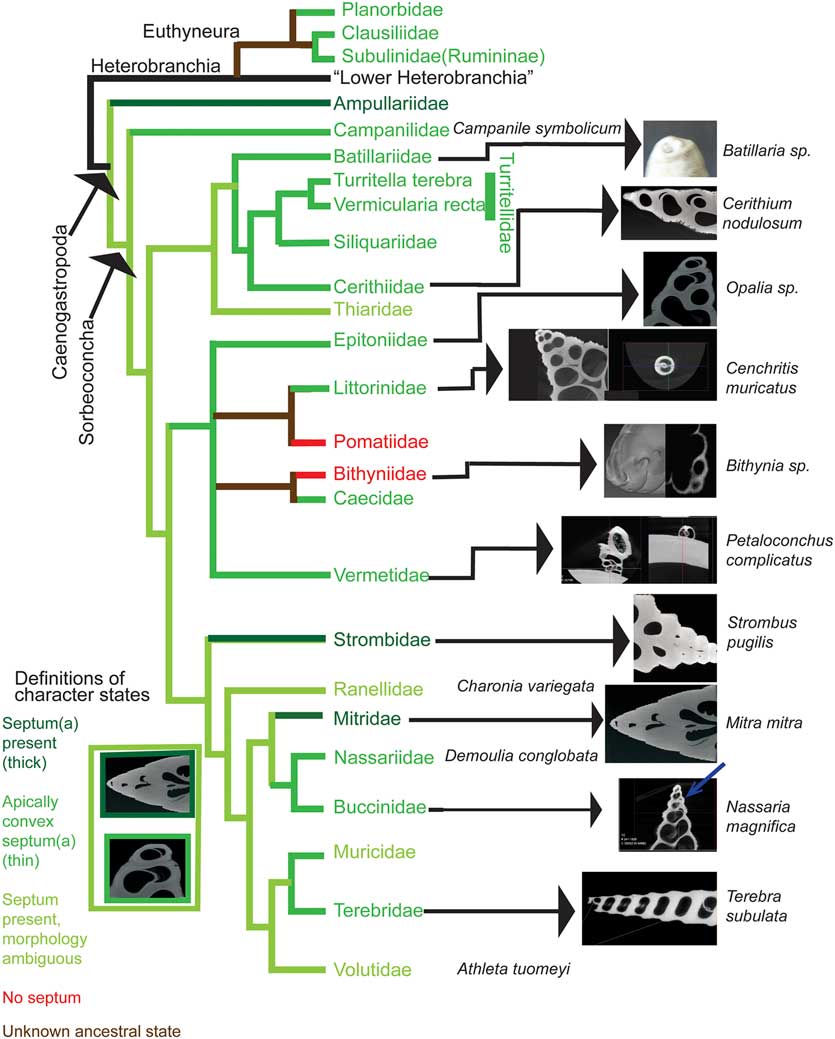
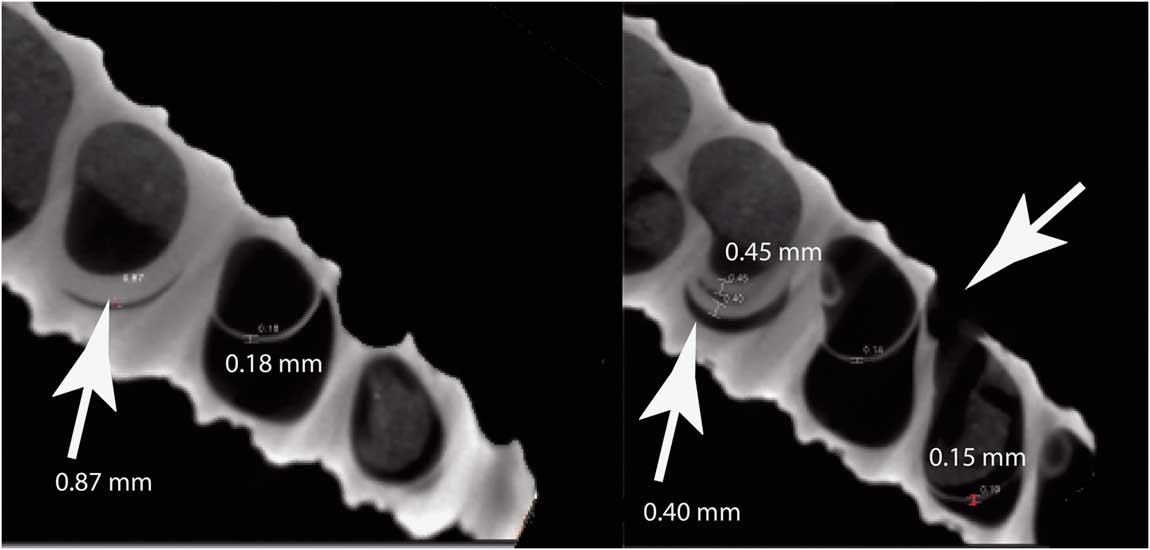
Septa were observed in 10 of the 12 families examined, the exceptions being the Bythiniidae and Pomatiidae (Fig. 2). Combined with information available in the literature reporting septa in Planorbidae (Brown et al. Reference Brown, Fison, Southgate and Wright1984), Subulinidae (Rumininae) (Hochpöchler and Kothbauer Reference Hochpöchler and Kothbauer1975), Clausiliidae (Pall-Gergely and Nemeth Reference Pall-Gergely and Nemeth2008), Campanilidae (Houbrick Reference Houbrick1981), Thiaridae (Fretter and Graham Reference Fretter and Graham1962), Caecidae (Fretter and Graham Reference Fretter and Graham1962), Ranellidae (Bandel Reference Bandel1979), Nassariidae (Fortey Reference Fortey2009), Volutidae (Ford Reference Ford2006), and Muricidae (Bandel Reference Bandel1979), septa appear to be a widespread feature of Caenogastropoda, with thin, apically convex septa the most common form. Septa in turritellid gastropods are very thin, only 0.14–0.25 mm thick, with thicker septa (0.50–0.90 mm) composed of multiple layers, often with gaps between these layers (Fig. 3, Supplementary Fig. S2). In some groups (Mitridae, Volutidae, Strombidae), septa are thick and may form through different processes (e.g., Strombus fill their apices, and septa may be generated through temporary cessation of deposition; Fig. 2). The presence of septa in a wide variety of taxa, including heterobranchs, basal caenogastropods, littorinomorphs, cerithiods, and neogastropods, suggests that they are either plesiomorphic for caenogastropods or extremely commonly evolved in unrelated taxa.
Phylogenetic distribution of septa in caenogastropods. Supertree phylogeny of caeonogastropods based on the strict-consensus tree obtained from Bayesian analysis of the combined molecular and morphological data set performed by Ponder et al. (Reference Ponder, Colgan, Healy, Nutzel, Simone and Strong2008), with modification to cerithioidean relationships based on Strong et al. (Reference Strong, Colgan, Healy, Lydeard, Ponder and Glaubrecht2011), and the positions of Pomatiidae, Caecidae, and Buccinidae inferred based on the superfamilial relationships in Bouchet et al. (Reference Bouchet, Rocroi, Fryda, Hausdorf, Ponder, Valdes and Waren2005). Data for Siliquariidae (Bieler Reference Bieler2004), Planorbidae (Brown et al. Reference Brown, Fison, Southgate and Wright1984), Subulinidae (Rumininae) (Hochpöchler and Kothbauer Reference Hochpöchler and Kothbauer1975), Clausiliidae (Pall-Gergely and Nemeth Reference Pall-Gergely and Nemeth2008), Campanilidae (Houbrick Reference Houbrick1981), Thiaridae (Fretter and Graham Reference Fretter and Graham1962), Caecidae (Fretter and Graham Reference Fretter and Graham1962), Ranellidae (Bandel Reference Bandel1979), Nassariidae (Fortey Reference Fortey2009), Volutidae (Ford Reference Ford2006), and Muricidae (Bandel Reference Bandel1979) were obtained from the literature. Septa were detected in all other taxa using CT scans, SEM, or visual observation. Ancestral states inferred through parsimony. Green colors indicate that septa are present. Light green indicates taxa in which the septum is thin and apically convex. Dark green indicates taxa in which septa are thick. Yellow-green indicates taxa that possess septa of ambiguous morphology. Red indicates taxa that were examined and found not to possess septa. Brown indicates unknown ancestral states. Consult Supplementary Fig. S6 for enlarged images.

Nano-CT scan of Turritella altilira from the Miocene, Gatun Formation (Panama). The septum in the left panel appears thick (0.87 mm), but is in fact composed of multiple layers of septa, with a gap evident in a deeper transect (right panel), location indicated with arrows. An additional arrow in the second panel shows the presence of a predatory drill hole located adapically of a septum, the sole instance of possible predation failure due to septa observed in 1263 shell fragments examined in Anderson et al. (Reference Anderson, Hendy, Johnson and Allmon2017).

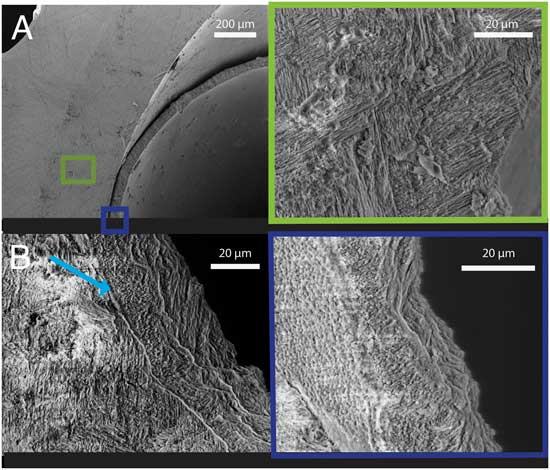
Turritellid septa universally have aragonitic crossed-lamellar (Lowenstam and Weiner Reference Lowenstam and Weiner1989) microstructure (Fig. 4), with some showing limited deposition of simple lamellar fibrous structure, as in the transition observed in the septa of the ranellid Charonia variegata Lamarck, 1816 (Bandel Reference Bandel1990). We also observed this microstructure in the inner shell layer of turritellids and in the material deposited by Turritella abrupta and T. duplicata, which sometimes fill their apices completely (Fig. 1, Supplementary Fig. S3). Crossed-lamellar microstructure is the most common microstructure in mollusks (Salinas and Kisailus Reference Salinas and Kisailus2013; Voltzow Reference Voltzow1994), but has a high degree of order (Salinas and Kisailus Reference Salinas and Kisailus2013), requiring a complex interaction with organic macromolecules (Weiner et al. Reference Weiner, Traub and Parker1984; de Paula and Silveira Reference de Paula and Silveira2009; Nouet et al. Reference Nouet, Cotte, Cuif, Dauphin and Salomé2012; Hickman Reference Hickman2013). In both turritellids and other taxa, septa form in clear continuity with the inner shell layer, with lamellae continuous in orientation where they intersect the inner shell layer (Fig. 4B), and septa maintain crossed-lamellar microstructure even at the apex of the dome (Fig. 4). The microstructure of septa from two non-turritellid taxa—Cerithium eburneum (Cerithioidea: Cerithiidae) and Terebra variegata, (Conoidea: Terebridae)—were also examined and found to be crossed lamellar (Supplementary Figs. S3, S4), consistent with reports of crossed-lamellar microstructures in the septa of Charonia variegata (Bandel Reference Bandel1979, Reference Bandel1990). Septa in Cerithium eburneum also appear to form in continuity with an inner shell layer, although for Terebra variegata this relationship is less clear, with a thin innermost shell layer in continuity with septa (Supplementary Fig. S4C).
The microstructural relationship between septa and secondary shell deposition in Turritella terebra. A, Overview showing the relationship between outer and inner shell layers and a septum. At right is a magnified view of the region indicated with the upper (green) rectangle, showing crossed lamellar microstructure. B, Detail of the region where the septum first detaches from the inner shell layer (left). This shows that septa form in continuity with the microstructure of the inner shell layer (boundary indicated with an arrow) before becoming distinct (right, region indicated by the lower, blue box in A), but maintain crossed-lamellar microstructure.

Septa are not inserted at regular intervals in Turritella leucostoma, and there is no obvious pattern to the position where they are inserted (Supplementary Fig. S5). Further, the number of septa in each similarly sized shell is highly variable (mean=7; SD 2.85). At 39.9% of the mean, this standard deviation exceeds the 10% coefficient of variation threshold proposed by Van Valen (Reference Van Valen2009) for detecting traits not themselves maintained by selection. Septa are rare in Terebra dislocata, with only one individual sectioned found to possess two septa in total, in the second and third teleoconch whorls.
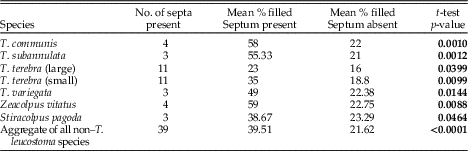
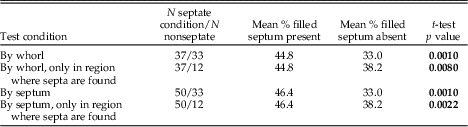
A clear relationship exists in turritellids between septation and the extent of secondary thickening of the shell (Tables 2, 3). Across all turritellid species examined, septa are more likely to occur in whorls where a greater portion of the whorl has been secondarily filled (Table 2; mean % filled 39.51 and 21.62 for septate and nonseptate whorls, respectively; t-test p<0.0001). In whorls of multiple individuals of T. leucostoma, septa were found to also be associated with thickening (Table 3). Septa are associated with more substantially thickened whorls even when only potentially septate whorls are considered (mean % filled 46.4 and 38.2 for septate and nonseptate, respectively; t-test p=0.0018; see Table 3 for additional treatments). Terebra dislocata had a noticeably lower mean % filled compared with most turritellid species examined (Supplementary Table S2), but the difference between septate and nonseptate whorls in the first three teleoconch whorls was statistically significant (mean % filled 32.2 and 23.4%, respectively; t-test, p=0.01).
Comparison of percentage of whorl filled between whorls with and without septa for non–Turritella leucostoma turritellid species. Percent filled measurements are included multiple times when multiple septa were present in the same whorl. Solid filled whorls are excluded. Bold indicates p-values significant at a 0.05 threshold.

Comparison of % whorl filled between whorls with and without septa for seven Turritella leucostoma under varying conditions. “By whorl” indicates that multiple septa within a single whorl were treated as a single septate whorl and compared with nonseptate whorls, whereas “By septum” indicates that multiple septa were treated individually. Bold indicates p-values significant at a 0.01 threshold.

Discussion
Most functional hypotheses for septation in turritellids (see “Introduction”) do not survive strong scrutiny. Only prophylactic hypotheses, particularly the possibility that septation reduces risk of microbial infection via seawater, are consistent with the available data.
1. If septa function for carbonate sequestration, then this role is already served by thickening the shell and should be uncommon in turritellids from low-carbonate environments, such as Turritella communis. Further, if this is a sink to avoid hypercalcemia (Yochelson Reference Yochelson1971), it is not intuitive why crossed-lamellar aragonite would be employed across multiple clades when less energetically expensive microstructures (Dillaman Reference Dillaman1981; Palmer Reference Palmer1983; Weiner et al. Reference Weiner, Traub and Parker1984; Lowenstam and Weiner Reference Lowenstam and Weiner1989; Avery and Etter Reference Avery and Etter2006; de Paula and Silveira Reference de Paula and Silveira2009; Cook et al. Reference Cook, Jell, Webb, Johnson and Baarli2015) would readily serve this function.
2. The hypothesis that septa provide protection against loss of the apex and possible parasitism of the gonads/digestive glands does not explain continued septal insertion in taxa that fully plug the most apical whorls with solid shell material, such as T. abrupta (Fig. 1C) and T. duplicata (Supplementary Fig. S2E). Further, while castration due to parasitism is a significant evolutionary pressure for turritellids, such parasites enter through the digestive tract, rather than penetrating the epidermis of the animal (Rothschild Reference Rothschild1935; Perez Reference Perez1936; Wright Reference Wright1956, 1971; Negus Reference Negus1968; Bieler and Hadfield Reference Bieler and Hadfield1990; Poulin and Mouritsen Reference Poulin and Mouritsen2003; Allmon Reference Allmon2011).
3. The hypothesis that adapical septa may be adaptive in turritellids or other gastropods to prevent seawater (and therefore microbial) access to the thinner epithelial tissue covering the visceral hump remains plausible. Yet in the hypothetical scenario in which a single septum or a small number were inserted near the apex as prophylaxis against possible loss of the protoconch/apex, the majority of septa within a typical turritellid shell would remain spandrels, as they do not serve this function (in this case, spandrels of the adaptive construction of single or limited septa). Any trauma that could sever the top 40% of a turritellid shell would not be thwarted by a 0.15-mm-thick dome. This would presumably include apex-snipping predators (hypothesis 3), which could conceivably be deterred by being forced to break larger whorls. Gastropods can also repair the shell rapidly after being damaged, patching breaches quickly with thin membranes before filling in additional shell material (Muzil et al. Reference Muzii, Catherine and Skinner1966; Marshall and Day Reference Marshall and Day2001; Fleury et al. Reference Fleury, Marin, Marie, Luquet, Thomas, Josse, Serpentini and Lebel2008; Fernández et al. Reference Fernández, Valenzuela and Arias2016). It is possible that the gregarious nature of turritellids (Allmon Reference Allmon2011) could lead to additional selective pressure from diseases, but constructing multiple septa far from the apex appears wasteful. The idea that the epithelium of the visceral hump produces scents more enticing to predators than the rest of the animal, which is normally exposed to seawater (including excretory apparatus), does not seem plausible. Neither increased rates of infection or increased attractiveness to predators for individuals with damaged apices have been demonstrated experimentally. If these hypotheses were shown to be correct, then the insertion of septa in early whorls would potentially be an adaptive (or exapted, depending on evolutionary history) feature.
4. Further, in examining several hundred shell fragments (1263 fragments, 74 drill holes [Anderson et al. Reference Anderson, Hendy, Johnson and Allmon2017]; 3475 fragments, 128 drill holes [Johnson et al. Reference Johnson, Anderson and Allmon2017]) only a single instance of drilling predation was found to have potentially failed due to the presence of a septum (Fig. 3). The observation of repeated septal insertion in shells with no apparent breakage or breaches of the external shell refutes the hypothesis that they are responses to damage or imminent threat (hypothesis 4).
5. The extreme thinness of gastropod septa also suggests that they do not function themselves to strengthen the shell (in agreement with Yochelson [Reference Yochelson1971] and Gubanov et al. [Reference Gubanov, Peel and Pianovskaya1995]).
For turritellids, the failure of these adaptive hypotheses, combined with high intraspecific variability (Van Valen Reference Van Valen2009) and a strong association with an adaptive feature (secondary shell thickening—an association demonstrated by their common physical construction [Fig. 4B] and the statistically significant association of septa with thickening both within individuals of a single species [Table 3] and across species [Table 2]), suggests that septa are spandrels (type 3). While the possibility that septal insertion is a response to an unknown, highly variable, environmental perturbation cannot be positively excluded, secondary shell thickening, an adaptive feature (Tull and Bohning-Gaese Reference Tull and Bohning-Gaese1993), provides a sufficient explanation for the construction and evolutionary maintenance of septa in this group. The microbial prophylactic hypothesis remains plausible, but there is presently no affirmative evidence in its favor (e.g., demonstrating that the mantle epithelium covering the visceral hump is more vulnerable to infection than the rest of the animal), and as the spandrel hypothesis does have support, there is no reason to automatically defer to the adaptive hypothesis in this case.
In other gastropod groups, such as Volutidae and Strombidae, it is possible that the creation of septa is the result of a similar process to that in turritellids, except rather than thickening the entire shell, these organisms may be attempting to fill the spire (which also occurs in some turritellids; Merriam Reference Merriam1941; Andrews Reference Andrews1974). If this is the case, then a temporary cessation of deposition could similarly result in the formation of a septum, deliberately or accidentally.
We are not here arguing that septation is necessarily a spandrel in all gastropods; some may deliberately construct septa. These include Paleozoic forms such as Fletcherviewia Cook, Reference Cook1993, which do not appear to secondarily thicken their shells (Cook et al. Reference Cook, Jell, Webb, Johnson and Baarli2015), and especially some decollate snails that appear to deliberately weaken the shell before inserting a septum (Draper Reference Draper1985), with some taxa, such as Albinaria Vest, Reference Vest1867 and Pontophaedusa Lindholm, Reference Lindholm1924, constructing a single septum (Pall-Gergely and Nemeth Reference Pall-Gergely and Nemeth2008), and others, such as Rumina decollata Linnaeus, Reference Linnaeus1758 (Subulinidae), repeating the process multiple times (Hochpöchler and Kothbauer Reference Hochpöchler and Kothbauer1975; Gittenberger and Povel Reference Gittenberger and Povel1995; Bandel Reference Bandel1996; Pall-Gergely and Nemeth Reference Pall-Gergely and Nemeth2008).
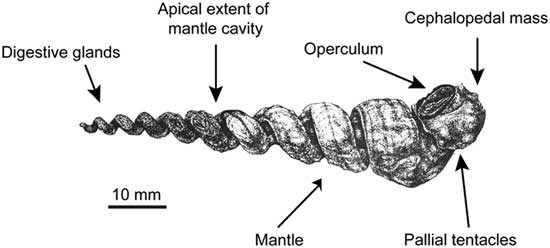
Septa, like the majority of calcium carbonate structures in gastropods, have been presumed to be constructed by mantle tissue in direct contact with the location where new shell material is being laid down (Andrews Reference Andrews1971; Kohn et al. Reference Kohn, Myers and Meenakshi1979; Bandel Reference Bandel1990, Reference Bandel1991; de Paula and Silveira Reference de Paula and Silveira2009; Nouet et al. Reference Nouet, Cotte, Cuif, Dauphin and Salomé2012). Fine study of the microstructure of Charonia variegata indicates that septa are initially spherulitic prismatic and grade into crossed-lamellar structure, “presumably with increased mantle control” (Bandel Reference Bandel1979, Reference Bandel1990; Hickman Reference Hickman2013). Reported examples of remote biomineralization (Chinzei and Seilacher Reference Chinzei and Seilacher1993; Checa Reference Checa2000; Hickman Reference Hickman2013), in which mantle tissue is not in direct contact with secreted shell material, are not well ordered (Bandel Reference Bandel1990, Reference Bandel1991; Hickman Reference Hickman2013; see also Dillaman Reference Dillaman1981; Kemperman and Gittenberger Reference Kemperman and Gittenberger1988; Checa Reference Checa2000), especially when microbially mediated deposition is hypothesized (Vermeij Reference Vermeij2014). The posterior edge of the visually distinct mantle cavity of Turritella bacillum, however, is 4.5–5 whorls from the apical termination of body tissue (the gonads, digestive glands, etc., all located well above the columellar muscle; Fig. 5), and 2.5 whorls away in Turritella communis (Fretter and Graham Reference Fretter and Graham1962). This situation is not unique to turritellids; in the phylogenetically distant Campanilidae, which also insert multiple septa, the adapical edge of the mantle is located 5–6 whorls from the end of the visceral mass (Houbrick Reference Houbrick1981). Septa therefore must be constructed by mantle epithelium tissue coating the visceral mass of the organism, which is visually and histologically distinctive from the tissue of the mantle cavity (Fretter and Graham Reference Fretter and Graham1962). Shell repair studies have typically examined areas of the shell that more typically shell-secreting portions of the mantle can readily access (e.g., Fleury et al. Reference Fleury, Marin, Marie, Luquet, Thomas, Josse, Serpentini and Lebel2008; Fernández et al. Reference Fernández, Valenzuela and Arias2016), although interior remodeling has been described in several groups (e.g., Kohn et al. Reference Kohn, Myers and Meenakshi1979). Comparing the shell repair capabilities of the mantle epithelium of the visceral mass in high-spired marine snails with more typical apertural repair could be a fruitful area of research for understanding the physiology of mantle tissue and gastropod biomineralization.
Anatomy of formalin-preserved Turritella bacillum animal removed from shell. Note that typical mantle tissue does not appear to extend over the last several volutions of the body (containing digestive glands and gonads).

Conclusions
Septa are widespread in caenogastropods and are also present in some shelled heterobranchs (e.g., Architectonicidae, Heliacus implexus Mighels, Reference Mighels1845 [Bieler Reference Bieler1993], Clausiliidae [Pall-Gergely and Nemeth Reference Pall-Gergely and Nemeth2008], Donaldinidae [Bandel et al. Reference Bandel, Nützel and Yancey2002]). Septation should be considered when examining fossil steinkerns, as the occlusion of the apex by a septum (providing it is robust enough to not be broken during the process of infilling the shell) both prevents direct measurement of the animal and provides ontogenetic information (Dattilo et al. Reference Dattilo, Freeman, Peters, Heimbrock, Deline, Martin, Kallmeyer, Reeder and Argast2016). The pervasive occurrence of septation in gastropod families also raises the question of possible homology of these structures. As gastropod septa are extremely simple in definition, we urge caution against considering all of them to be homologous, and we do not conclude that they are necessarily primitive for caenogastropods. In the case in which septa are selectively neutral epiphenomena of secondary thickening in many taxa, then they are not discrete characters (the appropriate character would be degree of shell thickening). Alternatively, if septal formation is adaptive, and the simplest means to generate septa is a generalized increase in secondary shell deposition, then the extent of shell thickening may be a spandrel of septation. Either way, separating these developmentally linked (nonindependent) characters in phylogenetic reconstructions would likely cause particular difficulties for character-poor families such as turritellids, potentially overestimating the phylogenetic relationship between species that converged on robust shells.
It also is likely inappropriate to propose simple homology of septation between septa-bearing taxa that clearly have developmental programming related to septal formation (e.g., decollate snails; Hochpöchler and Kothbauer Reference Hochpöchler and Kothbauer1975; Pall-Gergely and Nemeth Reference Pall-Gergely and Nemeth2008) and those that do not (e.g., Turritellidae). Additionally, if homologues are defined as having some underlying shared developmental programming (Wagner Reference Wagner2007), and no such genetic programming exists, it may be inappropriate to propose homology, even among organisms of the same species (e.g., the septum of the third whorl), if septal formation is a stochastic, rather than developmental event. Septa are, however, common features of moderate- to high-spired shells in a way that has not been heretofore appreciated.
An alternative perspective on coding septation would be to code the propensity to form septa (or to form septa sufficiently robust to be recognizable in the fossil record) separately from control on septal formation (e.g., Caecidae) and the type of control (P. Wagner personal communication). If coded in this manner, and septation is considered primitive, then loss of septation may occur either through the ability to prevent unnecessary secretion of shell material by the mantle epithelium when thickening the shell (gain of modularity) or decrease in extent of shell thickening relative to whorl expansion (spandrel of shell thickening). The absence/presence of septa would be coded as one character, agnostic to the existence of a control mechanism; the existence of a control mechanism would be a second character; and the type of control mechanism could be considered a third character.
An apparent trend toward septation in caenogastropods may be the result of either retention of the pleisiomorphic state or preferential gain rather than loss (McShea Reference McShea1994) of either septation or relative shell thickening. The latter seems plausible, given increased predation pressures since the Mesozoic marine revolution (Vermeij Reference Vermeij1977, Reference Vermeij1987, Reference Vermeij2013). Future work for understanding the evolution of septation in families other than Turritellidae would involve testing the correlation of septation with shell thickening among species and individuals in the respective families, determining the extent of developmental control on septal formation if it exists, and interpreting gain/loss of septation or extent of septation in a robust phylogenetic context, where ancestor–descendant pairs or subclade tests could be performed (McShea Reference McShea1994; Pagel Reference Pagel1994). At present, turritellid systematics are not well resolved, with the genus “Turritella” often considered a “wastebasket taxon” (Plotnick and Wagner Reference Plotnick and Wagner2006; Hendricks et al. Reference Hendricks, Saupe, Myers, Hermsen and Allmon2014) and relationships within the family poorly understood (Beu Reference Beu2010). The integration of molecular information with shell characters would be a first step toward interpreting evolutionary transitions and trends within this family.
Turritellid septa are irregularly inserted (a feature they share with septa in many other gastropod taxa, including high-spired, septate murchisoniids (Cook et al. Reference Cook, Jell, Webb, Johnson and Baarli2015; Rohr and Blodgett Reference Rohr and Blodgett2016) and open-coiled Paleozoic gastropods, such as Nevadaspira (Yochelson Reference Yochelson1971), and likely have no functional significance of their own. These domes thus appear to be spandrels of shell thickening (in agreement with the proposal that septa give “no particular advantage” to fossil Loxonematoidea (Yochelson Reference Yochelson1971). Shell-thickening or apex-filling material may lead to septa as constructional by-products in other taxa, such as Littorinidae or Cerithium, with accidental septal formation less likely to occur in taxa with a faster whorl expansion rate (Raup Reference Raup1966) or less extensive secondary shell thickening. Similar mechanisms may have contributed to septal formation in other taxa with similar morphology, such as hyoliths (Lophophorata) (Dzik Reference Dzik1978; Moysiuk et al. Reference Moysiuk, Smith and Caron2017; Parkhaev Reference Parkhaev2017). Predisposition to septal formation may have been exapted (Gould and Vrba Reference Gould and Vrba1982) in the uncoiled (or loosely coiled) Vermiculariinae, Siliquariidae, and Vermetidae, facilitating their rapid shell growth and uncoiled morphology and allowing the animal to remain close to the aperture (Bieler Reference Bieler2004), even when vertically oriented.
Acknowledgments
We thank E. Waldman for drafting the illustration of Turritella bacillum anatomy; T. Porri for assistance with CT services; A. Smith and D. Epstein for help sectioning; G. Dietl for the donation of specimens; and G. Dietl, J. Hendricks, S. Durham, D. Friend, J. Smith, G. Vermeij, and especially R. Bieler for comments on earlier versions of the article. We would also like to thank P. Wagner and anonymous reviewers for their thoughtful comments. This work made use of the Cornell Center for Materials Research Shared Facilities, which are supported through the National Science Foundation MRSEC program (DMR-1120296). CT imaging data were acquired through the Cornell University Biotechnology Resource Center, with National Institutes of Health 1S10OD012287 funding for the Zeiss-Xradia Versa 520 X-ray Microscope.
Supplementary material
Data available from the Dryad Digital Repository: https://doi.org/10.5061/dryad.47v0gf4