





Impact statement
Every summer, hundreds of thousands of visitors to Albania’s Adriatic and Ionian coast find that the most convenient stretches of sand are fenced off by paid sunbed concessions, while the free public strip is often narrow, poorly serviced or hard to reach. This case study examines why not a single failure of political will, but a structural pattern in which the same regulatory instrument governing public beach access has been rewritten three times in seven years, in 2019, 2024 and again in January 2026, entirely through secondary legislation, without ever taking the more durable form of a parliamentary statute. This pattern, which this article terms regulatory volatility, is of practical relevance to citizens exercising a constitutionally guaranteed right, to coastal municipalities balancing tourism revenue against residents’ access and to Albania’s European Union accession process, which requires alignment with European coastal-management standards.
The case is presented as representative of a broader challenge facing Mediterranean and Western Balkan states engaged in rapid, tourism-led coastal development: the gap between a constitutionally sound public-trust principle and an institutional architecture too fragmented to enforce it consistently. The article’s critical evaluation and its concrete field recommendations – legislative consolidation, a binding rather than merely advisory coordinating body and independently verifiable spatial monitoring of concession boundaries – are intended to be of direct practical use to legislators finalising Albania’s still-pending coastal-zone framework law, to coastal municipalities negotiating beach-station contracts and to comparative observers of Adriatic and Mediterranean coastal governance more generally.
Introduction
Albania’s coastline, stretching along the Adriatic Sea in the north and the Ionian Sea in the south, is both one of the country’s principal economic assets and a public space whose contested governance illustrates a wider Mediterranean pattern: the gap between a constitutionally sound principle of public coastal ownership and an institutional architecture that struggles to enforce it consistently. This case study examines that gap through a single, tightly bounded example: the regulation of ‘beach-station’ concessions, the mechanism through which Albania allocates its coastline between free public use and privately managed tourism infrastructure, because that example crystallises, with unusual clarity, two governance pathologies that the comparative integrated coastal zone management (ICZM) literature treats as generic risks to coastal-access regimes worldwide – institutional fragmentation and what this article terms regulatory volatility.
The case is instructive because Albania has not been passive on this issue. Since 2019, the state has progressively raised the guaranteed minimum share of free public beach space, financed an internationally supported ICZM project and drafted a consolidating framework law that remains, 6 years on, unadopted. Yet the instrument carrying the single most consequential access parameter has, within 7 years, been amended repeatedly, repealed and wholly replaced once and amended again, always through secondary legislation, never through a parliamentary statute. This pattern of formally strengthening a right while never anchoring it durably is, this case study argues, the more general and more instructive finding: statutory ambition and institutional durability are analytically distinct variables, and closing the gap between a formally guaranteed entitlement and a verifiable one requires attending to the latter, not assuming that a higher headline percentage is itself the remedy.
The Albanian case is representative, in the sense the case-study genre requires, of a challenge facing several rapidly tourism-developing Mediterranean and Western Balkan coastal states: reconciling a civil-law tradition that treats the seashore as inalienable public domain with the commercial pressure to allocate that same domain, segment by segment, to private concessionaires. Section ‘The Albanian case: Legal architecture, institutional fragmentation and regulatory volatility’ situates the Albanian instance within that broader pattern by comparing it briefly with Croatia and Italy, both of which face structurally similar tensions between coastal tourism development and the public-trust status of the shoreline, notwithstanding real differences in administrative tradition and accession status. The analysis proceeds by documentary legal analysis, reconstructing the applicable constitutional, statutory and regulatory instruments and reading them against the peer-reviewed comparative ICZM literature and against Sax’s (Reference Sax1970) public trust doctrine, which holds that the state administers shoreline resources not as ordinary fiscal assets but under a fiduciary obligation running to present and future generations of citizens, a framework more recently extended to contemporary regulatory-reform and climate-disruption contexts by Scanlan (Reference Scanlan2023), whose analysis of the unintended consequences that can follow from well-intentioned public-trust-based coastal regulation is directly relevant to the regulatory-volatility pattern this case study documents. No new primary empirical data were collected. The contribution is a critical, comparatively grounded evaluation of a live regulatory case, together with field-level recommendations, consistent with the case-study genre’s requirement for constructive, forward-looking discussion rather than description alone.
The Albanian case: Legal architecture, institutional fragmentation and regulatory volatility
Constitutional and statutory foundations
The Constitution of the Republic of Albania (Kuvendi i Republikës së Shqipërisë, 1998, as amended) situates the seashore within a category of property subject to a distinct public regime, consistent with the civil-law tradition of the maritime public domain and functionally analogous to the common-law public trust doctrine. The constitutional text does not, however, specify an operational threshold; it does not fix a minimum percentage of any beach that must remain free of charge, nor does it prescribe the institutional architecture through which the seashore is to be managed and no body of Constitutional Court jurisprudence has been identified specifically addressing the coastal-access dimension of that public property regime. These operational questions have instead been left to ordinary and, more consequentially, to secondary legislation. Law 93/2015 ‘On Tourism’ (Kuvendi i Republikës së Shqipërisë, 2015) supplies the statutory basis for beach-station activity and for the National Coastal Agency (AKB); Law 81/2017 ‘On Protected Areas’ (Kuvendi i Republikës së Shqipërisë, 2017), as amended by Law 21/2024 (Kuvendi i Republikës së Shqipërisë, 2024), governs the subset of coastline within designated protected categories.
Specifically, Law 21/2024 inserted a new defined category, ‘excellence tourism’ (turizëm i ekselencës, new point 25/1), permitting, as an exception to the general construction prohibition applicable to ‘National Park’ zones, hospitality infrastructure and activities meeting the highest architectural and environmental standards for five-star establishments, and separately amended the law’s statement of management principles to add explicit economic and touristic objectives alongside the ecological criteria the 2017 law had emphasised alone. This amendment took effect in the very period in which access requirements for ordinary beach stations were being tightened elsewhere in the same sectoral framework, an internal tension within the state’s own legislative programme that this case study treats as a first, mild symptom of the wider fragmentation documented below. The amendment did not go unchallenged: it was contested before Albania’s Constitutional Court by the Albanian Ornithological Society and EcoAlbania, supported by one-fifth of the Assembly’s deputies, on the grounds that it legitimises large-scale construction within high-natural-value territory and is incompatible with the Constitution and Albania’s international environmental commitments; the Constitutional Court rejected that challenge and upheld the law, a matter of public record at the time of writing that this case study reports descriptively rather than adjudicates. A separate draft framework law, ‘On the Integrated Management of the Coastal Zone’, has circulated for consultation since 2020 without reaching adoption; its prolonged non-adoption is not attributable to a lack of technical drafting capacity but to an absence of sustained political prioritisation.
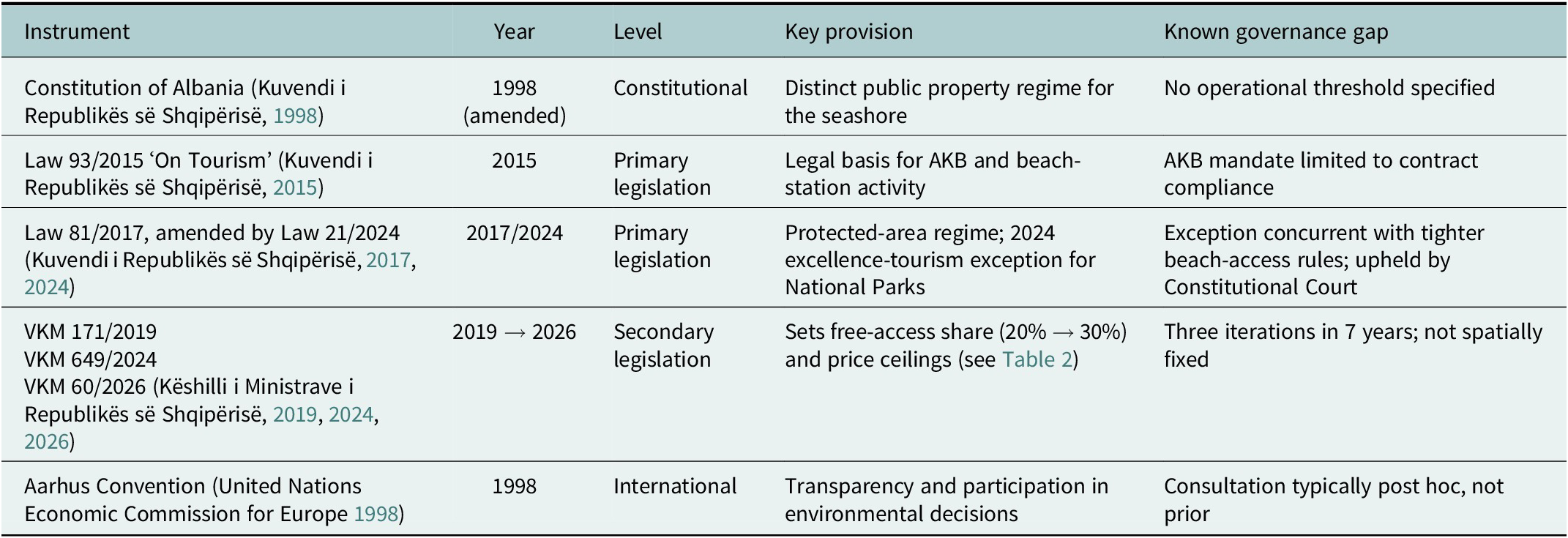
This domestic framework operates within an international layer that reinforces, without independently guaranteeing, public coastal access. As a state party to the UN Convention on the Law of the Sea, Albania retains sovereign competence over its territorial sea while leaving the domestic access regime to national law (United Nations, 1982); as a Mediterranean state, it participates in the Barcelona Convention system and its Protocol on Integrated Coastal Zone Management, which requires contracting parties to adopt coordinated planning instruments, minimum construction setbacks and public-participation mechanisms (UNEP/MAP, 1995, 2008); and its ongoing accession negotiations with the European Union create a further external anchor for aligning domestic practice with the Union’s own, non-binding 2002 Recommendation on integrated coastal zone management (European Commission, 2002). None of these instruments, however, supplies the binding domestic conflict-resolution mechanism whose absence Section ‘Institutional fragmentation’ identifies as the central institutional weakness of the Albanian case; international alignment and domestic institutional capacity are, on this evidence, analytically and practically distinct achievements. Table 1 summarises the principal instruments discussed in this section.
Selected principal legal and institutional instruments governing public access to Albania’s coastline (illustrative rather than exhaustive)

Table 1. Long description
The table consists of five columns: Instrument, Year, Level, Key provision, and Known governance gap.
* Row 1: Constitution of Albania (1998 amended). Level: Constitutional. Key provision: Distinct public property regime for the seashore. Gap: No operational threshold specified.
* Row 2: Law 93/2015 ‘On Tourism’ (2015). Level: Primary legislation. Key provision: Legal basis for A K B and beach-station activity. Gap: A K B mandate limited to contract compliance.
* Row 3: Law 81/2017, amended by Law 21/2024 (2017/2024). Level: Primary legislation. Key provision: Protected-area regime; 2024 excellence-tourism exception for National Parks. Gap: Exception concurrent with tighter beach-access rules; upheld by Constitutional Court.
* Row 4: V K M 171/2019, V K M 649/2024, V K M 60/2026 (2019 to 2026). Level: Secondary legislation. Key provision: Sets free-access share (20 percent to 30 percent) and price ceilings. Gap: Three iterations in 7 years; not spatially fixed.
* Row 5: Aarhus Convention (1998). Level: International. Key provision: Transparency and participation in environmental decisions. Gap: Consultation typically post hoc, not prior.
Institutional fragmentation
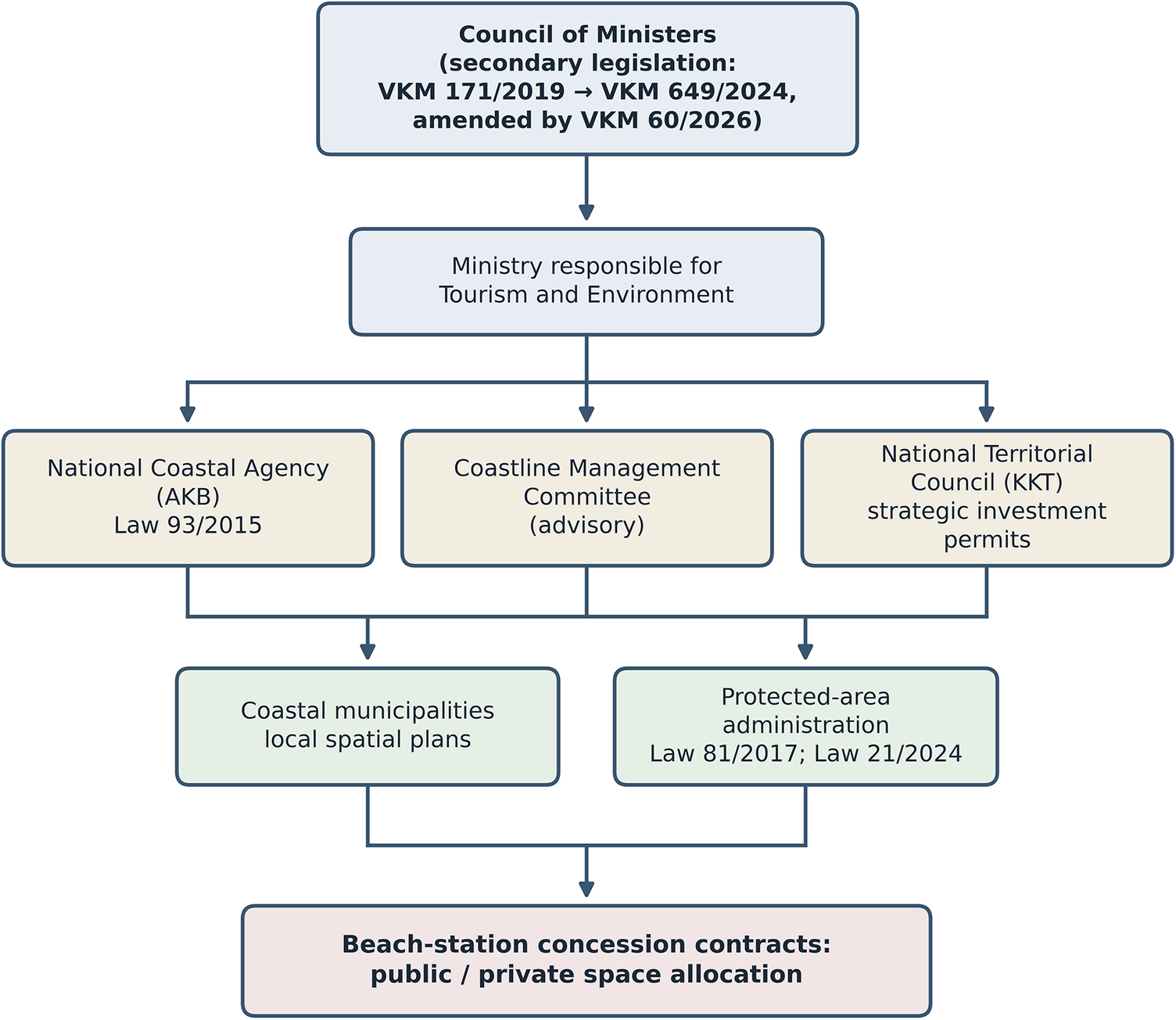
Implementing competence over the coastline is distributed across at least four bodies: the National Coastal Agency, which administers beach-station concessions; a Coastline Management Committee, whose role is advisory rather than decisional; the National Territorial Council (KKT), which approves strategic tourism investments with territorial effect; and coastal municipalities, which retain local spatial-planning competence but must coordinate with all three national bodies (Figure 1). Portman et al.’s (Reference Portman, Esteves, Le and Khan2012) eight-country comparative study of ICZM integration found institutional integration, coordination across levels and agencies, to be consistently the hardest of three integration dimensions to achieve, and found that regulatory commissions with binding conflict-resolution authority outperformed advisory committees lacking such power. Albania’s Coastline Management Committee corresponds structurally to the weaker, advisory category in that comparison: when a KKT-approved strategic investment affects coastline simultaneously subject to a protected-area designation and a municipal spatial plan, no single instrument specifies how the resulting conflict is to be resolved, and strategic-investment approval typically precedes, and thereby constrains, any subsequent protection or planning decision rather than being weighed against it concurrently.
Simplified institutional map of coastal-access governance in Albania. Own elaboration based on Law 93/2015, Law 81/2017 as amended by Law 21/2024, VKM 171/2019, VKM 649/2024 and VKM 60/2026.

Figure 1. Long description
The flowchart consists of four hierarchical levels connected by downward-pointing arrows.
* Level 1 (Top): A blue box represents the Council of Ministers, responsible for secondary legislation including V K M 171 forward slash 2019, which leads to V K M 649 forward slash 2024, as amended by V K M 60 forward slash 2026.
* Level 2: An arrow points down to the Ministry responsible for Tourism and Environment.
* Level 3: Three parallel tan boxes receive arrows from the Ministry. From left to right, these are the National Coastal Agency (A K B) under Law 93 forward slash 2015; the Coastline Management Committee (advisory); and the National Territorial Council (K K T) for strategic investment permits.
* Level 4: Arrows from the A K B and the Coastline Management Committee converge toward two green boxes. The left box represents Coastal municipalities and local spatial plans. The right box represents Protected-area administration under Law 81 forward slash 2017 and Law 21 forward slash 2024.
* Level 5 (Bottom): Arrows from the municipalities and protected-area administration converge into a final pink box labeled Beach-station concession contracts: public forward slash private space allocation.
A further, frequently underestimated source of fragmentation lies in the fiscal incentives facing coastal municipalities themselves. Where local revenue from tourism-related taxes and fees is tied to the volume of beach-station and hospitality activity within a municipality’s territory, its institutional interest in maximising active concessions can run counter to its responsibility for verifying that each concession leaves the statutory minimum of free public space intact, which compounds, at the municipal level, the same institutional-integration deficit that Portman et al. (Reference Portman, Esteves, Le and Khan2012) identify nationally. This is not a uniquely Albanian dynamic: comparative fiscal-federalism research on tourism-dependent coastal jurisdictions elsewhere documents similar tensions between local revenue interests and local regulatory responsibilities, which is precisely why Section ‘Conclusions and field recommendations’ below recommends a coordinating body positioned above, rather than beside, the municipalities whose fiscal interests are directly engaged by the allocation decisions in question.
Regulatory volatility: Three iterations in 7 years
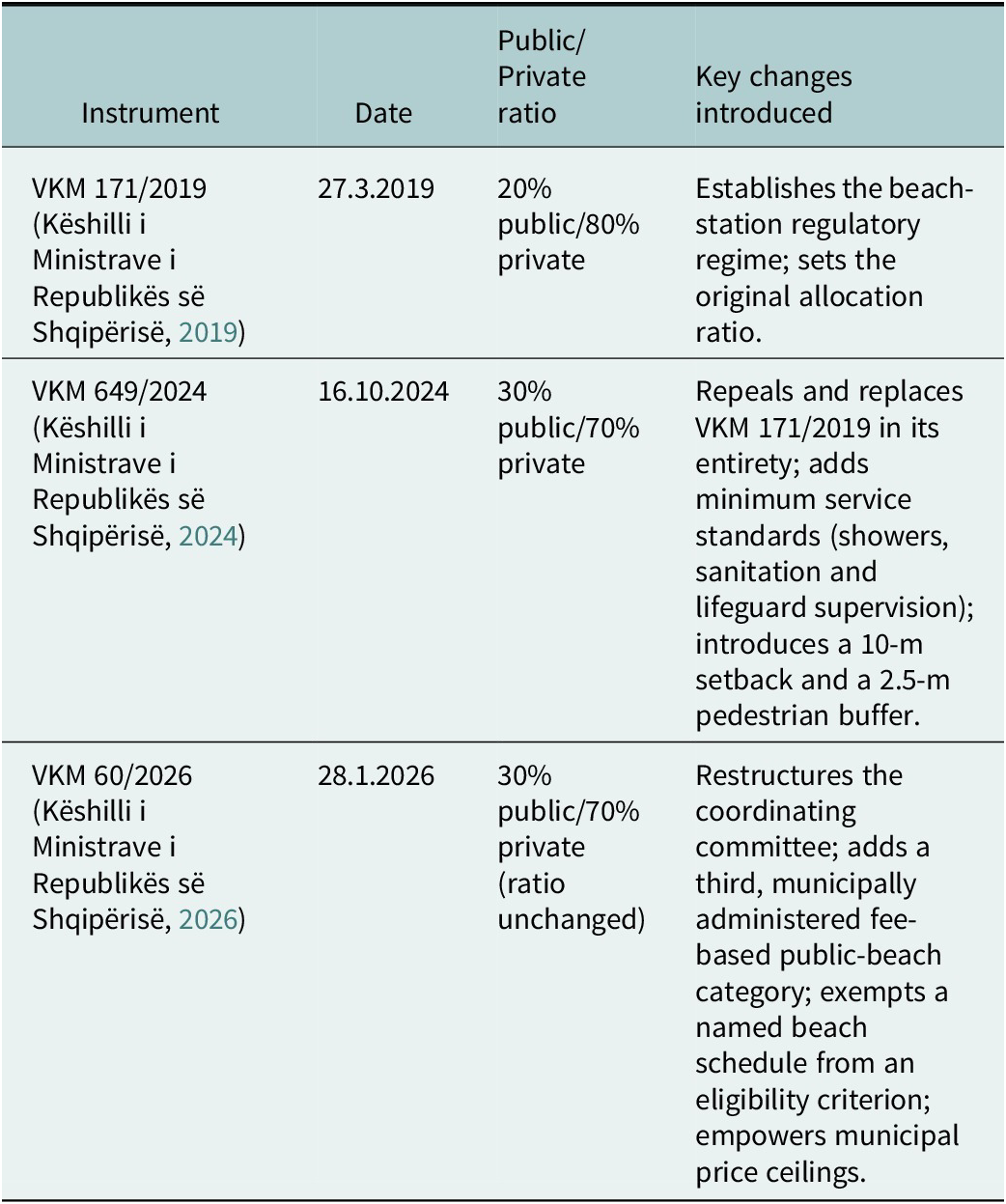
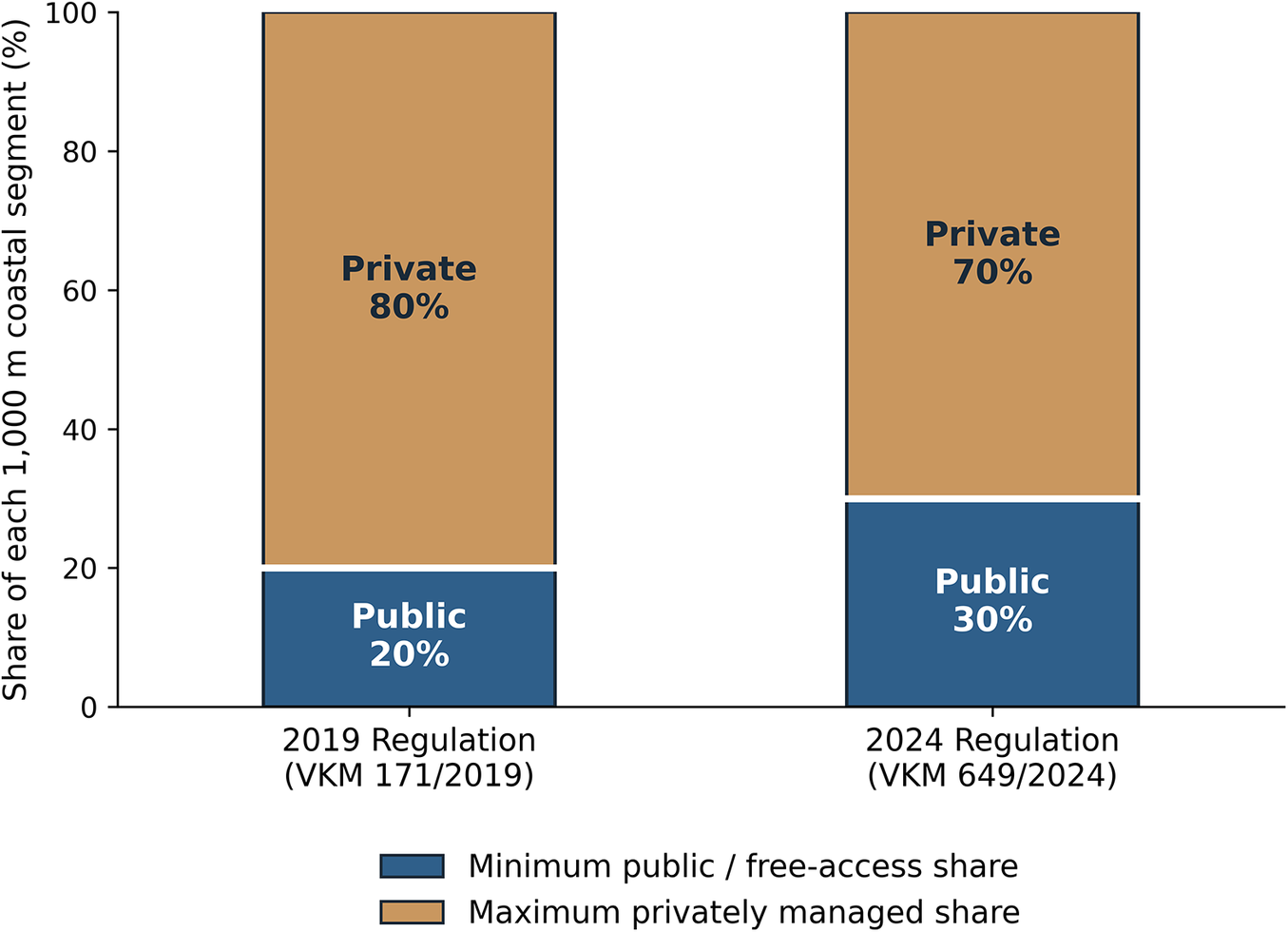
The clearest empirical expression of this case is the statutory allocation ratio itself. Council of Ministers Decision (VKM) No. 171 of 27 March 2019 (Këshilli i Ministrave i Republikës së Shqipërisë, 2019) initially permitted private beach-station management of up to 80% of any coastal segment, leaving 20% for free public use. That regulation was revised repeatedly before being repealed in its entirety and replaced by VKM No. 649 of 16 October 2024 (Këshilli i Ministrave i Republikës së Shqipërisë, 2024), which raised the guaranteed public share to 30%, added minimum service standards (showers, sanitation and lifeguard supervision) for the free zone and introduced a 10-m setback for sunbeds and umbrellas from the shoreline together with a 2.5-m pedestrian buffer. VKM No. 649/2024 was itself amended within little over a year, by VKM No. 60 of 28 January 2026 (Këshilli i Ministrave i Republikës së Shqipërisë, 2026), which restructured the coordinating committee, introduced a third access category, a municipally administered, fee-based public beach (‘plazh publik i tarifuar nga NJVV-ja’; NJVV, Njësia e Vetëqeverisjes Vendore, denotes a local self-government unit, i.e., a municipality, under Albanian administrative law), exempted a named schedule of beaches, including Gjiri i Lalzit and Borsh, both mapped in Figure 3, from a specific eligibility criterion and empowered municipal councils to set a binding maximum price ceiling for private beach-station services each season. Table 2 summarises the three instruments, and Figure 2 presents the headline ratio’s trajectory graphically.
Summary of Council of Ministers Decisions (VKM) 171/2019, 649/2024 and 60/2026, the three successive instruments governing beach-station concessions discussed above
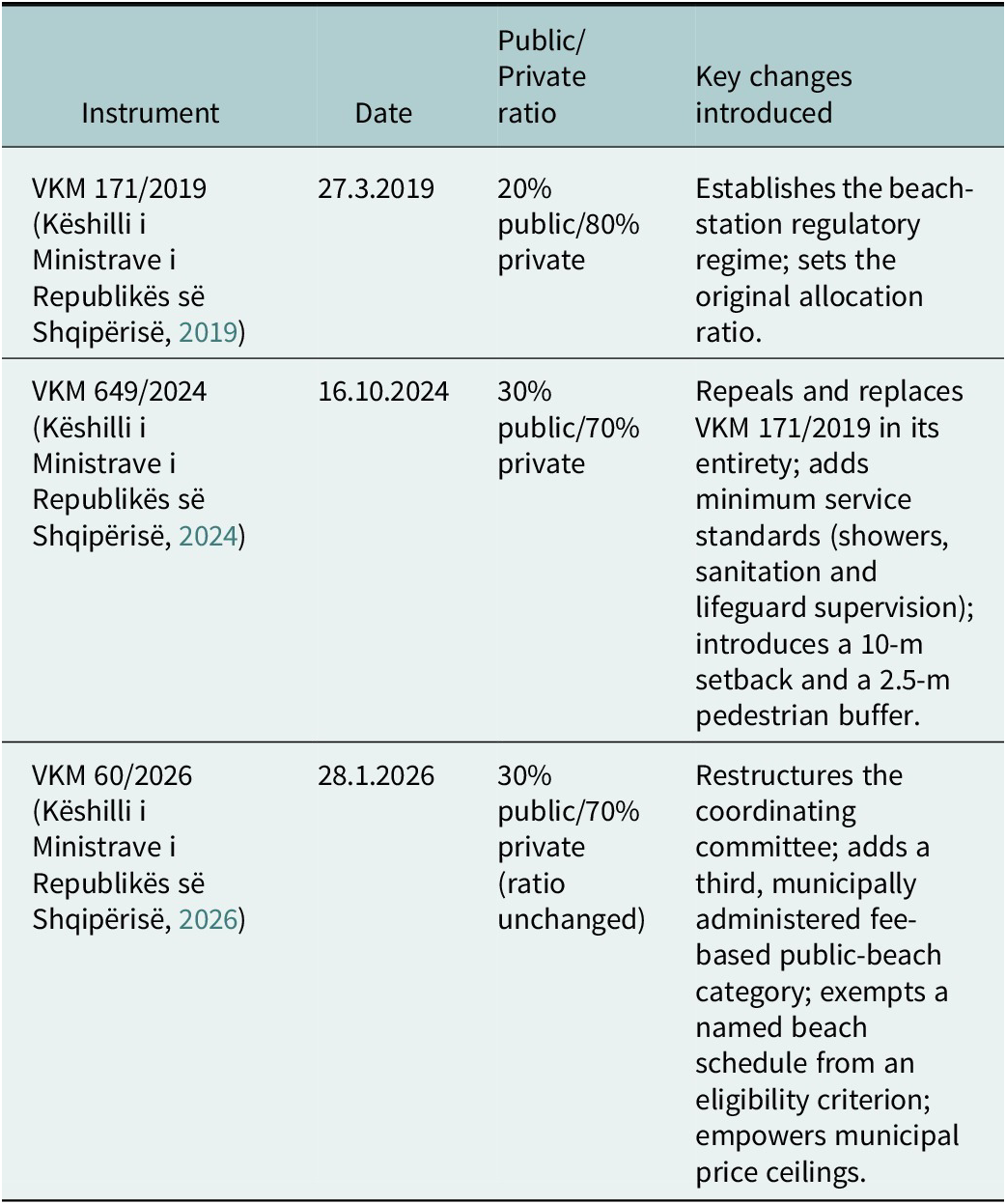
Table 2. Long description
The table consists of four columns and three data rows.
* Row 1: Instrument V K M 171/2019, dated 27.3.2019. Public/Private ratio is 20 percent public and 80 percent private. Key changes: Establishes the beach-station regulatory regime and sets the original allocation ratio.
* Row 2: Instrument V K M 649/2024, dated 16.10.2024. Public/Private ratio is 30 percent public and 70 percent private. Key changes: Repeals and replaces V K M 171/2019; adds minimum service standards including showers, sanitation, and lifeguard supervision; introduces a 10-meter setback and a 2.5-meter pedestrian buffer.
* Row 3: Instrument V K M 60/2026, dated 28.1.2026. Public/Private ratio remains 30 percent public and 70 percent private. Key changes: Restructures the coordinating committee; adds a third, municipally administered fee-based public-beach category; exempts a named beach schedule from an eligibility criterion; empowers municipal price ceilings.
Regulatory allocation of public and private beach space in Albania, 2019 and 2024. Own elaboration based on the cited Council of Ministers decisions.

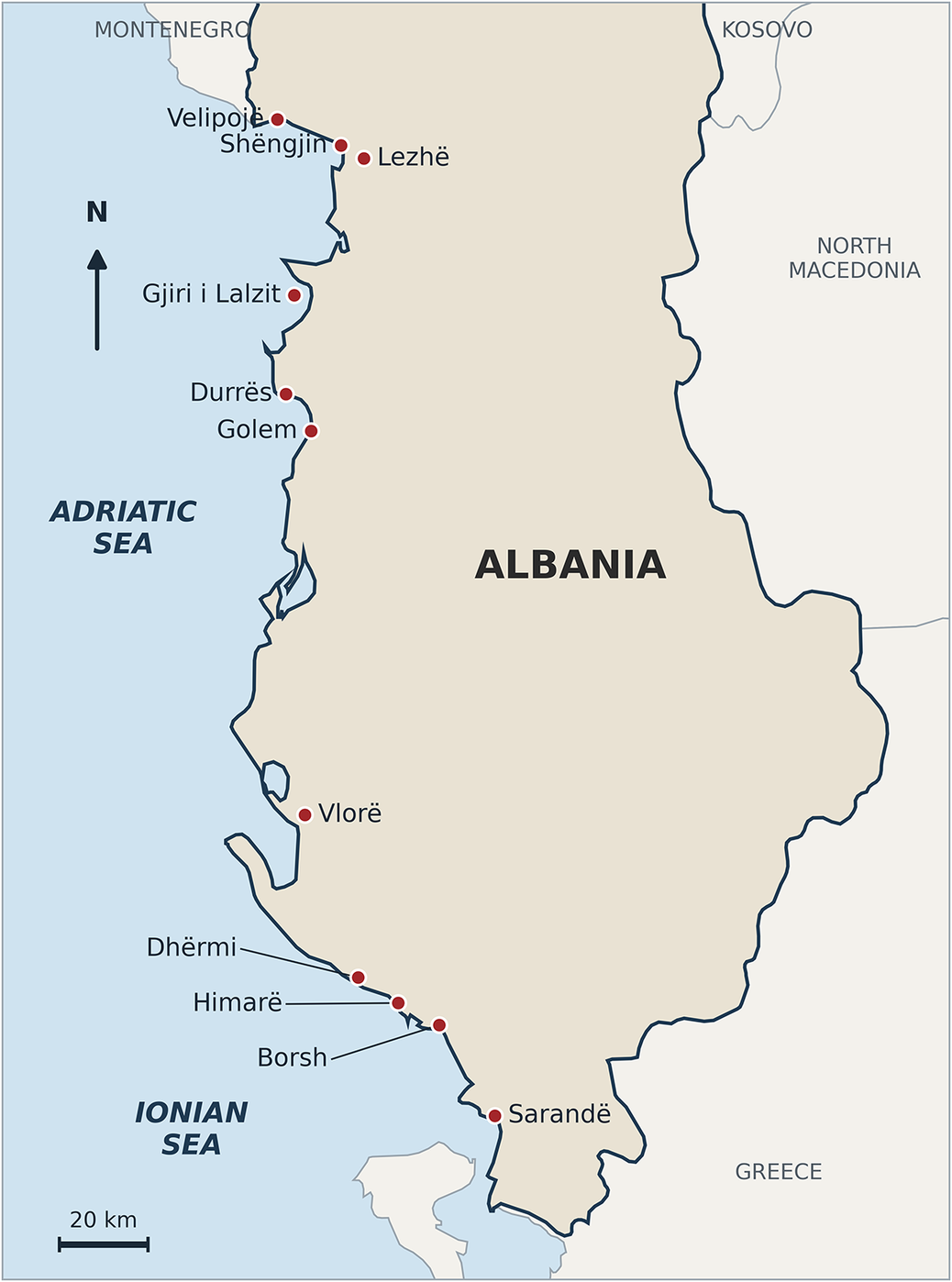
Map of Albania’s Adriatic and Ionian coastline showing the coastal settlements discussed by name in this case study, including Gjiri i Lalzit and Borsh, named in the VKM 60/2026 exemption schedule. Coastline from Natural Earth’s 1:10 m Admin 0 Countries dataset (public domain; naturalearthdata.com); Lezhë, Durrës, Vlorë and Sarandë from Natural Earth’s populated-places dataset; remaining settlements at established published coordinates. Illustrative only; not for navigational or cadastral use.

Figure 3. Long description
A vertical map showing the country of Albania and its neighboring borders. To the North is Montenegro, to the Northeast is Kosovo, to the East is North Macedonia, and to the Southeast is Greece. A North arrow points upward in the top left corner, and a 20 kilometer scale bar is located in the bottom left.
The coastline is divided into two sea regions. The Adriatic Sea is labeled in the upper half of the water body to the West, and the Ionian Sea is labeled in the lower half to the Southwest.
Coastal settlements are marked with red dots along the western edge of the landmass, listed here from North to South:
* Velipojë, Shëngjin, and Lezhë are clustered on the north-western coast .
* Gjiri i Lalzit lies on the central-northern coast .
* Durrës and Golem are situated on the central coast.
* Vlorë lies at the head of the Bay of Vlorë, opposite the Karaburun Peninsula and Sazan Island, where the Adriatic meets the Ionian Sea.
* Dhërmi, Himarë, and Borsh are located along the southern coastline facing the Ionian Sea.
* Sarandë is the southernmost settlement shown, located near the border with Greece.
That the executive has amended the operative instrument repeatedly, repealed and replaced it once and amended its replacement again, entirely through secondary legislation, is itself the finding this case study foregrounds: regulatory volatility, defined here as the vulnerability of a policy parameter to unilateral executive revision because it is fixed by an instrument outside the deliberative procedures attached to primary legislation. This has a genuine adaptive advantage: the ratio was recalibrated without awaiting a full legislative cycle once the original 20% minimum proved too narrow, and the 2026 price-ceiling mechanism responded quickly to a documented affordability concern. But the same flexibility means that neither municipalities, nor operators, nor citizens can treat any given ratio as legally settled, and it compounds a second, structural weakness: because the enforcement model relies on ex post inspection by the National Coastal Agency rather than a continuously published spatial record of concession boundaries, compliance is difficult to verify independently, a risk this article labels boundary drift, following the comparative literature on natural-resource concessions, without claiming it as an empirically documented pattern along the Albanian coast specifically. On this logic, a 30% minimum that is not spatially fixed and independently published offers a weaker practical guarantee than a smaller minimum that is.
Critical evaluation against the comparative literature
Read against Christie’s (Reference Christie2005) five preconditions for coastal-management sustainability, legal, institutional, economic, social and biophysical, the Albanian case is legally ambitious but institutionally thin. The legal precondition is only partly satisfied, since no consolidating statute exists and the principal parameter sits in repeatedly revised secondary legislation; the institutional precondition is the weakest of the five, for the reasons given in Section ‘Institutional fragmentation’; the economic precondition is ambivalent, since beach-station concessions generate revenue for both the state and local operators while informal coastal development has historically provided livelihoods to segments of the local population, so that stricter enforcement, however desirable from an access standpoint, could carry distributive costs if pursued without complementary measures; and the social precondition, whether affected communities regard the regime as legitimate, cannot be assessed through documentary analysis alone, a limitation acknowledged here rather than papered over, and one the Inclusivity Statement below addresses directly rather than treating as inapplicable to a documentary study.
The land-tenure legacy documented by Triantis and Vatavali (Reference Triantis and Vatavali2016) in the coastal settlement of Jal compounds this weakness: post-1990 restitution, weak cadastral administration and uneven, episodic enforcement of informal construction have left many coastal parcels with contested boundaries, and a 2019 World Bank review of Albania’s property-registration system (World Bank, 2019) found that a substantial share of the country’s properties – the review’s own estimate placed the national total at ~4 million, remained unregistered or registered with incomplete or contested boundary data. Where underlying tenure is contested, no authority can confidently designate a guaranteed public zone, since the designation could later be challenged by a successful restitution claimant; enforcement of the 2026 ratio is accordingly likely to remain systematically weaker on precisely the segments where it is most needed. Read through Fox et al.’s (Reference Fox, Tilt, Ruggiero, Stanton and Bolte2023) distributive, procedural, systemic and recognitional equity framework, advanced in this same journal, the regime satisfies the distributive dimension nominally but scores poorly on recognition and procedure, since the siting of free-access zones is determined administratively without documented community input, a gap Zhao and Butcher (Reference Zhao and Butcher2022) show the Aarhus Convention’s participation provisions (United Nations Economic Commission for Europe, 1998) are, in principle, capable of closing if operationalised prospectively, before an allocation decision is made, rather than as post hoc notification once it has already been taken.
The Albanian pattern is not sui generis. Maestro et al. (Reference Maestro, Chica-Ruiz, Popović Perković and Pérez-Cayeiro2022), evaluating Croatian marine protected areas against a 26-indicator framework, found the same asymmetry: strong formal institutional capacity paired with weak public participation, while Lancia (Reference Lancia2023) documents how Italy’s demanio marittimo concession regime, despite treating the shoreline as formally inalienable public property, produced a de facto closed market through decades of automatically renewed concessions, prompting an unresolved European Commission infringement procedure over compatibility with the EU Services (Bolkestein) Directive. Both cases illustrate the same generic risk identified here for Albania: a constitutionally or statutorily inalienable public coastal domain can nonetheless be captured, gradually and lawfully, through the ordinary operation of concession renewal and regulatory revision that no single instrument was designed to prevent. Such capture proceeds through repeated, individually defensible administrative acts, not through any single, contestable decision. The comparison also cautions against treating Albania’s case as uniquely severe: the Croatian and Italian evidence suggests that the combination of strong formal capacity with weak participatory and enforcement practice may be a recurring feature of Mediterranean coastal-concession regimes generally, rather than a distinctively Albanian institutional failure, a possibility the future-research agenda in Section ‘Conclusions and field recommendations’ takes up directly.
Conclusions and field recommendations
This article has argued that Albania’s coastal-access governance is best understood not as a failure of statutory ambition but as a demonstration of how institutional fragmentation and regulatory volatility can neutralise an otherwise well-specified entitlement. The state has, within 7 years, tightened its own access-allocation rules twice, restructured the coordinating committee and drafted a consolidating framework law. What has not occurred is the institutional consolidation that the comparative ICZM literature identifies as the binding constraint on translating statutory commitments into consistently verifiable outcomes on the ground. For the broader field of Mediterranean and Western Balkan coastal governance, the case offers three transferable, field-level recommendations, each pitched at the level of institutional design rather than at any single numerical threshold, and each considered below alongside its principal implementation hurdle rather than presented as self-evidently achievable.
First, the pending coastal-zone framework law should be enacted as a single consolidating instrument, upgrading the current advisory Coastline Management Committee to a body with binding, appropriately accountable conflict-resolution authority, positioned above rather than beside the National Coastal Agency, the National Territorial Council and coastal municipalities. This should be adapted, not transplanted wholesale, to local administrative capacity and governance-integrity constraints, consistent with Ostrom’s (1990) design principles for durable common-pool resource institutions and Armitage et al.’s (Reference Armitage, Berkes, Dale, Kocho-Schellenberg and Patton2011) account of co-produced, rather than unilaterally imposed, coastal rule-making. The principal hurdle is one already flagged above rather than glossed over: a commission granted binding authority without robust internal accountability, transparent appointment and external audit oversight could as easily consolidate discretionary power as resolve the coordination failures documented in Section ‘Institutional fragmentation’, so the recommendation is conditional on those safeguards rather than on legislative consolidation alone; jurisdictions considering this model should treat the accountability architecture, not the binding-authority grant itself, as the harder and more consequential design problem.
Second, the spatial boundaries of every beach-station concession and its corresponding free-access zone should be published in an open, machine-readable format before each tourist season, through the e-Government portal that already processes concession applications. This would directly address the boundary-drift risk identified in Section ‘Regulatory volatility: Three iterations in 7 years’ and operationalise the transparency logic of the Aarhus Convention (United Nations Economic Commission for Europe, 1998) as clarified by Zhao and Butcher (Reference Zhao and Butcher2022); more generally, transparent, open administrative procedures of this kind are a widely recognised precondition for accountable governance in natural-resource management well beyond the coastal-access context specifically, which is part of why this recommendation is offered with comparatively high confidence relative to the other two. Its principal hurdle is technical and administrative rather than legal: publication is only as reliable as the underlying survey data feeding it, and if the e-Government portal’s existing records are themselves incomplete, publishing them openly would make visible, rather than resolve, the land-tenure ambiguities documented in Section ‘Critical evaluation against the comparative literature’, a risk best managed by pairing publication with the cadastral prioritisation recommended next, rather than treating open publication as a sufficient remedy on its own.
Third, cadastral clarification should be prioritised on the specific coastal segments with the weakest historical compliance record, rather than pursued uniformly across the coastline, since enforcement of any access guarantee is systematically weaker where underlying land tenure remains contested, as Section ‘Critical evaluation against the comparative literature’ showed for Jal and for Albania’s wider property-registration deficit. Sequencing reform in this way, addressing the specific precondition that is empirically weakest in a given locality, consistent with Christie’s (Reference Christie2005) broader comparative finding, would make more efficient use of limited administrative capacity than a single national instrument applied without local differentiation. Its principal hurdle is resourcing and time: cadastral clarification is slower and more capital-intensive than a regulatory amendment, which is itself part of the explanation, this article suggests, for why successive governments have preferred to revise the allocation ratio rather than invest in the underlying property-registration infrastructure the ratio ultimately depends upon. Albania’s ongoing EU accession negotiations, and the corresponding requirement to align with the environmental and territorial-planning acquis discussed in Section ‘Constitutional and statutory foundations’, provide an external channel through which these three recommendations could be sequenced and monitored beyond any single electoral or budgetary cycle, though this case study stops short of asserting a specific level of Commission engagement with Albania’s coastal-zone governance that the documentary record available to it does not support.
A final, more general qualification is owed to the premise underlying all three recommendations: that a rising guaranteed minimum of free public beach space is straightforwardly desirable. In several common-law jurisdictions, most prominently the United States, mandatory public-access conditions attached to coastal development permits have themselves been challenged as uncompensated regulatory takings of private property, the US Supreme Court’s decision in Nollan v. California Coastal Commission, 483 U.S. 825 (Nollan, Reference Nollan1987), struck down exactly such a condition for lacking a sufficiently direct connection to the harm it was meant to remedy. This property-rights critique is considerably less prominent, and correspondingly less relevant, in Albania’s civil-law setting, where the seashore itself, rather than adjoining private land, is the object of the access guarantee and where the constitutional public-property characterisation discussed in Section ‘Constitutional and statutory foundations’ is not seriously contested; it is nonetheless worth noting explicitly, both for readers more familiar with common-law coastal-access debates and because it clarifies that the reforms proposed here concern the governance of an already-public resource rather than the imposition of new access burdens on private landowners.
Beyond Albania, the case illustrates a more general methodological point for the study of coastal governance: a jurisdiction’s headline compliance statistics, here, a rising minimum free-access percentage, can improve steadily even as the underlying institutional capacity to enforce them does not, and a case-study method attentive to the sequence and legal form of successive instruments, not only their content, is well suited to detecting this divergence. Future research would benefit from systematic geospatial verification of actual public/private beach allocation against the regulatory minimum, of a kind this documentary analysis could not itself undertake; from structured consultation with the coastal communities named in the Inclusivity Statement below, to assess the social precondition this article could not evaluate; and from comparative case studies of Montenegro’s and Croatia’s own coastal-concession regimes, to establish how far the pattern of regulatory volatility identified here for Albania generalises across the wider Adriatic.
Open peer review
To view the open peer review materials for this article, please visit http://doi.org/10.1017/cft.2026.10051.
Data availability statement
No new primary empirical data were generated for this study. All primary legal and policy documents relied upon are publicly available through the Official Gazette (Fletorja Zyrtare e Republikës së Shqipërisë), maintained by the Qendra e Botimeve Zyrtare (QBZ, https://qbz.gov.al) and through the depositary sources identified in the reference list. All peer-reviewed sources are identified in the reference list with a stable DOI where available. The coastline and settlement coordinates underlying Figure 3 are derived from Natural Earth’s public-domain 1:10 m Admin 0 Countries and populated-places datasets (https://www.naturalearthdata.com); settlements not present in that dataset are plotted at established published town-centre coordinates, as noted in the Figure 3 caption. No dataset associated with this study requires anonymisation or controlled access, since none was generated.
Author contribution
E. Kolaneci is solely responsible for the following contributions: Conceptualisation; methodology; investigation (documentary and legal research); formal analysis; writing – original draft; writing – review and editing; visualisation (design of Figures 1–3, the Graphical Abstract and Tables 1–2); and project administration.
Funding statement
This research received no specific grant from any funding agency, commercial or not-for-profit sector.
Ethics and approvals
This case study is based exclusively on the analysis of publicly available documentary sources and does not involve human subjects, personal data or experiments requiring institutional ethical approval. No personal data were processed.
Competing interests
None.

 Open access


Comments
Dear Editor-in-Chief,
I am pleased to resubmit my manuscript, “Public Access to Albania’s Coastline: A Case Study in Institutional Fragmentation and Regulatory Volatility”, for consideration as a Case Study, in accordance with the Editor-in-Chief’s assessment and the amendments detailed in the Author Instructions. The revised manuscript has been prepared in the Case Study format and is within the 3000-word limit for this article type.
The case study examines the governance of public access to Albania’s Adriatic and Ionian coastline as a representative instance of institutional fragmentation and regulatory volatility in Mediterranean coastal-zone management. Albania’s Constitution treats the seashore as subject to a distinct public property regime, yet the operative access parameters have been fixed entirely through secondary legislation: a 2019 regulation guaranteed a minimum free-access share of 20 per cent of every 1,000-metre coastal segment; that share was raised to 30 per cent in 2024, with minimum service standards and shoreline setbacks introduced; and the instrument was amended again in January 2026, three regulatory iterations within seven years, none of them taking the more durable form of a parliamentary statute.
Drawing on documentary legal analysis of the constitutional, statutory and regulatory instruments, and reading them against the comparative integrated coastal zone management literature, the study finds that the obstacle to consistent enforcement is not the absence of statutory ambition but the fragmentation of implementing competence among the National Coastal Agency, an advisory coordinating committee, the National Territorial Council and coastal municipalities, none of which holds binding authority to resolve conflicts between them. The arrangement is evaluated critically against Portman et al.’s comparative findings on ICZM integration and against Sax’s public trust doctrine, and is situated alongside comparable Croatian and Italian experience, where formally inalienable public coastal domains have nonetheless been captured gradually through concession renewal and regulatory revision.
The study advances three transferable, field-level recommendations: consolidating Albania’s pending coastal-zone framework law into a single instrument with binding conflict-resolution authority; instituting independently verifiable, spatially explicit monitoring of concession boundaries through open, machine-readable publication before each tourist season; and embedding prior, rather than retrospective, community consultation consistent with the Aarhus Convention. These are of direct practical use to legislators finalising the framework law, to coastal municipalities negotiating beach-station contracts, and to comparative observers of Adriatic and Mediterranean coastal governance. The analysis engages directly with scholarship published in this journal, most notably Fox et al.’s equity framework, and speaks to the journal’s mission of interdisciplinary research that informs more equitable and sustainable futures for coasts and coastal communities, including through Albania’s EU accession alignment with the environmental and territorial-planning acquis.
The manuscript is original work, has not been published elsewhere, and is not under consideration by any other journal. It is based exclusively on publicly available documentary sources, requires no ethical approval, and involves no conflicts of interest. It received no specific grant from any funding agency, as stated in the manuscript.
I am grateful for the Editorial Board’s earlier assessment, which has helped sharpen the manuscript’s focus, and I thank you for the opportunity to resubmit it as a Case Study.
I would be very happy to address any further comments or to provide additional information if required.
Kind regards,
Prof. Esmiralda Kolaneci