Introduction
A complete revision of the Old World taxa of Pouzolzia Gaudich. was published by Wilmot-Dear & Friis (Reference Wilmot-Dear and Friis2006). Subsequently, the identification of hitherto undetermined Urticaceae specimens from the Netherlands Centre for Biodiversity Naturalis (section NHN) (L), material which was not seen for the revision, has brought to light one collection of a distinctive new species. It is described here.
Material and Methods
The methods used for this paper are those of classical herbarium taxonomy with special attention given to minute morphological details of leaves, inflorescences, flowers, fruiting perianths and fruits, as described in Wilmot-Dear & Friis (Reference Wilmot-Dear and Friis2006). The material used here, a specimen from the herbarium in Leiden (L), was compared with other species of Pouzolzia described in Wilmot-Dear & Friis (Reference Wilmot-Dear and Friis2006).
Species Description
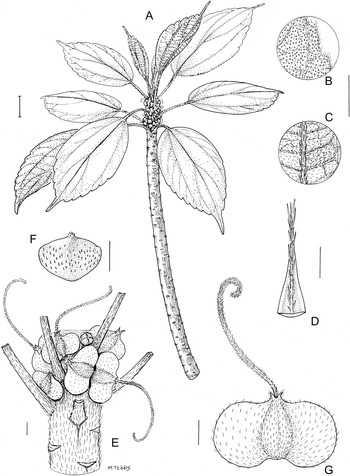
Pouzolzia floresiana Friis & Wilmot-Dear, sp. nov.Fig. 1.
Fig. 1.Pouzolzia floresiana Friis & Wilmot-Dear. A, habit; B, leaf, detail of upper surface and margin; C, leaf, detail of lower surface; D, stipule, dorsal view; E, portion of stem showing bisexual flower clusters in the axils of four leaves; F, male bud; G, fruiting perianth. Scale bars: A = 10 mm; B & C = 5 mm; D, E & G = 1 mm; F = 0.5 mm. Drawn from the holotype (Schmutz 1325, L) by Margaret Tebbs.

Ab omnibus ceteris speciebus combinatione characterarum, nempe caule succulento atque per magnam partem longitudinis nudum, foliis ad marginem in dimidio proximali integris distaliter tantum paucidentatis et fructu magno distaliter alam marginalem conspicuam 1.5–2 mm latam ferenti facile distinguenda. – Type: Indonesia, Nusa Tenggara Timur [‘Kl. Soenda Eil.’], W Flores, Nggoer-Wae Népa, near the coast, 1–5 m, 9 iii 1967, Schmutz 1325 (holo L! – barcode L0737946).

Herb, height unknown, stated by the collector to be very fragile in living state, stems presumably unbranched or little branched, very thick (presumed succulent in living state), up to c.4 mm diameter in dry state and with abundant minute adpressed whitish hairs 0.1–0.2 mm long. Stipules very soon caducous, narrowly triangular-acuminate, 3 × 1 mm, red-brown, rather thick-chartaceous with broad semi-hyaline margins, midrib robust keel-like, with long fine whitish hairs c.0.5 mm long on margin and dorsal surface of midrib. Leaves spirally arranged, in a tuft and crowded towards the apex of stems, but lower ones apparently soon falling leaving prominent scars; lamina ovate, 5–6 × 2–3 cm, width:length ratio 1:2–2.3, margin with 6–8 broad rounded teeth in distal part of lamina, all shallow c.1 mm deep but of irregular width 2–6 mm broad, becoming increasingly indistinct towards proximal part of lamina, the proximal 1/3–1/2 part with entire margin; apex abruptly long-acuminate to c.1.2 cm, base rounded; basal veins extending just into apical 1/3 of lamina, upper veins 2–3 either side, lowermost arising near middle of lamina, indistinctly impressed above, fine-prominent beneath, tertiary veins inconspicuous both sides; chartaceous; adaxial surface with very dense cystoliths giving rough feel and slightly greyish appearance to surface, glabrescent except for inconspicuous sparse fine hairs on main veins; abaxial surface with sparse very fine hairs 2–3 mm long along main veins and shorter along reticulation. Petioles 1–2.5 cm long, widely varying in proportion to lamina length, 0.15–0.4 × lamina length and those of lower leaves generally markedly longer than upper; indumentum like that of the abaxial side of the lamina. Inflorescences axillary, few-flowered with 2–3(?–4) female flowers and occasional males (only 1 male seen). Male flowers presumably 4-merous, mature buds small, c.1 mm diameter, with sparse hairs like those on petioles, subsessile. Female flowers (only seen in fruiting state) with conspicuous stigma 6–7 mm long. Fruiting perianth ovoid, c.2.5 mm long, 1.5 mm broad (excluding marginal wings), slightly dorsiventrally flattened and with 1–2 longitudinal ribs on each face and an extremely broad (1.5–2 mm wide) often slightly crenate marginal wing either side extending to the apex where the perianth is abruptly narrowed with a narrowly constricted opening bearing clearly visible apical teeth but not elongated into a beak; indumentum as in male flowers.
Distribution. Indonesia (Flores). See further under Discussion.
Habitat. Plant growing near the seashore, 1–5 m above the shoreline, possibly on rocks; the substrate in W Flores consists of igneous rock of various ages.
Conservation assessment. We provisionally give the new species the category (IUCN, 2011) of Critically Endangered, CR B1ab(iii). Pouzolzia floresiana seems to have a very narrow distribution. It is only known from one collection made at ‘Nggoer-Wae Népa’, a locality which we have only been able to localise to western Flores. The plant was found near the shore but it has not been possible to discover whether it was collected on the northern, western or southern side of the island. Flores is still very under-collected and therefore other populations of this plant may exist on the island. However, Flores habitats near the coast are the most disturbed by human activity (in the western part of the island this is particularly the case along the southern coast). The few and small conservation areas which exist on western Flores are mainly for marine animals or terrestrial vertebrates (IUCN, 2010). We therefore consider this plant, known only from a single collection from near the coast and presumably rare, to be clearly at risk and have therefore placed it in the IUCN category ‘Critically Endangered’. Urgent surveys are required at the type location (once its exact position has been established) and elsewhere along the coast, in order to determine whether this species is even still extant.
Discussion. The specimen was recently tentatively named as ‘cf. Pouzolzia’ by H. C. den Bakker. The characters of simple axillary inflorescence clusters (rather than branched axes or receptaculate glomerulae) and filiform (rather than capitate) stigma easily separate it from most other genera in the tribe Boehmerieae and confirm it as a species of Pouzolzia. Its female perianth constricted at the apex and not succulent separates it from the closely similar genus Pipturus Wedd. (whose perianth is succulent at maturity and with a clearly visible dark round apical opening). It is separated from the most similar genus, Boehmeria Jacq., on its shiny (rather than dull) achene which is easily detached from the perianth, fruit ornamentation formed by perianth tissue (rather than outer layers of the achene), and its caducous stigma.
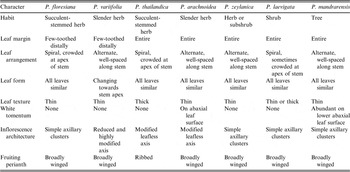
Pouzolzia floresiana has a sufficiently striking habit and fruit morphology that it can be described adequately as a species of Pouzolzia, even from such limited material. The absence of a transverse dorsal appendage on male tepals and the spirally arranged (rather than opposite) petiolate leaves possessing upper veins places it within Pouzolzia sect. Pouzolzia. It is distinctive in Pouzolzia sect. Pouzolzia (and in the genus as a whole) in its combination of a thick succulent stem with leaves crowded at its apex, leaves few-toothed distally, and a broadly winged fruit. The only other Old World species with a similar habit is Pouzolzia thailandica Friis & Wilmot-Dear (endemic to the eastern part of peninsular Thailand) which also occurs near the coast (although on limestone) but its leaves are entire and thick and its inflorescence architecture and fruit morphology are very different. Four of the five Old World species of Pouzolzia sect. Pouzolzia with a broadly winged fruiting perianth are also entire-leaved (as well as differing markedly from Pouzolzia floresiana in habit and other characters). Among the species with serrate leaves only Pouzolzia variifolia Friis & Wilmot-Dear (endemic to Timor and S Sulawesi) has a broad-winged fruiting perianth; the leaves of both taxa are somewhat similar in being entire proximally (rather than the more common character-state of toothed throughout) but P. variifolia differs markedly in habit, leaf form and inflorescence architecture. Pouzolzia floresiana is thus morphologically very distinct within Pouzolzia sect. Pouzolzia, although nothing is so far known about its phylogenetic position within the section. The taxa and characters mentioned above are detailed in Table 1.
Comparison of some morphological characters of the new species of Pouzolzia (P. floresiana) with those of a range of similar species in sect. Pouzolzia

In the key in Wilmot-Dear & Friis (Reference Wilmot-Dear and Friis2006: 11) couplet 6 is slightly modified and a new couplet inserted before couplet 8, as indicated in the following extract. (The second lead of couplet 6 will thus lead to a new couplet in the original key, ‘8A’ rather than ‘8’.)
6. First leaves dentate, later ones progressively changing in form towards stem apex, becoming smaller and entire or with a few erratically-scattered teeth; main stems usually with at least some highly reduced congested lateral inflorescence-bearing axes with bract-like leaves; slender herb with stems less than 1 mm diameter and membraneous or thin-chartaceous leaves 7
6. All leaves dentate or serrate and of similar form; no highly reduced axes present; shrub, tree or robust herb with stems often 2–3(–4) mm in diameter and leaves often thicker 8A
7. Fruiting perianth thick, warty, persistent; bract-like leaves of congested modified axes similar to unmodified leaves in shape, colour and texture; leaves always membraneous, drying bright green; male flowers 4-merous (Africa) 6. P. fadenii
7. Fruiting perianth smooth with broad wing giving apex a bi-dentate form; bract-like leaves of the congested modified axes very unlike unmodified leaves, forming an almost tubular structure enclosing inflorescence and drying blackish (?fleshy); unmodified leaves drying dull green, often thin-chartaceous; male flowers 3-merous (Sulawesi and Timor) 5. P. variifolia
8A. Leaves crowded at stem apex; herb with stems thick, juicy and fragile, c.4 mm diameter near apex; fruiting perianth longitudinally ribbed and with a broad, often slightly crenate, marginal wing, 1.5–2 mm wide; leaf margin entire in proximal 1/2–1/3, with up to 8 broad shallow teeth in distal part P. floresiana
8A. Leaves well spaced along stems; tree, shrub or woody-based herb, stems slender or woody, 1–3 mm diameter near apex; fruiting perianth longitudinally ribbed but without marginal wings; leaves often toothed to base 8B
8B. Stipules extremely broadly deltoid-cordiform with abrupt tail-like apex, broader than long, 2–3 × 2.5–5.5 mm excluding apical ‘tail’; stigma always short, c.0.5 mm; woody-based herb to 60 cm with leaves membraneous to thin-chartaceous, not exceeding 8 cm long, basal veins rarely extending into distal 1/3 of lamina (Indonesia, Luzon) 4. P. rubricaulis
8B. Stipules triangular-acute to narrowly triangular and gradually ± acuminate, always longer than broad; stigma always long, (1.5–)2–6 mm; often shrub to tree 1–5 m high, leaves often thicker and often up to 13 cm long, basal veins extending well into distal 1/3 of lamina 9 [i.e. rest of key in Wilmot-Dear & Friis (Reference Wilmot-Dear and Friis2006)]
Acknowledgements
The authors are indebted to the director and curator of the herbarium at Leiden (L) for the loan of material amongst which this specimen was found. The illustration was provided by Margaret Tebbs.