Clostridium difficile has rapidly emerged as the leading cause of healthcare-associated infectious diarrhea.Reference Dubberke, Butler and Yokoe 1 , Reference Jarvis, Schlosser, Jarvis and Chinn 2 Infections due to C. difficile are associated with significant morbidity and mortality, with clinical presentation ranging from diarrhea to pseudomembranous colitis, toxic megacolon, and sepsis.Reference Dubberke and Olsen 3 Established risk factors for C. difficile infection (CDI) include advanced age,Reference Keller and Surawicz 4 , Reference Makris and Gelone 5 prolonged hospital stay,Reference Bignardi 6 immunosuppression,Reference Haines, Moore and Bartlett 7 , Reference Shah, Tsapepas and Kubin 8 and exposure to various classes of antibiotics.Reference Garey, Sethi, Yadav and DuPont 9 , Reference Hensgens, Goorhuis, Dekkers and Kuijper 10
Several studies have demonstrated that C. difficile frequently contaminates the hospital environment, including patient skin sites, hands of healthcare workers, and hospital room surfacesReference Kim, Fekety and Batts 11 – Reference Gerding, Muto and Owens 15 such that transmission can occur directly via healthcare worker–patient contact or indirectly from contaminated surfaces.Reference Vardakas, Konstantelias, Loizidis, Rafailidis and Falagas 16 , Reference Stevens, Dumyati, Fine, Fisher and van Wijngaarden 17 In addition, C. difficile is capable of forming endospores that are resistant to many sterilization and disinfection measures, including heat, 70% ethanol (ie, the main component in hand sanitizers), and quaternary ammonium compounds, thus facilitating its persistence on environmental surfaces.Reference Gerding, Muto and Owens 15 , Reference Rutala and Weber 18 Along these lines, studies have shown that room assignment is important in the acquisition of C. difficile, with patients placed in a room with a previous occupant with CDI having a significantly increased risk of CDI.Reference Shaughnessy, Micielli and DePestel 19 , Reference Chang and Nelson 20
Although previous studies support an important role for the hospital environment in the acquisition of nosocomial CDI, to our knowledge there have been no studies to date assessing the association between hospital room size and risk of CDI. The objective of our study was to evaluate the association between CDI and hospital room square footage, with the hypothesis that a greater square footage would be associated with an increased risk of acquiring C. difficile (eg, due to increased environmental contamination and/or inadequate room cleaning).
METHODS
Study Design
A case-control study was performed at the Hospital of the University of Pennsylvania, a 775-bed tertiary care academic medical center. Case patients were defined as those with a first episode of nosocomial C. difficile (ie, positive test result for C. difficile >72 hours after admission) from January 1, 2011, through December 31, 2011. A CDI case was confirmed as an initial episode according to standard surveillance definitions in a patient with no prior episode in the preceding 8 weeksReference McDonald, Coignard, Dubberke, Song, Horan and Kutty 21 and was determined to represent an infection as opposed to colonization by case review by an infection preventionist. Testing for C. difficile was performed at the hospital’s clinical microbiology laboratory and involved glutamate dehydrogenase antigen enzyme immunoassay screening followed by toxin A/B enzyme immunoassay testing to confirm positive results. Rooms occupied with patients known to be colonized or infected with C. difficile undergo terminal cleaning with bleach-based disinfectant.
Study Population
The source population for control patients was comprised of patients who were hospitalized at the Hospital of the University of Pennsylvania in the same calendar year who did not have any positive CDI test results. Control patients were randomly selected and matched to case patients in a 2:1 ratio on the basis of “time at risk” in 3-day strata. The time at risk for case patients was defined as the date of admission to the date of the first positive C. difficile test. For control patients, time at risk was defined as the date of admission to the date of hospital discharge. The primary exposure of interest was the square footage of the room (length×width) that the patient had occupied at the time of CDI diagnosis.
Patients known to be C. difficile positive from prior admissions were excluded because these cases would most likely be representative of relapsing or recurrent disease as opposed to a first episode of nosocomial CDI. In addition, patients who were in the intensive care unit were excluded. Patients were also excluded if they had transferred room locations prior to the positive test for cases or prior to discharge for controls. If a patient had more than one positive test for C. difficile during the study period, only the first episode was included. The study was approved by the institutional review board of the University of Pennsylvania.
Data Collection
All cases of C. difficile during calendar year 2011 were ascertained from the University of Pennsylvania Health System Department of Healthcare Epidemiology and Infection Control. Data on case and control patients were abstracted from Penn Data Store, a comprehensive electronic database that includes demographic, laboratory, billing, and pharmacy information. Information was collected on demographic characteristics (eg, age, weight), room locations within the hospital from admission to discharge, comorbidities (eg, diabetes mellitus, malignant tumor), service of admission (eg, general medicine, oncology), prior admission to the University of Pennsylvania Health System in the previous 90 days, and hospital length of stay. Data was also collected on the square footage of the hospital rooms for case and control patients.
Data on medications received in the 30 days prior to the positive test date or discharge for case and control patients, respectively, were collected and modeled as dichotomous variables. Medication data included the use of antibiotics, proton-pump inhibitors, corticosteroids, and immunosuppressants (ie, azathioprine, cyclosporine, mycophenolate, sirolimus, tacrolimus). Antibiotics were classified for the purposes of analysis as follows: aminoglycosides, macrolides, fluoroquinolones, extended-spectrum cephalosporins (ie, ceftriaxone, ceftazidime, cefpodoxime), first-generation cephalosporins (ie, cefadroxil, cefazolin, cephalexin), penicillins (ie, ampicillin, amoxicillin, amoxicillin-clavulanate, nafcillin), carbapenems, piperacillin-tazobactam, cefepime, metronidazole, intravenous vancomycin, clindamycin, trimethoprim-sulfamethoxazole, and anti-anaerobic agents.
Statistical Analysis
Case and control patients were characterized by potential risk factors, including demographic characteristics, square footage of the patient’s hospital room, comorbidities, and prior medication use. Descriptive statistics were conducted to characterize the overall study population. Since data were matched, conditional bivariate logistic regression was used to examine the relationship between each potential risk factor and infection with C. difficile. To examine the relationship with square footage while adjusting for other possible risk factors, multivariate conditional logistic regression was performed. To limit the number of variables tested in a single model, on initial pass, variables from bivariate analyses with P<.05 were evaluated and considered for inclusion in the final multivariate model. Backward stepwise selection was performed for selection of variables in the final explanatory model, with results confirmed using likelihood ratio testing. Data are presented as odds ratios (ORs) with 95% CIs. All analyses were performed using STATA, version 13.0 (StataCorp).
RESULTS
Study Population
A total of 468 cases of C. difficile occurred during the study period. Of these cases, 103 (22%) were confirmed to be hospital-acquired infections. After application of inclusion and exclusion criteria, there were a total of 75 case patients included in this study, each of whom were randomly matched to controls in 2:1 ratio (n=150) based on time at risk. Among case patients, the median length of stay prior to positive C. difficile testing was 9 days (interquartile range, 7–15 days).
Among the entire study cohort, the median age of patients was 60 years (interquartile range, 50–70 years), and 117 (52%) were men. Of the 225 patients, 139 (62%) were categorized as “white” in regard to racial classification. Notably, there was a high prevalence of overweight/obesity (body mass index [calculated as weight in kilograms divided by height in meters squared] ≥25) (65%) and malignant tumor (47%) present in the study cohort. None of the patients in the study cohort were located in a room where the immediately preceding occupant had confirmed CDI.
Risk Factors for Nosocomial CDI
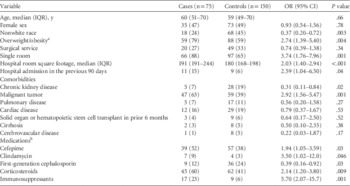
On bivariate analysis (Table 1), there was a significant association between risk of C. difficile and nonwhite race (OR, 0.37; 95% CI, 0.20–0.72; P=.003), as well as overweight or obesity (2.74; 1.39–5.40; P=.004). Bivariate analysis also demonstrated a significant association between CDI and location in a single room (OR, 3.74; 95% CI, 1.76–7.96; P=.001), hospital room square footage (2.03; 1.40–2.94; P <.001), prior admission to the hospital within the previous 90 days (2.59; 1.04–6.50; P=.04), and malignant tumor (2.92; 1.56–5.47; P=.001).
Bivariate Conditional Logistic Regression of Risk Factors for Nosocomial Clostridium difficile Infection Among Hospitalized Patients

NOTE. Data are number (percentage) unless otherwise indicated. OR, odds ratio; IQR, interquartile range.
a Body mass index (calculated as weight in kilograms divided by height in meters squared) ≥25.
b Only variables with P<.05 are shown.
Regarding medication use, there was a significantly increased risk of CDI with prior receipt of clindamycin (OR, 3.50; 95% CI, 1.02–12.0; P=.046), cefepime (1.94; 1.05–3.59; P=.03), corticosteroids (2.14; 1.20–3.80; P=.009), and immunosuppressants (5.70; 2.07–15.7; P=.001).
On subsequent multivariate analysis, hospital room square footage was an independent risk factor for acquisition of nosocomial C. difficile (OR for every 50 ft2 increase, 3.00; 95% CI, 1.75–5.16; P<.001). Single room assignment (OR, 3.43; 95% CI, 1.31–9.05; P=.01), malignant tumor (4.56; 1.82–11.4; P=.001), and previous receipt of cefepime (2.48; 1.06–5.82; P=.04) or immunosuppressants (6.90; 2.07–23.0; P=.002) were also significantly associated with an increased risk for acquiring nosocomial C. difficile. Notably, there was a significant difference between days of cefepime use in case and control patients, as follows: mean (SD), 8.9 (7.2) days and 2.4 (1.6) days, respectively (P<.001).
DISCUSSION
In this case-control study, we found that greater hospital room square footage was a significant risk factor for acquisition of nosocomial C. difficile after adjustment for other known risk factors. CDI was also significantly associated with single room assignment, presence of malignant tumor, and recent receipt of cefepime.
Previous epidemiologic studies have demonstrated that the hospital environment, including room assignment, is critical in the acquisition of nosocomial CDI.Reference Kim, Fekety and Batts 11 , Reference Shaughnessy, Micielli and DePestel 19 , Reference Chang and Nelson 20 However, to our knowledge this is the first study to demonstrate an association between hospital room square footage and CDI. Environmental contamination plays an important role in the transmission of C. difficile in the hospital setting, with greater intensity of contamination increasing transmission risk.Reference Weber and Rutala 22 , Reference Samore, Venkataraman, DeGirolami, Arbeit and Karchmer 23 It is likely that a larger hospital room allows for more contamination of surfaces with C. difficile spores and subsequent increased risk of acquisition. In addition, a hospital room with greater square footage is more likely to contain a greater number of high-touch objects (eg, medical equipment) that may become contaminated and thereby increase risk of transmission to subsequent room occupants. Finally, it is likely that a larger room increases the potential for inadequate room cleaning, particularly given the high demand for bed turnover in many hospitals.
Given that up to 50% of hospital surfaces are not cleaned appropriately by hospital environmental services staff during terminal cleaning,Reference Carling, Parry and Rupp 24 , Reference Goodman, Platt, Bass, Onderdonk, Yokoe and Huang 25 this finding has important implications for the hospital setting. It is clear that interventions to improve room cleaning, including all surfaces in addition to high-risk objects, are needed. Newer modalities (eg, hydrogen peroxide vapor or mist, ultraviolet-C light)Reference Nerandzic, Cadnum, Pultz and Donskey 26 , Reference Boyce, Havill and Otter 27 show significant promise in reducing surface contamination with C. difficile in hospital rooms. In addition, organizational factors, including education of environmental services staff, bed management, and allocation of time and resources for cleaning dependent on different factors (eg, prior occupant colonized or infected with a multidrug-resistant organism, room size), should be the focus of future studies.
The results of our study also demonstrated a significant association between malignant tumors and CDI. Patients with malignant tumors are at an increased risk for acquiring CDI for a number of reasons, including prolonged hospitalization, use of broad-spectrum antibiotics, bone marrow and peripheral blood stem cell transplantation, and neutropenia.Reference Chopra, Alangaden and Chandrasekar 28 The incidence of CDI in cancer patients receiving chemotherapy has been reported to be as high as 7%, compared with 1%–2% in the general hospitalized population.Reference Chopra, Alangaden and Chandrasekar 28 Patients with malignant tumors, as in our study, frequently receive chemotherapeutic agents, which likely increases the risk of CDI given alterations in bowel flora and depression of the immune system.Reference Anand and Glatt 29 Along these lines, patients who received immunosuppressants in the previous 30 days in our study were also found to have a significantly increased risk for acquiring C. difficile, including those who were recent recipients of solid organ transplants.Reference Collini, Bauer, Kuijper and Dockrell 30
We also found a significant association between CDI and location in a single room. Single rooms are often reserved for patients on contact precautions owing to colonization or infection with multidrug-resistant organisms. Therefore, location in a single room may be a proxy for patients who are at greater risk for hospital-acquired infections such as CDI. In addition, although there was no significant difference in median square footage of single versus double rooms in our study (P=.75), patients with malignant tumors were more likely to be located in single rooms (P<.001). Finally, single rooms are often in the highest demand for new hospital admissions, and the requirement to turn over these rooms on a timely basis may increase the potential for inadequate cleaning.
In the final multivariable model, cefepime use in the prior 30 days was also shown to increase the risk for acquiring nosocomial C. difficile. Although some prior studies have demonstrated a significantly increased risk of CDI specifically with fluoroquinolone use,Reference Vardakas, Konstantelias, Loizidis, Rafailidis and Falagas 16 , Reference Stevens, Dumyati, Fine, Fisher and van Wijngaarden 17 this association was not shown in our study, with 22% and 16% of case and control patients having received a fluoroquinolone, respectively (P>.99). Notably, cefepime and fluoroquinolones are all on formulary at the study hospital. A wide variety of antibiotic agents and classes have been associated with CDI,Reference Garey, Sethi, Yadav and DuPont 9 , Reference Hensgens, Goorhuis, Dekkers and Kuijper 10 and given its broad-spectrum activity, cefepime may be particularly likely to disrupt the endogenous gastrointestinal flora, thereby increasing the risk of colonization and infection with C. difficile.
There are potential limitations of our study. Misclassification bias is a concern in case-control studies. However, the outcome of nosocomial CDI was validated through medical chart review by infection preventionists rather than by relying on diagnostic or billing codes. Although there were no health system changes in regard to room cleaning or isolation precaution protocols during the study period, we did not have data on the adequacy of room cleaning or adherence to contact precautions that may have affected surface contamination with C. difficile. Given the retrospective nature of the study, we also did not have data on the number of objects (eg, medical equipment) present in the hospital room. Finally, the present study was conducted in a single healthcare system, and these results may not be generalizable to other institutions.
In conclusion, the results of our study demonstrate that greater hospital room square footage is a significant risk factor for nosocomial CDI. This finding highlights the importance of the hospital environment in the transmission of CDI as well as the need for interventions to improve environmental disinfection processes in the hospital setting. Future studies should also focus on the role of organizational factors and CDI transmission risk, including bed management and allocation of disinfection and environmental services resources based on patient location and characteristics.
Acknowledgments
Financial support. National Institutes of Health (K01-AI103028 to J.H.H.) and the CDC Prevention Epicenters Program (U54-CK000163 to Ebbing Lautenbach).
Potential conflicts of interest. All authors report no conflicts of interest relevant to this article.
The funding agencies had no role in the design and conduct of the study; collection, management, analysis, and interpretation of the data; or preparation, review, or approval of the manuscript.