INTRODUCTION
Schistosomiasis and soil-transmitted helminthiasis (STH) are widespread diseases of considerable public health importance in the least-developed countries (WHO, 2002a). The highest prevalence and intensity of infection are usually observed in school-aged children (WHO, Reference Hussein, Talaat, El-Sayed, El-Badawi and Evans2003). In sub-Saharan Africa, Tanzania is one of the most severely affected countries by schistosomiasis and STH (WHO, 1998).
Recognising the public health significance of schistosomiasis and STH, the World Health Assembly set forth a resolution for a combined approach for morbidity control of these diseases (WHO, 2002a). Following the advent of safe, inexpensive and efficacious single-dose oral drugs, chemotherapy is now considered the cornerstone for morbidity control of schistosomiasis and STH targeting school-aged children and other high-risk groups (WHO, Reference Hussein, Talaat, El-Sayed, El-Badawi and Evans2003). Currently, praziquantel is the drug of choice for the treatment of all human schistosomes, whereas albendazole and mebendazole are the two most widely used drugs for treatment of STH (WHO, 2004); Doenhoff et al. see in this special issue; Keiser and Utzinger, Reference Keiser and Utzinger2008).
School-based anthelminthic programmes are increasingly being implemented (Brooker et al. Reference Brooker, Kabatereine, Fleming and Devlin2008; Kabatereine et al. Reference Kabatereine, Tukahebwa, Kazibwe, Namwanje, Zaramba, Brooker, Stothard, Kamenka, Whawell, Webster and Fenwick2006; Partnership for Child Development, 1997; WHO, 2001). In Tanzania, mass drug administration (MDA) of anthelminthics to all children in schools is the approach adopted by the National Schistosomiasis and Soil-Transmitted Helminth Control Programme (NSSCP). The benefit of school-based de-worming programmes for children has been documented in several studies (Magnussen et al. Reference Magnussen, Ndawi, Sheshe, Byskov, Mbwana and Christensen2001; Saathoff et al. Reference Saathoff, Olsen, Kvalsvig and Appleton2004a, Reference Saathoff, Olsen, Magnussen, Kvalsvig, Becker and Appletonb; Zhang et al. Reference Zhang, Koukounari, Kabatereine, Fleming, Kazibwe, Tukahebwa, Stothard, Webster and Fenwick2007). However, a limitation of the school-based approach is that in areas with high rates of non-enrolment and non-attendance, a significant proportion of out-of-school children will be missed by the programme. UNESCO (2000) reported that an estimated 113 million children of school-age are not in school, the majority of these children are living in sub-Saharan Africa and South-East Asia. In contrast to one finding in Ethiopia (Tiruneh et al. Reference Tiruneh, Fantahun, Kassu, Tiruneh, Van Lieshout and Polderman2001), several studies have shown that non-enrolled children had higher prevalences and intensities of helminth infections than those attending school (Hussein et al. Reference Hussein, Talaat, El-Sayed, El-Badawi and Evans1996; Talaat, Omar and Evans, Reference Talaat, Omar and Evans1999; Useh and Ejezie, Reference Useh and Ejezie1999).
Although some school-based programmes have extended their treatment coverage to reach out-of-school children, studies have shown that older children and those living far away often do not show up for treatment (Webbe and el-Hak, Reference Webbe and el-Hak1990). Currently, the World Health Organization (WHO) requires that by the year 2010, regular treatment should be offered to at least 75% and up to 100% of all school-aged children who are at risk of morbidity due to schistosomiasis and STH (WHO, 2006). The challenge now is to ensure high and sustainable treatment coverage of school-aged children in affected communities. Therefore, evidence is needed on an intervention approach that enables all children to benefit from treatment.
The community-directed treatment (ComDT) approach has been shown to improve treatment coverage of MDA for control of onchocerciasis and lymphatic filariasis as compared to the use of mobile teams (TDR, 2000a, b). The objective of this study was to compare treatment coverage of a single dose of praziquantel (40 mg/kg) and albendazole (400 mg) for the control of schistosomiasis and STH among school-aged children using the ComDT approach or the school-based treatment approach, where non-enrolled school-aged children were invited for treatment in schools. In both approaches, treatment coverage was assessed in both enrolled and non-enrolled school-aged children.
MATERIALS AND METHODS
Study area and population
The study was conducted in Umba division, Lushoto district, Tanga region. The district is situated in the northern part of the Tanga region and borders Same district in the Kilimanjaro region to the northwest, and the Republic of Kenya to the north. In the south and east, it borders Korogwe district and Muheza district in the Tanga region, respectively. Lushoto district is divided into 8 divisions, 32 wards and 137 registered villages with a population estimated at 419 970 people among which 132 046 are estimated to be school-aged children (age: 6–15 years) (National Bureau of Statistics, 2002).
The main ethnic groups in Lushoto are the Sambaa (~70%), the Pare and the Mbugu. The majority (98%) of the population are peasants engaged in small-scale farming and petty business. The main food crops are potatoes, rice, beans, bananas, maize and cassava, while fruits, tea, coffee and ginger are grown as cash crops. Approximately 60% of the population keep cattle, sheep, goats or chickens. Lushoto district covers an area of about 3500 km2, of which arable land accounts for 50 to 80% (National Bureau of Statistics, 2004). It has an altitude ranging from 300 to 2400 m above sea level and experiences rainfall averaging 1100 mm per annum (range: 600 to 1200 mm per annum).The long rainy season is from March to May, while short rains occur during November and December. The dry season is short ranging from January to March. The month of September is also occasionally dry. The highlands (2666 km2) cover approximately 75% of the district. Generally, the highlands are characterized by cold weather with the mean annual temperature in the 17–18°C range, while in the hot lowlands the range is 25–27°C. Mean daily temperatures are highest in January and lowest in July. The soil generally has a high content of clay and sand, while low in silt (Tanzania Meteorological Agency, 2004). The Umba River and several seasonal streams pass through the lowlands.
The Umba division was selected based on an earlier questionnaire survey showing that the prevalence of haematuria (an indicator for urinary schistosomiasis) was higher in this division compared to other lowland divisions. Umba division has 13 villages and 17 primary schools and is served by one health centre and two dispensaries. Ten villages were randomly selected and randomly allocated to the two different drug delivery approaches: the ComDT approach (5 villages) and the school-based treatment approach (5 villages). A demographic survey of all school-aged children (age: 6–15 years) in the involved villages was conducted before the intervention was implemented.
The two drug delivery approaches
In the ComDT approach, the villagers were encouraged to take control of their own treatment. They selected their own community drug distributors (CDDs) who administered praziquantel plus albendazole to the school-aged children (those aged between 6 and 15 years). The CDDs organized and implemented their own method of distributing drugs at their own convenient time.
In the school-based approach, schoolteachers administered treatment to the children in the schools. The non-enrolled children were also invited to come to schools for treatment and the teachers were instructed to treat both the non-enrolled and the enrolled children with praziquantel plus albendazole as above.
Both the CDDs and schoolteachers attended a short training course covering drug dosage calculations, possible adverse events, registration and reporting before administering treatment and they were provided with free anthelminthic drugs. In case of adverse events after treatment, the CDDs and schoolteachers were instructed to refer the children to a local health facility. With both approaches the children received a single dose of praziquantel (40 mg/kg body weight) using the validated ‘dose pole’ (Montresor et al. Reference Montresor, Engels, Chitsulo, Bundy, Brooker and Savioli2001; WHO, Reference Hussein, Talaat, El-Sayed, El-Badawi and Evans2003), which are based on height to determine drug dosage against schistosomiasis, and a single dose of albendazole (400 mg) against STH.
Data analysis
All statistical analyses were performed using version 9.0 of the STATA software (StataCorp, College Station, Texas, USA). Treatment coverage of both the enrolled and non-enrolled school-aged children was computed as x/n where x is the number of children treated in each group of children and n is the total population of children in each group. Proportions were compared with χ2 tests and P<0·05 was considered significant.
Ethical considerations
Ethical clearance was obtained from the National Medical Research Coordinating Committee of the National Institute for Medical Research, Dar es Salaam in Tanzania (ref.: NIMR/HQ/R.8a/VolIX/127). The Danish National Committee on Biomedical Research Ethics, Copenhagen, Denmark recommended the study (ref.: 624-03-0016). Regional and district health authorities, regional and district education authorities, as well as village leaders and head teachers were informed about the study before it started.
Information meetings were held in each participating school and village to explain the purpose of the study, the procedures involved, the benefits and the potential risks of taking part in the study. The benefit of being part of the study was that children received free anthelminthic drugs for schistosomiasis and STH. The potential risks of taking part in the study were mainly due to a range of possible adverse events that may be associated with anthelminthic drugs and which are generally reported to be mild, transient, and self-limiting (Olsen, Reference Olsen2007; WHO, 2002a).
RESULTS
Baseline survey
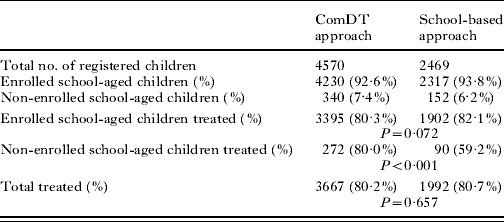
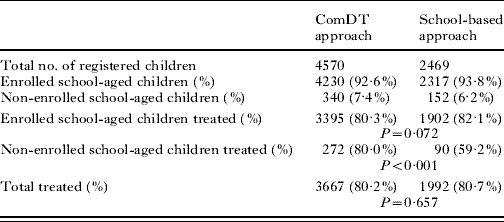
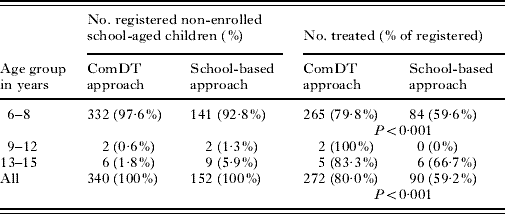
A total of 4570 school-aged children (age range: 6 to 15 years) were identified in the 5 villages allocated to the ComDT approach (Table 1). Among these children, 340 (7·4%) were found to be non-enrolled children. In the 5 villages allocated to the school-based approach, a total of 2469 school-age children (age between 6–15 years) were identified (Table 1). Among these children, 152 (6·2%) were found to be non-enrolled at school. In the ComDT and the school-based approaches, the mean age of the registered children was 9·8 and 9·6 years, respectively, and 51·2 and 50·2% were boys, respectively. There was no difference in the mean age and sex distribution between the areas.
Comparison of treatment coverage of school-aged children at the first treatment round by treatment approach
Coverage of school-aged children at the first treatment round by treatment approach
Treatment coverage was assessed from drug distribution registers which were used by both the CDDs and the schoolteachers. The registers included the names of all school-aged children surveyed earlier in the villages during the demographic survey. It also included sex, age, height, drug given and a space for comments. Overall, treatment coverage of the school-aged children was similar between the two approaches as the ComDT approach reached 80·2% and the school-based approach 80·7% (P=0·657). The treatment coverage among the enrolled children was also similar for the two approaches (ComDT: 80·3% and school: 82·1%, P=0·072, Table 1). However, when compared among the non-enrolled children the treatment coverage was significantly higher in the area where the ComDT approach had been implemented compared to the area using the school-based approach (80·0 versus 59·2%, P<0·001, Table 1).
Coverage of school-aged children at the first treatment round by age and treatment approach
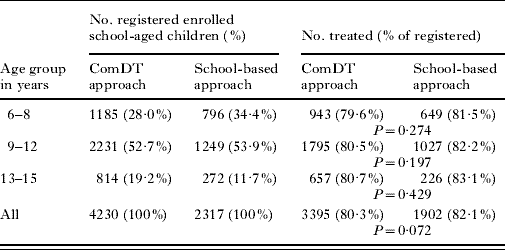
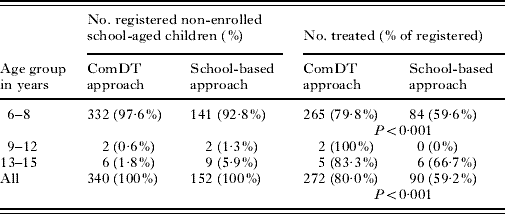
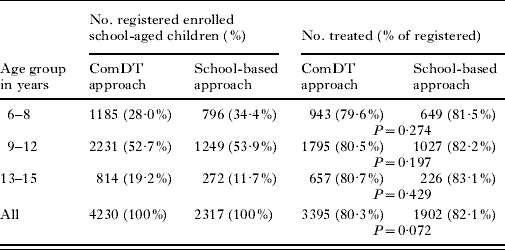
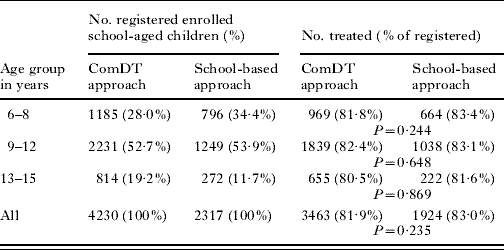
Treatment coverage was similar between boys and girls within each intervention approach (data not shown). Among the enrolled school-aged children, the treatment coverage was also similar within and between both approaches for all age groups (P>0·05, Table 2). For the non-enrolled school-aged children, the treatment coverage in the area with the ComDT approach was significantly higher in the age group 6–8 years compared to the area with the school-based approach (P<0·001, Table 3). There were too few children in the other age groups to make statistical comparisons.
Coverage of enrolled school-aged children at the first treatment round by age group and treatment approach
Coverage of the non-enrolled school-aged children at the first treatment round by age group and treatment approach
During the first treatment round the main reasons for non-treatment among the enrolled school-aged children in the area with the ComDT approach were absenteeism (95·8%), refusal (2·8%), sickness (1·3%) and being away from the village (0·1%). The main reasons for non-treatment among the enrolled school-aged children in the area with the school-based approach were absenteeism (91·6%), refusal (2·1%) and sickness (6·3%).
Coverage of school-aged children at the second treatment round by treatment approach
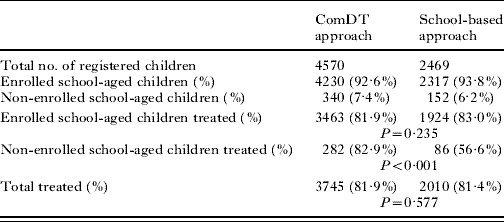
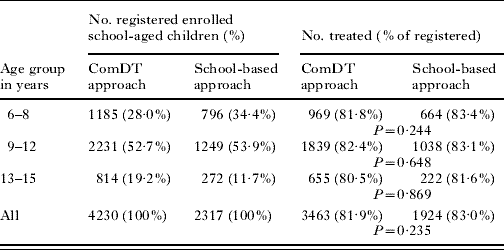
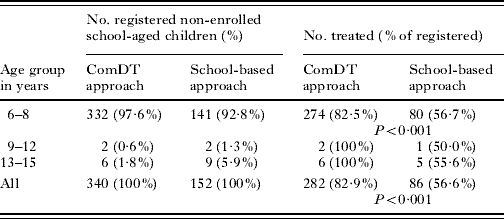
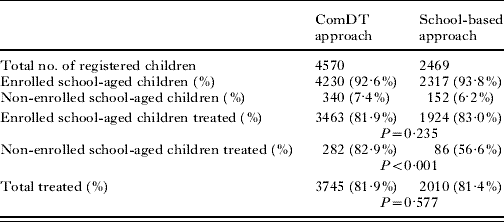
Overall, the treatment coverage for both approaches increased slightly, but insignificantly, compared to the first treatment round. Similar to the first treatment round, the treatment coverage of the school-aged children was similar between the two approaches as the ComDT approach reached 81·9% and the school-based approach 81·4% (P=0·577). The treatment coverage among the enrolled children was also similar between the ComDT approach and the school-based approach (81·9 and 83·0%, P=0·235, Table 4). However, when compared among the non-enrolled children, the treatment coverage was significantly higher in the area where the ComDT approach had been implemented compared to the area using the school-based approach (82·9 versus 56·6%, P<0·001, Table 4).
Comparison of treatment coverage of school-aged children at the second treatment round by treatment approach
Coverage of school-age children at the second treatment round by age and treatment approach
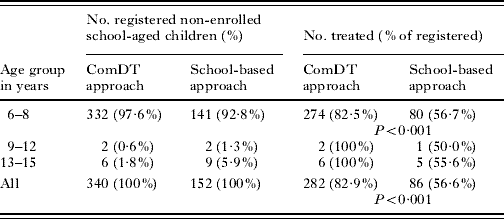
Treatment coverage was similar for boys and girls within each intervention area (data not shown). Among the enrolled school-aged children the treatment coverage was also similar within and between both areas for all age groups (P>0·05, Table 5). Treatment coverage for the non-enrolled school-aged children in the area with the ComDT approach was significantly higher in the age group 6–8 years compared to the area with the school-based approach (P<0·001). The number of children in the other groups was very small and did not allow for meaningful statistical analysis (Table 6).
Coverage of enrolled school-aged children at the second treatment round by age group and treatment approach
Coverage of the non-enrolled school-aged children at the second treatment round by age and treatment approach
During the second treatment round the main reasons for non-treatment among the enrolled school-aged children in the area with the ComDT approach were due to absenteeism (97·0%), refusal (1·6%), sickness (0·9%) and being away from the village (0·4%). The main reasons for non-treatment among the enrolled school-aged children in the area with the school-based approach were due to absenteeism (93·4%), refusal (4·1%), sickness (1·8%) and transfers to the urban schools (0·8%).
A small minority of school-aged children reported mild and short-lived symptoms and adverse events such as abdominal pain and nausea after the treatments.
DISCUSSION
The results of this study show that praziquantel and albendazole treatment coverage for the control of schistosomiasis and STH among school-aged children was similar in the ComDT and the school-based approaches. This is contrary to what has been observed in Uganda where the ComDT approach achieved a significantly higher treatment coverage compared to a school-based approach (Ndyomugyenyi and Kabatereine, Reference Ndyomugyenyi and Kabetereine2003). The relatively higher treatment coverage in the school-based approach in the present study is probably a result of the attention put into the approach, compared to what is done in Uganda where the school-based approach has existed for many years. In the present study the project instructed the leaders of the villages using the school-based approach to conduct mobilization meetings for the drug distribution. There was a positive interaction between the village leaders and the schools, which was fundamental for the success of the school-based approach. In addition, the schoolteachers were highly committed and positive about their role in the administration of drugs. This is in accordance with what has been found in other studies (Lengeler, Utzinger and Tanner, Reference Lengeler, Utzinger and Tanner2002; Magnussen et al. Reference Magnussen, Ndawi, Sheshe, Byskov, Mbwana and Christensen2001). All this had a great impact in the implementation and success of the school-based approach.
According to the National Bureau of Statistics (2004), urban residents within Tanzania are more likely to have attended and to have remained in schools for a longer period than rural residents. However, in this study the enrolment rate of school-aged children was very high in all study villages. Thus, when comparisons were made according to school enrolment, it was evident that both regimes of drug intervention approaches attained similar treatment coverage among the enrolled school-aged children, but that the ComDT approach achieved a significantly higher treatment coverage in the non-enrolled school-aged children compared to a school-based treatment approach, where non-enrolled school-aged children were invited for treatment in schools. The higher treatment coverage of the ComDT approach among the non-enrolled school-aged children is likely to be due to easy access and opportunity for the CDDs to make frequent home visits to reach these children whereas the schoolteachers did not have such opportunity. When comparisons were made for the different age groups, the two drug delivery approaches were equally successful within all age groups of enrolled children. For the non-enrolled children, the ComDT approach seemed to have covered more children than the school-based approach. Most non-enrolled children in our study population were between 6 and 8 years of age and very few non-enrolled children were above 9 years of age making it difficult to do meaningful comparisons in these age groups. The higher treatment coverage of the ComDT approach in the non-enrolled children was reflected in a significant lower re-infection at 12 months of Schistosoma haematobium and hookworm infections in the ComDT approach villages (Massa et al. Reference Massa, Magnussen, Sheshe, Ntakamulenga, Ndawi and Olsen2009).
It was found that treatment coverage for both approaches increased slightly in the second round of treatment. This is probably due to an increased awareness that could possibly be further enhanced in following rounds of treatment. The increased awareness was probably due to the mobilisation by the villagers leaders. This is encouraging as the villagers will be more likely to comply and sustain future intervention measures.
School-based programmes are currently being implemented in several developing countries. It is argued that treating schoolchildren takes advantage of the extensive educational infrastructure which provides a system where large numbers of school-aged children are accessible for MDA (WHO, Reference Hussein, Talaat, El-Sayed, El-Badawi and Evans2003). In this perspective, Montresor et al. (Reference Montresor, Crompton, Gyorkos and Savioli2002) reported that more than 480 million children attend primary schools each year in developing countries and those schools provide ideal settings in which to implement school-based programmes and reach these children for treatment. Several studies have documented that school-based de-worming programmes are beneficial to children (Magnussen et al. Reference Magnussen, Ndawi, Sheshe, Byskov, Mbwana and Christensen2001; Saathoff et al. Reference Saathoff, Olsen, Kvalsvig and Appleton2004a, Reference Saathoff, Olsen, Magnussen, Kvalsvig, Becker and Appletonb; WHO, Reference Hussein, Talaat, El-Sayed, El-Badawi and Evans2003; Zhang et al. Reference Zhang, Koukounari, Kabatereine, Fleming, Kazibwe, Tukahebwa, Stothard, Webster and Fenwick2007), but it should be noted that once children are enrolled it is not certain that they will attend regularly or stay in schools until they reach their final grade and complete a full course of primary education. In 2002, the United Nations reported that an estimated 115 million children were not in schools, either because they had dropped out or they had never been enrolled (United Nations, 2002). The majority of these children are living in sub-Saharan Africa and South-East Asia. If this is the trend in areas where school-based programmes are implemented, these programmes may exacerbate inequalities in communities because a significant number of school-aged children may not be reached by school-based health programmes. Although sub-Saharan Africa has made some progress in increasing school enrolment in order to reach the Millennium Development Goal (MDG) of universal primary education, it had been reported that one third of its children were still out of school (United Nations, 2005). This situation presents a great challenge to school-based programmes.
Although schistosome and STH infections may affect all age groups, those who are at most risk and would benefit most from preventive interventions are pre-school and school-aged children, adolescent girls, and women of child bearing age (WHO, 2004). It is likely that the ComDT approach can be effectively applied to reach these groups. This will also be in line with the new WHO policy to use praziquantel for pregnant and lactating mothers as well as using albendazole/mebendazole in children under the age of 24 months (Adam, Elwasila and Homeida, Reference Adam, Elwasila and Homeida2004; Montresor et al. Reference Montresor, Awasthi and Crompton2003; WHO, 2002b).
In conclusion, the school-based treatment has a limitation of reaching the non-enrolled children, while, the ComDT approach provided easy access in reaching this group through the use of CDDs, who successfully delivered the drugs. Therefore, it is anticipated that through community innovations and adaptation of the delivery strategies the ComDT approach can be utilized effectively to achieve higher treatment coverage of more school-aged children in the control of schistosomiasis and STH.
CONFLICTS OF INTEREST STATEMENT
The authors have no conflicts of interest concerning the work reported in this paper.
ACKNOWLEDGEMENTS
The authors would like to thank the Lushoto District Commissioner and the District Education Officer as well as the village leaders for granting permission to conduct the study in the villages and schools. Much thanks to the people in all study villages whose collaboration and understanding was crucial to the execution of the present study. Gratitude is also extended to the CDDs, schoolteachers and the school-age children who participated in the study. We gratefully acknowledge the financial support from the DBL-Centre for Health Research and Development.