I. INTRODUCTION
Borates, which usually feature diverse structure, high laser damage tolerance, wide transparency spectra range, good stability, and interesting thermal expansion, have shown their merit as functional materials (Chen et al., Reference Chen, Wu and Li1990; Becker, Reference Becker1998; Sasaki et al., Reference Sasaki, Mori, Yoshimura, Yap and Kamimura2000; Lou et al., Reference Lou, Li, Li, Zhang, Jin and Chen2015; Jiang et al., Reference Jiang, Molokeev, Gong, Yang, Wang, Wang, Wu, Wang, Huang, Li, Wu, Xing and Lin2016). In the past decades, a number of borates with superior optical properties have been synthesized and put into various applications. For example, K2Al2B2O7 (KAB) (Hu et al., Reference Hu, Higashiyama, Yoshimura, Yap, Mori and Sasaki1998), β-BaB2O4 (BBO) (Bosenberg et al., Reference Bosenberg, Pelouch and Tang1989), LiB3O5 (LBO) (Kellner et al., Reference Kellner, Heine and Huber1997), and Se2B2O7 (SBO) (Kong et al., Reference Kong, Huang, Sun, Mao and Cheng2006) have been used for second harmonic generation; YBO3 (Wei et al., Reference Wei, Sun, Liao, Yan and Huang2002), Ba2Mg(BO3)2 (Hu et al., Reference Hu, Wang, Huang and Fang2015), Na3Gd(BO3)2 (Shi et al., Reference Shi, You, Huang, Cui, Huang and Tao2016), and K3YB6O12 (Yang et al., Reference Yang, Wan, Huang, Chen and Seo2016) are desirable hosts of phosphor; and Ba3InB9O18 shows to be promising candidate for efficient scintillators used for X-ray detection applications (Cai et al., Reference Cai, Chen, Wang, Lou, Liu, Zhao and Chen2008).
As is known from the preceding study, lots of compounds with unique and outstanding properties have been generated from ternary borates of alkaline metals and rare earths. Saubat et al. (Reference Saubat, Vlasse and Fouassier1980) systematically investigated lanthanide magnesium pentaborates MgLnB5O10 (Ln = La, Ce, Pr, Nd, Sm, Eu, Gd, Tb, Dy, Ho, and Er). As a category of boron-rich borates, MgLnB5O10 compounds crystallize in a monoclinic structure belonging to space group P121/c1, and have turned out to be favorable solid-state laser materials and phosphors hosts. Nd3+-doped MgGd(BO2)5 has been characterized by a very strong absorption at near 808 nm and intense emission as a potential diode-pumped laser crystal (Fan et al., Reference Fan, Lin, Zhang and Wang2006), while Yb3+, Mn2+-codoped MgGdB5O10 has been demonstrated to generate room-temperature up-converted white light under the excitation of 976 nm diode laser (Ye et al., Reference Ye, Li, Yu, Dong and Zhang2011). Notably, previous studies have focused on the properties especially luminescence performances of rear earth-doped MgYB5O10. Knitel et al. reported the photoluminescence properties of MgYB5O10: Ce3+, which generates a broad self-trapped exciton (STE) emission band under X-ray excitation (Knitel et al., Reference Knitel, Dorenbos and Van Eijk2000). However, they failed to obtain single-phase samples by neither changing the amount of excessive H3BO3 nor prolonging the firing time. In addition, Zhou et al. (Reference Zhou, He, Liang and Hou2007) studied the luminescence properties of MO–Re 2O3–B2O3:Eu3+ (M = Mg, Sr; Re = Y, Gd) under vacuum ultraviolet (VUV) excitation, which included the ternary system we paid attention to in this work. Anyhow, it can be seen from the X-ray pattern given in their paper that the sample of MgYB5O10 was also not pure in their work. Moreover, little research has paid attention to the phase relations of the MgO–Y2O3–B2O3 ternary system.
Therefore, in the present work, the subsolidus phase relations of MgO–Y2O3–B2O3 ternary system were investigated, in which only one ternary compound, MgYB5O10, was confirmed. Single-phase powder sample of MgYB5O10 was successfully obtained by the solution method. Although Peterson (Reference Peterson1999) has studied MgYB5O10 and solved the structure by single-crystal diffraction method, the obtained results is in non-standard space group P121/n. Thus, we re-investigated it by the powder X-ray diffraction (XRD) and Rietveld method in this work. For the first time, first-principles calculations on the electronic structure of MgYB5O10 at T = 0 K have been performed in order for a better understanding of its basic physical properties.
II. EXPERIMENTAL
Samples were synthesized by the high-temperature solid-state reaction method when we explored the subsolidus phase relation of the MgO–Y2O3–B2O3 ternary system. Stoichiometric mixtures of MgO (spectral reagent), Y2O3 (analytical reagent), and H3BO3 (analytical reagent) were ground into homogeneous powders in an agate mortar and then were preheated in corundum crucibles for 12 h at 400–600 °C. The preheating process is to decompose H3BO3 and some other impurities. After cooling down to room temperature in the furnace, the mixtures were reground and calcined at 800–1100 °C for 24–48 h depending on their compositions. Finally, all the samples were naturally cooled to room temperature. In all cases, an excess amount (~2 at.%) of H3BO3 was added in order to compensate the losses of B2O3 in the heating processes. Especially, single-phase MgYB5O10 sample was synthesized by the Pechini method as following: stoichiometric mixtures were dissolved into dilute nitric acid and then some amount of polyvinyl alcohol was added as a complexing agent. The solution was heated with stirring to evaporate water and obtain a porous gel. Subsequently, the gel was ground and calcined at 700 °C for 48 h.
Powder XRD patterns were collected by Rigaku diffractometer D/MAX-2500 with CuKα radiation and graphite monochromator operated at 40 kV, 150 mA. The powder XRD data for crystal structure analyses were collected at room temperature under the step-scanning mode with a step size of 0.02° (2θ), counting time of 2 s step−1 and 2θ ranges of 10°–130°. Inorganic Crystal Structure Database (ICSD) and Powder Diffraction File (PDF-4 + 2011) were used for the phase analyses.
Infrared (IR) spectroscopy measurement was conducted with the objective of specifying and comparing the coordination of boron in MgYB5O10. The mid-IR spectrum ranging from 400 to 2000 cm−1 was obtained at room temperature via a Perkin–Elmer 983 G IR spectrophotometer with KBr pellets as standards.
The UV–visible (UV–vis) diffuse reflectance spectrum was measured through an SHIMADZU/UV-2450 UV spectrophotometer in the wavelength range from 200 to 700 nm.
First-principles calculations of the electronic structure for MgYB5O10 were performed using the scalar relativistic all-electron Bloch's projector augmented wave method within the generalized gradient approximation (GGA), as implemented in the highly efficient Vienna ab initio simulation package. For the GGA exchange-correlation potential, the Perdew–Burke–Ernzerhof parameterization was employed. The k-point meshes for Brillouin zone sampling were constructed using the Monkhorst–Pack scheme, and the reciprocal space meshes were increased to achieve convergence to a precision of better than 1 meV at−1. The plane-wave kinetic-energy cutoff was set as 600 eV for all calculations. The structure was optimized by minimization of the forces acting on the atoms. When the forces were minimized in this construction, one could then find the self-consistent density at these positions via turning off the relaxations and driving the system to self-consistency. We took the full relativistic effects for core states and used the scalar relativistic approximation for the valence states.
III. RESULTS AND DISCUSSION
A. Subsolidus phase relations in MgO–Y2O3–B2O3 system
In the binary system MgO–B2O3, four binary compounds MgB2O4, Mg3B2O6 [ICSD #31385], Mg2B2O5 [ICSD #79721], and MgB4O7 [ICSD #34397] (Sadanaga, Reference Sadanaga1948; Kuzel, Reference Kuzel1964; Bartl and Schuckmann, Reference Bartl and Schuckmann1966; Guo et al., Reference Guo, Cheng, Chen, Huang and Zhang1995) have been reported in former study. All of them but the first were confirmed in the present work. Mutluer and Timucin (Reference Mutluer and Timucin1975) verified the “compound” MgB2O4’s absence through the XRD pattern, DTA, and petrographic evidence, which agrees with the observation of some other researchers’ work (Kuzel, Reference Kuzel1964; Fletcher et al., Reference Fletcher, Stevenson and Whitaker1970; Bazarova et al., Reference Bazarova, Nepomnyashchikh, Kozlov, Bogdan-Kurilo, Bazarov, Subanakov and Kurbatov2007). This is identical with our experimental results. In addition, it is suggested that the considered MgB2O4 is mixture of MgB4O7 and Mg2B2O5.
In the Y2O3–B2O3 binary system, two binary compounds YBO3 [ICSD #27931] and Y3BO6 [ICDD–PDF 34-0291] (Levin et al., Reference Levin, Roth and Martin1961; Chadeyron et al., Reference Chadeyron, El-Ghozzi, Mahiou, Arbus and Cousseins1997) were reported to exist, which is in coherence with our work.
As for the binary system MgO–Y2O3, there is no binary compound, which is in coincidence with both the results of literature research and our experiment.
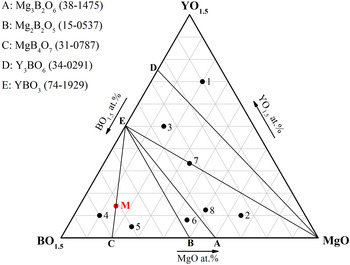
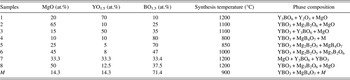
Based on the phase identifications of nine samples with different compositions as listed in Table I, subsolidus phase relations of MgO–Y2O3–B2O3 ternary system were determined under present experimental conditions, as shown in Figure 1. There are six definite three-phase regions and no unanimous solution exists. Only one ternary compound MgYB5O10 was found in this system. In this work, pure MgYB5O10 powder sample was successfully obtained by the Pechini method, which effectively suppressed the formation of YBO3 impurities.
Subsolidus phase relations in the system MgO–Y2O3–B2O3.

List of phase identification in the system MgO–Y2O3–B2O3.

B. Crystal structure of MgYB5O10
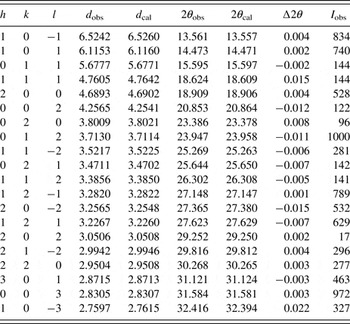
Using the program DICVOL04 (Boultif and Louër, Reference Boultif and Louër2004) by the successive dichotomy method, all the reflections (2θ ≤ 50°) of the compound MgYB5O10 can be well indexed on the basis of a monoclinic unit cell with lattice parameters a = 8.5084 Å, b = 7.5843 Å, c = 9.3689 Å, β = 93.740°, with F(20) = 77.0 and M(20) = 40.3. Table II shows the detail information of indexing result for compound MgYB5O10. According to the reflecting conditions, we can make a conclusion that MgYB5O10 crystallizes in the space group of P121/n1 (non-standard). The non-standard space group was transformed into standard form P121/c1 with crystal parameters a = 8.5084 Å, b = 7.5843 Å, c = 12.2346 Å, and β = 130.142°. According to comparisons between MgYB5O10 and ZnLaB5O10 (Jiao et al., Reference Jiao, Wang, Wang, Shen and Shen2010) in the crystal system, MgYB5O10 and ZnLaB5O10 are isostructural.
Details of indexing result for the compound MgYB5O10.

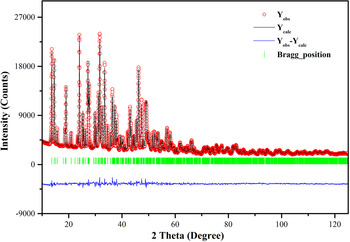
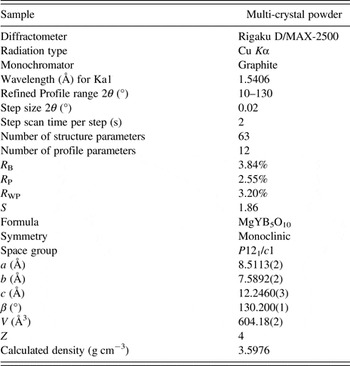
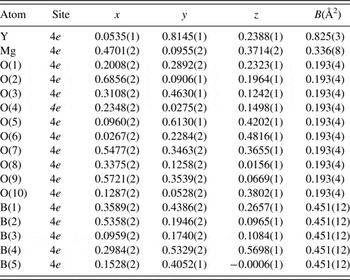
Thus, taking ZnLaB5O10 (Jiao et al., Reference Jiao, Wang, Wang, Shen and Shen2010) as the preliminary crystal structure model, the structure parameters of MgYB5O10 was refined and re-determined in this work. The process was accomplished by the Rietveld method (Rietveld, Reference Rietveld1967) using the program FullProf_suite. In the structure refinement, we used the diffraction data in the range of 2θ = 10–130° and chose Pseudo-Voigt function as peak shape function. Consequently, 75 parameters were refined in all, including 63 structure parameters and 12 profile parameters. In this structure, all atoms are located on the crystal lattice position 4e, which is similar to that of ZnLaB5O10. The agreement factors in the structure refinement were finally converged to R B = 3.84%, R P = 2.55%, R WP = 3.20%, and S = 1.86, which indicates the structure model is quite receivable. More details of refinement data are listed in Table III. Figure 2 is the final refinement pattern. Observed intensities are represented by the red hollow circle, the calculated intensities by the black line, and the difference plot by the blue line. The positions of all Bragg reflections are marked with the green bars. Refined structural parameters, including atomic coordinates, Wyckoff positions and isotropic displacement parameters are listed in Table IV. Asymmetric unit of MgYB5O10 comprises of one unique Mg atom, one unique Y atom, five unique B atoms, and ten unique O atoms. Figures 3(a), 3(b), and 3(c) are the projection view of the crystal structure of MgYB5O10 along a, b, and c-axes, respectively. Three of the B atoms are coordinated with four O atoms to form tetrahedron BO4 units and the other two B atoms are three-coordinated and build triangular BO3 units. As shown in Figure 3(d), jointed by BO4 in the middle, three BO4 units, and two BO3 units can be connected to form a B5O12 double-ring complex group. Double-ring B5O12 can further assemble infinite two-dimensional (2D) layers [B5O10]5− n via corner-sharing O atom between two adjacent B5O12 groups [Figure 3(b)]. Countless [B5O10]5− n layers are linked together by Mg and Y atoms forming the fundamental framework of MgYB5O10, which are perpendicular to the ac-crystallographic plane.
The final Rietveld refinement pattern for MgYB5O10.

(a)–(c) The projection of MgYB5O10 along the [100], [010], and [001] directions, respectively. (d) Fundamental building block, B5O12, for the polyborate framework in MgYB5O10. (e) The isolated Mg2O10 atom cluster formed by two adjacent MgO6 groups through edge-sharing. (f) Infinite zigzag chains Y n O 8n + 2 along the b-axis formed by edge-sharing YO10 polyhedra.

Details of Rietveld refinement and crystal data for the structure MgYB5O10.

Atomic coordinates and isotropic displacement for MgYB5O10.

The Mg atoms are surrounded by six O atoms to make up the MgO6 octahedra. From the view along a-axis direction, two adjacent MgO6 octahedra form an isolated Mg2O10 group through sharing an edge [Figures 3(a) and 3(e)]. The Y atoms are connected with ten atoms to form distortional YO10 polyhedra. Edge-sharing YO10 polyhedra can form infinite zigzag Y n O8n + 2 chains stretching along b-axis (Figure 3(f)).
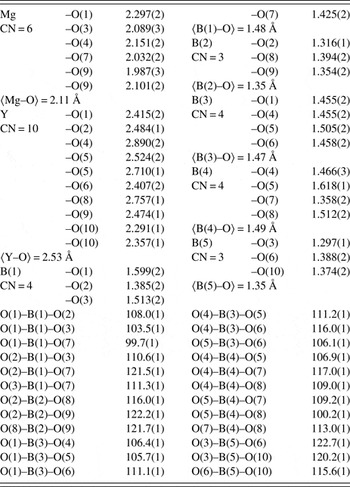
In the structure, the average lengths of the B–O bond in BO3 and BO4 groups are 1.35 and 1.48 Å, respectively, which are close to those observed in other known borates (Busche and Bluhm, Reference Busche and Bluhm1996; Chen et al., Reference Chen, Li, Zuo, Chang, Zang and Xiao2007; Jiao et al., Reference Jiao, Wang, Wang, Shen and Shen2010). The Mg–O bond lengths are in the range of 1.987–2.297 Å (2.11 Å in average) and the Y–O bond lengths are in the range of 2.291–2.890 Å (2.53 Å in average). Representative bond lengths, angles, and coordination number (CN) of cations are given in Table V. These values are approximately consistent with the corresponding bond lengths or angles found in other magnesium borates (Yang et al., Reference Yang, Chen, Liang, Lan and Xu2001; Li et al., Reference Li, Cai, Fan, Jin, Zhou and Chen2013) and yttrium borates (Chadeyron et al., Reference Chadeyron, El-Ghozzi, Mahiou, Arbus and Cousseins1997; Li et al., Reference Li, Chen, Wu, Cao, Zhou and Xu2004). The shortest distances of Y–Y in MgYB5O10 are 3.953 and 6.007 Å for intrachain and interchain, respectively. The process of intrachain energy transfer is much easier than that of interchain. In addition, 1D energy transfer can depress the backward energy migration to some extent, which further improved the transmission efficiency (Hong, Reference Hong2011). Short distance may result in strong interaction of energy levels of active ions, which occupy the Y sites when MgYB5O10 is doped, probably leading to strong fluorescence concentration quenching and short fluorescence lifetime.
Selected interatomic distances (Å), angles (°), and CN in structure MgYB5O10.

In order to examine the rationality of the determined structure of MgYB5O10, Brown’s bond valence method (Brown and Altermatt, Reference Brown and Altermatt1985) was utilized to calculate the valence sum for each ion. From the results given in Table VI, the bond valence sum of each cation is in very good agreement with the formal oxidation state, indicating that the calculated valence sums for all ions are reasonable in this structure.
Bond valence analysis of MgYB5O10.

Note. The results refer to the equations s = exp[(r 0–r)/B] with r 0 = 1.693 Å, 2.019 Å and 1.371 Å for Mg––O, Y–O, and B–O, respectively, and B = 0.37.
C. IR spectra of MgYB5O10
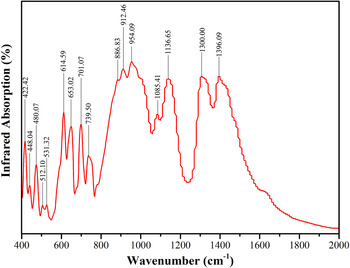
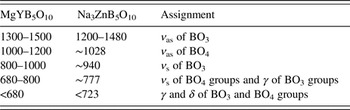
To further confirm the coordination surroundings of boron in the MgYB5O10, the IR absorption spectrum was measured at room temperature, which is shown in Figure 4. All the experimental peak positions of MgYB5O10 along with their assignments are displayed in Table VII, in which the reported data of Na3ZnB5O10 (Chen et al., Reference Chen, Pan, Wu, Han, Zhang and Zhang2012) are also given for comparison. The absorption wavenumber profile in 1300–1500 cm−1 should be assigned to the asymmetric stretching vibrations (ν as) of BO3 groups. Strong bands observed at 1000–1200 cm−1 should be attributed to asymmetric stretching vibrations (ν as) of BO4 groups. Those peaks at 800–1000 cm−1 should be the characteristic symmetric stretching of BO3 groups. The bands located at about 680–800 cm−1 can be assigned to the symmetric stretching vibrations (ν s) of BO4 and symmetric bending (γ) of BO3 groups, while the absorption below 680 cm−1 wavenumber mainly originates from the symmetric bending (γ) and asymmetric bending (δ) of BO3 and BO4 groups. IR spectrum of MgYB5O10 certifies the presence of BO3 and BO4 groups in the structure.
IR spectra for powder MgYB5O10 sample.

IR band positions (cm−1) of MgYB5O10 and Na3ZnB5O10 (Chen et al., Reference Chen, Pan, Wu, Han, Zhang and Zhang2012).

D. Crystal structure of compounds MRB5O10
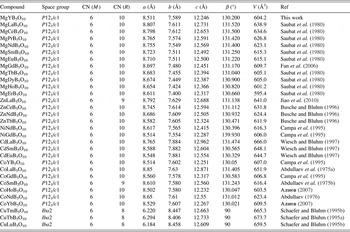
Most of the pentaborate family with the formula MRB5O10 (M and R are divalent and trivalent cations, respectively) reported in previous literatures are isostructural and crystallize in the P121/c1 (No. 14) space group, expect for the small brunches with the formula CuRB5O10, which belong to the orthorhombic crystal system. Table VIII lists the space group, CN of M and R ions, and lattice parameters (a, b, c, and β) of MRB5O10 compounds reported in both previous literatures and this work. It was found that all M ions have sixfold coordination. But the CN of R ions differs when compounds are in different space group. For those monoclinic compounds, the fundamental structure of anion group has the double-ring configuration, which is constructed by three BO4 tetrahedra and two BO3 triangles. However, in CuRB5O10 family, two tetrahedral BO4 and two planar B2O5 groups are linked together, forming a 12-membered ring consisting of boron and oxygen, and the ring is connected with the next one via the BO4 unit. The discrepancy of the anionic configuration and CN of M ions may be the main reason for the different space groups of MRB5O10 family.
Crystal information of compounds MRB5O10 (M and R are divalent and trivalent cations, respectively).

E. Diffuse reflectance spectra of MgYB5O10
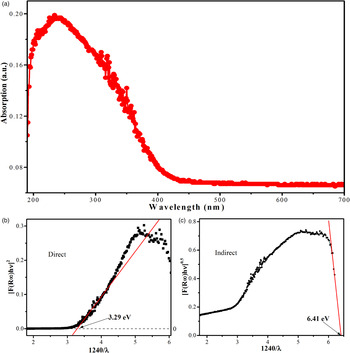
Aimed at investigating the optical absorption characteristic in the UV–vis light region, UV–vis diffuse reflectance spectroscopy of pure MgYB5O10 was measured within the wavelength range of 190–700 nm. As can be seen in Figure 5(a), there exists a wide absorption band within 190–400 nm. For direct (or indirect) semiconductor, a figure can be plotted with hν as the x-axis and [F(R∞)hν]2 (or [F(R∞)hν]0.5) as the y-axis, where hν is equal to 1240/λ and F(R∞) is calculated from Kubelka–Munk function (López and Ricardo, Reference López and Ricardo2012):
 $$F(R\infty ) = \displaystyle{{(1 - R\infty )} \over {2R\infty}}, $$
where R∞ = 0.1A, and A is the absorption intensity.
(a) The UV–vis diffuse reflectance spectra of MgYB5O10 at room temperature. The extrapolation of direct and indirect band gaps for MgYB5O10 is illustrated in (b) and (c).

The value at the intersection of the x-axis and extension of the straight portion is the optical band gap. Figures 5(b) and 5(c) show the extrapolation of direct and indirect band gaps E opt for MgYB5O10 obtained from diffuse reflectance spectra, which are about 3.29 and 6.41 eV, respectively. The direct E opt value 3.29 eV (~377 nm) fits well with the absorption edge of this material at about 400 nm. Since the host lattice is supposed to absorb VUV–UV excitement energy and transferred to luminescence center, the compound with large band gap is likely to have good luminescent properties after doping rare-earth ions. From this point of view, we can deduce that MgYB5O10 should have potential application value as a luminescent host material. As a matter of fact, there have been some previous researches about luminescent properties of active ions doped MgYB5O10. According to Ding's study, Tb3+ exhibits efficient emission in the Ce, Tb-codoped MgYB5O10 under the excitation of 365 nm (Ding, Reference Ding1989). Besides, Eu3+-doped MgYB5O10 has excitation band about 160 nm (in the VUV area), which promotes this compound to possess considerable application in the PDP (Plasma Display Panel) field (Wang and Wang, Reference Wang and Wang2004).
F. Band structure (BS) of MgYB5O10
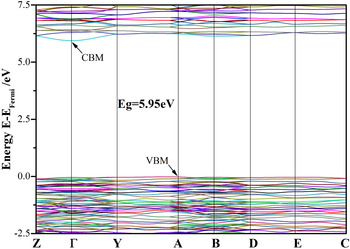
In order to better understand its basic physical properties, the BS of MgYB5O10 was calculated, and the result is presented in Figure 6. It possesses an indirect energy band gap of about 5.95 eV determined by A point at maximum of valence bands (VBM) and Γ point at minimum of conduction band (CBM). However, the real band gap for MgYB5O10 may be a little different because GGA generally underestimates band gap of the 3d compound and some defects exit in real crystals. Interestingly, the result of first-principles calculations is corresponding to the deduced E opt = 6.41 eV from its diffuse reflectance spectra by using the indirect method. Moreover, as can be seen from Figure 6, the valence band (VB) maximum is a flat band and the maximum values at point Γ and A in Briliouin zone is quite close, in which small disturbance (such as vacancy defects) may result in the transition from indirect band gap to direct band gap (Wei et al., Reference Wei, Yuan, Li, Liao and Mao2013; Ghosh and Gupta, Reference Ghosh and Gupta2015). Notably, the measured diffuse reflectance spectra and its deduced two type band-gap values are meaningful and acceptable. The possible explanation for the transition from indirect band gap to direct band gap is the existence of point defects in real crystal, whereas the model for the first-principles calculations is an ideal crystal without any defect.
The calculated BSs of MgYB5O10.

In fact, a number of patents related to phosphors emitting UV radiation when stimulated by VUV radiation based on MgYB5O10 have been delivered previously, such as YMgB5O10: Gd, Ce (US Patent Nos. 4319161 and 6007741), and YMgB5O10: Gd, Ce, Pr (US Patent No. 7419621).
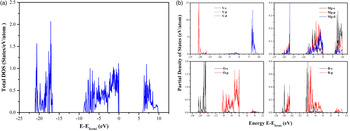
According to the calculated total density of states (TDOS) [Figure 7(a)] and partial density of states (PDOS) [Figure 7(b)], the electronic structure in energy range from −25.0 eV to EF mainly comprises Y-s and O-s/p states with small contributions from B-s/p and Mg-s/d/p states. The significant contribution to the lower conduction band (CB) comes from the Y-d state. It is obvious that the Y-d and Mg-s/p states in CB have a dominant effect on the energy band gap dispersion, while the O-s, B-s/p and Mg-p/d states in the upper VB have considerable effect on the dispersion. The PDOS of MgYB5O10 shows that Mg-p/d and B-p hybridize with O-p state at the VBM, and that Y-d and Mg/B-p hybridize with O-p state at the CBM. In addition, these results show that electrons, transferred from O-p, B-p, Mg-p/d, and Y-p/d states into VB, can contribute to weak covalence interactions of Mg–O and Y–O atom pairs as well as the substantial covalence interactions of B and O atoms.
(a) The calculated TDOS of MgYB5O10. (b) The calculated PDOS of MgYB5O10.

IV. CONCLUSIONS
In this work, sub-solidus phase relations of the MgO–Y2O3–B2O3 ternary system were determined. One pentaborate with the composition MgYB5O10 has been synthesized and its crystal structure has been investigated. Based on the structure model of ZnLaB5O10, the Rietveld method was utilized to refine the parameters of the MgYB5O10 from powder XRD data. The crystal structure of MgYB5O10 is composed of MgO6 octahedra, YO10 polyhedra, triangular BO3, and tetrahedral BO4 groups. The framework can be regarded as infinite 2D layers [B5O10]5− n linked together by Mg and Y atoms. The IR spectra of MgYB5O10 at room temperature verified the existence of BO3 and BO4. Diffuse reflectance spectra of MgYB5O10 shows wide absorption in the range of 190–400 nm, which indicates the compound may be a promising luminescence host materials. Most of the pentaborate family MRB5O10 (M and R are divalent and trivalent cations, respectively) crystallize in the P121/c1 (No. 14) space group, whereas those compounds containing copper CuRB5O10 are in Iba2 (No. 45). This may be because of the discrepancy of the anionic configuration and CN of M ions. The optical band gap of MgYB5O10 was determined from the UV–vis diffuse reflectance spectra by Kubelka–Munk function. The first-principles calculations of its electronic structure reveal that MgYB5O10 is an insulator with an indirect energy of about 5.95 eV, which is near to the indirect band gap value extrapolated from diffuse reflectance spectra. Meanwhile, the measured absorption edge is in agreement with deduced direct band gap according to diffuse reflectance spectra. Angular momentum characters of each structure groups in its electronic structure were identified according to the PDOS. The nature of chemical bonding in this structure has been elucidated from its TDOS and PDOS. The structural characteristics of both crystalline and electronic might make MgYB5O10 an excellent host for phosphors and a superior material for UV applications.
SUPPLEMENTARY MATERIAL
The supplementary material for this article can be found at https://doi.org/10.1017/S0885715617000227
ACKNOWLEDGEMENTS
Financial supports by the National Natural Science Foundation of China (Grant number 51472273) and Major State Basic Research Development Program of China (Grant number 2014CB6644002) are gratefully acknowledged. The work was also supported through a Grant-in-Aid from Department for Science and Technology of Hunan province (Grant number 2014FJ4099), the Projects of Innovation-driven Plan in Central South University (Grant number 2015CX004) and State Key Laboratory of Powder Metallurgy (Central South University, Changsha, China).