Introduction
Plant feeding value for herbivores lies in its nutritive value (notably in its energetic and nitrogen content) and on the amount animals may consume. Ruminants generally succeed in selecting an appropriate diet relative to their nutrient requirements, and macronutrients (e.g. energy and protein) are considered as playing a primary role in their food preferences (Villalba and Provenza, Reference Villalba and Provenza1996 and Reference Villalba and Provenza1997a). They seem able to discriminate the effects of energy and protein (Wang and Provenza, Reference Wang and Provenza1996a), and faced with a choice between foods varying in both, sheep select diets with relatively constant protein/energy ratios (Kyriazakis and Oldham, Reference Kyriazakis and Oldham1993; Provenza et al., Reference Provenza, Scott, Phy and Lynch1996). Previous work has shown that sheep balance their intake of ruminally degradable proteins and soluble carbohydrates (Kyriazakis and Oldham, Reference Kyriazakis and Oldham1997), according to their requirements (Cooper et al., Reference Cooper, Kyriazakis and Oldham1994). Furthermore, their voluntary intake of roughages also appears to be related to the protein/energy ratios of digestion products that arise from roughage consumption (Egan, Reference Egan1977).
Provenza and Balph (1990) proposed that ruminants learn about foods through the positive and negative consequences of their ingestion, by associating such effects with the sensory characteristics of foods (taste, smell) (Provenza, Reference Provenza1995). Many experiments have since been reported in which food sensory characteristics (artificially added flavours) have been variously associated with post-ingestive consequences (intra-ruminally added substances), rich in either energy (Burritt and Provenza, Reference Burritt and Provenza1992; Villalba and Provenza, Reference Villalba and Provenza1996, Reference Villalba and Provenza1997a and Reference Villalba and Provenza1997b) or protein (Villalba and Provenza, Reference Villalba and Provenza1997c). These studies have shown that animals are able to perceive post-ingestive signals and their intensities (Arsenos and Kyriazakis, Reference Arsenos and Kyriazakis1999), and modify their diet selection. It further appears that animals can distinguish energy digestive feedback signals from those caused by protein (Villalba and Provenza, Reference Villalba and Provenza1999a).
However, most previous studies indicating that ruminants can successfully use associative learning to choose a suitable diet have involved situations with simple discrimination tasks, and it is still uncertain to what extent such mechanisms operate in more complex feeding environments (Cassini, Reference Cassini1994), as in natural pasture where animals are faced with many plants and plant parts varying in both their energy and protein contents. In the current work, we investigated a more complex feeding situation by applying the conditioning method in a choice situation involving three foods, each associated with both energy-based and protein-based post-ingestive consequences of varying intensity. Furthermore, since modification of nutritional state leads to a change in nutrient requirements and diet selection (Cooper et al., Reference Cooper, Kyriazakis and Oldham1994; Kyriazakis et al., Reference Kyriazakis, Oldham, Coop and Jackson1994; Wang and Provenza, Reference Wang and Provenza1996b; Villalba and Provenza, Reference Villalba and Provenza1999b), we tested preferences of animals fed a basal diet allowing different growth rates on an energy and protein basis in order to see whether the low nutritional level would make them more sensitive to nutrient rewards.
Material and methods
The study was conducted indoors at the INRA Clermont-Ferrand/Theix experimental farm (45°42′N, 03°30′E) in central France. The animals were handled by specialised personnel who applied animal care and welfare in accordance with European Union Directive No. 609/1986. Before the main trial, we completed a methodological trial to determine the range of adequate dose of each stimulus so that none induced an aversion under our experimental conditions (Arsenos and Kyriazakis, Reference Arsenos and Kyriazakis1999). After the main trial, we conducted a final trial to measure the kinetics of several ruminal variables in order to help explain the results of the main trial. The main trial was conducted between late October and mid-December 2003.
Methodological trial
Animals and forages
We used 24 Romane (Berrichon du Cher × Romanov crossbred) ewe lambs, aged 5 months (initial mean live weight (LW): 32.6 kg, s.d. 2.0). From 2 weeks before the beginning of the test, the lambs were housed in individual pens isolated from each other by openwork fences allowing social contact. Water and salt blocks were freely available at all times. The lambs were fed a basal diet composed of dehydrated beet pulp and a permanent pasture hay in amounts that complemented the intake of experimental forages during tests, in order to satisfy a moderate growth rate of 50 g/day, equilibrated for both metabolisable energy (ME) and crude protein (CP) (Agricultural Research Council, 1980; INRA, 1989).
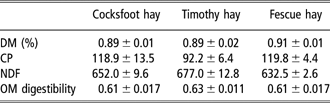
The experimental forages comprised a cocksfoot (Dactylis glomerata) and a timothy (Phleum pratense) hay, chopped into 5-cm-long pieces, and whose chemical characteristics are given in Table 1.
Chemical characteristics (mean ± s.d.) of experimental hays
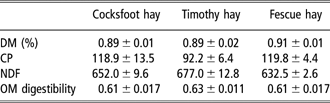
Crude protein (CP) and neutral detergent fibre (NDF) contents are expressed in g/kg dry matter (DM). Organic matter (OM) digestibility was measured in vivo on sheep.
Stimuli
We used two stimuli: starch as a source of energy (stimulus E) and casein as a source of protein (stimulus P). We defined three doses for each of them, based on the dry matter amount of hay eaten during conditioning (see below) so that they enhanced the ME or CP values of the hay in a range close to, or slightly higher than, the real values of natural forages that animals may encounter in the field (from INRA, 1989).
Hence, for starch the doses were E1: 110 mg/g DMI (dry matter ingested), E2: 220 mg/g DMI and E3: 330 mg/g DMI. These doses provided 1.51, 3.01 and 4.52 kJ/g DMI, respectively. For casein, the doses were P1: 70 mg/g DMI, P2: 140 mg/g DMI and P3: 210 mg/g DMI. As casein provides both nitrogen and energy (19.50 MJ/kg DM; Van Milgen et al., Reference Van Milgen, Noblet and Dubois2001), for each g of DMI the doses provided: 60 mg CP and 1.21 kJ for P1, 120 mg CP and 2.47 kJ for P2 and 180 mg CP and 3.68 kJ for P3.
Starch and casein were in powder form and were diluted in tap water at different concentrations according to the dose, so that 1 g of fresh matter ingested (FMI) of hay corresponded to 1 ml of solution administered to the animal, thus avoiding large differences in the volume of solutions imbibed between individuals. The amount of starch or casein was then administered to animals according to their dry matter intake and not according to their body weight. Solutions were administered orally to the animals using a veterinary dosing gun equipped with a graduated syringe enabling a precise dose of the solution to be administered. We chose this administration method because we were constrained by the amounts of substances that we had to deliver; delivery via capsule would have required multiple doses and this approach was rejected on ethical grounds.
Experimental design and procedure
The 24 ewe lambs were assigned to six treatments (four lambs per treatment allocated according to weight), each characterised by the nature and the dose of the stimulus administered. The experiment lasted for four 1-week-long periods. During each week the same general procedure of four conditioning days followed by one choice day was followed.
Conditioning was conducted between 1330 and 1500 h. At 1330 h, the animals received about 500 g fresh matter (FM) of one of the two experimental hays on Monday and Wednesday and the same amount of the other hay on Tuesday and Thursday. For each lamb, one hay was associated with the stimulus (either starch or casein) and the other hay was associated with water following the same rule of 1 g FMI corresponding to 1 ml of water administered. At 1400 h, we weighed the troughs to measure the amount of hay eaten during this time and to determine the amount of solution with stimuli to be administered to animals. Just after animals were dosed, refusals were offered to them for 1 h more. At 1500 h, we weighed again the troughs and dosed the lambs according to the amount of hay they ingested during this hour. Then, they did not receive any food until the distribution of their basal diet. The allocation of hays to animals, days, stimulus and association (stimulus v. water) was balanced for each stimulus and dose.
Choice tests occurred once a week on Friday at 1330 h. Animals received 400 g FM of each hay, placed in two adjacent troughs for 30 min. After the test, the troughs were weighed to allow the consumption of the hay associated with the stimulus to be assessed as a proportion of total intake.
On conditioning and choice test days, the basal diet was provided on the following morning at 0800 h until 1100 h. On the weekends, three-fourth of the diet was given in early afternoon and the remainder on the following morning to maintain the rhythm of two distributions a day.
Main trial
Animals and forages
We used a fresh batch of 24 Romane ewe lambs aged 8 months (mean LW 37.1 kg, s.d. 3.4 at the beginning of the first experimental period), housed under the same conditions as for the methodological trial. A fescue hay (Festuca rubra) was added to the two experimental forages already used in the previous trial (see Table 1 for chemical characteristics).
Stimuli
Starch and casein were this time used in combination to form four associations characterised by the respective levels, medium (m) or high (h), of energy (E) and protein (P): EmPm, EmPh, EhPm and EhPh. A fifth association was tested and named E0P0 where only water was administered. We considered the energetic value of casein to determine the doses of both stimuli to obtain the medium or high levels of energy in each association. The doses of starch and casein and the ‘new’ nutritional values of hays are set out in Table 2.
Doses of starch and casein applied according to associations and estimated metabolisable energy and crude protein values of hays considering these associations

DMI = dry matter intake; ME = metabolisable energy; CP = crude protein; DM = dry matter.
aE and P represent the amount of energy and protein, respectively, associated with a hay. This amount is either medium (m) or high (h).
The stimuli were prepared for administration as in the methodological trial.
Experimental design and procedure
The 24 lambs were divided into two groups (each n = 12) characterised by their feeding level, balanced for both ME and CP (from ARC, 1980; INRA, 1989) but allowing a daily growth of either 25 g (low level) or 150 g (high level). These feeding levels were applied from 2 weeks before the beginning of the trial. Each animal experienced only two out of the four associations stated above, those with either the medium or high level of protein (EmPm and EhPm, or EmPh and EhPh, respectively) plus E0N0. In each group, six animals experienced associations with each level of protein.
The experiment lasted for five 1-week-long periods. During each week the same general procedure of three conditioning days followed by two choice days was followed (see Table 3 for illustrative purpose). Conditioning was conducted on Monday, Tuesday and Wednesday between 1330 and 1500 h. Animals received about 400 g FM of a different hay each day. For each lamb, two of the hays were associated with the two associations involving stimuli and the third one was associated with water only (E0N0). As stimuli were combined, animals received two different solutions (starch and casein) for each ingested gram of forage, at a rate of 1 ml of each solution/g FMI. The animals were dosed at 1400 and 1500 h after the troughs had been weighed. The allocation of hays to animals, days and associations was balanced for each feeding level and level of protein.
Example of allocation of associations to hays and days, using two ewe lambs for illustrative purposes

Hays: Fesc. = fescue; Tim. = timothy; Cocks. = cocksfoot.
Choice tests occurred on Thursday and Friday at 1330 h. On the first day, the choice was between the hays associated with E0N0 and with one of the two associations (e.g. EmPm); the following day, the choice was between the hays associated with E0N0 and with the other association (in our example, EhPm) (Table 3). Animals received 350 g FM of each hay, placed in two adjacent troughs for 20 min. After the test, the troughs were weighed to allow the preference for the hay associated with the stimulus to be assessed as a proportion of total intake. During the last two periods (Per4 and Per5) we conducted one further choice test between the two hays associated with stimuli (either EmPm and EhPm or EmPh and EhPh) following the same procedure as for all choice tests.
The basal diet was composed of dehydrated beet pulp and natural pasture hay, as for the methodological trial. Their respective amounts were calculated daily for each individual so as to complement the amount of experimental hays eaten during tests while taking into account the growth target of the applied feeding levels. The hay was offered at the end of the afternoon on test days and at the beginning of the afternoon on weekends. Beet pulp was given on the following morning from 0800 h until 1000 h when all refusals were removed.
Ruminal determinations
Animals and forages
The objective of this trial was to determine the effects of our treatments on the ruminal environment. We used four castrated Texel male sheep aged 3 years (mean LW 56 kg, s.d. 3.7) equipped with rumen cannulae, and the cocksfoot hay as experimental hay. They were housed in individual pens where water and salt blocks were freely available. They were fed the same basal diet as during the main trial with the same pattern of offering the feed.
Experimental procedure
The trial was conducted over 2 weeks. On Monday, Tuesday, Thursday and Friday, the sheep received, each day, one of the four associations of stimuli used in the main trial, according to a Latin square design. To mimic the situation followed in the main trial, the two associations sharing the same level of protein were administered on two successive days, and all sheep received the E0P0 treatment on Wednesday so that they did not receive stimuli for over more than two consecutive days.
At 1315 h, all sheep received 500 g FM of cocksfoot hay. At t0 + 15 min and t0 + 60 min, they received the dose of both stimuli corresponding to an intake of 250 g FM of hay. At 1415 h, the 500 g of hay were ingested. Samples of ruminal fluid were obtained via the cannulae just before the distribution of hay (S1, at 1300 h), then at 1500 h (S2), 1600 h (S3), 1700 h (S4) and 1900 h (S5). Ruminal pH was measured and samples (7 ml) were mixed with H3PO4 5% (0.7 ml) and stored at −20°C for determinations of volatile fatty acid (VFA) concentrations and molar proportions (Jouany, Reference Jouany1982) and NH3 concentrations (method adapted from Weatherburn, Reference Weatherburn1967). The basal diet was offered at 1915 h.
Statistical analyses
For all trials, we used the mixed procedure of the SAS software package with the REPEATED statement (Statistical Analysis System, 1999) to account for the period effect in methodological and main trials and for sample effect in the ruminal determinations trial. Choice ratios were transformed (arcsine or square root) to stabilise variance.
Concerning the methodological trial, we separately analysed data with starch and with casein. As the period effect was never significant, we used the GLM procedure to perform analyses. For each stimulus, we conducted two types of analysis (see Arsenos et al., Reference Arsenos, Hills and Kyriazakis2000a). Firstly, we analysed the choice for the hay associated with the stimulus (or treatment ratio, TR), and tested the effects of stimulus dose (as a continuous variable), hay type and interactions. Secondly, we analysed the choice for each hay separately (or hay ratio, HR) to determine whether choices were different when the hays were associated with the stimulus or with water, and we tested the effects of association (stimuli or water), stimulus dose and interactions.
For the main trial, we analysed total dry matter intake and the choice for the hay associated with treatments (EmPm, EmPh, EhPm and EhPh) across experimental periods (Per0 to Per5), Per0 being the initial preference of each lamb between hays that had been measured beforehand. We tested the effects of period, feeding level, energy level and protein level (both as continuous), hay type with reference to the other hay associated and their interactions. For choice tests conducted in Periods 4 and 5 between the two hays associated with stimuli combinations (EmPm v. EhPm on the one hand and EmPh v. EhPh on the other hand), we analysed, for each feeding level, the preference for Eh. We pooled the results of the two periods and we performed a Student’s test to determine whether preference for Eh differed from 0.5.
Finally, for the trial on ruminal environment, we first averaged the results over the 2 weeks because we found no period effect. Then, proportions of acetate (C2), propionate (C3) and butyrate (C4), total VFA content, pH and NH3 concentration were analysed. We tested the effects of sampling number, treatment (EmPm, EmPh, EhPm, EhPh and E0P0) and their interactions.
Results
Methodological trial for the dose effect of starch and casein
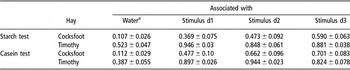
The lambs preferred timothy to cocksfoot hay (TR, P < 0.001 and P < 0.01 for starch and casein tests, respectively) and the preference for each hay was higher when associated with either stimuli than when associated with water (HR, P < 0.001 for both hays and stimuli) (Table 4). The dose affected animal choices only in interaction with the nature of the hay associated with the stimuli, especially when the stimulus was starch (TR, P < 0.05 v. P = 0.08 in case of casein). When stimuli were associated with cocksfoot, animal choices for this hay increased with the dose whereas this did not happen when stimuli were associated with timothy, probably due to the initial high preference for this hay.
Methodological trial: choice (mean ± s.e.m.) for cocksfoot or timothy hays depending on whether they were associated with water or with stimuli at each dose (d1, d2, d3), in both starch and casein tests
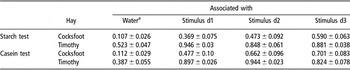
Choices are expressed in proportion of total dry matter intake.
aThe values for ‘water’ represent the proportion of dry matter ingestion averaged over the three tests involving the three doses.
Main trial
Dry matter intakes of hays during conditioning were on average 238 ± 5.4 g for animals on high feeding level and 341 ± 3.3 g for those on low feeding level (P < 0.001).
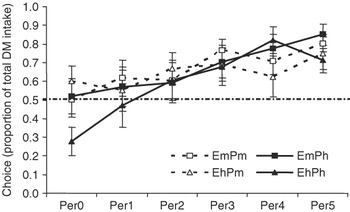
We did not observe any significant effect of energy level (P > 0.05), protein level (P > 0.05) or their interactions on the choice for the hay associated with the stimuli (Figure 1). On the contrary, the period effect was highly significant (P < 0.001), showing a continuous increase in preference for hays associated with stimuli with successive learning periods, from 0.48 (±0.05) before the first conditioning (Per0) to 0.78 (±0.03) at the end of the experiment (Per5). Feeding level was only significant in interaction with protein level (P < 0.05): on low feeding level, preference for hays associated with treatments was higher for animals with Pm (0.67 ± 0.03) than for those with Ph (0.58 ± 0.04) whereas the reverse was observed on high feeding level (Pm: 0.64 ± 0.04 and Ph: 0.69 ± 0.04).
Main trial-Choice for the hay associated with the combination of stimuli depending on the nature of stimuli combination (E = energy, P = protein, m = medium, h = high) and on the experimental period.

Student’s tests showed no difference in preference between Eh and Em for animals on the low feeding level, whether protein level was medium (0.54 ± 0.10) or high (0.57 ± 0.07), and for animals in high feeding level with Pm (0.56 ± 0.10) (P > 0.05). Only those with Ph on high feeding level expressed an aversion to Eh (0.24 ± 0.08) (P < 0.01).
Feeding level was particularly significant on the total intake during choice tests, showing that animals maintained on the low level exhibited larger dry matter intake than those maintained on the high one (211 ± 3.4 g v. 122 ± 2.8 g, respectively, P < 0.001).
Ruminal determinations
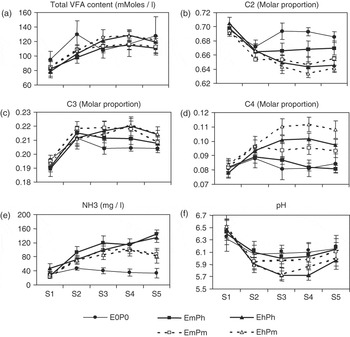
The values of all ruminal variables changed with sampling time; the proportion of acetate and the pH decreased (P < 0.001 for both) while all others increased (P < 0.001) (Figure 2a–f). We also observed some differences between treatments, the exception being the total concentration of VFA (P > 0.05, Figure 2a). These differences were mainly related to the interactions with sampling number as they rarely appeared before sample 3.
Ruminal determinations trial. Evolution of total volatile fatty acid content (a); acetate, propionate and butyrate proportions (b, c, d); ammonia concentration (e) and pH (f) of rumen fluid through successive samplings (S) for each treatment. Samplings 1 to 5 were done at 1300, 1500, 1600, 1700 and 1900 h while hay ingestion and stimuli administration occurred between 1315 and 1415 h.

The proportion of acetate (C2) was higher for E0P0 than for all other treatments from sample 3 and higher for EmPh than for others from sample 4 (treatment × sample, P < 0.05, Figure 2b). The proportion of propionate (C3) was lower for E0P0 than for other treatments except for EmPh, from sample 3 (treatment, P < 0.01, Figure 2c). Differences between treatments also appeared from sample 3 for butyrate proportion (C4) (treatment × sample, P < 0.001, Figure 2d). The lowest values were for E0P0 and EmPh, the highest for EhPm and the last two treatments EmPm and EhPh were positioned between them.
Concentration of ammonia (NH3) remained stable for E0P0 but increased for other treatments, leading to significant difference between E0P0 and other treatments from sample 3 (treatment × sample, P < 0.05, Figure 2e). Also, at the last sampling, ammonia concentration was higher for Ph than for Pm treatments.
Finally, pH was higher for E0P0 and EmPh treatments than for others, mainly at samples 3 and 4 (treatments × sample, P < 0.001, Figure 2f). The two Eh treatments were those with the lowest pH values at these sampling numbers.
Discussion
Our objective was to determine whether sheep were able to associate three forages with both energy-based and nitrogen-based post-ingestive consequences of various intensities. The doses of starch and casein used to modify these post-ingestive consequences were chosen so that the perceived ME and CP values of hays should fall within the range found in plants normally encountered under field conditions. Our experimental procedure meant that one stimulus varied within animals whereas the other only varied between animals. We expected comparisons within animal to be a more sensitive test of the preference response of animals to rewards. We therefore chose to modify the energy reward intra-individually since we expected animals to be more sensitive to this reward (Wang and Provenza, Reference Wang and Provenza1996a; Villalba and Provenza, Reference Villalba and Provenza1999a). We are conscious of the fact that our experimental procedure did not completely mimic natural conditions. For example, under our experimental conditions, nutrients were delivered instantaneously into the rumen while under natural conditions nutrient delivery would be more continuous. Furthermore, the choice measurements through which we assessed learning were made on a short time-scale. However, these methodological choices were constrained by both ethical (avoiding too many gavages) and scientific concerns (avoiding an impairment of learning by exposing animals to test foods in the absence of conditioning stimuli during long-term choice tests). The great majority of experiments on food learning where test foods have been dissociated from post-ingestive consequences have followed the same general procedure and this allowed us to compare our results to previous studies.
The choices expressed by lambs in the methodological trial showed that they perceived the stimuli in a dose-dependent fashion, and consequently showed that the experimental procedure was robust. In the main experiment, animal choices suggested that they also perceived that two out of three hays were associated with rewards whereas the third one was not (E0P0). However, they did not express a difference in preference for either rewarded hay when offered with the control hay or a preference between rewarded hays when offered together.
Did animals discriminate the nutritive rewards?
Information coming from both the literature and complementary trials led us to expect that our animals would be able to perceive the rewards we presented. Doses of starch were between 0.7 and 3.4 g/kg LW and those of casein were between 0.5 and 1.6 g/kg LW, and so were in the range that induced preferences in previous work (Villalba and Provenza, Reference Villalba and Provenza1997a; Arsenos and Kyriazakis, Reference Arsenos and Kyriazakis1999; Villalba et al., Reference Villalba, Provenza and Rogosic1999; Arsenos et al., Reference Arsenos, Kyriazakis and Tolkamp2000b). Also, in our methodological trial, dose rates were between 1.2 and 3.7 g/kg LW for starch and between 0.8 and 2.3 g/kg LW for casein and induced clear preferences for the hay associated with each of the stimuli. Moreover, if we consider the difference in energy reward an animal experienced between treatments Em and Eh, it was about 0.84 to 1.05 MJ ME (depending on amounts of hay eaten during conditioning), which represents about 15% of maintenance requirements for energy. This represents a considerable difference in energy reward and we had expected this to be perceived by animals, especially for animals maintained at the low feeding level, since we know that food preferences depend on animals’ nutritional state both in the short and longer term (Kyriazakis et al., Reference Kyriazakis, Tolkamp and Emmans1999; Villalba and Provenza, Reference Villalba and Provenza1999b). In addition, the results of the trial on the rumen environment did show some effects of our treatments on the studied variables between control (E0P0) and treatments and between treatments as well. These effects were rarely observed before the third sampling however, i.e. about 2 h after the last conditioning, which may have impaired the ability of the sheep to distinguish the different treatments (Villalba et al., Reference Villalba, Provenza and Rogosic1999). However, even with a delay of greater than 2 h, food learning with casein has been shown to be possible (Arsenos et al., Reference Arsenos, Hills and Kyriazakis2000a), and the basal foods were distributed 3 h after the third sampling, making it easier for animals to make the associations between post-ingestive consequences and experimental hays. Finally, the differentiation of ruminal variables values generally appeared at the same time between E0P0 and treatments as between treatments (Em and Eh), except for NH3 concentration, which however only varied between animals. So, it seems that at the rumen level, as animals discerned E0P0 from treatments, they should have been able to discriminate the treatments.
Considering that the treatments elicited detectable changes in the rumen, why did lambs not express a discrimination in their diet choices?
We can suppose either that they succeeded in associating post-ingestive consequences with the three hays but that the gap between the lambs’ nutritional state and the perceived nutritional rewards from different hays was not large enough to warrant discrimination, or that the learning situation was too complex to allow them to make the right associations. We cannot affirm which of these options applies but can only speculate on the basis of our data. It is true that all foods were nutritionally profitable and that preferences are not always strictly proportional to the nutritional composition of foods. Also, our feeding levels were equilibrated for both energy and protein, and animals might have been more receptive to the difference in rewards leading to different protein/energy ratios if they had been in a deficient state for one nutrient or the other (Wang and Provenza, Reference Wang and Provenza1996a). However, our feeding levels had a considerable physiological impact as shown by the difference in body weight gain between Per1 and Per5 (+1.5 kg for low v. +4 kg for high feeding levels), and by differences in dry matter intake during conditioning (341 ± 3.3 g v. 238 ± 5.4 g for low and high feeding levels, respectively). Hence, the complexity of the choice scenario, which was moderate but greater than in other experiments involving only one stimulus and two foods, appears to be the most likely explanation for the observed lack of discrimination between treatments during choice tests. Recent papers have highlighted the difficulties that animals experience in making associations between foods and post-ingestive effects when the conditioning procedure is given added complexity, either by presenting food options simultaneously (Duncan and Young, Reference Duncan and Young2002), increasing the number of stimuli associated with foods (Ginane et al., Reference Ginane, Duncan, Young, Elston and Gordon2005), or altering bout length and rate of nutrient delivery (Duncan et al., Reference Duncan, Elwert, Villalba, Yearsley, Pouloupoulou and Gordon2007) during the conditioning phase. In our experiment, the comparison of animals’ learning efficiency during the pre-trial and the main experiment brings another illustration of this phenomenon. Indeed, in the methodological trial, when the test involved only one stimulus and two foods, the lambs needed no more than one conditioning period to make the association while learning was slow and progressive in the more complex main trial. Also, a slight dose effect was shown in the pre-trial but not in the main one.
In conclusion, lambs in this experiment showed preference for the rewarded hays, indicating that they were able to learn when clear differences in nutritional post-ingestive consequences were applied. However, when these differences became more subtle and more complex, though they mimicked the range of variation that animals would experience with most conventional fodder plants, the learning process was impaired and the lambs did not seem to have strictly relied on it for shaping their diet choices.
Acknowledgements
The authors are grateful to the staff of the INRA experimental farm particularly B. Mallet, M. Bernard, H. Chandèze and D. Thomas for their technical assistance. We also thank J. Jamot, A. Le Morvan, G. Béchet and R. Bott for analysing the forage and rumen fluid samples.