

On 24 June 2013, the Brazilian football club Atlético Mineiro hosted the Paraguayan Olimpia for the second round match in the final of Copa Libertadores – the South American competition. Atlético was defeated 2–0 in the first game and needed to win the next one by more than two goals to become the champion of the most important football competition in Latin America. Driven by their faith in the potential of the team to reverse its fortune, 58,000 fans crowded the stadium in the city of Belo Horizonte, Minas Gerais, to support ‘Galo’ (rooster), as fans dubbed the club. Their belief in victory was justified. In the semi-final, ‘Galo’ lost the first game 2–0 against the Argentinian club Newell's Old Boys but, in a highly dramatic second match, the team went through to the finals on penalties. As to facing Olimpia, their next opponent, the players ‘simply’ needed to do the same. Oddly, they had scored exactly the same number of goals in the previous game, and, in a certain way, it further enhanced the mystique surrounding that particular event among football lovers and media.Footnote 1 During the game, the chant of fans filled the stadium with several songs to support the team. Among them was a chorus that became a reference to Galo's trajectory so far: ‘Eu Acredito!’ [I do believe] (Figure 1).
Figure 1.
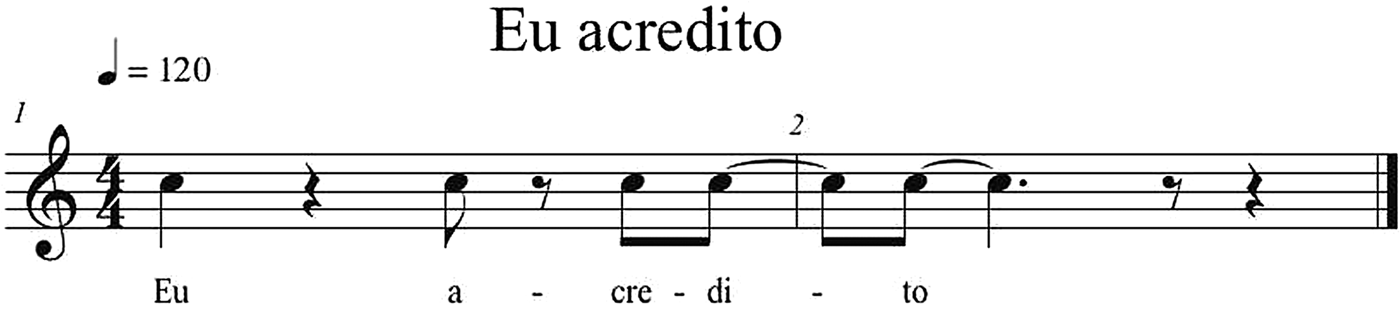
Assertively sung over one single note (usually not perfectly tuned, which makes it sound as a cluster), the chant expressed the enthusiasm of the cheering crowd toward the players. The force of the chant lies in the repetition of the same note but also in two significant rhythmical variations: the pause in the second beat and the anticipated note before the last beat. As a result, the notes are sung with an extra discharge of energy, owing to the rhythmic ‘propulsion’ created by the avoidance of regularity (Tagg and Clarinda Reference Tagg and Clarinda2003, p. 341). With this strength, the chant worked both as an effective sonic support to the team and as a shared manifestation of the fans’ faith in winning the championship. In response to the energetic chanting, the players put in a superhuman effort on the pitch and scored the indispensable two goals so as to push towards penalties. The game followed the same script of the semifinal and the incisive rhythm of ‘Eu Acredito’ pervaded the uneasy moment of the penalty shootouts, which culminated with the victory of the team and their first title at the Copa Libertadores. Three years later, on a television show, the player Bernard remembered the energy and the sonority of that particular game, affirming that ‘“Eu Acredito” made the impossible possible’.Footnote 2
‘Eu Acredito’ is a good point of departure for reflecting on the importance of beliefs in processes of symbolic and sonic achievements that are considered ‘magic’ by their practitioners. As Claude Lévi-Strauss's famous proposition states, ‘the efficacy of magic implies a belief in magic’ (Reference Lévi-Strauss1963, p. 168). Therefore, the chant of the fans is a sonorous metaperformative event in which the semantic and vibrational content of the chorus expresses belief in a particular process that is triggered by its own sonorous performance. The process can be described as some kind of short-circuit where faith resonates with fans and players, and becomes equally important (or more so) than the technical performance of the players against their opponents. The combination of music, sound and magic can be described as a connection between the worldly and the unexplainable. Music functions as a communicational axis linking the physical realm and mystical, occult or intangible dimensions. The mystique is reinforced in the events where a positive result is achieved, usually verified in terms of a transformation effect in the attitude of players in the pitch, hence reinforcing the belief system that ascribes success at least partially to supernatural forces.
The notion of ‘magic’ pervades sports like football in different ways. It is often used in narratives about skilful athletes who execute moves that are apparently impossible or unforeseen.Footnote 3 They are acknowledged as ‘wizards’, ‘saints’ or ‘gods’ who pull unbelievable stunts with the football and their bodies. At the same time, the stadiums where victories are accomplished are acknowledged as mystical spaces, ‘temples’ that evoke supernatural relations with histories of incredible achievements and fantastic feats.Footnote 4
This article aims to understand how fans perform certain actions through the operation of a set of sonic techniques – repertoires of practices which manipulate acoustic parameters (intensity, frequency and spatiality) – in order to create an ambience to boost the athletes’ performance.Footnote 5 The sonorous presence of the crowd at stadiums is often considered a factor that overcomes objective variables such as physical conditioning, training and tactic discipline,Footnote 6 or more subjective aspects of sports like talent or the opponents’ resistance. In this sense, the fans’ shared belief in the efficacy of sound in stadiums is a key feature in their interpretation of their clubs’ achievements in terms of magic.
Methodologically, the reflections developed here result from the fieldwork and sound recordings during Atlético Mineiro's matches from 2011 to 2015. During this period, 21 matches were recorded using three pairs of stereo microphones set in three different sections of stadium terraces (for more details, see Marra Reference Marra, Helal and Amaro2015). Later, the recordings were synchronized between themselves and with the radio broadcast. This material was complemented by research in media coverage of the team, informal interviews and reports collected during years of stadium attendance, following the team as fans. Although centred in Atlético Mineiro matches, the dynamics described here can be easily observed in other teams and regions, since they are far from being specific to Atlético. We understand professional football as part of contemporary spectacle, as a social field that is interconnected with capitalist market economy, scientific and psychological innovations, but also with religious, superstitious and supernatural practices. We argue that certain football events which fans consider ‘magical’ happen when the players on the pitch – immersed in the audible and performative enthusiasm of the crowd standing in the terraces – execute stunts of rare visual beauty, high level of difficulty or unlikelihood.
Consequently, fans, players and sports journalists describe and experience the charms of football in stadiums worldwide through a relationship between sonic techniques, ‘footballistic’ ambiences and ‘magic’.
Magic and science
To consider the idea of ‘magic’ as musically articulated to contemporary football requires an effort to delineate the intricate intersections the term articulates. Here, we conceive of magic as a form of holistic knowledge based on a vitalist cosmology according to which different spheres of existence are connected. As such, the boundaries between the worldly and the otherworldly can be crossed through tricks, rituals or innate abilities either revealed or learned. Through the manipulation of inexplicable forces, certain seemingly impossible or improbable achievements are accomplished owing to transformations in the appearance of beings, or a boost to the probability of success in a certain situation, in the will or the skill of players, and so on. Moreover, ‘magic’ is a belief that fills the explanatory gap for events not satisfactorily elucidated by rational logic or scientific knowledge, a belief ‘in some form of supernatural or alternative form of causality that extends beyond those that govern the natural world’ (Rosengren and French Reference Rosengren, French and Taylor2013, p. 6), and one that is widely used as a means for controlling chance, hence preventing the occurrence of unexpected nefarious events (Menandro Reference Menandro2014, p. 119).
The notion of magic is challenged by the idea of science, a concurrent knowledge system that also explains the world through causal relations. However, as Eugene Subbotsky (Reference Subbotsky2010) argues, people combine accepted scientific theories of natural law with magical beliefs in everyday life. In his work, the author observes that ‘most rational people display the belief in magic, and individual differences exist only in how deep in the subconscious magical beliefs are buried and how strong the psychological defences are’ (Subbotsky Reference Subbotsky2011, p. 137). Hidden behind rationalistic defences, in some situations the magical interpretation of the world can be seen both as an expectation to interfere in the course of events and as a subsequent explanation about them. Furthermore, Subbotsky (Reference Subbotsky2010) establishes a distinction between the notions of magical thinking and magical belief. The first is restricted to the domain of imagination, being characterized by the idea of magic inherent to fairy tales or fantastic narratives. Some recent mass culture audiovisual products such as Harry Potter, Stranger Things and Game of Thrones operate specifically within this category, where skilful characters perform supernatural acts like teleportation, levitation or resurrection of the dead. We know that these events occur in fictional universes and that their credibility does not reach out beyond fantastic worlds into real life. In its turn, the belief in magic ‘implies that the magical characters or events exist in the real physical world’ (Subbotsky Reference Subbotsky2010, p. 5). That is, magic is a belief in the possibility of certain concrete, everyday actions or events to activate, through specific procedures, something ‘otherworldly’.
This is particularly relevant to our study. Among football lovers worldwide, a belief in magic is widespread to explain otherwise (and apparently) unexplainable situations. A very particular idea of causality emerges in this environment whereby the sounds made by fans, collectively and individually, appears to affect the players’ behaviour and the match's outcome. As beliefs are transformed into agency through sonic means, a kind of embodied savoir-faire emerges in cheering practices throughout the terraces. Thus, truly believing requires making sounds.
Of course, despite this widespread conception, magic causality remains often experienced in a degree of tension with scientific rationality, which dismisses magic as an irrational, uncivilised understanding of world phenomena. Several authors indicate that the process of excluding magic explanations for natural phenomena is concomitant with the emergence of European modernity, when the development of science and rationality became hegemonic (Kuhn Reference Kuhn1970; Goldfarb Reference Goldfarb1987). Once confronted with scientific rationalism, magical beliefs are regarded as a lower form of knowledge, associated with barbaric, animalistic or inhuman behaviours, presumably revealing the lesser humanity of ‘savage’ and ‘primitive’, i.e. pre-modern Europe and non-European, populations (Travassos Reference Travassos2017; Becker Reference Becker2004).
During the preparation for the 2002 African Cup of Nations, for instance, the Confederation of African Football (CAF) banned ‘sorcerers’ from joining the clubs’ staff so as to prevent the dissemination of ‘a “Third-World image” during the most prestigious high-profile tournament on the continent’ (Schatzberg Reference Schatzberg2006, p. 357). On this occasion, the player Samuel Kuffour stated that this ‘old belief has no place in modern football’ (Schatzberg Reference Schatzberg2006, p. 357). According to CAF's directors and professionals such as Kuffour, the system of magic beliefs should be detached from the world of African football because it does not show itself as efficient in the face of ‘modernity’ (namely technique, training and scientificity), and is a residual aspect of the depreciation of African people as ‘primitive’ according to the Eurocentric view constructed upon their recent colonial past. This account emphasizes magic as hierarchically opposed to science, according to which science, rationality and the law have greater legitimacy than intuition, belief and magic (Santos Reference Santos2009).
According to the philosopher Achille Mbembe, the concept of ‘Africa’ in the ‘West’Footnote 7 is of an ‘absolute otherness’, serving the West's desperate and obsessive desire to assert its difference from the rest of the world because it conceives the continent as ‘something else, some other place, some other people’ (Mbembe Reference Mbembe2001, pp. 2–3). As such, the author states that Africans are represented not as individuals, but as ‘entities, captives of magical signs, amid an enchanted and mysterious universe in which the power of invocation and evocation replaces the power of production’ (Mbembe Reference Mbembe2001, p. 4). In this sense, the CAF board simply intended to overcome the African stigma by suppressing any trace of ‘non-civilised’ character, and by applying a rational ideology to transform African football into a modern example of a de-exoticised Africa.
The widely known African influence in all countries of the Americas has lent some of this otherness and perceived inferiority to the continent, but the latter was also shaped by cultural mixing with indigenous and colonizers’ traditions. Furthermore, the usual opposition between European rationalism and non-European mysticism is far too simplistic when it comes to magical beliefs. In a very interesting experiment, Subbotsky and Quinteros (Reference Subbotsky and Quinteros2002) compared the force of magical causality between inhabitants of a Mexican rural area and well-educated British students, expecting to confirm the higher endorsement of magic among the former group. Respondents were presented with a wooden box inside which a plastic card was supposedly destroyed under the effect of a magic spell. Then, they had to answer whether the card could be replaced by their voting certificate and, as expected, Mexican respondents were far more reluctant to agree than the British ones. However, when asked if they would place their own hands inside the box to be subjected to the spell, the percentages of negative responses were similar between the two groups. This led the authors to the conclusion that belief in magic in ‘Western’ educated societies is more likely to be endorsed as risk increases (Subbotsky and Quinteros Reference Subbotsky and Quinteros2002). The experiment revealed that magic beliefs are widespread in the world, and that, far from being an eccentric attitude, they are part of the human mind and scientific thought as well (Subbotsky Reference Subbotsky2010, p. 132).
Usually, magic beliefs appear in sports in the form of superstitions. Superstitions are related to an irrational belief that objects, actions and contexts with no logical connection between them can mutually influence their development (Damish et. al. Reference Damish, Stoberock and Mussweiler2010, p. 1014). By assuming an unusual form that is perceived as capable of operating a positive effect, ‘superstitious rituals differ from a normal routine in that the person gives the action a special, magical significance’ (Schippers and Van Lange Reference Schippers and Van Lange2006, p. 2533). Superstitions are quite common in several sports as a resource to lessen the inherent uncertainty of competitions, with some actions believed to alter the performers’ self-esteem, regulate their psychological tension and create a feeling of predictability in otherwise chaotic environments (Neil Reference Neil1982). For instance, Zagallo, a former football player and coach of the Brazilian national team, was somehow obsessed with the number 13 which, according to him, brought him luck. In fact, superstitions around the number 13 are not restricted to non-European contexts, as an article published (on a Friday the 13th) by UEFA (Union of European Football Associations) demonstrates. It compiles the various superstitions adopted by European players and normally deployed before their matches to chase away ‘bad luck’. Among other stories, that of Scotland's former goalkeeper, Alan Rough, is particularly intriguing owing to its complexity:
I got into a habit of not shaving before games, and I always had to hang my clothes on peg No 13. I'd bounce a ball off the changing-room wall a certain number of times – I forget how many – being careful not to stand on the unlucky part of the floor. I wore a favourite old shirt under my top and always my own white socks, and continued to take them on Scotland trips when the Scottish FA started getting fussy about the team all wearing red. (Alan Rough, http://www.uefa.com/memberassociations/news/newsid=2208535.html; accessed 13 January 2017)
The detailed description of pre-match procedures that have no causal effect on the players’ performance shows that magic beliefs in football abound and that, moreover, they are shared worldwide, including in the ‘Western’ world. Nevertheless, the concern of CAF's board members to exclude sorcery practices from the Africa Cup shows the ambiguity of the uses of magic beliefs in different contexts. Despite the hierarchical inferiority in relation to science, in everyday life, people apply a ‘sandwich of beliefs’ (Subbotsky Reference Subbotsky2010) both to hopefully interfere in the course of events and to explain them.
Football, belief and magic
Since the mid-1970s, contemporary football has become highly scientific, with research in the fields of medical, biophysical and biomechanical science aimed at improving the athletic performance of the players. Football is also an area of intense economic exploration, in which the most advanced principles of resource and marketing management are developed and applied in order to maximize profits. Moreover, the fascination it produces in fans is not limited to the universe of technical rationality, but also surrounded by charms, legends and mysticism that enliven both its practice and sociability. Fans, television and radio announcers, and sports chroniclers are agents who invent and circulate fantastic narratives about sports stunts and characters, thus contributing to the shared repertoire of transcendental explanations for surprising events in matches.
Frequently, sports journalists describe or even fabricate causal relations for events and matches, suggesting that facts can only be explained through ‘otherworldly’ interventions. During the 2014 FIFA World Cup, the idea that the English singer Mick Jagger brought bad luck circulated within the Brazilian press, owing to the fact that he had previously supported England, the USA and Brazil in different matches of the 2010 World Cup when all of these teams had been defeated. On May 2014, the singer predicted that Portugal would win the championship but soon afterwards the main Portuguese player was seriously injured. After the historical victory of Germany against Brazil by 7–1, several fans argued that Mick Jagger was at the stadium, overflowing the host team with bad luck, thus explaining the otherwise unexplainable, shameful thrashing.Footnote 8 In the 2018 World Cup, once again Jagger was blamed for England's defeat 2–1 during the extra time of the semi-final against Croatia. The Rolling Stones star had posted a video of himself at the Moscow stadium to his Twitter account just before the start of the match, under the subtitle ‘C'mon England’.
The Mick Jagger case reveals that players and journalists often ascribe defeats and victories to otherworldly factors in magical terms. In Brazil, there is a fictitious and particularly recurrent character named ‘Sobrenatural de Almeida’ (Supernatural de Almeida), created by the chronicler Nelson Rodrigues in his weekly column for the O Globo newspaper in the 1960s. According to the journalist, who cheered for Fluminense, a football club from Rio de Janeiro, the series of defeats suffered by his team was not due to ‘strictly technical or tactical reasons’, but caused by the character itself:
Supernatural de Almeida exists.
Here is the truth that only objective idiots don't get: Supernatural de Almeida was behind every defeat of the tricolour. Each near miss, it was him. Missed shoot-outs ditto (…). Here are the intentions of Supernatural de Almeida: he wanted to promote the absurd on the pitch. Instead of six footballs on the post, there were 25. Fluminense was about to lose by 10–0. And the crowd, impregnated with the fantastic, had to applaud on their feet, requesting for encore as if they were attending an opera (…). But instead of turning into Fluminense's ninth defeat, it happened to be their first victory. We won, as strange as it may seem, we won. The Tricolor was stronger than Supernatural de Almeida. (Nelson Rodrigues, ‘Meu personagem da semana’, O Globo, 11 September 1967, Matutina, Esportes, p. 8)
Nelson Rodrigues wrote this piece years before the flourishing of the technical rationalization of football, but the enduring mention of his character in Brazilian contemporary sports journalism, as well as in informal conversations in pubs and taverns around the country, confirms that the explanatory power of the ‘supernatural’ is continuously activated to describe situations, stunts and matches whose development occurs within the terrain of improbability.Footnote 9
Media is an important means through which magical beliefs are shared, not only by professional journalists but also by chroniclers and intellectuals who reflect on football in newspapers, TV shows and the Internet. After the World Cup Final in 1998, the renowned French sociologist and philosopher Edgar Morin wrote an article in the Libération newspaper where he emphasized the emotional force of the French victory against Brazil, which, according to him, had activated passion and a renewed sense of national pride amongst the French.
The miraculous victory over Italy, the astonishing victory over Croatia, amplified an obsessive expectation that was increasingly filled with hope and anguish, and the obsession was more and more fuelled by the media, where the World Cup devoured all other information. The hope of a victory becoming more and more precise, France became the navel of a world magically turned into a playful, childlike and ephemeral global village. (Morin Reference Morin1998)
The idea of magic used in this quote encompasses the shared feeling that a superhuman force has acted upon the event, a force with enough power to (‘miraculously’) defeat Italy and (‘magically’) transform the whole country into a festive, playful village. Of course, we in Brazil did not take part in this magical celebration – we were busy regretting the shameful defeat against a team we considered weaker than the Brazilian squad of stars. However, the explanations for the defeat were also imbued with magical beliefs once an unexplainable illness had knocked the best Brazilian player out of the match. The players’ apathy during the match raised conspiracy theories on the use of some sort of sorcery that had cursed the team, besides rumours on a shady deal involving FIFA and its sponsors to force South American players to let the Europeans win.Footnote 10 Here again, magic and science (as the economic and political basis for alternative groundless arguments) worked together in order to explain the unexplainable.
Notwithstanding, journalists are not the only group forging magical explanations for victories and defeats. Some researchers (Gumbrecht Reference Gumbrecht2007; Eichberg Reference Eichberg, Bateman and Bale2009, Alabarces Reference Alabarces2014) point out that fans’ attendance at stadiums, besides reinforcing thir own collective identity and demarcating the ‘other’ to be defeated, is justified by them as some sort of magical participation, creating a propitious ambience for energy to flow from the audience to the players, thus abolishing the separation between crowds and athletes and influencing the outcome.
Turning once more to the context of African football, an intense debate on the use of magic permeated a dispute between Uganda and Rwanda at the 2003 African Cup of Nations. Regardless of the superiority of the Uganda team, the first match ended in a tie and the exceptional performance of Rwanda's goalkeeper brought up doubts as to him having ‘either applied a magic potion to his gloves or hidden a juju in the grass behind the goal’.Footnote 11 In Uganda, during the second match, after two incredible defences performed by the goalkeeper over the first 15 minutes of play, there was a huge hurly-burly on the pitch involving fans, players and professionals convinced of the use of witchcraft. This case is an example of the extent to which magic belief engages football fans. Accordingly, Uganda's fans and players believed they were facing not only Rwanda's team on the pitch, but also supernatural forces that were interfering directly in the match. This magical intervention was imagined as meant to gain advantages for the Rwanda team, being acknowledged as an anti-ethical procedure. In this case, and contrary to CAF recommendations, magic supplanted science and technique in providing causal explanations, thus overshadowing rational logic. However, the episode was described in the press as a mix of surprise, humour and shame once it appeared to reinforce the stereotypical perception of African culture as uncivilised and primitive.
Based on examples from our research, it is possible to affirm that the tense and contradictory articulation between magic and technique consists of a causal model that is typical of football culture in different parts of the world. Discourse on football continuously trespasses the boundaries between the worldly (techniques, organizations, tactics, selection of players, maths tables, competitions, etc.) and the domain of the unexplainable (prayers, legends, chants, beliefs). Additionally, such knowledge is often articulated around music and sound, hence constituting a powerful communication tool between fans among themselves, between fans and players, and, most importantly, between the worldly and the otherworldly.
Sonic techniques I: intensity and rhythm
On December 2013, after winning the Libertadores Cup, Atlético Mineiro played ‘at home’ against Vitória da Bahia at the final round of the Brazilian national championship.Footnote 12 The match had a commemorative character for Atlético's fans, who bought all of the 22,000 tickets in order to celebrate that great year and their first achievement in Libertadores. This festive ambience, though, did not prevent Vitória from scoring two goals right at the start. Then the angry crowd demanded that the team at least manage a tie. Before the end of the first half, the situation started to change for the hosts: Ronaldinho Gaúcho, Atlético's main star, was fouled close to the penalty area. Nominated twice as the best male football player in the world in 2004 and 2005, he was returning to the pitch after a long recovery from a serious leg injury. While he was preparing himself for the free kick, the crowd began clapping in a 16-note rhythm pattern, crescendo and accelerating the beat with their hands and percussion instruments.
The reverberation of the stadium generally hinders the perfect synchronization of these musical performances; however, it produces a sound intensification that seems to multiply the attending crowd – which sounds larger than it really is. Sound is a sign of movement in space through which the vibrations of a body resonate into another. Therefore, it consists of a mediation between two or more objects, individuals or groups that, once immersed in the same physical environment, synchronize, harmonize or oppose each other. We call sonic techniques the practices and protocols for the use of sound that take advantage of the potentialities of their own acoustic materialities so as to perform certain tasks. Sonorities have certain features such as intensity (loudness), frequency (rhythms, melodies, durations, paces and tones) and spatiality (reverberation, direction, range), which favour their appropriation for the composition of certain practices and different sensibilities. In this example, sound manipulation was mainly employed according to the parameters rhythm and intensity.
Through sonorities, a body exerts its weight on another. This pressure is proportional to the matter displaced in the medium where it propagates. In this sense, we state that sounding – producing sounds – is also hearing. The sonorous event we have perceived as a single entity is, in fact, ‘a symphony of dispersed sympathetic vibrations’ (Daughtry Reference Daughtry2015, p. 164). Reverberation by sympathy is a spatial feature that merges different sonorous bodies into one single vibration, one that involves the clapping, the percussion instruments, the walls and columns of the stadium, the athletes and the fans’ own bodies. This process will be more or less present depending on the intensity of the acoustic vibrations which convey affective transformations in the form of ‘energy’. Energy is information on the amplitude of sound waves and their potential for projection. Consequently, it is a parameter with great ‘potential for causing changes’ (Eichberg Reference Eichberg, Bateman and Bale2009, p. 100).
Through the acoustic manipulation of intensity, the fans’ discontent with the performance of their team turned into hope for a different outcome. The momentary low self-esteem of a given player became the focus on his own body and moves. Through each connection of this web, energy flows of distinct natures – kinetic, mechanic, emotional – may transmute into one another through sonic vibrations, thus giving rise to a privileged medium for achieving transformations, causing changes of mood and functions in each of the agents involved. The addition of percussion beats during the preparation for the free kick was a crescendo of energy directed at the concentrated player who internalized the sound and resonated the surrounding energy. When he ran towards the ball and scored the goal, the whole stadium exploded in both affective and sonorous excitement. Ronaldinho, who was dubbed a ‘sorcerer’ by some Brazilian fans,Footnote 13 showed that he had returned to the pitch in great shape.
Besides intensity, sound was also manipulated in its rhythm aspect. Rhythm is a musical parameter that organizes sound onsets in time, establishing a direct organization of time itself. On a free kick (or a penalty), the player's concentration that precedes his moves towards the ball requires some time to be performed, amid a mixture of tension, fear, expectation, anxiety and hope. The crescendo of the beat modulates the time of concentration and directs the focus of the emotional explosion towards the expected outcome – the goal. Increasingly faster, the beating of hands and drums fills the temporal space of the preparation for the free kick, integrating the attention of players and fans in the hope of an efficient kick and goal. The acceleration also demarcates the psychological time of both preparation and kick, inducing the player to hit the ball in tune with the beat.
The match situation is a moment when various affects and affectations overlap, and whose sounds function as the main vector of reciprocal stimulation. Through sound, the fans manage to manipulate energetic ambiences to produce a positive outcome. Within this emotive web of multiple aspects, the technical, physical and spatial rationality is unable to explain the phenomenon in its entirety. By connecting different spheres – physical, biological, social, cultural – the incisive rhythm, the reverberation and the amplification of intensities during the free kick act over every vibratory body in the stadium, thus generating transforming potentialities.
This entanglement of bodies and sounds makes room for the incorporation of the idea of magic in narratives of the ‘efficient free kick’. Put differently, there is something ‘beyond’ training and technique that appears in stadiums at such moments. In the comments recorded right before and after the free kick, explanations about the player's talent and skill are combined in the assurance that, at that moment, a collective effect was produced through sound, thus enabling the crowd to activate a ‘touch of magic’ in the perfect free kick through sound. At the same time, those sonic techniques allowed the fans to feel part of the free kick, sharing the sonorous vibration and the transcendent energy of the preparation and the physical act of the kick.
Sonic techniques II: singing
In the intersection between sonorous practices, football and magic, collective chanting is a sonic technique that is particularly recurrent. We don't need to overdevelop this largely shared premise that music and especially singing have been working for centuries as a form of contact between the worldly and the supernatural, especially in religious rituals in numerous societies. Ranging from Gregorian choruses to cantatas, from Negro spirituals to Candomblé chants, music is a fundamental agent of communication with the ‘other side’. When describing the ‘physics and metaphysics of sound’, the Brazilian researcher José Miguel Wisnik observes that music operates as a ‘communicative link between the material world and the spiritual, invisible world’, and that, for this reason, ‘its value of magical usage’ derives from the fact that ‘organized sounds inform us about the occult structure of matter regarding its lively features’ (Wisnik Reference Wisnik1989, p. 28). Wisnik also indicates the power of singing toward the achievement of this process:
Singing together, finding the musical intervals which speak as language, tuning voices means accepting a deep and invisible agreement on the intimacy of matter, producing, ritually, against the noise of the world, a constant sound (one single musical and tuned sound diminishes the degree of uncertainty in the universe, which inseminates it with a principle of order). (Wisnik Reference Wisnik1989, p. 27)
Collective chanting produces a frequency that attunes and harmonizes individualities within a whole that forms one single group in action. This tune is an agent of the mobilization of affects, which are shared through musical performance. Marie Thompson and Ian Biddle, drawing from Deleuze and Guattari, define affectivity as the potency for a body to suffer or produce effects over other bodies, in an endless chain of sensibilities. Hence, sonorities are conformed ‘as facilitating acoustic entry into affective fields’ (Thompson and Biddle Reference Thompson and Biddle2013, p. 16).
Numerous examples can be given about how this affective manipulation is performed in football stadiums. Singing chants in praise of a team produce a consonant vibration that transmits confidence and energy to the players. National anthems sung at the beginning of important matches provide a sense of belonging that can activate the players to improve their efforts and training. In the 2014 World Cup, the playing of FIFA-recorded national anthems was limited to 90 seconds, which did not allow the fans to listen to the Brazilian anthem in full. As a response, fans in terraces kept on singing a capella after the recording had stopped, finishing the anthem by themselves, which reportedly provided an extra feeling of communion and energy embracing not only the players, but also the fans in the stadium and at home, as well as journalists and other professionals involved in the coverage of the competition.Footnote 14
Still, this vibrational and affective harmony occurs in football stadiums only on a few occasions, depending on numerous variables. Groups of fans are heterogeneous collectivities that aggregate different modes of participation and understanding of football matches. Some fans only accompany their clubs on an irregular bassis, engaging less with the trajectories and scores of several championships. Others go to the stadium for entertainment, without even knowing the details of the match or being concerned with the performance of the athletes and teams. However, some fans possess accumulated knowledge about a given match in relation to crowed behaviour and the dynamics of the team on the pitch. This knowledge is acquired by their long experience in attending football games, where one learns not only the sonic events to vocalise, but also the correct circumstances when each sound is necessary, and which acoustic characteristics must be employed in any given situation. Such connection refers to a perceptive state of embodied attention that intimately connects one's abilities to visually interpret elements of the game, predict possible moves of the athletes, listen to songs, rhythms, screams and slogans shouted by the crowd, and sound in agreement or dissent against this perceptive information. As we have mentioned earlier, sounding is hearing and vice-versa.
All this diversity of cheering practices makes the sounds of the stadium vary along an infinitesimal axis ranging from chaotic uproar to absolute unison, which, most of the time, is not synchronized. In this sense, the stadium crowd unceasingly self-organizes its sonority according to what happens on the pitch. Surely, some groups like Torcidas Organizadas Footnote 15 present a higher ability to orchestrate the attending crowd, but they do not always accomplish significant participation in their chants. More often than not, certain songs, rhythms and cries have acoustic features that are more attractive than others. When accessed in certain situations, they display the contagious power to spread through space, which enables the transformation of an indistinct sea of voices into a powerful unison, as if through a magic spell or trick. These are moments of great affective and transcendent intensity, that materialize the enchanting power of singing, mobilizing the affects and bodies of the players on the pitch as if by sorcery.
It is evident that the emotional (magic?) effect relies on several factors: the number of people at the stadium, the importance of the match, previous performances of the team, the identification of the fans with the moment and the repertoire of the performed songs. By manipulating sound through rhythms, intensities and chants (in different melodies, intonations, tones, prosodies), fans use the very acoustic features of the venue to construct a repertoire (Faulkner and Becker Reference Faulkner and Becker2009) of sonic techniques based on which they take part in the construction of the sports spectacle.
As DeNora argues, ‘musically entrained, the body and its processes unfold in relation to musical elements (…); they are aligned and regularized in relation to music, they are musically organized, musically “composed”’ (DeNora Reference DeNora2004, p. 78). Composing can both boost the actions of players and jeopardize their achievements and bodily moves through booing, for instance. What we want to emphasize is that affects can flow through sound in a stadium, enabling players to intensify their actions on the pitch. In other words, the athletes ‘make things happen when they let things happen to themselves’ (Gumbrecht Reference Gumbrecht2007, p. 48). Sonic techniques may catalyse such processes. Once sonified, bodies transmute one another and, thus, the witch can make the magic happen.
Eu Acredito!
The Biblical belief that ‘faith moves mountains’ is particularly strong among football players and supporters, who mobilize a set of magical practices to support their clubs. Not seldom, through prayers and pre-game rituals, they evoke a contact with supernatural entities that are able to provide help as to the uncertainties of the dispute. During a given match, the flow of vibrations and affects that pervade its different stages forms a hybrid entanglement of trust in the players’ techniques and belief in the transcending energy that emerges from the crowd. In this paper, we have indicated that these flows are supported by a world conception that incorporates magical beliefs, which materialize in the stadiums especially through sound and music. As we have suggested earlier, the action of the crowd is neither homogeneous nor perceived as enchanted all of the time. Several other variables shape a game, and the energetic communication between players and the crowd can of course sometimes fail.
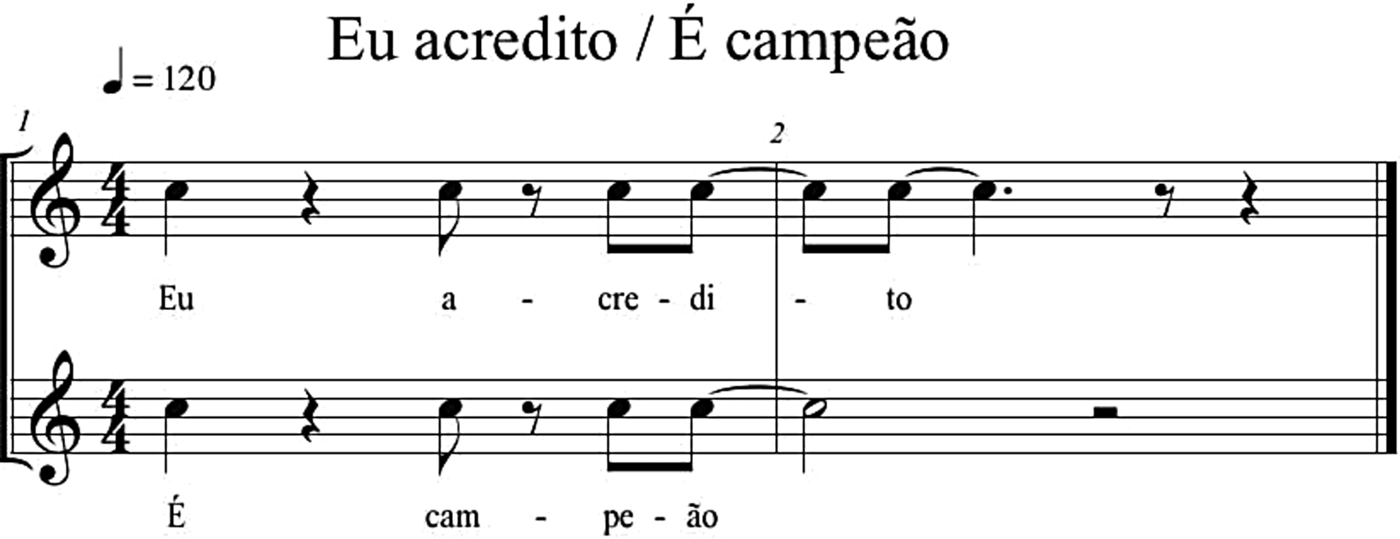
In 2014, during the final of a regional Latin American competition – the ‘Recopa’ – Atlético Mineiro hosted the Argentinian club Lanus after winning the first match by 1–0. By the end of the match, in spite of the intense sonorous activity from the Brazilian crowd, the score was tied by 2–2. The draw gave Atlético the title, but Lanus was struggling hard to score one more goal, being prevented several times from doing so by the defence and the goalkeeper. In this game, Atlético's goalkeeper did justice to his nickname ‘Saint Victor’ (São Victor) by operating ‘miraculous’ defences (more magic!). In unison, the crowd used a sonic technique that is usually employed when the game is about to reach a happy ending: whenever the opponent team got the ball, the crowd booed using their voices, a shrilling whistle or crying out loud. In the final minutes, the crowd began to sing victory songs, confident that their club would win another championship. The cry ‘É Campeão’ (Champion) heavily filled the whole stadium (Figure 2).Footnote 16
Figure 2.
However, the intensity of the collective chant could not undermine Lanus’ players’ will to win, nor could the intense cries from Atlético's fans force the Brazilian team to attack – instead, the team adopted a defensive, almost vulnerable attitude. In his comparison between sound and wind, Tim Ingold argues that the sweep of sound occurs in spite of the effort of the listener to keep oneself in the same place. ‘And this effort pulls against sound rather than harmonizing with it. Place confinement, in short, is a form of deafness’ (Ingold Reference Ingold and Carlyle2007, p. 12). Consequently, sonic techniques, even when ‘correctly’ employed, may not succeed because they aim at ‘deaf’ targets, that is, they are unable to be displaced from the position they already have or intend to occupy.Footnote 17 After scoring two goals at the opponent club's own stadium, Lanus’ players believed that they could win the match and struggled tirelessly to score the goal that would bring the game to extra time. At the final minutes, against all sonorous and affective adversities, their persistence was rewarded, and Lanus scored a goal. Horror – understood as an affect of extreme desolation, provoked by the occurrence of an event believed to be impossible – took over the terraces. The whole stadium stopped singing and the unison became a grievous silence. Within the dynamics of sound and silence, the first incarnates the ideas of vitality and energy, while the latter signals inactivity or death (Wisnik Reference Wisnik1989). Silence is the result of the absence of vibration and is thus employed in introspective moments, posthumous ceremonies or grieving situations. In the studied case, silence is also a sonorous expression with different layers of meaning.
At that stage of the season, the Brazilian team was not showing efficiency and beauty in its gameplay; it had lost the regional competition to its arch-rival, was prematurely disqualified from Copa Libertadores, and its performance was erratic in the National championship. By its turn, Lanus was playing with determination, displaying an intense will to be the champion. This situation made the Brazilian fans suspicious. In addition, the match took place at Minas Arena, a great multi-use arena renovated for the 2014 FIFA World Cup but with a ‘cold’ atmosphere. When Lanus scored at the very last minute, these ghosts haunted the fans. By the end of the match, all of these factors had contributed to the inefficiency of the dynamics of booing and shouting, then faded into the silence that was immediately followed by a disorganized brouhaha of outraged fans hitting the chairs, crying, insulting the coach and cursing the terrible tradition of the club winning or losing important games in the final minutes.
Nonetheless, the dynamics of any match do not follow a linear logic and are subject to energetic variations produced in the intersection between fans, the environment and the players. Approximately 30 seconds after this desolation, the crowd tried to recompose, and to do so, they sang in unison the chorus ‘Eu Acredito’. From that moment on, the team started to play better and winning the championship during the extra time no longer appeared unrealistic. ‘Eu Acredito’ took over the stadium, materializing into sound the self-proclaimed identity of Atlético's fans and their unconditional support for their team. The cries of ‘É Campeão’ (Champion) that were vocalized a few moments earlier now turned into ‘Eu Acredito’ and, surfing on the similar melody and intonation, hope invaded the stadium again.
This superposition of rhythm, prosody and intention spread through the stadium and consolidated an energetic flow that, activated by sound, made the bodies vibrate in one collective perception of trust. As if by magic, triggered by the intensity of the fans’ belief now materialized into sound, Atlético's players reacted and struggled for victory right from the start of the extra time, thus improving their technical performance on the pitch. Therefore faith – understood as an immeasurable belief in the achievement of the unlikely – defeated its twisted brother, horror. In this case, once more, the circuit closed efficiently with Atlético's victory and the consequent place at the championship. ‘Magic’, some may say. ‘Faith’ or ‘guts’, others might say. Either way, it is hard to believe that the turnaround would have happened purely thanks to a cold ‘tactical and technical effort’.
Conclusion
The case of Recopa's final evidences one of the axis of our analysis. The belief in magical achievements in football is often activated and mobilized through sound and music. Yet, for the magic to happen, it is necessary for the sound to resonate from all corners, to harmonize oneself with the collective cries, to let oneself be corporeally involved in the slogans, rhythms and sonorous intensities that reverberate during the game. This mutual activation depends on many factors and, during the final moments of the game-time, they were not working. It was only after Lanus's third goal that a flow enabled a coordinated vibration between athletes and fans, partly due to the sonorous presence of ‘Eu Acredito’. The sonic techniques of the fans are configured as magic when they make cosmological, historical and mythological structures vibrate, articulating a relationship between the fans and their team through cheering. However, for this to happen, it is necessary to believe that it can.
To what extent this belief really works is controversial. During field research, we recorded accelerating beat routines prior to free kicks eight times in four matches, but resulting in only two scored goals. This dynamic was only performed when a player particularly known for his ability at shoot-outs was on the pitch. The cry ‘Eu Acredito’ was registered in nine out of 21 matches. All of them were uttered at the beginning of decisive matches, or when the team was facing an adverse outcome. The cry resulted in two victories, three draws and four losses. These numbers indicate a low efficiency in scientific terms. Nevertheless, we have recorded fans talking about what they called ‘an inexplicable draw’ after one goal was scored by Atlético in the final minute of the first game of 2015 Libertadores round of 16, against their national rival, Internacional. They were leaving the stadium while discussing how the noisy fans in the terraces encouraged players to struggle. Coincidence or not, just before the match started, we also recorded an Atlético fan screaming mockingly but superstitiously to the players: ‘Eu Acredito! Internacional scored 2–0! Let's turn things around!’ Ironically enough, Internacional's fans sang ‘Eu Acredito’ minutes before Atlético managed to tie the game in its last minute – an outcome that could be interpreted as a curse to punish their team for misusing a spell.
In this article, we have argued that magic is a kind of holistic knowledge that connects causally different worlds – but only apparently isolated spheres of life – through the manipulation of a specific matter that is common to both of them. Although traditionally opposed to scientific knowledge, magic is a shared belief activated through sounds and rituals. As such, magic lies in the fans’ minds and performances which intertwine their sonic presence to the athletes’ skills. By doing so, football lovers explain their team's successes and achievements through causal arguments that embed the motricity of sports into movements delineated by sound. This articulation produces a belief in the repetition of sonic practices despite their low scientific efficiency, although it is reinforced and thus verified in mystical terms every time supporters find that their sonic performance hurried a change in the team's attitude on the pitch – a belief that, somehow, their chanting is able to activate extra-mundane help, by magic.



