Second language acquisition has passed its fourth decade as an independent field of research. It seems an appropriate time to critically reexamine some key concepts that, despite much theoretical debate and empirical research, still leave considerable room for refinement. What is looked at here are notions directly related to the interaction between the learner’s mind and instances of the language to which the learner is exposed, an interaction often referred to as input processing (see VanPatten, Reference VanPatten1996, Reference VanPatten, Piske and Young-Scholten2009) or the passage between input and intake. Because intake is by definition the information that can subsequently be used for acquisition, the conversion of input to intake is central to an understanding of SLA. Discussion of this crucial process has tended to center on the role of consciousness, usually framed in terms of the concept of noticing.
A great deal of theoretical confusion exists regarding this crucial notion, and therefore regarding the input-intake relation, which points to the need for a more developed theoretical base for the study of these issues. The goal of this article is thus to examine the current state of the field with regard to the input-intake relation, with a focus on the concept of noticing, and then to place the issues within a broader theoretical framework: the Modular Online Growth and Use of Language (MOGUL) framework of Truscott and Sharwood Smith (Reference Truscott and Sharwood Smith2004; see also Sharwood Smith, Reference Sharwood Smith2004, Reference Sharwood Smith, Köpke, Schmid, Keijzer and Dostert2007; Sharwood Smith & Truscott, Reference Sharwood Smith and Truscott2005, Reference Sharwood Smith, Truscott, Sorace and Unsworth2006, Reference Sharwood Smith, Truscott and Gabrys2008, Reference Sharwood Smith, Truscott, Perry, Collerton, LeBeau and Ashton2010; Truscott, Reference Truscott2006). The conclusion is that noticing, as reformulated within this framework, should be important for the acquisition of metalinguistic knowledge but should not play a direct role in development of the language module.
INPUT, INTAKE, AND THE NOTICING HYPOTHESIS
It is appropriate first to consider previous attempts to achieve theoretical precision in the way that input, intake, and consciousness are talked about. The central explanatory challenge is to account for how linguistic events in the immediate environment of the second-language (L2) learner are converted into linguistic knowledge and skill. It was the growing appreciation of the scale of this challenge that brought about the detachment of SLA as a research area from its strictly applied, teaching-oriented roots. In this section, the history of the concepts of input and intake is briefly surveyed and then the most influential attempt to make sense of the relation between them is considered more extensively—that is, Schmidt’s noticing, with its emphasis on consciousness.
Input and Intake
Input is defined in Sharwood Smith (Reference Sharwood Smith1993) as “potentially processible language data which are made available, by chance or by design, to the language learner” (p. 167). This is the definition followed in this discussion, but its use goes back, in the SLA literature at least, to Corder’s (Reference Corder1967) distinction between input and intake. In other words, right from the start, it was generally recognized that signals originating in the environment—ones that outside observers would recognize as being relevant for the processing and potential acquisition of the L2—would still need to undergo a filtering process. As a result, all, a subset, or possibly none of these signals at a given stage of development would be processed by the learner to the point at which they would trigger development.
Gass (Reference Gass1988, Reference Gass1997) distinguished between (a) apperceived input, which is recognized but not yet comprehended L2 information that is nonetheless registered as not being part of the learner’s L2 repertoire, and (b) the next step in processing input—namely, comprehended input. The question of what exactly apperceived input means will be taken up again in the Confusion in Noticing and Its Application section, but the general idea is that input that passes on into the comprehension stage can undergo analysis and may subsequently, via a process of matching new information with existing knowledge and hypothesis testing, become incorporated into the learner’s grammar, in which case, it can be classified as intake. Gass pointed out that input may be processed for comprehension alone or it may be used for adding to the learner’s L2 repertoire (i.e., for acquisition). This option reflects the dual route for input proposed in Sharwood Smith (Reference Sharwood Smith1986).
From Gass’s distinctions, the theoretical advantage of being more precise can clearly be seen: Only when a finer analysis of terms such as input is made will it be possible to see the kinds of assumptions or claims that a current theory is based on (see also Chaudron, Reference Chaudron1985). For example, it is possible to ask what decides exactly whether comprehended input is actually taken a stage further and pose the question as to what extent input processing during this further stage is best characterized as hypothesis formulation and hypothesis testing. It is also possible to ask if a dual or multiple view of L2 knowledge is envisaged and what particular part of the learner’s mind or processing system is being affected in the long term. Harking back to Krashen’s (Reference Krashen1981, Reference Krashen1982) distinction, what is being learned and what is being subconsciously acquired? If different aspects of the language system, in its broadest sense to include all semantic and pragmatic knowledge, for example, are being processed, will certain formal features then be dealt with by different learning systems such that pragmatic knowledge is acquired via one system and morphosyntactic knowledge via another (see discussion in Sharwood Smith, Reference Sharwood Smith1994)?
Answers to many of these questions concerning input only began to be tackled in greater detail with Carroll’s (Reference Carroll1999, Reference Carroll2001) extensive discussion of the multistage processing of input. Carroll drew on the ideas of Jackendoff (Reference Jackendoff1987, Reference Jackendoff1997) to develop a very specific and detailed critique of the notion of input as used in SLA to date. She redefined the input-to-intake process as a whole sequence of quite different inputs and outputs depending on what module (acoustic-auditory, phonological, syntactic, conceptual) is doing the processing (Carroll, Reference Carroll1999, Reference Carroll2001). The details of this chain of events will be returned to in the MOGUL Architecture section. Carroll rejects input in its standard sense of external, environmental linguistic events and replaces it with the term stimuli. Those stimuli that make an impact on the sensory system, thus constituting an initial input stage, are termed transduced stimuli (Carroll, Reference Carroll2001). Thus, in this view, if there is any sense to the conventional use of the term input at all, it would have to refer to this transduction stage. Additionally, these transduced stimuli are not fed into any learning mechanism to trigger change but first have to be parsed, initially by the phonological system, then the syntactic system, and then, finally, the conceptual system. In Carroll’s (Reference Carroll2001) autonomous induction perspective, learning is triggered as a result of parsing failure during the online building of a representation. In other words, here, input for comprehension and input for acquisition do not represent alternative processing routes for the same environmental stimuli but, initially, the same route beginning with comprehension, and potentially, where there has been parsing failure, a further acquisition stage in which some aspect or aspects of the parsing system are adapted. In sum, a theoretically imprecise definition of what constitutes input and intake inevitably conceals a host of complex issues on which only a more elaborate theoretical model such as Carroll’s (Reference Carroll2001) can hope to shed light.
Noticing as an Account of the Input-Intake Relation
The most prominent attempt to make sense of the input-intake relation and to establish a general theoretical basis for claims about the role of consciousness is that of Schmidt, with his work on noticing. Because of the pioneering quality of this work and its central place in SLA theory and practice, it will be considered in some depth.
Schmidt argued that awareness is necessary and sufficient for conversion of input to intake: A linguistic feature embodied in the input is useful for learning if and only if the learner is aware of it. This noticing hypothesis (NH) is a claim about the need for consciousness—learners must be aware of aspects of form—and an effort to define the limits of that claim. The limit is that the awareness of forms that constitutes noticing does not involve understanding those forms; the hypothesis excludes rules, generalizations about the language, and perhaps form-meaning mappings; it simply requires awareness of the presence of a form in the input—the registration of a sensory experience. On encountering an English yes-no question, for example, a learner might consciously recognize the subject-verb inversion as the way such questions are formed, but this awareness has nothing to do with the NH as Schmidt formulated it: The hypothesis would not predict an association (or a lack of association) between such awareness and successful learning. Although this hypothesis is stated in terms of the necessity of noticing, Schmidt was equivocal on this point; he appeared to favor the view that noticing is necessary for learning but left open the possibility that it is simply facilitative.
Schmidt has always closely associated attention with noticing, and his more recent article on this topic (Schmidt, Reference Schmidt and Robinson2001) focused on attention rather than consciousness. Robinson (Reference Robinson1995) offered a more developed account of the attention-noticing connection, drawing on Posner’s theory of attention (Posner & Petersen, Reference Posner and Petersen1990; Posner & Rothbart, Reference Posner, Rothbart, Milner and Rugg1992; see also Tomlin & Villa, Reference Tomlin and Villa1994, for an application to SLA). In this theory, attention consists of three parts: general alertness, orientation to a stimulus, and detection of a feature it contains. Robinson proposed that noticing should be seen as detection followed by rehearsal in short-term memory. This idea has been adopted by a number of authors (e.g., Izumi & Bigelow, Reference Izumi and Bigelow2000; Philp, Reference Philp2003).
Confusion in Noticing and Its Applications
Schmidt has done much to make the role of consciousness the central issue that it should be. His work is very widely cited, and the terms noticing and noticing the gap have become fixtures in the literature. This influence has brought relevant psychological theory and research into the discussion. He should also be credited with taking steps toward sorting out the varied senses of the term conscious, meanings too easily confused. However, Schmidt’s work as well as subsequent work on noticing has had only limited success in clarifying the issues and has, in important respects, led to confusion. Most of these concerns were presented by Truscott (Reference Truscott1998), but that very critical discussion of noticing has never drawn a response from NH supporters; there has in fact been very little discussion of the meaning of this central concept.
Schmidt’s noticing is an intermediate level of awareness, and the NH is a claim that this intermediate level is necessary for learning. Noticing is more than just awareness of input; it involves awareness specifically of forms in the input. However, it is much less than full awareness of form, as conscious understanding is excluded. Thus, noticing necessarily has a lower boundary that distinguishes it from simple awareness of input and an upper boundary that distinguishes it from awareness at the level of understanding. The concept of noticing can only be understood if there is a principled means of drawing these boundaries, but no such means has yet been offered.
The confusion begins with Schmidt’s (Reference Schmidt1990, Reference Schmidt1993, Reference Schmidt and Ellis1994, Reference Schmidt and Schmidt1995) reasonable reluctance to claim that learners must be aware of all aspects of linguistic form, as it is not plausible to say that a successful learner has full awareness of all the remarkable complexity of language. He thus left the door open to implicit learning: Even though learners must be aware of some aspects of form, other aspects can probably be acquired without awareness. The question then is how the two can be distinguished. Schmidt tried to deal with it through a distinction between noticing and understanding, in which noticing is necessary but not understanding. In this distinction, noticing is “conscious registration of the occurrence of some event,” whereas understanding is “recognition of a general principle, rule or pattern” (Schmidt, Reference Schmidt and Schmidt1995, p. 29).
This distinction has intuitive appeal, but it is difficult to say exactly what it means or how to apply it beyond the clearest cases of understanding; that is, it allows clear judgments that certain things do not constitute noticing and so are not included in the NH, but it is not helpful with regard to what things do qualify as noticing and are therefore included. Awareness of principles like “English does not allow null subjects” or “yes-no questions are formed by inverting subject and verb” clearly constitutes understanding, not noticing, and this is the way Schmidt presented such cases. The troublesome question is how the lower limit of understanding can be drawn to pick out genuine cases of noticing. What about direct object for example? It is an abstract notion; awareness of something as an object can only be in terms of the principles that make it an object. Such awareness is not just registration of a sensory experience, any more than is awareness of the null-subject rule. It is difficult to see any principled distinction between the two cases. Thus, awareness of an object as such also seems to be understanding, not noticing. The same logic applies to basic notions like noun. Awareness that a noun is present cannot reasonably be construed as registration of a sensory event; it is the (partial) understanding of that event.
This suggests that the upper boundary of noticing must be so low that the concept is in danger of becoming meaningless; no room remains for noticing in any form clearly distinct from mere awareness of input. This is a fundamental problem. If the distinction cannot be clearly drawn, the NH ceases to be interesting. The NH has always been presented as a rejection of unconscious acquisition, particularly of Krashen’s (Reference Krashen1981, Reference Krashen1982) views. The essence of this rejection is that learners must be aware of language form. If the NH simply says learners must be aware of input they receive, there is no distinction from Krashen’s views and no interesting claim about the need for awareness. However, at times, Schmidt does seem to treat noticing as simply awareness of input. Schmidt (Reference Schmidt and Schmidt1995) said that learners must only notice a sentence containing English verbal –s to acquire it. Schmidt (Reference Schmidt1990) stated that learning without noticing “means ‘picking up’ stretches of speech without ever noticing them” (p. 134), as if noticing is simply awareness of speech. At another point, he seemed to say that the NH requires only “that learners become aware of sounds, words (recognizable sequences of sounds associated with meaning) and sequences of words,” grammar being a matter of implicit versus explicit learning rather than attention or noticing (Schmidt, Reference Schmidt and Robinson2001, p. 31). It is difficult to see how this differs from a theory of unconscious acquisition.
A possible way to distinguish between noticing and awareness of input is suggested by Schmidt’s occasional statements, in passing, that noticing is equivalent to apperception: the recognition of an aspect of the input as special on the basis of comparison with past experience (see Gass, Reference Gass1988, Reference Gass1997). The term has some popularity in clinical psychology and personality theory but has received little use in the cognitive literature, so it is not as developed as it could be. Nevertheless, the idea is potentially useful here: Noticing is awareness of input as interpreted by the learner’s grammar. This approach may offer a way to distinguish noticing from simple awareness of input and to thereby make the NH interesting; people are directly aware of the input, but the forms are present in the background, tied to the conscious experience.
Although this approach is promising as a way to clarify the lower boundary of noticing, it leaves the noticing-understanding distinction as troublesome as ever. A necessary component of noticing, seen as a kind of apperception, is the behind-the-scenes activity that turns awareness of input into awareness of input as a particular linguistic form. The problem thus becomes how to distinguish between background activity that constitutes understanding and that which does not. The NH says that only the latter is necessary. However, a pure case of noticing or apperception, with no understanding, is difficult to imagine: There is no sense in the idea of recognizing that something is relevant to a particular aspect of the language system while having absolutely no understanding of it. The process presupposes some degree of understanding of the form.
This discussion brings out an interesting contrast between the noticing issue in SLA and a related issue in psychology—implicit learning. Both are about the possibilities and limits of unconscious learning, but a fundamental difference is that nothing parallel to the noticing-understanding issue occurs in the implicit learning discussion. This contrast is easy to understand because the claims in this discussion have never been specifically about registration of sensory experience distinct from understanding of that experience. The claim that initiated the debate (see Reber, Reference Reber1989, Reference Reber1993; see also Berry, Reference Berry and Ellis1994; Nissen & Bullemer, Reference Nissen and Bullemer1987) was that people can acquire abstract principles—those underlying artificial grammars, contingencies between sequences of lights, or the control of a complex system, for example—without awareness of those principles. Critics’ rejection of this claim has taken various forms (e.g., Dulaney, Carlson, & Dewey, Reference Dulaney, Carlson and Dewey1984; Perruchet & Pacteau, Reference Perruchet and Pacteau1990; Shanks, Johnstone, & Kinder, Reference Shanks, Johnstone, Kinder, French and Cleeremans2002), but they all hold that abstract principles cannot be acquired without awareness of those principles. This is an understanding hypothesis, not a noticing hypothesis. One way of seeing the problems with noticing is that Schmidt tried to do what the psychologists have not: to show that awareness is essential in learning while leaving open the possibility that complex abstract knowledge (grammar, in particular) can be acquired without awareness of that knowledge. For this purpose, he proposed a concept with no counterpart in the implicit learning literature—namely, noticing. It is perhaps not surprising that this more ambitious project led to serious conceptual problems.
One source of problems in the concept of noticing is thus Schmidt’s reasonable concern with the complexities of language. However, much of the confusion arises from the opposite source: A lack of concern with the nature of language. VanPatten (Reference VanPatten1994) raised the point that noticing was based on work in areas far removed from language. The relevance of such work to language acquisition is by no means clear, and Schmidt has made little effort to show that the application is valid. Similarly, Truscott (Reference Truscott1998) argued that a fundamental problem with noticing is that it does not rest on any clear notion of what language is. When there is no account of what does or does not count as an aspect of language, it is not possible to see any meaningful discussion of what aspects of language must be noticed—or even what it means to notice them.
This issue is especially important because of the two-step view of learning implicit in Schmidt’s descriptions of noticing. For Schmidt, much (and perhaps most) acquisition can be implicit, but first the learner must collect instances of forms by noticing them in the input. However, Schmidt has never explicitly developed this view. The clearest statement of the two-step view is by N. C. Ellis (Reference Ellis2005), who made extensive use of Schmidt’s notion in his own usage-based approach. In this approach, learners must notice the items that are to be combined to make constructions, but once they have been noticed, they can participate in further development of the system without attention to or awareness of them. This approach has yielded some interesting cognitive ideas, notable among them the use of overshadowing and blocking as possible accounts of why some aspects of input do not become incorporated in learner grammar (see N. C. Ellis, Reference Ellis2002a).
N. C. Ellis’s (Reference Ellis2005) use of noticing, however, contains the same problems discussed above. First, there is no account of what must be noticed. There is necessarily a set of elements that must somehow be picked out for initial noticing, but it is unclear what these elements might be. N. C. Ellis (Reference Ellis2002b) included a section called “What must and what need not be noticed for learning?” but did not try to answer the question. Second, the boundaries of noticing are no clearer here than in Schmidt’s writing. N. C. Ellis (Reference Ellis2005) approvingly quoted Baars’s (Reference Baars1997) statement that all we have to do is “‘point’ our consciousness at some target” for learning to occur “magically” (p. 304). This is attention to the task (Carr & Curran, Reference Carr and Curran1994; Curran & Keele, Reference Curran and Keele1993; Dienes, Broadbent, & Berry, Reference Dienes, Broadbent and Berry1991; Nissen & Bullemer, Reference Nissen and Bullemer1987; Winter & Reber, Reference Winter, Reber and Ellis1994), distinct from attention to the features or forms to be acquired (see Truscott, Reference Truscott1998). Presenting noticing in this way suggests that it is simply awareness of input—not of features of the form contained in the input. This, again, makes the concept largely uninteresting. The same conclusion is suggested by N. C. Ellis’ (Reference Ellis2005) reference to Schmidt’s (Reference Schmidt and Ellis1994) “registration of a stimulus event.” However, his writing clearly implied that noticing is awareness of (unspecified) forms in the input. N. C. Ellis (Reference Ellis2002a) did not seem concerned about the upper boundary of noticing either. One of the few examples he cited of a target of noticing was “a rise in pitch at the end of questions” (p. 174), which sounds more like Schmidt’s concept of understanding than noticing. These issues might be productively explored in the context of Ellis and Schmidt’s (Reference Ellis and Schmidt1998) connectionist model, although it seems that no attempt has yet been made to show exactly how noticing works in such a model. Ellis and Schmidt, for example, did not mention noticing in their article.
Another complication for efforts to understand noticing is confusion regarding the status of meaning: Does awareness of the meaning of linguistic elements constitute noticing? Does the NH require learners to be aware of meaning? For Schmidt (Reference Schmidt and Ellis1994), noticing refers “only to registration of the occurrence of a stimulus event in conscious awareness…not the detection of form/meaning relationships…” (p. 179). Schmidt (Reference Schmidt and Robinson2001), nevertheless, seemed to take the opposite position, stressing the need for attention to the meaning of the forms being acquired: “to acquire morphology…one must attend to both the forms of morphemes and their meanings and in order to acquire syntax one must attend to the order of words and the meanings they are associated with” (pp. 30–31). He did not note the apparent conflict with his original position nor has anyone else commented on this point—an illustration, perhaps, of the gulf between Schmidt’s work and the applications it has received.
Confusion is routinely found, first, in the separation between noticing and awareness at the level of understanding—the upper boundary of noticing. Schmidt has always been explicit that awareness of rules is not noticing; it is awareness at the level of understanding, on which the NH is silent. However, applications of his concept repeatedly miss or disregard this limit, a point that Schmidt (Reference Schmidt and Robinson2001) briefly noted. Egi (Reference Egi2004), for example, said learners “notice the target rule” (p. 257). Kowal and Swain (Reference Kowal, Swain, Johnson and Swain1997) referred to students noticing how a past participle can be used as an adjective. Leow’s (Reference Leow1997) study of the NH ended up dealing entirely with higher levels of awareness, on which the hypothesis is silent (a point Leow seemed aware of). Mennim (Reference Mennim2007) studied learners’ noticing that garbage is not countable. More generally, noticing has been offered as a theoretical basis for teaching form very broadly (e.g., R. Ellis, Reference Ellis1993, Reference Ellis1995; Long & Robinson, Reference Long, Robinson, Doughty and Williams1998; Nassaji & Fotos, Reference Nassaji and Fotos2004). Schmidt’s notion, however, can only justify very limited forms of instruction—those involving awareness below the level of understanding.
Similar problems appear with respect to the lower boundary of noticing—that is, its distinction from awareness of input. Many uses of noticing do not involve any target at all, at least not in the sense of a language form. Nicholas, Lightbown, and Spada (Reference Nicholas, Lightbown and Spada2001) repeatedly referred to learners noticing recasts, corrective feedback, and instances of error correction. Egi (Reference Egi2004), in the context of noticing, talked repeatedly of learners becoming aware of the target input. Mackey (Reference Mackey2006) described the NH as the claim “that learners must consciously notice input” (p. 408). These descriptions of the NH make it uncontroversial and uninteresting.
A Note on Noticing the Gap
Schmidt and Frota’s (Reference Schmidt, Frota and Day1986) noticing the gap, like noticing, has become a standard part of the literature, and the two routinely appear together. No one, to the authors’ knowledge, has attempted to say what the relation is between them, except that both somehow involve awareness. There is not much concern with the possible targets of this awareness either. There are various versions of what is on each side of the gap. It may be a gap between learners’ interlanguage and the target language (R. Ellis, Reference Ellis1993; Shekary & Tahririan, Reference Shekary and Tahririan2006), between interlanguage and input (Izumi, Reference Izumi2002), between learners’ own text and a native’s reformulation of it (Lapkin, Swain, & Smith, Reference Lapkin, Swain and Smith2002; Qi & Lapkin, Reference Qi and Lapkin2001), between their own utterance and the feedback they receive on it (e.g., Bitchener, Reference Bitchener2004), or between what they want to say and what they can say (Loewen, Reference Loewen2004). Some uses of noticing (without the gap) are closely related, referring to awareness that a problem exists (e.g., Anthony, Reference Anthony2008; Izumi & Bigelow, Reference Izumi and Bigelow2000; Kormos, Reference Kormos1999). These are worthwhile concerns, but their relation to Schmidt’s noticing is doubtful.
The Fundamental Problem
The NH has become, in practice, little more than a statement that consciousness is in some way necessary (or perhaps just important) for learning. Most discussions of noticing the gap are equally atheoretical. Thus, Schmidt’s theorizing has little to do with most of the work to which it nominally gave birth. Although a number of reasons might be cited, much of the problem can be attributed to the inherent lack of clarity in the notion. The focus here is on noticing because of its dominant position in this research area, but the more fundamental problem is that the field lacks an account of what consciousness is, in the sense of the so-called easy problem (Chalmers, Reference Chalmers1995, Reference Chalmers, Velmans and Schneider2007). The central requirement for such an account is that it should say how consciousness fits into the cognitive system, including what can become conscious and under what conditions. Without this element, there can be no solid foundation for a discussion of the role of consciousness in SLA. With such a foundation, noticing can be looked at in a new light, revisiting the problem of adequately characterizing noticing, awareness at the level of understanding, and noticing the gap. The large challenges presented here will be taken up in the MOGUL and Consciousness section.
MOGUL AND CONSCIOUSNESS
This section first provides a brief description of MOGUL as a processing-oriented framework and then discusses how it provides a relatively clear account of consciousness and its contents, in general and within a SLA perspective, with particular reference to noticing.
Framework, Not a Model
The MOGUL framework as originally proposed in Truscott and Sharwood Smith (Reference Truscott and Sharwood Smith2004) and elaborated in various other places since (e.g., Sharwood Smith & Truscott, Reference Sharwood Smith and Truscott2005; Sharwood Smith, Reference Sharwood Smith, Köpke, Schmid, Keijzer and Dostert2007; Truscott, Reference Truscott2006) constitutes an attempt to integrate accounts of language acquisition, including the acquisition of more than one language, with proposals about how language interacts with cognition. It finds special inspiration in the ideas of Jackendoff (Reference Jackendoff1987, Reference Jackendoff1997, Reference Jackendoff2002, Reference Jackendoff2007) concerning the architecture of the language faculty. The integration of linguistic theory and language processing accounts can allow the mapping out, in a more detailed and coherent manner, of both the content aspects of linguistic knowledge and the real-time processing of that content. This also includes the ways in which people can or cannot become consciously aware of that content.
As a theoretical framework, rather than a model, MOGUL can entertain various positions, albeit with certain well-defined limits. It is indeed designed to enable the reframing of key issues in more precise terms, issues that have virtually always lacked sufficient precision to fully guide empirical investigations and interpret their findings, irrespective of particular theoretical preferences. Not surprisingly perhaps, the role of consciousness is a case in point.
MOGUL Architecture
The architecture of MOGUL includes a core language system—roughly the language module as understood in mainline generative research. The term core is an indication not that only important aspects of language knowledge are handled by the language module but rather that it houses those linguistic systems whose properties are specific to human language and not accountable in terms of other aspects of human cognition. MOGUL is conceived largely in terms of Jackendoff’s (Reference Jackendoff1987, Reference Jackendoff1997, Reference Jackendoff2002, Reference Jackendoff2007) modular architecture, touched on already in connection with Carroll’s (Reference Carroll2001) autonomous induction model. The core language system is itself modularized in that it comprises two separate subsystems: the phonological module and the syntactic module. It also includes the interface system that determines how phonological structures (PSs) and syntactic structures (SSs) are linked up, as well as interfaces with adjacent systems outside. This involves, on one side, the auditory-acoustic systems that feed into the phonology as well as the articulatory systems responsible for the production of speech (and sign language). On the other side lies the conceptual system responsible for the interpretation and encoding of meaning and that also plays a crucial role in conscious introspection, as it is the basis for thought. Conceptual structures (CSs) more or less cover the traditional areas of semantics and pragmatics. The basic MOGUL architecture is shown in Figure 1.
MOGUL modules and interfaces.

Each of the modules, although operating according to their own unique code, has the same basic internal structure consisting of (a) an information store of structures (representations), some of which are universal primitives and others language-specific structures, and (b) a computational system, or processor, determining how the structures are selected, combined, and integrated into larger structures in the same code—that is, informally, the module’s rule system. It is important to note that the term module is used in a broad sense to refer to all processor-information store pairs, encompassing those (e.g., PS and SS) most clearly modular in the sense of Fodor (Reference Fodor1983) or Jackendoff (Reference Jackendoff1997) and those for which the term modular is most disputable (e.g., CS).
The job of the interface processors (shown as bidirectional arrows in Figure 1) is to match up structures in adjacent modules—for example, a specific PS /hot/ with a SS (Adj). The SS is matched up by another interface with a CS representing the meaning of hot. The function of the interfaces in processing is to coactivate the various coindexed items. Thus, when /hot/ is active, the PS-SS interface activates Adj, and vice versa, the result being that each becomes available for use by its processor.
To this point the focus has been on those portions of the cognitive system that are particularly important for language, but the following discussion will require a broader perspective. One additional system worth mention is affective structure (AfS). It also consists of an information store that contains representations of the possible emotions and a processor responsible for dealing with them. These affective representations are connected to perceptual and conceptual items, sometimes innately (as in fears of common dangers or disgust at the sight of rotting meat) but more often through experience.
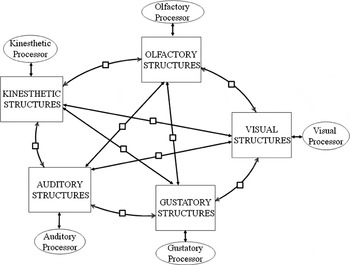
The main focus here is on perceptual output structure (POpS) shown in a simplified form in Figure 2. POpS represents the ultimate output of the modality-specific processing systems, each dealing with input from one of the senses. Auditory structures (ASs), for example, are produced in response to auditory stimuli in the environment and can be informally thought of as stored memories of sounds that may be conjured up in introspection (thinking), dreaming, and hallucination. Visual memory and experience is similarly based on visual structures (VSs), and the same applies to each of the other senses. These various specialized perceptual output systems are tightly connected to one another via interfaces (represented as small open squares), which means that the current state of one system greatly influences that of each of the others, resulting in a strong tendency toward synchronization of POpS activity. The survival value of such a system should be clear: It produces a focus on one coherent aspect of the current surroundings and allows and encourages a unified response to whatever is deemed most important at the time. A routine scattering of attention across a variety of separate objects and actions would not be conducive to survival. In this function, POpS resembles Aristotle’s common sense (Caston, Reference Caston2002; Gregoric, Reference Gregoric2007), Atkinson and Shiffrin’s (Reference Atkinson, Shiffrin, Spence and Spence1968) short-term store (STS), Baddeley’s (Reference Baddeley1986, Reference Baddeley2007) working memory (see also Baddeley & Hitch, Reference Baddeley, Hitch and Bower1974), and, most interestingly, Baars’s (Reference Baars1988, Reference Baars, Velmans and Schneider2007) global workspace.
Perceptual output structures (POpS) in simplified form.

Activation
This interconnectedness, with the resulting coactivation patterns, is a general property of the MOGUL framework. The extreme case is represented by POpS, with the rich connections found both among its component stores and between them and the individual perceptual modules that give rise to POpS representations and, secondarily, its connections with other portions of the cognitive system. This network of strong interconnections and the accompanying tendency toward synchronization implies that POpS representations routinely reach exceptional levels of activation—exceptional by the standards of the cognitive system as a whole.
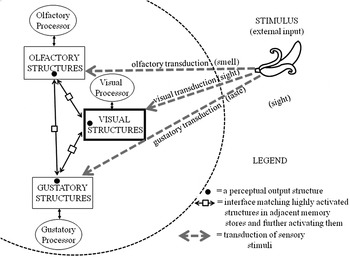
The situation is depicted (incompletely) in Figure 3, using the example of a person eating a banana. Visual perception of the banana involves processing in the vision module, ultimately resulting in activation or construction of a representation (image) of a banana in visual structures. Activation of this representation then leads each of the interfaces to activate coindexed representations in adjacent stores, including gustatory structures (i.e., tastes associated with bananas) and olfactory structures (i.e., smells associated with bananas). When the person smells or tastes the banana, processing in the olfactory or gustatory module results in further activation of these representations. The POpS interfaces then raise the activation levels of all of the representations in adjacent stores, including visual structures, that are coindexed with them, further raising their levels. Continuing stimulation from the senses will, for a time, maintain this process of continuously rising activation levels on POpS. Nonperceptual representations also play a crucial role in the process. Any activation of perceptual banana representations stimulates coindexed CS representations (the concept of a banana) and AfS representations associated with bananas. Activation levels of these AfS representations will be especially high if the person is hungry or likes (or dislikes) bananas. If processing throughout the system remains focused on bananas, the representations at the center of everything (i.e., on POpS) will achieve extremely high activation levels.
Activation patterns in POpS.

These extreme activation levels are a natural and probably inevitable consequence of the centrality of sensation in cognitive functioning and survival, as they ensure that events in the environment will have a strong impact on the workings of the system. A species in which current information about the surrounding world is easily subordinated to system-internal considerations is a species that is destined for quick extinction. For the same reason, it is quite possible that the output of each of the sensory modules, especially vision and audition, has inherently high activation levels, beyond the interconnectedness of POpS.
Similar considerations suggest that AfS representations should have particularly high activation levels. Affect is an extremely old system that has played a central survival role across species, including humans and their ancestor species, guiding behavior toward adaptive responses to events in the environment (see Damasio, Reference Damasio2003; Evans, Reference Evans2001; LeDoux, Reference LeDoux1996; Turner, Reference Turner2000). This role can only be carried out effectively if affective representations have very high activation levels, which allow them to dominate cognition and, therefore, behavior. The mechanism behind these high levels is presumably the extensive brain and body systems involved in emotion, especially the physiological arousal associated with it. AfS and POpS representations might well have inherently high resting levels in addition to what results from their rich connections.
Acquisition by Processing Theory
Modular Online Growth and Use of Language treats growth as the lingering effects of processing and dismisses the need for separate language acquisition mechanisms (for a discussion, see Truscott & Sharwood Smith, Reference Truscott and Sharwood Smith2004). The function of a processor is to construct on its store a legitimate representation for its current input. When this requires a novel combination of existing elements, a new representation is created entirely for the purpose of completing the current processing activity. The new representation lingers in the store with a low activation level. This level can then rise through subsequent use in processing.
Consciousness in MOGUL
A major problem in discussions of consciousness in SLA has been vagueness regarding what it is that becomes conscious. The objects of awareness have been variously characterized, always loosely, as input, language, language form, information, items of the language, and so on. However, from a cognitive perspective, what are these things, such that learners can be aware of them? The discussion of MOGUL architecture immediately suggests a preliminary answer: Learners are aware of representations. Input, language, and such are important as pretheoretical notions, to be incorporated in a cognitive theory, but are too vague to serve as actual entities within such a theory. Thus, within a cognitive theory, there is literally no sense in speaking of awareness of them, except to the extent that they translate into mental representations.
Given that the objects of consciousness are representations, the next question then is which representations become conscious and under what circumstances. An initial answer is suggested by the perceptual bias of consciousness (see Baars, Reference Baars1988). An old observation, no less valid now than when first made in the 19th century, is that conscious experience is dominated by perception. What people are aware of are sights, sounds, and other sensations as well as their internally generated counterparts, especially mental images and the voice inside the head. Nonperceptual representations—conceptual, in particular—can strongly influence conscious experience but do not themselves have phenomenal qualities; they are never conscious. Work on this subject tends to overlook another type of representation routinely present in awareness—the affective representation. Emotions clearly have phenomenal qualities and are central in conscious experience.
The most interesting feature of these observations is that these two representation types, perceptual and affective (POpS and AfS), are those identified as having especially high activation levels. A natural hypothesis, then, is that activation level is the key to awareness. The hypothesis is given in (1).
(1) The Activation Hypothesis: A representation is conscious if and only if its current activation level is above a given threshold value.
Baars (Reference Baars1988) argued that activation is a necessary condition for awareness but cannot be sufficient because informativeness is also crucial. An example would be the way that the sound of a fan gradually fades from awareness with continuous exposure to it. If activation is sufficient for consciousness, this should not occur because the stimulus (the fan sound) continues to activate auditory representations. However, if informativeness is also a necessary condition, the phenomenon is as expected because the sound ceases to be informative to the system once it has been noted and identified, and this change is clearly associated with the loss of awareness.
In MOGUL, these effects are not problematic because elevated activation levels in the portions of the cognitive system that deal with such stimuli can result in lowered activation levels for associated representations in the seat of consciousness, POpS, and so awareness of the stimuli fades as the system’s ability to deal with them increases. The logic is that considerable time is needed, in processing terms, for the POpS representation to become conscious (i.e., for its activation level to rise sufficiently). If conceptual or motor processors that use this representation finish with it before this rise is complete and shift their focus elsewhere, the initial representation will never become conscious. This is what happens in automatization and habituation: The peripheral processors become able to deal with the perceptual representation before it has had time to reach the level of consciousness, and so it never does. Thus, there is no need for an informativeness condition; the activation level offers a sufficient explanation (see Truscott, Reference Truscott2010).
In SLA, which representations reach extreme activation levels and under what circumstances? The preliminary answer should be the same as that for consciousness in general: The objects of consciousness are perceptual and affective representations. Affect is a crucial concern for SLA but is beyond the scope of this discussion, which will be restricted to POpS representations.
The perceptual bias of consciousness has the interesting implication that very little linguistic knowledge is actually conscious. What people are aware of is the sound (and written form) of language—never PS, SS, or CS representations. This is the MOGUL interpretation of Jackendoff’s (Reference Jackendoff1987) observation that the one level at which people can be conscious of language is phonological: “awareness comes clothed in phonological form” (p. 289). In MOGUL, this awareness is projected from the AS that is associated with a given PS, not the PS itself. Given these points, it is reasonable to say that learners can never be aware of grammar, even in principle. However, this may be taking too narrow a view of awareness of grammar, at least with regard to extramodular knowledge. Even though learners are never conscious of CS representations themselves, these representations can be expressed in perceptual form. A CS representation of the fact that man is a noun, for example, can have the AS counterpart [man is a noun], spoken aloud or inside the head, or a VS representation of the written form of the word juxtaposed with a noun (N)—that is, an image. Both types of perceptual representations can be conscious. The concept thus has conscious expression and is available for use in conscious processes; in this sense, it can be said to be conscious, even though it never actually appears in awareness.
This account of consciousness in MOGUL can be summarized as follows:
1. The objects of consciousness are representations.
2. A representation becomes conscious if and only if its activation level crosses a threshold (the activation hypothesis).
3. The representations that can attain such levels are those in POpS and those in AfS.
4. The only linguistic information that people are directly aware of is sound (or written form)—that is, representations in auditory (or visual) structures.
5. People can be indirectly aware of extramodular linguistic knowledge by virtue of its connections with perceptual representations that cross the consciousness threshold.
INPUT, INTAKE, AND CONSCIOUSNESS: THE MOGUL PERSPECTIVE
This discussion of MOGUL and consciousness provides a natural means of understanding the central issues of this article: input and intake, the relation between them, and the place of consciousness in this relationship. This account offers a good interpretation of noticing and the key related concepts of awareness at the level of understanding and noticing the gap while avoiding the problems associated with these concepts.
Input and Intake Revisited
One problem noted with work on consciousness in SLA is the unclear notion of awareness of input, unclear because input itself has been treated in a vague, atheoretical way and because there is so little concern with the structure of conscious experience—that is, the nature of the cognitive entities that can be conscious. The previous discussion developed here directly provides a theoretical interpretation. Input for language acquisition is a perceptual representation of spoken or written language—that is, an AS or VS representation. It becomes conscious in exactly the way that other POpS representations do: When its activation level rises above a given threshold, people become aware of it. Awareness of input is thus awareness of a POpS representation of a sample of language.
What then is intake in MOGUL? The standard notion of intake is that it is the input that can be used for learning, or perhaps information contained in that input. Thus, in MOGUL terms, the question is what can be done with the POpS representation that constitutes the input. General principles of processing, applied both to development of the language module and to the acquisition of metalinguistic knowledge in CS, are essential in discussing this question.
If the information in a POpS representation is to be useful to another module (conceptual or phonological), then that module must be capable, at least in principle, of using it. The phonology module cannot extract useful information from an AS representation of a lion’s roar, nor would a mathematical formula represented on VS be of any value to SS (by way of PS). Such representations could serve as intake for conceptual processing (if the term intake is to be extended in this way; see Sharwood Smith, Reference Sharwood Smith1986) but not for linguistic development, in the language module or in CS. Thus, for an input representation to qualify as linguistic intake, it must contain specifically linguistic information. Such information is never explicitly present in a POpS representation—which is, by definition, nonlinguistic—but must be extracted from it. Thus, the question of whether an input representation constitutes intake is about the ability of a module to carry out this extraction. This ability depends in part on the readiness of the module to deal with the particular information—that is, the current state of the information store. If nouns and adjectives are not yet represented in CS, for example, the adjective-noun (A-N) order implicit in old man cannot be used for development of metalinguistic knowledge, and so the AS does not constitute intake for CS. If nouns and adjectives are present in the store and the processor is in principle capable of dealing with their order, then the AS old man is intake, whether the module is CS or SS.
A module’s ability to extract information from a perceptual representation depends to a large extent on the strength and durability of that representation. If it is active on POpS only briefly, with a low activation level, processors have little opportunity to deal with it, and other activity can overwhelm any effects it might otherwise have. This factor interacts with the module’s ability to use the information automatically, as automaticity should greatly reduce the need for a strong, enduring representation on POpS. If information about categories can be very efficiently extracted, then a POpS representation that is active only for a fairly brief time with only a fairly low activation level can be intake. In the absence of this efficiency, it cannot.
To summarize this view of intake, if the information contained in a POpS representation is to constitute intake to a module, then (a) the module must in principle be capable of dealing with it, on the basis of the nature of the processor and the current state of its information store, and (b) it must be possible for the information to be extracted from the representation, on the basis of the strength and durability of the representation and the degree to which the module can deal with it automatically. It should be clear that although input receives a clear, concrete interpretation in MOGUL, intake is a more abstract entity, designating certain information in POpS representations that is useful to certain processors under certain circumstances. It might be preferable, in the long run, to abandon the concept and speak simply of the ways that input representations can and cannot be used by given modules in given contexts (see Carroll, Reference Carroll2001). However, standard practice will be followed for now and the term will be maintained.
Consciousness in the Input-Intake Relation: The NH Revisited
Given this understanding of input and intake, it is necessary to understand how consciousness is involved in the relation between them, which is addressed by the NH. The subject is best understood in terms of what goes on during the processing of linguistic input.
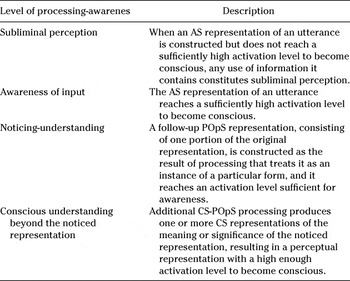
An instance of language comprehension begins with the auditory module constructing an AS representation for an utterance. This representation is the input to the language module. If it does not reach a current activation level sufficient for awareness, any subsequent use it receives is a case of subliminal perception (see Greenwald, Klinger, & Schuh, Reference Greenwald, Klinger and Schuh1995; Kihlstrom, Reference Kihlstrom and Velmans1996; Merikle, Smilek, & Eastwood, Reference Merikle, Smilek and Eastwood2001; Schmidt, Reference Schmidt1990). In contrast, if the representation does become sufficiently active to become conscious, there is awareness of input. The representation might be abandoned at this point, in which case nothing more than awareness of input took place. Another possibility, though, is that a portion of it becomes the subject of further processing; a new representation is constructed, specifically of the relevant portion of the original. For instance, if a sentence contains a word that is new to the person, a possible result is that a new representation is constructed specifically of that word (i.e., of its AS form). The construction of this more specific representation, on the basis of the larger original representation in which it was contained, is the registration of the word’s presence in the input. In Posner and Petersen’s (1990) and Posner and Rothbart’s (1992) terms, the word has been deleted. If this more focused representation then reaches a high enough activation level, as is likely, given that it is now the focus of processing, it becomes conscious (see the two-part account of noticing offered by Robinson, Reference Robinson1995). This conscious detection captures the intuitive idea that the word was noticed.
Noticing cannot be simply construction of a conscious follow-up representation, however. This would make the NH uninteresting, as described previously. The problem can be illustrated by consideration of what the hypothesis might say about the acquisition of direct object from input such as sentence (2):
(2) The old man showed us pictures of London.
A follow-up representation must be constructed of pictures of London and the learner must become aware of this series of sounds. However, the series also corresponds to a meaning, a string of phones, a string of phonemes, a stress unit, and an intonation pattern, among many other possibilities. In terms of syntax, the representation is not only a direct object but also a constituent, a noun phrase, a head-complement structure, an example of a complement following its head, an ordered series of lexical categories, a case of of insertion, and an instance of a null determiner in a plural noun phrase, to name only some of the possibilities. Construction of pictures of London as a follow-up representation is not inherently noticing of a direct object; it could constitute noticing of any of a great many things. Thus, what is gained through noticing, on this simple conception of it, is not instances of form as such but rather a collection of cases not yet defined for any particular aspect of form. These undefined instances might then be analyzed and incorporated in the grammar by unconscious processes. If this is the way to characterize noticing, the NH is not very interesting, as it contains no requirement for awareness of form in the input and offers no challenge to claims of unconscious acquisition. If it is to be made interesting, each instance of noticing must somehow be tied to a specific form, which is not a direct part of the conscious experience but is, nevertheless, the object of noticing.
As noted, this might be done in terms of apperception, which has a natural place in the account of the input-intake relation. Noticing and awareness at the level of understanding involve additional processing of a portion of a POpS representation. Apperception is the process by which that portion is picked out for additional processing. It is a name for the complex phenomena in which activity in one or more modules, occurring in response to a current POpS representation, leads to the creation of a new POpS representation of a particular sort. If this new representation is active enough to cross the consciousness threshold, noticing has occurred. In this view, the follow-up AS that is the object of noticing is constructed specifically because it has been recognized as containing an interesting form of a particular sort. In other words, noticing is awareness of a follow-up AS occurring while—and because—certain existing linguistic representations are active, giving that AS a particular significance. The activation of these representations constitutes a varying degree of understanding.
The presence of this more focused representation of the input might lead to construction of additional representations, involving further understanding. Understanding is, by definition, largely conceptual, so this additional processing is centered on CS. As for the example of adjective-noun order, if a low-level English learner hears old man and already knows that man is a noun and old is an adjective (where the learner knows in the sense that the information is represented in CS), the presence of the AS representation could result in construction of a CS representation of the adjective-noun order, which is, by definition, understanding. The learner can be said to be aware of this understanding if a perceptual counterpart of this CS representation is constructed and becomes conscious. This representation could be linguistic—the voice in the head expressing the order—or could take the form of an image, perhaps of an A to the left of a N, or perhaps some more idiosyncratic realization. It could be a strong, extended awareness, possibly followed by additional processing of the information, or little more than a fleeting experience quickly forgotten. In any case, the conceptual processing is likely to be accompanied by a conscious experience of understanding, or rightness (see Mangan, Reference Mangan1993, Reference Mangan, Velmans and Schneider2007), which is taken to be an affective representation with a high current activation level. The POpS experience could be so limited that this rightness is all, or very nearly all, of the conscious experience.
Given this discussion, the uncertain status of meaning in the NH is understandable. As noted, conceptual representations in themselves have no phenomenal properties; they are never the objects of consciousness. Thus, if noticing is about awareness, then it is impossible for meaning to be noticed in any literal sense. However, CS representations and their use are so intimately associated with POpS representations and their use that awareness of one can reasonably be seen as indirect awareness of the other. Awareness of the sentence The old man showed us pictures of London is literally awareness of the sounds that make up the AS representation, probably accompanied by a feeling of understanding or rightness. However, the meaning (i.e., the associated CS representation) is present in the background and available for manipulation. When a learner notices the –ed affix on showed, the conscious experience is of the sound, but activation of this AS representation might be accompanied by activation of the CS PAST, which is not present in consciousness but is active and prominently involved in the processing.
Putting these points together, a hierarchy of processing that can result from the representation of a linguistic stimulus on AS is presented in Table 1, ranging from minimal to maximal processing-awareness.
Hierarchy of processing-awareness

The NH can then be framed as in (3):
(3) The Noticing Hypothesis (NH): If learners are to acquire an aspect of language form, they must be aware of a POpS representation that was constructed as the result of processing that treats it as an instance of that form.
In terms of the hierarchy, this is to say that noticing-understanding is necessary for learning, and conscious understanding beyond the noticed representation is not; in other words, noticing-understanding is necessary and sufficient for the input-intake conversion.
The NH is interesting in this formulation because there is a clear lower boundary for noticing: It makes the claim that awareness of input is not enough. Regarding the upper boundary, this formulation abandons the effort to distinguish noticing from understanding, defining the boundary instead in terms of the representations that become conscious. What needs to be excluded from the NH is not understanding but rather awareness of additional representations beyond the noticed one. The claim made by the reformulated NH is that when the noticed representation becomes conscious, the form-meaning unit—that is, the coindexed pair of AS and CS representations—is automatically stored.
This hypothesis is presented as an interpretation of Schmidt’s claim, not as a claim of the authors. The implications of both the processing-awareness hierarchy and the noticing hypothesis as formulated here are explored in the next subsection.
Input, Intake, Consciousness, and Learning
The processing-awareness hierarchy has strong implications for the possibility of changes in the system (learning) that occur on the basis of given input. Greater processing and awareness create greater potential for learning, although the story is, not surprisingly, more complex than this.
The case of minimal processing-awareness—that is, subliminal perception—involves an AS representation that is not active enough to become conscious. Given the dynamic character of processing, this weak representation will quickly be replaced on POpS and so will have little opportunity to serve as input for other modules. Thus, some additional processing should be possible on the basis of the subliminal AS representation, but it should be quite limited, as has been found for subliminal learning in general (Greenwald et al., Reference Greenwald, Klinger and Schuh1995; Kihlstrom, Reference Kihlstrom and Velmans1996; Merikle et al., Reference Merikle, Smilek and Eastwood2001; Schmidt, Reference Schmidt1990).
The next level of the hierarchy is awareness of input. In this case, the input representation is strongly present on POpS, but there is no focus on any particular portion of it that might be of value for learning, nor does it contain any explicit information about language form. The order of adjectives and nouns, for example, is only implicitly represented. Here, the nature of the processor and the state of its associated store are crucial. The language module automatically deals with such information in perceptual representations, and so the fact that the information appears in only an implicit and unfocused manner should not matter, assuming that PS and SS representations of the words already exist—with the SS representations including the words’ categories. CS could, in principle, contain automatized processes of this sort, but this would certainly be the exception. In general, metalinguistic CS development on the basis of awareness of input is unlikely.
At the next level—noticing-understanding—a particular portion of the original input representation has, in effect, been selected for further processing and has thereby become the sole content of a follow-up representation. In the example of word order, this portion consists of the noun and the adjective, although this category information is not explicitly present. The NH, as formulated here, says that noticing-understanding is necessary and sufficient for converting input to intake. The implication of this discussion is that the NH should not be directly applicable to the growth of the language module, which can automatically extract linguistic information at the awareness of input level but appears reasonable for the development of extramodular linguistic knowledge because CS rarely has any such ability.
The final level of the hierarchy involves additional CS processing, beyond the noticed representation, with one or more resulting POpS representations reaching consciousness. This conscious understanding, a natural follow-up to noticing, is conceptual and so should be important for the development of CS but should have little or no relation to that of the language module. For the language module, explicit representations of information like category or order have no meaning and any such information that the processors can use was available in the original input representation in any case, as with noticing. With regard to the development of extramodular linguistic knowledge, however, understanding as described is precisely the sort of additional processing that should lead to changes in CS. The significance of awareness at this level is that its presence indicates the occurrence of relatively sustained processing that involves high activation levels, the optimal conditions for enduring changes in the information stores (i.e., learning).
In the example of word order, understanding involved the creation, from the noticed old man representation, of a CS representation (ADJECTIVE-NOUN). Given acquisition by processing theory (APT), this creation is in itself learning, as the new representation will remain in CS after this processing episode has ended. The crucial issue is how high its activation level will be and, therefore, how available it will be for future use. The key factor is how active it is during this processing episode, and this activity level is reflected in the presence or absence of consciousness. Because of normal interface activity, the current activation level of a CS representation is necessarily correlated with that of a coindexed POpS representation, perhaps the AS representation of the phrase “adjective, then noun” or a VS image of A preceding N. If this level is very high, the POpS representation will be conscious. In contrast, the absence of awareness would indicate that the activation (of perceptual and conceptual representations) did not reach high levels. Thus, the presence of awareness, although not a causal factor, is strongly associated with successful acquisition of metalinguistic knowledge.
A Note on Testability
Modular Online Growth and Use of Language is not a theory designed to explain specific phenomena. It is rather a broad framework within which specific theories can be formulated to allow research and theory from a range of disciplines to be brought together. Thus, the issues of testability that are crucial for theories are not directly applicable to MOGUL in itself. The framework must be judged by how well it serves its intended purpose. However, the question of testability does arise with regard to the specific accounts proposed within MOGUL, including the proposed version of the NH.
To a considerable extent, the question has already been addressed in experimental work on noticing. A major limitation of this research, however, is that it has been unable to separate noticing from awareness at the level of understanding, a distinction that is probably impossible to operationalize in any nonarbitrary way. The proposal here represents an improvement in that it involves no such distinction. Most past studies have operationalized noticing in terms of verbal report. What learners report being aware of during the experimental treatment is what they noticed. This approach is no less appropriate for experimentation within this account. It could be confined to testing awareness of a single representation or could be extended beyond this. The account involves the construction in real time of sequences of representations constituting awareness of input, noticing, and awareness beyond the noticed representation, and the sequence is, in principle, testable. When given specific linguistic input (e.g., the old man), do subjects sometimes report awareness of first the entire string and then specifically the old man portion of it and then additional representations involving category and order? If so, how is such awareness related to learning?
Another important issue is how a representation’s activation level can be measured, as activation is crucial in this account of consciousness. The answer must ultimately be cast in neural terms, although it is not yet clear exactly how such research is to be done. From a cognitive perspective, which is more immediately relevant, the most useful model for testing is work on lexical access, in which a representation’s activation level is defined as its availability for processing. The more quickly it can be used (measured by reaction time), the higher its level. Given the MOGUL framework, experimentation might also exploit the idea of competition. If two representations are both potentially useful at some point, the more active of them will win, appearing in production. The one that is actually used was thus the more active one.
This discussion leaves open a multitude of questions about how the ideas are to be worked out in practice, but there does not appear to be any problem of principle.
Another Note on Noticing the Gap
Implicit in this discussion is an interpretation of Schmidt and Frota’s (Reference Schmidt, Frota and Day1986) noticing the gap. As noted previously, the concept has no clear relation to noticing or to the input-intake relation, apart from the fact that it has something to do with consciousness. Uses of the term have varied considerably, the basic version arguably being awareness of a gap between input and interlanguage. Perhaps the best way to understand noticing the gap in this sense is as a version of apperception. It is what happens when unconscious processes pick out, in some sense, a portion of a POpS representation as relevant to the current state of the language system, resulting in the construction of a new POpS representation specifically of that portion, which then becomes conscious as its activation level crosses the threshold. In other words, noticing the gap is the process that underlies noticing. It tends to involve an additional conscious experience as well: the feeling of wrongness, accompanied (inconsistently) by an ability to verbally articulate the nature of the wrongness (i.e., the gap). This is a fringe consciousness experience (see Mangan, Reference Mangan, Velmans and Schneider2007), which in MOGUL terms results from an affective representation reaching a high activation level (see Truscott, Reference Truscott2010).
CONCLUSION
An understanding of the input-intake relation and the place of awareness in it is crucial for the development of SLA theory. In regard to this crucial issue, the following claims are summarized:
1. Considerable confusion exists in the concept that has thus far dominated attempts to reach an understanding of input, intake, and awareness (i.e., noticing).
2. Following Carroll (Reference Carroll1999, Reference Carroll2001), input is the representation(s) available to a given processor, especially those that make up perceptual output structures in MOGUL.
3. Intake is an abstract notion, comprising any information in an input representation that can be used by a given processor for a given purpose at the time it is present.
4. The role of consciousness in the input-intake relation can productively be seen in terms of the MOGUL account of consciousness:
a. A representation becomes conscious if and only if its activation level crosses a threshold (the activation hypothesis).
b. The representations that can attain such levels are those in perceptual output structures and those in affective structures.
5. Awareness of input is awareness of a perceptual (AS) representation.
6. Noticing is awareness of a follow-up perceptual representation consisting specifically of one portion of the original input representation.
7. Because such a representation has a high activation level, it is especially available for use by other modules.
8. If this follow-up representation triggers additional CS-AS processing, metalinguistic representations of its significance for the language system could result, and the learner could become aware of them. This is conscious understanding beyond the noticed representation.
9. The language module deals with linguistic information automatically; awareness of input is sufficient for its development, and noticing and understanding are not directly relevant.
10. The additional representations that constitute noticing and understanding should be of value for conceptual (metalinguistic) development.
Although a theoretical account has been presented here, these issues are ultimately empirical in nature. The success of an empirical investigation, however, depends greatly on its theoretical foundations, which determine the clarity and appropriateness of the questions that are asked and the insightfulness of the interpretations that can be provided for empirical findings. Our hope is that we have made a contribution in this respect.