Background
A growing number of epidemiological and clinical studies suggest caffeine (1,3,7-trimethyxanthine) to have neuroprotective properties which reduce aging-related cognitive decline, notably in women (Eskelinen et al., Reference Eskelinen2009; Maia et de Mendonca, Reference Maia and de Mendonca2002; Lindsay et al., Reference Lindsay2002; Ritchie et al., Reference Ritchie2007; Santos et al., Reference Santos2009). The principal underlying causal hypothesis has been that caffeine through antagonism of adenosine receptors (Daly and Fredholm, Reference Daly and Fredholm1998; Ribeiro et al., Reference Ribeiro2002) attenuates damage caused by β-amyloid (Aβ) (Arendash et al., Reference Arendash2006; Reference Arendash2009; Cunha et al., Reference Cunha2006; Dall'Igna et al., Reference Dall'igna2006). The assumption has thus been that caffeine has a direct effect on amyloid toxicity, however, more recent studies have shown caffeine to be associated with other pathologies which are highly likely to act as confounders in the association between caffeine and cognitive performance, notably diabetes and depression.
Diabetes is a highly significant risk factor for cognitive impairment and dementia; the risk more than doubling in persons with an ApoE ɛ4 allele (Irie et al., Reference Irie2008; Ritchie et al., Reference Ritchie2010). The principal mechanisms by which diabetes is currently hypothesized to lead to cognitive impairment and dementia are (a) vascular disease via the association of diabetes with stroke (Almdal et al., Reference Almdal2004); (b) glucose toxicity leading to progressive functional and structural abnormalities in the brain (Gispen and Biessels, Reference Gispen and Biessels2000); and (c) compensatory hyperinsulinemia, which is an established risk factor for both accelerated cognitive decline and dementia (Luchsinger, Reference Luchsinger2004; Zhao and Alkon, Reference Zhao and Alkon2001). Nine prospective cohort studies have now been undertaken demonstrating the effects of caffeine consumption on risk of type 2 diabetes, showing a protective effect in a dose-dependent association, with a combined RR of 0.65 (95% CI 0.54–0.78) (Van Dam and Hu, Reference van Dam and Hu2005). Taken together, these observations support the possibility that the beneficial effects of caffeine on cognitive functioning may be linked to its effects on insulin metabolism rather than by directly impacting on amyloid accumulation.
A competing mechanism is via depression. Thirteen cohort studies have examined the relationship between depression and subsequent cognitive decline over periods ranging from 1.5 to 6 years, of which 9 found a significant association, 3 no association, the remaining study being under-powered. A comprehensive review of these studies has been undertaken by the Agency for Healthcare Research and Quality, concluding a significant positive association between depression and rates of cognitive decline independently of dementia (Williams et al., Reference Williams, Plassman, Burke, Holsinger and Benjamin2010). Depression is furthermore an independent risk factor for type 2 diabetes (Golden et al., Reference Golden2008). Recent prospective studies have observed that caffeine, via coffee consumption, lowers risk of depression risk in both men (Ruusunen et al., Reference Ruusunen2010) and women (Lucas et al., Reference Lucas2011) even after controlling for a large number of potential confounding variables, with no effects observed for decaffeinated coffee.
Together these observations suggest multiple alternative pathways for the observed associations between coffee consumption and cognitive performance in older populations which have remained largely unexplored. In addition to possible effects on amyloid accumulation, we hypothesize alternative pathways may be (1) an effect mediated by diabetes risk and hence subsequent glucose toxicity, and diabetes-related vascular changes, (2) direct reduction of cognitive decline risk through anti-depressive action, or (3) by reducing risk of depression, which in turn lowers risk of diabetes.
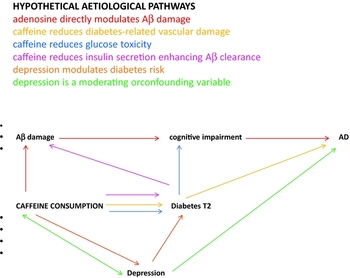
Caffeine is widely available and is currently the world's most frequently ingested psychoactive substance. In the form of tea or coffee, it has few adverse side effects in normal dosage, thus offering a relatively cheap and accessible potential neuroprotective measure. However, there are clearly multiple confounding factors and any health-related recommendation for increases in caffeine consumption cannot be justified without independent establishment of the biological pathways involved independently of any commercial interest. These potential mediating pathways are described in Figure 1. In the present study, data from a large prospective general population study with information on caffeine consumption, type 2 diabetes, fasting glucose levels, plasma Aβ levels, cognitive functioning and AD diagnosis, as well as data on a wide range of potential clinical and life-style confounders are used in order to examine alternative pathways linking caffeine and cognitive performance.
Hypothetical etiological pathways: adenosine directly modulates Aβ damage (red line); caffeine reduces diabetes-related vascular damage (yellow line); caffeine reduces glucose toxicity (blue line); caffeine reduces insulin secretion enhancing Aβ clearance (pink line); depression modulates diabetes risk (orange line); depression is a moderating or confounding variable (green line).

Methods
Study population
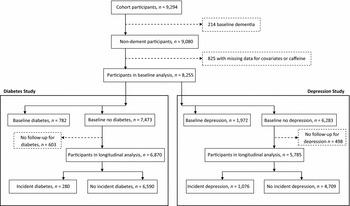
Subjects were recruited as part of a multi-site cohort study of community-dwelling persons aged 65 years and over from the electoral rolls of three French cities (Bordeaux, Dijon, and Montpellier) between 1999 and 2001 (the Three City Study). Between January 1999 and March 2001 9,294 persons were recruited, of whom 214 were eliminated due to a dementia diagnosis at baseline and 825 had missing data on one of the covariates. A sub-set of 1,193 persons had data on concentrations of serum Aβ. Subjects were examined at baseline and two, four, and seven years follow-up. The flow chart showing the numbers of participants included in the analyses is presented in Figure 2. Participants with missing data for the covariates or for caffeine were excluded (Figure 2, n = 825); they were older (p < 0.0001), had a lower educational level (p < 0.0001), and were also more likely to have vascular disease (<0.0001), hypertension (p = 0.0002), and mobility restriction (p < 0.0001).
Cohort flow-chart.

The study design and detailed methodology has been described elsewhere (The 3C Study Group, 2003). The study protocol was approved by the Ethical Committee of the Bicêtre University-Hospital (France) and written informed consent was obtained from each participant.
Caffeine consumption
Questions relating to caffeine consumption were part of a standardized interview administered by either psychologists or research nurses at baseline and two and four years. Number of cups normally consumed per day of tea and coffee were noted. Other forms of caffeine (e.g. colas, cocoa) were consumed too rarely by this elderly cohort to warrant inclusion, as already reported (Ritchie et al., Reference Ritchie2007). Calculations were made on the assumption of one cup of coffee containing 100 mg of caffeine and tea 50 mg, the total average consumption per day being calculated per subject in caffeine units (one unit = 100 mg). High caffeine consumers were defined as taking three units or more.
Socio-demographic and clinical adjustment variables
A standardized interview included questions on demographic characteristics, education level (classified in two groups corresponding to ≤5 and 6+ years of education), mobility, and confinement to home and neighborhood, height, and weight. A body mass index (BMI) between 25 and 30 kg/m2 was classified as overweight, and a BMI greater than 30 kg/m2, as obese. Information was obtained on type and quantity of alcohol consumption (number of units of alcohol per day; 0, 1–12, 13–36, >36 g/day) and tobacco use (classified as past, present, or never users). History of respiratory disorders, cancer, hypertension, hypercholesterolemia, diabetes, stroke, angina pectoris, myocardial infarction, cardiac and vascular surgery was established at baseline according to standardized questions with additional information where necessary from general practitioners. Cognitive impairment was defined at baseline as a Mini-Mental State Examination (Folstein et al., Reference Folstein, Folstein and McHugh1975) score less than 24. The interview also included an inventory of all drugs used during the preceding month, noting those with potential anticholinergic effects (Carriere et al., Reference Carriere2009). Medical prescriptions and, where feasible, the medications themselves were seen by the interviewer. Diabetes was defined as glycemia ≥7 mmol/l or anti-diabetic treatment at baseline and as declared or treated during the follow-up. Depressive symptomatology was assessed at baseline and during the follow-up by the Center for Epidemiological Studies-Depression scale (CES-D) (Radloff, Reference Radloff1977) with a 16 cut-off point or a diagnosis of current major depressive episode according to DSM-IV by the Mini-International Neuropsychiatry Interview (MINI) (Lecrubier, Reference Lecrubier1997). Information on depressive symptomatology was not available for Dijon at seven-year follow-up.
Non-fasting plasma samples were collected at baseline in tubes containing sodium EDTA as an anti-coagulant. Following centrifugation, plasma samples were aliquoted into polypropylene tubes, stored at –80°, and only thawed immediately prior to Aβ quantification. Plasma Aβ peptide levels were measured blind to cognitive status. The plasma Aβ peptide assay was performed using the INNO-BIA kit (Innogenetics, Ghent Belgium) based on a multiplex xMAP technique with a LABScan-100 system (Luminex BV, the Netherlands). Aβ 40 (kit format A) and Aβ 42 (kit format B) were respectively determined as described in further detail elsewhere (Lambert et al., Reference Lambert2009). Aβ peptide levels from each blood draw were measured in duplicate. Lipids levels of HDL cholesterol and triglycerides where categorized in three classes according to gender-specific quartiles (1st quartile, 2nd–3rd quartiles, 4th quartile) and ApoE genotype. For ApoE genotyping blood was collected on ethylenediaminetetraacetate K3 (EDTA K3, Le Pont-De-Claix, France). DNA was extracted from white blood cells with the Puregene extraction kit (Gentra Systems, Inc., Minneapolis, MN). ApoE genotyping was performed using the fluorogenic 5’-nuclease assay with TaqMan chemistry. Amplification was performed in a final volume of 5 _L containing 20 ng/_L of DNA solution, 900 nM of each primer, 200 nM of each probe, and 2_ TaqMan Universal PCR master mix (Applied Biosystems, Foster City, CA). In each assay, controls for the wild type and mutations were included. Reaction mixtures were loaded into 384-well plates and placed in a GeneAmp PCR system 9700 (Applied Biosystems). The PCR conditions were as follows: initial denaturation at 95 °C for 10 minutes followed by 48 cycles of den-aturation (92 °C for 15 seconds), annealing, and extension in one step (60 °C for 60 seconds). After cycling, genotyping was carried out on the ABI Prism Sequence detection system 7900 (Applied Biosystems). The allelic distribution for ApoE was 2/2 = 0.84%; 2/3 = 12.15%; 2/4 = 1.17%; 3/3 = 66.47%; ¾ = 18.78%; 4/4 = 0.59%.
Statistical analyses
χ2 tests were used to compare baseline characteristics according to gender. Cross-sectional associations of caffeine consumption with diabetes or depressive symptoms were assessed using logistic regression models and stratifying by gender due to previous findings of gender specific associations of caffeine consumption with cognitive decline (Ritchie et al., Reference Ritchie2007). A Cox model with delayed entry and taking age as the basic time scale and birth as the time origin was used in the longitudinal analysis of the incidence of diabetes or depressive symptoms over the seven-year follow-up in participants free of baseline diabetes or depressive symptoms respectively (Figure 2). In the Cox models, all participants were kept in the analysis up to their censoring age (age at the last visit). The age of event was the median age between the age at the examination where the event was detected for the first time and the age at the previous visit. The median (IQR) follow-up time was 3.7 years (3.5, 6.8) for diabetes and 3.6 years (3.0, 6.5) for depression. Univariate models (Model 0) were adjusted only for age and center while multivariable models (Model 1) further adjusted for covariates found to be significant at p < 0.10 in cross-sectional or longitudinal analyses; education level, cardiovascular pathologies, hypertension, BMI, HDL cholesterol, triglycerides and mobility (for diabetes only), and respiratory pathologies (for depression only). In a sub-sample of 1,193 participants, the cross-sectional analysis of Aβ40 (top tercile), Aβ42 (low tercile), and Aβ42/Aβ40 ratios (low tercile) associations with high caffeine consumption used a logistic model. In order to establish whether diabetes and depression could be considered intermediate variables in the relationship between caffeine consumption and cognitive performance, we adopted the three-phase definition of mediation proposed by Kraemer et al. (Reference Kraemer2001) namely that (i) caffeine consumption precedes the mediator and a longitudinal relationship is established between them, (ii) the mediator is related to the incidence of cognitive decline, and (iii) when caffeine consumption and the mediator (Me) are jointly entered in a model explaining cognitive decline incidence either Me “dominates” caffeine consumption (total mediation) or caffeine consumption and Me codominate (partial mediation).
Results
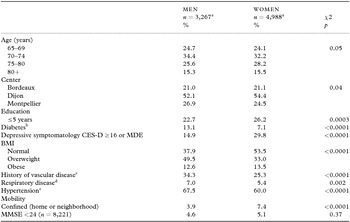
Within the cohort of 8,255 participants, 3,267 were men and 4,988 women. Women were older, with lower levels of education, less diabetes but more depressive symptomatology, less overweight with less often a history of vascular disease, respiratory disease or hypertension, more likely to have reduced mobility and cognitive dysfunction (Table 1).
Description of baseline sample (n = 8,255)

aUnless specified otherwise.
bDiabetes defined as glucose ≥7.0 mmol/l or treated.
cHistory of stroke, myocardial infarction, angina pectoris, arteritis, cardiac insufficiency, arrhythmia, or cardio-vascular surgery.
dChronic bronchitis or asthma attacks (over the last 12 months).
eSystolic blood pressure ≥160 or diastolic blood pressure ≥95 mm Hg or intake of antihypertensive drugs.
Note: BMI = body mass index; MDE = major depressive episode; MMSE = Mini-Mental State Examination.
Diabetes
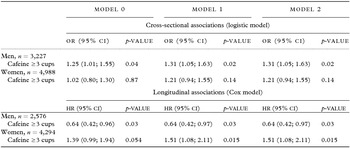
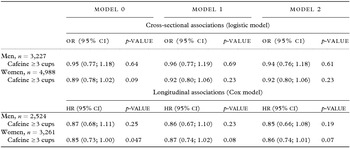
Results of cross-sectional and longitudinal associations of high caffeine consumption with diabetes are shown in Table 2. In cross-sectional analyses, a significant association was found in men only, higher consumers being more often diabetic (OR = 1.31, 95% CI 1.05–1.63) after multiple adjustments. In men higher coffee consumption was associated with a lower risk of diabetes onset (HR = 0.64; 95% CI 0.42–0.97), whereas in women it was associated with increased risk (HR = 1.51; 95% CI 1.08–2.11).
Associations between caffeine consumption and diabetes

Model 0 adjusted for age and center.
Model 1: model 0 + education, cardiovascular pathologies, hypertension, BMI, HDL cholesterol, triglycerides, and mobility.
Model 2: model 1 + baseline depressive symptoms.
Depression
Cross-sectional and longitudinal associations of higher caffeine consumption with depressive symptoms are given in Table 3. In both men and women the fully adjusted model showed no significant relationship between caffeine consumption at baseline and either prevalent or incident depressive symptoms, although a non-significant trend was observed for lower depression in women only.
Associations between caffeine consumption and depressive symptoms

Model 0 adjusted for age and center.
Model 1: model 0 + education, cardiovascular pathologies, respiratory pathologies, hypertension, BMI, HDL cholesterol, triglycerides, and mobility.
Model 2: model 1 + baseline diabetes.
Given the weak longitudinal association between high caffeine consumption and both diabetes (a protective effect with p-value = 0.03 in men and an at-risk effect with p-value = 0.02 in women) and depressive symptoms (non-significant protective effect with p = 0.19 in men and p = 0.07 in women) the first step in the establishment of mediation could not be established so a full model to explain cognitive decline was not constructed.
Plasma amyloid beta
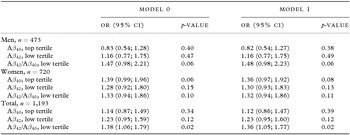
As Aβ measures were taken only once at baseline, only a cross-sectional analysis was undertaken (Table 4). Multivariate logistic regression adjusted by the potential confounders age, sex, study center, BMI, depressive symptoms, and ApoE ɛ4 status found significantly lower Aβ42/Aβ40 ratios in persons consuming three or more cups of coffee per day (that is, high coffee consumers are more likely to be in the lowest tertile) (OR = 1.36, 95% CI 1.05–1.77, p = 0.02) in the overall sample. However, after stratification by gender the association failed to reach significance.
Cross-sectional association between caffeine consumption (≥3 cups) and beta amyloids

Model 0 adjusted for age and center (and for gender in the total sample).
Model 1: model 0 + BMI, depressive symptoms, and ApoE 4.
Discussion
The overall aim of our analyses was to explore alternative putative pathways to explain the observed relationship between caffeine intake and cognitive performance in late life. The first hypothesis is mediation through diabetes risk and subsequent diabetes-related toxicity and vascular pathology. We found significant longitudinal associations between high caffeine intake and seven-year diabetes onset after adjustment for multiple confounding factors; however, these were not in the direction expected given the hypothesized relationship with cognitive decline. While men consuming three or more cups per day were observed to have a significantly lower risk of diabetes onset, our previous analyses on this cohort found no relationship between coffee intake and cognitive decline in men adjusting for diabetes (Ritchie et al., Reference Ritchie2007). This suggests that while in keeping with the results of nine preceding cross-sectional studies (van Dam and Hu, Reference van Dam and Hu2005) that coffee intake may reduce diabetes risk, this appears to be in men only, with no demonstrated impact on longer term cognitive decline. It is also uncertain as to what the protective effect may be attributed to as a previous study has shown that the reduction in the risk of diabetes is equally obtained with decaffeinated coffee (Floegel et al., Reference Floegel2012). In women we found, on the contrary, increased risk of diabetes onset with higher coffee consumption. This finding is in contrast to previously conducted cohort studies (Van Dam and Hu, Reference van Dam and Hu2005), which have not stratified by sex; our findings suggesting that previous associations may have been in men only.
An alternative pathway postulated by our study is via the possible anti-depressant effects of caffeine, or alternatively indirectly by reduction of diabetes risk. This study showed that high coffee consumption did not reduce the incidence of depression over seven-year follow-up although there was a non-significant trend for women. This finding is contrary to those of previous prospective studies which did not, however, adequately adjust for cardiovascular pathologies. It is thus possible that persons with cardiovascular disorder may reduce their caffeine intake and also concurrently experience depressive symptoms associated with cardiovascular disease rather than lack of caffeine. While we observed as in previous studies, an association between diabetes and depression (results not shown), this weakened the association in women between depression and coffee consumption after adjustment, suggesting it to be a potential confounding rather than mediating factor. We thus conclude that the pathway between caffeine consumption and cognitive decline does not pass by either diabetes or depression according to the criteria of Kraemer et al. (Reference Kraemer2001) for mediation.
Finally, we examined the relationship between caffeine consumption and amyloid accumulation through measures of plasma Aβ40 and Aβ42. Within our study, we observed significantly lower Aβ42/Aβ40 ratios levels in high coffee consumers independently of sex, and a trend for an association with Aβ42 in the whole sample and women which did not quite reach significance. As only baseline measures of Aβ40 and Aβ42 were available, we were unable to construct a mediational model. While the amyloid cascade hypothesis suggests that aberrant metabolism of the amyloid precursor protein and subsequent accumulation in brain of soluble oligomers Aβ40 and Aβ42 gives rise to Alzheimer disease pathology, this is expressed in plasma as low Aβ42 levels (Graff-Radford et al., Reference Graff-Radford2007; Kawarabayashi et al., Reference Kawarabayashi2001; Mayeux et al., Reference Mayeux2003). While this would initially appear to suggest that contrary to the coffee and amyloid hypothesis, that is, higher caffeine consumers are at increased risk of high brain amyloid plaque formation, more recent studies suggest that low serum levels of Aβ occur only in the period immediately preceding the clinical diagnosis of dementia (Lambert et al., Reference Lambert2009; Mayeux et al., Reference Mayeux2003). A recent prospective study by Cosentino et al. (Reference Cosentino2010) found that high baseline serum Aβ42 in persons without dementia was most highly predictive of cognitive decline across four years, with levels falling rapidly to significantly lower levels around the time of dementia diagnosis. This is coherent with our findings, and with previous observations from this cohort of fewer white matter lesions in high caffeine consumers (Ritchie et al., Reference Ritchie2010), however, stratifying on gender in keeping with our observation of an association with cognitive decline in women only the association lost significance in both men and women likely due to a loss of statistical power and the results are thus inconclusive. This would suggest the association with serum amyloid levels even if it does exist with larger numbers, is likely to be weak.
Together our findings suggest that the association between caffeine consumption and cognitive performance is unlikely to be mediated by either diabetes or depression, and we are unable to confirm a relationship with serum amyloid although there is a trend for an association with Aβ42. Serum amyloid remains, however, a highly contested indicator of brain amyloid and further investigations are required using CSF measures of amyloid deposition. Our findings further suggest that previous observations of a protective effect of caffeine on diabetes appear to be true for men only, and previous associations with lower rates of depression are probably principally due to inadequate controlling for confounding factors. This prospective study has been able to take into account a large number of potential clinical and life-style confounding variables and by its longitudinal nature, and the exclusion of dementia, depression and diabetes at baseline, to indicate direction of causality.
A shortcoming of this study is, however, the underlying assumption, as with previous studies, that caffeine is the active substance in tea and coffee consumption which provides this protective effect. Recent studies have suggested that coffee, and to a much lesser extent tea, may have estrogenic properties, principally through its high isoflavone content (Alves et al., Reference Alves2010) so that the association with reduction in rates of cognitive decline may be through these estrogen-like molecules. Numerous studies have demonstrated the effects of estrogen on cognitive function (Ryan et al., Reference Ryan2009) notably through its effect on the hippocampus (McEwen et al., Reference McEwen2012). We recently reported an association between genetic variation in the estrogen receptor and fewer white matter lesions in older women and interactions with hormonal treatment (Ryan et al., Reference Ryan2009), suggesting that an estrogen-mediated mechanism may well explain the specific benefits of caffeine consumption in women. We have been unable from the current data set to examine this hypothesis. While this study along with previous reports confirms observations by others that coffee and tea consumption may have a slightly protective effect on rates of cognitive decline in elderly persons, the precise mechanism is not sufficiently clear to warrant recommendation of increased coffee consumption as a public health measure.
Conflict of interest
Karen Ritchie has received travel costs for attending the annual scientific meeting of the International Coffee Manufacturers Association.
Description of authors’ roles
Karen Ritchie and Isabelle Carrière designed the study and analysis plan. Drs Ancelin, Amieva, and Rouaud have critically commented on the paper and contributed to the discussion.
Acknowledgments
The 3C Study is conducted under a partnership agreement between Inserm, the Victor Segalen – Bordeaux II University and Sanofi-Synthélabo. The Fondation pour la Recherche Médicale funded the preparation and first phase of the study. The 3C Study is also supported by the Caisse Nationale Maladie des Travailleurs Salariés, Direction Générale de la Santé, MGEN, the Institut de la Longévité, Agence Française de Sécurité Sanitaire des Produits de Santé, the Regional Governments of Aquitaine, Bourgogne and Languedoc-Roussillon and, the Fondation de France, the Ministry of Research-Inserm Programme “Cohorts and collection of biological material.”