The study of maltreatment has consistently elucidated its widespread consequences for development. The maladaptive sequelae of maltreatment are present at multiple levels of analysis (Cicchetti, Reference Cicchetti2016), and many problems are evident across the entire life span (Herrenkohl, Hong, Klika, Herrenkohl, & Russo, Reference Herrenkohl, Hong, Klika, Herrenkohl and Russo2013). While several interventions have been created to successfully target or prevent some of the developmental consequences of maltreatment experiences (Bernard, Hostinar, & Dozier, Reference Bernard, Hostinar and Dozier2015; Cicchetti, Rogosch, & Toth, Reference Cicchetti, Rogosch and Toth2006; MacMillan et al., Reference MacMillan, Wathen, Barlow, Fergusson, Leventhal and Taussig2009), more research into how maltreatment affects cascades across developmental domains is needed to more effectively interrupt these pathways. The present longitudinal study takes a developmental cascade approach to exploring the consequences of maltreatment at multiple levels of analysis, with the goal of elucidating optimal areas for preventing or mitigating further decline across developmental domains.
Effects of Maltreatment at Multiple Levels of Analysis
Maltreatment has been consistently associated with physiological, behavioral, and social difficulties, particularly in toddlerhood and early childhood. Children who have experienced maltreatment tend to have dysregulated diurnal hypothalamic–pituitary–adrenocortical axis activity manifested as either too high or too low morning cortisol levels, which may differ based on the subtype(s) of maltreatment experienced (Bruce, Fisher, Pears, & Levine, Reference Bruce, Fisher, Pears and Levine2009; Cicchetti & Rogosch, Reference Cicchetti and Rogosch2001a, Reference Cicchetti and Rogosch2001b, Reference Cicchetti and Rogosch2012). Dysregulated cortisol production has been associated with poorer physical and mental health across the life span (DePasquale & Gunnar, Reference DePasquale, Gunnar, Diener, Oishi and Tay2018) and may underlie other physiological or behavioral regulatory difficulties following chronic stress (Blair, Reference Blair2010). In addition to subtype, timing, chronicity, and severity of maltreatment experiences likely also play a role in the manifestation of hypothalamic–pituitary–adrenocortical axis dysregulation.
A profoundly consistent finding is that maltreatment experiences are associated with the development of externalizing behaviors (Manly, Oshri, Lynch, Herzog, & Wortel, Reference Manly, Oshri, Lynch, Herzog and Wortel2013; McCullough & Shaffer, Reference McCullough and Shaffer2014; Van Zomeren-Dohm, Xu, Thibodeau, & Cicchetti, Reference Van Zomeren-Dohm, Xu, Thibodeau, Cicchetti, Beauchaine and Hinshaw2016; White et al., Reference White, Ising, von Klitzing, Sierau, Michel, Klein and Stalder2017). This could be explained by deficits in emotion regulation (Heleniak, Jenness, Van der Stoep, McCauley, & McLaughlin, Reference Heleniak, Jenness, Van der Stoep, McCauley and McLaughlin2016; Shields & Cicchetti, Reference Shields and Cicchetti1997) or inhibitory control (Cowell, Cicchetti, Rogosch, & Toth, Reference Cowell, Cicchetti, Rogosch and Toth2015; Pears, Fisher, Bruce, Kim, & Yoerger, Reference Pears, Fisher, Bruce, Kim and Yoerger2010) seen in maltreated children. In addition, externalizing symptoms have long been found to be associated with dysregulated cortisol production, typically lower than normal (Martin, Kim, Bruce, & Fisher, Reference Martin, Kim, Bruce and Fisher2014; Salis, Bernard, Black, Dougherty, & Klein, Reference Salis, Bernard, Black, Dougherty and Klein2016), and particularly in maltreated children (Ouellet-Morin et al., Reference Ouellet-Morin, Odgers, Danese, Bowes, Shakoor, Papadopoulos and Arseneault2011; White et al., Reference White, Ising, von Klitzing, Sierau, Michel, Klein and Stalder2017). Externalizing problems are also strongly associated with, and may be one cause of, social difficulties in childhood (Blair et al., Reference Blair, Perry, O'Brien, Calkins, Keane and Shanahan2015; White, Jarrett, & Ollendick, Reference White, Jarrett and Ollendick2013). Self-regulation deficits, both behavioral and physiological, may explain why externalizing problems brought on by maltreatment experiences spill over into other developmental domains, such as social functioning (Pitula, DePasquale, Milner, & Gunnar, Reference Pitula, DePasquale, Milner and Gunnar2017; White et al., Reference White, Jarrett and Ollendick2013).
Cascading Effects of Maltreatment Across Domains
Developmental cascades refer to the spreading effects of a given experience or characteristic across many interacting developmental systems, resulting in cumulative positive or negative consequences for development (Masten & Cicchetti, Reference Masten and Cicchetti2010). Developmental cascades are critical to understanding the complex pathways through which experiences like maltreatment result in adaptation, maladaptation, psychopathology, and resilience (Masten & Cicchetti, Reference Masten and Cicchetti2010). By identifying critical drivers of these cascades, we can more effectively target problems and promote resilience following exposure to maltreatment. We know that cortisol regulation, externalizing behavior, and social difficulties are all highly related and all negatively impacted by maltreatment experiences; however, it is still unclear which direction the cascade primarily flows, or if these associations are bidirectional, and thus which characteristics drive the widespread negative consequences of childhood maltreatment.
The prevailing theoretical framework tends to conceptualize developmental pathways in a bottom-up fashion, such that changes at “lower” levels like genes and physiology tend to cause or drive the changes seen at “higher” levels like behavior and social functioning. Behavior, it could be argued, is a “middle” level between physiology and social functioning because it is focused more on the individual than the individual's relationships and interactions with others. There is some evidence for this with regard to developmental changes following maltreatment. For example, Teisl and Cicchetti (Reference Teisl and Cicchetti2008) found that poor emotion regulation predicted later social difficulties as measured through peer nomination for physically abused children. Shirtcliff and Essex (Reference Shirtcliff and Essex2008) found that high basal cortisol levels in fifth grade predicted increased levels of internalizing and externalizing symptoms in seventh grade. Another study found that greater basal cortisol variability across 20 weeks predicted more behavior problems at the end of the 20 weeks (Doom, Cicchetti, & Rogosch, Reference Doom, Cicchetti and Rogosch2014).
Still, there is also some evidence for top-down associations. Alink, Cicchetti, Kim, and Rogosch (Reference Alink, Cicchetti, Kim and Rogosch2012) found that maltreated children showed less prosocial and more disruptive and withdrawn behavior as measured through peer nominations. These behaviors were not concurrently associated with cortisol; however, these social difficulties predicted lower morning cortisol 1 year later. Obviously, developmental cascades emphasize the presence of multiple highly interactive systems within an individual, so these pathways are likely bidirectional to some extent. There is some evidence for this in another study that found that peer rejection is both influenced by and influences the emergence of externalizing symptomatology (Kim & Cicchetti, Reference Kim and Cicchetti2010). Still, more research is needed to fully elucidate these multilevel longitudinal relationships. There are interventions that attempt to interrupt negative developmental cascades following maltreatment (MacMillan et al., Reference MacMillan, Wathen, Barlow, Fergusson, Leventhal and Taussig2009, Sanders, Reference Sanders2012), but they may not be as effective or long lasting as they could be if informed by research identifying the main drivers of the resulting developmental cascades.
It is also important to acknowledge that prospectively studying the longitudinal impact of maltreatment has been notoriously difficult. Low-income families and families with children who have experienced maltreatment typically experience high mobility, which impacts the ability to remain in contact over long periods of time. In addition, these families typically do not have the financial or time resources to spend on continued participation in research. For example, the majority of the prospective longitudinal studies referenced above that include maltreated children have data across 1–2 years, at most. Thus, multiple research groups must make every effort to collect longitudinal data at a number of different developmental periods and across different developmental domains so that conclusions can be extrapolated across the longer developmental time span.
The Present Study
The present study seeks to elucidate the directionality of multilevel developmental pathways as a result of maltreatment experiences in school-aged children. With a 1-year longitudinal design and repeated measurement of physiological, behavioral, and social regulation at two time points, we will investigate both a top-down and a bottom-up model for the cascading impact of maltreatment across development. Based on the preponderance of extant longitudinal data, we hypothesized that a bottom-up model would fit the data best, where lower Year 1 morning cortisol predicts an increase in externalizing behavior from Year 1 to Year 2 and more Year 1 externalizing behavior predicts an increase in peer aggression.
Methods
Participants
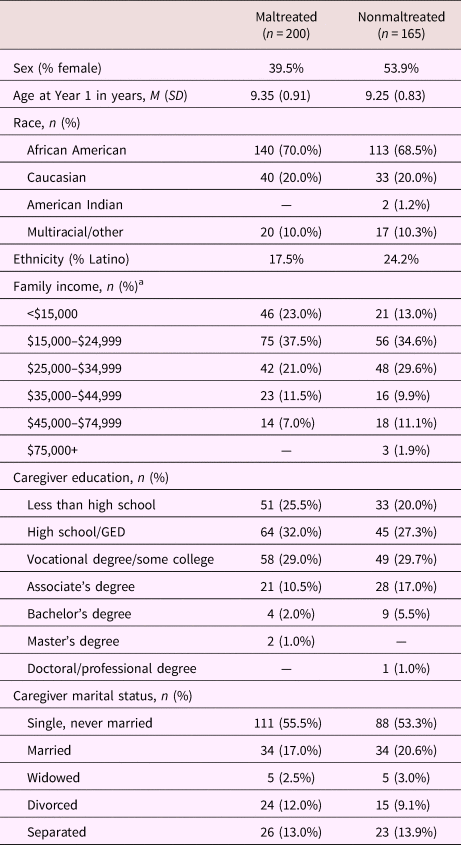
Participants were 365 school-aged children (M age = 9.3 years, SD = 0.87) who attended a 5-day research summer day camp offered to low-income families for two consecutive years (see Table 1 for full demographic information). A portion of the sample was identified as having experienced maltreatment (n = 200) by the local Department of Human Services (DHS) records. A DHS recruitment liaison contacted a random, representative sample of families with documented maltreatment history and explained the study to them, and obtained permission to share their contact information with the study staff.
Sample demographic information by maltreatment status

Note: aFamily income includes public assistance.
A nonmaltreated comparison group (n = 165) that was socioeconomically and demographically comparable to the maltreatment group was also recruited through a DHS recruitment liaison. Families with no recorded history of maltreatment but who were receiving Temporary Assistance for Needy Families were recruited because these families tend to be comparable demographically and similar in socioeconomic status to families receiving DHS services for child maltreatment. Still, the two groups differed in distributions of child sex and family income. The maltreated group had a larger proportion of males (χ2 = 7.02, p = .01) and lower yearly family income (χ2 = 17.04, p = .02). The groups did not differ on any of the other demographic variables included in Table 1. Children in foster care were excluded from participation, and families receiving preventative DHS services were also excluded to avoid the risk of unreported maltreatment experiences.
Once recruited, written consent was obtained from the primary caregiver of each participating child and assent was obtained from each child. Participation in the study was optional, and families were able to withdraw participation at any time without consequence from DHS. All study procedures were conducted in accordance with University of Rochester Institutional Review Board policies.
Procedures
Children were randomly assigned to peer groups composed of 10 children of the same sex, 5 maltreated and 5 nonmaltreated, and three trained camp counselors naïve to maltreatment status and study hypotheses. Each camp day was 7 hr long and consisted mostly of recreational activities, with a smaller amount of time devoted to research-related activities. Trained research assistants administered questionnaires and interviews with both parents and children. Children also completed various assessments and provided salivary cortisol measures each day. At the end of each camp week, counselors reported on child behavior symptomatology. Camp counselors were with each child for the entire 7-hr day, each of the 5 days of camp. This results in a total of 35 possible hours of interaction with each child (assuming full attendance) that informs their ratings. If any concerns about the safety of the participating children, families, or others arose throughout the study, resources and/or intervention were provided to ameliorate the concern.
Measures
All measures described below, with the exception of the maltreatment interview, were collected at both Years 1 and 2 for all participants.
Maltreatment Classification System (MCS)
The MCS (Barnett, Manly, & Cicchetti, Reference Barnett, Manly, Cicchetti, Cicchetti and Toth1993) is a set of operational criteria that utilizes DHS records to characterize multiple aspects of children's maltreatment experiences independent of DHS classifications. This system has been demonstrated as a reliable and valid measure of maltreatment typology (English et al., Reference English, Upadhyaya, Litrownik, Marshall, Runyan, Graham and Dubowitz2005; Manly, Reference Manly2005). The MCS identifies the subtype(s) of maltreatment a child has experienced, severity of the maltreatment, the number of developmental periods in which the maltreatment occurred, and the perpetrator of the maltreatment.
There are four subtypes of maltreatment as defined by the MCS. Neglect refers to lack of supervision, moral-legal neglect, and educational neglect, on one hand, and the failure to provide basic material necessities, including food, clothing, shelter, and medical treatment, on the other hand. Emotional maltreatment is classified as extreme avoidance of the child's basic emotional needs of psychological safety and security, for example, extreme hostility, threats of violence, or abandonment. Physical abuse includes nonaccidental physical injury inflicted on the child such as bruises, burns, welts, and broken bones. Sexual abuse is defined as attempted or actual sexual contact between the child and caregiver for the caregiver's sexual gratification and/or financial gain, which can range from exposure to pornography or adult sexual contact to forced intercourse with the child.
For the purposes of this study, the number of subtypes was used as the measure of maltreatment experiences because it is common for children to experience multiple subtypes (Manly et al., Reference Manly, Kim, Rogosch and Cicchetti2001), and it is generally regarded that experiencing multiple subtypes of maltreatment amplifies the impact of maltreatment on development (Cicchetti & Rogosch, Reference Cicchetti and Rogosch2012). Experiencing a greater number of maltreatment subtypes has been associated with externalizing psychopathology (Kim & Cicchetti, Reference Kim and Cicchetti2010) as well as impulsivity and antisocial behavior (Thibodeau, Cicchetti, & Rogosch, Reference Thibodeau, Cicchetti and Rogosch2015). In addition, there may be differential effects of different individual subtypes on development (e.g., Bruce et al., Reference Bruce, Fisher, Pears and Levine2009, Manly, Cicchetti, & Barnett, Reference Manly, Cicchetti and Barnett1994). This variable has a possible range of 0 to 4, where 0 indicates no experience of any subtype of maltreatment and 4 indicates some experience of all four subtypes of maltreatment. In the current sample, 165 children had experienced no maltreatment (45.2% of the full sample). Of the 200 maltreated children, 80 children had experienced one subtype (40.0%), 81 children had experienced two subtypes (40.5%), and 30 children had experienced three of the four subtypes (15.0%). Nine cases were unreported (4.5%), and these values were treated as missing. DHS records were updated at Year 2, and any additional reports of maltreatment were taken into account in the MCS.
The Maternal Child Maltreatment Interview (Cicchetti, Toth, & Manly, Reference Cicchetti, Toth and Manly2003) was also conducted with each family, regardless of whether their child was placed in the “maltreated” group via DHS records. In particular, this was used to inquire about possible unreported maltreatment instances in the nonmaltreated comparison group. Information gleaned from the Maternal Child Maltreatment Interview that was not officially reported to DHS was added to the MCS classifications.
Life Events Checklist
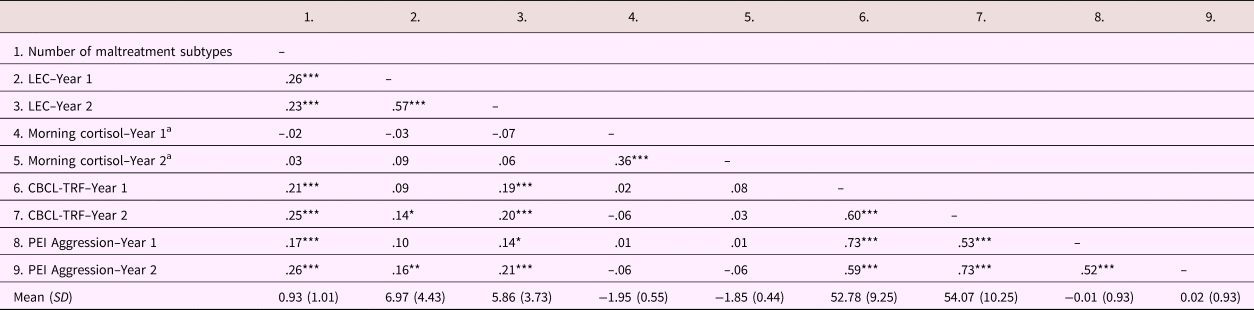
The Life Events Checklist (Johnson & McCutcheon, Reference Johnson, McCutcheon, Sarason and Spielberger1980) is a widely used measure in a variety of forms assessing whether a number of stressful events has happened in the last year. This 34-item measure was administered to the child's caregiver and asks about, for example, illness or deaths in the family, experiencing violence, and mental health problems. Items are coded 1 if they have happened in the last year and 0 if they have not. Composite scores are created from a summation of all “yes” responses for a total possible score ranging from 0 to 34 (see Table 2 for descriptive statistics).
Descriptive statistics for and correlations between all variables of interest

Note: aCorrelations and descriptive statistics based on natural-log transformed variables. N = 365. LEC, Life Events Checklist. CBCL-TRF, Child Behavior Checklist—Teacher Report Form. PEI, Pupil Evaluation Inventory. *p < .05. **p < .01. ***p < .001.
Salivary cortisol
Saliva samples were collected from each child each morning upon arrival at camp, at approximately 9:00 a.m., by trained research staff. This occurred following a 45-min bus ride to camp and initial staff greeting, ensuring that the children had been awake at least 1 hr prior to saliva sampling. This results in a measure of morning salivary cortisol, but avoiding the cortisol awakening response.
Samples were collected and stored in compliance with procedures recommended by Granger, Schwartz, Booth, Curran, and Zakaria (Reference Granger, Schwartz, Booth, Curran and Zakaria1999). Prior to sampling, each child chewed Trident® sugarless original flavor gum to stimulate saliva flow, and then samples were collected using passive drool through a straw. Children had not eaten or drank anything for at least 30 min prior to sampling. Samples were immediately stored frozen at –40° C until they were shipped next-day delivery on dry ice to Salimetrics Laboratories (State College, PA) to be assayed. Salivary cortisol (micrograms/deciliter) was assayed in duplicate using an enzyme immunoassay kit (Salimetrics, State College, PA). This kit is commercially available and uses 25 ml of saliva. Its lower limit of sensitivity is 0.007 mcg/dl (range up to 1.8 mcg/ dl) with average intra- and interassay coefficients of variation of <5.0% and 10.0%, respectively. Cortisol was assayed from saliva for each day across the week that it was collected. Morning cortisol values in μg/dL were calculated as the average of all morning cortisol values from the 5 days of camp each year. Over half of the children in this study provided saliva samples on all 5 days of camp (57% and 59% at Years 1 and 2, respectively). Most children provided at least four samples each year (82% and 88%, respectively). Values 3+ SD above the mean were winsorized to the next-highest value. Then, due to positive skew, values were natural-log transformed prior to analyses.
Child Behavior Checklist—Teacher Report Form (TRF)
The TRF (Achenbach, Reference Achenbach1991) is a well-validated 118-item measure of behavioral symptomatology that broadly assesses internalizing, externalizing, and total problem behaviors for children ages 4–18 years to be completed by a school teacher, or in this case a camp counselor. Counselors were new each year and got extensive training for the 2 weeks leading up to camp. Each counselor observed approximately 10 children and provided ratings for each child. Each behavior is rated on a 3-point scale (not true, somewhat true, or very true). The present study examined T scores of the externalizing scale, scores which were derived from an average of all counselors’ ratings for each child in their group (intraclass correlation = 0.83; see Table 2 for descriptive statistics). This study did not examine internalizing scores because, while very relevant for developmental cascades following maltreatment experiences, these symptoms likely operate through a distinct pathway (Dackis, Rogosch, Oshri, & Cicchetti, Reference Dackis, Rogosch, Oshri and Cicchetti2012) and are beyond the scope of the current project.
Pupil Evaluation Inventory
The Pupil Evaluation Inventory (Pekarkik, Prinz, Liebert, Weintraub, & Neale, Reference Pekarkik, Prinz, Liebert, Weintraub and Neale1976) is a sociometric technique for measuring school-aged children's social behavior. This 35-item measure assesses aggression, withdrawal, and likeability. Camp counselors were asked to nominate no more than two children in their respective groups that exemplify each item, and scores were determined by the number of items in each factor for which a given child was nominated. All counselors completed the measure for their groups, and so scores were averaged across counselors (intraclass correlation = 0.88; see Table 2 for descriptive statistics).
Data analysis plan
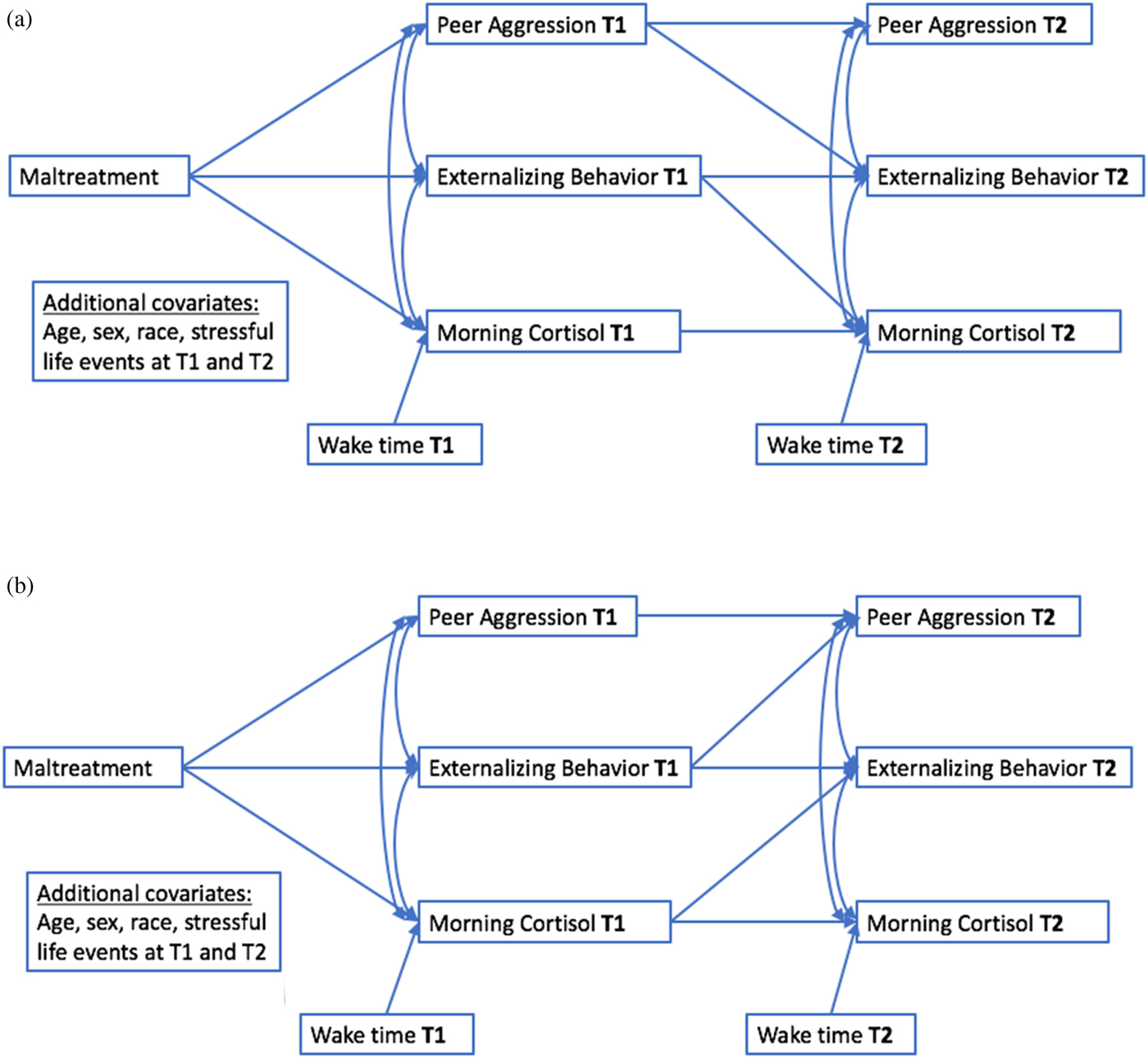
Structural equation modeling was conducted in the “lavaan” package in R (Rosseel, Reference Rosseel2012) to assess two candidate multilevel models of the cascading effects of maltreatment on development: a top-down and a bottom-up model. The top-down model, depicted in Figure 1a, predicts that (a) social difficulties following maltreatment experiences in Year 1 will predict behavioral difficulties in Year 2, and (b) behavioral difficulties in Year 1 will predict cortisol dysregulation in Year 2. Conversely, the bottom-up model depicted in Figure 1b predicts that (a) cortisol dysregulation following maltreatment experiences in Year 1 will predict behavioral difficulties in Year 2, and (b) behavioral difficulties in Year 1 will predict social difficulties in Year 2. All models account for the longitudinal stability in each measure by allowing Year 1 and Year 2 measurements to covary. Model fit was determined to be adequate if the comparative fit index (CFI) and Tucker–Lewis index (TLI) ≥ .95 and the root mean square error of approximation (RMSEA) ≤ .06, and nonnested models were compared using the Akaike information criterion (AIC) to determine the best fitting model, such that lower AIC indicates better fit (Hooper, Coughlin, & Mullen, Reference Hooper, Coughlan and Mullen2008). If neither model fits the data adequately, post hoc alternative models were explored. Mediation analyses of maltreatment predicting Year 2 variables through Year 1 variables were conducted using bootstrapped standard errors of the indirect effect in the respective structural equation models. Missing data was handled using full-information maximum likelihood estimation.
Conceptual (a) top-down model and (b) bottom-up model that was tested in focal analyses.

Child sex, age, race, and concurrent stressful life events were explored as potential covariates in all models. Time since waking was examined as a covariate for morning cortisol levels. Only statistically significant covariates were retained in the final model, but covariates were included at both time points if they were significant predictors at either time point. Because there were 48 families in the sample who had more than one participating child (98 total children with siblings in the study), a sensitivity analysis was conducted with all but 1 sibling (chosen at random) from each family excluded from the analyses to ensure results remained consistent.
Results
Descriptive statistics
Descriptive statistics for all variables of interest and correlations between all variables can be found in Table 2. Number of subtypes of maltreatment experiences was directly correlated with all variables of interest except morning cortisol, and there was substantial longitudinal stability within measures. Child race was associated with morning cortisol levels at Year 1, particularly with African American children showing the highest levels of cortisol. A dichotomous variable was created (African American race vs. all others) and was included as a covariate for both time points. In addition, wake time was included as a covariate for morning cortisol for Years 1 and 2. Concurrent stressful life events were significantly associated with Year 2 peer aggression and TRF externalizing problems, and so was included as a covariate when predicting these variables at both Years 1 and 2.
Comparing bottom-up and top-down models
Bottom-up model
According to fit statistics, a bottom-up model fit the data well (CFI = .97, TLI = .94, RMSEA = .05). Number of maltreatment subtypes experienced significantly predicted Year 1 peer aggression (z = 2.83, p = .005) and TRF externalizing problems (z = 3.71, p < .001), but not morning cortisol levels (z = –0.15, p = .88). After controlling for longitudinal stability, morning cortisol levels at Year 1 did not significantly predict TRF externalizing problems at Year 2 (z = –0.68, p = .49); however, externalizing problems at Year 1 did significantly predict peer aggression at Year 2 (z = 9.26, p < .001). As expected, more externalizing problems at Year 1 predicted more peer aggression at Year 2. In addition, morning cortisol at Year 1 was negatively associated with Year 2 peer aggression at the trend level (z = –1.66, p < .10). For the covariates included in the model, time since wake did not significantly predict Year 1 morning cortisol (z = 1.38, p = .17), but did significantly predict Year 2 morning cortisol (z = 2.67, p = .008). Child race significantly predicted Year 1 morning cortisol (z = 2.53, p = .01) but not Year 2 morning cortisol (z = 1.78, p = .08). Stressful life events at Year 1 was not significantly associated with concurrent peer aggression (z = 1.04, p = .30) or externalizing problems (z = 0.63, p = .53). Stressful life events at Year 2 predicted peer aggression (z = 2.39, p = .02) and externalizing problems (z = 2.03, p .04). These results indicate only partial support for a bottom-up model.
Top-down model
Fit statistics show that a top-down model fits the data poorly (CFI = .92, TLI = .87, RMSEA = .08). Like before, number of maltreatment subtypes significantly predicted Year 1 peer aggression and TRF externalizing problems, but not morning cortisol. Specifically, the more different subtypes of maltreatment experienced, the more counselor-reported peer aggression and externalizing problems. After controlling for longitudinal stability, peer aggression at Year 1 significantly positively predicted Year 2 externalizing problems (z = 6.37, p < .001) and negatively predicted Year 2 morning cortisol (z = –2.15, p = .03). Externalizing problems predicted Year 2 morning cortisol at the trend level (z = 1.75, p = .08), such that more externalizing problems at Year 1 was marginally associated with higher morning cortisol values at Year 2. Covariate patterns looked similar to the bottom-up model. When we attempted to investigate potential modifications to improve model fit, modification indices pointed to paths that would resemble the bottom-up model. Therefore, we investigated a third model with externalizing behavior affecting both upper and lower levels of analysis.
Exploring a model through externalizing behavior
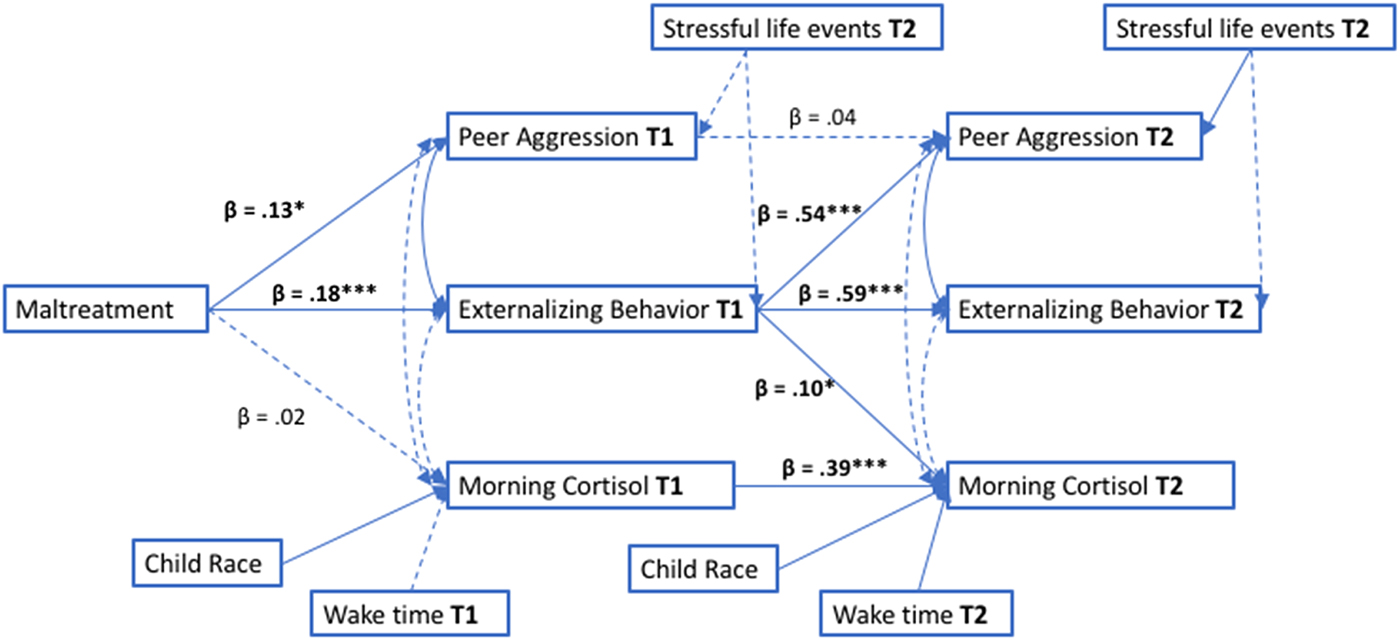
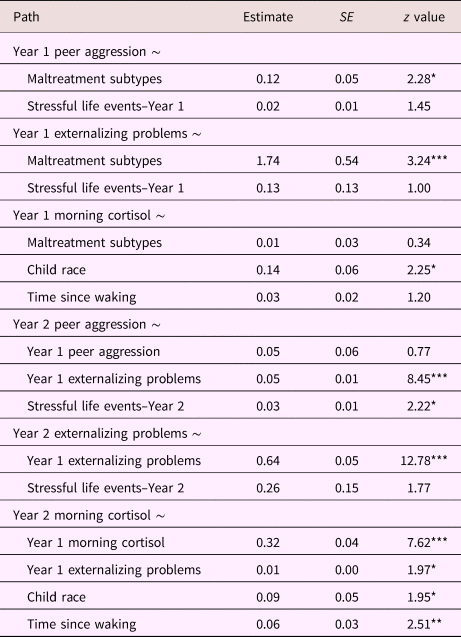
After accounting for covariates and longitudinal stability of measures, Year 1 externalizing problems seemed to be most strongly associated with Year 2 variables in the above models. Thus, we decided to examine a model in which change at all levels from Year 1 to Year 2 was predicted by TRF externalizing problems at Year 1 (see Table 3 and Figure 2 for model results). In addition, we tested whether Year 1 TRF externalizing problems mediated associations between maltreatment experiences and all Year 2 variables.
Final model results, a pathway through externalizing behavior. N = 315. Nonsignificant paths are indicated by dashed lines. Values are standardized beta values from the full path model. Child race was coded as a dichotomous variable where 1 = African American and 0 = other.

Final model results for best fitting model through externalizing problems

Note: N = 315. Results presented exclude siblings. All concurrent measures were allowed to covary. Child race was coded as a dichotomous variable where 1 = African American and 0 = other. *p < .05. **p < .01. ***p < .001.
Fit statistics demonstrate that this model fit the data well (CFI = .97, TLI = .94, RMSEA = .05). Furthermore, this model had the lowest AIC (bottom-up: 14,043.5, top-down: 14,079.9, externalizing: 14,041.8), suggesting that it is the best fitting model of the three models tested. As expected, number of maltreatment subtypes experienced significantly positively predicted Year 1 TRF externalizing problems (z = 3.71, p < .001), which in turn was significantly positively associated with Year 2 peer aggression (z = 9.16, p < .001). Furthermore, Year 1 externalizing problems significantly mediated the association between maltreatment and Year 2 peer aggression (z = 3.16, p = .002, 95% confidence interval [.04, .15]). Year 1 externalizing problems did not significantly mediate the association between maltreatment and Year 2 morning cortisol (z = 1.26, p = .21, 95% confidence interval [.00, .02]), which is not surprising given that the association between Year 1 externalizing problems and Year 2 morning cortisol is marginal in the full model. When considering abuse (physical and/or sexual) and neglect (physical and/or emotional) separately, the results remain consistent; however, there is evidence to suggest that there are larger effects for abuse compared to neglect or no maltreatment (results available upon request).
A sensitivity analysis was conducted when excluding siblings from the sample, which substantially reduced the AIC (12,196.0), and all decisions about statistical significance remained the same (n = 315; results available upon request) with the exception of one path. When excluding siblings, externalizing problems at Year 1 significantly, not marginally, predicted morning cortisol at Year 2 (z = 1.97, p = .05). All mediation analyses still held when excluding siblings. Because removing the nonindependent sibling pairs from the sample resulted in slightly different results than with the full sample, the results without siblings (n = 315) are reported in Table 3 and Figure 2. We also explored the model with peer likeability rather than peer aggression to test the robustness of the findings, given the similarity of aggression and externalizing behaviors as constructs. Peer likeability and aggression were strongly concurrently correlated with each other at Years 1 and 2 (r = –.43 and –51, respectively). Peer likeability showed identical (inverse) statistically significant associations with all other variables (data available upon request).
Discussion
The present study sought to investigate possible pathways through which the impact of childhood maltreatment experiences cascade across multiple domains of development. Using a 1-year longitudinal design with repeated measures at multiple levels of analysis, we explored both a bottom-up and a top-down model through which morning cortisol, externalizing problems, and peer aggression interact and affect one another following childhood maltreatment experiences. We hypothesized that a bottom-up model would fit the data best, based on the fact that a majority of longitudinal evidence, while incomplete, tends to support a bottom-up model (e.g., Doom et al., Reference Doom, Cicchetti and Rogosch2014; Shirtcliff & Essex, Reference Shirtcliff and Essex2008).
While there was partial evidence for both a bottom-up and a top-down model, both lacked longitudinal associations with morning cortisol levels. The top-down model showed a trend-level association between externalizing behavior and later morning cortisol, which led us to examine a model with externalizing behavior (the “middle” level) as the main driver of the pathway, rather than peer aggression or morning cortisol levels. This model had the best fit statistics of all three models discussed above. In addition, externalizing problems at Year 1 significantly mediated the association between maltreatment and Year 2 peer aggression. These findings may be reflective of the particularly strong association between maltreatment and externalizing problems (Manly et al., Reference Manly, Oshri, Lynch, Herzog and Wortel2013; McCullough & Shaffer, Reference McCullough and Shaffer2014), and the fact that externalizing problems have a particularly pervasive effect on other domains of development and well-being (Bornstein, Hahn, & Suwalsky, Reference Bornstein, Hahn and Suwalsky2013; Masten et al., Reference Masten, Roisman, Long, Burt, Obradović, Riley and Tellegen2005; van Lier & Koot, Reference van Lier and Koot2010). Consistent with developmental cascade models, externalizing problems are complex and multifaceted, which may facilitate their “snowballing” effect across developmental domains (Masten & Cicchetti, Reference Masten and Cicchetti2010).
Alternatively, these results may reflect a mere snapshot of more bidirectional, interactive associations that are not fully reflected in two time points across 1 year of childhood. Given that externalizing behavior and peer aggression strongly predicted each other over time, a true bidirectional model may be particularly likely. It is also important to note that even 1 year of prospective longitudinal data with high-risk families with maltreated children still adds substantially to the research base with this population. The present findings corroborate many other published findings across multiple developmental periods and in different contexts. Thus, it is important to continue efforts to summarize and synthesize information gleaned from short-term longitudinal studies with maltreated children in order to maximize the impact of research done with this difficult-to-reach population.
Still, there seem to be unidirectional associations with morning cortisol; however, the results from the sibling sensitivity analysis may suggest that the interdependence between siblings was masking some associations. In the full sample, Year 1 externalizing behavior predicted Year 2 morning cortisol at the trend level, but the reverse was not the case. Moreover, the association was in the opposite direction of what would be expected based on the extant literature. More externalizing problems was associated with increased morning cortisol a year later, with and without sibling pairs in the sample; however, externalizing symptoms tends to be associated with lower than normal cortisol production, particularly in children who have experienced maltreatment (Salis et al., Reference Salis, Bernard, Black, Dougherty and Klein2016; White et al., Reference White, Ising, von Klitzing, Sierau, Michel, Klein and Stalder2017). It is possible that this seemingly contradictory association is due to that fact that we have measured morning, not waking, cortisol levels. Many of the results showing lower morning cortisol associated with externalizing behavior measured cortisol during or just after the cortisol awakening response. By measuring morning cortisol after arrival at camp (at least an hour after waking), cortisol values in this study may be measuring something very different, such as their cortisol response to the beginning of the camp day or basal levels following the awakening response. In addition, Doom et al. (Reference Doom, Cicchetti and Rogosch2014) found that maltreated children initially show highly variable afternoon cortisol production that eventually decreases to lower than normal levels over time. Thus, it is possible that chronicity, developmental timing, and recency of maltreatment experiences can strongly influence the relation between cortisol and behavior.
However, other research has indicated that a positive association exists between aggression, peer rejection, and cortisol levels in preschool children (Gunnar, Sebanc, Tout, Donzella, & van Dulmen, Reference Gunnar, Sebanc, Tout, Donzella and van Dulmen2003). While they did find a direct negative association between surgency/poor effortful control and basal cortisol, there was also evidence of an alternative pathway through which surgency/poor effortful control predicts increased aggression and peer rejection and, in turn, increased basal cortisol. The present analyses, while in older children, seem to be in agreement with Gunnar et al. (Reference Gunnar, Sebanc, Tout, Donzella and van Dulmen2003). Future research will need to more thoroughly examine the role of diurnal cortisol regulation in the cascading developmental consequences of childhood maltreatment.
Furthermore, even though there was a significant correlation between Years 1 and 2 peer aggression (see Table 2), after controlling for the longitudinal association between Year 1 externalizing behavior and Year 2 peer aggression, the individual stability of peer aggression was no longer significant (see Figure 2). This was not expected but may reflect the particularly strong role externalizing behavior has in initiating broad developmental cascades following maltreatment. Other studies that have taken a developmental cascade approach to measuring externalizing behavior and social functioning in normative samples found more consistent stability over time, even when accounting for longitudinal associations between the two constructs (Bornstein, Hahn, & Haynes, Reference Bornstein, Hahn and Haynes2010; Bornstein et al., Reference Bornstein, Hahn and Suwalsky2013; Burt & Roisman, Reference Burt and Roisman2010; van Lier & Koot, Reference van Lier and Koot2010). Using the same measure of externalizing behavior and the same age range, the NICHD Early Child Care Research Network found that patterns of persistently high aggression across middle childhood predicted reduced friendship quality over time (Campbell, Spieker, Burchinal, Poe, & NICHD Early Child Care Research Network, Reference Campbell, Spieker, Burchinal and Poe2006). Additional research needs to be done to more fully elucidate the relationship between externalizing behavior and peer aggression, particularly following maltreatment, as this may be the source of important developmental processes following early adversity.
Another concern is that because aggression tends to be considered an externalizing problem, perhaps the associations between externalizing behavior and peer aggression in this study were conflated by the measurement of overlapping constructs. This complicates our ability to determine which of these variables is the more proximal factor in the developmental cascade. Still, it is important to note that externalizing behavior was reported on as a characteristic of the individual and peer aggression was reported on as a part of a day camp peer group, and we investigated the same pathway models using peer likeability rather than aggression to test the sensitivity of the findings. Still, peer likeability showed the same patterns of statistical significance as peer aggression. This further supports the fact that these findings represent associations with broader social functioning rather than aggression in particular, distinct from our measure of externalizing behavior.
This study also had a number of strengths. First, we were able to control for concurrent stressful life events, which allowed us to make inferences about maltreatment experiences independent of ongoing stressors in their lives (though the maltreatment could still be ongoing at the time the study was conducted). Second, it is quite difficult, and thus quite uncommon, to collect longitudinal data with high-risk samples such as children who have experienced maltreatment. Our large sample size and 1-year longitudinal data provide a unique opportunity to investigate directional pathways of cascading effects of maltreatment that are rare in the extant literature. While more than two time points over an even longer period of time is needed to fully elucidate these cascading pathways, the present study has still provided a useful stepping-stone for future research and prevention efforts.
We have identified externalizing behavior problems as a potential driver of cascading effects of maltreatment into multiple domains of functioning, which is consistent with prior research in more normative samples (Bornstein et al., Reference Bornstein, Hahn and Suwalsky2013; Masten et al., Reference Masten, Roisman, Long, Burt, Obradović, Riley and Tellegen2005; van Lier & Koot, Reference van Lier and Koot2010). This may indicate that prevention efforts and interventions designed to reduce the negative impact of maltreatment on child development should design programs around this fact, targeting the prevention or treatment of externalizing behavior before targeting other domains (insofar as they do not, in turn, reduce externalizing problems). Still, the present analyses have only investigated three developmental constructs. It is likely that other aspects of development operate through different pathways with different mediators. For example, internalizing symptoms may arise through a completely different process that is driven in a bottom-up fashion by deficits in emotion regulation or a top-down fashion via a lack of adequate social relationships that arise as a consequence of maltreatment experiences (Heleniak et al., Reference Heleniak, Jenness, Van der Stoep, McCauley and McLaughlin2016; Salazar, Keller, & Courtney, Reference Salazar, Keller and Courtney2011).
In addition, because morning cortisol was not associated with maltreatment in the final model, nor did externalizing problems mediate the association between maltreatment and cortisol, additional neurobiological indicators should be examined. For example, the cortisol stress response has been associated with maltreatment and resulting social problems (Harkness, Stewart, & Edwards, Reference Harkness, Stewart and Edwards2011; Ouellet-Morin et al., Reference Ouellet-Morin, Odgers, Danese, Bowes, Shakoor, Papadopoulos and Arseneault2011). Similarly, indices of other stress response systems (e.g., the autonomic nervous system via salivary α-amylase and respiratory sinus arrhythmia; Skowron Cipriano-Essel, Gatzke-Kopp, Teti, & Ammerman, Reference Skowron, Cipriano-Essel, Gatzke-Kopp, Teti and Ammerman2014) and interactions between these systems (Gordis, Granger, Susman, & Trickett, Reference Gordis, Granger, Susman and Trickett2008) may also shed light on important developmental cascades as a result of childhood maltreatment. Future research should investigate these pathways as additional avenues to find effective targets for prevention and intervention.
By utilizing a multiple-levels approach, we were able to examine developmental processes as exactly what they are, pieces of a much larger intricate, interconnected system of processes that affect and are affected by each other. Because of this interconnectedness, examining developmental cascades at multiple levels of analysis is critical to understanding how to impart change that counteracts the changes seen as a result of maltreatment experiences. Until much more research is done to put together the pieces of these complex developmental systems, our ability to apply the knowledge of this field to the real world will be limited. More research is also needed to delineate whether these patterns are bidirectional or primarily driven by behavior, as well as the role of cortisol regulation in these pathways.
Acknowledgments
We are grateful for the research team at Mt. Hope Family Center, for the support provided by the W.T. Grant Foundation and the Spunk Fund, Inc., and for all the families who participated in this research.