

Introduction
Milk is a unique product that is specifically suited to nourish the offspring. As initially milk is the young's only food, it has to contain all essential ingredients such as vitamins, minerals, essential amino acids and fatty acids (German et al., Reference German, Dillard and Ward2002). At a later age most mammals lose the ability to digest the milk sugar lactose. However, in some human populations lactase activity persists into adulthood and these people can continue to drink milk throughout life. Human genomic studies have shown that lactase persistence has offered a strong selective advantage. In fact, this ‘signal of selection’ is one of the strongest seen for any gene in the human genome (Bersaglieri et al., Reference Bersaglieri, Sabeti, Patterson, Vanderploeg, Schaffner, Drake, Rhodes, Reich and Hirschhorn2004) and emphasises the important role of milk in human nutrition. However, several studies have indicated that in modern human diets, a high intake of saturated fatty acids and trans fatty acids are risk factors for cardiovascular diseases (e.g. Mensink et al., Reference Mensink, Zock, Kester and Katan2003). Milk and dairy products are major sources of these fatty acids in the human diet. Consequently, several public health services promote reducing the intake of milk, cheese and butter. Modifying milk fat composition might be a means to decrease potential negative effects of milk fat on human health.
Modifying milk fat or milk protein composition might also be used to increase the suitability of milk for the production of different dairy products. For example, an increased casein content is favourable for cheese production (Wedholm et al., Reference Wedholm, Larsen, Lindmark-Månsson, Karlsson and Andrén2006), a low β-lactoglobulin concentration reduces the fouling rate of heating equipment (Elofsson et al., Reference Elofsson, Paulsson, Sellers and Arnebrant1996) and increased proportions of long-chain fatty acids improve the spreadability of butter.
Modifying milk fat and milk protein composition might be possible through selective breeding. However, detailed composition of milk fat and milk protein is generally not currently included in breeding goals for dairy cattle. Instead, most dairy cattle breeding focuses on improving the yields of milk volume, fat and protein (Miglior et al., Reference Miglior, Muir and Van Doormaal2005). It might be of interest to select for cows that produce milk with a specific composition, which has added value for the dairy industry. Here we explore the possibilities of selecting dairy cattle for detailed milk fat or milk protein composition.
Milk fat composition
Background
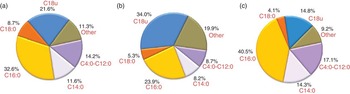
Bovine milk contains around 3% to 6% fat, which is mainly (±98%) composed of triglycerides. Triglycerides are composed of three fatty acids esterified to a glycerol backbone. More than 400 different fatty acids have been found in milk (Jensen, Reference Jensen2002). Most of these fatty acids occur in trace amounts and only about 12 of them are present in concentrations higher than 1% of milk fat. Approximately 75% of the fatty acids are saturated and 25% are unsaturated. Large differences exist in fat composition between individual cows (Figure 1).
Average fat composition based on test-day milk samples of Dutch Holstein Friesians (a) and two cows with very different fat composition (b, c). C18u is the sum of the unsaturated fatty acids, C4:0-C12:0 is the sum C4:0, C6:0, C8:0, C10:0 and C12:0.

Part of the fatty acids in milk are synthesised by the mammary gland (de novo synthesis), whereas others are derived from the blood. The most abundant fatty acids synthesised de novo are the short and medium even-chain fatty acids C6:0 to C16:0. These fatty acids are synthesised mainly through chain elongation with two carbons per cycle starting from acetate and butyrate. Acetate and butyrate are produced in the rumen and hindgut by microorganisms. Roughly 50% of C16:0 originates from de novo synthesis and the other 50% originates directly from blood lipids (Bauman and Griinari, Reference Bauman and Griinari2003; MacGibbon and Taylor, Reference MacGibbon and Taylor2006; Palmquist, Reference Palmquist2006). Odd-chain saturated fatty acids C5:0 to C17:0 can be produced de novo in the same manner as the even-chain fatty acids but with propionate as precursor instead of acetate or butyrate (Vlaeminck et al., Reference Vlaeminck, Fievez, Cabrita, Fonseca and Dewhurst2006a and Reference Vlaeminck, Fievez, Tamminga, Dewhurst, van Vuuren, De Brabander and Demeyer2006b; Craninx et al., Reference Craninx, Steen, Van Laar, Van Nespen, Martin-Tereso, De Baets and Fievez2008). However, odd-chain fatty acids, C15:0 and C17:0, can also be produced by rumen bacteria (Vlaeminck et al., Reference Vlaeminck, Fievez, Cabrita, Fonseca and Dewhurst2006a and Reference Vlaeminck, Fievez, Tamminga, Dewhurst, van Vuuren, De Brabander and Demeyer2006b; Craninx et al., Reference Craninx, Steen, Van Laar, Van Nespen, Martin-Tereso, De Baets and Fievez2008). Branched-chain fatty acids, C14:0 iso, C16:0 iso, C15:0 ante-iso and C17:0 ante-iso, are considered to originate from production by rumen bacteria (Vlaeminck et al., Reference Vlaeminck, Fievez, Cabrita, Fonseca and Dewhurst2006a and Reference Vlaeminck, Fievez, Tamminga, Dewhurst, van Vuuren, De Brabander and Demeyer2006b). Because different rumen bacteria produce a different profile of odd and branched-chain fatty acids, it has been suggested that the odd and branched-chain fatty acid profile in milk can be used as an indicator for rumen bacterial composition (Vlaeminck et al., Reference Vlaeminck, Fievez, Cabrita, Fonseca and Dewhurst2006a and Reference Vlaeminck, Fievez, Tamminga, Dewhurst, van Vuuren, De Brabander and Demeyer2006b).
Fatty acids with a chain length of 18 carbons or longer mainly originate from the feed of the cow. Fatty acids in dairy cattle diets are predominantly polyunsaturated fatty acids (mainly C18:2 cis 9, 12; and C18:3 cis 9, 12, 15). These unsaturated fatty acids are for a large part biohydrogenated by the rumen microbes to saturated C18:0. However, fatty acids that result from incomplete biohydrogenation, for example, the C18 transfatty acids, also can be found in milk. Unsaturated fatty acids can also be the result of the cow's ability to desaturate fatty acids. Even and uneven C10 to C18 fatty acids can be desaturated by Δ9-desaturase in the mammary gland, resulting in cis-9 unsaturated fatty acids (Bernard et al., Reference Bernard, Leroux, Hayes, Gautier, Chilliard and Martin2001).
In addition to de novo synthesis and dietary origin, fatty acids in milk can also originate from body fat reserves. Body fat mobilisation results in increased levels of C16:0 and C18:0, and some C18:1 cis-9 (Stoop et al., Reference Stoop, Bovenhuis, Heck and van Arendonk2009). When cows are in negative energy balance, a substantial fraction of the milk fatty acids might originate from body fat mobilisation.
Heritabilities and genetic correlations
Recent studies indicate that milk fat composition is strongly affected by genetic factors (Soyeurt et al., Reference Soyeurt, Dardenne, Dehareng, Bastin and Gengler2008; Stoop et al., Reference Stoop, van Arendonk, Heck, van Valenberg and Bovenhuis2008; Mele et al., Reference Mele, Dal Zotto, Cassandro, Conte, Serra, Buccioni, Bittante and Secchiari2009; Garnsworthy et al., Reference Garnsworthy, Feng, Lock and Royal2010; Bastin et al., Reference Bastin, Gengler and Soyeurt2011). Heritability estimates for short and medium even-chain fatty acids C6:0 to C14:0 (w/w%) are around 0.60, and for C18 fatty acids (w/w%) around 0.25 (Stoop et al., Reference Stoop, van Arendonk, Heck, van Valenberg and Bovenhuis2008). Estimates of heritability differ depending on the analytical method used to quantify fatty acids (e.g. using gas chromatography or IR spectroscopy) and the way in which fat composition is expressed (fat basis (w/w%) or milk basis g/100 ml milk). The general pattern, however, consistently indicates that heritabilities for short- and medium-chain fatty acids are higher than heritabilities for long-chain fatty acids. This difference coincides with the origin of the fatty acids and the biological pathways of synthesis.
In general, a higher milk fat content is correlated with more saturated C4:0 to C12:0 and C16:0 fatty acids, and less unsaturated C18 fatty acids. Combined with higher heritabilities for short- and medium-chain fatty acids as compared with long-chain (C18) fatty acids, this implies that selection for higher fat content will result in a relative larger increase of short- and medium-chain saturated fatty acids. This pattern is also observed across breeds. Jersey cows produce milk with a higher fat content than Holstein cows and their milk has a higher concentration of short- and medium-chain fatty acids, and less unsaturated C18 fatty acids. Thus, in Jersey cows, a relatively larger proportion of the milk fatty acids originate from de novo fat synthesis (e.g. Soyeurt et al., Reference Soyeurt, Dardenne, Gillon, Croquet, Vanderick, Mayeres, Bertozzi and Gengler2006a; Maurice-Van Eijndhoven et al., Reference Maurice-Van Eijndhoven, Hiemstra and Calus2011).
Genetic correlations between de novo synthesised fatty acids that are two carbon units apart (C6:0-C14:0) are high (Stoop et al., Reference Stoop, van Arendonk, Heck, van Valenberg and Bovenhuis2008). This might be related to their similar synthesis through chain elongation with two carbon units at a time. These high genetic correlations indicate that selection for one specific de novo synthesised fatty acid without affecting the others is not feasible. Genetic correlations between de novo synthesised fatty acids C6:0 to C14:0 and unsaturated C18 fatty acids are low, indicating that their concentrations in milk result from different pathways.
Genes involved in fat composition
It has been shown that polymorphisms in the DGAT1 and SCD1 genes have large effects on milk fat composition (e.g. Mele et al., Reference Mele, Conte, Castiglioni, Chessa, Macciotta, Serra, Buccioni, Pagnacco and Secchiari2007; Moioli et al., Reference Moioli, Contarini, Avalli, Catillo, Orru, De Matteis, Masoero and Napolitano2007; Schennink et al., Reference Schennink, Stoop, Visker, Heck, Bovenhuis, van der Poel, van Valenberg and van Arendonk2007 and Reference Schennink, Heck, Bovenhuis, Visker, Van Valenberg and Van Arendonk2008). DGAT1 is a key enzyme in triglyceride synthesis and is responsible for the fixation of fatty acids to the third position of triglyceride. The DGAT1 232K allele is associated with a higher milk fat content (e. g. Grisart et al., Reference Grisart, Coppieters, Farnir, Karim, Ford, Berzi, Cambisano, Mni, Reid, Simon, Spelman, Georges and Snell2002; Winter et al., Reference Winter, Kramer, Werner, Kollers, Kata, Durstewitz, Buitkamp, Womack, Thaller and Fries2002; Thaller et al., Reference Thaller, Kramer, Winter, Kaupe, Erhardt and Fries2003), a higher ratio of saturated/unsaturated fatty acids, a higher proportion of C16:0 and a lower proportions of C14:0 and unsaturated C18 (Schennink et al., Reference Schennink, Stoop, Visker, Heck, Bovenhuis, van der Poel, van Valenberg and van Arendonk2007).
The SCD1 enzyme is involved in desaturating fatty acids. Unsaturation indices have been suggested as indicators to measure the desaturation activity of the SCD1 enzyme indirectly (e.g. Peterson et al., Reference Peterson, Kelsey and Bauman2002). The SCD 293V allele is associated with lower C10, C12 and C14 indices and with higher C16, C18 and conjugated linoleic acid (CLA) indices, and thus with relatively less C10:1, C12:1 and C14:1, and more C16:1, C18:1 and CLA (Schennink et al., Reference Schennink, Heck, Bovenhuis, Visker, Van Valenberg and Van Arendonk2008). This suggests that the SCD1 293V allele has a higher affinity or specificity to unsaturate longer chain fatty acids (e.g. C18:0 or C18:1 trans-11) than other available fatty acids (e.g. C10:0 or C14:0). The polymorphism in SCD1 has no effect on total unsaturation index.
In addition to the effects of known genes, genome-wide association studies by Bouwman et al. (Reference Bouwman, Bovenhuis, Visker and van Arendonk2011 and Reference Bouwman, Visker, van Arendonk and Bovenhuis2012) have identified a number of regions on the bovine genome that are strongly associated with milk fat composition. Besides regions on BTA14 and BTA26, where the associations can be attributed to the polymorphisms in DGAT1 and SCD1, a number of other chromosomal regions were identified. Most notable was a rather large region on BTA19, which could contain more than one causal variant and additional regions on BTA5, 6, 13, 17 and 27. For these regions no causal variants have been identified.
Selection for milk fat composition
Selection for milk fat composition first requires defining a desired change. This is not a trivial task when it concerns aspects related to human health. In general, it seems that lower proportions of C14:0 and C16:0 and higher proportion of C18 fatty acids are desired, as this is positively associated with human health (e.g. Mensink et al., Reference Mensink, Zock, Kester and Katan2003). Further, increased proportions of long-chain fatty acids reduce the melting point of the fat, which improves the spreadability of butter. However, milk fat with increased proportions of long-chain and/or unsaturated fatty acids also reduces the shelf life of dairy products and increases the chance of oxidation (Chilliard et al., Reference Chilliard, Ferlay and Doreau2001).
Traditional selection requires phenotypic information. For phenotypes on milk fat composition, gas chromatography is an accurate but expensive and relatively time-consuming analytical method. Therefore, this method is not suitable for analysing large numbers of milk samples. Recent studies indicate that several fatty acids can be accurately predicted on the basis of IR spectra (Soyeurt et al., Reference Soyeurt, Dardenne, Dehareng, Lognay, Veselko, Marlier, Bertozzi, Mayeres and Gengler2006b; Rutten et al., Reference Rutten, Bovenhuis, Hettinga, van Valenberg and van Arendonk2009). In the RobustMilk project, we showed that IR calibration equations can be used to accurately predict fatty acids in milk from different breeds and across countries (Soyeurt et al., Reference Soyeurt, Dehareng, Gengler, McParland, Wall, Berry, Coffey and Dardenne2011; Maurice-Van Eijndhoven et al., Reference Maurice-Van Eijndhoven, Soyeurt, Dehareng and Calus2013). Current milk recording in most countries already uses IR analysis to estimate fat and protein concentrations. Using IR-based prediction equations could therefore lead to obtaining milk fat composition of milk samples collected routinely without substantial additional costs.
In addition to phenotypic records, DGAT1 and SCD1 genotypes as well as information of anonymous DNA markers located in chromosomal regions known to be associated with fat composition can be used to identify animals with favourable milk fat composition.
Milk protein composition
Background
Bovine milk contains around 3% to 4% protein, which consists of six major milk proteins α-lactalbumin, β-lactoglobulin, αs1-casein, αs2-casein, β-casein and κ-casein. Together these milk proteins make up about 90% of the total milk protein content. The remaining 10% consists of minor proteins such as bovine serum albumin, γ-casein, immunoglobulins, lactoferrin and many proteins that appear in low concentrations.
The high nutritional value of milk is partly because of the properties of its proteins. The caseins provide many essential amino acids and are also carriers of phosphate and calcium. Whey proteins are rich sources of essential amino acids such as methionine and cysteine and, therefore, have a high nutritional value (Wit De, Reference Wit De1998). Whey proteins consists mainly of α-lactalbumin and β-lactoglobulin. The biological function of α-lactalbumin is to support the synthesis of lactose (Walstra and Jennes, Reference Walstra and Jennes1984), whereas the biological function of β-lactoglobulin (besides providing essential amino acids) is less clear. Human milk does not contain β-lactoglobulin and, therefore, β-lactoglobulin might be less important for human infants.
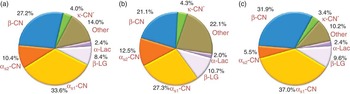
Milk protein composition shows both quantitative (Figure 2) and qualitative variation. Quantitative variation in milk protein composition is based on variation in absolute or relative amounts of the individual milk proteins.
Average protein composition based on test-day milk samples of Dutch Holstein Friesians (a) and two cows with very different protein composition (b, c). κ-CN represents only the non-glycosylated mono-phosphorylated form of κ-CN, which makes up ∼50% of total κ-CN. CN = casein.

Qualitative (genetic) variation in milk protein composition is the result of different protein variants. Milk proteins are products of the milk protein genes that determine the amino-acid sequence of the proteins. One difference in an amino acid, due to deletion, insertion or exchange of one or more bases in the DNA sequence, can give rise to a different protein variant with different physical or chemical characteristics. Aschaffenburg and Drewry (Reference Aschaffenburg and Drewry1955) were the first to describe two distinct forms of β-lactoglobulin (A and B), which differ from each other by two amino acids. Since then variants of other milk protein genes have been described. In most dairy cattle breeds, the αs2-casein is fixated at the A variant and α-lactalbumin is fixated at the B variant. Further, αs1-casein B, β-casein A1 and A2, κ-casein A, B and E and β-lactoglobulin A and B are the most common protein variants. In addition to protein or genetic variants, variation also occurs as a result from post-translational modification, such as phosphorylation and glycosylation.
Milk protein variants
It is well established that milk protein variants are associated with the manufacturing properties of milk. Protein variants of κ-casein have been shown to be associated with the renneting time of milk (e.g. Van den Berg et al., Reference Van den Berg, Escher, de Koning and Bovenhuis1992; Comin et al., Reference Comin, Cassandro, Chessa, Ojala, Dal Zotto, De Marchi, Carnier, Gallo, Pagnacco and Bittante2008; Vallas et al., Reference Vallas, Kaart, Varv, Parna, Joudu, Viinalass and Parna2012). The association between the κ-casein B variant and a shorter renneting time might be because of the differences in amino-acid composition between the A and B variants resulting in different physical or chemical properties. However, it also has been shown that the κ-casein B variant is associated with a higher κ-casein content (e.g. Hallén et al., Reference Hallén, Wedholm, Andrén and Lundén2008; Heck et al., Reference Heck, Schennink, van Valenberg, Bovenhuis, van Arendonk and van Hooijdonk2009). Recently, Bonfatti et al. (Reference Bonfatti, Di Martino, Cecchinato, Degano and Carnier2010) showed that effects of κ-casein protein variants on milk coagulation are the result of quantitative differences in κ-casein content, rather than the consequence of qualitative differences between the κ-casein A and B variant.
Other well-established relations are those between protein variants of β-lactoglobulin and cheese yield and heat stability of milk (Feagan, Reference Feagan1979; Van Den Berg et al., Reference Van den Berg, Escher, de Koning and Bovenhuis1992). Ng-Kwai-Hang and Kim (Reference Ng-Kwai-Hang and Kim1996) showed that the proportion of β-lactoglobulin protein variants A and B in milk from heterozygous AB cows was close to 1.5 : 1. Moreover, several studies have shown that the B variant of β-lactoglobulin is associated with a lower concentration of β-lactoglobulin and an increased casein concentration (e.g. Lundén et al., Reference Lundén, Nilsson and Janson1997; Heck et al., Reference Heck, Schennink, van Valenberg, Bovenhuis, van Arendonk and van Hooijdonk2009), whereas a complete knockdown of bovine β-lactoglobulin by RNAi resulted in a strong, compensatory increase of the other milk proteins, with a fourfold increase of the concentration of κ-casein (Jabed et al., Reference Jabed, Wagner, McCracken, Wells and Laible2012). This is in agreement with the results by McClenaghan et al. (Reference McClenaghan, Springbett, Wallace, Wilde and Clark1995) and Hallén et al. (Reference Hallén, Wedholm, Andrén and Lundén2008) that indicate that proteins compete for expression in the mammary gland. Consequently, milk from cows homozygous for β-lactoglobulin protein variant B results in ∼3% more cheese as compared with milk from cows homozygous for β-lactoglobulin protein variant A (Van Den Berg et al., Reference Van den Berg, Escher, de Koning and Bovenhuis1992). Selection for the β-lactoglobulin B variant has a negligible effect on casein composition, which implies that cheese quality is most likely not influenced by selection for the B variant (Heck et al., Reference Heck, Schennink, van Valenberg, Bovenhuis, van Arendonk and van Hooijdonk2009). Milk with a lower β-lactoglobulin concentration has been associated with a lower fouling rate of heating equipment (Elofsson et al., Reference Elofsson, Paulsson, Sellers and Arnebrant1996). Thus, milk with β-lactoglobulin protein variant B will result in lower costs of cleaning the heating equipment.
Although in general milk proteins are valued for their nutritional properties, some people are oversensitive to milk protein (cow's milk allergy). β-Lactoglobulin has been considered as a major milk allergen, which was one of the reasons for trying to create a cow's milk devoid of the protein (Jabed et al., Reference Jabed, Wagner, McCracken, Wells and Laible2012). In addition, a relationship between disease risk and consumption of specific bovine β-casein protein variants has been suggested. This is based on an observed association between consuming milk with high levels of the β-casein A1 variant and increased incidence of cardiovascular disease and type 1 diabetes and more severe symptoms of autism and schizophrenia (Elliott et al., Reference Elliott, Harris, Hill, Bibby and Wasmuth1999). This has led to the marketing of special A2 milk in a number of countries. The presumed mechanism focuses on β-casomorphin-7 (β-CM-7), a bioactive opioid peptide that might be produced during digestion of β-casein variant A1. However, recently the EFSA concluded that there is no evidence for a cause–effect relationship between the oral intake of milk with the β-casein A1 variant and the mentioned diseases (EFSA, 2009). Therefore, claims made by some of the producers of A2 milk are not supported by scientific evidence.
Genes involved in milk protein composition
Schopen et al. (Reference Schopen, Visker, Koks, Mullaart, van Arendonk and Bovenhuis2011) conducted a genome-wide association study for milk protein composition. The main regions of the bovine genome associated with milk protein composition or protein percentage were on chromosomes 5, 6, 11 and 14. Remarkably, the largest effects for all six major milk proteins were found in the region where the gene coding for the corresponding milk protein is located: for α-lactalbumin on BTA5, for αs1-casein, αs2-casein, β-casein and κ-casein on BTA6 and for β-lactoglobulin on BTA11. This confirms the importance of associations between protein variants and milk protein composition (e.g. Heck et al., Reference Heck, Schennink, van Valenberg, Bovenhuis, van Arendonk and van Hooijdonk2009; Visker et al., Reference Visker, Dibbits, Kinders, Van Valenberg, Van Arendonk and Bovenhuis2011). Results indicate that there are few genomic regions with major effects on milk protein composition and, in addition, several regions with smaller effects involved in the regulation of milk protein composition.
Heritabilities and genetic correlations
Recent studies demonstrate that milk protein composition is strongly affected by genetic factors (Schopen et al., Reference Schopen, Heck, Bovenhuis, Visker, van Valenberg and van Arendonk2009; Bonfatti et al., Reference Bonfatti, Cecchinato, Gallo, Blasco and Carnier2011). Heritability estimates for the six major milk proteins range from 0.25 to 0.80 (Schopen et al., Reference Schopen, Heck, Bovenhuis, Visker, van Valenberg and van Arendonk2009; Bonfatti et al., Reference Bonfatti, Cecchinato, Gallo, Blasco and Carnier2011). Heritability estimates from both studies differ for certain milk proteins, especially for β-casein and β-lactoglobulin, which might be because of differences in the methods used to quantify the milk proteins (capillary zone electrophoresis v. HPLC). However, heritability estimates of both studies indicate that there is substantial genetic variation in milk protein composition. Most of the genetic correlations among the major milk proteins were low, except for the genetic correlation between the relative β-lactoglobulin concentration and the relative proportion of casein in milk, which was strong and negative.
Selection for milk protein composition
Dairy products such as cheese, milk formula and milk powder will benefit from a product-specific milk protein composition. It has been shown that there is substantial genetic variation in milk protein composition, and different protein variants as well as genomic regions that contribute to this genetic variation have been identified. The genetic variation in milk protein composition can be exploited by means of selection. This selection can be either based on phenotypic information or on genotypic information. To obtain phenotypic information, different methods for quantification of milk proteins can be used, for example, HPLC, PAGE and capillary zone electrophoresis. However, these methods are costly and time-consuming and at present not suited for a large number of milk samples. Alternatively, milk protein composition might be predicted on the basis of IR spectroscopy, although accuracies of predicting individual milk proteins are low (Rutten et al., Reference Rutten, Heck, Bovenhuis and van Arendonk2011). Nonetheless, accurately estimating breeding values of sires on the basis of large number of daughter records might still be feasible. Animals can also be selected based on genotypic information, that is, either using polymorphisms in known genes or genomic selection. Genomic selection does not require information on location and size of gene effects, but does require a reference population of individuals with phenotypes on milk protein composition as well as genotypic information. Given that milk protein composition is strongly affected by a small number of genes with very large effects, selection for known protein variants, using polymorphisms in known genes, might be the preferred selection strategy. With β-lactoglobulin protein variants explaining most of the variation in β-lactoglobulin content, and β-casein and κ-casein protein variants explaining a substantial part of the variation in β-casein and κ-casein content, excellent tools are available for changing milk protein composition by means of selection.
Acknowledgements
H.B. and A.L. acknowledge funding from the RobustMilk project. H.B. and M.V. acknowledge support by the Dutch Milk Genomics Initiative. The RobustMilk project is financially supported by the European Commission under the Seventh Research Framework Programme, Grant Agreement KBBE-211708. RobustMilk acknowledges the financial support of EAAP towards the cost of publication. The content of this paper is the sole responsibility of the authors, and it does not necessarily represent the views of the Commission or its services.
For more information, please visit the website www.robustmilk.eu, read the other papers in these proceedings or contact the project coordinator: Roel F. Veerkamp (E-mail: Roel.Veerkamp@wur.nl).