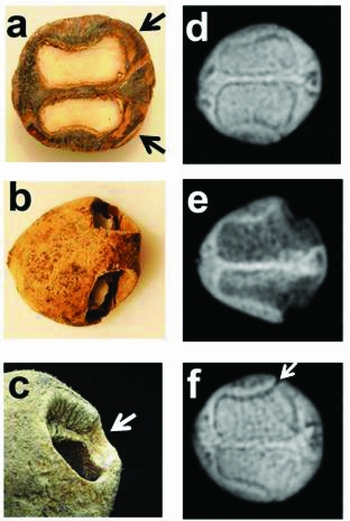
The marula (Sclerocarya birrea (A.Rich.) Hochst., Anacardiaceae) has a strongly lignified endocarp or stone which contains several seeds, each of which is within its own locule that is sealed by an individual operculum (Figure 1). The strong casing prevents germination, not by preventing the passage of water to the seeds, but by preventing oxygen from reaching the seeds (von Teichman et al. Reference VON TEICHMAN, SMALL and ROBBERTSE1985). It is well known that marula fruits taken from the dung of the African elephant (Loxodonta africana Blumenbach) have more rapid germination than those that have not been eaten by elephants (Dudley Reference DUDLEY2000, Lewis Reference LEWIS1987). This positive impact of elephants on marula germination continues to be considered to be through acid treatment in the digestion system of the elephant (Helm et al. Reference HELM, SCOTT and WITKOWSKI2011). We hypothesize that the primary mechanism which favours germination is mastication by elephants which physically loosens the opercula, rather than digestive dissolution of the stone. If true, the relevance of this is that only elephants would be the legitimate dispersers of marula seeds, because none of the many other species that are attracted to marula fruits would have jaws powerful enough to loosen the opercula.
The impact of compressive forces and squirrels, on marula (Sclerocarya birrea) stones. Cross-section through a marula stone showing two seeds. Arrows depict the opercula (a). Example of an experimentally compressed stone where the opercula have popped open exposing the seeds below (b). Example of a stone predated by squirrels. Arrow indicates where squirrels had chewed the edge of the operculum (c). Lodox X-ray of an entire stone with an intact opercula indicated by an arrow (d). Lodox X-ray of a predated stone with missing opercula and seeds (e). Lodox X-ray of an experimentally compressed stone with the arrow indicating where an operculum had been partially loosened (f).

The savanna tree squirrel (Paraxerus cepapi A. Smith) has long been observed to obtain and eat marula seeds from elephant dung, such as on the roads of the Kruger National Park (Pienaar Reference PIENAAR1968). Since many squirrel species are well-known hoarders of seeds, we hypothesized that it is possible the same applies to the marula. Viljoen (Reference VILJOEN1983) studied fruit and seed choice of several species of captive and wild South African squirrels including P. cepapi, but not including marula seeds. Viljoen (Reference VILJOEN1977a, Reference VILJOEN1977b) noted that P. cepapi readily buries seeds in captivity, but she however only made one observation of it scatterhoarding in the wild and this did not concern the marula. Direct observation of these animals is difficult in the field because they are secretive and their behaviour at ground level would be obscured by vegetation. It is possible that squirrel gnawing of the wooden seed casing may also facilitate germination. We investigated the impacts of compressive forces on releasing the opercula of marula stones, the role of elephant digestion on marula fruit and the impacts of squirrels on the fate on marula stones.
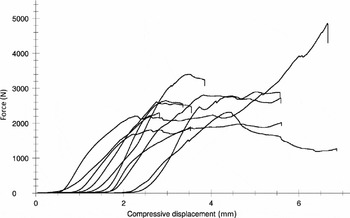
To determine the compression force required to significantly deform a marula stone so as to release the opercula, but not crush the stone and thus damage the seeds, we used a Zwick (Zwick, Germany) 1484 200-kN load cell at the Department of Mechanical Engineering at the University of Cape Town (UCT), South Africa. The largest flat surface of each stone was placed on the lowest surface of the machine and thereafter the head of the machine was slowly lowered against the upper surface of stone. The equipment then applies a steadily increasing load and determines the impact of this on displacement of the surface of the stone. We determined the point when the stones showed an abrupt change in displacement (Figure 2). This resulted from the obvious ‘popping’ of at least one operculum in four of 10 stones. In the other six stones, the applied force caused cracks to develop in the upper surface of the stone and the opercula were dislodged to a less obvious degree, but did not ‘pop’ out. We X-rayed a subset of these stones with the Lodox X-Ray Machine (Lodox, South Africa) at the Department of Health Sciences at UCT and noted that the opercula had nevertheless been dislodged in these ‘un-popped’ stones (Figure 1). For these trials, stones (n = 10) were collected from below a marula tree in the Skukuza area of the Kruger National Park. These stones had not passed through an elephant's digestive system. For our sample of 10 stones, a mean ± SD force of 2.77 ± 0.86 kN was required to either ‘pop’ the opercula or at least dislodge the opercula. This was 60% of the force required to crush a marula stone (mean = 4.66 kN) to the point that a primate could obtain the seeds within (Peters Reference PETERS1993).
The impact of force (N) on compressive displacement (mm) of marula (Sclerocarya birrea) stones (n = 10).

To determine the impact of elephant mastication and digestion on ingested marula fruits we collected nine entire elephant faeces which had some marula stones in them and sorted the stones into two classes; those with the fruit coat intact and those without a fruit coat. The faeces were collected from roads near Skukuza within the Kruger National Park. Of the 1322 marula stones retrieved from the elephant droppings, 81% (1076) of stones had no fruit coat left whereas 19% had virtually intact fruits. That fruits swallowed whole emerge with the fruit coat intact in faeces indicates that the elephant digestive system is chemically rather ‘mild’ and would not be able to loosen the opercula. Elephant faeces are coarse and dominated by the obvious remains of items such as grass leaves and small twigs which are very soft compared with the strongly lignified stones of marulas. Elephants clearly chew a high proportion of individual marula fruits so thoroughly, that relatively clean stones dominate their droppings. We found on average 146 ± 80.8 fruits/stones per pile of elephant dung.
To determine whether P. cepapi buries marula stones we attached 10-cm lengths of fluorescent thread to marula stones with quick-drying glue (Midgley & Anderson Reference MIDGLEY, ANDERSON, Forget, Lambert, Hulme and Vander Wall2005). The colourful thread projects above ground level for buried seeds. Threads are relocated using a UV-LED torch. We did this in 2010 and in 2011, both times over a 4-d period. At Skukuza 20 stones were left under each of 10 female S. birrea trees in unfenced natural vegetation adjacent to the Skukuza Golf Course. This area was chosen due to the presence of elephants and the relative absence of dangerous carnivores at this site, especially at dusk when stones were being relocated. Below each of 10 female marula trees on the golf course we placed 10 stones. Stones were put out and then checked every evening and morning (to confirm that removal was by a diurnal animal) for 4 d. The number of stones buried, moved, missing and undisturbed was recorded. For buried stones, the depth of burial was recorded; as were the distances that stones were moved, and the distance from the nearest other buried stone. Of the 300 marula stones that were left out in the Skukuza cafeteria experiment in 2010, 15 were buried (5%) and 87 were missing (29%), many of which may have been buried. Frequently squirrels bit-off the fluorescent thread, making the relocation of stones difficult. The average burial depth was relatively shallow at 0.5 ± 0.3 cm below the soil surface, and the dispersal distance of the 33 stones that were moved or buried was 4.6 ± 6.8 m and all stones were buried singly. In 2011, 17 out of 300 stones that were placed out were buried and a further 45 were missing. Many piles of stones were completely untouched (20 of the 30) and it seems reasonable to assume these piles of stones were undiscovered over the 4-d period, rather than ignored. This is because in any pile of 10 stones that suffered at least one stone having been predated, moved or buried, then more than 69% of all seeds suffered a similar fate. This suggests that dispersal could be as high as 62% (17+45)/100 of all stones that were discovered by squirrels and this took place over only a 4-d period.
We also attached small strong rare earth magnets to stones and tracked the magnets using magnetometers (Alverson & Diaz Reference ALVERSON and DIAZ1989). These magnets each weighed < 0.2 g and therefore comprised less than 5% of the mass of stones. They were glued onto stones and placed out under female marula trees in piles of five. Of these 25 stones were again placed out below marula trees in natural vegetation near the Skukuza golf course and 75 stones were placed out below marula trees in the N'wasitshaka area of the Kruger National Park. Six weeks later these stones were relocated. Of the 100 stones placed out with magnets, only 44 were relocated. Of these 18 were buried, 17 were untouched and nine had been predated. Stones dispersed were moved on average 2.67 ± 4.97 m. Many stones (54) were not relocated presumably because they had been moved beyond the 5-m radius that they were searched for. Two groups of five stones remained intact, presumably because they were not discovered by squirrels. We therefore detected a minimum of 18% burial, but this could have been as high as 80% burial of discovered stones over the 6-wk period, if we assume missing stones were buried ((18+54)/90).
In 2010 at the Shingwedzi Research accommodation site within the Kruger National Park, we were able to observe the response of semi-habituated squirrels to marula stones. Again we glued threads onto marula stones (n = 50) and also dusted them with fluorescent powder to facilitate recovery at night using an ultraviolet torch. These stones were placed out in groups of 10 and were followed for 2 d. Squirrels were opportunistically observed from behind closed curtains within the house and an effort was made to determine the fate of stones. Here 46% of the 50 marula stones left out were buried and a further 34% were missing and many of these are likely to have been buried. We directly observed four of the stones being eaten. Two squirrels took a stone each, moved a few metres away to a safe location, and took 5–10 min to remove seeds from both locules of the stones and consumed all the seeds. This they then repeated. Thereafter they proceeded to disperse others of the stones by grasping them in their mouth and running with them to a suitable area, where they dug a shallow hole with their forefeet and placed a single stone in it. They took time to cover them up, ensuring that they were completely hidden and a minimum of disturbance to the soils surface had been made. Buried stones would have been impossible to locate without the use of fluorescent powder, despite the process having been watched from nearby. They favoured areas with soft sand or leaf litter near a marker such as a tuft of grass or tree stump. Dispersal distances ranged from 7 to 33 m. In all cases relocated buried stones had suffered zero predation.
We measured the proportion of stones that had been predated by squirrels and which had been gnawed through the side of the stone or had been predated via the operculum. Gnawing through the stone side could conceivably allow oxygen to reach seeds and thus initiate germination, if in chewing the eaten stone the squirrel crossed two locules and did not eat both seeds. However, predation through the operculum would not allow oxygen to reach seeds in adjacent locules, because each locule is entirely separate. We collected predated stones from underneath trees in the N'waxisthsumbe exclosure (138 stones) where elephants had been prevented from taking seeds, as well as near Skukuza (244 stones) and N'wasitshaka area (108 stones). All the above sites are within the Kruger National Park. Predation of all seeds within a predated marula stone is variable. If at least one locule has been predated in a stone, then from 6% (N'wasitshaka), to 38% (Skukuza) and up to 66% (N'waxitshume) of these stones still had some seeds remaining. In the N'waxitshume sample, it was observed that squirrels tend to predate seeds more frequently from via the operculum (57%) only, than from the side (3%) only, with 40% of stones having been gnawed through both the side and operculum. Squirrels appear to make a notch on the edge of operculum and then pull the operculum out (Figure 1).
The force required to dislodge marula opercula is considerably more than the bite-force delivered by any contemporary mammals, even terrestrial carnivores. Lions (Panthera leo) and tigers (Panthera tigris) are only capable of an estimated bite force of 1.7 kN and the spotted hyaena (Crocuta crocuta) is only capable of 0.8 kN (Wroe et al. Reference WROE, MCHENRY and THOMASON2005). The bite force of elephants is unknown, but since it is well known that marula seed germination is high after ingestion by elephants, we suggest that it is likely that the elephant is capable of 2.7 kN. Since we have not seen any crushed marula seeds in elephant dung, elephants probably do not reach the forces obtained by Peters (Reference PETERS1993) needed to crush seeds. Although other animals ingest marula fruits, it is probable that they will not be able to apply enough force to dislodge the opercula. The large force required to initiate germination of marula seeds may be another trait of megaherbivore-dispersed seeds that can be added to those traits, such as relatively large propagule size, suggested by Guimarães et al. (Reference GUIMARÃES, GALETTI and JORDANO2008) to characterize megaherbivore dispersed fruits globally. This ‘large bite-force hypothesis’ specifically for elephants, could be tested on the other well-known genus which has elephant-dispersed fruits, Balanites (see references in Guimarães et al. Reference GUIMARÃES, GALETTI and JORDANO2008). Peters (Reference PETERS1993) obtained the extremely high forces of about 3.2 kN to crush stones of B. maughamii. We suggest that chewing of these stones by elephants would be sufficient to stimulate germination but not crush the seeds. Poupartia from Madagascar and Mascarene islands is closely related to Sclerocarya (Randriansolo & Miller Reference RANDRIANSOLO and MILLER1999), and can thus provide a further test of the large-bite-force hypothesis. Since elephants have not been documented from these islands, stones there should have thinner seed coats and require less force to release opercula and thus initiate germination. This seems the case as judged from the diagrams of P. orientalis in Randriansolo & Miller (Reference RANDRIANSOLO and MILLER1999).
Squirrels too have a role in marula recruitment. Firstly, we have shown that marula stones are scatterhoarded by squirrels. Therefore the marula can be considered to be diplochorous (Vander Wall & Longland Reference VANDER WALL and LONGLAND2004) with stones having two different dispersal distances and fates associated with the two dispersal agents, elephants and squirrels. It is possible that squirrels target elephant faeces for marula stones because elephant mastication removes the fruit, concentrates the seeds and because squirrels learn that elephant mastication also loosens the opercula. Squirrels are clearly able to penetrate a stone, although they often do this by obtaining seeds through the operculum, rather than gnawing through the coat. Therefore seed predation by squirrels is not likely to substitute for elephant mastication.
It seems likely that in conservation areas, optimum marula germination and establishment will occur after mastication by elephant, then subsequent defecation in the open and away from parent trees and finally after subsequent burial by squirrels. This would minimize post-release seed predation and dormancy, fire damage of ungerminated and unburied stones and drought impacts of seedlings that emerge on the soil surface rather than from below the soil surface. We found more than 100 marula stones in a single elephant dropping in more than 20% of the droppings we collected. Secondary dispersal of these concentrated locations of stones by squirrels will reduce intense intraspecific competition amongst seedlings.
ACKNOWLEDEGEMENTS
We thank Sanparks for permission to work in Kruger National Park and Eric Miner, Julia Siegel, Emma Alterman, Brianna Lind, Alberto Martinez and Peter Macfarlane from the Organisation for Tropical Studies (OTS) Field course in KNP for field assistance. We thank Stef Steiner of Lodox Systems for the Lodox X-Rays, Penny Park-Ross (Dept. Mechanical Engineering) for the compression measurements and N. Illing for assistance with figures.