Introduction
Electroconvulsive therapy (ECT) is a powerful acute treatment for severe and resistant depression.1 It involves producing a generalized seizure using an electrical current administered via the transcranial route in order to cause neurochemical changes. Currently modified ECT is applied under general anaesthesia.Reference Fossati2 In general, ECT has been considered an effective treatment for many psychiatric and non-psychiatric disorders,Reference Abrams3 with infrequent side-effects and low risk of death (<2/100,000).Reference Shiwach, Reid and Carmody4 Therefore, it is considered a very safe procedure in both younger and older people.5 Memory impairments are the most common side-effects and cardiac arrhythmias are the most severe complications. Its mechanisms of action have not yet been clarified.
An estimated 5–10% of older depressed patients in Europe are treated with ECT.Reference Philpot, Treloar, Gormley and Gustafson6 However, whilst a lot of scientific evidence exists about technical issues, efficacy, safety and adverse effects of ECT in general, there is less written about its specific application in older adults, particularly in the last years of life. Thus, despite increasing use in the elderly population, evidence to guide practice is particularly scarce. In this paper, therefore, we review literature related to the efficacy, safety and tolerability of ECT in elderly people.
Search methods
We undertook a literature review with an emphasis on research studies and reviews published in the last 25 years. Articles that examine the use of ECT treatment in elderly people were identified and retrieved using PubMed, Ovid, Wiley, ProQuest and Cochrane databases. Search terms included combinations of ECT, elderly depression, electroconvulsive therapy, elderly, and older people. Additional articles were sourced from the lists of references. Abstracts, books and official guidelines were also reviewed.
Historical background
The Hungarian neurologist, Ladislas Von Meduna, first described the use of pharmacologically induced grand mal seizures as a treatment for schizophrenia in 1935. Three years later, the Italian psychiatrists Ugo Cerletti and Lucio Bini modified the treatment by replacing pharmacological with electrical seizure induction. ECT rapidly became a widely applied treatment modality for schizophrenia.Reference Lerer and Isserles7 Until the 1950s there was a tendency to overuse ECT for psychotic disorders because of the lack of other effective treatments. During this time, the procedure was considered to have many negative side-effects and was associated with cognitive impairment, osteo-muscular complications and dental avulsions.
In 1957, in the United Kingdom it became obligatory for muscular relaxation to be introduced into the procedure, in order to diminish the negative consequences of the technique. Thus ECT under general anaesthesia appeared and was called ‘modified ECT’. In the 1970s, important technical modifications rendered ECT safer and more effective.
ECT has never been removed from the therapeutic arsenal, despite it now being a very old treatment. Its indiscriminate application in the past and subsequent cognitive side-effects gave it a negative reputation amongst both the scientific community and the general population. Furthermore, a number of factors have contributed to the limited and irregular use of the procedure in many countriesReference Philpot, Treloar, Gormley and Gustafson6, Reference Hermann, Dorwart, Hoover and Brody8, Reference Hermann, Ettner, Dorwart, Hoover and Yeung9 and ECT is even prohibited in some. In others, access is restricted due to mental health legal requirements, national clinical guideline regulation, availability of anaesthetic services, obsolete equipment and lack of staff training.Reference Philpot, Treloar, Gormley and Gustafson6
Some psychiatrists disagree about the appropriateness and effectiveness of ECT,Reference Hermann, Dorwart, Hoover and Brody8 although there is a relatively favourable consensus among old-age psychiatrists in Europe and the United States.Reference Hermann, Ettner, Dorwart, Hoover and Yeung9, Reference Benbow10 Based on emerging research in ECT, relevant physiological mechanisms are now better understood. The introduction of better equipment and the application of the ‘modified ECT’ technique have also succeeded in minimizing potential risks and side-effects. Originally a sinusoidal wave current was applied for inducing the seizure, but in recent years this has been replaced with a squared wave with modified brief pulse stimulation. The introduction of unilateral (UL), no dominant electrode placement also reduced the adverse cognitive effects previously associated with ECT. Both these factors have ensured that the use of ECT has become increasingly widespread once more.
Mechanisms of action
Many hypotheses have been proposed about the physiology of ECT. Extensive research efforts have focused on the neurochemical effects of ECT and have sought to link these to the antidepressant and other clinical effects. The mechanism of action includes increased permeability of the blood–brain barrier, improved GABAergic, serotoninergic and noradrenergic transmission and release of neurotrophic factors.11 Recently, new research has emphasized the generation of new neurons in the hippocampal dentate gyrus as an end-point of the cascade of neurochemical effects, as well as changes in gene expression. No biochemical evidence of neuronal or glial damage could be demonstrated following a therapeutic course of ECT,Reference Zachrisson, Balldin and Ekman12 but it does enhance cholinergic activity and seizures release higher concentrations of brain peptides,Reference Fink13 relieving defects that may underlie the clinical syndrome. Many authorsReference Abrams3, Reference Ottoson and Fink14 have proposed that it is the seizures that change the hormone balance of centrencephalic (brainstem) structures and that such changes provide the mechanism of recovery.
To be effective electrical stimulation must exceed the patient's seizure threshold level. UL electrode placement treatments are typically dosed at 3–6 times seizure threshold while bilateral treatments are dosed at just 1.5 times threshold.Reference Sackeim, Prudic and Nobler15, Reference Tiller and Lyndon16
Side-effects
Typical adverse effects associated with ECT are headache, muscle pains and euphoric symptoms, especially in bipolar patients and in those who are older. Especially important in older people is post-ECT delirium, particularly problematic in those who are already cognitively impaired.Reference Kelly and Zisselman17 ECT has been associated with a brief period of increased blood pressure and pulse rate, leading to increased myocardial oxygen demand. Despite ensuring basic care during the procedure, ECT may cause hypertensive emergencies and arrhythmias, which though rare, are more serious in the elderly population. They are more frequent if ECT is concurrent with use of medication such as venlafaxine.Reference Kranaster, Janke, Hausner, Frölich and Sartorius18 Major cardiac complications (myocardial infarction) have been reported in a small number of patients, mostly in those suffering from concomitant cardiovascular disorders.Reference Burke, Rutherford, Zorumski and Reich19, Reference Benbow20 Although they occur rarely, it is very important to consider the risk of fallsReference Rao, Daly and Sewell21 and hip fractures associated with ECT in older people, especially in patients with osteoporosis. The number of ECT sessions has been considered the main risk factor for this complication.Reference De Carle and Kohn22 Other seldom reported side-effects are pneumonia and hypomania.Reference Burke, Rubin, Zorumski and Wetzel23
Cognitive effects
ECT treatment can lead to cognitive disruption. However, to understand the effect of ECT on cognition, it is important to consider the neuropsychological effects of depression itself. It is known that depression can result in impairment of speed of information processing, visuospatial skill, executive function and memory (particularly autobiographic memory). Clinical, epidemiological and neuroimaging evidence suggest that late-life depression is associated with structural changes in the frontostriatal network that form the basis for many of the neuropsychological deficits.Reference Alexopoulos, Meyers and Young24, Reference Hickie, Naismith and Ward25–Reference Sheline, Barch and Garcia28 Other cognitive effects associated with depression may be the result of impairment in processing speed and executive function, though depression by itself affects specific aspects of autobiographical memory in older adults.Reference Birch and Davidson29 In studies of antidepressant medications, mood and cognition tend to improve together.Reference Simis and Nitrini30, Reference Horsfield, Rosse and Tomasino31 It seems reasonable to assume that cognitive function should similarly improve with ECT treatment in patients with depression, with or without dementia.Reference Tomac, Rummans and Pileggi32–Reference Gardner and O'Connor34
Typically, ECT-related cognitive disruption has been characterized by memory lapses and disturbance in memory functioning. Some studies in adults have found an association between ECT and memory loss, in particular anterograde amnesia, which is usually restricted to the period immediately following the ECT.Reference Brodaty, Berle, Hickie and Mason35 Significant improvement has been observed to take place over the weeks and months following ECT completion, but the time at which full recovery is achieved remains unclear.Reference Ingram, Saling and Schweitzer36 Deterioration in retrograde memory for personal and autobiographic events in the general population who receive ECT has been described, especially when administered bilaterally.Reference Fink13, Reference Sackeim, Prudic and Devanand37–Reference Lisanby, Maddox, Prudic, Devanand and Sackheim41
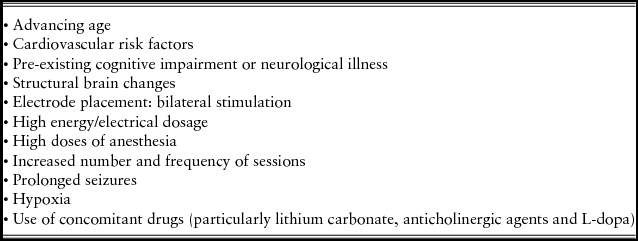
A short-lived mild delirium appears in nearly 50% of patients who receive ECT.Reference Rubin, Kinscherf and Figiel42Post-ictal disorientation or confusion often occurs immediately after ECT and, though transient in nature, it can take several hours, days or even weeks to resolve, especially in elderly patients.Reference Rubin, Kinscherf and Figiel42, Reference Tielkes, Comijs, Verwijk and Stek43 Severe and prolonged ECT-induced inter-ictal delirium is less frequent.Reference Chopra and Sola44 Risk factors (Table 1) include advancing age, cardiovascular risk factors and pre-existing cognitive impairment, neurological illness or structural brain changes, like basal ganglia and subcortical white matter lesions.Reference Brodaty, Berle, Hickie and Mason35, Reference Schatzberg and Nemeroff45–Reference Quante, Luborzewski and Brakemeier48
Factors that increase risk of post-ECT cognitive impairment
Older people are particularly vulnerable to ECT-related cognitive changes, both transient and more permanent.Reference Gardner and O'Connor34 Patients older than 65 years receive a disproportionately high share of ECT compared with younger patients,Reference Chanpattana49, Reference Wood and Burgess50 because it is the population where a more rapid and definitive response is required. Old people have fewer life times for using in the latency period of pharmacological response,Reference Agüera-Ortiz and Ramos Garcia51 high risk of depression-related physical complications and a greater risk of suicidal behaviours.Reference Szanto, Gildengers and Mulsant52 Despite this, cognitive side-effects after ECT are poorly investigated in older people. Most studies do not consider the technical conditions for applying ECT, electrical wave-forms, electrode placement, prior oxygenation level or other conditions that could influence the risk of cognitive side-effects appearing. As a standard practice it seems wise for the older depressed patient to have two or three sessions a week, to an average of 6–8 sessions. Evidence also suggests that increasing the frequency of ECT may result in more rapid improvement of depression, but increases adverse cognitive effects.Reference Charlson, Siskind and Doi53, Reference Gangadhar and Thirthalli54
In the general population, several studies have shown that high-dosage right UL ECT has a good antidepressant effect and UL placement works as well, or almost as well, as bilateral (BL) stimulationReference Sackeim, Prudic and Devanand37, Reference Stoppe, Louzã, Rosa, Gil and Rigonatti55, Reference Sackeim, Dillingham and Prudic56 and produces less cognitive side-effects.Reference O'Connor, Jacoby, Oppenheimer and Dening39, Reference Quante, Luborzewski and Brakemeier48 Bifrontal electrode placement provides another, potentially safer option.Reference Plakiotis and O'Connor57 In the elderly population, BL placement has been associated with more adverse cognitive effects, confusion and delirium than UL during acute treatment.Reference O'Connor, Jacoby, Oppenheimer and Dening39, Reference O'Connor, Gardner, Eppingstall and Tofler40, Reference Stoppe, Louzã, Rosa, Gil and Rigonatti55, Reference Rosen, Mulsant and Nebes58, Reference Prudic59
Use of ultra-brief pulse width ECT may be helpful for avoiding cognitive complicationsReference Sienaert, Vansteelandt, Demyttenaere and Peuskens60 and donepezil may mitigate symptoms of severe and prolonged post-ECT delirium.Reference Logan and Stewart61 Recent studies have shown that in patients with white matter hyperintensities (WMH) receiving BL ECT treatment, cognitive impairment improves when ECT is continued.Reference Oudega, van Exel and Wattjes62
An early studyReference Meeter, Murre, Janssen, Birkenhager and van den Broek63 using BL stimulus with brief pulse twice a week reported no retrograde amnesia at 3 month follow-up. Recent studiesReference O'Connor, Gardner, Eppingstall and Tofler40, Reference Kellner, Knapp and Husain64 comparing different sites for electrode placement have found that bitemporal electrode placement resulted in a more rapid decrease in symptom severity, but no significant differences between the electrode placement groups were found for global cognitive function. Bifrontal placement was not substantially different from bitemporal, except for significant worsening on two measures of anterograde memory. Both UL and BL placement were associated with autobiographical memory impairment. It is likely that technical improvements (brief pulse current, square waves) could have influenced these outcomes compared with earlier research. There are a few studies comparing electrode placements in psychogeriatric practice and recent studies in older people suggest that the negative effects of ECT on cognition are probably minimal.Reference Gardner and O'Connor34, Reference Tielkes, Comijs, Verwijk and Stek43 The emerging consensus is that there is no reason to choose BL ECT in the first instance,Reference O'Connor, Jacoby, Oppenheimer and Dening39, Reference Tew, Mulsant and Haskett65 though many old-age psychiatrists reserve BL ECT for life-threatening or treatment-resistant cases.Reference O'Connor, Jacoby, Oppenheimer and Dening39, Reference O'Connor, Gardner, Eppingstall and Tofler40 Some consider that BL ECT is simpler to administer and works faster, with cognitive sequelae being transient and mitigated by twice-weekly treatments.Reference Fink66 Nevertheless, brief pulse UL ECT is preferred in many old-age psychiatry centres, administered twice weekly to minimize cognitive impairment.
ECT as an acute treatment in old people
ECT is considered a second-line treatment option in older depressed people.Reference Contreras, Vallejo, Menchón and Urretavizcaya67, Reference Koenig, Blazer, Blazer, Steffens and Busse68 Most guidelines recommend ECT as a first-choice treatment for depression resistant to multiple trials of antidepressant pharmacotherapy and for depressive episodes with psychotic features, catatonia, high risk of suicide, or food refusal with nutritional compromise.5, 69, 70 Its effect is faster than psychopharmacological treatmentReference Rabheru71, Reference Kujala, Rosenvinge and Bekkelund72 and may be safer than pharmacological treatment in the very old (>85 years).Reference Tomac, Rummans and Pileggi32 It is used increasingly in the elderly population for treating major depression and psychotic depression when depression is not responsive to medications, when antidepressants are not tolerated due to side-effects, or when depression is accompanied by life-threatening complications and a rapid definitive response is required.Reference Kelly and Zisselman17, Reference Flint and Gagnon73, Reference Mitchell and Subramaniam74 For most psychogeriatricians, ECT is the treatment of choice for delusional depression.Reference Contreras, Vallejo, Menchón and Urretavizcaya67, Reference Meyers75, Reference Baldwin76
Whilst depressive syndromes remain the most common indication for ECT in elderly people, even in ‘old-old’ patients,Reference Rabheru71, Reference Kujala, Rosenvinge and Bekkelund72, Reference Manley, Oakley and Bloch78 it can be effective also in the acute treatment of mania, paranoid disorder and other psychiatric syndromes.Reference Alexopoulos, Young and Abrams77 However, there is less agreement about the use of ECT in these conditions.Reference Philpot, Treloar, Gormley and Gustafson6 There is also significant evidence for efficacy and safety in non-psychiatric disorders,Reference Kamat, Lefevre and Grossberg79 as it is considered a low-risk procedure that can be used successfully in medically ill older adults.Reference Kelly and Zisselman17, Reference Sutor and Rasmussen80
Efficacy in older depressed patients
Most studies about efficacy in older adults have been done in samples of depressed patients, comparing ECT treatment with antidepressants. These have confirmed the significant superiority of ECT in the treatment of severe and refractory major depressive disorders in older people, with or without psychotic features, catatonia and bipolar depression.Reference Kelly and Zisselman17, Reference O'Connor, Jacoby, Oppenheimer and Dening39, Reference Flint and Rifat81 Response or remission rates in depression between 50 and 85% have been found by many authors.Reference Brodaty, Hickie, Mason and Prenter46, Reference Manley, Oakley and Bloch78, Reference Flint82–Reference Mulsant, Rosen and Thornton84 In psychotic depression, the remission rate for ECT approaches 90%.Reference Ottoson and Fink14, Reference Flint and Rifat81, Reference Petrides, Fink and Husain85 Follow-up periods varied from 6 months up to 4 years and complete recovery rated at the end of follow-up periods ranged from 46 to 79.3%.Reference Van der Wurff, Stek, Hoogendijk and Beekman86 A positive relationship between outcome and older age was found in some studies,Reference O'Connor, Knapp and Husain87–Reference Tew, Mulsant and Haskett90 but not confirmed by others.Reference Brodaty, Hickie, Mason and Prenter46
Some studies suggested that good response predictors were psychotic and melancholic symptomsReference Mulsant, Rosen and Thornton84, Reference Petrides, Fink and Husain85, Reference Birkenhäger, Pluijms and Lucius91 and psychomotor retardation.Reference Buchan, Johnstone and McPherson92, Reference Hickie, Mason, Parker and Brodaty93, Reference Hickie, Mason and Parker94 Early studies did not find a high rate of responses for melancholic features.Reference Fink, Rush and Knapp95 In contrast to younger patients, hypochondriacal symptoms and anxiety did not predict a negative response in older people.Reference Stek, van der Wurff, Uitdehaag, Beekman and Hoogendijk96
Results from the few studies assessing the influence of age on the efficacy of ECT are inconsistent.Reference Tomac, Rummans and Pileggi32 Some authorsReference Tew, Mulsant and Haskett90 found an inferior response in younger patients with major depression treated by ECTReference Birkenhäger, Pluijms, Ju, Mulder and Broek97 or suggest that the efficacy of ECT in elderly depressed patients is at least equal to that in younger depressed patients. OthersReference Brodaty, Hickie, Mason and Prenter46, Reference Damm, Eser and Schüle98 suggest that depressive outcome and adverse effects of ECT are independent of age. Most agree that ECT appears to be associated with a higher risk of developing dementia, possibly underpinned by cerebrovascular disease and due to the increased risk associated with depression itself in older age groups.
Non-response to ECT has been associated with physical illness during the index episode, fewer life events before the onset of the episode and prolonged duration of the preceding depressive episode.Reference Magni, Fisman and Helmes99 Structural brain changes may be associated with poorer response to ECT and more adverse cognitive and functional outcomes.Reference Brodaty, Hickie, Mason and Prenter46, Reference Hickie, Mason, Parker and Brodaty93 Medial temporal lobe atrophy contributes to poor response in severely depressed elderly patientsReference Oudega, van Exel and Wattjes100 and WMH have been associated with increased risk of transient cognitive impairment.Reference Oudega, van Exel and Wattjes62
Safety in older depressed patients
ECT is safe and well-tolerated in both young and older people.Reference Kujala, Rosenvinge and Bekkelund72, Reference Damm, Eser and Schüle98 Cognitive and other ECT-related side-effects have been described previously in this paper. The majority of studies report lower or comparable mortality rates in ECT-treated patients and non-ECT patients. Case studies have described ECT to be safe in patients with long-bone fractures, cerebral aneurysm, intracranial tumours, intracranial vascular masses, impaired cardiac output, subdural haematoma, severe hypertension, cardiac arrhythmias, atrial fibrillation and in those on treatment with anticoagulants. It was also used safely in a patient who suffered from insecticide ingestion and in a patient with post-stroke depression.Reference Van der Wurff, Stek, Hoogendijk and Beekman86
Safety is independent of age. Mortality rates between 4 and 15% are found at 12–24 month follow-up after ECT in the very old.Reference Brodaty, Hickie, Mason and Prenter46, Reference Baldwin, Benbow, Marriott and Tomenson101 Studies focused on ECT safety have described extremely low mortality rates directly associated with ECTReference Shiwach, Reid and Carmody4, Reference Nuttall, Bowersox and Douglass102 and lower rates than in other psychiatric patients never treated with ECT.Reference Munk-Olsen, Laursen, Videbech, Mortensen and Rosenberg103 In general this risk was particularly significant for mortality linked to respiratory and cardiovascular disease and linked with the anaesthesia procedure. Accordingly, current guidelines emphasize the importance of identifying and carefully managing patients with risk factors before, during and after ECT, as well as assessing the risks associated with anaesthesia.5, 70 In all cases, ECT must be administered after legal authorization and the informed consent of the patient or their legal representative.
Treatment of non-depressed psychiatric disorders in older people
As well as in depression, ECT has also shown efficacy in the treatment of catatonia, mania, psychotic disorders, dementia with severe agitation, and Parkinson's disease. In general, in non-depressive disorders, ECT is considered a second- or third-line treatment. The risks and benefits of such treatment must be carefully weighed for each patient.
Catatonia
Catatonia is a psychomotor syndrome that results from an underlying medical condition, such as a cerebrovascular event, metabolic upset, seizure disorder, or infection. Catatonia may also be a manifestation of depression, mania or schizophrenia. People with catatonia, especially older people, often suffer many medical complications including dehydration, malnutrition, pneumonia and pulmonary embolism, as well as misidentification as ‘advanced dementia’. A severe form of catatonia, termed malignant catatonia, is associated with higher risk of death. The symptomatic treatment of choice for catatonia after evaluating for an underlying medical aetiology, are benzodiazepines. ECT should be considered first-line treatment in some cases and this does not necessarily depend on the underlying aetiology.Reference Suzuki, Awata and Matsuoka104, Reference Suzuki, Awata and Nakagawa105 If catatonic symptoms are unresponsive to benzodiazepines, or are associated with features of malignant catatonia, prompt treatment with ECT should be considered to prevent death. However, there is a paucity of literature on the use of ECT for the treatment of catatonia in older people, with just a few case studies reporting efficacy.Reference Caroff, Mann and Keck106
Mania
ECT is a safe and effective treatment in older people with mania,Reference Mukherjee, Sackeim and Schnur107 but is generally considered a second- or third-line treatment and is used only if symptoms are refractory to pharmacotherapy. There are no randomized controlled trials (RCTs) of acute treatment of mania in older people and the literature includes a handful of case reports on the use of ECT in older patients with mania and co-morbid neuropsychiatric or physical disorders, both for acute and maintenance treatment.Reference Tsao, Jain and Gibson108–Reference Weintraub and Lippmann110 Maintenance ECT in rapid-cycling bipolar disorder patients is well documented.Reference Minnai, Salis and Oppo111
Psychotic disorders
In older patients with a long history of schizophrenia or late-onset schizophrenia, ECT may be used as an alternative therapy for patients who are medication-resistant or for those who suffer intolerable side-effects to medications. Despite the established efficacy of ECT for the treatment of schizophrenia, its use in psychotic disorders in older people is not uniformly successful.Reference Wilkins, Ostroff and Tampi112
Delirium
The use of ECT in delirium with severe and difficult to treat agitation is highly controversial. Some authors in the past have proposed ECT as a therapeutic option to consider.Reference Zwil and Pelchat113
Parkinson's disease
Evidence supporting use of ECT in patients with Parkinson's disease (PD) comes from retrospective studies and case reports. ECT is generally safe, but information on side-effects in special patient populations is sparse. Depression is commonly seen in patients with PD, with reported prevalence rates ranging from 20 to 90%.Reference Koenig, Blazer, Blazer, Steffens and Busse68 Psychotic symptoms are also relatively common in PD and create major disturbances to patients’ daily lives. The use of anti-PD medications has been the most widely identified risk factor for PD psychosis and atypical antipsychotic drugs are widely used at low doses, but in many cases with severe adverse effects.
Case reports and case series have documented the positive effects of ECT on the motor symptoms of PD, in patients both with and without co-morbid psychiatric illness (including mood disorders, anxiety disorders and psychosis).Reference Ueda, Koyama and Okubo114, Reference Kennedy, Mittal and O'Jile115 It is an effective option in both acute treatment and maintenance treatment, especially in subjects with ‘intractable PD’, resulting in improvements not only in PD-related psychosis, but also in the severity of motor symptoms and on–off phenomenon.Reference Wengel, Burke, Pfeiffer, Roccaforte and Paige116, Reference Usui, Hatta and Doi117 ECT is hypothesized to act in PD by enhancing dopamine neurotransmission, including increasing sensitivity of dopamine receptors.Reference Popeo and Kellner118, Reference Fochtmann119 A recent study suggested that ECT influences basal dysfunction in the mid-frontal region for patients with PD-related psychosis.Reference Usui, Hatta and Doi117
Despite its proven benefits, ECT has never gained wide acceptance as a clinical treatment option, perhaps because PD is a chronic disease with high risk of relapse and the beneficial effects of ECT in PD persist for variable periods.Reference Popeo and Kellner118 Thus in most cases maintenance ECT is needed to increase the length of benefit. In addition, the stigma surrounding ECT has probably been responsible for its lack of use.
Dementia with behavioural disturbances
When non-pharmacological and pharmacological treatments for behavioural disturbance associated with dementia fail to work, ECT may be considered. The use of ECT in patients with dementia requires careful examination of the risk/benefit ratio for each individual case, with consideration given to the severity of the underlying dementing illness.Reference Wilkins, Ostroff and Tampi112 Its use has not been reviewed in controlled studies and only a handful of case reports are available that describe ECT as being safe and effective for the treatment of affective disorders (depression and mania)Reference Nelson and Rosenberg47, Reference Weintraub and Lippmann110, Reference McDonald and Thompson122, Reference Price and McAllister123 and agitation/aggressionReference Rao and Lyketsos33, Reference Sutor and Rasmussen80, Reference Grant and Mohan120, Reference Roccaforte, Wengel and Burke121, Reference Ujkaj, Davidoff and Seiner124 with co-morbid dementia. Post-ictal confusion was present in the majority of patients, but was transient and well tolerated in most.Reference Ujkaj, Davidoff and Seiner124 Most case studies are in Alzheimer's disease, but ECT has shown efficacy also for improving cognitive, affective and motor symptoms in Lewy Body dementiaReference Burgut125, Reference Takahashi, Mizukami, Yasuno and Asada126 and in patients with cognitive impairment and WMH.Reference Coffey, Hinkle and Weiner127
Long-term efficacy of ECT: continuation and maintenance treatment in older people
Over 80% of patients whose major depression remitted successfully with ECT had relapsed within 6 months when left without active therapy,Reference Sackeim, Haskett and Mulsant128 and 36% had a re-admission within 6 months of discharge because of depressive symptoms.Reference Benbow20, Reference Sackeim, Haskett and Mulsant128 Thus adequate continuation treatment, either pharmacotherapy or a continuation of ECT, following a successful ECT course is of vital importance to maintain the benefits achieved. Patients who respond especially well can be offered further treatments on an out-patient basis, as can those who fail to respond to pharmacotherapy or who cannot tolerate it.5
One approach is to reduce the frequency of ECT after an acute course, lengthening the intervals between treatments from weekly to fortnightly, then monthly before stopping – so-called ‘continuation’ ECT. Patients who remain at very high risk might then be offered ‘maintenance’, typically monthly treatments, for a period extending to 2 years in some cases. Continuation ECT (cECT) aims to prevent relapse. Maintenance ECT (mECT), defined arbitrarily as treatment extending beyond 6 months, is intended to prevent recurrence.5
mECT did perform better than medication for psychotically depressed older patients, whose risk of relapse is known to be higher than average.Reference Navarro, Gastó and Torres129 Studies in depressed older people, comparing mECT with long-term antidepressant medication, found that the cumulative probability of surviving without relapse or recurrence was 73% for mECT and 18% for medication alone at 5-year follow-up.Reference Gagné, Furman, Carpenter and Price130 Of the patients who received mECT, 37% had been re-admitted to hospital compared with 67% of controls.Reference Swoboda, Conca, König, Waanders and Hansen131 A recent non-randomized study investigated cECT and mECT versus medication in depressed, aged patients over a 6-year period for prevent relapsing unipolar depression. This suggests that ECT appears to be highly effective in reducing and shortening psychiatric admissions in older people with severe affective illness. No records were found of serious and persistent adverse effects.Reference O'Connor, Gardner, Presnell, Singh, Tsanglis and White132 Frail older people are still candidates for cECT and mECT, provided that basic safety criteria are satisfied.Reference Baldwin133 There are some reports of the efficacy of mECT in individual treatment-resistant patients with rapid cycling bipolar disorder,Reference Tsao, Jain and Gibson108, Reference Nascimento, Appolinario, Segenreich, Cavalcanti and Brasil134 but there are no specific studies in older people. There are also reports about the use of cECT and mECT in PDReference Wengel, Burke, Pfeiffer, Roccaforte and Paige116 and delusional depressionReference Meyers, Klimstr and Gabriele135 specifically in older people, and a case series of agitated patients with Alzheimer's dementia reported no relapse of symptoms after 1 year of treatment.Reference Sutor and Rasmussen80
Conclusion
ECT is an important therapeutic option in geriatric patients due to its safety, efficacy and rapid onset of action, all aspects particularly suited to the special needs of this population. In recent years, knowledge of ECT physiology has greatly increased and technological improvements are diminishing the potential side-effects, in particular on cognition. Currently, ECT has an adequate balance of risks and benefits to justify use for severe depression in older patients, both with and without associated dementia.
Conflicts of interest
None.