Introduction
Chronic diseases and disability are disproportionately prevalent among older people. Thus the growing elderly population will increase the demand for health care and other social services. This is likely to be compounded by the change in the traditional family support systems for older people. Policies and programmes that address the needs of the growing aged population are urgently needed to ensure successful ageing and to promote functional independence of the aged.
In clinical practice, the health status of patients is best described based on their own reports. The factors they report can then be analysed and correlated with their medical condition in the clinic. Multiple studiesReference Phillips, Hamel, Covinsky and Lynn1–Reference Cleeland, Foley and Gelband5 have reported a high prevalence of physical and psychosocial suffering, unmet practical and personal care needs and high caregiver burden in older people, especially those living with serious, chronic, or terminal illness. Recent publications from the Department of Health in England and other authorities highlight the importance of implementing quality of care into day-to-day practice. The ‘High Quality Care for All: NHS Next Stage Review Final Report’6 indicated the intention to link payments to PROMs data: ‘First, we will make payments to hospitals conditional on the quality of care given to patients as well as the volume. A range of quality measures covering safety (including cleanliness and infection rates), clinical outcomes, patients’ experience and patients’ views about the success of their treatment (known as patient reported outcome measures or PROMs) will be used.’
This article will discuss the concept of PROMs, the parties involved to set this service up and how it can be implemented into standard clinical practice.
The concept of self-reporting
Self-reported outcome is a subjective rating of one's own health. Self-rated health is also sometimes called self-assessed, self-evaluated, perceived, or subjective health. It can be measured using a variety of scales and question wordings, but generally involves asking the subject to rate their own general health on a single-item scale by questionnaire or interview, using either numerical visual analogue scales (VAS)Reference Van Tubergen, Debats and Ryser7 or Likert scale, with five options: e.g. poor, fair, average, good or excellent.Reference Idler and Benyamini8, Reference Idler9 It is designed to be either a general/global personal health rating, or a disease-specific one. In both cases, it has been found to be a reliable and useful indicator of a person's actual health. It has also been demonstrated as an independent predictor of mortality in older people,Reference Van Tubergen, Debats and Ryser7 a relationship only partially explained by disease and other health risk factors.Reference Strawbridge and Wallhagen10 Self-rated health has been shown to be related to various socio-demographic, psychological, physical, and social factors. Depression, for instance, is often found to have a negative effect on a person's self-rated health.Reference Schnittker11
Case-based approach
The difference that PROMs can make to clinical practice is their ability to use a problem-oriented approach, tailored to the individual's specific needs and strengths. In many situations this approach is not supposed to inform clinical decisions, but in some instances patient questionnaire scores reveal degrees of functional loss, pain or psychological issues which are not apparent in the simple clinical interview, particularly when accompanied by a flow chart of serial scores. A patient's level of pain, physical function, and global status at a given time, or as these problems may change over time, cannot be documented quantitatively from a careful history, physical examination, laboratory test, or radiograph, but only from a patient questionnaire.Reference Pincus, Callahan, Sale, Brooks, Payne and Vaughn12 Predicting which patient will provide important unexpected information in standard practice is not possible.
Patients almost always have 5–10 minutes to complete a questionnaire whilst waiting to see the physician. Therefore, asking each patient to complete a simple questionnaire at each visit, similar to checking weight or blood pressure at each visit, is logistically the most feasible procedure as it provides the most thorough assessment at that moment. Progress in medical care requires quantitative measurement to assess clinical status and document improvements over time in conditions ranging from hypertension to hypercholesterolaemia. Initially, complex measurements are developed in clinical research settings, which are then simplified for pragmatic use in clinical care.Reference Palmer, El Gaafary and El Miedany13
Incorporating PROMs into standard clinical practice
Incorporation of patient questionnaires into standard clinical care requires different strategies from those used in clinical research. Unfortunately, many health care professionals do not recognize substantial differences between patient questionnaires used for clinical research versus those for clinical care. This can be attributed to the fact that most of the published quantitative assessments in the medical literature involve thorough measurement in the small minority of patients who are enrolled in clinical trials, rather than pragmatic measurement in the vast majority of patients seen in standard clinical care. However, this approach is not compatible with evidence-based medicine and not in the patients’ best interest either.
Research questionnaires are generally elaborate, increase the length of a visit, add significantly to staff and physician time and require special tools to analyse and expertise to interpret them. They may include a lot of information that may be superfluous to patient assessment in standard care, such as extensive queries about work history and hospitalization. On the other hand, patient questionnaires for standard clinical care should be user friendly, with clear answers, easy enough to be completed in less than 10 minutes, reviewed (eyeballed) by a clinician in less than 10 seconds and scored in less than 30 seconds without a computer or calculator.Reference Pincus, Callahan, Sale, Brooks, Payne and Vaughn12, Reference Palmer, El Gaafary and El Miedany13 This type of questionnaire facilitates and improves clinical encounters. Although the self-reported measures are not a substitute for individualized assessment or diagnostic interview by an experienced health care professional, these instruments are useful screening tools in a variety of clinical settings, especially when baseline measurements can be compared with subsequent scores. These measures should never be the sole basis for a diagnosis.
Health care professionals
When implementing PROMs into clinical practice, health care professionals come at the top of the list of parties who need to be tackled. Many continue to believe that patient questionnaires are weak ‘subjective’ measures compared with the stronger ‘objective’ measures that they use. This view was challenged dramatically when Mossey & ShapiroReference Mossey and Shapiro14 showed that self-reported health measures were predictive of mortality. This was supported by another study published in 1984, which revealed that rheumatoid arthritis patients’ questionnaire scores predicted mortality more effectively than any traditional measure.Reference Pincus, Callahan, Sale, Brooks, Payne and Vaughn12 These findings suggested that questionnaires should be incorporated into standard patient care, similar to routine monitoring of important predictors of premature mortality such as blood pressure or cholesterol in cardiovascular disease, or glucose and haemoglobin A1c in diabetes mellitus. Identification of such impairment will not only help in the patient's differential diagnosis, but improvement in indicators of poor prognosis is also associated with increased well-being and survival. However, trying to persuade treating health care professionals to involve such questionnaires in their standard clinical practice remains a real challenge.
Are older patients different?
Older patients are an extremely heterogeneous group, which forms a particular challenge to the treating health care professional. As a result of factors such as inadequate social support, lack of confidence after falls, presence of multiple chronic conditions and deteriorating psychological status, quality of life may be seriously impaired, posing a serious challenge as patients get older. Elderly patients with chronic medical illness are known to have a high prevalence of co-morbid depression,Reference Picavet and Hazes15 which is of particular concern as it is often difficult to know whether a particular symptom, such as lethargy, is caused by low mood, or the medical illness itself, or both. Earlier studies revealed that recognition of depression has the potential to improve functioning and quality of life in spite of the presence of other medical co-morbidities.Reference Hitchcock, Williams and Unutzer16
Medication is another major challenge that faces the health care professional treating older patients. Firstly, older patients seem to be more vulnerable to side-effects.Reference Schaardenburg, Van den Brande, Lighart, Breedveld and Hazes17, Reference Michet, Evans, Fleming, O'Duffy, Jurisson and Hunder18 Secondly, the pharmacokinetics and pharmacodynamics of drugs and their interactions are affected by age-related changes.Reference Denham and Barnett19 Thirdly, older people experience greater co-morbidity and are therefore more likely to need multiple drug prescriptions. Fourthly, forgetfulness and negative beliefs about medications may make compliance and adherence to medical therapy hard to improve.
Finally, erosion of the traditional family support systems for older people has had a negative impact on their self-confidence, as reflected on patients’ self-helplessness index.Reference Palmer and El Miedany20
Recent developments in PROMs
The implementation of PROMs into practice has necessitated them becoming more comprehensive, more precise and less time consuming. Developing patient-friendly questionnaires helps improve patients’ confidence and willingness to complete the questionnaire. Another hurdle to overcome is the risk of care professionals getting lost in the diversity of PROMs questionnaires available. This has been tackled recently by developing conversion formulas between the different questionnaires versions to achieve a unified assessment for functional disability. For example, Anderson et al.Reference Anderson, Sayles, Curtis, Wolfe and Michaud21 and El Miedany et al.Reference El, Palmer, Youssef and El Gaafary22 have assessed the possibility of converting scores on the Modified Health Assessment Questionnaire (HAQ), Multidimensional HAQ, HAQII and Combined Inflammatory Arthritis Questionnaire – functional disability into the original HAQ score, using models developed with a large cohort of patients.
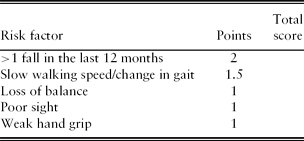
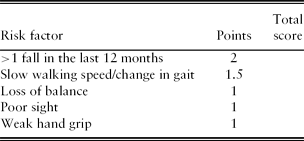
An example of a recent development in falls assessment is the Falls Risk Assessment Score (FRAS),Reference El Miedany, El Gaafary and Toth23 helping to assess falls risk for both in-patients as well as out-patients. The tool proved to be valid and comprehensive (Table 1).
Falls Risk Assessment Score (FRAS) used to calculate a patient's falls prediction score. The range of possible total score is 0–6.5, with higher score indicating a greater risk of sustaining a fall (high risk of falls at cut-off point 3.5)
Data recording
The improvement of clinical quality and outcomes for patients is at the heart of recent NHS reforms and it is expected to be a fundamental part of patient assessment in standard daily practice.6 However, after obtaining the PROMs, there is the question of what to do with them? The main task to be tackled is how to consistently record and analyse these outcome measures over time for both an individual patient and for a group of patients. The aim should not be limited to showing effectiveness of care, but also to track patients’ scores, by recording them at each visit and storing them either with the patient's medical notes or under alternative secure arrangements. Interestingly, recent reports showed that health care professionals lose 9% of their time looking for information and nurses spend 50% of their time completing paperwork.Reference Palmer and El Miedany32 With advances in technology, software programs have been designed to facilitate capture of patients’ data and to record outcomes over time, allowing the visualization of trends and promoting quality of care, safety and efficacy of treatment. A recent pilot studyReference El Miedany, El Gaafary and Palmer33 assessed the feasibility and impact of visual feedback, based on electronic recording of PROMs in patients suffering from inflammatory arthritis. This revealed that the visual feedback was associated with a significant reduction of disease activity parameters, as well as improved adherence to anti-rheumatic therapy.
From research to standard clinical practice
The authors’ experience can serve as a good example of incorporating PROMs into standard clinical practice. First, it started by providing an integrated service for ‘Osteoporosis and Falls’, launched in 2004. The aim was to provide a service that would cover bone mineral density measurement, as well as assessment for osteoporosis risk factors and falls risk, for all patients referred. The introduction of FRAX (10-years fracture probability) meant that this also had to be included in the assessment, along with the patients’ dual energy X-ray absorptiometry (DXA) scan reports. However, there were some challenges in relating these developments to real life. In an attempt to screen for all possible risk factors, a two-page DXA referral form was developed. On one side the referring doctor highlights the reason for referring the patient for DXA scanning, and the other page contains two short self-reported questionnaires to be completed by the patient, to assess for fracture risk probability and falls risk.Reference El Miedany and Toth24 The referral form and patient questionnaires are both in ‘tick-box’ format.
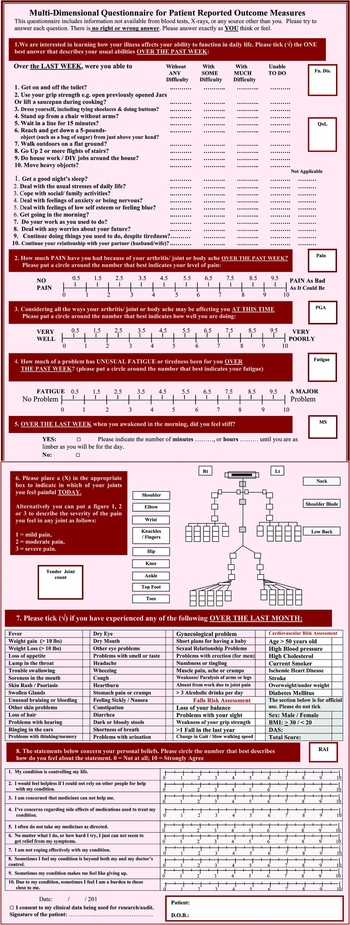
The second task was to set up a geronto-rheumatology service adopting the PROM.Reference El Miedany, Palmer, El Gaafary and Toth25 The geronto-rheumatological approach differs from regular rheumatological care in that it not only focuses on separate disease-related variables, but also uses a more holistic approach, taking age-related physical, psychological as well as social issues into account, so that proper intervention can be started early. To enable this, a PROMs format was introduced (Figure 1). The questionnaire includes assessments of functional disability and quality of life, using the combined inflammatory arthritis questionnaire. This is a set of ten questions for functional disability and another ten questions for quality of life. The functional disability score is calculated in a standard manner: the 10 items in each set are scored 0–3, where 0 = without any difficulty, 1 = with some difficulty, 2 = with much difficulty and 3 = unable to do. The overall physical function score is the mean of the sum of the responses divided by ten. The PROM also includes three numerical visual analogue scales to assess pain, fatigue and global health status (using a 10 cm line and where a score of 0 = no symptoms and a score of 10 = very severe symptoms) and questions on duration of morning stiffness (in minutes) and self-reported joint tenderness (using a diagram with the joint names written as a guide and where the patient is asked to tick the box matching the painful joints or painful areas).Reference El Miedany, El Gaafary, Youssef and Palmer28 The patient's self-helplessness is assessed using the modified rheumatology attitude index.Reference Palmer and El Miedany20, Reference El, Palmer and Toth26 In addition, there is a checklist of 43 common symptoms which are incorporated into a structured ‘review of systems’, as well as five questions (FRAS score) to assess falls riskReference El Miedany, El Gaafary and Toth23 and nine questions to assess cardiovascular risk.Reference Wood, Wray and Poulter27 When the patient registers for a visit, he or she is asked to complete the questionnaire whilst waiting to see the physician or the nurse specialist. A health care assistant or the receptionist are available for help, should the patient experience difficulty. The questionnaire is reviewed and scored by the treating specialist when the patient is in the clinic room.
Multidimensional questionnaire for patient reported outcome measures
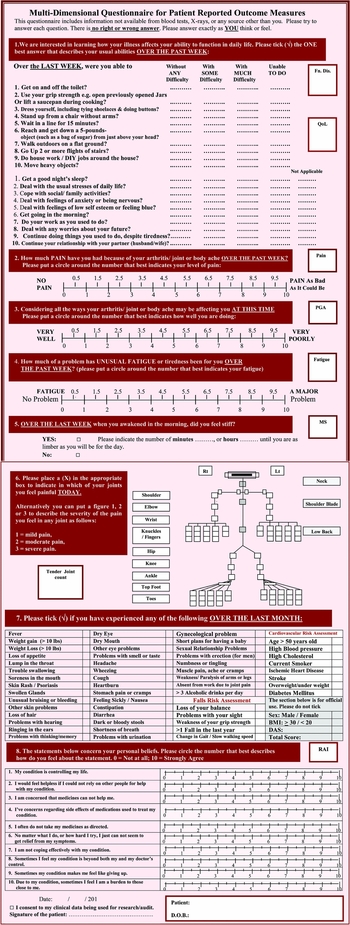
The PROM unifies three important aspects of a patient assessment instrument: the physical as well as mental aspects of the patient's functioning, a patient-oriented perspective and a brief user-friendly format. It has been used to evaluate older adult patients suffering from a wide spectrum of rheumatic diseases, with a high response rate on all items and 93% of respondents stating that the questionnaire was comprehensive and easy to complete.Reference El Miedany, Palmer, El Gaafary and Toth25 Earlier data revealed that the clinician can review the questionnaire easily in less than 10 seconds, and all scales can be scored formally in less than 20 seconds.Reference Palmer, El Gaafary and El Miedany29 Another advantage of the self-reported format is that it allows more time for the clinical assessment and for listening to the patient. Patient adherence to treatment programmes is directly linked to their satisfaction with the clinical encounter,Reference Sutton30 so if visit time is increased this should have a positive impact on care. In a recent study, Levy et al.Reference Levy, Cheetham, Cheatwood and Burchette31 postulated that if the time burden of collecting data is shifted from physicians to patients, then more physicians would use these tools in their regular practice and patients’ care would be improved.
Conclusion
There is overwhelming scientific evidence for the role and value of implementing PROMs into standard clinical practice for older adults. The exception may be in those with dementia, who might not be able to complete the questionnaire reliably. The ball lies within the health care professionals’ court, but most remain reluctant to use such tools in their practice. There is an urgent need to identify patients requiring additional and more thorough care and, to this end, a choice of reliable assessments has to be made to assess relevant functioning and risk factors. This will then allow a co-ordinated plan of care, aiming at focused interventions to address specific problems.
Conflicts of interest
The authors have nothing to disclose.