A common societal and political consequence of terrorism is an increase in the focus on security and security measures.Reference Davis, Pollard and Ward 1 , Reference Goodrich 2 The primary aim of this sharpened focus is to prevent terrorist acts from happening in the future, but an important aim is also to make people feel safe again and resume normal life after such horrific events. In the wake of September 11, 2001, spending on security-related issues increased significantly in many countries throughout the world.Reference Archick, Ek and Gallis 3 Although it is not necessarily straightforward to track how much countries are allocating to security, is has been estimated that the United Kingdom’s spending on “counterterrorism and resilience” increased from less than $1.8 billion before September 11 to a budgeted $3.6 billion in 2007-2008 (excluding core military and police spending).Reference Archick, Ek and Gallis 3 In the United States, spending on homeland security has been estimated at almost $100 billion in 2005, up from $56 billion in 2001.Reference Hobijn and Sager 4 According to the Watson Institute of International & Public Affairs at Brown University, an additional $369 billion has been spent on homeland security in the United States for the period 2001-2011 as a consequence of changing federal spending patterns after September 11 compared to if spending had continued at the rate seen in the 1990s. 5
The few studies that have examined the cost-effectiveness of various security-related interventions in terms of actual safety (ie, the statistical probability of another attack) do not unequivocally lend support to the effectiveness of these interventions.Reference Stewart and Mueller 6 - Reference Stewart 8 Many interventions also have high indirect costs to society because they infringe on civil liberties, and these indirect costs are hard to account for in cost-benefit analysis.Reference Lieberman 9 Even disregarding the issue of cost, one systematic review article suggests that it is not necessarily clear that all security measures achieve the main goal of increasing overall safety.Reference Lum, Kennedy and Sherley 10 Aside from highlighting the pressing need for more studies, these findings arguably raise the importance of the second rationale behind interventions: that they enhance peoples’ feeling of safety. Within the framework of Maslow’s hierarchy of needs, feeling safe constitutes a core human need, the importance of which is secondary only to basic physiological needs such as hunger.Reference Maslow 11 According to Maslow, therefore, people need to feel sufficiently safe—and have their physiological needs met—before they can pursue needs higher up in the hierarchy (eg, social needs, the need for esteem, and self-actualization). Research has shown that this feeling of safety is undermined in societies struck by terrorism.Reference Boscarino, Adams and Figley 12 , Reference Silver, Holman and McIntosh 13 Similarly, terrorism directed at the workplace reduces employees’ perception of safety at work,Reference Grieger, Fullerton and Ursano 14 , Reference Grieger, Waldrep and Lovasz 15 which could affect worker productivity and sick leave rates. A priority after terrorism, therefore, becomes to restore people’s sense of safety so that they can return to normal life and participate fully in society. One might argue that the desire to re-establish a “safe normality” is as an important driver behind the enhanced focus on security after terrorism. Limited research has been done, however, to assess how people’s perception of safety is linked to views of security-related issues and interventions, especially in connection to terrorism. One study at the University of Tennessee reported that more than 70% of faculty and students felt that “the events of September 11 had made airports safer from terrorism.”Reference Chen and Noriega 16 A study of attendees at a major sporting event concluded that venue-specific characteristics such as security checks and the presence of police was important for safety perception.Reference Taylor and Toohey 17 Somewhat tangentially, a study on risk perception and attitudes toward homeland security found that the perceived effectiveness of interventions was negatively associated with perceived intrusiveness.Reference Sanquist, Mahy and Morris 18 The 2 interventions perceived to be the most effective in the study were airport screening of passengers and baggage and explosive-detector canines. Notably, though, the operationalization of the term effectiveness in the study extended well beyond personal perception of safety, which is the focus of the current study. Unrelated to terrorism, research has shown that certain security devices in hotels (eg, deadbolt locks, closed-circuit TV cameras) enhance perceived safety among tourists,Reference Milman, Jones and Bach 19 and that police presence and increased lighting increase perceived safety among transit passengers.Reference Wallace, Rodriguez and White 20
The tragic events that occurred in Oslo, Norway, on July 22, 2011, offer an opportunity to examine safety perception at work for employees struck by terrorism. On that day, a terrorist car bomb was detonated outside the government headquarters in downtown Oslo, killing 8 people, wounding more than 200 others, and causing substantial damage to government buildings. Acute medical and psychological care was provided to affected individuals by the local emergency departments and hospitals in the days and weeks following the attack. Starting about 5 weeks after the attack, the government occupational health service conducted medical examinations and provided psychological assistance to employees in need, referring those requiring higher-level care to city hospitals. Priority was given to employees who were at work at the time of the attack (employees who were away from work when the bomb exploded were asked to contact the occupational health service at their own initiative if they needed professional help). In addition, most ministries arranged informational and psycho-educational meetings for employees. A quarter of the government employees who were at work at the time of the attack qualified for the post-traumatic stress disorder (PTSD) diagnosis 1 year after the attack.Reference Hansen, Nissen and Heir 21
Owing to the substantial damage to many government buildings, several ministries had to relocate to new buildings, some of which were several kilometers away from the government headquarters in downtown Oslo. The importance of quickly resuming governmental duties added a time-pressure component to an already extremely challenging situation, and decisions often had to be made without much time for reflection and discussion. Because of a high degree of uncertainty in the weeks and months following the attack, added security was put in place, such as restricted and security-controlled access to areas in and around government buildings, installation of bulletproof glass, and increased police presence. The attack on the government headquarters, and, even more so, the Utøya massacre (which occurred a few hours later on the same day), dominated media coverage in Norway for months. In terms of the attack, the media coverage raised many critical questions about the adequacy of security in and around government buildings prior to the attack.
In the present study, which is part of a larger research project investigating the consequences of the July 22 terrorist attack,Reference Hansen, Nissen and Heir 21 , Reference Nissen and Birkeland Nielsen 22 employees in the Norwegian ministries were asked about perceived safety at work, security measures, and emergency preparedness. The aim of the study was to explore how perceived safety at work after terrorism is associated with employees’ perception of whether security measures are sufficiently prioritized at work, whether there has been sufficient escape and evacuation training, and whether they are confident with evacuation procedures.
METHODS
Design and Participants
A cross-sectional, questionnaire-based survey was conducted about 9 to 10 months after the attack on July 22, 2011. Potential study participants included all individuals who had a contract of employment in 14 of the 17 ministries in Norway on the day of the attack and who were still employed in the ministries at the time of the study (ie, employees who had left their job between the attack and the study were excluded). Participants were first informed about the study by their respective ministries in February to March 2012 and were provided the opportunity to withdraw. Employees who could not be reached with information were automatically withdrawn. A study invitation letter was then sent out about 1 month later containing further information about the study, withdrawal procedures, and a log-on code to access the study’s web-based questionnaire. A data security expert independent of the research team assigned each participant a unique project ID number based on social security numbers, blinding the researchers to the identity behind responses. The key to match IDs with social security numbers was stored on an off-line server inaccessible to the researchers. The study was approved by the Regional Ethics Committee in Norway.
Measures
The main outcome variable, perceived safety at work, was measured by using a question from the Safety Perception Scale designed by Grieger and colleagues and used in their research on safety perception among employees in the Pentagon after the 9/11 attacks.Reference Grieger, Fullerton and Ursano 23 Because the present study focused on perceived safety at work, we used only 1 item from the 3-item scale, namely, the statement “I feel safe when I am at work,” which was scored on a 5-point Likert scale (1=disagree to 5=agree).
The 3 predictor variables under investigation were also statement questions answered on a 5-point Likert scale from 1=disagree to 5=agree. The 3 questions were as follows: “Security measures are not given sufficiently high priority at work” (factor loading of 0.585 for priority of safety at workplace, see Cox and CheyneReference Cox and Cheyne 24 ), “There has been insufficient escape and evacuation training” (factor loading of 0.74 for positive safety practice at workplace, see Williamson et alReference Williamson, Feyer and Cairns 25 ), and “I know what to do in the event of an evacuation situation” (reformulated question based on the Norwegian Petroleum Safety Authority’s questionnaire used in the project “Trends in risk levels – Norwegian shelf,” see Tharaldsenet alReference Tharaldsen, Olsen and Rundmo 26 ). In terms of the first question on priority of security measures, no accompanying explanatory information was provided, meaning the participants had to answer based on their overall feeling of whether security measures were sufficiently prioritized at work. The scoring of the 2 former questions was reversed in analysis to ease readability of results.
Symptoms of post-traumatic stress were measured through the Norwegian version of the Posttraumatic Stress Disorder Checklist (PCL), which has shown good psychometric and diagnostic properties in earlier research.Reference Hem, Hussain and Wentzel-Larsen 27 Participants were categorized as having PTSD if they had 1 positive score—ie, scoring 3 or above on the PCL 5-point scale—in symptom cluster B (re-experiencing); 3 positive scores in cluster C (avoidance); and 2 positive scores in cluster D (hyperarousal). The A criterion was not required. Participants were instructed to score questions with specific reference to the terrorist attack. In addition, data were collected on gender, age, and educational level.
Analysis of Data
Educational level was divided into the following 3 categories: <13 years, 13 to 16 years, and >16 years of education. Participants and nonparticipants were compared by age and gender by using t-test and chi-square tests for proportions, respectively. Linear regression modeling was used to explore the associations between the outcome of interest (perceived safety at work) and the 3 predictor variables (priority given to security measures, escape and evacuation training, and knowledge of evacuation procedures), and to evaluate confounding and effect modification. Education and PTSD were included in the final regression model given results from earlier work showing their importance for perceived safety at work.Reference Hansen, Nissen and Heir 21 Gender and age were included for a priori reasons. Predictor variables were added to the final model according to the strength of association with perceived safety found through bivariate analysis. The likelihood ratio test (LRT) was used to evaluate whether the addition of a variable improved the overall fit of the model and to evaluate possible effect modification. Results from the regression analysis are reported in unstandardized regression coefficients (b coefficients).
Missing values were dropped through listwise deletion when adding variables to the regression models. T-test, chi-square test, and Fisher’s exact test were used to evaluate potential bias introduced by dropping missing values. The number of participants contributing data to a given analysis is indicated in the tables. Analysis was performed by using Stata version 13 (STATA Corporation, College Station, TX, USA).
RESULTS
From the initial group of 3397 potential participants, 53 were excluded because they could not be reached with information about the study. Of the remaining 3344 employees, 1900 (56.8%) answered at least parts of the questionnaire and 1864 (55.7%) answered the questions on the main outcome and predictor variable(s). The 1900 participants included a higher proportion of women (0.57 versus 0.49, P<0.001) and were slightly older (45.4 versus 43.8 years, P<0.001) than the 1444 employees who did not take part in the study. Overall, the participants were highly educated, with more than 60% having completed university studies at the masters level (>16 years). Questionnaire-diagnosed PTSD prevalence among the participants was roughly 6% (restricted to PTSD related to the terrorist bombing). The final regression model was based on data from 1848 employees, ie, there were 52 missing (2.7% of 1900). There was no evidence that the missing group of 52 differed from the group included in the final model on gender (chi-square test p=0.64), age (t-test p=0.81), education level (Fisher’s exact test P=0.62; data only available for 36 employees), or PTSD (Fisher’s exact test P=0.45; data only available for 10 employees).
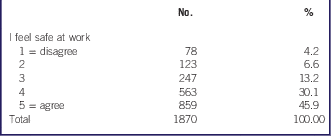
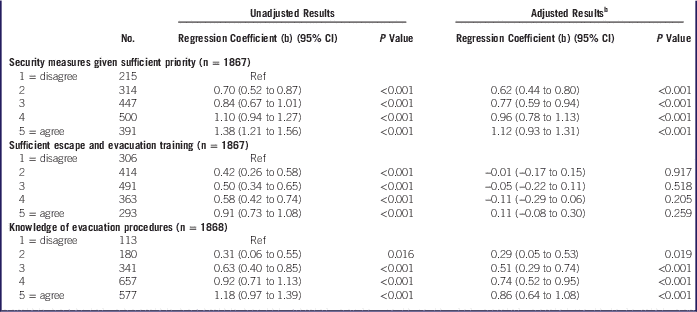
As can be seen from Table 1, the distribution of perceived safety at work was negatively skewed with almost half of employees completely agreeing that they felt safe at work (scoring 5 out of a maximum 5 on the “I feel safe at work” question). Bivariate analysis showed very strong evidence of an association between each of the 3 predictor variables and perceived safety at work (P<0.001 for all exposure categories in all 3 predictors except one when compared to the reference; Table 2). More specifically, there was a clear trend of increasing perceived safety at work the more employees believed security measures were given sufficient priority, the more they thought there had been sufficient escape and evacuation training, and the more knowledge they had on evacuation procedures. When adjusting the 3 predictors for each other, however, employees’ perception on escape and evacuation training appeared to no longer matter for perceived safety at work, whereas the strength of evidence for an association between the other 2 predictors and perceived safety remained.
Feeling of Safety at Work for Employees in the Norwegian Ministries 9 to 10 Months After the 2011 Oslo Bombing (n=1870)

Relative Probability of Feeling Safe at Work for Employees in the Norwegian Ministries 9 to 10 Months After the 2011 Oslo Bombing According to Employees’ Perception of Security Measures and Emergency Preparedness: Unadjusted and Adjusted ResultsFootnote a

a Abbreviations: CI, confidence interval; Ref, referent. Linear regression modeling of perceived safety (scored from 1=feeling unsafe at work to 5=feeling safe at work).
b Missing values were dropped when calculating adjusted results (n=1864).
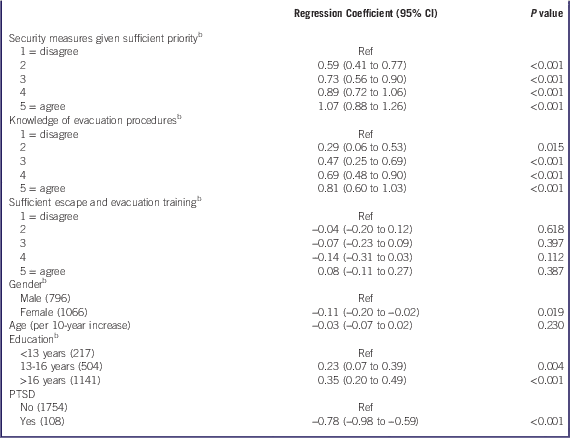
The fully adjusted results (Table 3) did not change the strong evidence of increasing perceived safety at work the more employees believed security measures were sufficiently prioritized and the more they knew about evacuation procedures (P<0.001 for all exposure categories except one). There was no evidence that the addition of the predictor escape and evacuation training improved the overall fit of the model (LRT P=0.10); however, it was retained in the model because it was a predictor of primary interest. PTSD appeared to act as a positive confounder in the association between the predictor security measures given sufficient priority and perceived safety at work, inflating unadjusted results by about 10% at each exposure level. There was also strong evidence that PTSD independently predicted perceived safety at work. Age, gender, and education did not appear to act as confounders in the final model. There was moderate to strong evidence that education modified the effect of the predictor security given sufficient priority on perceived safety at work (LRT of no interaction P=0.02), with a less pronounced effect in the middle educational category. There was also moderate evidence that both education and gender modified the effect of the predictor knowledge of evacuation procedures on perceived safety (LRT of no interaction P=0.05 and P=0.02, respectively). Knowledge of evacuation procedures was less important for perceived safety at work in females and more highly educated employees. Gender and education both independently predicted perceived safety at work (males and more highly educated participants were more likely to feel safe). All 4 covariates in the model (PTSD, gender, age, and education) improved the overall fit of the model.
Relative Probability of Feeling Safe at Work for Employees in the Norwegian Ministries 9 to 10 Months After the 2011 Oslo Bombing: Fully Adjusted Results (n=1848)Footnote a

a Abbreviations: CI, confidence interval; PTSD, post-traumatic stress disorder; Ref, referent. Linear regression modeling of perceived safety (scored from 1=feeing unsafe at work to 5=feeling safe at work).
b Education modified the effect of security measures given sufficient priority on perceived safety; and both gender and education modified the effect of knowledge of evacuation procedures on perceived safety (results not shown in table to ease readability – see Results and Discussion sections for details).
DISCUSSION
The present cross-sectional study of employees in the Norwegian ministries conducted 9 to 10 months after the 2011 terrorist attack on the Norwegian government explored how employees’ perceived safety at work after terrorism is associated with their perceptions on security measures and emergency preparedness. We found strong evidence of increasing perceived safety at work the more employees believed security measures were sufficiently prioritized at work and the better their knowledge of evacuation procedures. PTSD appeared to be a positive confounder in the former association, although the association remained strong after adjustments for PTSD. Both gender and education appeared to modify the positive effect of knowledge of evacuation procedures on perceived safety at work, with a less pronounced effect in women and more highly educated employees.
The strong adjusted positive association between perceived safety at work and 2 of the 3 predictors investigated—perceived priority given to security measures at work and knowledge of evacuation procedures—is both logical and broadly consistent with earlier research on related topics.Reference Chen and Noriega 16 - Reference Milman, Jones and Bach 19 The clear dose-response relationship within both predictors supports the internal validity and strength of the associations. Since cross-sectional studies cannot really be used to draw conclusions about causality, we can only theorize that the predictors exert a causal effect on perceived safety. Longitudinal, or ideally, experimental designs, must be used to assess whether true causal relationships exist. Nonetheless, by exploring security and perceived safety at work for terror-exposed employees, the study expands on the current literature which has mostly focused on safety perception and security/safety measures from a tourism perspective. Our study sample was also comparatively large and had a relatively high response rate.
The finding that gender modified the effect of knowledge of evacuation procedures on perceived safety at work, with the effect almost halved for women for any given level of knowledge, may be understood in light of earlier research on gender differences in reaction to safety measures and men’s tendency to feel more vulnerable when they have less control over their environment.Reference Yavuz and Welch 28 The underlying argument is that better knowledge of evacuation procedures increases the sense of control, which then leads to an enhanced feeling of safety, and that this effect is particularly strong in men. This perspective also resonates with known gender differences within Rotter’s theories on locus of control, with men more likely to have an internal locus than are women.Reference Rotter 29 , Reference Sherman, Higgs and Williams 30 That is, men in general tend to hold the belief that events in life are a product of internal and controllable factors, whereas women more often believe that events in life are the result of external factors they cannot control. From this point of view, better knowledge of evacuation procedures plays into men’s predilection for seeing events as under their influence or control, ie, the enhanced knowledge makes men feel more in control and less the victim of external and uncontrollable events, and this subsequently increases their perception of safety. The modifying effects of education in the relationship between knowledge of evacuation procedures and perceived safety at work, with a smaller effect of knowledge in more highly educated employees, is harder to relate to existing literature. A possible interpretation could be that more highly educated employees have a more sober view of the beneficial effects of knowing evacuation procedures in the case of a true emergency evacuation. We chose to interpret the effect modification of education in the relationship of the predictor security measures given sufficient priority on perceived safety at work as a chance finding because the smallest effect was found in the middle educational group.
Bivariate analysis also indicated that perceived safety at work increased the more employees thought there had been sufficient escape and evacuation training at work (the third predictor investigated). However, when adjusted for the other 2 predictors in the model, the association between perceived safety at work and escape and evacuation training disappeared. Given uncertainty about causal pathways between predictors and perceived safety, it may be misleading to adjust predictors for each other. For example, one could argue that sufficient escape and evacuation training would lead to better knowledge of evacuation procedures and enhance the feeling that security measures are prioritized. Therefore, when all 3 are put into the same regression model, the effect of the former on perceived safety at work may be incorrectly removed.
The limitations of the present study include that outcome and predictor variables were measured through single-item questions and that questions were selected from other scales used in similar research rather than constituting a premade and pretested scale. The psychometric properties of the question battery as used in the present study are therefore not known. Since questions on predictors directly followed the question on whether employees felt safe at work, it is also possible that priming biased the results somewhat (likely to have inflated the strength of associations between predictors and outcome). The participants in our study included a higher proportion of women compared with the nonparticipants; thus, our results likely underestimated the overall level of perceived safety at work in the study population (women in general felt less safe at work). In terms of external validity, it is worth highlighting that more than 60% of participants had completed university studies at the masters level or above. Because education was a strong independent predictor of perceived safety at work as well as an important effect modifier of the effect of knowledge of evacuation procedures on perceived safety, care should be taken when generalizing the findings from this study to other populations with different educational levels. Further research on the topic should include populations with lower levels of education, especially because our finding on education contrasts with findings from earlier research.Reference Fullerton, Ursano and Reeves 31 Last, even though we asked participants to answer the PCL questions with reference to the terrorist attack, it is impossible to rule out that post-traumatic stress reaction caused by traumas unrelated to the terrorist attack influenced the results (eg, it might be hard for participants to correctly attribute the cause(s) of hyperarousal). The likely consequence is that we have underestimated the strength of the association between post-traumatic stress reactions related to the terrorist attack and perceived safety at work.
CONCLUSION
In conclusion, the present study provides evidence of how perceived safety at work is connected to views on security measures and emergency preparedness in employees affected by terrorism at their workplace. The results show that employees who believe security measures are sufficiently prioritized at the workplace and who know evacuation procedures will feel safer at work. If causal relationships exist behind these cross-sectional associations, then our study could have implications for the choice of strategy at a terror-affected workplace. More specifically, management might enhance employees’ level of perceived safety at work by showing commitment to security measures and ensuring employers know evacuations procedures well. Equally important, our study highlights the rather stark contrast between the enormous amounts of resources devoted to security-driven interventions and the dearth of evidence to support their effectiveness. There is a clear need for more studies to investigate the effect and cost-effectiveness of these interventions on both actual safety and on the subjective feeling of safety. Future research should try to move from cross-sectional to longitudinal or, ideally, experimental studies; strive toward high methodological standards (ie, develop and use standardized and pretested batteries of questions); and explore how perceived safety at work responds to more objective measures of security interventions (eg, compare perceived safety before and after the implementation of various security measures).
Acknowledgments
The research project was supported by The Norwegian Directorate of Health.