The recent Volkswagen cheating scandal is another sign that the post-2001 cascade of federal government breakdowns is continuing. Although Volkswagen clearly lied about its scheme to evade pollution controls, the US Environmental Protection Agency had ample opportunities to catch the deception, prompting one senior official to promise after-the-fact that the agency’s Office of Transportation and Air Quality would be “upping our game” (Sparshott Reference Sparshott2015). If not triggered by EPA, the breakdown was aided and abetted by the absence of aggressive oversight about a known problem with both Volkswagen and General Motors, which reflected understaffing, a lack of long-sought after policy authority to regulate automobile safety, and even duplication and overlap with other agencies.
The Volkswagen case thereby joins a long list of troubling events that reflect what I believe is the continued weakening of the federal government’s inability to guarantee the faithful execution of the laws. Just as one breakdown—including the federal government’s sluggish response to the Ebola crisis, the misconduct of Secret Service agents, and the failure to anticipate the rise of the Islamic State in Iraq and Syria—recedes from the headlines, another one emerges, often in a totally unexpected place. Federal breakdowns have become so common that they are less of a shock to the public than an expectation. The question is no longer whether government will fail every few months but rather where and how.
Government was not always so vulnerable. Consider any significant domestic or international problem that the nation confronted after World War II, and the federal government almost certainly did something about it—and often with great success. Government made impressive progress in addressing some of the most difficult problems of the postwar era. It worked diligently to diminish the effects of diseases including polio, cancer, stroke, and heart attacks—and did. It worked to reduce poverty among older Americans—and did. It worked to build an interstate highway system—and did.
However, these under-appreciated successes cannot obscure the recent cascade of breakdowns. Government has long worked to provide steady care for the nation’s veterans of war, but it failed to prevent the mistreatment of wounded soldiers at Walter Reed Army Medical Center or their long wait for medical appointments in Phoenix. Government attempted to keep a watchful eye on terror, but it failed to prevent the September 11 terrorist attacks. It tried to answer the calls for help after Hurricane Katrina, but it failed to act with dispatch. It worked tirelessly to fill regulatory gaps and coordinate the confused federal response to the 2008 financial collapse, but it lacked the policy, resources, and organizational commitment to do so. The government launched an increasingly aggressive campaign against the Islamic State in Iraq and Syria, but it did so only after warnings drifted through the vast intelligence community and failed to draw presidential attention in a distracted White House.
This essay asks four questions about these and other federal government breakdowns: (1) Where did government break?; (2) Why did government break?; (3) What caused each breakdown?; and (4) What can be done to redress the underlying causes? The simple answer to these questions is drawn from the ancient Japanese saying that “vision without action is a daydream.” Unless policy visions include careful discussions of implementation and administration, they no doubt will become daydreams as well.
Before proceeding, I want to be clear in that I am not advocating for more implementation studies. This research movement has and will continue to provide great insights for government performance, but much of the discussion questions the post-enactment process for converting policy endeavors into administrative realities. Important as this work is, however, I am calling for a deeper integration of implementation and administration into every discussion along the path to policy. Successful implementation cannot be an afterthought left to underresourced agencies.
WHY STUDY BREAKDOWNS?
Some of my colleagues have been known to criticize my research on government breakdowns as unduly negative toward the public service, and a distraction from more motivating stories about government success. “Why focus on the federal government’s breakdowns when it creates so many miracles?” they ask. “Why not dwell on what government does well and why?”
My answer is that the breakdowns reveal both the effects of recent disinvestment in government’s capacity to implement policy, and provide warnings about future threats to faithful execution of the laws. Defined as a failure to faithfully execute the laws because of a bureaucratic failure of some type, breakdowns confirm the daydreaming that too often has led to tragic mistakes. It is one thing to develop grand visions of a future good; it is quite another to craft effective policies and provide the resources, structure, leadership, and organizational cohesion necessary to honor the promises made. Breakdowns provide one way to track the benign and deliberate neglect of government capacity and, in turn, send a clear signal that “nuts and bolts” matter not only after a policy is made but also in the making of that policy.
Breakdowns provide one way to track the benign and deliberate neglect of government capacity and, in turn, send a clear signal that “nuts and bolts” matter not only after a policy is made but also in the making of that policy.
Government’s Greatest Achievements
Breakdowns also help illuminate the peril now facing government’s greatest achievements, which I began to study in 1998 at the Brookings Institution. The project was relatively straightforward: I first culled the Congressional Quarterly Almanacs from 1945 to 1999 for major statutes, compressed the resulting inventory of 540 laws into 50 discrete endeavors, and finally surveyed a random sample of 1,000 members of the American Historical Association and American Political Science Association with stated-expertise in American public policy and post-World-War II history.
The 450 respondents who filled out my mail survey were asked three questions about each of the 50 endeavors. The first question was whether the given endeavor was very, somewhat, not too, or not at all important—which I still think is the most important question that Congress and the president should ask. After all, why bother to create grand visions and government capacity to address trivial issues? The respondents rated the federal government’s effort to expand the right to vote as the most important endeavor, followed by rebuilding Europe after World War II, providing greater access to health care, reducing workplace discrimination, and promoting equal access to public accommodations.
The second question asked whether the endeavor was very, somewhat, not too, or not at all difficult. This question comes directly from Alexander Hamilton’s notion in Federalist No. 72 that government should engage in “arduous and extensive enterprises for the public benefit” (462–467). Why bother to create grand visions and government capacity to pick the “low-hanging fruit” that is so easily harvested by others? The respondents rated the effort to advance human rights as the federal government’s most difficult endeavor, followed by reducing workplace discrimination, increasing arms control, renewing poor communities, and containing communism.
The third questions asked whether the endeavor was very, somewhat, not too, or not at all successful, which focuses on the core link between endeavor and achievement. Why bother to launch a grand scheme if it is bound to fail? Although even the “best-laid plans of mice and men” often go awry, government cannot discharge its responsibilities without at least some confidence that its plans will succeed. Respondents rated rebuilding Europe as the federal government’s most successful endeavor, followed by expanding the right to vote, strengthening the nation’s highway system (which I assumed meant building the Interstate Highway System), containing communism, and promoting equal access to public accommodations.
Based on a final weighted score that combined the importance (30%), difficulty (10%), and success (60%) of each endeavor, respondents rated rebuilding Europe after World War II as the federal government’s greatest achievement, followed by expanding the right to vote, promoting equal access to public accommodations, reducing disease, and reducing workplace discrimination. A new survey most certainly would change the order—some endeavors once rated at or near the top of the list (e.g., protecting the right to vote) likely would fall, whereas others once ranked at or near the bottom of the list (e.g., providing access to health care for the uninsured) likely would rise. Moreover, new endeavors (e.g., the war on terrorism) would be added to a new survey.
The problem is that many of these former achievements are now in peril, in part because bureaucratic breakdowns undermine faithful execution and in part because of the “dysfunction” created by intense polarization. Federal agencies and employees make miracles happen every day, but miracles are in short supply as Congress and the president compensate for declining legislative productivity through “backdoor” legislative smothering at one end of Pennsylvania Avenue and easily erasable regulations on new issues (e.g., climate change) at the other.
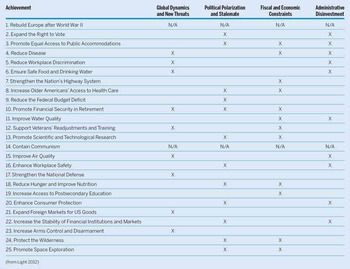
Time has already worked its will on my list of government’s greatest achievements and disappointments. As suggested in table 1, all but two of the federal government’s top 25 achievements in 1999 were under increasing bureaucratic, political, and/or financial pressure 16 years later. Both the rebuilding of Europe after World War II and the war on communism were finished but all of the other 23 achievements were in trouble to a certain degree. The budget surpluses of the late 1990s were gone; voting rights were under fire; the financial markets were still reeling from 2008; the space program was mostly adrift; efforts to help veterans were clouded by budget cuts and the waiting-list scandal; the Consumer Protection Safety Commission was still underfunded and overworked; the nation’s highways, railways, and bridges were still rusting; childhood poverty was still high; the working poor were still struggling; and both Social Security and Medicare were becoming “cash negative” as wage growth sagged and retirements began to surge.

There are bright spots on the list, however. Health care access for older Americans gained ground with prescription-drug coverage; health care access for uninsured Americans soared with the Affordable Care Act; efforts to reduce disease should be increasingly successful through new vaccines, designer treatments, and preventive care; the air and water undoubtedly are cleaner but showing the effects of climate change; childhood-obesity rates appear to be falling and nutrition is improving; and presidential candidates now are discussing access to education and student-debt loads. Perhaps it is time to ask my respondents for another round of ratings?
Government’s Most Visible Breakdowns
My interest in describing government achievements eventually led to a study of government breakdowns. Even as my list of government’s greatest achievements began to decay, my list of its most visible breakdowns began to grow. I wrote my dissertation on the president’s policy agenda and still consider myself an expert on the policy-making process, but was nonetheless drawn into what Paul A. Volcker’s 1988 National Commission on the Public Service called the “quiet crisis” in public service. I returned to the state of the public service when Volcker’s newly created Alliance for Effective Governance asked me to reexamine the quiet crisis two years ago. Simply asked, was he correct when he warned that a quiet crisis was coming, and what had happened to drive it forward?
Despite the federal government’s grand success in turning bold endeavors into achievements, I concluded that the crisis was no longer quiet. It was deafening. Succinctly, Volcker’s warning had materialized. The federal government had become ever more vulnerable to breakdowns. Although my conclusion is solely mine, it demonstrates what I believe to be a shocking acceleration in the federal government’s production of highly visible mistakes, miscalculations, and maladministration. There are many examples of highly performing federal departments and agencies; however, the aging bureaucracy can no longer guarantee faithful execution of all of the laws, and it has become increasingly unpredictable in where and how it will err.
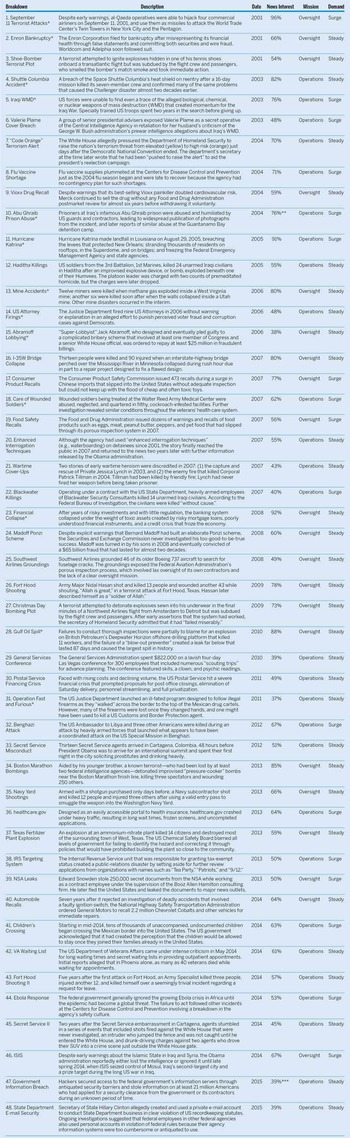
Few will be surprised by the list of 48 breakdowns presented in table 2. Almost a quarter of them eventually became the focus of a historically significant congressional or presidential investigation. Moreover, all of them were in the news long enough to create national controversy and to stoke public interest. Although I was surprised to find so much public interest in the pet-food recall, postal-service crisis, Benghazi attack, and true story of Corporal Pat Tillman’s death by friendly fire in Afghanistan, all of the events discussed in this essay generated sufficient public attention to merit further review.
Post-2001 Breakdowns

* These breakdowns produced one of the 100 most significant congressional and/or presidential investigations since World War II. For the full list, see Paul C. Light, Reference Light2014, Government by Investigation: Congress, Presidents, and the Search for Answers, 1945–2012 (Brookings/Governance). The failed search for WMD and the Abu Ghraib prison abuse were both part of the long-running congressional and presidential investigation of Iraq War conduct, and they are included here as separate investigations.
** This figure comes from the Pew Research Center’s May 12, 2004, survey showing that 87% of respondents were paying very or fairly close attention to the situation in Iraq, which followed Pew’s May 9, 2004, survey showing that 92 had heard of reports of mistreatment of Iraqi prisoners by US troops, and 76% had seen photographs from the incident. The proximity of the surveys strongly suggests that respondent interest in the situation in Iraq was heavily influenced by the Abu Ghraib story. Therefore, I listed the incident in combination with allegations of prisoner abuse at the Guantanamo Bay detention camp in 2005.
*** This figure comes from the Pew Research Center’s August 15, 2014, survey showing that 55% of Americans were not too or not at all confident that government would keep any of their computer records secure and private. It is supported by the Monmouth University Polling Institute’s June 22, 2013, survey showing that 39% of Americans had read or heard a lot about the cyberattack on government computers last spring, 44% had read or heard a little, and 18% had not read or heard anything.
My list of government breakdowns resulted from a search of news stories listed in the Pew Research Center’s “News Interest Index” (1986–2015). The nonpartisan index originally was launched in mid-1986 to measure the percentage of Americans who were following “some stories covered by news organizations” either very closely, fairly closely, not too closely, or not at all closely.
These were not just any stories, however. They were the most visible stories based on the Pew Center’s general reading of news coverage from month to month, reflecting what its staff concluded was “in the news” at any given moment. According to my count, the Pew Center asked Americans how closely they were following more than 2,000 stories that had been in the news between 2001 and June 2015, including 250 stories about the situation in Iraq and Afghanistan; 150 about upcoming campaigns and elections; 150 about the state of the economy; 50 about the war on terrorism; and 150 about presidential speeches, decisions, travel, and behavior in recent years.
According to a further search for stories that specifically addressed a government policy and/or administrative breakdown of some type, the public paid very close or fairly close attention to stories about 48 breakdowns during the period. Although most of the stories were in the news just long enough to be included in one Pew Research Center survey, the September 11 attacks and the 2008 financial collapse were in the news long enough for 10 surveys during the period; Hurricane Katrina for seven surveys; the Abramoff lobbying scandal and the consumer-product recalls for four surveys each; the Enron bankruptcy and mistreatment of wounded soldiers for three surveys each; and the 2003 flu-vaccine shortage, failure to find weapons of mass destruction in Iraq, healthcare.gov launch, and safety defects in automobiles made by General Motors and Toyota for two surveys each.
The remaining breakdowns were in the news long enough for only one Pew survey, but even a week or two of stories about events such as the Shuttle Columbia accident and the Minnesota I-35W bridge collapse generated very high news interest. Moreover, breakdowns in operating programs (e.g., veterans’ health care) are just as likely to produce headlines as those in oversight programs (e.g., banking regulation). Furthermore, breakdowns under steady pressure are just as likely to produce headlines as those during surges in demand.
EXPLORING THE LIST
Facing time constraints in their surveys, the Pew research team never asked about breakdowns that I might have included. In turn, I omitted breakdowns from my list that other experts might have included—not the least of which were the approximately 30 stories about federal budget fights, stalemates, and shutdowns. Although these issues may have contributed to my list and are recorded as plausible causes, they did not originate in the bureaucracy and cannot be described as a bureaucratic failure per se.
Similarly, I did not include the sequence of events leading directly to the Clinton impeachment. I do not believe that there was any law or regulation that could have prevented the president’s misconduct, and I cannot hold the federal government culpable either in whole or in part for his actions. Neither can I do so regarding the President and the First Lady’s alleged misconduct regarding the White House Travel Office firings (i.e., TravelGate) or requests for confidential Federal Bureau of Investigation files on former Reagan and George H. W. Bush administration employees (i.e., FileGate).
However, a government failure could make my list only by meeting two conditions: (1) the breakdown had to be in the news according to the Pew index, and (2) the underlying event had to be directly related to a government failure. Although every breakdown on my list involved some type of poorly designed policy, each one also involved a broad mix of other issues, including resource shortages, bloated hierarchies, miscommunication, bad decisions, organizational confusion, ethical misconduct, and failure to track potential problems. Policy was always a probable cause of breakdown but was never the sole cause.
Although every breakdown on my list involved some type of poorly designed policy, each one also involved a broad mix of other issues, including resource shortages, bloated hierarchies, miscommunication, bad decisions, organizational confusion, ethical misconduct, and failure to track potential problems.
An Initial Reconnaissance
Despite the odds of replicating my list using the same data, the 48 breakdowns share four characteristics. First, most involved errors of omission, not commission. The federal government did not hijack the aircraft that killed so many Americans on September 11, 2001, but it did not imagine the possibility in time to prevent the tragedy. The government did not breach the levees when Hurricane Katrina came ashore in 2005, but it did not have the leadership or plans in place to respond quickly. The government did not design the Byzantine instruments that triggered the banking collapse in 2008, but it had little capacity to eliminate the risk.
Second, some breakdowns stayed in the news longer than others. The failure to “connect the dots” prior to the September 11 attacks, prepare for and respond quickly to Hurricane Katrina, anticipate and prevent the 2008 financial collapse, and prevent the regulatory violations that led to the Gulf oil spill generated much higher visibility than the one-off stories of the Plame cover breach, the Haditha and Blackwater killings, the Vioxx drug recall, and Operation Fast and Furious—all of which were featured in only one or two Pew surveys.
Sustained visibility often generated multiple and nearly simultaneous blue-ribbon investigations. Although September 11 and the Columbia accident each produced only one blue-ribbon commission and inconsistent congressional hearings, the Gulf oil spill generated seven deeper reviews, including four in the House, two in the Senate, and one presidential commission co-chaired by former Senator Bob Graham (D-Florida) and former Environmental Protection Agency chief William Reilly. Despite the resulting inventory of hearings and final reports, I relied more heavily on newspapers including the New York Times and Washington Post for insights on cause and effect; the longer a story survived, the more likely a substantive piece would follow.
Third, the Pew index listed few successes against which to compare the 48 breakdowns, which is essential for confident conclusions about probable cause and consequence in each instance. Indeed, I counted only 10 successes on Pew’s post-2001 list of stories in the news, including three about early successes in Iraq and Afghanistan; three about the killings of Saddam Hussein, his sons, and Osama bin Laden; two about successful Mars landings; and one each about the capture of a senior al-Qaeda leader in 2003 and the National Highway Traffic Safety Administration’s relatively rapid investigation of the Toyota floor mat problem in 2007.
Fourth, some of the breakdowns contained elements of both success and failure. The FBI succeeded in identifying one of the Boston Marathon bombers as a potential terrorist, but never followed up on its lead nor informed the Boston police of the threat. “It’s people like this that you don’t want to let out of your sight, and this was a mistake,” Senator Lindsey Graham (R-South Carolina) said of the bombers almost a year later. “I don’t know if our laws were inefficient or if the FBI failed, but we’re at war with radical Islamists, and we need to up our game” (Schmitt and Schmidt Reference Schmitt and Schmidt2013).
Patterns in the Breakdowns
As discussed previously, the 48 breakdowns comprise a small subset of the 2,000 stories that the Pew Research Center has investigated over time. However, these 48 stories produced some of the highest public interest in contemporary history; the Shuttle Challenger accident, September 11, and Hurricane Katrina are still the most closely followed stories since 1986. Relative to the need for reform, my answers to the following six questions suggest that the cascade will continue and almost certainly accelerate without comprehensive reform to improve both vision and administration:
-
1. Has the number of government breakdowns increased over time? The answer is “yes” and significantly so. A review of news-interest surveys since mid-1986 reveals that the government had 23 breakdowns in the almost 14 years before January 2001 (1.6 per year) compared with 48 breakdowns in the 14 years since then (3.3 per year). Government breakdowns were relatively rare during the first decade of the 30-year period but began to increase during the second decade and accelerated during the third. At the current rate, government will set a contemporary record in the number of post-2001 breakdowns under President Obama. Government is currently running at 3.5 breakdowns per year, which means that the president will exceed the record before his successor is elected.
-
2. Did the number of breakdowns vary across the five administrations? As expected from the pre- and post-2001 comparisons, the answer again is “yes.” The federal government had four breakdowns during the final months of Reagan’s second term (1.6 per year), five during George H. W. Bush’s first and only term (1.2 per year), 14 during Clinton’s two terms (1.8 per year), 25 during George W. Bush’s two terms (3.1 per year), and 23 during Obama’s first 6.5 years (3.5 per year). At this current pace, government may yet set a record in the average number of breakdowns per year before Obama leaves office in 2017.
-
3. Did the number of breakdowns vary across first and second terms? The answer is again “yes” and significantly so. Second-term presidents face a greater risk that government will produce more breakdowns. Government produced a total of 29 breakdowns during the first terms of George H. W. Bush, Clinton, George W. Bush, and Obama (1.8 per year), compared with 42 during the second terms of Reagan, Clinton, George W. Bush, and Obama (2.9 per year). The differences are significant enough to suggest that government may be somewhat more likely to fail during the last few years of a two-term presidency. This is perhaps because presidents begin to lose focus, appointees begin to look for post-administration jobs, the opposition party becomes more likely to undermine government performance in advance of an open election, and the media looks more diligently for bureaucratic mistakes. All of these explanations make sense, but my view is that the lack of presidential attention and appointee turnover are the most important context setters.
-
4. Did the number of breakdowns vary across a government agency’s primary mission? The answer is “only slightly.” By my definition, oversight agencies focus mostly on monitoring and enforcement of regulations on regulated entities such as banks, drillers, campaign funders, drug makers, federal employees, and presidential appointees. The term operations focuses on providing day-to-day goods, services, and even protection to government beneficiaries, including veterans, taxpayers, uninsured people, and unaccompanied children who have crossed into the United States from Latin America. Based on subjective distinction, the post-2001 government breakdowns were more likely to involve operations (27) rather than oversight (21). To summarize, Congress and the president may have increased the odds of bureaucratic breakdowns by underinvesting in government’s administrative capacity regardless of the task.
-
5. Did more breakdowns occur during surges in demand? The answer is “no.” Government organizations were more likely to break down during steady demand (31) than during surges (17), which perhaps confirms the notion that surges sharpen organizational attention to risk. Steady demand, however, does not mean lighter workloads; it means only that government is not under siege at a particular point in time. Some of the agencies on my list were under enormous stress for years before they failed during steady-demand conditions, whereas others were under relatively light pressure for years before they failed during a surge.
-
6. Did more complex breakdowns produce greater public news interest? The answer is “yes.” The eight breakdowns that crossed the 81% threshold in public interest averaged almost 11 checkmarks in my analysis of probable causes, whereas the seven breakdowns that fell into the 71% to 80% range, the nine in the 61% to 70% range, and the 10 in the 51% to 60% range all averaged seven checkmarks. The eight breakdowns in the 41% to 50% range averaged slightly more than six checkmarks, and the six breakdowns in the 30% to 40% range averaged only five checkmarks. Either a more complicated breakdown generates higher public interest or higher public interest produces the type of sustained investigations that reveal more complex causes. Given my reading of the record, I believe the former explanation holds true.
The cascade of breakdowns described in the next section undoubtedly is rooted in broad demographic, economic, and social trends that have put greater pressure on the federal government to solve increasingly difficult, even unpredictable problems with an aging bureaucracy that underwent its last major overhaul in the early 1950s. The federal government’s vision appears unsteady as the world changes, and its action often is impeded by what the Founders called the “deadly adversaries” of government: cabal, intrigue, and corruption. Surveying the inventory of recent government breakdowns, Max Weber might even decide that bureaucracy is no longer the “optimum” form of organization for precision, speed, and clarity but rather the most vulnerable to break down, especially in the federal government.
The federal government’s vision appears unsteady as the world changes, and its action often is impeded by what the Founders called the “deadly adversaries” of government: cabal, intrigue, and corruption.
EXPLORING PLAUSIBLE CAUSE
The central question for this essay is why breakdowns occur. Without some sense about what causes what, reformers can only guess what might break the cascade. The result of this speculation likely will be minor improvement at best and wasted motion at worst. The key to successful reform is an indictment based on probable cause. However, the search for probable cause must begin with a set of plausible explanations.
Searching for Plausibility
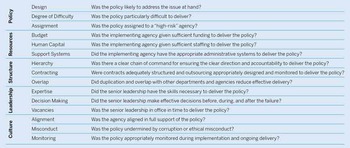
Breakdowns occur for many reasons, not the least of which is that some programs are so complex that the odds for mistakes are high, whereas others are so poorly funded that success is beyond reach. However, risk and funding are only two among many plausible causes. Table 3 suggests at least five categories of plausible cause, with at least three secondary causes within them. The 15 plausible causes include a combination of poor vision and/or weak administration.
Plausible Causes of Breakdown

Policy anchors the first category of plausible cause. Congress and the president can easily set a future breakdown in motion by adopting meek solutions to major problems; rescinding or diluting policies that could have prevented a future breakdown; creating so much ambiguity that implementation cannot proceed; or even delegating action to a high-risk, vulnerable agency. Policies do not have to be perfect to be implemented, and Congress often gives agencies significant authority to “smooth the edges” of ambiguous statutes. Nevertheless, some policies are simply “unimplementable” under even the best of circumstances.
Resources—or, more accurately, the lack thereof—create a second category of plausible cause. Congress and the president can lay the foundation for a future breakdown long before its adoption by denying the budget needed to cover program costs and the staffing needed to draft even relatively simple regulations; by failing to conduct effective oversight or to oversee essential contracts; and by not providing the administrative systems needed to track impacts, secure enrollment, and provide full transparency for every dollar spent. At some point, government simply runs out of miracles and reverts to the form created by deliberate starvation.
Organizational structure frames a third category of plausible clause. Congress and the president can undermine effective implementation by adding new layers of management to a federal hierarchy already filled with record numbers of management layers and title seekers, who slow the flow of information up the chain of command, sidetrack warnings of developing breakdowns as they move toward the top of the towering agency, slow guidance as it moves down, and deny accountability for sluggish implementation. In turn, these often-hidden blockades can create an overdependence on a faster but less accountable phalanx of contractors, produce distracting conflicts as agencies protect the duplication and overlap that undermines cooperation, and generate needless meddling and cross-checks that undermine effective implementation and waste scarce resources.
Leadership comprises a fourth category of plausible cause. Simply put, leaders can and do create breakdowns through neglect, inexperience, and bad decisions. Some leaders enter office with little expertise in the subject matter at hand and negligible experience in making tough decisions during a crisis. Moreover, even the most talented implementers cannot make good decisions if they are not in office; arrive exhausted by a selection process that is best characterized as “nasty, brutish, and not at all short”; and must start their 12- to 24-month stay by learning their agency’s politics and the structure needed to halt a developing breakdown.
Organizational culture creates the fifth category of plausible cause. Although culture is as difficult to define as it is to measure, organizations do adopt norms and tolerate behaviors that can easily lead to breakdowns. Some implementing agencies cannot agree on their mission—if only because they have more than one mission to implement. Other agencies have long histories of entertaining “cabals of intrigue,” creating their own standards of conduct, and ignoring obvious deceit. These cultures of evasion have long been a source of breakdowns and embarrassment, and they prove the point that cultures of excellence and innovation are easy to destroy with a single incident whereas they are exceedingly difficult to create.
EXPLORING PROBABLE CAUSE
As the following analysis shows, the five categories of plausible cause often come together to generate tragic breakdowns. In doing so, they move from plausible causes to probable indictment. The only way to distinguish one from the other is to follow the investigatory trail wherever it might lead—even all the way to a disengaged president, a disaffected congressional committee, or an uninformed judiciary.
I followed the 48 trails discussed in this essay through congressional hearings, investigatory reports and hearings, in-depth news stories, government’s own reviews, think-tank analyses, occasional interviews with key participants, and final judgments of the 13 blue-ribbon commissions that Congress or the president created to resolve doubts about what happened and to pinpoint opportunities for future prevention. These investigations involved difficult judgments about possible causes but were informed by the many indictments that were made before my tracking began—some of which led to firings and at least one that resulted in a prison sentence.
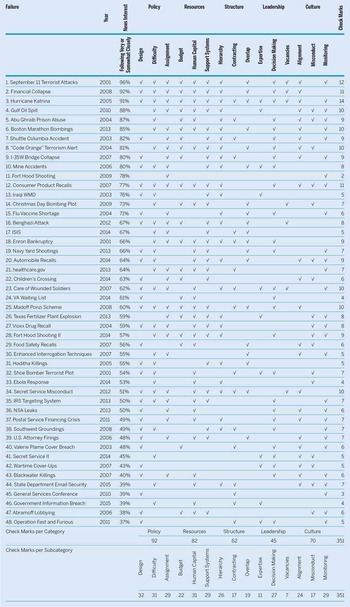
I reviewed these records many times as I added and deleted the checkmarks in table 4. Conservative as I might have been, however, I assigned 351 checkmarks across 48 breakdowns for an average of slightly more than seven per breakdown. As shown in table 4, some earned more checkmarks than others. However, the overall indictment of government’s ability to link vision and action provides an uncomfortable warning to those who favor smaller-scale reforms: there are multiple contributors to every breakdown and multiple breakdowns for every contributor and, therefore, multiple reforms that must be combined to create comprehensive reform.
Probable Causes of Breakdown

Table 4 also offers rather uncomfortable advice for those who labor on behalf of alluring reforms including more accurate performance measurement, new computer systems, more aggressive discipline, tougher hiring and pay freezes, and aggressive attacks on duplication and overlap: the time for these types of one-shot reforms is long past. There simply are too many causes and too little evidence of a domino effect to identify a single target for halting or even slowing the cascade.
Hence, I believe that the only way to address the breakdowns is through comprehensive, collaborative, and coordinated reform, which too many good-government groups eschew. As the 48 breakdowns involved many probable causes, so government reform also must address many probable causes. If a government divided cannot stand, an implementation system divided cannot end the daydreaming.
The following category-by-category ranking of probable cause provides an initial brief for comprehensive reform, and the short case studies provide examples of how the probable causes interacted in many breakdowns:
-
1. Policy was the largest contributor to the 48 government breakdowns with 92 checkmarks, including 32 for poor design, 31 for a high degree of implementation difficulty, and 29 for delegation to a damaged or vulnerable agency.
The 2013 healthcare.gov collapse illustrates the role of complex policies and weak administrative systems in breakdowns. The highly visible event earned seven checkmarks based largely on the high degree of difficulty associated with the website’s promised launch, the lack of expert oversight, and an overdependence on outdated technology. The policy also was burdened by an almost impossible deadline that required nearly flawless delivery from a poorly coordinated collection of 55 contractors overseen by an inexperienced federal-program unit.
The website launch also depended on strong support from a Republican House that won a midterm majority in 2010 by promising to repeal the health care law. In short, the website was almost destined to fail, entailing battle after battle to secure full implementation. It was built on complex policy that could have been simpler, created a high degree of difficulty, and was delegated to an agency that had been waiting for a Senate-confirmed administrator for almost seven years. It is not surprising that the website may have constituted a breakdown in progress from its inception.
-
2. Resources were the second-largest contributor to the breakdowns with 82 checkmarks, including 22 for underfunding shortages, 31 for understaffing, and 29 for weak administrative systems.
The Consumer Product Safety Commission’s 2007 “Year of the Recall” demonstrates the impact of underfunding and weak authority in a breakdown. Although the Commission’s 450 separate recalls of dangerous products might constitute a miracle—given its woeful understaffing—those recalls came after most of the cribs, building sets, toy ovens, dolls, and other dangerous products already had caused injuries and deaths. The Commission’s failure to react quickly to the surge in dangerous products was based on the lack of authority and staff to inspect products before they left for the market, especially those made in other nations including China. The breakdown also involved a hint of corruption in that Commission staffers took multiple foreign trips that were sponsored and underwritten by trade associations and product manufacturers seeking quick movement to the market.
-
3. Organizational culture was the third-largest contributor with 70 checkmarks, including 24 for misaligned missions, 17 for ethics and misconduct, and 29 for a lack of effective implementation monitoring.
The Department of Homeland Security’s 2004 decision to raise the nation’s terrorism alert system confirms the role of organizational culture and ethical misconduct in a breakdown. The color-coded system, rushed into operation within months in the wake of September 11, was implemented by a confused department built from 22 agencies in a bidding war between a Republican White House and Senate Democrats; it was eventually abandoned as a failure in 2011. Given the lack of clear guidelines for raising or lowering the alert level, the system also was highly vulnerable to political interference, which the White House exploited in 2004 when it pressured the department to raise the warning from “elevated” (yellow) to “high” (orange) only days after a highly successful Democratic National Convention. The former secretary of the Department of Homeland Security, Tom Ridge, acknowledged that pressure in his 2009 autobiography, which described White House concerns about political fallout from a new al-Qaeda tape recording. Ridge wrote that he knew immediately that he must leave government to save his reputation.
-
4. Structure was the fourth-largest contributor to the breakdowns with 62 checkmarks, including 26 for organizational thickening, 17 for overdependence on contracting, and 19 for duplication and overlap.
Structure may not have been associated with the largest number of breakdowns, but it was a probable cause of several of the most visible breakdowns. Although the September 11 attacks earned 12 checkmarks for a long list of probable causes, they underscore the impact of unwieldy bureaucratic structure in a breakdown. According to the National Commission on Terrorist Attacks upon the United States (2004), chaired by former Pennsylvania Governor Tom Ridge and former Representative Lee Hamilton, the September 11 attacks reflected failures in imagination, policy, capabilities, and management.
However, based on my reading of the September 11 Commission’s report, the breakdown was caused largely by the intelligence community’s unwieldy structure and was abetted by the lack of clear policy to address the terrorist threat; the lack of funding, staff, and administrative systems; and the intelligence hoarding across intelligence agencies. The Commission’s sweeping summary of what it learned about the multiple contributors to the breakdown is as follows:
We learned that the institutions charged with protecting our borders, civil aviation, and national security did not understand how grave this threat could be, and did not adjust their policies, plans, and practices to deter or defeat it. We learned of fault lines within our government—between foreign and domestic intelligence, and between and within agencies. We learned of the pervasive problems of managing and sharing information across a large and unwieldy government that had been built in a different era to confront different dangers (xvi).
-
5. Leadership was at the bottom of the list of contributors to breakdowns with 45 checkmarks, including 11 for weak leadership, 27 for poor decisions, and only seven for vacancies and delays in filling essential positions.
The government’s sluggish response to Hurricane Katrina illustrates the combined effects of multiple failures in a single breakdown. The breakdown earned 14 checkmarks due to unqualified leadership, confusing policy, bureaucratic vulnerability caused by the Department of Homeland Security merger, poor decisions, underfunding, and incompetence in the critical hours following the disastrous event. According to my reading of the House, Senate, and presidential investigations, the poor response also was driven by the lack of a fully developed national disaster-response plan; vacancies throughout the agency; and unrelenting confusion about who was responsible for what across federal, state, and local agencies.
COMBINING VISION WITH ACTION
Much as Congress and the president might want the one best way to prevent future breakdowns, I did not find it. I could argue easily, for example, that policy design almost always precedes breakdowns—if only because the textbooks say so. However, the fact is that policy design often follows other breakdowns as the Congress and the president try to prevent future problems that involve resources, structure, leadership, and culture. The only way to reduce the potential for breakdowns is to reform government as a whole. The time for tinkering on individual causes has long since passed.
Ultimately, I believe the only way to prevent future breakdowns is to integrate policy design (vision) and implementation (action) at the onset of the policy-making process. If daydreams are built on vision without action, then what good is even the most elegant vision? Moreover, if action moves forward without vision, what purpose does it serve? Yet, vision and action rarely meet before the vision is cast. Action is assumed and only rarely considered.
This tendency to separate vision and action is easy to identify in the federal policy-making process in which legislation is drafted, edited, enacted, and signed into law with little or no testimony about implementation. The Congressional Budget Office and General Accounting Office rarely communicate about their respective expertise in policy design and implementation; the government’s experts in policy and planning rarely talk to their colleagues in budget and management; and the “M” in the Office of Management and Budget rarely talks to the “B,” nor does the “M” have significant staff left to do the talking. The vast array of policy advocates rarely communicates with the small circle of good-government reformers. Policy design and administration continue to appear blissfully isolated from one another.
Based on my speculative analysis, this dichotomy also appears to divide some of the nation’s top graduate schools ranked by US News & World Report (Flanigan and Morse Reference Flanigan and Morse2013). Some of the top schools tend to emphasize public policy, while others specialize in public administration, and still others try to blend the two.
Although all three types of schools offer crossover courses in public policy and public administration, each lean more toward one or the other specialization. First, as suggested in table 5, the nation’s top public-policy schools tend to require their students to take almost twice as many economics and policy-analysis courses as the public-administration schools, whereas the public-administration schools require their students to take almost twice as many public-administration courses as the public-policy schools. In turn, the comprehensive schools require their students to take approximately equal numbers of public-policy analysis and public-administration courses, which confirms their designation as comprehensive.
Defining the Core Curriculum

* The list of core courses can be found on each school’s website and were sorted as follows:
-
1. Economics and policy-analysis courses included titles such as economics for policy analysis, managerial economics, policy analysis, policy design, and all other classes related to economic analysis and the process of determining and designing preferred public-policy options.
-
2. Public administration/business administration courses included titles such as human-resource management, organizational behavior, leadership, ethics, implementation theory, operations management, and others related to managing organizations and implementing policy initiatives.
-
3. Finance and budgeting courses included titles such as financial accounting, budgeting for organizations, and all others related to managing the finances and budgets of organizations and firms.
-
4. Research and methods courses included titles such as statistics, program evaluation, and performance measurement and management.
There actually were 22 schools in this analysis because two of the public-administration schools were tied for the seventh spot in their categories. The top public-policy schools ranked as such in the 2013 US News & World Report were Carnegie Mellon, Duke, Georgetown, Princeton, Chicago, and Michigan. The top public-administration schools were American, George Washington, Ohio State, Rutgers, the State University of New York at Albany, Arizona, Georgia, and Kansas (George Washington was not ranked in 2013 due to paperwork problems but was in the top seven in 2011). The comprehensive schools were Harvard, Indiana, New York, Texas-Austin, Washington, and Wisconsin. This analysis focuses on the primary focus of each school—that is, public-policy schools teach some public administration and vice versa. However, the primary focus of each school can be determined in part by its name, in part by its stated emphasis in its catalog and advertising material, and in part by its core curriculum.
Second, as suggested in table 6, 40% of public-policy faculties have doctorates in economics, compared with only 9% of public-administration faculties. In turn, only 1% of public-policy faculties have doctorates in public administration, compared with 36% of public-administration faculties.
Comparing the Disciplines

*The primary discipline was determined by reading the faculty biographies on each school’s website, with special emphasis on the core discipline of faculty members’ PhD, their teaching interests and courses, and a sampling of their publications.
All three types of schools have approximately equal numbers of political scientists, sociologists, anthropologists, historians, lawyers, scientists, physicians, and so forth, but the blended schools are almost as heavily anchored in economics as their public-policy peers. As the curriculum analysis shows, the public-policy and blended schools are concerned about implementation and management. However, these courses are more likely to be taught either from an economist’s perspective or by a clinical professor with no chance of tenure. This does not mean that the instruction is biased or the subject is disparaged; however, the faculty distribution suggests that many of the nation’s top programs tend to produce more policy designers than implementers. Indeed, several of the top public policy and blended schools have not tenured a public-administration faculty member for almost two decades. The prestige—not to mention tenure—seems to rest with policy design rather than implementation.
As a result, we might suggest that a public-policy school is the place to learn vision making, a public-administration school is the place to learn action, and a comprehensive school may encompass both. However, the workload for full engagement in vision and action would be heavy and nevertheless might well lead students to specialize in one or the other. Moreover, the faculties at comprehensive schools seem to lean more toward classes on vision rather than action.
BREAKDOWNS BY DESIGN
Not all of the 48 breakdowns on my list were accidents. To the contrary, some were the predictable consequence of decisions made by Congress and the president in the messy processes of creating, amending, and repealing policy. Some of the breakdowns also were carefully designed through backdoor budget cuts, hiring freezes, sequesters, duplication and overlap, and a host of administrative ills that were and still are well known to Congress and the president but have yet to garner careful attention.
The blame for inaction falls on congressional Republicans and the President alike. The Republicans have done everything in their power to undermine performance. They have never met a freeze or cut they could not embrace, they have repeatedly stonewalled needed policy changes, and they have made implementation of new programs as difficult as possible. The Republicans have cut budgets, staffs, and collateral capacity to a minimum, proving the adage that the logical extension of doing more with less is doing everything with nothing. They have used the presidential-appointments process to decapitate key agencies and have appointed more than their share of unqualified executives. Furthermore, they have muddied mission, tolerated unethical conduct, and gamed the performance-measure process to guarantee failing scores for a host of government policies that they oppose but cannot repeal through constitutional means. The repeal is de facto, not de jure—by practice, or the lack thereof, and not by law, or the lack thereof as well. Republicans may delight in the “perp walks” of disgraced presidential appointees caught in their investigatory crosshairs, but they have done little to address the problems.
Notwithstanding this two-decade Republican assault, I suspect that the Founders would hold their harshest criticism for Presidents George W. Bush and Barack Obama. After all, the president, not Congress, has the constitutional responsibility to “take care that the laws be faithfully executed.” The Founders might applaud President Obama’s 2011 promise to give Americans a “more competent and more efficient government,” (Obama Reference Obama2011). but they also might ask why he never followed up on his promise. Obama was justified in complaining that Congress would not give him the reorganization authority that past presidents used for comprehensive reform, but he could have moved in other ways, like many of his predecessors did. Would it have been difficult? Absolutely. Did he even try? Not too hard. Ironically, reform was well within reach—if only because comprehensive action could have produced $1 trillion or more in savings, which then could have been used for the budget battles.
Obama, like his predecessors, could have easily won reform through the ordinary legislative process. Even though Carter had reorganization authority, he chose the legislative option for the 1978 Civil Service Reform Act and the 1979 Regulatory Flexibility Act; George H. W. Bush used it for the 1989 Whistleblower Protection Act and the 1990 Pay Comparability Act; and Clinton used it to generate agreement on the 1993 Government and Results Act and his 1994 reinventing-government package. Committed presidents and congressional leaders can always find a path to reform, but they have to want implementation badly enough to try.
Congressional Democrats also contributed to the breakdowns, inventing many of the disinvestment tactics that the Republicans used after they retook the House majority in 1995. However, the Democratic contribution to the cascade of breakdowns was more one of omission, whereas the Republican contribution was one of deliberate commission. Although Democrats conducted more serious investigations of the 2008 financial catastrophe and the Gulf oil spill than Republicans might have, they refused to put comprehensive government reform on the agenda or to push Obama toward more aggressive action to prevent his second-term breakdowns.
Thus, with Obama quietly “seething” about the latest breakdown but doing little to prevent more in the future, congressional Republicans started to repeal the easy way—by cutting administrative funding, blocking needed appointments, freezing the hiring process, increasing the degree of difficulty in implementation, and heightening the very duplication and overlap they decried on the campaign trail. As for the treasured source of previous reform legislation, the new Republican majority allowed the once-proud House Government Operations Committee to fall into disrepute as a playground for frivolous investigations and bureaucratic harassment.
STOPPING THE CASCADE
Not only is the political dysfunction underpinning the cascade of breakdowns “worse than it looks,” as my colleagues Thomas E. Mann and Norman J. Ornstein (Reference Mann and Ornstein2013) have argued, it also is more destructive to the faithful execution of the laws than imagined. Moreover, the threat to future government performance is doomed to accelerate if the bitter polarization between the two parties continues.
Moreover, the threat to future government performance is doomed to accelerate if the bitter polarization between the two parties continues.
Applying the Brakes
The question is whether Congress and the president can do anything to prevent future breakdowns, including the one that is almost certain to occur within the first six months of the next presidency. I believe the answer is “yes”—but only if the nation’s leaders put vision and action on the agenda throughout the policy-making process.
They could start by simply adding an implementation assessment to every proposal headed toward the House or Senate floor for final approval and to every rule about to be forwarded to the Federal Register for notice and comment. The president and Congress could easily order their support agencies (e.g., Government Accountability Office, Congressional Budget Office, and Office of Management and Budget) to begin asking implementation questions at the beginning of the process and to provide final ratings for every policy headed toward final passage.
Congress also would be well within its authority to order the federal Inspectors General to prepare implementation ratings for major legislation. After all, these quasi-independent officers not only have full statutory-access freedom to any and all information; they also have full authority to assess obstacles to the economy and efficiency of government, including the prevention of any threats to performance.
Congress and the president also could order their support agencies, committees, and appropriators to develop estimates that might be used to create “set-asides” to cover implementation costs such as bridge funding, additional staff, and new technologies to ensure immediate action. They even could use these reviews to set reasonable “make-or-break” points for each implementation process, which would create timely opportunities to set new implementation targets, increase set-asides, and offer privileged “perfecting amendments” to adjust policy to reduce vulnerability.
These are only small steps in forcing a long-needed integration of vision and action. Congress and the president will need to think comprehensively about addressing the probable causes reviewed in this report, but they are fully capable of collecting the information necessary to do so. Most know that government desperately needs an overhaul. Every president since Franklin Roosevelt has taken the oath of office promising to create a government as good as the people, but few have delivered.
The next president is likely to follow tradition, with one important difference. The next breakdown is likely to occur within months, even weeks, of Inauguration Day. The new president can either get ahead of the breakdown by presenting a detailed reform agenda during the campaign and launching the overhaul in his or her first State of the Union Address, or wait for a wave of regret when the next breakdown occurs. I have no doubt that a breakdown will happen in 2017; the only question is how early. My data suggest that it will arrive before June 30.
Back to the Future with Paul A. Volcker
As the cascade continues and the failed implementation grades pour in one after another, Congress and the president will have little choice but to confront the threats addressed previously. Fortunately, they can find a ready-made reform agenda in the final report of the 1989 National Commission on the Public Service. Led by Paul A. Volcker, the Commission’s agenda is not only still relevant but also could be copied verbatim. This would include another one-time pay increase for judges and senior career executives designed to close the pay gap with the private sector—and even tighter ethics reform that would relax the burdensome paperwork imposed on federal employees—by eliminating the loopholes that riddle the current law and that created many of the breakdowns inventoried in table 2.
Dated though it may seem at first glance, the Commission’s warning of a coming crisis in government performance was sadly accurate, and the Commission’s argument that the need for a strong public service was growing, not lessening, is even more prescient. The federal agenda has grown exponentially in the 26 years since Volcker and the Commission presented the report to George W. Bush in the White House Cabinet Room, and the need for imagination and energy has never been greater. As the report notes on the second page, “the simple idea that Americans must draw upon talented Americans to serve us in government is uncontestable.” So also is the need for careful policy making, adequate resources, inspired leadership, and zero tolerance for misconduct and confusion.
Fortunately, through his Volcker Alliance, Volcker is still available and willing to lead the effort. Furthermore, many of his board members and supporters are ready to help Congress and the president update the 1989 recommendations to halt the current cascade and bring the federal government into the twenty-first century. Even in 1989, Volcker’s Commission knew that the federal government was losing its capacity to turn endeavor into achievement and marry vision to action. However, the Commission is undoubtedly shocked by the continued diminishment of government’s ability to faithfully execute the law.
Perhaps ironically, Volcker led a second National Commission on the Public Service in 2003. Unlike the 1989 report, the 2003 report never found its way to George W. Bush; it was presented to the White House in a dusty fourth-floor cubicle occupied by a talented but undersupported senior budget officer. No one knows what happened to this second report, but I suspect it was engulfed in the maelstrom of what would become the longest wars in US history.
The reform agenda does not lack for good ideas—indeed, we might argue that the problem today is not too few proposals but rather too many that are too meek. Both of the Volcker Commission reports contained comprehensive proposals for repairing the federal bureaucracy; thinning its needless layers; attacking its excessive duplication and overlap; and combining policy and implementation in the nation’s leading schools of public policy and administration, its legislative committees, and the Oval Office. Volcker (Forbes Reference Forbes2015) is well worth quoting as the final word of this analysis, for he captures the essence of repairing the schism between vision and action, as follows:
We depend on government in so many ways, often unseen and unrealized. But one can’t help but conclude upon seeing our institutions at work—or, more accurately, not working to their fullest potential—that we need to make some fixes. These institutions, from the UN and the World Bank, to our federal, state, and local governments for that matter—are tools that can improve peoples’ lives. We need them to run well. We have seen what happens when insufficient attention is given to understanding and mastering the basics of execution—the botched launch of healthcare.gov, the gaming of the veterans’ medical scheduling system, and, of course, the failure of the financial regulatory system to prevent unacceptable levels of private-sector risk-taking at the expense of the stability of the economy.
The issue for me is not whether the government is too big or too small. Neither is it the objective of particular social programs such as the urgency of environmental concerns, the size of the military, and the proper scope of the National Security Agency (NSA). They truly are policy issues to be resolved by political processes and public debate. Regardless, however those choices are being made, we must respect Thomas Edison’s warning: “Vision without execution is hallucination.” This means that government should run well; it should implement policies effectively and deliver them efficiently; and it should earn and redeem the public’s support every day—and that holds true for all of our public and international institutions.