Introduction
In the United States of America (USA), volunteers are a vital human resource for non-profit and faith-based organisations and for government agencies in providing social services and in addressing community needs. As the ‘baby-boomer generation’ ages, there will be a larger pool of potential older adult volunteers among the American population, because the size of the birth cohort exceeded its predecessors (Einolf Reference Einolf2009).Footnote 1 The total number of older volunteers will probably increase in the next decade, even if the rate of volunteering falls. While research has examined individual motivations for and the potential benefits of volunteering, little has explored how to retain older adult volunteers (Kovacs and Black Reference Kovacs and Black1999). The study reported here contributes to that knowledge base.
Previous publications using this study's first-wave data have examined the benefits of volunteering perceived by older volunteers (Morrow-Howell, Hong and Tang Reference Morrow-Howell, Hong and Tang2009) and the institutional facilitation of older Americans in volunteer engagement (Tang, Morrow-Howell and Song Reference Tang, Morrow-Howell and Hong2009a, Reference Tang, Morrow-Howell and Hong2009b). This paper employs two-wave data and an institutional perspective to evaluate the individual and programme characteristics that influence the turnover of older volunteers. Because institutions invest substantial amounts in training volunteers, understanding what factors contribute to their retention is important both economically and for service quality. This article seeks to advance knowledge about volunteer turnover among older adults by examining the effects of several factors including: socio-economic status, health status, organisations' arrangements for supporting older adult volunteers' efforts, and the reasons for ceasing to be a volunteer. The analysis includes both individual-level and programme-level factors in a multivariate model that incorporates a qualitative assessment of individuals' reasons for withdrawing from volunteering. It is anticipated that the combination of both quantitative and qualitative analysis will raise our understanding of why older adult volunteers quit.
Background
It is important for voluntary organisations to retain volunteers for extended periods because stability of service is commonly a critical attribute of their service provision (Chacon, Vecina and Davila Reference Chacon, Vecina and Davila2007). High turnover rates among volunteers create problems and have negative effects on volunteer institutions, placement sites and service recipients, as well as the volunteers themselves (Stevens Reference Stevens1991). Volunteer turnover is costly to an organisation, just as paid-employee turnover is costly, because the costs of recruitment and training can become a high proportion of all expenditure (Miller, Powell and Seltzer Reference Miller, Powell and Seltzer1990). Given the lack of a theoretical framework specifically on volunteer turnover, previous studies have adapted models of employee turnover that emphasise the importance of psychological predictors and personal circumstances (e.g. Farmer and Fedor Reference Farmer and Fedor2000; Laczo and Hanisch Reference Laczo and Hanisch2000; Miller, Powell and Seltzer Reference Miller, Powell and Seltzer1990), but volunteering differs from employment in organisational characteristics including management practices and the roles, attitudes, values and motivations of volunteers (Farmer and Fedor Reference Farmer and Fedor2000). Models of paid employee turnover are unlikely to explain volunteer turnover fully; especially of older adults who have retired from employment and no longer have paid earnings.
Since volunteers are free to leave their work and their contributions are not contingent upon monetary reward, their satisfaction with volunteering and commitment to the organisation are important determinants of their retention (Gidron Reference Gidron1984). Where lower levels of satisfaction and commitment are related to volunteers' intention to leave (Miller, Powell and Seltzer Reference Miller, Powell and Seltzer1990), adult volunteers that report higher levels of organisational support are likely to participate more in the organisations' activities than those that report low levels of support (Farmer and Fedor Reference Farmer and Fedor2000). Many factors in the work environment, such as opportunities to experience a sense of accomplishment, the validation of the volunteers' roles, and appropriate training and monitoring mechanisms, are manageable, and when delivered may well increase retention (Kovacs and Black Reference Kovacs and Black1999).
An enjoyable and worthwhile volunteer experience has been demonstrated to promote continued involvement (Wilson and Musick Reference Wilson and Musick1999). Volunteer's feelings of being useful and making a difference can raise retention, but when discrepancies exist between expectations for achievement and actual rewards, volunteers are likely to quit. In a study of 317 volunteers in health and mental health institutions, Gidron (Reference Gidron1978) found that long-term volunteers had fewer negative discrepancies between expectations and rewards than short-term volunteers, and that such discrepancies accounted for the high turnover rate among short-term volunteers. Other differences have been reported between current volunteers and those who had left by choice, with the former being better prepared for the task, more likely to consider the task interesting, challenging and well suited to their skills and knowledge, and more likely to derive a sense of achievement from the volunteer task and to interact meaningfully with their peers (Gidron Reference Gidron1984). Organisation type also makes a difference in volunteering duration, with church-related organisations generating the longest (McPherson Reference McPherson1983). Older people volunteer for longer periods than younger people (Cnaan and Cascio Reference Cnaan and Cascio1999), and highly-educated people are more likely to volunteer in the first place and to volunteer for longer (Wilson and Musick Reference Wilson and Musick1999).
Previous research, mostly based on descriptive, programmatic and prescriptive information, has identified the association between volunteer turnover and certain aspects of the volunteers' experiences (Brudney and Kellough Reference Brudney and Kellough2000). Some studies have emphasised the psychological predictors of turnover intention without paying sufficient attention to practice implications. In response, an institutional perspective has been proposed, a new theoretical framework that views volunteering behaviours and outcomes as a product of both individual and organisational factors (Sherraden et al. Reference Sherraden, Morrow-Howell, Hinterlong, Rozario, Morrow-Howell, Hinterlong and Sherraden2001). It has been asserted that factors related to volunteer experience are also important in understanding retention and withdrawals. The study reported here applies the institutional framework to examine the association of volunteer turnover with individual and organisational factors. Being a volunteer is commonly a life-long trait, while both the placement experience itself and the satisfaction it creates affect retention (Chacon, Vecina and Davila Reference Chacon, Vecina and Davila2007). Added to this is the reality that volunteering occurs through organisations, and their arrangements promote or deter volunteers' engagement. In addition, programmes vary in the roles available to older volunteers and ways in which they attract and support volunteers (Morrow-Howell, Hinterlong and Sherraden Reference Morrow-Howell, Hinterlong and Sherraden2001; Morrow-Howell et al. Reference Morrow-Howell, Hinterlong, Sherraden, Tang, Thirupathy and Nagchoudhuri2003). We therefore hypothesise that as well as individual factors, organisational variables such as incentives, role flexibility, training and on-going support influence volunteer turnover. More specifically, it was hypothesised that older volunteers disadvantaged in socio-economic status (SES) and health status would be more likely to quit volunteering than those more advantaged. In terms of volunteer experience at both individual and organisational levels, it was hypothesised that volunteers who were better trained and supported, who committed extensively to volunteering, and who were more satisfied with their volunteer experience were more likely to continue to be volunteers than those with low levels of training, support, commitment and satisfaction with their volunteer experience.
Methods
Sample and procedure
This study was a follow-up to a parent study about older adult volunteer programmes in the USA. A research team at Washington University in Saint Louis conducted the two-phase study during 2004–06 (Morrow-Howell et al. Reference Morrow-Howell, Tang, Hong, Goldberg, Kim and Luman2006). The parent study collected information from 51 volunteer schemes about programme characteristics, including goals, service scope, service recipients' characteristics, and institutional capacity to facilitate older adults in volunteer role performance. It surveyed the older adult volunteers of 14 programmes in ten states: Alabama, Alaska, California, Florida, Illinois, Minnesota, Missouri, New York, Washington, and Wisconsin. The participants were asked about their volunteer experience, including time commitment, perceived benefits, and opinions about organisational support. The programmes were purposively selected for a large number of volunteers and for their willingness to provide considerable assistance in distributing and collecting questionnaires, so it was a convenience sample.
The follow-up study was of 291 volunteers from ten programmes who completed the initial questionnaire between September and December 2005 (the four excluded programmes had low or much delayed responses to the initial survey). Among the 291, the attrition rate at the second phase was 13 per cent, principally because 35 did not provide contact information when completing the initial survey and could not be tracked, two passed away during the year between the two surveys, and one indicated no wish to participate. The resulting follow-up sample of 253 was therefore 87 per cent of the original sample. Of these, 207 (82%) completed the follow-up questionnaire between September and December 2006, 71 per cent of the 291 original respondents. The survey instruments were designed specifically for this study. Some questions were adopted from the Current Population Survey (US Bureau of the Census 2005) and some from a previous study of the self-perceived benefits of volunteering (Morrow-Howell, Kinnevy and Mann Reference Morrow-Howell, Kinnevy and Mann1999). The questionnaires were modified to improve clarity and simplicity after a pilot test with 12 respondents from a local volunteer programme.
Measures
Measures of both individual attributes and organisational factors were created. The former were: age, gender, race, marital status, education, income, employment status, and mental and physical health status. Age in years was a continuous variable, and ranged from 56 to 89, with only 13 respondents aged less than 60 years. Gender was coded male or female, and race was dichotomised into White (1) and non-White, because a large majority of the respondents were Caucasian and few were Hispanic or Asian. Marital status was categorised into married/partnered (1) and not married (including single, divorced, separated and widowed). Employment status was coded into employed (full-time and part-time) (1) and not employed. Education was an interval measure of years in school (or full-time education), and ranged from three to 25. Annual family income was a ten-category measure, and ranged from ‘less than $5,000’ to ‘$80,000 or more’). Health status measured both mental and physical health. Standardised scores from Kosinski and Keller's (Reference Kosinski and Keller1996) short-form 12-item scale were used to capture overall mental and physical wellbeing with two summary scores, the mental component scale (MCS) and the physical component scale (PCS). The scores were transformed and norm-referenced; with a score of 50 reflecting the population mean, and a ten-point deviation representing one standard deviation.
The characteristics of the volunteers' experience were measured through individual-level variables (volunteering duration, volunteering in other programmes, adequacy of training and support, and satisfaction with volunteer experience) and programme-level variables (type of volunteer activity, whether or not the volunteer programme provided stipends, and the extent to which the demands of a volunteer's role could be adjusted to the individual's capacities). A measure of volunteer turnover was developed from responses to the question, ‘Are you still volunteering in the (named) programme?’ (‘1’ no, ‘0’ yes). ‘Yes’ indicated that the respondent was a current volunteer, and ‘no’ that the respondent was a past volunteer. The volunteers' experience was captured by a measure of the duration of volunteering in the original questionnaire, reports of volunteering in other programmes in the follow-up survey, the perceived adequacy of the training and support provided by the programme, and satisfaction with the experience in the designated volunteer programme. Duration was measured by the number of months that the respondent had volunteered in one of the ten designated programmes in the parent survey. Given the measure's strong skewness, a logarithmic transformation was made for the final analysis.
Ceasing to be a volunteer in the designated programme did not mean complete withdrawal from volunteering, so both current and past volunteers were asked whether they were volunteering in other programmes or for other organisations (‘yes’ or ‘no’). Measures of time constraints and of the incompatibility of the volunteer activity with other commitments (e.g. employment or care-giving) were also collected. Actual time commitment to volunteering was not used as a predictor because some respondents may have volunteered at multiple sites, and some withdrew at different times. These realities made estimates of the total time commitment to volunteering unreliable. In the parent survey, volunteers had reported the extent to which they received adequate training and support from the designated programme, with responses from ‘1’ for ‘strongly disagree’ to ‘5’ for ‘strongly agree’. In addition, the volunteers were asked about their level of satisfaction with the volunteer experience in the designated programme, and the responses ranged from ‘1’ for ‘very unsatisfied’ to ‘5’ for ‘very satisfied’. In the follow-up survey, past volunteers were asked why they stopped volunteering in the designated programme. Responses to this open-ended question provided some information about individual reasons for volunteer turnover.
The directors of the ten designated programmes provided information about the major types of volunteer activity, whether the programme provided stipends to volunteers, and the extent to which the programme could adjust volunteer role demands to accommodate individual variability in the volunteers' capacities (role flexibility). Role flexibility was measured with a summary score of eight items about the extent to which volunteers could set their own schedules and activities (Cronbach's α=0.85). For the main type of volunteer activity, four categories were devised: mentoring or tutoring, instrumental or supportive (non-skilled), skilled assistance or technical advice, and public safety (Morrow-Howell, Hong and Tang Reference Morrow-Howell, Hong and Tang2009). Dummy-coded variables were used in the analysis, and public safety activities were the reference group.
Data analysis
Bivariate analyses were conducted to compare the socio-demographic and health profiles of current and past volunteers, and to compare aspects of the volunteers' experience. To analyse factors related to volunteer turnover, programme-level data about the volunteer activity type, the provision of stipends and role flexibility were combined with individual-level data about the volunteers; that is, respondents in the same programme were assigned the same value on the programme-level variables activity type, stipend and role flexibility, and then all individual respondents were clustered by each of the ten programmes included in this study (Morrow-Howell, Hong and Tang Reference Morrow-Howell, Hong and Tang2009).
Logistic regression analysis was conducted using the Generalised Estimating Equations (GEE) method. The GEE method is an effective way of analysing time-variant, auto-correlated data (Liang and Zeger Reference Liang and Zeger1986). GEE supplements generalised linear model methods by estimating parameters through maximum likelihood methods and controlling for within-subject and between-subject correlations (Liang and Zeger Reference Liang and Zeger1986). Unlike standard logistic regression, GEE allows for dependence within clusters (Zorn Reference Zorn2001); in this study, correlation between observations on a given programme. The appeal of the GEE model is that it gives consistent estimates of parameters and standard errors even when the correlation matrix of the observations in the same cluster is incorrectly specified (Zorn Reference Zorn2001). Because the GEE analysis does not generate fit statistics to indicate the variance explained by the model under test, a pseudo-measure of explained variance (R 2) was computed by using log-likelihood estimates to indicate the variance explained by the model under test (Nagelkerke Reference Nagelkerke1991). The robust GEE method maximises the utility of the information available and increases the statistical power, and for these reasons has been widely used in several research fields (Horton and Lipsitz Reference Horton and Lipsitz1999).
Less than 3 per cent of the sample respondents skipped the questions regarding marital status, employment status and the importance of varying amounts of time on volunteering each week, so with the exception of income (18; 9%), few respondents had missing values. Missing data represents a significant threat to the validity of inferential statistics because it produces inaccurate parameter estimates, biased standard errors, and unreliable population means (Graham, Taylor and Cumsille Reference Graham, Taylor, Cumsille, Collins and Sayer2001), thus a hot-decking imputation procedure was used to impute the missing data. The hot-decking imputation is a method in which missing data are substituted with data from similar cases that have been observed from the same dataset (Kotz, Johnson and Read Reference Kotz, Johnson and Read1982). For example, the missing income values were filled in with the values of respondents with similar levels of education. As the result, the incomplete data were imputed and used in the analyses.
To analyse the information from the open-ended question about reasons for stopping volunteer activity in the designated programme, content analysis was used to identify themes and categorise the responses. Each item was read carefully and categorised to identify the major reasons for withdrawal. Three coders worked independently and then together resolved disagreements on categorising response items. When agreement was reached, final codes were assigned. Analytical categories included reasons at individual level and at the organisational level as follows: other commitments, health decline, limited resources, no interest or motivation any more, temporary leaving, need time with families (individual categories); programme problems or turnover (organisational categories). This analysis was conducted to illustrate the quantitative findings regarding volunteer turnover derived from the institutional perspective.
Results
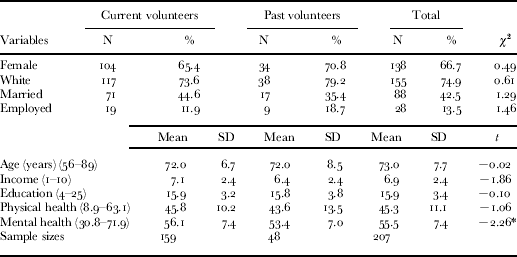
The majority (159) of the volunteers were still volunteering in the designated programmes at follow-up, while 48 had ceased. Approximately 64 per cent of all respondents were involved in other volunteer programmes, and devoted on average 14.2 hours per month. As shown in Table 1, the mean age of the volunteers serving in the ten volunteer programmes was 73 years, with no significant age (or gender or marital status) difference between current and past volunteers. About 67 per cent of the volunteers were female and 75 per cent were White. As described in most samples of volunteers, they were relatively highly educated and high-income, with about one-quarter reporting an annual household income of more than $60,000. About 14 per cent were employed and 43 per cent married. The average physical component scale (PCS) ranking was 45.3, lower than the population average of 50, while the mean score on the mental component scale (MCS) was 55.5, higher than the population mean. This was the only characteristic that was significantly different between current and past volunteers, with the latter group reporting a lower level of mental health.
Socio-demographic characteristics of current and past volunteers in ten US programmes, 2005–06
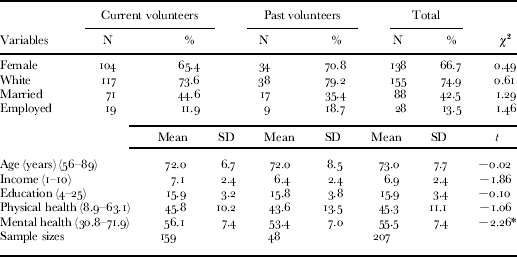
Notes: N: sample size. SD: standard deviation. For the chi-squared statistics in the upper panel, the sample size was 207 and there was one degree of freedom (none are significant). For the t statistics in the lower panel, the sample size was 205.
Source: Survey conducted by Brown School of Social Work, Washington University, St Louis. For details, see text.
Significance level: * p<0.05.
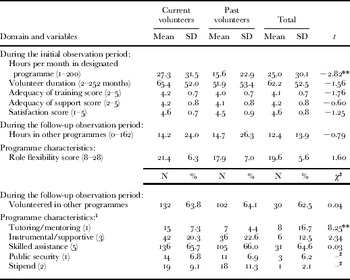
Although 48 volunteers left the designated programmes between the initial and follow-up surveys, 30 (62.5%) were still volunteering in other programme(s) (Table 2). There was no difference, however, between the current and past volunteers regarding the time commitment to other programmes. The volunteering commitment varied by the designated programmes from one to 200 hours per month, with a mean of 25 hours. Current volunteers devoted significantly more hours per month to the designated programme than had the past volunteers at the initial survey date. One designated programme skewed the distribution because it required intensive commitment from volunteers who lived in the community that was being served. This explained the high number for both volunteering intensity and duration (range 2–252 months, median 48). On average, respondents had devoted an average of 62 months to the designated programme. There was no significant difference in duration between current and past volunteers from the initial survey data, even though the latter had left the programme by the time of the second survey.
The experience of the volunteers in ten US programmes, 2005–06

Notes: 1. Numbers in brackets against variable name indicate the number of programmes with the characteristic. 2. Comparison was not conducted because too few cases. The chi-squared statistics apply to 2×2 comparisons (one degree of freedom and 207 observations). Degrees of freedom for the t statistics vary (details from the authors).
Significance level: ** p<0.01.
Regarding programme characteristics, five designated programmes in the sample provided skilled services like tax preparation, Medicare filing and legal services (Table 2). About 66 per cent of all the respondents were involved in this type of activity. Another 20 per cent of the respondents were from three programmes that provided instrumental or supportive services, like meal preparation and transportation. One programme, about 7 per cent of the respondents, volunteered in a tutoring programme. Another programme with 14 respondents (7%) provided the community with services to maintain and promote neighbourhood safety. This finding is consistent with O'Reilly and Caro's (Reference O'Reilly and Caro1994) finding that older adult volunteers are most likely to provide direct and supportive services (86% in this sample). This finding speaks to the importance of volunteerism to service delivery programmes in the country. The variance in activities observed among this sample also exemplifies the wide range of volunteer behaviours in which older adults can and do engage.
Type of activity correlated with retention, for volunteers in the tutoring programme were the most likely to have withdrawn (eight of 15 indicated they had terminated their volunteer activity at the follow-up survey). Only two programmes provided stipends to volunteers. Additionally, the study volunteer programmes indicated a high level of flexibility in adjusting volunteer role demands to accommodate individual variability (mean=21.4). In summary, past volunteers were not significantly different from current volunteers in their characteristics and volunteer experience, with the exception that past volunteers reported poorer mental health, devoted fewer hours in the designated programme at the initial observation period, and were likely to withdraw from tutoring programmes.
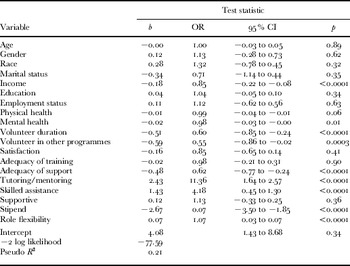
Table 3 presents the results of the GEE regression of retention or turnover by individual and programme characteristics. Interestingly, of the nine factors that were significant in predicting turnover, seven related to the volunteers' experience of volunteering or to the programme. Only two, income and mental health, were related to the volunteer himself or herself. The significant experience measures include duration of volunteering, volunteer commitment to other programmes, the adequacy of support, volunteering activity type, the payment of stipends, and role flexibility. Respondents with higher income and better mental health were less likely (by 15 and 2%, respectively) to have left the designated volunteer programme than those with lower income and worse mental health. When considering the volunteer experience, respondents who volunteered for a longer period were committed in other programmes, felt better supported, and received a stipend, and were also less likely to stop their work as a designated programme volunteer. More specifically in terms of odds, for each unit increment in volunteering duration, older adults were almost 40 per cent less likely to stop volunteering in the designated programme. Those who volunteered in other programmes at the mean time were 45 per cent less likely to discontinue volunteering. For each unit increase in perceived adequacy of the programme's support, older adults were about 38 per cent less likely to stop volunteering. Additionally, volunteers receiving a stipend were over 93 per cent less likely to withdraw from the designated programme. When the type of programme was considered, those working in a tutoring programme were over 11 times more likely to stop, and those providing skilled assistance services were over four times more likely to stop their volunteer activity compared with those working in the public safety programme. Lastly, role flexibility was considered. Here a one-unit increase in role flexibility was associated with a 7 per cent increase in the likelihood of turnover.
Factors related to volunteering turnover using GEE analysis

Notes: Sample size 207. OR: odds ratio. CI: confidence interval. Volunteer turnover coded as ‘1’ was used for prediction of the probability of terminating volunteer work in the designated programme. The estimated p values have not taken into account the use of interpolated values for missing observations.
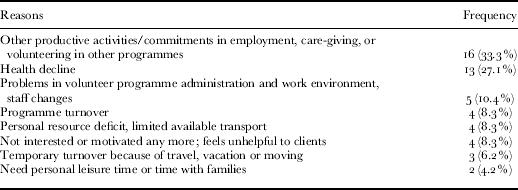
Table 4 reports the main reasons given by the 48 past volunteers for stopping volunteer activity in the designated programme. Over 33 per cent of these volunteers left the designated programme because other productive activity or commitments took on a higher priority than their volunteer work in the designated programme. These activities and commitments included employment, care-giving, e.g. ‘My husband had surgery and I have to take care of him’, or volunteering in other programmes. The second most important factor in volunteer turnover was health decline or upcoming surgery (27.1%). This category included such statements as, ‘I was having trouble getting in and out of the van because of my hip – also I had extensive surgery on my hand’. About 10 per cent of the past volunteers withdrew from their volunteer role because of problems with programme administration, the work environment, or staff issues, e.g. ‘The volunteer instructors weren't competent’ and ‘The IRS [Internal Revenue Service] had hired people to check on the tax preparers – volunteers. They didn't have money to have IRS teach us but there was money to have people check on us’. Programme discontinuation because of lack of funding was the reason that four volunteers gave for quitting. Other reasons included not feeling helpful to the clients, no more interest or motivation for volunteering, temporary discontinuation to travel or for a vacation, and the need for personal time and or for more time with families. These qualitative findings were supportive of the quantitative results, revealing that programme-level and individual-level factors partially explained the variance in volunteer turnover.
Reasons for stopping volunteer activity in the designated programme
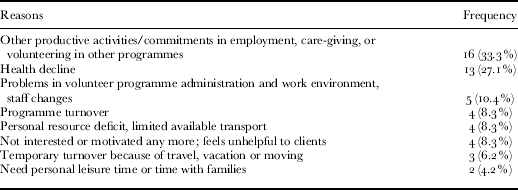
Note: Sample size 48 past volunteers. Some respondents gave more than reason.
Discussion
This study has examined the factors associated with volunteer retention and turnover in programmes that use older-adult volunteers in the USA. Using an advanced analysis procedure (GEE), this study has tested the effects of both individual- and programme-level factors on volunteer turnover. Support was found for the hypotheses that lower income, poorer health, short-term and sporadic engagement, inadequacy of programme support, and not receiving a stipend promoted volunteer withdrawal and turnover. Volunteer programme characteristics including activity type and organisational facilitation in various forms were also examined and found to relate to individual withdrawal from volunteering activity. Volunteers in tutoring and skilled assistance programmes were more likely to leave than volunteers in public safety programmes. It seemed that public safety and instrumental/supportive programmes were likely to retain older adult volunteers. In terms of organisational characteristics, stipend provision was associated with lower volunteer turnover. All of these findings point to the importance for organisations that use volunteers of paying attention to the organisational factors that contribute to their retention.
This study has supplemented quantitative analysis of the organisational factors that link to turnover by considering individual perspectives on the volunteer experience. Volunteers resigned from the programme for various reasons. Demands from other productive activity or commitments and declining health were the two primary reasons for turnover. Problems in programme administration and funding, financial constraints, and negative volunteer experiences were also listed as reasons for volunteer turnover. The participants evaluations supported the hypothesis that organisations play an important role in promoting volunteers' continued involvement. It is, therefore, very important for organisations to pay attention to how institutional support and attention to volunteers' activities and contributions are perceived by their volunteers. The findings have provided a more comprehensive understanding of older adult volunteers' turnover than previously available.
Health is a component of the human capital or personal resources that make volunteering possible. Health decline is a major issue in the ageing process. Much of the literature addressing the relationship between health and volunteering suggests that older adults in good health are more likely to volunteer or to continue volunteering (e.g. Fisher and Schaffer Reference Fisher and Schaffer1993; Okun Reference Okun1993). Older volunteers in good health are able to perform volunteer activity and a decline in health or increasing functional limitations may impede their continuation. This study demonstrates that mental health was more significant than physical functioning in predicting volunteer turnover. While this may be a function of the duration of the study, with only one year between the initial and the follow-up stages, it demonstrates the importance of paying attention to volunteers' mental health treatment needs to keep them from leaving. Other factors may mediate the relationship between volunteering and health; some of them, for example, personality, attitude toward volunteer organisations, and policy change may have more direct influence on volunteer turnover. All these explanations need further investigations.
The findings of this study that health and mental health were qualitatively related to volunteer turnover demonstrate the importance of paying greater attention to these factors in future research. Income also played a role in volunteering among these older adults. Lower-income elders were more likely to stop volunteering. Although only one respondent admitted that s/he lived on a very limited, fixed income and was not always able to pay for transportation, some indicated that their part-time jobs did not allow spare time for volunteering. This study implies that financial constraints can limit older adults' capacity in volunteering engagement. As noted in the literature, economically disadvantaged elders are faced with numerous barriers to volunteering, including lack of transportation, poor health, and competing demands of care-giving and employment for supporting their families or dependents (McBride Reference McBride2007). If they are not sufficiently supported by voluntary organisations or programmes, low-SES older adults, even those already engaged in volunteering, may not be able to sustain their efforts over an extended period. This turnover is costly to the organisation and the clients served.
There are several ways organisations can overcome the income barrier to volunteering. Stipends or other forms of financial incentive can serve as an important facilitator among low-SES volunteers in role performance and achieving positive outcomes (Morrow-Howell, Hong and Tang Reference Morrow-Howell, Hong and Tang2009). Reducing out-of-pocket costs can also help. National service programmes in the USA like ‘Senior Companions and Foster Grandparents offer minimal stipend (i.e. $2.65 per hour) to older volunteers. These programmes have shown that even a small stipend improves the recruitment and retention of older adults who meet low-income eligibility criteria (an income of 125 or 135 per cent of the Department of Health and Human Services’ Poverty Guidelines). For example, in 2001, Foster Grandparents recruited about 30,200 older adults who served over 275,000 children and youth with a total of more than 27.3 million hours, while Senior Companions recruited about 15,500 older volunteers who served 61,300 clients with a total of over 13.6 million hours (Morrow-Howell et al. Reference Morrow-Howell, Tang, Kim, Lee, Sherraden, Wykle, Whitehouse and Morris2005). According to Independent Sector (2002), in 2001 a total of 26.4 million older volunteers contributed approximately 5.6 billion hours, with an estimated value of $77.2 million.
Institutional support plays a critical role in retaining volunteers (Kovacs and Black Reference Kovacs and Black1999; Warburton and McDonald Reference Warburton and McDonald2009). The retention of volunteers and the effectiveness of the programme depend upon institutional support for the programme (Strom and Strom Reference Strom and Strom1994). It is not surprising, therefore, that volunteers who experienced more support from the programme were less likely to stop volunteering. Of interest, neither the perceived adequacy of training nor satisfaction with the volunteering experience had an effect on volunteer turnover. Although training provides opportunities to improve individual capacity in role performance, most programmes in this sample provided no more than informal briefing or a single structured training session, and training was not on-going effort, so its effects may trail off with time. Some previous studies have not found an association between satisfaction and volunteer retention, and further research is needed to investigate the expectation for volunteering, the reward received and the effects of both expectations and rewards on volunteers' perseverance (e.g. Miller, Powell and Seltzer Reference Miller, Powell and Seltzer1990; Wilson and Musick Reference Wilson and Musick1999).
It is interesting to note that role flexibility was related to volunteer turnover. By working in programmes that allowed volunteers to set up their work schedules, they may have had more flexibility about leaving the programme, even temporarily. As indicated in the qualitative analysis, some respondents stopped temporarily and wanted to return later. In the long run, role flexibility may well attract and retain volunteers, particularly ageing baby boomers, who prefer to undertake tasks of their choice, using certain skills, avoiding certain responsibilities, or to work alone from home (Center for Health Communication 2004). This study also found that some aspects of the volunteers' experience were related to retention as opposed to turnover. Short-term and sporadic engagement was positively related to turnover. It was unclear about the expectations with which respondents approached their volunteer work and the rewards they expected to gain from it. Yet the discrepancy between the expectation and actual gain was one of the cited reasons for turnover in this study, as documented by Gidron (Reference Gidron1978). Long-term and extensive experience may be helpful in acquiring self-efficacy and coping skills to deal with discrepancies in performance expectations; thus volunteers are not easily frustrated or discouraged from further efforts.
Additionally, the type of programme type was associated with the likelihood of turnover. Compared with volunteers in public-safety programmes, those in tutoring/mentoring and skilled-assistance programmes tended to stop volunteering. Volunteers in these programmes may require higher levels of skill and experience to interact with clients. The stress of personal interaction may contribute to volunteer turnover. It could be hard for the volunteer to experience a sense of accomplishment in the short term, which may discourage some from continued engagement. Another possible explanation is that volunteers in school-mentoring programmes are seasonal – they are needed only during the academic year or at certain times. These speculations require additional investigation.
The limitations of this study should be considered. The first lies in the single-item measurement of the variables of interest. Like the measure of volunteer satisfaction, there was only one question in this regard. A multifaceted measure of volunteer satisfaction index has been developed that merits further modification and tests of its reliability and validity (Galindo-Kuhn and Guzley Reference Galindo-Kuhn and Guzley2001). Also, volunteer experience is a comprehensive concept and a close examination of its components is needed. As suggested by the literature, factors such as satisfaction, organisational commitment and role identity contribute to intention and behaviour related to volunteer retention at different stages of volunteering (Chacon, Vecina and Davila Reference Chacon, Vecina and Davila2007). These factors need integration into the institutional framework as possible aspects of the volunteer experience. The measure of the turnover dependent variable is also limited in its application. Because the division between past and current volunteers did not precisely capture the meaning of volunteer turnover, some volunteers who quit service work temporarily but intended to return were not identified. Further, the programmes included in this sample did not represent the full range of volunteer opportunities available to older Americans. Programmes concerned with health care, mental health institutions and church-based organisations were excluded, where older Americans were most likely to be involved. While the programme characteristics appear relevant to volunteer retention as opposed to turnover, testing across the various types of volunteer programmes using a random sample is essential. Also observations at multiple times over a long period are helpful in assessing the relationship between programme characteristics and volunteer turnover. Lastly, diversity among older adult volunteers in life interests and activities is an area for future studies to explore.
Conclusions
This study has contributed to our knowledge of the factors that influence the retention of older adult volunteers. Compared to previous research that has drawn predominantly from descriptive and programmatic information (Brudney and Kellough Reference Brudney and Kellough2000), this study has expanded the scope of the analysis and evaluation of the issues. Based on the institutional perspective, a theoretical framework developed specifically for studying volunteerism and productive engagement by older adults (Morrow-Howell et al. Reference Morrow-Howell, Hinterlong, Sherraden, Tang, Thirupathy and Nagchoudhuri2003; Sherraden et al. Reference Sherraden, Morrow-Howell, Hinterlong, Rozario, Morrow-Howell, Hinterlong and Sherraden2001), this study presents both quantitative and qualitative findings about an array of factors related to older adult volunteers' turnover, including individual disadvantages (i.e. low income and poor health), short-term and limited volunteer experience, programme or activity type (i.e. tutoring/mentoring, skilled assistance programmes), the impact of organisational facilitation, and the role of other commitments in influencing turnover. Additionally, this study has presented data on the older-adult volunteer population rather than the general population as in previous studies. As the baby-boomer generation reaches the post-retirement years, an increased number of older adults are likely to engage in volunteering. Non-profit organisations in the USA and other Western countries should be ready to respond to this trend (Narushima Reference Narushima2005; Warburton and McDonald Reference Warburton and McDonald2009), and take appropriate strategies to recruit and support older adults in various volunteer roles.
Non-profit organisations are faced with the challenges of accommodating the variable capacities of older volunteers. It is believed that changes in programme characteristics, such as the provision of stipends and improvements in organisational support, would impact positively on volunteer retention, especially among low-income elders. To meet the interests in volunteering among older adults with disabilities or with poor access to transport, as well as among those living in rural areas, home-based opportunities for volunteering need to be developed, as suggested by the 2005 White House Conference on Aging (Morrow-Howell Reference Morrow-Howell2006). Counselling and support to older volunteers may address volunteer turnover issues, such as discrepancies between expectation and actuality, problems in the working environment, problems with working staff and clients, as well as the lack of interests or motivations among older adults. Recognising older volunteers' contribution may provide them with a sense of usefulness and purpose. In summary, non-profit organisations are presented with a resource by which to provide social services but there is a caveat – this resource needs to be supported in ways particular to their institutional and individual needs. Such institutional and organisational attention would increase their ability to recruit and sustain older volunteers in social service delivery.
Acknowledgements
The research reported in this article was supported by the John A. Hartford Foundation, the MetLife Foundation, and the Longer Life Foundation. We gratefully acknowledge the assistance of the Center for Social Development at Washington University in completing this project. We also thank Jaime Goldberg, So Yeon Kim, Amy Luman and Cal Halvorsen for their research assistance.