Introduction
Regionalist parties are often well represented in Western multilevel democracies, at the regional and increasingly also at the national levels of government (Müller-Rommel Reference Müller-Rommel1998, 17). In contrast with their “statewide” counterparts, however, regionalist parties question the territorial integrity of the state as such (Elias and Tronconi Reference Elias and Tronconi2011, 505). Secessionist upheaval in Catalonia, Scotland, and Flanders challenges trusted models of political decision making (Stefanova Reference Stefanova2014; Tronconi Reference Tronconi2015). Nonetheless, their demands for regional autonomy do not seem to prevent these parties from participating in regional and even national government (Deschouwer Reference Deschouwer2008).
Parties that cross the threshold of government implement their ideas into reality and have impact on the lives of their citizens (Dandoy Reference Dandoy2014, 629). Ministerial portfolio allocation plays a key role at the end of the coalition formation process: portfolios constitute one of the clearest manifestations of (policy) payoffs. Given a large degree of ministerial autonomy, public policy will primarily depend on the views of the party in control of the portfolio with jurisdiction over the policy area concerned (Laver and Shepsle Reference Laver and Shepsle1996, 301). As the ideological fundamentals of regionalist parties challenge the constitutional status quo of the state, their potential impact on political outcomes is not to be underestimated. Once in cabinet, they can advance the interests of own territorial subgroups and even change the outlook of society as a whole.
Regionalist parties are an important vehicle through which peripheral elites can participate in the national political arena. Ministerial appointments are an effective gateway to get access to central state institutions. But what kind and how many portfolios do regionalist parties hold in national cabinets? To address that question, we developed a new dataset that lists a comprehensive collection of ministerial posts (N=1880) that were allocated to 77 different regionalist parties across 10 Western multilevel democracies throughout the post–World War II period. Of these ministerial posts, 113 were situated within national governments. Although this is just a small portion of the whole dataset, this national arena is by definition crucial to the regionalist party type, because it is through these roles that they can advance toward the realization of their primary goal of more self-rule (Elias and Tronconi Reference Elias and Tronconi2011, 505).
What follows is a quantitative and a qualitative empirical analysis of our findings. We first discuss the relative number of ministerial posts, policy domains, and key leadership positions that regionalist parties hold in national cabinets vis-à-vis their electoral weight and their coalition partners. The second part of this article focuses on the kinds of portfolios that are the most popular among regionalist parties in national government.
Our findings on portfolio preference align with what other scholars found when they measured issue salience in the electoral manifestos of ethno-regionalist parties (Dandoy and Sandri Reference Dandoy and Sandri2007). For instance, our results show that regionalist parties hold significantly more policy domains that belong to their territorial-institutional core business in their ministerial portfolios. In this way, they can continue to stress and defend their subnational particularity. Furthermore, throughout consecutive legislatures in national governments, regionalist parties broadened their focus by alternating part of their attention between social-economic and culture-identity portfolios.
Yet, a party’s political success refers not only to electoral success and success in office—that is, government participation—but also to actual policy outputs. Oscar Mazzoleni and Sean Mueller (Reference Mazzoleni, Mueller, Mazzoleni and Mueller2016), for example, have measured in-depth the achievement of nine regionalist parties in terms of changing collective decisions. Developing a complete picture for a more comprehensive collection of regionalist parties (as included in our dataset) will necessitate further research.
Theoretical Framework
Regionalist parties are professional vehicles through which peripheral elites can participate in the national political arena. The central state apparatus has a judiciary, legislative, and executive branch. In Western multilevel democracies, regionalist parties have gradually gained electoral strength over the last decades. These days, they are often well represented in the legislative branch, and an increasing number of them has also taken on responsibilities in the executive branch of government.
In contrast with their statewide counterparts, however, regionalist parties question the territorial integrity of the state as such. They challenge the institutional status quo of the country in which they operate and upset existing models of political decision making. Most contemporary scholars assume the existence of a distinct regionalist party family (see, for example, Gómez-Reino Reference Gómez-Reino, De Winter, Gómez-Reino and Lynch2006; Hague, Harrop, and McCormick Reference Hague, Harrop and McCormick2016; Marks, Wilson, and Ray Reference Marks, Wilson and Ray2002). Scholars have provided empirical evidence that the regionalist party family is internally homogenous on territorial topics but heterogeneous on the other ideological dimensions of party competition (De Winter Reference De Winter, De Winter and Huri1998, 204). In other words, their shared ideology is rather thin: apart from their territorial and institutional core business there is above all a broad internal diversity when it comes to other (such as social-economic) issues.
Regionalist parties share their original demand for self-government (Alonso Reference Alonso2012; De Winter Reference De Winter, De Winter and Huri1998) but have “thickened” their ideological profile over time. Once started as single-issue parties, often focused on noneconomic issues (Wagner Reference Wagner2011), these parties now also display the typical programmatic characteristics of many mainstream political actors. They espouse broad policy platforms, position themselves over the full ideological scope of the left-right continuum, and co-govern regionally and nationally.
Regionalist parties originate from subnational territories that defend their own cultural particularity and aim for (more) self-rule. While regionalist parties have the electoral capacity to play an important political role in their own region, as a non-statewide party they are generally only a small political factor at the national level of government. Yet, a growing number of them do participate in the national executive branch. From a programmatic point of view, one would expect that the subgroup of governing regionalist parties is ideologically different from the pure oppositional ones. By definition, opposition parties benefit from having more liberty in the issues they address and take up a more radical stance than do incumbents (Green-Pedersen and Mortensen Reference Green-Pedersen and Mortensen2010). Yet, recent empirical research (Terrière and Bouteca Reference Terrière and Bouteca2020) found no significant differences between these subcategories. While there are only minor differences in the kind of issues they emphasize, governing regionalist parties do not consistently hold more moderate policy positions than oppositional ones. In other words, both party subgroups differ in the range of topics they talk about rather than in the issue positions they take up.
Crossing the threshold of government is surely one of the defining moments in a party’s lifecycle. Kris Deschouwer (Reference Deschouwer2008, 177) describes this as the fifth and last phase in his integrated “party lifespan model.” We follow Kaare Strøm and Wolfgang Müller (Reference Strøm and Müller1999), who portray the decision whether or not to participate in government as a deliberate and strategic trade-off between votes, offices, and policies. Different parties might assign a different priority to each of these goals in varying circumstances.
Since coalition formation typically takes place immediately after elections, most research in this subfield detects office-seeking and policy-seeking incentives (see, for example, Budge and Laver Reference Budge and Laver1986). Office-seeking actors are power hungry or after the recognition and respect that accrues to high political office, while policy-seeking actors get satisfaction from achieving a particular goal. In practice, political reality is nuanced: policy concessions may be compensated by prestigious portfolios or vice versa. A comprehensive theoretical framework must then at least include both payoffs.
In many situations, an opposition role might be perceived as the most remunerative electoral strategy. But parties also have a strong desire to fulfill their policy goals and directly influence decisions. Within a party, different factions and rationales compete. For instance, party activists are more policy-motivated and party leaders are more inclined to appreciate the benefits of holding office. Depending on which faction or rationale is dominant, the party will choose one option over another.
Obtaining positions in the national government is of vital importance if regionalist parties want to meet their primary goal, which is the redistribution of political authority across different territorial levels within the state (Elias and Tronconi Reference Elias and Tronconi2011, 521). Constitutional reform is ultimately decided at this central level of decision making. Ruling regionalist parties are therefore likely to prefer policies over offices at the national level of government. In addition, because of electoral reasons regionalist parties may opt to evade the key leadership positions in national cabinet. As Daniele Albertazzi and Duncan McDonnell (Reference Albertazzi and McDonnell2005, 953) rightly state, regionalist parties like to retain a fragile balance in terms of being both a governmental and an opposition party at the same time (keeping “one foot in and one foot out of’ government”). Instead, as the smaller coalition partner, they might rather try to get their hands on some specific policy domains that are important to them.
Certainly, ministerial portfolio allocation is a crucial stage in the coalition formation process (Strøm Reference Strøm2000). It is a highly strategic choice every party aspiring to govern needs to make (Bäck, Debus, and Dumont Reference Bäck, Debus and Dumont2011). Ministerial portfolios are one of the clearest manifestations of policy payoffs during negotiation talks. In the case of regionalist parties, portfolios can be meaningful tools to defend the interests of their own territorial subgroup. Their individual ministers can generate a serious impact upon policy (Fischer, Dowding, and Dumont Reference Fischer, Dowding and Dumont2012). As a consequence, parties who have different policy concerns will also have different orderings of preference for the ministries on offer.
Quantity versus Quality: Two Sides of the Same Coin
The earliest research on ministerial portfolio allocation focused on the relative share of ministerial posts that a party obtains vis-à-vis its coalition partners. The academics that studied portfolio allocation consistently found a very strong relationship between seat shares in parliament and portfolio shares in cabinet (Gamson Reference Gamson1961). Because of their limited electoral weight, Gamson’s law (1961) prescribes that regionalist parties will only hold a small share of the national ministerial posts. Later on, scholars (Browne and Franklin Reference Browne and Franklin1973, 460) detected a “small-party bias”: these are deviations from the expected proportionality to the benefit of the smallest coalition parties. More recently, bargaining models of coalition formation reveal that smaller coalition parties are slightly overrepresented in their share of minister portfolios (Warwick and Druckman Reference Warwick and Druckman2006, 635). Minister portfolio distribution is thus not fully proportional to electoral strength but also relies on actual bargaining power (Sartori Reference Sartori1976). Because regionalist parties are usually the junior partner in a national cabinet, one may therefore expect that its average share of ministers will slightly exceed its seat share in a national parliament. Indeed, in a typical coalition formation process, the last seats to form a majority are always the most expensive ones to acquire. Even though a party represents only a small number of parliamentary seats, those may be much needed by the formateur party to form a stable cabinet. We tested whether this bargaining leverage is reflected in the case of regionalist parties through the following hypothesis:
Hypothesis 1: Regionalist parties in national government hold a disproportionate number of ministerial portfolios in relation to their seat share in parliament.
Regionalist parties are first and foremost regional political actors who primarily seek to govern their own subterritories. They may feel very uneasy about a possible adventure in national government. First, their ministers are very likely to be criticized. National mass media might depict them as the Trojan horses of vested local interests within the central state apparatus (Harguindéguy, Pienado, and Sandri Reference Harguindéguy, Peinado and Sandri2021). At the same time, regionalist parties who occupy national leadership positions are afraid to create misperceptions vis-à-vis their traditional voter base: have their representatives stopped caring about their place of origin now that they have taken up a prestigious national political function? In order to avoid becoming too closely associated with the central state establishment and the reigning status quo, regionalist parties may therefore evade the highest executive offices that stand as a symbol for the state. Finally, coalition members will steer their regionalist partners away from key leadership functions, since they fear that such powerful mandates would be misused to further centrifugal tendencies. However, the hands-on application of effective monitoring instruments, such as strong parliamentary committees or frequent parliamentary questions, might temper eventual suspicion among cabinet partners (Höhmann and Sieberer Reference Höhmann and Sieberer2020; Martin and Whitaker Reference Martin and Whitaker2019). These three arguments lead us to test a second hypothesis:
Hypothesis 2: Regionalist parties in national cabinets hold a disproportionately small number of key leadership positions in relation to their seat share in parliament.
A second school of academics investigates what kinds of policy domains cabinet parties prefer to hold over time—the “qualitative” side of the coin. Their focus is on the question of which ministries are allocated to which parties: Who gets what, when and why?
Political parties operate in a context of bounded rationality: they should not forgo their ideological core business. Parties are rooted in deep “functional” and “freezing” cleavages dividing society, each reflecting different social classes and bases (Lipset and Rokkan Reference Lipset and Rokkan1967, 50). Scholars have identified major ideological dimensions that structure party competition and which have played a defining role in party politics throughout the post–World War II period. In describing our study and findings, we draw on prior work (Elias, Szocsik, and Zuber Reference Elias, Szocsik and Zuber2015; Wagner and Meyer Reference Wagner and Meyer2017) in focusing on three overarching dimensions for further empirical analysis: social-economic (left-right), territorial-institutional (centralization-decentralization), and culture-identity (liberalism-authoritarianism). Of these, the territorial-institutional dimension is particularly relevant because regional autonomy forms the ideological core business of regionalist parties.
Indeed, their quest for territorial and institutional reform is the one thing all regionalist parties have in common. Whether they are moderate or radical, autonomist or secessionist, they all advocate a movement away from the center toward more regional self-governance. Yet it is a striking paradox that, if regionalist parties want to advance in the realization of their ultimate goal of self-determination, then national government participation is imperative, for institutional and territorial reform is always decided at the central level of government.
The literature often labels regionalist parties as “niche” parties—a party type that is under heavy influence of party activists and their traditional rank and file (Wagner and Meyer Reference Wagner and Meyer2017, 84). From this point of view, regionalist parties are confined to their ideological core business in order not to lose their raison d’être. Apart from the territorial-institutional core business, there is a broad internal variety of other matters—social-economic and culture-identity (Dandoy and Sandri Reference Dandoy and Sandri2007). Social-economic leftist examples such as the Scottish National Party (Great Britain) stand in stark contrast to culturally conservative cases such as the Bavarian Party (Germany) or the Lega Nord (Italy).
Earlier scholars revealed consistent relationships between specific party types and the kinds of ministries they control (Browne and Feste Reference Browne and Feste1975). This is logical because ministerial portfolios enable parties to influence those policy areas with which they are especially concerned. In that way, the kinds of policy domains that a party holds in its portfolios also reveal something about its policy priorities. We query whether regionalist parties are confined to their ideological roots through our third hypothesis:
Hypothesis 3: Regionalist parties in national government have a distinctive portfolio preference for territorial-institutional affairs.
Finally, parties change their issue salience and position over time (Bouteca and Devos Reference Bouteca and Devos2016; Harmel and Janda Reference Harmel and Janda1995). Parties in government are under pressure to respond to public policy on a wide range of different topics. Consequently, they tend to increase their issue diversity the longer they are in office—although economic conditions play a mitigating role in that (Greene Reference Greene2014). As a loyal coalition partner, incumbent parties—which would include incumbent regionalist parties—are encouraged to broaden their original focus and divert their attention to other societal topics because they have to defend the common government record. There is no reason why the regionalist party type would be any different from others here. Indeed, manifesto research on regionalist parties shows that their attention to the decentralization issue stagnates after an initial period of growth (Dandoy and Sandri Reference Dandoy and Sandri2007). It stands to reason that a party’s programmatic adaptations are also reflected in the kind of policy domains that the party controls in government. Not all issues are created equal, however. Margi Tavits (Reference Tavits2007) has empirically proved that for “pragmatic” policy domains, such as social-economic themes, flexibility is acceptable to the voter. But on “principle” matters, such as culture-identity topics, a lack of stability jeopardizes votes. For the culture-identity issues, adhering to a strong reputation and credibility is crucial for a party to keep the support from its original constituency. Whether regionalist parties change in the kind of policy domains they control is tested by means of a fourth hypothesis:
Hypothesis 4: Regionalist parties shift in the kind of minister portfolios they control throughout consecutive legislatures in national government.
Data and Method
A New Dataset
We deliberately limited the scope of our research to those regionalist parties that have participated in government among Western democracies throughout the post–World War II period. Massetti and Schakel (Reference Massetti and Schakel2016) published an extensive list of 227 regionalist parties. We used their 2016 overview as a starting point to investigate which regionalist parties have effectively crossed the threshold of governance.
In our study, one case equals one ministerial post attributed to a regionalist party. This ministerial post frequently included multiple policy domains: these were also included in our dataset. The data gathering required complex historical research, including an appeal to official government websites and ministries’ archives. If some information was lacking, the inquiry was completed with the consultation of written media reports on election results and press releases on government composition (Terrière Reference Terrière2019). The result is a dataset that consists of 77 different regionalist parties in 10 Western decentralized democracies and, more specifically, representing 37 different regions (see appendix A). It is the first comprehensive overview on the actual presence of peripheral elites within the executive branch of national politics.
In our analysis, we focus specifically on the six parties that co-governed at the national level of government. Of these, the Swedish People’s Party is the only one that never governed at the regional level. Yet, the party did participate in numerous national coalition governments. And while this special issue of Nationalities Papers deals with both “pure peripheries” and “failed cores” (Rokkan and Urwin Reference Rokkan and Urwin1983), the great majority of the cases we investigated clearly belong to the “failed cores,” among them regions such as Flanders or Catalonia.
The inventoried national ministerial posts are ascribed to just three different counties: Belgium, Italy, and Finland. They account for 113 of the 1,880 unique ministerial posts that were listed. Because some posts were held for only a couple of months, while others were manned for several years, we reweighted all of them in order to account for important time-based differences (such as duration of the legislature, acknowledging reshuffles, early drop-outs). We thus arrived at a normalized total of 9,472 policy domains. These are the standardized units of analysis that are suitable for further statistical and comparative analysis. Of these normalized units, 299 are policy domains that belong to national minister posts.
Regrouping into Issue Categories
The names of the policy domains vary greatly over time and across regions. Indeed, beyond the basic ministerial posts, complexity and change are important bywords: jurisdictions are split, reshuffled, recombined, and renamed in ways that are often difficult to trace. To ensure cross-national and temporal comparability, the broad variety of detected policy domains was regrouped into a more manageable set of 27 issue categories (see appendix B). For this, we applied the same categorization scheme of 25 “most common” policy domains that James Druckman and Paul Warwick (Reference Druckman and Warwick2005, 17) identified in their pioneering comparative research on ministerial portfolio allocation across 14 Western countries. Nevertheless, some difficult choices had to be made regarding which general issue categories to assign to which country-specific post (Bäck, Debus, and Dumont Reference Bäck, Debus and Dumont2011).
Because our research focuses on one party family in particular, we adapted Druckman and Warwick’s general scheme of 25 issue categories, adding “territorial” and “institutional” affairs as issue categories. We regard these two policy domains as essential to regionalist parties’ ideology. Institutional affairs include elements such as interparliamentary relations, constitutional change, electoral reform, and minority rights. Territorial affairs contain issues such as urban development, municipal or rural relations, land reform, and territorial planning. (During the regrouping, both issue categories were used in a restrictive manner: as soon as other economic or cultural aspects came into play, the case was diverted to the other relevant issue category.) However, in previous quantitative analyses of ministerial portfolios among parties, the territorial and institutional issues domains have generally been regarded as marginal and displayed only low salience (Druckman and Warwick Reference Druckman and Warwick2005, 22). Calculating the relative popularity of these two additional issue categories vis-à-vis the other 25 policy domains enabled us to test the third hypothesis, that regionalist parties in national government have a distinctive portfolio preference for territorial-institutional affairs.
To falsify the first and second hypotheses, five additional variables have to be included. The first three of these variables are (1) a party’s number of seats in a national parliament (which reflects its capacity to claim a proportionate share of the available ministerial posts and a set of policy domains); (2) the number of regionalist parties’ ministers; and (3) the total quantity of ministers in a national cabinet. The variables enable us to test whether Gamson’s law applies to the regionalist party type (hypothesis 1). Further, our general scheme of 27 issue categories includes two leadership functions: prime minister and vice-PM. Computing their relative frequencies made it possible to test the second hypothesis.
The last two variables are (4) years in office and (5) the number of consecutive legislatures in government, which we calculated for every ministerial post. With these two additional variables we were able to assess whether there is a temporal change in ministerial portfolio preference, as expected in the fourth hypothesis. Analyzing change in 27 different policy domains was still too complex, however. Therefore, we aggregated 21 of them in just three overarching ideological dimensions of party competition. For this regrouping procedure, we used the classification scheme from the Manifesto Research on Political Representation (MARPOR) project on party manifestos (Volkens et al. Reference Volkens, Lehmann, Matthieß, Merz, Regel and Weßels2017). The social-economic dimension consists of 12 issue categories, the culture-identity dimension has five issue categories, and the territorial-institutional dimension consists of two policy domains (see appendix B).
Results
Portfolio Share
The fact that national ministerial posts (N=113) constitute just a very small part (6 percent) of the total dataset is a significant finding in itself. Moreover, just 3.15 percent of the inventoried policy domains (N=299) are attributed to ministers at the central level of government. There are several reasons for this. First, regionalist parties are granted few opportunities by their statewide competitors to effectively participate in national coalition governments. A second explanation is the low appetite among regionalist parties to cross the threshold of national government. Indeed, these parties may not be interested in occupying ministerial posts at a policy level they actually want to dismantle. In the end, regionalist parties are first and foremost regional political actors that primarily aspire to govern their own preferred subterritory.
Interestingly, their ministerial portfolios include, on average, far fewer policy domains at the national level (2.65) than their equivalents at the regional level (5.19). This is somewhat logical because, as a small national political actor, regionalist parties have less bargaining power to claim a broad variety of governmental departments for their ministers. As the junior coalition partner, they need to focus on obtaining just a couple of policy domains that are crucial to defend the interests of their territorial subgroup. But a more in-depth look at the 113 national ministerial posts and the 299 standardized policy domains is revealing. When these data are analyzed together with the additional variables displayed in table 1, we can test the first hypothesis, that regionalist parties in national government hold a disproportionate number of ministerial portfolios in relation to their seat share in parliament.
Additional variables: median and mean values (national level).

Due to high variances in the values of the added variables, it is recommended to take the median instead of the mean as a reference point here. At the national level, the regionalist party is always (100 percent) a member of a coalition government. Regionalist parties that cross the threshold of national government obtain on average three ministers out of 20 cabinet members (15 percent). Compared to their median national seat share (5.68 percent), one can speak of a discrepancy: regionalist parties hold a significantly higher share of ministerial posts than expected according to Gamson’s law of proportionality. Alternatively, when looking at their share of controlled policy domains within the national cabinet, such disproportion is not found. This comes as no surprise, as their national ministers hold fewer policy domains (2.65) in their portfolios. In sum, the first hypothesis holds when it concerns the share of posts, but it does not hold for the number of domains. In other words, regionalist parties collect a high number of ministers, but their radius of action is rather limited.
Portfolio Preferences
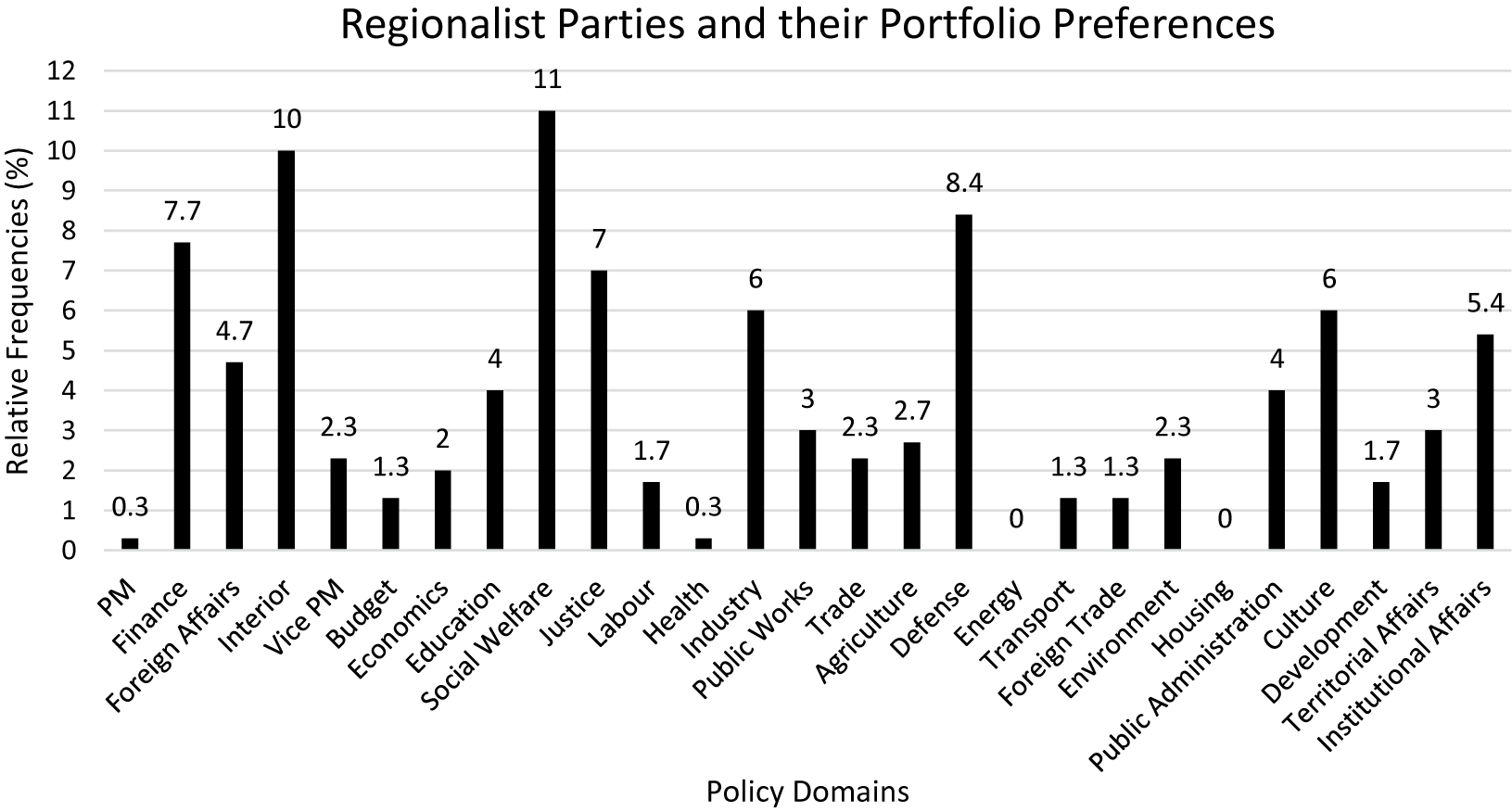
What kind of policy domains do regionalist parties hold in their national ministerial portfolios? The relative popularity among regionalist parties for the 27 most common issue categories is illustrated in figure 1 (see the entire frequency table in appendix B). These salience scores enable us to test the second and third hypothesis.
Minister portfolios preferences among regionalist parties sorted by policy domains.

The notion of key leadership is operationalized through the first (PM) and fifth (Vice-PM) issue category from the scheme. Their combined relative frequencies—two out of the 27 inventoried policy domains—account for just 2.6 percent of the total volume in recorded policy domains. This disproportionately low share confirms the second hypothesis, that regionalist parties in national cabinet hold a disproportionately small number of key leadership positions in relation to their seat share in parliament. We expected this finding for different reasons. First, leadership positions are usually attributed to the largest parties within the coalition, while regionalist partners are often the junior partner in national government. Also, regionalist parties are reluctant to take up such symbolic national mandates: they struggle with an almost natural aversion vis-à-vis this level of government and are afraid of misperceptions among their original constituency. Furthermore, as noted above, coalition partners may see regionalist parties as Trojan horses. In order to prevent the national level from being dismantled, statewide competitors will deny regionalist parties the access to the highest offices of the national executive branch.
Qualitative evidence for these reasons can be found in the dataset. For instance, the coalition formation of the Belgian government Michel I is illustrative of a regionalist party’s apparent natural aversion vis-à-vis the national level. In 2014, the Flemish-nationalist New Flemish Alliance (Nieuw-Vlaamse Alliantie) explicitly did not claim the post of prime minister although it was by far the largest cabinet party. The New Flemish Alliance justified this move by stating that it did not want to be seen as the ultimate symbol of the conservation of the Belgian State. Instead, the office of prime minister was passed on to the (only) Walloon coalition party, the liberals of the Mouvement Reformateur. The Mouvement Reformateur presented this windfall to its southern electorate as a hard-fought victory. Indeed, for the French-speaking part of the country it would have been difficult to accept a Flemish-nationalist as the national political leader. If a Walloon party had supported such a nomination, it would probably have signed its electoral death certificate.
Alternatively, the New Flemish Alliance laid its hands on a coherent cluster of authoritative departments for its ministers. This bundle of policy domains included, among others, home affairs, security, defense, asylum, and migration. All of these can be categorized within the culture-identity dimension of party competition. It was a deliberate choice of the New Flemish Alliance to prefer a coherent package of policy domains in its ministerial portfolios above the key leadership position.
The empirical results from testing the first two hypotheses can be summarized as follows: regionalist parties combine a high share of ministerial posts with a proportionate share of policy domains and a low share of leadership functions. This suggests that regionalist parties are predominantly driven by policy-seeking goals if they govern at the national level. In contrast, when they participate in regional governments, regionalist parties are primarily driven by office-seeking incentives (Terrière and Bouteca Reference Terrière and Bouteca2020).
Yet, the complete answer to the question of whether regionalist parties prefer ruling at the regional or national level is not univocal, but dependent on timing and context. The individual career paths of party leaders may be illustrative of where a party’s real priorities lay. When it concerns individual promotion ladders, the literature speaks of a “classical” or “inverse” springboard effect: peripheral politicians move from one position to the other at the state and substate levels according to their availability, accessibility, and attractiveness (Stolz Reference Stolz2010). These trajectories are also visible in our dataset: ministers move back and forth between levels in both directions. If we zoom in on just those individuals who occupied key leadership positions at the national level, then the “inverse” springboard effect appears to be dominant.
Three textbook examples are worth mentioning. First, Vic Anciaux was party president of the Volksunie and served as a minister in multiple Belgian governments during the 1970s, after which he moved to the regional government of Brussels in the 1980s. Similarly, Roberto Maroni was a former party leader of the Lega Nord and built his career throughout the 2000s as minister in the Italian government, even becoming deputy prime minister under Berlusconi. In the 2010s, he switched to the regional level and became the president of Lombardy. More recently, Jan Jambon (New Flemish Alliance) became deputy prime minister in the Belgian government in 2014. In 2019 he moved to the regional level and became acting minister-president of the region of Flanders, even before a new federal coalition was formed. He described his new function as the highest mandate he had ever held in this whole political career. This tendency for party leaders to prefer cabinet positions at the subnational level is possibly related to the degree of institutional decentralization of the country. The more the political center of gravity shifts from the federal to the regional level, the more examples of the inverse springboard effect one finds—for example, in countries such as Belgium and Italy (Massetti and Sandri Reference Massetti, Sandri, Régis and Schakel2013, 142).
Do regionalist parties remain loyal to their ideological roots? This is the subject of the third hypothesis. It raises the question of which kind of policy domains are most popular among regionalist parties once they cross the threshold of national government. Our third and fourth hypotheses were formulated to address these questions. First, we expect that regionalist parties have a distinctive preference for those policy domains that constitute their core business. In our scheme of 27 issue categories, these domains are represented by the categories territorial affairs and institutional affairs.
Overall, institutional and territorial affairs are only a marginal phenomenon in Western politics. These policy domains are often not even mentioned as a distinct portfolio when a new national government is created. Previous scholars estimate its overall salience in electoral manifestos at 2–3 percent, and up to 5 percent in multilevel democracies where regionalist parties compete (Libbrecht, Maddens, and Swenden Reference Libbrecht, Maddens and Swenden2013). In our dataset, the combined relative frequencies of institutional (5.4 percent) and territorial (3 percent) affairs represent 8.4 percent of the 299 inventoried policy domains. Taken together, they rank as the fourth most popular in the chart of issue categories. In other words, there is a clear preference among governing regionalist parties to hold territorial and institutional departments in their national ministerial portfolios. The third hypothesis thus holds. However, it is important to note that all available cases here are coalition cabinets. Ministerial portfolio distribution is thus inevitably an interdependent process. The allocation of regionalist parties heavily relies on the preferences of the other (larger) cabinet parties. Nevertheless, regionalist parties seem to hold on to a couple of policy domains that are crucial to defend the interests of their own territorial subgroup.
If advancing territorial decentralization is unfeasible, regionalist parties may try to impose the desired regional policies on the whole state. Several regionalist parties in our dataset have turned to this strategy. The Lega Nord advocated right-wing economic and fiscal policies during their participation in national cabinets throughout the 1990s and 2000s, which mainly benefited the wealthier north of Italy. This party has always opposed illegal immigration from non-European and Muslim countries to shield the prosperous Padania regions (Veneto, Lombardy, Piedmont, Liguria, and Emilia-Romagna) from poorer outsiders. Likewise, the New Flemish Alliance justified its participation in the Belgian cabinet Michel I by stating that it would support a Flemish-friendly and right-wing public policy at the national level as long as social-economic powers were not devolved to the regions. This was to the detriment of the Walloon part of the country, who prefer left-wing recipes. In that way, Wallonia could be turned into an applicant for future constitutional amendment.
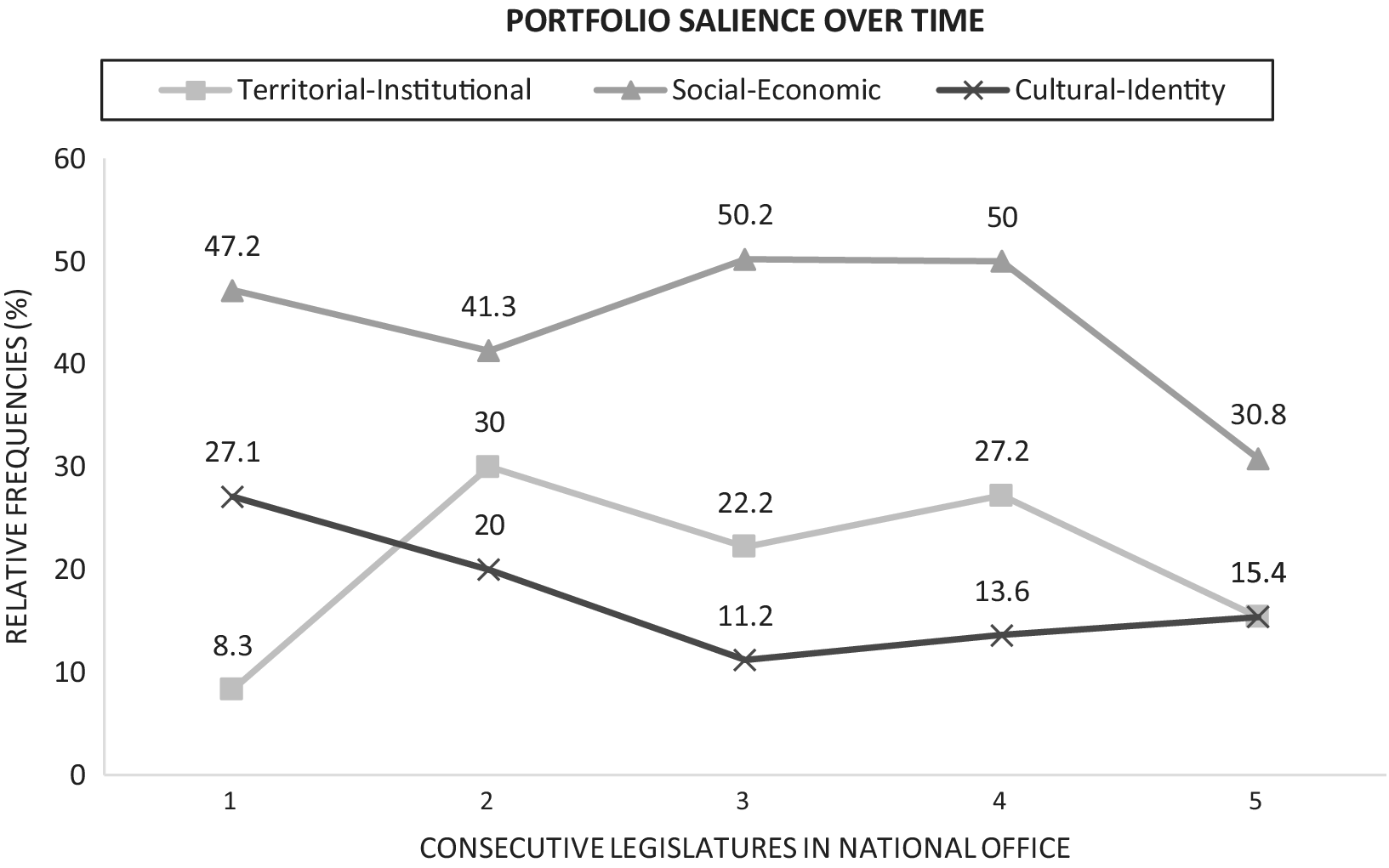
Our fourth hypothesis investigates whether incumbent regionalist parties change the kinds of portfolios they hold over time. We did not analyze popularity shifts for each of the 27 issue categories separately but instead looked at changes for three aggregated issue dimensions. Two of the five additional variables enabled us to map eventual changes over time, as illustrated in figure 2: we searched years in office and the number of consecutive legislatures in government for every standardized unit of analysis—the 299 occupied policy domains.
Portfolio salience throughout consecutive legislatures in national office (among regionalist parties).

The variable that provides the most reliable comparison and the most untroubled results is the number of consecutive incumbent legislatures. The temporal results are illustrated in figure 2. Two findings are worthwhile to report. First, it seems that regionalist parties have to give in on primary territorial-institutional domains when they enter national government for a first time, but they increase the frequency of these portfolios (again) if they remain in cabinet for additional legislatures. Second, concerning their secondary issue dimensions—social-economic and culture-identity portfolios—no clear pattern appears: the relative frequencies vary up and down over time. In sum, regionalist parties keep a narrow focus on their ideological roots when it concerns the kind of minister portfolios they prefer, while they are flexible with regard to the other ministerial portfolios they hold. Based on these results, the third hypothesis holds.
But apparently, regionalist parties do not escape the inevitable bargaining costs that apply to all political parties who enter negotiation talks. Coalition formation requires making political compromises with competing parties. Especially a first entry into national government requires regionalist parties to create convergence with potential future partners, and thus also to give in on their core beliefs—at least temporarily. This reflected in a low frequency of territorial-institutional policy domains upon first entry (8.3 percent, as shown in figure 2) when compared to the following legislatures.
A possible explanation for the subsequent increase in successive terms lies in the issue ownership theory. Parties compete by emphasizing those issues for which they have a stable reputation for greater competence (Petrocik Reference Petrocik1996). This theory does not view party competition as rigid, however (Budge and Farlie Reference Budge, Farlie, Daalder and Mair1983). Changes in policy preferences are expected to occur in an implicit manner, with parties selectively emphasizing and deemphasizing policy themes over time. This means that a party can depart from its ideological core, but cannot do so for too long without losing its credibility vis-à-vis the voter. At some point, sooner than later, a regionalist party will need to return its attention to territorial and institutional themes. While this logic of issue ownership normally applies to policy decisions that a party has to make, we argue that it is also reflected in its ministerial portfolio preference.
The observed changes over time in the frequencies of the two other overarching issue dimensions are a confirmation of the fourth hypothesis. The social-economic and culture-identity issue dimensions seem to be communicating vessels: regionalist parties continue to alternate part of their attention between both. We do not know whether this is a party’s own choice or a take-it-or-leave-it attitude—flexibility imposed by other cabinet parties.
Scholars such as Zachary Greene (Reference Greene2014) have empirically demonstrated how parties in government have a natural tendency to increase their issue diversity the longer they stay in cabinet. Regionalist parties appear to be no different from other party families in this matter. As a coalition partner they are compelled to broaden their initial focus and divert part of their attention to a variety of other policy domains, for instance because they have to defend the common government record. Again, we argue that such programmatic adaptations are eventually also reflected in the kind of ministerial portfolios that a party will hold.
The volatility on both secondary issue dimensions is an exponent of these adaptions. However, it may be unwise from a vote-maximizing point of view. Tavits (Reference Tavits2007) showed that for pragmatic policy domains, such as social-economic themes, flexibility can even be rewarded by the voter. But for principle-based issues, such as culture-identity topics, a lack of stability is not lucrative. For the principle-based policy domains, developing a strong reputation and building credibility is crucial if a party is to keep the support of its original electorates. The literature on substate nationalism (Freeden Reference Freeden1998) and identity politics (Smith Reference Smith1996) has repeatedly emphasized the tight ideological connectedness between the territorial-institutional and culture-identity dimensions. Hence, regionalist parties in particular have to move with caution in these areas: credibility losses on one dimension could easily spill over to the other.
As we discuss above, a first participation in national government forces regionalist parties to (at least temporarily) desist in claiming decentralization domains. We notice that in practice, participation in national government deprives regionalist parties the platform to articulate their territorial demands, since these demands are often perceived as provocative by other coalition partners. Indeed, it is difficult to object to the territorial integrity of the state while at the same time co-governing at that political level. Instead, regionalist parties continue to narrate their community-building feelings by expressing their territorial discourse in more cultural terms. A striking example from our dataset is Matteo Salvini, who, as the president of Lega Nord, even rebuilt the party discourse and rebranded the party name as “Lega” in 2018. During his time in national cabinet as deputy prime minister, territorial demands were reshaped into more cultural and identity notions designed to appeal to the whole country. Nevertheless, in the northern regions the Lega still has a strong autonomist outlook, and the party maintains its power base in the North, where it still gets most of its support.
Finally, regionalist parties can aim for a group of closely affiliated departments in their ministerial portfolios rather than a loose collection of prestigious but diverging policy domains. Coherent responsibilities enhance effective policy implementation and shape a clearer party profile vis-à-vis the public. Indeed, from the 113 national ministerial posts in our dataset, a number of adjacent policy domains frequently end up together under the control of the same regionalist party. At least three such parties occupied a set of national portfolios that are all categorized within the culture-identity dimension—that is, a cluster that consists of only five of the 27 issue categories. In Finland, the combination of justice, interior, and defense portfolios was highly popular among national ministers from the Swedish People’s Party from the mid-1970s until the mid-1980s. The Lega Nord adhered to a similar combination of justice and interior portfolios during its participation in Italian coalition governments throughout the 2000s. More recently, New Flemish Alliance ministers likewise combined interior, defense, asylum, and migration during their participation in the Belgian cabinet in the mid-2010s.
Conclusions
Ministerial portfolios constitute one of the clearest manifestations of policy payoffs. Each party has specific portfolio preferences because each party has a particular set of policy concerns. A party’s ministerial posts determine how influential this party will be over the policy decisions of the government. Given the large degree of autonomy that ministers have in modern democracies, the policy influence of the party in control of the portfolio with jurisdiction over the policy area concerned is high (Laver and Shepsle Reference Laver and Shepsle1996). Hence, parties need to make strategic choices during the coalition formation process with regard to the kind of ministerial portfolios they want to hold.
Our research addressed both quantitative and qualitative aspects of ministerial portfolio allocation. The scope was deliberately limited to regionalist parties who have participated in national cabinets. The empirical results are based on a novel dataset with a large sample of ministerial posts (N=1880) allocated to regionalist parties across Western multilevel democracies throughout the post–World War II period. From these, 113 were ministers appointed at the central level of government.
A first set of hypotheses assessed portfolio share. The findings were mainly in line with what recent bargaining models of coalition formation would predict. Governing regionalist parties control a disproportionately high share of the ministerial posts with a proportionate share of the policy domains and a disproportionately low share of the key leadership positions in national cabinets. We argued that regionalist parties are predominantly policy seeking if they co-govern at the national level. The slight overrepresentation in portfolio share may be because regionalist parties, while just small national actors, occasionally do operate as “kingmaker” or “hinge factor” in providing the last parliamentary seats to a stable majority government.
A second set of hypotheses investigated what kinds of portfolios are most popular among regionalist parties. The results show a distinctive preference to hold territorial and institutional policy domains. Regionalist parties have to give in on their primary domain (that is, decentralization) when they enter national government for a first time. The frequency of these portfolios is increased again if they remain in cabinet for additional legislatures. Concerning the secondary issue dimensions (that is, social-economic and culture-identity), no consistent pattern develops. Regionalist parties appear to be flexible at this point: consecutive legislatures in cabinet trigger a strategy of substitution whereby they alternate between both secondary dimensions, increasing the emphasis on either the social-economic or the culture-identity domains in their minister portfolios.
These findings advance our understanding of regionalist parties’ behavior and the strategies they employ once they participate in national government. However, portfolio distribution does not necessarily predict policy outcomes at the end of the legislature. Moreover, there is no straight line between obtaining particular governmental responsibilities and advancing a party’s final goal of (greater) self-rule. Initiating constitutional reform typically requires a long and thorough preparation phase. One does not change the institutional architecture of the house overnight.
Therefore, it is not surprising that several ministers from our dataset did not reap the results of their own political initiatives. For instance, Umberto Bossi (Lega Nord) was appointed minister for Institutional Reforms and Devolution in the second Berlusconi cabinet (2001–2005). In that capacity, Bossi started a roadmap that foresaw more autonomy for the regions in a federalized Italy. It was only after he had left government in 2006 that the proposal was put to the test in a national referendum—and rejected by the public. In the fourth Berlusconi cabinet (2008–2011), Bossi returned as minister of Federal Reforms and started preparing for a new attempt at decentralization. Again, long after he had departed executive office, Italians were asked in 2016 to weigh in on the constitutional amendment—which was rejected once more. A third, successful attempt took place in September 2020, after the preparatory work of Erika Stefani (Lega Nord) as minister of Regional Affairs and Autonomy in the Conte I cabinet (2018–2019).
These experiences show that the access of peripheral elites to the executive branch of the ideological state apparatus is no guarantee of policy success. The path to regional autonomy runs through the national political arena and is strewn with many stumbling blocks. Treading this trail may look like a Procession of Echternach, taking two steps forward and three backward.
Future studies could investigate what kinds of policy domains regionalist parties should control if they want to be more fortunate in terms of policy outputs and policy outcomes. On the other hand, if occupying particular ministerial posts is not a precursor for proper policy success, then what is the net effect of government participation on the subsequent electoral results of those ruling regionalist parties? Finally, a promising avenue for further research could tackle the question of whether cabinet entry generates a lasting impact on the organizational (and programmatic) outlook of regionalist parties.
Acknowledgments
We thank the GASPAR research group at Ghent University for enabling us to conduct this research and to provide the necessary tools in order to assemble this new dataset. Furthermore, we especially thank the guest-editors, Professor Jean-Baptiste Harguindéguy and Professor Guilia Sandri, for their enduring efforts to create this special issue of Nationalities Papers and for their valuable feedback on the drafts of our manuscript. Their guidance and academic support improved the quality of the paper that we gladly present to the reader today.
Supplementary Materials
To view supplementary material for this article, please visit http://doi.org/10.1017/nps.2021.34.
Financial Support
This study is part of doctoral research on the impact of regionalist parties on state public policies. The research was funded by Ghent University.
Disclosures
None.