



%20--%3e%3c!DOCTYPE%20svg%20PUBLIC%20'-//W3C//DTD%20SVG%201.0//EN'%20'http://www.w3.org/TR/2001/REC-SVG-20010904/DTD/svg10.dtd'%3e%3csvg%20version='1.0'%20id='Layer_1'%20xmlns='http://www.w3.org/2000/svg'%20xmlns:xlink='http://www.w3.org/1999/xlink'%20x='0px'%20y='0px'%20width='64px'%20height='64px'%20viewBox='5.5%20-3.5%2064%2064'%20enable-background='new%205.5%20-3.5%2064%2064'%20xml:space='preserve'%3e%3cg%3e%3ccircle%20fill='%23FFFFFF'%20fill-opacity='0'%20cx='37.785'%20cy='28.501'%20r='28.836'/%3e%3cpath%20fill='%23595959'%20d='M37.441-3.5c8.951,0,16.572,3.125,22.857,9.372c3.008,3.009,5.295,6.448,6.857,10.314%20c1.561,3.867,2.344,7.971,2.344,12.314c0,4.381-0.773,8.486-2.314,12.313c-1.543,3.828-3.82,7.21-6.828,10.143%20c-3.123,3.085-6.666,5.448-10.629,7.086c-3.961,1.638-8.057,2.457-12.285,2.457s-8.276-0.808-12.143-2.429%20c-3.866-1.618-7.333-3.961-10.4-7.027c-3.067-3.066-5.4-6.524-7-10.372S5.5,32.767,5.5,28.5c0-4.229,0.809-8.295,2.428-12.2%20c1.619-3.905,3.972-7.4,7.057-10.486C21.08-0.394,28.565-3.5,37.441-3.5z%20M37.557,2.272c-7.314,0-13.467,2.553-18.458,7.657%20c-2.515,2.553-4.448,5.419-5.8,8.6c-1.354,3.181-2.029,6.505-2.029,9.972c0,3.429,0.675,6.734,2.029,9.913%20c1.353,3.183,3.285,6.021,5.8,8.516c2.514,2.496,5.351,4.399,8.515,5.715c3.161,1.314,6.476,1.971,9.943,1.971%20c3.428,0,6.75-0.665,9.973-1.999c3.219-1.335,6.121-3.257,8.713-5.771c4.99-4.876,7.484-10.99,7.484-18.344%20c0-3.543-0.648-6.895-1.943-10.057c-1.293-3.162-3.18-5.98-5.654-8.458C50.984,4.844,44.795,2.272,37.557,2.272z%20M37.156,23.187%20l-4.287,2.229c-0.458-0.951-1.019-1.619-1.685-2c-0.667-0.38-1.286-0.571-1.858-0.571c-2.856,0-4.286,1.885-4.286,5.657%20c0,1.714,0.362,3.084,1.085,4.113c0.724,1.029,1.791,1.544,3.201,1.544c1.867,0,3.181-0.915,3.944-2.743l3.942,2%20c-0.838,1.563-2,2.791-3.486,3.686c-1.484,0.896-3.123,1.343-4.914,1.343c-2.857,0-5.163-0.875-6.915-2.629%20c-1.752-1.752-2.628-4.19-2.628-7.313c0-3.048,0.886-5.466,2.657-7.257c1.771-1.79,4.009-2.686,6.715-2.686%20C32.604,18.558,35.441,20.101,37.156,23.187z%20M55.613,23.187l-4.229,2.229c-0.457-0.951-1.02-1.619-1.686-2%20c-0.668-0.38-1.307-0.571-1.914-0.571c-2.857,0-4.287,1.885-4.287,5.657c0,1.714,0.363,3.084,1.086,4.113%20c0.723,1.029,1.789,1.544,3.201,1.544c1.865,0,3.18-0.915,3.941-2.743l4,2c-0.875,1.563-2.057,2.791-3.541,3.686%20c-1.486,0.896-3.105,1.343-4.857,1.343c-2.896,0-5.209-0.875-6.941-2.629c-1.736-1.752-2.602-4.19-2.602-7.313%20c0-3.048,0.885-5.466,2.658-7.257c1.77-1.79,4.008-2.686,6.713-2.686C51.117,18.558,53.938,20.101,55.613,23.187z'/%3e%3c/g%3e%3c/svg%3e)
%20--%3e%3c!DOCTYPE%20svg%20PUBLIC%20'-//W3C//DTD%20SVG%201.0//EN'%20'http://www.w3.org/TR/2001/REC-SVG-20010904/DTD/svg10.dtd'%3e%3csvg%20version='1.0'%20id='Layer_1'%20xmlns='http://www.w3.org/2000/svg'%20xmlns:xlink='http://www.w3.org/1999/xlink'%20x='0px'%20y='0px'%20width='64px'%20height='64px'%20viewBox='5.5%20-3.5%2064%2064'%20enable-background='new%205.5%20-3.5%2064%2064'%20xml:space='preserve'%3e%3cg%3e%3ccircle%20fill='%23FFFFFF'%20fill-opacity='0'%20cx='37.637'%20cy='28.806'%20r='28.276'/%3e%3cg%3e%3cpath%20fill='%23595959'%20d='M37.443-3.5c8.988,0,16.57,3.085,22.742,9.257C66.393,11.967,69.5,19.548,69.5,28.5c0,8.991-3.049,16.476-9.145,22.456%20C53.879,57.319,46.242,60.5,37.443,60.5c-8.649,0-16.153-3.144-22.514-9.43C8.644,44.784,5.5,37.262,5.5,28.5%20c0-8.761,3.144-16.342,9.429-22.742C21.101-0.415,28.604-3.5,37.443-3.5z%20M37.557,2.272c-7.276,0-13.428,2.553-18.457,7.657%20c-5.22,5.334-7.829,11.525-7.829,18.572c0,7.086,2.59,13.22,7.77,18.398c5.181,5.182,11.352,7.771,18.514,7.771%20c7.123,0,13.334-2.607,18.629-7.828c5.029-4.838,7.543-10.952,7.543-18.343c0-7.276-2.553-13.465-7.656-18.571%20C50.967,4.824,44.795,2.272,37.557,2.272z%20M46.129,20.557v13.085h-3.656v15.542h-9.944V33.643h-3.656V20.557%20c0-0.572,0.2-1.057,0.599-1.457c0.401-0.399,0.887-0.6,1.457-0.6h13.144c0.533,0,1.01,0.2,1.428,0.6%20C45.918,19.5,46.129,19.986,46.129,20.557z%20M33.042,12.329c0-3.008,1.485-4.514,4.458-4.514s4.457,1.504,4.457,4.514%20c0,2.971-1.486,4.457-4.457,4.457S33.042,15.3,33.042,12.329z'/%3e%3c/g%3e%3c/g%3e%3c/svg%3e)
%20--%3e%3c!DOCTYPE%20svg%20PUBLIC%20'-//W3C//DTD%20SVG%201.0//EN'%20'http://www.w3.org/TR/2001/REC-SVG-20010904/DTD/svg10.dtd'%3e%3csvg%20version='1.0'%20id='Layer_1'%20xmlns='http://www.w3.org/2000/svg'%20xmlns:xlink='http://www.w3.org/1999/xlink'%20x='0px'%20y='0px'%20width='64px'%20height='64px'%20viewBox='5.5%20-3.5%2064%2064'%20enable-background='new%205.5%20-3.5%2064%2064'%20xml:space='preserve'%3e%3cg%3e%3ccircle%20fill='%23FFFFFF'%20fill-opacity='0'%20cx='36.924'%20cy='28.403'%20r='28.895'/%3e%3cpath%20fill='%23595959'%20d='M37.442-3.5c8.99,0,16.571,3.085,22.743,9.256C66.393,11.928,69.5,19.509,69.5,28.5c0,8.992-3.048,16.476-9.145,22.458%20C53.88,57.32,46.241,60.5,37.442,60.5c-8.686,0-16.19-3.162-22.513-9.485C8.644,44.728,5.5,37.225,5.5,28.5%20c0-8.762,3.144-16.343,9.429-22.743C21.1-0.414,28.604-3.5,37.442-3.5z%20M12.7,19.872c-0.952,2.628-1.429,5.505-1.429,8.629%20c0,7.086,2.59,13.22,7.77,18.4c5.219,5.144,11.391,7.715,18.514,7.715c7.201,0,13.409-2.608,18.63-7.829%20c1.867-1.79,3.332-3.657,4.398-5.602l-12.056-5.371c-0.421,2.02-1.439,3.667-3.057,4.942c-1.622,1.276-3.535,2.011-5.744,2.2%20v4.915h-3.714v-4.915c-3.543-0.036-6.782-1.312-9.714-3.827l4.4-4.457c2.094,1.942,4.476,2.913,7.143,2.913%20c1.104,0,2.048-0.246,2.83-0.743c0.78-0.494,1.172-1.312,1.172-2.457c0-0.801-0.287-1.448-0.858-1.943l-3.085-1.315l-3.771-1.715%20l-5.086-2.229L12.7,19.872z%20M37.557,2.214c-7.276,0-13.428,2.571-18.457,7.714c-1.258,1.258-2.439,2.686-3.543,4.287L27.786,19.7%20c0.533-1.676,1.542-3.019,3.029-4.028c1.484-1.009,3.218-1.571,5.2-1.686V9.071h3.715v4.915c2.934,0.153,5.6,1.143,8,2.971%20l-4.172,4.286c-1.793-1.257-3.619-1.885-5.486-1.885c-0.991,0-1.876,0.191-2.656,0.571c-0.781,0.381-1.172,1.029-1.172,1.943%20c0,0.267,0.095,0.533,0.285,0.8l4.057,1.83l2.8,1.257l5.144,2.285l16.397,7.314c0.535-2.248,0.801-4.533,0.801-6.857%20c0-7.353-2.552-13.543-7.656-18.573C51.005,4.785,44.831,2.214,37.557,2.214z'/%3e%3c/g%3e%3c/svg%3e)
%20--%3e%3c!DOCTYPE%20svg%20PUBLIC%20'-//W3C//DTD%20SVG%201.1//EN'%20'http://www.w3.org/Graphics/SVG/1.1/DTD/svg11.dtd'%3e%3csvg%20version='1.1'%20id='Layer_1'%20xmlns='http://www.w3.org/2000/svg'%20xmlns:xlink='http://www.w3.org/1999/xlink'%20x='0px'%20y='0px'%20width='64.000977px'%20height='64px'%20viewBox='0%200%2064.000977%2064'%20enable-background='new%200%200%2064.000977%2064'%20xml:space='preserve'%3e%3cg%3e%3ccircle%20fill='%23FFFFFF'%20fill-opacity='0'%20cx='32.064453'%20cy='31.788086'%20r='29.012695'/%3e%3cg%3e%3cpath%20fill='%23595959'%20d='M31.943848,0C40.896484,0,48.476562,3.105469,54.6875,9.314453C60.894531,15.486328,64.000977,23.045898,64.000977,32%20s-3.048828,16.457031-9.145508,22.513672C48.417969,60.837891,40.779297,64,31.942871,64%20c-8.648926,0-16.152832-3.142578-22.513672-9.429688C3.144043,48.286133,0,40.761719,0,32.000977%20c0-8.723633,3.144043-16.285156,9.429199-22.68457C15.640137,3.105469,23.14502,0,31.943848,0z%20M32.060547,5.771484%20c-7.275391,0-13.429688,2.570312-18.458496,7.714844C8.381836,18.783203,5.772949,24.954102,5.772949,32%20c0,7.125,2.589844,13.256836,7.77002,18.400391c5.181152,5.181641,11.352051,7.770508,18.515625,7.770508%20c7.123047,0,13.332031-2.608398,18.626953-7.828125C55.713867,45.466797,58.228516,39.353516,58.228516,32%20c0-7.3125-2.553711-13.484375-7.65625-18.513672C45.504883,8.341797,39.333984,5.771484,32.060547,5.771484z%20M44.117188,24.456055%20v5.485352H20.859863v-5.485352H44.117188z%20M44.117188,34.743164v5.481445H20.859863v-5.481445H44.117188z'/%3e%3c/g%3e%3c/g%3e%3c/svg%3e)
‘Turmoil without end’Footnote 1 – with these words, the newspaper Wiener Morgenzeitung described the turbulent developments at the Paris Peace Conference, which from 18 January 1919 to 21 January 1920 redrew Europe’s political landscape. Among the many border disputes addressed by the victorious Allied powers was the future of Eastern Galicia, the eastern half of the former Habsburg crown land Galicia and Lodomeria (Galizien und Lodomerien).Footnote 2 The Viennese press, which stood at the former administrative centre of the monarchy, covered both the diplomatic proceedings in Paris and the military and political struggles unfolding in Galicia.Footnote 3
This article investigates how Eastern Galicia was represented in major Viennese newspapers after the emergence of the First Austrian Republic and thus whether and how the loss of empire continued to resonate in the small new state. The press in this case cannot simply be read as a direct mirror of ‘public opinion’. It does, however, show the publicly available patterns of interpretation and social boundary-making through which the relationship of the new rump state to the former crown lands was negotiated. Precisely because, in the early First Republic, a broad public sphere was created primarily through the daily press,Footnote 4 the analysis of newspapers with different political orientations makes it possible to draw conclusions about which notions of Eastern Galicia were or could become discursively effective. The press was thus not only an observer of the collapse of the monarchy but also an actor in the symbolic reordering of the post-imperial space.
Previous studies have focused on the depiction of Galicia during the First World War.Footnote 5 However, the following focuses on the extent to which discursive ties to the former territory were upheld or not. The focus lies deliberately on Eastern Galicia, as this part of the region remained contested after the First World War.Footnote 6 While the newly re-established Polish state quickly absorbed Western Galicia, Eastern Galicia became the site of violent clashes between Polish and Ukrainian forces and a subject of international negotiations. Its unclear status and symbolic significance made it more prominent in the Austrian media.
The case speaks to broader questions of how successor states narrate loss, distance themselves from former peripheries and normalise new borders. To this end, I propose an inverse variant of the ‘phantom-border’ heuristic, tailored to post-imperial entities. In the literature, ‘phantom borders’ denote abolished boundary lines that continue to structure space, for example, in electoral geography.Footnote 7 By contrast, this study examines the approach of the imperial centre to its former territories despite newly erected borders. In other words, it seeks to understand the ‘phantom pain’ or potential relief felt in Vienna over the loss of specific territories, in this case Eastern Galicia. Rather than tracing the persistence of abolished borders, I analyse how a newly instituted border was accepted or rejected in the press and the reasons for that.
To understand the role Eastern Galicia played in the immediate post-war narrative in Vienna, I use a mixed analysis of newspaper content and form. The topic is thus examined both quantitatively and qualitativelyFootnote 8 by using a representative sample of seven of the most widely read Viennese dailies, surveying all items that referenced Eastern Galicia between 18 January 1919 and 21 January 1920. The newspapers Arbeiter-Zeitung (AZ), Neue Freie Presse (NFP), Neues Wiener Journal (NWJ), Neues Wiener Tagblatt (NWTB), Reichspost (RP), Wiener Allgemeine Zeitung (WAZ) and Wiener Morgenzeitung (WMZ) reflected distinct political perspectives within the Austrian public sphere.Footnote 9 Additionally, reporting from the newspapers Deutsches Volksblatt (DVB), Die Zeit (DZ) and Der Neue Tag (DNT)Footnote 10 were used. However, since these newspapers have only been preserved for the period either from March (DNT) or up to March (DVB) and August (DZ) 1919 respectively, they are only used as additional examples and are not included in the statistical analysis.
The Arbeiter-Zeitung, founded in 1889 as the voice of Austrian Social Democrats, increased its circulation to 107,000 after the war. It promoted anti-imperialism and the political emancipation of the Austrian working class. Given its strong ideological stance, it focused on domestic politics.Footnote 11 On the opposite end of the spectrum stood the Reichspost, a conservative Catholic daily that reached about half the circulation of the Arbeiter-Zeitung. It also prioritised domestic issues and viewed developments in the Danube region through the lens of Austria’s former status as a multi-ethnic empire.Footnote 12 The Reichspost, an organ of the Christian Social Party, had frequently engaged in war propaganda and displayed a clear antisemitic tone.Footnote 13 The upper-class liberal Neue Freie Presse was widely regarded as Austria’s leading international paper. By 1924, it had reached a circulation of 72,000 and its editor-in-chief and owner, Moritz Benedikt, was one of the most influential press figures of the era.Footnote 14 Established in 1880, the Wiener Allgemeine Zeitung was left-leaning and liberal.Footnote 15 Neues Wiener Tagblatt was founded in 1867 and soon became the Viennese newspaper with the highest circulation. It was German liberal, bourgeois democratic and anti-Marxist in its outlook but did not take a clear stance on the emerging Christian Socialists and Social Democrats.Footnote 16 Also Neues Wiener Journal, founded in 1893, did not pursue a clear political line. The basic tendency was anti-Marxist and sympathetic to the monarchy, and it was open to questions of Zionism.Footnote 17 The Wiener Morgenzeitung, first published on 19 January 1919, with an initial circulation of 20,000, positioned itself more clearly against Jewish assimilation and took a favourable view of Zionism.Footnote 18 Its editor-in-chief, Robert Stricker – a passionate Herzlian Zionist and politically active figure – emphasised the newspaper’s Jewish-national orientation. As the only German-language newspaper of its kind in Europe at the time, it gained influence beyond the borders of the new Austrian Republic.Footnote 19 The Jewish perspective has to be included, as already in 1910, Jews accounted for around 175,000 people or 8.6 per cent of the Viennese population. Due to the arrival of Galician-Jewish refugees, who were, of course, particularly interested in developments in Eastern Galicia, this number had grown by more than 28,000 by the end of 1918.Footnote 20
All available digitised issues of the four newspapers within the defined timeframe of the peace conference were systematically searched for references to Eastern Galicia. Before turning to the findings, it is essential to situate the corpus within Austria’s as well as Eastern Galicia’s post-imperial context.
Austria after 1918: From Imperial Centre to Small Republic
The break-up of the Austro-Hungarian Empire at the end of the First World War had been aided by Emperor Karl’s attempt to preserve the monarchy by transforming it into a federation of autonomous states – outlined in the Völkermanifest of 16 October 1918. However, political developments on the ground soon outpaced imperial initiatives. National councils began asserting their authority: the Ukrainian National Council was established in Lviv (Lemberg/Lwów) on 18 October and German-speaking representatives in Vienna convened a provisional national assembly on 21 October. Within days, the imperial government was effectively defunct. Czechoslovakia declared independence on 28 October, Hungary followed on 31 October and on 12 November, the Republic of Austria was officially proclaimed.Footnote 21
Following the collapse of the Habsburg Empire, the successor states found themselves economically entangled despite their newly acquired political independence. Trade networks, financial systems and railway operations had long been interdependent. As long as the Austro-Hungarian monarchy had existed, it secured the provisioning of core areas such as Vienna through a stable inflow of goods from Hungary, Bohemia, Moravia, Silesia or Galicia. The empire had traditionally operated as a largely self-sufficient internal market, with less than 6 per cent of its trade occurring outside its borders. The dissolution of this integrated economic space presented severe structural challenges for all successor states. Although there was initially some hope that economic unity might outlast political fragmentation, this optimism faded by early 1919, as customs barriers and separate national currencies formalised the separation.
The disruption of this formerly balanced and interdependent system had far-reaching consequences. Industrial centres and transport networks were suddenly divided by newly drawn borders, interrupting production chains and cutting off vital supplies. Economic connections between industrial regions such as Bohemia, Moravia and the region around Vienna were interrupted. Austria could not easily remedy the loss of access to grain and meat as well as other essentials, and the successor states often used these dependencies as leverage in political negotiations.Footnote 22 The result was a severe shortage in coal and an acute risk of famine for Deutschösterreich (‘German-Austria’), which now had to look overseas for food imports due to its unfavourable geographic and economic position. These concerns, regularly echoed in newspapers across the political spectrum, reinforced a common perception that the new Austrian Republic was not economically viable on its own.Footnote 23
After the collapse of the monarchy and also because of the supposed inability of the small remaining Austrian state to survive, the idea of annexation to Germany became established as the best solution in Austrian society, especially, of course, among the German nationalists, as well as in the press.Footnote 24 However, this hope soon had to be given up due to the ban on annexation agreed upon at the peace conference.Footnote 25 This volatile mix of scarcity, dependency and thwarted political options set the agenda for Vienna’s press: economic viability and Austria’s place in post-imperial Europe became the lens through which distant regions were deemed relevant – or dispensable.
With the collapse of the Habsburg Empire and the creation of the Republic, the Viennese press lost large parts of its traditional readership across the former imperial territories.Footnote 26 However, it benefited from the abolition of censorship, which contributed to the rapid growth of both party-affiliated papers and the emerging tabloid press.Footnote 27 The introduction of universal suffrage and the birth of the new Austrian state sparked heightened public interest in political affairs, resulting in an increasingly comprehensive political news section. A new editorial logic emerged: articles were now organised by significance rather than by geography and reporting began to rely more heavily on news agencies, while the number of original reports declined.Footnote 28 This shift in editorial routines towards agency copy and significance-based ordering matters for the case analysed here: it shaped whether and where remote regions such as Eastern Galicia appeared at all. In comparison to the heavily censored reporting on Galicia during the war, this shift allowed journalists to report much more freely on the region after the collapse of the empire.Footnote 29
Galicia and the Peace Conference
From the outset, the new Austrian government faced a precarious position, both economically and diplomatically. It was dependent on neighbouring countries and the Allies for vital food and coal supplies. While it attempted to present itself as a peaceful and democratic successor state, committed to negotiation and cooperation, its neighbours – particularly Italy, Czechoslovakia and the emerging Kingdom of Serbs, Croats and Slovenes – viewed Austria with deep mistrust, also because Austria’s primary territorial concern was the retention of bordering German-speaking areas. These included regions such as South Moravia, South Bohemia, South Tyrol, parts of Lower Austria and Carinthia. The government argued that these territories were linguistically and culturally aligned with Austria and should therefore remain part of the republic. Its official stance emphasised peaceful resolution through internationally supervised plebiscites.
The Paris Peace Conference, which opened in January 1919, was the central arena for determining the post-war settlement. Austria was not invited to participate directly and could only present its case once the Allies had already made the main decisions. Its delegation arrived in Saint-Germain in May 1919.Footnote 30 While Austria sought to assert its interests through diplomatic channels, the Allied powers decided the fate of former imperial territories like Galicia largely without Austria’s involvement. As one of the most diverse and conflict-prone regions of the former empire, Galicia had already been the site of intense national rivalries during the war.Footnote 31 Following the collapse of Austrian rule in autumn 1918, a conflict had broken out between Poles and Ukrainians over Eastern Galicia.Footnote 32 In Kraków, Polish politicians formed a commission to integrate Galicia into a future Polish state. At the same time, Ukrainian representatives established a national council aiming to unite Ukrainian-populated territories. To pre-empt a Polish takeover of Lviv (Lemberg/Lwów), the Ukrainian National Council seized key positions in the city on 1 November 1918 and declared the West Ukrainian People’s Republic.Footnote 33 While armed Polish resistance quickly formed in Lviv and the Poles retook the city within weeks, the Ukrainian takeover in other regions was mostly peaceful and longer-lasting.Footnote 34 The clashes escalated into a Polish–Ukrainian war over Eastern Galicia. Although the Jewish community declared neutrality, Jews were often caught in the crossfire and accused of collaborating with the enemy by both sides.Footnote 35 Throughout 1919, fighting in Eastern Galicia continued.
At the Paris Peace Conference, proposed solutions to this issue varied, reflecting the differing positions of the victorious Allied powers.Footnote 36 The situation was further complicated by the ongoing conflict between the Ukrainian People’s Republic and the Bolsheviks in Kyiv (Kiev/Kijów) during the civil war, as well as its formal unification with the West Ukrainian People’s Republic (now based in Stanislaviv [Stanislau/Stanisławów]).Footnote 37 The Entente failed multiple times to broker a ceasefire between the Polish side and the Ukrainian factions before the parties reached a more lasting truce on 17 July 1919. By that point, Poland had firmly established its military position in Eastern Galicia.Footnote 38 This situation ultimately contributed to the more pro-Polish decision made in Paris: the territory was placed under Polish administration for twenty-five years, with the promise that a plebiscite would be held.Footnote 39 The plebiscite never actually manifested and the Ukrainians joined the many groups discontent with the outcomes of the conference.Footnote 40 Viennese newspapers closely observed and reported on the diplomatic manoeuvres in Paris as well as the developments in the former Austro-Hungarian territories – especially in Eastern Galicia.
Measuring Attention: Coverage and Meaning
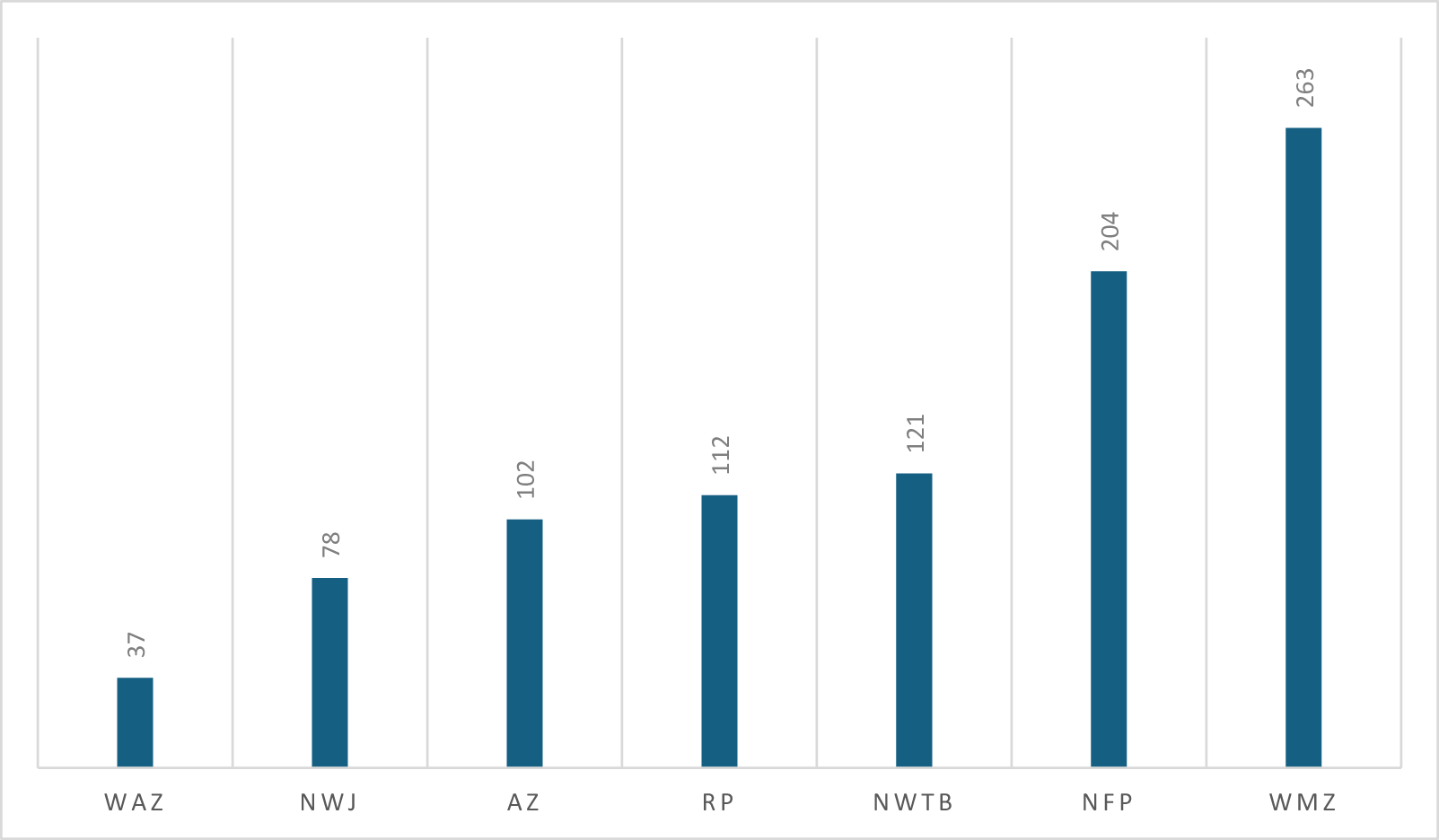
From the time when the Habsburg Empire collapsed, between 16 October 1918 and 21 January 1920, when the peace conference was meeting in Paris, the seven Viennese newspapers published 918 articles referencing Eastern Galicia.Footnote 41 Over 70 per cent of all references to Eastern Galicia appeared on page three or later and more than 80 per cent of these articles were shorter than half a column, most of them significantly so. Unlike coverage of other former crown lands, Eastern Galicia rarely received lengthy or in-depth reporting. As Figure 1 shows, Eastern Galicia was most prominently featured in the Wiener Morgenzeitung, with its Jewish-national focus,Footnote 42 and in the more liberal Neue Freie Presse. In contrast, both the Arbeiter-Zeitung and the Reichspost – positioned on the political left and right, respectively – as well as all other newspapers paid relatively little attention to the region. This can be attributed in part to their editorial priorities: while the Neue Freie Presse, for example, aimed to cover broad international developments extensively, the Arbeiter-Zeitung and Reichspost focused primarily on domestic political affairs within what was left o Austria and paid less attention to developments in the successor states. The high frequency of references to Eastern Galicia and Poland in the Wiener Morgenzeitung can be attributed to the significant Jewish population in the region, the large number of Galician Jews living in Vienna and the close ties between Viennese Jewry and their Eastern Galician counterparts.Footnote 43
Number of recorded items referring to Eastern Galicia by newspaper, 18 January 1919–21 January 1920.

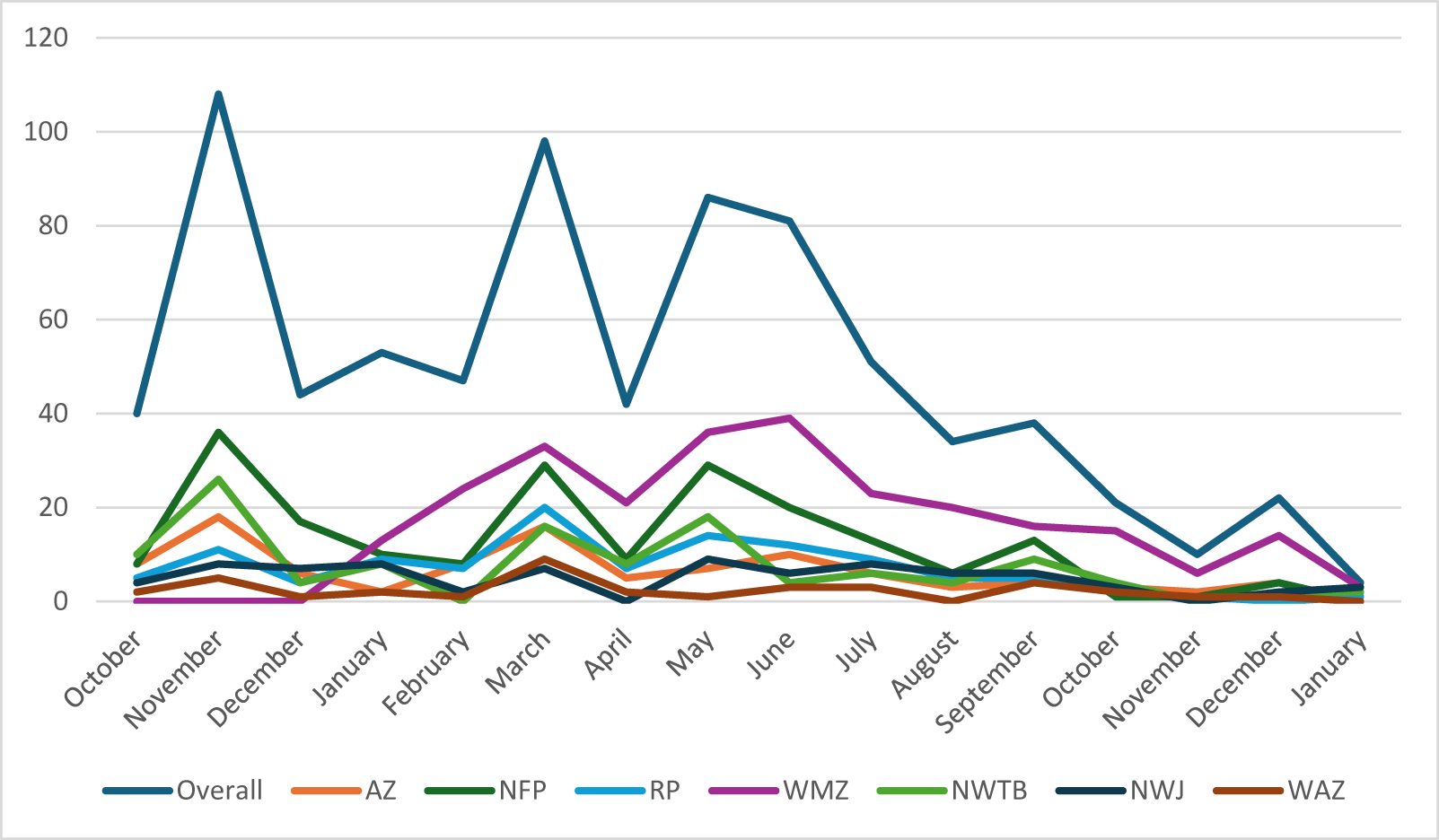
Reporting intensity also varied over time (Figure 2). Most newspapers showed a higher frequency of coverage in the first half of 1919, with a noticeable decline beginning in June. Until July, news coverage was dominated by the ongoing Polish–Ukrainian conflict. After that, attention shifted towards the diplomatic resolution of the issue at the Peace Conference. The overall peak in article frequency occurred in March, triggered by a report from Moscow claiming that a Bolshevik uprising had taken place in Eastern Galicia – a claim that was later proven false. Around 26 March, shortly after the establishment of the Hungarian Soviet Republic, headlines in all four newspapers included variations of ‘Formation of Bolshevik Republics in Eastern Galicia’.Footnote 44
Monthly distribution of recorded references to Eastern Galicia in the sampled Viennese press, October 1918–January 1920.
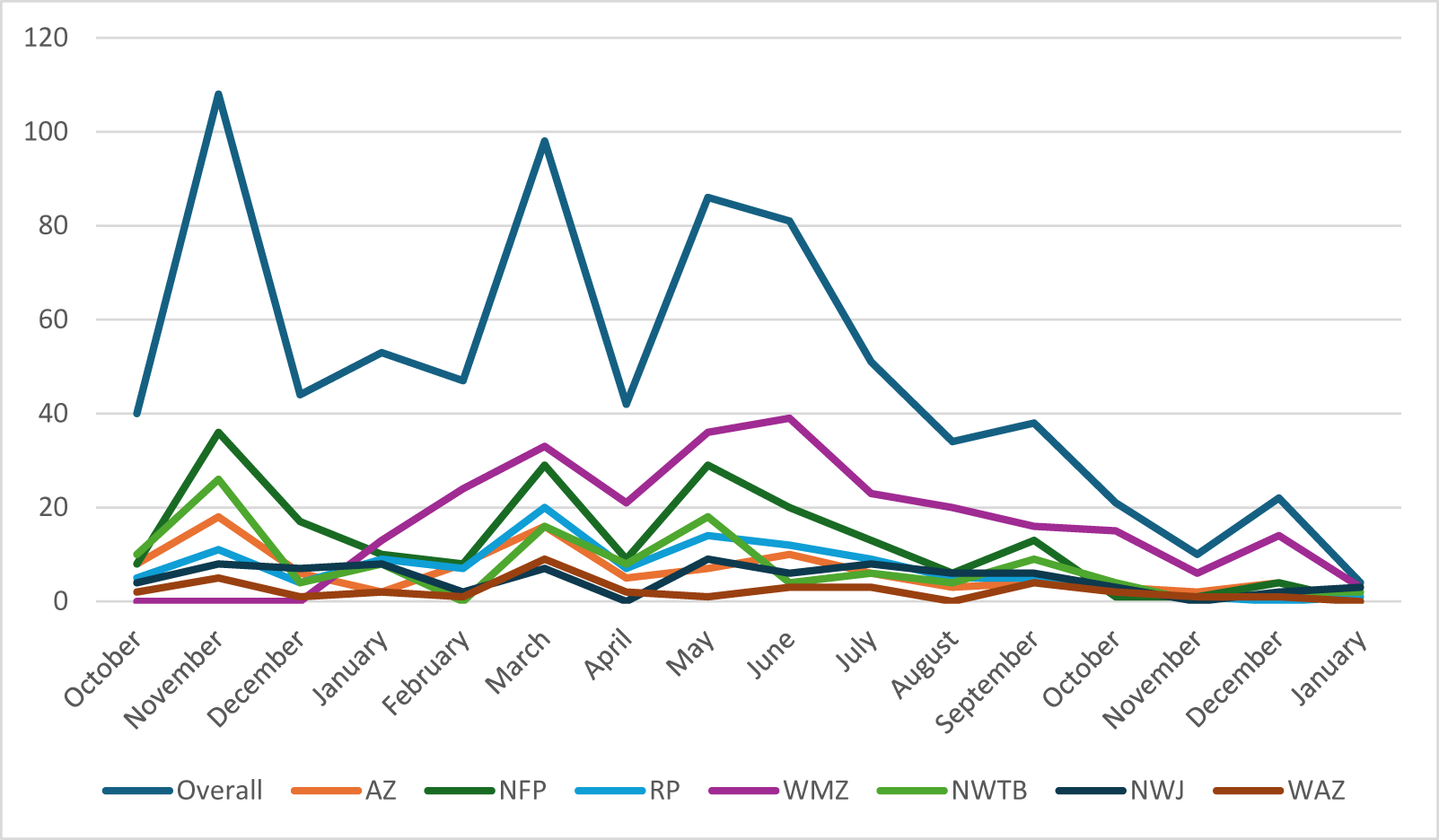
Figure 2 Long description
Monthly distribution of recorded references to Eastern Galicia in the sampled viennese press, October 1918–January 1920. The horizontal axis label: Month. The horizontal axis categories, left to right: October, November, December, January, February, March, April, May, June, July, August, September, October, November, December, January. The vertical axis range: 0 to 120. The vertical axis tick labels: 0, 20, 40, 60, 80, 100, 120. The vertical axis unit: Insufficient visual information to describe this element accurately. Legend labels: Overall, AZ, NFP, RP, WMZ, NWTB, NWJ, WAZ. Line identification by legend: Each series is shown as a separate solid line matching its legend label. Overall series coordinate pairs: (October, 40), (November, 108), (December, 44), (January, 53), (February, 47), (March, 98), (April, 42), (May, 86), (June, 81), (July, 50), (August, 34), (September, 38), (October, 22), (November, 10), (December, 22), (January, 4). AZ series coordinate pairs: (October, 8), (November, 18), (December, 2), (January, 3), (February, 1), (March, 15), (April, 4), (May, 9), (June, 10), (July, 6), (August, 2), (September, 5), (October, 3), (November, 1), (December, 2), (January, 1). NFP series coordinate pairs: (October, 10), (November, 36), (December, 16), (January, 9), (February, 8), (March, 30), (April, 10), (May, 29), (June, 20), (July, 14), (August, 7), (September, 12), (October, 4), (November, 2), (December, 4), (January, 2). RP series coordinate pairs: (October, 6), (November, 12), (December, 8), (January, 9), (February, 7), (March, 20), (April, 8), (May, 14), (June, 12), (July, 9), (August, 6), (September, 5), (October, 4), (November, 2), (December, 2), (January, 2). WMZ series coordinate pairs: (October, 0), (November, 0), (December, 0), (January, 12), (February, 24), (March, 33), (April, 21), (May, 36), (June, 39), (July, 23), (August, 20), (September, 16), (October, 15), (November, 6), (December, 14), (January, 2). NWTB series coordinate pairs: (October, 9), (November, 26), (December, 6), (January, 7), (February, 6), (March, 16), (April, 9), (May, 18), (June, 6), (July, 5), (August, 4), (September, 4), (October, 3), (November, 2), (December, 2), (January, 2). NWJ series coordinate pairs: (October, 4), (November, 8), (December, 6), (January, 9), (February, 2), (March, 7), (April, 1), (May, 9), (June, 5), (July, 4), (August, 4), (September, 3), (October, 2), (November, 1), (December, 1), (January, 1). WAZ series coordinate pairs: (October, 2), (November, 5), (December, 1), (January, 2), (February, 1), (March, 9), (April, 2), (May, 1), (June, 3), (July, 3), (August, 0), (September, 4), (October, 2), (November, 0), (December, 1), (January, 0). Key peaks and lows from the plotted values. Overall: highest at (November, 108) and (March, 98); lowest at (January, 4). AZ: highest at (November, 18) and (March, 15); lowest at (February, 1), (November, 1), (January, 1). NFP: highest at (November, 36) and (March, 30); lowest at (November, 2) and (January, 2). RP: highest at (March, 20); lowest at (November, 2), (December, 2), (January, 2). WMZ: highest at (June, 39) and (May, 36); lowest at (October, 0), (November, 0), (December, 0). NWTB: highest at (November, 26) and (March, 16); lowest at (November, 2), (December, 2), (January, 2). NWJ: highest at (January, 9) and (May, 9); lowest at (April, 1), (November, 1), (December, 1), (January, 1). WAZ: highest at (March, 9); lowest at (August, 0), (November, 0), (January, 0). Overall comparison across series using the plotted values. Overall is higher than the other series in every month shown. WMZ is the largest non-Overall series from January through September, with values from (January, 12) to (September, 16) and a peak at (June, 39). Most series show higher values around November and March and lower values near the final January.
In comparison to other former imperial territories – such as the three major successor states of the Habsburg Empire: the Kingdom of Serbs, Croats and Slovenes; the Czechoslovak Republic; and the Hungarian Soviet and People’s Republics – Galicia was not featured very heavily. Hungary was mentioned on approximately 83 per cent of all days in 1919, Czechoslovakia on 76 per cent and the Kingdom of Serbs, Croats and Slovenes on 58 per cent, while Eastern Galicia ranked only at 25 per cent. Even when considered within the broader context of Poland – into which the region was increasingly integrated – the combined reference rate to Poland and Eastern Galicia reached just under 53 per cent.
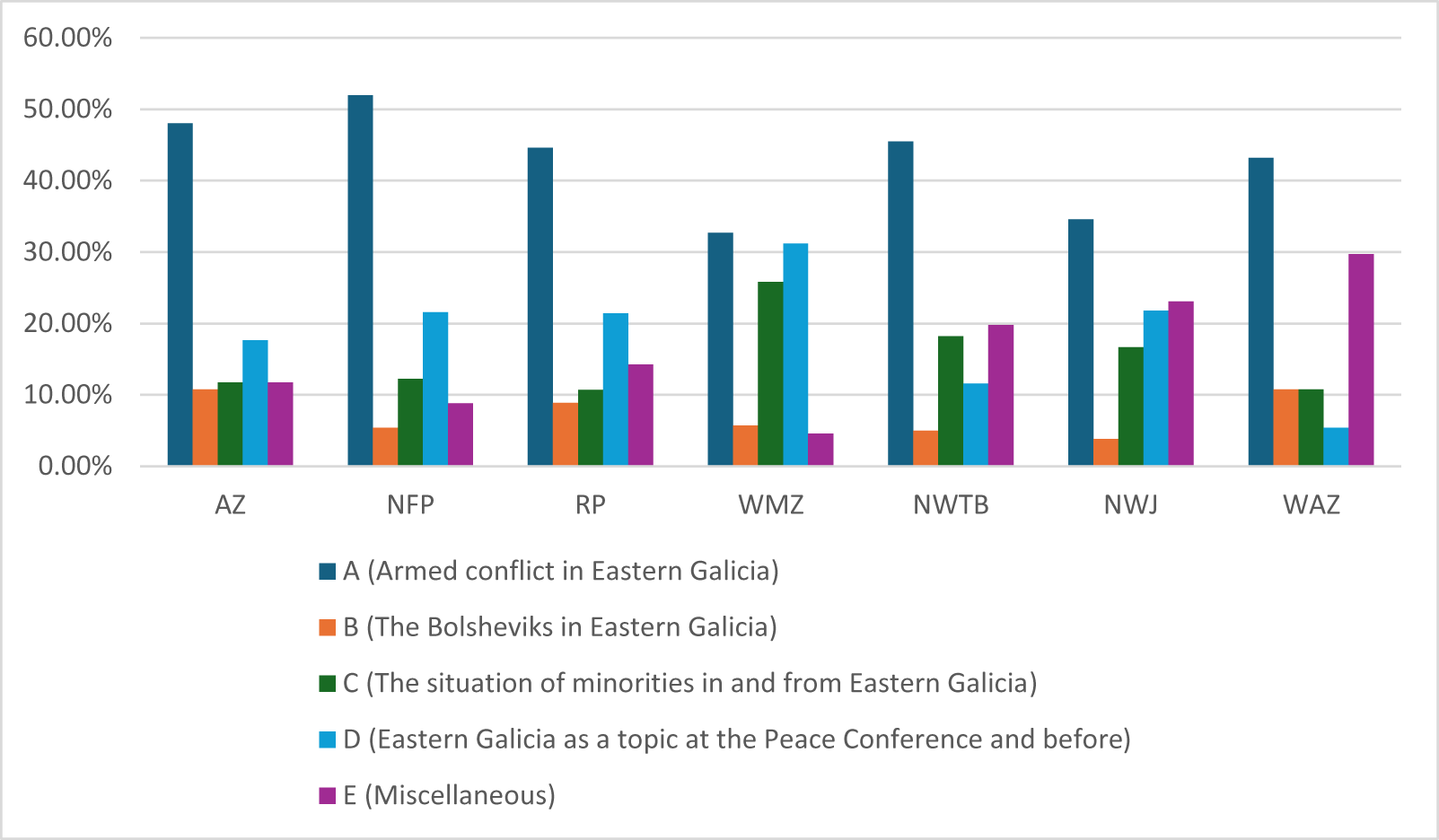
This disproportionate focus can be attributed to the fact that neither Poland nor Eastern Galicia were immediate neighbours of the Austrian Republic. Developments in neighbouring countries had a direct impact on Austria, such as the political upheaval in Hungary, which many politicians and commentators perceived as a threat to domestic stability,Footnote 45 the negotiations with Czechoslovakia regarding coal supplies,Footnote 46 and the territorial tensions with the Kingdom of Serbs, Croats and Slovenes in Austria’s southern provinces.Footnote 47 In contrast, Eastern Galicia was (and had always been) a long way from the new Austrian Republic. However, even if not in great detail, the most important events were reported. To assess not only the frequency but also the thematic structure of the coverage, the recorded items were categorised according to five topoi: A: armed conflict in Eastern Galicia; B: Bolshevik developments in Eastern Galicia; C: the situation of minorities in and from Eastern Galicia; D: Eastern Galicia as a topic at the Peace Conference; and E: miscellaneous. Figure 3 shows the distribution of these categories across the seven newspapers.
Thematic distribution of recorded Eastern Galicia items by newspaper, 18 January 1919–21 January 1920, as percentage of each newspaper’s Eastern Galicia coverage.
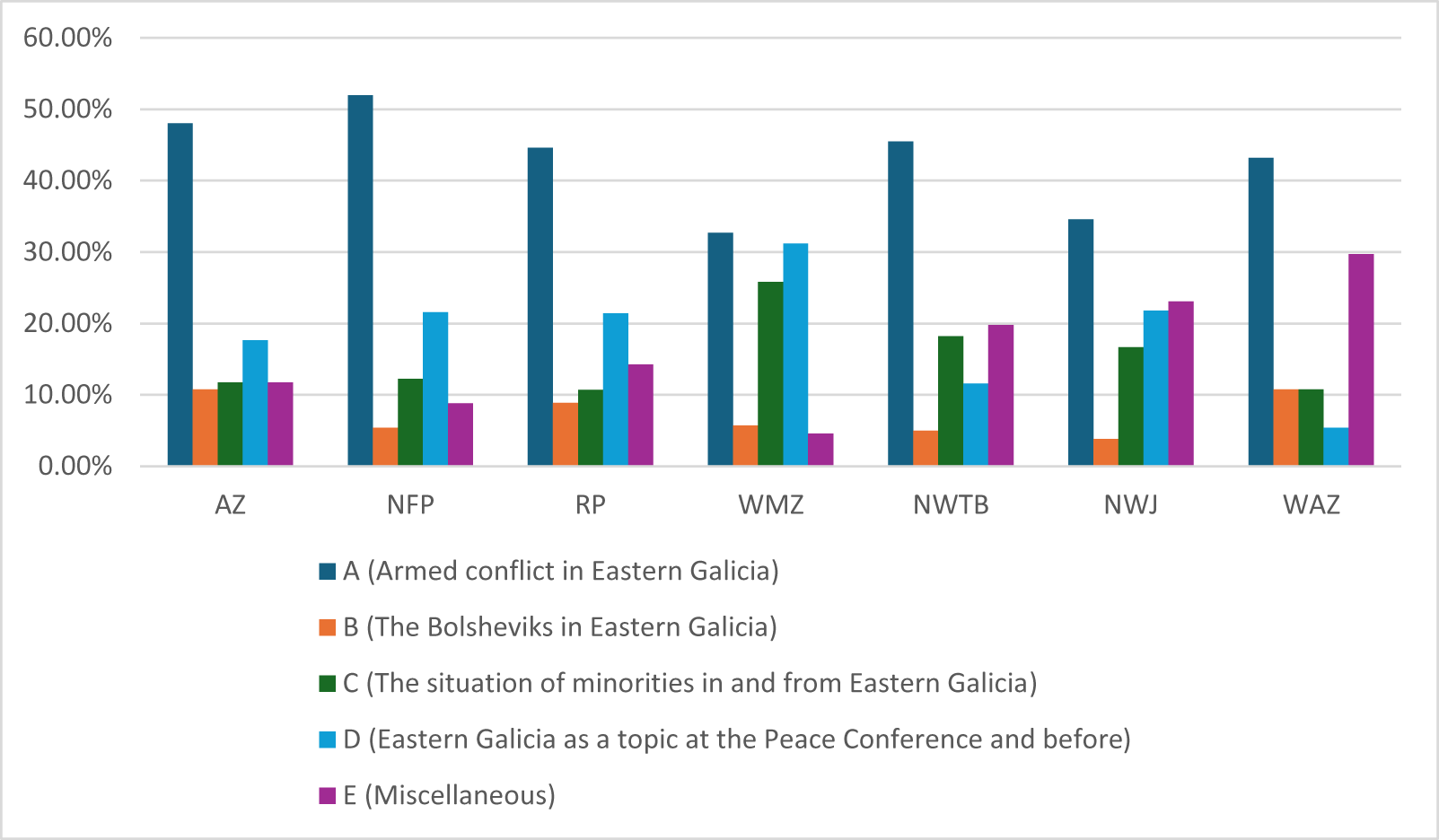
Figure 3 Long description
A grouped bar graph with seven x-axis categories: A Z, N F P, R P, W M Z, N W T B, N W J, W A Z. The y-axis shows percent values from 0.00 percent to 60.00 percent. Legend entries: A left parenthesis Armed conflict in Eastern Galicia right parenthesis, B left parenthesis The Bolsheviks in Eastern Galicia right parenthesis, C left parenthesis The situation of minorities in and from Eastern Galicia right parenthesis, D left parenthesis Eastern Galicia as a topic at the Peace Conference and before right parenthesis, E left parenthesis Miscellaneous right parenthesis. A Z group bars: A about 48 percent; B about 10 percent; C about 12 percent; D about 17 percent; E about 12 percent. N F P group bars: A about 52 percent; B about 5 percent; C about 12 percent; D about 21 percent; E about 9 percent. R P group bars: A about 44 percent; B about 9 percent; C about 10 percent; D about 21 percent; E about 14 percent. W M Z group bars: A about 33 percent; B about 5 percent; C about 26 percent; D about 31 percent; E about 4 percent. N W T B group bars: A about 45 percent; B about 5 percent; C about 18 percent; D about 11 percent; E about 20 percent. N W J group bars: A about 35 percent; B about 4 percent; C about 16 percent; D about 21 percent; E about 23 percent. W A Z group bars: A about 43 percent; B about 10 percent; C about 10 percent; D about 5 percent; E about 30 percent.
In Figure 3, the category ‘Miscellaneous’ includes, for example, reports on travels to Eastern Galicia, a typhus epidemic in Eastern Galicia at the beginning of 1920 or the confiscation of Galician crude oil fields.Footnote 48
(A) Just like during the war, the reporting on the post-war conflict emphasised the suffering of the population,Footnote 49 with particular focus on the battle for Lviv while other locations received little or no coverage.Footnote 50 Reporting centred on the capital city, including its architecture, and thereby shaped the discourse surrounding Eastern Galicia.Footnote 51 While the siege and destruction of Lviv by Ukrainian forces were portrayed rather negatively,Footnote 52 reporting overall tended to be more critical of the Polish side,Footnote 53 especially as the Bolsheviks gained more influence in the region.Footnote 54
(B) On 26 March 1919, all the newspapers under review reported on a radio message from Moscow announcing an alleged Bolshevik coup in Eastern Galicia that later turned out to be false. Across the board, the newspapers emphasised the misery and devastation left in the wake of Bolshevik advances.Footnote 55
(C) The Jewish part of the East Galician population in particular was an important part of the discourse on Eastern Galicia in the inter-war period.Footnote 56 During the First World War, the evacuation tactics of the Habsburg army brought a great number of Eastern Galician refugees to Vienna, many of them Jewish.Footnote 57 Especially the Wiener Morgenzeitung reported on their fate as well as on the situation of the Jewish population remaining in Eastern Galicia.Footnote 58 All newspapers discussed the pogroms against the Jewish population by Poles, for example in Lviv and Tarnopol at the beginning of 1919.Footnote 59
(D) The final decision of the peace conference on Eastern Galicia was often accompanied by contradictory information reaching the public and the press.Footnote 60 In general, it is possible to speak of a negative attitude towards the decisions of the peace conference. Both the Wiener Morgenzeitung and the Reichspost described the decision as ‘unjust’.Footnote 61 Criticism was levelled at the fact that ‘there is no specific official conception in this direction at all’.Footnote 62 The Arbeiter-Zeitung also criticised the conference’s lack of success in bringing peace to Central and Eastern Europe.Footnote 63 This has to be viewed in line with the broader disillusionment in the provisions of the peace in general that was viewed as a catastrophe.Footnote 64 Despite this sympathy for the fate of Eastern Galicia, none of the newspapers analysed highlighted discursive links between Eastern Galicia and the newly established Austrian Republic as will be shown in the next section. Although a kind of discourse of unity between the peoples of the Habsburg monarchy in general and Galicia in particular was prevalent in press coverage, especially at the beginning of the First World War, this changed with the dissolution of the empire. The Ukrainians in particular (known as ‘Ruthenians’ in the Habsburg monarchy) had been celebrated during the war for their loyalty as the ‘Tyroleans of the East’.Footnote 65 The young Austrian state, however, influenced by both the idea of nationalism and, in connection with the idea of unification with Germany (Anschluss), the absence of a specifically German-Austrian identity, viewed Eastern Galicia and the once-important Lviv as sites of Polish and Ukrainian nationalism. With the end of the Habsburg monarchy, connections to the former crown land were rarely emphasised in the press and events in the region were reported in the same way as events abroad had previously been reported in the monarchy. This reflected the general attitude.
Good Riddance? The Idea of Eastern Galicia as a Burden
As early as the end of October 1918, the Neue Freie Presse had reported that the officials of the monarchy in Lviv should continue to perform their duties as before, ‘until the moment when, in the normal course of events, state power can be transferred to the new state organizations yet to be created’.Footnote 66 The fact that this meant the loss of the former Austrian territory was not portrayed in a negative light. The Social Democratic workers’ newspaper, Arbeiter-Zeitung, even repeatedly emphasised the unlawfulness of the Habsburg claim to rule over various national groups.Footnote 67 It pointed out that in the monarchy, the German bourgeoisie had been appointed to rule, despite the Germans being a minority. To maintain their dominance, they had given power to selected groups, such as the Polish szlachta in Galicia, while other nationalities – in this case Ukrainians – were largely excluded from political influence. The German aristocracy in Austria had thus considered the monarchy their fatherland. However, the Arbeiter-Zeitung did not agree with this view:
The fatherland, they say, is what the German men and officers defended. Good heavens, is Galicia, is Bosnia, is Romanian Hungary the fatherland of the Germans? It was the property of the Habsburgs and German blood was claimed for it.Footnote 68
Already in December 1918, the Arbeiter-Zeitung thus made it very clear that in its view, the former territories of Austria-Hungary could not be considered part of the same homeland as the German-speaking regions of the former state. It is particularly evident here that the loss of large parts of the former monarchy was already accepted by the German-Austrian public at the end of 1918 and supported by the press. In March 1919, for example, the Deutsches Volksblatt emphasised: ‘We must break away from the past and also from our memories of it and face up to the reality of the situation, the facts.’Footnote 69
The widespread emphasis on a break with the former monarchy was also driven by pragmatic political considerations. The first Austrian Republic – like the other successor states of Austria-Hungary – had a strong interest connected to the Kriegsschuldfrage and potential reparations in presenting itself as a new state rather than the legal successor of the old empire. This message was reflected in the press. Newspapers stressed that Austria, like the other new states, had adopted a new form of government. As the Arbeiter-Zeitung put it: ‘Deutsch-Österreich [German-Austria] is not Österreich [Austria].’Footnote 70 The Neue Freie Presse emphasised that ‘Austria’, as a distinct territorial entity, had never truly existed under the monarchy. Instead, it had been a union of diverse regions like Dalmatia, Bohemia and Galicia. Thus, the new republic did not share anything with the old state except the name.Footnote 71
Thus, when writing about Eastern Galicia, there were only very few instances where references to the fact that the region had previously belonged to Cisleithania were made. For example, the Neues Wiener Tagblatt refers to ‘former Austrian Ukrainians’Footnote 72 and the Neues Wiener Journal to ‘former Austrian Poles’Footnote 73 or to parliamentarians who were well known in Vienna for their many years of parliamentary work.Footnote 74 Even though Brno, Prague, Budapest and Lviv were considered nearby foreign countries that young Austrian teachers would be most likely to move to, neighbouring countries were primarily seen as just that: neighbours.Footnote 75
However, the general distancing from Austria-Hungary did not mean that some media outlets did not perceive the end of the empire as a catastrophe. This was particularly true for the Reichspost and the Neue Freie Presse. The latter wrote in March 1919 that the Entente was only now starting to realise ‘that the destruction of Austria was one of the greatest mistakes’ they had made.Footnote 76 The Reichspost also mourned the idea of the old Austria. It described the ‘world-historical day on which the phrase of the right to self-determination burst the framework of the Danube monarchy’ as an especially ‘bad day for the future’ of the successor states, because the disintegration had been followed by further unrest:Footnote 77
Has the complete breakaway from the Germans in Austria really been so advantageous [for the other successor states]? … What misery is caused by discord and mutual violence! Only now does it become apparent how much, despite all the damage, the Austrian idea could have meant, for despite all the spitefulness, it was possible to prevent the antagonisms from escalating into open warfare and the peoples from facing each other with weapons in their hands… . As is well known, the understanding between the two peoples was almost complete several years ago …Footnote 78
The suggestion here, as reflected in further articles by the Neue Freie Presse, was that those who should mourn the loss of the Danube monarchy the most were the Poles and Ukrainians living in Galicia as they had profited the most from the empire.Footnote 79 The idea was that the monarchy had not only been a stabilising factor in the former territories but also provided the poorer regions with support:
Spoiled by the common table for centuries, accustomed to living comfortably from the common good and from the common work, the peoples now quarrel over the inheritance and violence and extortion are to supplement each one’s own inadequate means from the possessions of the neighbour… . [Before] There had been antagonisms, but what were they in comparison with the antagonisms that have arisen with the separation. Each nation was protected in its own way under the common coat of arms and protected from hostile threats. Each was able to pursue its own cultural path, not at the same pace, but all were able to move forward. Living and working together opened up sources of strength and opportunities for development for the small, weak peoples… Only in retrospect do they understand the meaning of the old state and the historical tendency towards unification gains new strength… . National egoism has wrested the helm of humanity from us… . We are drifting towards dark ends… . Only the revival of the idea of justice between peoples, that highest ethical idea whose political fulfilment the old Austria strove for, can save us.Footnote 80
As reported by the Reichspost, German-Austria had sacrificed a great deal for the empire.Footnote 81 According to this logic, what was later to become the Austrian Republic had not benefited from the empire at all, but only the other ungrateful regions, which now wanted nothing more to do with Austria. Deutsches Volksblatt correspondingly wrote about non–German-speaking parliamentarians who, ‘however much they were officially obliged to rejoice at the collapse of the Reich’, could not suppress ‘a secret regret that they would have to sever all the ties they had established with Vienna over the years’.Footnote 82 The view of the Entente and France that Austria had ‘robbed the provinces of their blood in favor of the imperial centre’ was thus rejected. The Neues Wiener Tagblatt emphasised that ‘to speak of hostility on the part of the organs of state administration towards the ‘dominated’ peoples is a falsification of history’.Footnote 83 ‘Galicia that was literally fed from imperial coffers’ was proof of this stance for the Reichspost.Footnote 84 For the new Austrian Republic, the breakaway of Eastern Galicia was thus framed as not a loss but rather a relief.Footnote 85
The same view is found in parliamentary debates from the time period. In May 1919, a parliamentarian stated that, in ‘old Austria’, backward ‘lands and their conditions’ had been dragged along, above all Galicia and Bukovina.Footnote 86 ‘Hundreds of millions of German taxpayer money’ had been pumped into these provinces.Footnote 87 Now, according to parliamentarians, laws such as the one on mandatory Sunday rest, as well as on women’s political participation in German-Austria, could therefore be implemented more easily because of the ‘more uniform mental and cultural outlook (Geisteszensus)’ present in the Austrian rump state.Footnote 88 The ‘myth of Galicia’, which had been widespread since the times of the monarchy, also played a decisive role in this.
Prior to the First World War, mentions of the region in the press had often focused on poverty, hardship and alcoholism, reinforcing an image of backwardness.Footnote 89 In connection with the general narrative of Galician misery, the topos of the ‘backward Galician Jew’ was also widespread in Viennese society.Footnote 90 Eastern Galicia was thus not only marginalised socio-economically but also subjected to a form of Orientalist othering. Karl Emil Franzos famously described the region as ‘semi-Asia’, reflecting a common perception in the western parts of the monarchy.Footnote 91 In the Austrian half of the former empire, Galicia was frequently portrayed as the easternmost outpost of European civilisation, an image that both symbolically and ideologically marked the boundary between ‘civilised’ Europe and the perceived chaos of the East.Footnote 92 This narrative served as a retrospective justification for the region’s annexation in the eighteenth century and can already be found in early twentieth-century reports in the Neue Freie Presse.Footnote 93 Such discursive patterns shaped how the Viennese press – and its readership – continued to frame Galicia (and especially Eastern Galicia) in the years after the collapse of the monarchy.
The First World War hit Galicia especially hard and press coverage in Vienna on the war and its effects on the local population was extensive.Footnote 94 Reports of wartime suffering further reinforced Galicia’s already negative image.Footnote 95 After the fall of the Habsburg Empire, it continued to be portrayed as a place of misery – no longer to justify its occupation, but rather its loss.Footnote 96 The coverage effectively denied any historical connection to the region, presenting it as a foreign land, as though it had never been part of the Habsburg monarchy:
The poverty in Eastern Galicia is so severe and the number of people who can neither read nor write so shamefully high, that Bolshevism, this scourge for past mistakes, was able to take root in people’s minds all too easily.Footnote 97
Galicia’s perceived backwardness was portrayed as fertile ground for communism. The claim that ongoing experiences of hardship and violence made the region particularly susceptible fits seamlessly into pre-existing narratives of a neglected Galicia, positioned somewhere between Asia and Europe, between Bolshevism and civilisation. Referring to Bolshevism as a ‘scourge for past mistakes’ and highlighting the shame of widespread illiteracy absolves any sense of shared responsibility.
The press presented the breakaway as a relief with the exception of some reports on Lviv.Footnote 98 The return of Galician refugees in Vienna to their homeland was connected to this. During the war, thousands of Galician refugees had come to Vienna, many of them Jews. This was a widespread topic at the time and also discussed in parliament.Footnote 99 In February 1919, the growing tensions on the housing market because of the ‘refugee movement from Galicia’ became even more obvious.Footnote 100 The Jewish Wiener Morgenzeitung campaigned for adequate care for this group and protested against their deportation, citing the prolonged fighting and devastation in Eastern Galicia.Footnote 101 While many newspapers reported on the issue rather neutrally or sympathetic towards those affected,Footnote 102 the antisemitic Reichspost, which generally, unlike the other papers, reported not on the suffering of the Jewish population but only on the situation of the Ukrainian and German minorities under Polish rule, took a diametrically opposed stance.Footnote 103 Antisemitism was already a tradition, and the image of Jews as fraudulent and exploitative usurers, peddlers and industrialists, among other stereotypes, was a much-used topos by the paper.Footnote 104 Accordingly, several articles from the period under investigation used the antisemitic stereotype of the ‘Eastern Jew’Footnote 105 and spoke of a ‘plague’ on the city by ‘refugees from the East, who, in addition to all our misery, bring us new difficulties in earning a living and feeding ourselves’.Footnote 106
This view is reflected in the parliamentary debates, where Galician refugees in Vienna were accused of having amassed large fortunes through ‘not always very appetizing businesses’.Footnote 107 The use of these narratives against immigrants can also be found in a weakened form in the Arbeiter-Zeitung, certainly also as a reaction to the accusation by the conservative Christian Social Party (Christlichsoziale Partei) that it was controlled by Jews.Footnote 108 It talks about the danger of rich refugees for the food supply, as they ‘know how to get food for a lot of money and thus worsen the situation of the general public’.Footnote 109 The Reichspost even emphasised the need for a ruthless approach here, as they were no longer obliged to look after these people;
This was ‘the old system’ under which Vienna, as the imperial capital, had to tolerate the immigration of such elements. Today, these considerations have fallen away and they are no longer fellow citizens of the same state. Here, too, the new Free State has a clear path ahead of it and free hands.Footnote 110
Even if the former affiliation of Galicia as a crown land to the Habsburg monarchy was emphasised in this case, this did not serve to establish a discursive connection to the first Austrian Republic, but rather acted as a justification for the now non-existent responsibility towards this unwelcome group. Eastern Galicia appears here as a burden that has now ‘fallen away’, which can be linked to the understanding of the region as backward. The discourse on the topic thus fits into existing patterns of understanding. The broad thematisation of this topic also highlights the Viennese newspaper landscape’s focus on its own suffering and heightened hostility towards refugees, as, in 1919, a hunger and heating crisis was looming.
Economic Ties and the German Minority
The economic challenges the new Republic faced did not fuel calls for a return to the empire. Rather, they underscored the urgent need to establish a functioning Austrian republican government capable of negotiating effectively with neighbouring successor states. Although the loss of the other former territories, especially Galicia, was widely accepted and even received with a certain degree of relief, the press of the young Republic also called for ‘economic understanding with the nation states that had formed on the soil of the former monarchy’. The Neue Freie Presse did not support the idea of a Danube federation proposed by France.Footnote 111 However, ‘peaceful economic relations, contractual security, the greatest possible freedom of movement and financial order’ were to be restored.Footnote 112 Despite political tensions, there was a shared interest across the region in re-establishing economic ties. The press repeatedly emphasised the continuing links between the successor states of the monarchy.Footnote 113 For example, the Wiener Morgenzeitung wrote at the end of 1919:
The future of German-Austria is closely interwoven with that of Czechoslovakia, Hungary, Yugoslavia, but also partly with that of Romania, Poland and Ukraine, primarily, however, in economic terms, whereby it must be taken into account that especially in the present time economy and politics can be separated less than ever.Footnote 114
These demands were not about old affiliations but rather economic necessities. Within Austria, all major political parties, despite their differing ideologies, embraced a pragmatic approach to foreign policy, characterised by openness, diplomatic adaptability and a strategy of leveraging relationships with multiple powers.Footnote 115 The reporting on Eastern Galicia thus also reflects the young republic’s search for identity, which on the one hand distanced itself from its former possessions and at the same time had to search for new patterns of identification due to the impossibility of joining Germany. The Neues Wiener Tagblatt wrote that in the future ‘Vienna and all of German-Austria will be more focused on economic relations than before and it is necessary to form an opinion about the value of future relations with neighbouring peoples’.Footnote 116 Eastern Galicia, widely regarded as one of the most economically backward crown lands of the Habsburg Empire, was not among the territories most deeply mourned by the rump state of Deutschösterreich following the monarchy’s collapse. It was not Galicia, but rather the loss of the Bohemian coal basins, that was most acutely felt in Vienna – coal being essential for the capital’s survival.Footnote 117 However, in the wake of the empire’s disintegration, Galicia was frequently invoked in discussions about food supply during the imperial period.Footnote 118 This also happened in the parliamentary debates, where it was emphasised that Deutschösterreich, which had been fed ‘by the whole East’,Footnote 119 was now left to its own devices. It could no longer hope for wheat importsFootnote 120 or livestock deliveries from Galicia.Footnote 121 And Galicia possessed one notable resource: the oil fields of Boryslav (Boryslaw/Borysław).Footnote 122 The Neues Wiener Tagblatt wrote regarding this topic:
Petroleum has risen with tremendous force and speed as a young giant, on whose mighty shoulders a large part of our well-being and our employment opportunities rest. We have had bitter experiences of what this brother of coal means when it left us.Footnote 123
The oil extraction and refining industry there had reportedly been profitable, but it was now outside Austria’s reach.Footnote 124 As one newspaper lamented, ‘Galicia is the land of gasoline and we receive just as little petrol from there as we do coal from Czechoslovakia’.Footnote 125 For this reason, there were also detailed reports about the confiscation of Austrian private property by the Polish state in the crude oil mines of Boryslav. Der Neue Tag emphasised that this measure was directed against ‘Austria’, to which Galicia itself had belonged until the collapse. ‘Ultimately, it represents an attack on the capital of Vienna’.Footnote 126 Yet even this loss was only mentioned occasionally – and typically in passing.Footnote 127
Other regions, such the Czech territories, were seen as far more relevant to Austria’s survival.Footnote 128 Just as the supply of coal from the neighbouring Czechoslovak Republic was much more important to the Austrian government than Ukrainian oil, so too were the Germans living in Bohemia, Moravia, Silesia and South Tyrol. As late as November 1918, the Reichspost wrote of German-language islands in Galicia and Bukovina, which should – in its view – belong to the German remnants of Austria. However, this idea was soon rejected as they were too far away from the other German territories.Footnote 129 In September 1919, even the Reichspost only demanded minority rights within Poland for these groups.Footnote 130 Other regions received more attention as they were neighbours and featured a large German minority.Footnote 131 Many still dreamed of annexing the compact German settlement areas in Bohemia or South Tyrol to either the young Austrian Republic or a larger Germany.Footnote 132 This focus was expressed, for example, in the presentation of the new curriculum in Austria, which was outlined in the Arbeiter-Zeitung at the beginning of October 1919:
Of the neighbouring nation states on the territory of the former Austro-Hungarian monarchy, the Czecho-Slovakian state will deserve the most attention, not only for geographical reasons (German low mountain range), but also because of the large German territories in Bohemia, Moravia and Silesia. On the other hand, the Carpathian region will take a back seat in our teaching, Galicia will naturally be completely excluded from the Vaterlandskunde [. . .]. In the future, all of these countries will belong to the ‘other countries of Europe’, in whose row they will be treated.Footnote 133
While Czechoslovakia was now also a foreign country, knowledge about it was much more important than knowledge about other former Austrian territories. The fact that Galicia in particular was cited as an example speaks volumes. In short, Galicia provoked little more than symbolic ‘phantom pain’ in the public discourse of post-imperial Austria. While occasionally referenced for its past economic contributions, particularly in food supply and oil production, it did not carry the same emotional or practical weight as the loss of Bohemia or other more industrialised regions.
Conclusion
The case of Eastern Galicia, while certainly present in the Viennese press during the time of the peace conference, remained on the margins of public discourse, as demonstrated by the quantitative analysis of four key newspapers. Although mention of the region varied across the outlets, overall coverage was limited in scope and depth. It lacked any significant attempt to assert historical ties or territorial claims. With the notable exception of border regions with substantial German-speaking populations, the loss of the empire was largely accepted by the press, and Galicia was no exception.
The coverage of Eastern Galicia tended to draw on pre-existing narratives that portrayed the region as impoverished, violent and unstable, all elements of what has been described as the myth of Galicia during the monarchy. This was reinforced by associations with Jewish refugees, Bolshevik threats and widespread disorder, further embedding Galicia in a discourse of otherness and detachment. The press, reflecting the broader public and political sentiment, no longer regarded Galicia, or its population, as within the realm of German-Austrian responsibility or identity. Here, the concept of ‘phantom borders’ operates in reverse: the empire disintegrated and new borders came into being. While ‘phantom pains’ appeared in press coverage with regard to regions in Bohemia or Italy with large German-speaking communities, they were notably absent in the case of Galicia. This was perhaps because, within the empire, a ‘phantom border’ persisted that symbolically cordoned off Galicia as one of the last-acquired and most clearly ‘backward’ crown land until 1918, when it turned into an actual border. What remained was a pragmatic sense of loss, focused primarily on economic concerns: the end of food shipments and the loss of the oil fields near Boryslav were repeatedly lamented. However, this did not give rise to irredentist demands. Rather, both political and media discourses centred on the need for renewed economic cooperation among the successor states, rather than any form of territorial revisionism.
Ultimately, the reporting on Eastern Galicia reveals important insights into the national self-image of the emerging Austrian state. The press, while highlighting Austria’s economic fragility and dependence, firmly rejected the notion of continuity with the former Habsburg Empire. The monarchy was understood as a thing of the past, and with it, the connection to Galicia was definitively severed.
Acknowledgements
This article was written with the help of the Post-DocTrack fellowship of the Austrian Academy of Sciences.

 Open access

