INTRODUCTION
Climate change has been a generally well-established idea within the scientific community since the 20th century (Houghton et al. Reference Houghton, Meira Filho, Callander, Harris, Kattenberg and Maskell1996) and the development of global climate change models (GCMs) provides the opportunity to estimate such changes in climate on a global scale (Rosenzweig & Iglesias Reference Rosenzweig and Iglesias1994; Harrison et al. Reference Harrison, Butterfield and Downing1995; Wolf & Van Diepen Reference Wolf and Van Diepen1995; Watson et al. Reference Watson, Zinyowera and Moss1996; Sathaye et al. Reference Sathaye, Dixon and Rosenzweig1997; Sirotenko et al. Reference Sirotenko, Abashina and Pavlova1997; Downing et al. Reference Downing, Harrison, Butterfield and Lonsdale2000). The GCM output results were statistically or dynamically down-scaled (Laprise Reference Laprise2008) to define regional climate changes (Alexandrov et al. Reference Alexandrov, Eitzinger, Cajic and Oberforster2002; Lalic et al. Reference Lalic, Eitzinger, Mihailovic, Thaler and Jancic2012). A key focus of much current research is to predict future changes in climate at individual locations and to suggest how these changes will curtail current agricultural production (Eitzinger et al. Reference Eitzinger, Orlandini, Stefanski and Naylor2010).
The Republic of Serbia belongs to the Balkan region, which is composed of several emerging countries in which agriculture is a very important part of the economy. Emerging countries are especially vulnerable to climate variability and extreme weather events (Sivakumar & Motha Reference Sivakumar and Motha2007; Stigter Reference Stigter2010) due to the lack of science-based agricultural policy and low levels of agricultural inputs (Lalic et al. Reference Lalic, Eitzinger, Mihailovic, Thaler and Jancic2012).
Soybean is an integral part of food production, because the grain legumes are a primary source of protein for humans and animals. Soybean is sown on 171 000 ha of land in Serbia and is the third most widely grown crop in the country, after maize and wheat: in 2010, 540 859 t of soybean seed was produced. After sunflower, soybean is the second most favoured oil used in human consumption. In 2007, 52 399 t of soybean oil was produced. Soybean is of great importance for soil management, as it enriches the soil by fixing atmospheric nitrogen (N) (Kumar et al. Reference Kumar, Pandey, Shekh, Dixit and Kumar2008).
Soybean is native to tropical and wet regions. It is a thermophilic plant, and the highest yield results are observed when mean summer day temperatures are 19–21 °C and night temperatures are above 13 °C. Soybean is one of the major crops grown during the April–September growing season. It does not generally have high water demands, except during the flowering and grain filling stages. Higher temperatures and frequent drought periods in summer months, along with lower precipitation and water shortages, are expected in the future and may result in damage to agricultural production, which would curtail much of the April–September crop production. The aim of the current research was to estimate the impacts of climate change on current cropping management, yield and irrigation demand, as well as the carbon dioxide (CO2) fertilization effect on yield in Serbia.
Integrating crop models with climate change scenarios may provide important information to quantify the impacts of climate change on growing dynamics and yield. The Decision Support System for Agrotechnology Transfer (DSSAT) 4·2 crop model (Tsuji et al. Reference Tsuji, Hoogenboom and Thornton1998) was used to estimate climate change impacts on current soybean cropping management and production strategies. The scientific community has successfully calibrated and validated the DSSAT crop model for various regions and soybean varieties (Southworth et al. Reference Southworth, Pfeifer, Habeck, Randolph, Doering, Johnston and Rao2002; Mall et al. Reference Mall, Lal, Bhatia, Rathore and Singh2004; Kumar et al. Reference Kumar, Pandey, Shekh, Dixit and Kumar2008). Potential adaptation measures were estimated with the DSSAT crop model by Southworth et al. (Reference Southworth, Pfeifer, Habeck, Randolph, Doering, Johnston and Rao2002) and Travasso et al. (Reference Travasso, Magrin, Rodriguez and López2009). Additionally, this model has been used for simulating sowing dates (Paknejad et al. Reference Paknejad, Pad, Ilkaee and Fazeli2012), estimating evapotranspiration and irrigation management in the USA (Hoogenboom et al. Reference Hoogenboom, Jones, Boote and Ritter1991) and yield simulations in India (Lal et al. Reference Lal, Singh, Srinivasan, Rathore, Naidu and Tripathi1999).
The DSSAT v. 4·2 model was used to quantify the following: (a) the climate change impact on current cropping management and soybean yield in Serbia using three GCMs: the European Centre Hamburg Model (ECHAM), The Hadley Centre Coupled Model (HadCM) and the National Center for Atmospheric Research Parallel Climate Model (NCAR-PCM) under two climate scenarios (A1B and A2) for 2030 and 2050 IPCC (2000); (b) the CO2 fertilization effect on yield; (c) the climate change impact on irrigation demand; and (d) water productivity (WP) for 1971–2000, as well as in 2030 and 2050.
MATERIALS AND METHODS
Location
The Republic of Serbia (46° 11′–41° 53′ N, 18°49′–23°00′ E) is situated mostly in the central Balkan region, whereas the northern part is located in the Pannonian lowland. The mean annual temperature for the period 1961–90 ranged from 10 to 10·9 °C, and the mean annual precipitation ranged from 540 to 820 mm (RHSS 2012).
Chernozem is the dominant soil type of the northern region of Serbia (Vojvodina), where most crop production is concentrated, covering almost half of the region's cultivated area. This soil type is characterized by a transitional horizon. Their mechanical composition and structure, including the presence of calcium carbonate (CaCO3) and large humus content, result in physico-mechanical properties favourable for agricultural production (www.fao.org).
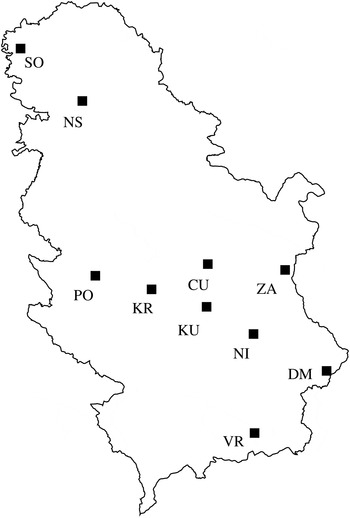
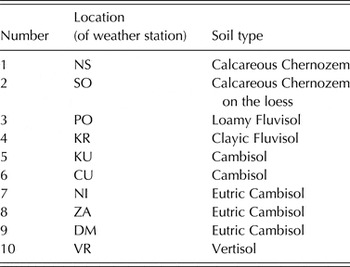
Soil types and sub-types, according to the FAO 2006 classification (IUSS Working Group WRB 2007), are given in Table 1 for the ten locations selected for the current experiment: Novi Sad (NS), Sombor (SO), Pozega (PO), Kraljevo (KR), Krusevac (KU), Cuprija (CU), Nis (NI), Zajecar (ZA), Dimitrovgrad (DM) and Vranje (VR). Soil data included profile depth, texture (clay, silt, sand percentages) and chemical characteristics (organic carbon and N percentages). The experimental locations are presented in Fig. 1. These data were collected by the Agency for Environmental Safety in the vicinity of weather stations.
The experimental locations.

Soil types with sub-types for ten chosen locations

NS, Novi Sad; SO, Sombor; PO, Pozega; KR, Kraljevo; KU, Krusevac; CU, Cuprija; NI, Nis; ZA, Zajecar; DM, Dimitrovgrad; VR, Vranje.
Current climate, climate scenarios and crop model weather input data
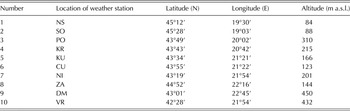
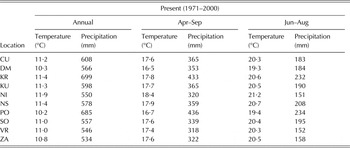
The current state of the climate was estimated using the observed daily weather data from ten weather station reports of the Republic Hydrometeorological Service of Serbia (RHSS) (Fig. 1, Tables 2 and 3). The weather data set included daily maximum and minimum temperature, precipitation, evaporation, solar radiation and wind speed for the period 1971–2000.
Location of weather stations
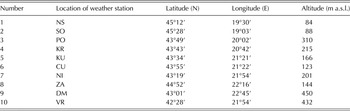
NS, Novi Sad; SO, Sombor; PO, Pozega; KR, Kraljevo; KU, Krusevac; CU, Cuprija; NI, Nis; ZA, Zajecar; DM, Dimitrovgrad; VR, Vranje.
Current climate (1971–2000) in Serbia: annual, April–September and June–August

NS, Novi Sad; SO, Sombor; PO, Pozega; KR, Kraljevo; KU, Krusevac; CU, Cuprija; NI, Nis; ZA, Zajecar; DM, Dimitrovgrad; VR, Vranje.
For expected climate conditions, the GCM results were obtained from the following integrated coupled models: HadCM3, developed at the UK Hadley Centre for Climate Prediction and Research (Gordon et al. Reference Gordon, Cooper, Senior, Banks, Gregory, Johns, Mitchell and Wood2000); ECHAM5, developed at the Max Planck Institute for Meteorology (Roeckner et al. Reference Roeckner, Bäuml, Bonaventura, Brokopf, Esch, Giorgetta, Hagemann, Kirchner, Kornblueh, Manzini, Rhodin, Schlese, Schulzweida and Tompkins2003); and NCAR-PCM, developed at the National Center for Atmospheric Research (Washington et al. Reference Washington, Weatherly, Meehl, Semtner, Bettge, Craig, Strand, Arblaster, Wayland, James and Zhang2000). The ‘Met & Roll’ weather generator statistically down-scaled the GCM results and synthesized the daily weather data series for the ECHAM5, HadCM3 and NCAR-PCM climate model outputs. The A1B and A2 IPCC (2000) scenarios were used for greenhouse gas (GHG) emissions for two integration periods, 2030 and 2050. The crop simulations were performed for climate scenarios (based on IPCC 2001 report) with and without considering the effect of increasing atmospheric CO2 concentration on photosynthesis efficiency (hereafter termed the ‘CO2 effect’). Absolute change in temperature and relative change in precipitation was estimated for 2030 and 2050, relative to the 1971–2000 baseline period. Mean temperature and precipitation were estimated for annual values, April–September and June–August periods.
Crop model and crop simulation
The DSSAT v. 4·2 crop model is a result of the International Benchmark Sites Network for Agrotechnology Transfer (IBSNAT) project, developed by Tsuji et al. (Reference Tsuji, Hoogenboom and Thornton1998). It is a shell that allows the user to organize and manipulate data to run crop models (Hoogenboom et al. Reference Hoogenboom, Tsuji, Pickering, Curry, Jones, Singh, Godwin, Rosenzweig, Allen, Harper, Hollinger and Jones1995; Thornton et al. Reference Thornton, Bowen, Ravelo, Wilkens, Farmer, Brock and Brink1997) and includes a suite of sub-modules that describe atmosphere–soil–crop interactions and operate with minimal input data sets. The model was originally developed and defined in 1984 and periodically improved until 1988 (IBSNAT 1984, 1986, 1988, 1989).
The selected crop model was SOYGRO (Tsuji et al. Reference Tsuji, Hoogenboom and Thornton1998), because it is physiologically oriented for legume cropping management. It predicts crop development, dry matter growth, leaf area index (LAI) and final soybean yield, depending on daily weather data (maximum and minimum temperature, precipitation, solar radiation, photoperiod), soils and specific genetic coefficients (Jones et al. Reference Jones, Boote, Jagtap, Hoogenboom and Wilkerson1988). SOYGRO has components that simulate phenology, as well as soil–water and plant–N balance. Phenology is an important component of the SOYGRO crop template approach. The phenology component uses information from the cultivar (genetic) file, which contains cardinal temperature values, as well as information from the cultivar and ecotype files, which contains physiological day durations for respective life-cycle phases. Life-cycle progress through any given phase depends on a physiological day accumulator, which is a function of temperature and day length in many cases. Crops such as soybean are sensitive to day length. When the physiological day accumulator reaches a value defined by a threshold given in the cultivar file, a new growth stage is triggered (Hoogenboom et al. Reference Hoogenboom, Jones, Porter, Wilkens, Boote, Batchelor, Hunt and Tsuji2003).
Soil–water balance simulates irrigation demand, soil evaporation, transpiration and evapotranspiration, while N balance includes N uptake, fixation and mobilization results (Hoogenboom et al. Reference Hoogenboom, Jones and Boote1990). The soil–water balance simulation was adapted from the model of Ritchie & Otter (Reference Ritchie, Otter and Willis1985), while potential evapotranspiration was calculated using the Priestley & Taylor (Reference Priestley and Taylor1972) equilibrium evaporation concept. This model has been used to predict evapotranspiration and irrigation management in the USA (Hoogenboom et al. Reference Hoogenboom, Jones, Boote and Ritter1991).
The SOYGRO model has the capacity to simulate the direct physiological effects of increased atmospheric CO2 concentrations on plant photosynthesis and water use, and it may adequately simulate CO2 fertilization (Hoogenboom et al. Reference Hoogenboom, Tsuji, Pickering, Curry, Jones, Singh, Godwin, Rosenzweig, Allen, Harper, Hollinger and Jones1995; Siqueira et al. Reference Siqueira, Farias, Sans, Rosenzweig and Iglesias1994; Jones et al. Reference Jones, Boote, Jagtap, Hoogenboom and Wilkerson1988).
The advantage of this model is that it is ideal for the purpose of assessing the impact of climate change and identifying adaptation options, as changes in essential signals in the soybean growing period can be detected on a daily time-scale, and the soybean response to cropping practice can then be quantitatively examined.
Decision Support System for Agrotechnology Transfer model calibration, validation and outputs
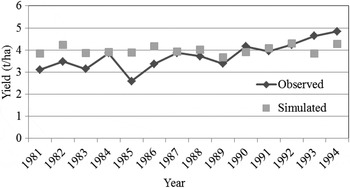
The data used for model calibration included daily weather data, soil characteristics, cropping management data related to time and number of operations and genetic coefficients that describe soybean variety characteristics. Observed field-level data were used to ensure that the simulated yield reflected the observed yield in representative agricultural areas. The experiment was conducted from 1981 to 1994 by the Institute for Field and Vegetable Crops at Novi Sad; common cropping management practices for soybean maturity group II were used. Figure 2 shows that DSSAT v. 4·2 was correctly validated for soybean maturity group II at the Novi Sad location for explicit genetic coefficients: the relative deviation was 8·33%. The cropping management applied was typical of soybean production areas in Serbia: sowing occurred on 20 April 1981, under an irrigation method with a fixed soil water threshold of 50% available water. Fertilizers were applied once in autumn as a base dose, with 30 kg N/ha, 60 kg P/ha and 50 kg K/ha. Harvest occurred when plants had reached maturity, on 15 August 1981. Figure 2 shows that the trend of improved technology was not captured by the model due to fixed crop management practices. Note that under different climate scenarios the sowing date was fixed, and there was no change to crop management settings.
Soybean yield (t/ha) validation under 50% available water for the Novi Sad location without CO2 effect.

The impact of climate change on soybean yield was quantified for 2030 and 2050, calculated relative to the baseline yield (1971–2000) for each of the ten locations.
First, crop simulations were performed in ‘climate-change only’ conditions (i.e., including only air temperature, precipitation and solar-radiation impacts on yield). The atmospheric CO2 concentration used in these simulations was 330 ppm for the current climate (1971–2000), 2030 and 2050.
In the next step, the CO2 fertilization effect on yield was estimated. Simulations were performed using future CO2 concentrations, according to the IPCC's Assessment Report (IPCC 2001).
The irrigation method in the DSSAT model was set as automatic timing with fixed 50% available water irrigation threshold, which provides the optimal amount of water to cover the estimated soil water deficiency. The same threshold for soybean production was recommended in Hoogenboom et al. (Reference Hoogenboom, Paz, Salazar and Garcia2012). SOYGRO simulated the irrigation demand under climate change conditions for three GCMs and two scenarios. The impact of climate change conditions on irrigation demand was quantified for 2030 and 2050, relative to the 1971–2000 period. In the next step, WP was calculated for 1971–2000 and under climate change conditions. The WP was calculated following Moayeri et al. (Reference Moayeri, Pazira, Siadat, Abbasi and Kaveh2011):
 $${\rm WP} = 0 {\cdot} {\rm 1} \times Y/I$$
where WP is the water productivity (kg/m3); Y is the dry matter grain yield (kg/ha) and I is the sum of irrigation and precipitation (mm). Dry matter grain yield was obtained using the equation based on Lauer (Reference Lauer2002):
 $$Y = G \times ({\rm 1} - p)$$
where Y is the dry matter grain yield (kg/ha), G is the grain weight (kg/ha) and p is observed grain moisture.
The present study included five different types of analysis: (a) change in yield for 2030 and 2050, calculated relative to the baseline yield 1971–2000; (b) spatial pattern yield analysis to estimate which locations are favourable for production; (c) CO2 fertilization effect on soybean yield; (d) climate change impact on irrigation demand; and (e) WP in 1971–2000 and 2030 and 2050.
RESULTS
Current climate conditions 1971–2000
The observed mean annual temperatures ranged from 10·2 in PO to 11·9 °C in NI and mean annual precipitation ranged from 534·1 in ZA to 698·8 mm in KR. During the April–September growing season, the temperature was 16·5–18·4 °C and precipitation was 317·5–435·6 mm (Table 3). Temperature and precipitation regime were also analysed for the June–August growing period, in which soybean is most vulnerable to drought stress. The temperature ranged from 19·3 to 21·2 °C and precipitation from 150·9 to 233·8 mm. The lowest precipitation was observed in NI, VR and ZA, while the highest temperature was observed in NI, which is located in the southern part of Serbia.
Climate conditions in 2030 and 2050
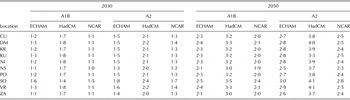
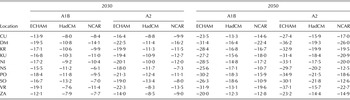
The analyses of expected climate conditions were focused on changes in annual, April–September and June–August period temperature and precipitation. These two meteorological elements can present either opportunities or constraints to crop production, depending on the region. Absolute change in temperature and relative change in precipitation were calculated, for 2030 and 2050 under two scenarios (A1B, A2) against to a 1971–2000 baseline period. Results obtained using the ECHAM, HadCM and NCAR model for the A1B and A2 scenario are presented for 2030 and 2050 (Tables 4 and 5).
Absolute temperature values (°C) in Serbia using three GCMs (ECHAM, HadCM, NCAR) under two scenarios (A1B, A2) for 2030 and 2050 in April–September

NS, Novi Sad; SO, Sombor; PO, Pozega; KR, Kraljevo; KU, Krusevac; CU, Cuprija; NI, Nis; ZA, Zajecar; DM, Dimitrovgrad; VR, Vranje.
Relative change in precipitation (%) in Serbia using three GCMs (ECHAM, HadCM, NCAR) under two scenarios (A1B, A2) for 2030 and 2050 in April–September

NS, Novi Sad; SO, Sombor; PO, Pozega; KR, Kraljevo; KU, Krusevac; CU, Cuprija; NI, Nis; ZA, Zajecar; DM, Dimitrovgrad; VR, Vranje.
It was shown that the annual temperature in Serbia is expected to increase by 1·3–1·7 °C by 2030 and by 2·5–2·8 °C by 2050 under the ECHAM5 A2 scenario. Detailed analysis of GCM outputs led to the conclusion that annual precipitation is expected to be 2·2–11·3% lower in 2030 and 5·5–19·9% lower in 2050, relative to 1971–2000, with the largest decreases in precipitation expected in the eastern (DM) and southern regions (VR).
During the April–September growing period, the change in temperature is expected to increase by 1·3–1·8 °C in 2030 and 2·5–3·0 °C in 2050. Projected April–September precipitation was 14·0–22·5% lower in 2030 and 23·2–37·1% lower in 2050. A significant decrease in precipitation is expected in south-eastern locations (VR and DM). During the June–August period, the largest increases in temperature, 3·4–3·5 °C, are expected in PO, KR, SO and VR in 2050, together with decreases in precipitation of 45–47·7%. Analysing the average values of precipitation during the June–August period, it was seen that southern locations VR and NI are expected to have the lowest precipitation with high temperatures.
Model runs and outputs
Impact of climate changes on soybean yield in 2030 and 2050 without carbon dioxide effect
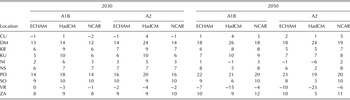
Using current cropping management, soil characteristic data for each location and synthesized weather series for three GCMs (ECHAM, HadCM and NCAR-PCM) under two scenarios (A1B, A2), soybean yield for 2030 and 2050 was simulated. Table 6 shows the change in yield for 2030 and 2050 calculated relative to the baseline yield (1971–2000). The projected yield increased in all locations, with the exception of NI and VR where a decrease is simulated for 2050. Analysis of the obtained results shows that the two scenarios used (A1B, A2) gave similar yield results for one integration period and no differences were obtained between climate models, except HadCM gave higher results for DM, and lowest results for VR in 2050.
Relative yield change (%) under 50% available water irrigation method conditions using three GCMs (ECHAM, HadCM, NCAR) under two scenarios (A1B, A2) for 2030 and 2050 without CO2 effect

NS, Novi Sad; SO, Sombor; PO, Pozega; KR, Kraljevo; KU, Krusevac; CU, Cuprija; NI, Nis; ZA, Zajecar; DM, Dimitrovgrad; VR, Vranje.
Spatial analysis
In northern locations (SO and NS) the results show a slight increase in yield, up to 10%, with three GCMs, for both scenarios at the two integration periods. In central Serbia, the results showed no changes in yield in CU and slight increases in KR and KU. The maximum increase in yield was seen in eastern (DM) and central (PO) locations, ranging from 12 to 24% in 2030 and 18 to 26% in 2050. The lowest yield is expected in southern locations (VR and NI) in 2050, up to –23%, where the absolute temperature has the highest value in the drought-sensitive period of June–August.
Carbon dioxide fertilization effect
An increasing CO2 concentration can affect plants differently, depending on the nature of the photosynthetic process used by the plant species (i.e., C3 and C4 photosynthesis). The C3 plants, such as soybean, are more sensitive to higher CO2 concentrations, which can greatly benefit productivity. The primary reason is that increased concentration of atmospheric CO2 will reduce photorespiratory losses of carbon in the C3 plant, thereby enhancing plant growth and productivity (Allen et al. Reference Allen, Boote, Jones, Jones, Valle, Acock, Rogers and Dahlman1987). Plants produce more vegetative matter as the atmospheric CO2 concentration increases. Wittwer (Reference Wittwer1995) reported that 0·93 of more than 1000 studies on CO2 fertilization effects showed increases in plant productivity, with a mean increase in yield of 52%. It has been reported that soybean yield will rise by 30% under the predicted 555 ppm CO2 concentration in Illinois, assuming that soybean is well-watered and not facing nutrient stress (Southworth et al. Reference Southworth, Pfeifer, Habeck, Randolph, Doering, Johnston and Rao2002).
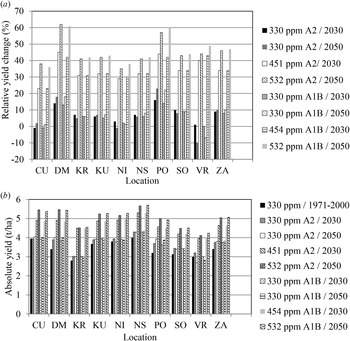
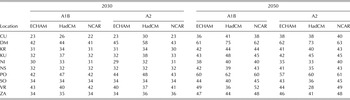
In Figs 3(a) and (b), the great benefit of CO2 fertilization on yield is shown. In Fig. 3(a), the relative changes in yield (%) with and without CO2-effect, calculated relative to baseline yield of 1971–2000, are presented. In all locations, the yield was increased significantly (P < 0·05) under future CO2 concentrations, with increases ranging from 22 to 58% in 2030 and from 28 to 75% in 2050 (Table 7). Analysis of the obtained results shows that the two scenarios used (A1B, A2) gave similar yield results for one integration period and no differences were obtained between climate models, except that HadCM gave slightly higher results for DM, and lowest results for VR in 2050.
CO2 fertilization effect on soybean yield (results were obtained for optimum irrigation): (a) change in yield (%) ECHAM (A1B, A2); (b) absolute yield (t/ha) ECHAM (A1B, A2) in 2030 and 2050.

Relative yield change (%) under 50% available water irrigated conditions in 2030 and 2050 using three GCMs (ECHAM, HadCM, NCAR) under two scenarios (A1B, A2) from the Special Report on Emissions Scenarios for ten locations with CO2 effect (2030 year = 454 ppm for A1B and 451 ppm for A2 scenario; 2050 year = 532 ppm for A1B and A2 scenarios)

NS, Novi Sad; SO, Sombor; PO, Pozega; KR, Kraljevo; KU, Krusevac; CU, Cuprija; NI, Nis; ZA, Zajecar; DM, Dimitrovgrad; VR, Vranje.
In most locations (KR, KU, NI, NS, SO, VR, ZA) the change in yield increased significantly (P < 0·05), from 22 to 43% in 2030 and from 28 to 52% in 2050, except CU with slightly lower change. The maximum increase in yield was seen in eastern (DM) and central (PO) location in 2050 up to 75%. These two locations showed also the highest increases in the scenarios without CO2-effect.
Figure 3(b) shows the absolute yield for the baseline period and for 2030 and 2050, both with and without the CO2-effect. The runs under CO2 future concentrations showed the greatest yield potentials in 2030 and 2050, with maximum of up to 5·70 t/ha (NS) in 2050. The yield increased in all locations, ranging from 3·95 to 5·30 t/ha in 2030 and 4·00 to 5·70 t/ha in 2050. In central Serbia (PO, CU, KU, KR), the average yield ranged from 4·48 to 4·90 t/ha in 2030 and 4·51 to 5·45 t/ha in 2050, with maximum yield seen in CU. In eastern (ZA, DM) and southern (NI, VR) locations, the yield ranged from 3·95 to 4·97 t/ha in 2030 and 4·11 to 5·47 t/ha in 2050, with maximum yield in DM. Of the northern locations (NS and SO), the yield reached maximum values in NS, at 5·30 t/ha in 2030 and 5·70 t/ha in 2050. Following this detailed analysis, it was concluded that the maximum yields were obtained in NS, DM and CU, ranging from 5·38 to 5·70 t/ha in 2050.
Climate change impact on irrigation demand under the A1B and A2 scenarios
The climate change impact on current (baseline) and future (climate scenarios) irrigation demand was estimated. Under this irrigation demand method and amount, the yield was high and stable for all locations using all three GCMs under both scenarios in 2030 and 2050. The second step was to estimate the impact of climate change on irrigation demand in 2030 and 2050, considering the CO2-effect.
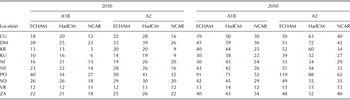
The change in irrigation demand was calculated for 2030 and 2050 relative to the 1971–2000 irrigation demand. All GCMs under both scenarios indicated a significant rise in irrigation demand under climate change conditions. Comparison of the two scenarios (A1B, A2) showed that A2 gave higher values for irrigation requirements for one integration period. In a comparison between climate models, NCAR-PCM gave the lowest relative change in irrigation demand for both periods, and ECHAM gave a slightly lower irrigation amount than HadCM model in 2050 period.
Spatial analysis
In all locations, the irrigation demand increased significantly (at the significance level α = 0.05), ranging from 5 to 50% in 2030 and from 12 to 110% in 2050 (Table 8). In the central locations of Serbia (CU, KR, KU), the change in irrigation demand was characterized as a significant increase, up to 28% (CU, HadCM A2) in 2030 and 63% (CU, HadCM, A2) in 2050, with maximum increases in PO, up to 50% in 2030 and 110% in 2050. In the northern (SO, NS) and eastern (DM, ZA) locations, the change in irrigation amount was significantly higher, up to 39% (DM, HadCM A2) in 2030 and very significantly higher 72% (DM, HadCM A2) in 2050. The southern locations (NI, VR) had lower change in irrigation demand especially in VR up to 13% (NCAR A2) in 2030 and 15% (HadCM A2) in 2050.
Relative changes in irrigation water demand (%) under 50% available water irrigation method with three GCMs (ECHAM, HadCM, NCAR) under two scenarios A1B, A2 with CO2 effect (2030 year = 454 ppm for A1B and 451 ppm for A2 scenario; 2050 year = 532 ppm for A1B and A2 scenarios)

NS, Novi Sad; SO, Sombor; PO, Pozega; KR, Kraljevo; KU, Krusevac; CU, Cuprija; NI, Nis; ZA, Zajecar; DM, Dimitrovgrad; VR, Vranje.
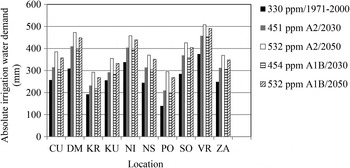
The predictions with ECHAM5 under each scenario for the absolute values of irrigation demand are presented in Fig. 4. The highest increase in irrigation demand was projected by the A2 scenario in 2030 and 2050 for all locations. In 2030 under the A2 scenario, irrigation demand ranged from 210 (PO) to 458 mm (VR), while in 2050, it reached 508 mm (VR). The highest average irrigation demand values were seen in VR, DM and NI, situated in the southern and eastern part of Serbia, where the highest irrigation demand was also seen for the baseline period. Under the conditions expected in 2030 and 2050, southern locations (NI, VR, DM) had the lowest precipitation during the June–August drought period, followed by high temperatures.
Absolute irrigation water demand (mm) with CO2 effect (2030 year = 454 ppm for A1B and 451 ppm for A2 scenario; 2050 year = 532 ppm for A1B and A2 scenarios) in 2030 and 2050 with ECHAM A1B, A2 scenario.

Water productivity (kg/m3) in 1971–2000, 2030 and 2050
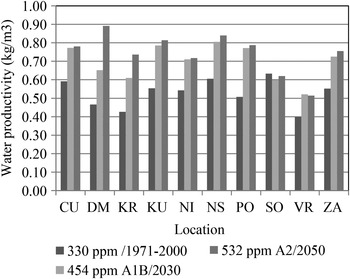
Water productivity results are presented in Fig. 5, obtained for 1971–2000, 2030 and 2050 year with ECHAM5 under both A1B and A2 scenarios, considering CO2 effect.
Water productivity (kg/m3) in 1971–2000, with ECHAM under A1B scenario in 2030 and A2 in 2050 considering CO2 effect.

In 2030 (A1B scenario), it ranged from 0·5 (VR) to 0·8 kg/m3 (CU, KU, NS, PO), and from 0·5 (VR) to 0·9 kg/m3 (DM) in 2050. The lowest WP was calculated for southern (VR) and northern (SO) locations. In central Serbia (PO, KR, KU, CU) WP was ranged from 0·6 (KR) to 0·8 kg/m3 (CU, PO, KU) in 2030 and 0·7 (KR) to 0·8 kg/m3 (CU, PO, KU) in 2050. In eastern (DM and ZA) locations, the WP was 0·7 (DM, ZA) in 2030 and 0·9 (DM) and 0·8 kg/m3 (ZA) in 2050. The lowest WP in 2050 was observed in southern (VR, 0·5) and northern (SO, 0·6) locations.
DISCUSSION
Current climate and soybean production in 1971–2000
In 1971–2000, during the drought sensitive period of June–August, observed temperatures were between 19·3 and 21·2 °C. In 1971–2000, 150·9–233·8 mm of precipitation was measured during the June–August period. In the ten locations selected, climate conditions were considered favourable for soybean production during the 1971–2000 period.
Changes in climate and yield for 2030 and 2050
According to all GCMs and scenarios, it may be expected that temperatures will rise, precipitation reduce and the risk of water shortages will be higher in 2030 and 2050. These are important, and limiting, factors in crop growth, development and yield (Prasad & Staggenborg Reference Prasad, Staggenborg, Ajuha, Reddy, Saseendran and Yu2008). Higher temperatures, along with noticeable declines in precipitation during the growing season, translate into decreases in soil moisture and exhaustion of plant water and nutrient availability.
The impact of climate change on soybean yield in 2030 and 2050 under ‘climate change only’ conditions demonstrated yield increases in nearly all locations, up to 24% for 2030 and 26% for 2050. Slight decreases were obtained only in southern locations (VR and NI) in 2050. Analysis of the expected climate conditions for 2030 and 2050 revealed that VR and NI had highest temperatures and lowest precipitation of all sites during the June–August period. Since automatic irrigation was applied, this yield decrease can be related to high temperature stress at these locations. In central and northern locations, increases in yield were considerably greater under optimum temperatures in the baseline period.
Carbon dioxide fertilization effect
The simulated yield under future CO2 concentrations are consistent with previous reports (Wittwer Reference Wittwer1995; Southworth et al. Reference Southworth, Pfeifer, Habeck, Randolph, Doering, Johnston and Rao2002), suggesting that the impact of climate change with increased CO2 concentrations can translate to considerable increases in soybean yield in all locations. The maximum increase in yield was seen in eastern (DM) and central (PO) locations in 2050 up to 75%. These two locations had high average precipitation and the lowest average temperature during the June–August period. To support the importance of temperature stress occurring above 30 °C during June–August, the number of tropical days at the different sites was analysed. At PO and DM, 13–14 tropical days were predicted to occur in 2030 and 17–18 in 2050. The most vulnerable locations were in the southern part of Serbia (VR, NI) with 16–17 tropical days in 2030 and 20–21 days in 2050. These results are supported by Kucharik & Serbin (Reference Kucharik and Serbin2008), who suggest that for each additional 1 °C of future warming during summer months, soybean yields could potentially decrease by 13% and 16%, respectively.
The great benefit of CO2 fertilization on average yield is seen for 2030 and 2050, with and without considering the effect of increasing atmospheric CO2 concentrations.
The largest increase in average soybean yield occurred in NS, DM, CU specifically 5·38–5·70 t/ha in the year 2050. In June–August, the average temperatures for these locations are expected to be between 22·7 and 23·7 °C and all these locations had well-structured soils.
Climate change impact on irrigation demand and water productivity
The results show a great increase in demand for irrigation under climate change conditions, ranging from 5 to 50% in 2030 and 12 to 110% in 2050. The highest increase was projected for the A2 scenario in 2030 and 2050 for all locations. The central (PO) and eastern (DM) locations showed the highest increases, where temperatures are expected to rise by 4·3–4·4 °C, and maximum decrease in precipitation of 52·4% in 2050 during the June–August drought-sensitive period. The absolute irrigation demand reached the highest values in VR, NI and DM, situated in the southern and eastern part of Serbia with lowest precipitation. Analysing the expected climate conditions for 2030 and 2050, these locations had the lowest June–August precipitation accompanied with high temperatures, and the maximum number of days with water deficit where actual evapotranspiration/potential evapotranspiration is <0·4 (dry intensive).
Water productivity was calculated for ten locations, and the highest values were found for eastern and central locations in Serbia. The largest decrease in WP was found for VR and SO. These locations have high temperatures, 23·8 °C, and low precipitation, 82–105 mm, projected for the June–August drought-sensitive period in 2050.
CONCLUSIONS
The main conclusions are as follows:
-
• The observed temperature and precipitation of ten selected sites in Serbia showed very favourable conditions for soybean production during the 1971–2000 period.
-
• The rise in temperature is expected to be up to 1·8 °C in 2030 and 3·0 °C in 2050, along with a 22·5% decline in precipitation in 2030 and 37·1% decline in 2050 during the growing season. The expected climate conditions will lead to decreases in soil moisture and exhaustion of plant water and nutrient availability, if crop water demand is not compensated by additional irrigation.
-
• Without the CO2-effect and under current cropping management, climate change positively impacts soybean yield in all locations in 2030 and 2050, especially in the central (PO) and eastern (DM) locations under optimum irrigation.
-
• The CO2-effect will further increase yield at all locations. The relative changes ranged from 22 to 58% in 2030 and from 28 to 75% in 2050. The highest yield increase is expected in the central (PO) and eastern (DM) location.
-
• Irrigation demand showed a significant rise under climate change conditions. The highest absolute values were simulated in VR and NI, which are the southern locations and DM, the eastern location in Serbia, where the precipitation is low during June–August, accompanied by high temperatures and soils with poor structure.
-
• Water productivity reached highest and stable values at the eastern and central locations, while the minimum is expected in southern (VR) and northern (SO) locations, where the precipitation is low during June–August followed by high temperatures.
Considering that soybean is likely to benefit from climate change, farmers can expect increased soybean production based on higher yields and increases in planted area. It has been reported that soybean cropping occurs mostly in the Vojvodina region, covering 159 000 ha (Statistical Office of the Republic of Serbia 2012), with other regions having significantly smaller areas of production, i.e. the Belgrade region has 5000 ha, Sumadija 7000 ha and eastern and southern regions 1000 ha.
According to the present results (yield, irrigation demand, soil type and water productivity), it can be concluded that soybean may benefit from expected climate conditions and that soybean cropping, currently conducted mainly in the Vojvodina region, may be expanded in the central region of Serbia (PO, KR, CU, KU). If soybean is seeded continuously as a monoculture, organic carbon and N losses from the soil profile over 30 years are considerably higher than if soybean is planted in the rotation with wheat and maize. It is therefore necessary to estimate the N and carbon losses for 2030 and 2050 under current cropping management and irrigation methods to appropriately adapt crop rotation strategies.
The research described here was funded by the Serbian Ministry of Science and Technology under the project No. III 43007 ‘Research of climate changes and their impact on environment. Monitoring of the impact, adaptation and moderation’ for 2011–2014.