Depression and antisocial behavior problems among youth constitute an area of significant clinical, social, and economic concern (Greenberg et al., Reference Greenberg, Weissberg, O'Brien, Zins, Fredericks and Resnik2003; Welsh, Schmidt, McKinnon, Chattha, & Meyers, Reference Welsh, Schmidt, McKinnon, Chattha and Meyers2008). Recent estimates suggest that depression will become the second leading medical cause of disability in the world by 2020 (World Health Organization, 2001) and that the prevalence rate is rising among young people (Collishaw, Maughan, Goodman, & Pickles, Reference Collishaw, Maughan, Goodman and Pickles2004). There is also evidence highlighting increasing rates of antisocial behavior problems among children and adolescents internationally (Ford, Reference Ford2008). Depression and antisocial behavior often co-occur (Angold, Costello, & Erkanli, Reference Angold, Costello and Erkanli1999), yet most research in the field of developmental psychopathology continues to focus on single-problem behaviors with considerably less attention given to multiple-problem domains. Further, when co-occurring symptoms are considered, research and clinical efforts are typically focused on samples of boys (e.g., Capaldi, Reference Capaldi1992; Drabick, Beauchaine, Gadow, Carlson, & Bromet, Reference Drabick, Beauchaine, Gadow, Carlson and Bromet2006; Loeber, Farrington, Stouthamer-Loeber, & Van Kammen, Reference Loeber, Farrington, Stouthamer-Loeber and Van Kammen1998), with few studies focused on the co-occurrence of antisocial behavior and depressive symptoms in girls.
Identification of the pathways and processes through which depressive symptoms and antisocial behaviors develop and are maintained, where both problem behaviors are included in a single model, can provide novel information about etiological pathways. In addition, this approach can simultaneously inform researchers as to modifiable targets for the development of intervention programs aimed at remediating problematic outcomes among at-risk youth. The primary goal of this study is to examine trajectories of depressive symptoms and antisocial behavior in two samples of at-risk adolescent girls: a US sample of girls who experienced childhood maltreatment and subsequent placement in foster care and a UK sample of girls with mothers who experienced recurrent depression. Although the presenting characteristics of the two samples are quite different (girls with a maltreating parent and girls with a depressed mother), these two familial characteristics are perhaps the most widely studied influences on youth psychopathology, and they have been shown to have substantial long-term effects on the development of psychopathology in children and adolescents (Kaufman & Charney, Reference Kaufman and Charney2001). Following the principles of multifinality (Cicchetti & Rogosch, Reference Cicchetti and Rogosch1996), we sought to apply a multilevel approach by examining whether multiple forms of psychopathology (depressive symptoms and antisocial behavior) emerge in each familial risk sample. Simultaneous to testing the principles of multifinality, we sought to test the principles of equifinality, whereby the two different familial backgrounds (maltreatment, maternal depression) would lead to similar psychopathology in girls. Our multilevel approach thus offers the opportunity for new insights into the distinct versus unique associations between maltreatment and maternal depression with adolescent psychopathology by examining two types of adolescent psychopathology across two types of familial risk. Further, we examine a hypothesized resilience-promoting factor (maternal caregiver involvement) and test its role in reducing trajectories of psychopathology across the 2-year study period in the two samples.
Links Between Antisocial Behavior and Depressive Symptoms
The etiology, prevalence rates, and long-term outcomes for depressed and antisocial youth are well illustrated in the extant literature (Angold et al., Reference Angold, Costello and Erkanli1999; Boylan, Vaillancourt, Boyle, & Szatmari, Reference Boylan, Vaillancourt, Boyle and Szatmari2007; Lahey, Loeber, Burke, Rathouz, & McBurnett, Reference Lahey, Loeber, Burke, Rathouz and McBurnett2002; Wiesner, Reference Wiesner2003). Youth with co-occurring forms of psychopathology experience a range of poor outcomes over time compared to youth with single, phenotype-specific problems (e.g., only depression or only antisocial behavior), including suicidality, substance use, and related health problems (Fite, Colder, Lochman, & Wells, Reference Fite, Colder, Lochman and Wells2008). For example, Angold and colleagues (Reference Angold, Costello and Erkanli1999) found that after controlling for other comorbidities, conduct disorder was about seven times more common in depressed than in nondepressed adolescents (Angold et al., Reference Angold, Costello and Erkanli1999), with recent evidence suggesting that this odds ratio reduced from 7 to 2.4 when controlling for oppositional defiant behavior (Copeland, Shanahan, Erkanli, Costello & Angold, Reference Copeland, Shanahan, Erkanli, Costello and Angold2013), thereby converging with the present study's focus on broad antisocial behaviors. Kovacs, Paulauskas, Gatsonis, and Richards (Reference Kovacs, Paulauskas, Gatsonis and Richards1988) estimated that approximately one-third of youth with a major depression diagnosis also met criteria for an externalizing diagnosis.
Several theoretical models have been proposed to explain the co-occurrence of depression and antisocial behavior problems among adolescent youth. Patterson and Capaldi (Reference Patterson, Capaldi, Rolf, Masten, Cicchetti, Nuechterlein and Weintraub1990) propose a failure model whereby antisocial behavior problems lead to depression because of the negative consequences that behavioral problems have for youth development, including academic failure, peer rejection, and increased family conflict. Antisocial behavior problems may interfere with the ability to develop competency skills, resulting in negative reactions and rejection from peers (e.g., Capaldi & Stoolmiller, Reference Capaldi and Stoolmiller1999). Such children may also evoke hostile and rejecting parenting (Reid, Patterson, & Loeber, Reference Reid, Patterson, Loeber and Bernstein1982), leading to decreased feelings of self-worth and self-competence. This combination of low self-competence and negative reactions from others may cause pervasive failures in adjustment (e.g., academic failure, inability to build social support networks, and relationship failures), making a child vulnerable to depressive symptoms (Biederman, Faraone, Mick, & Lelon, Reference Biederman, Faraone, Mick and Lelon1995; Capaldi, Reference Capaldi1991, Reference Capaldi1992; Patterson & Stoolmiller, Reference Patterson and Stoolmiller1991). Support for the failure model as a primary pathway to co-occurring problems comes from a recent longitudinal study of offspring of women in the National Longitudinal Study of Youth; this study found that, of children who developed depressive symptoms, all had moderate or high levels of preexisting oppositional symptoms (Boylan, Vaillancourt, & Szatmari, Reference Boylan, Vaillancourt and Szatmari2012).
A less common, but nonetheless important, pathway to co-occurring problems is from depressive symptoms to antisocial behavior problems. Depressive symptoms may lead depressed youth to seek associations with deviant peers, possibly as a means of attaining social acceptance. Children showing depressive symptoms may find that their choice of friends is limited (depressive symptoms have been linked to ongoing problems in social relationships; Capaldi & Stoolmiller, Reference Capaldi and Stoolmiller1999; Rudolph, Hammen, & Burge, Reference Rudolph, Hammen and Burge1997) and that they may be more easily accepted by deviant peers. Depressed youth may “act out” underlying depressive symptoms by externalizing their feelings and dysregulated mood in a manner more consonant with antisocial behavior. This model proposes that depression can also precede antisocial behavior (Capaldi, Reference Capaldi1992; Ritakallio et al., Reference Ritakallio, Koivisto, von der Pahlen, Pelkonen, Marttunen and Kaltiala-Heino2008). The purpose of this report is not to disentangle the directionality of effects but rather, given the extant literature on the co-occurrence of antisocial behavior and depression, to apply a multilevel approach by examining the trajectories of each problem behavior while controlling for concurrent levels of the other. We repeat this approach across two diverse samples of at-risk girls.
A Focus on Girls
Despite evidence of a high prevalence rate of co-occurring antisocial behavior and depression among youth, there is a paucity of research on multiple problem behaviors among adolescent girls, with most longitudinal studies focusing on the co-occurrence of depression and antisocial behavior problems among boys (Angold et al., Reference Angold, Costello and Erkanli1999). However, females have significantly higher lifetime prevalence rates of depression than do males, with 21% of women meeting criteria for lifetime depression versus 13% of males (Kessler et al., Reference Kessler, McGonagle, Nelson, Hughes, Swartz and Blazer1994). The origin of sex differences in depression can be traced to adolescence, at which time an elevated increase in depressive symptoms has been shown more frequently in girls than in boys (Angold & Costello, Reference Angold and Costello2001; Ge, Lorenz, Conger, Elder, & Simons, Reference Ge, Lorenz, Conger, Elder and Simons1994; Hankin et al., Reference Hankin, Abramson, Moffitt, Silva, McGee and Angell1998) and where rates of depression among girls are higher than rates for boys (Thapar, Collishaw, Pine, & Thapar, Reference Thapar, Collishaw, Pine and Thapar2012). This adolescent-onset sex difference has been shown across ethnic groups and sampling criteria (Grant & Compas, Reference Grant and Compas1995; Hyde, Mezulis, & Abramson, Reference Hyde, Mezulis and Abramson2008).
Although depression is a widely recognized public health concern in its own right, outcomes for adolescent girls with depressive symptoms are often further compounded by co-occurring delinquency problems. Official arrest record data show a 50% increase in girls' juvenile arrests, with girls now accounting for 30% of all juvenile arrests (Puzzanchera & Adams, Reference Puzzanchera and Adams2011). Numerous studies have shown that depressive symptoms are more highly associated with delinquency-based behaviors in girls than in boys (e.g., Costello, Mustillo, Erkanli, Keeler, & Angold, Reference Costello, Mustillo, Erkanli, Keeler and Angold2003; Gallerani, Garber, & Martin, Reference Gallerani, Garber and Martin2010; Roberts, Roberts, & Xing, Reference Roberts, Roberts and Xing2007; Silberg, Rutter, D'Onofrio, & Eaves, Reference Silberg, Rutter, D'Onofrio and Eaves2003). For example, Fazel, Doll, and Långström (Reference Fazel, Doll and Långström2008) found that 6-month prevalence of major depressive disorder among adolescent girls in the juvenile justice system was 29%, more than twice the rate of their male counterparts and four to five times the rate of the general population of girls. Fagan and Western (Reference Fagan and Western2003) analyzed longitudinal data on Australian adolescents and found that delinquent behaviors increased the probability of depression only for female participants, not for males. Wiesner and Kim (Reference Wiesner and Kim2006) reported that girls were more likely to exhibit comorbid depressive symptoms and delinquent behaviors than were boys (49.5% vs. 25.3%, respectively). One explanation for the increased rates of depression in girls with antisocial behavior problems is the “gender paradox,” which suggests that the sex with the lower prevalence of a disorder has a higher likelihood of developing co-occurring problems originating from the low-prevalence disorder (Loeber & Keenan, Reference Loeber and Keenan1994; Loeber & Stouthamer- Loeber, Reference Loeber and Stouthamer-Loeber1998; Zoccolillo, 1992). Given the relative dearth of research on co-occurring depressive symptom and antisocial behavior problems among girls, as well as the deleterious outcomes for girls with co-occurring problems, we focus specifically on developmental trajectories in two samples of girls at high risk for problems due to their distinct prior (US) and present (UK) rearing/caregiving environments.
Associations Between Caregiver Characteristics and Adolescent Psychopathology
Past research has identified that adolescent psychopathology may be explained by (a) adverse rearing environments that promote psychopathological trajectories among offspring, (b) genetic factors passed on from biological parents to offspring, and (c) a combination of the two (gene–environment interplay; see Rutter, Reference Rutter2006). In this article we focus specifically on the rearing environment, while acknowledging that some of the associations identified between the rearing environment and youth psychopathology may result from genetic factors passed on from biological parents. In one of the samples examined in this article, children resided with their biological mother; in the other sample, they were living in foster care and had been removed from the biological parent home. In each sample, the caregiving environment has been (and may continue to be) disrupted or is at higher risk of being affected: in one sample because of prior maltreatment of the child in the biological home and in the second sample because of recurrent depression in the biological mother. The maternal caregiving environment has been identified as a consistent correlate of negative developmental outcomes for youth in relation to both depression and antisocial behavior (Davies & Windle, Reference Davies and Windle1997; McCarty & McMahon, Reference McCarty and McMahon2003). Genetically sensitive research designs where rearing parents and children are not genetically related have facilitated examination of associations between aspects of the rearing environment (e.g., maternal caregiving quality) and child psychological outcomes that are unconfounded by common genetic factors (known as passive gene–environment correlation, see Jaffee & Price, Reference Jaffee and Price2007; Harold et al., Reference Harold, Rice, Hay, Boivin, van den Bree and Thapar2011). Results from these studies suggest two primary extensions from past research in this area. First, children at risk due to parent psychopathology may experience heterogeneous outcomes; studies suggest that children at risk for depression due to maternal depression, for example, may experience elevated symptoms of depression and/or antisocial behavior problems, rather than phenotype-specific transmission (e.g., depression to depression; Silberg, Maes, & Eaves, Reference Silberg, Maes and Eaves2010). Second, maternal caregiving may be a more consistent mediator of adverse outcomes for children in the case of antisocial behavior problems than depression (Harold et al., Reference Harold, Rice, Hay, Boivin, van den Bree and Thapar2011; Sellers et al., Reference Sellers, Harold, Elam, Rhoades, Potter and Mars2014).
The role of maternal caregiving in understanding risk and resilience mechanisms in relation to multiple adolescent problem behaviors was identified in a pioneering study by Ge, Best, Conger, amd Simons (Reference Ge, Best, Conger and Simons1996), who examined the associations among parental warmth, hostility, and disciplinary skills over 3 years across four groups of adolescents: (a) those with depressive symptoms, (b) those with conduct problems, (d) those with elevated conduct problems and depressive symptoms, and (d) those with neither depressive or conduct problems. Results suggested a differential pattern of association relative to the index of parenting considered, with parental hostility and harsh disciplinary practices more consistently associated with adolescent conduct problems than with depressive symptoms. However, parental warmth and responsive parenting practices reduced the co-occurrence and long-term development of depressive symptoms and conduct problems in offspring (Ge et al., Reference Ge, Best, Conger and Simons1996). This work marks an important departure in the developmental history of examining parenting effects on child outcomes by partitioning specific parenting behaviors (e.g., warmth vs. hostility) in examining long-term associations with youth internalizing and externalizing problems.
Building on this pattern of findings, this study used a measure of maternal caregiving that may be particularly salient when youth have previously lived with a caregiver who either suffered from clinical depression, or who maltreated the child: maternal caregiver involvement. Both childhood maltreatment and exposure to maternal depression have been identified as family-based risk factors for the development of psychopathology in girls (Leve & Chamberlain, Reference Leve and Chamberlain2007; Teicher & Samson, Reference Teicher and Samson2013; Trickett, Negriff, Ji, & Peckins, Reference Trickett, Negriff, Ji and Peckins2011). For example, Ryan and Testa (Reference Ryan and Testa2005) found that, of the 10- to 16-year-olds in the Illinois child welfare system between 1995 and 2000, more than 50% had at least one report of delinquency, a 47% greater likelihood than their non-foster-care peers. Studies using diagnostic interviews (e.g., the Casey Field Office Mental Health Study) have also indicated that youth in foster care tend to show high lifetime prevalence rates for disruptive disorders, such as conduct disorder and oppositional defiant disorder, ranging from 21% to 48% (White, O'Brien, White, Pecora, & Phillips, Reference White, O'Brien, White, Pecora and Phillips2008). Maternal depression has been identified as a risk factor for offspring depression and antisocial behavior problems (Lieb, Isensee, Hofler, Pfister, & Wittchen, Reference Lieb, Isensee, Hofler, Pfister and Wittchen2002; Wickramaratne & Weissman, Reference Wickramaratne and Weissman1998).
Given the documented impacts of maltreatment and maternal depression on the development of offspring psychopathology, we utilize a resiliency framework to examine the potential ameliorating (promotive) role of caregiver involvement on reducing trajectories of adolescent psychopathology (Cicchetti, Reference Cicchetti2013). As noted by Rutter (Reference Rutter, Shonkoff and Meiseis2000), understanding resilience in children and adolescents exposed to adversity is of considerable importance in guiding public policy aimed at the prevention of psychopathology. Learning about the protective mechanisms that promote resilience in the face of adversity is central to the prevention of psychopathology (Cicchetti, Reference Cicchetti2013; Masten, Reference Masten2001; Rutter, Reference Rutter, Shonkoff and Meiseis2000, Reference Rutter2007).
Originating from investigations of poverty and response to trauma, resiliency research is thus highly germane to understanding outcomes for maltreated youth who have previously experienced adversities (Cicchetti & Garmezy, Reference Cicchetti and Garmezy1993) and to understanding outcomes for youth living with a maternal caregiver who has suffered from recurrent depression. Masten's (Reference Masten2001) review of converging findings on resiliency highlighted that resilience occurs through ordinary processes involving the operation of basic human adaptational systems, even in the face of adversity. These adaptational systems can include family-level characteristics, such as close relationships with involved and caring adults. Through adaptational systems, such as involved caregiving, interventions could enhance child resilience by directly adding sufficient positive experiences to the child's life to offset the adversity (Cicchetti, Reference Cicchetti2013; Garmezy, Masten, & Tellegen, Reference Garmezy, Masten and Tellegen1984; Masten, Reference Masten2001).
The Present Study
This study employs a unique sampling strategy where adolescent girls are at elevated risk for psychopathology due to one of two familial risk factors: (a) having a history of maltreatment or (b) having a parent with a history of recurrent depression. The first sample comprises a group of US-based adolescent girls in foster care, each of whom has had a history of childhood maltreatment and removal from the home of her biological parent(s). Their current foster caregiving environments may facilitate decreases in adolescent psychopathology, relative to their former residences in maltreating biological parent environments. The second sample comprises a group of UK-based adolescent girls at high familial risk for depression, with each girl having a biological mother who has experienced recurrent depression. Thus, their current caregiving environments may continue to be risk perpetuating. This two-sample approach allows a multilevel examination of depression and antisocial behavior trajectories among diverse samples of adolescent girls who all have exposure to potent, recognized risks (maltreatment or maternal depression) that are associated with both youth depression and youth antisocial behavior. The association between current maternal/carer caregiving quality can be examined in the two samples: the UK sample of girls are fully genetically related to and living with their rearing mothers and the US sample of girls are not living with their biological mothers.
This study examined the role of caregiver involvement on girls' trajectories of depressive and antisocial behavior symptoms, while controlling for levels of co-occurring psychopathology at each time point across the study period, using two three-wave longitudinal research designs. Both studies employ samples of similarly aged adolescent girls (mean age = 11–12 years old at the start of the study), comparable measures of psychopathology (depressive symptoms, antisocial behavior problems), and a measure of maternal/carer caregiving practices (caregiver involvement). We hypothesized that (a) antisocial behavior problems would be associated concurrently with depressive symptoms when examining trajectories of depressive symptoms, depressive symptoms would be associated concurrently with antisocial behavior problems when examining trajectories of antisocial behavior, and we would see this pattern across both samples; (b) the foster care sample would show declines in psychopathology over time due to their placement in an improved caregiving environment relative to their biological home, whereas the daughters of mothers with recurrent depression would show normative age-related increases in depression and antisocial behavior over time; and (c) maternal caregiver involvement would reduce depressive symptom and antisocial behavior problems (initial levels and trajectories) in both samples.
Methods
Participants and procedures
Study 1: Middle school success
The Study 1 sample comprised 100 girls living in foster care in the US. Originally, 145 girls who met the two study criteria (living in relative or nonrelative foster care in one of two counties containing major metropolitan areas in the Pacific Northwest and in their final year of elementary school) were referred to the study by the child welfare system. Of these 145 girls, 27 girls refused to participate (either the girl, her caregiver, or her caseworker did not agree to the girls' participation), and an additional 18 girls were excluded because their eligibility status changed by the time they were contacted by the study staff for recruitment (e.g., moved out of the state, were pending reunification or adoption, or were in an incorrect grade level). Caseworkers and the foster caregivers provided informed consent for the remaining 100 girls, and the girls provided assent prior to participation. Both girls and caregivers were compensated for participating. All procedures for the study were approved by the institution's institutional review board.
The mean age of the girls was 11.54 years (SD = 0.48) at baseline. Sixty-three percent of the girls were White, followed by 14% multiracial, 10% Latino, 9% Black, and 4% Native American. According to child welfare records, 56% had at least one incident of physical abuse, 67% had at least one incident of sexual abuse, and 78% had at least one incident of neglect. Approximately 32% of girls had experienced all three types of maltreatment. Sixty-eight percent of the girls were in nonrelative foster homes and 32% were in relative foster homes at baseline. The girls and their caregivers completed a baseline (Time 1 [T1]) assessment and follow-up assessments at 12 months (Time 2 [T2]) and 24 months (Time 3 [T3]) postbaseline. The retention rates were consistently high across the study period, ranging from 92% to 98%. The assessments included a structured, in-person interview and questionnaire for each girl and her caregiver, an interview with the girl's caseworker, and the collection of child welfare records.
Assessments lasted approximately 2 hr and were conducted by trained interviewers. Participants were part of a longitudinal intervention trial in which girls were randomly assigned either to a behavioral support intervention condition (n = 48) or to a regular foster care control condition (n = 52; Chamberlain, Leve, & Smith, Reference Chamberlain, Leve and Smith2006). The intervention included parenting groups and girl groups, each focused on preventing the onset of behavior problems and health-risking behavior during the transition to middle school. Although an examination of intervention effects was not a primary focus of this study, intervention condition was included as a control variable in the analyses. Assessment staff members were blind to the intervention status of the girls.
Study 2: Early prediction of adolescent depression
The Study 2 sample comprised 145 girls who were the daughters of mothers with recurrent depression. The original sample included 337 parents who had a history of recurrent unipolar depression and their offspring (age 9–17 years). Participants were recruited predominantly from general practices across South Wales (78%), while the remainder of the sample was recruited through community volunteers (19%) and a variety of other resources (3%). A detailed description of the sample has been published previously (Mars et al., Reference Mars, Collishaw, Smith, Thapar, Potter and Sellers2012; Sellers et al., Reference Sellers, Harold, Elam, Rhoades, Potter and Mars2014).
For this analysis we focused on female offspring (n = 197). One family was omitted due to a diagnosis of bipolar disorder in the affected parent between the first and second assessment. Families of 13 depressed fathers were omitted from the analyses. A further 38 families were excluded based on offspring age (17 years or above at any wave), in order to be comparable to the Study 1 sample age range. The remaining 145 families were eligible for inclusion in the study.
The mean age of the girls was M = 11.70 years (SD = 1.63) at baseline. Girls and their mothers completed a baseline assessment (T1) and follow-up assessments at approximately 15 months (T2: M = 13.00 years, SD = 1.57) and 27 months (T3: M = 13.95 years, SD = 1.51). The retention rate across the study period was high (>90%). The assessments included a structured, in-person interview and questionnaire for each girl and her mother. Assessments lasted approximately 2 hr and were conducted by trained interviewers.
Measures
Youth depressive symptoms
In Study 1, youth-reported depressive symptoms were measured at T1, T2, and T3 using the Center for Epidemiological Studies—Depression Scale (Radloff, Reference Radloff1977). The Center for Epidemiological Studies—Depression Scale is a 20-item self-report measure of depressive symptomatology with a typical clinical cutoff score of 16 or higher (Radloff, Reference Radloff1977). In this study, the percent of girls at or above the clinical threshold for depressive symptoms was 30% (T1), 27% (T2), and 20% (T3). Internal consistency was acceptable (α = 0.71–0.78). In Study 2, youth-reported depressive symptoms were measured at T1, T2, and T3 using the child version of the Child and Adolescent Psychiatric Assessment (Angold & Costello, Reference Angold and Costello2000), which is a semistructured interview based on DSM-IV symptoms. Youth responded to the depression symptoms section about their symptoms over the preceding 3 months. A total depression severity score was derived using symptom totals from DSM-IV criteria (T1: M = 1.09, SD = 1.54; T2: M = 1.10, SD = 1.57; and T3: M = 1.27, SD = 1.85).
Youth antisocial behavior
In Study 1, youth-reported antisocial behavior was measured at T1, T2, and T3 using 23 items reflecting general delinquency that were developed using the diagnostic criteria for disruptive behavior disorder. Girls were asked to rate how many times they had committed various disruptive, antisocial, and delinquent acts. Sample items included “threatened to hit other kids” and “skipped classes without an excuse.” The scale showed good internal reliability (α = 0.82–0.84). Items were recoded as 0 (never) and 1 (at least one time) and then summed within wave to reflect the total level of antisocial behavior at that wave (T1: M = 10.02, SD = 4.20; T2: M = 8.88, SD = 4.34; and T3: M = 8.10, SD = 4.43). In Study 2, youth-reported antisocial behavior was measured at T1, T2, and T3 using the child version of the Child and Adolescent Psychiatric Assessment. Antisocial behavior scores were derived using symptom totals from DSM-IV criteria from the disruptive behavior scale (oppositional defiant disorder and conduct disorder; T1: M = 1.59, SD = 1.67; T2: M = 1.56, SD = 1.94; and T3: M = 1.49, SD = 1.94).
Caregiver involvement
Both studies included a measure of the level of caregiver involvement in the girl's life, measured at T1. In Study 1, youth reported on how much time they spent with their caregiver talking and doing things they enjoy (e.g., sports, hobbies, or games) in a variety of settings (weekdays, weekends), in terms of actual minutes and hours.
The total number of minutes doing activities and talking together was summed across four items. Higher scores indicated greater caregiver involvement. The scale showed acceptable reliability (α = 0.70). In Study 2, each mother completed a 12-item self-report questionnaire assessing maternal involvement and warmth toward her daughter (e.g., active interest, interested in what child does, enjoy having child around, pay a lot of attention, like to spend time with child). Each item was scored on a 5-point Likert-type scale, ranging across almost never true, rarely true, sometimes true, almost always true, and always. A total score was created (M = 44.14, SD = 5.13), with high scores indicating more time/interest in the youth's life. Internal reliability was excellent (α = 0.94).
Covariates
Two covariates were included in the analytical models for Study 1 because of the specificities of the foster care sample: intervention condition (0 = control group, 1 = intervention group), and age at first placement. Age at first placement was coded from official child welfare records. Girls were first placed in foster care at 7.63 years (SD = 3.14) on average and had spent approximately 2.90 years (SD = 2.25) in foster care prior to study entry.
Analytical approach
The distribution of child depression and antisocial behavior symptoms was positively skewed in both studies. Therefore, maximum likelihood estimators with standard errors that are robust to nonnormality (which incorporates full information maximum likelihood) were used (Muthén & Muthén, Reference Muthén and Muthén1998–2012). In addition, in Study 1, square root transformations were used to transform the depression and antisocial behavior scores prior to conducting latent growth curve modeling.
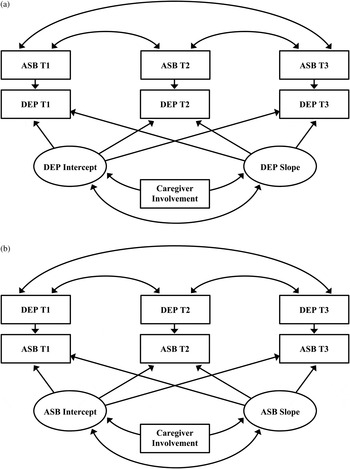
Two models were examined to test the study hypotheses: the first set of analyses considered trajectories of depressive symptoms as the outcome and the second set of analyses considered antisocial behavior trajectories as the outcome. In the first model, we ran a linear latent growth curve model (LGM) to examine developmental trajectories of depressive symptoms over time with antisocial behaviors as time-varying covariates. Girls' depressive symptom scores at T1, T2, and T3 were used to estimate two latent growth factors (intercept and slope) of depressive symptoms over time. Antisocial behavior at each of the corresponding time points was included as a time-varying covariate to take into account its proximal concurrent influence on depressive symptoms. The intercept factor loadings were all fixed at 1 and the slope factor loadings were fixed at 0, 1, and 2 (Study 1) and 0, 1.3, and 2.3 (Study 2) for T1, T2, and T3, respectively, to reflect the amount of time between assessments. In the event that a linear model did not fit the data well, a spline model was tested. In the spline model, loadings were fixed at 0 and 1 for T1 and T3, respectively, and the middle slope factor loading for T2 was freely estimated.
After the basic LGM was examined, a second LGM that included T1 caregiver involvement as a predictor of depressive symptom intercept and slope factors was tested. Caregiver involvement was centered and included in the model as a time-invariant covariate. Study 1 also included the two covariates specific to that sample in the models (intervention condition and age of first foster care placement). See Figure 1a.
Theoretical model (a) for depressive symptoms outcome adjusting for co-occurring antisocial behavior and (b) for antisocial behavior outcome adjusting for co-occurring depressive symptoms.

In our second set of analytical models, we repeated the steps outlined above but with a focus on antisocial behavior trajectories. We examined antisocial behavior trajectories from T1 to T3 while including depressive symptoms as a time-varying covariate and T1 caregiver involvement as a predictor. See Figure 1b. The inclusion of a time-varying covariate allows for the unique contribution of these variables on the outcome variable to be estimated while taking into account co-occurring symptoms. Analyses were conducted using Mplus version 7.1 (Muthén & Muthén, Reference Muthén and Muthén1998–2012).
Due to the longitudinal nature of the study designs and the presence of a modest amount of missing data, we examined whether the data were missing at random using Little's missing completely at random test in the Statistical Package for the Social Sciences. The missing completely at random test was significant for both studies: Study 1, χ2 (17) = 28.84, p = .04, and Study 2, χ2 (70) = 94.97, p = .03, indicating that the data may not be missing completely at random. In both studies, we then compared the data for participants with and without missing data. In Study 1, girls who had complete data (n = 91) were not significantly different from girls with missing data (n = 9) on any of the study variables included in this analyses, with the exception of T1 antisocial behavior: Girls with missing data reported significantly higher levels of antisocial behavior at T1 compared to girls with complete data, t (98) = −2.55, p = .012. In Study 2, girls who had complete data (n = 102) did not differ significantly from girls with missing data (n = 43) on any of the study variables included in this analyses. We used the full information maximum likelihood approach in Mplus to accommodate missing data across both studies, to provide unbiased estimates of model coefficients.
Multiple indices were used to provide a comprehensive assessment of model fit, including chi-square values, comparative fit index (CFI), Tucker–Lewis index (TLI), and root mean square of approximation (RMSEA). Goodness of fit was determined in accordance with Hu and Bentler (Reference Hu and Bentler1999): CFI and TLI were >0.90 and RMSEA was <0.08.
Results
Descriptive results
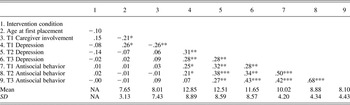
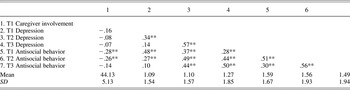
Tables 1 and 2 show the means, standard deviations, and correlations among study variables for Study 1 and Study 2, respectively. As seen in the tables, there were significant associations over time within behavior: depressive symptoms at T1, T2, and T3 were intercorrelated in both studies (with the exception of T1 and T3 depressive symptoms for Study 2), and antisocial behavior symptoms at T1, T2, and T3 were intercorrelated in both studies. In addition, depressive symptoms and antisocial behavior symptoms were correlated with each other both within and across time, with the exception of T1 depressive symptoms with T3 antisocial behavior symptoms for both studies. In addition, there was evidence that caregiver involvement was associated with both symptom sets. In Study 1, caregiver involvement was significantly and inversely associated with T1 depressive symptoms (r = −.26, p < .01), and in Study 2 caregiver involvement was significantly and inversely associated with T1 and T2 antisocial behavior symptoms (r = −.28, p < .001, and r = −.26, p = .004, respectively). These bivariate associations suggested partial support for the study hypotheses, which were then tested using a series of LGM analyses.
Means, standard deviations, and correlations for Study 1

*p < .05. **p < .01. ***p < .001.
Means, standard deviations, and correlations for Study 2

**p < .01.
Depressive symptom trajectories with antisocial behaviors as time-varying covariates
Study 1
The analyses first tested an LGM where the intercept factor loadings were all fixed at 1 and the slope factor loadings were fixed at 0, 1, and 2 for T1, T2, and T3, respectively. However, the model fit the data quite poorly, χ2 (10) = 20.61, p = .02, CFI = 0.79, TLI = 0.75, RMSEA = 0.10. To accommodate potential nonlinearity for some individuals in the sample, a spline model was fitted. As was the case with the linear model, all intercept factor loadings were fixed at 1. The slope loadings were fixed at 0 and 1 for T1 and T3, respectively, and the middle slope factor loading for T2 was freely estimated. The spline model showed a significantly better fit, χ2 (9) = 9.12, p = .43, CFI = 1.00, TLI = 1.00, RMSEA = 0.01; nested χ2 (1) = 11.49, p < .001, and was used in the remaining analyses.
The means of the intercept and slope factor, the average initial levels at T1 and change rates across all individuals in the sample, were 0.64 (p < .01) and 0.00 (ns), respectively. This suggests that only the initial level of depressive symptoms were significantly different from zero. The nonsignificant slope factor mean suggests that, on average, there was no significant change in girls' depressive symptoms over time. The intercept and slope had variances of 0.14 (p < .01) and 0.10 (p < .01), respectively. The significant intercept and slope factor variances indicate that there is substantial individual variability in the initial level (T1) as well as in the change rates of depressive symptoms over time. In addition, girls' antisocial behavior at each time point was significantly and positively associated with their depressive symptoms (0.44, p < .01), suggesting the proximal influence of girls' antisocial behavior on their depressive symptoms that is above and beyond the trajectory processes. The covariance between the intercept and slope factor (–0.10, p < .01) and covariances among time-varying covariates were also significant (0.03, 0.03, and 0.04 at T1, T2, and T3, respectively, all ps < .01).
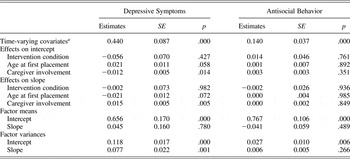
We then tested the prediction model by adding the intervention status, age at first placement, and caregiver involvement as time-invariant predictors to the model described above to examine the extent to which these factors were related to the intercept and slope factor of girls' depressive symptom trajectories (Table 3). Again, the model fit the data well, χ2 (21) = 13.04, p = .91, CFI = 1.00, TLI = 1.13, RMSEA = 0.00. The means of the intercept and slope factor in the prediction model were 0.66 (p < .01) and 0.05 (ns), respectively, suggesting that the mean of the slope factor remained nonsignificant in the prediction model. The intercept (0.12, p < .01) and slope (0.08, p < .01) factor variances were significant, indicating significant individual variances both in the initial level and in the change rates of girls' depressive symptoms even in the presence of the time-invariant predictors. The covariance between the intercept and slope factor (–0.08, p < .01), the time-varying effects of antisocial behaviors (0.44, p < .01), and covariances among time-varying covariates (0.03, 0.03, and 0.04 at T1, T2, and T3, respectively, all ps < .01) remained significant in the prediction model.
Final models for Study 1 latent growth curve model predicting depressive symptom trajectories and antisocial behavior symptom trajectories

a Time-varying covariates were constrained to be equal across all three time points.
The results also indicated that caregiver involvement was negatively associated with the initial level (–0.01, p = .01) and positively associated with the slope factor (0.02, p < .01). This suggests that girls who spent more time talking and doing activities with caregivers were more likely to have lower initial levels of depressive symptoms. However, they tended to show greater increases in depressive symptoms over time, likely a statistical artifact given the significant inverse association between intercept and slope factors in the model. Predictors in the model explained approximately 12% of the variance in the intercept factor (p = .047) and 21% of the variance in the slope factor (p = .034).
Study 2
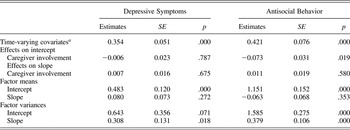
The analyses first tested an LGM where the intercept factor loadings were all fixed at 1 and the slope factor loadings were fixed at 0, 1.3, and 2.3 for T1, T2, and T3, respectively. A linear growth model fit the data well, χ2 (11) = 9.74, p = .55, CFI = 1.00, TLI = 1.02, RMSEA = 0.00.
The means of the intercept and slope factor, the average initial levels at T1 and change rates across all individuals in the sample, were 0.48 (p < .01) and 0.09 (p = .28), respectively, suggesting that only the initial level of depressive symptoms were significantly different from zero. The nonsignificant slope factor mean again suggests that, on average, there was no significant change in girls' depressive symptoms over time. The intercept and slope had variances of 0.64 (p = .07) and 0.37 (p = .02), respectively, indicating that there is substantial individual variability in the rates of change in depressive symptoms over time.
In addition, girls' antisocial behavior at each time point was significantly and positively associated with their depressive symptoms (0.36, p < .01), consonant with results presented for Study 1. The covariance between the intercept and slope factor (–0.23, p = .11) and covariances among time-varying covariates were also significant (1.60, 0.95, and 2.05 at T1, T2, and T3, respectively, all ps < .01).
We then tested the prediction model by adding caregiver involvement as a time-invariant predictor to the model described above to examine the extent to which this factor was related to the intercept and slope factor of girls' depressive symptom trajectories (Table 4). Again, the model fit the data well, χ2 (12) = 10.32, p = .58, CFI = 1.00, TLI = 1.02, RMSEA = 0.00. The means of the intercept and slope factor in the prediction model were 0.48 (p < .01) and .08 (ns), respectively, suggesting that the mean of the slope factor remained nonsignificant in the prediction model. The slope (0.31, p = .02) factor variance remained significant, indicating significant individual variance in the change rates of girls' depressive symptoms even in the presence of maternal involvement. There was no significant association for the initial status (0.64, p = .07). The covariance between the intercept and slope factor (–0.28, p < .05), the time-varying effects of antisocial behaviors (0.35, p < .01), and covariances among time-varying covariates (1.60, 0.97, and 2.06 at T1, T2, and T3, respectively, all ps < .01) also remained significant in the prediction model. Results also indicated that caregiver involvement was not associated with the initial level (–0.01, p = .79) or with the slope factor (0.01, p = .68).
Final models for Study 2 latent growth curve model predicting depressive symptom trajectories and antisocial behavior symptom trajectories

a Time-varying covariates were constrained to be equal across all three time points.
Antisocial behavior trajectories with depressive symptoms as time-varying covariates
Study 1
The reverse model was tested by using antisocial behavior at each time point to estimate two latent growth factors (intercept and slope) of antisocial behavior trajectories over time and by including girls' depressive symptom scores at each time point as time-varying covariates. The intercept factor loadings were all fixed at 1 and the slope factor loadings were fixed at 0, 1, and 2 for T1, T2, and T3, respectively. The resulting model fit the data reasonably well, χ2 (11) = 17.72, p = .09, CFI = 0.94, TLI = 0.93, RMSEA = 0.080.
The means of the intercept and slope factor were 0.82 (p < .01) and –0.05 (p < .01), respectively, indicating that both were significantly different from zero. The negative slope factor mean suggests that, on average, there were significant decreases in girls' antisocial behaviors over time. The intercept and slope had variances of 0.03 (p < .01) and 0.01 (ns), respectively. These variances represent the individual variability in the initial level and slope. The significant intercept factor variance and nonsignificant slope factor variance indicate that there is substantial individual variability in the initial level (T1) only. In addition, girls' depressive symptoms at each time point were significantly and positively associated with their antisocial behaviors (0.14, p < .01), suggesting proximal influence of depressive symptoms on antisocial behaviors above and beyond the trajectory processes. While the covariance between the intercept and slope factor was nonsignificant, covariances among time-varying covariates were significant (0.05, p < .01).
We then added the intervention status, age at first placement, and caregiver involvement as time-invariant predictors to the model to examine the extent to which these factors were related to the intercept and slope factor of girls' antisocial behavior trajectories (Table 3). However, the model did not fit the data well, χ2 (23) = 37.60, p = .03, CFI = 0.85, TLI = 0.87, RMSEA = 0.08. The means of the intercept and slope factor in the prediction model were 0.77 (p < .01) and –0.04 (ns) respectively. The mean of the slope factor was no longer significant once the time-invariant predictors were included. The intercept factor variance remained significant (0.03, p < .01), indicating significant individual variances in the initial level of girls' antisocial behavior in the presence of the time-invariant predictors.
The slope factor variance (0.01, ns) and the covariance between the intercept and slope factor (0.00, ns) remained nonsignificant in the prediction model. Furthermore, the time-varying effects of depressive symptoms (0.14, p < .01) and covariances among time-varying covariates (0.05, p < .01) also remained significant in the prediction model. Results also indicated that none of the predictors was significantly related to the growth factors of girls' antisocial behavior trajectories.
Study 2
The analyses first tested an LGM where the intercept factor loadings were all fixed at 1 and the slope factor loadings were fixed at 0, 1.3, and 2.3 for T1, T2, and T3, respectively. The LGM was an excellent fit to the data, χ2 (11) = 12.99, p = .29, CFI = 0.98, TLI = 0.97, RMSEA = 0.04.
The means of the intercept and slope factor, the average initial levels at T1 and change rates across all individuals in the sample, were 1.15 (p < .01) and –0.07 (p = .31), respectively, suggesting that only the initial level of antisocial behavior symptoms was significantly different from zero. The nonsignificant slope factor mean suggests that, on average, there was no significant change in girls' antisocial behavior over time. The intercept and slope had variances of 1.49 (p < .01) and 0.39 (p < .01), respectively. The significant intercept and slope factor variance indicates that there is substantial individual variability in the initial level (T1), as well as change rates in antisocial behavior symptoms over time. In addition, girls' depressive symptoms at each time point were significantly and positively associated with antisocial behavior (0.43, p < .01), suggesting proximal influence of girls' depressive symptoms on antisocial behavior that is above and beyond the trajectory processes, replicating results across all models tested. The covariance between the intercept and slope factor (–0.38, p = .01) was significant. Only the covariances among time-varying covariates at T3 were significant (0.75, 0.40, and 1.61 at T1, T2, and T3, respectively, ps < .01).
We then tested the prediction model by adding caregiver involvement as a time-invariant predictor to the model described above to examine the extent to which this construct was related to the intercept and slope factor of girls' depressive symptom trajectories (Table 4). Again, the model fit the data well, χ2 (12) = 14.07, p = .30, CFI = 0.98, TLI = 0.97, RMSEA = 0.03. The means of the intercept and slope factor in the prediction model were 1.15 (p < .01) and –0.07 (p = .35), respectively, suggesting that the mean of the slope factor remained nonsignificant in the prediction model. The intercept (1.59, p <.01) and slope (0.38, p < .01) factor variance remained significant, indicating significant individual variance in the change rates of girls' depressive symptoms even in the presence of maternal involvement.
The covariance between the intercept and slope factor (–0.36, p < .01), the time-varying effects of depression symptoms (0.42, p < .01), and covariances among time-varying covariates (0.78, 0.43, and 1.61 at T1, T2, and T3, ps < .01) remained significant in the prediction model. The results also indicated that caregiver involvement was associated with the initial level (–0.07, p = .02), but not with the slope factor (0.01, p = .58) of antisocial behavior.
Discussion
This study employed two geographically diverse yet complementary longitudinal samples to take a multilevel approach to examining the role of maternal caregiver involvement on adolescent girls' depressive symptoms and antisocial behavior trajectories, while controlling for co-occurring symptom levels across each respective study period. Both samples comprised adolescent girls at differential risk for psychopathology because of aspects of their caregivers and caregiving environments. Our first hypothesis, that antisocial behavior problems would be concurrently associated with depressive symptoms when predicting trajectories of depressive symptoms and that depressive symptoms would be concurrently associated with antisocial behavior problems when predicting trajectories of antisocial behavior, was supported in both samples. There were significant associations between depressive symptoms and antisocial behavior at each time point, regardless of whether depressive symptom trajectories or antisocial behavior trajectories were modeled.
These significant pathways provide additional support for the presence of co-occurring antisocial behavior and depressive symptoms problems among early adolescents (Capaldi & Stoolmiller, Reference Capaldi and Stoolmiller1999; Essex et al., Reference Essex, Kraemer, Armstrong, Boyce, Goldsmith and Klein2006; Ingoldsby, Kohl, McMahon, & Lengua, Reference Ingoldsby, Kohl, McMahon and Lengua2006; Mezulis, Vander Stoep, Stone, & McCauley, Reference Mezulis, Vander Stoep, Stone and McCauley2011). The dual-sample approach helps to build the evidence base on co-occurring problems specifically among high-risk girls. Most prior studies in this area have used community samples, have varied in terms of their use of symptoms versus cutoff values to categorize participants, and have included either boys only or both boys and girls. In comparison, our samples comprised high-risk girls who tended to show higher rates of psychopathology than did prior community-based samples. In our samples, 20%–30% of the sample showed clinical levels of either problem behavior at any given time point. By comparison, among sixth-grade boys, approximately 18% of the sample had elevated conduct problems, 15% had elevated depressive symptoms, and 11% were elevated on both domains of psychopathology (Capaldi & Stoolmiller, Reference Capaldi and Stoolmiller1999). Among fifth-grade youth, 14% had conduct problems, 12% had depressive symptoms, and 14% showed co-occurring problems (Essex et al., Reference Essex, Kraemer, Armstrong, Boyce, Goldsmith and Klein2006). Thus, the multisample findings uniquely add to the existing literature in this area by showing significant associations between antisocial behavior and depressive symptoms among girls during the important developmental period of early adolescence (when rates of depression increase among girls but not among boys). The confidence in these associations is strengthened by the design feature of respectively controlling for prior levels of antisocial behavior and depression as modeled in the trajectory analysis and supports the principles of multifinality of outcomes. Despite differences in the nature of the two samples (e.g., different index of familial risk; different countries), similar magnitudes of association were identified, suggesting the robustness of this pattern of associations.
Our second hypothesis, that the foster care sample would show declines in problem behavior over time because the children had been removed from a maltreating environment and placed in a more nurturing foster care environment, whereas the offspring of mothers with recurrent depression would show increases in problem behavior over time because they continue to reside with the affected biological mother and because genetic influences on risk for depression become more pronounced across development (Rice, Harold, & Thapar, Reference Rice, Harold and Thapar2002), was only partially supported. Examination of the mean levels of depressive symptoms and antisocial behavior did evidence decreases in both dimensions of psychopathology over time for the girls in foster care, whereas the offspring of depressed mothers evidenced increases in depressive symptoms over time. However, when the full models that considered the presence of co-occurring behavior problems (and of caregiver involvement) were examined, none of the models evidenced significant increases or decreases in psychopathology over time. This distinction is important to note; prior studies that have examined the trajectories of depression or antisocial behavior over time but have not considered the co-occurring influences of multiple problem behaviors may inadvertently misrepresent developmental increases or decreases in problem behaviors. Multiple forms of psychopathology may work together to magnify or reduce developmental trends in a single domain of psychopathology. For example, in addition to evidence for the positive association between depression and antisocial behavior across adolescence (Kofler et al., Reference Kofler, McCart, Zajac, Ruggiero, Saunders and Kilpatrick2011), when youth exhibit quite high levels of clinical depression, to the extent that they do not have the motivation to leave the house, there is a natural reduction in the expression of antisocial behavior and delinquency. However, in both of the current samples, the associations between depressive symptoms and antisocial behavior were positive, perhaps due to the at-risk nature of our samples. The nature of the association between depressive symptoms and antisocial behavior has implications for our etiological models, as well as for the targeting of interventions that may intend to reduce psychopathology in one domain but have unintended consequences on a related domain of psychopathology.
Fergusson, Lynskey, and Horwood (Reference Fergusson, Lynskey and Horwood1996) built on the hypothesis that symptoms of psychopathology among youth likely co-occur by suggesting that common explanatory factors also underlie association with co-occurring outcomes. For example, while depression and antisocial behavior problems likely co-occur in affected youth, both might share a common underlying influence (e.g., in accordance with the principles of multifinality).
One such possible shared etiological factor is genetic influences. While studies support the conclusion that there may be genetic overlap between co-occurring indices of psychopathology (e.g., antisocial behavior and depression; see Rowe, Rijsdijk, Maughan, Eley, & Hosang, Reference Rowe, Rijsdijk, Maughan, Eley and Hosang2008), it is also recognized that heritable characteristics only partially account for intergenerational transmission of risk and that noninherited factors have an important role (Harold et al., Reference Harold, Rice, Hay, Boivin, van den Bree and Thapar2011; Kerr et al., Reference Kerr, Leve, Harold, Natsuaki, Neiderhiser and Shaw2013; Silberg et al., Reference Silberg, Maes and Eaves2010; Tully, Iacono, & McGue, Reference Tully, Iacono and McGue2008).
It is unique that the complement of study designs employed in this study offers a further substantive attribute that advances past research in this area: examination of maternal caregiving influences on adolescent girls' depressive and antisocial behavior trajectories among girls living with their biological mother (UK sample) and among girls not living with their biological mother (US foster care sample). Our hypothesis examined whether maternal caregiver involvement would serve as a factor to promote resilience among girls previously exposed to adverse caregiving qualities (maltreatment or maternal depression). Results examining this hypothesis suggested a differential pattern of psychopathology-based trajectories for the two groups of adolescent children. Caregiver involvement played an important yet very distinct role in the prediction of psychopathology in the two samples of girls. For the US foster care sample, caregiver involvement was a significant predictor of both the intercept and slope of depressive symptoms, but it did not predict either the intercept or slope of antisocial behavior. In the UK sample, caregiver involvement predicted the intercept for antisocial behavior but not depression. In other words, the specific benefit of caregiver involvement on girls' outcomes depended on the nature of risk to which the girls had been exposed. For girls who experienced childhood maltreatment, higher levels of caregiver involvement were associated with lower initial levels of depressive symptoms. In comparison, girls who had mothers with recurrent depression showed reduced antisocial behavior when their mothers were highly involved.
These differences could reflect the principles of multifinality (Cicchetti & Rogosch, Reference Cicchetti and Rogosch1996): a single protective factor leading to multiple outcomes, depending on different familial risks the youth has experienced. In the case of the maltreated girls, the vast majority of whom experienced neglect as their primary maltreatment type (78%), having a caregiver who spends time with her could serve to lower depressive symptoms and serve in contrast to the experiences in the home of origin. It is important that the decrease in depressive symptoms comes at a time in development when girls typically begin to show normative increases in depression (Angold & Costello, Reference Angold and Costello2001), and therefore it is additionally meaningful from a clinical standpoint that these girls showed decreased depressive symptoms. In contrast, high caregiver involvement may have minimal effects on antisocial behavior, however, because firm and consistent discipline has been identified as the key caregiver protective factor for delinquency among youth in foster care (Eddy & Chamberlain, Reference Eddy and Chamberlain2000).
In the case of the offspring of depressed mothers, having a mother who is prone to depression who spends considerable time with her daughter may not protect against the daughter's own depressive symptoms and may in fact exacerbate them. This may be indicative of the fact that other types of factors beyond maternal involvement are needed to overcome a higher genetic or familial liability for depression (the mothers had recurrent depression rather than antisocial behavior). However, caregiver involvement may instead protect against antisocial behavior when the sample is not at high risk for antisocial behavior because of the ameliorative role of spending time with one's parent, rather than with deviant peers. One speculation around this finding is that girls of depressed mothers may take on more of a caregiving and protective role of their mothers in order to help and support them. The involvement of the mother in her daughter's life may thus be initiated by the daughter rather than by the mother, and the youth's preoccupation with caring for the mother may have an unintended effect of her spending less time with deviant peers. It is also possible that depressed mothers who were able to be more involved in their daughters' lives possessed less severe depression or had other positive traits that helped to offset risks for antisocial behavior in their daughters.
A similar pattern of findings has been identified for parental antisocial behavior (specifically fathers' antisocial behavior). In an epidemiological sample of over 1,000 children and their parents, Jaffee, Moffitt, Caspi, and Taylor (Reference Jaffee, Moffitt, Caspi and Taylor2003) found that the less time fathers lived with their children, the more conduct problems their children had but only when the fathers engaged in low levels of antisocial behavior. In contrast, when fathers engaged in high levels of antisocial behavior, the more time they lived with their children, the more conduct problems their children had. This suggests that distance from an antisocial parent may be beneficial to the prevention of child antisocial behavior, while proximity may be detrimental. In a similar fashion, having a depressed parent who is highly involved in a child's life may be detrimental with respect to the development of the child's depressive symptoms. As noted by the increasing levels of girls' depression and the lack of protective effect for caregiver involvement on girls' depression in the UK sample, the compounding negative influence of caregiver involvement on adolescent depression could be the dual influence of both genetic and environmental exposure to risk for depression, or simply not enough to overcome familial liability to mood problems.
Overall, results from this study are consistent with findings from recent studies suggesting that not only might associations between specific indices of parent and child psychopathology (e.g., parent antisocial behavior predicting child antisocial behavior) be heterogeneous, such that a specific index of psychopathology in a parent may differentially predict one or more indices of psychopathology in offspring (e.g., conduct problems and/or depression; Kerr et al., Reference Kerr, Leve, Harold, Natsuaki, Neiderhiser and Shaw2013), but also that identified environmental mediators of this association may also be differentially linked to specific indices of psychopathology. Thus, our multilevel approach to modeling provides evidence for multifinality (multiple psychopathologies from a given risk factor), equifinality (depressive symptoms and antisocial behavior can result from multiple distinct risk factors), and for risk-specific associations (the role of caregiver involvement may vary as a function of the specific risk factor).
Limitations and recommendations for future research
Although this study offers several noteworthy advantages in examining the developmental trajectories of adolescent girls' depressive symptom and antisocial behavior trajectories relative to maternal caregiving among at-risk girls, several limitations also merit mention. First, caution should be employed in relation to using direct comparisons regarding differences in the pattern of findings presented relative to risk group (maltreatment vs. depression), as differences may also be explained by differential measurement of theoretical constructs employed across each study (e.g., the index of maternal caregiving). In particular, the foster care sample used a measure of girl-reported caregiver involvement, based on the amount of time spent together, and the children of depressed mothers sample relied on a caregiver-reported measure of parent involvement. Because our outcome measures were youth report, it is possible that the associations between psychopathology and caregiver involvement in the foster care sample were inflated by method overlap. In addition, it is possible that the depressed mothers may not be accurate raters of the level of parental involvement with their child.
Second, although the two samples were selected for maltreatment and maternal depression, respectively, it is possible that these risks co-occurred in sample families and were not as distinct as we have purported here. However, these attributes may also be seen as relative study strengths.
Third, the present study covers a relatively limited period of repeat assessment across the period of adolescence represented by each respective study (mean age = 11.50 and 11.70 years at T1 for Study 1 and Study 2, respectively). The trajectories of depressive symptoms and antisocial behavior may vary at earlier or later stages of adolescence, as may the role of caregiving, particularly as children adjust to school transitions, postpubertal changes, and stronger peer influences. Replication and extension of the proposed theoretical model to additional ages and stages of adolescent development would therefore be informative.
Fourth, the present study focuses exclusively on mothers and girls, yet emerging evidence has increasingly highlighted the importance of the father–child (both the father–son and father–daughter relationships) in accounting for the transmission of parent to child psychopathology (Harold et al., Reference Harold, Leve, Elam, Thapar, Neiderhiser and Natsuaki2013). Extending the present study objectives to also include fathers and sons would also significantly advance knowledge relative to the primary study hypotheses. Notwithstanding these limitations, the present study adds to the literature on the familial underpinnings of adolescent depression among at-risk girls while also considering the relative role of covarying antisocial symptoms, and vice versa, across two geographically diverse and high-risk samples representing two distinct domains of risk influence (maltreatment and maternal depression).
In terms of future directions, and given estimates of the trajectory of depression as an index of global disability (Murray & Lopez, Reference Murray and Lopez1996), it is incumbent on researchers to explore mechanisms that underlie susceptibility, risk, and expression of depressive symptoms and depressive disorders across the lifespan. While evidence supports the conclusion that maltreatment affects brain development (Cicchetti, Reference Cicchetti2013), what about the role of maternal depression? This is an area of underexplored examination in the field of developmental psychopathology, yet examination of the neurobiological architecture that might underlie associations between exposure to environmental adversity marked by maternal (and paternal) depression and symptoms of child depression and antisocial behavior represents an important area of future research. Finally, study findings support the further study of prevention and intervention initiatives that target multiple domains of the family environment in ameliorating adolescent depressive symptoms and antisocial behavior. Facets of the parenting/caregiving environment might be pursued as possible promotive factors among high-risk youth in the context of adolescents' family-based caregiving experiences.