Introduction
The nine individuals whose names grace the Supreme Court’s opinions have long been subjects of interest to scholars. Much less attention has been directed toward those who work most closely with the justices: their law clerks. While clerks have seemed to generate controversy “cyclically” over time (see Kenney Reference Kenney2000b, 200; also see Peppers Reference Peppers2012), they have inspired far less academic work. We know a great deal about the clerks’ routine tasks thanks to books by Peppers (Reference Peppers2006), Ward and Weiden (Reference Ward and Weiden2006), and Peppers and Ward (Reference Peppers2012), but we know considerably less about clerks’ preferences and backgrounds or how these factors affect their interactions with the justices.
This is troubling because how a justice interacts with his clerks will have consequences for the work that leaves his chambers bearing his name.Footnote 1 Clerks are believed to have a greater potential for influence when they are delegated tasks, such as at the cert-granting and opinion-writing stages. Justices delegate at these stages to free up their own time, and if they do not oversee carefully and do not hire only ideological clones, clerks may shirk and shape the final product. However, clerks have another, more subtle, opportunity to affect their justice’s work: through their role as advisors.
Clerks are tapped as advisors because they are sources of information. In this way, clerks are similar to congressional aides or workers in bureaucratic agencies. Clerks are used in much the same way a justice relies on amicus curiae briefs (Collins Reference Collins2008), the solicitor general (Bailey, Kamoie, and Maltzman Reference Bailey2005; Black and Owens Reference Black and Owens2012), and attorneys (Johnson, Wahlbeck, and Spriggs Reference Johnson, Wahlbeck and Spriggs2006; McAtee and McGuire Reference McAtee and McGuire2007; Corley Reference Corley2008; Szmer and Ginn Reference Szmer and Ginn2014). Because the justices discuss pending cases with their clerks, they open their decision making to clerk influence. As the fruit born of these discussions, influence may be observable at stages of decision making believed to be more immune to the phenomenon, such as the justices’ votes on the merits.
This paper seeks to understand this process by identifying conditions under which the information clerks transmit can be detected at the merits-voting stage. I argue that structural features of a justice’s chambers affect how information transmitted by clerks influences decision making. Because it is essential to know what clerks want in order to know when they get it, I develop and validate a novel measure of clerk preferences based on their lower court clerkship experience. Using this measure, I find that information stemming from the clerks’ ideological views leads to change in voting behavior but only in chambers where clerks can agree on a preferred outcome. Further, I find that clerks’ ability to influence is asymmetric: from 1985 to 2001, conservative clerks were effective whereas liberal clerks appear not to have been.
Books by Peppers, Ward, and Weiden expanded our understanding of the role of law clerks at the US Supreme Court. Leveraging theirs and others’ work, I argue that it is appropriate to think of clerks as performing multiple roles. By analyzing how clerks function as advisors, I contribute to our understanding of how the justices seek out and use information to aid in their decision making. This research also has implications for the broader study of delegation: I find that structure moderates the principal’s acquisition of information. The conditional and asymmetric nature of clerks’ ability to shape behavior that I find may also have implications for other hierarchical relationships in which a principal relies on subordinates.
Clerks as Agents and Advisors
Supreme Court justices no longer, to paraphrase Justice Louis Brandeis, “do their own work” (see Rosenthal and Yoon Reference Rosenthal and Yoon2011, 1307). Their law clerks assist them in several aspects of their work, including processing cert petitions, conducting research, and writing opinions. While one reason for having their clerks perform these tasks is for the justices to reduce their own workloads, another, supported by the words of the justices themselves and their former clerks, is to tap their law clerks as sources of information. These distinct goals underlie two clerk roles that I label as time-savers and advisors.
The time-saver role is motivated by the justice’s desire to ease his workload. Over the history of the clerkship institution, clerks have assumed more and greater duties. As the work of the Court has grown more complex and time-consuming, the justices have relied on their clerks to assume more of what have been called the delegable tasks (Posner Reference Posner1995). The modern clerk’s delegated duties include, generally, reading and making recommendations on writs of certiorari, preparing bench memos that summarize litigants’ briefs and additional research, and writing drafts of opinions (Peppers Reference Peppers2006).
This delegation of tasks fits into the time-saver role if the justice only delegates in order to cut back on his own workload; it is unlikely that direct benefits are accrued to anyone but the justice when clerks complete these tasks. The justice becomes freer to devote his time and energy elsewhere, but the output may be of lesser quality. The justice who delegates faces considerable risk, however. Principal-agent theory explains that without proper monitoring, clerks are freer to shirk and pursue their own interests.Footnote 2
To date, scholarly studies have found little systematic evidence of untoward, intentional influence arising from the clerks’ role as time-savers. Influence can be defined as action by a justice that he would not have taken absent some intervention from his law clerks. Scholars have searched for influence at multiple stages, including cert granting (Brenner and Palmer Reference Brenner1990; Perry Reference Perry1991; Brenner Reference Brenner1997; Palmer Reference Palmer2001; Stras Reference Stras2007; Black and Boyd Reference Black and Boyd2012; Black, Boyd, and Bryan Reference Black, Boyd and Bryan2014; Wallander and Benesh Reference Wallander and Benesh2014), merits voting (Brenner Reference Brenner1992; Palmer and Brenner Reference Palmer1995; Peppers and Zorn Reference Peppers2008), and opinion writing (Wahlbeck, Spriggs, and Sigelman Reference Wahlbeck and Spriggs2002; Rosenthal and Yoon Reference Rosenthal and Yoon2011); research generally shows that, with the possible exception of opinion writing, the justices apparently design institutions that are effective at constraining clerk shirking.
An area that has received considerably less scholarly attention, despite its potential as a source of influence, is the clerks’ role as advisors. Whereas the justice’s goal with the time-saver role is to make his job easier through delegation, the advisor role is motivated by his desire to gather information. The justice can increase his understanding of a legal issue and its implications by obtaining his clerks’ personal input.Footnote 3 For instance, as the justice decides how to vote on the merits, clerks may be able to provide information based on their personal experiences or research that reduces the justice’s uncertainty about the policy consequences of available strategies. Reducing uncertainty helps the justice pursue two goals: to help him identify the optimal outcome, without regard to ideology, or to reinforce a desired ideological position by serving as evidence in the outcome’s favor.
The advisor role reduces uncertainty by facilitating information gathering in two ways. The first is that the justice increases his overall stock of information. Just as a justice is a product of his environment, so too his law clerks are of theirs. By virtue of having had different experiences—for example, as a member of a different gender or racial group, or of a different generation, or from viewing the world through a different ideological lens—clerks will have information from such experiences that the justice may not have, and this difference may be salient to issues that come before the Court. Key to this form of information gathering is that clerks possess an information asymmetry from which a justice, by definition of asymmetry, has an opportunity to learn. By discussing strategies with his clerks and seeking their input, the justice gains information with a fairly low-cost approach.
A second way the advisor role is a source of information is that it enables the justice to filter his clerks’ advice through their known biases. A bias that is likely to be helpful for this purpose is the clerk’s ideology.Footnote 4 Calvert (Reference Calvert1985) demonstrates the “value of biased information”: when a decision maker consults advisors with known biases, he can interpret their advice in the context of what he expected. When the advice goes against his expectation, the decision maker may learn about a outcome he wishes to avoid. This would occur, for example, when a justice interprets his conservative clerk’s begrudging endorsement of a liberal case disposition as a signal that the liberal outcome has merit.
Influences arising from the time-saver and advisor roles are distinct phenomena, but the roles themselves are not mutually exclusive. In all likelihood, most justices will use clerks in both roles, perhaps even simultaneously.Footnote 5 However, treating the roles separately when theorizing how influence can occur raises empirical implications that are unique to the advisor role. Influence from the time-saver role is undesirable, because it is a symptom of shirking—the output bears the clerk’s “fingerprints” when the justice does not want it to. Influence from the advisor role, however, occurs as the justice seeks to identify or to provide reinforcement for his optimal voting strategy. As I argue below, the justice’s learning is conditional on the information clerks have to offer and whether clerks agree on a preferred outcome. Before discussing how to model chambers structure and clerk preferences, I present evidence reinforcing the argument that clerks function as advisors to their justices.
Evidence of the Advisor Role
While most 27-year-olds are typically not founts of jurisprudential wisdom, historical and anecdotal evidence shows that the justices nevertheless find testing their clerks’ minds to be worthwhile. This is not surprising given the caliber of the clerks’ minds and that institutional pressures reinforce clerk allegiance. The prototypical modern Supreme Court clerk has received training from a top law school and tutelage from a federal courts of appeals judge. For her service as a clerk, she can expect a flurry of job offerings, and, at many firms, a hiring bonus well into six figures. Training and self-interest, in other words, render clerks uncannily useful resources for the justices.
There is evidence that at least 10 justices who served within the past 30 years relied on their clerks as advisors and welcomed their personal input.Footnote 6 Because of the importance of recognizing that the time-saver and advisor roles are distinct phenomena, I briefly recount this evidence. A significant account comes from the chambers of Byron White. Clerk Kevin Worthen recounts that “for Justice White, the judicial decision-making process was a two-step process: first make sure the problem has been fully considered, and, second, decide. The primary role of the law clerks was to assist with the consideration, not the decision” (Worthen Reference Worthen and Peppers2012, 305). Clerk David Kendall offers a more colorful account of this dynamic, remembering that White “wasn’t invested in an argument; if you could hit him back with a chair, intellectually speaking, he could be convinced” (Worthen Reference Worthen and Peppers2012, 305).Footnote 7
There is less vivid but still suggestive evidence from intrachamber memos and clerk surveys that William Rehnquist and Harry Blackmun’s clerks would try to influence their justice’s thinking and that these particular justices encouraged such behavior (Ward and Weiden Reference Ward and Weiden2006, 155, 192, 165–66). Similarly, Alex Kozinski lobbyied Warren Burger during his stint as Burger’s clerk, saying “sometimes [Burger] would switch, and sometimes he wouldn’t” (Kozinski and Bernstein Reference Kozinski1998, 58). Comments by a former clerk in a recent profile of Anthony Kennedy illuminate how he runs his chambers: “He wants to talk [a case] over (with his clerks). He wants the roundtable” (Calabresi and Drehle Reference Calabresi2012, 36; see also Peppers Reference Peppers2006, 203). Lewis Powell and John Paul Stevens reputedly preferred diversity among their clerks. Federal Judge and former Powell clerk J. Harvie Wilkinson III wrote that “Justice (Powell) preferred that his law clerks be of different persuasions and stir ‘crosswinds,’ as he once put it, through his chambers” (Wilkinson Reference Wilkinson2012, 346). Similarly, Peppers (Reference Peppers2006) describes Stevens as engaging his clerks “in what might be best described as a Socratic dialogue, a joint inquiry toward the ‘right’ outcome” (196). A former Stevens clerk wrote, “I can imagine few bosses so interested in the views of their employees, so prepared to engage in free-flowing debate, and so enthusiastic to be proven wrong” (Pearlstein Reference Pearlstein2000, 13; see Peppers Reference Peppers2006, 197). Finally, a study of clerk “fingerprints” in opinions from two chambers indicates that language crafted by Thurgood Marshall’s law clerks in opinion drafts was recognizable in final opinions (Wahlbeck et al. Reference Wahlbeck and Spriggs2002), from which we might infer that Marshall’s chambers, at least during 1985, were fertile grounds for clerk influence.
We can draw inferences, based on the justice’s hiring patterns, that he used clerks as advisors, and we thus add two more justices to the list. The logic behind doing so is as follows. Evidence suggests that ideology plays a role in hiring decisions. That the justice handpicked her from among a large pool of qualified applicants should further solidify a clerk’s status as trustworthy. Previous research has demonstrated a positive correlation between the ideologies of lower court feeder judges (Ditslear and Baum Reference Ditslear2001; Baum and Ditslear Reference Baum2010; Kromphardt Reference Kromphardt2014) or the clerks themselves (Peppers and Zorn Reference Peppers2008) and the justices who hire them. The most plausible explanation for this correlation is that the justices often seek to hire ideological compatriots. In principal-agent studies, this is referred to as the ally principle. The ally principle makes sense from a time-saver perspective: justices will worry less about shirking if they believe the clerks to whom they delegate share their preferences.
We know that for at least one justice, following the ally principle also makes sense from an advisor perspective. Clarence Thomas only hires clerks who share his ideological vision (Peppers Reference Peppers2006, 200). Thomas has compared clerk hiring to “selecting mates [for] a foxhole” (Ditslear and Baum Reference Ditslear2001, 883; Liptak Reference Liptak2010) and explained his reasoning that “[he] won’t hire law clerks who have profound disagreements with [him]. It’s like trying to train a pig. It wastes your time, and it aggravates the pig” (Savage Reference Savage2011). This is not simply rhetoric: prior to the 2013 term, Thomas had never hired a clerk from a judge appointed by a Democratic president, a streak of nearly 100 clerks.Footnote 8
We may add Antonin Scalia, a tenth justice, to this same category of justices who seek reinforcement from his clerks via the ally principle, albeit with some qualification. When he was a federal courts of appeals judge, in order to avoid, as Liptak writes, the “ideological orthodoxy (that) can dampen the robust discussions in chambers that clarify issues and shape rulings,” Scalia would hire a token liberal clerk (Liptak Reference Liptak2010).Footnote 9 In other words, Scalia apparently saw value in having an in-house non-ally. In recent years, however, this particular practice seems to have all but ended.Footnote 10
Reasons for Hiring Clerks as Advisors
It is apparent that while many justices use their clerks as advisors, they may not share the same reasons for doing so. More specifically, the evidence suggests that there are two goals underlying a justice’s decision to hire clerks for the purpose of acquiring information from them. These two purposes are to reinforce a desired ideological position and to determine the optimal strategy regardless of ideology.
Justices like Thomas prize ideological harmony among their clerks—they want allies. In hiring only allies, the justice who seeks clerks with broadly similar views may do so for purposes of minimizing clerk shirking, but he may also find another reason to be desirable. Thomas has been noted to engage his uniformly conservative clerks in conferences to discuss upcoming cases that “were the most uninhibited and wide-ranging on the Court” (Thomas Reference Thomas2002, 464–65; see Peppers Reference Peppers2006, 200; see also Benson Reference Benson2007, 41n119).Footnote 11 A fair interpretation of this practice is that Thomas uses his clerks as advisors to help determine the optimal application of his conservative views, seeking to identify the most robust conservative argument in each case. To generalize, a justice who hires a team of clerks who share similar preferences may seek to generate a critical mass of robust arguments in support of a preferred ideological outcome. This information serves to undergird strongly held views and may also provide persuasive material for lobbying other justices. Such chambers I categorize, inspired by Thomas’s memorable turn of phrase, as foxholes.
Other justices express a desire for ideological diversity among their clerks. They seem to be less concerned about hiring allies. The anecdotes above suggest that for Stevens, the purpose for doing so was to stimulate “a joint inquiry toward the ‘right’ outcome” (Peppers Reference Peppers2006, 196). While it is unclear what qualifies as an objectively “right” outcome, the method of assembling and engaging with a diverse team of clerks would enable a justice to evaluate multiple strategies across a variety of criteria. The justice could gather points of view from across the ideological spectrum. Moreover, he would have an in-house method for gauging the validity of these perspectives by filtering arguments through clerks he expects to disagree with them. Another understanding of the “right” outcome is one that avoids making mistakes, which was Scalia’s purported reason for preferring diversity and hiring a token, non-ally liberal clerk. Whichever benefit of diversity a justice seeks, it is clear that there are good reasons to use such a method. Judge Wilkinson’s remembrance of Powell provides the label for this category of chambers, a crosswinds.
Scholars have written before about the advisory role clerks play (Kenney Reference Kenney2000a,Reference Kenney2000b; Ward and Weiden Reference Ward and Weiden2006; Black and Boyd Reference Black and Boyd2012), but the categorization of foxholes and crosswinds and the outlining of reasons for assembling such chambers are new. More importantly, no existing study has developed a theory explaining the advisory role’s purpose as providing information for use in decision making and tested the implications of this mechanism using empirical data.Footnote 12
In the next section, I establish what sorts of information clerks may provide if they operate as advisors, such as information about policy views based on their own experiences, and I develop a model that accounts for the information clerks convey and the structural conditions under which this information leads a justice to change his vote. This discussion motivates a research design to observe informational influence on the justices’ votes on the merits.
Ideological Blocs and the Pull Model
To claim evidence of influence, I need to show that information attributable to clerks resulted in a change in the justice’s behavior. This framework has two steps: identify what information clerks transmit, that is, information that helps them get what they want; and when this information shapes a justice’s behavior, that is, when they get it. To depict the conditions under which information a justice acquires from his clerks can result in a change in behavior, I develop the pull model. The model emphasizes the structure of preferences within a justice’s chambers as consisting of blocs of law clerks, as determined by the actors’ ideal points. I also introduce below a new method for measuring clerk preferences, based on their lower court clerkship experience, that places clerks and justices on the same ideological scale.
I model a mechanism of information transmission and influence by conceptualizing chambers’ structure as composed of two ideological clerk blocs. In this section, I discuss salient characteristics of these blocs—the first step of the framework—and the conditions under which influence, defined as action taken by a justice that he would not have absent clerk intervention, occurs—the second step. I develop the prediction that the arrangement of clerks’ preferences conditions when clerks get what they want, in which a bloc composed of clerks pulls the justice’s vote in its direction. The hypotheses I derive will be tested empirically later, using the measure of clerk preferences I introduce in the next section.
Treating chambers as composed of blocs is a flexible and general approach for modeling information transmission. To begin with, every justice’s chambers consists of at least one bloc. Blocs are distinguishable by the unique information clerks possess to convey to their justice and by a shared incentive to pull their justice’s vote. For example, a bloc may be distinguished by clerks who share the same preference for a liberal outcome and who possess information for why that outcome is a good one. A bloc can have an informational advantage, or asymmetry, in which clerks possess information their justice does not. This asymmetry is important should a justice learn from it, by increasing his overall stock of information and by using his clerks as ideological filters. This learning may lead him to change his behavior to avoid a policy outcome that he believes goes against his preferences, and because his clerks conveyed the information that led to the change, I consider this to be clerk influence.
Because this information asymmetry is what a justice learns from, it is important to characterize it. One possible characterization is by the clerks’ unique life experiences: because the justice and his clerks have lived unique lives, the justice may learn something useful from talking a case over with his clerks if they approach the facts and the law from a unique perspective. However, it makes sense to characterize blocs only in terms of experiences that will be relevant to decision making in a judicial context (Tate Reference Tate1981; Tate and Handberg Reference Tate1991; Posner Reference Posner2009). Relevant experiences may be those arising from a clerk’s ideological views, gender, or race, to name a few. In the data I test below, the content of the asymmetry comes from information that has been accumulated as a result of perception through an ideological frame. While a justice and his clerks may share similar ideological preferences, their perspectives might not be the same. Whenever clerks possess an asymmetry from which their justice learns something relevant to the case he is deciding, this information mechanism may apply.
Before I discuss how chambers structure conditions how information clerks send is received, it is important to consider further the informational content of a bloc. A bloc, say one consisting of all liberal clerks, sends an informational signal that reinforces a specific ideological outcome, here a liberal one. The sort of signal that is likely to lead to influence consists of nonredundant information that is relevant to the case at hand. Recall that this asymmetry exists because clerks possess information as a result of their personal experiences, such as experiencing the world and politics through an ideological frame.
Having satisfied the first step of the framework by establishing the signal’s content and what clerks want, I now turn to when a signal will be influential. Signals must be conditioned on how likely the information they contain will successfully lead the justice to change his vote. More specifically, how does the structural arrangement of clerks’ preferences affect the likelihood that a justice votes in a particular direction, giving his clerks what they want? Below, I test two ways of conceptualizing preference structure: the proportion of clerks who are liberal and whether the clerks compose a foxhole or crosswinds. While both tests produce evidence consistent with the hypothesis that the structure of clerk preferences influences the direction of justice voting behavior, the second test has the advantage of the more specific mechanism.
The condition that clerks generally agree on which outcome is preferable is important for predicting whether a bloc of clerks can pull their justice in their direction. When ideologically unified and all to one side of the justice on a unidimensional scale, the clerks share an incentive to move the policy away from the justice’s ideal point. Per the theory, in order to achieve this result, the clerks send a single, consistent signal. Because there is only one signal and it reinforces a particular position, the justice may learn about the clerks’ position through the signal’s content and be convinced to move his vote in the clerks’ direction.
The learning process is different when clerk preferences are dissimilar, that is, when they are on both sides of the justice on a unidimensional scale. Clearly, the environment is much different when clerks disagree than when they can work with each other in pursuit of a common goal. In this situation, multiple blocs compete with each other, and the justice receives signals supporting opposing outcomes.Footnote 13 In this context, it is difficult to know what precisely the justice learns. Signals can conflict with each other ideologically, and without knowing anything of the relative quality of the signals, we cannot judge whether they are credible. Without knowing which bloc makes a more credible, convincing argument, I am unable to form any a priori predictions about how the justice’s vote will be pulled in such chambers.
Conceptualizing Signal Content and Chambers Structure
It is possible to operationalize variables for signal content and chambers structure, the independent and modifying variables, respectively, with varying degrees of precision. While greater precision gives us a clearer picture of the mechanism, it requires making assumptions when measuring clerk ideological preferences. Scholars of judicial politics are well aware that measuring ideology is, paradoxically, one of their most important yet contentious tasks. Therefore, I conduct tests using multiple measures and compare the results. Before turning to the options for operationalizing signal content and chambers structure, I discuss the theoretical concerns relating to each variable.
The theoretical expectation can be stated simply: the ability of the clerks’ signal to pull their justice’s vote in the clerks’ preferred direction is conditioned on chambers structure. One signal sent by unified clerks is likely to pull, while several signals sent by diverse clerks are not. This expectation would be borne out by evidence that a justice’s voting behavior is distinguishable across different structural arrangements.
The theory is general enough to allow us to consider these structural arrangements in at least two different ways. The first requires minimal theoretical assumptions: a vote in a chambers of all liberal clerks will be distinguishable from a vote in a chambers of all conservative clerks, ceteris paribus. This is the basic test that Peppers and Zorn (Reference Peppers2008) conduct and attribute as evidence of clerk influence. Among this approach’s virtues are the ease of interpretation and the relative lack of contestable assumptions about ideology. However, as the authors readily admit, their “findings offer no support for any particular causal model of that influence” (75). That is, while their evidence is consistent with the theory that unified clerks can craft a signal that pulls the justice in their direction, it is an opaque mechanism. I have no wish to criticize Peppers and Zorn; theirs is an important study of a hard-to-observe phenomenon like the effect of clerks on decision-making processes. Rather, by standing on their shoulders I hope to get closer toward establishing a mechanism for how this influence takes place.
I do this in two ways. First, I use greater specificity in conceptualizing the independent and conditioning variables. I measure clerk ideology at a higher level of precision—continuously ordinal rather than binary—in order to capture the relative ideological positions of the actors involved. I use this new measure to specify two characteristics related to the informational signal—Distance and Direction, which I operationalize in the next section—and one characteristic related to chambers structure—Proportion, which enables me to distinguish foxholes from crosswinds. The new measure lets me compare clerk and justice ideological positions on the same scale in order to determine the effects of ideological position. For instance, I show later that we observe greater pull in chambers containing ideologically extreme clerks, a finding that seems to fly in the face of the ally principle but which is consistent with the theory that distant clerks have larger information asymmetries compared to clerks who are more proximate to their justice (Kromphardt Reference Kromphardt2014). The second extension I make to previous research is to control for a broader array of competing factors affecting the dependent variable.
Measurement and Data
The theoretical model discussed above specifies conditions under which information can influence a justice’s voting behavior. In order to observe influence, or Vote Pull—which I operationalize as a change in the probability of a liberal vote across the range of values for the independent variable—I run a series of statistical models.
The first model is essentially a replication of Peppers and Zorn’s (Reference Peppers2008) statistical model of clerk influence on votes on the merits. To conduct the replication, I construct an independent variable Clerk Liberalism to measure the same latent variable as their main variable Clerk Partisanship. The dependent variable is whether a justice casts a liberal vote. I use logistic regression and control for competing explanations for the dependent variable by including the set of informational influences Collins uses in chapter 4 of his book (Reference Collins2008). I discuss the measurement of these variables below.
The second model is designed to be a more specific test of the informational theory I outline above, in which chambers structure modifies the effect the clerks’ informational signal(s) can have on their justice’s voting behavior. I use the same data and dependent and control variables as in the first analysis; what differs is the measurement of the independent and modifying variables. These variables—Direction, Distance, and Proportion—capture the informational content of the signal as well as the structure of the justice’s chambers.
Measuring Clerk Preferences and Bloc Direction, Distance, and Proportion
Construction of these variables requires information about clerk preferences that no available measure captures. Specifically, it requires an at least ordinal-level measure of clerks’ ideal points that can be ranked with their justice’s ideal point. Proportion and Direction require determining whether a clerk is more liberal or more conservative than her justice, and Distance requires determining how far away each clerk’s ideal point lies from the justice’s.Footnote 14
I present a new measure to address these concerns. The measure assigns a clerk the Judicial Common Space (JCS) score of the federal court of appeals judge for whom she previously clerked (Epstein et al. Reference Epstein, Martin and Segal2007). JCS scores are available for all federal judges and range continuously from −1 (liberal) to 1 (conservative). The new measure has several advantages. First, it satisfies the requirements for constructing Direction, Distance, and Proportion. JCS scores are continuous, ordinal, and directly comparable across the different levels of the federal judiciary (Ho and Quinn Reference Ho and Quinn2010), which allows determination of each bloc’s Distance and its Direction and Proportion, respectively. The measure’s continuousness also enables more precise description than binary (Peppers Reference Peppers2006; Peppers and Zorn Reference Peppers2008) or discretely ordinal (Ward and Weiden Reference Ward and Weiden2006) measures that collapse clerks into broad categories and therefore capture gradation in ideology with less specificity. For instance, a binary measure classifying a clerk as either “Democrat” or “Republican” cannot depict ideological extremeness or moderateness. Such a feature is desirable for fully describing the information asymmetries and determining how the ally principle functions.
A second advantage is that the measurement scheme assigns nearly every clerk a score. The scheme leverages the modern regularity, which has been recognized as a norm beginning with Burger’s tenure as chief justice (Peppers Reference Peppers2006, 31), of Supreme Court clerks having clerked for a courts of appeals judge. Over the course of the Burger Court, the percentage of clerks with prior clerkship experience increased from 68% to 95% (Peppers Reference Peppers2006, 31), and 85% of these clerks with experience had acquired it on the federal courts of appeals (Ward and Weiden Reference Ward and Weiden2006, 77). This trend grew even more pronounced in the Rehnquist Court, with 98% of all clerks having experience and 92% of that subset gaining it with federal appellate judges (Peppers Reference Peppers2006, 31; Ward and Weiden Reference Ward and Weiden2006, 77).Footnote 15 Because it assigns almost every clerk a score, the measure is not susceptible to issues arising from survey response rates, such as small sample (Ward and Weiden Reference Ward and Weiden2006, 103–5) or selection biases.Footnote 16
Finally, the measure is not subject to respondent misrepresentation or misunderstanding. While there is no specific reason to suspect that clerks misrepresent their preferences in their responses, Ward and Wasby (Reference Ward and Wasby2010) recommend that interview and survey data “should be supplemented with data developed through additional methodological approaches” (16). The measure takes that recommendation seriously and is constructed based on the empirically verifiable fact of each clerk’s previous clerkship(s).
The literature supports the assumption that a Supreme Court clerk’s ideology matches her federal court of appeals judge’s ideology by demonstrating that applicants are aware of and select on judge ideology, and vice versa. Kozinski and Bernstein (Reference Kozinski1998) is a discussion between a conservative feeder judge, Alex Kozinski, and his liberal clerk. The conversation openly discusses how ideology plays a role in two selection processes: for students, to whom to apply, and for judges, whom to hire. Making an ideological match may not always trump other factors, like judge prestige or the availability of qualified applicants (57–58),Footnote 17 but it is a factor.Footnote 18 Wasby (Reference Wasby2006) presents evidence that even students who apply to moderate judges and who are not necessarily positioning themselves for feedership to the Supreme Court, nevertheless based their decision to apply on ideology (419). Wasby explains that when applying to Judge Goodwin, “prospective clerks may unconsciously have gravitated toward someone who was politically like them” (429).
In the same conversation, after paraphrasing a liberal colleague, Stephen Reinhardt, who Kozinski says hires only “committed liberals, who are going to spend their careers promoting liberal causes,” Kozinski described his own attitudes this way: “I think I owe an extra measure of consideration to conservative and libertarian law students. First of all, I feel an obligation to train conservative and libertarian lawyers. There are a lot of liberal judges out there, not as many conservatives and libertarians. Second, there are a lot of cases, and having a clerk who basically agrees with me makes for an easier year” (Kozinski and Bernstein Reference Kozinski1998, 58).
This passage indicates that two prominent feeder judges, Reinhardt and Kozinski, are aware of their clerks’ ideologies when they are hired and that they base decisions on that information. These feeder judges have the luxury of choosing among the best applicants, and they do so with an eye toward burnishing and maintaining their own reputations.Footnote 19 Even if there are occasional mismatches at the hiring stage, a feeder judge who depends on his reputation to attract future clerks and to maintain positive relations with the justices is likely to only recommend for feeding clerks with reliable ideologies, that is, those that match his own, to maintain credibility.
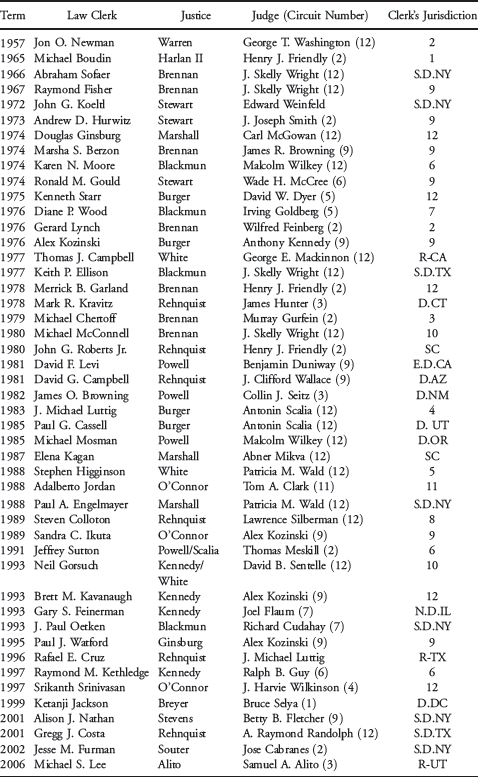
I conduct two analyses to support the validity of assigning a Supreme Court clerk the JCS score of their courts of appeals judge. First, I collected data on former Supreme Court clerks who became federal judges or members of Congress—clerks, in other words, for whom there are Common Space scores (Poole Reference Poole1998). I correlate the assigned JCS score with the actual measure of ideology of the Common Space score, anticipating a positive relationship if both variables measure the same underlying dimension. The moderately positive correlation of .369 (N = 43) supports this expectation and can be considered convergent validation (Adcock and Collier Reference Adcock2001, 540–42).Footnote 20
The replication of Peppers and Zorn (Reference Peppers2008, 74) that I present below pulls double duty as the second validation analysis. The replication shows that the assigned JCS measure behaves very similarly to the direct measure of clerk partisanship Peppers and Zorn use to predict the direction of votes on the merits. This result can be considered construct validation (Adcock and Collier Reference Adcock2001, 542–43), and it is further evidence of the validity of treating assigned JCS scores as proxy measures of clerk ideology.
In sum, among the virtues of the proposed measure are that it enables the construction of bloc characteristic variables Direction, Distance, and Proportion; it is continuous, available for almost every clerk, and not survey-based; and it is theoretically and empirically valid.
Controlling for Other Information Sources
The primary hypothesis is that the signal a bloc sends will pull a justice’s vote in its direction when the chambers structure is unified. I test this hypothesis with two model specifications. The first analysis measures the signal’s content with Clerk Liberalism, which is the proportion of liberal clerks a justice has hired.Footnote 21 The second analysis measures the signal’s content with variables for each bloc’s Proportion and Distance. With this second specification, I run separate models for each of the three chambers types: crosswinds, liberal foxhole, and conservative foxhole. I split the data along chambers type because the predictions are conditional on type.Footnote 22
For each model, I include controls for alternative informational influences on a justice’s vote from Collins (Reference Collins2008). The presence of these controls in the model means that any clerk effect is above and beyond that of other information sources. I repurpose Collins’s model into one testing for the general occurrence of vote pull by using Peppers and Zorn’s method of pooling data across justices and terms. I am not looking for influence in one term or for only one justice; rather, I am interested in exploring the general effect of chambers structure and signal content on decision making.
Collins conducts a rigorous analysis of amicus curiae influence that is bolstered by a theory that, while it does not explicitly account for law clerk influence, is consistent with the logic of law clerk influence I have presented. This is because amicus briefs provide new information in the same way that clerks provide information the justice does not already possess. For instance, Spriggs and Wahlbeck (Reference Spriggs and Wahlbeck1997) and Collins (Reference Collins2008) find that 67% and 70% of their samples of amicus briefs, respectively, contain new evidence, arguments, and policy ramifications not found in the parties’ briefs.
The model and data are thoroughly discussed in Collins’s book, so I will only summarize them here. The unit of analysis in all of my models is the justice-vote and the dichotomous dependent variable Vote Pull is whether a justice casts a liberal vote (1 for liberal, 0 for conservative), in orally argued cases, including split votes, from 1985 to 2001 (Segal, Cameron, and Spaeth Reference Segal1995; Spaeth Reference Spaeth2003).
The control variables Liberal Amicus and Conservative Amicus are the number of ideological amicus curiae briefs filed in either direction (Kearney and Merrill Reference Kearney2000; Collins Reference Collins2008). Lower Court Direction is the direction of the lower court decision under review (1 for liberal, 0 for conservative). Solicitor Liberal and Conservative are dummy variables coded 1 if the Solicitor General submitted a brief advocating that ideological position (Deen, Ignagni, and Meernik Reference Deen2003). Liberal Resources and Conservative Resources capture the identities of the litigants (Collins Reference Collins2008). Like Collins, I also interact Justice Ideology with Liberal Amicus and Conservative Amicus.
In the first analysis, I measure Justice Ideology with Segal-Cover scores (Segal and Cover Reference Segal1989) for the purpose of matching Peppers and Zorn’s approach. In the second analysis, I measure Justice Ideology using JCS scores, lagged by one term to reduce circularity.Footnote 23 JCS scores are transformed from the dynamic Martin-Quinn scores to a −1 (liberal) to l (conservative) scale (Giles, Hettinger, and Peppers Reference Giles and Peppers2001; Martin and Quinn Reference Martin and Quinn2002; Epstein et al. Reference Epstein, Martin and Segal2007). While these scores come with the risk of circularity, they present several advantages. First, the JCS already plays a role in the measurement of clerk ideology and chambers type: clerk scores and, say, Segal-Cover scores are not easily comparable, and being on the same scale is necessary for construction of Proportion, Distance, and Direction. Furthermore, because Segal-Cover scores are static, using them can overestimate or underestimate the sway clerks actually have. By controlling for a justice’s recent ideological voting using lagged JCS scores, I do not run the risk of attributing observed vote change to being pulled by clerks when a likely cause is a justice ideology score that has drifted out of date. To illustrate, consider Justices Souter and Kennedy in OT 2000. Souter’s Segal-Cover score is .325, while Kennedy’s is a slightly more liberal .365. Their lagged JCS scores, respectively, are −.414 and .179, suggesting that Souter is now much more liberal than Kennedy than at their respective confirmations. In 2000, Souter’s clerks’ scores were all more conservative than his JCS score, suggesting that he could be pulled in a conservative direction. The Distance of the bloc, and therefore the magnitude of the observed pull, would be much smaller if Souter were measured as a moderate-conservative, as he would given his Segal-Cover score, than as a strong liberal, as he would given his lagged JCS score. In short, the JCS is the most precise tool we currently have for testing the theory.
Finally, in the second analysis, in addition to splitting the data along chambers type—crosswinds, liberal foxhole, and conservative foxhole—I also split the data on Justice Ideology, and test only a continuous, ideologically moderate range of values. There are two reasons for doing this. First, as a justice’s JCS score approaches either pole, it will be difficult for him to hire clerks that are more ideologically extreme than he is. As a result, it makes less sense to assume that a justice’s structuring decisions were at all purposeful because clerks of particular ideology are scarce. This is evident in the data in chambers for Justices Marshall, Brennan, and Rehnquist, whose JCS scores were more extreme than all or nearly all active courts of appeals judges, making it impossible for these justices to stock their chambers with clerks more extreme than themselves: if these chambers were not excluded from the analysis, they would be automatically coded as foxholes. The second reason is that the theoretical model describes behavior likely to be exhibited by moderate justices. These justices are less attached to strong ideological views and may be more likely to seek out additional information, such as that which their clerks can provide.Footnote 24
Results
I begin with a replication of Peppers and Zorn’s model of a justice’s vote on the merits, as presented in their figure 4 (Reference Peppers2008, 74). This replication serves two purposes. First, it functions as a construct validation exercise (Adcock and Collier Reference Adcock2001, 542–43). Because, as I discuss below, the results with the JCS measure of clerk preferences hew closely to those obtained with Peppers and Zorn’s survey measure, we can infer that the JCS score is measuring the same latent variable: clerk ideology. Second, the replication leads directly to an analysis that is designed to uncover the mechanism of influence. These analyses are closely related. The first analysis makes minimal assumptions about how precisely clerk preferences have been measured, and after uncovering influence with this test, I conduct a more nuanced analysis that is designed to uncover how structure modifies how information influences merits’ votes.
Replication of Peppers and Zorn (Reference Peppers2008)
To conduct the replication, I construct an independent variable Clerk Liberalism that is assumed to measure the same latent variable as Peppers and Zorn’s main variable Clerk Partisanship. They measure chambers liberalism by aggregating survey responses and estimations of clerk partisanship. I code a clerk as having a liberal ideology if her proxy JCS score is ≤ 0 and as having a conservative ideology otherwise, and I construct a chambers-level variable that describes the proportion of liberal clerks.
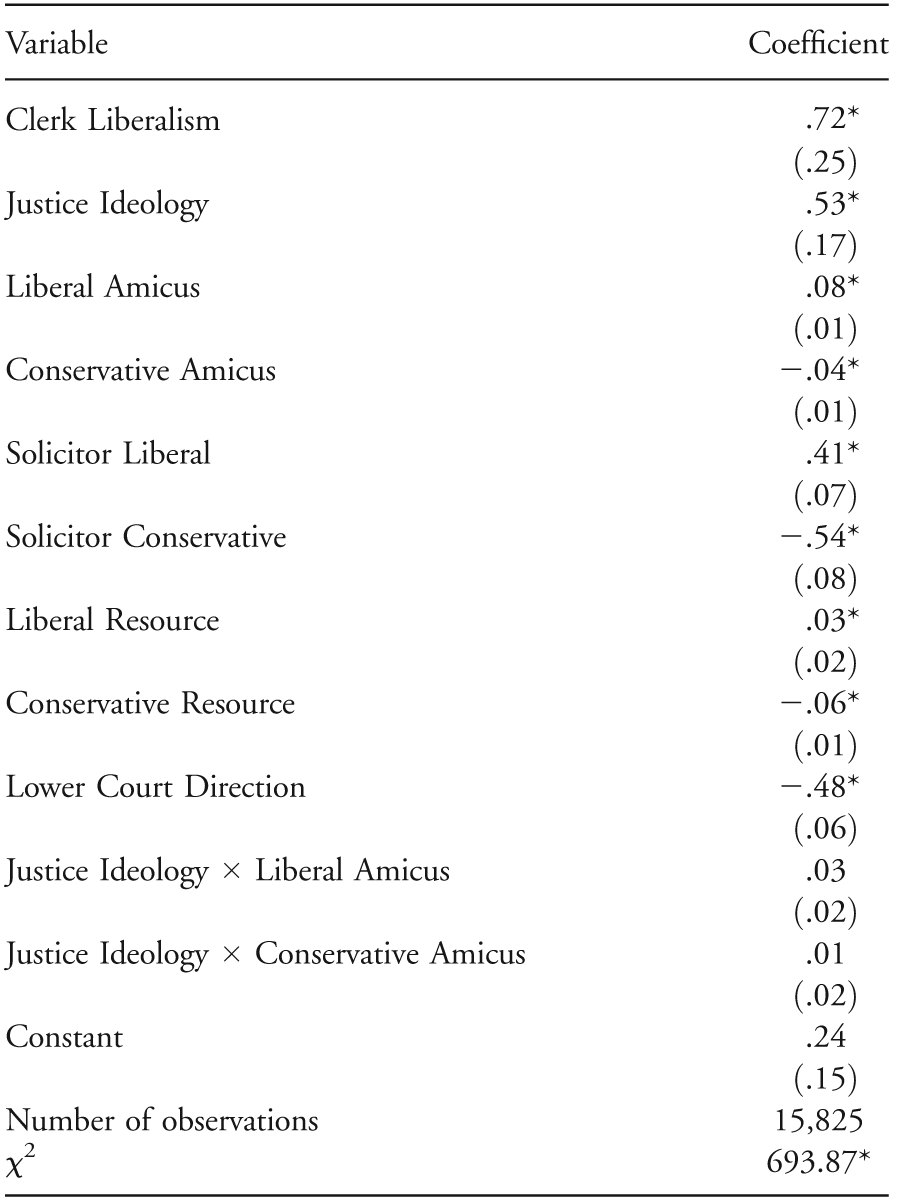
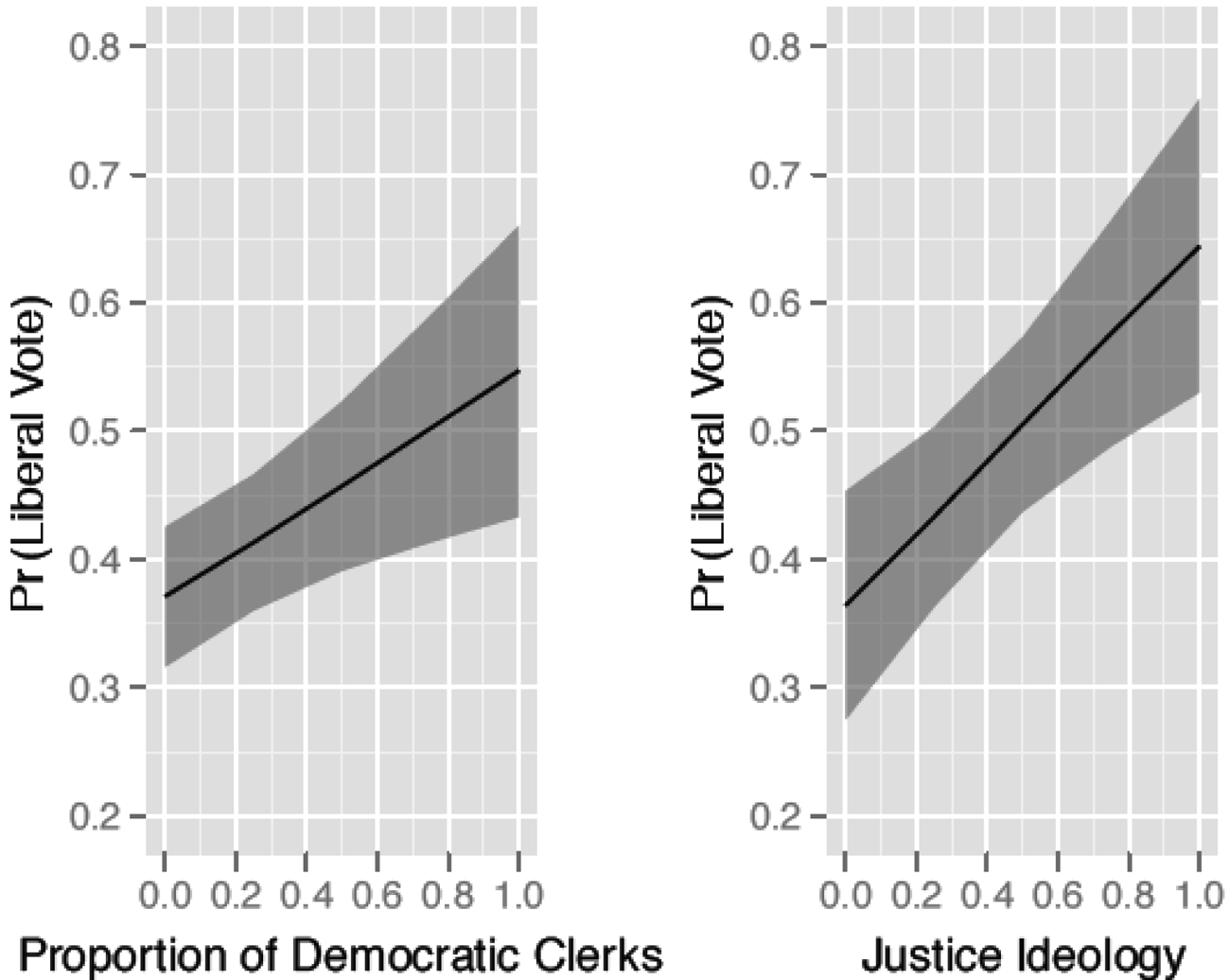
Table 1 presents the results of a logistic regression of a justice’s decision to cast a liberal vote on Clerk Liberalism. I note that Justice Ideology is measured with Segal-Cover scores in order to match Peppers and Zorn’s analysis. The results show that each variable, save Collins’ interactions, is statistically significant and correctly signed. Figure 1 plots the estimates obtained from the model in table 1. To compare the relative effect of Clerk Liberalism, I also plot the effect of Justice Ideology on an identical y-scale.
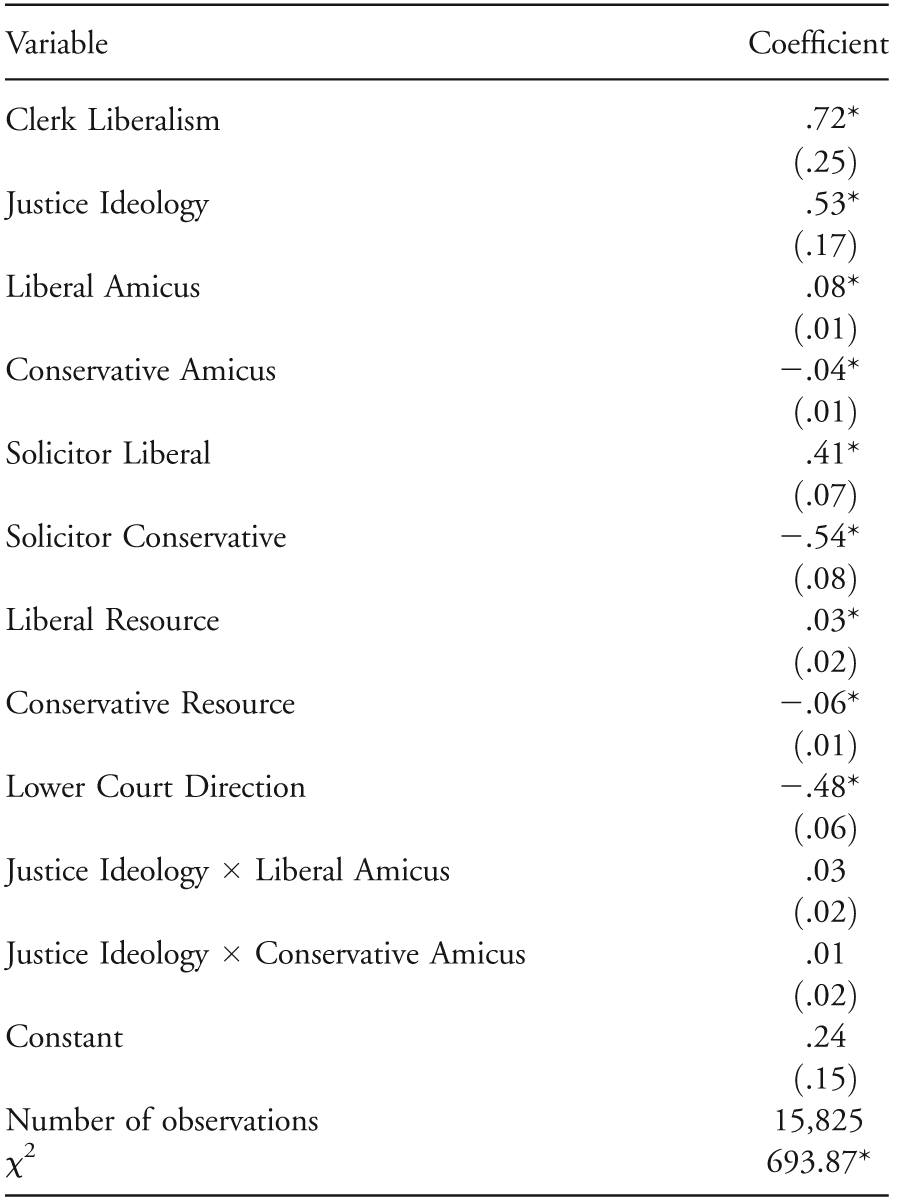
Note.—Robust standard errors (by justice) are in parentheses. Justice Ideology is measured by Segal-Cover scores.
* p < .05 (two-tailed).
Left panel, effect of increasing clerk liberalism on the probability a justice casts a liberal vote, 1985–2001; right panel, effect of increasing justice liberalism on the probability a justice casts a liberal vote, 1985–2001. Figures are on same y-scale for comparison purposes. Control variables are held at the mean or at a theoretically significant value.
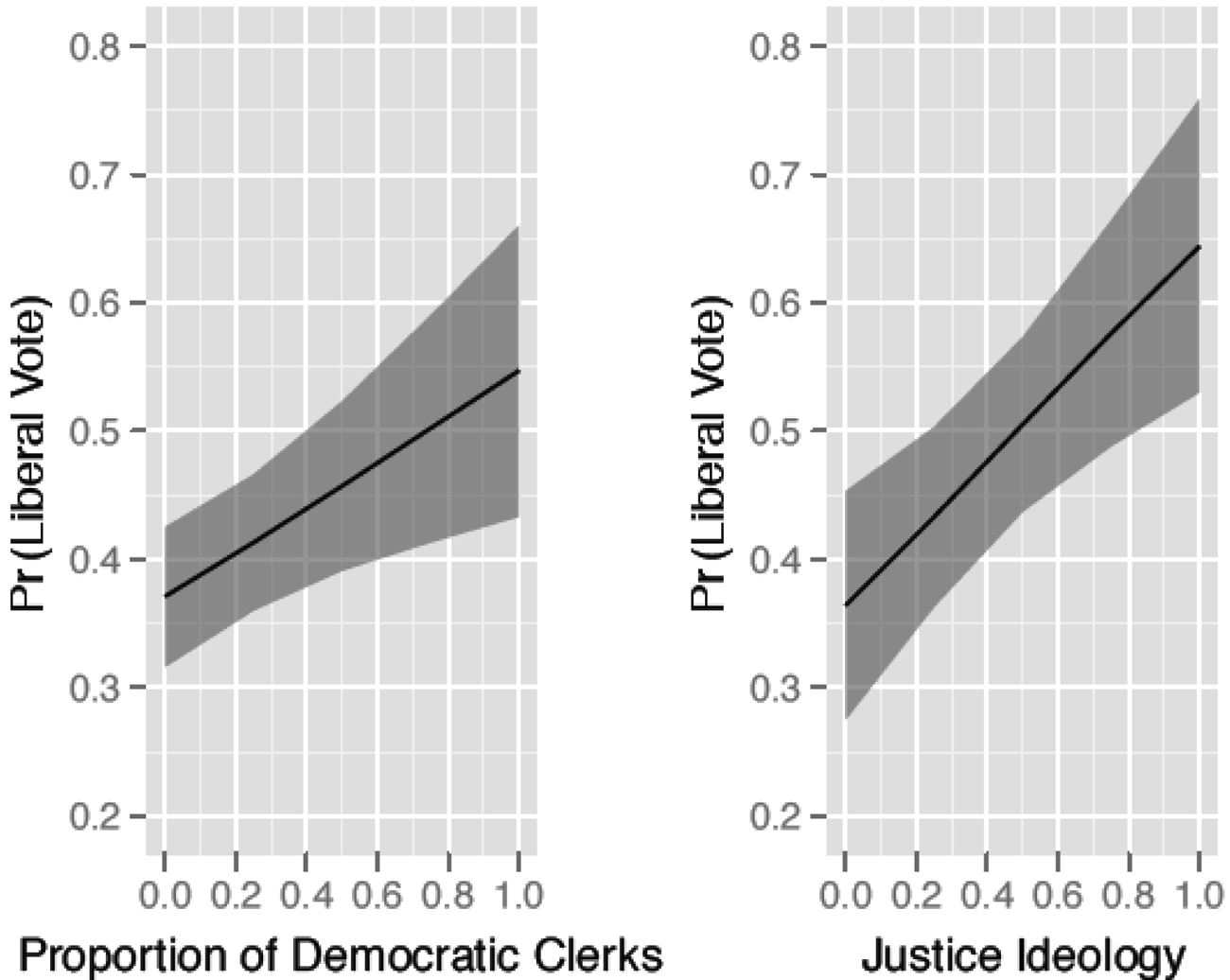
The results (for 1985–2001) strongly resemble Peppers and Zorn’s (for 1953–2004). They find that “a change across the full range of Clerk Partisanship from an all-Republican cadre of clerks to one composed entirely of Democrats increases the predicted probability of a liberal vote by 0.13 (from 0.39 to 0.52)” (Peppers and Zorn Reference Peppers2008, 74–75). My statistical model predicts a similar but slightly stronger effect: moving from a chambers of all conservative clerks to all liberal clerks increases the probability of a liberal vote by 0.18 (from 0.37 to 0.55). The difference in effect sizes—0.05—is quite small, and it could be due to the different time frames or to subtle differences in the measures.
As do Peppers and Zorn, I interpret the results of this statistical model as evidence that clerk ideology influences the justices’ votes on the merits. The more liberals a justice employs, the more likely he is to cast a liberal vote even after controlling for a host of other factors. Both sets of results also point toward structure being an important factor in clerk influence: variance among clerks’ ideologies affects their ability to pull a justice’s vote. This is apparent even with an interpretation strategy that does not try to ascertain the effect size: figure 1 shows that the predicted probability when Clerk Liberalism equals 0 is statistically distinguishable from when it equals 1.
There are limitations to what we can interpret using this research design. As Peppers and Zorn admit, while their findings are consistent with the phenomenon of justices’ votes being influenced by information gleaned from their clerks, their “findings offer no support for any particular causal model of that influence” (75). Similarly, while the results in table 1 and figure 1 are consistent with the informational account of clerk influence that I discussed above, the mechanism remains uncertain. I now turn to an analysis of how information influences behavior in each of the different types of chambers a justice assembles, crosswinds and both types of foxholes.
Testing an Informational Mechanism of Clerk Influence
I expect that the flow of information from clerks to justice differs according to chambers structure. Recall that foxholes are characterized by a high level of agreement among the clerks.Footnote 25 Relative to their justice, the clerks in these chambers are all either more liberal or more conservative. Clerks in foxholes can craft an informational signal upon which they all agree because any shift in the probability a justice casts a vote in the clerks’ direction will be preferable to the justice’s ideal point. Alternatively, crosswinds are characterized by a greater variety of viewpoints. On a unidimensional spatial model, clerks are to both sides of the justice. Rather than one powerful signal as in foxholes, clerks in crosswinds will craft multiple signals. Because the data cannot tell us anything about which bloc crafts the higher-quality signal in any given case, we cannot predict which is more likely to pull; sometimes the liberals will win out, sometimes the conservatives. As a result, I predict that overall pull in crosswinds will come out as a wash, resulting in no statistically distinguishable effect.Footnote 26
As described above, the variable Distance measures the content of a bloc’s signal. It captures the distance between the justice’s ideal point and a policy preferred by the clerks in a bloc. In foxholes, Distance should have a significant effect: as the signal endorses a position that is further away, the justice’s vote should be pulled to a greater degree. Because the dependent variable is whether a justice casts a liberal vote, in liberal foxholes the effect should be positive and in conservative foxholes it should be negative. In crosswinds, neither Distance nor Proportion, the latter of which drops out of the foxholes analyses, should have a significant effect.
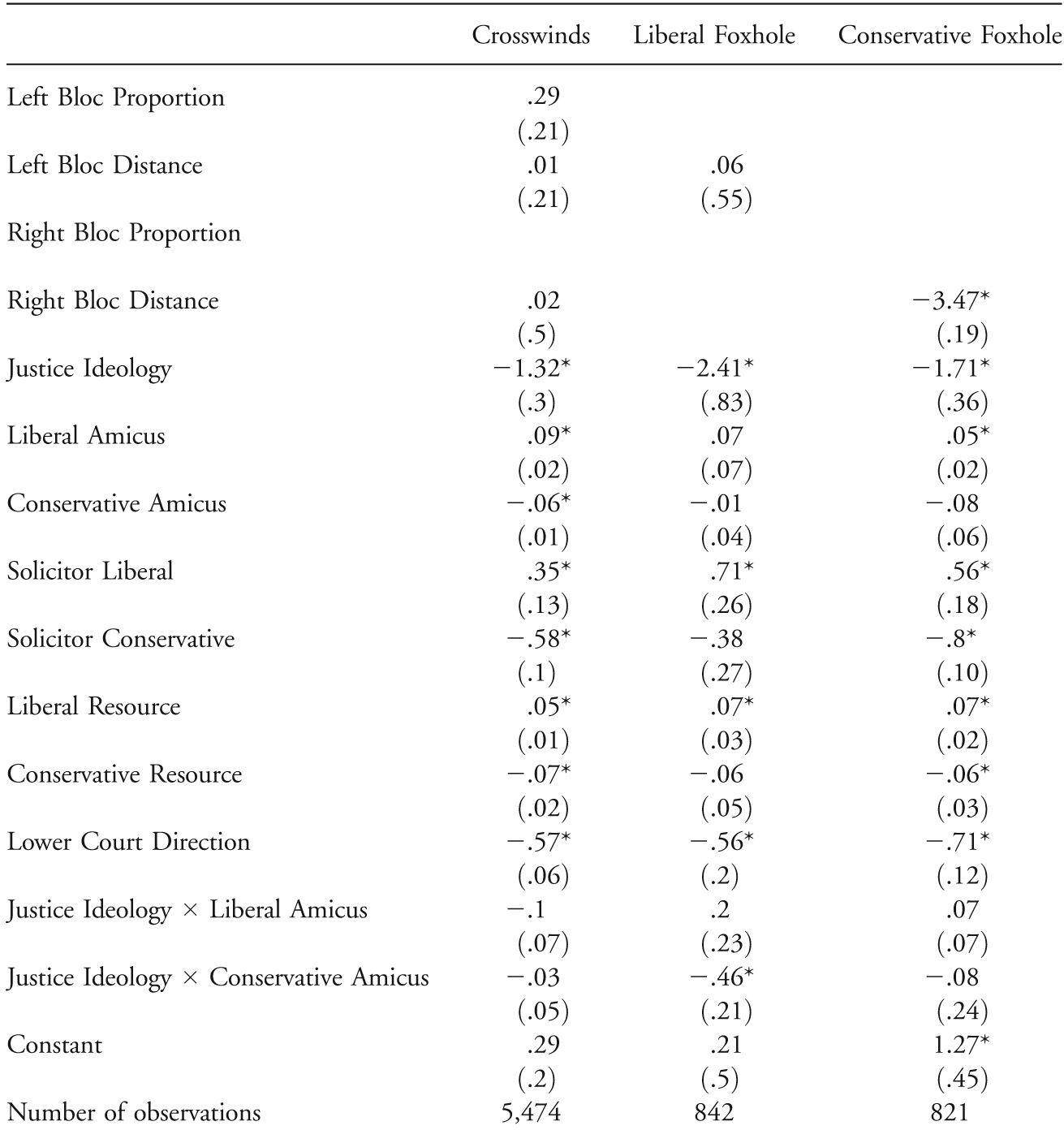
Table 2 reports the results of three models, each of which tests data from 1985 to 2001 for justices falling within a moderate range of ideology for crosswinds and liberal and conservative foxholes. The performance of the control variables provides confidence in the overall model. Consistent with social-psychological models of decision making, Justice Ideology is significant and correctly signed in all three models. Among statistically significant effects, the rest of Collins’s variables generally perform as expected.
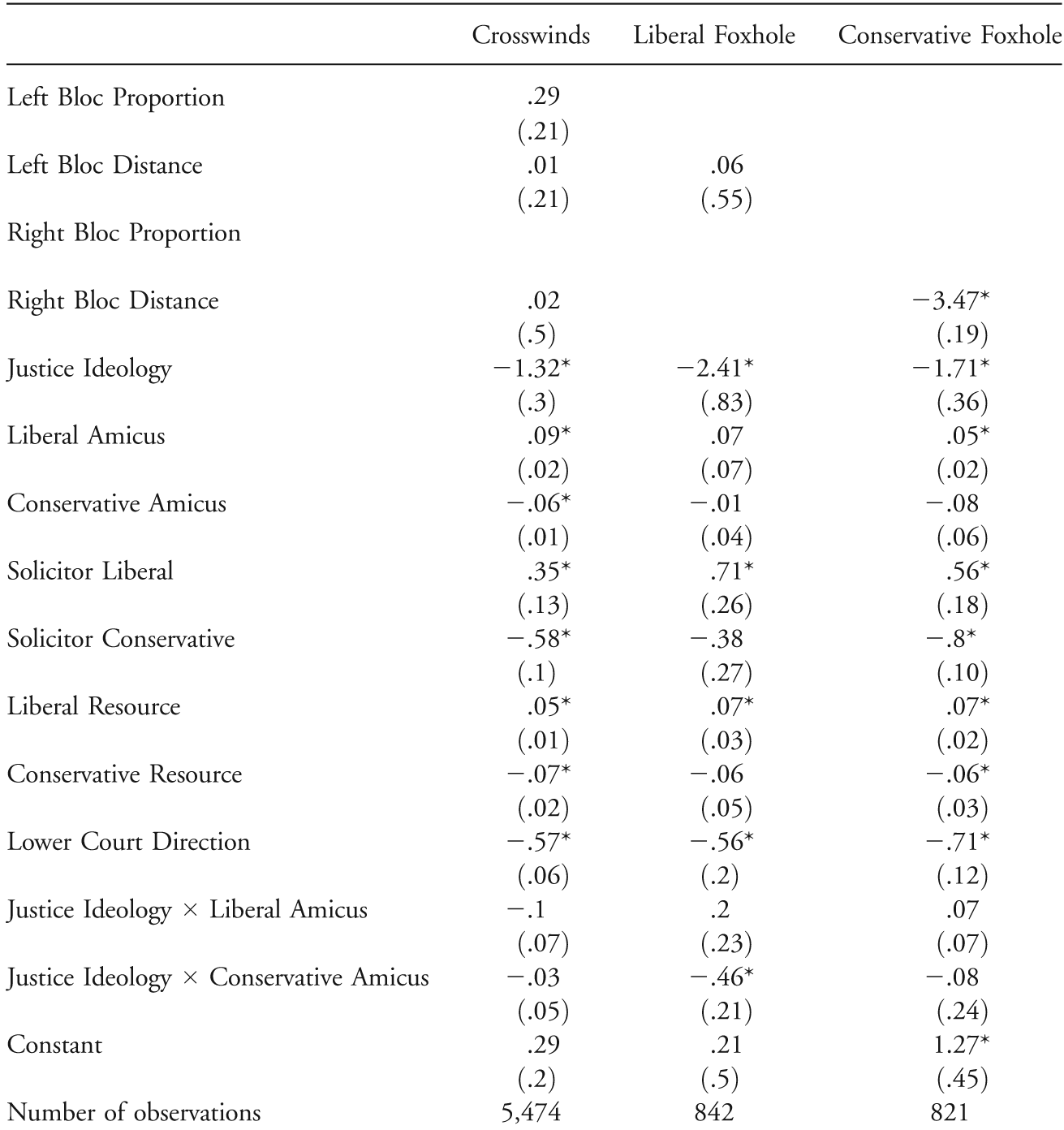
Note.—Crosswinds denotes proportion of clerks in both left and right blocs is greater than 0. Foxhole denotes proportion of clerks in bloc is equal to 1. Robust standard errors (by justice) are in parentheses. Justice ideology is measured by Judicial Common Space scores with a 1-year lag.
* p < .05 (two-tailed).
The results support many of the expectations. In crosswinds, neither bloc’s Proportion nor Distance has a statistically significant effect on vote direction. This is the predicted result, and we can interpret this finding that having clerks with diverse viewpoints results in no predictable pull on the justice’s vote.
In liberal foxholes, Right Bloc Proportion and Right Bloc Distance drop out of the model because, by stipulation, each has a value of 0. Left Bloc Proportion also drops out, because in this sample there is no variation; it is always equal to 1. Left Bloc Distance is signed correctly but is not statistically significant. We therefore cannot conclude from these results that liberals craft a strong enough signal to pull their justice’s vote.
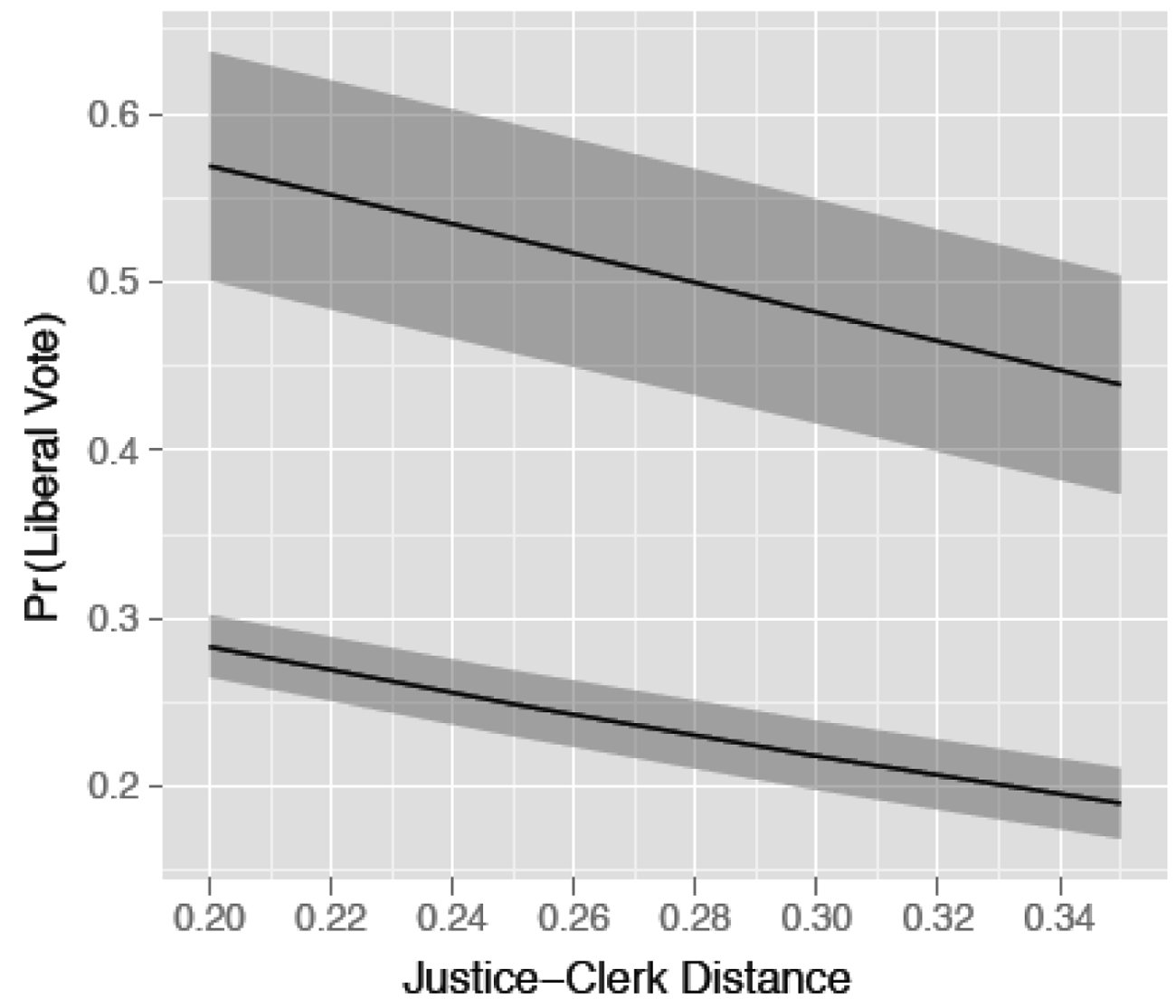
It is a different story in conservative foxholes. Left Bloc Proportion and Left Bloc Distance are both equal to 0 and drop out. Right Bloc Proportion also drops out because it is always equal to 1. Right Bloc Distance is correctly signed and statistically significant. This is evidence that the farther the average Distance between the justice’s ideology and his clerks, the more his vote is pulled rightward. I plot the conservative foxhole model’s estimates in figure 2 to interpret the magnitude of Distance’s pulling effect. Figure 2 shows that the effect is considerable. Over the range of Distance, a justice’s vote is pulled rightward by a probability of .09 to .13 (from .57 to .44 for a liberal-leaning justice and .28 to .19 for a conservative-leaning justice). In other words, a justice with clerks who are at the maximum distance is 23%–32% less likely to cast a liberal vote. The predicted probabilities reveal a statistically and substantively significant negative relationship between his conservative foxhole clerks’ preferred policy and the probability that a justice casts a liberal vote.
Effect of increasing the average ideological distance between justice and clerks on the probability a liberal-leaning (top) and a conservative-leaning (bottom) justice casts a liberal vote in a conservative foxhole chambers, 1985–2001. Control variables are held at the mean or at a theoretically significant value.
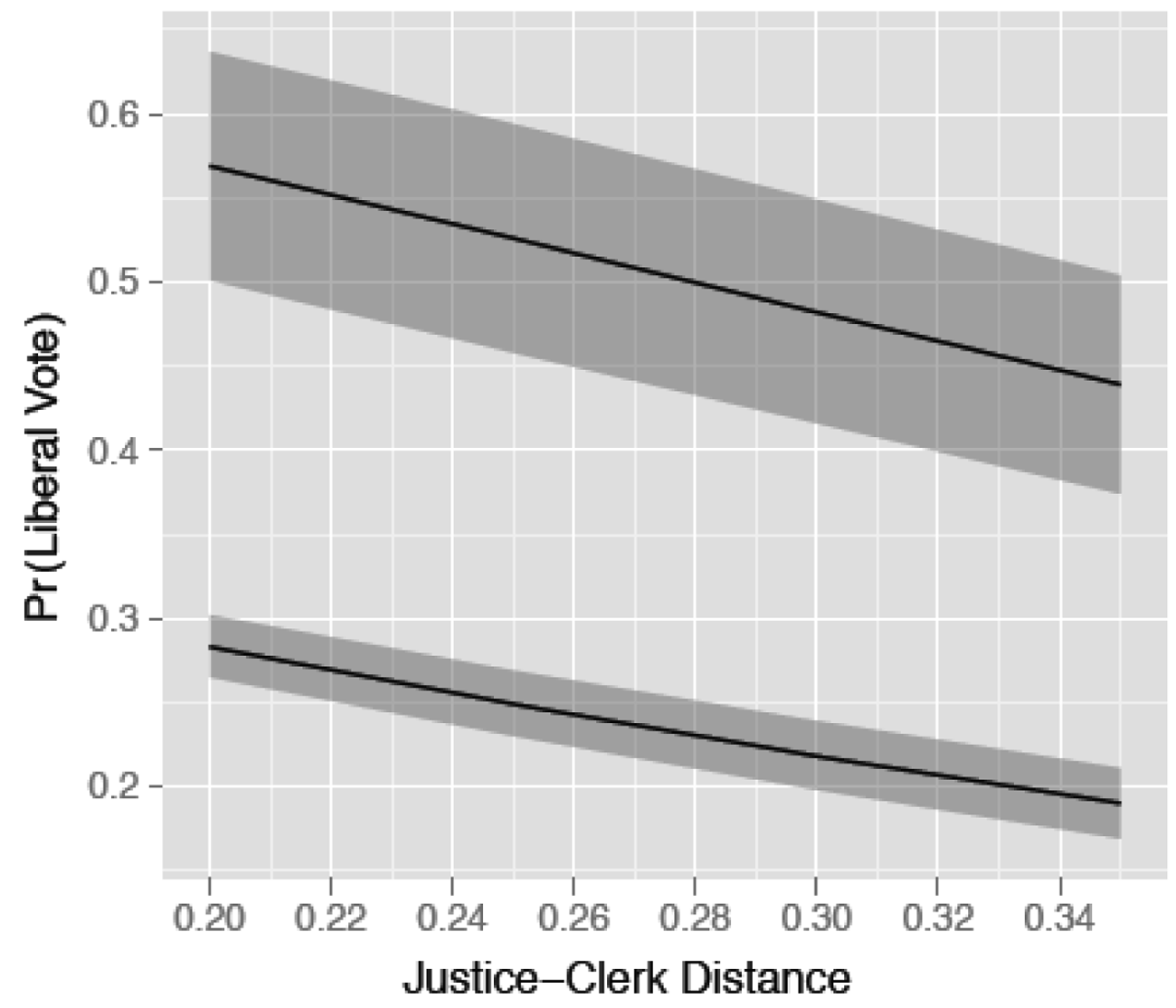
The evidence provides strong but asymmetric support for the theory because there is no significant effect for liberal clerks.Footnote 27 One explanation for this asymmetry could be that signals from liberals are viewed as less credible than signals from conservatives. This finding squares with Lazarus’s (Reference Lazarus1999) depiction in Closed Chambers of a conservative “Cabal” being more successful than the “Dreaded Libs” at manipulating the justices. While a political scientist has challenged elements of Lazarus’s book (Kenney Reference Kenney2000b), it could be that conservatives are more organized or are more effective at marshaling information and shaping votes. The Federalist Society, a powerful force in organizing conservatives in the legal community, formed in the early eighties, shortly before the period studied here, and a recent book shows how law clerks serve as a conduit for ideas from the society to the Court (Hollis-Brusky Reference Hollis-Brusky2015). The existence of such a network may also help explain how even faraway conservatives are able to pull their justice to their position, which complicates the ally principle. It appears that either the principle does not apply in this context or that even a faraway conservative can convince her justice that she is his ally.
Discussion
My findings show that structure matters in the justices’ interactions with their clerks. Whether the justices desire the sort of influence I have found remains an open question, but there is reason to expect that they do. They have great discretion about whom they hire, which may lead scholars to view a justice’s structural decisions as a purposeful assembling of a team designed to pursue his individual goals (Kromphardt Reference Kromphardt2014). It is noteworthy that ideology does not appear to be the sole factor in the decision to assemble a unified chambers: nine different justices in the analysis assembled at least one liberal or conservative foxhole, with one justice—O’Connor—assembling one of each. Further research should seek to uncover factors that systematically guide a justice’s structural decisions; in the meanwhile, the insufficiency of an obvious answer like ideology should allay concerns about sample bias or whether clerk ideology is endogenous.
While grounded in the literature on judicial decision making, my approach to studying clerk influence has little direct precedent, and so some may view my findings with skepticism. After all, I rely on a novel measure of clerk preferences to study a role played by the clerks that has been underappreciated in the literature. Skeptics should take note that the measure meets construct and convergent empirical validation and is supported by theory and the literature. Also, the theory of decision making I present is not new; only clerks’ role in it is. The literature has shown that the justices acquire and use information from attorneys, the solicitor general, and amicus curiae briefs, among other sources. I contribute to this conversation that clerks represent an additional source.
To the extent that a veil of secrecy hangs over the actions of the Supreme Court, we are limited in how much we can know about what goes on inside the justices’ chambers. To some, it is deeply concerning that young, unconfirmed lawyers play a part in deciding cases. Critics who are concerned about clerks’ usurpation of Article III may be premature: an advisory form of clerk influence actually may be welcomed by the justices. A robust formal literature documents the effects of delegation on decision making by other political actors (e.g., Gailmard and Patty Reference Gailmard2012; Gehlbach Reference Gehlbach2013, chap. 5), and future research may try to formalize or draw lessons from the justice-clerk dynamic.
When “young clerks keep judges abreast of the thinking taking place in the outside world,” there should be little doubt that when “a clerk persuades a judge to a view, so that the judge makes the view her own, this is proper functioning of the judge/clerk relationship rather than arrogation of judicial power by clerks” (Velvel Reference Velvel1995, 5). The justices’ chambers are the workplace of a corps of law clerks that grows increasingly diverse—perhaps by ideology, but certainly in terms of gender, race, and educational background—and the effects clerks have can be observed if we carefully discern implications of institutional structures. Only once we know what influence, if any, clerks have, should we draw normative conclusions.
Appendix
Table A1 is a list of former Supreme Court law clerks with federal courts of appeals clerkship experience and who have held a position for which a Common Space score was calculated. Scores for Justice Elena Kagan and Senator Ted Cruz were not yet available.