Introduction
The use of herbicides in the modern conventional cropping systems are becoming more limited mainly due to their negative environmental impact which has recently caused several concerns regarding their effect on soil, water and air qualities, as well as on human health and food quality (Gavazzi et al., Reference Gavazzi, Schulz, Marocco and Tabaglio2010). Furthermore, the excessive use of herbicides led to an increase of herbicide-resistant weed biotypes (Powels, Reference Powels2008). However, since herbicide application remains the main tool to control weeds in conventional cropping systems, there is the need to develop new approaches to weed management necessary both for assuring an adequate crop yield and for respecting the agro-ecosystems (Kruidhof et al., Reference Kruidhof, Bastiaans and Kropff2008; Möller and Reents, Reference Möller and Reents2009). For this reason, strategies based on both chemical refinement and integrated crop management are advocated in order to accomplish significant reductions in herbicide use in terms of quantity and frequency (Mortensen et al., Reference Mortensen, Bastiaans and Sattin2000). Recently, sustainable management practices such as conservation agriculture are widely adopted in order to improve crop yield, soil fertility and environmental issues (Campiglia et al., Reference Campiglia, Caporali, Radicetti and Mancinelli2010). Indeed conservation agriculture is a mix of environmentally friendly practices that combine minimization of soil disturbance with a permanent residue for soil cover and crop diversification (FAO, 2012). Although conservation agriculture includes several benefits such as the reductions in production costs, water pollution, soil erosion and soil degradation, as well as in nutrient leaching (Lonsbary et al., Reference Lonsbary, O'Sullivan and Swanton2004), these benefits might not be reached without properly developed strategies and technologies (Chauhan et al., Reference Chauhan, Singh and Mahajan2012). A major limitation on the adoption of conservation agriculture is related to reduced weed control due to a shift of weed flora composition (Trichard et al., Reference Trichard, Alignier, Chauvel and Petit2013). In fact, in agreement with Garnier and Navas (Reference Garnier and Navas2012), the reduction of tillage intensity seems to cause a change in weed flora composition, favoring perennial weed species. However, according to Campiglia et al. (Reference Campiglia, Radicetti and Mancinelli2015), adequate weed management could be achieved through the cultivation of suitable cover crops. Cover crops are an essential component of most conservation tillage systems and they are usually planted in early fall so that they grow before winter and produce sufficient biomass by early spring before the cultivation of the main cash crops. Under conservation agriculture, cover crop residues remain on the soil surface as organic dead mulch that can suppress weeds by reducing light transmittance, soil temperature amplitude (Teasdale and Mohler, Reference Teasdale and Mohler1993) and releasing allelochemicals (Kruidhof et al., Reference Kruidhof, Bastiaans and Kropff2008). All these factors could contribute to managing weeds under sustainable cropping systems and reduce the need for herbicides (Barberi, Reference Barberi2002; Kalinova, Reference Kalinova and Lichtfouse2010). Campiglia et al. (Reference Campiglia, Radicetti, Brunetti and Mancinelli2014) recently showed that the residues of cover crops, placed in strips in no-tillage system, are very effective in controlling weeds in summer vegetables cultivated in rows on the mulch strips. The combination of cover crops and conservation tillage may reduce early weed competition by delaying their germination and can help reduce herbicide inputs (Hoffman et al., Reference Hoffman, Regnier and Cardina1993; Burgos and Talbert, Reference Burgos and Talbert1996; Teasdale, Reference Teasdale1996). However, little information is available to support decision-making for both cover crop residue management and herbicide rate in a sustainable way for tomato production and weed management. We hypothesized that the adoption of cover crops under no-tillage conditions could be a sustainable strategy for weed management capable of reducing the rate of herbicides and maintaining the production of a tomato crop. Thus, the main objective of this work was to evaluate the impact of the combined effect of cover crop residue management and herbicide rate on tomato yield and weed characteristics under the agro-climatic conditions of northern Iran. The specific objectives were: (1) to evaluate the effect of herbicide rates applied to tomato crop under different cover crop residue managements on weed management; (2) to investigate the changes on weed flora composition in response to different cover crop residue managements and herbicide rates at tomato harvesting; and (3) to assess the yield response of tomato crop to cover crop residue management and herbicide rates.
Materials and methods
Experimental site description and experimental design
Field experiments were carried out in the 2014 and 2015 tomato growing seasons at the research farm of the College of Agriculture, Payame Noor University, Gorgan, Golestan province, Iran (36°50′N; 54°22′E, altitude: 61 m a.s.l.). The experimental site is characterized by a typical semi-arid climate with long dry summer and cool winter. Mean daily temperature during the tomato growing season (from April to August) varied from 17.9 to 28.3°C, while total rainfall in the same period was 190 mm (average of 2014 and 2015 growing seasons). Physico-chemical characteristics of the soil are: sand 47%, silt 25%, clay 28%, pH 7.4, EC 2.5 dS m−1, organic matter (0.40%), total N (0.06%), available phosphorous (6.5 mg kg−1) and available potassium status (187.5 mg kg−1), field capacity 26.4% d.w. and wilting point 14.9% d.w.
Each field experiment consisted of a cover crop–tomato sequence. The experimental treatments were: three winter soil managements: two cover crop species [annual medic (Medicago scutellata L., var. Robinson, hereafter called CC1) and barley (Hordeum vulgare L., var. Sahra, hereafter called CC2)] and a no covered soil (hereafter called CC0); two soil tillage for preparing the transplanting bed of the tomato crop: soil tilled conventionally at a depth of 30 cm (hereafter called CT) and no-tilled soil (hereafter called NT); three pre-plant herbicide rates [no application (H1), half recommended rate (H2) or full recommended rate (H3) of pre-emergence herbicides]. The experimental design was a split–split plot, where the winter soil management was the main factor, the soil tillage was the split factor and the pre-plant herbicide rate was the split–split factor. The treatments were replicated four times for a total of 72 basic plots: The main plot size was 115.2 m2 (14.4 × 8 m), the sub-plot size was 57.6 m2 (14.4 × 4 m) and the sub-sub-plot size was 28.8 m2 (7.2 × 4 m).
Farming practices
In September, at the beginning of each cover crop–tomato sequence, the soil was ploughed at a depth of 30 cm and fertilized with 100 kg P2O5 ha−1 as a triple superphosphate, then it was disk harrowed twice in order to prepare the seed bed for cover crop sowing. Annual medic and barley cover crops were sown manually and the seeds were superficially buried by harrowing on 24 October 2014 and 13 October 2015. The seed rate was 20 and 150 kg ha−1 for annual medic and barley, respectively, and it was the same in both experimental years. In the no covered plots, after seed bed preparation, the soil was kept bare throughout the cover crop growing season by hand weeding. Ten days before tomato transplanting, the aboveground biomass of cover crops was mechanically suppressed (22 March 2014 and 14 March 2015) and arranged as follows: (i) it was chopped using a straw chopper and immediately incorporated into the soil at 30 cm with a mouldboard plough and disked twice in order to manage the cover crop residues in conventional tillage system (CT); (ii) it was mowed about 5 cm above the soil surface and disposed in strips as organic dead mulch in order to manage the cover crop residues under no-tillage conditions (NT). Mulch strips were approximately 80 cm wide and 100 cm apart disposed as organic dead mulch (Radicetti et al., Reference Radicetti, Mancinelli, Moscetti and Campiglia2016). In the CC0 treatment, the soil was mouldboard ploughed and disked twice in order to simulate CT or left untilled in order to simulate NT treatments, respectively. The herbicide treatments were applied 3 days before tomato transplanting. The full rate treatment (H3) received 840 g ha−1 a.i. of Metribuzin (United Agri Products, Greeley, CO, USA), the half-rate treatment (H2) received 420 g ha−1 a.i. of Metribuzin, and there was no herbicide applied in the control (H1). Herbicide treatments were applied with a CO2 pressurized backpack sprayer using 8003 flat-fan spray tips (Teejet spraying systems, Wheaton, IL, USA) at 275 kPa in 187 L·ha−1 water. Post-emergence herbicide was not applied in this experiment.
On 2 April 2014 and 25 March 2015, 1-month-old tomato seedlings (Solanum lycopersicum L.) cv. Super Cheif were hand-transplanted in paired rows at a distance of 40 cm between one another and a distance of 140 cm between the paired rows at a density of 3.36 plants m−2. The same tomato planting system was used for all experimental plots. In the NT plots, the tomato seedlings were transplanted in the middle of the mulch strips with reduced disturbance of the residues layer, thus the mulch layer surrounded each tomato plant. The tomato crop was irrigated (with a traveling irrigation gun) as needed in order to maintain the tomato plants free of drought stress. Ammonium nitrate was applied at a rate of 112 kg N ha−1 on 15 April 2014 and 24 April 2015 (50% of the total amount), and 4 May 2014 and 9 May 2015 (the remaining 50% of total amount). Diseases and insects were controlled using standard production practices for the Golestan province. The tomato fruits were harvested on 19 August 2014 and on 20 August 2015.
Data collection
The cover crop and weed aboveground biomass were separately collected before cover crop suppression. The plants were hand-clipped at the soil surface and sampled using a 50 × 50 cm quadrat (0.25 m2) randomly placed four times in the middle of each plot. The samples were oven dried at 70°C until constant weight.
The photosynthetic photon flux density (PPFD, μmol m−2 s−1) transmitted by the tomato canopy and the mulch layer when present was measured at ground level. Every 20 days, from tomato transplanting to tomato harvesting, a linear ceptometer (SS1-UM-2.0, DELTA-T Devices LDT, Cambridge, England) was placed horizontally at ground level five times in the central tomato paired rows. The measurements were performed only in the H3 plots in order to minimize interference of weeds. All measurements were performed under full sunlight on clear days between 12.00 and 14.00 h. The fraction of PPFD intercepted was calculated using the following formula:
 $${\rm FiPPFD} = \left( {1 - \displaystyle{{I_0} \over {I_{\rm t}}}} \right),$$
where FiPPFD is the fractional amount of radiation interception, I 0 is the average of five measured PPFD on the surface of the ground, and I t is the radiant flux density on top of the canopy. FiPPFD equal to 1 or 0 indicates all or no PPFD intercepted, respectively.
Tomato N status was evaluated using a chlorophyll meter (SPAD-502, Konica Monolta Holding, Inc.). SPAD readings were taken on the uppermost fully expanded leaf in ten plants per plot and averaged every 15 days.
In order to evaluate the effect of winter soil management, soil tillage and herbicide rate treatments on weed management, weed density (total and per species) and total weed aboveground biomass (oven dried at 70°C until constant weight) were sampled at tomato harvesting using a 40 × 100 cm rectangle randomly placed four times within the paired tomato rows. Fruit yield was determined by harvesting the marketable fruits of the ten consecutive tomato plants picked from the middle paired rows (five plants per row) from all plots.
The relative response index (RRI) was adopted in order to assess the effects of cover crops and their residue management on tomato (RRIt) or weed (RRIw) fitness (Williams et al., Reference Williams, Mortensen and Doran1998). The RRI was calculated as:
 $${\rm RRI} = \displaystyle{{T{\rm nc} - T{\rm c}} \over {T{\rm nc} + T{\rm c}}},$$
where T nc represents tomato or weed response (e.g., grain yield and biomass) in the no cover treatments, and T c represents tomato or weed response in the cover crop treatments. The RRI index expresses plant response to cover crop residue in relation to the bare soil control; RRI higher, equal to or lower than 0 indicates that cover crop residue management decreased, had no effect or increased plant fitness compared with no cover treatments, respectively (Grace, Reference Grace1995). The response comparison index (RCI), at tomato harvesting, was used to quantify whether the addition of the cover crop has a more positive influence on tomato or on tomato weeds. The RCI index was calculated as:
 $${\rm RCI} = {\rm RRIw} - {\rm RRIt}.$$
RCI higher, equal to or lower than 0 means that the positive influence of the addition of cover crop in tomato was greater, equal to or lower than the positive influence on the tomato weeds, respectively.
Statistical analyses
The analysis of variance (ANOVA) was carried out for all the data of the 2-yr period using the JMP statistical software package 4.0 (SAS Institute, 1996). The cover crop and weed aboveground biomass at cover crop suppression were analyzed using the cover crops as a fixed factor and the year as a repeated measure. At tomato harvesting, the data regarding weed density, aboveground biomass, species richness and tomato fruit yield were analyzed as a split–split plot experimental design where the winter soil management was treated as a main factor, soil tillage as a split factor, the herbicide rate as a split–split factor and the year as a repeated measure. Fisher's protected least significant differences (LSD) were used for comparing the main and interaction effects.
The association between the winter soil management and soil tillage treatments on the occurrence of weed species was analyzed by means of a canonical discriminant analysis (CDA). JMP statistical software package 4.0 (SAS Institute, 1996) was used to perform the CDA analysis. The results of the CDA were summarized in a two-dimensional canonical discriminant structure plot, into which a vector diagram based on the total canonical coefficient of each weed species from the canonical functions were combined. The group means were determined and reported on axes defined by the first and second canonical functions in order to describe the degree of similarity of weed species between the cropping system or soil tillage groups. Weed species were represented as vectors whose length indicates the degree of association with direction in ordination space (Kenkel et al., Reference Kenkel, Derksen, Thomas and Watson2002).
Results
Cover crop aboveground biomass production
In both the 2014 and 2015 experimental years, annual medic and barley cover crops emerged uniformly in September about 10 days after sowing and they grew regularly until March. At the cover crop suppression, annual medic was at the late flowering stage, while barley was at the beginning of milk stage. At the cover crop suppression, the aboveground biomass in annual medic was higher than barley [569 vs 408 g m−2 of dry matter (DM), respectively]. In the same period in both the cover crop growing seasons, barley showed a lower weed aboveground biomass compared with annual medic (32 vs 48 g m−2 of DM, respectively).
SPAD and FiPPFD measurements throughout the tomato growing season
The chlorophyll leaf content was measured by SPAD throughout the tomato growing seasons. In all winter soil management, it gradually increased after tomato transplanting and it reached higher values about 1 month after tomato transplanting and then it was the lowest at tomato harvesting (Fig. 1). However, tomato grown in annual medic residues (CC1) showed higher values of SPAD compared with tomato cultivated in barley residues (CC2) and no cover (CC0), regardless of the tillage management and herbicide treatments (Fig. 1). In CC1, the SPAD reading tended to be higher in NT-H3 and H2 and in CT-H3, while the lowest values were observed in CC1-CT-H1. In CC2, the SPAD reading values were lower in CT at the beginning of the cropping period of the tomato, while it increased and became similar with NT at tomato harvesting. The maximum amplitude in SPAD values was observed in barley (from 21.9 to 49.2), while annual medic showed the minimum amplitude (Fig. 1). The SPAD reading values observed in bare soil were generally lower in NT compared with CT throughout the tomato cropping period. The SPAD showed a similar trend regarding the herbicide treatments; in fact, it was generally higher in H3 and H2 compared with H1.
Effect of cover crops under different soil tillage and herbicide rate treatments on chlorophyll content (SPAD) of tomato leaves throughout the growing season of the crop. Data correspond to the 2014 and 2015 tomato growing seasons. Error bars represent ±standard error from mean. NT, no-tillage; CT, conventional tillage; H1, non-herbicide; H2, half rate herbicide; H3, full rate herbicide.

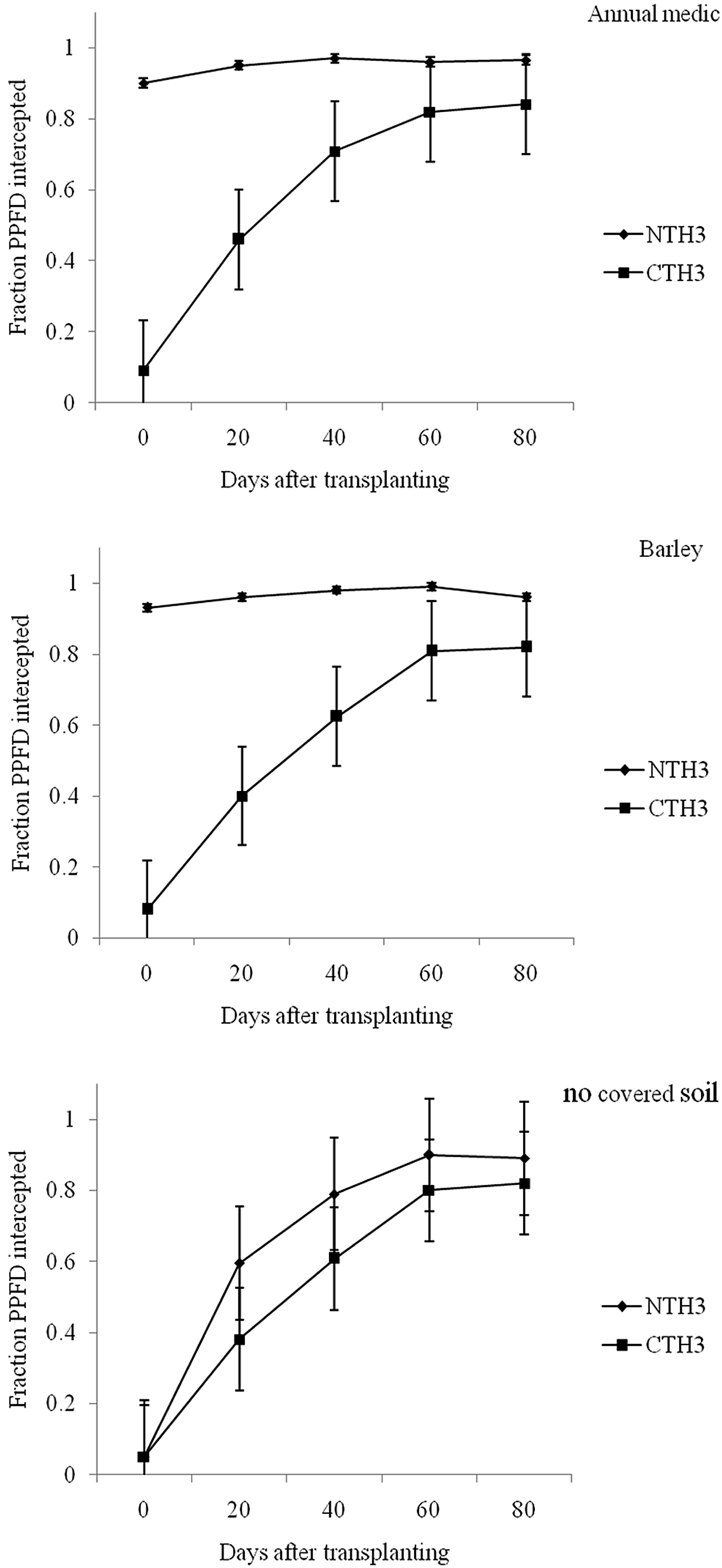
The fraction of intercepted photosynthetically active radiation (PAR), expressed as a fraction of intercepted PPFD, for different cover crops throughout the tomato growing seasons in CT-H3 and NT-H3 treatments were reported in Figure 2. As expected for the entire tomato growing seasons, the values of FiPPFD under CC1 and CC2 winter soil management were higher in NT compared with CT, while no differences were detected between soil tillage in CC0. However, the differences in intercepted PAR were more pronounced among tillage managements early in the season, while the differences tended to be diminished later during the tomato season (Fig. 2). In NT treatments, FiPPFD was higher in CC1 and CC2 compared with CC0, while in CT treatments, few differences were observed among the winter soil management (Fig. 2).
The effect of cover crops on the fraction of photosynthetic photon flux density intercepted at ground level (FiPPFD) in conventional tillage (CT), no tillage (NT) with full rate of herbicide (H3) tomato plots measured at interval of 20 days throughout the growing season of the crop. Data correspond to the 2014 and 2015 tomato growing seasons. Bars indicate ±standard error of the mean.

Weed characteristics in cover crop and tomato
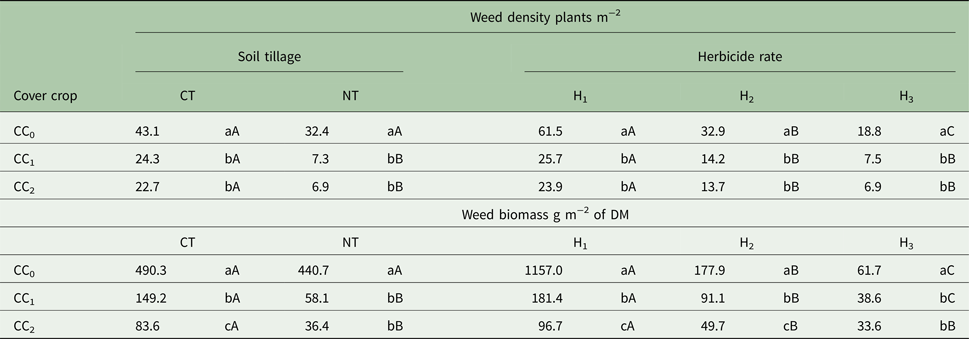
At tomato harvesting, weed density, weed aboveground biomass and weed richness varied significantly according to winter soil management × soil tillage (P ⩽ 0.01) and winter soil management × herbicide rate (P ⩽ 0.05, Table 1). Generally regardless to soil tillage, weed density tended to be higher in CC0 than CC1 and CC2 treatments (on average 35.6 vs 15.3 plants m−2, respectively), even if in CC1 and CC2 weed density was higher in CT than NT soil tillage (Table 1). As expected, the application rate of pre-emergence herbicide significantly affected weed density. In CC0, it was high in H1, intermediate in H2 and low in H3 (61.5, 32.9 and 18.8 plants m−2, respectively). However, in CC1 and CC2, weed density resulted similar and lower in H3 and H2 compared with H1. A similar trend was also observed in weed aboveground biomass (Table 1).
The interaction effects of cover crop × soil tillage and cover crop × herbicide rate on weed density and weed aboveground biomass at tomato harvesting

Values belonging to the same characteristic and treatment with different letters in rows for soil tillage or herbicide rate (upper case letter), and in columns for cover crop (lower case letter) are statistically different according to LSD (0.05). CC0, no covered soil; CC1, annual medic; CC2, Barley; CT, conventional tillage; NT, no-tillage; H1, non-herbicide; H2, half rate herbicide; H3, full rate herbicide.
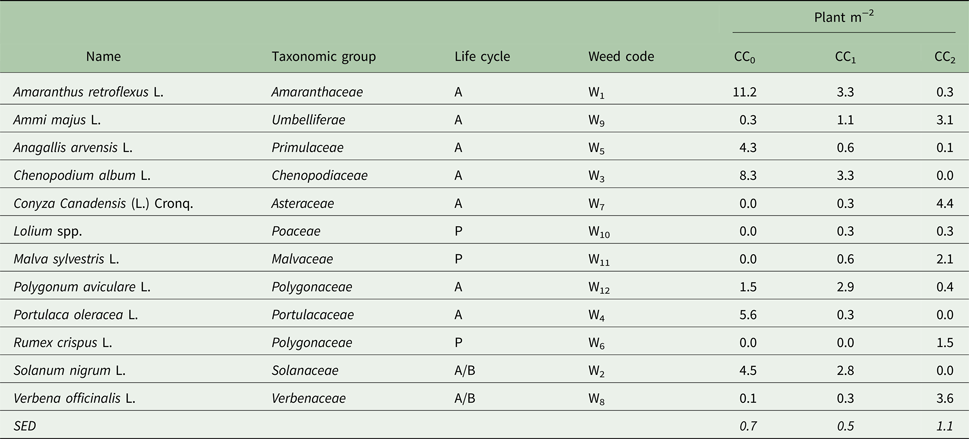
A total of 12 main weed species were found across the winter soil management treatments (Table 2). The results of CDA on the weed density at tomato harvesting are reported in Figure 3. The first two canonical variables explained 69% of the total variance. Generally, Amaranthus retroflexus, Chenopodium album, Solanum nigrum, Portulaca oleracea and Anagallis arvensis vectors were generally in the same ordination space of no covered soil and annual medic regardless the soil tillage and herbicide treatments, while barley appears to be associated with Ammi majus, Verbena officinalis, Malva sylvestris and Conyza canadensis (Fig. 3).
Biplot from canonical discriminant analysis (CDA) of the weed species in the tomato crop at tomato harvesting. Data were combined for two growing seasons. CC0, no covered soil; CC1, annual medic; CC2, barley; NT, no-tillage; CT, conventional tillage; H1, non-herbicide; H2, half rate herbicide; H3, full rate herbicide. See Table 2 for a description of symbols for weed species.

Weed characteristics and density per species at tomato harvesting in annual medic, barley and in bare soil

Data were combined for 2 yr.
Weed characteristics and density per species at tomato harvesting in annual medic, barley and in bare soil. Data were combined for 2 yr. CC0, no covered soil; CC1, annual medic; CC2, barley; A, Annual weed specie; B, Biennial weed specie; and P, Perennial weed specie; SED, Standard error of differences.
Tomato yield
ANOVA on marketable tomato fruit yield showed a significant interaction winter soil management × soil tillage × herbicide rate (P ≤ 0.05). Marketable tomato fruit yield was the highest in CC1-NT-H3 [75 t ha−1 of fresh matter (FM)] and the lowest in CC0-NT-H1 (29 t ha−1 of FM). Among winter soil management, the tomato fruit yield was always highest in CC1 followed by CC2 and CC0 (on average 63, 53 and 47 t ha−1 of FM, respectively). Regarding the soil tillage, tomato fruit yield tended to be similar between NT and CT treatments, except in CC0 where CT treatments yielded more compared with NT treatments (on average 56 vs 37 t ha−1 of FM, respectively). As expected, tomatoes yielded more in H3 compared with H2 and H1 (on average 65, 61 and 37 t ha−1 of FM, respectively), except in CC1 and CC2 where the H2 and H3 herbicide treatments showed similar values of marketable tomato fruit yield (Fig. 4).
The effect of interaction of the cover crop × tillage management × herbicide rate on the yield of tomato. CC0, no covered; soil CC1, annual medic; CC2, barley; CT, conventional tillage; NT, no-tillage; H1, non-herbicide; H2, half rate herbicide; H3, full rate herbicide. The same letters in columns are not different according to LSD (0.05). FM, fresh matter.

RRIt and RRIw are affected by winter soil management × soil tillage interaction (P ≤ 0.05, Table 3). Generally, RRIt was lower in annual medic than barley (on average −0.36 vs −0.13, respectively) and lower in NT than CT treatments (Table 3). Conversely, the RRIw was always higher in barley compared with annual medic (on average 0.78 vs 0.65, respectively), except in NT treatments where similar values were observed (Table 3). RCI was higher in CC1 compared with CC2 in NT treatments, while it was similar between CC1 and CC2 winter soil management in CT treatments (Table 3).
The effect of interaction of the winter soil management × soil tillage management on the relative response index of tomato (RRIt), the relative response index of weeds (RRIw) and on response comparison index (RCI) at tomato harvesting in the full rate of herbicide treatment (H3)

Values belonging to the same characteristic without common letters are statistically different according to LSD (0.05) in columns for each cover crop (lower case letter) and in rows for each residue management (upper case letter) of each weed management. CC1, annual medic; CC2, barley; CT, conventional tillage; NT, no-tillage.
Discussion
According to Wittwer et al. (Reference Wittwer, Dorn, Jossi and van der Heijden2017), the success of adopting cover crops under sustainable cropping system is strongly related to their establishment and biomass production. The results of this experimentation showed that, at cover crop suppression, annual medic had the highest aboveground biomass, while barley exerted the strongest weed reduction. This is probably due to the ability of the grass species to act as smother crop (Campiglia et al., Reference Campiglia, Radicetti, Brunetti and Mancinelli2014). The aboveground biomass observed in annual medic was in agreement with the findings of Dorry (Reference Dorry2008) which recognized the greatest potential of M. scutellata for use as cover crop in the northeastern Golestan region. Furthermore, the quantity of biomass production in legume species had a great impact on the total amount of nitrogen (N) accumulated during the growing season by means of biological fixation (Wagger, Reference Wagger1989). For all these reasons, both species could be considered a suitable cover crops for the agro-environmental conditions of the northern Iran, which is able to produce a high amount of biomass that serves for agro-ecological services in both tilled (Wittwer et al., Reference Wittwer, Dorn, Jossi and van der Heijden2017) and no-tilled (Campiglia et al., Reference Campiglia, Radicetti, Brunetti and Mancinelli2014) cropping systems.
About 2 weeks before tomato transplanting, the aboveground biomass of both cover crop species was easily killed in either soil tillage treatments and no re-growth was observed (data not shown), especially in NT conditions. Overall, the results of this experiment showed how management of cover crop residues strongly affected weed characteristics, in term of density, biomass, floristic composition and tomato yield, in agreement with the findings of Radicetti et al. (Reference Radicetti, Mancinelli and Campiglia2013). In the NT conditions, cover crops left, after their suppression, uniform strips of organic residue on the soil surface that acts as a physical barrier for weed seedlings to emerge through. The results showed how annual medic and barley mulches intercepted almost the whole PPFD for the entire tomato growing seasons, which probably reduced the stimulation of weed germination. In fact, the only weeds that emerged in this experiment were mainly located near gaps in the mulch layer (data not shown). It is well know that when soil surface is covered by a mulch layer, weed seed germination is reduced mainly due to light interception (Campiglia et al., Reference Campiglia, Radicetti and Mancinelli2015). Furthermore, organic mulches may also have released, during the decomposition of cover crop residues, allelopathic compounds that also affected weed seed germination and their establishment (Kruidhof et al., Reference Kruidhof, Bastiaans and Kropff2008; Bezuidenhout et al., Reference Bezuidenhout, Reinhardt and Whitwell2012). This effect was particularly evident when cover crop residues were green manured; in fact, both weed density and weed aboveground biomass were reduced in CT treatments compared with no cover soil, even if the strongest effect on weed aboveground biomass reduction was observed in barley residues. In fact, it seems that weed establishment and development were hindered by barley residues incorporated into the soil which release allelochemicals (Putnam et al., Reference Putnam, DeFrank and Barnes1983) and reduce N availability (Rosecrance et al., Reference Rosecrance, McCarthy, Shelton and Teasdale2000). Although it seems that either soil tillage managements are effective for weed management when cover crops are adopted, chemical effects under CT conditions, due to the release of allelochemical compounds, are deemed to be less effective than physical effects under NT conditions, due to mulch layer (Moonen and Barberi, Reference Moonen and Barberi2006). Moreover, soil tillage could have brought deep buried seeds to the surface to a more favorable position for their germination (Shrestha et al., Reference Shrestha, Knezevic, Roy, Ball-Coelho and Swanton2002) which may have promoted the breaking of seed dormancy (Ghersa and Martinez-Ghersa, Reference Ghersa and Martinez-Ghersa2000). Conversely in NT there was probably a reduction of microsites available for germination considering that the soil is undisturbed (Ghersa and Martinez-Ghersa, Reference Ghersa and Martinez-Ghersa2000). As expected, the adoption of the growing herbicide rate on the tomato crop decreased both weed density and weed aboveground biomass in all winter soil management; this effect was particularly evident in no cover soil and annual medic, where the soil environment was probably more favorable to weed infestation compared with barley. In fact, it is well known that grass residues could cause an immobilization of available N in the short-term period, especially when residues are incorporated into the soil as green manure (Radicetti et al., Reference Radicetti, Campiglia, Marucci and Mancinelli2017). The different level of soil N availability between annual medic and barley residues was confirmed by the SPAD reading throughout the growing cycle of the tomato crop in different soil tillage. However, considering that tomato fruit yield was similar between full rate and half rate of herbicide, this indicates that tomato yield can be maintained while reducing the amount of pre-emergence herbicide applied by 50%, especially in barley under NT conditions.
Furthermore, N content in the annual medic residues led to high nitrate content soils due to mineralization process (data not shown). Consequently greater soil N availability increased the amount of yield and relative fitness of the tomato (RRIt) in the soil previously cover cropped with annual medic regardless of the residue management treatment. The SPAD values clearly showed that tomato plants cultivated after an annual medic cover crop had higher chlorophyll content than tomato plants grown after barley. Although the annual medic cover crop always led to an increase of the tomato biomass (RRIt < 0), it also caused an increase of the weed biomass, especially in conventional tillage. In fact, when the annual medic residues were incorporated into the soil, they provided a relatively weaker suppressive effect on weed emergence and growth and the weeds took advantage of the presence of annual medic residues. Furthermore, RRIw values tended to be lower in annual medic than barley. On the contrary, the cover crop residues placed in mulch always led to a reduction of the weed biomass. Consequently RCI at tomato harvesting indicated that the relative fitness of tomato was much greater than the fitness of the weeds when the tomato was cultivated in mulched conditions. It is important to note that replacing the traditional incorporation of cover crop residues into the soil with the conversion of cover crop residues in organic dead mulch left on the soil surface would lead to a reduction of agronomical inputs. In fact, the cover crop aboveground biomass was disposed superficially as organic mulch with only one farm operation, while for preparing the tomato seedling beds in conventionally tilled soil was necessary to chop the cover crop biomass, incorporate residues into the soil and then disk the soil twice. Moreover, the excellent weed suppression provided by the mulch layer on the tomato row reduced the amount of herbicide needed for weed control.
In this experiment, the floristic composition of weeds was mainly represented by annual small-sized seed broadleaf species such as A. retroflexus L., C. album L., S. nigrum L., P. oleracea L. and A. arvensis L. These weed species were found in both soil tillage treatments, even if their frequency and abundance appears to be mainly influenced by winter soil management where a differentiation on weed composition was observed. Generally, S. nigrum, A. retroflexus and C. album, which are typically nitrophilous species, were mainly associated with annual medic. These weed species may have been favored due to the presence of the legume residues particularly rich in N and easily decomposed (Campiglia et al., Reference Campiglia, Radicetti, Brunetti and Mancinelli2014; Radicetti et al., Reference Radicetti, Mancinelli, Moscetti and Campiglia2016). Conversely, Rumex crispus, M. sylvestris, C. Canadensis and V. officinalis were mainly associated with barley, especially under NT conditions. Probably the mechanical suppression of cover crops killed annual weeds, but it was less effective on perennial species as their root systems were not disturbed (Campiglia et al., Reference Campiglia, Radicetti and Mancinelli2015).
Conclusion
The results reported in this experiment show that cover crop species and their residue management are a key factor for reducing the use of chemical herbicide under conventional cropping systems and could represent an important tool for farmers to improve the sustainability of vegetable cropping systems. Annual medic should be considered preferable than to barley for enhancing N availability to tomato crops. However, when its residues are incorporated into the soil, there is the risk that weeds will take advantage of the N released from residues, increasing the competition effect between crops and weeds, thus requiring the application of the full herbicide rate to avoid severe yield reduction. Conversely, the incorporation of barley residues determines the highest weed suppressive ability, showing the possibility to reduce herbicide rate even if they could also cause a shortage of N for the crops requiring a modification of the fertilization strategy in tomato crops. For these reasons, it is preferable to leave the residues of both annual medic and barley on the soil surface in order to create a physical barrier able to reduce weed emergence and establishment. Under these conditions, a reduction of the herbicide rate could be considered practical for reducing the chemical inputs of the vegetable cropping systems. Although further research of cover crop residue management is required to obtain a better understanding on herbicide rate reduction, these preliminary results could be extended to other vegetable crops which have requirements similar to tomato.
Acknowledgement
The author would like to thanks Payame Noor University of Gorgan. Moreover, The Authors wish to thank the anonymous reviewers and the editor for their constructive comments on the manuscript.