I. INTRODUCTION
A356 (Al–7% Si–0.3% Mg) is one of the most popular aluminum cast alloys which is widely used because of its attractive castability, heat treatability, and mechanical properties. Reference Liu and Samuel1–Reference Khan, Kutty and Surappa4
Grain refinement is a critical operation in aluminum foundries that influences the quality of the cast parts. Reference Murty, Kori and Chakraborty5–Reference Faraji, Wright and Katgerman9 Chemical refinement of cast aluminum alloys has been applied for several decades Reference Cibula10,Reference Pacz11 and is currently become a routine practice in aluminum foundries.
Titanium (Ti), boron (B), and zirconium (Zr) have been widely used in the form of different master alloys for grain refining of cast aluminum alloys. Reference Fan, Wang, Zhang, Qin, Zhou, Thompson, Pennycook and Hashimoto12–Reference Seyed Ebrahimi and Emamy17 In late 1940s, the efficiency of grain refinement was considerably increased, when B was added to molten aluminum, allowing the same level of refinement at much lower Ti content. Reference Cibula10 As a consequence, Al–Ti–B master alloys have been found as standard grain refiners for aluminum alloys ever since. Reference Fan, Wang, Zhang, Qin, Zhou, Thompson, Pennycook and Hashimoto12–Reference Liu, Ding and Li15 Moreover, there are several references addressing the grain refining effects of Zr on cast aluminum alloys. Reference Seyed Ebrahimi and Emamy17–Reference Sepehrband, Mahmudi and Khomamizadeh20
There are several accomplished works indicating the effects of applying different heat treatment procedures on A356 aluminum alloy. Reference Ji-hua, Xiao-long, Jian-ting and De-ying21–Reference Shabestari and Shahri24 It is well established in the literature that during T6-treatment, the morphology of eutectic silicon particles changes from platelike to spherical in as-cast condition. This has a considerable influence on the mechanical properties, particularly, the ductility of the alloy.
Although the automotive manufacturers demand for improved quality and properties, only few studies are carried out on finding an optimum condition in simultaneous effects of heat treatment and grain refinement. Hence, the main focus of the current study was to discover the most efficient combination of grain refiners among conventional Al–5Ti–1B, Al–8B, and Al–5Zr master alloys and suitable heat treatment. Moreover, the effects of structural improvements on the tensile properties of the alloys are addressed due to their importance.
II. EXPERIMENTAL PROCEDURE
The ingots of Al–7 wt% Si–0.3 wt% Mg (A356) alloy were prepared by the addition of pure Si (>99.5% purity) and Mg (>99.9% purity) to pure commercial Al (>99.8%) melt at 780 °C in a SiC crucible (10 kg capacity) which was heated up using an electrical resistance furnace (6 L capacity). The produced parent alloy ingots were then cut into small pieces and remelted in an electrical resistance furnace at 750 °C. Different amounts (0.01, 0.05, and 0.1 wt%) of Ti, B, and Zr were added to the molten alloy in the form of Al–5Ti–1B, Al–8B, and Al–5Zr master alloys, respectively. To ensure complete mixing, the molten alloy was hand stirred gently with a graphite rod for about 1 min. This was followed by degassing by the use of C2Cl6 tablets (0.3 wt% of the molten alloy) for about 2 min. Subsequent to stirring and cleaning off the dross, the molten alloy was cast into a prepared cast iron mold to produce tensile test specimens. The mold was prepared according to ASTM:B108/B108M-12e1. The main advantage of such thin-section casting mold is the applications of both suitable uphill filling system and feeding design. Reference Emamy, Nemati and Heidarzadeh25 The mold was preheated to 200 °C to make sure that the melt completely fills the mold cavity. The size of tensile test specimens was consistent with ASTM:B557M-10.
Heat treatment experiments were performed in a highly accurate temperature controlled (±2 °C) electrical resistance furnace. All specimens were solutionized at 540 °C for 6 h followed by quenching in water at room temperature and artificial aging at 155 °C for 4 h. Reference Shabestari and Shahri24
Microstructural studies have been carried out on polished specimens selected from the gauge portion of the test bars (with 6 mm diameter) before fracture. Metallographic specimens were polished using standard routine techniques and etched for about 2 min with Keller’s reagent to reveal the microstructure. Specimens were also soaked in Poulton’s reagent for 15 s to reveal the grains. 26 The average grain size measurements were performed using the linear intercept method according to the ASTM:E112-12. The quantitative data from microstructural studies were obtained using an optical microscope (OM) equipped with an image analysis system (Clemex Vision Pro. Ver. 3.5.025, Clemex, Quebec, Canada). Microstructural characteristics of the specimens were also examined in a Vega© Tescan scanning electron microscope (SEM; TESCAN, Brno, Czech Republic).
Tensile tests were carried out on a Santam STM-20 computerized testing machine (SANTAM Engineering Design Co. Ltd., Tehran, Iran) at room temperature at a strain rate of 5.6 × 10⁻⁴ s−1. At least three samples were tested for each material to check the reproducibility. The fracture surfaces of the tensile test specimens were also studied by SEM.
III. RESULTS AND DISCUSSION
A. Structure
1. Effects of grain refiners on the cast alloys
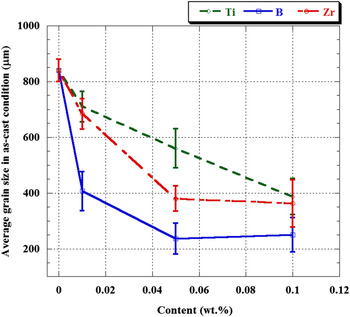
The average grain sizes of cast and refined alloys with different amounts of the grain refiners are shown in Fig. 1. It can be clearly seen that the grain size of the alloy had reduced from 840 μm to 387 μm, 363 μm, and 236 μm with the addition of 0.1 wt% Ti, 0.1 wt% Zr, and 0.05 wt% B, respectively. Al–8B seems to be the most efficient master alloy as the least average grain size was obtained by adding 0.05 wt% B to A356 alloy.
Average grain size of cast A356 alloy as a function of different weight percentages of Ti, B, and Zr.

Many mechanisms responsible for grain refinement of Ti, B, and Zr have been noticed. The presence of some particles like TiAl3, ZrAl3, TiB2, and AlB2 is known to be effective for grain refinement. Reference Murty, Kori and Chakraborty5,Reference Quested and Greer27–Reference Jones and Pearson29 In comparison with AlB2 and TiB2, TiAl3 is known to be a more potent nucleating site for α-aluminum. Reference Murty, Kori and Chakraborty5,Reference Quested and Greer27,Reference Rokhlin, Dobatkina, Bochvar and Lysova28 Some researchers Reference Murty, Kori and Chakraborty5,Reference Jones and Pearson29 have shown that the presence of small amounts of boron in master alloys containing titanium has a considerable effect on enhancing the grain refinement in aluminum alloys. Jones and Pearson Reference Jones and Pearson29 demonstrated that a ternary Al–Ti–B master alloy is 4–5 times more efficient than a binary Al–Ti master alloy having approximately the same titanium content, with respect to grain refinement. It is suggested that TiB2 particles retard the dissolution of TiAl3 by creating a shell around them. Reference Murty, Kori and Chakraborty5
Another factor that shows the higher efficiency of Ti in comparison with other elements is the growth restricting factor (GRF) defined as mC 0(k − 1), where m is the slope of the liquidus line, C 0 is the concentration of the solute in the melt, and k is the equilibrium partitioning coefficient which is defined as k = C s/C l (where C s and C l are the solute concentrations of the solid and liquid at the interface). In the case of titanium and zirconium, at the peritectic composition, the GRFs are 31 and 5, respectively, which clearly suggests that titanium is more efficient in restricting the grain growth compared to zirconium. Reference Senkov, Bhat, Senkova and Schloz30,Reference Nadella, Eskin, Du and Katgerman31 However, Al–8B is found to be stronger than Al–Ti–1B in reducing the grain size.
Birol Reference Birol16 compared the refining effects of Ti and B on Al–Si cast alloys. He hypothesized that cast alloys are almost invariably alloyed with Ti with the intention to control the grain size. However, it is shown recently that the favorable impact of Ti on grain refinement is severely impaired when Si content is over 5 wt%. Reference Birol32 Solute Ti, which is known to be the most effective restrictor for the growth of aluminum grains, Reference Quested, Dinsdale and Greer33 is rendered ineffective as it forms Ti–Si compounds and precipitates out of the melt. The majority of cast alloys, on the other hand, contains more Si and has to bear the consequences. TiB2 particles are also poisoned by Si that coats their surfaces with Ti–Si compounds. Reference Birol16
Although Al3Ti and TiB2 are the effective heterogeneous nucleants, the grain refinement mechanism of B-containing master alloys in hypoeutectic Al–Si alloys is a controversial subject. Reference Fan, Wang, Zhang, Qin, Zhou, Thompson, Pennycook and Hashimoto12 According to boride particle theory (proposed by Cibula Reference Cibula13 ), insoluble boride particles in the melt act as the heterogeneous nucleation sites. However, Mohanty and Gruzleski Reference Mohanty and Gruzleski14 observed that borides are pushed to grain boundaries, and no grain refinement was observed in the absence of solute Ti. Jones et al. Reference Jones and Pearson29 also reported that AlB2 particles are less stable than TiB2 particles in the Al melt and do not act as heterogeneous nucleation sites.
The existence of AlB2 particles is an indispensable pre-condition and AlB2 particle is the indirect nucleating base for subsequent α-Al phase. The undissolved AlB2 particles accelerate the eutectic reaction at 659.7 °C and form the ‘Al–AlB2’ shell structure. The subsequent α-Al phase will nucleate directly on the ‘Al–AlB2’ shell structure, resulting in grain refinement. Reference Liu, Ding and Li15
Similar results were found in the present study for A356 alloy (which contains 7 wt% Si). The above explanations can be applied for the 72% reduction in grain size by the addition of 0.05 wt% B to the alloy.
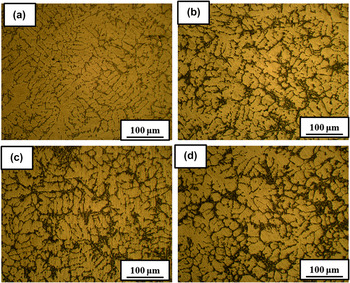
Figure 2 shows the microstructures of A356 alloy in as-cast and grain-refined conditions.
Microstructures of A356 in (a) as-cast and grain-refined with (b) 0.1 wt% Ti, (c) 0.05 wt% B, and (d) 0.1 wt% Zr conditions.

The microstructures of the as-cast alloy [Fig. 2(a)] clearly show the presence of α-Al matrix (light regions) and a eutectic structure (dark regions). The morphology of α-Al primary phase is mainly dendritic but is changed to rosettelike in Ti-refined [Fig. 2(b)], B-refined [Fig. 2(c)], and Zr-refined [Fig. 2(d)] conditions. It is noticeable that grain refinement enhances the number of grain boundaries which promotes a more homogeneous distribution of silicon particles.
The length of eutectic silicon needles at optimum amounts of grain refiners was measured. It can be concluded that grain refinement reduces the length of needlelike silicon particles. The length of the particles is around 32 μm in as-cast condition which decreases to 21 μm, 15 μm, and 17 μm with addition of 0.1 wt% Ti, 0.05 wt% B, and 0.1 wt% Zr, respectively.
2. Simultaneous effects of grain refinement and heat treatment
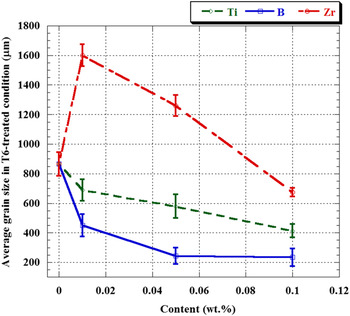
The average grain size of the heat-treated alloy as a function of different weight percentages of added Ti, B, and Zr is illustrated in Fig. 3. The results show that Ti and B prohibit grain coarsening during heat treatment as the average grain size remains approximately unchanged during heat treatment. It seems that insoluble TiB2 and AlB2 which come from Al–5Ti–1B and Al–8B master alloys pin the boundaries at elevated temperature and prevent further coarsening of the grains. Reference Zhu, Jian, Yang and Zhou23,Reference Shabestari and Shahri24
The average grain size of T6-treated A356 alloy as a function of different weight percentages of Ti, B, and Zr.

The behavior of the Zr-refined alloy during T6 heat treatment is different. The Zr-refined alloy shows significant grain coarsening. In some cases, the average grain size reaches to over 1 mm. According to the literature, coarse ZrAl3 particles dissolve in the matrix and re-precipitate as smaller particles during the solution treatment of the alloy. Reference Baradarani and Raiszadeh18 Migration of the grain boundaries at high temperatures is attributed to the declared transformation.
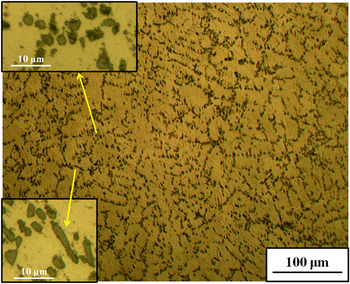
The microstructure of T6-treated A356 alloy is illustrated in Fig. 4. As can be seen in the enlarged images of the figure, the morphology of silicon particles was changed from acicular to spherical. This morphological transformation is a consequence of the diffusion of Mg and Si elements into the matrix. Reference Malekan, Emamy, Rassizadehghani and Emami34 The unmodified eutectic silicon particles undergo necking, separate into segments, and then spheroidize and coarsen. Consequently, the average particle size decreased during solution treatment. Reference Zhu, Jian, Yang and Zhou23 These spherical features mainly affect the ultimate tensile strength (UTS) since the potential sites for stress concentration (especially sharp tips in acicular particles) are reduced; hence, crack initiation is postponed.
Microstructure of T6-treated A356 alloy.

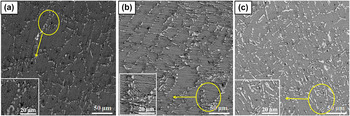
Simultaneous effects of T6-treatment and grain refinement with optimum conditions on the microstructure are illustrated in Fig. 5. The back-scattered electron (BSE) images show the spherical morphology and more homogeneous distribution of silicon particles in all cases.
Back-scattered electron images of T6-treated A356 alloy containing (a) 0.1 wt% Ti, (b) 0.05 wt% B, and (c) 0.1 wt% Zr.

B. Tensile properties
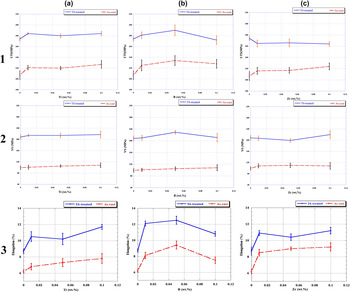
Figure 6 shows yield strength (YS), UTS, and elongation values as functions of Ti (a), B (b), and Zr (c) weight percentages. Each graph represents the mechanical properties of the alloys in both as-cast and T6-treated conditions.
UTS (1), YS (2), and elongation (3) values of A356 alloys as functions of (a) Ti, (b) B, and (c) Zr contents in as-cast and T6-treated conditions.

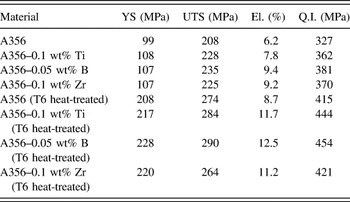
It is well established that YS, UTS, and elongation values of as-cast alloys increase in the presence of adequate amounts of grain refiners. YS, UTS, and elongation values increase from 99 MPa, 208 MPa, and 6.2% in as-cast condition to 108 MPa, 228 MPa, and 7.8% [Fig. 6(a)], 107 MPa, 235 MPa, and 9.4%, [Fig. 6(b)] and 107 MPa, 225 MPa, and 9.2% [Fig. 6(c)] after grain refining the alloys with 0.1 wt% Ti, 0.05 wt% B, and 0.1 wt% Zr. The improvements in mechanical properties are in agreement with the decrease in the grain size which was a result of the formation of finer particles and more uniform distribution in the matrix.
As expected, during solutionizing heat treatment, with the purpose of alteration in the morphology of silicon from acicular to spherical (Figs. 4 and 5), YS, UTS, and elongation values improved considerably due to the elimination of favorite sites for stress concentration. The main reason for such enhancement, in all as-cast and grain-refined alloys, is the diffusion of Mg and Si atoms during solution heat treatment leading to the formation of spherical silicon particles and Mg2Si dispersoids during aging heat treatment. Reference Baradarani and Raiszadeh18
By scrutinizing the graphs, one can conclude that the highest YS, UTS, and elongation values are related to T6-treated A356 refined with 0.05 wt% B. These values reach to 228 MPa, 290 MPa, and 12.5%, respectively, which is mainly related to the role of insoluble AlB2 in grain boundary pinning and obtaining more uniform distribution of spherical eutectic silicon particles.
In the case of Zr-refined, a marginal reduction in UTS values of heat-treated alloy is observed [Fig. 6(c)]. Although grain coarsening may play a destructive role in reducing the mechanical properties of the alloy (Fig. 3), it is reported that the reprecipitated Al3Zr particles are not as effective as Mg2Si dispersoids in increasing the hardness of the T6 heat-treated alloys. Reference Baradarani and Raiszadeh18 The slow diffusion of Zr in Al prevents the coarsening of Mg2Si precipitates during aging heat treatment. This characteristic prevents the decline of the hardness of the alloy Reference Baradarani and Raiszadeh18 and also UTS values in the present study.
It is important to note that the combination of UTS and elongation values is a reliable parameter in quantifying tensile properties for engineering applications. To quantify the overall tensile properties of the Al–Si alloys, the quality index (Q.I.) was used in this work. Q.I. is explained as a semi-logarithmic plot of UTS versus the elongation to fracture and it is expressed as the following Reference Wang, Hui, Wang, Zhao and Chen35 :
 $${\rm{Q}}{\rm{.I}}{\rm{.}} = {\rm{UTS}}\left( {{\rm{MPa}}} \right) + 150 \times \log \left( {\% {\rm{El}}} \right)\quad,$$
where UTS, elongation percent, and the Q.I. values for each alloy are listed in Table I.
Tensile properties of A356 alloy in as-cast, grain-refined, and T6 heat-treated conditions.

As shown in Table I, the highest quality index is achieved in T6 heat-treated A356 alloy refined with 0.05 wt% B.
C. Fractography
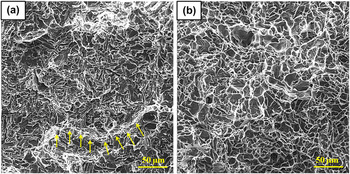
Typical fracture surfaces of as-cast and T6-treated A356 are shown in Fig. 7. Figure 7(a) shows the brittle mode of fracture. This is related to the presence of coarse acicular silicon particles at the interdendritic regions or grain boundaries which causes the initiation and fast propagation of the cracks. As can be seen in Fig. 7(b), the fracture surfaces of the T6-treated samples are mainly dimplelike which is a major characteristic of ductile fracture.
Fracture surfaces of A356 alloy in (a) as-cast and (b) T6-treated conditions.

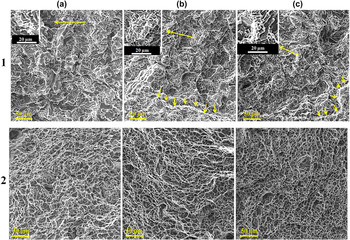
Figure 8 shows the fracture surfaces of as-cast and T6-treated alloys refined using adequate amounts of Ti [Fig. 8(a)], B [Fig. 8(b)], and Zr [Fig. 8(c)].
Fracture surfaces of A356 alloy in (1) as-cast and (2) T6-treated conditions refined with (a) 0.1 wt% Ti, (b) 0.05 wt% B, and (c) 0.1 wt% Zr.

In the as-cast condition, as shown in the micrographs, some areas with very fine dimples are present; on the other hand, derived cracks which propagate through the grain boundaries (see yellow arrows) are also observable. The presence of such fine dimples on the fracture surfaces of the as-cast refined alloys proves the improvement in elongation of the alloy.
Fracture surfaces of the heat-treated and refined alloys are completely dimpled. The ductile fractures resulted from the size of dimples, i.e., more homogeneous and deeper dimples, are considered as a result of higher ductility for the alloys. The dimple size on a fracture surface is governed by the number and distribution of the microvoids. Depending on the microstructure and plasticity of the material, the dimples can exhibit very deep and conical shape or can be quite shallow. The former brings about a higher ductility. 36 In the present study, the existence of deep and conical dimples in fracture surfaces of heat-treated and refined alloys (Fig. 8) shows that T6 heat treatment possesses a magnificent role in improving the ductility of the material which is evident from Fig. 6.
IV. CONCLUSIONS
The structure and tensile properties of thin cast and T6 heat-treated A356 alloys refined with Ti, B, and Zr were investigated and the following conclusions were obtained:
-
(1) Al–8B master alloy is the most efficient grain refiner as it decreased the grain size of the cast alloy from 840 μm to 236 μm by the addition of 0.05 wt% B. It is clarified that Al–5Ti–1B, which is widely used to refine Al–Si alloys, is not as effective as Al–8B master alloy in this respect.
-
(2) The average grain size of Ti and B-refined alloys remained almost unchanged during heat treatment, indicating that most probably Ti and B had prohibited the grain coarsening. In contrast, the Zr-refined alloy showed considerable grain coarsening during T6 heat treatment.
-
(3) In agreement with structural studies, tensile test results revealed that the addition of 0.05 wt% B to A356 alloy accompanying T6-treatment increased the UTS and elongation values from 208 MPa and 6.2% to 290 MPa and 12.5%, respectively.
-
(4) Comparing the fracture surfaces of the alloys before and after T6 heat treatment showed that T6 heat treatment is an effective process with respect to altering the mode of fracture from brittle to ductile.
ACKNOWLEDGMENT
The authors gratefully acknowledge University of Tehran for lab facilities and financial support of this work.