The nurse effect is a positive interaction in which one plant (the nurse) provides conditions that enhance the establishment and growth of another plant species (Callaway Reference CALLAWAY1995). Increased environmental severity appeared to increase the strength of nurse effects (Brooker et al. Reference BROOKER, MAESTRE, CALLAWAY, LORTIE, CAVIERES, KUNSTLER, LIANCOURT, TIELBOERGE, TRAVIS, ANTHELME, ARMAS, COLL, CORCKET, DELZON, FOREY, KIKVIDZE, OLOFSSON, PUGNAIRE, QUIROZ, SACCONE, SCHIFFERS, SIFAN, TOUZARD and MICHALET2008, Lortie & Callaway Reference LORTIE and CALLAWAY2006). On the one hand, the impact of the nurse effect depends on the magnitude of the environmental changes exerted by the nurse plant. On the other hand, the impact could depend on the number of plant species in the regional pool that respond to such changes. For example, better conditions beneath the crowns of nurse plants might allow the occurrence of species that are sensitive to environmental stress and that occur infrequently in open areas. Thus, if a nurse plant modulates environmental conditions that are critical for the persistence of other plant species, it seems likely that such nurse plants would have greater effects in stressful habitats, where they cause relatively larger environmental mitigation (Badano et al. Reference BADANO, JONES, CAVIERES and WRIGHT2006, Callaway et al. Reference CALLAWAY, BROOKER, CHOLER, KIKVIDZE, LORTIE, MICHALET, PAOLINI, PUGNAIRE, NEWINGHAM, ASCHEHOUG, ARMAS, KIKIDZE and COOK2002).
Several works have confirmed that the magnitude of the nurse effect increases with environmental stress when examined along environmental gradients at large spatial scales. Nurse effects are often stronger at higher than at lower altitudes (Badano & Cavieres Reference BADANO and CAVIERES2006), in xeric than in mesic sites along aridity gradients (Holzapfel et al. Reference HOLZAPFEL, TILEBORGER, PARAG, KIGEL and STERNBERG2006), and in colder than in warmer environments along regional gradients (Callaway et al. Reference CALLAWAY, BROOKER, CHOLER, KIKVIDZE, LORTIE, MICHALET, PAOLINI, PUGNAIRE, NEWINGHAM, ASCHEHOUG, ARMAS, KIKIDZE and COOK2002). Comparatively, fewer studies (Badano et al. Reference BADANO, CAVIERES, MOLINA-MONTENEGRO and QUIROZ2005, Pugnaire & Luque Reference PUGNAIRE and LUQUE2001) have examined how the strength of nurse effects changes when environmental stress varies across small spatial gradients. Clarification of how nurse effects may vary across different spatial scales will improve our understanding of plant facilitation relationships (Brooker et al. Reference BROOKER, MAESTRE, CALLAWAY, LORTIE, CAVIERES, KUNSTLER, LIANCOURT, TIELBOERGE, TRAVIS, ANTHELME, ARMAS, COLL, CORCKET, DELZON, FOREY, KIKVIDZE, OLOFSSON, PUGNAIRE, QUIROZ, SACCONE, SCHIFFERS, SIFAN, TOUZARD and MICHALET2008).
High-mountain environments are excellent systems to examine the factors that influence nurse effects at small spatial scales for several reasons. First, physical stress is severe, with extreme air and soil temperatures and often harsh winds (Körner Reference KÖRNER1999). Second, the presence of rocky outcrops and the orientation of slopes may modify the severity of this stress at scales of a few metres (Badano & Cavieres Reference BADANO and CAVIERES2006, Badano et al. Reference BADANO, CAVIERES, MOLINA-MONTENEGRO and QUIROZ2005, Brooker et al. Reference BROOKER, MAESTRE, CALLAWAY, LORTIE, CAVIERES, KUNSTLER, LIANCOURT, TIELBOERGE, TRAVIS, ANTHELME, ARMAS, COLL, CORCKET, DELZON, FOREY, KIKVIDZE, OLOFSSON, PUGNAIRE, QUIROZ, SACCONE, SCHIFFERS, SIFAN, TOUZARD and MICHALET2008, Medina et al. Reference MEDINA, RIBEIRO and SCARANO2006). Finally, some high-mountain plants are well known for their ability to buffer severe environmental conditions (Brooker et al. Reference BROOKER, MAESTRE, CALLAWAY, LORTIE, CAVIERES, KUNSTLER, LIANCOURT, TIELBOERGE, TRAVIS, ANTHELME, ARMAS, COLL, CORCKET, DELZON, FOREY, KIKVIDZE, OLOFSSON, PUGNAIRE, QUIROZ, SACCONE, SCHIFFERS, SIFAN, TOUZARD and MICHALET2008). Overall, the combination of environmental severity, heterogeneous topography, and the relative high frequency of potential nurse plants make montane ecosystems a good system in which to study how facilitative effects of plants may change over small spatial scales.
The highest peaks of the Cordillera de Talamanca in southern Costa Rica are characterized by a severe climate, strong topography, and the presence of shrubby plants that may act as nurses (Kappelle & Horn Reference KAPPELLE and HORN2005). Daily temperatures may vary from −5 °C at night to 35 °C at midday; thus plants often suffer water and thermic stress (Körner Reference KÖRNER1999). However, this environmental stress can vary among slopes with different orientations. In the dry season, when solar radiation and water loss are more severe, mornings are often sunny and afternoons often cloudy. Hence, east-facing slopes receive more solar radiation than west-facing slopes. Maximum soil temperatures of open areas on east-facing slopes reach 34 °C, while similar areas on the west-facing slopes reach only 26 °C (Easdale et al. Reference EASDALE, ALBÁN, BAKER, VÁZQUEZ, GALLEGO, RADA, Farji-Brener and Barrantes1999).
Hypericum irazuense Kuntze (Hypericaceae) is a perennial shrub (~2 m height) common in the high-mountain flora of Costa Rica (Kappelle & Horn Reference KAPPELLE and HORN2005), but its role as a nurse plant has been rarely investigated. In this study, we evaluated the effect of the shrub H. irazuense on species richness and composition of plant assemblages located on different slope orientation in a paramo in Costa Rica. We evaluated how the magnitude of this nurse effect varies along a small-scale gradient of inferred environmental stress. When environmental modifications performed by nurse plants result in amelioration of physical stress, their positive effects on other plant species increases as the surrounding habitat becomes harsher (Badano & Cavieres Reference BADANO and CAVIERES2006). Hence, if east-facing slopes are characterized by more severe environmental stress than west-facing slopes, we predicted that the nurse effect would be stronger on east-facing than on west-facing slopes.
We conducted this study in the Páramo Buenavista, located at 3450 m asl on the Cordillera de Talamanca in southern Costa Rica (9°30′N, 84°40′W). Mean annual rainfall is c. 2500 mm, and is mainly seasonal. The months of December to April are dry. The shrubby paramo vegetation is dominated by the bamboo Chusquea subtessellata Hitchc. (Poaceae) and by evergreen shrubs in the Ericaceae, Hypericaceae and Asteraceae (Kappelle & Horn Reference KAPPELLE and HORN2005).
To evaluate the effect of H. irazuense on plant richness and whether this effect depends on slope orientation, in January 2008 we randomly selected a total of 20 plants of this species around 2 m in height. Ten were located on the west-facing slope and 10 on the east-facing slope of Cerro Buenavista. West-facing and east-facing slopes were only ~200 m apart; soils, vegetation and topography were similar on both slopes. Around each plant, we located a plot of 1 m × 1 m, centred on its trunk. As a control, we randomly located another 1 m × 1-m plot, 2 m from the selected plant in open areas (i.e. without the presence of nurse plants). In each plot, we recorded the number of plant species. Plants were identified to generic level and, within each genus, sorted to species. When identification to species was not feasible, we classified them as morphospecies.
To detect whether the differences in the amount of irradiation between slopes influence the rate of water evaporation and plant survival, in January 2009 we performed the following experiment. We randomly selected five H. irazuense shrubs in each slope. Under the crown of each shrub we located three 2-ml plastic vials completely filled with water, and a Rhodiola rosea L. (Crassulaceae) seedling in a plastic bag. This species is a garden plant common in the study area. We carried out the same procedure at each adjacent control plot. Five days later, we determine the amount of evaporated water in the vials, and evaluated the health condition of the seedlings looking for dehydration signs.
To analyse the effect of H. irazuense as a nurse plant, we employed a two-way block ANOVA. Nurse-plant presence (present vs. absent) and slope orientation (west and east) were considered fixed factors, and the site (nurse plot and its paired control plot) was considered a random factor nested within the factor slope orientation. The response variable was the density of plant species (spp. m−2). Tukey post-hoc comparisons were employed when ANOVA results were statistically significant (P < 0.05). The per cent of evaporated water in the vials was analysed in the same way. Plant survival in each slope was analysed by Fisher exact tests. In addition, we analysed the effect of the nurse plant on the composition of plant assemblages using a non-metric multidimensional scaling (NMDS) ordination with the Bray–Curtis similarity index. To more clearly observe differences in plant composition, centroids (± SD) were also calculated for each group (under-outside nurses and east-west facing-slopes).
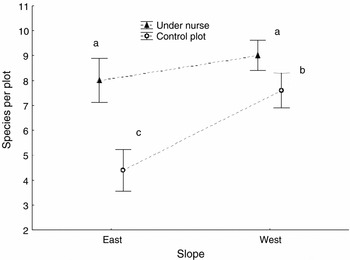
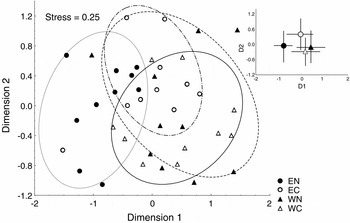
We found a total of 36 plant species, which represent about 25% of the total plant species described for this region (Kappelle & Horn Reference KAPPELLE and HORN2005). We found 35 plant species on the west-facing slope and 23 on the east-facing slope. Thirty-four species were found under H. irazuense and 24 species in open sites (22 species in common). Mean plant richness was higher on the west-facing than on the east-facing slope (8 ± 1 vs 6 ± 1 respectively, mean ± SE, F 1, 18 = 12.5, P = 0.002) and higher under H. irazuense than in control plots (9.5 ± 0.5 vs 5.5 ± 1.5 respectively, F 1,18 = 47.4, P < 0.001). However, the strength of the nurse effect depended on the slope orientation (F 1, 18 = 4.3, P = 0.04). On the east-facing slope, H. irazuense allowed a mean increment of between 3 and 4 more plant species m−2 compared with open sites. On the west-facing slope, its effect comprised a mean increment of only 1 species m−2 (Figure 1). The per cent of water loss in the plastic vials follows the same trend. Mean water evaporation was higher in control plots than under nurse mainly in the east-facing slope (interaction between slope orientation × nurse plant presence F 1, 8 = 5.5, P = 0.04). Mean water loss on the west-facing slope (under nurse and control plots) and under nurse in the east-facing slope ranged between 5–7%, while evaporation in control plots on the east-facing slope reach 19%. Accordingly, plant survival was enhanced by the presence of nurse plants only on the east-facing slope. On the west-facing slope, all plants survived except one located in an open area (Fisher exact test, P = 0.50). However, on the east-facing slope, all the plants under a nurse survived while 80% of the plants placed in open areas died (Fisher exact test, P = 0.02). The ordination of sites based on species presence did not reveal clear differences in floristic groups regarding their location or their association with H. irazuense. However, nurse sampling sites segregated more from control sites on east-facing than on west-facing slopes (Figure 2).
Number of plant species (mean ± SE) in plots under the canopy crown of Hypericum irazuense shrubs (treatment plots) and in adjacent open areas (control plots) on slopes with different cardinal orientations in a Costa Rican paramo. Different letters denote statistically different groups (P < 0.05, ANOVA test, Tukey post-hoc comparisons).

Non-metric multidimensional scaling ordination plots of plant assemblage based on their location (E = east-facing and W = west-facing slopes) and the presence or absence of nurse plants (N = nurse, C = control). Ellipses represent 95% confidence intervals. The upper right figure shows the centroids (± SD) for each group.

Our results suggest that H. irazuense acts as a nurse species. In all cases, the number of plant species beneath the crowns of H. irazuense was higher than in adjacent, exposed areas. However, the strength of this effect depended on the location of the nurse-plant. Despite the absolute number of plant species beneath the nurse are similar between slopes; the relative increase of species richness in relation to an adjacent open area is clearly higher in the most stressful east-facing slope. The benefits to a plant growing under H. irazuense might include access to improved soil nutrients, protection from disturbance (including herbivores), and amelioration of extreme temperatures (Brooker et al. Reference BROOKER, MAESTRE, CALLAWAY, LORTIE, CAVIERES, KUNSTLER, LIANCOURT, TIELBOERGE, TRAVIS, ANTHELME, ARMAS, COLL, CORCKET, DELZON, FOREY, KIKVIDZE, OLOFSSON, PUGNAIRE, QUIROZ, SACCONE, SCHIFFERS, SIFAN, TOUZARD and MICHALET2008, Callaway et al. Reference CALLAWAY, BROOKER, CHOLER, KIKVIDZE, LORTIE, MICHALET, PAOLINI, PUGNAIRE, NEWINGHAM, ASCHEHOUG, ARMAS, KIKIDZE and COOK2002).
Several lines of evidence suggest that the main benefit to a plant growing under H. irazuense is avoiding extreme temperatures. First, east-facing slopes are more stressful environments than are west-facing slopes. As discussed earlier, east-facing slopes receive stronger solar radiation than do west-facing slopes, because in the most stressful season, mornings are often sunny and afternoons are cloudy. Accordingly, we found fewer plant species in open areas on the east-facing than on the west-facing slope (13 vs 23, respectively). This result concurs with the hypothesis that east-facing slopes are more stressful environments than are west-facing slopes. Second, the nurse effect was stronger on east-facing slopes. Since east-facing and west-facing slopes are similar in soil type, herbivore pressure and other types of disturbances, it is unlikely that the stronger nurse effect found on the east-facing slope was an effect of accumulation of nutrients, protection from herbivores and/or protection from disturbances. Third, while in open areas soil temperatures can reach 30–35 °C, soil temperatures under H. irazuense crowns only reach 20–25 °C (Farji-Brener, unpubl. data). Finally, our results demonstrated that water evaporation is higher outside than under H. irazuense shrubs mostly in the stressful east-facing slope. Collectively, these results support the hypothesis that the amelioration of extreme temperatures is the most parsimonious explanation of why the presence of H. irazuense improves plant richness.
Our experimental data also concur with this hypothesis. Water loss and plant mortality were higher outside nurses only in the most stressful east-facing slope, suggesting that slope orientation enhances the nurse effect of H. irazuense. The micro-environment created by H. irazuense crowns may have a two-fold effect. During the day, the shade created by H. irazuense plants may reduce air and soil temperatures and thus improve the soil moisture levels. At night when temperatures may drop below freezing, the foliage of H. irazuense may retain heat and thereby increase air and soil temperatures in the immediate vicinity of the plant (Tewksbury & Lloyd Reference TEWKSBURY and LLOYD2001). This stabilization of soil surface moisture and temperature is crucial for seedling establishment and growth, as mortality due to desiccation and heat stress is often high early in the life stage of plants that inhabit the paramo region (Körner Reference KÖRNER1999).
There are, however, some limitations in this argument. First, we performed no systematic measures of the temperature beneath the canopy of H. irazuense and adjacent open areas. Without this information, the argument that the amelioration of temperature is the mechanism by which H. irazuense presence increases plant richness is weakened. Nonetheless, the low water evaporation we found beneath the nurse plants must be related with temperature changes. Second, our study is limited to both slopes of one mountain. Considering mountains as experimental units, our results would be valid mainly to the study area. However, the effect found here could be extrapolated to other mountains in this region because of the Talamanca mountain range orientation (NW–SE).
The effect of H. irazuense on other plant species depends on the extent to which soil temperature restricts the establishment and growth of other plants, the strength of environmental changes caused by the nurse plant, and the availability of plant species that can respond to such changes. Hypericum irazuense showed a stronger nurse influence in sites with high solar radiation such as east-facing slopes, where their crowns can decrease the soil temperature up to 15 °C at midday (Farji-Brener, unpubl. data). Accordingly, the plant assemblages of nurse and control plots differed most from each other in the more stressful east-facing slope compared to the relatively more benign west-facing slope (Figure 2). The nurse effect seems to favour the establishment of plant species that already occur in the area but are otherwise infrequent in open sites characterized by high solar radiation. For example, on the east-facing slope, the presence of H. irazuense increased the number of species to levels similar to what we found in the west-facing slope. Moreover, 75% of the species growing under nurse plants on the east-facing slope were found in open areas on the less stressful west-facing slope.
The results of this work are significant at both theoretical and applied levels. On a theoretical level, they corroborate earlier works suggesting that the strength of facilitative effects of nurse-plants increases with environmental stress (Brooker et al. Reference BROOKER, MAESTRE, CALLAWAY, LORTIE, CAVIERES, KUNSTLER, LIANCOURT, TIELBOERGE, TRAVIS, ANTHELME, ARMAS, COLL, CORCKET, DELZON, FOREY, KIKVIDZE, OLOFSSON, PUGNAIRE, QUIROZ, SACCONE, SCHIFFERS, SIFAN, TOUZARD and MICHALET2008, Callaway et al. Reference CALLAWAY, BROOKER, CHOLER, KIKVIDZE, LORTIE, MICHALET, PAOLINI, PUGNAIRE, NEWINGHAM, ASCHEHOUG, ARMAS, KIKIDZE and COOK2002). Our study exemplifies that this rule also applies when stress levels vary at small spatial scales. On an applied level, our work suggests that the paramo shrubs should be the focus of conservation efforts, because of their beneficial effects on plant species richness. This facilitative effect of shrubs might be applied for restoration efforts in degraded, tropical high-mountain environments (Gómez-Aparicio et al. Reference GÓMEZ-APARICIO, ZAMORA, GÓMEZ, HÓDAR, CASTRO and BARAZA2004). If other shrubs species also act as nurses, the conservation of high-mountain shrubs should be a central concern for biodiversity maintenance and restoration, particularly in environmental stressed habitats.
ACKNOWLEDGEMENTS
We appreciate suggestions and comments of Frank ‘Gandalf’ Joyce and three anonymous reviewers. The Organization for Tropical Studies provided logistic support.