Introduction
Weevils (Coleoptera: Curculionidae), belonging to the genus Oribius Marshall, commonly known as oribius, oribius weevils or grey weevils, are abundant throughout Papua New Guinea (PNG) and West Papua, Indonesia. The genus is restricted to the island of New Guinea (Thomas & Verloop, Reference Thomas and Verloop1962) and the northern tip of Cape York, Australia (Zimmerman, Reference Zimmerman1991). The exact number of different Oribius species is unknown, but at least 50 are thought to exist (Marshall, Reference Marshall1956), of which seven are pests of PNG agriculture (Ero et al., Reference Ero, Clarke, Wesis and Niangu2006). The pest Oribius species occur in both lowland and highland cropping and forests areas of PNG, and the lowland species, particularly, have the potential to be moved to Australia through informal movement across Torres Strait.
Oribius species have been implicated as causing significant damage to many agricultural crops, including small crops, leafy greens, introduced orchard trees, such as apple and citrus, and field crops, such as coffee (Marshall, Reference Marshall1957, Reference Marshall1959; Szent-Ivany, Reference Szent-Ivany1959; Szent-Ivany & Stevens, Reference Szent-Ivany and Stevens1966; Wilson, Reference Wilson1977; Greve & Ismay, Reference Greve, van and Ismay1983; Thistleton, Reference Thistleton1984; Yoon & Wiles, Reference Yoon and Wiles1995; Waterhouse, Reference Waterhouse1997). The adult weevils are the damaging stage, feeding on leaves, soft shoots, green stems, flower buds and developing fruit (Thistleton, Reference Thistleton1984). Unquantified reports (such as those cited above) or unpublished personal observations (by the authors and others) suggest that feeding by oribius may cause significant growth loss, yield decline, downgrade of crop marketability and, in severe cases, tree and seedling mortality. The true extent of damage, however, has never been quantified for any commodity; and, in the absence of such data, the true pest status of the insects is hard to determine.
Little detail is known about the ecology of oribius weevils. Adult females lay eggs at the base of plant stems, from which the emergent neonate larvae burrow into the soil where they are suspected to feed on a wide range of plant roots (Thistleton, Reference Thistleton1984). The duration of the larval/pupal period is uncertain and may be variable; Thistleton (Reference Thistleton1984) reports two to three months, while a seven month adult-to-adult period has been recorded in an outdoor insectary (authors' unpublished data). Adult grey weevils can live for more than six months (Thistleton, Reference Thistleton1984). Damage by oribius weevils (and species belonging to closely related genera) is considered to be particularly severe where weeds are plentiful, as this is believed to affect larval populations (Moxon, Reference Moxon1992; Bar-Zakay, Reference Bar-Zakay1995). Movement of adult populations is limited, as the beetles are flightless and infestations are considered to arise from emergence of adult weevils from the soil within the crop, or migration of adults from weedy areas close to the crop. Clearing of crop edges and surrounding areas has been recommended as a way of preventing this migration, as adult weevils are considered unlikely to move over bare ground to reach the crop (Moxon, Reference Moxon1992).
The bulk of the preceding introduction is collated from unpublished working reports or grower advisory leaflets, and in at least some cases we are aware that reported findings are based on unquantified observation and need experimental confirmation. Two key sets of unquantified observations include: (i) the level of damage caused by weevil feeding, which is almost always reported in simple descriptive terms (eg ‘minor damage to leaves’, ‘frequent on leaves’ Greve & Ismay, Reference Greve, van and Ismay1983); and (ii) the role of non-crop hosts in the ecology and pest management of the weevil.
The objectives of this study were, therefore, twofold. Firstly, we wanted to gain a better understanding of general host use by the weevils, including adult abundance on crop and non-crop host plants, daily patterns of adult activity on plants and confirmation of larval feeding behaviour. The second major aspect of the study related to quantification of adult weevil impact on selected agricultural crops. No prior studies had measured crop yields in the absence of weevils, and such work is necessary to justify field management and to prioritize future research. Because operational constraints did not allow us to carry out full replicated impact trials on every possible crop type, we used a tiered approach to gaining the required information and this involved: (i) replicated, on-station trials (good quantification, high confidence data); (ii) on-farm trials (some quantification, medium confidence data); and (iii) farmer surveys (qualified data, lowest level confidence).
All work was carried out in Eastern Highlands Province, PNG. Two Oribius species, O. inimicus Marshall and O. destructor Marshall, occur sympatrically in cropping districts throughout the PNG Highlands and were the focus of our studies. Both species are considered polyphagous and, prior to our study, O. destructor was considered the most damaging (Marshall, Reference Marshall1959; Thistleton, Reference Thistleton1984). Where possible, we worked with the two species separately, but in field trials the impacts are of both species combined.
Methods
Study sites
On-station trials were conducted at the (PNG) National Agricultural Research Institute (NARI) Main Highlands Program, Aiyura Valley (6°20′23″S 145°54′18″E, elevation 1566 m ASL), via Kainantu, Eastern Highlands Province (EHP). Field surveys were carried out in the Aiyura Valley, while on-farm trials and farmer surveys were carried out on private commercial and subsistence farms within EHP in regions surrounding or between Aiyura and the provincial capital, Goroka (6°06′17″S 145°23′28″E, elevation 1489 m ASL).
Study animals
Oribius inimicus and O. destructor were identified using a working key to adults developed by Ero, prepared with reference to previously identified material held in the PNG National Agricultural Insect Collection (NAIC), KilaKila and the relevant taxonomic literature (see Ero et al., Reference Ero, Clarke, Wesis and Niangu2006). Voucher material from our studies has been lodged at the NAIC. We are assuming for the purposes of this paper that the taxa morphologically identifiable as O. inimicus and O. destructor do represent single biological species; however, we are mindful that the genus is poorly worked from a systematics/biological perspective and that cryptic species may exist within these taxa.
Host use studies
Host use survey
Twenty-five plants of each of 32 different plant species were surveyed around the Aiyura Valley from 13–20 April 2004 and 29–30 March 2005. Plants were chosen based on their abundance in the Valley and to ensure a broad taxonomic coverage (e.g. ferns, dicots, monocots) but not based on any prior perception of beetle host use. Individual plants were sampled through a combination of beating onto a tray and hand collecting. Plants within a species were from multiple sites within the valley, although this was not, and could not be, structured in any formal way.
Daily activity patterns
Four small (each 1.0×0.5 m), adjacent plots were established within a shade-house. Each plot was planted with one of four locally abundant non-crop plant species: thickhead (Crassocephalum crepidioides), goatweed (Agerotum conizoides), setaria grass (Setaria viridis) and green-leaf desmodium (Desmodium intortum); of these, thickhead, at least, was a known host. Each plot was separated from its neighbour by a small path of bare soil (<30 cm wide) to allow observer access.
At 5:00 am, on day one of a five-day observation period (16–20 May 2005), 30 adult weevils (equal number of each sex) were deposited in each of the four plots. Counts (hourly from 6:00 am to 6:00 pm on days one and two, and two-hourly on days three to five) for each plot were then made for: (i) the number of weevils on bare soil within a plot; (ii) the number of weevils actively walking or feeding on the tops of leaves; and (iii) the number of weevils sheltering within the canopy of a plant or in the leaf litter at the base of the plant (the different architecture of the four different plant species made this last category difficult to separate). These three primary activities were designated based on preliminary observations of behaviour. Trials were designed to show if weevils moved between host plants over days and diurnal patterns of behaviour on those hosts. Experiments for O. inimicus and O. destructor were run concurrently in replicated shade houses.
Larval feeding
Although Oribius species have been referred to as root feeders (Thistleton, Reference Thistleton1984), this record was based on an expert opinion of observations rather than specific larval feeding trails (Masamdu, personal records (Masamdu was Thistleton's technician at the time)). To answer this question, we ran shade-house pot experiments, placing oribius larvae into pots consisting of one of four treatments: (i) heat sterilised soil (local dark clay-loam); (ii) sterile soil to which extra organic matter had been added (1:1 steam sterilised cow dung: soil); (iii) sterile soil with a potted thickhead plant; and (iv) sterile soil with potted setaria grass. Oribius spp larvae were collected from various local field sites, bulked in the laboratory and then divided into groups of ten larvae each. The larval groups may have consisted of both O. inimicus and O. destructor, but to get the larval numbers needed we had to harvest wild animals and so could not solve this problem. Each group of ten larvae was weighed and then gently buried in a pot. Each treatment was replicated 24 times to allow for the increased variation which field collection of larvae may have induced. A one-way ANOVA demonstrated no significant difference between mean cohort weights at the start of the trial (F3=0.329, P=0.803).
The trial was run for 14 days, at which time larval cohorts were dug up and larval survivorship and weight recorded. One-way ANOVA (with Tukey's used as the post-hoc test) was used to assess significant treatment effects. In combination with the diurnal activity trial, we also used the results of this experiment to determine if any difference in larval growth or survival between pots planted with thickhead or setaria were correlated with differential adult use of these plants.
Crop impacts
Grower survey
A survey of 49 farmers from 12 locations in Eastern Highlands Province was conducted so that relative impacts of oribius weevils over a range of crops could be assessed. Leaf and fruit/corm damage estimates were scored as high, medium or low by each farmer. Twenty-four of the most commonly grown crops in the region were included in the survey. The survey was conducted between April and July 2005, and only crops which were currently being cultivated by a farmer were included in the survey so that estimates of damage could be as accurate as possible. Results of the farmer survey are supplemented by data extracted from Greve & Ismay (Reference Greve, van and Ismay1983) .
On-farm trials
On-farm impact trials for Irish potato (Solanum tuberosum), celery (Apium graveolens), lettuce (Lactuca sativa), broccoli (Brassica oleracea) and French bean (Phaseolus vulgaris) were conducted on private farms in Eastern Highlands Province. Each trial consisted of three, 20 plant plots for each of four treatments. The treatments were: (i) Insecticide 1 (Karate® (Lambda-cyhalothrin, 25 g L−1 active ingredient), applied at a rate of 1 ml L−1 water); (ii) a corresponding unsprayed control; (iii) Insecticide 2 (Target® (Pirimiphos-Methyl/Permethrin, 5+95 g L−1 permethrin pirimiphos-methyl), applied at a rate of 5 ml L−1 water); and (iv) a second corresponding unsprayed control. Chemicals were applied to run-off using a locally purchased back-pack sprayer. The data collected for each treatment was the weight of harvested crop per plot. Insecticides were applied on an ‘as needs’ basis by the individual farmer and were chosen based on their known efficacy in laboratory trials (Wesis et al., Reference Wesis, Niangu, Ero, Elmouttie and Clarke2007). Irish potato and lettuce had three and two separate trials, respectively, run on different farms. Individual farmers were supported by project staff in design setup and implementation, but day-to-day management was left to the local farmers within a participatory research framework. Preliminary analysis showed no difference between insecticides, so data was pooled for the two insecticide and control treatments per trial (i.e, for each trial n=6 insecticide plots and n=6 control plots). Data was analyzed using one-way ANOVA (with Tukey's used as the post-hoc test), with the plot being the level of replication. The two lettuce trials and three potato trials were not pooled for analysis.
On-station trials
Crop impact studies were carried out for five fruit and vegetable crops, which were identified as important to local stake-holders at a project initiation workshop. These were orange (Citrus sinensis), avocado (Persea gratissima), capsicum (Capsicum annuum), strawberry (Fragaria spp hybrids) and cabbage (Brassica oleracea). Crops were not picked based on a perceived ‘high’ risk status; indeed, cabbage was considered a priori as a non-host of oribius weevils but was picked as representative of different types of cash and subsistence crops grown in the region. Of the five crops, only citrus was known, before trials began, to suffer routinely from severe weevil damage. All trials, with one exception, were managed by project staff and run on, or near, the Aiyura research station. The one exception, a citrus trial, was run in an orchard near Goroka and was managed by a dedicated team under close supervision of project staff. The orange and avocado trials were run on established trees; the strawberry, capsicum and cabbage trials used plants grown to an advanced seedling stage in pots in a shade-house before being planted out into small plots.
Two active treatments, in addition to an untreated control, were established for each crop except avocado, which had only one active treatment and a control. The first active treatment consisted of a sticky non-drying ‘glue’ (Tanglefoot®) applied as a barrier to the trunk (citrus), major branches (avocado) or to a fly wire fence dug into the ground surrounding the crop (strawberry, capsicum, cabbage). Fly wire fences which surrounded the crop were approximately 500 mm in height, suspended using wooden stakes, with Tanglefoot® applied to the top 30 mm of each side of the fence. Barriers were routinely monitored to check that they were not deteriorating and were refreshed as needed. The second active treatment (not applied to avocado) involved the use of the insecticide Karate®, applied on a calendar basis every two weeks following label recommendations. The logic of the double treatment design was that as weevils are flightless, barrier treatments should have excluded foraging oribius from establishing on the crop, whilst allowing other (flying) insects to access the plants. Insecticide treatments would exclude all insects from crop, and thus the difference between treatments and control would give an estimate of oribius impact alone.
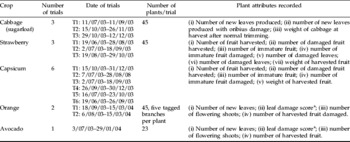
Replication (of plants within trials and number of trials) and crop traits measured varied between crops depending on availability of sites and plants. The crop attributes measured included the number of new shoots, damaged leaves, damaged fruits, total fruits and bud damage, along with the number of weevils present. A summary of the different crop trials is given in table 1. For all crops except avocado, treatments were applied at the plant level. However, because of the nature of avocado production in the Highlands, with trees grown in ones and twos in individual gardens, it was not possible to work at the whole tree level and so the two treatments for avocado were applied at the within tree level. Two major branches within a tree were trimmed at the start of the trial, so no canopy overlap occurred between branches. Of these two branches, one had Tanglefoot applied to its base (barrier treatment) and the other was a tagged control. We had no insecticide treatment for avocado. Twenty-three trees were used, scattered around the Aiyura Valley.
Summary of on-station Oribius spp impact trials reported in this paper. Three treatments (a barrier exclusion treatment, a fortnightly insecticide cover-spray, and an untreated control) were applied equally to a third of the plants in each trial, with the exception of avocado. For avocado, two treatments (the insecticide treatment was not applied) were applied individually to major, isolated branches, within a tree. With the exception of final harvest weights, plant attributes were recorded on a two-weekly basis during each trial and summed to give an overall count for each plant. Weevil numbers on plants were also collected on a two-weekly basis and summed over the life of the trial.

* Leaf damage score was a qualitative four-point visual scoring ranging from 0=no damage to 3=serious damage.
Because weevil pressure was considered a priori the most likely driver of between-trial variation, analysis of data first tested the mean weevil abundance for each trial within a crop type. If weevil abundance was not significantly different between two or more trials, then those trials were combined for subsequent analysis; if weevil abundance was significantly different, trials were analysed separately. Significance of treatment effects was tested using one-way ANOVA (with Tukey's used as the post-hoc test) for all trials except the avocado trial, which was analysed using a paired t-test.
Results
Host use survey
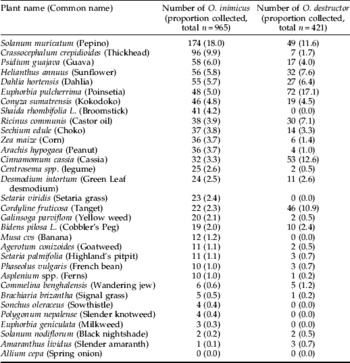
Oribius inimicus and O. destructor were found on nearly all species of plant surveyed; only spring-onions never yielded a beetle of either species (table 2). Not all plants were utilised equally, with the top ten plants for each species yielding 67% and 85% of all O. inimicus and O. destructor collected, respectively. While the proportion of each beetle species collected from each plant species was similar for most plants, there were some notable exceptions. Pepino and thickhead together supplied 28% of the O. inimicus collected, but only 13% of the O. destructor; while poinsettia and cassia supplied 30% of the O. destructor, but only 8% of the O. inimicus (table 1). Oribius destructor was collected from fewer plant species (25 from 32) than O. inimicus (31 from 32), but this may be a reflection of its overall lower abundance than any true difference in possible host range. We note here that our collections from these plants are independent of feeding studies; and, in some cases, (particularly plants from which beetles were rarely collected) beetles may simply have been resting or sunning on the plants and not feeding.
Number (and proportion) of adult Oribius species collected from 25 individuals each of 32 different plant species in the Aiyura Valley, Eastern Highlands Province, Papua New Guinea.

Daily activity patterns
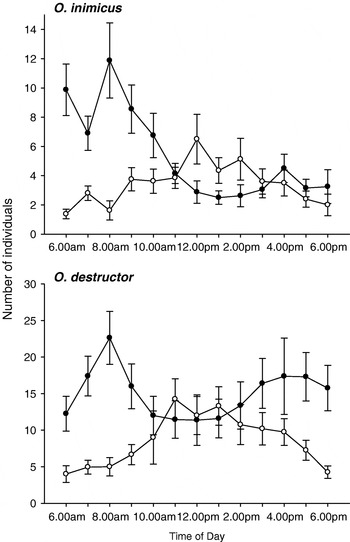
As beetles relocated themselves between vegetation plots (see following section), they must have crossed bare soil, but this was rarely observed, and insufficient counts were made to allow quantification. It is possible that most between plot movement was made at night. Both O. destructor and O. inimicus were most obvious on leaves of the upper plant canopy in the early morning, with the beetles subsequently moving to leaves within the canopy or towards the base of the plant (fig. 1). Most O. inimicus stayed within the plant for the remainder of the day, with only a slight increase in the number of beetles on outer leaves late in the day. In contrast, nearly 50% of O. destructor was still found on upper canopy leaves in the middle of the day and this increased in mid to late afternoon. Oribius weevils do not exhibit a drop escape mechanism, and we are confident that changes in abundance reflect diurnal patterns of movement rather than experimental artefact as a result of observer interference.
Mean (±SE) daily activity of two Oribius species on host plants within a shade house. n=5 sequential days of observations, number of weevils=120 of each species released at the start of the trial (–•–, beetles on upper leaf surfaces; –○–, beetles sheltering within canopy).

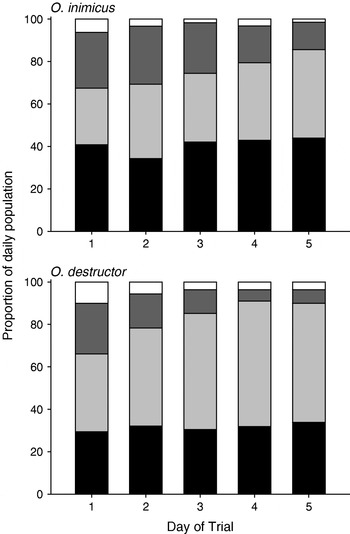
Beetles reallocated themselves between plants over the course of the five day trial. By the end of the trial, there were very few beetles of either species found on the Desmodium and the Setaria. The movement away from the Desmodium was very rapid and was obvious even by day one. Thickhead and goatweed were preferred by the two species, but not equally; more O. inimicus were found on thickhead and more O. destructor on goatweed (fig. 2).
Changing proportional abundance of Oribius inimicus and O. destructor on four plant species over five days in a shade-house trial. Plants were in four, 0.5 m2 plots planted directly into the soil. On day 0 of the trial, weevils were placed equally on all four plant species (i.e. initial proportion of population per plant=25). Number of weevils of each species at start of trial=120 (▪, thickhead;  , goatweed;
 , setaria; □, desmodium).

Larval Feeding
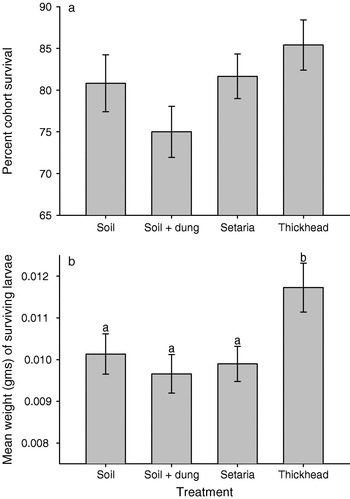
Substrate type did not affect mean cohort survival of larvae but did affect weight of survivors, with larvae reared in pots with thick-head significantly heavier than larvae from other pots (fig. 3). This finding supports previous reports that larvae are root feeders (rather than organic matter feeders) and that larval feeding is restricted to roots of certain plants.
Mean (±SE) cohort (a) survival and (b) weight (gms) of Oribius spp. reared for two weeks in pots containing sterilized soil, soil and dung, or an actively growing monocot (Setaria viridis) or dicot (Crassocephalum crepidioides). Larval weight (F3=3.708, P=0.014), but not cohort survival (F3=1.998, P=0.12), varies significantly across treatments. n=24, ten larval cohorts per treatment.

Impacts
Farmer surveys
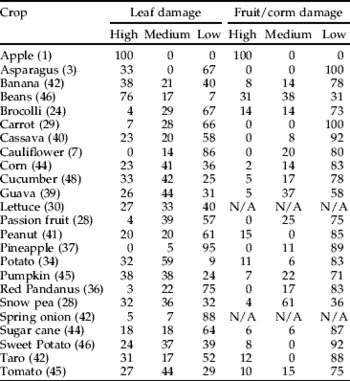
Farmers recognised some level of Oribius spp damage on all but three of the crops surveyed. However, relatively few farmers (generally <15% for any particular crop) scored oribius damage as high (table 3).
Qualitative estimates of Oribius spp. damage on 24 commonly grown crops in Eastern Highlands Province, Papua New Guinea, based on an in-field survey of 49 local growers. Results are the percentage of growers in each damage category for each crop. The number in brackets is the number of growers providing information on that crop. Additional records are from Greve & Ismay (Reference Greve, van and Ismay1983) and only include species not covered by the grower survey.


On-farm trials
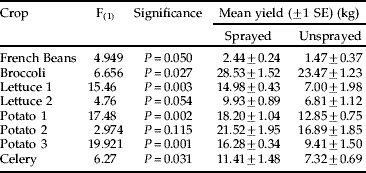
Significantly higher harvest yields were obtained following Oribius spp. control for six out of the eight on-farm trials and all five (i.e. French beans, broccoli, lettuce, potato, celery) of the different crops tested. One potato and one lettuce trial did not result in significantly increased harvests after control, but in both cases different trials on the same crops did produce significant treatment effects. Average yield increases (as a percentage of the yield of the unprotected crop) ranged from 22% (broccoli) to 114% (lettuce, trial 1) (table 4).
The impacts of Oribius spp. on five crops treated or not treated with an insecticide cover spray on an ‘as needs’ basis in Eastern Highlands Province, Papua New Guinea. Trials were run ‘on-farm’ and managed by local growers. For lettuce and potato, multiple trials were repeated on different farms. The yield is the mean of six, 20 plant plots for both sprayed and unsprayed treatments. The insecticides used were Karate® at 1 ml L−1 water and Target® at 5 ml L−1 water. Each insecticide was used on three of the six replicate plots, the data of which were subsequently combined for analysis. Preliminary analysis showed no insecticide-type effect.

On-station trials
General observations
The control treatments for all crops were never 100% effective. Barrier treatments generally gave better control (in terms of reduced weevil numbers) than spray treatments, but spray treatments were often not significantly different from untreated controls in reducing weevil numbers. Observations suggested that this was because weevils rapidly recolonized plants from untreated areas outside our treatment plots. Insecticides are effective against the weevil (Weises et al., in press), but our observations demonstrate the need to spray larger areas than our small experimental plots to gain effective field control. Spray treatments very rarely resulted in improved crop attributes (e.g. plant growth, fruit yield, fruit damage) over the barrier treatments alone, implying that we were not getting added plant health benefits by applying a broad-acting insecticide which would have controlled pests other than oribius. This further implies that Oribius spp. are the major pests of the horticultural pest complex in Eastern Highlands.
Cabbage
Weevils were found to be a very minor pest of cabbage, confirming local opinion expressed at the start of the trial. In two of three trials, no weevils were recorded on plants although oribius damage was observed; while, in the third trial, 15 weevils were recorded. Weevil density did not significantly differ across the three cabbage trials (F2=2.713, P=0.07) and so the trials were grouped for subsequent analysis. There was no effect of treatment on final harvest weight after trimming (F2=0.601, P=0.55), but there was a significant effect of treatment on the number of new leaves per plant recorded with damage, with both the active treatments having the same and significantly fewer numbers of damaged leaves than the untreated control (F2=20.263, P<0.000; mean±SE number of damaged leaves/plant for barrier, spray and control treatments were 2.55±0.42, 2.69±0.34 and 7.06±0.81, respectively).
Strawberry
Mean weevil numbers per plant varied significantly across the trials (F2=21.60, P<0.000), with post-hoc tests identifying that trials one and three had significantly similar and greater weevil numbers than trial 2. Trials one and three were subsequently combined for further analysis.
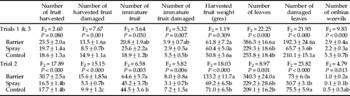
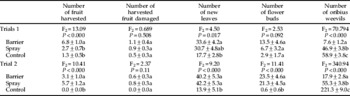
In trial 2, where weevil numbers were low (a mean of one or fewer beetles observed per plant over the duration of the trial for all treatments), the barrier treatment plants had over 50% more leaves and produced almost twice as much mature fruit (in number and weight) than the spray or control plants, although the proportional level of damage on fruit (~50%) was similar to that experienced by the other treatments (table 5). In trials 1 and 3, where weevil pressure was higher (a mean of 2–5 weevils per plant), barrier protected plants had greater numbers of leaves than plants in the other treatments, but fruit number and yield did not differ. In both sets of trials, spray treatments reduced the damage to leaves that were produced. We conclude from these trials that strawberries are highly susceptible to oribius damage on both foliage and fruit, and control needs to be highly efficacious to produce a noticeable effect.
Impact of Oribius spp. on strawberries in Eastern Highlands Province, PNG. Three treatments (a barrier exclusion treatment, a fortnightly insecticide cover-spray and an untreated control) were applied equally to a third of the plants in each of three, 45 plant trials. Trials one and three had significantly similar weevil densities and their data is combined for analysis. Results are the per plant means per treatment (i.e. n=5 plants per treatment for trial 2 data, n=30 plants per treatment for trial 1 and 3 data).

Numbers in the same column for the same trial (or trial pair) followed by the same letter are not significantly different at P=0.05.
Capsicum
Mean weevil numbers per plant varied significantly across the trials (F2=40.57, P<0.000), with post-hoc tests identifying that trials one and four, two and three, and five and six all had significantly similar weevil numbers to each other, but different to those in the other trial pairs. These three pairs of trials were subsequently combined for further analysis.
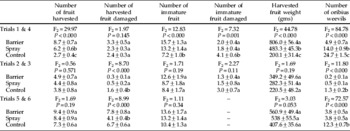
Trials two and three had a very low mean number of weevils (1.3 or less per plant); and, at this level of infestation, there was no impact of treatment on any of the measured crop variables. Similarly, trials five and six, where weevil numbers were higher, at a mean of between four and 12 weevils per plant, showed no effect of controlling weevils on total fruit yield. Noticeable in this trial, however, was a significant reduction in the number of damaged fruit following control. Capsicums damaged by oribius are unmarketable and so even though total yields did not differ between treatments, the decline in damage is critical to enhanced crop value. In trials one and four, where uncontrolled weevil infestation levels were very high, there were highly significant, positive effects of both the barrier and spray treatments on all crop attributes recorded (table 6).
Impact of Oribius spp. on capsicums in Eastern Highlands Province, PNG. Three treatments (a barrier exclusion treatment, a fortnightly insecticide cover-spray and an untreated control) were applied equally to a third of the plants in each of six, 45 plant trials. Trials one and four, two and three, and five and six, had significantly similar weevil densities and their data is combined for analysis. Results are the per plant means per treatment (i.e. n=30 plants per treatment for each of the combined trial pairs).

Numbers in the same column for the same trial (or trial pair) followed by the same letter are not significantly different at P=0.05.
Orange
Mean weevil numbers per plant varied significantly across the two trials (F2=17.98, P<0.000), and so the trials were analyzed separately. Both trials showed the same patterns. Citrus was very badly damaged by oribius weevils (table 7). In one trial, control trees produced no fruit; and, in the second, they produced just over one fruit per tree. Fruit loss is through consumption of flower buds and surface scarring of developing fruit. In addition to fruit loss, weevils seriously impacted on tree health through the continual destruction of new leaves. This resulted in branch die-back as weevils fed on green shoots and soft-bark after all leaves were consumed. During the period of our project, we observed neglected orange trees being killed by oribius; similar effects (although unquantified) were observed on apple trees.
Impact of Oribius spp. on oranges in Eastern Highlands Province, PNG. Three treatments (a barrier exclusion treatment, a fortnightly insecticide cover-spray and an untreated control) were applied equally to a third of the plants in each of two, 45 plant trials. The two trials had significantly different weevil densities and so their data is not combined. Results are the per plant means per treatment (i.e. n=15 plants/treatment for each trial).

Numbers in the same column for the same trial (or trial pair) followed by the same letter are not significantly different at P=0.05.
Avocado
We observed Oribius spp. causing significant shot-hole damage to avocado foliage and fruit surface scarring, but our trials failed to detect any differences between the barrier treatment and control for the crop variables we measured (number of new leaves: t 22=0.081, P=0.936; leaf damage score: t 22=–1.352, P=0.190; flowering branches: t 22=0.935, P=0.360; number of fruit: t 22=1.549, P=0.136).
Discussion
Host use and movement
Making an assumption that the taxa O. inimicus and O. destructor do represent single biological species, our data (and that of Greve & Ismay, Reference Greve, van and Ismay1983) strongly suggest that both species are truly polyphagous and will feed on a very wide range of host plants. As with other polyphagous insects (e.g. Bactrocera papayae Drew & Hancock (Clarke et al., Reference Clarke, Armstrong, Carmichael, Milne, Raghu, Roderick and Yeates2005)), however, not all host plants are used equally, and some hosts are clearly preferred. There may be some link between adult and larval host utilization, with field surveys showing high adult abundance on thickhead and larvae feeding on the roots of this plant, but further work to clarify this issue is clearly required.
Despite being flightless, the beetles seem highly mobile (at least at the patch level). This is seen directly in the field cage trial where weevils relocated themselves between plants within a day, but also indirectly in our impact trials where weevils quickly re-infested crops treated with short acting insecticides. Additionally, in a mark-release-recapture experiment (authors' unpublished data), not one weevil from an initial cohort of 100 weevils released onto five mature orange trees within an orchard was recaptured 24 hrs later (preliminary trials demonstrated marking was not killing the weevils). Such observations suggest that weevils not only walk off plants daily, but then walk around the local environment before moving onto another plant.
Impacts
The study confirms findings of previous work (Marshall, Reference Marshall1957, Reference Marshall1959; Szent-Ivany, Reference Szent-Ivany1959; Szent-Ivany & Stevens, Reference Szent-Ivany and Stevens1966; Greve & Ismay, Reference Greve, van and Ismay1983; Thistleton, Reference Thistleton1984; Waterhouse, Reference Waterhouse1997), indicating that oribius weevils are serious horticultural pests of PNG. The impact of oribius weevils is, generally, much more severe than previous reports suggest and what local land owners believe. Contrary to previous reports (Marshall, Reference Marshall1959; Thistleton, Reference Thistleton1984), O. destructor was not the most prevalent species in our study area. Rather, O. inimicus was much more common and damaging. Whether this change in prevalence reflects a differential geographic distribution of these species within the Highlands, a permanent or fluctuating change in relative abundance of the species over time or a change in abundance due to changing agricultural practices cannot be determined through our study.
In impact surveys, few growers scored Oribius damage as high; however, data from on-farm and on-station trials suggests otherwise. In on-farm trials, yield reduction in uncontrolled plots ranged from 18–50% (average 34%); and, for on-station trials, yield reduction in uncontrolled plots ranged from 0–100% (average 42%). While we don't expect all crops to be attacked at a consistently high level, we suspect, based on our experimental studies, that farmers underestimate the impact of oribius on crop yield for many crops. The impact of Oribius species species attack is two-fold. In the first instance, feeding on leaves, shoot, buds and possibly roots significantly impacts on the productivity of affected plant. Continual weevil damage has serious impact on the longevity of orchard crops, such as citrus and apples (personal observation), which may die due to weevil feeding. The second phase in the damage process involves attacking those fruits which the plant has been able to set, making the fruit unmarketable. Depending on the fruit type, damage may (e.g. for capsicum) or may not (e.g. for citrus) make the fruit inedible. In the latter case the fruit can still be consumed by growers, off-setting the economic losses of market downgrade. The issue of assessing real crop impact should be regarded as a priority for further research and extension programs.
The negative impact of oribius weevils on Irish potato is a significant and unexpected finding. While leaf damage is common, farmers did not perceive that weevil feeding caused a reduction in crop yield (table 3). Reduction in yield may be a product of both leaf feeding, which reduces a plants potential to store energy, and larval attack on tubers and root systems. Further research should investigate the impact of the larval stage of oribius weevils on the productivity of root crops, particularly sweet potato, which is the local staple starch crop.
On-station trials show that, not surprisingly, the level of weevil pressure affects the amount of damage a crop sustains. Our work on the weevils did not allow us to elucidate the determinants for the local abundance of weevils, but we did make observations which suggest several reasons. In conversations with older members of the local community, their thoughts were that weevils were more of a problem in recent years than previously. While it is impossible to verify such memories, they do correlate with our own observations that weevil damage was often worse in well-established gardens and orchards. The Highlanders are traditional gardeners, but the location of gardens moved every few years. In contrast, changing social patterns mean that intensively managed garden areas are now much more likely to be permanently established, as of course are orchards. As flightless weevils, oribius may be slow to locate a new garden, but so long as it is maintained (even with weedy fallow periods), local beetle populations can build up over time. Thus, we suspect that while oribius might always have been a low-level problem in Highland gardens, changing agricultural practices have exacerbated the problem.
Biosecurity implications
Based on the high level of damage recorded to a very wide range of horticultural and orchard crops, Oribius species should be regarded as major regional biosecurity threats. Their largely unknown pest status, however, means that they are invariably absent from quarantine target lists and industry biosecurity response plans. The Highland Oribius species dealt with in this paper are unlikely threats because there is no obvious pathway for them to be transported from the highlands. In contrast, the lowland pest species (O. cruciatus (Faust), O. cinereus Marshall, O. improvidus Marshall) (Ero et al., Reference Ero, Clarke, Wesis and Niangu2006) do have potential pathways into Australia via the Torres Straits. We have no information on the host ranges or impacts of these species; but, if they are similar to the Highland species, then they should be regarded with concern.
Acknowledgements
This project was funded by the National Government of Papua New Guinea and the Commonwealth Government of Australia through Australian Centre for International Agricultural Research (ACIAR) Project CS2/2001/032, Impact and Management of Oribius Weevils in Papua New Guinea. The project was a joint collaboration between the National Agricultural Research Institute (PNG), the Fresh Produce Development Association (PNG) and the Queensland University of Technology (Australia). For discussions and sharing of expert knowledge on oribius, both before and during this work, we would like to thank: Dr John Moxon, LAES Keravat, NARI; Dr Brian Thistleton, DBIRD, Northern Territory; Mr Nelson Simbikin, Coffee Research Institute, Aiyura; and Mr James Watson, Goroka. We would like to thank the following growers from Eastern Highlands Province for running the on-farm trials: Yatex Kate, Michael Kari, Sharon Mike, Joshua I. (Yameiufa), Ila Fapa, Simon Jay, Bob H. (Ifiufa) and Rose Nagani.