INTRODUCTIONFootnote 1
Dromoi are considered essential features of Mycenaean funerary architecture, inherently associated with tholoi and chamber tombs (Hood Reference Hood1960, 174; Mylonas Reference Mylonas1966, 111–12, 118–20; Pelon Reference Pelon1976, 154; Dickinson Reference Dickinson1977, 59–67; Reference Dickinson1983, 57). Several scholars have examined changes in their size and form as the result of wider technical developments (Wace Reference Wace and Persson1931; Reference Wace1932, 124–31; Blegen Reference Blegen1937, 232–8; Pelon Reference Pelon1976, 277–97; Dobiat Reference Dobiat1982; Cavanagh and Mee Reference Cavanagh and Mee1998, 46; Kamm Reference Kamm2000; Como Reference Como2007, 23–8; Zavadil Reference Zavadil2013, 53–9). Yet a specialised study of dromoi as distinct architectural elements with their own history is still lacking. This is probably because the dromos is seen as a practical necessity, a supplementary feature to the structural sophistication of the tholos, or the inevitable solution for accessing an underground chamber tomb from ground level.
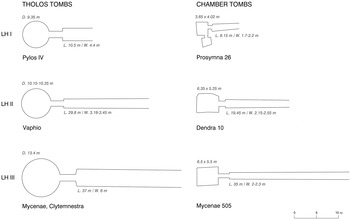
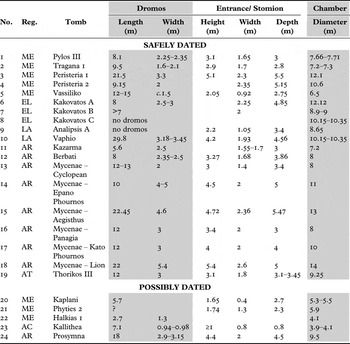
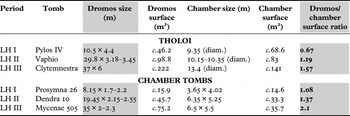
This, however, may be a partial picture. We know that dromoi were also constructed in smaller built graves (‘built chamber tombs’) and circular tombs (‘small tholoi’), which could have been easily accessed without such passageways (Korres Reference Korres1975a, 472–3, 489–90; Papadimitriou Reference Papadimitriou2001a, 159–61). On the other hand, some tholoi were clearly not provided with a dromos (Pelon Reference Pelon1976, 277–8, 398; Konsolaki-Giannopoulou Reference Konsolaki-Giannopoulou, Vasilopoulou and Katsarou-Tzeveleki2009, 510–11). In fact, it seems that the dromos was the most variable feature in Mycenaean funerary architecture. A simple comparison among tholoi and chamber tombs with the longest known dromoi of LH I, II and III date (Fig. 1) indicates that the size of this feature increased dramatically over the LBA, not only lengthwise but also proportionally to the chamber. Even if such variability is partly attributed to the mounting desire for display observed in Late Mycenaean ‘royal’ tholoi (Pelon Reference Pelon1976, 287–93; Wright Reference Wright and Laffineur1987; Santillo Frizell Reference Santillo Frizell1997–8; Fitzsimons Reference Fitzsimons, Terrenato and Haggis2011, 110–11), this could hardly explain the presence of impressive passageways in some LH III chamber tombs, e.g. Mycenae 505, whose dromos exceeded 35 m in length (Wace Reference Wace1932, 12–15). We should also bear in mind that several dromoi had features of possible ritual function, such as grooves and depressions (Åkeström Reference Åkeström, French and Wardle1988, 202–5; Zavadil Reference Zavadil2013, 63–71); others have yielded evidence of ritual feasting and drinking (Cavanagh and Mee Reference Cavanagh, Mee, Galanakis, Wilkinson and Bennet2014); and in one case, two horses were ceremoniously interred at the beginning of the dromos (Marathon tholos, Pelon Reference Pelon1976, 229).
Comparative plans of tholoi and chamber tombs with the longest known dromoi in LH I, LH II and LH III (after the original publications, with recorded dimensions) (graphically edited by Ms C. Stamati).

It is, therefore, improbable that practicality or ostentation were the sole raisons d’être of dromoi. A more nuanced picture can emerge if we examine them as elements which served also ritual/symbolic needs. The dromos was the final earthly passage through which the deceased was carried ‘from the visible society to the invisible’ (Hertz Reference Hertz1960, 80) and also a feature that restricted access to the tomb and channelled the attention of participants to the entrance. Anthropological literature suggests that entrances to tombs are often invested with liminal symbolisms expressed as territorial passages (Eliade Reference Eliade1959, 179–84; Gennep Reference Gennep1960, 15–25, 192). On the other hand, architectural theorists argue that passages and marked boundaries (such as those found in some dromoi, see section II.F) are usually meant to represent transitions between spaces of different cognitive and symbolic value (Palyvou Reference Palyvou and Danielidou2009, 537–41).
Evidence for funerary processions and ritual activities in dromoi (or similar passageways) and forecourts is available from a variety of archaeological contexts, e.g. Neolithic Britain (Barrett Reference Barrett1994, 57–60), Bronze Age Sardinia (Blake Reference Blake, Silverman and Small2002), Archaic Cyprus (Karageorghis Reference Karageorghis1967; Reference Karageorghis1973) and Etruria (Pareti Reference Pareti1947; Bartoloni Reference Bartoloni2003, 67–72), and also from Early Minoan Crete (Hamilakis Reference Hamilakis and Branigan1998; Reference Hamilakis2014 chapter 5; Catapoti Reference Catapoti, Knapp and Dommelen2014). Yet the potential use of Mycenaean dromoi for similar purposes has been only marginally explored, usually in relation to toasting ceremonies in front of the stomion (see next section).
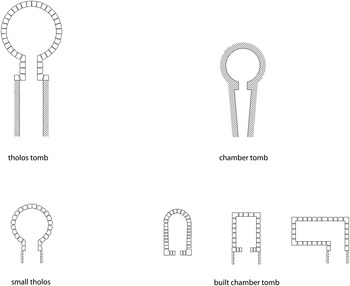
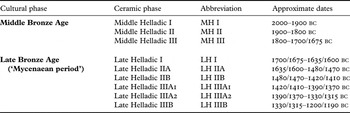
The present paper aims at investigating how the dromos emerged as an architectural feature and why it became the principal access device in Mycenaean tombs. For that purpose, it will focus on the formative stages of Mycenaean funerary architecture, i.e. the LH I period and the transition to LH IIA (Table 1). This was a time of change, during which the custom of burying the dead in collective (‘family’) sepulchres started spreading in mainland Greece, and numerous types of tomb with lateral entrance were adopted (Fig. 2), whose form varied until LH IIA, when the layout of Mycenaean burial structures was more or less standardised (Pelon Reference Pelon1976, 402; Boyd Reference Boyd2002, 56–9, 93). I will thus examine developments in all types of tomb with lateral entrance (tholoi, chamber tombs, small tholoi, built chamber tombs) constructed prior to LH IIA, including some MH examples with dromos-like arrangements, which may provide typological ancestry to the feature. I will also explore the possible functions of dromoi, by examining permanent installations encountered in their space, and finds that may have been related to ritual activities. Finally, I will discuss the performative character of dromoi and their possible symbolic connotations. It will be argued that the dromos was not an integral part of Mycenaean funerary architecture from the very beginning but came about gradually out of a long process of experimentation as to the system of access, which originated in MH tumuli and was completed in late LH I or LH I/IIA tholoi and chamber tombs. This process managed to merge practical considerations with new ritual needs arising at a period of intense social and cultural change.
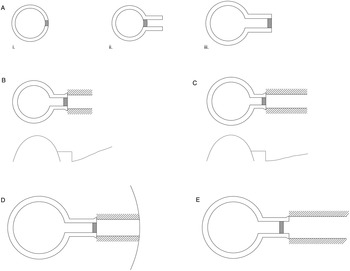
Types of tombs with lateral entrances used in LH I (drawn by the author, graphically edited by Ms C. Stamati and Mrs H. Pangalou).

The chronology of the Middle and Late Bronze Age in Mainland Greece (after Cline Reference Cline2010, xix and 28).

PREVIOUS RESEARCH
Because of the general impression that the dromos was a ‘natural’ feature of Mycenaean tombs, little attention has been paid to early idiosyncratic examples and tombs with underdeveloped or no dromoi. Most architectural treatises have focused on examples with long passageways of LH IIA or later date, and tried to identify proportional schemes that could explain changes in the size of dromoi in relation to the dimensions of the stomion and the chamber (Wace Reference Wace and Persson1931; Reference Wace1932, 124–31; Dobiat Reference Dobiat1982; Kamm Reference Kamm2000). Sometimes, the absence of a dromos from early tholoi is acknowledged but not discussed further (Blegen et al. Reference Blegen, Rawson, Taylour and Donovan1973, 155 n. 97; Dickinson Reference Dickinson1977, 60); often, the lack of a dromos is attributed to poor preservation or unfavourable soil conditions (e.g. Kontorli-Papadopoulou Reference Kontorli-Papadopoulou and Laffineur1987, 154; Zavadil Reference Zavadil2013, 59).
Pelon was the first scholar to discuss the absence of a dromos from a number of LH I and LH IIA tholoi as a meaningful fact rather than a hazard of preservation, and attempted to identify a pattern of evolution. Focusing on sites with several early tholoi (Peristeria, Kakovatos, Pylos), he suggested a gradual increase in size and elaboration, which he related to changes in construction techniques and the progressive ‘sinking’ of the tomb into the ground until it became almost subterranean; it was this gradual ‘sinking’ that made the creation of a corridor-like access necessary (Pelon Reference Pelon1976, 277–97, 395–403). Pelon placed the culmination of this process in LH II, when the tholos form was crystallised (1976, 402). Unfortunately, by the time he wrote, this development could be followed in detail only in Messenia and, partly, in the south-east Peloponnese, but not in the Argolid or Attica, where tholoi seemed to have been introduced in finished form in LH IIA.
Pelon's remarks are of great value but need revision in view of subsequent discoveries, namely Korres’ investigations in a number of Messenian tholoi in the late 1970s and recent excavations of early tholoi in the south-west and north-east Peloponnese (for references, see Appendix II: Table A1a ).Footnote 2 Besides, Pelon focused exclusively on tholoi, not taking into account the evidence of early chamber tombs, most of which were also provided with some sort of dromos. More recently, Boyd suggested that the idea of a dromos may have originated in chamber tombs, and was later adapted in tholoi, only to become a standard feature of tholos architecture in late LH I or LH IIA, in what he described as ‘the secondary adaptation of the tholos form’ (Boyd Reference Boyd2002, 56–9, 93)Footnote 3 . This is an interesting suggestion which, however, does not account for the presence of dromos-like arrangements in some MH built chamber tombs (Papadimitriou Reference Papadimitriou2001a, 159–61). Zavadil, who has re-examined the evidence from the dromoi of Messenian tombs (Zavadil Reference Zavadil2013, 53–9, 98–101), admits that some early tholoi were probably built without a dromos, yet she assumes that in most cases where a dromos has not been found this is due to the erosion of the covering mound. The validity of these theories will be tested in the course of this study.
The symbolic/ritual use of dromoi has been discussed by several scholars, albeit rarely with reference to chronologically early tombs. An old idea that dromoi were used for the carriage of the corpse on a cart has proved rather poorly substantiated (see Gallou Reference Gallou2005, 70–1, with references). Kontorli-Papadopoulou (Reference Kontorli-Papadopoulou and Laffineur1987) and Åkeström (Reference Åkeström, French and Wardle1988) have discussed the possible ritual/symbolic use of grooves found in front of the stomia of early chamber tombs, and the function of blocking walls built at the outer ends of some dromoi. Voutsaki has suggested that the tripartite scheme of Mycenaean tombs arose from, and gave material expression to, a complex set of beliefs (Voutsaki Reference Voutsaki1993, 142) but paid little attention to dromos rituals (Voutsaki Reference Voutsaki1993, 79, 103, 125, 140), as her research focused mostly on conspicuous consumption and the secondary treatment of the dead. Cavanagh and Mee have recorded meticulously evidence of ritual activities from Mycenaean tombs and stressed that tombs with lateral entrances favoured the development of liminal rites in front of the stomion (Cavanagh and Mee Reference Cavanagh and Mee1998, 45–9, 54–5, 103–20 esp. 117–18), yet the wide scope of their work has not allowed for a detailed treatment of the dromos. Gallou has explored the symbolic and performative qualities of the tripartite dromos–stomion–chamber layout (Gallou Reference Gallou2005, 65–71 and Chapter V) but focused mostly on tombs with fully developed characteristics dating to LH IIA or later; as a consequence, she has not raised the question why dromoi were created in the first place. The performative properties of dromoi have been also discussed by Wright from a theoretical point of view (Wright Reference Wright, Maran, Juwig, Schwengel and Thaler2006, 57–8). Moschos, in his study of wooden doors in Mycenaean tombs (Moschos Reference Moschos2008), has recognised the liminal character of dromoi but discussed only selected cases of ritual activity. The excavators of the Agia Sotira cemetery (Nemea) have proposed new stratigraphic methods of recording human activities in dromoi and treated the question of ritual practices in detail, but their samples are of LH III date (Smith et al. Reference Smith, Dabney, Pappi, Triantaphyllou and Wrightforthcoming, chapter 10). Boyd has made the most systematic attempt to record remains of ritual practices from Early Mycenaean tombs and to explore their symbolic significance so far (Boyd Reference Boyd2002; Reference Boyd2014a; Reference Boyd, Nakassis and James2014b, 196–200); his approach is valuable, among other reasons, because it touches upon the issue of funerary processions as distinct ‘fields of action’, especially in relation to dromoi (Boyd Reference Boyd, Dakouri-Hild and Boydforthcoming). The subject has been also discussed by the author in relation to built chamber tombs (Papadimitriou Reference Papadimitriou2001a, 182–6).
METHODOLOGICAL ISSUES
Before turning our attention to the data, some comments about the use of terminology and the methods of assessing the construction date of a collective tomb are necessary.
Terminology
In studies of Early Mycenaean funerary architecture, confusion is sometimes caused (a) by the undifferentiated application of the term ‘tholos’ to all types of circular constructions, irrespective of size and setting, and (b) by the interchangeable use of the terms ‘built chamber tomb’ and ‘built grave’. In this paper, the following definitions are used (Fig. 2):
-
tholos tombs – tholoi built as single monuments either above ground or partly underground, usually with a covering mound (although, as we will see, some early examples may have been freestanding);Footnote 4
-
chamber tombs – earth-cut chamber tombs, usually dug on sloping terrain;
-
small tholoi – small tholos-like structures (<4–5 m in diameter), clustered in groups and often covered by a common mound;Footnote 5
-
built chamber tombs (BCTs) – tombs of apsidal or rectangular form with built walls and side entrances (which differentiate them from plain ‘built graves’)Footnote 6 .
Chronology
Pelon has discussed extensively the problems surrounding the dating of collective tombs, especially tholoi (Pelon Reference Pelon1976, 372–91). He has argued that their continuous use over long periods of time renders their contents unreliable for assessing their construction date. Instead, he proposed to employ architectural criteria for tracing stages of evolution at each site. Unfortunately, this method can be applied only on sites with more than one tholos. Moreover, Pelon himself acknowledges that evolutionary patterns are site specific and cannot be applied on regional or supraregional level (Pelon Reference Pelon1976, 380–91). Therefore, if we seek a dating tool that is both omnipresent and quite independent of regional developments, we have to stick with pottery. For all the vicissitudes of preservation, pottery is the only type of evidence that can provide a safe terminus ante quem for the construction of a tomb. Although this can only produce a minimum number of tombs used in each period (for other tombs may have originally contained vases of that period, which were removed in later funerals or cleaning operations), it nevertheless provides a satisfactory level of chronological resolution for the purposes of the present study.
Even more difficult is to determine whether the dromos was constructed at the same time as the tomb. Few dromoi have been excavated in a stratigraphic way that allows for independent dating.Footnote 7 Moreover, some tombs evidently underwent changes at a stage of their history, which may have affected the dromos, too.Footnote 8 When such information is available, it is included in the discussion. Otherwise, it is assumed that the dromos was an original feature of the tomb.
The study will focus on LH I tombs with lateral entrances, but will differentiate between:
-
a) safely dated examples, i.e. tombs which have yielded complete or almost complete LH I vases, and
-
b) possible examples, i.e. tombs which have yielded only sherd material of LH I date (for such sherds may have derived from the fill rather than from the chamber itself), and tombs which have been dated by their excavators to LH I but are only known through brief preliminary reports without published pottery.
Tombs attributed to ‘MH/LH I’ due to the presence of MH-style vessels among their contentsFootnote 9 will be listed with LH I examples. The problem of MH ceramic survivals into the LBA is too complex to discuss here;Footnote 10 in any case, a distinction between MH/LH I and LH I is not crucial for the present paper, which aims to identify general developments in the period between the end of the MBA and the beginning of LH IIA, not to establish the chronological precedence of one tomb over another.
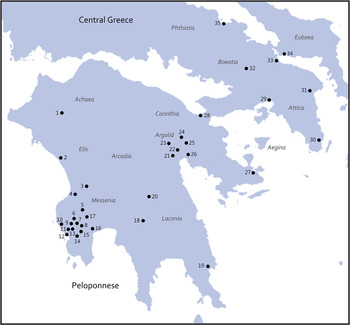
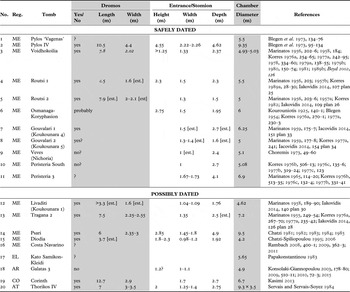
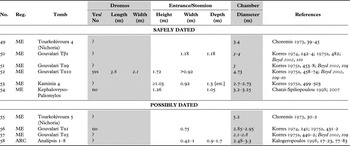
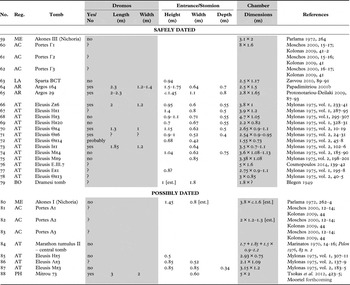
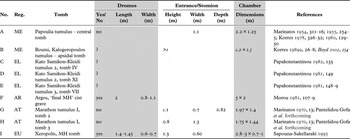
Detailed dating sources and information about the identification of a tomb as ‘safe’ or ‘possible’ LH I are provided in Appendix I. For the sake of convenience, ‘safe’ and ‘possible’ examples are discussed together, but ‘possible’ LH I tombs are marked with an asterisk (*) throughout the text. All examined tombs are listed per type and region and numbered sequentially in Appendix II: Tables A1a , A1b , A1c , A1d and A2 (with references). Numbers in the tables are indicated in the text by figures in square brackets next to the tomb's name. A map of sites with LH I and pre-LH I tombs with lateral entrance is provided in Fig. 3.
Map of sites with LH I and pre-LH I tombs with lateral entrance (T = tholos tomb, C = chamber tomb, S = small tholos, B = built chamber tomb).
a) Numerical Index
1. Portes [B]; 2. Kato Samikon [T, B]; 3. Psari [T]; 4. Peristeria [T]; 5. Kephalovryso-Paliolylos [S]; 6. Volimidia [C]; 7. Routsi [T, B]; 8. Papoulia [B]; 9. Pylos [T]; 10. Costa Navarino [T]; 11. Tragana [T]; 12. Voidhokoilia [T]; 13. Osmanaga [T]; 14. Koukounara [T, S]; 15. Kaminia [S]; 16. Nichoria [T, S, B]; 17. Diodia [T]; 18. Sparta [B]; 19. Epidaurus Limera [C]; 20. Analipsis [S]; 21. Kokla [C]; 22. Argos [B]; 23. Schoinochori [C]; 24. Mycenae [C]; 25. Prosymna [C]; 26. Tiryns [C]; 27. Galatas [T]; 28. Corinth [T]; 29. Eleusis [B]; 30. Thorikos [T]; 31. Marathon [B]; 32. Thebes [C]; 33. Dramesi [B]; 34. Xeropolis [B]; 35. Mitrou [B].
b) Alphabetical Index
Analipsis [S] 20; Argos [B] 22; Corinth [T] 28; Costa Navarino [T] 10; Diodia [T] 17; Dramesi [B] 33; Eleusis [B] 29; Epidaurus Limera [C] 19; Galatas [T] 27; Kaminia [S] 15; Kato Samikon [T, B] 2; Kephalovryso-Paliomylos [S] 5; Kokla [C] 21; Koukounara [T, S] 14; Marathon [B] 31; Mitrou [B] 35; Mycenae [C] 24; Nichoria [T, S, B] 16; Osmanaga [T] 13; Papoulia [B] 8; Peristeria [T] 4; Portes [B] 1; Prosymna [C] 25; Psari [T] 3; Pylos [T] 9; Routsi [T, B] 7; Schoinochori [C] 23; Sparta [B] 18; Thebes [C] 32; Thorikos [T] 30; Tiryns [C] 26; Tragana [T] 11; Voidhokoilia [T] 12; Volimidia [C] 6; Xeropolis [B] 34.

I. THE DROMOI OF LH I TOMBS
IA. Tholos tombs (Appendix II: Table A1a )
Twenty tholoi in Messenia, Elis, Corinthia, the Argolid and Attica can be safely or possibly dated to LH I (or MH/LH I). Two of them have produced no evidence of a dromos at all (Pylos ‘Vagenas’ [1], Galatas 3* [18]). At Galatas 3* (Fig. 4) Konsolaki-Giannopoulou is clear that a dromos had never existed (Konsolaki-Giannopoulou Reference Konsolaki-Giannopoulou and Konsolaki-Giannopoulou2003, 178; Reference Konsolaki-Giannopoulou, Vasilopoulou and Katsarou-Tzeveleki2009, 510; Reference Konsolaki-Giannpoulou2010, 72). Pelon believes that the ‘Vagenas’ tholos was also devoid of a dromos or, if it had one, it was very short (1976, 397). The two tombs share many construction details. They were built entirely above ground and had comparable diameters (4.9–5.5 m). Although only the lower courses of their walls have survived, they were apparently thin (‘Vagenas’: 60 cm; Galatas 3*: 40 cm).Footnote 11 Konsolaki-Giannopoulou believes that none of them could have supported a full-stone superstructure; instead they may have been roofed with a dome of lighter materials, such as wood and clay (Konsolaki-Giannopoulou Reference Konsolaki-Giannopoulou and Konsolaki-Giannopoulou2003, 178; Reference Konsolaki-Giannopoulou, Vasilopoulou and Katsarou-Tzeveleki2009, 510; Reference Konsolaki-Giannopoulou, Schallin and Tournavitou2015). The entrance of Galatas 3* was very narrow (1–1.1 m) and low (c.1.20 m), flanked by two monolithic antae, without a stomion.
Tholos 3 at Galatas, Troezen (courtesy of Dr E. Konsolaki-Giannopoulou; source: Konsolaki-Giannopoulou Reference Konsolaki-Giannopoulou and Konsolaki-Giannopoulou2003, 226 fig. 70).

A number of tholoi had rudimentary access devices. Peristeria South [10] (Fig. 5) and Veves [9] had short projecting walls (Peristeria South: 2.38–2.7 m; Veves: 2.4 m), which created small ‘vestibules’ in front of their entrances (i.e. corridor-like features open at the outer end and blocked at the inner end). That these features were meant to function as stomia is unlikely; although no blocking walls have been reported, the photos and plan of Peristeria South (Fig. 5 and Korres Reference Korres1976b, 549 fig. 11) show a row of stones at the inner end of the feature (along the line of the chamber wall) which must have belonged to the blockage; at Veves, Choremis describes the corresponding feature as a ‘walled dromos’ (Choremis Reference Choremis1973, 60) implying that the doorway was also placed at its inner end. The discovery of a lintel at Peristeria South (Korres Reference Korres1976c, 138) does not allow us to exclude the possibility of a stomion altogether,Footnote 12 although one should remember that the practice of providing roofing to a walled ‘vestibule’ is also known from the LH IIB tholos at Marathon (Pelon Reference Pelon1976, 229). Choremis asserts categorically that there was no earthen dromos at Veves (Choremis Reference Choremis1973, 60), neither is a dromos reported from Peristeria South. This suggests that access to both tombs was provided through short and narrow ‘vestibules’ leading to equally narrow (c.1 m) and shallow doorways without distinct door-jambs – an arrangement which differs substantially from the wide and deep facades of later tholoi. Both tombs were built above ground, and had small diameters (5.08–5.1 m) and thin walls (Veves: 60 cm; Peristeria South: est. 50–60 cm). Korres has suggested that the upper part of Peristeria South might have been built of light sandstones and covered with layers of clay (Korres Reference Korres1976b, 508; Reference Korres1977b, 322).
The South tholos at Peristeria, Messenia (courtesy of the Archaeological Society at Athens; source: Korres Reference Korres1976b, pl. 268α).

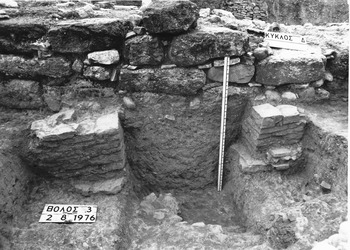
A slightly different arrangement is attested in the Costa Navarino tholos* [16] and in Peristeria 3 [11]. These tombs also had projecting walls creating corridor-like features, which however were probably used as stomia. This is certain at Costa Navarino*, where a blocking wall has been found at its outer end (Rambach Reference Rambach2009, 363 fig. 21). As for Peristeria 3, Korres interprets the corresponding feature as a stomion, and the fact that it has a finished facade (built with horizontal slabs which create jambs wider than the walls, Fig. 6 and Korres Reference Korres1977b, 328 fig. 6) seems to support his view. However, a piece of low but well-built masonry found in the inner part of this feature (Korres Reference Korres1976b, pl. 272c; Reference Korres1977b, pl. 174b) raises questions about its function. Korres believes that the masonry was not part of the tomb's blockage but a cross-wall associated with a floor depression running through the ‘stomion’ into the chamber, which must have been dug at a later stage of the tomb's history (but still within LH I) as it left the lower part of the ‘stomion’ walls exposed (Reference Korres1976b, 533–4 and pl. 272c; Reference Korres1977b, 337–9; see also Fig. 6). However, the published plans and photos suggest that the masonry in question reached a considerable height in relation to the ‘stomion’ walls, thus probably obstructing circulation between the ‘stomion’ and the chamber. For that reason, it is not implausible that it actually belonged to the tomb's blockage (cf. Dickinson Reference Dickinson1977, 93); if so, then the corridor-like feature of Peristeria 3 might also have functioned as a ‘vestibule’, albeit of greater size (4.1 × 1.73 m) and of more advanced form than those in Peristeria South and Veves. Whether the tombs were provided with earthen dromoi is unclear. According to Korres (Reference Korres1976b, 532; Reference Korres1977b, 339), the dromos of Peristeria 3 would have lain below the West House, and the fact that a published photo (Fig. 6) shows the depression continuing beyond the facade may support this suggestion, although no traces of dromos walls have been identified. No information about the presence of a dromos is available for Costa Navarino*. The tholos of Peristeria 3 was quite large (6.9 m in diameter) but clearly built above ground with thin walls (c.60 cm, Pelon Reference Pelon1976, 345). The size of the Costa Navarino tomb* is unknown, but its walls were obviously thin (Rambach Reference Rambach2009, 363 fig. 21; Reference Rambach2011).
The facade of tholos 3 at Peristeria, Messenia (beneath a later wall) (courtesy of the Archaeological Society at Athens; source: Korres Reference Korres1976b, pl. 273a).

So far, we have examined tholoi where the presence of a dromos is either safely excluded or reasonably doubted, and the system of access is unsophisticated and non-standardised. With the possible exception of Costa Navarino*, which is not yet documented in detail, these tombs were built above ground and were either freestanding or covered with light materials (e.g. clay).Footnote 13 This goes against Zavadil's idea that the lack of a dromos from some Messenian tholoi is due to the erosion of the surrounding tumulus (Zavadil Reference Zavadil2013, 59); in all probability, the examined tombs had never had a covering mound of the type known from later tholoi, not least because their thin walls (<60 cm) and primitive structure would have been unable to bear its weight.
We now turn to LH I tholoi which have yielded positive evidence for the presence of a dromos and a stomion. As we will see, there is still considerable variation in the form of the dromos and the entrance system as a whole.
Short, narrow and steep dromoi have been found or reasonably assumed in three cases: Routsi 1 [4], Diodia* [15] and Osmanaga [6]. Tomb sizes vary considerably (4.2–6 m) but all three were sunk in the ground up to the level of the lintel, had quite thick wallsFootnote 14 and clearly defined albeit rather shallow stomia (1.92–2.3 m deep)Footnote 15 of comparable height (Osmanaga: 2.75 m; Routsi 1: 2.3 m; Diodia*: 1.8–2.3? m)Footnote 16 . At Routsi 1 and Diodia*, stomia had finished facades with narrow door-jambs built of flat stones,Footnote 17 and dromoi were short (c.5 and 3.7 m)Footnote 18 descending sharply towards the entrance (Korres Reference Korres1989a, 28; Fig. 7). No dromos has been excavated at Osmanaga, but Pelon believes that a steep one must have existed because of the difference in height between the entrance and the original ground (Pelon Reference Pelon1976, 198, 278), and Korres seems to confirm its presence (Korres Reference Korres1977a, 232). There is no information about the presence of a mound at Routsi; the tholoi at Osmanaga and Diodia were probably covered by small earthen mounds (Pelon Reference Pelon1976, 298; Chatzi-Spiliopoulou Reference Chatzi-Spiliopoulou2006, 202).
The tholos at Diodia, Messenia (courtesy of the Ephorate of Antiquities of Messenia and Dr G. Chatzi-Spiliopoulou; source: Chatzi-Spilioupolou Reference Chatzi-Spiliopoulou1995, 181 fig. 2).

A short (c.3.3 m preserved length) but almost flat dromos has been found at Livaditi* [12]. Unlike the previous tombs, this one is said to have been built above ground with a large covering mound, but documentation is very concise. It was rather small in diameter (4.62 m), and had a shallow stomion (1.76 m) built of flat stones with narrow jambs in the facade (Marinatos Reference Marinatos1958, 189 and pl. 147b; Iakovidis Reference Iakovidis2014, 140 plan 30).
Routsi 2 [5], Tragana 2* [13] and the insufficiently known tombs Gouvalari 1 and 2 [7, 8] belong to a type with well-formed stomia and dromoi, which seem to have sloped gently towards the entrance (Iacovidis Reference Iakovidis2014, 109 plan 26, 126 plan 28, 151 plan 33, 154 plan 34). Among them, Tragana 2* was built partly underground and had a covering mound; Gouvalari 1 and 2 may have been covered by a single mound; the setting of Routsi 2 is not clear, but the available plan suggests that it was also built partly underground.Footnote 19 At Routsi 2 and Gouvalari 2 (5 m in diameter), stomia were built of flat stones and although shallow (1.5–1.6 m) had well-finished facades (Marinatos Reference Marinatos1957a, pl. 52a; Reference Marinatos1959, pl. 149a). The larger tholoi Gouvalari 1 and Tragana 2* (6.25–7.2 m) have poorly preserved but longer stomia (2.5–2.7 m), and that of Tragana 2* seems to have been built of large, dressed blocks (Korres Reference Korres1976a, pl. 180a). The dromos length has been recorded only at Tragana 2* (7.5 m) and can be estimated from the plan for Routsi 2 (7.9 m). All tombs had floor depressions, which started at the inner end of the dromos and continued into the chamber (see section IIA); Korres (Reference Korres, Oliva and Frolikova1982, 91–3) believes that some of these depressions were the result of later rearrangements due to stability problems related to the tholos, but dates them before the end of LH I.
The tholos at Kato Samikon-Kleidi* [17], reportedly built within a tumulus 14.6 m in diameter, was quite large (5.65 m) but neither its stomion nor the dromos has been excavated (Papakonstantinou Reference Papakonstantinou1983).
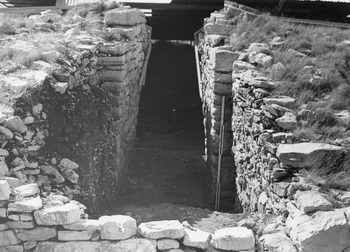
Pylos IV [2] and Psari* [14] were the two largest tholoi of the period. They were built partly underground, had spacious chambers (>9 m in diameter), well-formed stomia (4.62–4.9 m deep) and high entrances (Pylos IV: 4.55 m, Psari* 2.85 m). Pylos IV was covered by an earthen mound and had a long and wide earth-cut dromos 10.5 × 4.4 m (Blegen et al. Reference Blegen, Rawson, Taylour and Donovan1973, figs. 176, 177, 186, 188); its blocking wall was not placed at the outer end of the stomion but close to its centre. Psari* was covered by a stone-clad mound and had a shorter and narrower dromos (6 × 3 m) with dressed sides and a low blocking wall at its start (Chatzi Reference Chatzi1983, pl. 57b–c; Reference Chatzi1985, pl. 35) (Fig. 8); since this wall was aligned with the masonry of the surrounding peribolos, it is clear that the length of the dromos was determined by the diameter of the mound. Interestingly, the stomion at Psari* was blocked at both ends (Chatzi Reference Chatzi1985, 103). The covering mound at Psari* had two or more concentric lines of stones around the tholos, which may suggest successive stages of construction (Chatzi Reference Chatzi1983; Boyd Reference Boyd2002, 181).
The dromos and the stomion of the tholos at Psari, Messenia (courtesy of the Ephorate of Antiquities of Messenia and Dr Georgia Chatzi-Spiliopoulou; source: Chatzi Reference Chatzi1985, pl. 35b).

Voidhokoilia [3] is a unique case of a tholos built within a pre-existing tumulus. Although not particularly large (4.93–5.03 m), it had a well-formed and relatively deep stomion (2.37 m), which may suggest a mature stage in LH I, as is also indicated by pottery (Lolos Reference Lolos1987, 179–81). The ‘dromos’ was an artificial break in the mantle of the tumulus (Korres Reference Korres1989b, 418–9; Boyd Reference Boyd2002, 126), its length (7.8 m) being determined by the size of the mound.Footnote 20
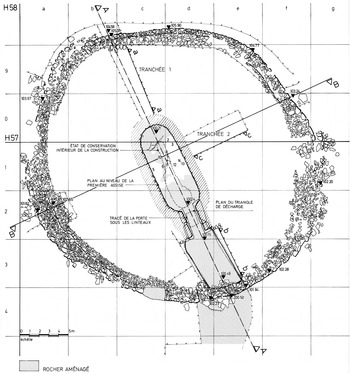
Thorikos IV* [20], built next to a MH/LH I tumulus, is a hybrid tomb (Fig. 9) whose elongated shape may have derived from a combination of tholos techniques with a local tradition of built chamber tombs with apsidal ends (although the latter cannot be shown to date as early as LH I, Papadimitriou Reference Papadimitriou2001a, 93–4). The tomb was built partly underground, and had a low stomion (2 m) with a primitive relieving triangle, and a slightly off-axis 7 m-long dromos, i.e. shorter than the chamber (9.3 m long). The outer end of the dromos was blocked by a low wall, perfectly aligned with the stone peribolos of the covering mound but separated from it by means of two side-jambs. The left jamb (as one approaches the dromos) was built at a small distance from the left wall of the dromos, possibly suggesting two phases of construction (Servais and Servais-Soyez Reference Servais and Servais-Soyez1984, 27–9). The experimental character of this tomb is readily apparent. Although its dromos was not the earliest to be built in Attica (see the BCTs of Eleusis in section ID), it was the first to provide sufficient space for any sort of ritual activities (see section IIC); as such it may have functioned as a prototype for later Attic tombs with dromoi.Footnote 21
The ‘oblong tholos’ (tomb IV) at Thorikos, Attica (courtesy of the Belgian School at Athens; source: Servais and Servais-Soyez Reference Servais and Servais-Soyez1984, 22 fig. 8).

The recently excavated tholos at Corinth* [19] was large (6.7 m) with rather thin walls, and is reported to have had the longest LH I dromos known to date (12.7 m), although no details are yet available about it. The tomb presents an interesting peculiarity: its 2.7 m-long ‘stomion’ seems to have been blocked at its inner, not outer, end (Kasimi Reference Kasimi, Kissas and Niemeier2013, 45–7 figs 3–4); the excavator, Mrs Kasimi, has kindly informed me that this was probably the case in the earlier phases of its use, although later in the history of the tomb the blockage must have been placed in the outer end of the ‘stomion’.Footnote 22 Consequently, this corridor-like feature may have been initially used as a built ‘vestibule’, not unlike those seen at Peristeria South and Veves, something supported by the fact that it does not seem to have had a distinct facade with well-formed jambs. If this observation is correct (and if the dromos was an original feature of the construction), the tomb may represent an intermediate stage in the development of tholos entrances; however, one should await the final publication before drawing definite conclusions.
IB. Chamber tombs (Appendix II: Table A1b )
Approximately thirty chamber tombs in Messenia, Laconia, the Argolid and Boeotia can be safely or possibly dated to LH I (or MH/LH I). Among the north-east Peloponnesian and Boeotian examples, Mycenae 518 [34], Prosymna 25 [35] and Prosymna 26 [36] had the longest dromoi (6.6–8.15 m), with vertical or almost vertical sides widening towards the stomion; at Prosymna dromoi presented a sharp inclination (Blegen Reference Blegen1937, figs. 181–2, 201). Tombs were rectangular in shape with side chambers (one in Mycenae 518 and Prosymna 26, three in Prosymna 25)Footnote 23 , shallow stomia (0.9–1.27 m), and relatively low entrances (1.70–2 m to 2.25 m). Prosymna tomb 52 [37] was smaller, and semicircular in plan, but its dromos was destroyed. Tiryns XIX* [46] was rectangular in plan with a short (3.2 m) and steep dromos. Schoinocnori E* [47] had an elliptical chamber but its dromos was destroyed. Kokla V and VIIB [38–39] are only known through a preliminary report (Demakopoulou Reference Demakopoulou1982); the length of their dromoi can be estimated from the plans at c.3–4 m. Thebes Agia Anna 2* [48] was also large with shallow stomion, and had a wide (2.6 m) but only partially excavated dromos.
It is unclear which of the Epidaurus Limera tombs contained the two LH I vases published by Demakopoulou (Reference Demakopoulou1968, cat. nos. 3 and 64) and discussed by Dickinson (Reference Dickinson1977, 63–4 and note 34). The available plans of the Agia Triada tombs* [42–43] show elliptical main chambers, circular secondary ones (with separate entrance on the left side of the dromos), shallow and low stomia, and very short dromoi (est. <2.2 m) possibly accessed through steps (Christou Reference Christou1956, 208–9 figs. 1–2). The Vamvakia and Palaiokastro tombs* [44–45] are described as being similar to the Agia Triada ones, the former with steps leading to a short dromos, the latter without a secondary chamber. Gallou, who is restudying the material from the site, reports that the Palaiokastro tomb(s)* had carefully built stomion but no dromos (Gallou Reference Gallou, Cavanagh, Gallou and Georgiadis2009, 87).
The Volimidia cemetery included many LH I tombs [21–33, 40–41*] but not all of them have been illustrated or described in detail. According to Iakovidis (Reference Iakovidis1966, 100–1), they were strikingly homogeneous in style, with circular chambers, tholos-imitating roofs, shallow stomia (<80 cm) and short dromoi with vertical walls widening towards the stomion. The published plans, however, suggest greater diversity in shape (Marinatos Reference Marinatos1965, 105–8 figs 2–4; Iakovidis Reference Iakovidis2014, 3–90). At least four early tombs (Koronios 6 [23], Angelopoulos 7 [25], Angelopoulos 9 [27], and Koronios 1* [40]) had secondary chambers accessed through separate entrances, usually on the left side of the dromos (Fig. 10) (Marinatos Reference Marinatos1953, 238, 239, 245 fig. 6; Zavadil Reference Zavadil2013, 100; Iakovidis Reference Iakovidis2014, 5 plan 1, 32 plan 9, 44 plan 14, 45 fig. 7). Most dromoi were less than 6 m long (usually much shorter), rather narrow (1–2 m) and steep.Footnote 24 Only tombs Angelopoulos 4, 7, 8, 9 [24–27] had longer but also steep dromoi (6–7.8 m) (Fig. 10). Entrances were low (1.2–1.8 m), at least in the recorded cases (see also Boyd Reference Boyd2002, 138–47).
The dromos of chamber tomb Angelopoulos 9 at Volimidia, Messenia (courtesy of the Archaeological Society at Athens; source: Iakovidis Reference Iakovidis2014, 45 fig. 7).

IC. Small tholoi (Appendix II: Table A1c )
Nine small tholoi in Messenia can be safely or possibly dated to LH I (or MH/LH I). They are said to be included in large mounds, whose precise form and structure are unclear (Boyd Reference Boyd2002, 109, 116). The tombs range in size from 2.73 to 5.2 m, although most are less than 3.5 m in diameter. Among safe LH I examples, only Gouvalari Tα10 [52] had a dromos (c.3.6 × 2.1 m) (Korres Reference Korres1975b, 87 fig. 1). Dromoi are also known from Gouvalari Tα4 (est. 2.5 m) and Kaminia 3 (est. 4.7 m), which, however, have yielded only LH II–III pottery (Korres Reference Korres1975a, 432–40, 493–9). Gouvalari Tα1* [56] was clearly devoid of a dromos (Korres Reference Korres1976–8, 340) and this may have been true in other cases, as most tombs at Gouvalari and Kaminia were placed with their entrances towards a steep slope. No dromos was found at Kephalovryso-Paliomylos [54]; a kind of peribolos creating an enclosed space (approximately 2 × 2.5 m) with a side entrance has been excavated in front of the stomion but its chronological relation to the tomb is unclear (Chatzi-Spiliopoulou Reference Chatzi-Spiliopoulou2007, 357–8 figs 4–5).
Kaminia 4 [53] had a small stomion (est. 1.3 m deep) with a blocking wall at its outer end, probably without a dromos (Korres Reference Korres1975a, pl. 325; Reference Korres1980, inset pl. ΣΤʹ). Gouvalari Τβ1 [50] had short walls projecting from the entrance, which probably formed an open vestibule rather than a proper stomion (Korres Reference Korres1975a, pl. 317b); in the nearby Gouvalari Tα2 (of unknown date) a similar feature was clearly meant to be a vestibule, since a blocking wall was found at its inner end (Korres Reference Korres1974, 141–2, pl. 109b).
The small tholoi at Analipsis* [58] (2.48–3.2 m) had small corridor-like features in their entrances (0.9–1.7 m deep) but it is unclear whether they were meant as stomia or ‘dressed dromoi’, i.e. built vestibules (Kalogeropoulos Reference Kalogeropoulos1998, 77–8). In any case, they seem to lack proper facades, thus possibly resembling the tholos at Costa Navarino*.
ID. Built chamber tombs (Appendix II: Table A1d )
Approximately 30 BCTs from various regions can be safely or possibly dated to LH I (or MH/LH I). They include apsidal tombs, rectangular tombs with entrance in a long or a short side, and complex tombs with more than one compartment and entrance in a short or a long side. The BCTs of Portes [60–62, 81–83*] and Marathon* [84] were included in tumuli; Akones I* [80] and III [59] are said to have been covered by a large mound, whose precise nature remains obscure. Other examples, like the tombs at Argos [64, 65] and Eleusis [66–75, 85–87*] were covered by individual mounds.
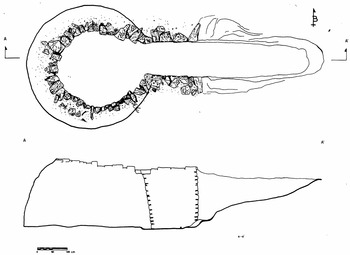
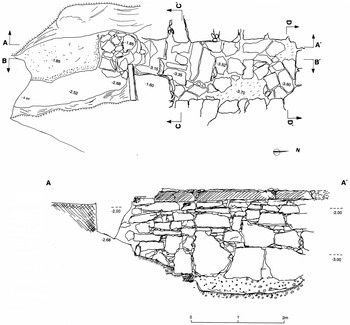
BCTs are generally small in size, ranging between 1.55 and 4 m in length, but Mitrou 73* [88], Eleusis Hπ3 [68] and Eleusis E.III.7 [76] were c.5 m, and Portes Γ1 [60] 8 m long. Their height does not exceed 1.75 m, at least where measurements are available. Dromoi are attested in seven cases but most are very small (1.6–2.3 long, 0.9–1.4 m wide) and steep (Fig. 11).Footnote 25 Mitrou 73* had a larger slab-lined dromos (3 × 2 m) featuring a porch with two support bases and a thin wall of clay at its outer end (Moortel Reference Moortel, Dakouri-Hild and Boydforthcoming). Eleusis Iπ1 [73] had the inner part of its 1.85 m-long dromos dressed with horizontal slabs (Mylonas Reference Mylonas1975, vol. 2, 104). A small but well-built wall projecting from the stomion of Portes Γ1 (Moschos Reference Moschos2000, 16 fig. 7) may have belonged to a ‘vestibule’ but has not been discussed by the excavators. A few more Eleusinian tombs may originally have had short dromoi (Papadimitriou Reference Papadimitriou2001a, 216).
The built chamber tomb 164 at Argos, Argolid: plan and section A–A′ (source: Papadimitriou Reference Papadimitriou2001b, 45–6, figs. 3–4).

Many BCTs had shallow (<1 m) but quite distinct stomia: at Eleusis they were formed by upright slabs or rectangular blocks flanking the entrance (e.g. Zπ6 [66], Ηπ3 [68], Ηπ20 [69], Ιπ1 [73]); at Akones I* [80] by two small antae; Portes A2* and A3* [83–83] had ‘an entrance with pillars’ in one short side (Moschos Reference Moschos2000, 13); Argos 164 [64] and Portes Γ1 [60] had built antae and thresholds (Papadimitriou Reference Papadimitriou2001b, pl. 4d; Moschos Reference Moschos2000, 17 fig. 8).
Among BCTs with dromoi, Eleusis Iπ1, Argos 164 and Mitrou 73* evidently underwent some kind of refurbishment at a later stage of their history. Eleusis Iπ1 was enlarged during LH I and it is possible that the partially dressed dromos was added by that time (Mylonas Reference Mylonas1975, vol. 2, 102–4; Papadimitriou Reference Papadimitriou2001a, 74). Argos 164 was probably extended in LH IIA and a more elaborate stomion was constructed, but the dromos seems to have been an original feature (Papadimitriou Reference Papadimitriou2001b, 47–8). Mitrou 73* was extended and rearranged in LH IIB but the dromos was an original construction (Moortel Reference Moortel, Dakouri-Hild and Boydforthcoming).
Some access devices in BCTs cannot be technically classified as dromoi, yet they reflect a similar concern for some sort of passageway. The central structure at Marathon tumulus II* [84] (Fig. 12) consisted of three compartments, the outermost of which was very low, empty of finds, had a monolithic threshold at its entrance and a built one at its rear side, and may have functioned as an open courtyard or an early form of dromos (Marinatos Reference Marinatos1970 15 fig. 4 and pl. 19b; Pelon Reference Pelon1976, 84; Cavanagh Reference Cavanagh1977, 105; Papadimitriou Reference Papadimitriou2001a, 103–4); another threshold was attached to the outer peribolos of the mound along the main axis of the tomb. The presence of two peribolos lines and of concentric lines of stones around the tomb may suggest successive stages of construction. Tomb E.III.7 at Eleusis [76] was divided by a partition wall, and one part was probably used as a ‘vestibule’ as it has yielded only pottery and animal bones; the entrance was not excavated, as it lay under the Peisistratian wall, but the arrangement is reminiscent of two LH II tombs from the West Cemetery (Λπ4 and Τ4), which had partition walls and covered vestibules with entrance in one long side (Cosmopoulos Reference Cosmopoulos2014, 139–40).
Tumulus II at Marathon, Attica (plan also showing tumulus III and the ‘altar’) (courtesy of the Archaeological Society at Athens; source: Marinatos Reference Marinatos1970, 15 fig. 4).

IE. Pre-LH I tombs with lateral access devices (Appendix II: Table A2)
A number of MH tombs were also provided with lateral entrances, some of which were arranged in a fashion resembling later stomia. The most safely dated example is the MH II tomb 2 at Marathon tumulus I [G], whose entrance was defined by carefully built antae creating a small paved stomion and vestibule (Marinatos Reference Marinatos, Crossland and Birchall1973, pl. 15; Pantelidou Gofa et al. Reference Boyd, Dakouri-Hild and Boydforthcoming). The disturbed tomb 3 [H] at the same tumulus had upright slabs flanking the entrance (Marinatos Reference Marinatos1970, pl. 15a). The entrance of the central apsidal tomb at Papoulia [A], most probably of MH II–III date, was partly enclosed by a low curving wall which may have been meant to create a kind of vestibule or forecourt (Korres Reference Korres1978, 328 fig.1; Reference Korres1980, pl. 106a). A MH II(?) apsidal grave in the Kalogeropoulos mound, Routsi [B], and the apsidal tombs of Kato Samikon-Kleidi [C–E], reported to have contained MH III pottery, also had side entrances, although their precise form is unknown.
Two tombs which may predate the MH/LH I transition had short but well-defined passageways. A steep, earth-cut dromos c.2 m long is reported from a large cist grave at Argos [F], tentatively dated to the ‘final MH’ period (Morou Reference Morou1981, 107–9). The Xeropolis tomb [I] had a kind of roofed ‘vestibule’ or very short dromos obliquely set to the chamber and separated from it by a blocking wall; the tomb is dated to late MH on the basis of published sherd material, which however could also be early LH (Sapouna-Sakellaraki Reference Sapouna-Sakellaraki1995).
II. SPECIAL FEATURES AND FINDS IN DROMOI
As noted already, only in a few cases do we have information about the stratigraphy of the dromos (e.g. Pylos IV, Voidhokoilia, Mycenae 518, Prosymna 25 and 26, Argos 164). Usually, the description of the dromos and its contents is very concise. As a result, it is often impossible to know what belonged to the earlier levels of the dromos and, thus, to determine whether the objects found there had been intentionally deposited or were remnants of later activities and cleaning operations. Nevertheless, a simple account of features and finds revealed in, or in association with, dromoi can provide helpful insights into their possible uses.
IIA. Floor depressions and grooves
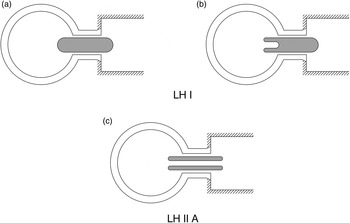
A number of LH I tholoi have yielded evidence of special arrangements in the floor of the dromos. Usually, this is in the form of a wide depression (almost as wide as the stomion), starting at, or a little before, the entrance and continuing into the chamber (Fig. 13a ). This is attested in Peristeria 3, Tragana 2* and Gouvalari 1. At Peristeria 3 the depression (90 cm wide, c.80 cm max. depth) reached the centre of the chamber and has yielded spectacular finds (gold vases and ornaments, and a silver vessel), although no bone material was clearly associated with it (Marinatos Reference Marinatos1965, 116–19, pl. 133–144a; Korres Reference Korres1976b, 515–17, 533–5, pl. 272c; Reference Korres1977b, pl. 174). The Tragana 2* depression (1.35–1.5 m wide, c.40–50 cm deep)Footnote 26 started at the entrance and reached the middle of the chamber; it contained intense traces of fire and a LH III piriform jar (Marinatos Reference Marinatos1955, 255, pl. 97a; Korres Reference Korres1976a, 270; Reference Korres1977a, pl. 142b; Iakovidis Reference Iakovidis2014, 126 plan 28). The Gouvalari 1 depression (1.4–1.9 m wide, 50 cm deep) carried on for more than 4 m inside the chamber, reaching beyond its centre, but no finds are reported (Marinatos Reference Marinatos1959, 176; Iakovidis Reference Iakovidis2014, 151 plan 33).
Typology of depressions and grooves found in Early Mycenaean tombs (drawn by the author, graphically edited by Ms C. Stamati).

Some tombs had depressions which started in the dromos and split into two narrow grooves or furrows in the chamber (Fig. 13b ). This is attested at Routsi 2 and reported (without being illustrated) from Gouvalari 2. At Routsi 2, the depression was very deep (1.3 m) and continued for c.1 m inside the chamber before splitting into two furrows 1–1.8 m. long (Marinatos Reference Marinatos1957a, pl. 52a; Reference Marinatos1957b; Boyd Reference Boyd2002, 154; Reference Boyd2014a; Iakovidis Reference Iakovidis2014, 109 plan 26). At Gouvalari 2, the furrows are said to have been 60–70 cm long and 10–15 cm deep but no detailed description is available, nor are finds recorded.Footnote 27
The character and function of these features – which are attested only in tholoi in this periodFootnote 28 – are uncertain. The depressions created an obvious gap between the level of the entrance and the floor of the chamber. In Routsi 2, it is clear that this was not part of the original planning: the lower 1.3 m of the stomion walls was earthen (not reinforced with masonry), suggesting a secondary adaptation, when the level of the dromos was also lowered (Marinatos Reference Marinatos1957a). The same is true for Peristeria 3, where the earthen lower part of the stomion (Fig. 6) suggests also a later deepening in the level of the entrance and part of the chamber. The unsystematic recording of such depressions (there are no detailed descriptions or information about their extent in the dromos) and associated finds does not allow definite conclusions about their function,Footnote 29 although the seeming lack of skeletal material suggests a non-funerary use. We should stress here that no example of the neat, parallel grooves of the type encountered in LH IIA and later tholoi and chamber tombs in the Argolid, Messenia and Boeotia (Fig. 13c ), is known from LH I tombs.Footnote 30 The latter grooves have been convincingly interpreted as ceremonial features aimed at the symbolic communication with the dead through libations and offerings (Åkeström Reference Åkeström, French and Wardle1988, 202–5; Gallou Reference Gallou2005, 70–1). The LH I depressions may have been forerunners of the LH IIA grooves. As some of them are evidently secondary adaptations, dating to an advanced stage of LH I (Korres Reference Korres, Oliva and Frolikova1982, 91–3), they may mark the time during which the dromos and the entrance started acquiring ritual and symbolic significance. The LH IIA tholoi A and C at Kakovatos, which had similar depressions spanning the stomion and part of the chamber (although tholos C had no dromos; see Pelon Reference Pelon1976, 220–1, 277, 325), reinforce the possibility that threshold rituals became important in funerals and started acquiring standardised form during the LH I/IIA transition.Footnote 31 A much larger rectangular depression (5.46 × 1.80 m, and 15–70 cm deep), stretching from the entrance to the back wall of the chamber, has been found in the tholos of Corinth*, but it was obviously used for burials and does not seem to have continued in the stomion or the dromos (Kasimi Reference Kasimi, Kissas and Niemeier2013, 47–8).
IIB. ‘Benches’
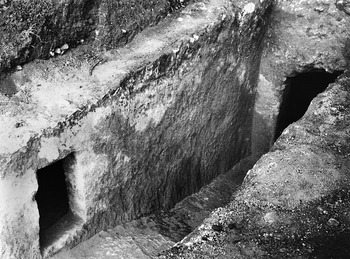
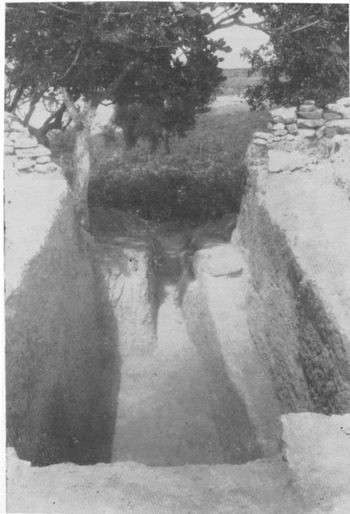
Two LH I tombs have yielded evidence of some kind of ‘bench’ in the area of the dromos. An earthen ledge c.20 cm wide and 1–1.3 m high was found along the left side of the dromos at Routsi 2 (Fig. 14); it was probably created when the original floor of the dromos was dug to a lower level at some stage of the tomb's history (Marinatos Reference Marinatos1957a 118 and pl. 52b; Reference Marinatos1957b), which Korres places within the LH I period (Korres Reference Korres, Oliva and Frolikova1982, 91–3). A ‘hearth’ was discovered on this ledge (see section IIC).
The dromos of tholos 2 at Routsi, Messenia (courtesy of the Archaeological Society at Athens; source: Marinatos Reference Marinatos1957a, pl. 52b).

In the BCT Argos 164 an earthen platform was found on the left side of the dromos (Fig. 11). It ran for most of the dromos’ length and was c.70 cm wide and c.70 cm high close to the entrance. Although it was not associated with finds, the excavator believes that it was an intentional feature perhaps used for the prothesis of the dead (Papadimitriou Reference Papadimitriou2001b, 43 and pls. 4a,b). Despite a possible rearrangement of the tomb's entrance in LH IIA, the dromos and the earthen platform seem to have been original features (Papadimitriou Reference Papadimitriou2001b, 47–8).
Only two more examples of (built) benches are known from dromoi of later date: one has been found on the left side of the dromos of the LH IIA tomb S2 at Medeon, and another one on the left side of the dromos of the LH IIIB(?) tomb Bπ1 at Eleusis (Papadimitriou Reference Papadimitriou2001a, 185 with references). None of them was associated with finds.
IIC. ‘Altars’, ‘hearths’, and possible ritual deposits in pits
Routsi 2 is the only LH I tomb where a permanent feature of possible ritual use has been reported from within the dromos (Fig. 14). It is described as an elliptical ‘hearth’ (60 × 30 cm) of local soft stone, placed at the outer end of the ledge formed along the left side of the dromos. The feature bore intense traces of fire and was associated with fragments of coarse pottery, some from cooking vessels (Marinatos Reference Marinatos1957a, 118; Reference Marinatos1957b; Korres Reference Korres, Oliva and Frolikova1982, 94).
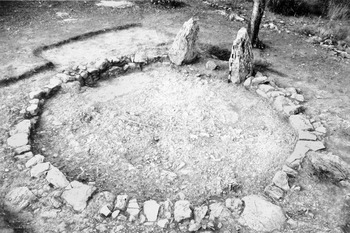
A circular stone feature excavated at a distance of c.3 m from the entrance of Marathon tumulus II* (Fig. 12) has also been interpreted as an ‘altar’, although no finds were associated with it (Marinatos Reference Marinatos1970, 10 and pl. 8).
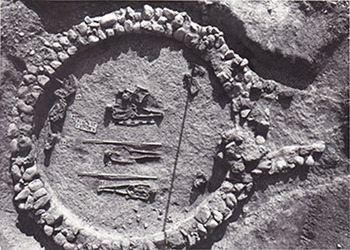
Permanent constructions of possible ritual use have also been found in association with the entrances of pre-LH I collective tombs. At Kato Samikon-Kleidi, two small circular ‘altars’ are reported to have been found at the outer ends of the long walls of tomb XI and another one in tomb IV (Papakonstantinou Reference Papakonstantinou1981, 149; Reference Papakonstantinou1982, 133). Although in the past I had doubted the character of these features (Papadimitriou Reference Papadimitriou2001a, 43–4, 183), the excavator Mrs Eleni Papakonstantinou has kindly shown me photographs which make clear that they were independent circular constructions placed slightly higher than the walls.Footnote 32 Close to the ‘altars’ of tomb XI a ‘Keftiu cup’ with ripple decoration (and, thus, possibly LH I) and a LH II scoop were found (Papakonstantinou Reference Papakonstantinou1981, 149). Mrs Papakonstantinou has also informed me that ashes and bones were recovered from the interior of the ‘altars’.Footnote 33
At Papoulia, the small enclosed space in front of the central apsidal tomb has yielded abundant remains of fire, small animal bones and a large one possibly from a boar; similar remains are reported from an ‘altar’ found ‘at a small distance’ from the eastern end of the northern long side, which however has not been described in detail or illustrated (Marinatos Reference Marinatos1956, 254; Korres Reference Korres1978, 328 fig. 1). A sample of the ashes has been dated through C14 to 1850–1770+/−70 bc, thus probably falling within the late MH period or the MH/LH transition (Korres Reference Korres1978, 331; Boyd Reference Boyd2002, 122–3).
Next to the MH II tomb 2 in Marathon tumulus I, Marinatos unearthed an unusual feature consisting of one horizontal and two upright slabs leaning against the inner peribolos of the mound, together with the necks of two amphorae (Marinatos Reference Marinatos1970, 13 and pl. 12b). Kilian-Dirlmeier (Reference Kilian-Dirlmeier1997, 91) suggests a ritual function. The chronological relation of the feature to tomb 2, however, is problematic: tomb 2 seems to belong to the second phase of the tumulus use, when the ‘altar’ may have been covered by earth (Kilian-Dirlmeier Reference Kilian-Dirlmeier1997, 91–7).
Deposits of possible ritual character have been found in two cases. In the oblong tholos Thorikos IV*, a pit containing yellow earth together with MH/LH I – LH I/II sherds from open vases (cups, bowls) and coarse pottery was found in front of the western (left) jamb of the low blocking wall at the outer end of the dromos; traces of fire were found a little further, i.e. just behind the low blocking wall, suggesting to the excavators a rite associated with the closing of the dromos after a funeral (Servais and Servais-Soyez Reference Servais and Servais-Soyez1984, 26–9, 56). A shallow pit with broken bones and a few ‘Mycenaean’ sherds has been found in the dromos of the chamber tomb Volimidia-Angelopoulos 11*, close to the entrance (Marinatos Reference Marinatos1960, 199). Although it is not clarified whether the bones belonged to human or animal skeletons, I presume that if the former were the case it would have been noted by the excavator.
Finally, we should mention the ‘ritual deposits’ found in proximity to the BCTs 164 and 29 at Argos, in the area of the so-called ‘tumulus Γ’.Footnote 34 Protonotariou-Deilaki reports three such deposits (two ‘bothroi’ and a horseshoe structure) containing much ash, animal bones, ‘portable tables of offerings’ and pottery dating from LH I/II to LH IIIA1, and thus probably in use from the beginning of the LBA (Protonotariou-Deilaki Reference Protonotariou-Deilaki and Morou-Kapokaki2009, 57–9, 204–5).
IID. Drinking and feasting remains, traces of fire, ceremonial vessels and other objects
Evidence of drinking or feasting activities in LH I tombs is rather limited, but this may be partly due to poor recording. In Pylos IV, 25 trays of pottery dating from MH to LH IIIB were recovered from the dromos, but no information is available about sherds associated with the earliest levels (Blegen et al. Reference Blegen, Rawson, Taylour and Donovan1973, 111); a patch of red earth found 15 cm above the ground, 1.7 m from the entrance, has been tentatively attributed to a purificatory fire (Blegen et al. Reference Blegen, Rawson, Taylour and Donovan1973, 100–1). At the Veves tholos, traces of fire mixed with bones of a bird, possibly the remains of a funerary meal, were found in the area of the built ‘vestibule’ (Choremis Reference Choremis1973, 51). Traces of fire have also been found at the beginning of the dromos of Thorikos IV* (see section IIC). At Volimidia-Kephalovryso 6, a pile of burnt stones mingled with ashes, animal bones and sherds from drinking cups of possible LH I date was found in front of the entrance and has been interpreted by the excavator as remains of sacrifice (Marinatos Reference Marinatos1965, 107; Lolos Reference Lolos1987, 206). Animal bones together with some sherds were also found in the ‘vestibule’ of the BCT E.III.7 at Eleusis, which apparently had not been used for burial (Cosmopoulos Reference Cosmopoulos2014, 139–41).
The dromoi of Mycenae 518, Prosymna 25 and 26 have yielded much pottery, including broken kylikes, which however date primarily to LH III (Wace Reference Wace1932, 75; Blegen Reference Blegen1937, 86, 93). In general, the custom of smashing drinking cups in front of the entrance as part of a final toasting ceremony is considered a LH III practice associated mostly with chamber tombs, at least in the Argolid (Cavanagh and Mee Reference Cavanagh and Mee1998, 55, 115; Reference Cavanagh, Mee, Galanakis, Wilkinson and Bennet2014; Gallou Reference Gallou2005, 25–6, 88–91). However, the stratigraphically excavated dromos of the BCT Argos 164 has yielded an intact layer (lot 8), which contained large numbers of LH IIB undecorated goblets together with animal bones and sea-shells, suggesting that the custom of drinking and feasting in dromoi may have started earlier (Shelton Reference Shelton2001, 77); an earlier layer (lot 9) is reported also to have contained pottery, sea-shells and animal bones, but the finds were not located during the study of the tomb (Shelton Reference Shelton2001, 77–8 and table I). At Messenia, dozens of intact and broken LH I cups have been found in tombs (Lolos Reference Lolos1987, 233–71 and tables 1–4; see also Chatzi Reference Chatzi1983, 111), although their exact findspots are rarely recorded; cups found in dromoi are explicitly mentioned from Routsi 2, Tragana 2* (Lolos Reference Lolos1987, 182, 210) and the aforementioned chamber tomb Volimidia-Kephalovryso 6. Boyd suggests an early start for the custom of ritual drinking in funerals in this part of the Peloponnese (Boyd Reference Boyd2002, 87–8).
Fragments of Palace Style jars are also occasionally found in dromoi (e.g. Prosymna 25, 26, Pylos IV), although they may have belonged to offerings taken out of the chamber in later cleaning operations (as was obviously the case in Pylos IV, Blegen et al. Reference Blegen, Rawson, Taylour and Donovan1973, 105). At Routsi 2, four LH I oval-mouthed amphorae were found near the entrance, whereas six large ‘Keftiu cups’ and a bronze double axe were recovered from other parts of the dromos (Marinatos Reference Marinatos1957a, 119; Lolos Reference Lolos1987, 210). Marinatos believed that they may have been remains of ritual feasts, but given the lack of stratigraphic details this can only be taken as a hypothesis. Other items discovered in the dromoi of some tombs (pieces of gold-leaf ornaments, bronze and stone tools, etc.) were probably leftovers from cleaning operations (e.g. Blegen et al. Reference Blegen, Rawson, Taylour and Donovan1973, 100–1; Marinatos Reference Marinatos1957a; Papadimitriou Reference Papadimitriou2001b, 51).
IIE. Burials in dromoi
Early Mycenaean tombs have yielded minimum evidence for the use of dromoi for burials.Footnote 35 In chamber tomb Tiryns XIX*, a skeleton has been found in a pit dug in the dromos floor close to the entrance, but the accompanying vases date to LH IIB–III (Rudolph Reference Rudolph1973, pl. 50–1, nos. 4, 5, 6). A niche on the right side of the dromos of the chamber tomb Volimidia-Kephalovryso 2 contained two skeletons, one with Hellenistic, the other with LH IIIA vases, and thus was opened at an advanced stage of the tomb's history (Marinatos Reference Marinatos1964, 84–5). At Agia Anna 2*, a skeleton was found in the dromos but the accompanying stirrup jar was late in date (Keramopoulos Reference Keramopoulos1910, 214–15). The aforementioned shallow pit in the dromos of chamber tomb Volimidia-Angelopoulos 11* contained unspecified ‘broken bones’, but it is improbable that they were human. Otherwise, burials found in the upper levels of chamber tomb Mycenae 518 and Routsi tholos 1 were post-BA (most probably Byzantine).
We should note, however, that some chamber tombs had secondary chambers, accessible through the dromos, which might have been used for primary or secondary burials. They occur in Volimidia (Koronios 1* and 6, Angelopoulos 7 and 9) and Epidaurus Limera (Agia Triada A* and B*, Vamvakia*), but unfortunately no information is available about their contents and date. The side chamber at Volimidia-Koronios 1* had evidently been used for extended burials (Marinatos Reference Marinatos1953, 238; Iakovidis Reference Iakovidis2014, 5 plan 1), and the same is probable for some of the Epidaurus Limera tombs (Gallou Reference Gallou, Cavanagh, Gallou and Georgiadis2009, 89); given the lack of detailed data, however, we do not know whether side chambers were original features of the tombs or later additions (e.g. when the main chambers became overcrowded).
IIF. Liminal features
Features separating the dromos from the area outside the tomb have been identified in four cases. The tholoi of Psari* and Thorikos IV* had low blocking walls at the outer ends of their dromoi, carefully aligned with the stone periboloi of the covering mounds (Figs. 8, 9). At Thorikos IV*, in particular, the wall was flanked by two antae built of flat stones, which gave the whole ensemble an entrance-like appearance (Servais and Servais-Soyez Reference Servais and Servais-Soyez1984, 24–9). This arrangement (which is also seen in later tholoi; Pelon Reference Pelon1976, 296–7) and the ritual deposits found in association with the low blocking wall (see section IIC) suggest that such features were not designed to retain the earth filling of the dromos, as thought by some scholars (e.g. Tsountas and Manatt Reference Tsountas and Manatt1897, 140–1; Mylonas Reference Mylonas1966, 118–19; Kontorli-Papadopoulou Reference Kontorli-Papadopoulou and Laffineur1987, 154); instead, they must have served a strictly non-practical function. That such walls were symbolic in nature was long ago implied by Wace (Reference Wace1921–3, 358), who stressed that, had they been intended ‘to prevent free access to the dromos’, they ‘could not be very effective’. Moreover, the fact that they were aligned with the peribolos – which according to Pelon (Reference Pelon1976, 274–5) was an ‘enceinte sacrée’ – may suggest that they were meant as conceptual boundaries marking the passage to a space of special symbolic/ritual value.Footnote 36
A symbolic function is also possible for the large stone threshold (flanked by two upright slabs) which abutted the outer peribolos of Marathon tumulus II* along the axis of the central tomb but at a distance from it (Marinatos Reference Marinatos1970, 14–16) (Fig. 12). That this feature did not serve practical needs is suggested both by the small height of the peribolos at that point (c.20 cm) and by the fact that no thresholds are known from tumuli outside Marathon. Its construction may have been meant to create a symbolic access-point, which gave direction to an otherwise unoriented monument and drove the funeral procession to the actual entrance of the tomb. The presence of a possible ‘altar’ at a distance of c.3 m (see section IIC) may suggest that the area in front of the tumulus was the focus of ritual activities.Footnote 37
Finally, the entrance to the dromos of the intramural BCT Mitrou 73* was marked by a low clay wall and a kind of a porch with support bases on either side; according to the excavator, the wall may have been a symbolic boundary between the public street and the private tomb (Moortel Reference Moortel, Dakouri-Hild and Boydforthcoming).
Since three of the above examples come from LH I/IIA burial mounds with a single central tomb and a stone peribolos, it is possible that the practice of marking the end of the dromos with a liminal feature arose in the architectural environment of tumuli. From LH IIA onwards, blocking the dromos with a cross-wall became more common in good-quality tholoi and high-status chamber tombs, especially in the Argolid and occasionally in other regions.Footnote 38
As for the inner end of the dromos, its liminal character has been stressed by many scholars, who have discussed the frequent discovery of smashed drinking vessels in front of the doorway (see section IID) and also the decoration of facades with plaster, painted motifs and added walls of poros blocks from LH IIA onwards, or even with wooden doors in later times.Footnote 39 The sense of liminality was further emphasised by the corridor-like stomion. As we have seen, however, some early tholoi (Veves, Peristeria South, Peristeria 3, Gouvalari Tβ1, Corinth*) may have had their blocking walls at the inner (instead of the outer) end of this corridor-like feature, which therefore must have functioned as an open vestibule rather than a proper stomion; in these cases, a dromos is usually lacking.
III. PERFORMATIVE AND SYMBOLIC ASPECTS OF DROMOI
The relative scarcity of direct evidence for ritual activities in dromoi is hardly surprising. Dromoi were transitive features, not the terminal places of Early Mycenaean funerals, and may have been backfilled after burial.Footnote 40 Objects used in dromos rituals would have been removed after the funeral or during later visits. If anything rests in place, it is due to accidental preservation rather than intention. Therefore, the absence of artefacts from dromoi cannot be taken as proof for lack of activity in their space. A number of permanent features, such as the depressions and grooves (which were relatively common in LH I tholoi and LH IIA tholoi and chamber tombs), the outer blocking walls (which delimited the space of the dromos initially in tholoi and built chamber tombs and later in chamber tombs), the ‘altars’ (found in association with pre-LH I and LH I built chamber tombs and a tholos), and the few ‘benches’ (found in the dromoi of a tholos and a built chamber tomb), suggest intentional arrangements, most probably destined to serve ritual and/or symbolic purposes. Of course, the lack of uniformity ought not to be overlooked; this was a period of experimentation, during which new burial practices were adopted and a number of ideas were tried out, some of which would eventually be abandoned. Grooves and depressions do not seem to occur after LH II,Footnote 41 nor are ‘altars’ or other types of permanent ritual devices frequently encountered.Footnote 42 Blocking the outer end of the dromos, on the other hand, would become a quite common practice.Footnote 43
To fully appreciate the symbolic significance of the dromos, one should also explore the performative aspects of Early Mycenaean funerary rituals. Such rituals were not limited to libations, sacrifices, feasting and other stationary actions; they also included processions, which followed specific routes from and to places (Gallou Reference Gallou2005, 25–6; Boyd Reference Boyd, Dakouri-Hild and Boydforthcoming). With cemeteries being located at a distance from settlements, such processions would inevitably assume a public character (Boyd Reference Boyd2014a 197–8; Papadimitriou Reference Papadimitriou, Dakouri-Hild and Boydforthcoming a; Smith et al. Reference Smith, Dabney, Pappi, Triantaphyllou and Wrightforthcoming, chapter 10). It is precisely because of their public dimension that such rituals (at least their final parts) deserve to be examined as social performances.
The notion of performance is used by social anthropologists to analyse the nature and effects of participation in public actions regulated by formal ritual canons. It is considered a constitutive element of all rituals, irrespective of scale, not only a feature of elaborate ceremonies (Tambiah Reference Tambiah1979, 119; Rappaport Reference Rappaport1999, 37–46, 50–2; Boyd Reference Boyd2014a, 194). Performative approaches are not concerned with the content of rituals but with their structure and its experiential impact on participants. Ritual is not seen as a static set of predetermined, strictly signified actions but as a dynamic form of symbolic communication, which acquires (and produces) social meaning through recurring practice. By performing repetitive rituals, participants provide authority to liturgical canons (Rappaport Reference Rappaport1999, 33–8, 118–19) but, at the same time, they incorporate the collective representations and social constructs such rituals symbolically project (Tambiah Reference Tambiah1979, 122–30). This is facilitated by the heightening of emotions (effervescence) generated by orchestrated collective activity (Bell Reference Bell1997, 24–5, 73). Performance is, thus, inherently linked with sensorial experience and bodily movements (Hamilakis Reference Hamilakis2014). Such movements, however, require specially designated places in order to be effectively framed, physically articulated, and eventually turned into a kind of embodied habitus (Bell Reference Bell1992, 98–9; Reference Bell1997, 73–4, 78, 81–2). Architectural configurations, in particular, order space in formal ways that help to define (rather than simply reflecting) the social relations of the participants (Inomata and Coben Reference Inomata, Coben, Inomata and Coben2006, 17; Wright Reference Wright, Maran, Juwig, Schwengel and Thaler2006, 50). Yet, as rituals often express a state of liminality, in which the social order is temporarily negated in order to be reconstituted (Bell Reference Bell1997, 40), performance is always open to status negotiations and claims (Tambiah Reference Tambiah1979, 115; Boyd Reference Boyd, Dakouri-Hild and Boydforthcoming).
Status claims, however, are not the only symbolic components of ritual. In particular, rites of passage, to which funerals belong, are meant to express a variety of changes related to the physical and social death of an individual: his/her separation from the living and initiation in the world of ancestors; the reallocation of rights and obligations held by the deceased to other members of the kin; and a readjustment of intercommunal relations in order to maintain social cohesion at the disruptive occurrence of death (Gennep Reference Gennep1960, 15–25, 151–6; Eliade Reference Eliade1959, 184–6; Bloch and Parry Reference Bloch, Parry, Bloch and Parry1982, 4). Such multiplicity of symbolisms is often communicated through processional actions, which focus on passages and doorways as liminal points or indices of transition (Gennep Reference Gennep1960, 20–3, 158–9; Eliade Reference Eliade1959, 179–84).
The importance of space arrangements for performative action can be also illuminated by architectural theory. In her analysis of Minoan and Mycenaean palatial propyla, Claire Palyvou has discussed the symbolic significance of boundary markers, access-ways, gates and other transitional features, and argued that they were meant to express in material form the conceptual interplay between exterior and interior space, inclusion and exclusion, movement and stop, and other binary oppositions inherent in any type of transition (Palyvou Reference Palyvou and Danielidou2009, 537–41). Especially for Mycenaean architecture, she observes that such features were frequently used to mark a passage between two open spaces, one of which was unbounded and freely accessible, the other bounded and subject to controlled access (Palyvou Reference Palyvou and Danielidou2009, 549). Other theoreticians have argued that, unlike modern architecture, which prioritises a visual and distantiated perception of built space, architecture in traditional societies had a strong embodied dimension, which took into account the emotional impact of experiential changes between light and dark, sound and silence, open and bounded areas, and so on (Pallasmaa Reference Pallasmaa2005). These views are based on a relational understanding of space as a socially produced medium, which acquires meaning through the experience of bodily movements (Tilley Reference Tilley1994, 11–14) and the juxtaposition of an undifferentiated exterior expanse with a structured performing (or ‘sacred’) area (Eliade Reference Eliade1959, 20–4). This type of understanding may offer useful insights as to the function of Mycenaean dromoi.Footnote 44
As we have seen, dromoi restricted access to tombs both naturally, i.e. by their corridor-like form, and symbolically, though the low blocking walls that sometimes bounded their far ends (see section IIF). Given the public character of Mycenaean funerals, one can reasonably assume that such boundaries were intended to mark a point after which only selected participants, plausibly the members of the immediate kin (or primarily the members of the kin), were allowed to enter. If so, then the dromos should be seen as an intermediate area, a liminal space in which the deceased had not yet been separated from the living, yet the kin group was physically distinguished from the rest of the community.
Entering this long corridor and marching towards the tomb would have been an evocative experience – at least when dromoi acquired considerable size in LH I/IIA. The rising walls gave the impression of a gradual transition from light to dark, from sound to silence and from a public to a more exclusive, private sphere, the realm of ancestors (cf. Boyd Reference Boyd, Dakouri-Hild and Boydforthcoming). Irrespective of what was said or done in the dromos, the experiential impact of such a transition must have been great; in fact, it may have helped to create what Hamilakis (Reference Hamilakis2014, 126–8) describes as a ‘sensorial assemblage’, i.e. a temporary kind of communitas among people who shared strong emotions, perhaps ancestral memories, and certainly a sense of distinction from the rest of the society – which, in this particular instance, assumed the role of the audience.
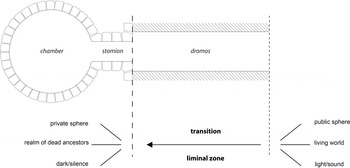
Had this been a singular event, its long-term effect might have been minimal; but this was not the case. The repeated enactment of funerary processions in the increasingly standardised space of the dromos transformed this area into a regular stage of symbolic representation, where abstract transitions and binary oppositions (Fig. 15) were materialised and physically embodied by participants, inevitably emphasising their sense of belonging and their collective identity.Footnote 45 Dromos rituals may thus have provided kin groups with the opportunity to periodically reaffirm their solidarity, endurance, and distinctiveness in a public, socially sanctified frame. Accordingly, they may have played a part in status negotiations, alongside other well-attested strategies, such as the construction of imposing tombs and the deposition of valuables with the dead.
Symbolic transitions and binary oppositions expressed in the liminal space of the dromos (drawn by the author, graphically edited by Ms C. Stamati and Mrs H. Pangalou).

We should stress here that, while the gradual adoption of collective (‘family’) tombs from LH I onwards testifies to the growing importance of kinship and descent for Helladic societies (Wright Reference Wright and Shelmerdine2008, 238–9), in many sites such tombs were a minority until LH II, coexisting with traditional forms of burial in single graves (Dickinson Reference Dickinson1983, 61–2; Papadimitriou Reference Papadimitriou, Dakouri-Hild and Boydforthcoming a). Therefore, the owning groups may have needed to do more than simply constructing them in order to legitimise their departure from earlier traditions, establish their distinct position within the community, and also reaffirm their internal coherence (Boyd Reference Boyd2014a, 202; Papadimitriou Reference Papadimitriou, Dakouri-Hild and Boydforthcoming a).
The performance of exclusive processional rituals in the restricting space of the dromos may have actually helped kin groups both to craft the image of a distinct collective self and to internalise their own hierarchical relations through the structured form of the processions (Boyd Reference Boyd, Dakouri-Hild and Boydforthcoming). According to Bell, the insensible objectification of hierarchical orders in the ‘structured and structuring environment’ of ritualised performance can contribute to the creation of relations of power even within a fairly homogeneous group (Bell Reference Bell1992, 206–7, 215–16). This might partly explain why dromoi retained their importance until the later part of the LBA, acquiring monumental dimensions in the Atreus and Clytemnestra tholoi, which are widely considered as emblems of royal power and political authority (Wright Reference Wright and Laffineur1987; Fitzsimons Reference Fitzsimons, Terrenato and Haggis2011, 110–11; cf. Boyd Reference Boyd, Dakouri-Hild and Boydforthcoming).
Although containing a certain amount of speculation, especially as to who participated in dromos rituals, the above remarks outline the performative potentials of dromoi and may provide a reasonable explanation as to why they became the favoured system of access in Mycenaean tombs and continued to expand until the very end of the LBA.
DISCUSSION
This paper has focused on c.90 collective tombs with lateral entrances (20 tholoi, c.30 chamber tombs, c.10 small tholoi and c.30 BCTs) safely or possibly dated to LH I or the LH I/IIA transition. Almost half of them are from Messenia, 18 from Attica, 12 from the north-east Peloponnese, and less than 6 from each of the other regions (Elis, Laconia, Arcadia, Achaea, Boeotia, Phthiotis). In addition, 9 pre-LH I tombs with lateral entrances from Messenia, Elis, the Argolid, Attica and Euboea have been examined. The following conclusions about the formation and use of dromoi can be drawn from their analysis.
1. Spread of dromoi in LH 1
Dromoi occur in all types of tombs with lateral entrances used in LH I, but not in all examples of each type (with the possible exception of chamber tombs). Most of them are 2–8 m long, often quite steep, and generally diverse in style, differing considerably from the elongated passageways constructed in LH II and III. Dromoi over 8 m long are known only from two tholoi (one of which is ‘possible’ LH I) and two chamber tombs. Given that the passageways of most LH IIA tholoi (Appendix II: Table A3) were much longer than 8 m (nine falling in the 12–22 m range and one being c.30 m long), Boyd's suggestion that the full development of the dromos was part of the ‘secondary adaptation of the tholos form’ in LH IIA or LH I/IIA (Boyd Reference Boyd2002, 56–9, 93) seems justified. Moreover, since several LH IIA chamber tombs had equally long passageways (e.g. Dendra 10: 19.45 m; Prosymna 44: 18.80 m; Asine 2: 17 m), one could suggest a similar pattern of evolution for this type of tomb, too.
2. Formation of dromoi in tholos tombs
The dromos was not an original feature of tholos architecture and seems to have developed gradually, as part of a wider process, which involved also the formation of the stomion. This process was probably associated with a shift in the setting of tholoi from above ground to partly underground. In fact, one can tentatively identify five broad typological groups of LH I tholoi based on the system of access, which are listed below.
A. Tombs with no dromos (Fig. 16A)
This group includes three subtypes:
-
i. Tholoi with no pronounced entrance (Galatas 3* and possibly ‘Vagenas’).
-
ii. Tholoi with a small built ‘vestibule’ (the blocking wall placed at its inner end) without a distinct facade (Veves, Peristeria South).
-
iii. Tholoi with plain stomia (the blocking wall placed at its outer end) without a distinct facade (Costa Navarino*).
A tentative typology of LH I tholoi based on the system of access (drawn by the author, graphically edited by Ms C. Stamati).

Peristeria 3 may have belonged to subtype ii or iii, if it really had no dromos, but differs from other examples in that it had greater dimensions and a finished facade.
The majority of these tombs were built above ground (some perhaps with superstructures made of lighter materials) and were probably not covered with earthen mounds.Footnote 46
B. Tombs with short and steep dromoi (Fig. 16B)
This group includes tholoi with shallow (<2.3 m) stomia and finished facades built of flat stones (Routsi 1, Diodia* and perhaps Osmanaga). They were built underground up to the level of the lintel and were probably covered with earthen mounds, perhaps of quite small size. They had short (<5 m), sharply descending dromoi.
C. Tombs with relatively long, smoothly descending dromoi (Fig. 16C)
The tombs of this group (Routsi 2, Tragana 2*, Gouvalari 1 and 2) were also built partly underground and had quite shallow (<2.7 m) stomia with finished facades, and (probably large) covering mounds. Dromoi, however, were longer (7.5–7.9 m in the recorded cases) and more smoothly descending than those of group B; moreover, all of them had floor depressions running from their inner ends into the chamber. Peristeria 3 might have belonged to this group, as it had a finished facade and a floor depression, but the presence of a dromos is not confirmed and the blocking system is unclear.
D. Tombs with almost flat dromoi limited by the size of the surrounding tumulus (Fig. 16D)
This group includes tholoi built within stone-clad (Voidhoikoilia, Psari*) or earthen (Thorikos IV*) mounds, whose size limited the length of the almost flat dromos (6–7.8 m), sometimes by means of a low blocking wall aligned with the peribolos (Psari*, Thorikos IV*). They had well-formed stomia (2.37–4.9 m long) with carefully constructed facades. The stomion of Psari* was blocked at both ends, perhaps reflecting an earlier tradition, when tholoi had still ‘vestibules’ blocked at their inner part (see above, group A.ii). The tholos at Voidhokoilia was built at ground level, while Psari* and Thorikos IV* were partly underground.Footnote 47
E. Tombs with elongated, almost flat dromoi (Fig. 16E)
The tombs of this group (Pylos IV, Corinth*) had elongated (10.5–12.7 m) and almost flat dromoi (at least in the case of Pylos IV; the dromos of Corinth* is insufficiently known). Both present some ‘transitional’ features. At Corinth*, the ‘stomion’ probably had no distinct facade and the blocking wall was originally placed at its inner end, thus resembling the ‘vestibules’ of group A.ii tholoi. Pylos IV had a long and very high stomion with carefully dressed facade (which is reminiscent of the ‘canonical’ tholoi of LH IIA; see Appendix II: Table A3), but its blockage was placed close to the middle of the stomion's length, perhaps echoing an earlier tradition of tholoi with ‘vestibules’ (group A.ii).
This grouping need not represent distinct chronological phases; experimentation was intense throughout this period, and different solutions may have been tested at any stage. It suggests, however, that the dromos developed gradually, probably as builders realised the structural problems of freestanding tombs and started favouring partly underground constructions or tholoi built within mounds. In fact, it seems that dromoi acquired their final form as relatively long and flat passageways at an advanced stage of LH I or the LH I/IIA transition (e.g. Tragana 2*, Voidhokoilia, Psari*, Thorikos IV*, Corinth*)Footnote 48 . Only two examples with relatively long dromoi may be dated to the earlier part of LH I (Routsi 2 and Pylos IV), but ceramic evidence for this dating is not conclusive (Lolos Reference Lolos1987, 184–6, 209–10: Murphy Reference Murphy2014, 213; Davis and Stocker Reference Davis, Stocker, Macdonald, Hatzaki and Andreou2014); Pylos IV, in particular, has architectural refinements which seem incompatible with such an early construction date (Pelon Reference Pelon1976, 395–6, 401).
In any case, it would be unwise to apply this tentative evolutionary scheme on a supraregional level. In Elis and Arcadia, large tholoi without dromoi were built even in LH IIA (e.g. Kakovatos C, Analipsis A: Pelon Reference Pelon1976, 186, 221), and in Attica the dromos of the only known LH IIA tholos (Thorikos III: Gasche and Servais Reference Gasche and Servais1971) presented strong affinities to that of Thorikos IV*, while really long dromoi appeared only in LH IIB (at Marathon, c.25 m: Pelon Reference Pelon1976, 229). These cases suggest that the development of the dromos was subject to local conditions rather than being the result of wider, cross-regional processes and transmissions.
The same may have been true for tholos architecture as a whole. Despite the primacy of Messenia in LH I, recent finds cast doubt on the theory that tholoi were disseminated in developed form from the south-west Peloponnese to the rest of mainland Greece in LH IIA (Fitzsimons Reference Fitzsimons, Terrenato and Haggis2011, 90 with references). The cases of Galatas 3* (which was as idiosyncratic and perhaps as early as the earliest Messenian tholoi, and had strong similarities with Cretan circular tombs: see Konsolaki-Giannopoulou Reference Konsolaki-Giannopoulou and Konsolaki-Giannopoulou2003, 178–80; Reference Konsolaki-Giannpoulou2010, 72–3; Reference Konsolaki-Giannopoulou, Schallin and Tournavitou2015), and Corinth* (which had a ‘vestibule’ with no distinct facade, instead of a proper stomion) may reflect early efforts at local adaptation in the north-east Peloponnese. Similarly, the hybrid tomb Thorikos IV* (which combined tholos techniques with pre-existing traditions of tumuli and BCTs) highlights the importance of local variations and may point to different sources of inspiration, especially since Thorikos had closer contacts with the Cyclades and Crete than with the Peloponnese in LH I–IIA (Papadimitriou Reference Papadimitriou, Laffineur and Docterforthcoming b). Although further research on the subject is necessary, it is not impossible that tholos architecture developed independently in Messenia, Attica and the north-east Peloponnese, and followed distinct local trajectories.Footnote 49
3. The earliest use of dromoi
There is very little evidence to support the view that the use of dromoi in tholoi was inspired by their earlier use in chamber tombs, as suggested by Boyd (Reference Boyd2002, 56–9). First, chamber tombs had a limited distribution in LH I and were rather modest in size and contents to have inspired tholos users. Second, tholoi belonged to the tradition of built architecture and some of the earliest ones were constructed above ground, making influences from a type of tomb which was dug on a hillside rather unlikely.Footnote 50 Third, and most important, the chronological precedence of chamber tombs over tholoi is difficult to establish.
In Messenia, some of the Volimidia chamber tombs are dated to early LH I (e.g. Kephalovryso 2: see Lolos Reference Lolos1987, 204) but the Osmanaga tholos, which was probably provided with a short dromos, may have been as early or earlier (Lolos Reference Lolos1987, 492–4); in addition, the Volimidia tombs seem themselves to imitate tholoi (Iaκovidis Reference Iakovidis1966). In the north-east Peloponnese, chamber tombs with relatively long dromoi (6–8 m) were constructed in LH I Mycenae and Prosymna, but the Corinth tholos*, which had a longer dromos, might also date to this period; short dromoi were also used in two LH I BCTs at Argos. In the south-east Peloponnese, at least one LH I chamber tomb at Epidaurus Limera was provided with a very short and stepped dromos, yet the presence of a large LH IIA tholos without a dromos at Analipsis (where small tholoi may have existed in LH I), and of another one with a very long dromos at Vaphio, suggests independent development of the feature rather than influence from the marginal site of Epidaurus Limera or even from Volimidia. In Attica, chamber tombs were introduced in LH IIA (Mountjoy Reference Mountjoy1999, 485; Phialon Reference Phialon2011 307, 382–3) while dromoi had been employed since LH I in Thorikos IV* and in several BCTs at Eleusis. It is thus improbable that the formation of dromoi involved ‘loans’ among different tomb types; instead, it must have lent itself to experimentation arising from practical and ritual needs.
4. Earlier access arrangements
In most regions, the notion of a passageway leading to the tomb seems to have emerged prior to the introduction of tholoi and chamber tombs. The MH tumuli of Papoulia, Routsi, Kato Samikon-Kleidi and Marathon I contained BCTs which would have necessitated an access device from the periphery of the mound to the tomb's entrance. Unfortunately the east/south-east part of the Papoulia tumulus, where such a device would have lain, was heavily disturbed (Korres Reference Korres1978, 328 fig. 1); at Marathon I the situation in front of tombs 2 and 3 is unclear (Pantelidou Gofa et al. Reference Boyd, Dakouri-Hild and Boydforthcoming); and the tumuli of Routsi and Kato Samikon-Kleidi remain unpublished. However, two slightly later BCTs constructed within tumuli (in all probability prior to the appearance of tholoi and chamber tombs in the corresponding regions) suggest that the adopted solutions were highly experimental: tomb Γ1 at Portes tumulus Γ had a small wall projecting from the entrance, which might have belonged to a built ‘vestibule’; at Marathon tumulus II*, the outer part of the central tomb was probably left open and had thresholds at both ends, most likely functioning as an access device or ‘courtyard’ (Fig. 12).
These examples suggest that the search for a horizontal system of access started already in the MBA, when built architecture was first merged with the tumulus tradition. This merging intensified in LH I, when apsidal BCTs (Akones) and small tholoi (Gouvalari, Kaminia, Tourkokivoura) were constructed within collective earthen mounds, and even proper tholoi were inserted in stone tumuli (Voidhokoilia, Psari*) (cf. Korres Reference Korres1976–8, 347–50, 352–3; Boyd Reference Boyd2002, 55–6). It would be erroneous, however, to understand this as a continuous process: we have seen that several early tholoi were built above ground as freestanding structures without a covering mound (e.g. Galatas 3*, Vagenas, Veves, Peristeria South). The combination of tholoi with tumuli may have been partly motivated by the need to resolve the structural problems encountered in these early tombs. Yet it was probably this development that created the necessity for an opening in the thickness of the mound (e.g. Voidhokoilia), thus eventually (and perhaps incidentally) giving rise to the notion of the dromos as a flat and relatively long passageway (although the case of the LH IIB tholos Galatas 2, which was accessed by a very short and steep dromos not reaching the periphery of the covering mound, suggests that other solutions were sometimes favoured: see Konsolaki-Giannopoulou Reference Konsolaki-Giannopoulou and Konsolaki-Giannopoulou2003, 176, 220 fig. 59, 222 fig. 63; Reference Konsolaki-Giannopoulou, Schallin and Tournavitou2015).
Early access devices, however, are also attested beyond the environment of tumuli. The construction of a dromos in a ‘final MH’ cist grave at Argos (located in a flat cemetery: see Morou Reference Morou1981, 107) may reflect efforts towards the creation of a lateral type of approach prior to the introduction of chamber tombs and tholoi in the Argolid; short dromoi were also used in some BCTs of Eleusis (clearly built on flat ground) from the beginning of LH I if not earlier (e.g. Θπ6, Ιπ1), i.e. before the appearance of tholoi or chamber tombs in Attica; as for further north, the short dromos (or built ‘vestibule’) of the late MH BCT of Xeropolis, and the slab-lined dromos of the LH I BCT Mitrou 73* certainly predate the introduction of tholoi and, most probably, chamber tombs in the region (for the dating of tholoi and chamber tombs in central Greece, see Cavanagh and Mee Reference Cavanagh and Mee1998, 44, 46; Phialon Reference Phialon2011, 246–58, 379–83).
It is thus probable that the formation of the system of access in Mycenaean tombs was affected by pre-existing traditions of tumuli and BCTs (Korres Reference Korres1976–8, 365–9; Reference Korres1979b, 72–3; Pelon Reference Pelon and Laffineur1987, 112–13; Cavanagh and Mee Reference Cavanagh and Mee1998, 46; Boyd Reference Boyd, Nakassis and James2014b, 194). Indirect support for this hypothesis may be provided by the fact that several LH I tholoi (e.g. Routsi 1, Diodia*, Galatas 3*, Thorikos IV*), small tholoi (Gouvalari T10, Kaminia 4, Kephalovryso-Paliomylos) and most chamber tombs had low entrances (<2.3 m) and shallow stomia, which did not differ greatly from the entrances of BCTs (compare Tables A1a , A1b , A1c , A1d and A2 in Appendix II). Really high (>3 m) stomia appeared in Pylos IV* and became common in LH IIA (see Appendix II: Table A3).
5. Ritual use of dromoi
The use of dromoi for ritual activities and their symbolic signification do not seem to have started until an advanced stage of LH I, mainly in tholoi. Among chamber tombs, only Volimidia-Kephalovryso 6 and Angelopoulos 11* have yielded evidence of possible ritual activities of LH I date in their dromoi; information for other Volimidia tombs is limited, and evidence of ritual drinking from other areas (e.g. Mycenae and Prosymna) is later in date. As for BCTs, Eleusis E.III.7 and Argos 164 have yielded evidence of possible ritual activities which may go back to their earliest periods of use; Argos 164 had also an earthen ‘bench’ and Mitrou 73* a low blocking wall of LH I date at the end of the dromos.
The situation is clearer in tholoi. Among examples without dromoi (group A), only the Veves tholos has yielded some evidence of ritual activities in the ‘vestibule’ (ashes and bones of a bird), and Peristeria 3* (if really belonging to this group) had a depression extending from just before the entrance to the chamber. The steep dromoi of group B tholoi have not yielded any evidence of such activities and were probably used as plain passageways. By contrast, the tholoi of group C had features of probable ritual use (depressions) and Routsi 2 also had a bench with an ‘altar’ in the dromos. These features are dated by Korres (Reference Korres, Oliva and Frolikova1982, 91–3) to late LH I. Two tholoi of group D (also of late LH I or LH I/IIA date) had cross-walls of possible symbolic character in the outer end of the dromos; at Thorikos IV* this was associated with traces of ritual activities (a pit with drinking vessels in front of the left anta and a deposit of ashes behind the cross-wall). Among the tholoi of group E, Pylos IV has yielded evidence of a purificatory(?) fire in the lowest levels of the dromos. It is thus plausible that dromoi acquired symbolic importance and started being used for ritual purposes only when they became sufficiently long and flat, most likely in the later part of LH I. Although the built ‘vestibules’ of group A.ii tholoi may reflect earlier efforts to create a pronounced entrance (perhaps as a symbolic passage or a space for preparatory rites), it was only when dromoi increased in size that they became widely invested with symbolic and ritual significance.
It is also possible that investment in funerary ritual and symbolisms depended on the affluence and status of the tomb owners. We have seen that evidence of ritual activities in dromoi is largely restricted to tholoi in LH I. A similar bias towards ‘wealthy’ tombs is attested in later periods.Footnote 51 This need not imply that rituals did not take place in other tombs. The few indications of such activities we have from early BCTs and chamber tombs, and the evidence of ritual drinking in front of tombs’ entrances in later times (Cavanagh and Mee Reference Cavanagh, Mee, Galanakis, Wilkinson and Bennet2014), suggest that the ‘ritualization’ of the dromos from late LH I onwards was a rather common phenomenon. It is probable that some groups performed rituals in ways that left no traces in the archaeological record, while others adopted more formal versions, which involved specially designed devices and paraphernalia.
6. From public to more exclusive rituals
The performance of rituals before the entrance of tombs may have been anticipated in some pre-LH I BCTs constructed within tumuli. The ‘altars’ found in association with the central structure at Papoulia, tombs IV and XI at Kato Samikon-Kleidi, and perhaps tomb 2 in Marathon tumulus I, suggest that ritual feasting and drinking, and possibly sacrifices, were performed in front of, or close to, the entrances of collective tombs well before the emergence of the ‘Mycenaean’ mode of burial. The ‘altar’ found close to the entrance of Marathon II* may echo similar practices, although its date is uncertain.
Given that devices of probable cultic function are also known from MH tumuli with single graves, e.g. Argos tumulus A (Protonotariou-Deilaki Reference Protonotariou-Deilaki and Morou-Kapokaki2009, 36–9) and Drachmani (Soteriades Reference Soteriades1908, 94), and possibly from Mycenae Grave Circles Bʹ (the horseshoe structure K1, Mylonas Reference Mylonas1973, 124–6 and pls. 107a,b) and Aʹ (the ‘altar’ on top of shaft grave IV; see Gallou Reference Gallou2005, 21–4), it is likely that the performance of rituals in proximity to the grave had a long ancestry in mainland Greece. Although the latter devices were probably destined to serve more than one grave, their presence within the limits of the burial enclosure (the tumulus or the grave circle) may have provided the inspiration for the construction of ‘altars’ in association with pre-LH I collective BCTs, and eventually for the ‘ritualization’ of the dromos from late LH I onwards.
Two sites may help to illustrate this transition. At Argos, the BCT 164 was built in the area of a pre-existing burial ground (‘tumulus Γ’), which has yielded three LH I/II–IIIA1 ‘ritual deposits’ not associated with particular graves, and thus probably of public character (see section IIC); however, its short dromos had a ‘bench’ since LH I and was evidently used for ritual activities in LH II and possibly earlier. At Thorikos, a rectangular platform attached to the MH III/LH I tumulus V may have been used as an ‘altar’ (although no finds were associated with it; Servais and Servais-Soyez Reference Servais and Servais-Soyez1984, 63); yet the neighbouring LH I/IIA tholos IV* has yielded evidence of very early ritual activities from the outer end of the dromos. These cases suggest a gradual shift from open ceremonies in ‘public’ areas to more ‘private’ performances in the space of the dromos. Given the overall absence of ‘public’ cultic devices from later Mycenaean cemeteries (with the notable exception of Dendra; see Pappi and Isaakidou Reference Pappi, Isaakidou, Schallin and Tournavitou2015), it is possible that the dromos gradually appropriated the functions of ‘altars’ and other devices used for ritual purposes in MH and early LH tumuli and grave enclosures. This may have rendered funerary rites more exclusive, a fitting change in a period during which the ‘politics of death’ became important for denoting social distinction.
CONCLUSION
To sum up, the available evidence suggests that the emergence of the dromos and its establishment as a standard feature of Mycenaean funerary architecture was a long process, which had its origins in the MBA and was completed in the later part of LH I or the LH I/IIA transition. The process was affected by practical considerations, technical advances, changing ritual needs and the desire of kin groups for more exclusive performances at the beginning of the LBA. At the same time, it brought together different building traditions, among which the tradition of tumuli and BCTs seems to have played a crucial part in defining the form of the system of entrance. From the end of LH I, long dromoi became common in both tholoi and chamber tombs, perhaps, as has been suggested in this paper, because they provided kin groups with an exclusive performing space, where they could demonstrate their distinct identity, promote their social claims and reproduce their internal hierarchical structures.
That the dromos retained its importance for funerary rites until the end of the LBA is suggested by its continuous enlargement in relation to the chamber (Fig. 1). A plain comparison of the surface area occupied by the dromoi and chambers of the tombs depicted in Fig. 1 shows a threefold increase of the dromos/chamber ratio in tholoi, and a twofold one in chamber tombs from LH I to LH III (Appendix II: Table A4). Although calculation is based on tombs with the longest dromoi of each period, the change is striking and suggests that dromoi provided increasingly more space for gatherings and ceremonies than chambers. This is difficult to explain in terms of practicality. It is far more probable that the construction of spacious, labour-demanding performative spaces was dictated primarily by ritual needs.
The above remarks should, of course, be considered tentative, since many LH I tombs remain unpublished and the date of others is uncertain. Future publications and stratigraphic excavations of dromoi may refine or modify this picture. Yet, I hope I have demonstrated that Mycenaean tombs cannot be fully understood if studied only as technical accomplishments; equally important is to appreciate the experiential value and the symbolic power of the rites performed in them – and their possible impact on the choices of the builders. Studying the earliest Mycenaean tombs and their local predecessors can be particularly instructive: for it is these unimpressive examples that can allow us to understand how the various components of Mycenaean funerary architecture came into being and why they acquired importance for the inhabitants of mainland Greece at a time of major social and cultural transformations.
ACKNOWLEDGEMENTS
Research for this paper started during a Stanley J. Seeger Fellowship at the Center for Hellenic Studies, Princeton University; I wish to thank the Center's Director, Dimitris Gondicas, for his support. Thanks are also due to: Prof. George Korres and Dr Aphroditi Hassiakou for discussing with me aspects of tholos architecture; Mrs Panagiota Kasimi and Mrs Eleni Papakonstantinou for kindly providing me with information about the Corinth tholos and the tumuli at Kato Samikon-Kleidi; Dr Mary Dabney for bibliographic suggestions; Prof. James C. Wright, Dr Michael Boyd and Mrs Eirini Papageorgiou for comments on earlier drafts of the paper; and the anonymous reviewer for a number of constructive remarks; of course any fallacies are my own responsibility. I am grateful to the following institutions and scholars for granting me permission to reproduce images: the Athens Archaeological Society (figs. 5, 6, 10, 12, 14); the Belgian School of Archaeology (fig. 9); the Ephorate of Antiquities of Messinia and Dr Georgia Chatzi-Spiliopoulou (figs. 7, 8); Dr Eleni Konsolaki-Giannopoulou (fig. 4). Finally, I would like to thank Mrs Helli Pangalou and Ms Claire Stamati for graphically editing figs 1, 2, 13, 15, 16.
APPENDIX I: THE DATING OF THE TOMBS
Tholos tombs (Appendix II: Table A1a )
For the dating of most tholoi from Messenia and Elis, I follow Lolos’ detailed account of LH I pottery from funerary contexts in the south-west Peloponnese (Lolos Reference Lolos1987, 147–219 and table 22).Footnote 52 A number of tombs are listed as ‘possible’: Livaditi* [12] because only LH I–II sherds are reported from it (Lolos Reference Lolos1987, 165); Tragana 2* [13] because only one vase ‘seems attributable’ to a late stage of LH I (Lolos Reference Lolos1987, 182); Psari* [14] because its LH I date is based on sherd material from the dromos (Chatzi Reference Chatzi1983, pl. 57a; Lolos Reference Lolos1987, 610); Diodia* [15] because LH I–II sherds are reported from the chamber but have not been illustrated (Chatzi-Spiliopoulou Reference Chatzi-Spiliopoulou2006, 204); the recently excavated Costa Navarino tholos* [16] because the excavator mentions LH I finds (including a Vaphio cup) but has not illustrated them (Rambach Reference Rambach2008, 400–1; Reference Rambach2009, 362–3); Kato Samikon-Kleidi* [17] because LH I vases are reported (Lolos Reference Lolos1987, 606) but the ones that have been illustrated (Papakonstantinou Reference Papakonstantinou1983, pl. 56) are not earlier than LH IIA.
LH I tholos tombs.

Both north-east Peloponnesian examples are listed as ‘possible’ for the following reasons: the Corinth tholos* [19] because it contained a LH I Mainland Polychrome jug, which however was found in the same context (a burial pit) as LH IIA Palatial jars (Kasimi Reference Kasimi, Kissas and Niemeier2013, 47–9); Galatas 3* [18] because it has yielded only fragmentary material of MH/LH I date from the chamber (Konsolaki-Giannopoulou Reference Konsolaki-Giannopoulou and Konsolaki-Giannopoulou2003, 179 and figs 72–3).
Thorikos IV* [20] is listed as ‘possible’ because it has been dated to LH I/IIA by the excavators (Servais and Servais-Soyez Reference Servais and Servais-Soyez1984, 60) and according to Mountjoy (Reference Mountjoy1999, 489) ‘may have been constructed in LH I’.
Chamber tombs (Appendix II: Table A1b )
For the dating of the unpublished Volimidia tombs in Messenia [21–33, 40–41], I follow Lolos (Reference Lolos1987, 196–7; see also Boyd Reference Boyd2002, 141–5, 243 table 42). Volimidia-Koronios 1* [40] and Angelopoulos 11* [41] are listed as ‘possible’ because their LH I date depends on sherd material and a cup of uncertain provenance (Lolos Reference Lolos1987, 199, 203).
LH I chamber tombs.

The tombs of Epidaurus Limera* in Laconia [42–45] are listed as ‘possible’ because Dickinson (Reference Dickinson1977, 63–4 and note 34) has identified two vases, possibly from the Agia Triada tombs, as LH I, but their exact provenance is not specified either by him or by Demakopoulou (Reference Demakopoulou1968), who originally published the pottery (see also Gallou Reference Gallou, Cavanagh, Gallou and Georgiadis2009).
As for the Argolid, I follow Shelton (Reference Shelton1996, 273–4; Reference Shelton, Iakovidis and French2003) and Mountjoy (Reference Mountjoy1999, passim) for Mycenae [34] and Prosymna [35–37]; Demakopoulou (Reference Demakopoulou, Zerner, Zerner and Winder1993) for Kokla [38–39]. Tiryns XIX* [46] is listed as ‘possible’ because it is dated to LH I in the original publication (Rudolph Reference Rudolph1973, 81–5) but Mountjoy (Reference Mountjoy1999, 66) believes that the Profitis Ilias cemetery was only established in LH IIA. Schoinochori E* [47] is also listed as ‘possible’, because its LH I date depends on a cup found in the dump of a clandestine excavation (Renaudin Reference Renaudin1923, 221 fig. 23).
Thebes Agia Anna 2* in Boeotia [48] is claimed by Dickinson (Reference Dickinson1977, 64, note 42) to be LH I, but Mountjoy (Reference Mountjoy1999, 642) dates the earliest use of the cemetery to LH IIA. No other chamber tombs in mainland Greece can be safely or possibly dated to LH I on the basis of pottery (Dickinson Reference Dickinson1983, 60–1; Cavanagh and Mee Reference Cavanagh and Mee1998, 48; Phialon Reference Phialon2011, 249–58, 379–83).
Small tholoi (Appendix II: Table A1c )
These are known mainly from Messenia. Tourkokivoura 5* [55] is listed as ‘possible’ because its dating is based on non-ceramic finds (Choremis Reference Choremis1973, 30–2; Lolos Reference Lolos1987, 157). For Koukounara-Gouvalari and Kaminia, I follow Lolos, who has safely identified LH I pottery in four tombs (Gouvalari Tα9, Tα10, Tβ1, Kaminia 4 [50–53]) and possibly in another two (Gouvalari Tα1*, Tα5* [56–57]) (Lolos Reference Lolos1987, 161–4, 166–8). For Kephalovryso-Paliomylos [54], I follow the excavator (Chatzi-Spiliopoulou Reference Chatzi-Spiliopoulou2007).
LH I small tholoi.

One or more of the small tholoi excavated at Analipsis* [58] may have been built in LH I, but the three vases dating to this period are of uncertain provenance (Kalogeropoulos Reference Kalogeropoulos1998, 17–23, 82). Since the tombs are similar in size, they are treated here collectively as ‘possible’.
Built chamber tombs (Appendix II: Table A1d )
For the dating of built chamber tombs I refer to original reports, my 2001 study (Papadimitriou Reference Papadimitriou2001a) and Cosmopoulos recent publication of Bronze Age Eleusis (Cosmopoulos Reference Cosmopoulos2014). The following tombs are listed as ‘possible’: Akones I* [80] because it contained no pottery but may possibly be dated to LH I on stratigraphic grounds (Papadimitriou Reference Papadimitriou2001a, 39); Portes A1*, A2* and A3* [81–83] because, although empty of finds, they were embedded in a tumulus which has yielded LH I material (Moschos Reference Moschos2000, 12–14); Marathon II* [84] because it has been tentatively dated to LH I (Marinatos Reference Marinatos1970, 14–16; Cavanagh Reference Cavanagh1977, 103–5), although no pottery has been published; Eleusis Hπ5* and Mπ3* [85, 87] because they contained MH/LH I or LH I sherds but no complete vases of this date (Mylonas Reference Mylonas1975, vol. 1, 307, vol. 2, 185; Papadimitriou Reference Papadimitriou2001a 70, 76–7) and Λπ3* [86] because its dating depends on two MH/LH I vases found outside the tomb (Mylonas Reference Mylonas1975, vol. 2, 137); Mitrou 73* [88] because LH I pottery is reported but not yet published (Moortel Reference Moortel, Dakouri-Hild and Boydforthcoming).
LH I built chamber tombs (BCTs).

Pre-LH I tombs with lateral entrances (Appendix II: Table A2)
Some tombs with lateral entrances and/or dromos-like arrangements may be earlier than LH I or MH/LH I. The central structure at the Papoulia tumulus [Α] was empty of finds but has been dated by Korres to MH II or III on contextual evidence.Footnote 53 An apsidal grave with side entrance in the Kalogeropoulos mound, Routsi [Β], is dated to an early stage of the MBA (MH II?) on the basis of unpublished pottery finds (Korres Reference Korres1989a, 26–8).Footnote 54 Three tombs at Kato Samikon-Kleidi [C–E] are reported to have yielded MH III vases which have not been illustrated (Papakonstantinou Reference Papakonstantinou1981, 148–9; Reference Papakonstantinou1982, 133; Lolos Reference Lolos1987, 606). A large cist grave with a dromos at Argos [F] is reported to be of ‘final MH’ date but remains unpublished (Morou Reference Morou1981, 107–9). Tomb 2 at Marathon tumulus I [G] contained pottery dating probably to MH II (Maran Reference Maran1992, 321, 370; Pantelidou Gofa et al. Reference Boyd, Dakouri-Hild and Boydforthcoming). Tomb 3 in the same tumulus [H] was disturbed, containing a mixed fill with no complete vessels (Marinatos Reference Marinatos1970, 13), but its position in the mound suggests that it is earlier than the neighbouring tomb 4, which contained MH II pottery (Maran Reference Maran1992, 321–2, 370; Pantelidou Gofa et al. Reference Boyd, Dakouri-Hild and Boydforthcoming). The Xeropolis tomb [I] is dated to late MH on the basis of sherd material from the chamber (Sapouna-Sakellaraki Reference Sapouna-Sakellaraki1995).
Pre-LH I tombs with lateral entrances or dromoi.

APPENDIX II: LIST OF TOMBS
Regional abbreviations: AC = Achaea; AR = Argolid; ARC = Arcadia; AT = Attica; BO = Boeotia; CO = Corinthia; EL = Elis; EU = Euboea; LA = Laconia; ME = Messenia; PH = Phthiotis.
Dimensions: as provided by excavators, unless (a) italicised (estimations or measurements by Pelon or Boyd – reference cited in italics), (b) followed by [est.] (my own estimations on the basis of published plans).
LH IIA tholos tombs.

The dromos/chamber surface ratio from LH I to LH III (including tholoi and chamber tombs with the longest dromoi in each period).