During the Cold War, crucial resources for California's high-technology firms came from what Stuart Leslie calls “the biggest ‘Angel’ of them all,” the federal government.Footnote 1 Yet, well before World War II the region that later became known as Silicon Valley had already entered America's modern military-industrial complex on the ground floor as a source of communications technology.Footnote 2 Without reliable, large-scale demand, American wireless (radio) development at the turn of the twentieth century might have remained in the hands of amateur inventors and academics. The federal government provided such demand. This article traces the establishment of this relationship, which set a pattern that proved crucial in the region's development as a center of high-tech innovation.
The region's first major high-tech company, Federal Telegraph (founded in 1909), began in 1913 to provide wireless communications equipment for American naval vessels and for high-powered radio stations at U.S. overseas possessions newly acquired in the wake of the Spanish-American War. From 1913 to 1919, the company sold nearly $3 million of equipment to the U.S. Navy.Footnote 3 Federal Telegraph developed a valuable knowledge base, targeted expansion to South American and Asian markets, and for a time thrived by meeting the telecommunications needs of America's nascent overseas empire. Federal Telegraph's defense work began a pattern that for the next half century defined the region that later became known as Silicon Valley. Long before consumers began to snap up digital calculators, video games, and personal computers, significant demand for the region's high-tech products came from the U.S. Armed Forces and, in time, NASA. These customers sought cutting-edge technology in telecommunications (especially radio and radar), advanced instrumentation, and electrical components that would enhance systems capabilities as the United States built a military commensurate with its economic might.Footnote 4
Crucially, government contracts bought the area's early high-tech companies time to stabilize. Indeed, when Federal Telegraph's commercial business floundered in 1912, steady government work saved the firm. Scholars of entrepreneurship have found that about half of all start-ups fail during their first five years, but casualty rates drop considerably during subsequent years.Footnote 5 Venture capital firms have played a key role since the 1960s in protecting new companies from the “liability of newness.”Footnote 6 Access to resources during this vulnerable period, before sufficient revenue is generated, helps a fledgling company survive long enough to stand on its own. The federal government, as what Martin Kenney terms “a price-insensitive lead customer,” provided the same sort of incubation to early start-ups like Federal Telegraph.Footnote 7
Federal Telegraph Company's development as a public-sector story reflects larger forces in American technological history. By the beginning of the twentieth century, and accelerating with World War I, American military interests drove not only technical innovation but also institutional relations. This emergence of a “military-industrial complex” was spearheaded by the U.S. Navy.Footnote 8
Federal Telegraph often appears in the growing literature on governmental influence on the development of the American telecommunications industry.Footnote 9 Similarly, studies of the distinctive technological activity on the West Coast during the first half of the twentieth century show small western firms (such as Federal Telegraph) competing with eastern giants. Some of these studies feature the start-up/spin-off cycle of university-business relations as a foundation for an active electronics industry along the San Francisco Peninsula.Footnote 10 Not until we trace the inception of the region's governmental relationships, however, can we determine how Silicon Valley came to be.
This article takes an explicitly institutional approach, focusing on the relationship between Federal Telegraph Company and the U.S. Navy and, to a lesser extent, the U.S. State Department.Footnote 11 During a period when the road to success was littered with wireless company casualties, Federal Telegraph lasted two decades in the San Francisco Bay Area because it became an industrial extension of American foreign policy. In an industry where, as Richard John states, “technology and politics have been inextricably linked,” the company exploited opportunities provided by American geopolitics while its well-being became a goal of navy department officials as well as company employees and investors.Footnote 12 Examining the opportunities and challenges faced by this particular company helps us understand central aspects of the region's subsequent high-tech path—not only how distinctive features of post-1945 Silicon Valley developed, but also how the region has changed since its first half century. Silicon Valley today symbolizes the confluence of various forms of change, from disruptive technology to creative destruction, and for a time, some corners of the Valley embraced the 1960s counterculture.Footnote 13 Yet during Silicon Valley's first fifty years, significant opportunities were shaped in Washington, D.C., and the region's enterprise embodied policies of the national establishment.
The Rise of Wireless—and American Empire
The United States’ initial overseas expansion coincided with the first American wireless age, when imperial ambition fueled technological advance. America's brief 1898 conflict with Spain ended with its first acquisition of lands beyond North America: the Philippines, Guam, and Puerto Rico. Soon after, the United States acquired the eastern islands of Samoa, annexed Hawaii and the Canal Zone, and established Cuba as a protectorate.Footnote 14
After making these acquisitions, the American government sought to expand its telecommunications capabilities. Prompt exchange of information had immense military and economic value. At the time, the fastest transoceanic form of communication was via undersea cable, and information could be selectively delayed, distorted, or denied by the cable's owner. Great Britain owned about two-thirds of the world's cable system; it was, as Hugh Aitken notes, “not a neutral carrier.”Footnote 15 American vulnerability was summed up by the American statesman Elihu Root: “No message which might be of value either to the British foreign office or to the British Board of Trade is assured of secrecy if at any point in its journey it passed over a British line.”Footnote 16 By 1900, the United States had fought two wars with Great Britain and they had nearly come to blows three other times as the British attempted to stand in the way of America's “manifest destiny” in Texas, California, and Oregon.Footnote 17
Guglielmo Marconi's December 1901 transatlantic wireless transmission signaled the development of a technological alternative. Unfortunately, Marconi's Wireless Telegraph Company, established in 1897, was headquartered in London.Footnote 18 Instead of threatening British global telecommunications hegemony, this new technology appeared to reinforce it. “Never before or since in history,” writes Daniel Headrick, “has communications power been so concentrated and so effective.”Footnote 19 If information was power, the United States was still no match for Great Britain.
The initial attraction of wireless technology was for maritime use. Communicating with ships at sea provided flexibility that fixed point-to-point undersea cable systems lacked.Footnote 20 As early as 1904, U.S. Navy leaders had expressed the desire for a chain of wireless stations to provide fleet-wide global communications, specifically including the Canal Zone, Samoa, Hawaii, Guam, and the Philippines.Footnote 21 The navy's goals for the chain were manifold: “control of the fleet, for the handling of Governmental business with important points across the seas, to cover possible breakdowns of cables in time of peace and cutting of same in times of war.”Footnote 22
Government contracts represented the primary early source of revenue for wireless firms. By 1899, Marconi Wireless Telegraph Company customers included the British Admiralty and the Italian navy.Footnote 23 During the first eight years of German firm Telefunken, a 1903 joint venture of Slaby Arco and Braun-Siemens-Halske, more than 70 percent of its revenue came from the German navy.Footnote 24 In the United States, Professor Reginald Fessenden, as an employee of the U.S. Weather Bureau, became in 1900 the first to transmit and receive wireless voice messages. Two years later, Fessenden and two investors established the National Electric Signaling Company (NESCO), which received nearly all of its business from the U.S. Navy.Footnote 25 Customers for Danish inventor Valdemar Poulsen's wireless system were also from the military.Footnote 26 Ultimately, Poulsen's “arc” system would replace Marconi's “spark” system as the long-distance wireless leader, providing the foundation for Federal Telegraph's military wireless business model.
Inception of the Federal Telegraph Company
Federal Telegraph Company owed its 1909 beginnings to regional technological enthusiasm (including Stanford University faculty and alumni), the death of an inventive prodigy, and an act of international technology transfer.Footnote 27 Marconi's demonstrations had inspired many West Coast youths to take up wireless as an avocation. The area was soon awash with inventors exploring wireless ship-to-shore and air-to-land transmissions. None received more contemporary publicity than San Francisco's Francis J. McCarty. Co-founder of the McCarty Wireless Telegraph Company (1905), McCarty was a gifted inventor as well as promoter, embodying a contemporary American archetype: the heroic “boy inventor.”Footnote 28 After the eighteen-year old McCarty's tragic death in 1906, Oakland banker Tyler Henshaw, McCarty's principal financial backer, contacted Professor Harris Ryan, chair of Stanford's electrical engineering department, in search of someone to continue McCarty's work. Ryan referred Henshaw to one of his recent graduates then serving as a lecturer, Cyril F. Elwell, setting in motion events that would bring large-scale electronics manufacturing to the San Francisco Peninsula.Footnote 29
In 1908, Elwell began wireless experiments in a Stanford engineering laboratory attic (the same space William Hewlett would use for experiments in the 1930s before joining David Packard in a Palo Alto garage).Footnote 30 He soon abandoned McCarty's spark-based system and decided to start his own company, forgoing Henshaw's support.Footnote 31 Elwell was enticed by the work of Poulsen, the Dane, whose arc transmitter proved quieter and more efficient than the spark system used by Marconi, McCarty, and others.Footnote 32 After visiting Poulsen in 1909, a trip financed in part by Stanford friends, Elwell agreed to pay $450,000 for rights to use Poulsen's system in the United States and its possessions.Footnote 33 Elwell tried to raise the funds among New York financiers, but they had seen too many wireless company frauds in the previous decade.Footnote 34 Poulsen agreed to finance Elwell's enterprise. With a nominal down payment of $1,000, Elwell agreed to pay the rest over time.Footnote 35
Elwell established the Poulsen Wireless Telephone & Telegraph Company (soon after renamed the Federal Telegraph Company) in San Francisco, with experimental and, later, manufacturing operations forty miles to the south, in Palo Alto (Stanford University's college town).Footnote 36 Just as Stanford faculty had assisted the long-distance electrical power industry since the 1890s, C. D. Marx and C. B. Wing (civil engineering) and Ryan (electrical engineering) advised the new company. Several other professors made early investments in the firm—as did Stanford's president, David Starr Jordan—and a number of alumni initially sat on its board of directors.Footnote 37 From the beginning, the firm's workforce included numerous young Stanford engineering graduates.Footnote 38
In 1910, Elwell met Stanford alumnus Beach Thompson, who had led investment groups in California's hydroelectric power industry.Footnote 39 Thompson bought out Elwell, replacing him as company president while Elwell assumed the role of chief engineer.Footnote 40 In telecommunications, as in railroads and electrical power, the American private-enterprise model involved not only know-how but also know-who: relationships with government officials as well as investors.Footnote 41 Thompson had access to sources of financing and experience with the public sector.
Under Thompson, Federal Telegraph's business model changed from transmitting voice wirelessly to challenging existing Morse code–based cable telecommunications networks, such as by offering lower per-word telegraph rates than those of Western Union's wired network. The system's first six months of operation, from June to December 1911, brought total revenue of less than four thousand dollars.Footnote 42 The ever-optimistic Thompson promised, “Give us time and we will grow up.”Footnote 43 In January 1912, Thompson negotiated a deal to handle transmissions of Publishers Press Association, a news agency that provided many newspapers with stories beyond their respective regions. This one customer was expected to make Federal Telegraph's first stations profitable.Footnote 44
The company's prototype network, which connected cities along the Pacific Coast from San Diego to the Pacific Northwest and, with an eye to Pacific traffic, a notable Hawaiian station, gave the new management false optimism about the company's ability to scale up the network inland. After expanding to El Paso, Fort Worth, and Kansas City, the company experienced disastrous Midwest thunderstorms in 1912; the associated static caused inland customers to experience dropped connections. Federal had closed all but one of its stations east of the Pacific Coast by the end of 1913.Footnote 45 Like many American start-ups, the company faced the possibility of falling by the wayside.Footnote 46
Becoming a Government Contractor
Federal Telegraph's salvation came from Washington, D.C. In August 1912, Congress appropriated one million dollars to establish a chain of stations, as first envisioned by the U.S. Navy nearly a decade earlier, and these stations required powerful transmission equipment.Footnote 47 In September, Elwell met with naval officials in Washington to discuss Federal Telegraph's long-distance overseas transmission capabilities. Following the meeting, Rear Adm. Hutchinson I. Cone, commander of the Bureau of Steam Engineering (overseer of the navy's radio capabilities), granted Federal Telegraph permission to conduct a demonstration at the new naval station in Arlington, Virginia.Footnote 48 Cone was skeptical, however, and prohibited Federal Telegraph employees from putting “any holes or screws in the floors, walls, or ceilings of the station.”Footnote 49
The December 1912 demonstration of Federal Telegraph equipment involved an exchange of messages from Arlington to the U.S. battleship Arkansas as it traveled to the Canal Zone and back. Additional tests in early 1913 involved transmission with the U.S. cruiser Salem during its trip to and from Gibraltar, as well as messages with Federal Telegraph's station in Honolulu, more than 4,500 miles away—a record transmission distance.Footnote 50 A subsequent report by George H. Clark, the navy's first civilian “Expert Radio Aide,” who was on board the Salem, confirmed that Federal Telegraph's arc was just what the navy sought.Footnote 51 With Clark's endorsement, Elwell promised Lt. Cdr. A. J. Hepburn, chief of the Radio Division of the Bureau of Steam Engineering, that Federal Telegraph would provide what the navy needed.Footnote 52
The result of an April 1913 meeting between Thompson, navy secretary Josephus Daniels, and assistant navy secretary Franklin D. Roosevelt was a contract written in such a way that only Federal Telegraph Company could meet the navy's requirement to supply a 100-kilowatt arc for the Canal Zone station.Footnote 53 Commander Hepburn later recalled that “we advertised for the bids to be submitted within the least time the law allowed.”Footnote 54 The sole-source contract was intended to preclude a bid from the Marconi Wireless Company of America, Federal Telegraph's most formidable competitor. Established in 1899, American Marconi had exclusive American rights to Marconi's patents and benefited from access to the resources of the British Marconi Company (a partial owner). Management experience was another asset: general manager E. J. Nally had decades of telecommunications experience, while company president John W. Griggs, a former governor of New Jersey and U.S. attorney general, was a special resource in a litigious industry dependent on ownership of, and access to, intellectual property. American Marconi was on its way to earning more than five times Federal Telegraph's level of revenue in 1913.Footnote 55
Setbacks and failures among other wireless firms left American Marconi and Federal Telegraph as the navy's two most reliable contractors.Footnote 56 For the next five years, the fortunes of both companies were shaped by policies of the secretary of the navy and actions of his staff. By June 1913, the navy's strong preference for dealing with American firms combined with what navy sub-inspector Guy Hill called the arc's technical superiority “from a military point of view” to give Federal Telegraph Company (a company with just over eighty thousand dollars of total revenues since its 1909 inception) a fifty-thousand-dollar contract from the wireless industry's biggest customer.Footnote 57 Within a year, in addition to the Canal Zone work, Federal Telegraph received contracts to supply smaller apparatus for naval stations in Massachusetts, Texas, and Cuba.Footnote 58
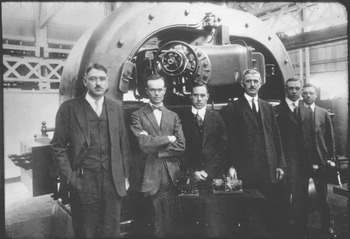
Securing that first contract was one thing; meeting its requirements was another. When Thompson agreed to supply a 100-kilowatt arc for the Canal Zone station, the company's engineers had yet to figure out how to do so. The task of keeping the company's technical promises went to recent Cornell graduate Leonard Fuller (see Figure 1). After a confrontation with Thompson, Elwell had left the company in spring 1913; young Fuller, who became an expert on ever-larger arc transmitters, replaced him as chief engineer. During the next six years, Fuller took out twenty-three patents related to arc transmitters and equipment and completed a doctorate at Stanford (the navy classified his thesis).Footnote 59 As the navy pushed for greater transmission distance, the maximum power of Federal Telegraph's arc sets increased by a factor of two hundred in the decade following its 1909 founding.Footnote 60
Federal Telegraph Company's engineering staff (1917) standing in front of a 500-kilowatt arc. Chief engineer Leonard Fuller is on the left. (Source: Perham Collection of Early Electronics, History San Jose, San Jose, Calif.)

Completed in 1914 and commissioned in 1915, the 100-kilowatt arc for the Canal Zone (Darien) allowed “continuous reliable communications” between Arlington and Darien, a distance of 1,791 nautical miles.Footnote 61 Navy secretary Daniels's 1914 annual report highlights the Canal Zone station and singles out “the co-operation of the progressive American manufacturers of the apparatus”—that is, Federal Telegraph Company and its arc.Footnote 62
Thanks to Fuller and Federal Telegraph, the American chain of high-powered radio stations became the world's best. Meanwhile, Federal Telegraph's directors saw the manufacture of devices as a means to establish its own far-flung wireless network. Thompson hoped to rebuild the continental commercial wireless system that had faltered in 1912 due to static interference. He began negotiating with government officials from Brazil, Argentina, Chile, and Peru regarding commercial systems that would connect South America with the United States. Thompson also began negotiations with officials from the governments of Japan and China regarding construction of stations in the Far East.
A June 1914 report to Federal Telegraph's board of directors demonstrates the centrality of these commercial systems in Thompson's plans. The manufacture of equipment for the U.S. government is discussed on only four pages, of more than one hundred; there is no mention that the U.S. government could block Federal Telegraph's commercial goals. Even after its public-sector manufacturing work had become far more lucrative than its private-sector operations, the company hesitated to define itself as a manufacturer and government contractor rather than as a commercial telecommunications operating firm.Footnote 63 As the company's management vacillated, the navy became both its greatest source of revenue and the biggest barrier to its global wireless commercial ambitions. With the onset of World War I, Federal Telegraph quickly learned that the navy giveth and the navy taketh away.
The Lead Customer
As war engulfed Europe in August 1914, the U.S. government worried that Germany and Great Britain, each with a wireless presence in the United States and South America, would expand their Western Hemisphere presence.Footnote 64 The British were first to act, cutting a German transatlantic cable and censoring transatlantic messages carried on their cables. The result was an increase in the transit time of round-trip messages between New York and London from forty minutes to seven hours.Footnote 65 These actions, and their impact on American commerce and diplomacy, reinforced the navy's suspicions of the British Marconi Company and its American offspring. During World War I, the navy rewarded the Federal Telegraph Company (with its American ownership, management, and engineering talent) while penalizing American Marconi for its British connections. Meanwhile, the navy became a potential competitor for both firms.
When the United States entered the war in April 1917, the U.S. government took an unprecedented step: government ownership of railroads, telephone, and radio.Footnote 66 Aside from the U.S. Post Office, the federal government had hitherto hesitated to rely on state-owned enterprise. For example, unlike other major nations, the U.S. retained a privately owned telephone system.Footnote 67 Nevertheless, Progressive political momentum advocating public ownership of utilities had preceded American entry into the war. Woodrow Wilson's administration (1913–1921) stood out for its comfort with the concept of federal government ownership.Footnote 68
Within the Wilson administration, two leading figures strongly advocated for government ownership: postmaster general Albert S. Burleson, who sought government control of “electrical means of communication” and led the charge for “postalization” of the telephone system, and navy secretary Daniels, who argued for government ownership of wireless (later known as “radio”).Footnote 69 Daniels made a national security argument: transmissions from private radio stations might interfere with military communications during a national emergency.Footnote 70
Daniels's opinions on wireless policy mattered beyond the purview of his office. The navy was the federal government's leading buyer of wireless equipment and was more knowledgeable about the technology than other branches of government. President Wilson supported Daniels regarding government ownership of radio. As a result, State Department policy was, notes Jonathan Winkler, “largely ad hoc, reactive, and dependent upon the navy's initiative.”Footnote 71
Daniels's commitment to government ownership already had crossed paths with Federal Telegraph Company's strategic plans in the Pacific. Federal Telegraph's transpacific network was expected to cost $1.6 million, but could possibly yield more than $4 million of annual earnings (after operating expenses) if run at 20 percent of capacity.Footnote 72 A Manila station was crucial to the system's viability. In spring 1914, a year after American Marconi had proposed building a commercial station in the Philippines, Federal Telegraph president Beach Thompson requested permission to build commercial stations in Guam (controlled by the U.S. Navy) and Manila (under U.S. Army control).Footnote 73
Momentum halted with Thompson's sudden death in October, however.Footnote 74 Leadership of the company fell to his brother-in-law Howard P. Veeder, who had worked with Thompson on hydroelectric power projects in Northern California before becoming Federal Telegraph's vice president and secretary-treasurer in 1910.Footnote 75 Veeder waited more than six months to follow up with Daniels regarding the Manila station.Footnote 76 Daniels subsequently convinced army secretary Lindley Garrison to deny Veeder's proposal.Footnote 77 Federal Telegraph's transpacific commercial network tottered.
The U.S. Navy was more concerned about South America. Echoing a longstanding concern about, and proprietary feeling for, its hemispheric neighbors, navy officials endorsed a “Monroe Doctrine” for radio communications policy in the region.Footnote 78 In August 1914, two weeks after the outbreak of war in Europe and two days before the opening of the Panama Canal, Panama's president granted control of American wireless stations in the country to the U.S. government.Footnote 79 Equally concerned about Central and South American stations financed and staffed by Europeans, Daniels wrote in June 1915 to the new secretary of state Robert Lansing, promoting the idea of government control for all stations within the U.S. “sphere of influence.”Footnote 80
If American regional telecommunications hegemony could not be achieved through government control, American corporate activity represented an attractive alternative. Federal Telegraph entered the Latin American commercial radio sweepstakes with a proposed $1.2 million network expected to return more than $2 million annually if operated at 20 percent capacity.Footnote 81 In September 1915, Federal Telegraph won a concession from Argentina to build a station in Buenos Aires—an important toehold for a South American network.Footnote 82 In a letter to Secretary Lansing, Daniels derided the Marconi Wireless Telegraph Co. of America as not as American as it appeared. If American Marconi obtained South American radio station concessions, he wrote, “the apparatus used would be of foreign manufacture and under foreign patents and installed by foreign personnel, and finally operated in the interests of foreign capital.” His department concluded that Federal Telegraph deserved preference.Footnote 83
Throughout 1915 and 1916, the Federal Telegraph Company was the vessel of U.S. policy in the region. The State Department deferred to the navy's preferences. U.S. diplomats in five South American countries helped Chauncey Eldridge, who headed the Federal Holdings Company. Prodded by the United States, Brazil's foreign minister blocked American Marconi's concession in favor of Federal Telegraph.Footnote 84 In South America, U.S. telecommunications influence mattered, and the influence of the navy department mattered most.
The navy's most knowledgeable figure regarding wireless technology was Lt. Cdr. Stanford C. Hooper, the navy's primary contact with potential radio contractors. In April 1915, Hooper became head of the Bureau of Steam Engineering's Radio Division, and he held that position (or was director of naval communications) for three stints ending in 1934. Hooper developed the world's foremost global communications system connecting naval bases with one another and with vessels of the fleet. His stewardship of navy radio and promotion of those capabilities led him to be dubbed the “Father of Navy Radio.”Footnote 85
During Hooper's first year as division head, financial constraints spurred his push for technological advances with the planned chain of high-powered stations.Footnote 86 He realized that, beyond the Canal Zone station (with Federal Telegraph's 100-kilowatt arc), his budget would not have sufficient funds for five additional high-power stations (San Diego, Guam, Samoa, Hawaii, and the Philippines). Hooper sought to economize by reducing the number of stations to three, each with an increased transmission capacity.Footnote 87 He asked Federal Telegraph's chief engineer, Leonard Fuller, to equip the San Diego station with a 200-kilowatt arc and the stations in Hawaii and the Philippines with 1,000-kilowatt arcs. “The cries of anguish which arose from the Federal Telegraph Company,” wrote George Clark, “could almost be heard as far as the intended reach of the stations.”Footnote 88 Fuller subsequently convinced Hooper to accept 350-kilowatt arcs for both Hawaii and the Philippines.Footnote 89 In February 1916, the company signed contracts totaling $400,000 to supply sets for navy stations in the Philippines, Hawaii, and San Diego.Footnote 90
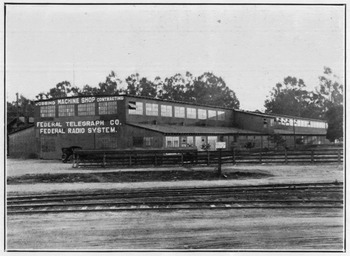
Its role as supplier of apparatus for U.S. naval vessels and high-powered stations put Federal Telegraph on a better financial footing and changed company operations. In early 1916, its facility at Channing and Emerson streets in Palo Alto, a bungalow and out-buildings, employed twenty to thirty individuals. The shop lacked machine tools, crane facilities, and space. The largest arc that could be built there was a 100-kilowatt model, weighing between one and two tons.Footnote 91 A ten-minute walk from the Palo Alto train station, the site was too distant from the tracks to conveniently receive enormous bronze chamber castings from a San Francisco supplier; now, it was contractually obligated to ship 350-kilowatt arcs weighing sixty tons apiece.Footnote 92 Anticipating increased navy business, the company moved its manufacturing to a spacious facility next to the train station, with 25,000 square feet on the ground level and 3,500 square feet of office space on the second floor (see Figure 2). Rail tracks ran directly into the new building.Footnote 93 The new factory, completed that spring, allowed Federal Telegraph to expand its manufacturing workforce by a factor of ten to meet its contractual obligations.
Federal Telegraph Company's Palo Alto factory, constructed in 1916 to keep up with the needs of the U.S. Navy. (Source: Perham Collection of Early Electronics, History San Jose, San Jose, Calif.)

Regional Disadvantage
By mid-1916, Federal Telegraph Company appeared well positioned. Its intellectual property for wireless transmission, particularly Fuller's improvements to the Poulsen patents, were on the verge of becoming the industry standard. A prized customer, the U.S. Navy, sought a system around which to build technical compatibility among its stations and vessels—and seemed to have found it with Federal Telegraph's arc. In addition to apparatus for high-powered navy stations, Federal Telegraph had dozens of contracts to provide arcs for army posts throughout the United States and hundreds of arcs for the Shipping Board's Liberty Ships.Footnote 94 Federal Telegraph's technical prowess, combined with its position as a favored “all American” firm, gave it what Clark called a “natural design monopoly.”Footnote 95
One issue bedeviled the company, however: location. As the European war expanded in 1916, America's neutral position appeared less tenable. As it ramped up production of radio sets, the navy, with its East Coast–based fleet, worried about Federal Telegraph's West Coast location. In September 1916, Lieutenant Commander Hooper recommended a licensing agreement that would allow the navy to produce, or have other manufacturers produce (presumably on the East Coast), radio sets covered by Federal Telegraph's patents.Footnote 96 Little came of that plan.
In late 1916, Rear Adm. Robert Griffin, now commander of the Bureau of Steam Engineering, complained about Federal Telegraph's shipment delays. “Such delays and explanations would be obviated,” he concluded, if the company “had a representative on the Atlantic Coast, to look out for the details of delivery, etc., in a manner similar to that in force in various other concerns dealing with the Gov't.”Footnote 97 Federal Telegraph responded by sending Ralph Beal as “resident engineer” to Washington, where he represented the company for the next three years.Footnote 98 Beal's presence helped, but ultimately did not solve the problem.
Federal Telegraph Company's regional disadvantage became a greater concern in early 1917. With increased congressional appropriations, the navy's attention shifted from budget constraints to time constraints.Footnote 99 In March, Hooper wrote that the navy had more than four times the radio apparatus under contract as “in any year previously,” but identified some serious bottlenecks. Under increased time pressure, Federal Telegraph's West Coast location was becoming a handicap.Footnote 100 Lieutenant Commander Hooper staggered Federal Telegraph's executives shortly after America's April 1917 entry into the war by asking them to establish a factory on the East Coast.Footnote 101
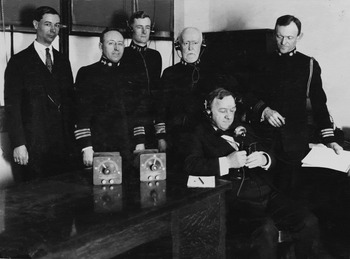
Hooper surprised them again that summer. Since January 1917, he had expressed doubts about Secretary Daniels's plan for complete government ownership of radio in the United States (Daniels and Hooper in Figure 3). While Hooper supported government ownership of coast stations because of their importance to national security, he believed that prohibiting high-powered commercial stations inland might restrict America's capacity to assume a dominant position in the radio world. Dubious that a single firm could accumulate the necessary patents, Hooper suggested that rivals American Marconi and Federal Telegraph form a joint venture to establish a communications network in Latin America.
Secretary of the navy Josephus Daniels, sending radio greetings to President Woodrow Wilson, 1918. Stanford C. Hooper is second from the left; Robert S. Griffin, chief of the Bureau of Steam Engineering, stands behind Daniels. (Source: Photo NH 57302, U.S. Navy History and Heritage Command, Washington, D.C.)

The result was establishment of the Pan American Wireless Telegraph and Telephone Company in October. It was to be “all American” to the extent that its directors and officers would be U.S. citizens, and no more than three-eighths of the stock would be in British hands. Although Hooper thought this extension of American radio enterprise to Latin America “a great step in advance,” his boss did not. Daniels successfully urged Wilson to unite with the South American countries to create a system run by the respective governments.Footnote 102 This decision favoring nationalization over private enterprise stunned American Marconi, particularly E. J. Nally, slated to become Pan American's founding president.
Nally kept his job with Marconi; Veeder, at Federal Telegraph, was not as fortunate. By summer 1917, Federal Telegraph's main customer was frustrated with the company's location and unhappy with its leadership. That May, Hooper learned (but not from Federal Telegraph officials) that the Australian government had engaged the company to bid on two 1,000-kilowatt arcs. Hooper felt betrayed that Federal Telegraph had broken a promise “to keep us informed of any contracts they were negotiating.”Footnote 103
In early October, Veeder and Charles W. Waller, Federal Telegraph's East Coast sales representative, met with D. W. Todd, director of naval communications, to discuss the Pan American venture. Veeder left the meeting once the formal agenda had been covered, but Waller remained. The navy had complained, and Waller, on behalf of the company's directors, offered Veeder's head on a platter. He told Todd that under a new president, Federal Telegraph Company would dispose of its operating business and focus on manufacturing, and it would open a new plant on the East Coast, to be closer to the navy.Footnote 104
In December 1917, San Francisco banker Washington Dodge assumed the presidency of Federal Telegraph. Trained as a physician at the University of California, Dodge entered San Francisco politics in the 1890s, was elected supervisor in 1898, and served four terms as the city's assessor. A survivor of the Titanic, in 1912 Dodge became a vice president of the Anglo and London Paris National Bank of San Francisco, and through the bank's relationship with Federal Telegraph joined the company's board of directors.Footnote 105 As president, Dodge set out in the direction Waller had indicated: that of making Federal Telegraph a manufacturing firm.
Meanwhile, the American Marconi Company was in a difficult position. Navy secretary Daniels's rejection of the Latin American joint venture denied American Marconi access to Federal Telegraph's arc technology, the navy's preferred transmission system. American Marconi's trump card, however, was its superior resources. The company played that card, offering $1.644 million for Federal Telegraph's nine stations on the West Coast as well as its patents, thereby gaining access to Fuller's improvements to the Poulsen system. Attracted by the cash settlement, which would allow the company to finally get out from under its longstanding $500,000 of debt obligations for Elwell's original acquisition of the Poulsen rights, Federal Telegraph initially agreed to the deal.
Waller then offered the navy right of first refusal on the deal—not once but three times—in April 1918. The navy, sensing an opportunity to block a company with British connections from gaining key intellectual property and strategic radio stations, took the bait. On May 18, the navy acquired most of Federal Telegraph's real properties, including stations in Los Angeles, San Diego, and San Francisco. The navy also received American rights to eighteen patents by Poulsen and colleagues P. O. Pederson and C. L. Schou, four patents and sixteen patents pending for technology developed at Federal Telegraph's Palo Alto facility (mainly by Fuller, including his Stanford doctoral research), and other intellectual property, for $1.6 million.Footnote 106
Why was Federal Telegraph so eager to deal with the navy rather than with American Marconi? It had less to do with patriotism than with form of payment. Instead of writing a check to Federal Telegraph, the navy provided $1.6 million in Liberty bonds. The lack of a company name on the bonds apparently opened the door to chicanery. Only $1.12 million made it to the corporate coffers of Federal Telegraph. The rest—nearly a half million dollars—went to an entity called the Valencia Improvement Company, controlled by Dodge's brother-in-law. A 30 percent “finder's fee” (in this case, $480,000) was not uncommon in some circles; indeed, when Elwell first sold stock, he provided 40 percent to his agent, John C. Coburn. Details soon emerged, however, indicating that Dodge had done the negotiating himself as part of his presidential duties, for which he was paid $18,000 a year. It was against California law for an executive to receive both forms of compensation. Furthermore, Federal Telegraph's decision to approve Dodge's commission was made at an illegal board meeting, to which corporate secretary Augustus Tayler and certain directors were not invited.Footnote 107 The scandal broke in January 1919 amidst a confrontation with newly installed board member Hiram Johnson Jr. (son of former California Progressive governor and now U.S. Senator Hiram Johnson). Dodge resigned on January 17; he committed suicide in June.Footnote 108
The bad publicity came at a difficult time for Federal Telegraph's primary customer. Congressional hearings in late 1918 regarding government ownership of radio had indicated a turn back to privatization. In December 1918, as Daniels testified before the Merchant Marine Committee regarding government monopoly of wireless, the navy's 1918 radio spending attracted scrutiny.Footnote 109 Subsequent to the Federal Telegraph deal, the navy had bought shore stations and radio installations on hundreds of vessels from American Marconi for $1,450,000.Footnote 110 Congressmen wondered whether there were better uses for the $3 million paid to Federal Telegraph and American Marconi. In January, there were calls for recovery of the money and for the impeachment of Secretary Daniels.Footnote 111
Having lost faith in Federal Telegraph in the wake of the Dodge scandal, the navy attempted to find a second source for arcs. In May 1919, the navy sold one of Federal Telegraph's 30-kilowatt arcs to the Western Electric Co. “so they could make another like it and show the navy whether they could or not enter into real competition with the Federal Co.,” surmised Clark, “and if so, thus provide an East Coast manufacturer of arcs.”Footnote 112 Western Electric's attempt at reverse-engineering appears not to have succeeded.Footnote 113 After six years of manufacture for the navy, an exclusive license to Poulsen's patents was not Federal Telegraph's only competitive advantage. Chief engineer Fuller and his staff, along with the company's manufacturing organization, had developed what Aitken calls “a body of design and manufacturing experience to be found nowhere else in the world.”Footnote 114 This was an impressive knowledge base that even Western Electric, a firm nearly one hundred times the size of Federal Telegraph, could not quickly replicate.Footnote 115
The navy's 1919 offer to Western Electric came within a new postwar context for the radio industry. In March, Congress reflected newly won Republican majorities in both Senate and House. Support for government ownership of radio both from the president and within the navy ranks dissipated. What endured, despite a wartime alliance, was a desire to displace Britain as global communications hegemon. During the 1919 Paris peace talks, Wilson confided to Rear Adm. W. H. G. Bullard that he considered three areas crucial to global influence: petroleum, transportation, and communications. The United States dominated petroleum and Great Britain controlled shipping. In communications, America's ability to lead in radio could balance Britain's dominance in cables.Footnote 116 The navy had a solution: an American radio monopoly, regulated by the U.S. government, that could compete with the British Marconi Company.
In April, Hooper and Bullard approached General Electric (GE) about creating a new radio giant. The Radio Corporation of America (RCA), based in New Jersey, would feature a telecommunications network, manufacturing capabilities, American management and directors, and no more than 20 percent foreign ownership. The goal, as RCA's chairman Owen Young wrote, was “to set up an all American owned and operated wireless company.”Footnote 117 The creation of RCA meant the disappearance of the American Marconi Company. Its intellectual property and stations went to RCA, and its manufacturing facilities to General Electric. RCA's president was Nally, American Marconi's erstwhile general manager.Footnote 118
RCA involved cross-licensing among AT&T, GE, Westinghouse, and the United Fruit Company, but not Federal Telegraph.Footnote 119 Having already assigned its intellectual property to the navy a year earlier, Federal Telegraph Company had forfeited its primary asset. The loss of intellectual property, combined with the company's reputation for poor management and its West Coast location, assured its exclusion from the creation of a new monopolistic East Coast firm.
When R. P. Schwerin replaced Dodge as Federal Telegraph's president in January 1919, he faced myriad problems: exclusion from the RCA deal, termination of defense contracts after World War I, and a deteriorating relationship with the company's foremost customer.Footnote 120 Schwerin wrote to the navy's Hooper, “I have been working in every possible way to rehabilitate this organization, put it on its feet.” Schwerin resolved “to make good with the Federal Government all the obligations the Federal Telegraph Company was under.”Footnote 121 Hooper responded with a diagnosis of Federal Telegraph's problems. Echoing earlier critiques of the company, Hooper noted two major reasons why it had failed to benefit from its considerable technological accomplishments. The first was the company's location, “so far from the center of business on the East Coast.” The second: the “organization of the Company has not been a working one . . . with the proper organization and proper management.”Footnote 122
Although not a telecommunications veteran, Schwerin brought several assets to the job. He was an Annapolis graduate of the same class as Rear Admiral Griffin, chief of the Bureau of Steam Engineering, which controlled navy radio.Footnote 123 After a few years in the navy, Schwerin had run the Pacific Steamship Company (an early Federal Telegraph customer) for more than twenty years. Seeking federal subsidies for the firm, he had learned the ropes in Washington, D.C.Footnote 124 Given the requirements of the job, Schwerin had a more relevant background than had his predecessors at Federal Telegraph. The biggest concern was whether he had accepted too great a challenge. As A. Y. Tuel suggested in 1919, all that seemed to remain of Federal Telegraph was “just a leased line service and a factory on the wrong side of the U.S.”Footnote 125 It would not be long, however, before other branches of the U.S. government acted on the company's behalf.
The Open Door and a Window of Opportunity
In April 1913, Federal Telegraph president Beach Thompson provided Veeder an update on the company's efforts to establish a network in the Far East: “Ministers from both China and Japan told me that the probability is, that they will not allow us to own stations in their territory.”Footnote 126 Seven years later, Schwerin and his attorney negotiated a deal for Federal Telegraph to build high-powered wireless stations for the Chinese government in Shanghai, Harbin, Canton, and Peking.Footnote 127 News of the 1921 contract, worth $13 million (about $170 million in 2015 dollars), was greeted with enthusiasm at the U.S. State Department, where American access to the China market had long been a holy grail. Heretofore, communication with individuals or organizations in China had passed through either British or Japanese cables; uncensored arrival of such messages was not guaranteed. Concerns about Japanese censorship were reflected in correspondence from a Federal Telegraph contractor (in San Francisco) to Schwerin (in China) that bore a stamp that read “POSITIVELY Do Not Send on JAPANESE STEAMERS.”Footnote 128 Federal Telegraph's contract represented what Harry Kirwan called a “testing of the Open Door,” an American statement of “principles of equal and impartial trade” with China.Footnote 129 The State Department put its money where its policy was, providing Federal with $50,000 to cover the costs of obtaining the contract.Footnote 130
One of the requirements of the China contract was that the supplier own relevant patents, but Federal Telegraph's patents had been conveyed to the government as part of Dodge's 1918 deal. Schwerin argued that the government had never actually owned the patents, having instead obtained licensing rights.Footnote 131 His legal position was shaky, but the State Department was eager to establish relations with China. Therefore, in March 1921, a mere two weeks after Warren Harding took office as president, the secretary of state Charles Evans Hughes wrote to navy secretary Edwin Denby emphasizing “the paramount importance to the United States of the development of adequate . . . communication service between the United States and its Pacific possessions.”Footnote 132 The navy agreed to “sell” the patents back to Federal Telegraph—at little or no charge.Footnote 133 Ultimately, for its 1918 investment of $1.6 million, the navy kept only four of the West Coast stations (having closed five others) and no intellectual property.Footnote 134 The real value to the navy had been assuring that American Marconi, a firm with British connections, did not acquire Federal Telegraph's arc patents.
In China, the United States was a relatively late wireless mover. Barely a month after the contract was signed, in February 1921, complaints emerged that the contract violated China's earlier agreements with Denmark (1913, the Great Northern Telegraph Company), Japan (1918, the Mitsui Company), and Britain (1919, the Marconi Company).Footnote 135 Yet Federal Telegraph entered the fray with a valuable ally. After the initial British complaint, Secretary Hughes conveyed a message to the Chinese premier that cancellation of the contract “would be regarded by the American Government as an unfriendly act.”Footnote 136
Federal Telegraph had trouble obtaining financing for the project.Footnote 137 As a result, in August 1922, Schwerin negotiated a joint venture with RCA called the Federal Telegraph Company of Delaware. Although headed by Schwerin and run by Federal Telegraph's engineers, the joint venture was 70 percent owned by RCA and 30 percent owned by Federal.Footnote 138
The next hurdle proved insurmountable: a combination of Japanese influence and Chinese political instability. The Japanese government, protecting a seven-million-dollar Mitsui Corporation contract for construction of a Peking station, strategically planted seeds of doubt in the minds of Chinese officials regarding the U.S. venture.Footnote 139 This delayed Federal Telegraph's construction of the stations. In 1926, when secretary of state Frank B. Kellogg weighed his options regarding Federal Telegraph's contract, the U.S. envoy to China conveyed doubts that “in the near future a government will exist to which the American Minister can appropriately present an ultimatum.”Footnote 140 The Nationalist Revolution, one of whose platforms was to rid China of the domination of foreigners, was underway—putting an end to Federal Telegraph's hopes of building radio stations in China.Footnote 141
By then, Schwerin's role had changed. He had headed both Federal Telegraph and the China joint venture for two years when San Francisco industrialist Rudolph Spreckels bought a controlling interest in the Federal Telegraph Company in 1924. Spreckels replaced Schwerin (who remained head of the China venture) with another navy man, Lt. Cdr. Ellery Stone, who had worked for one of Federal Telegraph's suppliers.Footnote 142 Although the navy's return of the company's intellectual property did not yield benefits that the company or the State Department had wanted, it led Federal Telegraph to a different business model—again with the help of the federal government.
Organizational Change and Departure
Federal's reacquisition of its patents in March 1921 provided a second wind to the company, but it was a last gasp for the arc. Just as arc technology had proven superior to the spark in 1913, by the early 1920s the vacuum tube was becoming a preferred alternative—especially at lower-power applications.Footnote 143 Nobody knew this better than the staff of Federal Telegraph. In January 1919, Ralph Beal, the company's Washington representative, had written to Fuller, “If our cost figures cannot be reduced we may as well face the fact at once that we cannot compete with other manufacturers, especially in the small units.”Footnote 144 The arc had served the company well as the navy expanded American telecommunications capabilities, but the technological climate had changed.
With the arc's pending eclipse, Federal Telegraph needed something new to remain viable—and found it.Footnote 145 Included in the intellectual property that the government returned to the company were Frederick A. Kolster's patents. Kolster had served as “radio specialist” for the U.S. Bureau of Standards (1911–1920), where he organized the radio section and became recognized as one of the top radio men in the U.S. government.Footnote 146 While at the bureau, Kolster developed a radio direction finder, a navigational device that improved maritime safety. Because he successfully argued that he had done some of the relevant work before joining the bureau, Kolster retained rights (to the bureau's regret) and then sold his patents to the Federal Telegraph Company.Footnote 147 As part of the deal, Federal Telegraph hired Kolster in 1921.Footnote 148 Kolster's arrival allowed Federal Telegraph to develop the first commercial radio direction finder, which became known as a “radio compass,” a significant departure from its prior emphasis on high-power arc transmission systems.Footnote 149
During the 1920s, the formative years of commercial radio, Kolster developed a receiving set using the principles behind his radio compass. The new product's popularity transformed Federal Telegraph into a mass production enterprise.Footnote 150 The company's location again became a concern. Distant from major suppliers and customers, the West Coast was not an ideal place from which to compete on a cost/price basis in commercial markets. In January 1926, President Stone negotiated a merger with the Brandes Companies, a New Jersey manufacturer of headsets.Footnote 151 Brandes manufactured the Kolster Radio Compass on the East Coast under the same umbrella firm that owned the Federal Telegraph Company.Footnote 152
Stone dangled other intellectual property in front of a different suitor. During a brief (1911–1912) stint at Federal Telegraph, Lee de Forest had developed an audion amplifier, which was adapted for use as a vacuum tube transmitter and used in several industries.Footnote 153 Fifteen years later, Stone found that Federal Telegraph had shop rights for de Forest's work, meaning that the company could make and use vacuum tubes without risking patent infringement. The resulting nonexclusive license from vacuum tube makers AT&T and RCA attracted the attention of the Mackay Radio and Telegraph Company.Footnote 154 In October 1927, Federal Telegraph became exclusive manufacturer and supplier of equipment for Mackay's operating system (similar to Western Electric's role as equipment supplier for the Bell System). The International Telephone and Telegraph Corporation acquired Federal Telegraph Company the following year and in 1931 moved its Palo Alto manufacturing and research operations to Newark, New Jersey.Footnote 155 There it became part of a telecommunications cluster that also included AT&T, RCA, and Western Electric. Fifteen years after the U.S. Navy had first complained about Federal Telegraph's remote location, the company arrived on the East Coast.
Conclusion
In 1964, Stanford University's provost Frederick Terman wrote that “with the proper management, the Federal Telegraph Company could have been RCA”—the world's most significant radio firm.Footnote 156 To Terman, the saga of Federal Telegraph was no abstract matter. After graduating from Stanford in June 1920, he had worked for a summer at the company's Palo Alto manufacturing facility. In 1923 he considered quitting graduate school at MIT to join the company's China venture, but his thesis advisor, Vannevar Bush, persuaded Terman to complete his PhD.Footnote 157 When Terman joined Stanford's engineering faculty in 1925, Federal Telegraph's loss became the region's gain: Terman subsequently helped establish a “community of technical scholars,” including Stanford professors and researchers, along with engineers at regional start-ups and at the local operations of companies based elsewhere. By 1964, the community's efforts had been aided by funding from several branches of the federal government, particularly the Office of Naval Research (ONR). Terman's success at bringing together representatives of academia, industry, and government earned him the moniker of “Father of Silicon Valley.”Footnote 158
Terman's community included Charles Litton, founder of the defense giant Litton Industries (1946), who had designed and manufactured glass tubes at Federal Telegraph in the late 1920s and early 1930s. Litton collaborated with Heintz & Kauffman's William Eitel and Jack McCullough, whose 1934 start-up grew to 3,600 employees during World War II, based on government contracts. Litton mentored many, including the founders of Hewlett-Packard in the late 1930s, and Russell Varian and Sigurd Varian, whose groundbreaking prewar work on the klystron tube led to the 1948 establishment of Varian Associates. Technical knowledge and manufacturing practices stayed in the region, passed on from one enterprise to the next.Footnote 159
Crucial to the region's development was the larger context in which it operated. Both know-how and know-who mattered as technological knowledge and practice were magnified by relationships with government officials. America's modern military-industrial complex began with the U.S. Navy's challenge of British global hegemony. Federal Telegraph Company, as an independent enterprise (1909–1928), survived as long as it did because its efforts aligned with that challenge. The navy, and to a lesser extent the State Department, served as incubator, providing much-needed revenue and protection from competition of the British-funded American Marconi Company.
Location in the United States of the twentieth century became one of the competitive advantages of early Silicon Valley firms. Demand from the navy, the army, and the air force provided Federal Telegraph Company's successors with business until each built an organization able to compete in commercial markets. In addition to Eitel-McCullough and Litton Industries, key entrants in electronics equipment (Hewlett-Packard, 1938), recording equipment (Ampex, 1944), power tubes (Varian Associates, 1948), and semiconductors (Fairchild Semiconductor, 1957) followed this pattern. Government contracts sustained these firms within their first six years (Federal Telegraph Company, Eitel-McCullough, and Hewlett-Packard) or at the very beginning (Ampex, Litton Industries, Varian Associates, and Fairchild). Indeed, Varian cofounder Edward Ginzton called the acquisition of security clearances the “most important” event in the company's founding.Footnote 160
The Federal Telegraph Company is important because it blazed a path that subsequent Silicon Valley firms followed, and it illuminates relationships and dynamics we must explore in order to understand Silicon Valley's development. By virtue of its relations with the U.S. Navy, Federal Telegraph contributed to and benefited from the military-industrial complex of the world's budding superpower. The company's high-tech successors in the valley also grew up with, and were incubated by, America's defense agencies. Therefore, although the Federal Telegraph Company abandoned the region, it left behind an important legacy that has less to do with its exit to New Jersey than with its entree to Washington, D.C.