INTRODUCTION
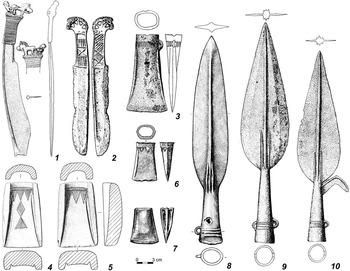
The Seima-Turbino (ST) transcultural phenomenon is a distinctive and enigmatic occurrence in the Late Bronze Age archaeology of Eurasia, and it has been a key research issue for decades (e.g. Chernych Reference Chernykh1992). It refers to an emergence and wide and rapid distribution of specific bronze objects in Siberia and eastern Europe, which mainly represent weaponry items—spears, celts and knives—often decorated by geometric figures or featuring figured tops on knife handles (Figures 1 and 2). A horse is the most common shape for the tops (Figure 2: items 1 and 2), and in one case, a man and a horse (Figure 2: item 1; Molodin Reference Molodin1983; Kiryushin Reference Kiryushin1987; Matyushchenko and Sinitsyna Reference Matyushchenko and Sinitsyna1988; Molodin et al. Reference Molodin, Chemyakina and Pozdnyakova2007, Reference Molodin, Hansen, Mylnikova, Nagler, Kobeleva, Durakov, Efremova, Novikova, Nesterova, Nenakhov, Kovyrshina, Mosechkina and Vasil’eva2011).
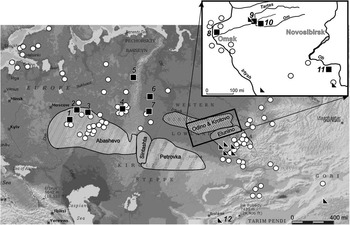
Map showing the distribution of the Seima-Turbino objects (squares) in funeral, ritual-funeral, and settlement complexes (excluding occasional and single findings) and daggers with figured handles (triangles, numbers indicate closed complexes) in Eurasia. Seima-Turbino sites: 1 – Seima; 2 – Reshnoe; 3 – Ust’-Vetluga; 4 – Pepkinskii Kurgan, Turbino, and Bor Levi; 5 – Kaninskaya cave; 6 – Satyga 16; 7 – Shaitanskoe 2; 8 – Rostovka; 9 – Tartas 1; Sopka 2/4B and Sopka 2/4C; Vengerovo 2 and Staryi Tartas 1; 10 – Preobrazhenka 6; 11 – Elunino 1 and Teleutskii Vzvoz 1; 12 – Galich Hoard. Closed complexes containing daggers with figure handles: 9 – burial ground Sopka 2/4B; 12 – the Second Karakol Hoard. Map sources: Chernykh (Reference Chernykh2015), Chlenova (Reference Chlenova1976), Alekhin and Vladimirov (Reference Alekhin and Vladimirov1984), Molodin (Reference Molodin1983, Reference Molodin1993, Reference Molodin2013, Reference Molodin2015), Samashev and Zumabekova (Reference Samashev and Zhumabekova1993), Grushin et al. (Reference Grushin, Merz, Papin and Peresvetov2006), Kiryushin et al. (Reference Kiryushin, Grushin and Tishkin2006), Molodin et al. (Reference Molodin, Chemyakina and Pozdnyakova2007, Reference Molodin, Hansen, Mylnikova, Nagler, Kobeleva, Durakov, Efremova, Novikova, Nesterova, Nenakhov, Kovyrshina, Mosechkina and Vasil’eva2011), Kovalev (Reference Kovalev2013), and Kuzminykh (Reference Kuzminykh2011). Map adapted from Encarta Microsoft 2006.

Seima-Turbino objects (4, 5 – stone, other – bronze) from the burial grounds of southwestern Siberia. 1, 3, 9, 10 – Rostovka (Matyushchenko and Sinitsyna Reference Matyushchenko and Sinitsyna1988); 2 – Elunino 1 (Kiryushin Reference Kiryushin1987); 4–6 – Sopka 2/4C (Molodin Reference Molodin1983); 7 – Tartas 1 (Molodin et al. Reference Molodin, Hansen, Mylnikova, Nagler, Kobeleva, Durakov, Efremova, Novikova, Nesterova, Nenakhov, Kovyrshina, Mosechkina and Vasil’eva2011), 8 – Preobrazhenka 6 (Molodin et al. Reference Molodin, Chemyakina and Pozdnyakova2007).

In eastern Europe, the main ST-type findings have been made in the Volga-Ural region (Seima, Reshnoe, and Ust’-Vetluga sites) and the forest zones of Cis-Ural (Turbino and Kaninskaya Cave) and Trans-Urals (Satyga 16 and Shaitanskoe 2; Figure 1). In general, these mostly represent ritual-funeral and funeral sites. In western Siberia, the main sites are located in the Ob-Irtysh forest-steppes (Rostovka, Preobrazhenka 6, Sopka 2/4B, Sopka 2/4C, and Vengerovo 2) and in the Upper Ob River region (Elunino 1; Chernykh and Kuzminykh Reference Chernykh and Kuzminykh1987; Kiryushin Reference Kiryushin1987; Matyushchenko and Sinitsyna Reference Matyushchenko and Sinitsyna1988; Molodin Reference Molodin1983; Chernykh Reference Chernykh2015). The majority of the western Siberian sites are necropoleis, and in two cases settlements (Staryi Tartas 1 and Vengerovo 2; Molodin et al. Reference Molodin, Durakov, Sofeikov and Nenakhov2012a, Reference Molodin, Mylnikova, Durakov, Borzykh, Selin, Nesterova and Kovyrshina2015). In addition, a vast number of ST bronze objects are represented by occasional finds recovered as widely as from the Baltic Sea coast to southern Siberia (Minusinsk Basin). Notably, among the western Siberian materials, not only bronze objects themselves, but the associated casting molds have been found indicating the local production of the objects. The findings of weaponry (spears, knives, axes) and bone and horn armor plates in burials suggest the military lifestyle of the population that left the objects. The image of a horse in the ST bronze art characterizes it as a domesticated animal and indicates its important role in human life.
Seima-Turbino complexes have been investigated for more than a century, and the research transformed from collecting isolated unique objects, discovery of distinctive and original ritual-funeral sites, to considering them as the Eurasian “transcultural phenomenon” (Chernykh and Kuzminykh Reference Chernykh and Kuzminykh1987:84–105). The main issues of the ST problematics have concerned not only the initial provenance of the bronze objects, identification of the people who produced them and their relationships with other populations of forest and forest-steppe zone of Eurasia, but also chronology and means of distribution of the items. Comparative analysis of metal objects in various archaeological sites allowed attributing a considerable part of complexes of the Middle and Lower Volga region, Southern Urals and Trans-Urals, including a number of Srubnaya and Abashevo Culture sites, to the “Seima chronological horizon” (Chernykh Reference Chernykh1970: Figure 67). The major concentration of the ST-type objects has been found in the Volga-Ural region. The Abashevo sites either preceded or coexisted with the “Seima chronological horizon” (third quarter of the 2nd millennium BC; Chernykh Reference Chernykh1970:103). However, the thin-wall-casting technology of the ST type bronze objects makes their principal difference from rather rough Abashevo (or “common Eurasian” by Chernykh Reference Chernykh1970) casting and the later forging technology, which does not allow considering South Urals and Cis-Urals as the areas of production of these items. The spectrum analysis of the ST bronze objects suggests the Sayano-Altai Mountains as a region of provenance of raw materials (tin bronze) used. Therefore, until recently, it has been assumed that the western foothills of the Sayano-Altai Mountains were the place of origin of the ST transcultural phenomenon (Chernykh Reference Chernykh1970). However, the increasing number of ST finds in western Siberia and Central Asia allows the expansion of the presumable place of the initial impulse into the eastern and southeastern foothills of Altai and Xinjiang (Molodin and Komissarov Reference Molodin and Komissarov2001; Chernykh Reference Chernykh2013, Reference Chernykh2015; Molodin and Grishin Reference Molodin and Grishin2016).
For a long time, Seima-Turbino objects were dated using the Balkan (Borodino Hoard, Ukraine) and Chinese analogies (Anyang complexes; e.g. Chernykh Reference Chernykh1970). The comparative analysis of these complexes suggested the 16th–15th centuries BC as the timing of their existence (Chernykh and Kuzminykh Reference Chernykh and Kuzminykh1987; Chernykh Reference Chernykh1992). The appearance of the first sparse radiocarbon (14C) dates from burial materials did not resolve the chronological issue, as they showed the earlier age (Kiryushin Reference Kiryushin1987) than comparative typological analysis of the bronze objects.
Here, we present a new set of 14C dates from human remains originating from burials containing ST-type objects in southwestern Siberia. An important aspect of this study is that burials with the ST-type objects, including the key site of Rostovka, were dated directly. Such an approach will significantly increase the precision of the ST chronology, as previously in many cases 14C dates were produced from burials that did not contain bronze items themselves (Kiryushin et al. Reference Kiryushin, Grushin and Tishkin2003; Trufanov Reference Trufanov2011). Comparison of the new and existing 14C dates will allow defining the chronological position of western Siberian sites among the ST complexes and other archaeological cultures of forest and forest-steppe zone of Eurasia.
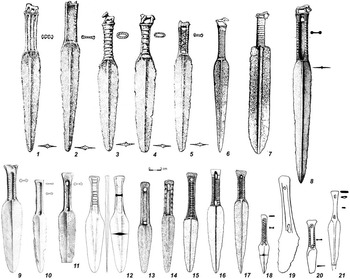
Another aspect of this work is 14C dating complexes for the handles of bronze figured daggers (Figure 3). Similar to the ST bronzes, these daggers are also characterized by an advanced level of metalwork, and some have suggested that they are possibly related to the ST phenomenon (Molodin Reference Molodin1993; Parzinger Reference Parzinger2000). These items, like the ST objects, mostly represent occasional findings from Central Asia (East Kazakhstan, Altai, and Xinjiang) and southwestern Siberia (Chlenova Reference Chlenova1976; Aleshin and Vladimirov Reference Alekhin and Vladimirov1984; Molodin Reference Molodin1993, Reference Molodin2015; Samashev and Zumabekova Reference Samashev and Zhumabekova1993; Grushin et al. Reference Grushin, Merz, Papin and Peresvetov2006, Reference Grushin2009; Kiryushin et al. Reference Kiryushin, Grushin and Tishkin2006; Kovalev Reference Kovalev2013). As to closed complexes, to date, only two are known to have contained daggers. These are the hoard of five daggers from eastern Kyrgyzstan (the Second Karakol Hoard, Karakol village; Vinnik and Kuz’mina Reference Vinnik and Kuz’mina1981) and burials 425, 427, 443 of the Sopka 2/4B site (Baraba forest-steppe, southwestern Siberia; Molodin Reference Molodin1993, Reference Molodin2015). Earlier, the chronology of these daggers was based on their stylistic comparison with metal objects from various Bronze Age Siberian archaeological cultures (Elunino, Krotovo, Karasuk) and also with the ST metal complex, and was attributed to the first half (Molodin Reference Molodin1993; Parzinger Reference Parzinger2000) or the end of the 2nd millennium BC (Chlenova Reference Chlenova1976; Kiryushin and Grushin Reference Kuryushin and Grushin2009; Papin and Fedoruk Reference Papin and Fedoruk2009; Kovtun Reference Kovtun2013).
Bronze daggers with figured handles from Sopka 2/4B burial ground and their analogies. 1–5 – the Second Karakol Hoard (Vinnik and Kuz’mina Reference Vinnik and Kuz’mina1981); 9–11 – Sopka 2/4B (Molodin Reference Molodin1993); other – occasional finds; 6, 7 – eastern Kazakhstan (Samashev and Zumabekova Reference Samashev and Zhumabekova1993); 8 – Altai (Kiryushin et al. Reference Kiryushin, Grushin and Tishkin2006); 12 – Upper Irtysh River basin (Grushin et al. Reference Grushin, Merz, Papin and Peresvetov2006); 13, 14 – Gansu province (Kovalev Reference Kovalev2013); 15 – southern Siberia (Chlenova Reference Chlenova1976); 16 – Altai (Alekhin and Vladimirov Reference Alekhin and Vladimirov1984); 17 – Altai (Chlenova Reference Chlenova1976); 18, 21 – Kazakhstan (Chlenova Reference Chlenova1976); 19 – Kazakhstan (Chernikov Reference Chernikov1960); 20 – Altai or Kazakhstan (Chlenova Reference Chlenova1976); 15–21 are without scale.

ARCHAEOLOGICAL SITES
Burial materials from southwestern Siberia have been used for chronological analysis of Seima-Turbino type objects and bronze figure-handled daggers. These included Rostovka—one of the key sites of the ST problematics, located in Middle Irtysh River basin—and also individual graves containing ST items from four Bronze Age necropoleis of the Baraba forest-steppe (Sopka 2/4B, Sopka 2/4C, Preobrazhenka 6, and Tartas 1 sites; Figure 1).
Rostovka burial ground (55°01.2′N, 73°35.1′E) consists of 38 graves, the majority of which contain bronze ST items (celts, spears, knives; Figure 2: items 1, 3, 9, 10; Matyushchenko and Sinitsyna Reference Matyushchenko and Sinitsyna1988; Chernykh and Kuzminykh Reference Chernykh and Kuzminykh1987; Chernykh Reference Chernykh1992). The prevailing number of burials shows traces of disturbance in ancient times—and in some cases—traces of fire, including calcined ground, charcoal, and cremated bones. Bronze objects have been found inside burials or placed in compact assemblages on the ground beside graves. Stone molds for casting bronze objects were also placed in graves or next to them. Apart from the bronze weaponry, stone spearheads and horn armor plates have been found.
The necropoleis of Sopka 2/4B and Sopka 2/4C (55°37.3′N, 76°44.5′E), Tartas 1 (55°38.1′N, 76°44.1′E), and Preobrazhenka 6 (55°30.1′N, 77°00.9′E) are located in the central part of the Baraba forest-steppe (Molodin Reference Molodin1985, Reference Molodin2001, Reference Molodin2012; Molodin et al. Reference Molodin, Sofeikov, Deich, Grishin, Chemyakina, Manshtein, Balkov and Shatov2003, Reference Molodin, Chemyakina and Pozdnyakova2007, Reference Molodin, Hansen, Mylnikova, Nagler, Kobeleva, Durakov, Efremova, Novikova, Nesterova, Nenakhov, Kovyrshina, Mosechkina and Vasil’eva2011, Reference Molodin, Mylnikova, Durakov, Borzykh, Selin, Nesterova and Kovyrshina2015; Marchenko et al. Reference Marchenko, Orlova, Panov, Zubova, Molodin, Pozdnyakova, Grishin and Uslamin2015). Sopka 2/4B represents a group of graves of the Krotovo Culture within the Sopka 2 necropolis consisting of more than 600 Neolithic to Medieval burials in total (Molodin Reference Molodin1985, Reference Molodin2001, Reference Molodin2012). Burial 427 contained the casting mold for the ST type bronze spear. The grave was made among the earlier Krotovo Culture burials (and therefore was considered synchronous to them for a long time; Molodin Reference Molodin1985), and showed signs of destruction. Radiocarbon dating attributed the main part of the Krotovo Sopka 2/4B to the first half of the 3rd millennium BC (Molodin et al. Reference Molodin, Marchenko, Grishin and Orlova2010). The burial ground Sopka 2/4C appears as planigraphically isolated group of three graves (282, 594, and 623) within the Sopka 2 site. Burial 282 represents the so-called “grave of a caster,” which contains objects related to casting (stone casting molds and clay melting pots) and bronze items themselves (celt; Figure 2: items 4–6; Molodin Reference Molodin1983). The nearby graves 594 and 623 did not contain similar objects but were characterized by similar burial practice atypical for the Bronze Age—the deceased were buried on their backs with knees bent up.
The Tartas 1 necropolis is located 1.5 km northeast of Sopka 2 (Molodin et al. Reference Molodin, Sofeikov, Deich, Grishin, Chemyakina, Manshtein, Balkov and Shatov2003, Reference Molodin, Hansen, Mylnikova, Nagler, Kobeleva, Durakov, Efremova, Novikova, Nesterova, Nenakhov, Kovyrshina, Mosechkina and Vasil’eva2011). The core of the site is Bronze Age burials, the majority of which date to the first part of the 2nd millennium cal BC (Molodin et al. Reference Molodin2012). Burial 487 contained bronze celt (Figure 2: item 7; Molodin et al. Reference Molodin, Hansen, Mylnikova, Nagler, Kobeleva, Durakov, Efremova, Novikova, Nesterova, Nenakhov, Kovyrshina, Mosechkina and Vasil’eva2011) and the remains of a 20–25-year-old woman, positioned similar to burials of Sopka 2/4C—on the back with knees bent up. A bronze spear was found in burial 24 of the Preobrazhenka 6 site (Figure 2: item 8; Marchenko et al. Reference Marchenko, Orlova, Panov, Zubova, Molodin, Pozdnyakova, Grishin and Uslamin2015).
Bronze daggers with figured handles (Figure 3: items 9–11) were found in burials 420, 425, and 443 of Sopka 2/4B (Molodin Reference Molodin1993). Currently these are the only cases when daggers of this type have come from burials. Graves 420 and 425, and also 427 containing ST type object, were located among the earlier burials of the Krotovo Culture at the Sopka 2/4B and did not appear to stratigraphically overlap them. Burial 425 had a somewhat separated position, while burial 420 was in line with other three graves, the cultural attribution of which cannot be determined due to significant destruction. Burial 443 also located among earlier Krotovo burials.
MATERIALS AND METHODS
In total, 28 samples from 6 sites of the Baraba forest-steppe (Sopka 2/4B, Sopka 2/4C, Tartas 1, Preobrazhenka 6, Staryi Tartas 1, and Vengerovo 2) and the Middle Irtysh River basin (Rostovka) were used for the 14C analysis (Table 1). Among them, 15 samples derive from the Seima-Turbino complexes (7 burials from Rostovka; burial 427 from Sopka 2/4B; burial 282 from Sopka 2/4C; and burial 487 from Tartas 1). One sample, discovered near Staryi Tartas settlement on the Om River, not far from Tartas 1 and Sopka 2, represents the occasional finding of bronze ST type celt. This object likely came from the coast scree of the Bronze Age cultural layer of site Staryi Tartas 1, which is presently overlain by modern agricultural buildings. For 14C dating, the wooden (coniferous) handle from the sleeve celt was used, as well as bones of two humans from burials 420 and 425 of Sopka 2/4B, which contained bronze daggers with figured handles.
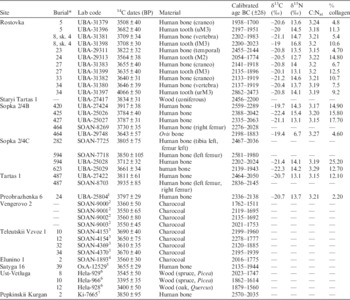
Radiocarbon dates, calibrated ages, and stable isotope values for the Seima-Turbino complexes in Eurasia (from current and previous research).

*sk.=skeleton. 1Marchenko et al. (Reference Marchenko, Orlova, Panov, Zubova, Molodin, Pozdnyakova, Grishin and Uslamin2015); 2Molodin et al. (Reference Molodin, Mylnikova, Nesterova, Borzykh, Ivanova, Golovkov, Selin, Orlova and Vasilev2013); 3Kuryushin et al. (2003); 4Kiryushin et al. (Reference Kiryushin1987); 5Hanks et al. (Reference Hanks, Epimakhov and Renfrew2007); 6Yunger and Karpelan (Reference Yunger and Karpelan2005); 7Kuznetsov (Reference Kuznetsov2003).
Furthermore, we analyzed 5 samples from burials of Sopka 2/4B (464) and 2/4C (594, 623), not containing ST objects themselves but being strictly synchronous to the burials with ST artifacts. These were used, firstly, to assess the possible influence of the freshwater reservoir effect (FRE) on the 14C dates and, secondly, to increase the accuracy of the 14C chronology of the ST complexes. Regarding the latter, the samples from burials 594 and 623 of Sopka 2/4C, synchronous with burial 282, were dated. To investigate the presence of the FRE, we dated associated human and herbivore bones from Sopka 2/4B burial 464, and bone and tooth samples of 4 individuals from Rostovka (burials 5, 8, 27, 34). For grave 594 of Sopka 2/4C and grave 487 of Tartas 1, samples from same skeleton were dated at different laboratories.
For analysis of the chronology of the ST complexes in the Baraba forest-steppe, published 14C data from burial 24 of the Preobrazhenka 6 site (Odino Culture) were also engaged (UBA-25804; Marchenko et al. Reference Marchenko, Orlova, Panov, Zubova, Molodin, Pozdnyakova, Grishin and Uslamin2015).
For chronological analysis of Seima-Turbino objects, 4 dates from charcoal from house 5 of the Vengerovo 2 settlement (Krotovo Culture) located near the cemeteries of Sopka 2/4B and Tartas 1 were also included (Molodin et al Reference Molodin, Mylnikova, Nesterova, Borzykh, Ivanova, Golovkov, Selin, Orlova and Vasilev2013). All samples were taken from one burned construction. Among archaeological materials of house 7, a fragment of stone casting mold for celt was found, which can be associated with Seima-Turbino production (Molodin et al Reference Molodin, Mylnikova, Durakov, Borzykh, Selin, Nesterova and Kovyrshina2015). As the latest excavation has shown, all dwellings of the site were fenced, which allows them to be associated with the same settlement (Molodin et al. Reference Molodin, Mylnikova, Nesterova and Efremova2016). In total, 22 14C dates were received from anthropological materials (5 from teeth and 17 from bones), 1 date from wood, 1 from animal bone, and 4 from charcoal.
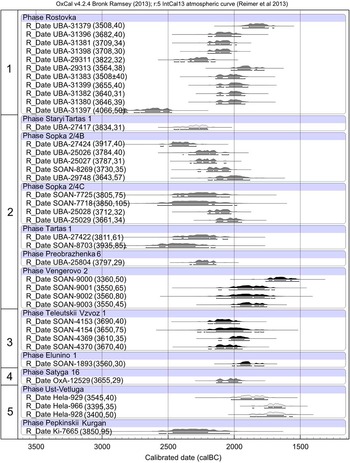
The dates were produced in two laboratories, namely 14CHRONO Centre for Climate, the Environment and Chronology of the Queen’s University Belfast (n=20, lab code UBA) using accelerator mass spectrometry (AMS), and the Institute of Geology and Mineralogy of the Siberian Branch of the Russian Academy of Sciences (Novosibirsk; n=8, lab code SOAN) using liquid scintillation counting (LSC). Calibration was performed using OxCal v 4.2.4 software (Bronk Ramsey Reference Bronk Ramsey1995, Reference Bronk Ramsey2001) and the IntCal13 curve (Reimer et al. 2013; Figure 4).
Plotted calibrated 14C dates (from current and published research; see Table 1) of the Seima-Turbino sites: 1 – Middle Irtysh River basin; 2 – Baraba forest-steppe; 3 – Upper Ob River basin; 4 – Trans-Urals; 5 – Middle Volga River basin. Materials analyzed are collagen (anthropological and animal remains; dark grey), wood (light grey), and charcoal (black).

For comparative analysis, the 14C dates from the cemeteries of the Upper Ob River basin (Teleutskii Vzvoz 1 and Elunino 1), Trans-Ural forest zone (Satyga 16), and Middle Volga River basin forest-steppe (Ust’-Vetluga and Pepkinskii Kurgan) belonging to the Elunino (21st–17th centuries cal BC; Kiryushin et al. Reference Kiryushin, Grushin and Tishkin2003) and Abashevo Cultures (23rd–19/18th centuries cal BC; Chernykh and Orlovskaya Reference Chernykh and Orlovskaya2013; Molodin et al. Reference Molodin, Epimakhov and Marchenko2014; Shishlina et al. Reference Shishlina, Skorobogatov, Kaiser and Usachuk2015) were used (Table 1; Figure 4). The dates were obtained from charcoal (Teleutskii Vzvoz 1 and Elunino 1), wood (Ust’-Vetluga), and in one case, human bone samples (Satyga 16). The 14C date from the Elunino 1 necropolis derives from the Elunino Culture burial, which contained the ST-type knife with a figured handle featuring a horse head on the top (Figure 2: item 2; Kiryushin Reference Kiryushin1987). The cemetery of Teleutskii Vzvoz 1 did not contain ST-type objects, however, the overall assemblage of artifacts and burial practice were identical to that of Elunino 1. Furthermore, according to some researchers (Kiryushin et al. Reference Kiryushin, Grushin and Tishkin2003), the bronze leaf-shaped ornamented arrowhead from the Teleutskii Vzvoz 1 grave is close to the ST metallurgical tradition. The metal complex of the Satyga 16 cemetery is not numerous or diverse and is mainly presented by common bronze knives; only the remains of clay casting molds recovered from the site can be characterized as ST-type objects (Trufanov Reference Trufanov2011:30–2). However, this site is considered to be the ST type (Trufanov Reference Trufanov2011:60–85). A 14C date was obtained from burial 39, which did not contain bronze objects or items associated with metallurgy.
14C dates from the Abashevo Culture sites are important for establishing the chronology of the Seima-Turbino complexes, as ST-type objects have been repeatedly found in the Abashevo sites of Middle Volga River basin, suggesting their chronological similarity (Solovyov Reference Solovyov2003, Reference Solovyov2013; Bolshov Reference Bolshov2012). The Ust’-Vetluga necropolis combines at least two metallurgical traditions—the local Abashevo and the external Seima-Turbino (Solovyov Reference Solovyov2013). The 14C dates were obtained from wooden handles of the ST bronze objects (Yunger and Karpelan Reference Yunger and Karpelan2005). From the Abashevo Culture, the 14C date of Pepkinskii Kurgan grave 2 was also used (Middle Volga River basin; Kuznetsov Reference Kuznetsov2003). This grave is a collective burial of 27 adult men showing the signs of violent death—the majority of individuals were hit by stone arrowheads most similar to ones found at the Turbino cemetery, one of the main sites related to the Seima-Turbino phenomenon (Khalikov et al. Reference Khalikov, Lebedinskaya and Gerasimova1966).
RESULTS AND DISCUSSION
Overview of Results
The analyzed bone samples demonstrate excellent collagen preservation with yields ranging between 2.2 and 25.2% (van Klinken Reference van Klinken1999; Table 1). The C:Nat ratio of the samples varied between 3.2 and 3.3, which is also within the accepted range characterizing well-preserved collagen (DeNiro Reference DeNiro1985).
The 14C dates of burials with the Seima-Turbino type objects from the Baraba forest-steppe and the Middle Irtysh River basin show a wide chronological interval of 29th–20th centuries cal BC (Table 1, Figure 4). Eleven 14C dates from human tooth and bone samples from Rostovka appear the closest to each other (except for UBA-31397), and these are attributed to the end of the 3rd millennium BC (22nd–20th centuries cal BC). The date from burial 5 (UBA-31379) appears younger at 20th–18th centuries cal BC. Other burials with the ST objects (Sopka 2/4B, Sopka 2/4C, Preobrazhenka 6, and Tartas 1) from the Baraba forest-steppe have wider chronological intervals—from the beginning to the end of 3rd millennium BC or 25th–19th centuries cal BC if excluding dates SOAN-8703 and SOAN-7718 with large standard deviations of more than ±85 yr. The date UBA-27417 from wooden ax handle (Stariy Tartas 1) appears earlier (25th–23rd centuries cal BC) than those from human remains of Rostovka and the Baraba burial grounds, which is possibly the result of the “old wood effect” (Bayliss and Tyers Reference Bayliss and Tyers2004).
14C Chronology and FREs
Recently, a special consideration has been given to the presence of FREs in the Eurasian Steppes and Siberia, and their influence on particular 14C dates from human and some faunal samples, as well as entire chronologies based on these (e.g. Svyatko et al. Reference Svyatko, Mertz and Reimer2015, in Reference Svyatko, Schulting, Poliakov and Reimerpress; Schulting et al. Reference Schulting, Ramsey, Bazaliiskii, Goriunova and Weber2014, Reference Schulting, Bronk Ramsey, Bazaliiskii and Weber2015; van der Plicht Reference van der Plicht, Shishlina and Zazovskaya2016). It has also been shown that FREs are present and appear highly variable in modern reservoirs across the area (Svyatko et al. this volume). However, to date, no specific FRE studies have been undertaken in western Siberia. The problem of the presence of the FRE has only been earlier discussed for the Bronze Age burial ground of Preobrazhenka 6—the dates from human bone samples compared to those from charcoal and herbivore bone may suggest a 100-yr offset (Marchenko et al. Reference Marchenko, Orlova, Panov, Zubova, Molodin, Pozdnyakova, Grishin and Uslamin2015).
Here, we attempt to assess the presence of the FRE in western Siberia for the first time. The associated samples from human and animal bone from burial 464 of Sopka 2/4B yielded a difference in 14C ages of 87±67 14C yr (Table 1), which is somewhat consistent with the offset from Preobrazhenka 6 and generally suggests the possibility of apparent, older 14C dates for the human individuals from the Baraba forest-steppe.
High nitrogen isotopic concentrations (13.1–16.8‰) in the analyzed human individuals suggest the consumption of fish, which apparently was the general pattern for the majority of the 3rd millennium BC populations from the forest-steppe of the Ob-Irtysh interfluve (Marchenko et al. 2016). Therefore, the dated human remains may be subjected to the FRE. As the recent data have shown, FREs can be variable in different water sources of southwestern Siberia, such as the large rivers Ob and Irtysh, smaller rivers Tara, Tartas, and Om, and many large and small lakes of different ages (Svyatko et al. this volume; Marchenko unpublished data). As such, the extent of the reservoir offset in human bones depends on the provenance of the consumed fish. If the water sources for fishing changed during the lifetime of an individual, e.g. as a result of migration, the reservoir offset could differ between parts of the skeleton. To identify possible reservoir offsets, four pairs of samples (bone and tooth) from same individuals of Rostovka cemetery (burials 5, 8, 27, and 34) were dated. In two cases the bone dates were statistically indistinguishable (Ward and Wilson Reference Ward and Wilson1978) from those of associated teeth (burials 8 and 27), and in the other two cases, the teeth were much older than bone samples (174±40 14C yr for burial 5, and 558±45 14C yr for burial 34). These results did not reveal an unambiguous link between the 14C ages and different parts of the skeleton analyzed, although the 14C age difference in the latter two cases might result from the FRE.
Other possible evidence for the presence of FRE in the area may be drawn from the 14C dates of the Vengerovo 2 settlement. The dates look somewhat later than those from almost all burials of southwestern Siberia (Table 1, Figure 4). Three of four dates (SOANs 9001–9003) belong to the 21st–18th centuries cal BC, and one date (SOAN-9000) is later at 18th–16th centuries cal BC (Table 1; Figure 4). We cannot explain young age of the last date because all samples were taken from the same burned construction of house 5. Likely this date belongs to the later Andronovo period (Molodin et al. Reference Molodin, Marchenko, Kuzmin, Grishin, Van Strydonck and Orlova2012b).
In general, the 14C dates from human bones from the monuments of western Siberia associated with the ST phenomenon appear 200–300 14C yr older than those from charcoal from the fillings of graves and dwellings. Only two human bone dates from Rostovka, UBA-31379 and UBA-29313, are close to those from charcoal samples from Vengerovo 2. The earliest date from Rostovka comes from a human tooth from burial 34 (UBA-31397), and it is 558±45 14C yr older than date UBA-31379 (human bone), which derived from burial 5 of the same site. From the archaeological data, the Rostovka necropolis was likely formed in a relatively short time, so the difference between the two dates (the earliest and the latest) from the site can possibly be the results of FRE. Given the mobility of the population associated with the Seima-Turbino metal, we can assume that this individual spent some period of life (when the tooth, the third molar, was formed) in different location than the rest of individuals from the necropolis.
14C Dates of the Seima-Turbino Complexes in Eurasia
The 14C dates from the Rostovka and Baraba forest-steppe burials, on one hand, and the Upper Ob River valley (Altai Region) necropoleis, on another, coincide with the period of the 22nd–20th centuries cal BC (Table 1; Figure 4). Dates from Teleutskii Vzvoz 1 and Elunino 1 (Upper Ob River) are closer to those from Rostovka. The date OxA-12529 (human bone) from Trans-Urals burial ground of Satyga 16 belongs to the same period (Hanks et al. Reference Hanks, Epimakhov and Renfrew2007). The 14C dates from the Middle Volga River valley are more dispersed. The date from Pepkinskii Kurgan grave 2 (Ki-7665) is the oldest at 26th–21st centuries cal BC (Kuznetsov Reference Kuznetsov2003). Three other dates from Ust’-Vetluga cemetery (Hela-929, -966, -928) are younger—21st–17th centuries cal BC—and two of them (Hela-966, -928) have even younger ages of 19th–16th centuries cal BC. Surely, these data are not sufficient for resolving the issue of the Abashevo Culture chronology and the chronology of the mixed Abashevo and ST complexes, however, the existing dates suggest that materials from Pepkinskii Kurgan are synchronous to the major ST sites, whereas items from Ust’-Vetluga are somewhat younger. Perhaps the latter reflects the final stage of the ST transcultural phenomenon. The date SOAN-1893 from Elunino 1 (Upper Ob River), which was 21st–18th centuries cal BC, takes an intermediate position between the dates from Ust’-Vetluga and other European and Asian ST complexes (Kiryushin Reference Kiryushin1987). At the same time, this date is similar to those from the Vengerovo 2 settlement. Importantly, the dates from Elunino 1 and Vengerovo 2 have been obtained from charcoal and cannot be affected by FRE. Until the new 14C and archaeological evidence is available, the chronology of this site cannot be precisely associated with the main ST group complexes or the later Ust’-Vetluga site. As such, with the exception of dates from Ust’-Vetluga, all other necropoleis (in eastern Europe, Trans-Urals, and western Siberia) with the ST metal date to the 22nd–20th centuries cal BC.
The 14C dates for complexes with daggers with figured handles from Sopka 2/4B allowed defining their chronology and their place among the Bronze Age archaeological complexes. Earlier, some researchers attributed them to the ST bronze items circle (Molodin Reference Molodin1993; Parzinger Reference Parzinger2000; Grushin Reference Grushin2009; Kovtun Reference Kovtun2013). Others brought parallels to the metallurgy of the Karasuk Culture of the Minusinsk Basin (southern Siberia; Chlenova Reference Chlenova1976; Papin and Fedoruk Reference Papin and Fedoruk2009). However, the Karasuk Culture has been recently dated to the 14th–10th centuries cal BC (Goersdorf et al. Reference Görsdorf, Parzinger and Nagler2001; Svyatko et al. Reference Svyatko, Mallory, Murphy, Polyakov, Reimer and Schulting2009). Therefore, the two dates from Sopka 2/4B (UBA-27424 at 26th–23rd centuries cal BC, and UBA-25206 at 24th–21st centuries cal BC) rather support the idea of synchroneity of daggers with figured handles and ST objects. High nitrogen isotopic values (14.3–15.4‰) of human bone samples also suggest consumption of fish, which could result in freshwater reservoir offsets in humans. The obtained 14C dates for complexes with the daggers attribute them to no later than the 3rd millennium BC, and at the same time there is no archaeological evidence to consider them earlier than the ST bronze objects.
In spite of the apparent synchroneity of the ST objects and daggers with figured handles, it would be premature to consider these two types of bronze objects as originating at the same metallurgical center, as they have different distribution areas. Seima-Turbino items have mainly been recovered from forest and forest-steppe zone of eastern Europe and western Siberia, whereas daggers with figured handles have been recovered from Central Asia. At the moment, forest-steppe and steppe zone of Ob-Irtysh region and northern and western Sayan-Altai mountains are regarded as their common area of distribution. We can suggest that in the last third of the 3rd millennium BC, certain groups of warriors were moving from southern and southeastern regions of Central Asia through the Ob-Irtysh interfluve, which resulted in the spread of bronze warfare objects. The defined synchroneity of bronze objects, most likely produced in different metallurgical centers, indicates the accumulation of specialized bronze weapons in southwestern Siberia in the last third of the 3rd to the transition to the 2nd millennia BC. Most probably, this region became the area of formation of the so-called “Siberian phalanx” military units (Kozhin Reference Kozhin1993) for long-distance western campaigns. The aim and the most likely enemy of the Siberian units was the Abashevo Culture population of the Volga-Urals region and, somewhat later, the Sintashta people of southern Urals (Chernykh and Kuzminykh Reference Chernykh and Kuzminykh1987; Grigoriev Reference Grigoriev2002; Solovyov Reference Solovyov2005; Bolshov Reference Bolshov2012; Chernykh Reference Chernykh2015). Currently, 14C dates of the majority of Abashevo sites in the Volgo-Ural region belong to the 23rd–19th centuries cal BC (Chernykh and Orlovskaya Reference Chernykh and Orlovskaya2013; Molodin et al. Reference Molodin, Epimakhov and Marchenko2014), with several sites in the Middle Don River basin dating to a later period of the 20th–18th centuries cal BC (Shishlina et al. Reference Shishlina, Skorobogatov, Kaiser and Usachuk2015). The Sintashta culture 14C dates to the 21st–18th centuries cal BC (Hanks et al. Reference Hanks, Epimakhov and Renfrew2007; Molodin et al. Reference Molodin, Epimakhov and Marchenko2014). As such, the obtained set of 14C dates on the ST complexes from southwestern Siberia allows the new level of synchronizing of the historical processes in the eastern European, South Ural, and western Siberian sites.
CONCLUSIONS
The first set of 14C dates from the Baraba forest-steppe and Middle Irtysh River region burial complexes confirmed the earlier age of the Seima-Turbino objects relative to the traditional archaeological chronology based on Balkan and Chinese analogies. Previously, the objects were attributed to the 16th–15th centuries BC (Chernykh Reference Chernykh1992), whereas the new set of 14C dates suggests the 22nd–20th centuries cal BC as the timing for the majority of sites with the Seima-Turbino items in eastern Europe, Trans-Urals, southwestern Siberia. Presently, this is the largest series of 14C dates for the ST complexes in Eurasia. At the moment, we can suggest that a number of 14C dates from human bone samples from the Baraba forest-steppe are affected by the freshwater reservoir offset and appear older. Further research into freshwater reservoir offsets in the region is essential for a more reliable reconstruction of the chronology of the Seima-Turbino phenomenon.
The analyzed complexes containing daggers with figured handles appear to be synchronous to the Seima-Turbino objects. Perhaps new discoveries and investigation of similar complexes in Eurasia, and further 14C dating, will allow a more detailed chronology of the sites containing Seima-Turbino objects to be developed. At the moment, the 14C dates from the Trans-Urals and southwestern Siberia, with the exception of the dates from Elunino 1 and Vengerovo 2, attribute these complexes to no later than the 3rd millennium BC. The 14C dates of ST metal objects from eastern European sites currently appear younger than those from the Trans-Ural and western Siberian ST sites, which is consistent with the common opinion suggesting that the Seima-Turbino transcultural phenomenon expanded from the northern areas of Central Asia and Siberia to the west.
ACKNOWLEDGMENTS
The paper was supported by the Russian Science Foundation (grant RSF-14-50-00036) and the Leverhulme Trust (grant RPG-2014-08). We are sincerely thankful to Galina Vasilevna Sinitsyna for the opportunity to use anthropological materials from the Rostovka site.