Hurricane Ike made landfall near Galveston, Texas, on September 13, 2008, as a strong category 2 hurricane. Because Ike was an unusually large storm that nearly encompassed the entire Gulf of Mexico, it produced a massive storm surge1 of 15-20 feet at landfall.Reference Berg2 More than 1 million Texans evacuated the area, and 38 US counties were declared disaster areas.3 Twenty US deaths occurred as a direct result, and 64 US deaths were indirectly attributed to Hurricane Ike (eg, electrocution, carbon monoxide poisoning, and preexisting medical complications).Reference Berg2 Damage was widespread, with total damages estimated to be in the billions of dollars, making it the third most costly storm in US history, after hurricanes Katrina in 2005 and Andrew in 1992. The counties that sustained the most damage from Ike (Harris, Galveston, Chambers, Orange, and Jefferson) reflect the majority of these costs.4
Published data summarizing the health-related effects of Hurricane Ike are limited to a report of Houston-area residents,5 another on Hurricane Ike-related household illness and injury,Reference Norris, Sherrieb and Galea6 a study identifying increased risk of alcohol and drug use among Houstonian youth,Reference Peters, Meshack, Amos, Scott-Gurnell, Savage and Ford7 and a few reports documenting challenges in the provision of health care services in the aftermath of Ike.Reference Forrester8Reference Seale9Reference Vo, Brooks, Bourdeau, Farr and Raimer10 The Houston Department of Health and Human Services conducted a rapid-needs assessment of public health impact five to six days after landfall.5 A random-walk method of interview was conducted with 440 households in the Houston area. Major findings were that (1) the greatest need was assistance finding food (27%); (2) 25% reported evacuating their home for at least one day because of the storm, and 14% reported that some of their family members had not returned home at the time of the interview; and (3) the most common new health complaints were sleep disturbances (25%), headache (17%), diarrhea (16%), and respiratory complaints (13%). Notably, this survey is likely an underestimate of the impact of the storm, as it excluded individuals in evacuation zones, including the coastal communities of Galveston and Chambers counties, where displacement and damage were considerably more widespread. Norris and colleaguesReference Norris, Sherrieb and Galea6 conducted a population-based survey of Galveston and Chambers county residents two to six months post-Ike and reported that prevalence of personal injury and household illness was 4% and 16%, respectively. Risk of illness/injury was more likely to be reported among adults living in communities hardest hit by Hurricane Ike and was less likely to be reported among adults who evacuated. The occurrence of illness and injury was, in turn, associated with increased risk of postdisaster stress reactions, number of days of disability, and perceived need of care. Diagnostic mental health prevalence and risk factor data are not yet available in the published literature, and such data are important toward understanding the health impact of this storm.
This study builds on existing research by describing the physical impact of Hurricane Ike as well as the mental health outcomes among residents of Galveston and Chambers counties. These counties were among those hardest hit by the storm, suggesting that their residents were likely to have particularly high risk for mental health disorders. Mental health interviews focused on posttraumatic stress disorder (PTSD), generalized anxiety disorder (GAD), and major depressive episode (MDE), because these disorders are prevalent in the aftermath of disasters.Reference Acierno, Ruggiero and Galea11Reference Galea, Brewin and Gruber12Reference Galea, Nandi and Vlahov13Reference Norris and Elrod14Reference van Griensven, Chakkraband and Thienkrua15
METHODS
Data Collection and Sample
This study consisted of 255 adults, aged 18 years and older, residing in households with landline telephones in Galveston and Chambers counties in Texas when Hurricane Ike made landfall. This population represents a randomly recruited subsample of 1249 adults associated with a larger study involving the evaluation of a postdisaster intervention (National Institute of Mental Health study R34MH77149). A random digit-dial method was used for recruitment to maximize generalizability of the data. This method involved use of systematically selected telephone banks within each geographic area, using the comprehensive database of telephone “hundred banks” (defined by the first 8 digits of the 10-digit phone number, with the final 2 digits being randomly selected) containing three or more listed residential phone numbers. Once a geographic block had been selected, a 2-digit random number in the range of 00-99 was appended to the block to form a 10-digit telephone number. Participants eligible for recruitment were aged 18 years or older; lived in Galveston or Chambers counties at the time of Ike's landfall; and had Internet access at home. The last criterion was included because a major goal of the larger project was to evaluate an online postdisaster intervention. Galveston and Chambers counties were chosen for inclusion based on an analysis of the areas hardest hit by Hurricane Ike, including severity of damage to communities and likely mental health needs. Efforts to limit seasonal residents were made by recruiting only individuals who were living in these counties at the time of Hurricane Ike. If several eligible adults lived in a household, then the individual with the most recent birthday was typically selected to participate. However, in telephone-based research, women are more likely than men to answer the telephone and participate in the screening processReference Rizzo, Brick and Park16; therefore, it was necessary to intermittently enforce gender quotas by asking for male participants to ensure an appropriate gender distribution in the sample. Data were weighted by age for each county (Galveston and Chambers) to ensure the sample was consistent with 2008 US Census estimates.
Interviews were conducted between September 10, 2009, and October 12, 2009. Up to 21 attempts were made to contact an adult at each landline phone number (M = 4.6, SD = 4.0). The overall cooperation rate (#4), calculated according to the American Association for Public Opinion Research's industry standards (ie, [completed interviews + screen outs] divided by [completed interviews + screen outs + refusals]), was 50.2%.
Participants
The characteristics of the weighted sample were as follows. Participants were 107 women and 149 men, with an average age of 44.6 years (median = 44; SD = 16.9). The racial and ethnic status (nonmutually exclusive categories) was 16.3% Hispanic or Latino, 79.4% White, 10.9% Black, 3.8% Asian, 0.7% Native American or Alaskan Native, 0.9% Native Hawaiian or Pacific Islander, and 0.5% “other” (0.7% chose not to identify their race). Most participants (71.9%) were married or living with a partner. Less than one half (40.3%) had a college degree; another 39.6% attended at least some college; and the remaining 20.1% had a high school degree, GED, or did not complete high school. Household income was less than $20 000 for 11.9% of the sample, between $20 000 and $40 000 for 12.1%, between $40 000 and $60 000 for 14.1%, between $60 000 and $80 000 for 17.4%, and $80 000 and higher for 44.5%. It was noted that educational attainment and household income for this sample were somewhat higher than would be anticipated for the population as a whole, likely due to the household Internet criterion during recruitment.
Measures
A structured telephone interview was developed to assess demographics; impact of Hurricane Ike; history of other potentially traumatic events; and mental health symptoms, functional impairment, and diagnoses.
Demographics
Participants were asked about age, racial and ethnic status, gender, education, and income.
Hurricane exposure
Questions about hurricane exposure were modified from our earlier research with adults affected by Hurricane Hugo4 and the 2004 Florida hurricanes.Reference Freedy, Saladin, Kilpatrick, Resnick and Saunders17 We assessed evacuation, displacement, personal exposure to hurricane-force winds or major flooding, injury, property damage and loss, and access to basic resources (eg, clean water, clothing).
Posttraumatic stress disorder
Posttraumatic stress disorder (PTSD) since Hurricane Ike was assessed using the National Women's Study (NWS) PTSD module,Reference Kilpatrick, Resnick, Saunders and Best18 a widely used measure of PTSD in the Diagnostic and Statistical Manual of Mental Disorders, 4th ed (DSM-IV) in population-based research. This measure has support for concurrent validity and several forms of reliability (eg, temporal stability, diagnostic reliability, internal consistency).Reference Resnick, Kilpatrick, Dansky, Saunders and Best19Reference Kilpatrick, Ruggiero, Acierno, Saunders, Resnick and Best20Reference Kilpatrick, Resnick and Freedy21 For PTSD symptoms that involve specific content (eg, nightmares, avoidance, memories, thoughts), we asked whether the symptom was related to “the hurricane,” “something else,” or “both the hurricane and something else.” These choices allowed us to create two classifications of PTSD, as consistent with that of Acierno et alReference Acierno, Ruggiero and Galea11: PTSD-general (PTSD-G) and PTSD-hurricane (PTSD-H). PTSD-G placed no restrictions on symptom content (eg, did not require nightmares or avoidance behavior to be related to Hurricane Ike). For PTSD-H, symptoms that involved specific content had to be related to Hurricane Ike to qualify as symptoms. This clarification is consistent with algorithms we have used elsewhere.Reference Galea, Ahern and Resnick22 Cronbach's alpha for the NWS-PTSD with this sample was 0.87.
Major depressive episode
A major depressive episode (MDE) since Hurricane Ike was assessed using structured interview questions, modified from the Structured Clinical Interview for DSM-IV (SCID-IV),Reference Spitzer, Williams and Gibbon23 that target MDE criteria using yes/no response formats for each DSM-IV symptom. Respondents met criteria for DSM-IV MDE if they had five or more depressive symptoms for at least two weeks since Hurricane Ike. Support for internal consistency and convergent validity has been reported for this measure.Reference Kilpatrick, Ruggiero, Acierno, Saunders, Resnick and Best20 Cronbach's alpha for the MDE module with this sample was 0.91.
Generalized anxiety disorder
Generalized anxiety disorder (GAD) since Hurricane Ike was measured using a modified version of SCID-IV Reference Spitzer, Williams and Gibbon23 questions, corresponding directly to DSM-IV criteria using yes/no options. GAD required excessive and poorly controlled anxiety and worry, as well as at least three of six symptoms occurring during the past six months relating to restlessness, fatigue, concentration, irritability, tension, and sleep. This scale had satisfactory internal consistency among the 28 adults who screened into the module (Cronbach's alpha = 0.72).
Procedure
The Hurricane Ike baseline interview was conducted by Abt SRBI (New York, NY), a survey research organization with an extensive background in health research, including numerous surveys with disaster- and violence-affected populations. A total of 255 adults were randomly selected to complete the mental health modules assessing diagnostic status for PTSD, MDE, and GAD. As noted, this sample was recruited from a larger study of adults involving evaluation of a postdisaster intervention; budget restrictions precluded administration of diagnostic measures to the full sample. Computer-assisted telephone interviewing technology was used to guide the interview process, and supervisors conducted random checks of data-entry accuracy and interviewers' adherence to assessment procedures. The telephone interview averaged 21 minutes. The Institutional Review Board of the Medical University of South Carolina approved this study. Respondents were paid $10 for their participation.
RESULTS
Impact of Hurricane Ike on Residents of Galveston and Chambers Counties
Most participants (96.0%) resided in Galveston county, while 4.0% resided in Chambers county. The Galveston-county population is primarily (91.6%) urban, and the Chambers-county population is primarily (64.3%) rural.24 Three-fourths of the residents (72.4%) reported having left their home for at least one day because of Hurricane Ike. Of these, 167 (90.3%) evacuated before Ike's landfall, 12 (6.5%) evacuated after landfall, and 5 (2.5%) evacuated both before and after landfall. Nearly one-half of the participants who left their homes returned to them in less than one week (46.5%). Another 26.9% was displaced for one to two weeks; 7.0% from two to four weeks; 4.2% between one and two months; 6.9% between two and four months; and 8.5% longer than four months (5% of this group was still displaced at the time of interview).
One half (51.3%) of the sample reported being personally present when hurricane-force winds or major flooding occurred because of Hurricane Ike. One fifth (20.0%) reported that they were afraid they might be killed or seriously injured during the hurricane. Five participants (1.9%) reported physical injury as a result of the storm. Nearly one third (29.2%) reported being unsure about the safety or whereabouts of family members or close friends. Many participants experienced loss or damage with regard to their (1) place of residence (79.5%); (2) furniture, appliances, or other household contents (39.7%); (3) sentimental possessions such as photographs (16.7%); (4) cars or trucks (18.1%); (5) pets (3.6%); (6) crops, trees, or garden (72.1%); or (7) other property loss (34.9%). Participants also reported being without electricity for an average of 13.0 days (SD = 22.9); enough drinking water for 2.9 days (SD = 9.0); enough food for 1.1 days (SD = 4.3); shelter for 0.9 day (SD = 4.4); enough clean clothing for 1.2 days (SD = 4.5); and adequate transportation for 0.7 day (SD = 3.5); or sufficient money for living expenses for 5.0 days (SD = 27.4).
Posthurricane Mental Health
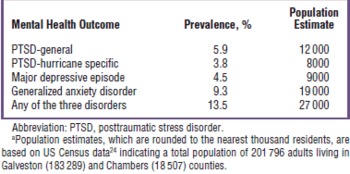
Prevalence of probable mental health diagnoses among adults in Galveston and Chambers counties after Hurricane Ike, and corresponding population estimates, are presented in Table 1. Criteria for PTSD-G were met by 5.9% of the sample since Hurricane Ike, while criteria for PTSD-H were met by 3.8% of the sample. MDE criteria since Ike were met by 4.5% of the sample. Nearly 10% of the sample (9.3%) met criteria for GAD criteria since Ike.
Prevalence of Probable Mental Health Diagnoses Among Adults in Galveston and Chambers, Texas, Counties After Hurricane Ikea

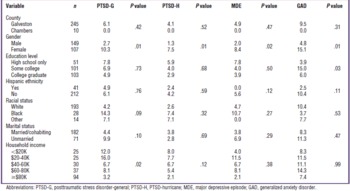
Demographic and disaster-related correlates of mental health diagnoses are presented in Tables 2 and 3, respectively. Consistent with previous research, female gender was associated with increased risk of all four mental health outcomes. Racial/ethnic status, marital status, and county (predominantly urban Galveston, predominantly rural Chambers) were all unrelated to mental health outcomes. Lower levels of income were associated with greater likelihood of PTSD, but income was unrelated to MDE and GAD. Higher educational achievement was associated with a greater likelihood of GAD (Table 2).
Bivariate Associations Between Demographic Characteristics and Postdisaster Mental Health

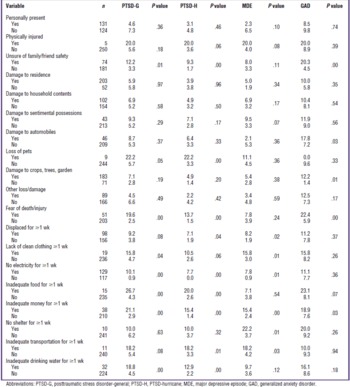
Bivariate Associations Between Hurricane Impact Characteristics and Postdisaster Mental Health

Various indicators of disaster severity were unrelated to mental health outcomes, including damage to one's residence, damage to household contents, and damage to sentimental possessions (Table 3). Two severity variables—damage to automobiles and damage to crops, trees, and/or garden—were associated with increased likelihood of GAD but did not show a strong relation with PTSD or MDE. In contrast, several peritraumatic indicators were strongly related to mental health outcomes, particularly PTSD. These indicators included fear of death or injury; displacement of at least one week; uncertainty about the whereabouts and safety of family or friends; and lack of adequate clean clothing, electricity, food, money, transportation, or water for at least one week. Loss of a pet was associated with both PTSD and MDE. Physical injury was not a statistically significant correlate of mental health outcomes; however, only five cases of physical injury were reported, and therefore analysis of this factor was underpowered.
COMMENT
This study extends the existing literature on the mental health outcomes among disaster-exposed adults by examining the prevalence and risk factors for diagnoses of PTSD, major depression, and GAD in the wake of Hurricane Ike. Extrapolation of the main findings suggest that approximately 27 000 (13.5%) of the 200 000 adults living in Galveston and Chambers counties at the time of Hurricane Ike met criteria for probable PTSD, MDE, and/or GAD during the one-year period post-Ike. Risk for these postdisaster outcomes was associated with a wide range of disaster characteristics.
Our estimate of Ike-related PTSD prevalence was significantly lower than estimates from Hurricane Katrina-affected populationsReference Galea, Brewin and Gruber12 (3.8% vs 16.3%), but similar to other hurricane-affected samples such as the 2004 Florida hurricanesReference Acierno, Ruggiero and Galea11 (Charley, Frances, Ivan, and Jeanne). Differences in prevalence between Katrina- and Ike-affected samples may be associated with measurement differences and disaster severity. Relative similarities in prevalence estimates between residents affected by Hurricane Ike and the 2004 Florida hurricanes, on the other hand, may reflect the consistencies in sampling and measurement approaches across the two studies. Whereas the prevalence of MDE was comparable to findings from the 2004 Florida hurricanes,Reference Acierno, Ruggiero and Galea11 both studies produced lower estimates than national data from the National Comorbidity Survey (NCS).Reference Kessler, McGonagle and Zhao25 Kessler and colleaguesReference Kessler, McGonagle and Zhao25(p14) reported that “virtually all disorders are lowest in the South,” which may partially account for our low MDE prevalence estimate, but measurement differences between this study and those of the NCS also likely played a role.
Consistent with previous research indicating that peritraumatic and postdisaster factors proffer risk for development of postdisaster mental health problems,Reference Galea, Brewin and Gruber12Reference Galea, Ahern and Resnick22Reference Galea, Tracy, Norris and Coffey26Reference Norris and Wind27 the current study found that risk factors spanned the broader categories of potentially traumatic stressors, loss, and ongoing adversities. In fact, unmet basic needs in the immediate postdisaster period were consistently associated with multiple mental health outcomes. This finding suggests that hurricane preparedness (adequate food, water, financial resources, and evacuation plan) and community support of preparedness efforts may have a meaningful and direct impact on postdisaster resilience and mental health recovery.
Limitations
This study provides valuable information on the prevalence and risk factors associated with several postdisaster mental health diagnoses. However, the findings are limited by several factors. First, interviews were conducted in English; therefore, results may not generalize to non-English speaking persons affected by disaster (less than 4% of the Galveston and Chambers county population24). Second, although participants were recruited into the study via random digit-dial procedures, interviews were conducted only with people residing in homes with landline telephones and home Internet access, thus limiting generalizability to populations meeting these inclusion criteria. Approximately three in four households in the United States have Internet access,Reference Smith28 and about three in four households have a landline telephone.Reference Blumberg and Luke29 Third, due to budget restrictions that affected interview length, we were unable to carefully differentiate new-onset episodes of disorder from predisaster episodes. Finally, our interviews were necessarily brief and sample size was relatively small due to budget restrictions.
CONCLUSIONS
Findings from this study build on a growing literature on postdisaster mental health outcomes and risk factors for development of mental health problems. Overall, our results suggest the importance of community support and preparedness not just in the prevention of injury and death, but also in potentially reducing postdisaster mental health risk. Future research should examine the role of preparedness and immediate postdisaster support in mental health outcomes. Further, the significant contribution of factors such as loss of housing, financial means, clothing, food, and water to the development and/or maintenance of negative mental health consequences highlights the importance of systemic postdisaster intervention resources targeted to meet basic needs in the postdisaster period.
Funding/Support: This study was supported by National Institute of Mental Health (NIMH) grant R34 MH77149 (Dr Ruggiero).
Disclaimer: Views expressed herein are those of the authors and do not necessarily reflect those of NIMH or respective institutions.
Additional Contribution: Daniel Loew, MA, Abt SRBI, provided assistance in data collection and management.