

INTRODUCTION: BRONZE AGE LOG-COFFIN BURIALS IN NORTHERN EUROPE
Burial within a hollowed-out tree-trunk was a feature of many regions in northern Europe during the Bronze Age, and such coffins are found in Bohemia, Moravia, Silesia, Germany, and the Netherlands (Parker Pearson et al. Reference Parker Pearson, Sheridan and Needham2013, 29). The best known European examples are, however, those from beneath the Early–Middle Bronze Age barrows in southern Scandinavia, especially Denmark, which contain the extended, supine, burials of both males and females (Boye Reference Boye1896; Glob Reference Glob1974; Holst et al. Reference Holst, Breuning-Madsen and Rasmussen2001; Holst & Rasmussen Reference Holst and Rasmussen2013). Eighteen of the Danish tree-trunk coffin burials have been dendrochronologically dated, and all fall within the period 1396–1268bc (Randsborg & Kristensen Reference Randsborg and Kristensen2006; Parker Pearson et al. Reference Parker Pearson, Sheridan and Needham2013, 29).
In Britain, more than 60 known examples of Bronze Age log-coffins are found scattered across England, Scotland, and Wales, from west Wales to East Anglia and from the Moray Firth to the Isle of Wight (ibid., 29–31). To date, 16 of the British log-coffin burials have been radiocarbon dated to the Bronze Age, with dates ranging from 2500 cal bc to 1320 cal bc (ibid., 41, table 4.2), but with the more recent and reliable radiocarbon dates coming from the earlier part of the range, prior to c. 1800 cal BC. Parker Pearson et al. (Reference Parker Pearson, Sheridan and Needham2013, 40) conclude from the various sources of dating that the use of tree-trunk coffins in Britain is likely to fall between the 22nd and the 17th centuries bc.
The British examples in which there has been bone preservation, such as that excavated at Gristhorpe on the Yorkshire coast in 1834 (Melton et al. Reference Melton, Montgomery, Knüsel, Batt, Needham, Parker-Pearson, Sheridan, Heron, Horsley, Schmidt, Evans, Carter, Edwards, Hargreaves, Janaway, Lynnerup, Northover, O’Connor, Ogden, Taylor, Wastling and Wilson2010; Reference Melton, Montgomery and Knüsel2013), frequently appear to have contained a body in a flexed burial position, but not exclusively so: for example in North Yorkshire, the log-coffin burials at Loose Howe (Elgee & Elgee Reference Elgee and Elgee1949) and Towthorpe (Mortimer Reference Mortimer1905, 3–5) contained extended bodies (Parker Pearson et al. Reference Parker Pearson, Sheridan and Needham2013, 53–65, appx 4.1). Previously published as one of several textiles from Early Bronze Age inhumations (Henshall Reference Henshall1950, 133), the Rylstone example was recently investigated in the search for the earliest wool textiles in Europe (Bender Jørgensen & Rast-Eicher Reference Bender Jørgensen and Rast-Eicher2015, 69).
WILLIAM GREENWELL’S EXCAVATION AT RYLSTONE IN 1864
The Rylstone (Rilston, Rylston, Rylestone) barrow lies within the grounds of Scale House near the village of Rylstone, formerly in the old West Riding but now in North Yorkshire 5 km north of the market town of Skipton (OS Grid Ref. SD 970 568). Greenwell undertook his investigations on 25 October 1864 when he found that the centre of the barrow had been disturbed about a year prior to his excavation (Greenwell Reference Greenwell1877, 375). He described the barrow as being 9.1 m (30 ft) in diameter and 1.5 m (5 ft) high, encircled by a shallow ditch, and containing the following layers encountered during the excavation:
-
i) a layer of flat stones, c 1.8 m (6 ft) in diameter, immediately below the surface of the barrow.
-
ii) A layer of firmly compacted clay.
-
iii) A thin, dark-coloured earthy layer containing charcoal.
-
iv) A layer of finer clay, which appeared to have been tempered.
-
v) A log-coffin, which was ‘carefully embedded’ (ibid.) in the fine clay and laid on more clay with a few stones to help support it.
The coffin was orientated north–south and had been fashioned from the trunk of an oak. It was 2.21 m (7 ft 3in) long and 0.59 m (1 ft 11in) in diameter and tapered, with the wider end to the south; both ends had been partially rounded. The inner hollow was 1.93 m (6 ft 4in) long and 0.30 m (1 ft) wide and had been fashioned using a narrow-bladed metal tool. Greenwell (Reference Greenwell1877, 375) described the coffin as ‘very much broken’, attributing this to the previous year’s disturbance of the barrow. This latter point contrasts somewhat with his account of the apparently intact archaeological stratigraphy that sealed the coffin.
The layer of fine, probably tempered, clay that sealed the coffin is interesting as it resonates with the layer of ‘Puddle, or blue clay’ that sealed the Early Bronze Age log-coffin found at Gristhorpe in 1834 (Williamson Reference Williamson1834, 10–11) and with other North Yorkshire examples (Parker Pearson et al. Reference Parker Pearson, Sheridan and Needham2013, 36). It has been suggested (ibid.) that this could represent a mortuary rite aimed at preservation of the body, with analogies with the Danish log-coffin burials, where experimental archaeology has shown that steps were taken to seal the burial by inducing the formation of a layer of iron pan (Breuning-Madsen & Holst Reference Breuning-Madsen and Holst1995).
All that remained of the body at Rylstone was an ‘unctuous white substance’, which was analysed and found to be of animal origin (Greenwell Reference Greenwell1865, 253; 1877, 376). The corpse, which must have been laid in an extended position with the head to the south, had been wrapped in a wool textile which had survived in a rotten state. Greenwell (Reference Greenwell1865, 254) described the textile as dark brown in colour, probably due to the tannins present in the oak coffin, and as having a coarse, loose texture. Davis (Reference Davis1865, 2 fn), quoting inquiries made of Greenwell, described it as woollen cloth that had been woven. There were no other grave goods and Greenwell’s (Reference Greenwell1877, 376–7) attribution of a Bronze Age date for this burial was based on the fact that it was under a ditched round barrow and on its similarity with other burials from Britain and Denmark. Davis (Reference Davis1865) compared the Rylstone burial with the Gristhorpe coffin and grave goods, and with examples of log-coffin burials from Denmark in which woollen clothing had been present. He, too, concluded that the burial was Bronze Age. In the 1930s, the Rylstone burial was quoted as a key site in an hypothesis that a route traversing Yorkshire was taken by traders from Denmark seeking copper ore from Ireland (Elgee & Elgee Reference Elgee and Elgee1933, 68–9). Greenwell’s and Davis’s Bronze Age attribution for the Rylstone burial has remained to the present day (Parker Pearson et al. Reference Parker Pearson, Sheridan and Needham2013, appx 4.1, no. 9), based largely on the ‘barrow’ aspect of the burial cited by Greenwell.
There have, however, been finds of later log-coffin burials in north-west Britain. Greenwell (Reference Greenwell1877, 377) contrasted Rylstone with log-coffin burials which were not under barrows and which he considered to date from ‘a time several centuries after the Christian era’. These included his excavation of a barrow to the south of Kirby Stephen in Cumbria in which he found a burial on a thick, hollowed, slab of wood with short planks either end, and to which he attributed a post-Roman, possibly Anglian, date (ibid., 384–5). More recently, a canoe-shaped log-coffin found during car park construction works near Quernmore, Lancashire was published as a Bronze Age example (Edwards Reference Edwards1973), but has subsequently been radiocarbon dated to cal ad 430–970 (95.4%) (White Reference White2001). The Quernmore coffin, like the Rylstone example, contained an extended body wrapped in a wool textile, although unlike that at Rylstone it was not buried under a barrow.
THE RADIOCARBON DATES
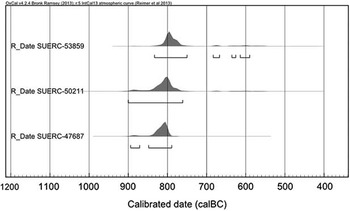
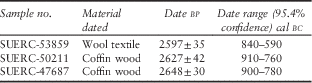
Fragments of the coffin and wool textile excavated by Canon Greenwell are curated in the Craven Museum and Gallery in Skipton (SKIPM:76). A fragment of the textile was illustrated by both Davis (Reference Davis1865, 2) and Greenwell (Reference Greenwell1877, 32, fig. 2). The coffin fragment was sampled for radiocarbon dating (SUERC-47687). This gave a highly unexpected result: a Late Bronze Age–earliest Iron Age measurement of 2648±30bp, calibrating to 900–780 cal bc (95.4%). If the date range estimated by Parker Pearson et al. (Reference Parker Pearson, Sheridan and Needham2013, 40) for the British examples of 22nd–17th centuries bc is used, the Rylstone coffin is approaching a millennium later than the latest of the other British Early Bronze Age coffins, and is approximately half a millennium later than the Danish examples. It was therefore considered important that a second date be obtained for the coffin. The sample for this second date (SUERC-50211) was taken from the same side of the surviving coffin fragment and produced a statistically indistinguishable measurement of 2627±42 bp, calibrating to 910–760 cal bc (95.4%).
As a further check on the date of the burial and to ensure that there had been no mix-up in the century and a half that the items had been curated, a thread from the textile was also submitted for radiocarbon dating (SUERC-5389). This produced a radiocarbon age of 2597±35bp (840–590 cal BC; 95.4%). The results of the three radiocarbon dates are given in Table 1 and Figure 1. A Chi-squared test indicates that they are indistinguishable from one another (T=1.22 (Χ2 P=0.05=5.99)). The two wood samples were so close that they were regarded as representative of the same point in time and a weighted mean calculation produced an age of 2641±25bp. This provides a calibrated date of 840–790 cal bc (95.4%) for the coffin.
Multiplot of the calibrated age ranges for the coffin and textile

Radiocarbon Dates Obtained from the Rylstone Coffin & Textile (Calibrated Using Oxcal v4.2.4)

THE WOOL TEXTILE
Additional fragments of the Rylstone textile are archived in the British (1879.1209.2064-7, 1879.1209.1595, 1873.1209.219) and Ashmolean (AN1983.201) Museums, and are well represented in the literature (Henshall Reference Henshall1950, 131–3; Crowfoot in Kinnes & Longworth Reference Kinnes and Longworth1985, 97; Bender Jørgensen 1992, 19, 197).The largest fragment in the British Museum (1879.1209.2064) measures 170×120 mm. On the basis of technical similarities, the fragments appear to belong to the same textile, which is consistent with Greenwell’s description when it was excavated: ‘The corpse had been enveloped in a woollen fabric, enough of which remained to show that it had reached from head to foot. It was very rotten ... it was impossible to recover any but small pieces of it, or to prove whether the body had been laid in the grave in its ordinary dress or simply wrapped in a shroud’ (Greenwell Reference Greenwell1877, 376). Whether this textile was a shroud, blanket, cloak, or other large garment is thus unclear. Well preserved textiles of these kinds have been identified in the male and female earlier Bronze Age barrow burials of southern Scandinavia (Broholm & Hald Reference Broholm and Hald1940; Bergerbrant Reference Bergerbrant2007, 49–61; Mannering et al. Reference Mannering, Gleba and Bloch Hansen2012, 97–102).
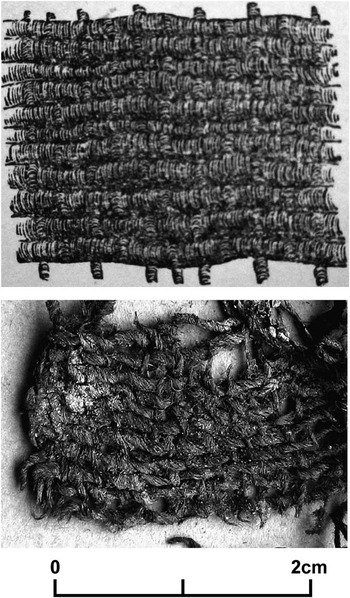
The Rylstone textile is woven in tabby (plain weave) which is a simple one over, one under configuration alternating in each row (Fig. 2). The threads of both systems are single z-spun yarns. As there are no selvedges or starting borders, the attribution of warp and weft is a matter of judgement. In Crowfoot’s opinion, the finer and more tightly spun yarn is probably the warp (Crowfoot Reference Crowfoot1979, 1), as previously observed by Henshall (Reference Henshall1950, 136). Measured with digital callipers, the warps of the textile in the British Museum have a diameter ranging from 0.35–0.8 mm and the weft 0.5–1.0 mm. The weave density is also somewhat irregular; there are 7–11 threads per cm in the warp and 8–9 threads per cm in the weft. The textile is dark brown, presumably due to staining from the burial environment.
The Rylstone textile, (U) As illustrated by Greenwell in 1877 and (L) detail of the Craven Museum and Gallery fragment (photograph: J.R. Towers)

Sheep’s wool is known in Britain from the Early Bronze Age, as attested by organic remains identified by Walton-Rogers as wool or sheepskin in a cist burial from Spinningdale, Scotland (2051–1911calbc; Arabaolaza et al. Reference Arabaolaza, Ballin Smith, Clarke, Ramsay and Walton Rogers2013, 15). There are a handful of Late Bronze Age textiles in Britain and Ireland made of plant fibres, wool, and horsehair, mostly from the north and west (Wincott Heckett Reference Wincott Heckett2012, 432–3). These include wool textiles wrapped around or adhering to hoards excavated from St Andrews Fife, Scotland (Ewart Park Phase, 9th–8th centuries bc) and Cromaghs, Co. Antrim, Northern Ireland (900–500bc) and textiles from a mound deposit at Killymoon, Co. Tyrone, Northern Ireland (c. 1000bc) (Gabra-Sanders Reference Gabra-Sanders1994, 36; Wincott Heckett Reference Wincott Heckett1998, 29–30; Reference Wincott Heckett2007, 28). Although few, the wool textiles are typically tabbies of z-spun yarn, and in this technically the Rylstone textile fits well. The plant fibre textiles follow a different pattern, and more complex weaves are known. For example, also from Cromaghs comes an ornamental horsehair band, woven in broken twill and finished in elaborate tassels (Wincott Heckett Reference Wincott Heckett1998, 31–2; 2012, 433–4). The new radiocarbon date for the Rylstone textile adds another example to what is currently a rather small corpus of preserved Late Bronze Age/earliest Iron Age wool textiles from Britain.
DISCUSSION
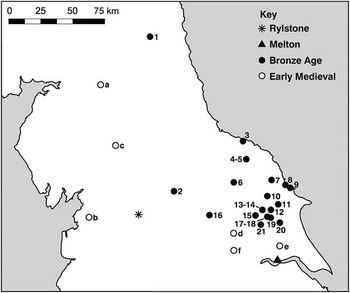
The statistically indistinguishable radiocarbon dates obtained from the Rylstone coffin and textile clearly demonstrate that it was not the case of the re-use of an Early Bronze Age coffin. Prior to these dates being obtained from the Rylstone example, log-coffin burials found in Britain had, with one exception discussed below, fallen into two distinct chronological groupings. The first comprises the Early Bronze Age examples which are distributed throughout England, Scotland, and Wales (Fig. 3), with three main concentrations in East Yorkshire, Wessex, and the south coast, and in Leicestershire and Cambridgeshire (Parker Pearson et al. Reference Parker Pearson, Sheridan and Needham2013, 30–1, fig. 4.1). They range in date from the 22nd to 17th centuries bc (ibid., 40) and represent a high status burial rite. Many contain grave goods that include bronze daggers and knives and, especially in the southern cluster in Wessex and the south coast, exotic items such as the amber and shale cups found in log-coffin burials at Hove and Stoborough (Stowborough) respectively (ibid., 37).
Distribution of log-coffin burials in northern England (based on Parker Pearson et al. Reference Parker Pearson, Sheridan and Needham2013, fig. 4.1, with additions). Early Bronze Age: 1. Cartington; 2. West Tanfield; 3. Howe Hill, Brotton; 4–5. Loose Howe; 6. Pockley, Oxclose Farm; 7. Hutton Buscel; 8. Irton Moor; 9. Gristhorpe; 10. West Heslerton; 11. Beacon Hill, Ruston Parva; 12. Willie Howe; 13–14. Towthorpe; 15. Hanging Grimston; 16. Little Ouseburn; 17–18. Wetwang Slack; 19. Garton Slack; 20. Old Sunderlandwick. 21. Calais Wold XIV. Early medieval: a. Wydon Eals; b. Quernmore; c. Kirby Stephen; d. St Saviour Gate and Parliament Street, York; e. Beverley Parks; f. Selby Abbey

The second group of British log-coffins dates from the early medieval period. They have been found mainly in the north and east of England (Fig. 3), and include examples excavated at Wydon Eals, near Featherstone Castle in Northumberland (Wallace Reference Wallace1832; Snagge Reference Snagge1873; Whiting Reference Whiting1937, 96–98; Parker Pearson et al. Reference Parker Pearson, Sheridan and Needham2013, 66, appx 4.2) and in East Yorkshire, where such coffins have been found at Church Hill, Selby (Snagge Reference Snagge1873), at Beverley Parks (Gomme Reference Gomme1886, 83; Wright Reference Wright1857; Greenwell Reference Greenwell1865, 254 fn; 1877, 377fn; Whiting Reference Whiting1937, 100–1; Mowat Reference Mowat1996, 140) and at St Saviour Gate and Parliament Street, York (Elgee & Elgee Reference Elgee and Elgee1933, 209–10; 1949, 102). Examples from elsewhere in northern England include those from Quernmore and Kirby Stephen mentioned previously. In the south of England, ‘Arthur and Guinevere’ were found by monks in the 12th century in a log-coffin burial in Glastonbury Abbey (Wallace Reference Wallace1832, 177). In Scotland, two log-coffins containing the bodies of a male and a female were found on the Castlehill, Edinburgh in 1851 (Mowat Reference Mowat1996, 86; Parker Pearson et al. Reference Parker Pearson, Sheridan and Needham2013, 29). The interiors of the coffins had been shaped with recesses for the head and arms in the manner of medieval stone coffins and these examples appear to date to the High Medieval period (ibid.). The early medieval log-coffins differ from the Bronze Age examples in a number of ways: the lid and base are pegged together; the bark has been removed; they do not contain grave goods; they are not associated with barrows; and they can occur in cemeteries, for example, at Wydon Eals and Selby.
The Rylstone log-coffin, therefore, represents a previously unrecognised and distinct chronological occurrence in Britain for this type of high-status funerary practice. The dates obtained from both the coffin and the fragment of textile place this burial at around 800bc, on the Late Bronze Age–earliest Iron Age transition (Needham Reference Needham2007). A tantalising hint that iron objects might have been present in the coffin is provided by the noted anatomist and antiquarian J. Barnard Davis (Reference Davis1865, 2) in his description of ‘pieces of a bright black substance like pitch, which appeared to have been placed on the inside of the coffin, on examination are found to be (Fe3O4)’. Lustrous black oxide is often left behind when iron objects have entirely decayed in anoxic environments (Cronyn Reference Cronyn1992, 184). There are a small number of iron objects that have been found primarily in southern and eastern England such as socketed axes, socketed spearheads, a rivet, and a sword which, whilst frequently lacking archaeological contexts, appear to be typological imitations of Late Bronze Age–earliest Iron Age forms (Collard et al. Reference Collard, Darvill and Watts2006, table 6, fig. 19; Roberts et al. Reference Roberts, Boughton, Dinwiddy, Doshi, Fitzpatrick, Hook, Meeks, Woodward and Woodward2015). This includes three sites in Yorkshire, although none is entirely unproblematic in terms of the dating. These three sites encompass: Castle Hill, Scarborough, where an iron rod was excavated in the same pit context as a Late Bronze Age (Ewart Park metalwork phase) bronze socketed axes of Type Yorkshire (see Collard et al. Reference Collard, Darvill and Watts2006, 413 for analysis and discussion); three pieces of iron from ditch fills at the hillfort at Grimthorpe (Stead Reference Stead1968, 166 nos 5–7) of which two were found within or just above a deposit dated to 1150–400 cal bc (2640±130bc; NPL-136; see Collard et al. Reference Collard, Darvill and Watts2006, 413); and two iron pins from the fortified hilltop settlement at Staple Howe dating from 753–402 (68.2%) and 765–350 (95.4%) cal bc (Dent Reference Dent2010). The recent excavation of an iron furnace and substantial quantities of iron slag at Greetwell Hall Farm, Messingham, Scunthorpe which is securely radiocarbon dated to c. 780–590 cal bc provides the earliest evidence for iron production in northern England, and potentially in Britain (Pitts Reference Pitts2016). The interpretation of iron objects being placed within the log-coffin at Rylstone and subsequently decaying prior to their discovery is obviously provisional due to the lack of modern post-excavation analyses. There are also currently no known funerary sites in Britain dating to the Late Bronze Age–earliest Iron Age transition where iron objects have been recovered. However, it is worth noting that iron objects play an especially prominent role in funerary deposits in the Iron Age of East Yorkshire (Giles Reference Giles2007; Reference Giles2012; Dent Reference Dent2010; Halkon Reference Halkon2011) and there is now widespread evidence for Iron Age iron production in the region (Halkon Reference Halkon2011).
Rylstone, the most westerly of the Bronze Age log-coffin burials in Yorkshire, clearly has close associations with its Early and Middle Bronze Age predecessors in North and East Yorkshire. Rylstone may, therefore, represent a continuing, or perhaps re-discovered and re-instated local tradition, especially as it appears that the funerary rite included sealing the coffin with clay (Parker Pearson et al. Reference Parker Pearson, Sheridan and Needham2013, 36).
However, given the centuries that had passed since the earlier Bronze Age log-coffins were felled, prepared, and interred, this continuity is surprising. It is even more surprising as this elite burial rite is virtually unique in the contemporary archaeological record of north-west Europe with only one other log-coffin burial known for this date in Ireland, Britain, or the near continent from north-west France to southern Scandinavia. Cremation was the dominant funerary rite throughout north-west Europe during the early 1st millennium bc, frequently in flat graves or older monuments and with few grave goods (Bradley et al. Reference Bradley, Haselgrove, Webley and Vander Linden2016, 246–50).
With the exception of the recently discovered site of Melton, East Yorkshire (Fenton-Thomas Reference Melton, Montgomery, Knüsel, Batt, Needham, Parker-Pearson, Sheridan, Heron, Horsley, Schmidt, Evans, Carter, Edwards, Hargreaves, Janaway, Lynnerup, Northover, O’Connor, Ogden, Taylor, Wastling and Wilson2010), Rylstone stands in stark contrast to what is known from elsewhere in Britain during the Late Bronze Age–earliest Iron Age (Brűck Reference Brűck1995; Thomson Reference Thomson2011; Roth Reference Roth2012; Warden et al. Reference Warden, Caswell and Robertsforthcoming). Burial in this period in Britain has previously been notable for being difficult to detect archaeologically, with human remains in southern Britain occurring in cremated or disarticulated forms and fragments placed without grave goods in a range of contexts associated with settlements, especially in enclosure ditches (Brűck Reference Brűck1995, 257). They have been interpreted as associated with the ritual destruction of the corpse, either by cremation or by excarnation and disarticulation, and linked to changing social and economic conditions (ibid., 262–3). A recent comprehensive examination of evidence for disposal of the dead in the Late Bronze Age (c. 1100–800bc) just to the north of Rylstone in the Tyne–Forth region of north-east England and south-east Scotland (Warden et al. Reference Warden, Caswell and Robertsforthcoming), revealed only 12 sites, with only two radiocarbon and three typologically dated sites which are potentially contemporary. In the Tyne–Forth region, the evidence indicates that a similar rite of dispersal of both cremated and unburnt remains was being practised to southern Britain, although deposition of the remains was generally in pits and associated with older monuments in the landscape rather than with settlements. The layer of ‘carefully arranged’ flat stones that Greenwell encountered ‘immediately below the surface’ of the Rylstone barrow (Greenwell Reference Greenwell1877, 375) is unusual and may be associated with the disturbance of the barrow the year prior to Greenwell’s excavation. If not, it raises the possibility that the log-coffin had been inserted into an earlier Bronze Age barrow and is, therefore, also another Late Bronze Age–earliest Iron Age re-use of an earlier monumental site.
The secondary burial of urned and unurned cremations in earlier barrows, as well as in contemporary settlements and enclosures, during the Late Bronze Age is found throughout Yorkshire (see Manby et al. Reference Manby, King and Vyner2003) though radiocarbon dating is required to distinguish Middle and Late Bronze Age funerary rites. For example, recent excavations at Melton Area 2–3 revealed five aceramic cremations in and outside of a barrow ring-ditch with one in Pit 1224 dated to 1027–842 cal bc (Wk-21864 2795±35bp; Fenton-Thomas Reference Fenton-Thomas2010). A further cremation, in a truncated pot with charcoal was excavated at Preston in Holderness and dates to 1107–1088 cal bc (Poz-25567 2825±35bp; Savage Reference Savage2013, 101–2). Beyond these cremation deposits, there is one burial, and possibly two, which are potential contemporary parallels to Rylstone. Recent excavations of a group of seven inhumations dating to the 8th–6th centuries bc at Melton, East Yorkshire revealed one ?male adult individual (Skeleton 2722) a flexed inhumation on the left side orientated north–south within the soil stain of a wooden, and very probably log, coffin (Fenton-Thomas Reference Fenton-Thomas2010, 50, fig. 29, pls 18–19; table 17; 566). The burial was accompanied by one sherd of Early Bronze Age and one of Early Iron Age pottery but the skeleton was radiocarbon dated to 800–500 cal bc (Wk 21865 2522±47bp) and the placing of earlier pottery in later graves is known in the region (Manby et al. Reference Manby, King and Vyner2003, 60). This burial had cut into an earlier grave of a flexed adult male (Skeleton 3397) which revealed soil stains of a wooden coffin or stretcher as well as Beaker pottery sherds from seven different vessels, The burial was not radiocarbon dated but is paralleled by late 3rd millennium bc burials in the region (ibid., 46–8). The excavators propose two explanations: either that a late 3rd millennium bc grave was cut over a millennium later by the earlier 1st millennium bc log-coffin burial; or that both graves were dug in the early 1st millennium bc and either disturbed or removed an earlier grave (ibid., 49). Given the narrow interior width of the Rylstone log-coffin, it would appear to be impossible that an adult inhumation could have been deposited in a flexed position. Manby (Reference Manby1986, 71) highlights the cairn site at Roomer Common, Yorkshire as potentially dating to the Late Bronze Age due to the associated ceramic sherds. It comprised a small round cairn with a wide ditch that contained a stone-lined cist that originally had a wooden cover. No bones were found in the acidic soil, potentially implying an inhumation, and iron fragments were found between the stones of the cist that could have resulted from a collapse. The evidence is fragmentary and the dating is disputable in the latter case, yet these sites are the closest potential parallels to Rylstone in the region.
As a consequence, it is increasingly evident that there is a far greater diversity in funerary practice in Late Bronze Age–earliest Iron Age Britain than has previously been recognised. The antiquarian excavation of numerous unburnt bones, including crania, accompanied by animal bones, metalwork, and ceramics in Heathery Burn Cave, Co. Durham (Greenwell Reference Greenwell1894) highlighted the potential funerary depositions within these natural phenomena during the Late Bronze Age. The radiocarbon dating of human remains excavated at Sculptor’s Cave, Covesea, north-east Scotland (Armit et al. Reference Armit, Schulting, Knüsel and Shepherd2011) and at Raven Scar Cave, Yorkshire (Leach Reference Leach2005) to the Late Bronze Age further supports the use of caves in funerary rites during this period. The dating of human crania and bones found in rivers and lakes to the Late Bronze Age in Britain implies the potential contemporaneous importance of funerary rites in watery contexts (Bradley & Gordon Reference Bradley and Gordon1988; Schulting & Bradley Reference Schulting and Bradley2013). Human crania and bone fragments were also found in Late Bronze Age–earliest Iron Age levels in the substantial midden sites of Potterne (Lawson Reference Lawson2000) and East Chisenbury (McOmish Reference McOmish1996), Wiltshire, England. Further previously unrecognised Late Bronze Age funerary complexities in Britain are suggested by the settlement site of Cladh Hallan, Uist, Scotland, where Middle Bronze Age human remains were preserved for re-use and re-burial alongside Late Bronze Age human remains (Parker Pearson et al. Reference Parker Pearson, Chamberlain, Craig, Marshall, Mulville, Smith, Chenery, Collins, Cook, Craig, Evans, Hiller, Montgomery, Schwenninger, Taylor and Wess2005; Booth et al. Reference Booth, Chamberlain and Parker Pearson2015). The recent excavation of a large mortuary feature at Cliff’s End Farm, Kent, England revealed a minimum of 24 individuals dating to the Late Bronze Age who not only had been subject to differing mortuary practices including exposure, excarnation, and curation, but also had strontium and oxygen isotope ratios suggestive of diverse geographical origins (McKinley et al. Reference McKinley, Leivers, Schuster, Marshall, Barclay and Stoodley2015). Rather than seeing the dating of a log-coffin burial at Rylstone to c. 800bc as a surprise anomaly, it should be seen more as a challenge for us to re-evaluate our interpretations of the disposal of the dead at the Late Bronze Age–earliest Iron Age transition in Britain.
Acknowledgements
Martin Wills, Craven Museum and Gallery, Skipton kindly gave access and permission to sample the coffin and textile fragments for radiocarbon dating. The authors are grateful to Quentin Bourgeois, Catherine Draycott, David Fontijn, Mette Løvschal, Brendan O’Connor, John Waddell, and Eugène Warmenbol for discussions of potential parallels for the Rylstone burial. They are especially grateful to Terry Manby for detailed comments and bringing the site at Melton to their attention. Thanks also to Jacqueline Towers for photographing the textile and to Peter Montgomery for assistance in the preparation of Figs 2 & 3. NDM acknowledges Rob Janaway’s assistance in sampling the Craven Museum and Gallery textile fragment for radiocarbon dating.