Introduction
Feeling useful is of essential significance for people in need of assistance in person-centered and relationship-centered care (Kitwood, Reference Kitwood1997; Nolan et al., Reference Nolan, Davies, Brown, Keady and Nolan2004; van Vliet et al., Reference van Vliet2011). People in need of assistance describe being useful as “being helpful to others” (Guse and Masesar, Reference Guse and Masesar1999; Gerritsen et al., Reference Gerritsen2007; Vernooij-Dassen et al., Reference Vernooij-Dassen, Leatherman and Olde Rikkert2011). The term “sense of purpose” has also been used, which refers to “opportunities to engage in purposeful activity facilitating the constructive passage of time, to be able to identify and pursue goals and challenges and to exercise discretionary choice” (Nolan et al., Reference Nolan, Davies, Brown, Keady and Nolan2004). Feeling useful has been linked to dignity, self-esteem (Vernooij-Dassen et al., Reference Vernooij-Dassen, Leatherman and Olde Rikkert2011), and giving meaning to life (Gerritsen et al., Reference Gerritsen2007) and is important for quality of life and social well-being (Guse and Masesar, Reference Guse and Masesar1999; Gerritsen et al., Reference Gerritsen, Steverink, Ooms and Ribbe2004; Byrne-Davis et al., Reference Byrne-Davis, Bennett and Wilcock2006; Gerritsen et al., Reference Gerritsen, Steverink, Frijters, Ooms and Ribbe2010).
However, dementia compromises a person's sense of usefulness and causes loss of ability across many domains. People with dementia become increasingly dependent on their informal and/or professional caregivers. These losses are experienced by all people with dementia but may be particularly complex for people with Young Onset Dementia (YOD). In people with YOD, dementia symptoms start before the age of 65 years and interrupts roles inextricably linked to a younger life phase such as being a parent, financial provider, or colleague, thus undermining sense of identity and self-esteem (Beattie et al., Reference Beattie, Daker-White, Gilliard and Means2004; Harris and Keady, Reference Harris and Keady2009; van Vliet et al., Reference van Vliet, de Vugt, Bakker, Koopmans and Verhey2010; Roach and Drummond, Reference Roach and Drummond2014). Focusing on strengths and providing opportunities to feel useful may help restore self-esteem, provide a greater sense of control, and empower people with YOD.
Currently, healthcare providers focus too little on people's strengths and their need for reciprocity (van Vliet et al., Reference van Vliet2011; Vernooij-Dassen et al., Reference Vernooij-Dassen, Leatherman and Olde Rikkert2011; Millenaar et al., Reference Millenaar2016). In a study on professional dementia caregivers’ attention to quality of life domains, it appeared that especially the domain “being useful/giving meaning to life” received little attention (Gerritsen et al., Reference Gerritsen2007). Another large study showed that having meaningful daytime activities was one of the most unmet needs reported for people with YOD (Bakker et al., Reference Bakker2014b). Since “being useful” is a domain that holds many opportunities to empower people with dementia, it is important that we expand our knowledge of these potential empowerment opportunities and enable healthcare providers to better connect to strengths and reciprocity in the daily life of people with YOD and their caregivers. Therefore, this study explores how people with YOD shape their daily lives to retain a sense of usefulness.
Methods
Participants
Day-care centers affiliated with the Dutch Young-onset Dementia Knowledge Centre, providing care and support for people with YOD, were asked to participate in the study. Three day-care centers from geographically dispersed areas in the Netherlands were willing to participate. Day-care-center staff asked people with YOD and their caregivers to participate in a focus group session. Those invited were eligible to participate if (1) dementia was diagnosed, (2) symptom onset was before the age of 65 years, (3) they were living in the community, and (4) a healthcare professional of the participating organization deemed them able to participate in a group discussion. Family caregivers were relatives, partners, or friends who had a significant personal relationship with, and provided a broad range of assistance to, a person with YOD for at least three months and/or more than 8 hours per week. Family caregivers were not necessarily related to the participating persons with YOD. In total, 18 people with YOD and 21 caregivers participated in this study. Eight focus groups were conducted: four with people with YOD and four with informal YOD caregivers.
Data collection
A focus group discussion guide was developed (Patton, Reference Patton1998) based on the literature about needs in YOD and the literature about meaningful activities in people with dementia. Four clinical experts in YOD were consulted and provided input on the guide. This guide was edited according to their input following a consensus meeting of the project group. In the focus groups, four themes were discussed: “Major changes since diagnosis,” “Wishes, needs and satisfaction with regard to daily activities, family and social relationships,” “Feeling useful,” and “Improving self-esteem.”
During discussions, participants were encouraged to express their views on their current daily activities and the activities they consider important for feeling useful, on how dementia affects their daily lives, and on strategies they have employed to retain a sense of usefulness. The questions were open ended and asked broadly to enable a range of responses. Focus groups were organized separately for people with YOD and for informal caregivers. Caregivers discussed their views about the lives of the people they were caring for. In focus groups for people with YOD, the questions were formulated using language that was clear and easy to understand.
Discussions were facilitated by a skilled moderator and lasted approximately 2 hours. An observer was also present. The moderator and the observer held a debriefing session afterwards and adapted the discussion guide if necessary. The discussions were tape recorded with participant consent and transcribed verbatim. Demographic data such as age, gender, education, living situation, type of dementia, and duration were collected.
Data analysis
Transcripts of the discussions were entered into Atlas.ti and inductive qualitative content analysis was conducted to derive codes, categories, and themes from the data (Graneheim and Lundman, Reference Graneheim and Lundman2004; Elo and Kyngas, Reference Elo and Kyngas2008). Two researchers (DvV and AP) read the transcripts to acquire an overall understanding of the content and discussed their views on important issues related to the study aim.
According to Dutch Quality Institute for Health Care (CBO) guidelines for conducting focus groups, evaluation of results after three focus groups is necessary, because most information is collected during the first two focus groups (Dutch Quality Institute for Health Care, 2004). Therefore, the first six transcripts (three YOD groups and three caregiver groups) were coded independently by two researchers (DvV and AP) using open coding. Analysis was done on the Dutch-language transcripts. The two researchers developed a coding system that included codes and categories. Codes that were related in terms of meaning or content were merged into categories. A consensus meeting was held to reach agreement on the coding system. In a second phase, the coding system was validated by applying it to the last two transcripts (Friese, Reference Friese2012). In the seventh and eighth focus groups, saturation of the data occurred as no new information emerged. Both researchers conceptualized the underlying meanings of the categories in overall themes. A consensus meeting was then held to reach final agreement on the developed themes. Finally, during two meetings that included a third researcher (DG), a conceptual framework that represented the content and relationships between the categories and themes was discussed. Relevant quotes illustrating the results were translated from the original Dutch into English by the first author (DvV) and checked by a native English speaker.
Ethical considerations
The study was conducted in accordance with both Dutch law and the Declaration of Helsinki. The study protocol was reviewed by the local Medical Ethics Review Committee “CMO Regio Arnhem-Nijmegen” (number 2012/307), which stated that the study was not subject to the Medical Research Involving Human Subjects Act (World Medical Association, 2013). Verbal and written informed consent was obtained from all participants and audio recordings of the focus group interviews and data were analyzed using unique and anonymous codes.
Results
Participant characteristics
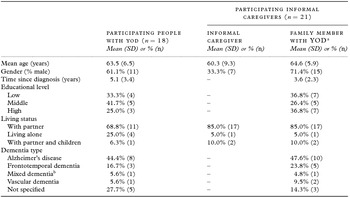
Demographic characteristics of the participating people with YOD and of the participating caregivers and their family member with dementia are shown in Table 1. The YOD groups consisted of 11 males and 7 females in total, with a mean age of 63.50 (SD = 6.51). Education level was low (primary school) (n = 4), middle (advanced elementary or occupational education) (n = 5), high (higher education, university) (n = 3), and missing in six cases. Eleven YOD participants were living with their partner, one was living with partner and children, and four were living alone or in an assisted living facility. In two cases, this information was missing. Eight YOD participants had Alzheimer's disease, one had mixed dementia (Alzheimer's and vascular dementia), one had vascular dementia and three had frontotemporal dementia. In five cases, the dementia type was not specified. The stage of dementia varied between YOD participants. The average time since diagnosis was 5.1 (SD = 3.4) years (n = 14).
The caregiver participant groups consisted of 7 males and 14 females, with a mean age of 60.29 (SD 9.28). The family member with YOD (not all participating) whom these caregivers cared for had a mean age of 64.4 (SD 5.9). Education level of the family member with YOD was low (n = 7), middle (n = 5), high (n = 7), and missing in two cases. The caregiver participants were spouses of a person with YOD, except in one case in which a son was the caregiver. Seventeen caregiver participants were living with their partner, two were living with partner and children, and in one case, the family member with YOD was living in an assisted living facility. The family members of caregiver participants had Alzheimer's disease (n = 10), mixed dementia (n = 1), vascular dementia (n = 2), frontotemporal dementia (n = 5), or a not specified dementia type (n = 3). They were diagnosed with dementia on average 3.6 (SD = 2.3) years prior (n = 20).
Demographic characteristics of the participating people with YOD and participating informal caregivers and their family member with YOD

aCharacteristics of the people with YOD who were being cared for by the participating informal caregivers.
bAlzheimer's and vascular dementia.
Focus group discussions and themes
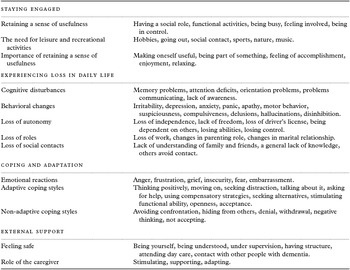
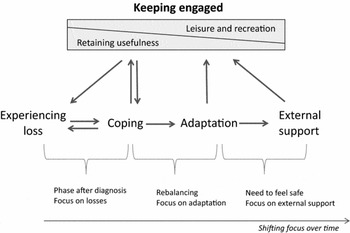
The inductive qualitative content analysis resulted in four themes: (1) staying engaged, (2) loss in daily life, (3) coping and adaptation, and (4) external support. Table 2 shows an overview of the codes, categories, and themes. These themes are integrated in a conceptual model, as displayed in Figure 1, incorporating the finding that the content and relevance of these themes changed during progression of the dementia.
Overview of the codes, categories, and themes

Conceptual model of results. The themes emerging from the qualitative analyses of focus groups with persons with YOD and caregivers concerning the topic of retaining a sense of usefulness.

Staying engaged
Retaining a sense of usefulness
The key theme that emerged from the analyses is the importance for people with YOD of staying engaged in daily life as much as possible through tasks such as those related to previous occupations or the household, or through participation in activities for leisure and recreation. Activities can provide a sense of usefulness for some people with YOD:
I still do several chores here (at the day care center). I help distribute paper and detergent and I like that. To me it is important to keep busy, because I like to be physically active. (66-year-old man diagnosed with Alzheimer's disease)
Loss of autonomy and loss of roles were mentioned as having an impact on one's sense of usefulness, but it was still considered possible and important to retain a sense of usefulness, especially for the relatively young and in the early stages of dementia:
I don't miss my work anymore after 46 years, I liked it when I retired. But I understand it is different for you. You are much younger. (68-year-old man, diagnosed with dementia NOS, responding to a 53-year-old woman diagnosed with mixed dementia (Alzheimer's disease and vascular dementia).
Functional activities like housekeeping and gardening at home or at a day-care center were seen as opportunities for feeling useful:
That I still can cook sometimes and do the laundry gives me satisfaction. My cooking, it isn't always flawless, but I manage. Then I think ‘look, they say you have it (dementia), you wear the stigma, but you are still fine, you are doing it. (52-year-old woman diagnosed with Alzheimer's disease)
Some people with YOD reported being able to perform work or work-related activities at a day-care facility, which they highly valued. One person with YOD reported having worked as a postman for several years after he was diagnosed. Furthermore, social relationships were also seen by participants with dementia and caregivers as important to a sense of usefulness. Participants provided examples of such interactions as helping others, watching grandchildren, participating in conversations, and being asked for advice by their children, etc.
Importance of retaining a sense of usefulness
In talking about activities that provided a sense of usefulness, some participants also described feelings of accomplishment, being in control, still being meaningful, and being part of something:
I didn't want to cook dinner at Christmas, but my children said, let's do it together. I felt useful, because they still came to ask me things. I thought, yes I'm still here. (53-year-old woman diagnosed with mixed dementia (Alzheimer's disease and vascular dementia).
The need for leisure and recreational activities
Next to activities providing a sense of usefulness, activities for leisure and recreation constituted a major source of daily activity in people with YOD. Examples of leisure and recreation were hobbies, outings, music, nature, and sports. These activities often involved social engagement, and while the importance of activities providing a sense of usefulness appeared to decrease over time, the need for leisure and recreation seemed to increase. Activities for leisure and recreation like going for a walk or listening to music were seen mainly as ways to relax and enjoy life, but also as the only type of activities during which engagement was still possible in the later stages of dementia. The content of activities depended on previously performed activities and the personal interests of the person with dementia. Some participants with YOD mentioned discovering new activities they liked:
I have a lot of interests. I have always played in an orchestra, but I had to let it go. I still listen to music a lot, pop music for example. I always borrow CDs and DVDs from the library. (66-year-old man diagnosed with Alzheimer's disease)
Changes over time
Several caregivers specifically described their spouse as having different preferences in an earlier stage of dementia than in a later stage of dementia. Participants mentioned that the need to retain a sense of usefulness decreased in the course of the dementia. In the later stages of dementia, the need for leisure and recreational activities seemed to increase:
For my husband, in the beginning feeling useful was important. He was proud when he had vacuumed or helped someone, but that is especially important in the beginning. Now that he is unable to do that anymore, he no longer think about it. (69-year-old wife of a man diagnosed with Alzheimer's disease).
Other respondents also mentioned this change over time:
Unbelievably, he continued to work as usual until three years ago. And he felt happy with that. Going to work every day made him feel useful. Now, this is impossible. (55-year-old wife of a man diagnosed with vascular dementia)
And one husband said about his wife:
Yes, in fact she used to organize the household but say two years ago this decreased and for the last year and a half she has not even thought about doing something or of being useful. In the beginning, she was interested in undertaking useful activities, but that interest decreased as the dementia progressed. Because you knew her condition would change, or might change, we did as many nice activities as possible, like going to concerts for example (man, age unknown, of a woman diagnosed with Alzheimer's disease).
Experiencing loss in daily life
Participants reported experiencing loss at different times during the progression of the dementia, but it was considered most prominent in the early stages when people had to cope with the diagnosis and often with the loss of their jobs:
When you hear you have dementia, you try to occupy yourself at home. I started doing more in the household, but that didn't go well, which was very frustrating. So I didn't go out of the house anymore and became very passive, because I just missed my work . . . I missed the engagement. (52-year-old woman diagnosed with Alzheimer's disease)
Cognitive disturbances
Participants with YOD considered cognitive disturbances an important barrier to doing the things they used to do and still wanted to do. They found their own cognitive problems and deteriorating abilities confusing and confronting:
It makes me sad, because if I watch the news three times, I only remember two things. And then I think: why? What's wrong with you? Things a child would understand, I don't understand now. That's why I don't watch movies anymore. (69-year-old woman diagnosed with frontotemporal dementia)
Behavioral changes
Caregivers reported primarily on the behavioral changes of their close family member rather than on the cognitive deterioration:
During the weekends I feel like a prisoner in my own home. My husband sits down on the couch and that's it. I try to stimulate him by asking him to walk the dogs with me. But he doesn't do that anymore. (55-year-old wife of a man diagnosed with vascular dementia)
Loss of autonomy and roles
Participants with YOD also described experiencing a great loss of autonomy and freedom. They talked about this in terms of missing their normal life in which they could effortlessly perform daily tasks such as driving a car, going to work, and doing housework. Parenting and partner roles also changed. Loss of both autonomy and social roles was linked to loss of opportunity to feel useful. One of the youngest participants in particular found it especially difficult to find things that provided a sense of usefulness:
You still feel useful watching the grandchildren. But I have really young children and that hurts. I don't feel useful when I do some house cleaning. . . But I am writing a book on YOD now. I want to be an advocate for people with YOD. That gives me a sense of usefulness. (52-year-old woman diagnosed with Alzheimer's disease)
Loss of social contacts
Another major loss mentioned by many people with YOD and caregivers is the loss of social contacts and lack of understanding from their environment. People with YOD reported being less engaged in social activities due to loss of social contacts. Misunderstandings and avoidance by family and friends were reported to cause much pain and grief for people with dementia and their caregivers. Both groups advocated for more awareness, societal knowledge, and information about dementia:
I don't know if everyone with dementia experiences this, but you lose a large part of your network. It seems like you have a contagious disease. They don't want to come near you and that hurts. (53-year-old woman diagnosed with mixed dementia (Alzheimer's disease and vascular dementia).
Coping and adaptation
Emotional reactions
Some participants described a process of rebalancing after an initial period of grief, frustration, and anger during which they learned to accept the dementia and to be more open to help from others. The time it took to come to terms with the condition varied from person to person. Some found it quite easy to accept limitations and adjust while others continuously struggled to deal with the consequences of dementia:
My husband has now totally accepted it. This will happen to your husband as well, for sure. Then you'll see you can still discuss quite a lot with him and involve him in a lot of things. (52-year-old wife of a man diagnosed with frontotemporal dementia)
Non-adaptive coping styles
Loss experienced as a consequence of dementia led to a range of emotional reactions such as anger, grief, insecurity, and embarrassment. Avoidant coping strategies such as denial, social withdrawal, and refusing help were all reported, especially in the early stages of dementia:
I thought, no way am I going to day care, because I still feel fine. But feeling fine meant that I was lying in bed all day. Now I am glad I went, because it gives some structure to my life. (53-year-old woman diagnosed with mixed dementia (Alzheimer's disease and vascular dementia).
In contrast, some people with YOD exceeded their own limits, resulting in frustration or tiredness:
I noticed he functioned better when I was there but had major setbacks afterwards, because he tried so hard. (28-year-old son of a man diagnosed with Alzheimer's disease)
Adaptive coping styles
More adaptive coping styles were also seen. One common coping style was “to just move on” and “try not to let it get to you.” Participants also mentioned focusing on the things they were still able to do and trying not to get discouraged by limitations. Staying engaged, therefore seems itself also to be a way of adaptively coping with dementia:
When I heard I was no longer able to work, I thought: I still have three children at home to take care of. So I was not empty-handed, I kept on going. (57-year-old woman, diagnosed with frontotemporal dementia)
In addition, sharing experiences with one's partner or other people with dementia was greatly valued. Openness toward family, friends, and neighbors was generally experienced as positive. Some participants reported receiving more understanding from their environment and feeling more secure when performing activities:
I have been quite open towards my neighbors, so I don't have to justify myself when something happens or when I forget to greet someone. (52-year-old woman diagnosed with Alzheimer's disease)
Compensatory strategies and adaptations were also found to be helpful. These include things like taking more time, asking for help, using technical aids (e.g. GPS devices), preparing activities, inviting smaller groups of people for social events, and focusing on one task at a time. Openness and acceptance toward new activities and support services also facilitated new types of engagement:
I am always interested in what other people do. And then I ask myself, could that be something for me? If you don't know, you just try. (71-year-old woman, diagnosed with Alzheimer's disease)
Caregivers had to cope with and adapt to the changing situation during the progression of the dementia. They considered the behavior changes – apathy especially – difficult to manage and understand. Caregivers witnessed their partner's passive behavior and lack of initiative and attempted to keep the partner active and involved. Caregivers also found it difficult to help their partner stay active and engaged in daily life during later stages of the dementia due to the partner's reduced abilities.
External support
Feeling safe
Participants frequently coupled external support together with sense of security as important prerequisites for staying active as long as possible:
I am dependent on the help of others. I feel safe when someone accompanies me. Then I don't have to worry that I will get lost. (69-year-old woman diagnosed with frontotemporal dementia)
Having both supervision and a daily structure enabled participants to perform daily tasks. For some participants, the day-care facility provided them a safe environment where they could perform tasks they were unable to do at home. Feeling safe in social contexts was also considered important. People with YOD reported feeling safe when they felt understood and accepted by others. Being among other people with dementia provided this sense of security:
At day care we are with a group of people and you feel safe among each other, because you can be yourself. (52-year-old woman diagnosed with Alzheimer's disease)
Role of the caregiver
Primary caregivers played an essential role in supporting people with YOD in being active and engaged. They provided safe environments by helping, encouraging, and guiding people with YOD through daily activities. Caregivers reported employing several strategies to stimulate activity such as allowing the person with YOD to do as much as possible (instead of taking over tasks), involving them as much as possible in, for example, the household, and saving up chores, and using cues as reminders:
I let him do little things around the house, for example sweeping the back yard, removing the snow, doing groceries. I know he can do these things and it keeps him busy. (54-year-old wife of a man diagnosed with frontotemporal dementia)
However, caregivers also experienced several problems in this respect. Some had difficulties sensing the needs of their family member with YOD. Others experienced their family member's reluctance to do the suggested activities. Nonetheless, some caregivers noted the person's ability to enjoy an activity once begun. In some cases, only outsiders could motivate the person with dementia:
At the care farm my husband is very active, mowing the lawn, sweeping leaves. But at home, if I only ask him to peel the potatoes, he starts digging in his heels. (59-year-old wife of a man diagnosed with Alzheimer's disease)
In cases of extreme passivity, caregivers reported becoming very frustrated. Especially, when efforts proved ineffective. Caregivers found that this was not only burdensome but that it also led to internal conflicts and insecurity about whether to provide encouragement:
My husband doesn't want to do anything. The only thing I can occasionally seduce him with, is to walk the dog with me. What I really miss, is the feeling that I make him happy, to see that smile again. (57-year-old wife of a man diagnosed with frontotemporal dementia)
Integration of themes on retaining usefulness in daily life by people with YOD
The themes resulting from the analyses were displayed in a conceptual model (Figure 1). The need to retain a sense of usefulness and the need for leisure and recreational activities are integrated into the overarching theme of staying engaged. This theme occurs in the context of other factors such as experienced loss, coping strategies, level of adaptation, and available support. Results indicated that being engaged may also contribute to adaptive coping. Finally, three phases are shown which roughly show the shift in focus during progression of the dementia that was mentioned by participants.
Discussion
This study is the first to investigate the views of people with YOD and their caregivers on retaining a sense of usefulness in daily life. Results revealed four themes: (1) staying engaged, (2) loss in daily life, (3) coping and adaptation, and (4) external support. These themes seem to be interrelated and appear to show a shift in focus over time. In the early stages of dementia, participants mentioned a focus on loss in the early stages of dementia, followed by a stage of rebalancing and finally by a shift toward more external support.
Our results are in line with a study on older people with dementia which showed that being active and doing as much as possible was a driving force for this population. Participants felt a sense of enjoyment, connection, autonomy, and identity through involvement in a range of daily activities, including leisure activities, household activities, work-related activities, and social activities (Phinney et al., Reference Phinney, Chaudhury and O'Connor2007). Our study adds an important additional theme of feeling useful, which could be more specific to people with YOD. In addition, feeling useful appeared to be of greater importance in the early stages of dementia, which needs to be considered when offering daytime activities to people with YOD. Having suitable daytime activities and companionship are among the most reported unmet needs of people with YOD and their caregivers (Bakker et al., Reference Bakker2014a). However, knowledge of suitable activities is lacking. Only four studies on YOD investigated work-related daytime activities. All reported positive outcomes on subjective well-being and self-esteem and stressed the importance of adequate support during the activities (Kinney et al., Reference Kinney, Kinney, Kart and Reddecliff2011; Hewitt et al., Reference Hewitt, Watts, Hussey, Power and Williams2013; Robertson et al., Reference Robertson, Evans and Horsnell2013; Reference Richardson2016). Our findings provide a useful basis for such initiatives.
Further, our study showed that during the same period when people with YOD were striving to retain a sense of usefulness, they were simultaneously dealing with major losses in this area. Older people with dementia also constantly struggle to balance feelings of retaining and losing value (Steeman et al., Reference Steeman, Steeman, de Casterle, Godderis and Grypdonck2006). This struggle is expected to be even more pronounced in younger people because of the specific age-related impacts of YOD on workforce, relationships, and social roles (van Vliet et al., Reference van Vliet, de Vugt, Bakker, Koopmans and Verhey2010; Clemerson et al., Reference Clemerson, Walsh and Isaac2013). The shift in focus we found from the theme “loss” to the theme “rebalancing,” is in line with coping theories (Lazarus and Folkman, Reference Lazarus and Folkman1984) and a study on YOD in which coping styles seemed to redress balance by regaining a sense of competency over typical mid-life tasks, after a period of loss of identity, disconnection, and isolation (Clemerson et al., Reference Clemerson, Walsh and Isaac2013). In this period, denial and regressive coping are common and may serve to keep threats out of consciousness (Droes, Reference Dröes2007); or they may be related to fear of the responses of others, suggesting that reducing stigma may help people with YOD accept dementia and re-engage more easily in daily life.
Furthermore, external support was an important factor to engage in daily life for people with YOD. However, while people with YOD expressed feeling a need to engage in daily life, caregivers stated that their family members with YOD were reluctant to participate in activities. This difference in perspective could be partly explained by the fact that most of the caregivers (13 out of 21) were caring for a relative who did not participate in the study. The views of people with YOD may also differ from those of the caregiver due to a lack of disease awareness in people with dementia. These findings indicate that caregivers should receive adequate support and information on ways to manage apathetic behavior, especially since these behaviors are among the most burdensome to caregivers (de Vugt et al., Reference de Vugt2003).
A strength of this study is that the groups were heterogeneous in terms of gender, age, education, dementia type, stage of dementia, and geographical location. Furthermore, analyses have been conducted separately by two researchers who had regular discussions with each other, which is important for increasing trustworthiness of results (Endacott, Reference Endacott2008). However, the study also has limitations. We were unable to recruit people with YOD who were not yet using healthcare services. In addition, no data were collected on severity of dementia. The people with YOD in the focus groups were possibly less impaired and – given their participation in a scientific study – were possibly more likely to be people for whom being useful was important than the family members with YOD of the participating caregivers. This may account for differences in results between the groups. Only including caregivers who were unrelated to participants with YOD might possibly have resulted in an even broader range of responses. However, because the studied group was heterogeneous, we assume that our study population is a reasonable reflection of community-dwelling people with YOD. Further, the proposed model was based on cross-sectional data. A longitudinal study is recommended to further establish the proposed model. In such a study, the construct “sense of usefulness” deserves specific attention. The actual meaning of the construct was not discussed and in the focus groups the concept was not always separated from activities commonly considered as useful, like vacuuming, or from “being of use.” Providing a definition of “sense of usefulness” in people with YOD would contribute importantly to the knowledge on improving their well-being.
This study has important implications. Health and support services for people with YOD should address the need to feel useful by offering activities that are adapted to individual needs. Since adaptive and stimulating caregiver management strategies decrease caregiver burden and behavioral problems in the person with dementia (de Vugt et al., Reference de Vugt2004), caregivers should be educated in ways to enhance a sense of usefulness and engagement in daily life. Awareness of possible empowerment opportunities and ways to support and adapt activities will provide a stimulating environment for people with YOD.
Conflict of interest
None.
Description of authors’ roles
D. van Vliet collected the data, analyzed and interpreted the data, and wrote the paper. A. Persoon analyzed and interpreted the data. C. Bakker collected the data and assisted in writing the paper. R.T.C.M. Koopmans supervised the data collection, and assisted in writing the paper. M.E. de Vugt assisted in writing the paper. A. Bielderman assisted in writing the paper. D.L. Gerritsen supervised the data collection, assisted with interpretation of the data, and wrote the paper.
Acknowledgments
This work was supported by The Dutch Alzheimer Society (grant number WE03.2011-11). The authors thank The Dutch Alzheimer Society for their funding.