1 Introduction
A growing body of work on exemplar-based theories of learning suggests the possibility of formal models of phonological representation which will offer deeper explanations of basic phonological properties than current models allow. Exemplar-based models have proven useful not only in solving problems in phonetics and phonology (e.g. Pierrehumbert Reference Pierrehumbert1990, Reference Pierrehumbert, Bybee and Hopper2001, Reference Pierrehumbert, Gussenhoven and Warner2002, Goldinger Reference Goldinger1996, Johnson Reference Johnson, Johnson and Mullennix1997, Bybee 2001, Ernestus & Baayen Reference Ernestus and Baayen2003), but also in research domains as diverse as semantics, syntax, language acquisition and language change (see Gahl & Yu Reference Gahl and Yu2006 and references therein). The main purpose of this paper is to shed light from this newer perspective on near merger, a recalcitrant problem in sound change. Near merger describes the situation where speakers consistently report that two classes of sounds are ‘the same’, yet consistently differentiate them in production at better than chance level. Labov et al. (Reference Labov, Yaeger and Steiner1972: ch. 6), for example, find that speakers differentiate words like source and sauce in production, but report no distinction between them in perception. Similar near mergers have been reported in other varieties of English (e.g. fool and full in Albuquerque (Di Paolo Reference Di Paolo, Ferrara, Brown, Walters and Baugh1988); too vs. toe and beer vs. bear in Norwich (Trudgill Reference Trudgill1974); line vs. loin in Essex (Labov Reference Labov and Dingwall1971, Nunberg Reference Nunberg and Labov1980); meat vs. mate in Belfast (Milroy & Harris Reference Milroy and Harris1980, Harris Reference Harris1985)). Many studies under the heading of ‘incomplete neutralisation’ have also reported small but consistent phonetic differences in supposedly neutralised environments. Thus, German has a fortis/lenis contrast between /t/ and /d/. This contrast occurs word-initially (e.g. Tier [tiːr] ‘animal’ vs. dir [diːr] ‘to you’) and intervocalically (e.g. leiten [laitən] ‘lead’ vs. leiden [laidən] ‘suffer’), but only the fortis consonant occurs word-finally (see Iverson & Salmons Reference Iverson and Salmons2007). Production and perceptual experimental results, however, show that the two sets of final voiceless stops are consistently different phonetically (Port & O'Dell Reference Port and O'Dell1985, Port & Crawford Reference Port and Crawford1989). For example, the vowel or duration of closure voicing may be longer, or stop closure or burst shorter, in Rad /rad/ ‘wheel’ than in Rat /rat/ ‘advice’. Similar findings have been reported for other languages, including Russian (Chen Reference Chen1970, Burton & Robblee Reference Burton and Robblee1997), Catalan (Dinnsen & Charles-Luce Reference Dinnsen and Charles-Luce1984), Polish (Giannini & Cinque Reference Giannini and Cinque1978, Tieszen Reference Tieszen1997), Lezgian (Yu Reference Yu2004) and Dutch (Warner et al. Reference Warner, Jongman, Sereno and Kemps2004).
The main puzzle of near merger and incomplete neutralisation is how speakers manage to maintain a systematic production difference when they consistently fail to identify the distinction at the conscious or near-conscious level. This is especially perplexing within traditional theories of the phonetics–phonology interface (Cohn Reference Cohn1990, Keating Reference Keating1990, Pierrehumbert Reference Pierrehumbert1990), which assume that phonological representations in the lexicon are categorical, contrastive elements, while the phonetic implementation component computes the degree and timing of articulatory gestures, which are gradient and variable. Information flow is strictly unidirectional in the sense that no articulatory plan can look backward to the phonological encoding, nor can the phonological encoding look back to the lexical level. No lexical information can influence the phonetic implementation directly either, bypassing the level of phonological encoding. On this view, the categorical form of a lexeme wholly determines the phonetic outcome. Phonetic variations on the surface are considered artefacts of the context or performance-induced anomalies. The discovery of systematic subphonemic differences between representations that are otherwise taken to be identical is unexpected. As Labov et al. (Reference Labov, Karen and Miller1991: 38) summarise:
The assumption that contrasts were discrete and binary, that there was no such thing as a small difference in sound, that production and perception were symmetrical, and that introspections were reliable, all militated against such an idea [i.e. near merger – AY].
From this perspective, near merger and incomplete neutralisation, which could collectively be referred to as ‘suspended contrasts’, are essentially two sides of the same coin. That is, both phenomena involve an unexpected distinction at the phonetic level between lexical items (in the case of near merger) or phonemes (in the case of incomplete neutralisation), which escapes detection by traditional methodologies of phonological investigation. The main distinction between near merger and incomplete neutralisation has to do with the purported site of contrast elimination. Near merger is found at the level of the lexicon or the morphology and is therefore context-free. Incomplete neutralisation is context-dependent, since the location of contrast neutralisation is restricted to a phonologically defined context.
Reports of incomplete neutralisation and near mergers have puzzled linguists of all stripes. Responses to the existence of incomplete neutralisation and near merger vary widely in the literature. Some phonologists categorically deny the existence of the phenomenon (e.g. Manaster Ramer Reference Manaster Ramer1996). Others suggest that the subtle phonetic differences observed are better explained as a consequence of orthographic differences or as variation in speaking style. For example, it has been found that the less the experimental design emphasises the role of orthography, the smaller the durational effects (Fourakis & Iverson Reference Fourakis and Iverson1984, Jassem & Richter Reference Jassem and Richter1989). Port & Crawford (Reference Port and Crawford1989) find that discriminant analysis to classify productions by underlying final voicing is most successful (78% correct) when speakers dictate the words, but least successful (approximately 55% correct) when target words are embedded in sentences that do not draw attention to the minimal pairs (whether read or repeated orally). Focusing on the case of final devoicing in Dutch, Warner et al. (Reference Warner, Jongman, Sereno and Kemps2004) control for possible orthographic influence and still find subphonemic durational differences in that language. They also show that listeners can perceive durational differences which are not consistently observed in production. Ernestus & Baayen (Reference Ernestus and Baayen2003) find evidence that listeners can use these subphonemic distinctions to hypothesise which past tense allomorph non-words would take.
While the phonological community reacted to the existence of ‘suspended contrasts’ with caution, the reactions from the sociolinguistic community proved to be much more receptive. Labov (Reference Labov and Heilmann1975), for example, concludes that the existence of near merger suggests that sound change may bring two phonemes into such close approximation that semantic contrasts between them are suspended for native speakers of the dialect, without necessarily leading to merger. Largely unresolved is the question of what mechanism, grammatical or otherwise, leads to this type of ‘suspension of contrasts’. In near merger, the underlying category difference has to be supported by something, e.g. contact with another dialect that maintains the distinction (Labov Reference Labov1994) or, in the case of literate cultures, by orthographic differences (Faber & Di Paolo Reference Faber and Di Paolo1995).
The goal of this paper is twofold. The main empirical contribution comes from a case study of tonal near merger in Cantonese (§2). The morphologically derived mid-rising tone in Cantonese shows a fundamental frequency profile consistently distinct from that of the lexical mid-rising tone. Taking the Cantonese tonal near merger as a jumping-off point, this paper offers a theory of near merger couched within an exemplar-based model of speech production and perception. Near merger is explained as the by-product of extensive overlapping of the exemplar clouds of two or more categories. This exemplar-based view of near merger finds further support from the origins of tonal near merger in Cantonese (§4). Discussion and concluding remarks appear in §5.
2 Tonal morphology in Cantonese
Cantonese has six tone types. Traditional Chinese philology treats syllables with final stops (checked syllables) as distinct tone classes (checked tones), yielding a nine-tone system. Until recently, there was also a contrast between high level and high falling; however, this distinction has collapsed for most speakers today. Open syllables are generally treated as phonemically CV, since there is no phonemic vowel-length contrast in Cantonese, even though phonetically they are more accurately represented as CVV.
(1)


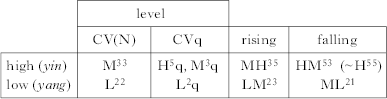
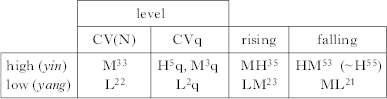
Chen (Reference Chen2000) 's analysis of the tonal system of Cantonese, which assumes that there are three tone heights, H, M and L, is adopted here. Contour tones are represented as sequences of level tones. A summary of the phonological representation of the Cantonese tone system, adapted from Chen (Reference Chen2000: 33), is given in Table I. For ease of reference, the corresponding Chao tone number is given in superscript. Chen uses ‘q’ to indicate the checked tones. This section begins with a presentation of a set of phenomena in the tonal morphology of Cantonese. A production experiment is reported on in §2.2, and a perception experiment in §2.3.
The phonological representation of the Cantonese tone system (adapted from Chen Reference Chen2000: 33).
2.1 The ‘changed tone’ in Cantonese
Other than the lexical mid-rising tone (henceforth Rlex), mid-rising tones may also come about as the result of a set of morphological alternations, which are collectively referred to as pinjam, or ‘changed tone’, in the Cantonese linguistic literature. Following Downer (Reference Downer1959) and Kam (Reference Kam1977), pinjam may be regarded as manifestations of a system where certain morphemes are derived from their respective semantic correlates just by a change of tone. There are two phonetically distinct products of this tone change. Historically high-falling tone (i.e. 53) changes to high-level (i.e. 55). However, since the high-falling tone is for the most part no longer contrastive, this alternation is irrelevant to the phonologies of most speakers. The only clear case of pinjam is the derivation of mid-rising tones from semantically related syllables with a non-high-level, non-mid-rising tone. For example, the nominalisation of verbs carrying a non-rising tone (2a) is indicated purely by a change in tone (2b).
(2)
The productivity of the pinjam pattern (henceforth Rmorph for ‘morphologically derived rising tone’) is unclear.Footnote 1 Tonal alternations are largely unpredictable. Thus, the /jɐn11/ ‘human’ element in /nөЧ23 jɐn35/ ‘female’ and /nɑn11 jɐn35/ ‘male’ has a pinjam, while the same element in /kuŋ55 jɐn11/ ‘labourer’ and /nuŋ11 jɐn11/ ‘farmer’ does not. While the condition for the application of pinjam appears random, nonetheless, several generalisations hold. Several morphological contexts give rise to pinjam (e.g. vocative, adjective reduplication, etc.). The alternant generally denotes the nominalisation of a verbal action (2) or a familiar and/or diminutive object (3a) and various other complicated semantic nuances (Jurafsky Reference Jurafsky1988). Wong (Reference Wong1982) reports that words with pinjam like those in (3b) occur more frequently in less formal situations than in higher-register speech. Kam (Reference Kam1977) reports that many native speakers do not recognise any relationship between the derived forms and their alleged base. It should be noted that the number of these pinjam derived syllables is sizeable. For a comprehensive discussion of the phonology and semantics of pinjam, see Bauer & Benedict (Reference Bauer and Benedict1997: ch. 2).
(3)
Previous phonological treatments advocate a floating high tone morpheme account of pinjam (Yip Reference Yip1980, Reference Yip2002, Chen Reference Chen2000). The floating high tone attaches to the end of the relevant syllable and creates a new 35 tone (4).
(4)
While there are several morphological patterns that give rise to Rmorph, since they are all analysed phonologically as the docking of a floating high tone onto the host syllable, the term pinjam or Rmorph will continue to be used as a cover term to describe these morphological alternations as a whole.
Given the fact that the alternation in tone signifies a change in meaning, pinjam is necessarily a morpholexical pattern (i.e. not a postlexical phenomenon). Thus floating tone association must take place within the lexicon, as is generally assumed under a modular feed-forward model of phonetics and phonology interface. Neutralisation within the lexical phonology component is absolute (i.e. Structure Preservation; Kiparsky Reference Kiparsky1985), thus the prediction of such a model is that segmentally identical syllables with Rlex and Rmorph respectively are implemented in the same way by the phonetic implementation component, since the underlying morphological difference between these two tones does not persist past the phonological component to the phonetic implementation component. Let us refer to this as the Absolute Neutralisation Hypothesis.
(5) Absolute Neutralisation Hypothesis
Identical phonological surface representations have similar phonetic realisations.
Experiment 1, which investigates the phonetic realisation of pinjam and Rlex, was conducted to ascertain the validity of this prediction.
Cantonese tone has been the focus of many phonetic studies (e.g. Fok Reference Fok1974, Vance Reference Vance1976, Reference Vance1977, Vance & Walker Reference Vance and Walker1976, Gandour Reference Gandour1981, Kong Reference Kong1987, Bauer & Benedict 1997, Wong & Diehl 1998, 1999, Wong Reference Wong, Ohala, Hasegawa, Ohala, Granville and Bailey1999, Flynn Reference Flynn2003, Francis & Ciocca Reference Francis and Ciocca2003, Francis et al. Reference Francis and Ciocca2003). Some studies have also discussed the phonetic aspects of pinjam in Cantonese. Cheng (Reference Cheng1973) finds that pinjam in the Taishan dialect of Cantonese has a higher F0 maximum than the highest level tone in the language. Taishan Cantonese has five basic tones, three level tones and two falling tones (6). Cheng uses a seven-point scale to draw attention to the exact spacing of the tones and the extra-high F0 maximum of pinjam.
(6)
Cheng's detailed study of the pitch tracking shows that pinjam in Taishan Cantonese has the shape of the basic tones, with an added rise to the very high tone at the end. However, the significance of the extra height of pinjam is unclear, since Taishan Cantonese has no lexical rising tone. Thus, unlike Standard Cantonese, Taishan pinjam is structure-building in the sense that it introduces additional tones to the language. No merger is involved. With respect to Standard Cantonese, Whitaker (Reference Whitaker1955–56: 188) and Yuan (1983) notice impressionistically that the contour of Rmorph rises higher than the contour of Rlex. Based on the production of six speakers from Guangzhou, Hong Kong and Macau, Bauer & Benedict (Reference Bauer and Benedict1997) report no significant differences between the realisation of the Rlex and Rmorph tones. However, it should be noted that, while the actual F0 values were reported for each speaker in their study, no statistical analysis was attempted. Taking these reports into account, Flynn (Reference Flynn2003: 64) concludes that pinjam should not be treated as an independent tone, since no systematic experimental evidence has ever been provided in support of the claim that pinjam in Standard Cantonese has a different tonal value. Experiment 1 is designed to ascertain the phonetic correlates of pinjam, and how pinjam compares to lexical mid-rising tone.
2.2 Experiment 1: a production study
2.2.1 Methods
Subjects: Six native speakers of Hong Kong Cantonese (three males and three females), all undergraduates at the University of Chicago, were paid a nominal fee for participating in the production experiment. They were all born and raised in Hong Kong. With the exception of one of the male speakers (EK), who had been in the United States for eight years, the other subjects had been in the United States for less than two years. They spoke English as a second language. None of them reported any speech or hearing problems.
Stimuli and procedures: The target CVN syllables, underlined in (7), are ten (near) minimal pairs (i.e. with identical rhyme). Each target syllable has two versions (Rlexvs. Rmorph).
(7)
To minimise the subjects' awareness of the focus of the experiment, the target disyllabic words/phrases of this experiment are embedded and randomised within a larger set of tokens of different syllable structure and different tone types. The subjects recited the list of Cantonese disyllabic words/phrases written in the carrier phrase /ŋɔ23 wui23 tuk⌝22 _ pεi35 nεi23 tʰæŋ55/ ‘I am going to say _ for you to hear’ three times. Each subject recited, in total, 300 sentences (i.e. 10 target tokens×2 versions×3 repetitions+80 fillers×3 repetitions=300 tokens). The randomised tokens were divided into three lists. Subjects were given the opportunity to take breaks between lists. Subjects' productions were recorded in a sound-proofed room, using a Marantz PMD670 solid state recorder and a SONY C-48 condenser microphone, which was placed approximately six inches from the subject's mouth.
Acoustic measurement: The speech was digitised at a sampling rate of 48,000 Hz, and all measurements were made with Praat (Boersma & Weenink Reference Boersma and Weenink2005). The following parameters were measured: the F0 at the onset of the sonorous phase of the syllable, the F0 peak of the rising contour, the duration of the sonorous phase of the syllable and the duration of the F0 peak relative to the onset of voicing. Recordings of the Cantonese contour tone syllables showed a slightly falling F0, occurring over the first quarter to the first third of the syllable (cf. Bauer & Benedict Reference Bauer and Benedict1997, Vance Reference Vance1977, Flynn Reference Flynn2003). The point at which the slope changes is referred to here as the inflection point (IP; Francis et al. Reference Francis and Ciocca2003). Since the inflection point might interact with the realisation of the F0 peak, it was estimated visually from the F0 plot, and both the time (relative to the onset of voicing) and F0 at that point were also measured. Only tokens with clear F0 contours (i.e. tokens not affected by excess creakiness) were included in the results reported below.
2.2.2 Results
Outliers, defined as F0 more than two standard deviations from the means of their condition, were replaced by condition means. This occurred for 1·5% of the onset measurements, 1·8% of the inflection-point measurements and 2% of the peak measurements. A within-subject design was used to examine the surface tone realisation with different underlying tonal specification: Rlex and Rmorph. Data were analysed using a one-way repeated measures ANOVA. There was a significant main effect of underlying tone type at all three points of measurements (Onset: F(1, 5)=9·42, p=0·028; IP: F(1, 5)=21·62, p=0·006; Peak: F(1, 5)=28·37, p=0·003). Thus the underlying tonal specification affects the surface realisation of the rising tone.
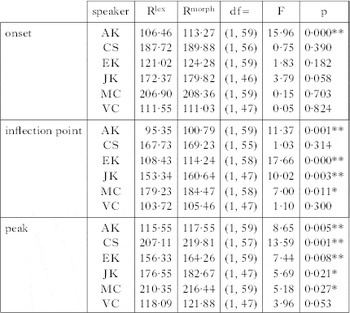
Tables II and III show the results of the acoustic measurements by individual subjects. Table II summarises the F0 measurements, showing that, with the exception of speaker VC, the F0 maxima of the two rising tones are significantly different from each other, contrary to the prediction of the Absolute Neutralisation Hypothesis (5). In particular, the F0 maximum of Rmorph is higher than that of Rlex. Four of the six speakers show a significant difference in the F0 of the inflection point as well.
Mean F0 values of Rlex and Rmorph at three temporal locations (the onset of voicing, the inflection point and the F0 peak), and the ANOVA results for the F0 difference between Rlex and Rmorph.
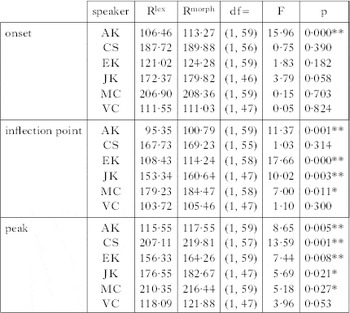
* significant at p<0·05
** significant at p<0·01.
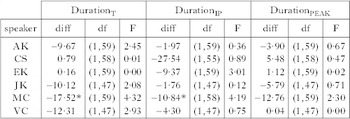
Mean differences and results of the ANOVAs of three durational measures: the overall duration of the sonorous phase of the syllable (DurationT), the time it takes for the F0 fall to reach the inflection point (DurationIP), the time it takes for the F0 rise to reach its peak (DurationPEAK).
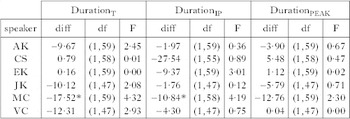
* significant at p<0·05
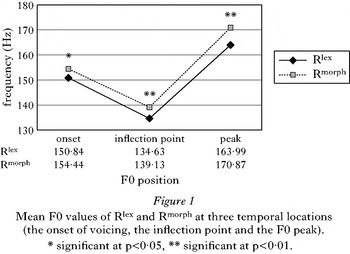
As shown in Fig. 1, the overall contour of Rmorph is higher than the contour of Rlex. In particular, the F0 values of the inflection point and the peak of the rise are generally higher for Rmorph than Rlex. The results of a one-way ANOVA for the rate of change of the rising contour beginning at the inflection point for the two rising tone types show no significant difference.Footnote 2 This suggests that the overall rise is the same between the two rising tone types, but the overall contour is shifted upwards in the case of Rmorph.
Mean F0 values of Rlex and Rmorph at three temporal locations (the onset of voicing, the inflection point and the F0 peak). * significant at p<0·05, ** significant at p<0·01.

Table III summarises the durational measurements. No significant durational difference is found between the Rlex and Rmorph syllables, except for speaker MC, who shows a difference in the overall duration of the sonorous phase of the syllable and the time it takes for the initial portion of the F0 contour to reach the inflection point.
2.2.3 Discussion
The results of Experiment 1 indicate that the F0 contours of Rlex and Rmorph are significantly different, confirming Whitaker and Yuan's impressionistic observations. One interpretation of the production results is that there are two sets of mid-rising tone in Standard Cantonese, akin to the analysis of Taishan pinjam mentioned earlier. The insensitive phonetic transcription by previous researchers has therefore obscured a tonal distinction in the language. Previous perceptual studies have found that Cantonese speakers can reliably identify and discriminate contrastive tones in the language (Fok Reference Fok1974, Vance Reference Vance1977, Francis et al. Reference Francis and Ciocca2003). Thus, if Rmorph were indeed a contrastive tonal category in Cantonese, one would also expect that native speakers of Cantonese would be capable of reliably distinguishing between Rlex and Rmorph. To test this hypothesis, a small-scale identification experiment was conducted.
2.3 Experiment 2: an identification experiment
2.3.1 Methods
Subjects: Five native speakers of Hong Kong Cantonese (two males and three females), all undergraduates at the University of Chicago, were paid a nominal fee for participating in this identification experiment. Two of the participants (CS and AK) also participated in the first experiment.
Stimuli and procedures: The tokens of speaker EK for the production experiment were chosen for the perceptual test, since his tokens showed the greatest difference between Rlex and Rmorph. The stimuli were a set of five minimal pairs, shown in (8), which consisted of target syllables with Rlex or Rmorph.
(8)
30 tokens (10 syllables×3 repetitions) were used as stimuli in the identification test. An experimental design program, E-Prime, was used to administer the experiment. The tokens were placed in random order by E-Prime, and the subjects were given a ten-alternative forced-choice task. The stimuli were played to the listeners through headphones as they sat alone in a quiet room. After a stimulus was played, the listeners were presented with ten response alternatives written in Chinese characters on a computer screen, and identified the word by clicking on the appropriate Chinese character.
2.3.2 Results
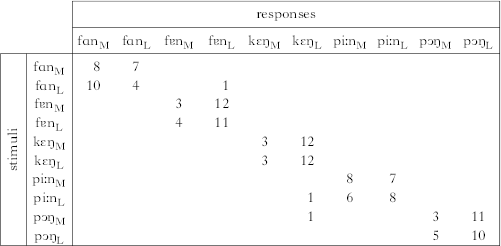
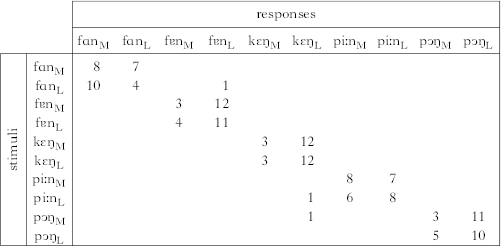
The confusion matrix of the responses is given in Table IV. The stimuli are arranged in rows, while the responses are arranged in columns. The mean correct identification rate is 46·7%. While the average correct identification rate is above chance level (10%), the listeners' identification of Rlex and Rmorph remains quite poor. The rate of the listeners misidentifying one type of rising tone for the other is 51·3%, suggesting that the listeners are confusing Rlex and Rmorph. It should, however, be noted that the most common responses seemed to be words with lexical tone, since approximately 63% of the responses were for words with lexical tones, while only 35% of the responses were for derived words.
The number and distribution of identification responses by five listeners. Subscript M=Rmorph; subscript L=Rlex. The stimuli are arranged by rows, while the responses are given in columns.
2.3.3 Discussion
The results of the production and identification experiments establish that the phonetics of morphological tone in Cantonese reflects a near-merger scenario. That is, while speakers show distinct tonal realisations for Rlex and Rmorph in production, listeners are not able to identify the appropriate lexical item based on the different tonal information alone. The simple introduction of an additional tonal category in Cantonese is therefore unsatisfactory. Further qualification is needed to explain the apparent near merger between Rlex and Rmorph. The fact that Rmorph occurs only in a limited, morphologically definable set of environments demands an explanation as well.
The discovery of near merger in Cantonese is significant for several reasons. To begin with, phonetic evidence for near merger involving tonal features has never been reported before. Thus, the addition of tonal contrasts to the set of ‘suspendable phonetic contrasts’ strengthens the empirical support for near merger as a genuine phenomenon of language. Cantonese tonal near merger is similar to other reported cases of near merger in which listeners consistently produce a small difference between two contrasting words without being able to reliably recognise the difference in either their own or other people's productions. However, there are notable differences between Cantonese tonal near merger and previously reported cases of suspended contrasts. In traditional cases of incomplete neutralisation such as German syllable-final devoicing, the underlying category difference is supported by an alternation at the phonemic level. That is, the underlying category difference can be recovered paradigmatically, since the underlying voicing category is recoverable in certain phonologically definable environments. The underlying category difference between Rlex and Rmorph, on the other hand, is supported by alternations at the morphological level. That is, the underlying category difference cannot be recovered from the immediate phonetic environment where the respective tone type occurs.
It is also important to point out that these results cannot simply be dismissed as an artefact of the language studied, since Cantonese speakers do not possess conscious knowledge of the tonal phonology or the morphology of the language. That is, Cantonese has no standard orthography or accepted Romanisation that is taught in school. To the extent that a modified version of Standard Chinese orthography is used by Cantonese speakers, that orthography still does not indicate tonal information, nor does it reflect morphological changes. Thus the source of the observed near merger must rest elsewhere; orthography per se offers no support for the suspension of complete merger in this case. In §4, several theories of the origins of tonal near merger are discussed. As will be demonstrated, tonal near merger is the result of variations introduced by the morphology of the language. Cantonese tonal near merger thus provides an instructive example of near merger that is not sustained by dialect contact or orthographic factors. But before discussing of the origins of pinjam, the next section will articulate a theory of near merger.
3 Sound change as exemplar redistribution
As noted in the introduction, traditional modular feed-forward models of phonetics and phonology predict that the categorical form of the lexeme wholly determines the phonetic outcome. According to the modular feed-forward model, two words should be implemented similarly if they share the same phonological representation. The model of the lexicon and the phonetics–phonology interface advocated in this paper diverges from such models in several important ways. An exemplar-based speech-processing system recognises inputs and generates outputs by analogical evaluation across a lexicon of distinct memory traces of each token of speech. A category label is defined by a ‘cloud’ of exemplars (i.e. memorised tokens). Each exemplar may contribute to many categories simultaneously. While specific exemplar models differ in how new experiences are assigned to relevant categories and how that new experience is integrated with the stored exemplars, all exemplar-based models assume that each experience alters the entire category system slightly by changing the range, and perhaps activation, of component exemplars (Hintzman Reference Hintzman1986, Nosofsky Reference Nosofsky1986, Kruschke Reference Kruschke1992, Goldinger Reference Goldinger1996). As the perceptual memories associated with the label (i.e. the exemplar cloud) accumulate and are incrementally updated, the distribution of these forms may shift. To account for recency effects, most exemplar-based models assume some form of time-sensitive base-activation decay (Pierrehumbert Reference Pierrehumbert, Bybee and Hopper2001). Furthermore, exemplar models can also accommodate abstract categorical behaviours via abstract generalisations that can be continually created and updated through experience (Tenpenny Reference Tenpenny1995). This model has received an impressive array of empirical support in recent years. Studies in perception have shown that listeners may rely on fine-grained phonetic details in word recognition (e.g. Goldinger Reference Goldinger1996, Johnson Reference Johnson, Johnson and Mullennix1997, Ernestus & Baayen Reference Ernestus and Baayen2003). Pierrehumbert (Reference Pierrehumbert, Gussenhoven and Warner2002) reviews a large body of literature that shows that allophonic details are systematically associated with words. Clopper & Pisoni (Reference Clopper and Pisoni2004) show that dialect perception appears to be exemplar-based as well. These cases are difficult to explain without assuming that individual words have associated phonetic distributions.
Recent years have also witnessed much growth in applying exemplar-based models to the understanding of language change. For example, Bybee (2001) reviews evidence from leniting historical changes, arguing that lexical representations of words must include incrementally updated information about the phonetic distribution of each word. Kirchner (Reference Kirchner1999) offers a computational simulation of phonologisation using an exemplar-based speech processing system. Batali (Reference Batali and Briscoe2002) investigates the emergence of recursive syntactic structures using an exemplar-based computational simulation of language acquisition. Focusing on the problem of sound change, exemplar-based models conceive of changes in the sound system as the result of shifts and redistribution of exemplars within the exemplar space. Within this model of sound change, changes in the pronunciation norm are largely involuntary and fully dependent on the listener's linguistic experience. Following Pierrehumbert (Reference Pierrehumbert, Bybee and Hopper2001), the production of a category label results from a random selection of a category exemplar correlated with the probability of the base-activation level of an exemplar. The production target is the result of averaging some number of exemplars within a region of an exemplar cloud (Pierrehumbert Reference Pierrehumbert, Gussenhoven and Warner2002). This averaging between exemplars predicts a steady convergence to the mean over the entire category. When the exemplar cloud of one category is mixed with the exemplars of another, the averaging procedure might recruit exemplars of both categories. Over time, the means of the two categories will gradually converge. Three major types of phonological change thus find natural expressions within this model, as shown in (9).
(9)
An unconditional merger (9a) obtains when an exemplar cloud shifts its distribution to overlap completely with another. A secondary split (9c) takes place when a unimodal distribution of exemplars becomes bimodal or multimodal. Conditioned merger and primary split (9b) obtain when a unimodal distribution of exemplars becomes bimodal and one of the resultant exemplar clouds overlaps completely with another exemplar cloud. In these cases, mergers are complete, because exemplars previously classified under one category end up being classified under a different category.
On this view, near merger represents the transition stage in a complete merger scenario. That is, near merger results when the exemplar clouds of two or more categories overlap sufficiently but the category membership of the exemplars remain distinct. Since exemplars are categorised in any number of salient dimensions, under most communicative situations a given phonetically ambiguous token may still be categorised accurately in other dimensions, based on contextual and indexical information. Listeners have troubles identifying the appropriate category label in a laboratory or fieldwork setting, since important contextual cues are often absent (see also Labov Reference Labov1994: ch. 14). When forced to make a categorical judgement based solely on the acoustic information, identification is at chance level, since the perceived utterance falls within the combined exemplar cloud. The production of a near-merged category, however, is no different from any other. It proceeds by creating a target based on the average of some number of exemplars, including those within the region of the partially overlapping exemplar clouds. The mean production difference between two merging categories might be small, but they will continue to show distinct phonetic realisation as long as the category means remain separate.
Returning to the case of Cantonese tonal near merger, we hypothesise that the morphological tone category is the result of incomplete mergers between two or more tones in the immediate past. The main question that must be addressed, however, is what tones were merged and how the production mean of the merged tones gave rise to the slightly higher fundamental frequency profile of the Changed Tone. The answer lies in the origins of the Changed Tone, which is the focus of the next section.
4 Explaining Cantonese tonal near merger
It is widely recognised that Cantonese pinjam comes from the elision of certain morphemes that are no longer synchronically productive. Several possible sources have been proposed in the literature. Beginning with Chao (Reference Chao1948), many have noted that pinjam is probably the cognate of er-suffixation in other Chinese dialects (Whitaker Reference Whitaker1955–56, Wong Reference Wong1982). While the modern pronunciation of Mandarin er ‘child’ in Cantonese is /ji21/ ‘child’, according to Wong (Reference Wong1982), an alternative pronunciation of the word, /ji55/, must have been prevalent at the time when pinjam developed. The two pronunciations possibly represent a difference in speech style. This situation is not uncommon, as the Cantonese lexicon is divided into roughly two layers: the literary and the colloquial registers. Reflexes of this now lost colloquial morpheme /ji55/ can be found in certain lexicalised forms in Modern Cantonese (10).
(10)
Based on dialectal evidence, Bauer & Benedict (Reference Bauer and Benedict1997) propose that Cantonese pinjam must have developed from a monosyllable that carried a rising tone. For example, in the Bobai dialect of Yue spoken in the southeastern Guangxi Province, the more conservative variety employed the diminutive suffix [ɲin] with a long rising tone: /kae32 ɲin25/ ‘small chicken’, /iaŋ21 ɲin25/ ‘small sheep’, /ma21 ɲin25/ ‘small horse’ (Wang Reference Wang1932, Wong 1982, Bauer & Benedict 1997). When words ended in a final stop, the final stop would change to its homorganic nasal counterpart and the word would acquire a long rising tone, associated with /ɲin25/ (11). According to Bauer & Benedict, what is found in Modern Cantonese today reflects the stage where the final nasal suffix has been dropped and pinjam remains as the sole marker of the morphological change.
(11)
The morpheme /tsi35/ ‘son’ has also been advanced as a possible source of pinjam (Cheng Reference Cheng1973, Wong Reference Wong1982). Unlike the morpheme /ji55/ in (10), the use of /tsi35/ to mark diminutive is still semi-productive today. Many of the /tsi35/-attached forms also have a pinjam alternative (12).
(12)
To summarise, pinjam originated from the loss of certain diminutive morphemes. Several candidates have been proposed: /ji55/ ‘child’, /ɲin25/ ‘child’ and /tsi35/ ‘son’. While proposals as to the specific origins of pinjam vary, crucially, these morphemes are all realised with a high or rising tone. The generalisation that emerges from the historical evidence is clear: the tonal morpheme today is a relic of an earlier syllable-contraction phenomenon. When the morpheme in question elides, the orphaned high or rising tone is realised on the preceding syllable. Pinjam thus represents the morphologisation of a sandhi pattern in the immediate past. From the point of view of the present theory of sound change, the historical scenario suggests that the fundamental frequency profile of pinjam is the reflex of combined fundamental frequency profiles of a host of sandhi tones. One question remained unanswered by the above historical scenario, however. Why is pinjam realised differently from the lexical rising tone? While the precise phonetics of the sandhi pattern that gave rise to pinjam is lost for ever, a set of sandhi patterns still active in Cantonese today provides us with important clues on how the sandhi tone is realised at the pre-morphologised pinjam stage.
4.1 Experiment 3: a phonetic study of contracted syllables
Several modal elements in Cantonese which have either an underlying high or mid-rising tone often elide in colloquial speech, causing the tone of the preceding syllable to change to mid-rising. Two types of elision or contraction are illustrated in (13). (13a) shows that the perfective marker, /tsɔ/, merges with the head verb. (13b) shows the merger of the potential marker, /tɐk⌝/, with the head verb. The perfective marker carries a lexical 35 tone, while the potential marker has a lexical 55 tone. The two types of resulting merged syllables are traditionally transcribed identically with a 35 tone.
(13)
Phonologically, this syllable-contraction pattern (also referred to as a sandhi phenomenon in the literature) is often characterised as the re-association with the preceding syllable of a high tone (14b), set afloat by the elision of an originally high tone or rising tone syllable (Yip Reference Yip1980, Chen Reference Chen2000). A rule of register readjustment gives rise to the appropriate representation of the MH cluster (14c).
(14)
Thus, if pinjam were indeed the reflex of a historical syllable-contraction phenomenon similar to those found in Modern Cantonese (13), the phonetic realisation of the modern-day sandhi rising tone should shed light on the source of the pinjam F0 profile as well. To this end, an experiment was conducted to examine the acoustics of the sandhi tones in (13). While the results are quite variable, they nonetheless offer some clues as to the likely origins of the subphonemic difference observed in Experiment 1.
4.1.1 Methods
Subjects: The same six speakers who participated in Experiment 1 also participated in this experiment.
Stimuli and procedures: Ten pairs of verb+modal phrases in Cantonese were used. The list of verbs used, all CVN in shape, is given in (15). Two modal markers were used: /tɐk⌝55/ (potential) and /tsɔ35/ (perfective). After the application of syllable elision, the two phrases in each pair should be homophonous. For ease of reference, the rising tone resulting from the elided /tɐk⌝55/ will be referred to as RS1 from now on, while the rising tone resulted from the elided /tsɔ35/ will be referred to as RS2.
(15)
Subjects were instructed to recite a randomised set of the target phrases written in the carrier phrase /ŋɔ23 wui23 tuk⌝22 _ pεi35 nεi23 tʰæŋ55/ three times in ‘lazy speech style’, to maximise the likelihood of syllable elision. Each subject recited a total of 60 sentences (i.e. 10 target tokens×3 repetitions×2 lists=60 tokens). Subjects were given the opportunity to take breaks between lists. The recording procedure was the same as for Experiment 1.
4.1.2 Acoustic measurement
The results of the experiment are quite mixed. Only three speakers (EK, JK, VC) produced some form of syllable contraction. The other three speakers either refused to acknowledge the possibility of contraction in Cantonese at all (Speakers AK, CS) or produced no noticeable contraction in the recitation (Speaker MC). Of the three speakers who did produce syllable contraction ‘on the fly’, only JK and VC show actual syllable elision. While Speaker EK produced syllable contraction, the modals were not entirely elided. This result is akin to the type of syllable-fusion phenomenon reported in Wong (Reference Wong1996, Reference Wong, Bel and Marlien2004), where the second syllable is obscured by onset lenition or deletion and vowel reduction – the target phrase thus remains disyllabic (e.g. /pɔŋ22 tsɔ35/→/pɔ22 ŋɔ35/). Since the focus here is on the realisation of RS, non fully elided examples of syllable contraction will not be considered further. Only tokens with complete second (modal) syllable elision (e.g. /pɔŋ22 tsɔ35/→/pɔŋ35/) or those fused with the targeted syllable as a short vocalic release of the final nasal (e.g. /pɔŋ22 tsɔ35/→/pɔŋә35/) were taken into account.
The same acoustic measurements performed in Experiment 1 were taken, again using Praat. Only tokens with clear F0 contours (i.e. tokens not affected by excess creakiness) were included in the results reported.
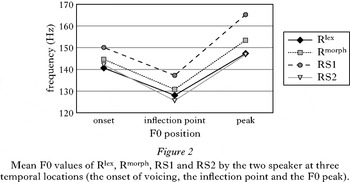
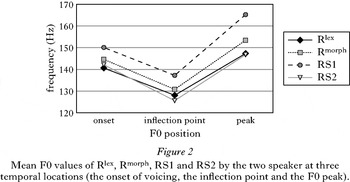
Mean F0 values of Rlex, Rmorph, RS1 and RS2 by the two speaker at three temporal locations (the onset of voicing, the inflection point and the F0 peak).
4.1.3 Results
Outliers, defined as F0 values more than two standard deviations from the means of their condition, were again replaced by condition means. This occurred for 1% for the inflection point measurements and 4% of the peak measurements. Since both JK and VC participated in the first experiment, their Rlex and Rmorph production results were used for comparisons with the RS1 and RS2 data. A summary of the measurements is given in Fig. 2. Data were analysed using a one-way ANOVA with four levels (Rlex, Rmorph, RS1 and RS2). There were significant main effects of the derived status of a tone at the F0 onset (F(3, 189)=2·933, p<0·05), inflection point (F(3, 190)=3·675, p<0·05) and F0 peak (F(3, 190)=7·808, p<0·01). Thus the derived status of a tone affects the surface realisation of the rising tone.
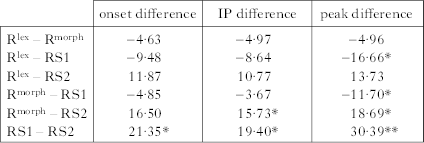
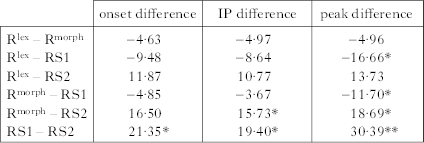
The results of a series of post hoc pairwise comparison are given in Table V. The tonal contour of Rlex is not significantly different from that of Rmorph or that of RS2.Footnote 3 The F0 peak of RS1 is significantly higher than that of Rlex and Rmorph. RS1 and RS2 are significantly different at all three points of measurement. The overall duration of the sonorous phase of the RS syllables is generally significantly longer than those of the Rmorph and Rlex syllables. The RS1 syllables (VC=237·3 ms; JC=233·51 ms) are on average about 15–20% longer than the Rmorph and Rlex syllables, while the RS2 syllables (VC=267·02 ms; JC=254·49 ms) are on average about 35–40% longer than the Rmorph and Rlex syllables.
F0 differences based on pairwise comparison of Rlex, Rmorph, RS1 and RS2 at three temporal locations (the onset of voicing, the inflection point and the F0 peak).
* significant at p<0·05
** significant at p<0·05
4.2 Discussion
The F0 contours of the RS tones are not completely neutralised with the Rmorph F0 contour. The direction of incomplete neutralisation, however, differs, depending on the nature of the fused syllable. The tonal contour of RS1 is found to be higher than Rmorph, but the tonal contour of RS2 is lower. On the other hand, RS2 and Rlex share similar F0 values, while the F0 peak of RS1 is significantly different from Rlex. The F0 profiles of RS1 and RS2 do not match as well; RS1 has a significantly higher rising profile than that of RS2. The incomplete merger between RS1 and RS2 seems puzzling at first glance. Why should the two types of fused syllable behave differently in terms of their F0 contours? Here, the difference between the F0 contours of RSI and RS2 can be explained as a difference between the elided morphemes: the perfective marker /tsɔ/ carries an underlying 35 tone, while the potential marker /tɐk⌝/ has an underlying 55 tone. The phonological analyses in (14) and (16) help clarify this point. Syllable contraction and the resulting tonal fusion are treated as part of the postlexical phonology of Cantonese. The rising contour of the perfective marker, /tsɔ/, is analysed as a sequence of level tones under a single tonal root note, abbreviated in (16) as R (Yip Reference Yip1989).Footnote 4 RS2 is the result of R reassociating with the preceding host syllable (16b). A set of tonal readjustment rules prevent surface sequences of a level tone and a rising tone, so that the underlying L tone of the verb drops out in (16c).
(16)
Phonetically speaking, the fact that RS2 has a similar tonal profile to Rlex is not surprising, since the perfective marker /tsɔ/ is expected to have a lexical mid-rising tone profile. All else being equal, the fused syllable should retain the F0 contour of the elided syllable. A similar explanation can be advanced for RS1. Phonologically, the RS1 syllable results from the disassociation of the high tone from the potential marker /tɐk⌝/, as in (14a) above. As shown there, the unassociated H then docks onto the preceding host syllable, and a register-readjustment rule gives rise to the MH cluster in (14c).
As Lee (Reference Lee1999) reports, the F0 of a 55 tone in a checked syllable is higher than the peak of the F0 rise of a lexical 35 tone for some speakers. Ladefoged (Reference Ladefoged2000) also transcribes the mid-rising tone as 24 and the high tone as 55, suggesting that the peak of the rising tone is slightly lower than that of a high tone. Thus, the extra-high F0 of the potential marker can be interpreted as the retention of the tonal profile of an underlying 55 tone.
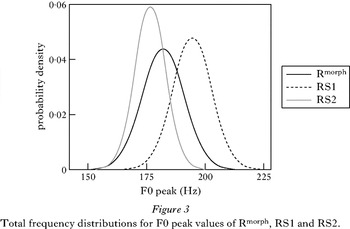
The phonetic realisation of the RS tones revealed in Experiment 3 offers instructive clues as to why pinjam today has a tonal profile different from that of Rlex. Recall that pinjam was the result of the elision of a set of morphemes with inherent high or mid-rising tone, similar to the RS tones examined above. Assuming the uniformitarian hypothesis, we may hypothesise that the phonetic realisation of the sandhi tones prior to the emergence of the pinjam category shared similar phonetic qualities with the RS1 and RS2 tones today. As shown in Experiment 3, the tonal contour of a sandhi tone varies, depending on the tone of elided syllable. That is, an elided high tone syllable gives rise to a higher rising contour than an elided rising tone syllable does. In an exemplar-based model of speech perception and production, the production of a phonological representation of a category involves making a selection from the exemplar cloud for that category. As the perceptual memories associated with the category accumulate and are incrementally updated, the distribution of these forms may shift. Thus, when the sandhi patterns lose their productivity and become morphologised, the exemplars of what would have corresponded to modern-day RS1 and RS2 tones would come to represent a unified category. The mean of this combined category would therefore lie somewhere between the extremes of the two sandhi tone exemplar clouds. Figure 3, which shows the distribution of the F0 peak values of RS1 and RS2 on the one hand, and the distribution of the F0 peak values of Rmorph on the other, sketches how this would give rise to a distinct tonal profile for the pinjam category. Based on the data obtained in Experiment 3, we know that the mean probability distributions of the F0 peak values of RS1 and RS2 fall at opposite ends of the F0 continuum. If these two exemplar clouds were combined to form a new category, as arguably happened in the origins of the pinjam category, the production of this combined category would draw its exemplars from a diffused exemplar cloud. Given the averaging procedure mentioned above, the production target of the combined category would fall somewhere between the two extremes of the F0 continuum. As the resulting production tokens were stored as new exemplars in their category of origin, the perception-production feedback loop would result in exemplars steadily populating the exemplar region corresponding to the mean over the entire category (cf. Wedel Reference Wedel2007). As illustrated in Fig. 3, the distribution of Rmorph lies between the RS1 and RS2 distribution, and is thus consistent with the predictions of the present model. Note that, on this exemplar-based understanding of pinjam, there is no need to posit a new distinct tonal contrast in Cantonese. The fact that the Rmorph exemplars pattern together emerges from their morphological patterning (i.e. only exemplars of the types deverbal noun, diminutive and vocative may carry pinjam). The class behaviour of Rmorph cannot be established on the basis of phonological distribution alone. This exemplar-based understanding thus obviates the need to fit pinjam into some parochial representation such as a single branching tone unit or a tonal cluster. To the extent that representational analyses of the sort in (14) and (16) are useful for conceptualising abstract relations between exemplars, pinjam may be understood as the conglomeration of exemplars of both tonal clusters and branching tone units (i.e. what would correspond to modern-day RS1 and RS2 respectively).
Total frequency distributions for F0 peak values of Rmorph, RS1 and RS2.
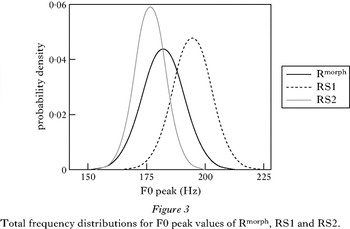
The present model also predicts incomplete neutralisation between Rmorph and Rlex. Recall that the tonal profile of RS2, which resulted from elided mid-rising tone syllables, does not significantly differ from that of Rlex. Thus, given that the mean distribution of Rmorph lies above the mean of RS2, the mean distribution of Rmorph should lie above Rlex as well. Listeners cannot reliably identify Rmorph from Rlex, because their distributions overlap extensively with one another.
The current state of Rmorph can thus be seen as the result of a two-stage development. In the first stage, a set of syllable-contraction patterns gave rise to two types of phonetically distinct sandhi tones, one with a higher F0 peak than the other. As these sandhi alternations became morphologised, a new morphological category, i.e. the pinjam tone, was established. The Rmorph exemplar cloud thus encompasses the exemplar spaces of both types of sandhi tones. A new production norm for pinjam gradually emerged as new pinjam exemplars steadily populated the region of exemplar space which corresponds to the mean of the entire pinjam exemplar cloud. The Rmorph and Rlex exemplar clouds do not merge completely, since the mean of the Rmorph exemplar cloud is skewed by the many high F0 exemplars, which are relics of sandhi tones that resulted from fused high tone morphemes. Rlex would lack such exemplars intrinsically.
5 Conclusion
The existence of near merger has puzzled phonologists and historical linguists for many years. Using a case study of tonal near merger as a jumping-off point, this paper draws on insights from a growing body of work on exemplar-based models of phonological representation and offers a concrete model of sound change. This model relies on the notion that phonological representations are viewed as aggregates of exemplars of linguistic experiences, rather than a set of abstract categorical units. Changes in the sound system are the result of shifts in the organisation of the exemplar space. When two or more exemplar clouds of different categories overlap extensively, listeners are predicted to have difficulty in reliably identifying tokens falling within the combined exemplar space. The production difference between near-merged tokens is predicted to be small, due to the proximity of exemplars being drawn for calculating the production target. Previous literature suggests that the underlying category difference in a near-merger situation may be supported by contact with another dialect that maintains the distinction (Labov Reference Labov1994) or, in the case of literate cultures, by orthographic differences (Faber & Di Paolo Reference Faber and Di Paolo1995). This paper argues that underlying category difference in a near-merger situation can be sustained by grammar-internal factors as well. That is, the production difference between lexical and morphological rising tones is sustained by the morphology/semantics alone.
The model of sound change articulated in §3 not only provides a principled explanation for near merger, but also offers useful insights for problems unresolved in previous models of sound change. For example, many have assumed that the typological convergence of sound change results from language-universal factors, such as physiological and psychological factors common to all human speakers at any time period (Ohala Reference Ohala and Jones1993, Blevins Reference Blevins2004). Sound change takes place when the listener mistakes the effects of the speaker's production system, of ambient effects on the acoustic stream or of his or her own perceptual system as representative of the speaker's internal representations or computations.
Within this comprehensive model of sound change, taking into account production, perception and feedback effects of both on the developing grammar, a potential source of sound change are ‘errors’ that listeners make in (re)constructing pronunciation norms (Ohala Reference Ohala and Jones1993) based on pronunciation variation (cf. ‘choice’ in Blevins Reference Blevins2004). While much effort has been devoted to understanding the nature of misapprehension, what is less clear is why listeners would ever change their assumption about the language in the face of seemingly haphazard evidence of deviation from the norm. At issue here, therefore, is the nature of the pronunciation norm (re)construction. One way to account for the eventual change in pronunciation norms is to assume that the listener may not have the experience to enable him to do the necessary normalisation or correction. Two special groups lacking this experience are children acquiring phonological systems for the first time and adult second-language learners (Ohala Reference Ohala and Jones1993: 247). Within this model, primary agents of change are individuals with a near blank slate, due to their lack of previous significant exposure to the language being learned.
The assumption that children and second language learners are the only agents of sound change is, however, too restrictive, particularly in light of a growing body of research demonstrating that it is possible for adults to participate in sound change, albeit less readily than children (Sankoff Reference Sankoff and Fought2004). For example, Harrington et al. (Reference Harrington, Palethorpe and Watson2000) compare the vowel space of Queen Elizabeth II, based on her annual Christmas broadcasts spanning three time periods (the 1950s, the late 1960s/early 1970s and 1980s), and find that her vowel system has gradually shifted toward a more mainstream form of Received Pronunciation. Sancier & Fowler (Reference Sancier and Fowler1997) investigate the voice onset time (VOT) production of a native Brazilian Portuguese speaker, and find that the speaker's VOTs for Brazilian Portuguese and English stops are shorter after a stay of several months in Brazil than after a similar stay in the United States. The findings of the Harrington et al. and Sancier & Fowler studies demonstrate that a speaker well past the critical period for language acquisition may change his pronunciation norm upon prolonged exposure to the ambient language. Learning, as it were, is ongoing. In light of the evidence, how can the apparent need to include adults in the set of potential participants in linguistic change be reconciled with the listener-misperception view of sound change? The answer lies in the proper understanding of what constitutes the pronunciation norms. Within the model of sound change argued for in this paper, changes in the pronunciation norm are largely involuntary and dependent on the listener's linguistic experience. The ‘blank slate’ problem vanishes in this model, since no assumption about the linguistic experience of the agent of change is explicitly required. The fact that adults may participate in sound change is explained by the fact that they share with children the same mechanism of speech production and perception. However, other factors, such as the critical period of acquisition or the impoverished linguistic experience of a child (i.e. fewer competing exemplars) may explain why sound change can occur, overtly or covertly, when children learn to speak.