Introduction
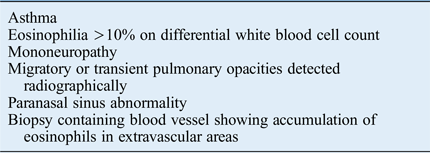
Known formally as Churg–Strauss Syndrome, eosinophilic granulomatosis with polyangiitis was first described in 1951.Reference Churg and Strauss 1 It is a multisystem disease characterised by peripheral blood eosinophilia, bronchial asthma and chronic rhinosinusitis. Given the frequent occurrence of anti-neutrophilic cytoplasmic antibodies, it is usually grouped with conditions such Granulomatosis with polyangiitis, but is unique within vasculitic disorders. Its aetiology is allergic in nature, with a close relationship reported between disease activity and eosinophils and interleukin 5 concentration.Reference Taki, Shinoda, Hounoki, Ogawa, Ishizawa and Sugiyama 2 The incidence of eosinophilic granulomatosis with polyangiitis in the general population is estimated to range between 1.3 and 6.8 cases per million people per year.Reference Sinico, Di Toma, Maggiore, Bottero, Radice and Tosoni 3 No clear sex predominance has been identified and the mean age at diagnosis is 48 years.Reference Guillevin, Cohen, Gayraud, Lhote, Jarrousse and Casassus 4 It is diagnosed according to the American College of Rheumatology criteria (Table I).
American College of Rheumatology 1990 criteria for classification of EGPA*

* Four criteria required
The ENT manifestations of the condition include allergic rhinitis, nasal obstruction, recurrent rhinosinusitis, nasal polyposis, otitis media with effusion (OME), progressive sensorineural hearing loss, and facial nerve palsy.Reference Olsen, Neel, DeRemee and Weiland 5 There is a paucity of research in the area, and the available literature tends to be limited to case series or case reports.Reference Martinez Del Pero, Moffat and Sudhoff 6 , Reference Ovadia, Dror, Zubkov, Tanay, Levy and Zandman-Goddard 7 The largest studies suggest an incidence of ENT symptoms of between 48 and 80 per cent in patients with the condition, with rhinological features being the most common.Reference Bacciu, Buzio, Giordano, Pasanisi, Vincenti and Mercante 8 , Reference Comarmond, Pagnoux, Khellaf, Cordier, Hamidou and Viallard 9 Although there is limited knowledge of the condition, recognition of eosinophilic granulomatosis with polyangiitis is critical because the associated otological manifestations are highly sensitive to high-dose systemic glucocorticoid therapy.Reference Ribi, Cohen, Pagnoux, Mahr, Arène and Lauque 10
The incidence of nasal polyps varies between 2 and 4 per cent of the general population. The largest trial published to date indicates a prevalence of nasal polyposis of approximately 2.7 per cent, with increased frequency seen in men, asthmatics and the elderly.Reference Johansson, Akerlund, Holmberg, Melén and Bende 11 Eosinophilic nasal polyps are the predominant subtype in the UK.Reference Scadding, Durham, Mirakian, Jones, Drake-Lee and Ryan 12 Otitis media is an inflammatory state of the middle ear that is regularly associated with effusion. The incidence of OME has not been systemically investigated in adults.Reference Tewfik and Mazer 13 There is an increasing recognition that a relationship exists between nasal polyposis and OME. Recent work has demonstrated a five times higher risk of developing OME in patients with nasal polyposis.Reference Parietti-Winkler, Baumann, Gallet, Gauchard and Jankowski 14 That paper suggested that OME be considered as a marker of the inflammatory process driving the pathology. Furthermore, evidence of allergy in 45 per cent of polyposis patients is suggestive of a potential immune or inflammatory effect of allergy on Eustachian tube function. The majority of adult OME cases settle on medical management and do not require surgical intervention.Reference Rosenfeld, Culpepper, Doyle, Grundfast, Hoberman and Kenna 15
Eosinophilic OME is an intractable form of otitis media characterised by viscous yellow effusion containing eosinophils.Reference Nagamine, Iino, Kojima, Miyazawa and Iida 16 New diagnostic criteria have appeared in recent years. Major criteria include OME. Minor criteria include highly viscus middle-ear effusion, resistance to conventional treatments for otitis media, association with bronchial asthma and association with nasal polyposis.Reference Iino, Tomioka-Matsutani, Matsubara, Nakagawa and Nonaka 17
We encountered two patients with a known diagnosis of eosinophilic granulomatosis with polyangiitis presenting with bilateral refractory OME in association with bilateral nasal polyps, requiring grommet insertion. The almost solid nature of the inspissated mucoid effusion on myringotomy was noted. This led to an enquiry as to whether the simultaneous diagnoses of chronic rhinosinusitis with nasal polyposis and refractory otitis media could be an indication of possible eosinophilic granulomatosis with polyangiitis.
Materials and methods
A retrospective observational study was carried out at two university centres in Ireland: the University Hospital Limerick and University Hospital Waterford. We identified patients using out-patient records and operating theatre records, specifically examining patients who required grommet insertion and who had a known diagnosis of chronic rhinosinusitis with nasal polyposis.
The following patient parameters were assessed: age, gender, history of medical and surgical treatment for nasal polyposis, history of surgical treatment of otitis media with effusion, history of asthma or other respiratory complaints, chest radiography, neuropathy, and peripheral or histological evidence of eosinophilia.
No formal ethical approval was required for this study, but local hospital committee chairperson's consent was obtained as per recommended advice and established protocol.
Results
Sixteen patients were identified including the two with a known diagnosis of eosinophilic granulomatosis with polyangiitis prior to presentation. Ten patients (62.5 per cent) were male and six (37.5 per cent) were female.
The mean age at which the first grommet insertion occurred was 45.4 years. The mean number of myringotomies and grommets inserted per patient was 1.6. All 16 patients were treated with maximal medical therapy, prior to any surgical intervention, with oral glucocorticoids and antimicrobial therapy where appropriate. The mean number of nasal polypectomies per patient was 1.7.
On further assessment of the patient records, 14 patients (87.5 per cent) had a diagnosis of asthma, 9 (56.25 per cent) had serological eosinophilia and 7 (43.75 per cent) had extravascular eosinophilia. No patients in this cohort were found to have any positive radiological findings or neurological findings to support a diagnosis of eosinophilic granulomatosis with polyangiitis.
All patients were referred for a respiratory assessment once the diagnosis was suspected. In total, nine patients (56.2 per cent) had at least four diagnostic criteria of eosinophilic granulomatosis with polyangiitis, and three (18.75 per cent) had a definitive diagnosis of eosinophilic granulomatosis with polyangiitis.
Discussion
Eosinophils are leukocytes of granulocytic lineage, which includes basophils and neutrophils. They were first discovered 130 years ago, and were initially associated with parasitic and allergic disease, particularly bronchial asthma.Reference Gleich and Adolphson 18 Although the true physiological function of eosinophils is not fully understood, they are known to be involved in host immune response to infection, tumour surveillance, tissue remodelling and maintenance of other immune cells. Research has also demonstrated that eosinophils have a striking ability to cause cellular damage through their granule proteins, which are both cytotoxic and cytostimulatory. Eosinophils develop and differentiate in the marrow under the influence of interleukins 5 and 3, and granulocyte-macrophage colony-stimulating factor.Reference Gotlib 19 Recognition of the phlogistic capabilities of eosinophils has stimulated increased interest in eosinophilic diseases and the postulated mechanism by which eosinophils damage tissue. However, the answers to these questions remain unknown.
Eosinophilic granulomatosis with polyangiitis is a vasculitis of the small- and medium-sized vessels.Reference Lanham, Elkon, Pusey and Hughes 20 It is often a triphasic illness, with a prodromal phase, eosinophilic phase and vasculitic phase, although the stages are not always clearly distinguishable.Reference Spry 21 The prodromal phase typically occurs in the second and third decade of life, and is characterised by atopic disease, allergic rhinitis and asthma. The eosinophilic phase of the syndrome consists of peripheral eosinophilia, and eosinophilic infiltration of organ systems including the lungs, kidneys and skin. The vasculitic phase of the syndrome is associated with vascular and extravascular granulomatosis; it is the most serious phase and can be life-threatening.
Eosinophilic granulomatosis with polyangiitis is treated with systemic glucocorticoid steroids according to the Five-Factor Score.Reference Guillevin, Pagnoux, Seror, Mahr, Mouthon and Le Toumelin 22 The majority of patients treated systemically will achieve remission with systemic glucocorticoid therapy.Reference Guillevin, Pagnoux, Seror, Mahr, Mouthon and Le Toumelin 22 In the event of relapse, more aggressive therapies including cyclophosphamide can be beneficial. Overall, the survival rates of eosinophilic granulomatosis with polyangiitis are good, but relapses are not uncommon.Reference Bourgarit, Le Toumelin, Pagnoux, Cohen, Mahr and Le Guern 23
The data provided by the small series of patients support the strong link between otitis media with effusion (OME), nasal polyposis and eosinophilic granulomatosis with polyangiitis. The co-existence of these pathologies should certainly trigger referral to a specialist service and consideration for the initiation of systemic therapy. Further research is required to clarify the implications of this finding and to determine its usefulness clinically. Given the frequency that otolaryngologists encounter these pathologies separately, it is certainly worthwhile increasing awareness about the link between the three. Certainly, the recognition of this triad may lead to an increased rate of diagnosis and improve treatment of the condition.
The majority of the new cases of eosinophilic granulomatosis with polyangiitis were subtle and less severe, but the diagnosis was suspected by aligning the two conditions of refractory OME and chronic rhinosinusitis with nasal polyposis. The pathophysiology of the disease indicates that initially rhinological manifestations predominate, and recognition of nasal polyposis and OME together may lead to earlier referral and subsequent diagnosis of the disease given that the pulmonary manifestations are frequently quiescent. This sign has proven its usefulness in and beyond our specialty, and should prove to be valuable in areas such as primary care where, again, physicians practising in this area encounter nasal polyposis and OME as separate pathologies very frequently, but where an association with a systemic condition might not be fully appreciated or realised.
Our paper is limited by the small sample size, but this is not surprising given the relatively low incidence of the disease in the population, which is a recurring theme in the literature on eosinophilic granulomatosis with polyangiitis. A further limitation is that we have not provided follow-up data on these patients to ascertain if having a diagnosis of eosinophilic granulomatosis with polyangiitis improved their quality of life above and beyond the standard management of their dual ENT conditions. Given that patients do achieve chemical remission with glucocorticoids and immunosuppressants, it is likely that a survival benefit is conferred, but this needs to be investigated further. Future research is warranted to identify and monitor these patients, to determine if specialist referral and the induction of a chemical remission will have any impact on ENT or systemic symptoms, or affect the relapse of both polyposis and OME, but this will not be possible to do in only one or two departments. We had to combine the data from 2 institutions to garner a group of 16 cases, indicating that multi-centre collaboration in a prospective study will be needed for further work on this premise.
-
• Eosinophilic granulomatosis with polyangiitis is a multisystem disease characterised by peripheral blood eosinophilia, bronchial asthma and chronic rhinosinusitis
-
• Most patients treated systemically will achieve remission with systemic glucocorticoid therapy
-
• In this study, almost 60 per cent of otitis media with effusion (OME) patients with nasal polyps, who required grommet insertion, met eosinophilic granulomatosis with polyangiitis criteria
-
• Co-existing nasal polyps and resistant OME should raise the possibility of eosinophilic granulomatosis with polyangiitis
This limited clinical series indicates that the association between refractory OME, chronic rhinosinusitis with nasal polyposis and eosinophilic granulomatosis with polyangiitis is more than tenuous. While the ENT manifestations of this condition are extensively described in the literature, this is the first time that a persuasive link between them has been demonstrated, with the suggestion of a very simple and distinct clinical ruling or aphorism. It is an exciting development that deserves further scrutiny. When these conditions are seen in the clinical setting, it should trigger an immediate referral to an appropriate vasculitic service. If there is a high suspicion of eosinophilic granulomatosis with polyangiitis in a patient presenting with middle-ear effusions, it might be better to follow up on eosinophilic granulomatosis with polyangiitis, and possibly await a course of high-dose steroids likely to be instigated by the treating physician, before inserting grommets, as the OME is more likely due to the eosinophilic inflammation than Eustachian tube obstruction. Recognition of the eosinophilic granulomatosis with polyangiitis is critical because associated otological manifestations are highly sensitive to glucocorticoidsReference Ishiyama and Canalis 24 and remission can be achieved. Indeed, prior to the introduction of glucocorticoid and immunosuppressive therapy, the disease was uniformly fatal, with 50 per cent of patients dying within three months of diagnosis. These treatments have been successful in improving the five-year survival rate to between 70 and 90 per cent,Reference Keogh and Specks 25 and highlight the benefit of early recognition and diagnosis of the condition.
Conclusion
Almost 60 per cent of patients who required grommet insertion for otitis media with effusion (OME) in the setting of nasal polyps met the diagnostic criteria or had a formal diagnosis of eosinophilic granulomatosis with polyangiitis. The co-existing presence of nasal polyps and resistant OME should raise the possibility of eosinophilic granulomatosis with polyangiitis.